New York Times Moves Toward Netflix Model as Ads Tumble

New York Times Moves Toward Netflix Model as Ads Tumble

New York Times Co. (NYT), the newspaper publisher betting its future on a shift toward digital subscriptions, posted lower sales last quarter as it failed to attract enough readers to make up for a steeper ad decline.

Advertising dropped more than 11 percent to $191.2 million in the first quarter, while subscription sales rose 6.5 percent to $241.8 million, the company said today in a statement. Total revenue fell 2 percent from a year earlier to $465.9 million, missing analysts’ estimates of $470.5 million on average, according to data compiled by Bloomberg. Excluding some items, profit was 4 cents a share, matching estimates.

The results represent Mark Thompson’s first full quarter as the company’s chief executive officer, following his arrival from the British Broadcasting Corp. last November. Thompson announced new strategic initiatives today in a bid to revive growth. The effort includes a lower-priced subscription plan, as well as a higher-priced option that would include access to events. The company also aims to entice more readers and advertisers with online videos.

“We mean to grow our business by launching new products and services based on the unique strengths of Times journalism and by investing in the rapid expansion of existing operations,” Thompson said in a statement. Read more of this post


Let a Billion Consumers Bloom; Subsidies to encourage consumption distort China’s economy

April 25, 2013, 12:24 p.m. ET

Let a Billion Consumers Bloom

Subsidies to encourage consumption distort China’s economy.

The 7.7% growth rate China clocked for the first three months of the year was lower than economists had expected, and now Beijing is looking to stimulate domestic consumption instead of its usual reliance on manufacturing exports and investment. Uh oh. This wouldn’t be the first time the government has gone down this route. In 2009 it rolled out a range of consumption subsidies, such as the Chinese version of “cash-for-clunkers,” to encourage new-car purchases, handouts for rural households that bought new appliances, and even a subsidy for new motorbikes. This was only part of the broader four trillion yuan ($647 billion) stimulus plan Beijing rammed through that year, but it led to some of the most positive headlines out of China’s economy, especially concerning sales of new cars.

That stimulus was less than it was cracked up to be. Consider the case of automobiles, in which roughly 6.4 billion yuan in government money subsidized the purchased of 459,000 new cars in 2010 alone. Some observers hailed this as a policy success. But subsequent events have shown that—like its American counterpart—the Chinese auto subsidy mainly stole consumption from the future by encouraging car buyers to shift forward purchases they would have made anyway. New car sales fell precipitously as soon as the subsidy program ended. Read more of this post

Shared Auditors in Mergers and Acquisitions

Shared Auditors in Mergers and Acquisitions

Dan S. Dhaliwal University of Arizona – Department of Accounting

Phillip T. Lamoreaux university of arizona – Department of Accounting

Lubomir P. Litov University of Arizona – Department of Finance; University of Pennsylvania – Wharton Financial Institutions Center

Jordan Neyland The University of Melbourne; Financial Research Network (FIRN)

April 1, 2013

Abstract: 
We examine the effect of shared auditors, defined as audit firms that provide audit services to both target and acquirer prior to an acquisition, on transaction outcomes. We find that shared auditors are frequently observed — in a quarter of all public acquisitions — and are associated with significantly lower deal premiums, lower target event returns, higher acquirer event returns, and higher deal completion rates. Moreover, targets are likelier to receive a bid from a firm that has the same auditor. These results are more pronounced when targets and acquirers are audited by the same office of the audit firm and are mitigated to an extent after the adoption of the Sarbanes-Oxley Act. Overall, our results suggest that the bidder benefits from sharing the same auditor with the target, in part because of the lower costs to learn about it.

Are Israel’s banks using the people’s money to control the people? The issue is much more complex than haircuts and debt arrangements for tycoons

Are Israel’s banks using the people’s money to control the people?

The average Israeli’s anger toward the country’s banks is reasonable, but the issue is much more complex than haircuts and debt arrangements for tycoons.

By Guy Rolnik | Apr.25, 2013 | 1:56 PM |  2

Haircuts. Defaults. Debt arrangements. Write-offs.

The average Israeli now knows these terms as well as any banker. On radio and television, in Knesset speeches and on the beach – finance experts have been popping up and spouting argot overnight. Defaulting tycoons seem to be replacing the ultra-Orthodox as scapegoats for Israel’s social evils. Read more of this post

WPP CEO Sorrell: Google Will Overtake News Corp As Our Largest Media Investment This Year Or Next

WPP CEO Sorrell: Google Will Overtake News Corp As Our Largest Media Investment This Year Or Next

INGRID LUNDENposted 22 hours ago

Martin Sorrell, the CEO of WPP, today laid out a stark picture of how significant a role digital is playing for the advertising giant. Speaking at the FT Digital Media Conference in London today, he said that digital now accounts for 34% of WPP’s media investment, amounting to some $72 billion, rising “from zero to over one-third in about ten years, the age of Google,” he said.

Google, he said, is the second-largest recipient of that digital spend at the moment, at around $2 billion for the quarter, but that it will soon overtake the single biggest beneficiary at the moment, News Corp. Sorrell described Google as “a media owner masquerading as a tech company.” Read more of this post

Brewers set out to take sake global; the ascent of Japanese whiskey

Brewers set out to take sake global

BY NORIKO KAWAMURA

APR 26, 2013

NAGOYA – Ambitious sake brewers have turned to foreign markets in an attempt to replicate wine’s global success.

Exports of sake, which is essentially a rice wine locally referred to as “nihonshu,” have been growing in recent years, and trade fairs and competition events have become common. The proponents, some of whom are motivated by an unquenchable ambition, feel ready to take it up a notch.

Banjo Jozo, a sake brewery in Nagoya, has for several years been cultivating foreign customers. It is now exporting the Kamoshibito Kuheiji brand to upscale establishments, including the Ritz Paris and a three-star restaurant. Read more of this post

Goldfish used to test the river quality in Sichuan quake zone died

Goldfish used to test the river quality in quake zone died

2013-04-26 01:08:21 GMT2013-04-26 09:08:21(Beijing Time)  SINA.com

About 100 goldfish raised in the pool of mountain springs in quake-hit Ya’an, Sichuan province were found dead on Tuesday night, raising fears of quality of drinking water in the region. Water samples have been sent to the Disease Control and Prevention Center of Sichuan province for further test. More than 4,000 residents in Tianquan county are without their natural water supplies, forcing them to live on bottled water and water carried by three fire trucks.

U47P5029T2D585682F31DT20130426090821

Chinese restaurant owner says robot noodle maker doing “a good job!” Chinese restaurants, industry develop taste for robots

CHINESE RESTAURANT OWNER SAYS ROBOT NOODLE MAKER DOING “A GOOD JOB!”

Written By: Peter Murray
Posted: 04/19/13 8:15 AM

image1

Noodle peelers should probably start looking for other things to do around the kitchen – there’s just no competing with these robots. Not only are they saving restaurants in China money in wages, they can work rapidly and tirelessly for hours.

We reported on the robots, invented by restaurant owner Cui Runguan, last August. Now, we’re hearing from another restaurant owner who has had one of the robots in his “employ” for a month. How is the indefatigable noodle-maker working out at the Jinhe Noodle Shop in Beijing? The restaurant owner, with the last name Zhao, loves it and tells China’s state-run Xinhua News Agency that “It does a good job!”

Runguan’s robots peel noodle strips from a firm piece of dough and tosses them directly into boiling water “before diners’ eyes can follow the whole process.” To Zhao and a growing number of restaurant owners in China, choosing robots over human noodle cooks is a no-brainer. While a cook doing the same job would make about 40,000 yuan ($6,400) per year, the robot cost him just 10,000 yuan ($1,600). And no human chef can work so tirelessly.

Read more of this post

Oil and Gas, Blondes and Over-Accessorized Brunettes, and Ruthless, Hard-Drinking Cowboys

Speeches by Richard W. Fisher
‘Oil and Gas, Blondes and Over-Accessorized Brunettes, and Ruthless, Hard-Drinking Cowboys’ (With Reference to Sheikh Zayed, Diana Natalicio, My Nephew Charles and President Peña Nieto)

Remarks at the University of Texas at El Paso Centennial Lecture
El Paso, TX · April 10, 2013 

130410c8

I so appreciate being here at the University of Texas at El Paso (UTEP), my first outing since returning from a trip to the United Arab Emirates. The founder of the Emirates—a collection of former “Trucial States” along the lower coast of the Arabian Sea—was Sheikh Zayed bin Sultan Al Nahyan, a wise man who had no formal education but knew of its enormous value. He said, “Education is a lantern which lights the dark alleys of ignorance.”[1]

I mention this because I cannot think of an educator who embodies this practical dictum better than Diana Natalicio. President Natalicio is a bright, shining lantern in the world of education. Actually, that’s an understatement: She is a klieg light! We are blessed to have her lead UTEP and move Texas and the nation forward on the frontiers of higher education. I am tremendously honored to be introduced by her. Thank you, Diana.

I am going to depart from my usual format today and rely heavily on slides—slides that provide a factual basis for what is going to be a dose of “Texas brag.” With its branches in El Paso, San Antonio and Houston, the Federal Reserve Bank of Dallas—the Federal Reserve’s Eleventh District—covers about 27 million people over 360,000 square miles stretching from northern Louisiana to southern New Mexico. Over 96 percent of the economic output of the district comes from Texas. Read more of this post

The Gorilla and the Maginot Line; Janet Yellen likes metaphors. This is a common trait among central bankers, at least the ones who see value in trying to explain their work

APRIL 25, 2013, 12:41 PM

The Gorilla and the Maginot Line

By BINYAMIN APPELBAUM

Janet Yellen likes metaphors. This is a common trait among central bankers, at least the ones who see value in trying to explain their work.

In 2007, she compared problems in the housing market to a 600-pound gorilla lurking in the corner of the Federal Reserve’s meeting room.

In 2010, she described the state of financial regulation before the crisis as “a financial Maginot Line that we believed couldn’t be breached.”

We all know what happened next: The gorilla broke through the Maginot Line.

She is not the most colorful of the current crop of Fed officials. That honor surely belongs to Richard Fisher, president of the Federal Reserve Bank of Dallas, whose most recent speech was titled “Oil and Gas, Blondes and Over-Accessorized Brunettes, and Ruthless, Hard-Drinking Cowboys.” Read more of this post

Doctors Denounce Cancer Drug Prices of $100,000 a Year; More than 100 influential cancer specialists argued that some drug prices are unsustainable and perhaps even immoral

April 25, 2013

Doctors Denounce Cancer Drug Prices of $100,000 a Year

By ANDREW POLLACK

With the cost of some lifesaving cancer drugs exceeding $100,000 a year, more than 100 influential cancer specialists from around the world have taken the unusual step of banding together in hopes of persuading some leading pharmaceutical companies to bring prices down.

Prices for cancer drugs have been part of the debate over health care costs for several years — and recently led to a public protest from doctors at a major cancer center in New York. But the decision by so many specialists, from more than 15 countries on five continents, to join the effort is a sign that doctors, who are on the front lines of caring for patients, are now taking a more active role in resisting high prices. In this case, some of the specialists even include researchers with close ties to the pharmaceutical industry.

The doctors and researchers, who specialize in the potentially deadly blood cancer known as chronic myeloid leukemia, contend in a commentary published online by a medical journal Thursday that the prices of drugs used to treat that disease are astronomical, unsustainable and perhaps even immoral. Read more of this post

Southern Europe’s Recession Threatens to Spread North

April 25, 2013

Southern Europe’s Recession Threatens to Spread North

By JACK EWING

Recession1-articleLarge

An ominous sign in Spain, where the unemployment rate is a staggering 27.2 percent.

FRANKFURT — No company symbolizes German industrial might like Daimler, the giant maker of Mercedes-Benz autos and trucks. So when the company said this week that it, too, had finally been caught in the downdraft of the European economic crisis, it was an ominous sign for all of the Continent, if not the whole world.

German exporters like Daimler have been bastions of stability on a continent burdened with shaky banks, dysfunctional governments and legions of unemployed youth — not to mention the worst auto industry slump in two decades. But Daimler’s glum forecast for 2013 was the latest evidence that Germany, and other relatively healthy countries like Austria and Finland, risk falling into the recession that has long afflicted their southern neighbors. Read more of this post

Raymond Bickson’s Revival Plan for Taj Hotels

Raymond Bickson’s Revival Plan for Taj Hotels

by Cuckoo Paul | Apr 26, 2013

Raymond Bickson is trying to change the Taj hotels’ operating model, but first the chain will have to learn to get out of its comfort zone

topimg_21589_raymond_bickson_600x400Taj Hotels.inddimg_69783_taj_hotels_newTaj Hotels.indd Read more of this post

Is Timex Suffering the Early Stages of Disruption? Amateurs can now make watches. Consumers might not want to wear your brand.

Is Timex Suffering the Early Stages of Disruption?

by Grant McCracken  |  12:00 PM April 25, 2013

In the early days of an innovation, it’s hard to tell whether we are looking at the future or just another blip on the screen.

Take the case of the Hudson Watch Company (HWC). It just got its first round of funding. From Kickstarter. It raised $115,703 from 409 backers, and will now go into production.

At this stage, the enterprise is preposterously small. (No disrespect to HWC. It’s simply a matter of scale.) We can’t believe something this tiny can tell us anything about the future. This can’t be a staging area for disruptive change.

Well, not so fast. No one at Patek Philippe has cause for concern, to be sure. But someone at Timex may. HWC may be precisely a harbinger of disruptive change. Read more of this post

CHART OF THE DAY: Chinese Politicians

CHART OF THE DAY: Chinese Politicians Are Ridiculously Wealthy

Sam Ro | Apr. 25, 2013, 2:30 PM | 1,924 | 11

China has a major corruption problem.

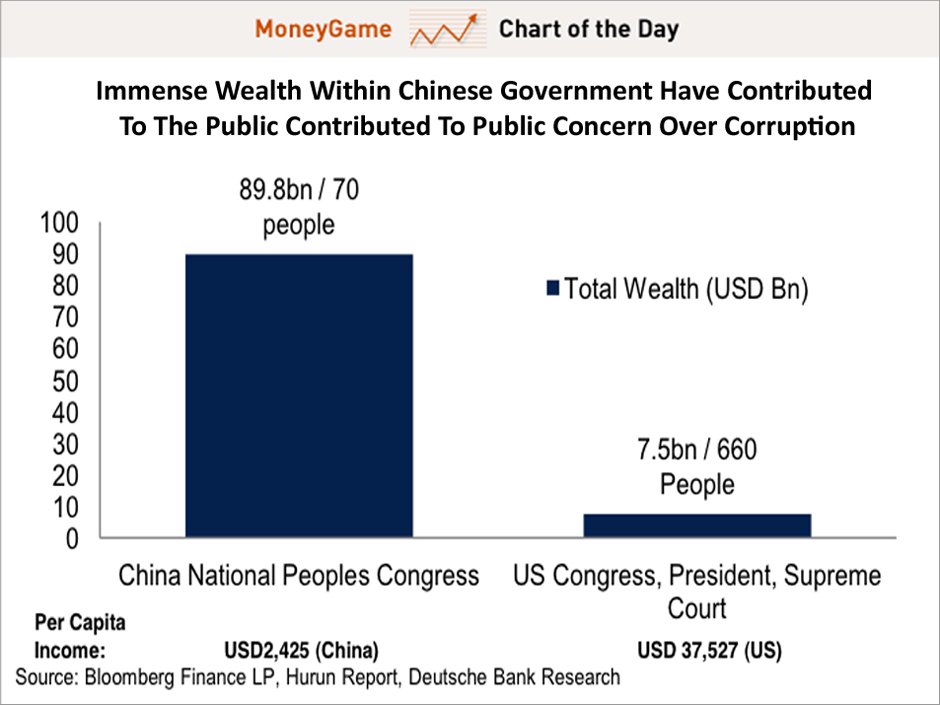
“2013 will mark the most vigorous anti-corruption fight by the Chinese leadership in decades,” write the analysts at Deutsche Bank. This initiative is expected to be bad news for China’s liquor suppliers, watch-makers, and food-service industry workers.  But it’ll be a big win for investor confidence. In its new “Equity House View” report, Deutsche Bank includes this stunning chart showing how much more wealthy Chinese congressman are compared to American politicians. They cite it as a reason why so many are worried about corruption.

moneygame-cotd-042513


Chinese bond market authorities will suspend new account openings by non-bank financial institutions, the latest move in a growing crackdown on self-dealing in China’s fast-growing bond market

Friday April 26, 2013

China suspends new bond accounts

SHANGHAI: Chinese bond market authorities will suspend new account openings by non-bank financial institutions, the latest move in a growing crackdown on self-dealing in China’s fast-growing bond market, multiple sources told Reuters.

The move could effectively bar brokerages, fund companies, trusts, and possibly even banks from issuing new bond-based products to investors.

China’s main bond clearinghouse, the China Central Depository & Clearing Co Ltd, will suspend applications from trust plans, brokerages, and fund companies to establish special-purpose accounts they use to manage funds for bond-based wealth management products (WMPs), bond mutual funds, and other bond-based investment products. Read more of this post

Netflix Boss Reed Hastings Wrote An 11-Page Manifesto On The Future Of TV

How Netflix CEO Reed Hastings Sees the Future: Netflix Wins, Apps Win and So Do HBO, ESPN and the Cable Guys

APRIL 24, 2013 AT 1:27 PM PT

Fresh off a triumphant earnings report, and with investors once again clamoring for his shares, Reed Hastings has something to say. A lot to say: The Netflix CEO has written an 11-page essay that lays out his vision for the future of streaming video. If you’re looking for news, you won’t find much here — nearly everything in the document, published on Netflix’s investor website, is a repeat of things Hastings has said or written in recent years. But if you’re at all interested in the way Hastings thinks things are going to play out in the battle for video eyeballs, and why he thinks Netflix will win many millions of them, it’s well worth a read. I’ve embedded the document below so you can scan it at your leisure. If you’re in a hurry, some bullet points:

  • The one new nugget here is a Hastings prediction, held by many other people, that we’re moving to a world where “apps replace channels.” Hastings mentions apps nearly 3 dozen times in his essay, and makes it clear that he sees Netflix first and foremost as an app provider.
  • Hastings figures that lots of other video services will figure the same thing out. And he goes out of his way to mention others that are already there or close to it, citing ESPN, HBO and the BBC.
  • But those who don’t get it are screwed, he says: “Existing networks, such as ESPN and HBO, that offer amazing apps will get more viewing than in the past, and be more valuable. Existing networks that fail to develop first-class apps will lose viewing and revenue.”
  • In the past, Netflix has tacked back and forth on whether it is competing head to head with HBO. Now Hastings is back in “we’re coming for you” mode: “The network that we think likely to be our biggest long-term competitor-for-content is HBO … They have global reach and strengthening technology capacity.”
  • But while Netflix now has as many U.S. subscribers as HBO — and while Hastings thinks he can eventually double or triple his current 30 million — he figures it will take him a while to truly compete with HBO. “While we are passing HBO in domestic members in 2013, it will be several years before we are peers with them in terms of Original programming, Emmy awards, and international members. It wouldn’t be surprising to us if HBO does their best work and achieves their highest growth
    over the next decade, spurred on by the Netflix competition and the Internet TV opportunity.”
  • But Hastings also reiterates his argument that there’s room for lots of streaming video services, just like there are lots of cable channels today. Translation: Don’t worry, Jeff Bewkes: Just because we’re coming for you doesn’t mean we’ll crush you. Also, please keep selling us Time Warner’s content! Thanks!
  • Hastings also continues to offer olive branches to the entrenched cable guys, especially those that also sell broadband: “At times we have worried about the strategic motivations of ISPs that are also MVPDs, but the absence of cord-cutting has mitigated this concern. … Internet video services like Netflix, MLB.tv, iTunes and YouTube are not currently a material strategic problem for companies that are both an ISP and an MVPD.” Translation: Hey Comcast, Time Warner Cable, Verizon! It would be pretty cool if we figured out a way for you guys to bundle us along with your other video services! Let’s (continue to) talk!

Google search proves to be new word in stock market prediction

Last updated: April 25, 2013 9:47 pm

Google search proves to be new word in stock market prediction

By Richard Waters in London

Searches of financial terms on Google can be used to predict the direction of the stock market, according to an analysis of search engine behaviour stretching back nearly a decade. The research, by UK and US academics, is the latest attempt to mine online behaviour patterns for clues about future movements in financial markets.

The findings appeared to show that people do more searches on terms such as “stocks”, “portfolio” and “economics” when they are worried about the state of the markets, said Tobias Preis, associate professor of behavioural science and finance at Warwick Business School. Rises in search volumes for such terms are generally followed by stock market declines, according to the research published in the journal Scientific Reports. By contrast, a fall in financial searches often points to greater optimism among investors, leading to a rising market. Read more of this post

Over the last 21 months, the SNB has expanded its balance sheet by an amount equivalent to 40% of Swiss GDP. Yet the Swiss franc hasn’t weakened

The Short Yen Trade Is The Hottest Trade In The World — But There’s One Big Risk To It

Matthew Boesler | Apr. 25, 2013, 12:55 PM | 2,901 | 2

It’s the hottest trade in the world right now: betting the Japanese yen will decline against the U.S. dollar. As part of the Japanese government’s new “Abenomics” strategy to lift the Japanese economy out of a decade of deflation, the Bank of Japan (BoJ) recently announced a massive quantitative easing program, unprecedented in scale. Investors – especially those outside of Japan – have taken this as a sign that the Japanese government and the BoJ are serious about weakening the yen and inducing a little inflation. A mini market crash caused by a fake AP tweet earlier this week showed how correlated the short yen trade is with risky assets in general right now. While the S&P 500 tanked in response to the tweet, the yen instantly strengthened against the dollar. And since so many investors are now using the cheap yen – which has already weakened considerably in recent months – to fund carry trades in other risky assets, it’s important to consider what else could derail the short yen thesis, which has become one of the most “consensus” trades on the planet.

Société Générale FX strategist Alvin Tan says the biggest risk to the “widespread expectation of lower yen over the next several quarters” is pretty simple: a global slowdown in economic growth. He uses the Swiss National Bank (SNB) as an example. Over the last 21 months, the SNB has expanded its balance sheet by an amount equivalent to 40% of Swiss GDP (the new BoJ program will fall short of that). Yet the Swiss franc hasn’t weakened. Of course, the reason for this is the ongoing euro crisis and the flight to safety into Swiss francs that has caused the currency to appreciate. So, the comparison, considering the context, is not really apples-to-apples. That is, unless you consider a scenario in which global growth enters a slowdown phase. Read more of this post

Billionaire Mark Cuban Is Massively Short The Yen; “in early December, I went and took every penny of debt that I had – with the Mavericks, and personal debt, and everything – and converted it to a yen loan at mid 80s”

Mark Cuban Is Massively Short The Yen

Matthew Boesler | Apr. 25, 2013, 4:39 PM | 10,455 | 12

Entrepreneur Mark Cuban made an interesting admission today on CNBC: he’s massively short the yen. The conversation started with a discussion on tech stocks, but then Cuban said: Honestly, I don’t jump into a lot of public technology stocks other than to have fun and trade every now and then. Where I have made my biggest trades have been in currencies, because there is a lot more transparency, and a lot more information available, than there are with stocks. It’s just a more efficient market, in my mind. CNBC anchor Scott Wapner then asked Cuban, “Now that you went there, I’ve got to ask you: what are you trading now? Are you short the yen, like everybody else?”

Cuban replied: Yeah. Actually, in early December, I went and took every penny of debt that I had – with the Mavericks, and personal debt, and everything – and converted it to a yen loan, when I think [the yen] was in the mid 80s [against the dollar]. So, I’ve been really happy with it. When the value of the currency decreases, it reduces the burden of the debt in real terms. The yen has decreased from “the mid 80s” against the dollar (when Cuban says he converted the loans) to around 100 against the dollar today, so Cuban has done pretty well on his yen trade so far.

Venture capital flight away from life sciences as the costs, time, and uncertainty involved in developing medical ideas have risen to “crisis” levels

April 25, 2013 9:58 pm

Venture capital flight away from life sciences

By April Dembosky in San Francisco

Venture capitalists are fleeing investments in life sciences, as the costs, time, and uncertainty involved in developing medical ideas have risen to “crisis” levels, according to a new report released on Thursday.

First-time financings are suffering in particular, with only 20 life sciences companies receiving start-up funding in the first quarter of 2013, the lowest number seen since the second quarter of 1995. Read more of this post

Latin America Threatened With Cancer Epidemic

Latin America Threatened With Cancer Epidemic

By Agence France-Presse on 9:29 am April 26, 2013.
Sao Paulo. Latin America faces a cancer epidemic unless governments act quickly to improve health care systems and treat the poor, scientists said.

The researchers pointed to around 13 deaths for every 22 cancer cases in the region, compared to around 13 deaths for every 37 cases in the United States and around 13 deaths for every 30 cases in Europe.

The main reason, according to the study published in the British journal The Lancet Oncology, is that too many people are diagnosed with cancer at a late stage when the disease is much harder to treat and more likely to kill.

“Researchers estimate that by 2030, 1.7 million cases of cancer will be diagnosed in Latin America and the Caribbean, with more than one million deaths from cancer predicted to occur annually,” said the report launched at the Latin American Cooperative Oncology Group (LACOG) 2013 conference in Sao Paulo. Read more of this post

Norway’s $720 billion oil fund to become active investor

April 25, 2013 6:06 pm

Norway’s oil fund to become active investor

By Richard Milne in Oslo

Yngve Slyngstad, chief executive: ‘As a top-five investor we would expect to have that dialogue [with the chairman]’

Norway’s oil fund is to become a more active investor by helping pick directors at companies in which it has significant stakes in a big shift of strategy at the world’s largest sovereign wealth fund.

Yngve Slyngstad, chief executive of Norges Bank Investment Management as the fund is known, is joining the nomination committee of Swedish truckmaker Volvo in a move that will see the oil fund formally participate in selecting directors for the first time.

“I think active is a fair description. We think it’s the responsibility of the larger investors to be more involved in what in the UK is referred to as stewardship and have a dialogue not just with the CEO and CFO but also the chairman of the board,” Mr Slyngstad told the Financial Times. Read more of this post

Gravity Theory of Einstein’s Proved Right—Again

Updated April 25, 2013, 7:28 p.m. ET

Theory of Einstein’s Proved Right—Again

By GAUTAM NAIK

OB-XF813_0425ei_G_20130425153714

Scientists have subjected Albert Einstein’s famous theory of gravity to its toughest real-world test so far—and it has prevailed.

The theory, which was published nearly a century ago, had already passed every test it was subjected to. But scientists have been trying to pin down precisely at what point Einstein’s theory breaks down, and where an alternative explanation would have to be devised.

Einstein’s framework for his theory of gravity, for example, is incompatible with quantum theory, which explains how nature works at an atomic and subatomic level. Read more of this post

Yen Bets Don’t Add Up for Hedge Fund Giant Rennaissance Technologies; The firm’s recent challenges underscore how even hedge funds with stellar records are having a tougher time beating the market lately

Updated April 25, 2013, 6:16 p.m. ET

Yen Bets Don’t Add Up for a Fund Giant

By GREGORY ZUCKERMAN

Renaissance Technologies LLC, a hedge-fund heavyweight, has been bruised in the market’s recent turbulence.

Two of the three hedge funds that the company makes available to outside investors have suffered sizable losses this month, largely due to the big drop in the Japanese yen, investors say.

At the same time, Renaissance continues to raise cash at a slower pace than some had expected. The firm manages about $6 billion of cash for outside investors—down from about $25 billion in 2007. Read more of this post

Fed Zeroes In on Vulnerability to Rate Rise; Fed is scrutinizing the nation’s biggest banks to ensure they can handle an eventual rise in interest rates

April 25, 2013, 8:26 p.m. ET

Fed Zeroes In on Vulnerability to Rate Rise

By VICTORIA MCGRANE

The Federal Reserve is scrutinizing the nation’s biggest banks to ensure they can handle an eventual rise in interest rates, as concern grows among regulators about the risks posed by a long low-interest-rate environment.

On Thursday, a panel of federal regulators charged with identifying market risks warned that a sudden rise in interest rates could have a destabilizing effect on financial markets. The Financial Stability Oversight Council, in its third annual report, cited interest-rate risk as one of seven major vulnerabilities to financial stability.

“A sudden spike in yields and volatilities could trigger a disorderly adjustment, and potentially create outsized risks,” the council said in its report. Read more of this post

Europe’s Unemployment Problems Worsen; Southern Europe’s economic malaise echoes Great Depression

Updated April 25, 2013, 3:25 p.m. ET

Europe’s Unemployment Problems Worsen

Spain and France Both Record New Highs, Adding to Pressure to Ease Up on Austerity in Favor of Economic Stimulus

By ART PATNAUDE in Madrid and WILLIAM HOROBIN in Paris

WO-AN514_SPJobs_G_20130425173904

As unemployment rises to 27.2% of the workforce, the Spanish government is about to introduce a budget that eases austerity measures. Friday’s budget will be another sign that supporters of austerity are losing the political battle in Europe as the social cost becomes too high. Unemployment in Spain and France has jumped to new highs, data showed Thursday, lending ammunition to a growing chorus calling for easing the euro zone’s austerity drive as the cure for its debt crisis because of the high social fallout.

The jobless rate in Spain rose sharply to 27.2% of the workforce in the first quarter, the highest level since records began in the 1970s. In France, the number of registered job seekers who are fully unemployed rose to more than 3.2 million, topping a previous record set in 1997. The weak figures in France and Spain, two of the biggest euro-zone economies, come on the heels of sharp rises in unemployment in March in the Netherlands and Sweden—an indication that the European Union’s northern members are also suffering from the bloc’s economic weakness.  Read more of this post

The dirty little secret among luxury goods companies is that they have been persistently overcharging their best customers in China

April 25, 2013, 1:13 p.m. ET

Luxury-Goods Firms’ Little China Secret

By WEI GU

AM-AY241_WEICOL_G_20130425144208

Makers of luxury goods have found a way to add to their profits: Charge Chinese consumers more than their counterparts in the U.S. and Europe. The WSJ’s Wei Gu tells Deborah Kan why luxury cars and fashion brands are more expensive in China. The dirty little secret among luxury-goods companies is that they have been persistently overcharging their best customers in China. With Chinese appetite for everything from expensive cars to handbags is starting to moderate, companies that count on the country as a big growth driver may have to do the unthinkable and lower their prices.

A comparison of three models from Mercedes-Benz, Audi NSU.XE +0.16% and BMWBMW.XE +1.55% shows that, on average, listed prices of luxury sedans in China are 64% more expensive than similar vehicles sold in the U.S. This looks counterintuitive, considering goods made in China are supposed to be cheaper. Read more of this post

In China, Air Quality Boosts SUVs; The big winners should include domestic players like Great Wall Motor who saw SUV sales volumes jump 90% year-on-year in February

April 25, 2013, 4:50 a.m. ET

In China, Air Quality Boosts SUVs

ByABHEEK BHATTACHARYA

AM-AY245_SUVHER_NS_20130425061206

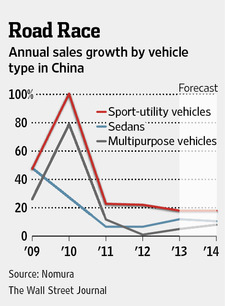
Following a run of several smog-ridden months in China, investors might be looking to bet on fuel-efficient or electric cars. In fact, it is sales of sport-utility vehicles that are soaring. The number of SUVs sold in China jumped 43.4% in the quarter ended March 31 compared with a year earlier, according to IHS Automotive. Total auto sales volumes were up just 13.8%. China’s middle class consumers see SUVs as a status symbol and view them as a safer option on the country’s notoriously dangerous roads, says China Auto Analyst Michael Dunne.

Ironically, air pollution might be playing a part too. China’s government rolled out new fuel-efficiency regulations last month aimed at the country’s air quality problem. A quirk in those rules could juice the SUV market, says Bernstein Auto Analyst Max Warburton. Fuel-economy targets based on different car weights—including easier targets for heavier vehicles—mean manufacturers have an incentive to make more SUVs, Mr. Warburton says. Something similar occurred in the U.S. in the 1980s, when more relaxed fuel-efficiency standards for heavier cars saw the big auto makers invest heavily in minivans and SUVs. The big winners should include domestic players like Great Wall Motor2333.HK +2.99% and foreigners like Jaguar-Land Rover, owned by India’sTata Motors 500570.BY +4.19% . Great Wall Motors saw SUV sales volumes jump 90% year-on-year in February, more than twice the increase in overall vehicle sales. The company boasts 35-40% of the low-end SUV market and 8% of the market overall, Nomura says. Read more of this post

How Chinese Subsidies Changed the World; Since 2008, through government subsidies, the manufacturing capacity of China’s solar-panel industry grew tenfold, leading to a vast global oversupply

How Chinese Subsidies Changed the World

by Usha C.V. Haley and George T. Haley  |   8:00 AM April 25, 2013

Last week, LDK Solar, a struggling Chinese manufacturer of solar wafers and panels, announcedthat it had missed $24 million in bond payments. This news followed the bankruptcy in March ofWuxi Suntech, the main operating subsidiary of the world’s largest maker of solar panels, after it defaulted on a $541 million bond payment.

It is no coincidence that this upheaval in the Chinese solar industry is occurring at a time when the central government’s subsidies that had financed the industry’s explosive expansion have declined even as problems in the global solar-panel market have soared.

Since 2008, through government subsidies, the manufacturing capacity of China’s solar-panel industry grew tenfold, leading to a vast global oversupply. A surge in exports of Chinese panels depressed world prices by 75%. In 2012, China’s top six solar companies had debt ratios of over 80%. Our research showed that without subsidies, these companies would be bankrupt. If the Chinese government sticks to its decision to stop funding unprofitable solar-panel manufacturers and support a revamping of the industry, more bankruptcies and restructurings are sure to follow. Read more of this post