Edir Macedo, Brazil’s Billionaire Bishop; Prosecutor says that Macedo’s promise of riches amounts to fraud; “The preachers make use of the faith, desperation, or ambition of [their followers] to sell the idea that God and Jesus Christ only look upon those who contribute financially to the church”

Edir Macedo, Brazil’s Billionaire Bishop

By Alex Cuadros on April 25, 2013

feature_edirmacedo18__01__630x420feature_edirmacedo18__04inline__popup

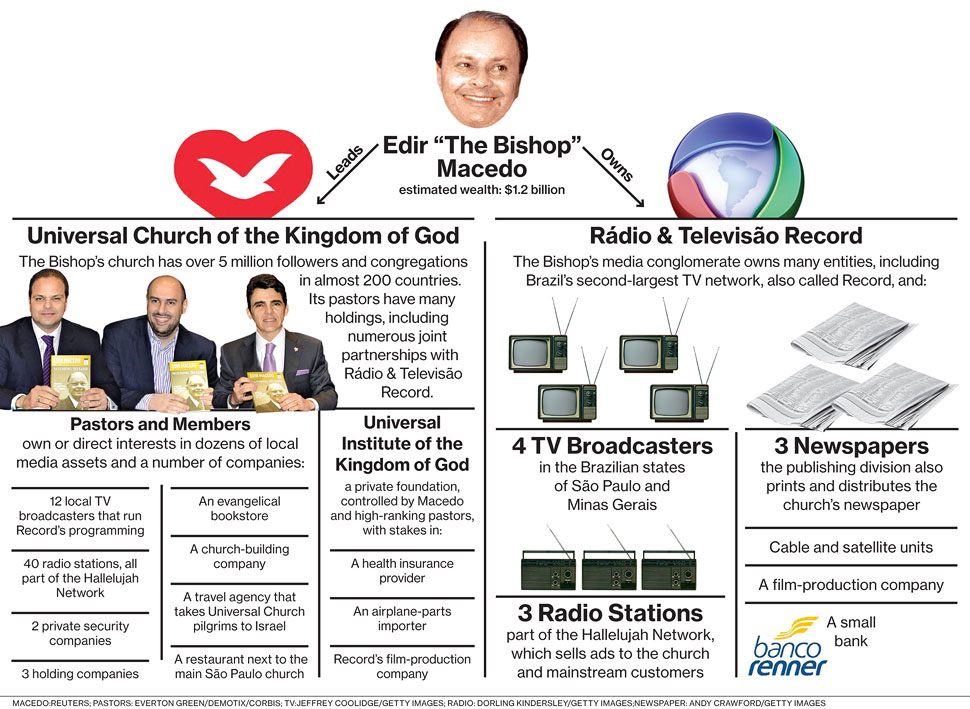
Edir Macedo is 5-foot-6, slight, and 68 years old. He has deformed fingers, a sparse crown of graying hair, and more than 5 million followers, whose donations over the last 36 years have made him a billionaire. In Brazil, where he was born and raised, he is a major national figure, the subject of dozens of criminal inquiries, and the owner of Rádio & Televisão Record, a media conglomerate that runs the country’s second-largest television network. He is known to most everyone by the title he created for himself: He is O Bispo—“The Bishop.” Macedo is the founder of the Universal Church of the Kingdom of God, a Pentecostal denomination specializing in prosperity theology, which links faith to financial success. He preaches twice a week, often in two different cities, and the sermons are fervently watched on church websites, his Facebook page, and the miniature TV sets that Brazilian taxi drivers like to keep on their dashboard. Now and then he holds outdoor events that draw crowds of half a million. In February he addressed 5,000 of his parishioners at one of his churches in Belo Horizonte, in southeastern Brazil. High overhead, a stained-glass cross lit by fluorescent bulbs took up most of the ceiling while a theater-size screen blew him up for the pews in the back. He paced back and forth on the stage, explaining the intersection of God and money. “Which is the largest country in the world, economically speaking? It’s America, the United States. Do you know why? Because way back—this is history, you can look it up on the Internet—the colonization was done by men who believed in the word of God. And they were tithers,” he said. “That’s why you see on the dollar bill: ‘In God we trust.’ ” Read more of this post
Innovator: Matt Rabinowitz Sifts Gene Data for Healthy Pregnancies; Traditional screenings during a pregnancy’s first trimester miss 15% of Down syndrome cases and yield false positives 5% of the time

Innovator: Matt Rabinowitz Sifts Gene Data for Healthy Pregnancies

By John Tozzi on April 25, 2013

tech_innovator1813__01__630x420

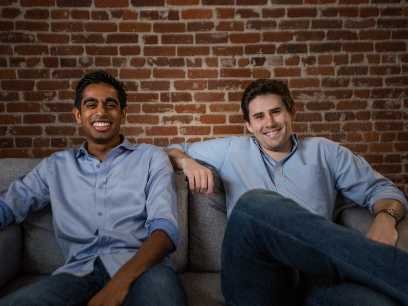
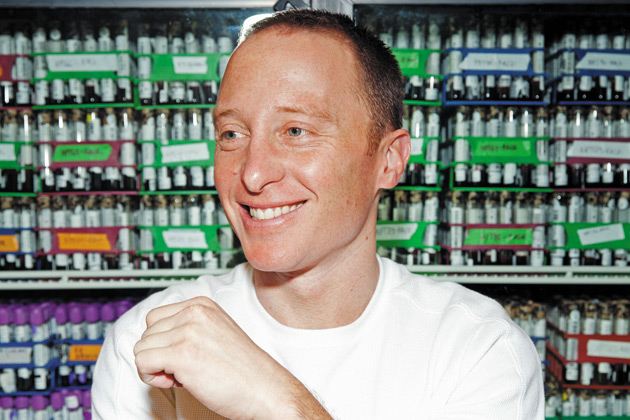
Ten years ago, prenatal screenings gave a clean bill of health to Matt Rabinowitz’s nephew. The tests didn’t show that he had Down syndrome, which raises infant mortality risks. The boy died six days after birth. While Rabinowitz mourned, the Stanford-educated data scientist began to research genetic testing. “It just seemed amazing to me that that would happen in the 21st century,” he says. Traditional screenings during a pregnancy’s first trimester miss 15 percent of Down syndrome cases and yield false positives 5 percent of the time. False alarms can lead to more invasive diagnostics, such as amniocentesis and chorionic villus sampling, which are highly accurate but increase risk of miscarriage. In the past three years, four companies have developed noninvasive tests that predict the risk of birth defects by analyzing fetal DNA that’s mingled with the mother’s blood. Rabinowitz’s company, Natera, introduced the newest of these tests in March. Based in San Carlos, Calif., Natera’s more than 200 employees use cloud computing to analyze the genetic data they extract from maternal blood samples. The software scans 19,500 of a cell’s 10 million genetic markers. Using data from the human genome project and samples of the parents’ genes, “you can reconstruct the entire DNA of the child from that single cell,” Rabinowitz says. He says it detects miscarriage-threatening conditions other screenings can miss, such as triploidy, which occurs when cells carry extra copies of each chromosome. Read more of this post

Alzheimer’s: The Costliest Killer

Alzheimer’s: The Costliest Killer

By Peter Coy on April 25, 2013

BW18_OR_alzheimers_inline

In 2006 former television journalist Meryl Comer described in the Alzheimer’s & Dementia journal what it’s like to care for a husband with early-onset Alzheimer’s disease. “At night I slip between the bed covers, careful not to disturb the stranger lying there,” she wrote. “Soon he will wake screaming and flailing his arms as if fighting off demons. … Exhausted, I drift off only to reawaken and find myself lying by his side in a pool of urine.” Eleven years earlier, before his diagnosis at age 58, Comer’s husband, Harvey Gralnick, had been chief of hematology and oncology at the National Institutes of Health (NIH). Now he was detached from reality and unpredictably violent. He knocked out her two front teeth once when she tried to bathe him—an incident she left out of her article. Comer clung to one hope. “Today,” she wrote, “the field is on the brink of major breakthroughs that may lead to more effective treatments and, ultimately, to prevention.” Seven years after Comer wrote that article, things are worse. Her husband lingers on, protected at home from the secondary infections that kill many Alzheimer’s patients in nursing homes. Now her 93-year-old mother—who in 2006 was just beginning to exhibit Alzheimer’s-related paranoia—has full-blown symptoms and lives with her as well. Comer, who has been named president of the Geoffrey Beene Foundation Alzheimer’s Initiative, puts in 12-hour shifts caring for her husband and mother and spends $100,000 a year on home nursing care, none of it covered by Medicare. She expects to go bankrupt eventually.

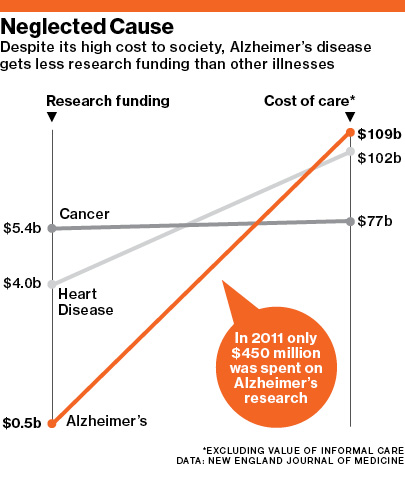
Alzheimer’s disease remains incurable and 100 percent fatal. Because of modern medicine’s successes, more people are outliving heart disease, cancer, and stroke, only to be hunted down by Alzheimer’s and other forms of dementia. It’s hard to conceive of a worse way to die than to lose one’s mind. Asked last year in a Home Instead Senior Care/Marist Poll which disease they were most afraid of having, 44 percent of Americans named Alzheimer’s, as many as named cancer and stroke combined. If nothing is done, Alzheimer’s will become the “financial sinkhole of the 21st century,” says gerontologist Ken Dychtwald, chief executive officer of Age Wave, a consulting firm. Already, treating dementia of all kinds costs more than heart disease or cancer, more than $150 billion a year in the U.S., including the value of informal care, according to a Rand Corp. study released on April 3. That number could more than double by 2040 as baby boomers age into the Alzheimer’s danger zone, Rand says. Compounding the economic impact, women, who provide most of the care, are often forced to drop out of the labor force. Read more of this post

Startup Prism Skylabs is closely tracking shoppers via video surveillance to try to match the detail of data gleaned by e-tailers

To Catch Up With E-tail, Tools to Track Shoppers in the Store

By Brad Stone on April 25, 2013

tech_shopping18__01__630x420

Of the many advantages online retailers enjoy over their brick-and-mortar counterparts, the preponderance of data might be the most significant. While physical stores know how many customers visit and what they buy, e-commerce sites know which section customers head to first, how long they look at each product, and who browses but doesn’t make a purchase. Venture capitalist Marc Andreessen suggested in a Jan. 29 interview with startup news site PandoDaily that, in part because of this data gap, all of traditional retail will go the way of Circuit City and Borders. “The retail guys are going to go out of business, and e-commerce will become the place everyone buys,” he said.

U.S. Census data show physical stores still account for 95 percent of retail sales. Still, they’re growing at barely one-quarter the rate of online retailers, and so several technology startups are trying to find ways to provide them with e-commerce-level data. Prism Skylabs uploads and analyzes video from in-store surveillance cameras to track customer movement and the effectiveness of promotions. “All of retail is in a knife fight,” says Steve Russell, co-founder and chief executive officer of the two-year-old San Francisco startup. “There is a lot of pressure from the online world on physical retailers to change, and we are trying to facilitate that.” Read more of this post

Apple’s 10-Year-Old iTunes Loses Ground to Streaming; iTunes’ share of U.S. digital music sales has fallen from 69 percent to 63 percent as avid music listeners turn to streaming services.

Apple’s 10-Year-Old iTunes Loses Ground to Streaming

By Andy Fixmer on April 25, 2013

tech_ituneschart18_405

A decade ago, the newly started iTunes Store gave away a song called Over My Head (Cable Car) by an obscure Denver rock group called The Fray. That was, explains lead guitarist Joe King, the band’s big break. “I’ll never forget, our manager e-mailed and said there had been 300,000 downloads,” says King. “Immediately our fan base went from several hundred to thousands, everywhere. Our tour started selling out.” These days, iTunes doesn’t offer that kind of overnight success for undiscovered musicians, despite its 435 million registered users.

Apple (AAPL) opened the iTunes Store on April 28, 2003, as a legitimate, industry-supported alternative to online music piracy, selling most individual songs for 99¢ a pop. It was the first venue to make digital music purchases mainstream. “Consumers don’t want to be treated like criminals, and artists don’t want their valuable work stolen,” Apple co-founder Steve Jobs said in a statement at the time. “The iTunes Music Store offers a groundbreaking solution for both.” Paired with Apple’s ubiquitous iPod music players and, later, iPhones, it quickly became the Internet’s de facto record store, accounting for nearly 69 percent of digital U.S. music sales at its peak in 2010, according to estimates from market researcher NPD Group. Read more of this post

Israelis Rise Up Against the Oligarchs, a group of 20 families that control about 50 percent of the value of the Tel Aviv stock exchange

Israelis Rise Up Against the Oligarchs

By David Wainer and Calev Ben-David on April 25, 2013

Ilyan Marshak was outraged when he heard that Bank Leumi would forgive as much as $42 million in debt owed by companies controlled by Nochi Dankner, one of Israel’s so-called oligarchs—a reference to the group of 20 families that control about 50 percent of the value of the Tel Aviv stock exchange. Marshak wanted to know why a rich man was getting a break while he worked odd jobs to pay off about 100,000 shekels ($27,600) of debt. “These tycoons are getting bargains because of their influence in our economy, and that comes at the expense of the public,” says the 28-year-old Tel Aviv resident.

Marshak was one of thousands who posted on a Facebook (FB) page titled “Bank Leumi Consumer Boycott,” after a local paper reported in mid-April that the bank had agreed to erase some of Dankner’s debt as part of a broader corporate debt restructuring. The scion of a family that made its fortune in table salt and real estate, Dankner has spent the past 15 years building his own sprawling empire, which includes the country’s biggest supermarket chain, Shufersal (SAE), and its largest mobile operator, Cellcom Israel (CEL). The deal with Leumi would have allowed the businessman some breathing room as his IDB Holding (IDBH) struggles to meet payments on about $560 million in debt. Read more of this post

Regulating China’s Shadow Banking System Isn’t Easy; Attempts to bring transparency to China’s $3.4 trillion shadow banking system are foundering, judging from a pilot program in Wenzhou.

Regulating China’s Shadow Banking System Isn’t Easy

By Jun Luo on April 25, 2013

On a morning in March, row after row of chairs in the waiting room of Wenzhou Private Lending Registration Service Center sit empty. Zhou Xiang, a manager at one of the five government-sanctioned loan brokers operating in the center, which opened in 2012, hasn’t had a single customer today. “The volume of lending is so low we ourselves won’t be here long without expanding into some other businesses,” he says.

The dearth of clients helps explain the failure of China’s year-old effort to regulate informal lending. Former Premier Wen Jiabao chose to locate the center in Wenzhou, a city of 9 million in southeastern China, after more than 80 businessmen in the area committed suicide or declared bankruptcy because they were unable to make payments on black-market loans. Brokers like Zhou match cash-strapped businesses with private lenders, draft loan contracts, and monitor monthly payments.

Wen’s goal was to impose some controls on what is a huge but disorderly market. Many Chinese savers prefer to lend their money to businesses and real estate developers, rather than letting it languish in a bank account. Estimates by UBS (UBS)put the size of the nation’s so-called shadow banking system at $3.4 trillion, equal to 45 percent of gross domestic product. In Wenzhou, almost 90 percent of families and 60 percent of companies participate in the informal market for loans, according to a 2011 survey by the People’s Bank of China. Read more of this post

In China, the License Plates Can Cost More Than the Car; None of the top 10 passenger car models sold in China are Chinese brands

In China, the License Plates Can Cost More Than the Car

By Tian Ying and Alexandra Ho on April 25, 2013

comp_shanghai18__01__630x420

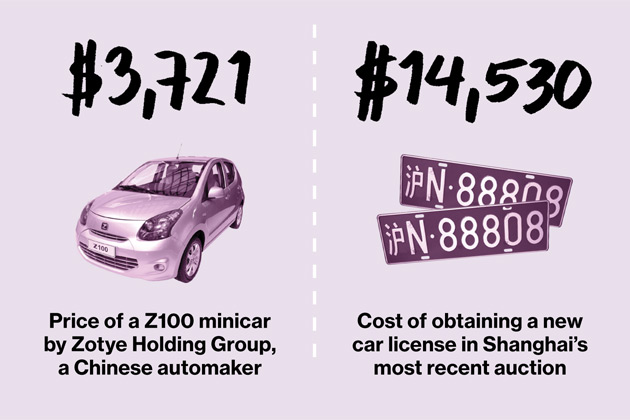
Shanghai’s busy streets teem with Buicks, Fords, Volkswagens, and Toyotas. More than 9 out of 10 cars in the world’s most populous city are made by foreign companies, and it’s not just a reflection of mainlanders’ preference for Western design. Some local automakers say the city’s license plate auctions are responsible for their weak sales. Shanghai is one of four Chinese cities that limit car purchases by imposing quotas on registrations. The prices paid at Shanghai’s license auctions in recent months—90,000 yuan ($14,530)—have exceeded the cost of many entry-level cars, the stronghold of Chinese brands such as Chery, Geely, and Great Wall. While residents with modest incomes may be able to afford an inexpensive car, the registration cost is often beyond their reach. “Whenever there’s a restriction of new car purchases through the quota system, there is always a big impact on lower-price cars like the ones we make,” says Lawrence Ang, executive director of Geely Automobile Holdings (175), whose Panda minicar sells for 37,800 yuan.

After Beijing (pop. 21 million) introduced a license plate lottery in January 2011, the combined share of Chinese brands sold there plunged by more than half, to 9.7 percent for the year, according to researcher IHS Automotive. In Shanghai, which began auctioning license plates in 1994, domestic brands made up only 8.9 percent of cars sold in 2011 (the most recent data available), less than a third the level nationwide, IHS reports. Read more of this post

Watchmakers fret over China sales slump

Watchmakers fret over China sales slump

1:26pm EDT

By Silke Koltrowitz

BASEL (Reuters) – Luxury watchmakers expect sales growth to slow this year as a recovery in the United States and buoyant Middle East demand fail to offset a China slump more deep-rooted than a temporary blip caused by anti-corruption moves.

The heads of Swatch Group’s (UHR.VX: QuoteProfile,ResearchStock Buzz) biggest brand Omega and LVMH (LVMH.PA: QuoteProfileResearchStock Buzz) flagship brand TAG Heuer as well as high-end independents Patek Philippe and Ulysse Nardin all said demand in Greater China had tumbled, particularly for high-end models. Read more of this post

Buffett Tells Coke CEO Study Failure, Avoid Complacency; “You want a restlessness, a feeling that somebody’s always after you, but you’re going to stay ahead.”

Buffett Tells Coke CEO Study Failure, Avoid Complacency

Warren Buffett, who controls the largest stake in Coca-Cola Co. (KO), knows how to steal a show.

The billionaire investor showed up at the soda maker’s annual meeting today to help sell the company’s message to shareholders in an on-stage interview with Chief Executive Officer Muhtar Kent. The surprise appearance drew a standing ovation as Buffett advised Kent to stay ahead of competitors by reviewing what made other businesses falter.

“I like to study failure,” Buffett, 82, said at the meeting held in the Cobb Galleria Center in Atlanta. “We want to see what has caused businesses to go bad, and the biggest thing that kills them is complacency. You want a restlessness, a feeling that somebody’s always after you, but you’re going to stay ahead.”

Berkshire Hathaway Inc. (BRK/A), which Buffett has led for more than four decades, owns 400 million Coca-Cola shares after a share split last year, with a value of almost $17 billion. Berkshire, which owns See’s Candies and an equity stake in American Express Co. (AXP), favors companies that have loyal customers and can withstand competition, Buffett said. Read more of this post

Few $1-Salary CEOs Make a Buck as Ellison Gets $96 Mln

Few $1-Salary CEOs Make a Buck as Ellison Gets $96 Mln

The chief executive officers of software developer Oracle Corp. (ORCL) and watchmaker Fossil Inc. (FOSL) both work for a salary of a dollar or less a year. The only difference: $96.2 million.

That’s how much Oracle founder Larry Ellison really earned in fiscal 2012 when you count options awards and other extras, more than any other CEO in the Standard & Poor’s 500 Index. Fossil’s Kosta Kartsotis’ actual take-home pay: Zilch.

While CEOs with single-digit salaries are a rare breed, those who really work for nothing when other compensation such as bonuses is included are rarer still. These executives, sometimes big shareholders, only benefit if the stock rises or dividends are paid, an alignment of interests that appeals to some investors. Read more of this post

Risk of Miscalculation Over North Korea Has Grown, Dempsey Says; North Korea is “in a period of prolonged provocation rather than cyclical provocation,”

Risk of Miscalculation Over North Korea Has Grown, Dempsey Says

The risk of a miscalculation in the dispute over North Korea’s nuclear and missile programs has increased, and China takes the tensions “very seriously,” the chairman of the U.S. Joint Chiefs of Staff said yesterday.

North Korea is “in a period of prolonged provocation rather than cyclical provocation,” Martin Dempsey told reporters yesterday after arriving in Beijing April 21 and meeting officials including President Xi Jinping.

Dempsey’s visit is part of a series of high-level contacts between the U.S. and China this month to discuss issues including cybersecurity and the North’s nuclear program. Tensions on the Korean peninsula have been high since February, when Kim Jong Un’s regime tested a nuclear device in defiance of the United Nations Security Council.

“The risk of miscalculation is higher and I think the risk of escalation is higher,” Dempsey said. “They are on a path that will certainly increase risk in the region.”

China is North Korea’s largest trading partner and Beijing regards the neighboring country as a strategic buffer with U.S.- backed South Korea. In a visit to China earlier this month, Secretary of State John Kerry said China needs to “put some teeth” into restraining Kim’s regime.

“I will leave here with the belief that the Chinese leadership is as concerned as we are,” Dempsey said. “We think there is still time for North Korea’s leaders to back away from provocations and we hope they take the opportunity to do so.” Read more of this post

Thai 7-Eleven King Turns Retail Dream to Stock Nightmare; Thailand Stock Exchange to Probe Siam Makro Trades

Thai 7-Eleven King Turns Retail Dream to Stock Nightmare

Billionaire Dhanin Chearavanont’s ambitions to create Southeast Asia’s largest retailer already wiped out $2.3 billion for CP All Pcl (CPALL) investors. Now, funding the industry’s most expensive bid may put more value at risk.

Dhanin’s CP All, which runs more than 6,800 7-Eleven stores in Thailand, slid 10 percent in Bangkok yesterday — the most in more than four years — after saying it will pay $6.6 billion for discount wholesaler Siam Makro Pcl. (MAKRO) The offer is 41 percent above Siam Makro’s average price in the prior 20 days, a record premium for a retail deal in emerging Asia, according to data compiled by Bloomberg. CP All’s bid also represents the highest multiple to net income, the data show.

While Dhanin plans to squeeze suppliers for better terms and export Siam Makro’s membership-warehouse model across Asia, the limited increase to profits isn’t enough to justify the price, said Credit Suisse Group AG. Although the Bangkok-based company says it has no plans to sell new stock to fund the deal, CP All’s share price will be weighed down by concerns that it will eventually have no other option, said UOB Kay Hian Securities (Thailand) Pcl.

“CP All is going to have to do a cash call,” Alan Richardson, a Hong Kong-based fund manager who helps oversee about $110 billion for Samsung Asset Management Co., including Siam Makro shares, said in a phone interview. “The valuation doesn’t make sense. With this kind of emerging market, the potential is definitely there, but for a stock investor who looks on a time horizon of one to two years, it would be negative.” Read more of this post

Three Taipei hospital staff show symptoms after H7N9 bird flu contact; H7N9 outbreak in Taiwan could derail buoyant stock market

Three Taipei hospital staff show symptoms after H7N9 contact

CNA and Staff Reporter, 2013-04-25

Three hospital personnel have developed respiratory symptoms after coming into contact with Taiwan’s first confirmed case of H7N9 avian flu, the country’s Central Epidemic Command Center said Wednesday. All three had taken proper protective measures when providing medical care for the patient, a 53-year-old man who fell ill three days after returning from eastern China’s Jiangsu province, one of the H7N9-affected areas, the center said. A survey of the epidemic situation showed that 139 local people had come into contact with the man, a Taiwanese businessman based in Jiangsu’s Suzhou area, the center said. Three of them had close contact, 26 had contact more than seven days ago — putting them outside the infectious period — and 110 are hospital personnel, the center said. Four of the hospital staff have also passed the infectious period and have not developed symptoms, the center said. A further three of the hospital staff did not take proper protective measures when treating or caring for the patient, but none of them have so far shown any symptoms, the center said, adding that they will be strictly monitored until April 27. The epidemic control center said that all those who have had contact with the patient have been served notice urging them to monitor their own health. They will also be subject to close monitoring until their respective infectious periods expire, the center said, adding that public health officials will help people on the watch list get medical treatment should they develop flu-like symptoms such as fever or coughing. The quasi-official Straits Exchange Foundation said Wednesday it has posted information about the imported H7N9 case in Taiwan on its website and urged the Taiwanese trade association in Suzhou to help push Taiwanese residents in the region to step up epidemic prevention measures and provide them with news updates. China reported the world’s first confirmed H7N9 human infections March 31, and as of April 23, 108 cases had been confirmed there, with 22 deaths. Two of China’s largest cities — Shanghai and Beijing — as well as five Chinese provinces — Jiangsu, Zhejiang, Anhui, Henan and Shandong — have reported confirmed infections. As of 8am Wednesday, Taiwan had reported 129 suspected H7N9 cases, 128 of which have been ruled out as H7N9 infections, said Chou Jih-haw, deputy director-general of the Centers for Disease Control under the Department of Health. The center said it had informed the World Health Organization and China of Taiwan’s first H7N9 case earlier in the day, Chou said. It was also the first H7N9 case outside China.

H7N9 outbreak in Taiwan could derail buoyant stock market

Staff Reporter, 2013-04-25

News of Taiwan’s first confirmed case of H7N9 avian influenza is expected to derail the country’s surging stock market, reports our Chinese-language sister paper China Times. Read more of this post

First suspected H7N9 bird flu case reported in Jiangxi Province

First suspected bird flu case reported in Jiangxi Province

Created: 2013-4-25 9:42:58

Author:Dong Zhen

AUTHORITY of east China’s Jiangxi Province today reported the first suspected case of H7N9 infection inside the province. The patient, a 69-year-old male, has been admitted into a hospital in Nanchang City. He was confirmed as a suspected case yesterday by the local disease control authority. A team of medical experts have rushed to the hospital for his treatment and medical analysis. A total of 14 persons who had had close contacts with the patient are now under medical observation and they have so far shown no flu symptoms, the provincial government said. The country’s state disease control authority is now checking a sample to confirm whether the man is infected with the virus.


Is there another factor other than cholesterol and triglycerides causing heart attacks? The trillions of bacteria and other microbes living in the human gut

Updated: Thursday April 25, 2013 MYT 8:14:07 AM

Is there another factor other than cholesterol and triglycerides causing heart attacks?

NEW YORK: Thousands of heart attack victims every year have none of the notorious risk factors before their crisis – not high cholesterol, not unhealthy triglycerides.

Now the search for the mystery culprits has turned up some surprising suspects: the trillions of bacteria and other microbes living in the human gut.

In a study released on Wednesday, scientists discovered that some of the bugs turn lecithin – a nutrient in egg yolks, liver, beef, pork and wheat germ – into an artery-clogging compound called TMAO. They also found that blood levels of TMAO predict heart attack, stroke or death, and do so “independent of other risk factors,” said Dr Stanley Hazen, chairman of cellular and molecular medicine at the Cleveland Clinic’s Lerner Research Institute, who led the study. Read more of this post

Chinese officials’ deepening “watch phobia”; The disappearing Vacheron Constantin watch of Fan Jiyue, county Party secretary of Lushan

Latest case shows Chinese officials’ deepening “watch phobia”

2013-04-23 04:12:46 GMT2013-04-23 12:12:46(Beijing Time)  SINA English

By Jia Xiaoguang, Sina English

A distinct mark left by wearing watch on the wrist of a local official has solicited the attention of China’s watchful netizens recently, who linked their finding with the possibility of the official’s involvement in corruption. Photo shows Fan Jiyue, county Party secretary of Lushan hit by the recent deadly earthquake in southwestern Sichuan Province, had taken off his wrist watch before he started an inspection visit to the quake-stricken areas with Premier Li Keqiang. There is a ring of white stain on his left wrist, a clear evidence of wearing a watch, as the photo displays. Some netizens then found a file photo of Fan delivering a speech, which testifies to the existence of the “vanished” watch. It is a deluxe watch branded Vacheron Constantin, costing a staggering price up to 210 thousand yuan, some other person pointed out. Fan’s motivation of picking off the watch before showing up in the public is then accused of deliberately dodging the public supervision and covering up his extravagant life style, which, however, ended up with much wider self-exposure. His case, a latest instance of official’s rising fear of carelessly exposing their costly personal assets such as wristwatches, is preceded by the notorious “Brother Watch” Yang Dacai, former head of the work safety administration of NW China’s Shaanxi Province. Yang was found wearing luxury wristwatches and was later expelled from the Communist Party of China (CPC) over engagement in serious disciplinary violations in February.

U158P5029T2D584647F26DT20130423121246 U158P5029T2D584647F24DT20130423121246

Buddha statue wearing all-back hairstyle

Buddha statue wearing all-back hairstyle

2013-04-25 06:42:50 GMT2013-04-25 14:42:50(Beijing Time)  SINA English

By Jia Xiaoguang, Sina English

An online image of a colossal Buddha statue has caused a buzz among China’s Internet users recently, as the Buddha wears an outlandish all-back hairstyle that makes their eyes pop out. Still under construction, this sculpture is located in the Longhua Playground in Luoyang, C China’s Henan Province. While an official declaration has confirmed that the statue, though in the figure of a Buddha, is actually an artistic representation of the founder of the playground, it does little to suffocate the diffusing imagination of the netizens. “How come he wears an all-back hairstyle?” some one is clearly taken aback. “The Buddha must have used some hair-growing shampoo!” another cried out. “This is a sublime piece of art work. “ some other with the eyes of a connoisseur said. “His face reminds you of Sakyamuni, state leader, corrupt official and capitalist at the same time.”

U158P5029T2D585414F24DT20130425144250

Euro may only last five years, says senior German government advisor

Euro may only last five years, says senior German government advisor

The euro has a “limited chance of survival” and may only endure another five years, Kai Konrad, one of the German government’s closest economic advisers, has claimed.

“Europe is important to me. Not the euro,” said Dr Konrad.

By Jeevan Vasagar, Berlin

3:15PM BST 24 Apr 2013

In notably outspoken remarks for a senior German figure, Dr Konrad, chairman of a scientific council that advises the finance ministry, said: “Europe is important to me. Not the euro. And I would only give the euro a limited chance of survival.”

Asked whether he thought the single currency would last five years, the economist said: “A concrete period is hard to identify as it depends on so many factors. But five years sounds realistic.”

This pessimistic judgment by a senior adviser runs counter to the official German government view that the euro must be held together for the sake of unity in Europe. Dr Konrad’s remarks came in an interview with the newspaper Welt am Sonntag, on the debt crisis in Europe. Read more of this post

Changing Rules of the Road for China’s Auto Industry; Domestic car makers face a tough struggle to adapt to their evolving marketplace

April 24, 2013, 12:25 p.m. ET

Changing Rules of the Road for China’s Auto Industry

Domestic car makers face a tough struggle to adapt to their evolving marketplace.

By LARRY WANG, PAUL GAO AND AXEL KRIEGER

In many areas of the Chinese economy, from refrigerators to computers and banking to consumer goods, domestic players have captured the lion’s share of the enormous market. There is only one glaring exception: autos. Even after the government plowed billions into building up domestic champions, Chinese auto makers account for fewer than 30% of the new cars sold in China each year. This week’s Shanghai Auto Show is a good time to consider why that is and how local firms can change it.

Chinese auto makers have achieved impressive success, building their 30% market share from virtually zero 15 years ago mainly by delivering relatively inexpensive cars to a large number of first-time car buyers. They also are closing the quality gap with their international peers in surveys such as the J.D. Power and Associates Initial Quality Survey, although a gap still remains.

But their share has remained relatively flat in the past five years. This suggests they already have plucked the low-hanging fruit in the marketplace. Further success will hinge on their ability to adapt to a more sophisticated auto market. Read more of this post

Nespresso’s bitter taste of defeat in the $10bn coffee capsule market where it has a market share of roughly one-third

April 24, 2013 7:49 pm

Nespresso’s bitter taste of defeat

By Louise Lucas

Even judges, it appears, are waking up and smelling the coffee. The phalanx of patents designed to protect Nestlé’s Nespresso machine-and-capsule coffee systems has been dented by a UK High Court ruling. The decision hands consumers the option of using rival capsules made by Dualit, the British manufacturer better known for its retro toasters, in their Nespresso machines. Dualit, which spent about £1m on lawyers during the course of the 10-month legal battle, was delighted. Leslie Gort-Barten, managing director, said he already had an appointment next Tuesday with one of Britain’s big four supermarkets that could now consider stocking its capsules.

Nespresso has a powerful grip on the $10bn coffee capsule market. It has a market share of roughly one-third, according to Euromonitor, more than the next two biggest players – Green Mountain and DE Master Blenders – put together. It generates sales of just under SFr4.5bn ($4.75bn), estimates Jamie Isenwater, analyst at Deutsche Bank, and margins on earnings before interest and tax (all of which comes from pods rather than machines) of more than 30 per cent. Read more of this post

Indonesia is the world’s biggest market for one American icon: Tupperware.

April 24, 2013, 1:54 p.m. ET

Indonesia Provides a Tasty Dish for Tupperware

AM-AY223_INDOTU_G_20130424112451

‘Open your hearts,’ CEO Rick Goings told salespeople in Jakarta this month. ‘Indonesia is the No. 1 market in the world.’

By ERIC BELLMAN

JAKARTA, Indonesia—Companies from across the globe are just starting to tap Indonesia’s booming consumer sector. But the Southeast Asian archipelago already is the world’s biggest market for one American icon: Tupperware. Indonesia last year replaced Germany as the biggest market for Tupperware Brands Corp., TUP -4.14% which sells plastic containers for leftover beef stew and baba ganoush at house parties world-wide. Indonesia is likely to lead the company’s growth in Asia this year. That will help make the Asian-Pacific region the company’s biggest this year, topping Europe, South America and North America, said Chief Executive Rick Goings. Tupperware’s sales force has exploded to an army of more than 170,000 people here from only 2,000 a decade ago, riding a consumer boom in Southeast Asia’s largest economy and selling record numbers of water bottles, plastic lunchboxes and neon-green plastic dining sets.

Read more of this post

Should Bloomberg be afraid of Twitter?

Should Bloomberg be afraid of Twitter?

April 24, 2013: 6:35 AM ET

Social media analytics firms such as Dataminr are trying to take on Bloomberg in the race for fast-paced business news updates.

By Omar Akhtar, reporter

FORTUNE — Bloomberg LP has long prided itself on being the premier provider of financial data, news, and analytics, but can it deliver news faster than social media?

Millions of dollars can change hands through the rapid decisions investors make based on industry news. It’s why they’re willing to pay an average of $20,000 a year to use a Bloomberg terminal. The service, which makes up Bloomberg’s core business, aggregates information from more than 1,000 news organizations and 90,000 websites, vital to clients looking for any kind of advantage for their investment strategies. Companies like New York-based startup Dataminrclaim they can deliver market-moving information faster than the newswires by accessing and analyzing information available on social media. Read more of this post

Beyond the energy and cost savings, new types of lighting are now envisioned as ways to heal, soothe, invigorate or protect people.

April 24, 2013

New Technology Inspires a Rethinking of Light

By FELICITY BARRINGER

LIGHT-articleLarge

BETTER GUIDANCE Engineers with the Lighting Science Group Corporation, Mark Oostdyk, right, and Ran Zhou, testing road lights.

AFTER the joy of the birth itself, parenthood sometimes brings the unwelcome news that a newborn has jaundice and must wear goggles and be placed under special lights. Imagine how different this experience might be if there were no goggles, just a warm blanket covering the tiny body, a healing frequency of blue light emanating from its folds. That comforting scene, already a reality in some hospitals, is evidence of the fundamental rethinking of lighting now under way in research labs, executive offices and investor conferences. Digital revolutionaries have Edison’s 130-year-old industry, and its $100 billion in worldwide revenue, in their sights. Color, control and function are all being reassessed, and new players have emerged like a wave of Silicon Valley start-ups.

“This is the move from the last industrial-age analog technology to a digital technology,” said Fred Maxik, the chief technology officer with the Lighting Science Group Corporation, one of many newer players in the field. Read more of this post

Mixpanel, A Startup That Wants To Kill Pageviews And Other ‘BS Metrics,’ Now Measures 12 Billion Actions Per Month

Mixpanel, A Startup That Wants To Kill Pageviews And Other ‘BS Metrics,’ Now Measures 12 Billion Actions Per Month

Alyson Shontell | Apr. 24, 2013, 2:37 PM | 1,947 | 3

mixpanel-suhail-doshi-tim

Suhail Doshi is a no BS kind of guy. He believes it’s “BS” to report pageviews, a metric digital companies frequently use to show their site’s growth. Instead, Doshi wants digital and mobile companies to highlight monthly user engagement numbers, a metric he believes is much more important than pageviews. His startup, Mixpanel, helps companies track one key metric, and his engagement-first mentality is starting to catch on.Mixpanel is an analytics company that was founded in 2009. It helps 1,000 paying customers and tens of thousands of non-paying customers track “actions.” Any time a user engages in a powerful way with a brand (a user buying a rental on Airbnb, for example, posting a photo to Instagram, or “liking” content on Facebook), Mixpanel calls that an event or “action.” Doshi says his company now tracks 12 billion actions per month for its customers. That’s up from 10 billion the month before. It took one year for Mixpanel to track its first 1 billion actions. Read more of this post

Rise of the Maple Syrup Mafia; Can a successful exit by one Canadian tech firm jump-start innovation north of the border, a la Silicon Valley’s PayPal Mafia?

Rise of the Maple Syrup Mafia

April 24, 2013: 7:18 AM ET

Can a successful exit by one Canadian tech firm jump-start innovation north of the border, a la Silicon Valley’s PayPal Mafia?

By Ryan Holmes

FORTUNE — In 2002, PayPal, the online payments giant, was sold to eBay for a cool $1.5 billion. Overnight, many of PayPal’s core employees got very rich. Rather than calling it a day, however, theso-called PayPal mafia went on to found and invest in a wave of new startups. You may have heard of some: Facebook, LinkedIn, YouTube, Yelp, Zynga, and Kiva … to name just a few. From one buyout, an entire ecosystem of wildly successful tech companies was spawned. In fact, over the last decade, the PayPal mafia’s track record has been nothing short of extraordinary, with one promising startup after another propelled to billion-dollar status and well beyond.

So what’s their secret? Was there something in the water? Did PayPal (EBAY) co-founders Peter Thiel and Max Levchin teach employees some Jedi entrepreneurial magic? Maybe. (Thiel doesbelieve humans can live forever.) But the likeliest explanation is a bit more mundane: The PayPal buyout gave some very young, very ambitious people the confidence to try for another big win and an experienced network to fund them. If that’s all there is to it, then I’ve got a question. Why does Silicon Valley get to have a monopoly on innovation? Why aren’t new tech mafias springing up elsewhere? The Internet radically decentralized information and ideas. So why is startup success still confined mainly to one corner of California? Read more of this post

IBM’s Chief to Employees: Think Fast, Move Faster

Updated April 24, 2013, 9:24 p.m. ET

IBM’s Chief to Employees: Think Fast, Move Faster

By SPENCER E. ANTE

IBM is reassigning hardware chief Rodney Akins following poor performance results in the first quarter that sent the stock plunging. Spencer Ante reports on The News Hub. (Photo: AP)

International Business Machines Corp. IBM +0.05% Chief Executive Virginia Romettydelivered a rare companywide reprimand in the wake of a poor earnings report last week, saying the sprawling technology company needed to move faster and respond more quickly to customers. The comments came in a five-minute internal video message to the company’s 434,000 employees. In the video, Ms. Rometty salted the praise for employees in her regular post-earnings pep talk with unusually blunt comments that the company needs to speed its shift to new computing models to get back on track. “Where we haven’t transformed rapidly enough, we struggled,” Ms. Rometty said in the video published on IBM’s internal website and reviewed by The Wall Street Journal. “We have to step up with that and deal with that, and that is on all levels.” Read more of this post

Mutant H7N9 Bird Flu Virus Evolves to Show Pandemic Characteristics

Mutant Bird Flu Virus Evolves to Show Pandemic Characteristics

A mutant version of a bird flu virus created by scientists last year to show its ability to spread between humans evolved to show characteristics of previous pandemic viruses, a study found.

A genetic component of the mutant H5N1 virus developed a 200-fold preference for binding with human over avian receptors, according to a study led by researchers at the MRC National Institute for Medical Research in London. Their paper was published today in the scientific journal Nature.

The study builds on work led by Yoshihiro Kawaoka at the University of Wisconsin-Madison that showed how H5N1 could become highly transmissible if its hemagglutinin gene is mutated and mixed with those of the H1N1 virus that sparked the 2009 swine flu pandemic. As a follow-up, the MRC-led team plans to study the same binding properties of the current H7N9 virus reported in China, John Skehel, one of the study authors in London, said in a phone interview.

“The preference of the transmissible mutant for binding to human versus avian receptors, and the structural manner by which it binds them, are highly characteristic of pandemic viruses,” the researchers said in the published paper.

The hemagglutinin gene produces the protein that the virus uses to stick itself to host cells. By measuring the binding properties of the mutated gene in the H5N1 virus, the scientists found that its affinity for human receptors increased slightly, while its preference for avian receptors declined significantly, they said. Read more of this post

Meet your new, high-tech $100 bill on Oct 8; The note features a series of amped-up security measures aimed at combating counterfeiters

Meet your new $100 bill

By Emily Jane Fox @CNNMoney April 24, 2013: 7:22 PM ET

tumblr_l18gscKsSY1qz7q8fo1_500

For only the fourth time in history, there will be a new $100 bill. After a three-year delay due to slower-than-expected production, Americans will finally have an improved, high-tech $100 bill for their wallets, the Federal Reserve said Wednesday. The bill is set to debut on Oct. 8. What’s so special about the new greenback? To start, the Fed says the the bill is a culmination of a decade-long research and design process. The note features a series of amped-up security measures aimed at combating counterfeiters, including a blue, 3-D security ribbon on the front of the bill that moves when the note is tilted back and forth and side to side. The inkwell and bell on the front of the bill and the number 100 on the right-hand corner also change from copper to green when the note is tilted. This is the fourth time the $100 bill has been redesigned, according to a Fed spokeswoman. It has been revamped three times in the last 20 years alone, as the Fed had to react more often to improved counterfeiting technology. The design was first unveiled in 2010 and was meant to go into circulation in Feb. 2011.

New York City Plans World’s Biggest Indoor Ice Facility in Bronx

New York City Plans World’s Biggest Indoor Ice Facility in Bronx

628x471

New York City plans to create the largest indoor ice facility in the world, with a former Deutsche Bank AG (DB) asset manager investing $275 million to turn a vacant Bronx armory into a 750,000-square-foot skating palace.

KNIC Partners LLC, founded by Kevin Parker, a former asset management head at Germany’s largest bank, will transform the Kingsbridge Armory into a center with nine regulation-size rinks expected to attract 2 million visitors a year, city officials said. The first five rinks are set to open in late 2018.

The landmark armory, built between 1912 and 1917, takes up a full city block and has been vacant since 1996. Officials said they expect the development will create 260 permanent jobs and 890 construction jobs in the Bronx, the poorest of the city’s five boroughs.

KNIC Partners will lease the facility for 99 years and direct 5 percent of annual gross revenue, or about $1 million per year, to the city, Tom Corsillo, a spokesman for KNIC Partners, said today in a telephone interview.

“The construction of the world’s largest indoor ice rink facility will create recreational opportunities for millions of visitors and local residents, and most importantly create hundreds of jobs for the local community,” Mayor Michael Bloomberg said in a statement. Read more of this post