Foster a Culture of Gratitude

Foster a Culture of Gratitude

by Christine M. Riordan  |   1:00 PM April 23, 2013

In the movie Remember the Titans, Coach Herman Boone takes his high school football team to thebattleground of Gettysburg. Having inherited a fractured and divided squad, Coach Boone implores the players to “take a lesson from the dead. If we don’t come together, right now on this hallowed ground, we too will be destroyed, just like they were.” Coach Boone then establishes the primacy of an important team virtue: “I don’t care if you like each other right now, but you will respect each other.”

In every workplace and on every team, all people have the innate desire to feel appreciated and valued by others. Like Coach Boone, leaders of teams — and team members themselves — should work to foster a culture of value and appreciation. High performing teams have well-defined goals, systems of accountability, clear roles and responsibilities, and open communication. Just as importantly, teams that foster cohesion with a sense of appreciation and gratitude among the team members maximize performance on a number of dimensions. Jon R. Katzenbach and Douglas K. Smith, authors of the Wisdom of Teams, define a high-performing team in part by members’ strong personal commitment to the growth and success of each team member and of the team as a whole.

Research on gratitude and appreciation demonstrates that when employees feel valued, they have high job satisfaction, are willing to work longer hours, engage in productive relationships with co-workers and supervisors, are motivated to do their best, and work towards achieving the company’s goals. Google, which sits atop many best-places-to-work lists, fosters feelings of employee value through an open culture that promotes employee input, routinely rewards and recognizes performance, and encourages personal growth. In a recent interview, CEO Larry Page stated, “My job as a leader is to make sure everybody in the company has great opportunities, and that they feel they’re having a meaningful impact and are contributing to the good of society.” Read more of this post

India in depth: A Japanese-style “big reset”

India in depth: A Japanese-style “big reset”

Tue, Apr 16 2013

By Andy Mukherjee

SINGAPORE (Reuters Breakingviews) – India needs a Japanese-style reset. For the country to decisively escape from its self-constructed trap of extreme economic pessimism, New Delhi needs to import the spirit of Abenomics.

The advice may appear counterintuitive, considering that new Japanese Prime Minister Shinzo Abe’s strategy of aggressive fiscal and monetary easing is the opposite of the policies India should pursue. But at its core, Abenomics is about hitting an economic reset button so that corrosive forces, which have created a lousy equilibrium of their own, are defeated, and a more virtuous economic cycle can begin.

With economic growth at its weakest in a decade, India needs a reset as badly as Japan did when it elected Abe in December last year. Finance Minister Palaniappan Chidambaram has so far focussed on structural reforms. But pruning government expenditure and allowing greater foreign participation in aviation, insurance and retail does not produce results overnight. A bold reset – such as devaluing the rupee 16 percent against the US dollar – will have an immediate impact. Read more of this post

Is This How You Really Talk? Your Voice Affects Others’ Perceptions; Silencing the Screech in the Next Cubicle

Updated April 23, 2013, 9:16 p.m. ET

Is This How You Really Talk?

Your Voice Affects Others’ Perceptions; Silencing the Screech in the Next Cubicle

By SUE SHELLENBARGER

It is hard to hear the sound of your own voice. But that sound may affect other people’s impressions of you even more than what you say. A strong, smooth voice can enhance your chances of rising to CEO. And a nasal whine, a raspy tone or strident volume can drive colleagues to distraction. “People may be tempted to say, ‘Would you shut up?’ But they dance around the issue because they don’t want to hurt somebody’s feelings,” says Phyllis Hartman, an Ingomar, Pa., human-resources consultant. New research shows the sound of a person’s voice strongly influences how he or she is seen. The sound of a speaker’s voice matters twice as much as the content of the message, according to a study last year of 120 executives’ speeches by Quantified Impressions, an Austin, Texas, communications analytics company. Researchers used computer software to analyze speakers’ voices, then collected feedback from a panel of 10 experts and 1,000 listeners. The speakers’ voice quality accounted for 23% of listeners’ evaluations; the content of the message accounted for 11%. Other factors were the speakers’ passion, knowledge and presence.

HowYouReallyTalk0423 Read more of this post

China’s Shaken Trust; An earthquake shows the decline of confidence in the Communist Party.

Updated April 23, 2013, 5:10 p.m. ET

China’s Shaken Trust

An earthquake shows the decline of confidence in the Communist Party.

Saturday’s earthquake in Sichuan brought back traumatic memories of the much larger quake only 40 miles away that killed almost 90,000 people in 2008. So far the official death toll this time is around 200, but the government has again mobilized a massive rescue and relief effort.

A notable difference is the public response, which has revealed profound mistrust of the government. Donations to state-run charities are down and cynicism reigns online about official statements and appeals. The country has shifted under the feet of the Communist Party since 2008, which means new leaders Xi Jinping and Li Keqiangare under pressure to find ways to restore trust.

After the first Sichuan quake, there was an immediate outpouring of donations in response to the state-run media’s appeals. Yet early praise for government efforts gave way to anger as the quake exposed government corruption and incompetence. Poorly built schools collapsed, killing more than 5,000 schoolchildren, while government offices and their occupants survived. Large sums of relief money disappeared. The reconstruction enriched officials while survivors continued to suffer.

The Party’s reputation has deteriorated even further since 2009, when the advent of microblogging created a new outlet for exchanging information and opinions. A watershed moment came after the 2011 crash of a high-speed train in Wenzhou, when news flashed around the country that a two-year-old girl had been found alive in the wreckage after rescue operations were called off. Former Railways Minister Liu Zhijun is awaiting trial for taking $250 million in bribes, which given the notorious corruption in the high-speed rail program is probably a fraction of his total take. Read more of this post

‘Target’ Funds Vulnerable to Rate Rise; “People think this is safe money. Losing money in bonds is a brutal way to lose money.”

Updated April 23, 2013, 8:04 p.m. ET

‘Target’ Funds Vulnerable to Rate Rise

LIAM PLEVEN and JOE LIGHT

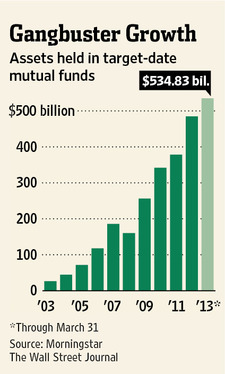
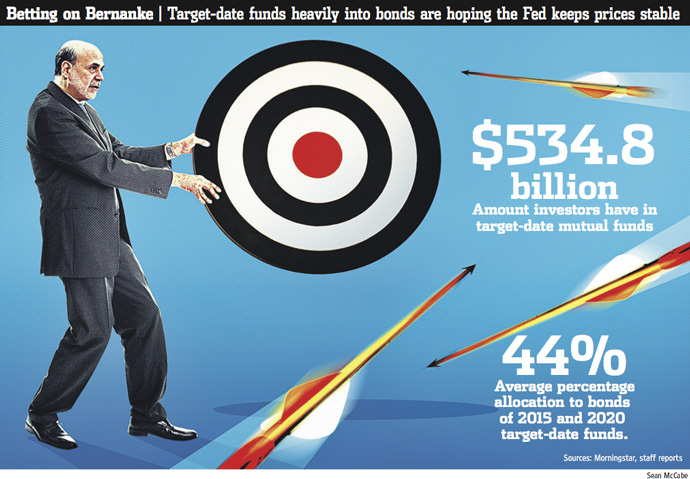
Millions of workers saving for retirement risk losing part of their nest eggs if interest rates jump. The cause for concern: target-date mutual funds, designed for investors who lack the time or expertise to balance their investment portfolios. The funds typically increase their bondholdings with the approach of the target date, which is pegged to the investor’s expected retirement year. In theory, more bonds should make portfolios safer, because bonds tend to be less risky than assets such as stocks. But if yields rise and bond prices slump, as many experts predict, the funds could suffer losses.

“People think this is safe money,” said Dave Scott, chief investment officer of Sunrise Advisors, a registered investment adviser in Leawood, Kan. “Losing money in bonds is a brutal way to lose money.”

OB-XE901_Bettin_G_20130423201402MI-BV523_TARGET_NS_20130423180021 Read more of this post

Falling Yen Sets Stage for Profit Windfall

April 23, 2013, 3:00 p.m. ET

Falling Yen Sets Stage for Profit Windfall

By MAYUMI NEGISHI And DANIEL INMAN

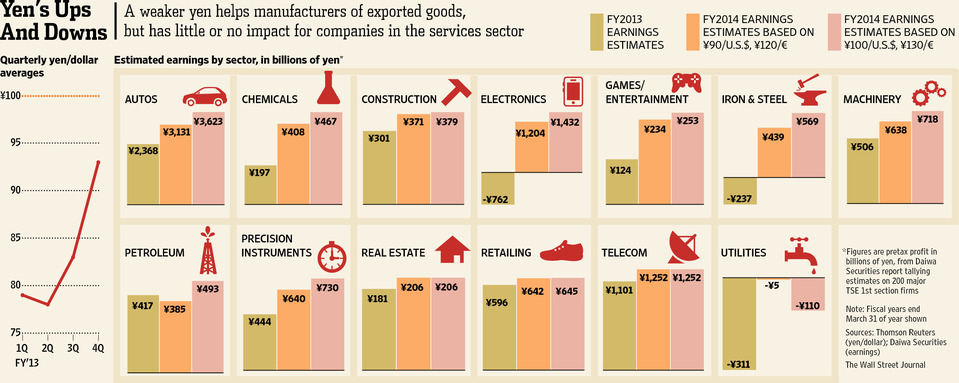
TOKYO—When Japan’s biggest companies begin to report earnings this week, they are expected to forecast the highest profits in six years and higher capital spending, raising hopes that this time, the country’s corporate recovery could have staying power.

After years of belt tightening, the yen’s recent drop is expected to propel corporate earnings to new heights. At ¥100 to the dollar—around the current level—pretax profit at the top 200 Japanese companies is forecast to rise 75% to ¥16.09 trillion ($162.15 billion) in the fiscal year that started this month, according to Daiwa Securities.

AI-CA502_JEARNS_G_20130423135405 Read more of this post

Can Abenomics Heal Japan’s Two-Decade Trauma? (Infographics)

yens

How the Wheels Came Off for Electric-Car Firm Fisker; U.S. Loans Saddled It With Factory Never Used

Updated April 24, 2013, 4:09 a.m. ET

How the Wheels Came Off for Fisker

Untested Electric-Car Firm Was Ripe for the Times; U.S. Loans Saddled It With Factory Never Used

By YULIYA CHERNOVA and MIKE RAMSEY

OB-XE904_WrongT_G_20130423201406

For a few months in 2012, Bruce Simon, the chief executive of gourmet food retailer Omaha Steaks International Inc., drove a $100,000 plug-in hybrid electric car known as the Fisker Karma. No longer.

Mr. Simon says his car broke down four times over the span of a few months. Each time, Fisker Automotive Inc. picked it up and sent it by trailer from his home in Omaha, Neb., to a dealer in Minneapolis.

The Karma was “so vulnerable to software errors, and the parts used were of such poor quality that eventually I insisted they take the car back and return my purchase price, which they did,” he says. “It’s a real shame, the car itself was beautiful.”

The near collapse of the Anaheim, Calif., company—it missed a loan payment on Monday, earlier dismissed most of its staff and has hired bankruptcy advisors—comes as affluent buyers like Mr. Simon have turned away from the once promising startup and falling gasoline prices have chipped away at demand for electric cars. Read more of this post

Soros looking set to attack Asian currencies again

Soros looking set to attack Asian currencies again

Staff Reporter

2013-04-24

George Soros may be paying attention to Asian currencies again. The currency speculator recently paid a visit to China and Hong Kong, triggering concerns of his return to the region after his large bet against the Thai baht in the late 1990s.

The hedge fund billionaire has reportedly made more than U$1.2 billion betting against the Japanese yen since November of last year.

Early this month, Soros attended an annual convention in Hong Kong organized by the Institute for New Economic Thinking, a New York City-based nonprofit thinktank he co-founded.

At the conference on April 6, Soros joked that he was ready to attack the Hong Kong dollar, in response to a question from the audience on whether Soros might be shorting the currency as his next target after the yen. Read more of this post

Bond Bubble, Or Rational Expectations? Visualizing 220 Years Of Treasury Yields

Bond Bubble, Or Rational Expectations? Visualizing 220 Years Of Treasury Yields

Tyler Durden on 04/23/2013 22:09 -0400

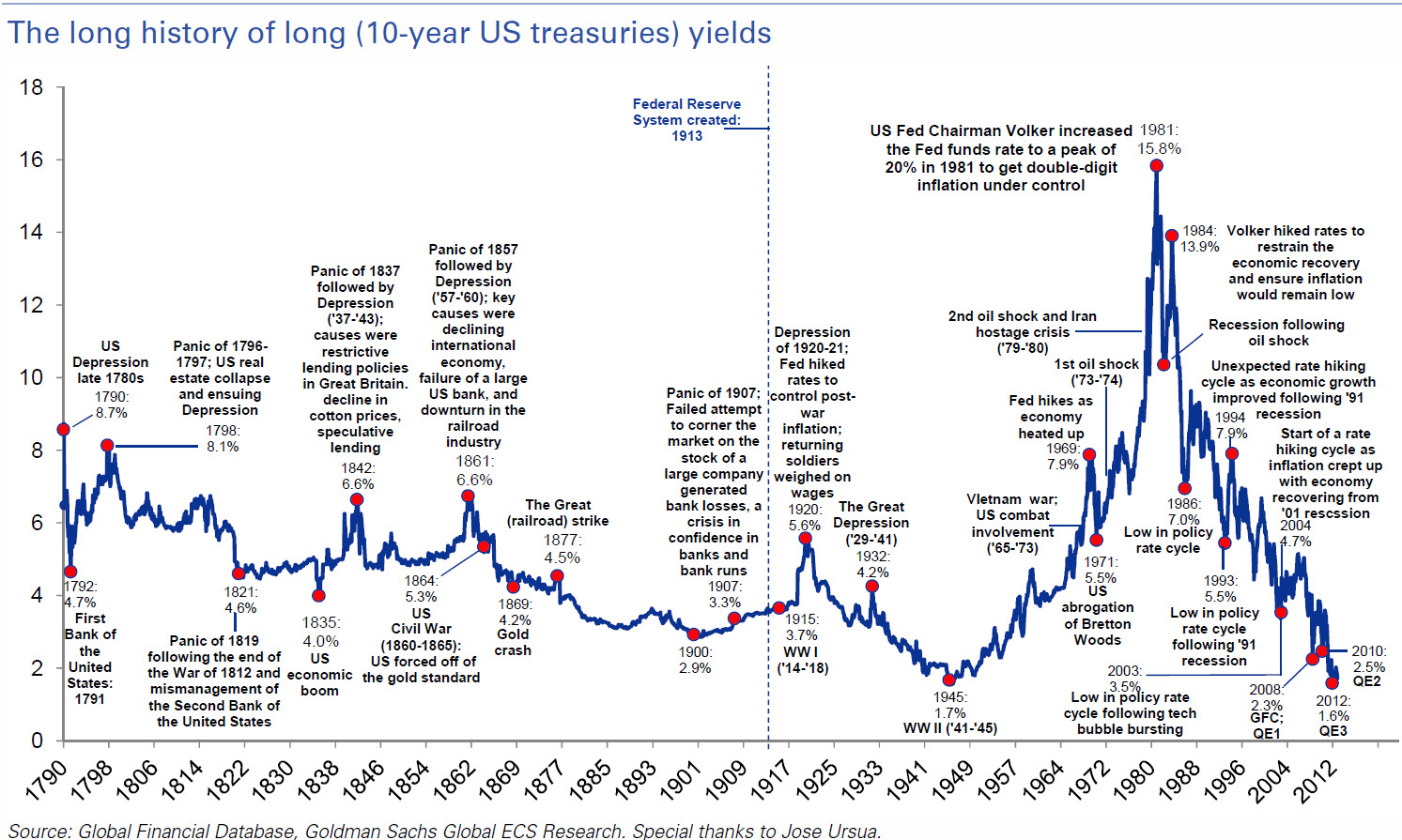
Near multi-generational low bond yields, driven at least in part (and some think in full) by the undeniably large asset purchase program (Quantitative Easing (QE)) that the US Federal Reserve has been implementing in one form or another since the 2008 Global Financial Crisis (GFC), have pushed the question of whether or not the bond market is a bubble to the front of many people’s minds. However, while the chart below of over 220 years of 10-year treasury yields shows the extraordinarily low bonds yields, they have resulted from many fundamental and rational drivers (expectations of weak economic growth and safe haven flows amid the European sovereign debt crisis) in addition to Fed purchases. So while bond prices look expensive, there is nothing particularly bubbly about the bond market today.

20130423_10Y

Earnings Quality in Acquired and Non-Acquired Family Firms: A Socioemotional Wealth Perspective

Earnings Quality in Acquired and Non-Acquired Family Firms: A Socioemotional Wealth Perspective

Federica Pazzaglia University College Dublin

Stefano Mengoli University of Bologna – Department of Management

Elena Sapienza University of Padua – Department of Economics “M.Fanno”

April 17, 2013
Family Business Review, Forthcoming

Abstract: 
We develop a socioemotional wealth (SEW) explanation for the differences in earnings quality between family firms. We argue that the process by which families obtain ownership of firms is a key contingency affecting earnings quality. Specifically, firms acquired by families through market transactions display lower earnings quality due to lower identification of family owners relative to firms still owned by the families which created them. Acquired family firms benefit with respect to their earnings quality from having a nonfamily CEO while non-acquired family firms benefit from having a family CEO.

The Myth that Insulating Boards Serves Long-Term Value

The Myth that Insulating Boards Serves Long-Term Value

Lucian A. Bebchuk 

Harvard Law School; National Bureau of Economic Research (NBER); European Corporate Governance Institute (ECGI)
April 1, 2013
Columbia Law Review, Fall 2013, Vol. 113, Forthcoming

Abstract: 
This paper comprehensively analyzes – and debunks – the view that insulating corporate boards serves long-term value.
Advocates of board insulation claim that shareholder interventions, and the fear of such interventions, lead companies to take myopic actions that are costly in the long term – and that insulating boards from such pressure therefore serves the long-term interests of companies as well as of their shareholders. This claim is regularly invoked to support limits on the rights and involvement of shareholders and has had considerable influence. I show, however, that this claim has a shaky conceptual foundation and is not supported by the data.
In contrast to what insulation advocates commonly assume, short investment horizons and imperfect market pricing do not imply that board insulation will be value-increasing in the long term. I show that, even assuming such short horizons and imperfect pricing, shareholder activism, and the fear of shareholder intervention, will produce not only long-term costs but also some significant countervailing long-term benefits.
Furthermore, there is a good basis for concluding that, on balance, the negative long-term costs of board insulation exceeds its long-term benefits. To begin, the behavior of informed market participants reflects their beliefs that shareholder activism, and the arrangements facilitating it, are overall beneficial for the long-term interest of companies and their shareholders. Moreover, a review of the available empirical evidence provides no support for the claim that board insulation is overall beneficial in the long term; to the contrary, the body of evidence favors the view that shareholder engagement, and arrangements that facilitate it, serve the long-term interests of companies and their shareholders.
I conclude that, going forward, policy makers and institutional investors should reject arguments for board insulation in the name of long-term value.

Board Games: Timing of Independent Directors’ Dissent in China

Board Games: Timing of Independent Directors’ Dissent in China

Juan Ma 

Harvard Business School

Tarun Khanna 

Harvard University – Strategy Unit
April 18, 2013
Harvard Business School Strategy Unit Working Paper No. 13-089

Abstract: 
This paper examines the circumstances under which so-called “independent” directors voice their independent views on public boards in a sample of Chinese firms. Controlling for firm and board characteristics, we find that independent directors’ dissent is associated with breakdown of directors’ interpersonal ties with board chairpersons, who locate at the center of the board bureaucracy in China. In particular, independent directors tend to “time” their dissent into a restricted set of socially-appropriate circumstances, either when the board chairperson who appoints the independent director has left the board, or when the voting occurs at the end of board “games” that corresponds to a 60-day window prior to departure of the board chairperson or departure of the independent director herself. The endgame effect is particularly strong: 27% of the dissent was issued at board “endgames” which represent merely 4% of independent directors’ average tenure. While directors with foreign experience are more likely to dissent, we do not find that academics, accounting and law professionals are significantly more active. We also show that dissent is consequential, to the director and the firm. Although dissent has no significant marginal effect on the total number of board seats received subsequently by an independent director, it significantly increases the chance for a director to exit the director labor market. Firms suffer an economically and statistically significant cumulative abnormal return of -0.97% around announcement of dissent. Literature has suggested that dissent might be reflecting of diverse viewpoints, perhaps beneficial in and of itself through reducing variability of firm performance, however we do not find this offsetting beneficial effect to be strong.

How to Predict the Next Big Bailout; Real estate agents who help Chinese investors buy homes abroad say the easier it is for their clients to buy citizenship, the likelier it is for the country’s economy to tip over into crisis

April 23, 2013, 6:16 PM

How to Predict the Next Big Bailout

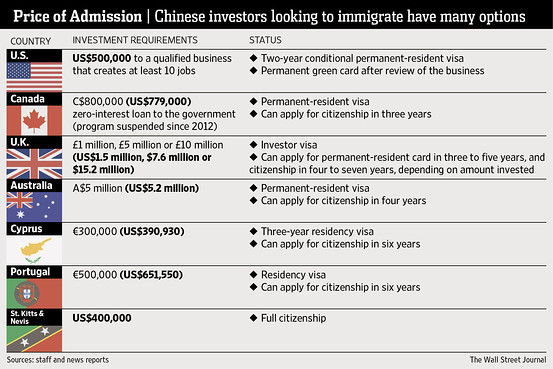
After Cyprus, who’s next to fall? Real estate agents in China have their own crude method for identifying the next domino. And it doesn’t involve number crunching banks’ balance sheets.

Real estate agents who help Chinese investors buy homes abroad say they can guess which country is facing financial ruin by the level of restrictions attached to their investment immigration programs. That is, the easier it is for their clients to buy citizenship, the likelier it is for the country’s economy to tip over into crisis.

OB-XC848_0418CR_G_20130418020456 Read more of this post

Drugs to Lift Depression in Hours Rather Than Weeks? “People come in urgently wanting to kill themselves”; drugs might be helpful in emergency rooms with patients who are actively suicidal

April 22, 2013, 6:25 p.m. ET

Drugs to Lift Depression in Hours Rather Than Weeks

By ANDREA PETERSEN

The hunt is on for a faster-acting, more effective antidepressant.

Current treatments for depression, including drugs like Prozac and Celexa, often take a month or more to give patients relief—and they don’t work for everyone. Now, researchers and several pharmaceutical companies are testing medications that early studies are showing can lift mood in just a few days or even within a couple of hours.

“You can control seizures and control hypertension within minutes and hours,” says Carlos A. Zarate, chief of the experimental therapeutics and pathophysiology branch in the intramural research program at the National Institute of Mental Health and a leading researcher in the search for new antidepressant medications. “That is what we should aim for [with depression],” he says. Read more of this post

Blood Test May Help Diagnose Autism

April 23, 2013, 10:41 a.m. ET

Blood Test May Help Diagnose Autism

By SHIRLEY S. WANG

To cut through some of the mystery of mental disorders, which are largely defined by how people behave, universities and medical-technology companies are seeking firmer biological clues lurking in blood and saliva.

The latest initiative is a clinical trial of a blood test that may distinguish between kids with autism and those with other developmental delays.

The 20-site, 660-patient study, expected to be launched Wednesday, is thought to the biggest multisite effort to date to study a biological marker for autism-spectrum disorders, which affect one in every 50 children in the U.S.

The test aims to speed the diagnosis of autism, a condition characterized by poor social interaction and repetitive behaviors that can be hard to recognize when a child is very young. The average age of diagnosis in the U.S. is about 4 years, older than is optimal, according to experts, because therapies are more effective when begun early. Read more of this post

Fab, ‘The World’s Alternative To Amazon And Walmart,’ Could Now Be A Billion-Dollar Company with $150 million revenue

Fab, ‘The World’s Alternative To Amazon And Walmart,’ Could Now Be A Billion-Dollar Company

Megan Rose Dickey | Apr. 23, 2013, 9:43 AM | 1,136 | 2

Fab is reportedly raising a massive round at a $1 billion valuation, just as it’s gearing up to announce its next pivot. The round is expected to be more than $100 million, TechCrunch’s Leena Rao and Alexia Tsotsis report. Fab has already raised $171 million in funding, but the highest valuation it received prior to this round was $600 million. Last year, Fab saw $150 million revenue, with sales growing nearly 300% from January 2012 to January 2013. Since it’s first pivot from a social network for gay men to a design flash sales site, Fab has grown to more than 11 million members. Fab also has great retention, with repeat buyers making up 67% of its daily sales. As Fab gears up to pivot, it will have a nice chunk of cash to fuel its next move. Fab’s previous investors include Andreessen HorowitzMenlo VenturesSoftTech VCFirst Round CapitalKevin RoseSV Angel, and many others. Business Insider has reached out to Fab CEO Jason Goldberg and a couple of Fab’s previous investors. We will update this story if we hear back.

Everyone wants to be a REIT; Restyled as Real Estate Trusts, Varied Businesses Avoid Taxes

April 21, 2013

Restyled as Real Estate Trusts, Varied Businesses Avoid Taxes

By NATHANIEL POPPER

A small but growing number of American corporations, operating in businesses as diverse as private prisons, billboards and casinos, are making an aggressive move to reduce — or even eliminate — their federal tax bills. They are declaring that they are not ordinary corporations at all. Instead, they say, they are something else: special trusts that are typically exempt from paying federal taxes. The trust structure has been around for years but, until recently, it was generally used only by funds holding real estate. Now, the likes of the Corrections Corporation of America, which owns and operates 44 prisons and detention centers across the nation, have quietly received permission from the Internal Revenue Service to put on new corporate clothes and, as a result, save many millions on taxes. The Corrections Corporation, which is making the switch, expects to save $70 million in 2013. Penn National Gaming, which operates 22 casinos, including the M Resort Spa Casino in Las Vegas, recently won approval to change its tax designation, too.

Read more of this post

How smaller rivals beat Wipro and Infosys and turned India’s IT sector upside down

How smaller rivals beat Wipro and Infosys and turned India’s IT sector upside down

By Nandagopal Jayakumar Nair April 23, 2013

Nandagopal Jayakumar Nair is a Knight-Bagehot fellow in economics and business journalism at Columbia University in New York. He previously worked for CNBC-TV18 in India.

The players in India’s $108 billion information-technology industry are realigning. Finally.

While pioneers like Infosys and Wipro have been caught wrong footed, agile rivals are banking on aggression and vision to grow their businesses.

Today, shares of India’s third largest software provider Wipro fell more than 8% as the management said revenue would grow 1.3%, at best, in the next quarter. Earlier in April, India’s second largest software exporter Infosys lost more than a fifth of its value in a single trading session after it gave a disappointing annual revenue growth forecast of 6-10%. While Wipro is optimistic about a turnaround later in the year, Infosys admitted that the tough macroeconomic conditions would hamper the company’s performance. “There is uncertainty all around us. I don’t believe that this is something we can wish away,” said Infosys CEO SD Shibulal.

But how then to explain Tata Consultancy Services? TCS, as it is better known, is decidedly bullish on its near future. India’s largest software exporter is confident of beating IT industry body Nasscom’s estimate of 12-14% revenue growth for 2013-14.  “The global economic environment is providing us with many new opportunities,” said CEO N Chandrasekaran. “We are going to have a better year this year.” Read more of this post
Infosys’s boss blames the economy but the source of its troubles is internal

Infosys’s boss blames the economy but the source of its troubles is internal

Apr 20th 2013 | MUMBAI |From the print edition

THERE was something humiliating about the latest results from Infosys, long an icon of India’s technology-outsourcing industry. On April 12th it released weak figures and said that it expected sales in the year to March 2014 to grow by 6-10%, far below the level number-crunchers had hoped for. To blame, it said, was an uncertain global economy. If true, that should have hurt all firms in the industry, but investors were having none of it. Infosys’s shares fell by 21% on the day, whereas those of its main competitors were largely stable. Lo and behold, five days later, TCS, Infosys’s main Indian rival, announced yet another sparkling set of results and said all was rosy in the world.

For Infosys’s chief executive, S.D. Shibulal (pictured), it must have been a painful moment. He is the fourth, and almost certainly the last, of the company’s founders to serve as boss, having finally got the top spot in 2011, three decades after Infosys was started in a flat. Inevitably there have been whispers that he is not up to the task and that letting the firm’s creators take turns ascending to the throne has proved disastrous. That is an overstatement. Infosys has been trounced by TCS, but over the past year its shares have underperformed India’s broader IT sector by a more modest 13%. Still, the firm clearly has problems.

One is its inability to give reliable guidance on its performance. Some 90 days before this most recent announcement Mr Shibulal said he was “cautiously optimistic” about the coming quarter. It now seems clear the firm was winging it, relying to an uncomfortable degree on new business still to be won and on squeezing more from existing contracts. Rajiv Bansal, the chief financial officer, admitted there had been “confusion”. Read more of this post

How IDEO brings design to corporate America

How IDEO brings design to corporate America

By Dinah Eng @FortuneMagazine April 11, 2013: 8:06 AM ET

130409154900-how29-a-620xa

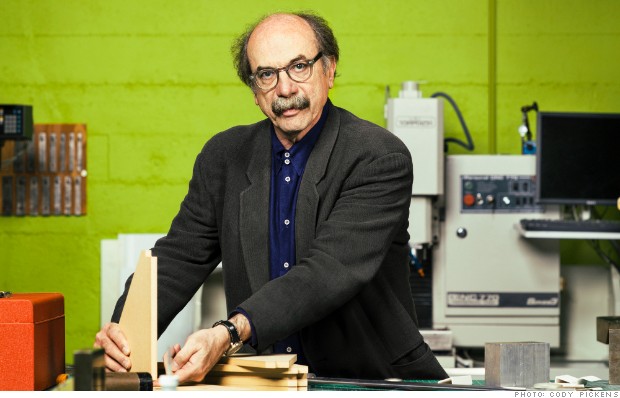
David Kelley in IDEO’s Palo Alto workshop

You may not know the design firm IDEO (pronounced EYE-dee-oh), but chances are you know its work. If you’ve used an Apple mouse (IDEO fashioned the company’s first, in 1980), swept with a Procter & Gamble (PGFortune 500) Swiffer (it collaborated on the hit), or even stood in line at an airport recently (the firm has worked with the Transportation Security Administration to make the process friendlier), you’ve felt the legacy of David Kelley. He founded IDEO in Palo Alto in 1978 and built it into a global operation with 600 employees and $130 million in revenue (he declines to divulge profits). IDEO brings a human-centered approach to products, services, and organizational concepts for the likes of Samsung, Eli Lilly (LLYFortune 500), and Bank of America (BACFortune 500). Kelley, 62, is also Stanford University’s resident design Yoda. The avowed “variety junkie” is proud that IDEO does everything from designing the ideal home for wounded soldiers to helping Elmo teach kids good behavior via a mobile app. His story:

I grew up in Barberton, Ohio, where my father was an engineer at Goodyear and my mother was a housewife. It was a typical Midwest upbringing, and I wasn’t really into college preparatory stuff. What was exciting to me was taking apart the car or the washing machine.

In 1973, I got a BS in electrical engineering from Carnegie Mellon University and went to work forBoeing (BAFortune 500) in Seattle, designing things for the interior of the 747. When I found out about the Stanford Product Design Program, I became interested in the human-centered side of technology, but didn’t think I’d get into the program. So I moved to Dayton and worked for National Cash Register (NCR,Fortune 500), designing new banking terminals, until I found out I was admitted.

Going to the Stanford program was a perfect fit. I love trying to understand what people want, what they value, and designing something for them. I graduated in 1977 with my MS in engineering and product design, and discovered that I really liked teaching. In 1978, I went to my mentor, professor Bob McKim, and said I wanted to keep teaching and I wanted to start my own company. He introduced me to Dean Hovey, who was studying at Stanford, and we started a company called Hovey-Kelley Design. A couple of professors who had their own companies in Silicon Valley gave us our first projects — designing a reading machine for blind people and a medical device called a differential [blood] cell counter.

Soon after Dean and I started our company, another Stanford colleague introduced us to Steve Jobs. We ended up doing a lot for Apple (AAPLFortune 500). They were technologically focused, and we focused on the human side. We’d ask [with the first Apple mouse], should you use the mouse with your fingertips or slide it like a bar of soap? Once we started doing Apple products, people wanted to know who we were.

Back then, we were paying about $300 a month for three offices. I remember flinching when I signed a 10-year lease because I still owed on student loans and I had a negative net worth. I had no interest in calculating revenue, and still don’t. We charged $25 an hour and had six employees. Half the time we worked, and half the time we didn’t. All I cared about was how much we were paid per hour, and if we had enough to keep everybody busy. Read more of this post

China bird flu death toll rises to 22; Infections rise to 108

China bird flu death toll rises to 22

9:31am EDT

BEIJING (Reuters) – An elderly man in eastern China died of bird flu on Tuesday, bringing the death toll from a strain that recently emerged in humans to 22, a provincial health agency reported. The 86-year-old man died after having been diagnosed with the H7N9 virus on April 17, the Zhejiang Health Bureau said on its website. Two others in Zhejiang have been diagnosed with the disease, including an 84-year-old man and a 62-year-old man, both of Hangzhou who fell ill on April 15, the health bureau said. In neighboring Anhui province, another case was diagnosed on Tuesday, a 91-year-old man, the state-run Xinhua news agency said. The man became sick on April 14, Xinhua said. So far 108 people have contracted the disease since the first deaths were reported in China last month. Read more of this post

Big tech is struggling with old age; Some of the world’s most well-known and powerful tech titans – IBM, Microsoft, Intel – are marked by trying to manage declining aspects of their businesses

Big tech is struggling with old age

April 23, 2013: 6:51 AM ET

Some of the world’s most well-known and powerful tech titans — IBM, Microsoft, Intel — are marked by trying to manage declining aspects of their businesses.

By Kevin Kelleher, contributor

FORTUNE — At its heart, the tech industry is about the new. Today, tech giants succeeded because of what was new yesterday. The flip side is that the new ages into the old more quickly in tech than in most other industries. And so companies that dominated tech even a decade ago can appear to be aging quickly. Such is the picture of the tech industry after a week of earnings reports that saw giants like Intel (INTC), Microsoft (MSFT), and IBM (IBM) discuss their financials in the first quarter of 2013. While the individual results and subsequent reactions among investors varied, one thread ran through all three: Each is struggling to manage older businesses in decline even as they push into promising new areas like cloud computing.

The most dramatic example was IBM, which has seen its stock decline 9.3% since it reported first-quarter earnings last week. IBM, a 101-year-old company, sold its PC business in 2004 in an effort to move into higher-margin software and IT services businesses. Its growth since then has made the stock a favorite among tech investors. Even so, IBM is still struggling with aging businesses. Revenue at the company fell 5% last quarter from the same quarter a year earlier to $23.4 billion, below analyst forecasts. Much of the disappointment centered around hardware, including servers based on x86 architecture that, like PCs, have become low-margin commodities. Some reports suggested IBM may sell its x86 server business to Lenovo (LNVGY), the company that bought its PC business years ago. Read more of this post

Can Google stop the drop in mobile advertising prices?

Can Google stop the drop in mobile advertising prices?

By JP Mangalindan, Writer April 23, 2013: 6:34 AM ET

Google’s latest quarterly earnings raise concerns about its mobile ad efforts. But things may turn out just fine for the tech giant. More than fine, in fact.

FORTUNE – For Google, the money has always been in advertising.

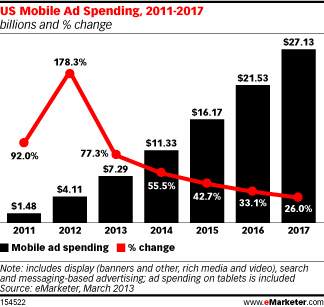
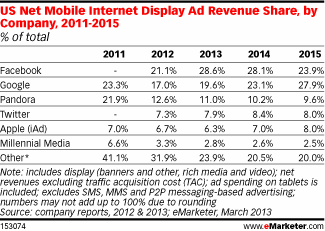
Propelled by products like AdWords, advertising generated $43.7 billion in sales last year — a whopping 95% of Google’s (GOOG) overall revenue. Its continually lucrative ad business has allowed Google to use its cash for other less-profitable ventures: Android, self-driving cars, Glass among many others. But like most of tech, Google has been challenged by the transition from desktop to mobile computing — and how to make money from users browsing the web on smartphones and tablets. One thing is for certain: The mobile market cannot be ignored. In the U.S. alone, mobile ad spending is expected to more than double from $7 billion this year to $16 billion in 2015. JMP Securities analyst Ron Josey recently estimated that mobile ads now account for 14% of Google’s overall ad sales. An important metric for Google tied to ads is called “cost-per-click.” It measures the average amount advertisers pay Google each time a user clicks on an ad. Last quarter, the company announced it would reduce the number of ads on its mobile search page to preserve the user experience and predicted a higher cost-per-click. The latter didn’t happen. Instead, Google’s cost-per-click fell 4% compared with the same time last year and marked the sixth consecutive quarterly decline. In truth, mobile ads still command lower prices than desktop ads do, the argument being that people remain less likely to click ads on their phones or tablets than desktops. (What’s more, many users may be clicking on them accidentally.) “The saying goes that ad dollars follow eyeballs, but that’s not entirely the case,” explains Clark Frederickson, vice president of New York-based digital market research firm eMarketer. Companies may be quick to tout growing mobile sales, but at the end of the day, just over 10% of e-commerce occurs on mobile. And until mobile phones and tablets become just as much a buying device as they are say, a consumption device, Frederickson says many advertisers will continue to focus their ad dollars on the desktop for the time being — even if the desktop’s days appear numbered.

154522153074 Read more of this post

Alibaba’s billionaire founder Jack Ma: “The world is so cruel that only with much of your own efforts plus a bit of luck can you survive the black forest. Never expect anyone. Count on yourselves. ’

Jack Ma to Set up A College for Entrepreneurs in Two Years

By Chelsea Dong on April 23, 2013

Jack Ma, who is about to resign as CEO of Alibaba Group soon, revealed at an event on the past Sunday that he was planning to found a college for entrepreneurs in about two years in collaboration with some of his friends. He once said he would set up a business school with Feng Tang, a real estate tycoon. He also advised entrepreneurs not to count on big companies to save them. He said, ‘Never dream of saving your lives with help from big companies. The world is so cruel that only with much of your own efforts plus a bit of luck can you survive the black forest. Never expect anyone. Count on yourselves. ’ On May 10, Jack Ma will retire from his post as CEO and become the chairman. He seems to quite look forward that day. He said, he would do what he likes after that day and enjoy the simple relaxing life after resignation. Regarding the dreams other than the business school, he said, “I don’t want to leave much regret when I leave the world.”


Reuters: How do you spell Singapore without “LKY”?

Analysis – How do you spell Singapore without “LKY”?

Sun, Apr 21 2013

By John O‘Callaghan

SINGAPORE (Reuters) – They crammed into an art cafe in Singapore and pulled no punches, deriding authoritarian officials who ruled with an “iron fist” and complaining that government ministers with million-dollar salaries were out of touch.

One woman, a middle-aged professional, got nods of agreement when she said modern Singapore’s founding father, Lee Kuan Yew, had done great things but that new ways were needed from current leaders still practising a “do-as-I-say style of parenting”.

Singapore remains regimented but the unusually frank criticism at the recent gathering, part of a government-run national “conversation” about the city state’s future, reflects the reality that this is no longer the era of Lee Kuan Yew.

LKY, as he is widely known, built the tiny Southeast Asian island into one of the world’s wealthiest nations with a strong, pervasive role by the state and no patience for dissent. Read more of this post

Magnetic therapy may not relieve ringing in the ears; “People want a pill to make it go away, but there isn’t anything like that. There’s no cure for tinnitus.”

Magnetic therapy may not relieve ringing in the ears

Mon, Apr 22 2013

By Genevra Pittman

NEW YORK (Reuters Health) – Using a magnet to generate an electrical current in areas of the brain that control hearing does not seem to improve ringing in the ears, a new study suggests. Researchers found people reported just as much bothersome ringing after a month of so-called repetitive transcranial magnetic simulation (rTMS) as after a series of fake, magnet-free treatments.

Although it seems natural that ringing in the ears – known as tinnitus – would be a hearing-related problem, so far medications and magnetic stimulation targeting the brain’s auditory areas haven’t made the sound go away, according to Dr. Jay Piccirillo. “People want a pill to make it go away, but there isn’t anything like that,” Piccirillo, an otolaryngologist from the Washington University School of Medicine in St. Louis, told Reuters Health. “There’s no cure for tinnitus.”

Read more of this post

Sirgoo Lee, CEO of Kakao Corporation, shared what made KakaoTalk a hit messaging platform in Korea and its rapid expansion

The Kakao story: Rising from the ashes of failure and being lean

BY JOASH WEE | APR 22, 2013 | ASIA

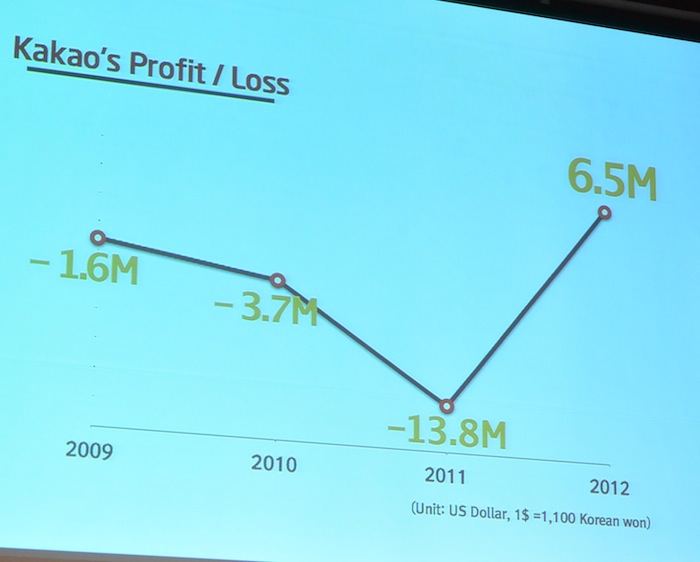
Sirgoo Lee, CEO of Kakao Corporation, shared what made KakaoTalk a hit messaging platform in Korea and its rapid expansion. Born from two failures, KakaoTalk was created by Brian Kim and his founding team as their “killer application.” Having built two web applications that have failed, Buru.com (social bookmarking serice, 2009) and Wisia.com (social ranking service, 2008), the appearance of the smartphone came at the right time for the company, then named iWILAB, to revive its efforts in the application space. According to CEO Sirgoo Lee, the team threw away all the code for the web service and decided to do something called “application service.” With just four people, KakaoTalk was created in two months. Sirgoo shared that they have since tried to keep to the “4 by 2” spirit where they aim to create something with the least amount of resources in the shortest amount of time. The reason was, when they were building web services, the team focused on creating products that had no flaws, and that is why they failed. KakaoTalk taught them to release products as quickly as possible and to continuously improve the product. KakaoTalk currently has 86 million registered users, with 70 percent of them in Korea, 29 million daily users and send 4.8 billion messages daily. In 2012, the company reported revenues of US$42 million and had its first profitable year in six years, pulling in US$6.5 million in profits.

Kakao-Revenu-BreakdownKakao-Users

Kakao-RevenuKakao-Profit Read more of this post

South Koreans, who lunch religiously between midday and 1 p.m., can now get an extra treat through a smartphone app that promises to help singles find their one true love; The app now has 800,000 subscribers

“Catch of the day” for Korea’s hungry singles with popular app

2:05am EDT

By Narae Kim

SEOUL (Reuters) – South Koreans, who lunch religiously between midday and 1 p.m., can now get an extra treat through a smartphone app that promises to help singles find their one true love. In a country with the longest working hours among rich industrialised nations, and where 8 million of its 50 million people are thought to be single, the i-um app, which means “to connect”, offers detailed profiles and photographs to help match up busy singles. Subscribers register and submit photographs and personal information. Then at exactly 12:30 p.m. each day they receive a message through a stylised “lunchbox” showing the match of the day – and if both parties click “okay”, they receive the other’s name and phone number. “At 12:30 p.m., the hour and the minute hand make a straight line. That means that both the man and the woman we connect can become one,” said Park Hee-eun, who founded the company that developed the app in 2011. The app now has 800,000 subscribers and Park says that so far, 56 people have successfully found mates. “App dating was my last-ditch effort, (I was) grabbing at straws,” said Lee Ji-sun, a 33-year-old businesswoman who last month married the man she met through the app.

China says aims to banish superstition, promote knowledge

China says aims to banish superstition, promote knowledge

Sun, Apr 21 2013

By Ben Blanchard

BEIJING (Reuters) – China is struggling to get its estimated 100 million religious believers to banish superstitious beliefs about things like sickness and death, the country’s top religious affairs official told a state-run newspaper.

Wang Zuoan, head of the State Administration of Religious Affairs, said there had been an explosion of religious belief in China along with the nation’s economic boom, which he attributed to a desire for reassurance in an increasingly complex world.

While religion could be a force for good in officially atheist China, it was important to ensure people were not mislead, he told the Study Times, a newspaper published by the Central Party School which trains rising officials.

“For a ruling party which follows Marxism, we need to help people establish a correct world view and to scientifically deal with birth, ageing, sickness and death, as well as fortune and misfortune, via popularizing scientific knowledge,” he said, in rare public comments on the government’s religious policy. Read more of this post