Crude Inventories Surge To Record High As Energy Demand Collapses
May 2, 2013 Leave a comment
Crude Inventories Surge To Record High As Energy Demand Collapses
Tyler Durden on 05/01/2013 11:38 -0400
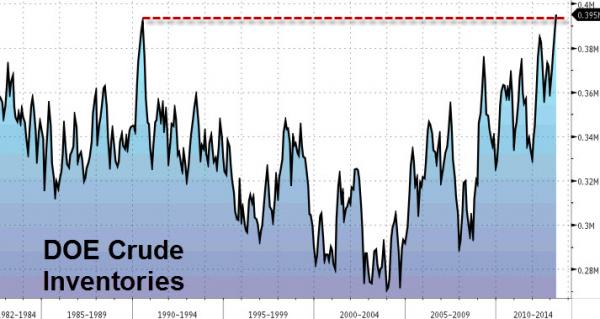
A month ago we highlighted the somewhat stunning reality of the real economy via the EIA’s detailed energy supply and demand data. The key takeaway was that we hoped this did not represent the true state of the economy since the data was so dismal. Fast forward to today and the DOE just released a much higher than expected build in crude inventories that took the stuffed-channel of oil products to all-time highs.The 395.3 million barrels is higher than the previous record in July 1990. There appears to be a number of factors at play – none of which are positive. There is a surge in supply due to the incessant harvesting of shale oil (which could have its own problems as we noted here). Second, we suspect there is a degree of ‘channel-stuffing’ occurring – if we pump it, they will buy – as producers and transporters are desperate to keep active and show incremental business (despite fading railcar loadings). But perhaps most important, as EIA data has shown, there has been a collapse in end demand for crude products not seen since the 1990s. Today’s surge in inventories appears to confirm demand remains subdued at best.
Crude Declines for Second Day on Record Inventories
West Texas Intermediate oil fell for a second day as U.S. inventories reached a record high last week and on signs of economic slowdown in the U.S. and China. Futures dropped as much as 3.3 percent as stockpiles increased 6.7 million barrels, the Energy Information Administration reported. Analysts surveyed by Bloomberg expected a gain of 1.1 million. U.S. companies added fewer workers than forecast in April, according to the ADP Research Institute, and China’s manufacturing expanded at a weaker pace.
“The market is worried about the ADP number being weak and they are worried about the manufacturing numbers in China,” said Phil Flynn, senior market analyst at the Price Futures Group in Chicago. “The concern is that supplies are going to exceed demand. The market is focused on the overwhelming supplies.”
WTI for June delivery retreated $2.96, or 3.2 percent, to $90.50 a barrel at 10:33 a.m. on the New York Mercantile Exchange. The futures were at $90.95 before the report. The volume of all futures traded was 35 percent above the 100-day average for the time of day. Prices were down 3.9 percent last month.
Brent for June settlement slid $3.03, or 3 percent, to $99.34 a barrel on the London-based ICE Futures Europe exchange. Volume was 22 percent above the 100-day average. Brent’s premium to WTI decreased to as small as $8.39, the narrowest since January 2012.
Crude Inventories
U.S. oil inventories rose to 395.3 million barrels, the highest level in records begun in 1982, the EIA, the Energy Department’s statistical arm, said. Gasoline stockpiles slid 1.82 million barrels and distillate fuels, which include diesel and heating oil, increased 474,000.
The industry group American Petroleum Institute reported yesterday that crude inventories rose by 5.18 million barrels last week. The API collects stockpile information on a voluntary basis from operators of refineries, bulk terminals and pipelines. The government requires that reports be filed with the EIA for its weekly survey.
U.S. companies added 119,000 jobs last month, the smallest since September, figures from the Roseland, New Jersey-based ADP showed today. The median forecast of economists surveyed by Bloomberg projected a 150,000 advance. The April number followed a revised 131,000 gain in March that was smaller than initially estimated.
‘Quite Disappointing’
“The ADP number is quite disappointing and the Chinese manufacturing report is really weighing on this market,” said Bill Baruch, a senior market strategist at Iitrader.com in Chicago. “The API reported a quite big build. It’s pulling the market down.”
China’s Purchasing Managers’ Index was at 50.6, the National Bureau of Statistics and China Federation of Logistics and Purchasing said today. That compared with the 50.7 median forecast of analysts in a Bloomberg News survey and a March reading of 50.9.
The U.S. and China are the world’s two leading oil consumers, together using 32 percent of the global total in 2011, according to BP Plc (BP/)’s Statistical Review of World Energy. The U.S. took 21 percent.
Daily output by the Organization of Petroleum Exporting Countries increased in April by 194,000 barrels a day to 30.9 million barrels, a separate Bloomberg survey indicated. Saudi Arabia, the group’s biggest producer, increased daily output by 80,000 barrels to 9.18 million.
“With inventories at the levels they are at, it is a question of how much demand there is, and there is growing evidence of a slowdown in economic activity with even China weaker than expected,” said Michael Hewson, a market analyst at CMC Markets Plc in London. “The direction of travel on oil is down and I see no reason to change that view unless OPEC cuts production.”
To contact the reporter on this story: Moming Zhou in New York at mzhou29@bloomberg.net
 About bambooinnovator
 Bamboo Innovator