Where the Chinese credit is going; there is plenty of evidence to suggest that financial distress is another reason why credit expansion has not worked well
May 2, 2013 Leave a comment
Where the Chinese credit is going…
Kate Mackenzie | May 01 10:51 | 3 comments | Share
Part of the CHINA’S CREDIT CONUNDRUM SERIES
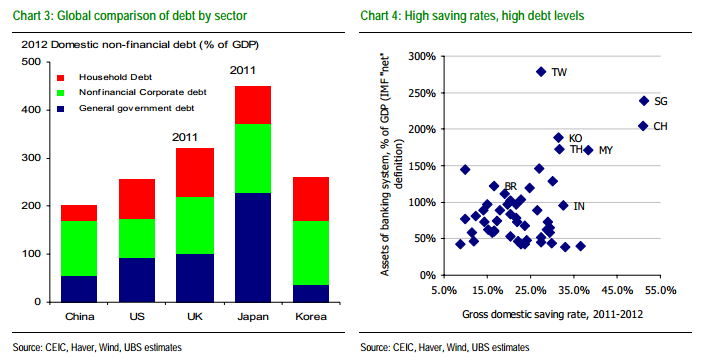
After Chinese first quarter GDP missed expectations, there was some hope that the relatively strong manufacturing PMIs in March would point to a better second quarter. Now that we know China’s April PMIs are definitely not supporting that notion, it is worth revisiting, again, the whole question of the country’s recent surging credit growth. The significance of the debt-to-GDP ratio can be argued over, and it’s impossible to say at what level it might become a big problem. But here are a couple of ideas to consider. First, UBS’ China economist Wang Tao has taken a look at the debt/GDP question. Her estimate is that government debt was about 55 per cent of GDP at the end of 2012, and total debt is about 210 per cent of GDP. (China’s official government debt to GDP ratio is only about 15 per cent, going purely on government bonds, but that ignores many government corporations, local debt, and the asset management companies that took on bad debt in the early 2000s financial crisis.) Anyway, 210 per cent is broadly in line with other credible estimates. Wang argues this absolute level in itself is not cause for dismay. In comparison to developed economies it may seem high, but it’s less dramatic measured against other emerging and Asian economies, which she points out typically have high savings rates which in turn provide some of that credit: There are a couple of other reasons not to worry. The growth might simply be lagging the credit surge, and some credit might have been double-counted: To be fair, we think credit growth has a delayed effect on economic growth, and expect construction an investment to pick up in Q2 and Q3 this year on the back of strong credit growth so far. Also, the TSF may overstate (or double count) the leverage increase in the real economy – corporates that engage in interest arbitrage by borrowing cheaply in the interbank credit market and lend to other corporate and/or local governments have both legs of their transaction included in TSF. While Wang doesn’t think a debt crisis is imminent, she does believe there are certainly reasons to worry. One is the recent rapid increase in the debt-to-GDP ratio. This is a very good point which we mentioned in February and forgot to point out in our ruminations of the past couple of weeks. To recap: Morgan Stanley’s Ruchir Sharma sums up some of these reasons in a WSJ op-ed, citing a BIS paper by Mathias Drehmann and Mikael Juselius which finds that if the private debt-to-GDP ratio increases by 6 per cent or more above its 15-year average, that is a “very strong indication that a crisis may be imminent”.
Wang believes there’s another reason for worry:
However, there is also plenty of evidence to suggest that financial distress is another reason why credit expansion has not worked well. Some local governments and companies do not have sufficient cash flow to pay interest on their existing debt, and have to borrow new debt to help service older debt. This is not hard to imagine for local governments – even if they have invested in sound projects in the last stimulus program, most of the projects do not yet have a cash return. In a downturn where local governments face weak tax revenue, dropping land sales, and more demand for pushing up investment and GDP from higher levels of government, the logical solution would be to incur more debt to keep the ball rolling.Nomura’s Zhiwei Zhang has been pondering the question of where the credit went, too. The Q1 Chinese GDP figure came in below his forecasts — he’d been predicting a quarter-on-quarter bump in Q1 followed by a steady decline for the rest of the year. Here’s what he found (our emphasis):
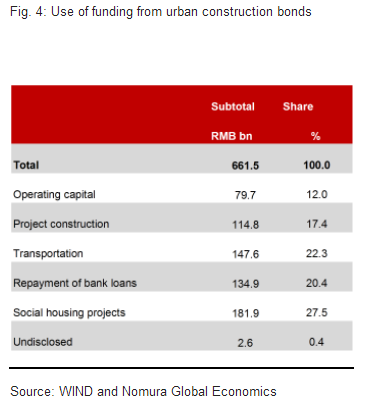
Many investors ask us the same question: where has all the money gone? We believe a large part of the new credit supply in Q1 did not go into the real economy. We do not have comprehensive information, but we provide the following two pieces of evidence. First, we collected public information on the 370 largest issues of urban construction debt that took place in 2012, and found that at least 20% of the money raised was used to repay debt (Figure 4). It is not surprising to us as many infrastructure investments projects are not yet profitable. Therefore, local government financing vehicles need to continue borrowing new funds for debt financing.
Zhang mentions another possible indicator that this has been a problem:
Another piece of evidence comes from a recent government policy announcement. According to a Chinese newspaper, First Financial Daily,the National Development and Reform Commission (NDRC) issued a policy notice at the end of March to ensure the funds raised for public housing construction in the bond market are not used for other purposes. We believe this policy may be triggered by cases where some funds were misused. Indeed, risks of such events have been mentioned repeatedly in government documents.
In terms of signs of a financial crisis or downturn, the cost of debt servicing relative to growth is an important indicator, according to the BIS paper we mentioned earlier.
Zhang’s theory is that this all derives from over-capacity in manufacturing, which has been attracting declining rates of fixed-asset infrastructure investment since 2011. He also believes the big fall in the input price component of today’s official PMI (to 40.1 from 50.6) might have also reflected this.
The overall effect, though, is that China’s capital investments are not yielding the high returns they once did. Alistair Thornton from IHS writes:
A recent study from the Conference Board shows this trend really started in the early 2000s and as a result, today China’s ”marginal product of capital”—basically, investment’s “bang for the buck”—is closer to that of advanced economies such as the United States and Germany than that of lower-income countries such as Brazil, Malaysia, and India. The current uptick in credit issuance is chasing after yesterday’s easy gains.
This is China’s declining capital productivity — aka its incremental capital output ratio. It’s not to say that growth opportunities aren’t there; quite the opposite (total factor productivity could be an example) — but tapping into them requires somedifficult policy decisions.
 About bambooinnovator
 Bamboo Innovator