Intel v ARM
May 4, 2013 Leave a comment
Intel v ARM
Chip off the old block
May 2nd 2013, 20:29 by M.G. and P.L.| SAN FRANCISCO AND LONDON
IT’S all change at the top of two of the world’s leading semiconductor companies. On May 2nd Intel, the world’s largest chip-maker, announced that Brian Krzanich (pictured above), the firm’s current chief operating officer, will become the sixth chief executive in the firm’s history. Mr Krzanich, who will take over as boss on May 16th, replaces Paul Otellini, who unexpectedly announced last November that he would be resigning as Intel’s boss.
ARM, Intel’s British rival, is also changing its leader. In March Warren East, the company’s chief executive, said he would stand down in July after 12 years in the top job. Like Intel, ARM has chosen an internal successor, Simon Segars (pictured below), who has been running the company’s intellectual-property divisions and is also the company’s president.
Mr Krzanich faces the harder challenge of the two. Intel rode to greatness on the back of the personal computer (PC). Its microprocessors are in most PCs and the server computers that are found in data centres and offices. But PC sales have been falling sharply just as sales of smaller mobile computing devices have taken off. IDC, a research firm, reported that shipments of PCs in the first quarter of 2013 plummeted by almost 14%.Intel’s new boss will have to come up with a strategy to deal with this shift in the technology landscape—and arrest the decline in Intel’s net profit, which fell from $13 billion in 2011 to $11 billion last year. Most important, the company needs to come up with creative ways to boost its sales in the rapidly growing markets for smaller computing devices, such as tablet computers and smartphones, where it has struggled to make headway.
One way to boost revenues and profits will be to come up with more innovative software applications that can be combined with Intel’s chips. It is probably no coincidence that at the same time it announced Mr Krzanich’s elevation, Intel’s board also promoted Renee James, the head of the company’s software division, to president.
Mr Segars has an easier task ahead of him. ARM makes no chips of its own (and so is a fraction of the size of Intel), but it designs chip technology that others, from Apple and Samsung to NVIDIA and Qualcomm, license and then build on. ARM’s low-power, battery-saving chip designs have been just what the mobile-device market needed.
Granted, not everything with an ARM-based chip in it turns to gold. Sales of the Surface RT, a Microsoft tablet, have been poor. Even so—and despite Intel’s best efforts to make inroads into its territory—ARM said on April 23rd that its revenue had risen by 28% in the year to the end of March 2013, reaching £170.3m ($263.9m) and its pre-tax profit had gone up by 44%, to £89.4m.
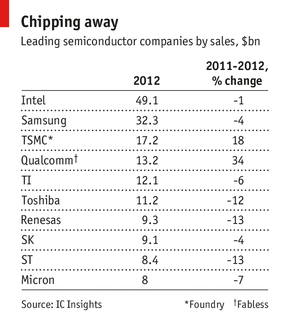
As the table from IC Insights, another research firm, shows, Intel is still a formidable force. Last year it even extended its lead over the second-biggest chipmaker, South Korea’s Samsung Electronics. But the world’s fastest-growing chip company was America’s Qualcomm, which leads the market for smartphones’ application processors (the brains of the devices). And Taiwan Semiconductor Manufacturing Company (TSMC), which makes chips for many of Intel’s rivals—including Qualcomm, which has no factories of its own—also saw its business grow strongly. Mr Krzanich and Intel have quite a battle on their hands.
Thursday, May 2, 2013 — Instapaper
A new CEO has taken over Intel. Their core business, upon which the company has been built, is floundering. Does the new CEO, who is not really new at all (he’s the current COO), have the vision to ensure Intel’s continued success?
I’m not talking about Brian Krzanich, who today was promoted from COO to CEO at Intel. Rather, I’m talking about Andy Grove, who took over Intel in 1987.
INTEL’S IDENTITY CRISIS, V1
Intel originally found success as a memory manufacturer. It’s 1103 chip was the first commercially available DRAM memory, and the DRAM business led massive growth throughout the 1970s.
By the 1980s, though, it was the microprocessor business, fueled by the IBM PC, that was driving growth, while the DRAM business was fully commoditized and dominated by Japanese manufacturers. Yet Intel still fashioned itself a memory company. That was their identity, come hell or high water.
By 1986, said high water was rapidly threatening to drag Intel under. In fact, 1986 remains the only year in Intel’s history that they made a loss. Global overcapacity had caused DRAM prices to plummet, and Intel, rapidly becoming one of the smallest players in DRAM, felt the pain severely. It was in this climate of doom and gloom that Grove took over as CEO. And, in a highly emotional yet patently obvious decision, he once and for all got Intel out of the memory manufacturing business.
Intel was already the best microprocessor design company in the world. They just needed to accept and embrace their destiny.
INTEL’S IDENTITY CRISIS, V2
Intel reaped the benefit of Grove’s repositioning for 25 years. Their chip designs were the foundation of the PC era, and while they faced nominal competition from AMD, they gained many of the economic benefits of a monopolist. But for a brief spell around the turn of the century, a “good” computer required an Intel chip, and they charged prices befitting their place in the PC value chain.
Throughout the PC period, Intel invested heavily in their chip design. They learned the lesson of DRAM, and were determined to never be commoditized; their microprocessors would always be superior performers.
The problem with setting such ambitious goals, of course, is that you are usually successful. Intel chips have no rival when it comes to PC performance; unfortunately for Intel, PCs are in decline. Mobile devices, such as phones and tablets, are in ascendance, and there Intel’s core strength in all-out performance is a 2nd-order consideration. Power consumption is critical, as well as custom logic for specific functions such as graphics and media decoding. General purpose performance is nice-to-have.
Intel’s identity as a chip designer is increasingly irrelevant.
THE COMMODIFICATION OF CHIP DESIGN
Most chip designers are fabless; they create the design, then hand it off to a foundry. AMD, Nvidia, Qualcomm, MediaTek, Apple – none of them own their own factories. This certainly makes sense: manufacturing semiconductors is perhaps the most capital-intensive industry in the world, and AMD, Qualcomm, et al have been happy to focus on higher margin design work.
Much of that design work, however, has an increasingly commoditized feel to it. After all, nearly all mobile chips are centered on the ARM architecture. For the cost of a license fee, companies, such as Apple, can create their own modifications, and hire a foundry to manufacture the resultant chip. The designs are unique in small ways, but design in mobile will never be dominated by one player the way Intel dominated PCs.
THE RISE OF MANUFACTURING
It is manufacturing capability, on the other hand, that is increasingly rare, and thus, increasingly valuable. In fact, today there are only four major foundries: Samsung, GlobalFoundries, Taiwan Semiconductor Manufacturing Company, and Intel. Only four companies have the capacity to build the chips that are in every mobile device today, and in everything tomorrow.
Massive demand, limited suppliers, huge barriers to entry. It’s a good time to be a manufacturing company. It is, potentially, a good time to be Intel. After all, of those four companies, the most advanced, by a significant margin, is Intel. The only problem is that Intel sees themselves as a design company, come hell or high water.
BACK TO THE FUTURE
Today Intel has once again promoted a COO to CEO. And today, once again, Intel is increasingly under duress. And, once again, the only way out may require a remaking of their identity.
It is into a climate of doom and gloom that Krzanich is taking over as CEO. And, in what will be a highly emotional yet increasingly obvious decision, he ought to commit Intel to the chip manufacturing business, i.e. manufacturing chips according to other companies’ designs.1
Intel is already the best microprocessor manufacturing company in the world. They need to accept and embrace their destiny. 2
Of course they keep the x86 design business, but it’s not their only business, and over time not even their primary business ↩
Hopefully Krzanich is as inspired a choice as Grove was; in fact, he may have to be even better. The transition I’m calling for will be harder than 1987. That transformation was from a low margin volume business to a high margin one; Wall Street loves that. To go in the opposite direction will take incredible intestinal fortitude ↩
 About bambooinnovator
 Bamboo Innovator