Brazil has plenty of entrepreneurs but many lack ambition when it comes to expanding companies

May 8, 2013 7:27 pm

A spirit for enterprise

By Joe Leahy

When Linda Rottenberg moved to Latin America in the 1990s, she was surprised to find there was no word for “entrepreneur” in the local Spanish or Portuguese. Ms Rottenberg, president of Endeavor, a global non-governmental organisation that supports entrepreneurship, says every university student she met wanted to work for the government. Over the years, however, with the opening of the region’s economies and the rise of its stock markets, that attitude has changed so much that a Portuguese word for entrepreneur has emerged: empreendedor. “One of my favourite days was when the editor of a Portuguese dictionary told me he was adding the word for ‘entrepreneur’,” Ms Rottenberg said recently, before the Global Entrepreneurship Conference, a summit for service providers in the field, which was held in Rio de Janeiro.

Few people, particularly the participants milling around the conference, would question the existence of a Brazilian entrepreneurial spirit. On the global stage, there is Brazil’s most prominent entrepreneur, Jorge Paulo Lemann, who is teaming up with Warren Buffett to buy Heinz. Or Embraer, the world’s third-largest commercial aircraft maker, which continues to practise “intrapreneurship” by taking risks on new products and investing in fresh business lines. At home, there are businessmen such as Andre Esteves, who is building BTG Pactual, the country’s biggest independent investment bank, or Peixe Urbano, the collective buying platform that is Brazil’s version of Groupon. The idea of the entrepreneur has become such a celebrated part of Brazilian culture that one of the main characters in Avenida Brasil, a popular soap opera, was an entrepreneur selling hair products developed in her shop in a favela.

But in a country dominated by huge companies, some state run and most recipients of state credit, how much is this idea of the great Brazilian entrepreneur myth or reality? Rather than patting itself on the back, should Brazil, facing increasing doubts over its international competitiveness, be doing much more to foster entrepreneurship? “You need more Embraers, you need more Brazilian companies participating in higher value-added production chains,” says Paulo Sotero, director of the Brazil Institute at the Woodrow Wilson International Centre for Scholars in Washington. Read more of this post
Norges, the world’s largest sovereign wealth fund, is fleeing out of inflation-linked bonds in a sign of how many large investors are souring on the asset class

May 8, 2013 4:44 pm

Norway’s oil fund dumps inflation-linked bonds

By Richard Milne in Oslo and Robin Wigglesworth in London

The world’s largest sovereign wealth fund is fleeing out of inflation-linked bonds in a sign of how many large investors are souring on the asset class. Norway’s oil fund has cut its holdings of inflation-linked bonds by 73 per cent in the past year and almost halved them in the first three months of this year alone. Yngve Slyngstad, head of the oil fund, told the Financial Times that, in theory, inflation-linked debt was one of the ways investors could hedge the risk of negative real yields in government bond portfolios. But he added that the oil fund was in fact reducing its exposure to inflation-linked bonds sharply because it had concluded that it was not a big enough market. Read more of this post

University endowments trim holdings in US Treasuries from as much as 30 per cent in 2008-09 to zero in some cases, fearing they could be caught flat-footed by a reversal of the Federal Reserve’s low interest-rate policy

May 8, 2013 7:34 pm

University endowments trim holdings in US Treasuries

By Henny Sender in New York

Some of the smartest money in America is getting out of US government debt. Many university endowments have scaled back their holdings of Treasury securities from as much as 30 per cent in 2008-09 to zero in some cases, say people familiar with their investment strategies. The sell-off reflects a big change in the way fund managers view US government debt. The traditional attraction of Treasuries for US investors was that they were certain to be repaid. But with interest rates at such low levels, investors worry that bond prices could fall dramatically. “Treasuries were a core holding,” said one university fund manager. “Now everyone is holding less than 5 per cent.” The fear on campuses is that universities, which profited in recent years from the rally in Treasury prices, could be caught flat-footed by a reversal of the Federal Reserve’s low interest-rate policy. “If you think you can change allocations quarter by quarter, and you believe rates will be low for longer, and you think you can make a quick switch, then maybe it is OK,” the university fund manager said. “But that isn’t the way we invest. Today government bonds should come with a warning about interest rate risk.” Princeton’s $17bn endowment has converted its Treasury holdings to cash, according to published reports. Duke’s $5.5bn endowment has also shifted from Treasuries to US stocks with high dividends and emerging market equities, a person familiar with the university fund said. Last week, Cornell’s $5bn endowment decided to reduce its investments in Treasury securities to just over 3 per cent of assets. As of June last year, Yale’s $19bn endowment had only 4 per cent of its holdings in Treasuries. “Yale is not particularly attracted to fixed income assets as they have the lowest expected returns of the seven asset classes that make up the endowment,” the university’s fund said in its annual report. According to one survey of 831 US universities, the average endowment lost 0.3 per cent in the fiscal year ending June 2012, with gains on holdings of government debt offsetting losses elsewhere in their portfolios. By contrast, endowments earned an average return of 19.2 per cent in the year to June 2011.


Jim Chanos: ‘If I Had To Pick One Short, It Would Be Seagate’; Companies like Samsung are exiting the HDD business as quickly as they can

JIM CHANOS: ‘If I Had To Pick One Short, It Would Be Seagate’

Linette Lopez | May 8, 2013, 6:03 PM | 1,556 | 1

Jim Chanos believes in the mobile revolution, and that means the death of the PC and all the businesses that exist within the PC family. At the annual Sohn Investing Conference today, he focused on one branch of that family (which he identified as value traps, of course) in a presentation called, Mobile Computing Revolution: Collateral Damage in Hard Disk Drives. “Most people have way too much storage as it is on their laptops and desktops,” he explained. “The move to the cloud is actually more efficient… The amount of storage out there still exceeds the needs as fast as data is growing.” In short, no one needs hard drives anymore. Companies like Samsung are exiting the business as quickly as they can. In fact, he pointed out, Samsung sold their disk drive business to his short pick at half of revenues in 2011 — the short pick is Seagate. He mentioned another company, Western Digital, in his presentation as well, but he particularly focused on Seagate because it’s exhibiting all the characteristics of a classic Chanos short. First off, there are, of course, accounting issues. It wouldn’t be a Chanos short if there weren’t. Seagate put about $1 billion of goodwill on the books after its Samsung acquisition, which can be great way to mask cash flow problems. Not only that, but the top 3 person in the company quit last night. And if this isn’t enough for you, Chanos put up a table that shows that the top Seagate stock holders are selling like crazy. “I think it’d probably be best if you did too,” he closed. The stock was trading at $42.32, and is now down 3.36% in after hours trading.

The Complex World of Marketing Technology

This Insane Graphic Shows How Complex Marketing Technology Is Right Now

Laura Stampler | May 8, 2013, 4:08 PM | 12,101 | 7

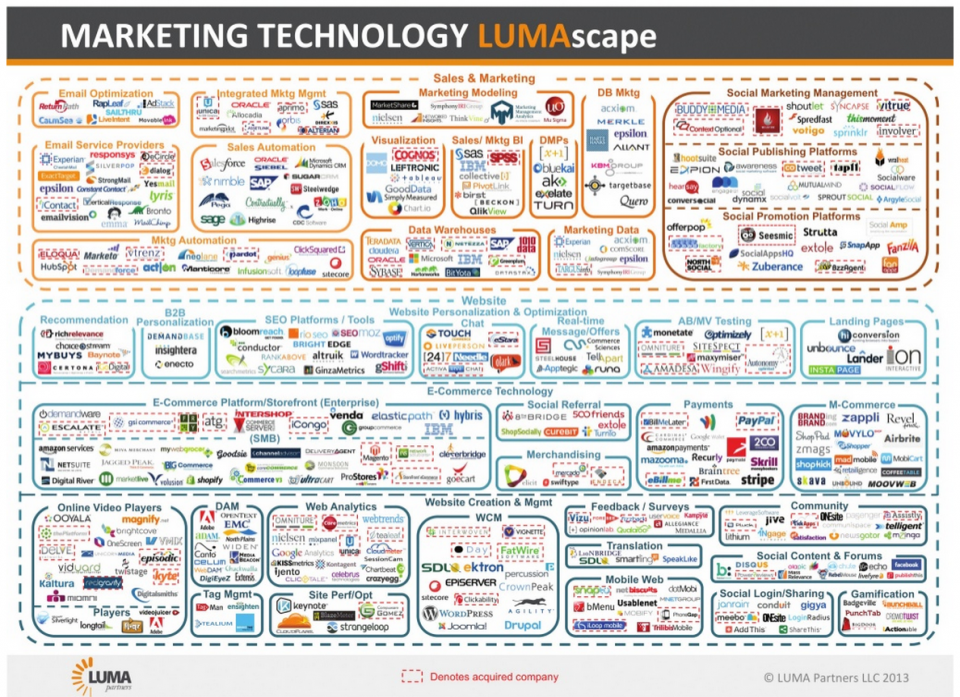
The marketing technology world is insanely specialized and complex. How complex? This new chart from LUMA Partners breaks down the world’s many different components, from sales and marketing to e-commerce technology to website creation and management.

screen shot 2013-05-08 at 3.56.56 pm

Once-Hot App Viddy Returns $18 Million To Investors And Prepares A Final Attempt To Turn Around

Once-Hot App Viddy Returns $18 Million To Investors And Prepares A Final Attempt To Turn Around

Alyson Shontell | May 8, 2013, 9:23 AM | 1,362 | 2

Last summer, social video app Viddy was in a much different place. It was in a battle to be the “Instagram of Video” alongside competitor SocialCam, and its number of users surged higher every day. Viddy used that momentum to raise a $30 million Series B round from investors such as Khosla VenturesNEA and Goldman Sachs. Even Shakira invested. But the traffic was temporary. Viddy grew quickly on Facebook‘s platform, but Facebook cut off the traffic hose when news broke that people were getting spammed by social video apps. Viddy’s executive team has all but left, including its CEO and its head of business development. In February, one-third of the staff was laid off. Now, Viddy is giving itself one last go. It’s returning $18 million to investors and keeping the remaining millions to try a few more product launches. “Viddy raised a substantial amount of capital last year, during different market conditions,” Viddy’s president, JJ Aguhob, told AllThingsD. “A year later, Viddy is a leaner, product-focused organization that is steadily growing its audience and will soon be releasing new products. Our late-stage investors have been very supportive, but it just makes good business sense to return capital we do not need and have a clean balance sheet in the process.” Having to return all that cash isn’t the most painful part of Viddy’s story either. Last year, Viddy reportedly turned down a $100 million buyout offer from Twitter when the app was on the upswing.

Billionaire Taizo Son Emerges With ‘Puzzle & Dragons’ App after shares of GungHo soared more than 10-fold this year. “Puzzle & Dragons” was the world’s top-grossing game app for smartphones in March

Billionaire Taizo Son Emerges With ‘Puzzle & Dragons’ App

Taizo Son, the youngest brother of SoftBank Corp. (9984) magnate Masayoshi Son, has become a billionaire after shares of his company GungHo Online Entertainment Inc. (3765) soared more than 10-fold (3765) this year. The GungHo chairman holds a 27.8 percent stake in the Tokyo-based company. The shares account for almost all of his $3.3 billion fortune, according to the Bloomberg Billionaires Index. Taizo Son has never appeared on an international wealth ranking. His older brother’s SoftBank holds a 40 percent stake and was an early GungHo investor in 2002. GungHo’s flagship app, “Puzzle & Dragons,” is the world’s best-selling game for Apple Inc (AAPL).’s iPhones and smartphones using Google Inc. (GOOG)’s Android software. The app has been downloaded more than 13 million times in Japan, or about 10 percent of the nation’s population. While free to play, the role-playing game encourages participants to buy and collect characters. It generates about $3 million a day in revenue, according to Macquarie Group Ltd. analyst David Gibson.

“It has become the ‘Angry Birds’ of Japan, the default game users download and play once they buy a smartphone,” Gibson, who has an outperform rating on the stock, wrote in an e-mail interview from Tokyo. “Puzzle & Dragons” was the world’s top-grossing game app for smartphones in March, according to the App Annie Index, which measures revenue and downloads.

Read more of this post

‘Fruit Ninja’ Will Add China Content to Narrow ‘Angry Birds’ Gap; The Brisbane, Australia-based company’s game has been downloaded 500 million times, less than a third of the 1.7 billion downloads for “Angry Birds.”

‘Fruit Ninja’ Will Add China Content to Narrow ‘Angry Birds’ Gap

Halfbrick Studios Pty, creator of the “Fruit Ninja” smartphone game, will add China-specific content to win users in the world’s most populous nation and narrow the gap with Rovio Entertainment Oy’s “Angry Birds.”

In the next three months, Halfbrick will release a China version of Fruit Ninja that will include special weapons and backgrounds designed to increase its local appeal, Phil Larsen, chief marketing officer for Halfbrick, said in an interview in Beijing yesterday. The Brisbane, Australia-based company’s game has been downloaded 500 million times, less than a third of the 1.7 billion downloads for “Angry Birds.”

Halfbrick has its work cut out to match Rovio, which has made tailoring products for China a key strategy. Espoo, Finland based Rovio built an update of its “Angry Birds Seasons” game around China’s Moon Festival, sells Angry Birds-themed mooncakes during the holiday and publishes comic books that use its bird and pig characters to tell Chinese legends, according to Chief Marketing Officer Peter Vesterbacka.

“A lot of foreign companies have this hubris that we are going to bring you this great product and you are going to love it,” said Mark Natkin, managing director of Marbridge Consulting Ltd., a market research firm in Beijing. “It’s a common mistake to think that localization means translation from English to Chinese and then you’re done.” Read more of this post

Why mobile wallets alone will fail; Smartphones are the key to revolutionizing shopping—but not in the way many think.

Why mobile wallets alone will fail

May 8, 2013: 11:18 AM ET

Smartphones are the key to revolutionizing shopping—but not in the way many think.

By Cyriac Roeding

FORTUNE — Mobile wallets as they are defined today are unfortunately a solution in search of a problem. Consumers are quite happy with their credit and debit cards…they work, they’re fast and they’re familiar. And retailers, while they may complain about credit card fees, have bigger strategic issues with online competition and showrooming than to worry about installing the next “wallet” created to replace tried and true payment systems they’ve already invested in – and successfully process millions of transactions every day. The problem with mobile payments is that payment isn’t a problem in the shopping world.

So, what is the problem? The problem is the experience of shopping. One hundred years ago, as a customer, you’d have been greeted by name when you walked into a local store. The shopkeeper would have asked you whether your kids liked the cereal he sold you last week. Nowadays no one “greets” you until you swipe your credit card because it isn’t until that point when the store finds out you are even there – that means, as you leave, when you are no longer looking for items to purchase. No one shows you something that *you* might like at the store while shopping – everything is impersonal. By scaling retail, shopping has become inhuman. Read more of this post

China may not overtake America this century after all; world’s tallest tower in Changsha should have been built by now when officials announced said last year the great edifice would be erected in 3 months

China may not overtake America this century after all

Doubts are growing about whether China can pass the US to become the world’s biggest economy this century amid warnings that the country’s 30-year miracle is nearing exhaustion.

China’s catch-up spurt has a few more years to run in the Western hinterlands perhaps, but when the full story comes out we may find that nationwide growth has already fallen below 7pc. Photo: Getty

By Ambrose Evans-Pritchard

3:21PM BST 08 May 2013

The world’s tallest tower should have been built by now. Officials said last year that the great edifice with 220 floors would be erected in three months flat in China’s inland city of Changsha by March, snatching the crown from Dubai’s Burj Khalifa. The deadline has come and gone, yet the wasteland sits untouched. It now looks as if the fin d’époque project – using prefab blocs – may never be approved. Even China knows its limits. Read more of this post

The US will match China on the cost of manufacturing by 2015. Companies in both countries must adapt

The parity puzzle

Thursday, May 9, 2013

The US will match China on the cost of manufacturing by 2015. Companies in both countries must adapt, write Ivo Naumann and Steve Maurer

Ivo Naumann and Steve Maurer are managing directors at AlixPartners, a global business advisory firm. Naumann heads the firm’s activities in mainland China, and Maurer leads the firm’s manufacturing practice for the Americas.

It happens regularly in virtually every segment of every industry: A newcomer arrives, offers an advantage that competitors in the segment can’t match and rapidly begins to build both its business and market share.

What often follows, however, is also predictable: The market adapts, the advantage diminishes and the newcomer finds that it is in a vulnerable, rather than valued, situation. Read more of this post

U.S. taxpayers employ more low-wage workers than Wal-Mart, McDonald’s combined

Study: U.S. taxpayers employ more low-wage workers than Wal-Mart, McDonald’s combined

By Jim Tankersley and Marjorie Censer, Published: May 8

_tn_1001.7.822064553_Ud14mreGEeKS8_KRgBk2uA_w-cheapgov

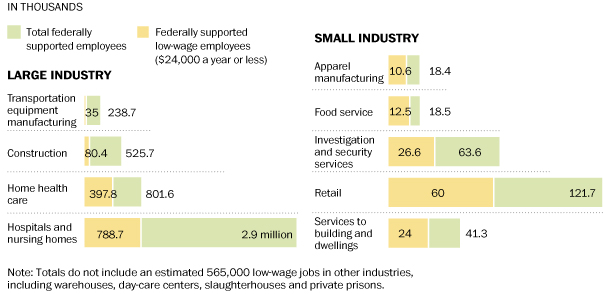
Federal taxpayers employ more low-wage workers than Wal-Mart and McDonald’s combined, a new study calculates.

The report from a public policy organization Demos, set to be released Wednesday, estimates that taxpayer dollars fund nearly 2 million private-sector jobs that pay $24,000 a year — about $12 an hour — or less. Those workers owe their incomes to government contracts, Medicare and Medicaid spending, and federal infrastructure funds, among other public sources. In contrast, Demos estimates that about 1.4 million workers earn that amount or less at Wal-Mart and McDonald’s, which are two of the largest employers of low-wage workers.

The findings highlight inequality within the government contracting industry; as chief executives of major contractors rake in millions, many contract employees are struggling to get by, according to the report from Demos, which advocates for worker-friendly policies. It is a situation that could be worsened by the budget pressures of sequestration, which is pushing the federal government to spend fewer dollars and pursue lower-priced contracts. Read more of this post

Google Translate For Android Can Now Interpret 16 Additional Languages By Camera, Adds Phrasebook Support

Google Translate For Android Can Now Interpret 16 Additional Languages By Camera, Adds Phrasebook Support

FREDERIC LARDINOIS

posted 7 hours ago

One of the coolest features of the Google Translate for Android app is that you can just point your camera at a text, tap the word you want to translate and get a translation back.Starting today, this feature supports 16 additional languages. Those are Bulgarian, Catalan, Danish, Estonian, Finnish, Croatian, Hungarian, Indonesian, Icelandic, Lithuanian, Latvian, Norwegian, Romanian, Slovak, Slovenian and Swedish. That’s in addition to Czech, Dutch, English, French, German, Italian, Polish, Portuguese, Russian, Spanish, and Turkish, which the app already supported in its first release. Google uses optical character recognition and its machine translation tools to make all of this work. In addition, Google is making its recently introducedphrasebook feature available in that app. The phrasebook, Google said at the time, allows “you to save the most useful phrases to you, for easy reference later on, exactly when you need them,” and revisiting them regularly should help you turn these translations “into lasting knowledge.” The phrasebook is now available in Translate’s app menu, where it replaces the app’s ‘favorite’ feature. The service will automatically sync with your Google Account (assuming you are signed in), so any changes you make on your phone will also be reflected on the Google Translate desktop site. “With your favorite phrases synced across devices,” Google writes, “we hope you’ll never be at a loss for words again.” It’s worth noting that the iOS version of the app does not currently support translate by camera.

Huawei founder gives first ever interview

Huawei founder gives first ever interview

May 9, 2013 – 2:21PM

Tom Pullar-Strecker

The founder and president of Chinese technology giant Huawei, Ren Zhengfei, has used a visit to New Zealand to speak to the media for the first time in his career.

Ren, 68, had never previously consented to media interviews inside or outside of China, but this morning fielded questions from a handful of journalists at Wellington’s Museum Hotel on topics ranging from his personal view of China’s human rights record to a rumour he will soon retire.

Responding to speculation about Huawei’s relations with the Chinese government, he said they were no different to those that might exist between a New Zealand firm and the New Zealand government.

His visit follows a trade trip to China by Prime Minister John Key and a large entourage last month to celebrate the fifth anniversary of the countries’ free-trade agreement, during which relations between the governments appeared to hit a new high. Read more of this post

Kuroda stimulus policies backfire as mortgage costs rise

Kuroda stimulus policies backfire as mortgage costs rise

BY YUMI IKEDA

BLOOMBERG

MAY 9, 2013

Bank of Japan Gov. Haruhiko Kuroda’s stimulus policies are backfiring in the housing market, where mortgage rates are rising even as the central bank floods the financial system with cash. Fixed 35-year home-loan costs rose to 1.81 percent this month, the first increase since February and up from an all-time low of 1.8 percent in April, according to data compiled by the Japan Housing Finance Agency. The BOJ’s April 4 announcement that it would double bond buying to generate 2 percent inflation unleashed the highest government-debt volatility in a decade and pushed 10-year yields up by five basis points. The benchmark lending rate for large corporations, known as the prime rate, increased five basis points from its record low to 1.2 percent on April 10, despite the BOJ’s aim of stoking the economy through cheaper funding.

“It makes little economic sense for rates to decline when the BOJ says it will raise consumer prices,” said Toru Suehiro, a market economist at Mizuho Securities Co. “Yields are higher than before the monetary easing to reflect the volatility risk, and lending rates have risen because they are set based on bond yields.” Read more of this post

Meltdown of company triggers suicides in India; Failing to repay investors’ money after the Saradha Group meltdown, an agent and a director of two different deposit mobilising companies committed suicide

Meltdown of company triggers suicides in India


Thu, May 09, 2013
The States Man/Asia News Network

Indian activists of the Congress party shout slogans against the arrested Chairman of Saradha group, Sudipta Sen, outside the court in Kolkata on April 25, 2013.

Failing to repay investors’ money after the Saradha Group meltdown, an agent and a director of two different deposit mobilising companies committed suicide. Ten persons have committed suicide in the state so far following the multi-million dollar scam.

Indrajit Roy, one of the directors of Hello India, a chit fund company, committed suicide by hanging himself from the ceiling of a room in his residence off 14 Brindaban Mallick Lane at Amherst Street today. Read more of this post

Next Wal-Mart CEO Faces Challenges Sam Walton Never Saw

Next Wal-Mart CEO Faces Challenges Sam Walton Never Saw

As Wal-Mart Stores Inc. (WMT) prepares to anoint the fifth chief executive in its history, the world’s largest retailer is grappling with challenges founder Sam Walton never faced.

Wal-Mart’s board has identified international chief Doug McMillon, 46, and Bill Simon, 53, who runs the U.S. operations, as leading candidates to succeed Chief Executive Officer Mike Duke, according to a person familiar with the situation. While Duke, 63, isn’t expected to step down immediately, Wal-Mart may name his successor in the coming months, said the person, who asked not to be identified because the matter is private.

Wal-Mart is trying to goose slowing sales gains in the U.S. as such rivals as Amazon.com Inc. (AMZN) and the dollar stores lure its customers. Overseas, the company is struggling to ignite growth in China and other emerging markets even as it probes allegations of bribery in Mexico and possible violations of the Foreign Corrupt Practices Act.

The next CEO will face “tough decisions globally,” said David Strasser, a New York-based analyst for Janney Montgomery Scott LLC. “They have to pick and choose. China has been a big struggle. What do you do? Double down? Back out?” Read more of this post

Fed Council Warned of Credit Risk, Asset Price Bubble

Fed Council Warned of Credit Risk, Asset Price Bubble

A Federal Reserve (TREFTOTL) panel of bankers warned policy makers in February that record stimulus was pushing financial institutions to take on more credit risk and creating a “bubble” in the price of U.S. farmland.

“The margin pressures that the low-rate environment has put on financial institutions, coupled with dramatically increased compliance and other infrastructure costs, have caused many to seek higher returns by accepting greater interest-rate or credit risk,” the bankers said on Feb. 8, following a Federal Open Market Committee meeting on Jan. 29-30.

The minutes of the meeting by the Federal Advisory Council trace how the 12 bankers’ views evolved from opposition to the Fed’s announcement of new bond buying in September to support for Fed efforts in February to boost an economic expansion beset by a “drag” from fiscal tightening. Read more of this post

Aquino Hunts ‘Big Fish’ to Bury Philippines’ Sick-Man Tag

Aquino Hunts ‘Big Fish’ to Bury Philippines’ Sick-Man Tag

The Philippines, Asia’s fastest-growing economy after China, needs to do more to finally lose its decades-old tag as the “Sick Man of Asia,” according to the country’s president.

“We’ll have to be able to prove that this is not cyclical, or a temporary aberration,” President Benigno Aquino said in an interview yesterday of the country’s economic revival. “We’ll have to be able to do it year in, year out.” His point was illustrated when the lights went out during the 90-minute meeting at the presidential compound in Manila, as the capital suffered a major power failure. Aquino, 53, who is campaigning to expand his support in elections for the Senate on May 13, said more needs to be done to jail the “big fish” in his anti-corruption drive. Reducing the number of Filipinos who travel abroad to find work is also a key benchmark of success in the three years that remain in his single six-year term, he said. In the first half of his presidency, Aquino has overseen a resurgence in the economy, which expanded 6.6 percent last year. While the growth rate and a shrinking budget deficit helped earn the country a ratings upgrade, they mask an unemployment rate that is among the highest in Asia-Pacific and poverty levels unchanged since before he took office in 2010.  Read more of this post

SAT Scandal Shines Harsh Light on South Korean Academics

May 9, 2013, 4:28 a.m. ET

SAT Scandal Shines Harsh Light on South Korean Academics

By JEYUP S. KWAAK

AI-CA829_SKCHEA_NS_20130508035708

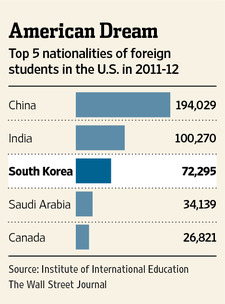
SEOUL—The recent cancellation of U.S. college entrance exams in South Korea—the first time SAT tests have been called off nationwide anywhere in the world for suspected cheating—is throwing the spotlight back on the country’s hyper-competitive academic environment. The May 4 sessions of the SAT, the most widely used standardized evaluation tool for high-school students applying to American universities, were scrapped three days before the test date across South Korea after the U.S.-based administrator discovered questions from the tests circulating in test-prep centers in the country.

The cancellation has thrown college-entrance preparations for thousands of students into disarray. Some students now plan to travel to other countries in the region to ensure they are able to take the next test in the summer. Read more of this post

Shale Boom a Bust for Europe’s Gas Plants; European utilities are forced to mothball modern gas-fired power plants that can’t compete with growing imports of cheap coal dislodged from the U.S.

May 8, 2013, 11:44 a.m. ET

Shale Boom a Bust for Europe’s Gas Plants

By JAN HROMADKO

EI-CA770_EUPOWE_G_20130508140906

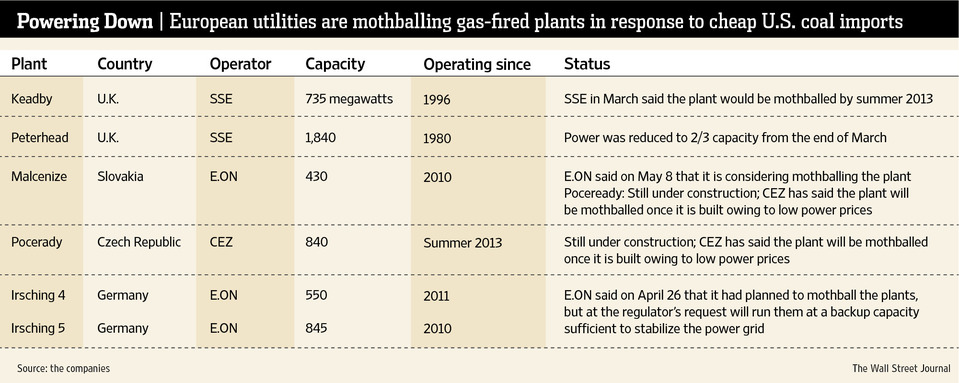
FRANKFURT—The ripples of the North American shale boom continue to spread, as a growing number of European utilities are forced to mothball modern gas-fired power plants that can’t compete with growing imports of cheap coal dislodged from the U.S.

Norwegian state energy company Statkraft said Wednesday it has idled a gas-fired power station in Germany that couldn’t compete with its coal-fired rivals, while German utility E.ON EOAN.XE -0.60% SE said it is seriously considering mothballing more gas-fueled plants, including a state-of-the-art facility in Slovakia.

Other European utilities have taken similar action, presenting policy makers with a dilemma—cheaper coal-fired power could provide some relief for the region’s struggling economies, but might be incompatible with long-term goals for carbon emissions and renewable energy.

The closures across Europe are another example of the far-reaching effects of the North American energy-supply boom. Surging supplies of natural gas in North America, unlocked from shale rock by a new combination of technology known as hydraulic fracturing, have prompted many U.S. power generators to switch away from coal, pushing increasing amounts of the fuel into Europe as cheap imports.

In 2012, U.S. exports of coal to Europe rose 23% to 66.4 million short tons, according to data from the U.S. Energy Information Administration.

Much of this coal is displacing natural gas as a fuel for electricity generation in Europe. In the U.K., for example, the proportion of electricity generated from coal rose to its highest level in 17 years in 2012, while gas fell to a corresponding low.

“The economic situation of our legacy business in Europe, particularly in conventional power generation, remains difficult,” said E. ON Chief Executive Johannes Teyssen.

Gas-fired power plants are losing out to coal-fueled rivals, which are more competitive at present electricity and commodity prices. Additionally, the expansion of renewable energies is reducing the operating hours of gas power plants; wind and solar energy output is generally higher at peak demand hours, a market gas plants are designed to serve. “Companies are struggling to operate gas-fired power plants economically, even in case of modern, state-of-the-art facilities,” said IHS Energy analyst Kash Burchett. Read more of this post

Contemporary Accounting Research: Family Ownership and CEO Turnovers

Family Ownership and CEO Turnovers

Xia Chen Singapore Management University

Qiang Cheng Singapore Management University

Zhonglan Dai University of Texas at Dallas – School of Management

May 30, 2013
Contemporary Accounting Research, Forthcoming

Abstract: 
This paper investigates the impact of the founding family’s presence on CEO turnover decisions. We find that family firms managed by CEOs outside the founding family (i.e., professional CEO family firms) have higher CEO turnover-performance sensitivity than family firms managed by family members (i.e., family CEO firms) or non-family firms. These results are robust to alternative performance measures and CEO turnover definitions. Additional analyses indicate that higher family ownership leads to even higher (lower) turnover-performance sensitivity in professional CEO family firms (family CEO firms). These results indicate that, with regard to CEO turnover decisions, better monitoring of CEOs by family owners leads to the alleviation of agency conflicts, but the power of family CEOs leads to potential family entrenchment.

Are the Life and Death of a Young Start-Up Indeed in the Power of the Tongue? Lessons from Online Crowdfunding Pitches

Are the Life and Death of a Young Start-Up Indeed in the Power of the Tongue? Lessons from Online Crowdfunding Pitches

Dan Marom Hebrew University of Jerusalem – Jerusalem School of Business Administration; Hebrew University of Jerusalem

Orly Sade Hebrew University of Jerusalem – Department of Finance

April 23, 2013

Abstract: 
Securing seed funding is one of the biggest challenges for any entrepreneur. While presenting an initiative to potential investors, the entrepreneur can choose the extent to which she presents herself, versus presenting the project idea. This research investigates not only this decision, but also the effect of this decision on the success of the fundraising in a leading crowdfunding financing platform (Kickstarter). In our empirical analysis, we use a text mining quantification method validated by experiment and robustness tests. This methodology was implemented on a dataset that was collected by custom software, and which includes more than 20,000 online business pitches and their crowdfunding results. Our findings indicate clearly that in Kickstarter fundraising, entrepreneurs’ descriptions do matter – projects which highlighted their entrepreneurs enjoyed higher rates of success, controlling for other relevant variables.

Pre-Disclosure Accumulations by Activist Investors: Evidence and Policy

Pre-Disclosure Accumulations by Activist Investors: Evidence and Policy

Lucian A. Bebchuk Harvard Law School; National Bureau of Economic Research (NBER); European Corporate Governance Institute (ECGI)

Alon P. Brav Duke University – Fuqua School of Business

Robert J. Jackson Jr.Columbia Law School

Wei Jiang Columbia Business School – Finance and Economics

April 1, 2013
Journal of Corporation Law, Volume 39, Fall 2013, Forthcoming

Abstract: 
The SEC is currently considering a rulemaking petition requesting that the Commission shorten the ten-day window, established by Section 13(d) of the Williams Act, within which investors must publicly disclose purchases of a 5% or greater stake in public companies. In this Article, we provide the first systematic empirical evidence on these disclosures and find that several of the petition’s factual premises are not consistent with the evidence. Our analysis is based on about 2,000 filings by activist hedge funds during the period of 1994-2007. We find that the data are inconsistent with the petition’s key claim that changes in market practices and technologies have operated over time to increase the magnitude of pre-disclosure accumulations, making existing rules “obsolete” and therefore requiring the petition’s proposed “modernization.” The median stake that these investors disclose in their 13(d) filings has remained stable throughout the 17-year period that we study, and regression analysis does not identify a trend over time of changes in the stake disclosed by investors. We also find that:
* A substantial majority of 13(d) filings are actually made by investors other than activist hedge funds, and these investors often use a substantial amount of the 10-day window before disclosing their stake.
* A significant proportion of poison pills have low thresholds of 15% or less, so that management can use 13(d) disclosures to adopt low-trigger pills to prevent any further stock accumulations by activists — a fact that any tightening of the SEC’s rules in this area should take into account.
* Even when activists wait the full ten days to disclose their stakes, their purchases seem to be disproportionately concentrated on the day they cross the threshold and the following day; thus, the practical difference in pre-disclosure accumulations between the existing regime and the rules in jurisdictions with shorter disclosure windows is likely much smaller than the petition assumes.
* About 10% of 13(d) filings seem to be made after the 10-day window has expired; the SEC may therefore want to consider tightening the enforcement of existing rules before examining the proposed acceleration of the deadline.
Our analysis provides new empirical evidence that should inform the SEC’s consideration of this subject — and a foundation on which subsequent empirical and policy analysis can build.

The Signals in the Noise: The Role of Reputable Investors in a Crowdfunding Market

The Signals in the Noise: The Role of Reputable Investors in a Crowdfunding Market

Keongtae Kim University of Maryland – Robert H. Smith School of Business

Siva Viswanathan University of Maryland – Robert H. Smith School of Business

April 29, 2013

Abstract: 
This paper examines the role of reputable investors in a crowdfunding market. Using a novel data set on individual investments in a crowdfunding market for mobile applications, we investigate whether early investments serve as signals of quality for later investors and if the value of these signals differs depending on the identity of early reputable investors. We find that reputable investors – app developer investors and experienced investors – tend to invest early. Both are likely to affect later investors, although their expertise determines their influence. App developer investors tend to have a better knowledge of the product and are found to be more influential for “concept apps” (apps that are in development), whereas experienced investors – investors with a better knowledge of market performance are found to be more influential for “live apps” (apps that are already being sold in the market). Our findings show that investors in this market, although inexperienced, are rather sophisticated in their ability to identify and exploit nuanced differences between various signals within the same market. In examining the ex-post performance of apps, we find that successful funding in the market is positively associated with ex-post app sales, providing some indication of rational herding among investors. Our study offers new insights for theories of opinion leadership and signaling, and also has practical implications for the design of crowdfunding markets.

Giant Australian property trust GPT agreed to pay its shareholders $75 million for allegedly failing to disclose in 2008 that the company was financially underperforming its previous forecasts.

Davids win in giant fight with GPT

May 9, 2013

Elizabeth Knight

The final chapter in the legal brawl between giant property trust GPT and its shareholders drew to a close on Wednesday. The Davids won and the Goliath agreed to pay $75 million for allegedly failing to disclose in 2008 that the company was financially underperforming its previous forecasts. It was a two-year battle and it went to the wire. In class action cases, neither party wants the outcome to be determined by the courts and this was no exception. Allowing the courts to set precedents presents hazards for both sides. The corporate defendant would have to accept liability if it lost and the damages could be more onerous. For the shareholder plaintiffs, a poor outcome could be every bit as damaging if an unfavourable precedent was set.

Corporate continuous disclosure is an area in which the phrase ”the lawyers always win” is particularly apposite. This class action was mounted in 2011 by lawyers Slater & Gordon and bankrolled by a US litigation funder who, for its troubles, will probably get about 25 per cent of the proceeds. Thanks to the newly intense focus in this area, legal firms are raking in fees for ensuring companies adhere to legal disclosure responsibilities. For the legal fraternity, corporate disclosure is lucrative business. Read more of this post