Shale Boom a Bust for Europe’s Gas Plants; European utilities are forced to mothball modern gas-fired power plants that can’t compete with growing imports of cheap coal dislodged from the U.S.
May 9, 2013 Leave a comment
May 8, 2013, 11:44 a.m. ET
Shale Boom a Bust for Europe’s Gas Plants
By JAN HROMADKO
FRANKFURT—The ripples of the North American shale boom continue to spread, as a growing number of European utilities are forced to mothball modern gas-fired power plants that can’t compete with growing imports of cheap coal dislodged from the U.S.
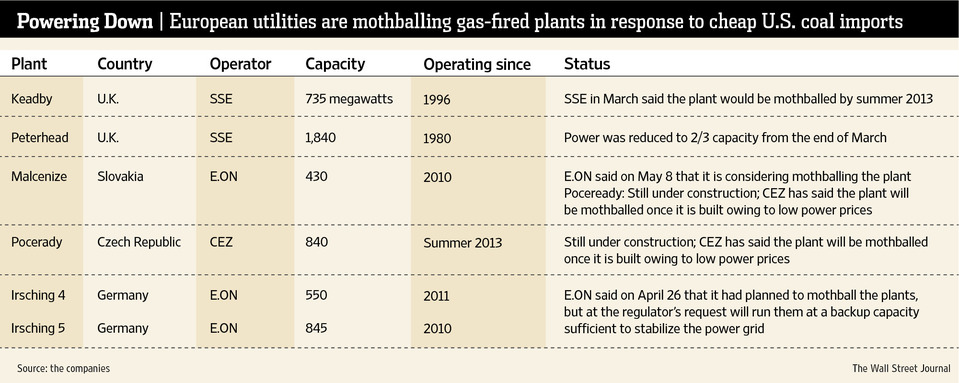
Norwegian state energy company Statkraft said Wednesday it has idled a gas-fired power station in Germany that couldn’t compete with its coal-fired rivals, while German utility E.ON EOAN.XE -0.60% SE said it is seriously considering mothballing more gas-fueled plants, including a state-of-the-art facility in Slovakia.
Other European utilities have taken similar action, presenting policy makers with a dilemma—cheaper coal-fired power could provide some relief for the region’s struggling economies, but might be incompatible with long-term goals for carbon emissions and renewable energy.
The closures across Europe are another example of the far-reaching effects of the North American energy-supply boom. Surging supplies of natural gas in North America, unlocked from shale rock by a new combination of technology known as hydraulic fracturing, have prompted many U.S. power generators to switch away from coal, pushing increasing amounts of the fuel into Europe as cheap imports.
In 2012, U.S. exports of coal to Europe rose 23% to 66.4 million short tons, according to data from the U.S. Energy Information Administration.
Much of this coal is displacing natural gas as a fuel for electricity generation in Europe. In the U.K., for example, the proportion of electricity generated from coal rose to its highest level in 17 years in 2012, while gas fell to a corresponding low.
“The economic situation of our legacy business in Europe, particularly in conventional power generation, remains difficult,” said E. ON Chief Executive Johannes Teyssen.
Gas-fired power plants are losing out to coal-fueled rivals, which are more competitive at present electricity and commodity prices. Additionally, the expansion of renewable energies is reducing the operating hours of gas power plants; wind and solar energy output is generally higher at peak demand hours, a market gas plants are designed to serve. “Companies are struggling to operate gas-fired power plants economically, even in case of modern, state-of-the-art facilities,” said IHS Energy analyst Kash Burchett.Coal prices for year-ahead delivery on the European Energy Exchange have fallen nearly 19% over the past 12 months. The bulk of natural gas on mainland Europe is priced relative to oil and in the first quarter of 2013 the average price of crude benchmark Brent fell by just 5% on the year, according to BP data.
That has changed the dynamics of the power market. Czech utility CEZ ASBAACEZ.PR +0.09% said last week it could keep a new gas-fired power plant due to start in summer closed for much of the time because it will be unprofitable from day one. U.K. utility SSE SSE.LN -0.13% PLC said in March it would close one gas-fired plant, reduce capacity at a second and won’t build any new ones for several years because of the poor economics.
E.ON’s power-plant closures could have gone further had it not struck a deal with Germany’s grid regulator and a power-grid operator to keep two modern but unprofitable gas-fired power plants in operation. E.ON and its partners in the plants had considered mothballing them, but the grid regulator considered them crucial for security of supply in southern Germany.
According to Eurelectric, the association of the electricity industry in Europe, in 2010—the most recent figures available—the 27 members of the European Union generated 24% of their electricity from coal and 23% from gas, with the remainder a mix of nuclear and renewables.
Cheap coal isn’t bad news for every utility. RWE AG, RWE.XE -0.34% Germany’s largest electricity producer by capacity, which gets over 62% of its electricity from coal, said earlier this year that it increased production from coal and lignite power plants by over 16% in 2012. RWE expects flat operating earnings in 2013, while E. ON has projected a decline of up to 15% on the year.
There could also be wider benefit. “At the moment the broader economy is benefiting from cheaper power production,” said Marcus Schenck, E.ON’s chief financial officer, in a conference call with reporters. But that only holds if, “one believes that environmental protection isn’t a political priority anymore.”
The EU has committed to cutting its carbon-dioxide emissions by 20% from 1990 levels and getting 20% of its energy from renewable sources by 2020. A spokesman for Europe’s energy commissioner, Günther Oettinger, on Wednesday declined to comment on the latest plant closures. Mr. Oettinger said in an interview last month that the bloc should broaden the focus of its energy policy beyond purely reducing greenhouse-gas emissions to ensuring that energy will remain affordable.
Industry experts warn that closure of a broad swath of gas-fired power plants could weaken the continent’s energy security as intermittent renewable energy such as wind becomes more widespread.
“In practice, intermittent capacity requires some form of backup,” IHS Energy’s Mr. Burchett said. A looming lack of gas-fired power plants, which are ideal to help mitigate imbalances that can be caused by unpredictable shifts in supply from renewable energy like wind power, could aggravate the problem, he said.
France is rolling out a new market model that could offer financial incentives to utilities to retain backup gas-fired power, said Mr. Burchett.
Mr. Teyssen renewed his demand for a new market design in Germany to give similar incentives, although the coming general election in September has slowed progress on market reforms.
In Italy, which does offer financial incentives to maintain backup power plants, a spokesman for utility Enel SpA ENEL.MI -1.41% said it has no plans to mothball its plants.
 About bambooinnovator
 Bamboo Innovator