ARM: “A lot of companies talk about collaboration, but they struggle with it because it’s not really in their DNA”. The company has established a strong level of trust with partners over 22 years in business, enabling partners to share proprietary information and intellectual property with ARM without reservations
May 14, 2013 Leave a comment
Segars won’t rock the ARM boat
Dylan McGrath
5/10/2013 3:21 PM EDT
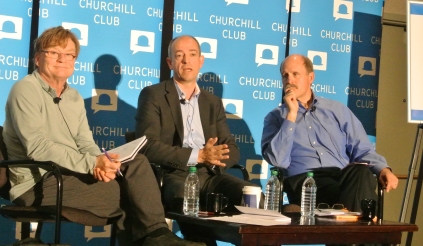
From left: James Moore, a former Harvard Berkman Center Fellow, Simon Segars, the incoming CEO of ARM, and Paul Saffo, a veteran industry forecaster at Discern Analytics, at the Churchill Club event Thursday.
Simon Segars, the soon-to-be CEO of processor IP licensor ARM Holdings plc, is obviously a believer in one timeless adage: If it ain’t broke, don’t fix it. Segars, who is set to take the reins at ARM from Warren East on July 1, said Thursday (May 9) he doesn’t plan any major changes to put his stamp on the company he’s worked for since 1991. “I’m going to do exactly the same things as we’ve been doing, cause they are working very well,” Segars told an audience of about 250 people at a Churchill Club event in San Francisco Thursday. “I truly believe that what has gotten us to this point is going to be what gets us through the next set of technology challenges,” Segars said. Segars, who last month told EE Times he wouldcontinue to emphasize driving down the power consumption of electronics as ARM CEO,would be wise to stick with what works. ARM has rocketed to prominence in recent years, even though—compared to perceived peers such as Intel Corp.—it’s still a relatively small company, with 2012 revenue of about $880 million. The Churchill Club even Thursday, moderated by Paul Saffo, a veteran industry forecaster at Discern Analytics, focused mainly on ARM’s collaborative ecosystem, considered a model for the industry. Saffo quipped during the event that the idea of collaboration has become any industry buzz term that many people pay lip service to but few actually make it a focus. “A lot of companies talk about collaboration, but they struggle with it because it’s not really in their DNA,” Saffo said. ARM, however, is the exception. Segars acknowledged that maintaining a large network of partners—membership in ARM’s Connected Community is approaching 1,000 companies—can be challenging, especially since many of the community’s members compete head to head in the marketplace. “They are in business to put each other out of business,” Segars said. But ARM mostly stays above the fray, Segars said. The company has established a strong level of trust with partners over 22 years in business, enabling partners to share proprietary information and intellectual property with ARM without reservations, he said. Occasionally, he said, ARM does find itself caught in the middle of disputes between its member companies. James Moore, a former Harvard Berkman Center Fellow who also participated in the Churchill Club event Thursday, raved about ARM’s business model, saying the firm focuses on openess and the proliferation of its technology instead of relentlessly focusing on profit margin, as many organizations do. ARM doesn’t take as much profit as it could, Moore said, and does not attempt to lock partners in using its technology. Moore, who was contracted by ARM to do a study of the company’s ecosystem, said the ARM ecosystem may well be unique. “The disruptive technology here is this organization, where people are willing to take less in favor of growth [in the use of its IP],” Moore said.
 About bambooinnovator
 Bamboo Innovator