Lowering Salt Intake to Improve Health May Backfire

Lowering Salt Intake to Improve Health May Backfire

Lowering sodium intake, a drumbeat of doctors’ efforts to improve patient health, may have the opposite effect if taken to the extreme, scientists said.

U.S. dietary guidelines to reduce sodium intake to 1,500 milligrams a day for certain people aren’t supported by enough scientific evidence, an Institute of Medicine panel said today in a report. Studies reviewed by the panel didn’t prove health outcomes improved when salt consumption was cut to that level.

“Lowering sodium intake too much may actually increase a person’s risk of some health problems,” Brian Strom, the panel chairman and a public health professor at the University of Pennsylvania Perelman School of Medicine, said in a statement. The studies still “support previous findings that reducing sodium from very high intake levels to moderate levels improves health.” Read more of this post


Caffeine key to cloning ‘Holy Grail’: Scientists have used caffeine to achieve a stem cell breakthrough that many researchers thought impossible but which could lead to new therapies for many crippling diseases

Shot in the arm for mission to take stem cells from embryos

May 16, 2013

Nicky Phillips

Scientists have used caffeine to achieve a stem cell breakthrough that many researchers thought impossible but which could lead to new therapies for many crippling diseases. A US team used a human skin cell to create a cloned human embryo from which they were able to extract embryonic stem cells, a world first. This technique, known as somatic cell nuclear transfer, or therapeutic cloning, is ethically controversial because it involves the production, and subsequent destruction, of a human embryo.

1_art-353-16cloning_update-300x0 Read more of this post

How Many Turns in a Screw? Big Data Knows; Raytheon is one of many manufacturers installing more sophisticated, automated systems to gather and analyze factory-floor data

Updated May 15, 2013, 7:57 p.m. ET

How Many Turns in a Screw? Big Data Knows

By JAMES R. HAGERTY

Companies’ pursuit of “big data”—collecting and crunching ever larger amounts of information—is often thought of as another way to figure out exactly what customers want. But big data is also a means of measuring millions of little things in factories, such as how many times each screw is turned.

That is what Raytheon Co. RTN +1.75% is doing at a new missile plant in Huntsville, Ala. If a screw is supposed to be turned 13 times after it is inserted but is instead turned only 12 times, an error message flashes and production of the missile or component halts, says Randy Stevenson, a missile-systems executive at Raytheon. Improvising with a defective screw or the wrong size screw isn’t an option, he says. “It’s either right or it’s not right.”

Raytheon is one of many manufacturers installing more sophisticated, automated systems to gather and analyze factory-floor data. The company uses software known as manufacturing execution systems, or MES, which has been around since the 1980s. Semiconductor and other high-tech companies were early adopters, but now “others are catching up,” says Tom Comstock, an executive vice president at Apriso Corp., one of the suppliers of this software. Other suppliers include General Electric Co., GE +1.00% SAP AG, SAP.XE +0.03%Siemens AG SIE.XE -0.28% and Rockwell Automation Inc. ROK -0.38% Read more of this post

Smartphone Locating Aid for Rescues Pushed as GE Objects

Smartphone Locating Aid for Rescues Pushed as GE Objects

Technology to help police locate wireless callers inside buildings advanced with a U.S. regulator past objections from General Electric Co. (GE), Google Inc. (GOOG) and the E-ZPass Group toll system that it may interfere with millions of devices.

Federal Communications Commission Chairman Julius Genachowski yesterday asked fellow commissioners to approve closely held Progeny LMS LLC’s location system, Neil Grace, an FCC spokesman, said today. To proceed, the measure needs a majority of commissioner votes.

Under Progeny’s proposal, smartphones would calculate their position using radio waves put out by the company, and would report that location during emergency calls. In tests, Progeny’s technology was able to pinpoint within 2 meters (2.2 yards) the vertical position of the calling party, “potentially revolutionizing the speed of emergency response in large multi-story urban environments,” the company said in a filing.

Progeny’s technology represents “a clear improvement” over current techniques, which don’t offer reliable location information for indoor calls from wireless phones, the International Association of Chiefs of Police, an Alexandria, Virginia-based membership organization, said in an FCC filing. Read more of this post

Startups’ Secret: More Are Facing Patent Suits

May 15, 2013, 2:32 p.m. ET

Startups’ Secret: More Are Facing Patent Suits

By PUI-WING TAM

Kate Endress is mired in a type of legal quagmire that is afflicting an increasing number of Silicon Valley startup entrepreneurs, but which few typically want to openly discuss.

Ms. Endress is chief executive and co-founder of San Mateo-based Ditto Technologies Inc., a website that sells designer eyewear. Founded in 2011 and backed by venture-capital firm August Capital, the site features 3-D virtual “try-on” technology that lets customers scale a pair of glasses to their face.

In February, Ms. Endress received a complaint from lawyers of 1-800 Contacts Inc., a Draper, Utah, online purveyor of contact lenses owned by WellPoint Inc. WLP -0.22%In its lawsuit, filed in U.S. District Court for the District of Utah’s Central Division, 1-800 Contacts said it had purchased a patent for the 3-D technology last year and alleged Ditto was infringing it. Read more of this post

Longer Odds for Short-Selling Success

May 15, 2013, 4:35 p.m. ET

Longer Odds for Short-Selling Success

By JUSTIN LAHART

MI-BV992_SHORTH_NS_20130515170904

Most investors know that shorting a stock, or betting it will fall in value, entails the chance of huge losses. But knowing that is nothing like seeing it in action. The ramp higher in Tesla TSLA +1.92% shares in the days since the electric-car maker reported a first-quarter profit has served as a vivid reminder of just how dangerous a game shorting stocks can be. It may also signal a shift to a kind of market environment that can prove particularly treacherous for those on the short side. Even before Tesla reported, investors heavily short the shares had to be feeling queasy. In the time since Tesla said in early April that it had beaten its first-quarter deliveries target, its shares had risen 47%. When the stock jumped after the earnings report, the “short squeeze” looks as if it got unbearable. Investors raced to buy back shares they had sold short. That intensified the stock’s move higher, prompting even more pessimistic investors to throw in the towel. Tesla’s shares rose 53% in three trading days, taking its market value to a peak of $10.1 billion, from $6.4 billion. In turn, shares of other heavily shorted companies, likeInterOil IOC +1.39% and Questcor PharmaceuticalsQCOR -9.46% also rallied. That is an indication some traders are actively looking to buy stocks with high short interest, posing an additional risk for short sellers.

Read more of this post

Private equity funds have struggled to offload investments made before the financial crisis and are taking longer to pay out to investors

Fund managers fail to offload investments following crisis

Filed 15 hours ago

LONDON – Private equity funds have struggled to offload investments made before the financial crisis and are taking longer to pay out to investors, research showed on Wednesday. Data from research firm Prequin showed that companies sold by funds in 2012 were held for an average of 5 years, compared to an average holding period of 3.9 years for companies sold in 2008. “Fund managers are still struggling to sell investments for a sufficient profit that were purchased at peak prices during the buyout boom, and consequently are holding portfolio companies for longer,” said Ignatius Fogarty, Head of Private Equity Products at Prequin. Just 33 percent of the capital investors chipped into deals made in 2007 has been returned in the last six years, compared to a 95 percent pay back rate in the six years after 2001.


Do Canadians love real estate too much?

Do Canadians love real estate too much?

Garry Marr | 13/05/15 | Last Updated: 13/05/15 6:57 PM ET
If you want to include your home as part of your asset mix, Canadians may not be such bad savers after all.

Chris asks: I have a large mortgage ($327,000) and I have been thinking a lot lately about a plan to pay it off by age 50. I’m 34, married, and my wife and I have a two-year-old son. We are responsible financially and our only other debt is for one car payment. Read more here.

The net worth of Canadians keeps rising — it reached $199,700 per capita at the end of the fourth quarter of 2012. But that wealth is being generated from our flourishing property prices, something that financial planners haven’t always considered in a retirement planning scenario. Read more of this post

isintegration or integration, both painful for eurozone; “There is no happy ending to this euro crisis. There is no winner, there are only losers”

Disintegration or integration, both painful for eurozone

by Jiang Hanlu, Huang Jihui

2013-05-15

NEW YORK, May 15 (Xinhua) — Leading economists have painted a grim outlook for the euro zone at a forum here, with one saying there will be no winners, no matter what course of action is taken.

“More integration will be painful for everyone, and disintegration will be also very painful. Whichever way is chosen, it will be very painful,” Andreas Hoefert, chief global economist with UBS Wealth Management Research, told the American Business Forum on Europe on Monday.

“There is no happy ending to this euro crisis. There is no winner, there are only losers,” he said. Read more of this post

Sovereign wealth funds from resource-rich countries controlling more than $500bn of assets operate with no disclosure, limiting their accountability and increasing the risk of corruption, a leading transparency watchdog has said

May 15, 2013 11:48 pm

Watchdog raises fears over wealth funds

By Ed Crooks in New York

Sovereign wealth funds from resource-rich countries controlling more than $500bn of assets operate with no disclosure, limiting their accountability and increasing the risk of corruption, a leading transparency watchdog has said. The Revenue Watch Institute, a New York-based group backed by charitable foundations and rich-country governments, published research on Wednesday showing that eight large funds, including the investment authorities of Qatar, Kuwait and Libya, disclosed no details at all about their assets, transactions or investments. Those eight funds are estimated to have assets worth $539bn. Other funds, including Saudi Arabia’s, which controls an estimated $530bn, and Nigeria’s, have little disclosure or political accountability.

Read more of this post

Why Hedge Funds’ Criticism of the Fed May Be Right

MAY 15, 2013, 12:15 PM

Why Hedge Funds’ Criticism of the Fed May Be Right

By JESSE EISINGER

The economics world has been having a lot of fun with hedge fund managers.

After several such managers at a recent conference denounced the aggressive money-printing policies of Ben S. Bernanke, the Federal Reserve chairman, the economic blogosphere rose up to mock them.

Many hedge fund managers have been predicting that high inflation and fleeing creditors would send interest rates skyrocketing. Stanley Druckenmiller, Paul Singer, J. Kyle Bass and David Einhorn — all big names in the investing world — have warned against the supposedly runaway central banker. Mr. Druckenmiller said that Mr. Bernanke was “running the most inappropriate monetary policy in history.” Read more of this post

As Baht Rises, Thai Tycoons Spend

Updated May 15, 2013, 8:00 p.m. ET

As Baht Rises, Thai Tycoons Spend

By JAMES HOOKWAY

Dhanin Chearavanont, billionaire chairman of CharoenPokphandGroup, says the stronger baht isn’t good for exports, but it is “a good opportunity for change.”

BANGKOK—Fifteen years ago, Thailand and other Asian countries let their currencies slide, using cheap exports to help lift them out of a devastating economic slump. Today, Thailand’s currency is soaring, and some of its tycoons are going on a buying spree. As Japan has moved to drive down the yen to power up its own exports, billions of dollars in funds have flowed into Thailand and other emerging markets in search of higher yields. That is pushing up the value of local currencies against major global counterparts such as the U.S. dollar and Japanese yen. It also is giving businesses a new, and sometimes perplexing, opportunity: purchasing power. The Thai baht has risen as much as 6% against the dollar since the beginning of the year and many economists predict further gains, leading some businessmen to reckon the best response is to borrow heavily in dollars to expand their businesses. Chief among them is Dhanin Chearavanont, who turned a seed business into Thailand’s largest conglomerate, making himself the country’s richest man in the process. Read more of this post

Easy Money: Too Much of a Good Thing?

Updated May 15, 2013, 1:41 p.m. ET

Easy Money: Too Much of a Good Thing?

By DAVID WESSEL

NA-BW388_CAPITA_G_20130515104804

WSJ Global Economics Editor David Wessel joins the News Hub with a look at what we know and what we don’t know about central banks, easy money, asset purchases and bubbles. Photo: Getty Images.

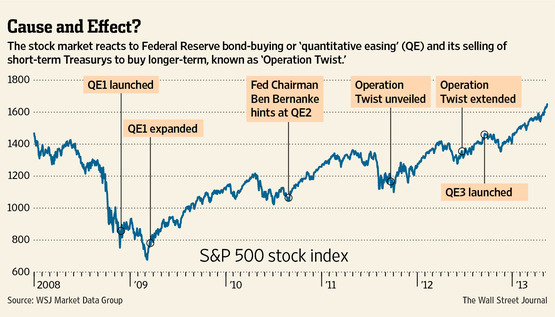
The Dow Jones Industrial Average has risen 14% since the Federal Reserve launched a third round of bond buying in September. The Stoxx Europe 600 index has climbed 22% since the president of the European Central Bank vowed in July to do “whatever it takes” to save the euro. Japan’s Nikkei has risen 22% since the Bank of Japan unveiled its big bond-buying initiative in April—and more than 50% since the election of a new government that campaigned on installing an aggressive central banker. There were, of course, other drivers behind the stock-market gains. But there’s little doubt that when central banks print lots of money (or hint they will), they push up stocks, bonds, houses and other assets. Indeed, that was part of the plan: Boost asset prices so businesses and consumers will spend more readily. Did the central banks’ efforts work? Did struggling economies get a lift? And has the Fed, which acted more forcefully than others, overdone it? Is it blowing another bubble already? Read more of this post

Asia’s biggest casino company SJM Executives to Sell Shares Worth as Much as $57M

SJM Executives to Sell Shares Worth as Much as $57M

Two senior executives of SJM Holdings Ltd. (880), Asia’s biggest casino company by revenue, are seeking to raise as much as HK$440 million ($57 million) in a share sale after the stock surged to a record. Chief Executive Officer Ambrose So and Chief Operating Officer Ng Chi Sing are offering 20 million shares at HK$21.50 to HK$22 each, a discount of 2.2 percent to 4.4 percent to yesterday’s close, terms for the deal show. Deutsche Bank AG (DBK) is joint book runner, according to the term sheet. Read more of this post

Malaysia Prime Minister Najib Cabinet Rewards Base as Chinese Sidelined: Southeast Asia

Najib Cabinet Rewards Base as Chinese Sidelined: Southeast Asia

Malaysia Prime Minister Najib Razak stocked his Cabinet with party stalwarts, after the ruling coalition’s biggest ethnic Chinese partner said it wouldn’t accept ministerial posts following its poor election showing.

Najib tapped leaders of his ruling United Malays Nasional Organisation for key positions before party polls later this year that will determine whether he stays on as prime minister. He also gave posts to the heads of Malaysia’s biggest bank, a corruption watchdog and a Hindu rights group. Two of the new line-up are Chinese, compared with more than a dozen previously.

“The Cabinet reflects a prime minister concerned about retaining the premiership and the presidency of UMNO,” said Edmund Terence Gomez, a professor at the University of Malaya in Kuala Lumpur. “I don’t see any move in the direction to talk about reconciliation and transformation and inclusivity in this cabinet.”

Najib’s coalition retained power in the May 5 election even after losing a majority of the popular vote for the first time since 1969, which the prime minister attributed to a loss of support from Chinese voters. Besides an ethnic divide, his administration faces a weakening economy, with Malaysia’s growth slowing to less than 5 percent for the first in seven quarters. Read more of this post

Euro-Style Bail-In Plan Means Bondholder Wipe-Out: Brazil Credit

Euro-Style Bail-In Plan Means Bondholder Wipe-Out: Brazil Credit

Brazil is drafting rules that would wipe out some creditors of failing banks in an effort to avoid taxpayer rescues, echoing European proposals to make bondholders shoulder more costs after three bailouts in as many years.

The central bank said May 6 it had prepared a draft of a “bail-in” proposal that would impose losses on holders of subordinated and unsecured bonds in case of insolvency and use their investments to revive the lenders. The measure would boost funding costs for the nation’s investment-grade banks, which currently pay a near record-low 3.77 percent on average to borrow dollars in the bond market, according to Carlos Thadeu de Freitas Gomes, a former central bank director.

The proposal, similar to one being considered by European Union lawmakers, comes after seven Brazilian banks became insolvent in the past three years and the deposit insurance fund spent 3.8 billion reais ($1.9 billion) to rescue Banco Panamericano SA. The rules would clarify risks for investors, save taxpayer money, and shield policy makers from political pressure to rescue lenders that took excessive risks, even as it pushes up costs for financial firms, said Freitas, now the chief economist at the National Commerce Confederation.

“It’ll help establish order and more transparency,” Freitas said in a telephone interview from Rio de Janeiro. “Investors know that, if there is a bankruptcy, they will have to cover the costs.” Read more of this post

U.S. 2 Percenters Trade Down With Post-Recession Angst

U.S. 2 Percenters Trade Down With Post-Recession Angst

Jennifer Prentice, a medical-equipment saleswoman in Minneapolis, once had no qualms about dropping $600 or more for Gucci purses. Now she spends $300 for Coach Inc. (COH) bags and is filling in her Burberry wardrobe with pieces from J. Crew.

“The things we went through over the last couple of years definitely have an impact on what I am doing,” Prentice, 45, said in an interview. “I tend to be less frivolous now.”

While good times keep rolling for the super-wealthy, many Americans at the bottom end of the privileged group with incomes of $250,000 or more are thinking twice. These “two-percenters,” unnerved by the most recent recession, are trading down to less-expensive offerings from Coach Inc. and Ralph Lauren Corp. (RL) rather than pricier goods from Prada SpA (1913) and Giorgio Armani SpA. Even with the stock and real estate markets rebounding, they’re not draining their wealth again, and the shift may prove challenging for the highest-priced brands that can no longer lean on credit card-fueled aspirational customers.

“The rich have lost their exuberance,” said Pam Danziger, president of Unity Marketing, a luxury research firm. “They do not feel as wealthy. They increasingly feel that their wealth is threatened, real or not.”

An increasing share of America’s “ultra-affluent” consumers view themselves as middle-class and are spending like “Henrys,” which stands for High Earner Not Rich Yet, Danziger said. People in the latter category earn $100,000 to $249,999 a year, putting them in the top 20 percent by income, Danziger said. Read more of this post

US Government Begins BitCoin Crackdown

US Government Begins BitCoin Crackdown

Tyler Durden on 05/15/2013 14:02 -0400

As we first noted here (regulation) and here (supervision), the US government has been gradually encroaching on the independence and freedom of the virtual currency. This week, as The Washington Post reports, the government escalated. The feds took action against Mt. Gox, the world’s leading Bitcoin exchange. Many people use Dwolla, a PayPal-like payment network, to send dollars to their Mt. Gox accounts. They then use those dollars to buy Bitcoins. On Tuesday, Dwolla announced that it had frozen Mt. Gox’s account at the request of federal investigators.

It’s the first federal action against the currency. CNet has confirmed that the asset seizure was initiated by Homeland Security Investigations (which among other things is responsible for enforcing the laws associated with money laundering and drug smuggling).

As this crackdown begins, many argue that “you can’t put the genie back into the bottle,” as far as shutting down the ‘network’ of open source transactions; but as one Bitcoin enthusiast added (sadly), “I hate to say it, but the Bitcoin community needs to start lobbying, it needs to start educating policymakers, lobbyists and influencers about the pros of Bitcoin and the impossibility or the difficulty in getting rid of all the bad uses.” Read more of this post

Will Fed “Taper” Talk Crush Chinese Property Prices?

Will Fed “Taper” Talk Crush Chinese Property Prices?

Tyler Durden on 05/15/2013 21:01 -0400

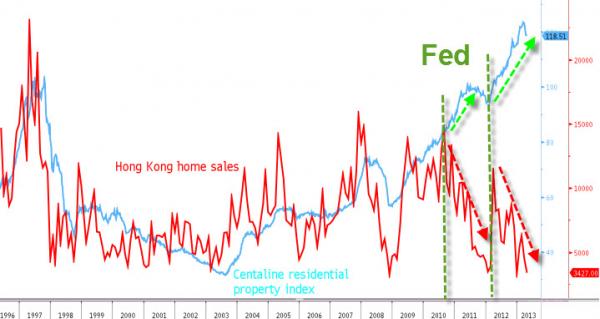
When the Fed extended its guidance for extremely low rates to 2014 and later, none of the Chinese government’s measures to deter property speculation could deter ‘homebuyers’ from bidding up prices. However, as the chart below shows, the disconnect between home prices (extreme highs) and home sales (near lows) has never been greater and with the Chinese looking to further control speculation at the same time as a Fed that is increasingly jawboning a slowing to its easy money policy, the prices of Hong Kong property has begun to drop in recent weeks. As Bloomberg notes, prices have fallen 4.2% from a record reached in mid-March, compared with a 77% contraction in sales from their post-global financial crisis peak in 2010.  The prices of property is explicitly deterring the ‘urban dream’ that we explained here, but any sustained drop in property prices (given the shadow lending and collateralization this bubble represents) leaves China once again between a bubble-pricking rock and an inflationary (social unrest harboring) hard place. The Hong Kong dollar’s peg to the U.S. counterpart has kept borrowing costs in the city at near-record lows, underpinning a 109% gain in home prices since the beginning of 2009, even as the government imposed several property curbs to cool demand. Hong Kong property prices relative to sales…

20130515_china1_0