Asia seen as least creditworthy relative to their global peers

‘Asia seen as least creditworthy relative to their global peers’

Published: 2013/05/28

BEIJING: Borrowers in Asia are seen as the least creditworthy relative to their global peers in almost a year on signs of faltering growth in China.

The Markit iTraxx Asia index of credit-default swaps traded as much as 20 basis points higher than the average of four others from around the world this month, the biggest premium since June, according to data provider CMA. As recently as March, Asian borrowers were seen as better credits than the rest of the world.

Confidence in Asia is being dented by slowing growth in the region’s biggest economy, where manufacturing is contracting for the first time in seven months.  Read more of this post
Idea Entrepreneur: The New 21st Century Career

Idea Entrepreneur: The New 21st Century Career

by John Butman  |  10:00 AM May 27, 2013

There is a new player emerging on the cultural and business scene today: the idea entrepreneur. Perhaps you are one yourself — or would like to be. The idea entrepreneur is an individual, usually a content expert and often a maverick, whose main goal is to influence how other people think and behave in relation to their cherished topic. These people don’t seek power over others and they’re not motivated by the prospect of achieving great wealth. Their goal is to make a difference, to change the world in some way.

Idea entrepreneurs are popping up everywhere. They’re people like Sheryl Sandberg (Facebook COO and author of Lean In), who is advocating a big new idea from within an organization. And like Atul Gawande (the checklist doctor), who is working to transform a professional discipline. Or like Blake Mycoskie (founder of TOMS shoes), who has created an unconventional business model. In my research into this phenomenon (which forms the basis of my book, Breaking Out), I have been amazed at how many different kinds of people aspire to be idea entrepreneurs. I have met with, interviewed, emailed or tweeted with librarians, salespeople, educators, thirteen-year-old kids, marketers, technologists, consultants, business leaders, social entrepreneurs — from countries all over the world — who have an idea, want to go public with it, and, in some cases, build a sustainable enterprise around it.

Read more of this post

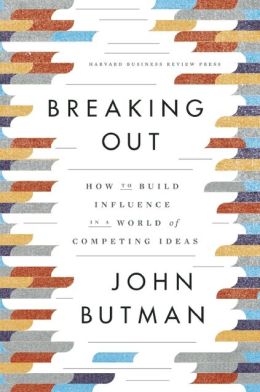
Breaking Out: How to Build Influence in a World of Competing Ideas

Breaking Out: How to Build Influence in a World of Competing Ideas [Hardcover]

John Butman (Author)

9781422172803_p0_v2_s260x420

Publication Date: May 21, 2013

How do you gain influence for an idea?
In Breaking Out, idea developer and adviser John Butman shows how the methods of today’s most popular “idea entrepreneurs”—including dog psychologist Cesar Millan, French lifestyle guru Mireille Guiliano (French Women Don’t Get Fat), TOMS founder Blake Mycoskie, and many others—can help you take an idea public and build influence for it.
It isn’t easy. Butman argues that the rise of the “ideaplex” (TED, Twitter, NPR, YouTube, online learning, and all the rest) has caused such an explosion in the creation and sharing of ideas that it has become much easier to go public—yet much harder to gain influence. But it can be done.
Based on his own experience in advising content experts worldwide, Butman shows how the idea entrepreneur breaks out—by combining personal narrative with rich content, creating many forms of expression (from books to live events), developing real-world practices, and creating “respiration” around the idea such that other people can breathe it in and make it their own. The resulting idea platform can reach many different audience groups and continue to build influence for many years and even decades.
If you have an idea and want to make a difference in your organization, build a change movement in your community, or improve the world in some way—this book will get you started on the journey to idea entrepreneurship. Read more of this post

Mudslinging in China’s Heavy-Machinery Sector

May 27, 2013, 9:21 a.m. ET

Mudslinging in China’s Heavy-Machinery Sector

By DUNCAN MAVIN

Digging for dirt on China’s machinery sector can be productive, especially when the economy’s stuck in the mud. Several companies that supply excavators, loaders and other construction equipment ran into trouble in 2012 and in the first few months of this year. The main problem was slowing economic growth, though oversupply of equipment was a big factor too. That led to slumping sales, rising inventory levels and a sharp uptick in accounts receivable as hard-up customers took longer to pay. Read more of this post

Why Extravagant New HQs Planned At Apple, Google, Amazon And Facebook Are Negative Indicators

Why Extravagant New HQs Planned At Apple, Google, Amazon And Facebook Are Negative Indicators

Bill Rigby and Alistair BarrReuters | May 27, 2013, 8:41 AM | 2,027 | 1

SEATTLE/SAN FRANCISCO (Reuters) – While much of corporate America is retrenching on the real estate front, the four most influential technology companies in America are each planning headquarters that could win a Pritzker Architecture Prize for hubris.

Amazon.com this week revealed plans for three verdant bubbles in downtown Seattle, joining Apple’s circular “spaceship,” Facebook’s Frank Gehry-designed open-office complex and a new Googleplex on the list of planned trophy offices.

“It signals a desire, a statement, to say that we’re special, we’re different. We have changed the world and we are going to continue to change it,” said Margaret O’Mara, associate professor of history at the University of Washington, who has written about the building of Silicon Valley. Read more of this post

GeoPay used the messaging ability that led to the earliest cellphones to create a mobile-banking platform in Central Asia

Reston firm turns to decades-old technology to set up mobile banking in Central Asia

By Abha Bhattarai, Monday, May 27, 5:31 AM

Not all new ideas for technology have to be, well, new.

As the start-ups around it tinkered with the cutting edge, a Reston company called GeoPay stuck by decades-old technology — the same used in messaging systems that led to the earliest cellphones — to create a mobile-banking platform.

The start-up, founded in 2011, provides cellphone-based banking services for people who might not otherwise have accounts at financial institutions. The simpler the interface, the more people the system could reach in the developing world, GeoPay said. Read more of this post