Bond Love Endures for Investors Unconvinced Rally’s Over

Bond Love Endures for Investors Unconvinced Rally’s Over

Bill Gross, the world’s largest fixed-income manager, says the bull market for bonds may have ended last month. Investors are staying put.

Four years into the biggest rally in U.S. stocks since 2000, bond mutual funds are attracting more money than their equity counterparts. After at least three warnings from Gross that the fixed-income market has peaked, there’s no evidence of what strategists including Michael Hartnett of Bank of America Corp. have predicted would be a ‘great rotation’ out of fixed income into stocks.

“For the past 25 years, you’ve seen the stable decline of interest rates and a level of comfort that bonds are the stable asset,” Rick Rieder, New York-based BlackRock Inc.’s co-head of fixed income in the Americas, said in an interview. “Money will still flow into bond funds for the next couple of years because of the tremendous need for income by an aging population.” Read more of this post
Gross to Buffett Omens Disregarded as Sales Soar: Credit Markets

Gross to Buffett Omens Disregarded as Sales Soar: Credit Markets

Sales of corporate bonds in the U.S. are surging toward the busiest May ever as borrowers race to the market before demand dries up with Bill Gross and Warren Buffett cautioning against buying debt at all-time low yields.

Petroleo Brasileiro SA’s $11 billion deal, the biggest on record for an emerging markets issuer, leads sales this month of $120.2 billion, on pace to exceed the unprecedented $162.6 billion sold in May 2008, data compiled by Bloomberg show. Issuance has already eclipsed the $108.2 billion sold in all of May 2012.

Borrowers are accelerating sales as speculation mounts that yields may only rise amid signs the economy is improving. Three Federal Reserve regional bank presidents called last week for phasing out the central bank’s monthly purchases of $40 billion in mortgage-backed securities as the housing recovery shows signs of gaining momentum, potentially reducing demand for riskier assets from stocks to speculative-grade bonds.

“Many issuers may decide it is not worth tempting that fate,” Edward Marrinan, a macro credit strategist at RBS Securities in Stamford, Connecticut, said in a telephone interview. The firm is one of the 21 primary dealers of U.S. government securities authorized to trade with the Fed. Read more of this post

Knesset to vote on law tightening pyramid structure of Israeli businesses

Knesset to vote on law tightening pyramid structure of Israeli businesses

Lawmakers agree to give holding groups six years to dismantle excess layers of their “pyramid” structure after the bill becomes law.

By Zvi Zrahiya | May.21, 2013 | 9:11 AM

The Knesset Finance Committee is scheduled to vote on Tuesday on the Business Concentration Law, after lawmakers agreed to toughen its terms to permit no more than two tiers of chained ownership, committee chairman Nissan Slomiansky ‏(Habayit Hayehudi‏) said Monday.

However, lawmakers agreed to give holding groups six years to dismantle excess layers of their “pyramid” structure after the bill becomes law. That is two more years than the government panel proposing the law wanted to allow. That panel had also proposed limiting pyramids to two tiers only for new holding groups, while letting existing groups retain three. Read more of this post

ThyssenKrupp Woes Tarnish 99-Year-Old German Steel Baron’s Legacy

ThyssenKrupp Woes Tarnish 99-Year-Old Steel Baron’s Legacy

For 60 years, the name of Berthold Beitz has been synonymous with Germany’s biggest steelmaker, ThyssenKrupp AG (TKA), at first for his role in rebuilding the former arms supplier and helping it break with its Nazi past.

Now, as head of the foundation that holds a 25.3 percent blocking minority, the 99-year-old has become a symbol of much that has gone wrong at the Essen-based company, whose stainless steel was used in Manhattan’s Chrysler and Empire State buildings. ThyssenKrupp is again seeking renewal after a botched expansion in the Americas and bribery and price-fixing scandals pushed it to a 4.7 billion euro ($6.1 billion) annual loss.

The power wielded by the German industrialist, who was a little known insurance executive when he was hired as general manager by the last Krupp family owner in 1953, is under attack from investors who hold him partly accountable for lax corporate governance that led to the missteps. With the company on May 15 refusing to rule out a capital increase to repair its balance sheet, the foundation over which Beitz presides risks losing its influence. Read more of this post

Mexico’s 400,000 Abandoned Homes Draw Venture Capital

Mexico’s 400,000 Abandoned Homes Draw Venture Capital

Mexico’s attempt to solve the country’s housing shortage by constructing millions of new homes far from city centers has crippled the nation’s homebuilders and fueled record foreclosures. For Antonio Diaz, a former investment banker with Banco Santander SA, it’s an opportunity.

Diaz’s company, backed by a venture-capital firm whose funders include JPMorgan Chase & Co. and the Soros Economic Development Fund, is buying foreclosed homes for as little as 60 percent of face value, refurbishing them and then selling them for up to 90 percent of a new home price. The number of properties sold by Tijuana-based Comunidades que Renacen SAPI, or ProVive, climbed 10-fold to 530 last year, and its target is to sell 1,300 units in 2013, said Diaz.

For Diaz, 53, it’s not just about making money. It’s an attempt to repopulate towns that face an exodus and plunging property values after the government subsidized developments that sprawled too far from cities and led to unattended buildings that lured criminals and illegal tenants. He estimates there are 400,000 deserted homes and another 200,000 held by squatters, even as the economy is projected by the government to grow 3.1 percent this year.

The number of empty properties “creates a very interesting universe for doing business,” Diaz said. Read more of this post

As Greece Struggles with Debt Crisis, Its Shipping Tycoons Still Cut a Profit

As Greece Struggles with Debt Crisis, Its Shipping Tycoons Still Cut a Profit

By Yannis Palaiologos / AthensMay 16, 201312 Comments

On December 5 last year, the Ob River, an 288-metre LNG (Liquefied Natural Gas) tanker with a capacity of 84,682 deadweight tonnes chartered by Russian energy giant Gazprom, arrived at the Japanese port of Tobata. The ship belonged to Dynagas, a privately held company owned by George Prokopiou, one of Greece’s preeminent shipping magnates.

It was a delivery of historic significance. To make it, the Ob River had traveled through more than 3,000 miles of the bleak, icy expanse of the Northern Sea Route, accompanied by two nuclear-powered Russian icebreakers. It was the first ever sea voyage of an LNG cargo through the frozen waters north of Siberia, cutting the distance traveled from Norway to Japan by more than 5,000 miles compared to the Suez Canal route. Read more of this post

Financial markets are at risk of a ‘big data’ crash

May 20, 2013 6:37 pm

Financial markets are at risk of a ‘big data’ crash

By Maureen O’Hara and David Easley

Regulation needs to adapt to computerised details, write Maureen O’Hara and David Easley

Regulators and investors are struggling to meet the challenges posed by high-frequency trading. This ultra-fast, computerised segment of finance now accounts for most trades. HFT also contributed to the “flash crash”, the sudden, vertiginous fall in the Dow Jones Industrial Average in May 2010, according to US regulators. However, the HFT of today is very different from that of three years ago. This is because of “big data”.

The term describes data sets that are so large or complex (or both) that they cannot be efficiently managed with standard software. Financial markets are significant producers of big data: trades, quotes, earnings statements, consumer research reports, official statistical releases, polls, news articles, etc. Read more of this post

Adaro Energy Chief Says Thermal Coal at $100 a Ton Is New Normal, which is half a peak reached in 2008

Adaro Energy Chief Says Coal at $100 a Ton Is New Normal

PT Adaro Energy (ADRO), Indonesia’s second-biggest producer of power-station coal, said miners will have to adjust to prices of about $100 a metric ton, which is half a peak reached in 2008.

“The new normal, I think, would be $95 to $100 a ton, based on the marginal cost of production in the region,” Adaro Energy President Director Garibaldi Thohir said in an interview.

A slump in coal prices will help ease oversupply as it would prompt some small and high-cost miners to reduce output or stop production, Thohir said in his office in Jakarta on May 17. Adaro is expected to report lower net income this year than in 2012, Thohir said, without giving a specific forecast.

The price of coal has fallen by more than half since a peak in mid-2008 amid slowing Chinese imports and rising output from producers including Indonesia and Colombia. The decline is forcing companies including Adaro to trim costs to safeguard margins. Thohir said the price may have bottomed. Read more of this post

15 years on, debate over Suharto’s legacy still simmers

15 years on, debate over Suharto’s legacy still simmers

BY – 5 HOURS 11 MIN AGO

JAKARTA — Tree-lined Cendana street in an upscale neighbourhood in central Jakarta has not changed much in recent decades, save for the demolition of a few Dutch colonial homes in favour of modernist villas. Yet, a former resident whose home once took up the entire middle of the block initiated dramatic changes in his country and, 15 years after he disappeared from Indonesia’s political scene, debate still rages about whether they were for better or worse.

Cendana is synonymous with Suharto, the army general-turned-President who ruled Indonesia for 32 years while residing in the houses at Nos 6, 8 and 10, which were renovated and connected. After his death in 2008, an Indonesian Web portal dedicated to paranormal activity published an account by an elderly servant who said Suharto’s ghost was still there and occasionally pinched and poked him.

Perhaps. But more certain is that Suharto’s spirit continues to loom over modern-day Indonesia. Read more of this post

Japan Inc. averse to further yen drop, poll finds

Exclusive: Japan Inc. averse to further yen drop, poll finds

By Kaori Kaneko, Tetsushi Kajimoto

Filed 10 hours ago

TOKYO – Signs are that most firms in export-driven Japan Inc, having got the weaker yen they craved, now want the currency to either stabilize or recover ground, rather than continue a slide that will increasingly raise their costs.

About half the Japanese companies in a new Reuters survey say the yen has fallen enough, just 15 percent want a further yen decline and more than one-third would in fact like to see the currency rebound from its 4-1/2-year lows.

At the same time, top officials in Prime Minister Shinzo Abe’s half-year-old government — who used to stress the urgency of reversing the yen’s strength — have also begun highlighting the downside of the yen’s steep slide, such as higher imported-energy costs. Read more of this post

A Japanese government panel warns there is “absolutely no guarantee” that domestic investors will keep financing the country’s massive public debt, citing the risk of a spike in bond yields that could crimp long-term growth prospects

Exclusive: Japan panel warns of dangers if debt not addressed

8:57am EDT

By Takaya Yamaguchi

TOKYO (Reuters) – A Japanese government panel warns there is “absolutely no guarantee” that domestic investors will keep financing the country’s massive public debt, citing the risk of a spike in bond yields that could crimp long-term growth prospects, according to a draft report seen by Reuters on Monday.

The warning from the advisory panel to Finance Minister Taro Aso comes at a critical time – when the government bond market has seen volatile price falls, underscoring a delicate balancing act for Prime Minister Shinzo Abe’s government.

Abe has unleashed huge fiscal and monetary stimulus to spur short-term growth, sending stock prices .N225soaring. But at the same time, he is trying to convince investors that over the longer term Japan will tackle a public debt that, at more than twice the nation’s annual economic output, is the biggest in the developed world. Read more of this post

Japan Inc. Should Take a Look in the Mirror

Japan Inc. Should Take a Look in the Mirror

Sony Corp.’s curt dismissal of a foreigner’s advice last week didn’t shock Michael Woodford, the former chief executive officer of Olympus Corp.

“The club, meaning corporate Japan, will do everything it can to mask and hide what’s wrong. That’s what’s most important,” said Woodford, a Briton who was fired in late 2011 after he exposed a $1.7 billion accounting fraud in his own company.

Woodford’s tale is worth revisiting as Sony rebuffs a proposal from hedge-fund investor Daniel Loeb for the company to sell off its entertainment divisions and focus on hardware. Far from being rewarded for trying to clean up the 93-year-old Olympus, Woodford was ousted by his board, which criticized him for being culturally insensitive. Clearly the non-Japanese CEO didn’t understand the clubby, docile ways of Japan Inc.

Now Loeb is running into a similar wall of disdain. Sony CEO Kazuo Hirai has 100 billion reasons — the market value in dollars the company has lost since 2000 — to consider the American’s plea to bring more focus to Sony’s disjointed businesses. Yet Hirai is unmoved. Why? Even though Loeb holds a sizable $1.1 billion stake in the company, Hirai knows a critical mass of domestic investors, the ones who really matter, are certain to support him against any brash outsider. Read more of this post

Vitamins That Cost Pennies a Day Seen Delaying Dementia (Research Sponsored by Vitamin-Makers?)

Vitamins That Cost Pennies a Day Seen Delaying Dementia

A cheap regimen of vitamins in use for decades is seen by scientists as a way to delay the start of Alzheimer’s disease and dementia, a goal that prescription drugs have failed to achieve.

Drugmakers including Bristol-Myers Squibb Co., Pfizer Inc. (PFE) and Eli Lilly & Co. (LLY) have spent billions of dollars on ineffective therapies in a so-far fruitless effort to come up with an effective treatment for dementia and Alzheimer’s.

Now, in the latest of a steady drumbeat of research that suggests diet, exercise and socializing remain patients’ best hope, a study published today in the Proceedings of the National Academy of Sciences shows that vitamins B6 and B12 combined with folic acid slowed atrophy of gray matter in brain areas affected by Alzheimer’s disease.

“You don’t have any other options for these patients, so why not try giving them this cocktail of B vitamins?” says Johan Lokk, a professor and head physician in the geriatric department at Karolinska University Hospital Huddinge in Sweden, who wasn’t involved in the study.

Alzheimer’s disease and dementia mostly affect older people. As people live longer, the number afflicted by the conditions is growing. Delaying dementia with an inexpensive vitamin regimen may help stem the surge in cases, which the World Health Organization predicted would more than triple from 36 million worldwide in 2010 to 115 million in 2050, as well as the cost, estimated at $604 billion in 2010 by Alzheimer’s Disease International. Read more of this post

China trying to manage exposure of corruption online

China trying to manage exposure of corruption online

7:29am EDT

By Terril Yue Jones

BEIJING (Reuters) – China’s Internet is brimming with disclosures of officials collecting bribes, homes and luxury accessories as casually as they do mistresses.

But while the government tolerates such anti-corruption vigilantism, it is also extremely leery of the threat the Internet can pose to Communist Party rule.

The Internet is the new tool in the fight against corruption – a cornerstone policy of new President Xi Jinping, who has pledged to tackle the problem head-on.

But while acknowledging that China’s online world is helpful, authorities have also moved quickly to quash rumors that might fan protests that could escalate out of control, deleting microblog posts or even entire accounts. Read more of this post

Baidu and Tencent Thought to be Vying to Acquire Mobile Antivirus Expert NetQin

Baidu and Tencent Thought to be Vying to Acquire Mobile Antivirus Expert

May 20, 2013

by Steven Millward

Antivirus products and services have been a renewed battleground in China in the past couple of years, enveloping several of the country’s top web businesses. According to rumors in the industry heard byTechinAsia, that battle is now taking the form of these companies vying to acquire NetQin (NYSE:NQ), a China-based expert in mobile antivirus apps. Both Baidu (NASDAQ:BIDU) and Tencent (HKG:0700) are thought to be in the running, but the market value of NetQin is proving to be a bone of contention. NetQin executives even addressed the rumors late last week in the earnings call after revealing their Q1 2013 financials. Directly alluding to the suitors, NetQin co-CEO Omar Sharif Khan said during the call: Read more of this post

Hazards of the Buzzy Startup: Yahoo’s $1.1 billion deal for Tumblr is a fairy-tale ending for the blogging site, which fetched a rich price despite its meager revenue. Many other highflying Web startups may not be as lucky

May 20, 2013, 8:00 p.m. ET

Hazards of the Buzzy Startup

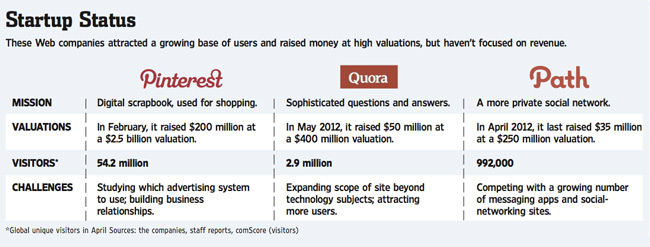
Yahoo’s Purchase of Tumblr Puts Spotlight on Highfliers Like Pinterest, Quora With Little Revenue

By AMIR EFRATISPENCER E. ANTE and EVELYN M. RUSLI

OB-XN856_Startu_G_20130520200007

Yahoo Inc.’s YHOO +0.23% $1.1 billion deal for Tumblr Inc. is a fairy-tale ending for the blogging site, which fetched a rich price despite its meager revenue. Many other highflying Web startups may not be as lucky.

Monday’s deal for New York-based Tumblr throws the spotlight on a cadre of other Web startups that have similar characteristics. Many of them raised money at sky-high valuations based on their huge user growth, before a spate of troubled Internet initial public offerings in 2011 and 2012 for social networkFacebook Inc., FB -1.87% daily-deals site Groupon Inc. GRPN +0.14% and online-gaming service Zynga Inc.ZNGA +0.59%

Since then, a damper has been put on the Internet market. And as these startups have burned through cash to sustain their user growth, they have been dealing with difficult questions about exactly how much value they command and whether to remain independent or sell themselves off. Read more of this post

INFOGRAPHIC: Inside The Massive Mobile Video Ecosystem

INFOGRAPHIC: Inside The Massive Mobile Video Ecosystem

Business Insider | May 20, 2013, 3:37 PM | 13,495 | 7

Mobile video has begun to accumulate scale, and has also turned out to be one of the few types of mobile content — along with games — that monetizes reliably and drives premium ad rates. That’s reflected in the much higher prices that mobile publishers can command for mobile video ads, compared to standard mobile formats like banners. eMarketer estimates mobile video will account for $520 million in ad spending in the U.S. this year, or 13% of the digital video ad market. In a new reportBI Intelligence breaks down the mobile video ecosystem, analyzing the behavior and devices behind the growth in consumption, and examining the demographics and behavior of mobile video consumers. We specifically detail how mobile video monetization is booming, and look at the new video ecosystem that is taking shape, with mobile devices — rather than television — at the center. Thanks in large part to this growing ecosystem, brands and agencies are becoming more familiar with mobile video ad formats and in putting together mobile video ad campaigns. Thanks to technology and better know-how among ad platforms, mobile video ad units are easier to deploy across the mobile landscape than they were in the past. As we detail in our report, tablet-specific ad units are beginning to proliferate, as are non-ad videos that brands push out on their own digital platforms. So are anecdotes about increased mobile video ad transaction volume: YuMe, a provider of brand video advertising services, saw its mobile video advertising revenue in France and the U.K. grow over 500 percent in 2012. Mobile video ad specialist AdColony also reported U.S. revenue growth above 500 percent in 2012.  Michael Bayle, senior vice president of ESPN Mobile, says he sees the automotive industry diving quickly into mobile video as a complement to TV spending. “We see automotive highly skewing in favor of mobile,” he told Business Insider. ESPN benefits because its audience is 85 percent men, and auto advertisers are often chasing male eyeballs.

themobilevideoecosystem-1 (1)

Global Brands: Online retailer Amazon grabs top spot from bricks and mortar rival Wal-mart

May 20, 2013 11:59 pm

Global Brands: Online retailer grabs top spot from bricks and mortar rival

By Barney Jopson

Calling Amazon the “Walmart of the web”, a common moniker for the online giant, is one way to make people from Walmart bristle. The bricks-and-mortar behemoth tends to think that if any company is going to be the Walmart of the web, then it should be Walmart.

That is why, after several false starts, the 50-year-old retailer from Arkansas is in the throes of its latest – and most serious-looking – effort to build a substantial online business. The results will help shape the evolution of the Walmart brand for years to come (as will the progress of its international bricks-and-mortar business).

But the 2013 BrandZ Top 100 ranking shows that Amazon still has more momentum. For the first time since the ranking began, Amazon, founded in 1994, has leapfrogged Walmart to become the most valuable retailer in the rankings: a 34 per cent rise in its brand value to $45.7bn lifted it to position number 14 overall. Read more of this post

But Wait. Didn’t Yahoo Try a Deal Like This Before? Yahoo’s deal for Tumblr raises questions about its ability to make money by selling ads, among other thorny issues

MAY 20, 2013, 9:00 PM

But Wait. Didn’t Yahoo Try a Deal Like This Before?

By ANDREW ROSS SORKIN

When Yahoo announced its headline-grabbing acquisition, it boasted that the deal gave it access to an “unduplicated” audience of users and that its target was a “popular personal publishing” platform.

“Yahoo will be able to integrate and distribute a powerful set of state-of-the-art editing tools and content published through personal home pages in an array of services,” the company declared.

But Yahoo wasn’t talking about Tumblr. Those quotes came from a news release Yahoo issued in 1999 when it acquired GeoCities, which allowed users to create their own Web pages — not unlike Tumblr — for $3.6 billion in stock. The site was closed in 2009. Read more of this post

All Yahoo’s spending can’t make it cool again; It’s time for the Web 1.0 icon to put down its credit card and get back to work

All Yahoo’s spending can’t make it cool again

May 20, 2013: 12:15 PM ET

It’s time for the Web 1.0 icon to put down its credit card and get back to work.

By Cyrus Sanati

FORTUNE — Yahoo’s $1.1 billion acquisition of Tumblr looks like an expensive and misguided attempt by chief executive Marissa Mayer to somehow make the Web 1.0 company “cool” again. Instead of innovating her way out of the mediocre corner of the Internet in which Yahoo currently resides, the former Google executive has instead decided to take the company’s debit card and go on a shopping spree, snapping up 10 companies in less than a year on the job. Tumblr is by far the most expensive bauble she has picked up so far and could prove a dud over the long term given its questionable content, much of which is “NSFA” — Not Safe For Advertisers.

When Mayer took the helm at Yahoo (YHOO) last year, investors were ecstatic. The company had been on a listless voyage over the previous decade as it struggled to move from awkward adolescence into adulthood. Ms. Mayer’s appointment gave investors hope that Yahoo could somehow be pulled back from the brink of technological irrelevance. She was seen as a bright star equipped with the magic Google (GOOG) touch that would, hopefully, help restore Yahoo’s rusty search engine as well as the hodgepodge of companies it acquired over the years. Read more of this post

Viewers Start to Embrace Television on Demand

May 20, 2013

Viewers Start to Embrace Television on Demand

By BRIAN STELTER and AMY CHOZICK

While companies weigh bids for Hulu and industry heavyweights complain that TV Everywhere isn’t going much of anywhere, another way to watch time-shifted television is quietly gaining traction: video-on-demand, or VOD.

Glittery, those three letters are not. VOD rarely gets media attention, partly because of past missteps by cable and satellite providers.

But more and more TV episodes and movies are becoming available through the on-demand systems that cable subscribers can tune in with their set-top boxes. Some shows, like Fox’s “The Following” and ABC’s “Scandal,” now gain hundreds of thousands of viewers every week because of VOD, part of a decades-long shift from television on a linear schedule to television on viewers’ own terms.

“On-demand isn’t always the shiniest new technology. But we are seeing tremendous growth,” said Matthew Strauss, who oversees digital strategy for Comcast, the nation’s largest cable company. Read more of this post

Samsung swipes 95% of total industry profits earned from Android phones

HOW MUCH? SAMSUNG SWIPES 95 PERCENT OF TOTAL INDUSTRY PROFITS EARNED FROM ANDROID PHONES

By Andy Boxall — May 16, 2013

Google revealed its own fair share of big numbers associated with Android during its Google I/O keynote presentation, saying as of 2013, there have been 900 million activations of the mobile OS, making it the world’s most popular operating system. That must mean there are a lot of companies out there getting rich and fat from selling Android hardware, right?

Well, yes, but if the latest research from Strategy Analytics is accurate, it’s only one company doing so, despite Android being licensed by dozens of firms. As you have probably guessed, the one making the most profit from Android is market leader Samsung, but the actual figure may come as a surprise, as it’s said to have taken almost 95 percent of the global profits earned from the mobile OS during the first quarter of 2013. Read more of this post

Amazon wins key cloud security clearance from US Govt

Published: Tuesday May 21, 2013 MYT 1:55:00 PM

Amazon wins key cloud security clearance from US Govt

SAN FRANCISCO: Amazon.com Inc has been given a security clearance by the U.S. government that will make it easier for federal agencies to use its cloud computing services.

Amazon Web Services, known as AWS, was certified to operate as a cloud service provider for three years under the government’s new FedRAMP program. The accreditation covers all AWS data centers in the United States, the company said on Tuesday.

“This will cut the cost and time for agencies to deploy our systems,” saidTeresa Carlson, vice president of Worldwide Public Sector at AWS. “It cuts costs for AWS too.”

Amazon, the world’s largest online retailer, has moved aggressively into the business of renting remote computing, storage and other IT services in recent years through AWS. The business has been a hit with startups, but the company is now going after big corporations and government agencies, a much larger opportunity. However, these organizations are more demanding, especially on issues like security and regulatory compliance. Read more of this post

NYC Startup Scene Boosted by 50-Fold Return on Tumblr Deal: Tech

NYC Startup Scene Boosted by 50-Fold Return on Tumblr Deal: Tech

Tumblr Inc.’s $1.1 billion purchase by Yahoo! Inc. (YHOO) marks the biggest deal for a venture-backed New York startup, bringing a windfall for East Coast investors Union Square Ventures and Spark Capital while laying a foundation for further investing in the region’s entrepreneurs.

Union Square, founded in New York in 2003, and Boston-based Spark, which opened two years later, first led an investment of $775,000 in Tumblr in 2007, and then $4.5 million the following year. The firms owned a combined 47 percent of the company, giving them about a 50-fold return, according to PrivCo, which tracks private companies and venture capital.

While about 40 percent of venture funding happens in Silicon Valley, twice the amount in New York and New England combined, Union Square and Spark have spent about a decade investing in a revival of the East Coast technology industry. Though not all of the joint bets have panned out, their success proves there’s still growth in New York’s startup scene. Read more of this post

How cognitive science and user empathy powered Google’s design breakthrough

How cognitive science and user empathy powered Google’s design breakthrough

By Devindra Hardawar | VentureBeat.com, Published: May 20

Google has gone from a company that approached design through cold, hard data to one that’s employing gorgeous, user-centric interfaces.

Design was a big theme at this year’s Google I/O developer conference, with over a dozen sessions exploring design in some fashion. And you can see Google’s new aesthetic focus in plenty of its products — like Gmail’s slight redesign and the upcoming Google Maps refresh — but Android serves as the fastest example of Google’s design turnaround.

Perhaps it’s because design matters all the more on a small smartphone screen. With Android, Google also had to do something about Apple’s head start with iOS. To get Android to look as good at the iPhone, Google had to radically reshape how it thought of design, and fast. Android 4.0 “Ice Cream Sandwich,” released in 2011, was Google’s first attempt to emphasize design in its mobile OS. Its aesthetic has only become more refined since then. Read more of this post

GrubHub to Merge With Seamless as Food Orders Go Mobile

GrubHub to Merge With Seamless as Food Orders Go Mobile

GrubHub Inc. and Seamless North America LLC, two of the top food-delivery websites in the U.S., have agreed to combine their companies to take on rivals in the growing market for online meal orders.

GrubHub Chief Executive Officer Matt Maloney will become CEO of the merged group, and Seamless CEO Jonathan Zabusky will serve as president, the two said in an interview. Neither company is paying to acquire the other, Maloney said, declining to share financial details of the agreement. The deal now awaits the approval of U.S. regulators, he said.

Food-delivery sites and mobile applications are gaining in popularity as more people order their meals online, instead of calling or picking up orders at restaurants. That’s also driving consolidation, as startups join forces to head off competition from review sites such as Yelp Inc. (YELP) The merger will help the combined company accelerate the addition of users and restaurants, said Maloney, who co-founded GrubHub in 2004. Read more of this post

Expert Networks and Insider Trading: An Introduction and Recommendation

Expert Networks and Insider Trading: An Introduction and Recommendation

Daniel H. Jeng Boston University School of Law

May 7, 2013
Review of Banking and Financial Law, Forthcoming

Abstract: 
An expert network enabled the largest insider trading scheme ever discovered and charged by the Securities and Exchange Commission (“SEC”). As complex information webs circulating money for information, expert networks are significant and relevant to the financial system, generating over $400 million in revenue annually. In the past decade, regulatory revisions to disclosure requirements and reformations to investment banking research practices have fueled the rise of expert networks. Despite recent notoriety in connection with Raj Rajaratnam’s insider trading case and various insider trading convictions of expert network consultants, use of expert networks is legally permissible, as specifically acknowledged by the SEC. Nevertheless, expert network firms, expert consultants, and clients must guard against insider trading by ensuring that no information transferred is material, nonpublic, or acquired through a breach of duty. This article argues that strong compliance programs and well-written contracts protect expert networks against insider trading and regulatory investigations.

Testosterone and Financial Misreporting

Testosterone and Financial Misreporting

Yuping Jia Frankfurt School of Finance and Management

Laurence Van Lent Tilburg University – CentER for Economic Research and Dept. of Accounting

Yachang Zeng Tilburg University – Department of Accounting & Accountancy; Tilburg University – Center for Economic Research (CentER)

May 15, 2013

Abstract: 
We examine the relation between a measure of CEOs’ adolescent exposure to the hormone testosterone and financial misreporting. Testosterone is associated with a set of behaviors in males, including aggression, egocentrism, risk seeking, and a desire to maintain social status. Using a sample of CEOs from Standard and Poor’s 1500 firms during 1996–2010, we document a positive association between our measure of CEO testosterone exposure and financial misreporting. Our primary evidence is based on a sample of financial restatements due to intentional irregularities. Additional analyses are based on misreporting proxies derived from the misstatement-prediction model proposed by Dechow et al. [2011]. The positive association between CEO testosterone exposure and financial misreporting is robust to the various misreporting proxies. We show that our measure of testosterone exposure is different from overconfidence, which prior studies have shown to be associated with misreporting. Finally, we demonstrate that testosterone exposure not only correlates with financial reporting decisions but also predicts the incidence of option backdating in the sample.

Shaping Liquidity: On the Causal Effects of Voluntary Disclosure

Shaping Liquidity: On the Causal Effects of Voluntary Disclosure

Karthik Balakrishnan University of Pennsylvania – Accounting Department; University of Pennsylvania – The Wharton School

Mary Brooke Billings New York University; New York University (NYU) – Department of Accounting, Taxation & Business Law

Bryan T. Kelly University of Chicago – Booth School of Business; National Bureau of Economic Research (NBER)

Alexander Ljungqvist New York University (NYU) – Department of Finance; National Bureau of Economic Research (NBER); Centre for Economic Policy Research (CEPR); European Corporate Governance Institute (ECGI); Research Institute of Industrial Economics (IFN)

April 2013
NBER Working Paper No. w18984

Abstract: 
Can managers influence the liquidity of their firms’ shares? We use plausibly exogenous variation in the supply of public information to show that firms seek to actively shape their information environments by voluntarily disclosing more information than is mandated by market regulations and that such efforts have a sizeable and beneficial effect on liquidity. Firms respond to an exogenous loss of public information by providing more timely and informative earnings guidance. Responses appear motivated by a desire to reduce information asymmetries between retail and institutional investors. Liquidity improves as a result of voluntary disclosure and in turn increases firm value. This suggests that managers can causally influence their cost of capital via voluntary disclosure.

The only Fortune 500 company that’s grown faster than Apple; A big player in a low-profile business has outpaced the tech giant in both revenue growth (10-Yr) and stock return (5-Yr)

The only Fortune 500 company that’s grown faster than Apple

May 20, 2013: 10:38 AM ET

A big player in a low-profile business has outpaced the tech giant in both revenue growth and stock return.

World Fuel Services sells fuel to cargo ships and tankers globally.

By Brian O’Keefe, assistant managing editor

Fortune — The growth of Apple (AAPL) over the past decade is one of the most extraordinary stories in American business history. Ten years ago, the computer giant ranked No. 300 on the Fortune 500 with $5.7 billion in revenues. This year — millions of iPods, iPhones, and iPads later — Apple is ranked No. 6 on the 500 with $156.5 billion in revenues. And yet, Apple is not the fastest-growing company in the Fortune 500 over that span — at least on a percentage basis. That honor belongs to a company called World Fuel Services (INT), which ranks No. 74 on this year’s 500 list with $38.9 billion in revenues. Over the past decade, World Fuel grew its revenues at a blistering annual rate of 39.8%, or just good enough to edge out Apple’s average annual growth rate of 39.2%. Here’s another surprising fact about World Fuel Services: Its stock has easily trounced both Apple and the broader market over the past five years: In that span World Fuel shares have risen 230% vs. 131% for Apple and just 17% for the S&P 500. Read more of this post