Companies might be forced to boost the amount of debt they report on their balance sheets by hundreds of billions of dollars under a proposal announced to overhaul the accounting for leases

May 16, 2013, 1:05 p.m. ET

Accounting Change Could Boost Companies’ Debt

Proposed Rule Would Require Most Leases to be Treated on the Books as Debt

By MICHAEL RAPOPORT

Companies might be forced to boost the amount of debt they report on their balance sheets by hundreds of billions of dollars under a proposal announced Thursday to overhaul the accounting for leases.

If adopted, the changes could affect retailers and restaurant chains, which lease real estate at hundreds or thousands of locations. Other companies that may feel the impact are airlines and package-delivery companies, which finance aircraft through leases, and companies that lease printers, copiers and other office equipment.

The new proposal from the Financial Accounting Standards Board and International Accounting Standards Board, which set accounting rules for the U.S. and most of the rest of the world, respectively, would require companies to add all but the shortest leases to their balance sheets as obligations akin to debt. That could have a major impact, experts said, given the estimated $800 billion in new lease contracts world-wide every year. Read more of this post

The Risky Business of Investing

The Risky Business of Investing

14 MAY 2013 – ASHBY MONK

Note to readers: institutional investors are not in the business of making investments or managing investment returns. I know I’ve said this before, but that’s really not what pension funds, sovereign funds, endowments or foundations ultimately do. Investors are, at their core, risk takers. They assess, mitigate, manage, bear and trade risks. If they perform these tasks well, they make money in the process. Risk, then, isn’t just something to mitigate; it’s something to be actively sought out. Risk is the oxygen that gives life to financial markets; it’s the currency upon which all assets are traded. You get the picture.

Given the enormous importance of risk in the investment business, you’d think that risk management would be fully integrated into everything these investors do. But… you’d be wrong. As it turns out, over the past few decades, many institutional investors have moved away from a ‘risk based’ approach to investing and have preferred to think about investing in terms of products and expected returns. This was deemed to be a useful abstraction that rendered modern finance consumable by the masses. However, this wound up be being somewhat problematic, as focusing on returns to the exclusion of risk resulted in some unhealthy distortions in the way we think about investments. Read more of this post

STX Group Chairman Kang Duck-soo is under mounting pressure to pay some of the debts held by the struggling units of the country’s 19th largest conglomerate using his own assets

2013-05-16

STX boss pressured to give up private assets

By Na Jeong-ju

STX Group Chairman Kang Duck-soo is under mounting pressure to pay some of the debts held by the struggling units of the country’s 19th largest conglomerate using his own assets. Government officials and creditor banks say the 63-year-old executive should give up a considerable part of his fortune to take responsibility for the ongoing liquidity crisis in STX. “That’s a pre-condition for a financial lifeline. All creditor banks and the government want him to join their rescue efforts,” said an official from the Financial Supervisory Service (FSS). “They will take extreme measures, including requesting the court to seize his property, if needed.” Kang recently handed over his controlling stake in STX Offshore & Shipbuilding, which generates more than 50 percent of the group’s total revenue, to creditors. He is also considering selling the group’s overseas assets to secure cash. However, creditor banks claim that’s far from being enough to get STX out of its financial hole. Some bank officials told media Kang should pay the price for mismanaging the firm. They alleged that some of Kang’s relatives are working in key positions at STX affiliates, indicating he abused his status and power to give them jobs.  Read more of this post

Jakarta Governor Joko Widodo, an untested outsider to Indonesian politics, has attracted an unexpected national following in this fledgling democracy amid a void of young leaders

May 16, 2013, 1:32 p.m. ET

With Little to Show, Jakarta Governor Attracts Following

By BEN OTTO

JAKARTA, Indonesia—An untested outsider to Indonesian politics has attracted an unexpected national following in this fledgling democracy amid a void of young leaders.

Joko Widodo, the 51-year-old governor of Jakarta, is taking on the major challenges of the capital—flooding, poverty and traffic—and though evidence is scant so far that he can fix the problems, he has attracted intensive media coverage and is even mentioned as a strong presidential contender in 2014, when President Susilo Bambang Yudhoyono is due to step down after a decade in power. Read more of this post

Former Malaysian Prime Minister Mahathir’s influence in new Cabinet ‘likely to hamper reform’

Mahathir’s influence in new Cabinet ‘likely to hamper reform’

KUALA LUMPUR — The new Malaysian Cabinet, which is filled with established leaders of United Malays National Organisation (UMNO), shows the influence of former Prime Minister Mahathir Mohamad, opposition Pakatan Rakyat (PR) leaders said yesterday.

BY –6 HOURS 43 MIN AGO

KUALA LUMPUR — The new Malaysian Cabinet, which is filled with established leaders of United Malays National Organisation (UMNO), shows the influence of former Prime Minister Mahathir Mohamad, opposition Pakatan Rakyat (PR) leaders said yesterday.

“You don’t see any intention of breaking away from the past,” Democratic Action Party (DAP) strategist Liew Chin Tong told The Malaysian Insider. “The appointment of Shahidan furthers the UMNO agenda … there is no intention to reform,” he added, referring to former Perlis Mentri Besar Shahidan Kassim’s appointment as a minister in the Prime Minister’s Department. Read more of this post

Unhappy Malaysians can leave country: Home Minister Zahid

Unhappy Malaysians can leave country: Zahid

PETALING JAYA — Malaysia’s new Home Minister Ahmad Zahid Hamidi (picture) has told Malaysians who are dissatisfied with its political system after the general election — which handed victory to the long-ruling Barisan Nasional (BN) coalition — to migrate to other countries, as those who are loyal would accept the rule of law.

BY –6 HOURS 42 MIN AGO

PETALING JAYA — Malaysia’s new Home Minister Ahmad Zahid Hamidi (picture) has told Malaysians who are dissatisfied with its political system after the general election — which handed victory to the long-ruling Barisan Nasional (BN) coalition — to migrate to other countries, as those who are loyal would accept the rule of law.

Mr Zahid made the comments in an editorial for Utusan Malaysia, a newspaper controlled by the BN’s dominant party, United Malays National Organisation, a day after he was appointed Home Minister by Prime Minister Najib Razak, news website Malaysiakini reported yesterday. Read more of this post

Vietnam to Force Bank Bad-Debt Sales to State Asset Company

Vietnam to Force Bank Bad-Debt Sales to State Asset Company

Vietnam will force banks to sell bad debt to a soon-to-be established asset management company, according to State Bank of Vietnam Chief Inspector Nguyen Huu Nghia, as the government steps up efforts to revive the economy.

Lenders assessed by the central bank to have bad-debt ratios of 3 percent and above will be required to comply, Nghia said today, citing a final proposal that is awaiting the prime minister’s review and approval. The government plans to set up the company this month, according to Cao Sy Kiem, member of the National Financial and Monetary Policy Advisory Council. Read more of this post

Chinese graduates face toughest job market ever

Chinese graduates face toughest job market ever

May 16, 2013 11:18am by Julie Zhu

While many Chinese of a certain age are reliving their college days through the movie “So Young”, the country’s students of today are facing the fiercest ever competition for jobs, with a record high number of nearly 7m graduates this year.

“So Young” – a nostalgic look at student lives and loves of the 1990s from actress-turned-director Zhao Wei – has successfully captured the collective memories of those who left campus all those years ago. But when they look at the pressures facing today’s graduates, they may be glad their own student days are in the distant past.

According to the ministry of education, 6.99m students will graduate from university this summer, 190,000 more than last year and the most since records began in 1949.

Tough competition and slackness in China’s economy have made 2013 what many in the media have described as the “hardest” yet for graduates looking for jobs. According to Shanghai Evening Post, the situation is even more severe than it was in late 2008, when the global financial crisis was at its height. Read more of this post

As Jade Becomes Rarer, a Thirst for More

May 15, 2013

As Jade Becomes Rarer, a Thirst for More

By SONIA KOLESNIKOV-JESSOP

To judge by auction prices, the appetite of collectors for top quality jade jewelry remains unsated, despite recent talk of slowing demand for luxury goods in China, where jade has traditionally been held in near-mystical reverence.

At Christie’s London last month, a simple necklace featuring two rows of graduated jadeite beads with an Art Deco diamond clasp realized £49,875, or $77,625, far exceeding its pre-sale estimate of £5,000 to £6,000. At Sotheby’s New York, also last month, a suite of gold, jade and diamonds, comprising a necklace, brooch, ear clips and ring, estimated at $30,000 to $50,000, sold for $149,000.

At Sotheby’s Hong Kong, a jadeite bangle estimated at 200,000 to 250,000 Hong Kong dollars, or $26,000 to $32,000, sold for 1.12 million, and a jadeite and diamond ring estimated at 350,000 to 500,000 dollars sold for 1 million.

Yet, not all the jade on offer at recent sales has fared so well. Some lots have barely made their estimates, and others have remained unsold. Read more of this post

China Encourages Foreign Auto Investment in Policy Reversal

China Encourages Foreign Auto Investment in Policy Reversal

China said it will encourage foreign investment in vehicle manufacturing in its western region, reversing a policy to remove automaking from a list of industries qualifying for government incentives.

Starting June 10, foreign auto investment will be given preferential treatment, the National Development and Reform Commission and Ministry of Commerce said in a joint statement today, without giving more details. The policy was among measures taken to encourage labor-intensive projects in the central and western regions, which attracted $19.2 billion in overseas investment last year, according to the statement.

The announcement follows official figures this week that showed foreign direct investment growth slowed in April, highlighting concern at the outlook for the world’s second-biggest economy. Giving foreign automakers preferential treatment in building plants may allow companies like Volkswagen AG (VOW) and General Motors Co. (GM) to accelerate expansion in China, increasing competition for local companies. Read more of this post

McDonald’s Seen Overhauling U.S. Menu From 145 Choices; “They can’t make the food fast enough”; “Part of the reason why Chipotle works so well is that it’s simple”

McDonald’s Seen Overhauling U.S. Menu From 145 Choices

The Angus burger is going away, and it may not be the only McDonald’s dish on the chopping block.

The world’s largest restaurant chain has also considered axing Caesar salads, the McSkillet Burrito, the Southern Style Biscuit and steak bagels, according to a franchisee e-mail obtained by Bloomberg News. While the Angus burger contains as many as 820 calories and costs $4, the culling isn’t simply about offering healthier fare and cheaper items. It’s an effort by McDonald’s Corp. (MCD) to streamline a menu that has expanded by 70 percent to about 145 items since 2007 — straining kitchen staff, gumming up service and spoiling customers for choice.

“It’s gotten to the point where the operation has kind of broken down and that’s all a symptom of the complication of the menu,” said Richard Adams, a San Diego-based restaurant franchisee consultant and former McDonald’s store owner. “They can’t make the food fast enough.” Read more of this post

Three Asian Democracies, One Lame-Duck Problem

Three Asian Democracies, One Lame-Duck Problem

Voters in the Philippines appear to have delivered a resounding victory to President Benigno Aquino in midterm elections. The son of former President Corazon Aquino looks set to control both houses of Congress, giving him a mandate to continue his reform policies. His biggest worry now is making them stick.

In the first half of his six-year term, Aquino arrested his predecessor on corruption charges, faced down the business lobby to pass revenue-raising taxes on cigarettes and liquor, and challenged the powerful Catholic Church by providing free contraceptives to slow population growth. His payoff: investment-grade credit scores for the first time, the support of almost three-quarters of the electorate and even a place on Time magazine’s list of 100 most influential people.

It may seem odd, then, that with three years left in his term, some pundits are already calling Aquino a lame duck. Rivals know the president can’t run again; all that Aquino has accomplished could easily be undone by a successor more interested in self-enrichment than good governance. He not only needs to push forward with his reforms now, while he has a popular tailwind, but also must make sure that his foes can’t easily roll them back once he’s gone. Read more of this post

Singh’s Growth Push Imperiled as Graft Scandals Rattle: Economy

Singh’s Growth Push Imperiled as Graft Scandals Rattle: Economy

Indian Prime Minister Manmohan Singh’s latest skirmish with corruption risks setting back efforts to spur growth, worsening a legislative logjam under a government set to pass the fewest bills ever in a full term.

Singh, 80, is grappling with renewed allegations that he has allowed corruption to fester after separate graft probes led to the May 10 dismissal of the law and railways ministers. Parliament ended two days early last week as opposition parties demanding the men’s resignation blocked proceedings, with proposals to open up the country’s pension and insurance industries to overseas investment still stalled.

At stake is Singh’s ability to extend an eight-month push to revive Asia’s No. 3 economy that included allowing more foreign investment in aviation and retail, measures for which parliamentary approval weren’t required. With just the monsoon and winter sessions left this year before a general election in 2014 and India’s expansion at a decade low, the government is running out of time to complete its legislative agenda. Read more of this post

Thailand’s asset management industry is voted the third best in the world, according to a global investor survey, behind US and South Korea

Thai fund industry ranked 3rd in the world

The Nation May 17, 2013 2:05 pm

Thailand’s asset management industry is voted the third best in the world, according to a global investor survey announced today by the Securities and Exchange Commission. Thailand follows the US and South Korea. It scores well in terms on regulatory framework and tax structure and improvement in selling activities and intermediary role. Yet, Thailand still has to improve some areas, particularly the information disclosure. Morningstar’s survey covers investors in 24 countries, ranked Thailand at the “B” level, putting it on par with the Netherlands, Singapore and Taiwan. This is chiefly thanks to tax incentives like capital gain tax waiver and tax deduction on investment in long-term mutual funds.This raised the scores in the regulatory and tax category above the average level. However, some limitations need to be addressed, like the ones on local funds’ overseas investment and the direct offering of overseas funds to Thai investors. In the fee and expense category, the scores are higher than the average., as most funds do not levy fees on unit trust transactions. In the disclosure category, Thailand wins a moderate score. Absent from Thai funds’ prospectus are trading cost, the names of fund managers and their experiences as well as investment data of the funds under the managers’ control. Thailand scores the lowest points in the selling and intermediary category, though the 2013 result is better than the previous year. Most funds are now sold via bank branches, limiting access for some investors. Less than 20 per cent of mutual funds is sold through non-bank channels.  “The research reflects the continued development in the Thai asset management industry. There is still much to be done, though,” said SEC Secretary-General Vorapol Socatiyanurak.

S&P: Asia’s Unfinished Homework: Rebalancing Growth To Make It Sustainable

Asia has unfinished homework: S&P

The Nation May 17, 2013 1:00 am

Although Asia’s trade and current account surpluses have declined recently, the evidence is mixed on whether the indicators have improved for the right reason, according to Standard & Poor’s Ratings Services. In its report on “Asia’s Unfinished Homework: Rebalancing Growth To Make It Sustainable,” S&P said the region has been accused of having “mercantilist tendencies” for its role in the unhealthy global imbalances. Paul Gruenwald, chief economist for Asia-Pacific, said China often gets the lion’s share of the blame for Asia’s surpluses. “When the indicators in Asia are scaled by GDP, we see that size matters,” he said. “It’s easier for a small economy to run a large surplus or deficit, and the ‘big guys’ don’t look so dominant when we scale the data. “If we scale China’s current account and foreign currency reserves by GDP, the country doesn’t appear so uniquely guilty of generating the types of macroeconomic outcomes typically associated with the conventional wisdom about Asia’s contribution to global imbalances,” he said. Asia’s unfinished homework is to rebalance to a more consumption-driven economic model. “Note that it isn’t about simply consuming more. Consumption has been trending higher in all the economies in our sample. The key is for private consumption to grow faster than GDP. Only then will the consumption-to-GDP ratio rise,” he said.

Aussie Dollar dives like a ‘falling knife’

Dollar dives like a ‘falling knife’

May 17, 2013 – 3:39PM

Glenda Kwek
1_dollar-620x349353-aud-commodity-300x0

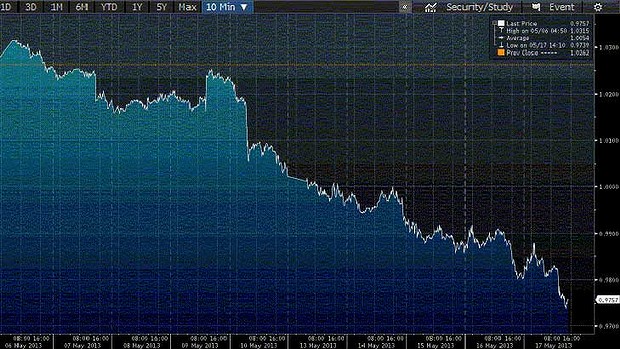
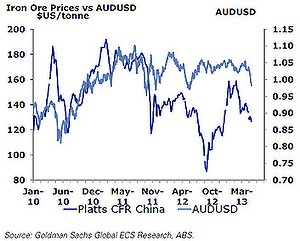
On the way down … the Australian dollar over the past 10 trading sessions. In just 10 days, the Australian dollar has fallen from US103¢ to US97.4¢. The sudden fall has been so sharp one currency strategist described it as a ”falling knife”. The dollar has now fallen for five weeks in a row, and is on track for its worst weekly fall this week since November 2011. So what’s been driving the recent drop, and should we expect a rebound any time soon, if at all? Australian dollar … commodity price trends suggest that the currency should be trading closer to 80 US cents than parity, Goldman Sachs analysts say. In short, the first trigger was the sudden rallying of the US dollar against the yen and other currencies last Thursday night in New York. The US dollar broke through the significant psychological barrier of 100 yen and sent its Australian counterpart into free fall. That pushed the dollar past its own psychological barrier of US101.50¢ and it didn’t take long for the currency to drop through parity on Friday night. The Australian currency continued to fall over the past week, while the greenback has kept strengthening. This is not the first time the Australian dollar has broken out of the 102 to 106 US cents range it has been mostly trading in over the past two years. In September 2011 and May 2012, the currency fell below parity with the US dollar but lifted again shortly after.

Turning point

But currency strategists said the Australian dollar appeared to have reached a turning point, and talk of it bouncing back to above-parity levels was looking less likely.

”The big difference between this fall and the falls in the last couple of years is that they were driven by risk aversion, big falls in asset prices and global growth confidence associated with the European currency crisis,” RBS currency strategist Greg Gibbs said.

”This time, the Australian dollar has fallen in a risk-positive environment, and in some ways, it makes it feel more permanent.”

As optimism grows about the US economy amid growing expectations the US Federal Reserve could wind back its ”quantitative easing” money-printing strategy by the end of this year, investors were once again turning to other fundamentals that drive the Australian dollar, such as the Chinese economy, commodity prices, and the mining investment outlook, Mr Gibbs said.

And all of these indicators have been weak of late.

Stars align for drop

”Iron ore since the peak in February of this year … has lost a fifth of its value. Importantly, coking coal prices have weakened fairly significant too. The spot price of coking coal from the highs in February has dropped by 18 per cent,” Westpac chief currency strategist Robert Rennie said.

”When two or our key export commodities – coking coal and iron ore – lose a fifth of their value, that obviously implies that we should see some weakness in the currency.”

Mr Gibbs said investors now viewed the Australian dollar as reconnecting with commodity price movements.

The Japanese selling of the Australian dollar has also been weighing it down. Japanese investors were net sellers of Australian bonds last year – the first time since 2005 – while becoming record buyers of European bonds.

Given Japan’s influence in the debt market – where it contributes about 10 per cent of all portfolio investment in debt securities, the sell-off could also lower the dollar, HSBC analysts said.

Also fuelling the recent lows are the federal government’s announcement of budget deficits in the next few years, soft domestic economic indicators and the imminent peak of the mining investment boom, Goldman Sachs analysts said in a research note, adding they had reduced their 12-month Australian dollar forecast to 90 US cents.

No longer a safe haven?

At the same time, another change is occurring.

The Australian dollar, along with commodities such as gold, has functioned as a safe haven amid the global economic turmoil over the past few years. They have provided an avenue for higher yield as compared to other investment assets.

But as the recent plunge in gold prices showed, optimism about the US economy and its outlook was driving investment away from safe havens like the Australian currency and gold, and back into other investment vehicles such as the US equities market and greenback.

Already, the lack of increased inflation as economies printed more of their currency over the past few years meant investors felt they no longer needed to pile into the Australian dollar and use it as a hedge, like gold, against global inflation, ANZ currency strategist Andrew Salter said.

”Despite the truly considerable increase in global money supplies the world over, central banks have been largely successful in keeping inflation near target and consumer and business expectations in check,” Mr Salter said.

Whats next?

All eyes will be on Federal Reserve chairman Ben Bernanke as he speaks on Saturday in the US at a graduation ceremony, and testifies to Congress’ joint economic committee on the US economic outlook on Wednesday.

Any indication that suggests the Federal Reserve is open to winding back its bond-buying program – part of how it has been pumping money into the economy – could push the US dollar higher, and its flipside, the Australian dollar, down.

The falling Australian dollar could pare back expectations of a Reserve Bank rate cut in June.

Financial markets were pricing in a 19 per cent chance of a cut next month, and  the chance of at least one more cut by the end of this year.

Meanwhile, a 6 per cent decline in the exchange rate (the past 10 days has seen it decline by 5.6 per cent) could have the same impact as a 100 basis points interest rate cut, boosting economic growth by about 100 basis points over a couple of years, Barclays chief economist Kieran Davies said in a research note today.
Denmark Shelves Euro Goal Indefinitely as Crisis Scars Too Deep

Denmark Shelves Euro Goal Indefinitely as Crisis Scars Too Deep

Denmark is shelving indefinitely its euro adoption goal as Prime Minister Helle Thorning-Schmidt says an exchange rate peg without full European monetary membership is proving the best currency regime for the Nordic nation.

A euro referendum “in this election term is unrealistic,” Thorning-Schmidt said yesterday in an interview in Stockholm. “I don’t think it makes any sense to discuss the option of a euro referendum in the next term” set to run from 2015 to 2019, she said. Read more of this post

U.K. commercial real estate investors may be unable to refinance about half of their 198 billion pounds ($303 billion) of bank loans as property values fall

U.K. Property Loans Seen Facing 92 Billion-Pound Refinancing Gap

U.K. commercial real estate investors may be unable to refinance about half of their 198 billion pounds ($303 billion) of bank loans as property values fall, a survey by De Montfort University shows.

About 92 billion pounds of remaining bank loans are “likely to be unrefinancable on terms available in today’s lending market,” according to the survey of 78 lenders, which was published today. The amount of the loans is too high compared with the real estate backing them, the report by the Leicester, England-based university said.

Banks and other lenders cut U.K. commercial real-estate lending by 7.7 percent last year as they repaired balance sheets damaged by losses and tried to meet regulatory requirements, De Montfort estimates. Almost a quarter of all property loans are now in “severe distress” because the outstanding debt is higher than the value of the real estate after the worst-located and lowest-quality buildings in the U.K. depreciated further last year. Read more of this post

Chief executives and the itch to quit

Thu, May 16 2013

By Andrew Callus

LONDON, May 16 (Reuters) – On approaching his 60th birthday this year, long-serving Tullow Oil boss Aidan Heavey told staff he felt “like two 30 year-olds”.

A handful of recent shock departures by 50-something chief executives at European blue chip companies – none of them under any obvious pressure to quit – suggest some of his peers either lack that vigour, or want to channel it elsewhere.

Peter Voser is giving up one of the world’s most challenging CEO roles at Royal Dutch/Shell next year, before his 55th birthday, in pursuit of a “lifestyle change”.

Swiss engineering group ABB’s 55-year old boss Joe Hogan is also going, for “private reasons”. Pierre-Olivier Beckers, 53, is walking out on Belgian retailer Delhaize , and Paul Walsh, 57, is waving goodbye to drinks multinational Diageo. Read more of this post

Central banks saved world economy, now beware the fallout

Published: Friday May 17, 2013 MYT 11:30:00 AM

Central banks saved world economy, now beware the fallout

WASHINGTON: Central banks got it right when they saved the world economy, but their unprecedented actions risk disruptive cross-border spillovers and potentially heavy losses when the time comes to reverse course, the IMF said on Thursday.

In its most detailed survey so far of the dramatic measures taken to counter the damage from the 2007-2009 financial crisis, International Monetary Fund staff repeated earlier assessments that the steps had worked but face diminishing returns.

However, in new research, they also said central banks could face severe losses when they begin to withdraw the extraordinary sums of money they have pumped into financial systems around the world. Read more of this post

Kuroda Faith Waning Halts Debt Deals as Forecasts Blown; “BOJ policy has become more unpredictable”

Kuroda Faith Waning Halts Deals as Forecasts Blown: Japan Credit

Bank of Japan Governor Haruhiko Kuroda’s stimulus policies pushed bond yields above analyst forecasts for the first time since at least July as the widest price swings in a decade halted two debt offerings.

Benchmark 10-year Japanese government bond yields reached 0.92 percent yesterday, the highest since April 2012. That put the rate above the 0.7 percent year-end forecast by analysts in a Bloomberg News survey. The rate later pared gains after the central bank announced a 2.8 trillion yen ($27.4 billion) infusion of funds. Analyst forecasts for 10-year Treasury yields are at 2.2 percent compared with the current 1.93 percent.

Kuroda’s doubling of bond purchases last month to achieve 2 percent inflation in two years has failed to cap borrowing costs, with the 10-year yield rising the most since August 2003 in the three sessions through May 14. Toyota Industries Corp. (6201) joined Lixil Group Corp. (5938) in canceling debt sales this week due to market volatility, casting doubt on the BOJ’s plan to boost investment and growth by keeping borrowing costs low.

“It’s probably not realistic for the BOJ to think that it can keep bond yields low despite monetary easing aimed at 2 percent inflation because it buys” lots of JGBs, said Takeshi Minami, chief economist in Tokyo at Norinchukin Research Institute Co. That’s “contradictory,” he said. Read more of this post

Bill Gross: “We See Bubbles Everywhere”

Bill Gross: “We See Bubbles Everywhere”

Tyler Durden on 05/16/2013 14:25 -0400

It is only logical that when one of the smarter people in finance warns that he “sees bubbles everywhere” that he should be roundly ignored by those who have no choice but to dance. Because Bernanke and company are still playing the music with the volume on Max, and if not for POMOthere is always FOMO. However, if there is any doubt why this “rally is the most hated ever”, here are some insights from the Bond King from an interview with Bloomberg TV earlier today: “We see bubbles everywhere, and that is not to be dramatic and not to suggest they will pop immediately. I just suggested in the bond market with a bubble in treasuries and bubble in narrow credit spreads and high-yield prices, that perhaps there is a significant distortion there. Having said that, it suggests that as long as the FED and Bank of Japan and other Central Banks keep writing checks and do not withdraw, then the bubble can be supported as in blowing bubbles. They are blowing bubbles. When that stops there will be repercussions. It doesn’t mean something like 2008 but the potential end of the bull markets everywhere. Not just in the bond market but in the stock market as well and a developing one in the house market as well.” Read more of this post

Are Japanese Banks On The Verge Of Insolvency? A 100 basis point (parallel) rise in market yields would lead to mark-to-market (MTM) losses of 20% of Tier-1 capital for regional banks and 10% for the major banks

Are Japanese Banks On The Verge Of Insolvency?

Tyler Durden on 05/16/2013 13:13 -0400

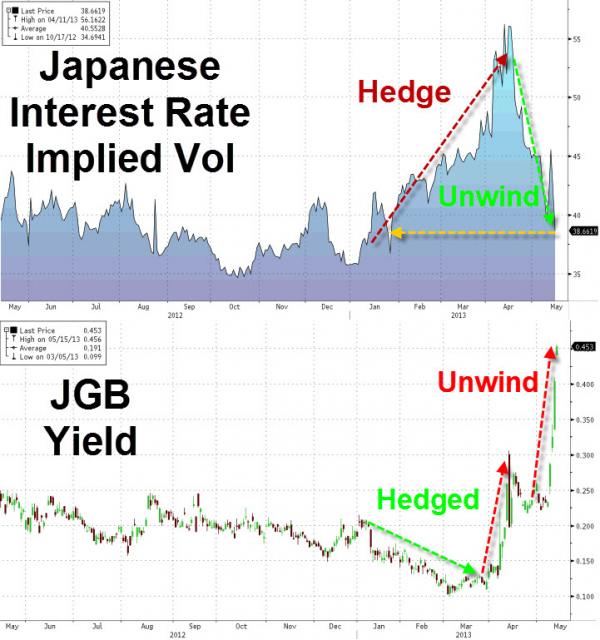
We have long discussed the problem that the Japanese government faces if interest rates in the troubled nation rise (cost of debt financing will swamp revenues in a vicious circle); but now it seems there is another – just as vicious – problem (that the BoJ is set to discuss according to Nikkei). The inability of the BoJ to ‘control’ Japanese interest rates (JGB rates spiking unprecedentedly day after day) has put the banking system in a lot of trouble. As we explained recently the banks appeared to initially ‘hedge’ their huge JGB positions but now appear to recognize that first out wins and are reducing exposure overall (YTD -3.7% according to local data). The reason – simple – as the IMF explains via the BoJ – according to BOJ estimates (footnote 4)a 100bp (parallel) rise in market yields would lead to mark-to-market (MTM) losses of 20% of Tier-1 capital for regional banks and 10% for the major banks. He who sells first wins…

We said previously: This is what is going on in JGBs… JGBs were able to rally since smart money was hedging significantly (and not selling) but once the initial clusterfuck exploded after the BoJ meeting (and protection costs soared), it seems clear that JGBs just became far too expensive to hold given their risk and so protection was unwound and positions were reduced… which is why we are now seeing JGB yields jumping… and as the IMF explainsJGB market exposures represent one of the central macrofinancial risk factors. This risk reflects the possible impact on public debt sustainability of changes in yields and related effects on investor confidence; the increased role of the private financial sector in covering government borrowing needs; the prospect that ongoing demographic shifts will reduce private saving; and growing household interest in investing abroad. Interest rate risk sensitivity is especially prevalent in regional banks and insurance companies (JGBs representing about 70 percent of life insurers’ securities holdings and 90 percent of insurance cooperatives’ securities holdings). In addition, the main public pension scheme, as well as Japan Post and Norinchukin bank, also have large JGB exposures. According to BOJ estimates, a 100 basis point (parallel) rise in market yields would lead to mark-to-market (MTM) losses of 20 percent of Tier-1 capital for regional banks (not taking into account net unrealized gains on securities), against 10 percent for the major banks. Surely all this has been provisioned for somehow. Or not?

20130514_JGB1_0

From Brooklyn to California, Housing Bubble Threat Grows

From Brooklyn to California, Housing Bubble Threat Grows

Just a year since the U.S. housing market hit bottom after the biggest plunge in eight decades, signs of excess are re-emerging.

An open house for a five-bedroom brownstone in Brooklyn, New York, priced at $949,000 drew 300 visitors and brought in 50 offers. Three thousand miles away in Menlo Park, California, a one-story home listed for $2 million got six offers last month, including four from builders planning to tear it down to construct a bigger house. In south Florida, ground zero for the last building boom and bust, 3,300 new condominium units are under way, the most since 2007.

The U.S. spring homebuying season has been marked by a frenzy of demand fueled by the Federal Reserve’s drive to push down borrowing costs, a scarcity of listings and Wall Street’s new appetite for foreclosed homes. While values remain well below their peak, economists including Stan Humphries of Zillow Inc. (Z) and Mark Vitner of Wells Fargo & Co. assert prices in some areas are rising at an unsustainable pace — a dramatic shift from early 2012, when billionaire Warren Buffett said housing “remains in a depression.” Read more of this post

How China Fell in Love with Fruit Ninja, the #2 smartphone game of all time?

How China Fell in Love with Fruit Ninja

by KAI LUKOFF on 05/16/2013 · LEAVE A COMMENT

Fruit Ninja is the #2 smartphone game of all time, said Phil Larsen the CMO of Halfbrick Studios in an interview at the GMIC. So how did this slasher of satisfyingly squishy fruits move into China? For one, China is the only market in the world where Halfbrick does extensive internationalization. ”We’re not going to do a different version for Germany anytime soon,” says Larsen. But China’s both large enough (the second-largest market for the game) and different enough to justify the extra effort. The China-specific adaptations came in two steps: 1) monetization; and 2) new content. To enter China, Halfbrick turned to the publisher iDreamSky. CEO Jeff Lyndon told me that they spent the past year focused on adapting the monetization model of Fruit Ninja. To really thrive in China, the game required more than simple localization (translation, Chinese payment SDKs, Chinese game center). It also had to be internationalized–parts of the gaming experience had to be redesigned and rebuilt–for the China market. Read more of this post

Tencent Becomes World’s 4th Largest Internet Company by Market Cap on Strong Q1 Figure, higher than that of Facebook, only lagging behind Google, Amazon and eBay

Tencent Becomes World’s 4th Largest Internet Company by Market Cap on Strong Q1 Figure

05-16 15:42 Caijing

Market value for the Chinese Internet bellwether topped USD 69.85 billion, higher than that of Facebook, only lagging behind Google, Amazon and eBay

Tencent has risen to become the world’s fourth Internet company after its shares hit a record high Thursday following strong first quarter earnings. Market value for the Chinese Internet bellwether topped USD 69.85 billion, higher than that of Facebook, only lagging behind Google, Amazon and eBay, after its shares surged over 6% to close at HKD 293.4. It now worths twice as much as Baidu, China’s largest search engine, and is nearly in a tie with the country’s e-commerce empjire Alibaba Group, which is widely believed to have USD 70billion in valuation and is expected to go public as early as the next year. Tencent Wednesday reported total revenues of RMB13,547.6 million (USD 2,161) in the first three months, representing a remarkable 40.4% year-on-year growth, and an increase of 11.5% over the previous quarter. Q1 profit was RMB4,071.1 million (USD649.4 million), an increase of 17.3% QoQ or an increase of 37.4% YoY. Net margin increased to 30.1% from 28.6% last quarter. Monthly active user accounts (MAU) of instant messaging were 825.4million, an increase of 9.8% year-on-year, while MAU of Weixin and WeiChat surged 228.4% from a year earlier. The number of users of Weixin, Tencent’s increasingly popular instant text and voicing messaging service, has exceeded 300 million. The company is planning to take the service to a bigger stage in launching WeiChat targeting overseas market. The robust growth in the first three months has enabled the company to fund investments in longer-term opportunities such as WeChat international user acquisition, online video content aggregation, said chairman and CEO Ma Huateng. “We will continue to invest proactively in innovation and technology, and to cultivate our open platform, in order to capture the mobile opportunities ahead and cement our role as a leading Internet platform in China,” Ma said.

Going global: how one Melbourne start-up did it

Going global: how one Melbourne start-up did it

May 16, 2013

Valerie Khoo is a journalist, author and entrepreneur, offering insights into the minds of other small- to medium-sized business entrepreneurs.

Patrick Llewellyn was on a plane back to Australia from the US when a fellow passenger had a heart attack mid-flight. The plane was forced to turn back and stop in Hawaii so the passenger could get medical attention and Llewellyn found himself in a hotel room on an unexpected and extended stopover. “I was sitting there answering emails when I realised that I’d never been to Hawaii before,” says Llewellyn, who is the CEO of 99designs, a crowd-sourced marketplace for graphic design. Llewellyn, 40, decided to make the most of it, venturing on to Waikiki Beach where he took his very first surfing lesson. “As soon as I stood up, I was hooked,” says Llewellyn. It’s was a rare moment of relaxation for the CEO of a fast growing company that now experiences $1.8 million in transactions each month and has over 200,000 registered designers. Although 99designs was founded in 2008, Llewellyn didn’t join the team until September 2009 and then moved to the US in February 2010 to spearhead growth in North America. Shortly after, he became CEO, after founder Mark Harbottle stepped back to focus on his other entrepreneurial pursuits. At the time, 99designs had 10 staff in Melbourne and four in the US. Now, there are about 90 staff  spread across the globe including 46 in the US, 34 in Melbourne, eight in Berlin, and two in Paris. Read more of this post

How Microsoft, Google, and Square use hardware to market their software and services

How Microsoft, Google, and Square use hardware to market their software and services

BY NATHANIEL MOTT 
ON MAY 16, 2013

Hardware is becoming an increasingly important aspect of traditionally software-focused companies. Microsoft and Google have both introduced their own hardware over the last year, with the Surface tabletsand Chromebook Pixel; Square recently announced the Square Stand, which turns an iPad into a cash register; and Adobe announced its own stylus and a “smart ruler” around the same time it said that its design products would only be available by subscription.

It’s doubtful that any of these companies got into the hardware business just for kicks; despite lower barriers to the hardware business, entering the physical realm is still a challenge. But why, then, are these companies building their own hardware even as they work to increase software’s role in our everyday lives? The answer, it seems, is that hardware is the best advertising platform available for their software. Read more of this post

China’s Alibaba Makes Its Move Against Google’s Android

China’s Alibaba Makes Its Move Against Google’s Android

By Bruce Einhorn on May 16, 2013

Jack Ma, the founder of Chinese e-commerce giant Alibaba Group, has made a career of taking on big-name rivals from the U.S. As the company has grown since its 1999 founding into a hybrid of Amazon.com (AMZN) and EBay (EBAY) and become a leader in business-to-business sales, only Google (GOOG) has gotten the better of Ma. In September, Alibaba accused the search giant of scotching the debut of a smartphone using its homemade operating system just hours before its big coming-out party in Shanghai, prompting Android seller Acer (2353) to drop its partnership with Alibaba. The U.S. search company says the Chinese company’s system “is based on the Android platform and takes advantage of all the hard work that has gone into that platform,” as Google developer Andy Rubin wrote online at the time.

On May 10, Ma officially stepped down as chief executive officer, part of his plan to focus on longer-term strategy while handing day-to-day responsibilities to company veteran Jonathan Lu. Ma remains executive chairman, though, and his fight with Google isn’t over. In April, Alibaba announced deals with five lower-profile Chinese smartphone makers, including G’Five and Zopo, to sell devices using its operating system. The company maintains that its OS has always been a distinct creation. “Google is not the judge,” says Chief Technology Officer Wang Jian. “Let the market and the consumer decide.” Vendors who sell goods on Alibaba websites Taobao Marketplace and Tmall.com will be able to manage their online operations from apps built into the new mobile system, he says. Read more of this post

Apple Seen Losing Innovation Magic by 71% in Global Poll

Apple Seen Losing Innovation Magic by 71% in Global Poll

Apple Inc., (AAPL) the world’s most valuable technology company, has lost its edge among investors, according to the latest Bloomberg Global Poll.

Hedge funds sold large stakes of the iPhone maker’s stock in the first quarter, Apple shares are down 40 percent from last year’s high and the company paid higher interest rates for a recent bond sale than Microsoft — in a PC trumps Mac moment.

Now, 71 percent of poll respondents say the Cupertino, California, company has lost its cachet as an industry innovator, which includes 28 percent who say it is permanent and 43 percent who say it may be a temporary hiccup. There are still true believers; 23 percent said Apple remains the best in the business. Six percent were unsure.

“They’ve definitely lost their momentum,” said Lionel Mellul, 43, head of the cash equity business at Sunrise Brokers in New York, a poll respondent. “It’s still at the point where they might turn things around. They still have a strong brand.” Read more of this post