Tata Steel: Goodwill write-offs are confusing. When they happen, the managers of firms insist they do not matter. The simple, cynical—and largely true—view is that managers are vain and hate to admit mistakes

Tata Steel

Goodwill Hunting

May 14th 2013, 11:38 by P.F. | MUMBAI

GOODWILL write-offs are confusing. When they happen, the managers of firms insist they do not matter. Goodwill is the excess paid for an asset over its book value. Writing it down is a mere accounting adjustment, bosses tend to say. Yet those same bosses go to inordinate lengths to delay recognising such supposedly irrelevant, non-cash losses. On May 13th Tata Steel, an Indian firm, announced a $1.6 billion impairment, mainly of its $13 billion takeover of Corus, a British steelmaker. The deal happened six years ago. It has been clear for at least four years that it has been a financial disaster. Why recognise that now?

The simple, cynical—and largely true—view is that managers are vain and hate to admit mistakes. Investors usually decide an acquisition has gone bad within a year or two. The buyers’ shares drop. It takes longer for the accounts to catch up. Auditors should subject balance sheets to a yearly impairment test, but valuations are subjective and executives can twist their arms. When the auditors do, finally, assert themselves, companies are often blasé. An example is ArcelorMittal, another steel firm, which disclosed a $4.3 billion write-down in December. There has been no post-mortem of the long and value-destructive acquisition spree that helped generate it. Read more of this post

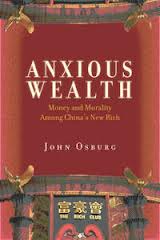
Anxious Wealth: Money and Morality Among China’s New Rich

Anxious Wealth: Money and Morality Among China’s New Rich [Paperback]

John Osburg (Author)

Anxious Wealth

Publication Date: April 3, 2013

Who exactly are China’s new rich? This pioneering investigation introduces readers to the private lives—and the nightlives—of the powerful entrepreneurs and managers redefining success and status in the city of Chengdu. Over the course of more than three years, anthropologist John Osburg accompanied, and in some instances assisted, wealthy Chinese businessmen as they courted clients, partners, and government officials.

Drawing on his immersive experiences, Osburg invites readers to join him as he journeys through the new, highly gendered entertainment sites for Chinese businessmen, including karaoke clubs, saunas, and massage parlors—places specifically designed to cater to the desires and enjoyment of elite men. Within these spaces, a masculinization of business is taking place. Osburg details the complex code of behavior that governs businessmen as they go about banqueting, drinking, gambling, bribing, exchanging gifts, and obtaining sexual services.

These intricate social networks play a key role in generating business, performing social status, and reconfiguring gender roles. But many entrepreneurs feel trapped by their obligations and moral compromises in this evolving environment. Ultimately, Osburg examines their deep ambivalence about China’s future and their own complicity in the major issues of post-Mao Chinese society—corruption, inequality, materialism, and loss of trust. Read more of this post

100 years on, Rockefeller Foundation still busy

100 years on, Rockefeller Foundation still busy

David Crary, The Associated Press, New York | World | Mon, May 13 2013, 8:48 AM

For the richest American family of their era, the goal was fittingly ambitious: “To promote the well-being of mankind throughout the world.”

With that mission, underwritten by the vast wealth of John D. Rockefeller Sr., the Rockefeller Foundation was chartered 100 years ago. For several decades, it was the dominant foundation in the United States, breaking precedent with its global outlook and helping pioneer a diligent, scientific approach to charity that became a model for the field.

“They were in a very small group of foundations that practiced idea-based philanthropy as opposed to just charity. They are willing to invest in ideas,” said Bradford Smith, who as president of the New York-based Foundation Center oversees research on philanthropy worldwide.

The Rockefeller Foundation is celebrating its centennial by touting an array of forward-looking projects, ranging from global disease surveillance to strengthening the resilience of vulnerable cities in the U.S. and Asia to future calamities. It is also looking back, at a 100-year history replete with triumphs and controversy. Read more of this post

Sir Luke Johnson: Whether it’s selling or shutting a business, leaving a job or ending a relationship, deciding when and if to let go makes all the difference

May 14, 2013 4:08 pm

Walking away is often the best option

By Luke Johnson

Deciding when and if to let go makes all the difference

Knowing when to quit separates winners from losers. Those who spend years pursuing lost causes can waste their lives. Others who leave gracefully and move on understand that the world is full of opportunities, and know that sheer stubbornness for its own sake is foolish. A couple of years ago I backed a play called Onassis in London’s West End. As ever, it was launched with great optimism. But the reviews were mediocre and the box office takings poor. Soon the choice came: should we put in more money to fund additional marketing, or accept that the show wasn’t good enough and close? I’m relieved to say that we shut, took the pain – and learnt a few lessons from the experience.

Whether it’s selling or shutting a business, leaving a job or ending a relationship, deciding when and if to let go makes all the difference. As they say, timing is everything. Occasionally massive persistence can pay off: Chester Carlson first patented his technique for a photocopier in 1938 but it wasn’t until 1949 that the Xerox Corporation first launched his product. But for every epic invention like that there are many thousands of doomed ideas that will never achieve lift-off. I regularly receive business plans for schemes that appear entirely uneconomic: in lots of cases the passionate founder has spent years hawking their dream around financiers getting nowhere, ignoring the evidence and allowing emotions to overwhelm their judgment. Read more of this post

Billionaires Juan Roig and Hortensia Herrero, the husband-and-wife team that controls Mercadona SA, Spain’s largest supermarket chain, created thousands of jobs last year as their country’s economy crumbled

Spanish Billionaires Hire 4,000 Amid Country’s Job Slump

Billionaires Juan Roig and Hortensia Herrero, the husband-and-wife team that controls Mercadona SA, Spain’s largest supermarket chain, created thousands of jobs last year as their country’s economy crumbled. Revenue at the closely held operation rose 7 percent to 19.1 billion euros ($24.5 billion) in 2012, according to its annual report, as demand for its low-priced, private-label goods lured cash-strapped Spanish shoppers. Net income also jumped 7 percent to 508 million euros, a performance that helped allow the company to hire 4,000 new workers. Roig, the country’s fourth-richest person and a well-known figure in the Spanish press for his economic commentary and pronouncements, controls 51 percent of Mercadona. He has a $4.5 billion fortune, according to the Bloomberg Billionaires Index.

“Mercadona, under the Roigs’ instruction, has posted extraordinary growth over the last 10 years,” said David Bain, the London-based head of research at Campden Wealth, a networking community for the world’s wealthiest family businesses. “Roig is a big believer in the family business model, and is strict about his family actually contributing rather than providing a nice place to hang out in a high-paying non-job.” Herrero, 62, is vice president of the Valencia, Spain-based company, which commands 14 percent of all food retail space in the country, according to the annual report. She controls a 28 percent stake in the company and has a net worth of at least $2.6 billion. Read more of this post

Game Theory and the Treatment of Cancer; Thinking about cancer as an ecosystem is giving biologists access to a new armoury of mathematical tools for tackling it, such as evolutionary game theory

The Physics arXiv Blog

May 14, 2013

Game Theory and the Treatment of Cancer

Thinking about cancer as an ecosystem is giving biologists access to a new armoury of mathematical tools for tackling it, such as evolutionary game theory

“A small but growing number of people are finding interesting parallels between ecosystems as studied by ecologists (think of a Savanna or the Amazon rain forest or a Coral reef) and tumours.” So begin David Basanta and Alexander Anderson at the Moffitt Cancer Centre in Florida in a fascinating paper describing a new way of thinking about cancer and the way to treat it. They point out that it’s more or less impossible to understand any creature or its behaviour without thinking carefully about the environment in which it lives and evolves.  “As convenient as it would be for cancer biologists to study tumour cells in isolation, that makes as much sense as trying to understand frogs without considering that they tend to live near swamps and feast on insects,” say Basanta and Anderson . What would biologists make of a frog’s sticky tongue without knowing how it is used for catching flies, for example? Similarly, how should cancer biologists think about cancer cells capable of producing vascular endothelial growth factor, a protein that promotes the growth of blood vessels?  Read more of this post

India’s demographic challenge: India will soon have a fifth of the world’s working-age population. It urgently needs to provide them with better jobs

India’s demographic challenge

Wasting time

India will soon have a fifth of the world’s working-age population. It urgently needs to provide them with better jobs

May 11th 2013 | PATNA, BIHAR |From the print edition

20130511_FBD002_0

ONE of India’s bigger private-sector employers can be found in Patna, the capital of Bihar, a poor, populous state in the east of the country. Narendra Kumar Singh, the boss, has three gold rings on his right hand and arms big enough to crush rocks. His firm, Frontline, has 86,000 people on its books. They are mostly unskilled men from rural areas in poor states like Bihar; thanks to Mr Singh they have jobs in cities all over India.

There is lots to celebrate about this. Mr Singh’s business has sales of $185m and its employee base has grown by 1,600% since 2000. He is looking for a Western partner and wants to expand to Sri Lanka and Bangladesh. He is providing paid work for part of the large cohort of young people now entering the workforce. And by shifting people from farms to cities he is helping urbanisation of the sort that underpinned startling progress elsewhere in Asia.

Yet Frontline is also a symptom of a colossal failure. For it is not supplying labour for a manufacturing boom of the kind that helped so many in China, South Korea and Taiwan out of poverty, or for the IT services at which India has excelled. Instead it offers relatively unproductive service-sector jobs—in particular, security guards. It has become de rigueur for every ATM, office, shop and apartment building to have guards. Across India millions of young men now sit all day on plastic seats in badly fitting uniforms with braids and epaulettes, unshaven and catatonically bored as the economic miracle passes by. This isn’t how East Asia got rich. Read more of this post

Water With Some Pop to It: New Drinks Go After People Who Don’t Like the Bland Taste; Controlling the Flavor

May 14, 2013, 7:43 p.m. ET

Water With Some Pop to It

New Drinks Go After People Who Don’t Like the Bland Taste; Controlling the Flavor

By SARAH NASSAUER

With soda and diet soda sales in decline, drinks companies are coming up with waters that look more like soda than water. Sarah Nassauer joins Lunch Break with a look.

PJ-BO298_NOWATE_DV_20130514194240

When is water actually soda? As bottled-water sales boom and traditional soda sales slump in an almost decade-long decline, companies are marketing water that hints it could taste like soda. The consumer targets: People who know they should drink more water but don’t always like the taste. These water-fussy drinkers are a quiet but large group—about 20% of Americans, say drinks companies and consumer research firms. Some complain water tastes metallic or chlorinated. Others say water is too boring. The products becoming popular with these folks aim to mimic water: They have no calories and market themselves as natural, though some have artificial sweeteners and colorings, or other ingredients that help deliver a soda-like fix. The makers of these drinks hope people who like water or soda but want more variety will also buy the products. Read more of this post

European authorities raid Shell, BP and Statoil offices to probe suspected manipulation of oil prices

Published: Wednesday May 15, 2013 MYT 9:27:00 AM

European authorities raid Shell, BP and Statoil offices to probe suspected manipulation of oil prices

LONDON/OSLO: European authorities have raided offices of oil majors Shell, BP and Statoil in an investigation of suspected manipulation of oil prices, one of the biggest cross-border actions since the Libor rigging scandal. Authorities have sharpened scrutiny of financial benchmarks around the world since slapping large fines on some of the world’s biggest banks for rigging interest rate benchmarks. On Tuesday, the European Commission said it was investigating major oil companies over suspected anti-competitive agreements related to submission of prices to leading oil pricing agency Platts, a unit ofMcGraw Hill Group. “Officials carried out unannounced inspections at the premises of several companies active in and providing services to the crude oil, refined oil products and biofuels sectors,” the Commission said. The inspections took place in two EU member states and one non-EU country, it said. “The Commission has concerns that the companies may have colluded in reporting distorted prices to a price reporting agency to manipulate the published prices for a number of oil and biofuel products,” it said.

Read more of this post

Why Foxconn’s Switch to Robots Hasn’t Been Automatic

05.14.2013 17:43

Why Foxconn’s Switch to Robots Hasn’t Been Automatic

With the wages of workers rising, the huge manufacturer has pursued increased automation, but the effort has not gone smoothly

By staff reporter Li Xuena

(Beijing) – In the face of rising labor costs in recent years, manufacturing companies at home and abroad have tried to find new ways to control spending and improve productivity. At the same time, Foxconn International Holdings, the original equipment manufacturer for companies such as Apple Inc. and its iPhones and iPads, has been at the center of controversy over its labor practices since a spate of worker suicides at its facilities in 2010. This prompted the company to give employees a raise. In June 2010, Foxconn said that starting from October 1, 2010 its entry-level workers’ wages would be increased to 2,000 yuan per month from 1,200 yuan after a three-month probation. It also spurred Foxconn to speed up its pursuit of automation. The company’s president, Terry Guo, said in 2010 that it would produce 1 million Foxbots, a mechanical arm researched and developed by Foxconn to perform dull and dangerous jobs. The robots would be implemented from 2012 to 2015 to increase the rate of automation and productivity. However, a poor financial showing in 2012 has become an obstacle realizing the plan. Foxconn’s net loss in 2012 was US$ 316 million, the biggest loss it has suffered since listing in Hong Kong in 2005, the company’s financial report shows. Read more of this post

Errors of Aggression Catch up with Underwriter; Ping An Securities pursued IPOs with abandon for two years, but sloppy work has resulted in heavy punishment from the regulator

05.14.2013 18:24

Errors of Aggression Catch up with Underwriter

Ping An Securities Co. pursued IPOs with abandon for two years, but sloppy work has resulted in heavy punishment from the regulator

By staff reporters Zhang Bing, Fu Yanyan and Zheng Fei

(Beijing) – Ping An Securities Co. has been slapped with a fine by the securities regulator and will lose its stock underwriting license for three months because of its sloppy work in underwriting the initial public offering of a company that turned out to be a fraud.

This is not the first time the leading underwriter had to swallow a bitter pill for its overly aggressive approach to IPO underwriting in 2010 and 2011, when it beat all other brokerage firms in the country in underwriting revenue. Read more of this post

China: High and dry; Water shortages put a brake on economic growth and stir political discontent

Last updated: May 14, 2013 9:12 pm

China: High and dry

By Leslie Hook

Water shortages put a brake on economic growth and stir political discontent

Holed beneath the waterline: China’s droughts and water shortages are pushing people to leave their homes and join an exodus to the cities

Wang Fuguo, a 63-year-old cotton farmer, does not know when his ancestors began tilling the land in the dusty village of Weijie. But he is fairly sure he will be the last of his family to do so. “They’ve all fled,” he says, looking out from his gate at the abandoned houses that line the village’s only street. The reason is simple. “There’s just no water here,” he says. “If you don’t have water you can’t survive.” His household gets running water for one hour every five days, barely enough to feed a tiny patch of aubergines and supply his family and their dozen sheep. In the face of China’s rapid economic expansion and growing presence on the global stage, it is often forgotten that the country is running out of water. In per capita terms, China’s water resources are just a quarter of the world average. Eight of China’s 28 provinces are as parched as countries in the Middle East such as Jordan and Syria, according to China Water Risk, a consultancy based in Hong Kong. Read more of this post

Why Investors Can’t Imagine a Collapse of the Bond Market

May 14, 2013

Why Investors Can’t Imagine a Collapse of the Bond Market

By Jason Zweig

For years on end, pundits have been predicting the collapse of the bond market, and recently such calls have reached a crescendo – with bond king Bill Gross of Pimco being the latest to sound the death knell.

But investors show almost no inclination to avoid the impending doom: A new survey of investors by BlackRock found that 57% are “worried about rising interest rates” and 53% think bonds are riskier today than a decade ago. Yet fewer than 7% said that “identifying the bond investments that are right for you” would be a major focus for them over the coming year – and 60% said they wouldn’t focus on it at all.

Meanwhile, even as the stock market has shot almost straight up for the past four years, investors appear to be turning their backs on equities. The proportion of Americans who will admit to owning stocks has sunk to 52%, down from 65% in 2007, according to a new Gallup survey.

In short, investors are the prisoners of their past. Read more of this post

James Montier’s Presentation at London Value Conference: GMO Now 50% in Cash

Monday, May 13, 2013

James Montier’s Presentation at London Value Conference: GMO Now 50% in Cash

Continuing our notes from the London Value Investor Conference 2013, the next speaker is James Montier of GMO.  He presented an update on their latest asset allocation model.
GMO Now 50% in Cash
James Montier said that GMO’s 7 year asset allocation model for US stocks is now predicting  negative returns. GMO are now 50% in cash.  While they’ve been known to hold higher levels of cash than most investors, this seems to be taking things a step further.  They still hold some investments in Japan but he  indicated that they are likely to be selling over the next couple of months.
He said that a year ago the model was indicating good returns in Europe but now it only suggests  2.5% real return per annum. He said that they are a bit frightened to follow the model in Europe  because of the leverage at the company level, particularly in the financial sector.
Their model suggests that the best value is in emerging markets where 6% real is forecast. However,  he mentioned that the research by his colleague, Edward Chancellor, which has identified an asset  bubble in Chinese real estate, has made GMO cautious and led them to allocate less to EM than the  model would suggest.
It is clear that at certain times GMO are prepared to overrule their  quantitative asset allocation models when other evidence suggests caution.

Brokers Go Gray as Youth Unsustainable Without Cold Calls

Brokers Go Gray as Youth Unsustainable Without Cold Calls

Alex Freemon was so eager to be a stockbroker after graduating from the Georgia Institute of Technology last year that he said he was happy to go door to door selling mutual funds for Edward Jones & Co.

The brokerage flew him to St. Louis, where he practiced knocking on a model door in a classroom of would-be brokers at the company’s headquarters, then sent him back to Atlanta to walk the streets for 10 hours a day for about $30,000 a year plus commissions. Freemon said he quit in March after realizing he would have to spend five years struggling to meet sales goals before he could focus on helping clients make financial plans.

“Until you actually go out and hit the pavement, it doesn’t really sink in,” said Freemon, 23, who now works as a business analyst at a software company in Atlanta. “It’s not impossible, but it’s definitely not sustainable if you have a family or anything to do besides knocking on doors.”

Breaking into the brokerage business is getting tougher as declining fees make small accounts less profitable and government restrictions on unsolicited calls make phone sales taboo. That’s leaving big firms struggling to replace a retiring generation of advisers who helped accumulate trillions of dollars of assets and generated steady profits for years.

“The only way you can do it is if your dad is rich and he’s got country-club buddies he can send you or you’re a psycho who can work 20 hours a day,” said Josh Brown, who helps oversee about $350 million at Fusion Analytics Investment Partners LLC in New York. Read more of this post

The Resistible Fall of Europe: An Interview with George Soros

George Soros is Chairman of Soros Fund Management and Chairman of the Open Society Foundations. A pioneer of the hedge-fund industry, he is the author of many books, including The Alchemy of Finance and The New Paradigm for Financial Markets: The Credit Crisis of 2008 and What it Means.

The Resistible Fall of Europe: An Interview with George Soros

14 May 2013

Editor’s note: On May 12, George Soros was awarded the Tiziano Terzani Prize for his 2012 book Financial Turmoilpublished in Italy by Hoepli. The following interview is adapted from a press conference held in Udine, Italy, on that occasion.

INTRODUCTION
SOROS: I have been very concerned about Europe. The euro is in the process of destroying the European Union. To some extent, this has already happened, in the sense that the EU was meant to be a voluntary association of equal states. The crisis has turned it into something that is radically different: a relationship between creditors and debtors. And, in a financial crisis, the creditors are in charge. It is no longer a relationship between equals. The fate of Italy, for example, is no longer determined by Italian politics – which is in a crisis of its own, I would say – but rather by the creditor/debtor relationship. That is really what dictates policies.

QUESTION: But the stock markets are apparently in good condition. Why do you think we are in a crisis? Do you think this kind of honeymoon will go on for a long time?

SOROS: The answer is no. We are in what I call a far-from-equilibrium situation. Therefore, it cannot last. But I am not in a position to predict the future. Read more of this post

Malaysian Pension Fund Sold Stocks on Poll Rally: Southeast Asia

Malaysian Pension Fund Sold Stocks on Poll Rally: Southeast Asia

Malaysia’s biggest pension fund sold about 331 million ringgit ($110 million) of shares in the country’s benchmark index as Prime Minister Najib Razak’s election victory sparked the largest rally since 2008.

Employees Provident Fund, which oversees $176 billion for more than 13 million Malaysians, reduced stakes in 20 of the 30 stocks in the FTSE Bursa Malaysia KLCI Index (FBMKLCI) as the gauge jumped 3.4 percent on May 6, regulatory filings compiled by Bloomberg show. The fund’s net sales of UEM Land Holdings Bhd. (ULHB) were the biggest on record for a single day, while the reduction in Public Bank Bhd. (PBK) was the largest in three months.

EPF sold even as Najib’s win in the May 5 election eased concern the first change in leadership since 1957 would disrupt his plans to narrow the budget deficit and boost infrastructure spending. The fund may have taken advantage of foreign purchases to lock in higher prices on its holdings as the KLCI index rose as much as 7.8 percent to a record, said ABN Amro Private Bank’s Daphne Roth. Trading volumes on May 6 were 87 percent higher than the 12-month average, data compiled by Bloomberg show.

“The local funds went in before the election so they are just lowering their holdings and they just want to take profit,” Roth, the Singapore-based head of Asia equity research at ABN Amro Private Bank, which oversees about $207 billion, said by phone yesterday. “They are hoping to come back in when the prices are down.” Read more of this post

The Emergence of Openness: How Firms Learn Selective Revealing in Open Innovation

The Emergence of Openness: How Firms Learn Selective Revealing in Open Innovation

Joachim Henkel TUM School of Management – Technische Universität München (TUM) ; Centre for Economic Policy Research (CEPR)

Simone Schöberl McKinsey & Company Inc.

Oliver Alexy Technische Universität München (TUM), TUM School of Management

March 28, 2013

Abstract: 
Open innovation is often facilitated by strong intellectual property rights (IPRs), but it may also function, and even be boosted, when firms deliberately waive some of their IPRs. Yet, extant literature falls short of explaining how firms learn to practice this behavior. To address this question, we conduct an empirical study in a segment of the computer component industry which traditionally has taken a rather proprietary stance. With the advent of the open source operating system Linux, firms increasingly waived their IPRs on software drivers. We trace and analyze this process using both qualitative and quantitative methods. We find that component makers had to go through a learning process to realize that and how selectively waiving IPRs may be beneficial for their business. We uncover customer demand as a trigger, organizational inertia as an obstacle, and positive experiences as subsequent driver of this learning process. We also identify differences between uni-directional and bi-directional openness, and find that firms’ motives relate to how they implement openness. Of particular interest are the important role of an external trigger to rethink an engrained industry practice of strong IP protection, and the development of openness into a new dimension of competition.

AD OF THE DAY: This Cutesy Oreo Commercial Is Strangely Transfixing

AD OF THE DAY: This Cutesy Oreo Commercial Is Strangely Transfixing

Dominic Green | May 13, 2013, 8:30 PM | 563 | 

If you can stand electro-pop sensation Owl City’s auto-tuned singing, you just might love this new Oreo commercial. It features a song, the “Wonderfilled Anthem,” written by Owl City, and a cutesy animation of lovable, dancing characters. All together, the formula is oddly addicting, slightly reminiscent of last year’s Dumb Ways To Die video. An excerpt from the Martin Agency-created spot: “If I gave [Oreos] to great white sharks, would they share them with baby seals? / Would they call up a giant squid for a friendly meal?” Oreo has been all about viral marketing this year — its quick-thinking tweet during the Super Bowl power outage quickly earned the company deserved coverage.


The ‘Real Winners Of The World’ Don’t Have Work-Life Balance, They Have Work

The ‘Real Winners Of The World’ Don’t Have Work-Life Balance, They Have Work

Max Nisen | May 13, 2013, 10:00 PM | 6,284 | 20

For many, work-life balance is seen as the ultimate goal. For others, that mindset is hogwash that’s holding you back in your career. Taking time off for family or passions “can offer a nice life,” legendary GE CEO Jack Welch once told The Wall Street Journal. But he said that it lessens the chances for promotion or to reach the top of a career path. Welch is not the only one who believes this. Recently, Glencore Xstrata PC CEO Ivan Glasenberg argued that those executives who start to focus on family and hobbies will find themselves undercut and replaced by those who don’t. It’s easy to dismiss these attitudes as outdated, macho, and unreasonable. But it’s possible that people seeking work-life balance are just avoiding finding a way to work extremely hard, and be very happy about it.  Marty Nemko, a career coach, author, columnist, and radio host, argues that the most successful and contented people prefer a heavily work-centric life over work-life balance.

“The real winners of the world, the people that are the most productive, think that this notion of work-life balance is grossly overrated,” Nemko told Business Insider. “Most of the highly successful and not-burned out people I know work single-mindendly towards a goal they think is important, whether it’s developing a new piece of software, inventing something, or a cardiologist who’s seeing patients on nights and weekends instead of playing Monopoly with his kids on the weekend.””Don’t blame the hours,” Nemko says. “If somebody says they got burned out working 70 hours a week it’s because they weren’t competent enough to do the work..” These people, who are “out-of balance” in the usual sense of the word, find motivation and satisfaction in devoting themselves to something and making a difference. That comes with a caveat of course. Sleep is non-negotiable. “If you need your eight hours, you get it,” Nemko says. If you sleep eight hours a night, that still leaves you a hundred hours a week. “The pool of people that do not have work-life balance feel efficacious — are efficacious in the world — are making a difference, and are making more money,” Nemko says. He argues that many people who champion work-life balance aren’t overworked, but are using the term as a politically correct tool, as a smokescreen for the desire to not do work. So rather than focusing on work-life balance, focus on being in the moment, on giving everything at work instead of imagining relaxing at home on the weekend. And if you can’t bring yourself to work 70 hours now and then, or it feels like torture, you’re probably at the wrong job. Even startup founders, known for working incredible hours under a lot of stress, shouldn’t blame burnout on a lack of work-life balance. “Don’t blame the hours,” Nemko says. “If somebody says they got burned out working 70 hours a week it’s because they weren’t competent enough to do the work, they hired the wrong people, or the product they were working on wasn’t good enough, and they were trying to make it work when they really shouldn’t have.”

The search for work-life balance has become gospel in recent years. But depending on who you ask, sometimes it can become an excuse.

Island mentality: Joke map shows uncomfortable truths — about Taiwan

Island mentality: Joke map shows uncomfortable truths — about Taiwan

Staff Reporter  2013-05-14

20130514000024

A world map created as a joke by internet users in Taiwan is an accurate reflection of the prejudices of the country’s people, as highlighted by the local response to the fatal shooting of a fisherman by the Philippine coast guard on May 9, according to the chief editor of a multilingual Taiwanese magazine. The death of Hung Shih-cheng prompted a furious response across Taiwan, with hackers appearing to target government websites in the Philippines and fishermen burning the Philippine national flag. On Sunday, Taiwan’s president Ma Ying-jeou threatened to freeze the applications of Filipino laborers seeking work in Taiwan unless Manila addresses the incident to Taipei’s satisfaction within 72 hours. Chang Cheng, the editor-in-chief of 4-Way Voice, a monthly magazine catering to Vietnamese, Thai, Indonesian, Filipino and Cambodian readers, said Taiwan’s reaction has displayed a condescending attitude towards the Philippines. Taiwanese netizens and commentators are commonly saying that they are angry because “even” the Philippines is stepping all over Taiwan, Chang said, revealing a prevalent sense of superiority with regards to people from Southeast Asian countries. Read more of this post

The ASEAN bid: policy risk to the fore

Updated: Tuesday May 14, 2013 MYT 1:54:54 PM

The ASEAN bid: policy risk to the fore

SINGAPORE: Investors are becoming increasingly picky about which bonds and stocks they buy in Southeast Asia’s fast-growing economies as the risk of policy bungling makes them more discerning. The ebb and flow of cash from money managers and retail investors into Indonesia, the Philippines, Thailand and Malaysia is still on balance an inflow into these markets. The dynamics have however changed, with marked differences between countries. Unlike in 2011 or 2012 when the simple risk-on and risk-off switches could trigger flows in and out of the region, investors are a lot more discriminating.  Read more of this post

Thailand Now Has 18 Million Social Media Users

Puzzle & Dragons Maker GungHo Reaches $15 Billion Market Cap, Now Worth More Than Nintendo, or more than Mobage operator DeNA, GREE, and Zynga combined

Puzzle & Dragons Maker GungHo Reaches $15 Billion Market Cap, Now Worth More Than Nintendo

May 13, 2013 by Dr. Serkan Toto


I’ll say it again: if there is one mobile game out there right now that people in Japan will remember in 10 years, it’s Puzzle and Dragons. The game, which boasts 13 million registered users in this country (10 percent of the population), has generated US$113 million in sales in April. Since late last year, maker GungHo’s market cap at the Osaka Stock Exchange kept rising and rising – to about $10 billion – to the point that the company is worth more than Mobage operator DeNAGREE, and Zynga combined. And today, GungHo (3765.OS) shares jumped limit-up by 300,000 yen to 1,342,000 yen (up 28.8 percent) in just a few minutes of trading, until the stock was bid-only. As a consequence, the company’s market cap now reached 1.54 trillion yen, which translates to $15.1 billion. With this number, GungHo topped Nintendo’s market cap of US$1.53 trillion yen (or US$15.0 billion). The US$15.1 billion market cap is also higher than that of Nikon, Fujitsu, Isuzu, Sanyo, All Nippon Airways, Sharp, or Mitsubishi Motors. It’s a new world we live in. Other market caps (Monday, May 13 at 11:30am JST):

GREE: $2.8 billion

DeNA: $3.6 billion

Zynga at $2.6 billion

Electronic Arts: $6.7 billion

Activision Blizzard: $16.7 billion

GungHo’s new owner SoftBank can be very happy.

Unfinished Asia’s biggest amusement park in Beijing demolished after 15 years of abandonment

Unfinished Asia’s biggest amusement park demolished

2013-05-14 01:31:22 GMT2013-05-14 09:31:22(Beijing Time)  SINA English

Most of the unfinished Wonderland Amusement Park in Beijing’s Changping district has been demolished after 15 years of abandonment.

The Reignwood Group launched construction of the park, which was going to the biggest amusement park in Asia, in the mid-1990s. However, construction was stopped in 1998, leaving the park uncompleted. An Feng, the chief inspector of the investment supervision department of Reignwood Group, said that construction was suspended because most land covered by the park is forestry land, and the policy to protect such land changed after major floods in 1998, forcing the company to review its plans. Even though the park was unfinished, the fairytale castles there and other facilities still attracted many visitors every year. Demolishment operations started on April 20 and most buildings are now gone. There are only some foundations left. “In 2005, the local government of Changping district got the usage rights for part of the land covered by the park back when it was doing the planning for its new town. However, we can use only 15 hectares now,” An said. “A comprehensive luxury product supermarket will be built on the site, but we are still going through the planning permission formalities,” An added.

U142P5029T2D590207F24DT20130514093122U142P5029T2D590207F28DT20130514093122

Investment Company Asks: Is it legal in China to short a company’s shares and then publicly question its financials with prepared research reports?

05.13.2013 16:20

Investment Company Asks: Can We Legally Short Sell?

Zhongneng Xingye’s research reports can hammer a listed companies’ share prices, but CSRC refuses to say whether it regards the activity as legal

By staff reporters Liu Ran and Wang Shenlu

(Beijing) – Is it legal in China to short a company’s shares and then publicly question its financials with prepared research reports? This is the question a domestic investment company formally asked China Securities Regulatory Commission (CSRC) in a letter in March.

The matter drew attention because of the significant weight it carries in the country’s nascent short-selling industry. The method in question is practically the same as that used by American short seller Muddy Waters Research, which has made a name for itself by attacking U.S.-listed Chinese companies in recent years and making big money out of the ensuing share collapses. Read more of this post

An odd corporate vehicle in China; The experience of carmakers reveals the challenges of joint ventures

May 13, 2013 4:21 pm

An odd corporate vehicle for doing business in China

By Andrew Hill

In 2010, seven managers from PSA Peugeot Citroën and five from Chang’an Automobile met in Shenzhen, southern China, to lay the groundwork for a new car factory. Three years later, Capsa, a 50-50 joint venture between the French and Chinese companies, is in the final stages of preparing a 1m square metre plant for the September launch of Chinese-made premium cars under the DS brand. “Because we were beginning from a blank sheet, people wanted to make it as perfect as possible,” says Gilles Boussac, Capsa’s president, between meetings with his team of mostly Chinese managers. “So often in China, if you’re trying to rework or improve something, it takes years to achieve.” But the people who built Capsa have not started from scratch. Their shared enterprise is based on three decades of global car companies’ experience working with Chinese partners. International car executives are confident such ventures will continue to be the best way to reach Chinese customers, who now buy more than 20m new vehicles annually, making it the world’s largest automobile market. But their enthusiasm for these awkward corporate vehicles, with their unique management challenges, obscures the fact that the path of co-operation has been bumpy. Read more of this post

Without constitutional rule, China will struggle to avoid turbulence

Last updated: May 13, 2013 7:07 pm

Reform can end loose talk of a Chinese revolution

By Deng Yuwen

Without constitutional rule, the country will struggle to avoid turbulence, says Deng Yuwen

There are few books as popular among Chinese intellectuals and officials these days as Alexis de Tocqueville’s L’Ancien Régime et la Révolution. The 19th-century historian postulated that the unprecedented prosperity France enjoyed under Louis XVI, its final pre-revolt king, actually hastened the 1789 French revolution.

This seems to have relevance for China. Many people say there is a possibility of revolution in China in the next 10 years. That revolution is being discussed again at all – an idea to which China’s intelligentsia bade farewell in the 1990s – shows how enormously our country has changed over the past decade.

Indeed, when we discuss revolution today, the target is the ruling Communist party – an irony given that the party long monopolised the definition of revolution. The renewed talk of revolution also shows that without constitutional rule, China will struggle to break free from the cycles of turbulence that have dominated its history. Read more of this post

France set to tax smartphones to protect culture in digital age

Last updated: May 13, 2013 6:51 pm

France set to tax smartphones to protect culture in digital age

By Hugh Carnegy in Paris

France is preparing to tax smartphones, tablets and all other internet-linked devices to help fund the production of French art, films and music.

The proposal was made in a government-commissioned report that was broadly endorsed by President François Hollande’s socialist administration.

In a trenchant defence of France’s “exception culturelle” in the digital age, the report proposed imposing a tax of up to 4 per cent on the sale of all devices, including gaming consoles and e-readers, that allow access via the internet to “cultural content”. Read more of this post

Emerging markets turn sour for global banks; Muddy Waters’ Carson Block Says He’s Shorting Standard Chartered Debt

May 13, 2013 5:54 pm

Inside Business: Emerging markets turn sour for global banks

By Patrick Jenkins

As growth has stagnated or gone into reverse across much of the western world in recent years, banks have understandably been burnishing their emerging markets credentials. Any lender with a credible plan to tap into the most dynamic markets of the world has been duly rewarded. It is no coincidence that the archetypal emerging markets bank, UK-based Standard Chartered, has seen its share price increase more than 130 per cent since its low point in early 2009 – outperforming the FTSE global banks index by 38 per cent. Rewind a few weeks, though, and that outperformance was all the more dramatic. Until the start of March, this was an unadulterated boom stock, with outperformance topping 65 per cent. The latest dip came as a result of some disappointing results last week. The bank only publishes skeletal quarterly information, but the disclosure that profits fell “slightly” in the first three months of the year has been enough to push its share price down more than 10 per cent over the four trading days since. The reason is simple enough. The bank’s core operations are no longer performing as they once did – high-risk emerging markets are delivering the same near-zero growth as lower-risk developed markets. StanChart is not alone. Other global banks with big operations in Asia and Latin America suffered a disappointing first-quarter performance, too. Read more of this post