Bank recruitment runs into red-faced factor; Only 2% of students considering career in finance; More than a quarter of students would be too embarrassed to admit to their friends that they were taking up a job in banking

May 13, 2013 8:05 pm

Bank recruitment runs into red-faced factor

By James Pickford, London and South-East Correspondent

More than a quarter of students would be too embarrassed to admit to their friends that they were taking up a job in banking, according to research that underlines the failure of banks to win over public opinion following the financial crisis. António Horta-Osório, chief executive ofLloyds Banking Group, said the result – in which only 2 per cent of students surveyed said they were considering embarking on a career in banking – was “very worrying”.  Read more of this post

Engaging with a company’s users: Ducati tapped the power of its fans; In five years revenues quadrupled to €407.8m, market share doubled and the company became more widely known

May 13, 2013 4:21 pm

Engaging with a company’s users

By Paolo Aversa

The story. Widely seen as the acme of Italian style, tradition and performance in motorcycle design and manufacturing, Ducati has nevertheless often struggled to transform fame and fans into sales. By 1996 the company was on the verge of bankruptcy and had undergone several buyouts when a new chief executive, Federico Minoli, took over.

The challenge. Ducati faced fierce competition from traditional brands such as Harley-Davidson, BMW and Triumph, and from Japanese companies Honda, Yamaha, Kawasaki and Suzuki. Ducati’s annual production in the late 1990s was about 20,000 bikes, which generated modest revenues compared with, say, the annual 5.4m Hondas sold at the time. In less than five years Mr Minoli effected a turnround. This was achieved partly by a strict reduction in production costs, but also through a strategy of extending the traditional consumer base of extreme riders to the larger group of more laid-back enthusiasts. Still, Mr Minoli felt Ducati had not made full use of the potential of its fans’ extensive community. But how could it reach such a widespread group of users with few resources to invest in the endeavour? Read more of this post

When Computer Games May Keep the Brain Nimble

Updated May 13, 2013, 7:12 p.m. ET

When Computer Games May Keep the Brain Nimble

By SUMATHI REDDY

PJ-BO258_YHEALT_DV_20130513172544

The computer game Double Decision helped boost players’ brain function, a study found. Doing crossword puzzles had no such benefit. A new study reveals that adults who played a video game helped their mental agility more than adults who did crossword puzzles. Your Health columnist Sumathi Reddy and University of Iowa public health professor Fred Wolinsky join Lunch Break with details. Photo: Double Decision.

The computer game’s concept is relatively simple. Find the matching motor vehicle and road sign amid a series of increasing distractions. Succeed and the challenge gets quicker and harder. Cognitive-training games like this one, Double Decision, are designed to improve brain functions and are at the center of a growing body of research looking at their effectiveness as scientists strive to find ways to ward off the cognitive declines that usually come with age. A government-funded study published this month found that playing Double Decision can slow and even reverse declines in brain function associated with aging, while playing crossword puzzles cannot. The study builds on an earlier large trial which found that older people who played various cognitive games had better health-related outcomes, driving records and performed better at everyday tasks such as preparing a meal. Read more of this post

Investors bracing for slower growth in China are turning to a formerly little-used currency trade: selling Australian dollars and buying Mexican pesos

Updated May 13, 2013, 7:53 p.m. ET

Currency Investors Turn to Unlikely Pair

By ERIN MCCARTHY and MATTHEW WALTER

MI-BV936_MKTLED_G_20130513181503

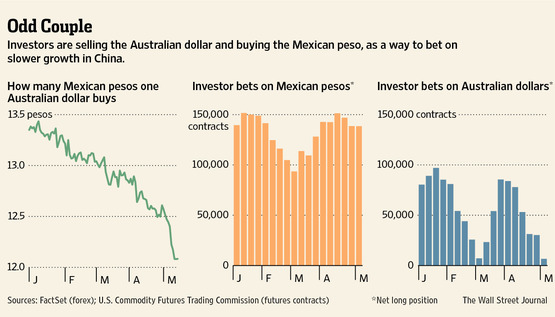
Investors bracing for slower growth in China are turning to a formerly little-used currency trade: selling Australian dollars and buying Mexican pesos. The bet is that Australia’s economy, and its currency, will suffer as Chinese demand cools for raw materials like iron and coal. Mexico, with closer ties to the resurgent U.S. economy, is seen as more insulated if commodities prices fall. Read more of this post

Melting Ice Cap Draws China, Japan to Seek Arctic Riches

Melting Ice Cap Draws China, Japan to Seek Arctic Riches

Japan, China and South Korea are seeking to expand their influence in the Arctic as melting ice caused by global warming offers potentially lucrative access to resources and shipping shortcuts in the region.

Asia’s biggest economies are among 14 applicants seeking observer status on the eight-nation Arctic Council, which holds its biennial ministerial meeting in Sweden on May 15. Member countries include the U.S., Russia, Canada, Denmark, Finland, Iceland and Norway.

Winning approval would mean greater sway in international discussions over a region estimated to contain 90 billion barrels of oil, according to the U.S. Geological Survey. With climate change resulting in an Arctic that will be almost ice-free in the summer by 2050, according to a U.S. government study, the organization is facing an increase in maritime traffic and environmental disruption. Read more of this post

Chinese Power Consumption Collapses: Economic Growth Slowest Since Early 2009

Chinese Power Consumption Collapses: Economic Growth Slowest Since Early 2009

Tyler Durden on 05/13/2013 11:52 -0400

Not much to add here. If there still is any confusion why China is desperately manipulating its economic data, so balatantly in fact that virtually everyone has now noticed, this chart should put all doubt to rest. According to CLSA’s Chris Wood using NEA data, China’s monthly power consumption (the most accurate proxy for underlying economic strength according to the current premier) growth slowed from 5.5% YoY in Jan-Feb 2013 to 1.9% YoY in March, the slowest growth rate since May 2009 (as discussed in-depth here). And just to make CNBC’s life easier, we will prespin this data: the lack of growth merely shows there is much pent up growth on the sidelines, even if the country is now injecting more debt to just maintain the flatline, than ever.

China power_0_0social financing volume_0

Institutional Investors Need to Stop Abdicating Their Responsibilities

Institutional Investors Need to Stop Abdicating Their Responsibilities

08 MAY 2013 – ASHBY MONK

Allow me to channel Winston Churchill by saying that capitalism is the single worst economic coordination system in the world … except for all the other models that have been tried. In short, capitalism’s got its problems but it’s still better than any of the alternatives. And that means it’s worth our while to spend some time thinking about how to improve it (rather than replacing it with something silly).

I’m clearly not alone in thinking this, as a growing army of finance and business people look to render capitalism more “inclusive” and “conscientious.” As evidence of this enlightened perspective, witness sustainable development initiatives, impact investing, community based investing, SRI, ESG, CSR, SEE, PRI, OMG, LOL, WTF, and all the other random combinations of letters that will transform icy-veined capitalists into… this guy.

I think all those initiatives are great. Expanding the number of risks that investors price in their investment decision-making can only create value in the long run, if done with rigor and routine. But it hasn’t seemed to be enough to meaningfully change the system because these strategies operate at the margin. To really transform capitalism for the better, there’s a more basic approach that could be very significant: empowering the ultimate sources of capital to be better stewards of their capital. Let me explain (and reiterate something I’ve argued for a long time now). Read more of this post

ARM: “A lot of companies talk about collaboration, but they struggle with it because it’s not really in their DNA”. The company has established a strong level of trust with partners over 22 years in business, enabling partners to share proprietary information and intellectual property with ARM without reservations

Segars won’t rock the ARM boat

Dylan McGrath

5/10/2013 3:21 PM EDT

130509_churchill_arm1_423

From left: James Moore, a former Harvard Berkman Center Fellow, Simon Segars, the incoming CEO of ARM, and Paul Saffo, a veteran industry forecaster at Discern Analytics, at the Churchill Club event Thursday. 

 Simon Segars, the soon-to-be CEO of processor IP licensor ARM Holdings plc, is obviously a believer in one timeless adage: If it ain’t broke, don’t fix it. Segars, who is set to take the reins at ARM from Warren East on July 1, said Thursday (May 9) he doesn’t plan any major changes to put his stamp on the company he’s worked for since 1991. “I’m going to do exactly the same things as we’ve been doing, cause they are working very well,” Segars told an audience of about 250 people at a Churchill Club event in San Francisco Thursday. “I truly believe that what has gotten us to this point is going to be what gets us through the next set of technology challenges,” Segars said. Segars, who last month told EE Times he wouldcontinue to emphasize driving down the power consumption of electronics as ARM CEO,would be wise to stick with what works. ARM has rocketed to prominence in recent years, even though—compared to perceived peers such as Intel Corp.—it’s still a relatively small company, with 2012 revenue of about $880 million. The Churchill Club even Thursday, moderated by Paul Saffo, a veteran industry forecaster at Discern Analytics, focused mainly on ARM’s collaborative ecosystem, considered a model for the industry. Saffo quipped during the event that the idea of collaboration has become any industry buzz term that many people pay lip service to but few actually make it a focus. “A lot of companies talk about collaboration, but they struggle with it because it’s not really in their DNA,” Saffo said. ARM, however, is the exception. Segars acknowledged that maintaining a large network of partners—membership in ARM’s Connected Community is approaching 1,000 companies—can be challenging, especially since many of the community’s members compete head to head in the marketplace. “They are in business to put each other out of business,” Segars said. But ARM mostly stays above the fray, Segars said. The company has established a strong level of trust with partners over 22 years in business, enabling partners to share proprietary information and intellectual property with ARM without reservations, he said. Occasionally, he said, ARM does find itself caught in the middle of disputes between its member companies. James Moore, a former Harvard Berkman Center Fellow who also participated in the Churchill Club event Thursday, raved about ARM’s business model, saying the firm focuses on openess and the proliferation of its technology instead of relentlessly focusing on profit margin, as many organizations do.  ARM doesn’t take as much profit as it could, Moore said, and does not attempt to lock partners in using its technology.  Moore, who was contracted by ARM to do a study of the company’s ecosystem, said the ARM ecosystem may well be unique. “The disruptive technology here is this organization, where people are willing to take less in favor of growth [in the use of its IP],” Moore said.

Behavioral Outcomes of Next Generation Family Members’ Commitment to Their Firm

Behavioral Outcomes of Next Generation Family Members’ Commitment to Their Firm

Alexandra Dawson Concordia University, Quebec – John Molson School of Business

P. Gregory Irving Independent

Pramodita Sharma Wilfrid Laurier University

Francesco Chirico Jonkoping University – Jonkoping International Business School (JIBS)

Joel Markus Wilfried University

April 23, 2013 European Journal of Work and Organizational Psychology (Forthcoming)

Abstract: 
Are there variations in behaviors and leadership styles of next generation family members or descendants who join their family business due to different forms of commitment? Evidence from a dual respondent study of 109 Canadian and Swiss family firms suggests that descendants with affective commitment to their family firms are more likely to engage in discretionary activities going beyond the job description, thereby contributing to organizational performance. Next generation members with normative commitment are more likely to engage in transformational leadership behaviors. Both affectively and normatively motivated next generation members use contingent reward forms of leadership. A surprising finding of this study is the binding force of normative commitment on positive leadership behaviors of next generation members. This study empirically tests the generalizability of the three-component model of commitment to family businesses, a context in which different forms of commitment may play a unique role.

How Much Does an Illegal Insider Trade?

How Much Does an Illegal Insider Trade?

Alex Frino University of Sydney – Discipline of Finance; Financial Research Network (FIRN)

Stephen E. Satchell University of Cambridge – Faculty of Economics and Politics

Brad Wong University of Sydney

Hui Zheng Discipline of Finance, The University of Sydney; Financial Research Network (FIRN)

June 2013 International Review of Finance, Vol. 13, Issue 2, pp. 241-263, 2013

Abstract: 
This paper examines the choice of trade size by an illegal insider. Previous literature (i.e. Meulbroek 1992) tends to focus on the price impact of such a trader. Using a unique data set hand‐collected from the litigation reports of the Securities and Exchange Commission and court cases, we provide evidence, which suggests that the size of an illegal insider’s trade is a function of the value of his private information, the probability of detection and the expected penalty if detected. Our results have important implication for security market regulators.

Linguistic Diversity and Stock Trading Volume

Linguistic Diversity and Stock Trading Volume

Yen-Cheng Chang Shanghai Advanced Institute of Finance; China Academy of Financial Research (CAFR)

Harrison G. Hong Princeton University – Department of Economics; National Bureau of Economic Research (NBER)

Larissa Tiedens Stanford Graduate School of Business

Bin Zhao Shanghai Advanced Institute of Finance; China Academy of Financial Research (CAFR)

March 14, 2013
Rock Center for Corporate Governance at Stanford University Working Paper No. 134

Abstract: 
We test the hypothesis that the linguistic diversity of a stock’s investor base leads to more trading. Trading might be due to beliefs differing across languages or investor exposure to multiple languages leading to more trading ideas. Using stock message boards from China, which has ten languages, we measure the linguistic diversity of a stock’s investor base using a Herfindahl index of messages posted from different languages. A firm’s diversity increases in the number of languages spoken in the province where it is headquartered. Using the latter as the instrument, trading volume in a stock rises with its linguistic diversity. We then attempt to discriminate among competing mechanisms. We also show using a sample of forty-one countries that countries with more linguistic diversity have greater stock market turnover.

The History of the Decline and Fall of the American Accounting Profession; “I don’t trust doctors, dentists or auto mechanics because I don’t know what they are doing. I don’t trust lawyers or CPAs because I do know what they are doing.”

The History of the Decline and Fall of the American Accounting Profession

William Dennis Huber Capella University

May 4, 2013
International Journal of Economics and Accounting, Forthcoming

Abstract: 
“I don’t trust doctors, dentists or auto mechanics because I don’t know what they are doing. I don’t trust lawyers or CPAs because I do know what they are doing.”

There have been many articles and books published on the development of accounting and the accounting profession in the U.S., both historically and sociologically. Some have critically examined actions taken by the AICPA, and others that have studied the effects of legislation on the accounting profession such as the Sixteenth Amendment or the creation of the PCAOB. Still others have observed the decline in the American accounting profession‘s status and image as a result of various failures such as Enron. This is the first to combine systematically a sociological analysis of the accounting profession in the U.S. with the historical development of the profession‘s power and status, and the subsequent loss of its power and status. A sociological analysis of the American accounting profession strongly suggests that it is no longer a profession as conceived by sociologists.

Local Institutions, Audit Quality, and Financial Fraud of US-Listed Foreign Firms

Local Institutions, Audit Quality, and Financial Fraud of US-Listed Foreign Firms

Lei Chen London School of Economics & Political Science (LSE) – Department of Accounting

Jan 16, 2013

Abstract: 
Using data on shareholder-initiated class action lawsuits in the US, I investigate financial misconducts of US-listed foreign firms. After controlling for type I errors (e.g. frivolous lawsuits), I document that firms domiciled in the countries with weak corporate governance were more likely to commit fraud, but such relation could be moderated by the presence of Big 4 auditors. Investors automatically adjusted for type II errors (e.g. undiscovered fraud) when valuating the stocks of non-sued firms. That is, non-sued firms that shared the same countries of origin with their sued peers experienced valuation declines around class periods end dates (the dates when the scandals were exposed rather than the dates when the litigation was filed). Investors relied on audit quality to form their expectations about the severity of type II errors, and thus posed less negative spillovers on firms with Big 4 auditors, especially when the firms were from countries with weak corporate governance. Taken together, my results suggest that a listing on US exchanges does not fully compensate weak local institutions; voluntarily bonding to more stringent audit process has an incremental effect on protecting shareholder interests, and enhances the confidence of investors in firms’ financial integrity.

China “shadow banking” growing fast, having risen nearly 70 per cent over the past two years and now total more than half the size of the world’s second-largest economy

China “shadow banking” growing fast

POSTED: 13 May 2013 7:36 PM

AFP/fl
China’s shadow banking activities have risen nearly 70 per cent over the past two years and now total more than half the size of the world’s second-largest economy.

BEIJING: China’s shadow banking activities have risen nearly 70 per cent over the past two years and now total more than half the size of the world’s second-largest economy, ratings agency Moody’s said on Monday. Shadow banking includes private lending, off-balance-sheet vehicles and trusts, and allows borrowers to circumvent banks’ formal underwriting standards, as well as official regulation. Such lending has surged 67 per cent since the end of 2010, Moody’s said in a report, reaching an estimated total of 29 trillion yuan (US$4.7 trillion) at the end of last year, or 55 per cent of China’s GDP. The rapid growth was partly due to some borrowers having difficulties obtaining regular bank loans, according to the report, and threatened the health of the banking system and the overall economy. “Shadow banking may encourage excessive financial leverage in the broad economy and add to credit bubble concerns,” Moody’s said. “Given the substantial scale and growth of shadow banking activities in China, we are doubtful of the banks’ ability to isolate themselves from a significant increase in defaults in the shadow banking domain.” China’s banking regulator has sought to rein in non-transparent lending activities and in March ordered banks to step up checks on wealth management products as part of a bid to boost risk control and openness. But Moody’s said: “The impact from shadow banking on banks will depend on the amount and timing of losses and how they are allocated, variables that are difficult to assess at this point, given the lack of transparency and fast-evolving nature of shadow banking in China.”

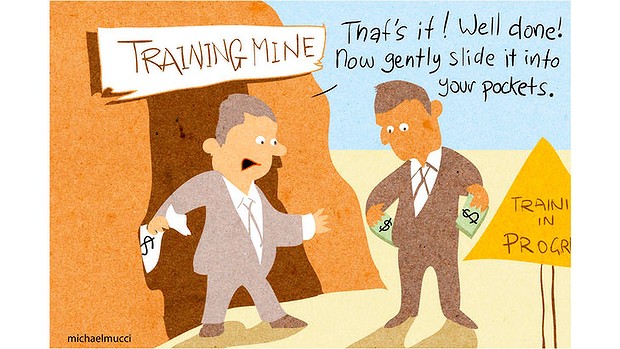
Give a man a coalmine, make him rich, and what does he do? He goes and tells everybody he’s not your mate. The costs of corruption will weigh on NSW for years to come. A decade of deals can hardly be unwound now

Mateship, it is obvious, can come at a high price

May 11, 2013, Michael West

mucci-620x349

‘If he was me mate, he would have showed up.” Former union boss John Maitland tells the Independent Commission Against Corruption this week former New South Wales mining minister Ian Macdonald was not his mate because he didn’t show up at his farewell dinner. Crikey, that’s hurtful. Give a man a coalmine, make him rich, and what does he do? He goes and tells everybody he’s not your mate. It’s fair dinkum un-Australian! Granted, the union boss did concede in testimony before ICAC this week, that he and the minister may have had a ”close working friendship”. Yes, struck the deal over a magnum of pinot noir at Catalina Restaurant. Yes, there had been no tender – come on, it was only a ”training mine”. Yes, the training mine somehow become a real mine and found its way into a stockmarket company NuCoal. And yes, John’s $165,000 investment happened to turn into $14 million. After all that goodwill from Macca, one can only surmise that John attaches exceedingly rigorous performance hurdles to his mateships. In the same year that Macca approved the Hunter Valley licence for John, he also opened up tracts of land in the Bylong Valley. That’s the spot where, by sheer providence, Labor powerbroker Eddie Obeid had bought a property whose value was soon to rise fourfold. Eddie Obeid had stewardship of the mines portfolio in NSW from April 1999 to April 2003. Macca came later. A pall has been cast over any mining deal struck by the NSW government in the past 14 years, including those with mining leviathan Newcrest, which operates Cadia, the country’s largest gold mine, near Orange. Gold and Copper Resources – an explorer led by Brian Locke and backed by former Rio Tinto boss Leigh Clifford, founder of Barlow Jonker Jeremy Barlow, former Glencore and Xstrata chairman Willy Strothotte, and venture capitalist Mark Carnegie – is contesting the validity of Newcrest’s licences. They await judgment on the first of five court actions over the Cadia licences. It’s a mess, though there is the odd winner from ICAC: the Coalition, we in the media and, of course, Ian Macdonald’s dentist to name three (love that smile). But the costs of corruption will weigh on NSW for years to come. A decade of deals can hardly be unwound now.

‘All in the Family’: Earnings Management Through Non-Listed Subsidiaries

‘All in the Family’: Earnings Management Through Non-Listed Subsidiaries

Massimiliano Bonacchi University of Naples “Parthenope”; New York University (NYU) – Leonard N. Stern School of Business; City University of New York, CUNY Baruch College, Zicklin School of Business

Fabrizio Cipollini Universita di Firenze, Dipartimento di Statistica

Paul Zarowin New York University (NYU) – Department of Accounting, Taxation & Business Law

May 7, 2013

Abstract: 
We find evidence consistent with the hypothesis that non-listed subsidiaries engage in accrual and real earnings management when their listed parent is reporting small annual profits. Our evidence is important, because it shows that business groups manage earnings differently from single firms. In particular, to avoid reporting annual losses, the parent company drives earnings management of the subsidiary. Cross-sectional analysis reveals that Big4 auditors mitigate accrual earnings management at the subsidiary level, and that family-owned firms are more likely to use earning management through non-listed subsidiaries to avoid losses.

Extraordinary Acquirers

Extraordinary Acquirers

Alfred Yawson City University London – Sir John Cass Business School; University of Adelaide Business School

Huizhong Jodie Zhang University of Adelaide – Business School

May 3, 2013

Abstract: 
We examine acquirers that persistently generate positive announcement returns in takeovers (extraordinary acquirers). Extraordinary acquirers constitute 14.9 percent of US acquiring firms during the period 1990-2011. The probability of observing an extraordinary acquirer from a takeover announcement is 2.41%. Extraordinary acquirers prefer subsidiary targets and cash deals but avoid using stocks to finance acquisitions. Further, we find strong evidence that the attainment and preservation of extraordinary acquirer status depend on top management team tenure and tenure heterogeneity. Compensation heterogeneity does not change after the transaction suggesting top team members contribute more equally to the acquisition success. Further we show that extraordinary acquirers possess strong negotiation skills which enable them to appropriate a larger share of the synergy gain.

Everyone Will Be Debating The WSJ Story About The Fed Considering Ways To End QE

Everyone Will Be Debating The WSJ Story About The Fed Considering Ways To End QE

Joe Weisenthal | May 12, 2013, 7:22 PM | 2,992 | 16

Futures are down modestly in early Sunday trading, and one possibility for that is the story that came out after the bell on Friday in the Wall Street Journal from Fed whisperer Jon Hilsnerath titled Fed Maps Exit From Stimulus. The gist: The Fed is seriously thinking about how it might begin the QE wind-down process. Given the widespread belief that Fed stimulus is a major tailwind for the market, talk of QE wind-down is invariably something of a negative. In tonight’s “Closing Print” note, Mike O’Rourke from JonesTrading thinks the article’s existence is pretty significant.

He writes:

The WSJ’s Jon Hilsenrath published a story Friday evening titled “Fed Maps Exit From Stimulus – Timing of Wind-Down Is Uncertain, but Focus Is on Managing Unpredictable Market Expectations.”  We suspect the twitter taper caper on Thursday opened the window for the FOMC to provide some clarity as to where policy stands.  Here are some key questions.  Is this story important?  Can it be taken at face value and should markets move?  The answer is yes, yes and yes.  The WSJ placed the article prominently on the cover of the Saturday edition, so they believe they have an important story.  It is a Hilsenrath story, and in the post-recession QE era the Fed has used him to foreshadow almost every major monetary policy move. Finally, in a tape where QE is the dominant theme, any indication of policy slowing or reversing course is meaningful.  Read more of this post

The Ingenious Enterprise: Competing Amid Rising Complexity

The Ingenious Enterprise: Competing Amid Rising Complexity

by Martin Reeves and Jussi Lehtinen

MAY 07, 2013

472-Ingenious-Enterprise-Ex1_lg_tcm80-133375472-Ingenious-Enterprise-Ex2_lg_tcm80-133377

“Creating a great culture, finding the right people, managing them to do great things, and solving problems creatively and systematically are challenges faced by all organizations. What differentiates [organizations] is how they approach these challenges.”

Ray Dalio, Founder, President, and CIO, Bridgewater Associates

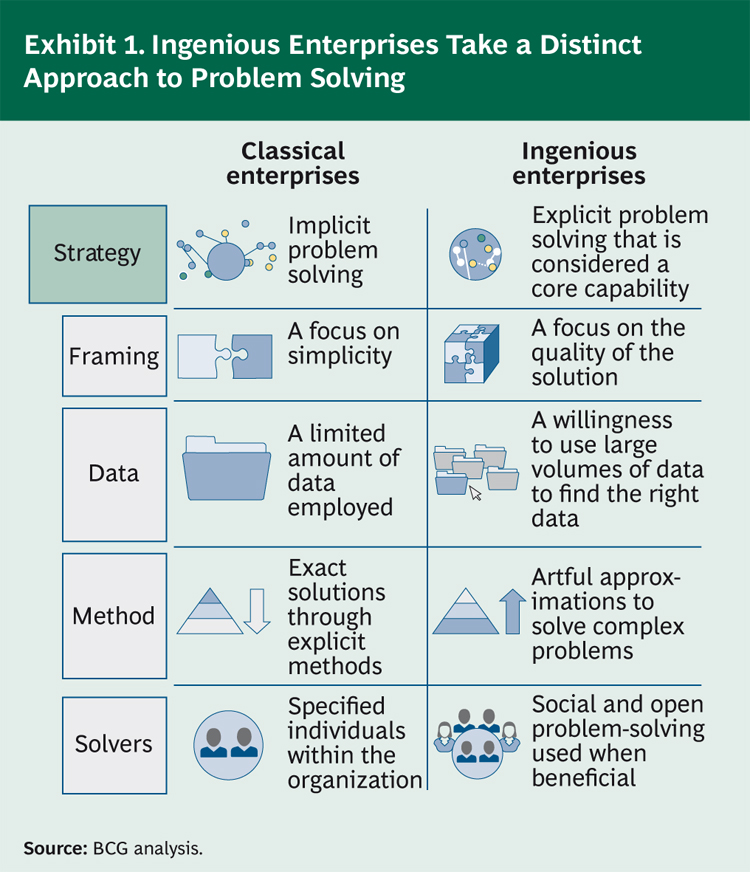
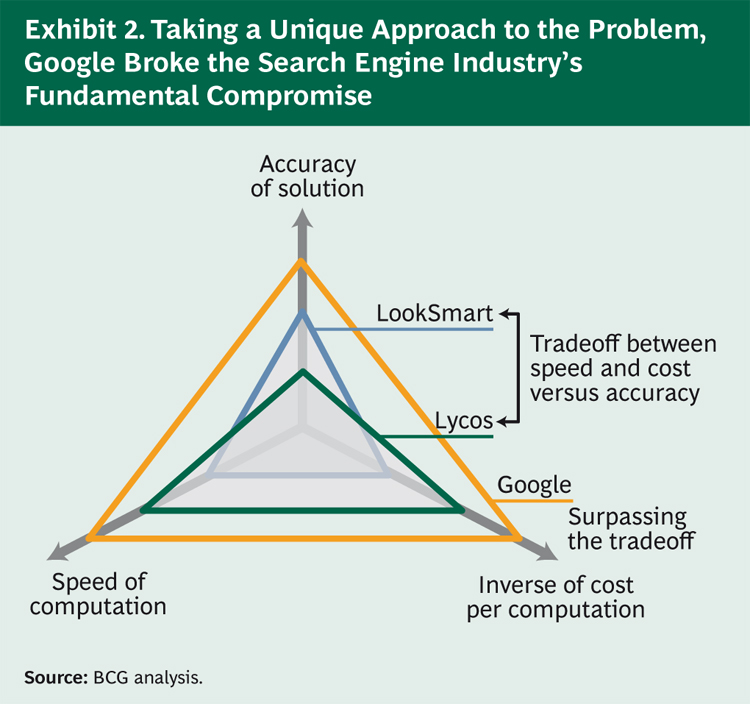
Business, at its heart, is about solving problems. Problem solving is performed both explicitly by analysts and computers and implicitly by your organization as a whole. And the way your organization is designed—the structure, processes, communication policies, incentives, training, and talent management you have in place—shapes the way your problems are approached and solved. Many organizations, however, lack explicit strategies for problem solving. This has come at little cost to these organizations historically, given that many of the problems they faced could be solved using straightforward, well-known methods. But today’s business environment, characterized by sharply rising complexity and hence increasingly complicated problems, is putting a rising premium on more sophisticated approaches to problem solving.

The rise in complexity—defined as the number of calculation steps required to reach a solution—is being driven by the rapid growth of three variables: data, interconnectedness, and the speed of change. Read more of this post

Graduate-turned-butcher shares experience with alma mater

Graduate-turned-butcher shares experience with alma mater

graduate-butcher_China-daily

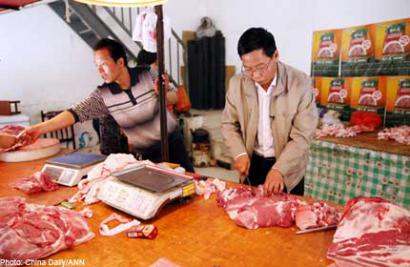
Lu Buxuan (right) helps his brother Lu Buning in the family butcher’s shop.

Zhang Yue, China Daily/Asia News Network

Monday, May 13, 2013

CHINA – It was the first time in 24 years that Lu Buxuan was speaking at his alma mater, Peking University, and the scene was emotional. His career choice of selling pork for a living after graduation in 1989 – at a time when college education was accessible only to a few in the society – has brought him to public attention for the past decade. In April, Lu was invited to return to the university. This time as a speaker, providing advice to his juniors. “I am very excited to stand here,” Lu says. “I understand that only the elites of our society can stand here and give a speech to the students.” “I, on the other hand,” he choked, and his face turned red, “brought shame to my alma mater.” Lu graduated from Peking University in 1989, majoring in Chinese language and literature, and was assigned to a factory job in his hometown in Shaanxi province. “It was definitely not the job I liked. But most students were assigned jobs at that time.” Lu says his tough and stubborn personality made his career in the State-owned factory increasingly harder. “I didn’t talk much,” says 47-year-old Lu. “And because I was too quiet and did not cultivate good relationships with people around me, I was ostracized.” Lu quit his low-paying factory job in 1999 and was planning to start a small business of his own. Setting up a stall in a food market was one of the easiest options. Read more of this post

Richard Branson dresses as stewardess on charity flight

Branson dresses as stewardess on charity flight

20130512.160728_branson_2

He spent the five-and-a-half hour flight pouring coffee or tea, serving meals, distributing goodies, entertaining as well as making in-flight announcements.

Virgin group founder Sir Richard Branson has finally made good on a bet he lost two years ago. The bet was made with AirAsia CEO Tony Fernandes on who had a better Formula 1 team at the 2010 Grand Prix in Abu Dhabi. The loser would have to dress as a female flight attendant on board the winner’s airline. Fernandes’ Lotus beat Branson’s Marussia Virgin by two spots in the final rankings. The flight took off from Perth, Australia, to Kuala Lumpur this morning (May 12). Tickets were priced at A$399 (S$494.61), with A$100 from each ticket sold donated to Australia’s Starlight Children’s Foundation. 10 per cent from all inflight sales will also be donated. “As an AirAsia X’s flight attendant, he has to comply with our grooming standards and that includes shaving his legs, donning high heels, putting on some makeup and slipping into the AirAsia’s famous red uniform,” Fernandes said. He added: “He will be committed to carry out the responsibilities of a flight attendant, including offering coffee, tea and other food and beverages to guests on the special 6-hour Perth to Kuala Lumpur flight.”

Japanese ‘latte’ artist creates 3D art on coffees

Japanese ‘latte’ artist creates 3D art on coffees

Forget your typical drawings of flowers and leaves on lattes, Japanese artist Kazuki Yamaoto brings latte art to a whole new level with 3D characters.

May 11, 2013

Forget your typical drawings of flowers and leaves on caffé lattes — art on coffee has gone 3D. According to an article on Kotaku, a Japanese “latte artist” named Kazuki Yamamoto, who is famous for drawing characters from games and anime with steam milk, has brought latte art to a whole new level — he does it in 3D now.

2014

China’s Data Manipulation In One Chart, And Why The Real Data Implies Weakest GDP Growth In Over 20 Years

China’s Data Manipulation In One Chart, And Why The Real Data Implies Weakest GDP Growth In Over 20 Years

Tyler Durden on 05/12/2013 13:31 -0400

China exports_0

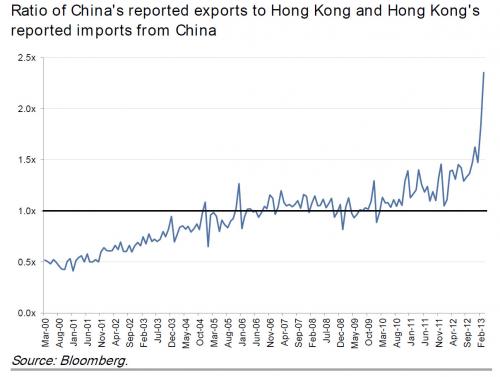
By definition, exports from country A have to equal imports from country B. Unless country A is China. Then, central planning magic happens, as can be seen in the chart below showing the misreporting of Chinese exports to HK compared to HK’s reported imports from China, which is just the latest nail in the coffin of Chinese economic data “integrity.” The issue, however, is that since China manipulates its data “upward”, as does the rest of the civilized, “unmanipulating” world, none of the ‘very serious people‘ have any incentive in calling China out – because suddenly all the world’s growth data may fall under the microscope, as perhaps it should – after all it was less than two years ago that we observed that the entire world was exporting over $300 billion more than it was importing (numbers which should net to zero), leading us to wonder if it was aliens that were importing all the excess Louis Vuitton bags… So for those actually interested, here is Sean Corrigan of Diapason breaking down the true numbers behind China’s economy, who using real export and import data ex-manipulation and fudging, that China’s reported 7.7% GDP would translate into a 5.5% Q1 GDP growth, the lowest rate of growth in 20 years! Read more of this post

In Taiwan, Lamenting a Lost Lead; Fostering innovation has become a mantra among corporate leaders and government officials because Taiwan’s huge consumer electronics industry has run into serious trouble.

May 12, 2013

In Taiwan, Lamenting a Lost Lead

By KEITH BRADSHER

13taiwanweb1-articleLarge

Jonney Shih, the chairman of Asustek Computer, at Asus’s headquarters on the outskirts of Taipei in April.

TAIPEI, Taiwan — Jonney Shih, the chairman of Asustek Computer, has epitomized the Taiwanese electronics engineer for a generation: a slender figure in rumpled, baggy trousers, he once helped Intel solve heat problems in its Pentium 4 microprocessors. So it has been a surprise over the last several years to see Mr. Shih, now 60, reinvent himself with snug-cut Italian suits, innovative designs for tablet and notebook computers and scathing criticisms of Taiwan’s test-obsessed, engineering-oriented educational system.

“I don’t think the Taiwanese got very good training to drive the mentality of innovation,” he said during an interview at Asus’s headquarters here on the outskirts of Taipei. (Mr. Shih also demonstrated his flexibility in the interview, assuming the lotus position while wearing a dark blue Armani suit with a sky-blue Armani tie.) Fostering innovation has become a mantra among corporate leaders and government officials alike in Taiwan this year because the island’s huge consumer electronics industry has run into serious trouble. Read more of this post

Jack Ma’s Last Speech as Alibaba CEO

Jack Ma’s Last Speech as Alibaba CEO

May 13, 2013

“Small businesses are where most of the Chinese dreams live”

After a couple of hours of music and extravaganza – including Ma himself singing – he gave his speech to the roaring stadium audience of over 20,000 employees, merchants, and guests. Below is our unofficial translation of Jack’s speech. I do hope it captured a large part of what he communicated:

Jack Ma: In the last ten years, there are many people who have paid a big price to live this dream. For our dream, we have walked ten years. I have been thinking, even if someone had removed 99 percent of Alibaba’s assets, we are still worthy. We have no regrets. We have our team, our partners, and friends. What is the thing that has made Alibaba what it is today? What is the thing that has made me what I am today? I have no reasons to succeed. Alibaba and Taobao have no reasons to succeed either. But today, we have walked so far and for so many years with so many aspirations for the future. I believe, it is trust that has made us walk this far.

When no one believes in the future, we chose to believe… we chose to trust.. that 10 years later, China will be better. We chose to believe that our colleagues will do better than myself. I believe, the younger generation of Chinese will do better than us. I’m very thankful that my colleagues have trusted me. It’s tough to be a CEO but being a CEO’s employee is even tougher. At times when trust was doubted, people actually bought things online, even when they haven’t even seen the items before. Over thousands of kilometers, through an unknown person, the goods fall safely into your hands. Today’s China has trust and belief. Everyday, there are 24 million transactions on Taobao signifying China’s trust. Read more of this post

Rivals brace for Alibaba push into overseas markets

Last updated: May 12, 2013 8:06 pm

Rivals brace for Alibaba push into overseas markets

By Kathrin Hille in Hangzhou

When the thin man in the silver-coloured windbreaker walks on to the stage, a roar goes through the crowd. Then he starts singing: “Friends, we have walked together all our lives, but those days are over,” and the audience goes crazy. But this is not a pop concert. The 40,000 in the Yellow Dragon Stadium in Hangzhou on Friday night were Alibaba Group employees and their family, and the man on stage was Jack Ma, saying farewell to the business he founded that has now grown into one of the world’s largest ecommerce companies. At 48, Mr Ma has handed the job of chief executive to Jonathan Lu, his trusted lieutenant and 13-year Alibaba veteran, and gone into semi-retirement as executive chairman. The change at the top comes as the group is preparing what could become one of the largest-ever internet initial public offerings. A listing in the US, expected at the end of this year or in early 2014, would allow Alibaba to buy back up to half of Yahoo’s 24 per cent stake in itself and raise $60bn or more from public investors.

Mr Lu inherits a formidable business. Alibaba operates the world’s largest online marketplace for trade between companies. It has also built an unrivalled online retail platform in China. Taobao.com, the group’s eBay-like consumer-to-consumer website, accounts for 90 per cent of China’s online retail transaction value in this segment. TMall, its business-to-consumer platform, accounts for half of online business-to-consumer sales in China by transaction value, according to McKinsey. Read more of this post

China Officials Seek Career Shortcut With Feng Shui

May 10, 2013

China Officials Seek Career Shortcut With Feng Shui

By DAN LEVIN

sub-fengshui-articleLarge

In Hunan Province, a boulder was placed outside a government building to create better feng shui for superstitious civil servants.

ZOUMAJIE, China — Outraged peasants protesting land grabs. Jilted mistresses plotting revenge. Provincial investigators seeking out graft.

For top officials at the local land resources bureau beleaguered by these and other headaches, there could only be one explanation for the miasma of misfortune they believed was threatening their careers last year: the pair of ferocious stone lions that guarded the state-owned China Tobacco building across the street from their offices.

An official confided that the secret weapon the land bureau used was feng shui, the ancient practice of arranging objects and designing architecture to improve one’s health, prosperity and luck. For proof, he nodded toward a stone wall in the parking lot that was built to block the feline statues’ harmful qi, or energy.

“Our bureau wasn’t doing so well until we erected the barrier last year,” said the official, who gave only his last name, Chen. “Now things are a lot better.” Read more of this post

The Son also Rises: nepotism doesn’t disappear in China, it just gets a promotion

The Son also Rises: nepotism doesn’t disappear in China, it just gets a promotion

Monday, 13 May, 2013, 12:00am

News›China

CHINA BRIEFING

Wang Xiangwei xiangwei.wang@scmp.com

The history of graft in China has come full circle amid reports of children of powerful officials stepping into their parents’ shoes

Throughout Chinese history, the expression ya nei originally meant palace guards but later referred generally to children of government officials. In traditional Chinese opera and drama, they are immortalised as the worst of the worst – vile, violent and corrupt. Dressed in silk and drooped in gold, ya nei roamed the streets, beating people for no particular reason or kidnapping young girls and forcing them to become concubines. They usually escape punishment thanks to their powerful fathers and relatives. Today, such characters may go by a different name, guan er dai – the second-generation government officials, or princelings, particularly those of top mainland leaders. While they may no longer go around beating people or abducting girls, they invariably take advantage of their parents’ power and influence to enrich themselves or their families. Judging by the rising number of reports in state media, the guan er dai are now using their nepotistic connections for what is termed “riding a rocket” – being promoted rapidly through government or party ranks to fill positions that, usually, have been vacated by their parents. Read more of this post

Ancient Buddhist temple in China bogged down by fake monks and debt

Ancient Buddhist temple in China bogged down by fake monks and debt

Sunday, 12 May, 2013, 7:31pm

Patrick Boehler

A provincial city’s ambitious plans for turning an ancient Buddhist temple near Xian into the world capital of Buddhism and listing it on a stock exchange have stagnated, leaving the temple surrounded by fake monks and sham Buddha statues.

Famen Temple houses a Buddhist relic. Photo: AP[1]In an investigative report [2], the Guangzhou-based Southern Weekly documents how the project involving the 1,700-year-old Famen Temple in Shaanxi province – which boasts the ownership of Buddha’s finger bone – went horribly wrong.

Now, fake monks from Hubei province roam a nearby scenic park that opened in 2009 and that tourists and pilgrims mistaken as part of the temple. The impostors get commission for collecting donations to the Shaanxi Famen Charitable Foundation. But clueless visitors do not know the foundation is a front for the operating company of the park, Shaanxi Famen Temple Scenic Park Cultural Industrial Group, and is not related to the temple, the weekly reported last week. Read more of this post

European companies wrote off a record €350bn in bad debt last year, more than the annual GDP of Austria, Denmark or Finland.

May 12, 2013 11:03 pm

European groups write off record €350bn in bad debt

By Richard Milne, Nordic Correspondent

European companies wrote off a record €350bn in bad debt last year, more than the annual GDP of Austria, Denmark or Finland.

The amount of write offs increased 7 per cent in the past year and 27 out of the 31 countries surveyed by Intrum Justitia, a Swedish credit management company, saw either a worsening in credit conditions, or no change. The debt amounts to 3 per cent of all outstanding invoices in European companies.

“It is the highest level of bad debt losses so far, and the forecast is bleak. Three per cent of all receivables; think of the net profit margin of companies in Europe and that is a big part of it,” Lars Wollung, Intrum Justitia’s chief executive, told the Financial Times. Read more of this post