Valuable as Art, but Priceless as a Tool to Launder Money

May 12, 2013

Valuable as Art, but Priceless as a Tool to Launder Money

By PATRICIA COHEN

According to the air bill slapped on the crate that arrived at Kennedy International Airport from London, an unnamed painting worth $100 was inside. Only later did federal investigators discover that it was by the American artist Jean-Michel Basquiatand worth $8 million. This painting, known as “Hannibal” after a word scribbled on its surface, was brought into the United States in 2007 as part of a Brazilian embezzler’s elaborate effort to launder money, the authorities say. It was later seized at a Manhattan warehouse by federal investigators who are now preparing to return it to Brazil at the behest of law enforcement officials there. The painting’s seizure was a victory in the economy-rattling, billion-dollar fraud and money laundering case of Edemar Cid Ferreira, a former Brazilian banker who converted some of his loot into a 12,000-piece art collection. Read more of this post

Student Debt and the Crushing of the American Dream

MAY 12, 2013, 9:09 PM

Student Debt and the Crushing of the American Dream

By JOSEPH E. STIGLITZ

A CERTAIN drama has become familiar in the United States (and some other advanced industrialized countries): Bankers encourage people to borrow beyond their means, preying especially on those who are financially unsophisticated. They use their political influence to get favorable treatment of one form or another. Debts mount. Journalists record the human toll. Then comes bewilderment: How could we let this happen again? Officials promise to fix things. Something is done about the most egregious abuses. People move on, reassured that the crisis has abated, but suspecting that it will recur soon.

The crisis that is about to break out involves student debt and how we finance higher education. Like the housing crisis that preceded it, this crisis is intimately connected to America’s soaring inequality, and how, as Americans on the bottom rungs of the ladder strive to climb up, they are inevitably pulled down — some to a point even lower than where they began. Read more of this post

Coal barons see assets fade as prices slump in China; Heavy Industry’s Reverberating Slump

Coal barons see assets fade as prices slump in China

Staff Reporter

2013-05-12

The assets of Chinese coal mine owners are gradually diminishing as coal prices slump, a trend which has also resulted in their company’s stock prices declining, reports the Shenzhen-based New Fortune monthly. Many coal millionaires have attracted attention for the public flaunting of their wealth. A notable example was when Xing Libin, chairman of Liansheng Energy Group, spent 70 million yuan (US$11.3 million) to stage a lavish wedding party for his daughter in March last year. The wedding party caused a public outcry in Shanxi province, the largest coal-producing region in China where the average income is only 5,807 yuan (US$950) a year, said the report. The golden days for mine owners seem to be numbered as the government began streamlining the industry in 2008, and cut the number of firms from 2,200 to just 130 through incorporations and mergers, and brought 70% of them under the control of state enterprises. It was reported that private owners,whose mines were taken over by big state enterprises were compensated to the tune of 600 billion to 1 trillion yuan (US$97-$161 billion) in total. Many smaller business owners have little expertise outside of the coal industry. They are expected to quickly spend their newly gained wealth and fade from the nation’s business circles because they will likely not invest their wealth wisely, said the magazine. Only the big coal companies with advanced technology and abundant capital could survive in the reshaped industry, said the report.

Heavy Industry’s Reverberating Slump

By Yu Huapeng (于华鹏)  
Issue 617, April 29, 2013

After two days in Qingdao, Hong Daoqing (洪道清) failed to persuade Qingdao Iron & Steel Company to order any coking coal from him.
Just as he was feeling completely frustrated, Hong’s telephone rang with more bad news from Manager Ma at Laiwu Iron & Steel Company. Ma told him that his company had shut off four blast furnaces and the rest were just working at half capacity.  Read more of this post

Electric car development could be sidelined in China; Chinese carmakers have spent lots of money developing electric cars — development that may have been a waste of resources

Electric car development could be sidelined in China

Staff Reporter

2013-05-12

Carmakers could sideline electric cars to make way for the promotion of hybrid cars in China’s automobile industry, reports Guangzhou’s 21st Century Business Herald, citing executives at last week’s Shanghai International Car Show. At this year’s biennial show, only the venture between BYD and Daimler, Mercedes-Benz, Shanghai Volkswagen, and Dongfeng Nissan introduced pure electric cars, while the majority introduced new hybrid car models, according to the paper. According to official figures, carmakers sold 12,791 new-energy cars in China last year, including 11,375 electric cars, a rise of 98.8% from the previous year and 1,416 hybrid cards, up by 103.9% due to a low base last year. China’s electric car market is reportedly losing money, however, and its true scale is currently unknown, said independent automobile commentator Zhong Shi, adding that Chinese carmakers have spent lots of money developing electric cars — development that may have been a waste of resources. Read more of this post

Why the Chinese government is choosing to let its debt crisis continue to spiral out of control

Why the Chinese government is choosing to let its debt crisis continue to spiral out of control

By Gwynn Guilford @sinoceros 6 hours ago

chinese-scary-loans1

For around a year now, the Chinese government has been trying to curb “shadow banking,” as lending to local government investment proxies and other insolvent vehicles through difficult-to-trace channels is known. Shadow banking is now thought to be as big as 36 trillion yuan ($5.8 trillion), according to JP Morgan. There’s been more shaking this last week. The government rolled out two new policies directed in most part at limiting the creation of wealth management products (WMPs), which securitize a good deal of shadow banking financing, selling the products on to retail investors. As of the end of March, WMPs had securitized debt worth of 8.2 trillion yuan. Will this have more effect than the measures taken so far? Not necessarily, says Patrick Chovanec, chief strategist at Silvercrest Asset Management and expert on China’s economy. “[The government has been saying] ‘We need to crack down on risks in interbank and shadow lending.’ Obviously there’s a growing awareness of risks,” he tells Quartz. “But if you look at what has happened since [the new administration effectively took over] in October, there’s been a renewed credit boom to try to prop up investment. That’s what policy has been in practical terms with almost no control over expansion of shadow credit.” Read more of this post

Bullish yuan herd leaves China fundamentals in the dust

Bullish yuan herd leaves China fundamentals in the dust

Sun, May 12 2013

By Gabriel Wildau

SHANGHAI (Reuters) – Investors convinced China’s currency is once again a one-way bet upward should think again: signs of slowing economic growth could cut short the yuan’s rally. Investors and companies have been pouring funds into China in recent months, helping send the yuan to a series of record highs. But with evidence of a slowdown mounting, investors thinking of joining the rush into yuan would do well to remember 2011 and 2012, when fears of a Chinese hard landing sent the yuan, or renminbi, tumbling. Read more of this post

Hong Kong has world’s most expensive retail space; Rents were 50% higher than for similar districts such as upper Fifth Avenue in Manhattan and more than four times the rate in similar areas in London and Paris

Hong Kong has world’s most expensive retail space: report

12:06am EDT

By Ilaina Jonas

NEW YORK (Reuters) – There’s expensive and then there’s Hong Kong.

The Asian shopping haven in the first quarter kept its crown as having the world’s highest rent for prime retail properties, at nearly 50 percent more than for similar districts such as upper Fifth Avenue in Manhattan. Rents were more than four times the rate in similar areas in London and Paris, according to a report by global property advisor CBRE Group Inc. The 10 most expensive cities for retailers benefit from strong demand and modest new supply, a recipe for stable record-high prime rental rates, the report released on Sunday showed. In some markets, such as Hong Kong and London, the sky-high rents have prompted some newcomers to look nearby. For example, in London, Mayfair has benefited from those priced out of Bond Street. Annual retail rent in high-end shopping areas in Hong Kong averaged $4,328 per square foot (36,351 euros per square meter). Read more of this post

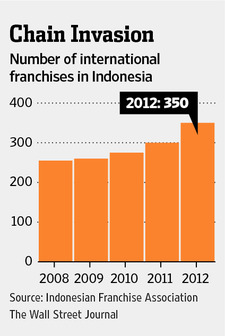
Indonesia to Big Chains: Share the Wealth; under the new rules, any convenience store or other retailer with more than 150 stores and any restaurant or café with more than 250 outlets will have to bring in additional Indonesian partners

May 12, 2013, 8:39 p.m. ET

Indonesia to Big Chains: Share the Wealth

By ERIC BELLMAN

MK-CD152_INDOCH_NS_20130512174803

JAKARTA, Indonesia—A jump in the number of chain stores in Indonesia has triggered a backlash from regulators and owners of small shops, concerned that homegrown entrepreneurs could get elbowed out of the country’s economic growth. For decades, Torikin did a brisk business selling batteries, cigarettes, cold drinks and instant coffee from his cart in central Jakarta. Then a brightly lighted store sprouted in the vacant lot where he had been setting up shop. He had never heard of 7-Eleven or its Slurpee frozen drinks. But in the past year he has watched almost all of his customers defect to the chain store, with its wide selection and low prices. “There is no way I can compete,” says Mr. Torikin, who, like many Indonesians, uses only one name. “Office workers that bought cigarettes from me for years, now just walk right past me on the way to that store. They say ‘Hello,’ but they don’t buy anything.” Mr. Torikin says his sales plunged to around $5 a day from roughly $100. Now he is looking for a new spot to set up, far from a Western-style convenience store.

Hoping to protect and enrich small-shop owners like Mr. Torikin, Indonesia has been implementing rules to force large chains to share their success. The new rules could change expansion plans for such chains as KFC, Starbucks SBUX +1.18% and 7-Eleven. Read more of this post

Doubts come to surface about ‘the decade of Latin America’

May 12, 2013 12:58 pm

Doubts come to surface about ‘the decade of Latin America’

By John Paul Rathbone, Latin America Editor

First, in March, an Argentine Pope; then, last week, a Brazilian appointed to lead the World Trade Organisation. Latin America, long associated with default, dictatorships and disgrace, seems to be riding high and enjoying its growing global clout.

Since 2003, the region’s $6tn economy has almost doubled its share of world economic output to 8 per cent. At the same time, the middle class has grown by 50m people while inequality has shrunk – a unique feat. For some, the region is now enjoying what Sir Martin Sorrell, head of advertising group WPP, hailed in 2010 as “the decade of Latin America”.

But now, in the fourth year of its decade, Latin America, lulled by recent success, risks taking its eye off the reform ball and losing its way. Read more of this post

The lust for Latino lucre: How American firms are chasing the elusive Hispanic dollar

The lust for Latino lucre: How American firms are chasing the elusive Hispanic dollar

May 11th 2013 | LOS ANGELES |From the print edition

20130511_WBC579

ONE in six Americans is Hispanic. In politics, ignoring the Latino vote is suicidal, which is why the Republican Party is at last getting serious about immigration reform. In business, ignoring Latino tastes is equally daft, which is why American firms are at last getting serious about pursuing the Hispanic dollar. Read more of this post

All Signs Suggest The College Bubble Has Finally Burst

All Signs Suggest The College Bubble Has Finally Burst

Rob Wile | May 11, 2013, 7:04 PM | 5,492 | 17

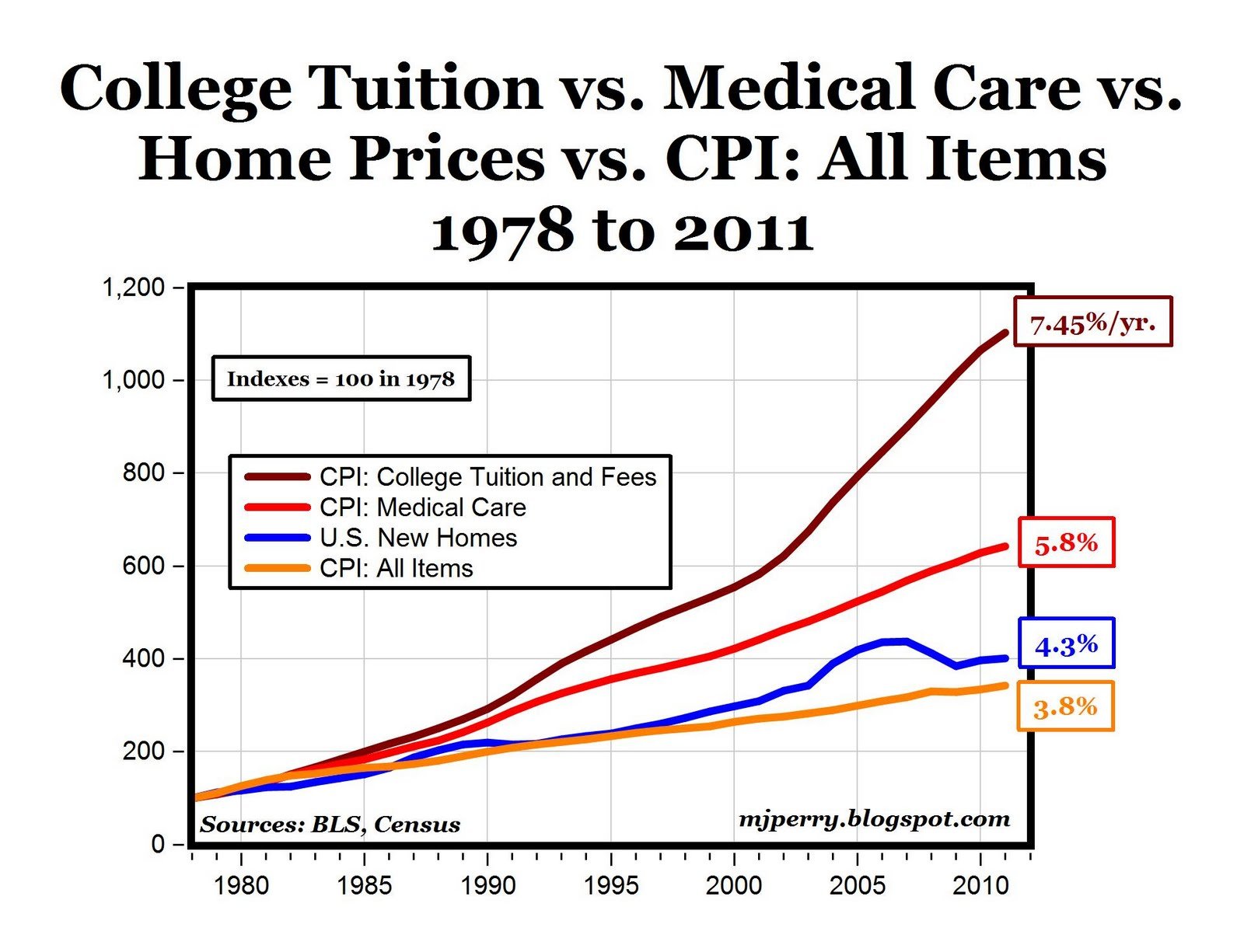
This week, the Wall Street Journal’s Ruth Simon reported private colleges are now offering record financial assistance to keep classrooms full. Some schools are now seeing just 20% of the students they accepted actually enrolling, versus the usual rate of 33%. So they have increased the “tuition discount rate”— the price after grants and scholarships  —  to an all-time high of 45%. Meanwhile, the median sticker price increased just 3.9% last fall, the smallest gains in 12 years. And at public schools, the sticker price climbed just 4.8%, also a 12-year low. For the Washington Examiner’s Michael Barone, this makes it official: the college bubble has finally burst: Applicants are negotiating bigger discounts than they used to. Market competition has kicked in. What has happened is that in a recessionary and sluggish economy potential customers have been figuring out that a college diploma may not be a good investment — particularly if it entails six-figure college loan debt that cannot be discharged in bankruptcy. The Millennial Generation that voted so heavily for Barack Obama — 66 to 32 percent in 2008, 60 to 37 percent in 2012 — has had a hard time finding jobs, even with diplomas in hand. Especially if their degrees are in gender studies or similar fields beloved of academics. Moody’s Investors Service Managing Director John Nelson basically agrees, telling Simon,  “we have hit a tipping point on price.” It was a long time coming. Check out this chart from AEI’s Mark Perry showing the rising cost of tuition outpacing basically every other good in American society for nearly two decades: Barone goes a bit further than we would about the bust’s implications (he writes that administrators actively believed they were “above market forces” and could make investment decisions accordingly).

college-10

Here’s Why Facebook Wants To Spend $1 Billion On Waze, According To Industry Sources Who Are Smarter Than We Are

Here’s Why Facebook Wants To Spend $1 Billion On Waze, According To Industry Sources Who Are Smarter Than We Are

Nicholas Carlson | May 12, 2013, 11:09 AM | 7,060 | 8

According to several reportsFacebook is in talks to buy an Israeli startup called Waze for $1 billion. Waze makes a “social” mapping app for smartphones. It was founded in 2009, and it has been backed by investors that include Horizons Ventures Hong Kong and Kleiner Perkins. Last July, when Waze hit 20 million users, this is how BI’s Alyson Shontell described the service: Waze relies on the community to give real-time traffic reports. If a user is on Waze while driving and hits traffic, a red line will appear behind the vehicle on Waze’s map to alert others in real time. Drivers can take pictures of accidents so other drivers will know why they’re not moving. They can also alert other drivers of upcoming speed traps. Why does Facebook want to buy a mapping app? We asked a few industry sources. Three came up with interesting answers. These sources asked to remain anonymous because they do business with Facebook, they wanted to be candid in their thoughts, and it’s just easier to talk to a reporter if they are allowed to be on background. We’ve presented lightly edited versions of those answers below.

Industry source #1:

Facebook is buying Waze because each of the major tech companies want to own a mapping service. MicrosoftGoogle, and Apple own one. Now, so would Facebook.   Waze is a crowdsourced map. Users turn on Waze and as they drive around, roads are drawn. They can tell traffic by how fast people are moving around on the roads via GPS.   Read more of this post

Cisco Tries Reinvention in Tough Time

Updated May 12, 2013, 7:58 p.m. ET

Cisco Tries Reinvention in Tough Time

By DREW FITZGERALD

Cisco Systems Inc. CSCO +1.30% shares tumbled this time last year after executives warned their biggest corporate customers were ordering less equipment. If history repeats itself this week, the networking giant will join a dreary but growing club.

A wide range of companies—from Cisco rival Juniper Networks Inc. JNPR +0.12% to tech juggernaut International Business Machines Corp. IBM +0.61% —have caught investors off guard in recent weeks as corporate belt-tightening saps their growth. Read more of this post

Google+ struggles to attract brands, some neglect to update

Google+ struggles to attract brands, some neglect to update

8:03am EDT

By Alexei Oreskovic

SAN FRANCISCO (Reuters) – To mark the Cinco de Mayo holiday this year, Domino’s Pizza festooned its Facebook page with a string of posts, including an image of a Mexican-themed guacamole pizza that garnered over 2,000 “likes”. But visitors to Domino’s companion Google+ page on that day found less festive fare: The most recent post was from October 2012. Two years after introducing its social network, Google Inc is struggling to win over the brands and businesses that have been its most loyal customers in the Internet search market. For Google+ to thrive, it is vital to draw in household names, not just to lay the groundwork for potential future business, but also because users of the site have come to expect being able to follow, comment on or even vent about their favorite brands. Progress has been slow. Rival services from Twitter to Amazon.com Inc are increasingly competitive in vying for corporate attention and marketing budgets, while technical shortcomings of Google+ have put off some companies accustomed to the flexibility of Facebook, marketing and corporate executives say. Read more of this post

Creators are so caught up in the pursuit of their work mission that they sacrificed all, especially the possibility of a rounded personal existence

How to be a Creator

by Eric Barker

1) Be curious and driven

For his book Creativity, noted professor Mihaly Csikszentmihalyi did interviews with 91 groundbreaking individuals across a number of disciplines, including 14 Nobel Prize winners. In 50 Psychology Classics Tom Butler-Bowdon summed up many of Csikszentmihalyi’s findings including this one: Successful creative people tend to have two things in abundance, curiosity and drive. They are absolutely fascinated by their subject, and while others may be more brilliant, their sheer desire for accomplishment is the decisive factor.

2) It’s not about formal education. It’s about hours at your craft.

Do you need a sky-high IQ? Do great geniuses all have PhD’s? Nope. Most had about a college-dropout level of education.

Via Talent Is Overrated: What Really Separates World-Class Performers from Everybody Else:

Dean Keith Simonton, a professor at the University of California at Davis, conducted a large-scale study of more than three hundred creative high achievers born between 1450 and 1850—Leonardo da Vinci, Galileo, Beethoven, Rembrandt, for example. He determined the amount of formal education each had received and measured each one’s level of eminence by the spaces devoted to them in an array of reference works. He found that the relation between education and eminence, when plotted on a graph, looked like an inverted U: The most eminent creators were those who had received a moderate amount of education, equal to about the middle of college. Less education than that—or more—corresponded to reduced eminence for creativity.

But they all work their ass off in their field of expertise. That’s how to be a genius. Those interested in the 10,000 hour theory of deliberate practice won’t be surprised. As detailed in Daily Rituals: How Artists Work, the vast majority of them are workaholics.

Via Daily Rituals: How Artists Work

“Sooner or later,” Pritchett writes, “the great men turn out to be all alike. They never stop working. They never lose a minute. It is very depressing.”

In fact, you really can’t work too much.

Via Talent Is Overrated: What Really Separates World-Class Performers from Everybody Else:

If we’re looking for evidence that too much knowledge of the domain or familiarity with its problems might be a hindrance in creative achievement, we have not found it in the research. Instead, all evidence seems to point in the opposite direction. The most eminent creators are consistently those who have immersed themselves utterly in their chosen field, have devoted their lives to it, amassed tremendous knowledge of it, and continually pushed themselves to the front of it.

3) Test Your Ideas

Howard Gardner studied geniuses like Picasso, Freud and Stravinsky and found a similar pattern of analyzing, testing and feedback used by all of them:

Via Creating Minds: An Anatomy of Creativity Seen Through the Lives of Freud, Einstein, Picasso, Stravinsky, Eliot, Graham, and Ghandi:

Creative individuals spend a considerable amount of time reflecting on what they are trying to accomplish, whether or not they are achieving success (and, if not, what they might do differently).

Does testing sound like something scientific and uncreative? Wrong. The more creative an artist is the more likely they are to use this method:

Via Little Bets: How Breakthrough Ideas Emerge from Small Discoveries

In a study of thirty-five artists, Getzels and Csikszentmihalyi found that the most creative in their sample were more open to experimentation and to reformulating their ideas for projects than their less creative counterparts.

4) You Must Sacrifice

10,000 hours is a hell of a lot of hours. It means many other things (some important) will need to be ignored. In fact, geniuses are notably less likely to be popular in high school. Why? The deliberate practice that will one day make them famous alienates them from their peers in adolesence.

Via Quiet: The Power of Introverts in a World That Can’t Stop Talking:

…the single-minded focus on what would turn out to be a lifelong passion, is typical for highly creative people. According to the psychologist Mihaly Csikszentmihalyi, who between 1990 and 1995 studied the lives of ninety-one exceptionally creative people in the arts, sciences, business, and government, many of his subjects were on the social margins during adolescence, partly because “intense curiosity or focused interest seems odd to their peers.” Teens who are too gregarious to spend time alone often fail to cultivate their talents “because practicing music or studying math requires a solitude they dread.”

At the extremes, the amount of practice and devotion required can pass into the realm of the pathological. If hours alone determine genius then it is inevitable that reaching the greatest heights will require, quite literally, obsession.

Via Creating Minds: An Anatomy of Creativity Seen Through the Lives of Freud, Einstein, Picasso, Stravinsky, Eliot, Graham, and Ghandi:

My study reveals that, in one way or another, each of the creators became embedded in some kind of a bargain, deal, or Faustian arrangement, executed as a means of ensuring the preservation of his or her unusual gifts. In general, the creators were so caught up in the pursuit of their work mission that they sacrificed all, especially the possibility of a rounded personal existence. The nature of this arrangement differs: In some cases (Freud, Eliot, Gandhi), it involves the decision to undertake an ascetic existence; in some cases, it involves a self-imposed isolation from other individuals (Einstein, Graham); in Picasso’s case, as a consequence of a bargain that was rejected, it involves an outrageous exploitation of other individuals; and in the case of Stravinsky, it involves a constant combative relationship with others, even at the cost of fairness. What pervades these unusual arrangements is the conviction that unless this bargain has been compulsively adhered to, the talent may be compromised or even irretrievably lost. And, indeed, at times when the bargain is relaxed, there may well be negative consequences for the individual’s creative output.

5) Work because of passion, not money

Passion produces better art than desire for financial gain — and that leads to more success in the long run.

Via Dan Pink’s Drive: The Surprising Truth About What Motivates Us:

“Those artists who pursued their painting and sculpture more for the pleasure of the activity itself than for extrinsic rewards have produced art that has been socially recognized as superior,” the study said. “It is those who are least motivated to pursue extrinsic rewards who eventually receive them.”

Buffett declares bonds are “terrible investments”; “people could lose a lot of money if they’re in long-term bonds”

May 10, 2013 5:56 pm

Alternatives to Buffett’s ‘terrible’ bonds

By Elaine Moore

Warren Buffett, America’s best-known investor and the world’s fourth-richest person, has made his feelings about bonds clear, declaring them “terrible investments”.

Speaking on US television this week, the chief executive of Berkshire Hathaway said that many investors had been drawn to bonds because their prices tend to rise as interest rates fall. But, he warned, when the situation changes “people could lose a lot of money if they’re in long-term bonds”.

Talk of a “bond bubble” and a “great rotation” away from bonds and towards equities is not new. But bonds are still popular. The best selling sector for Individual Savings Accounts (Isa) money in the most recent tax year was the Sterling Strategic Bonds, according to the Investment Management Association. But in recent months investors have started to put more money in equities than bonds. Read more of this post

Fed Maps Exit From Stimulus

Updated May 10, 2013, 7:19 p.m. ET

Fed Maps Exit From Stimulus

Timing of Wind-Down Is Uncertain, but Focus Is on Managing Unpredictable Market Expectations

By JON HILSENRATH

P1-BL500_FED_on_G_20130510184805

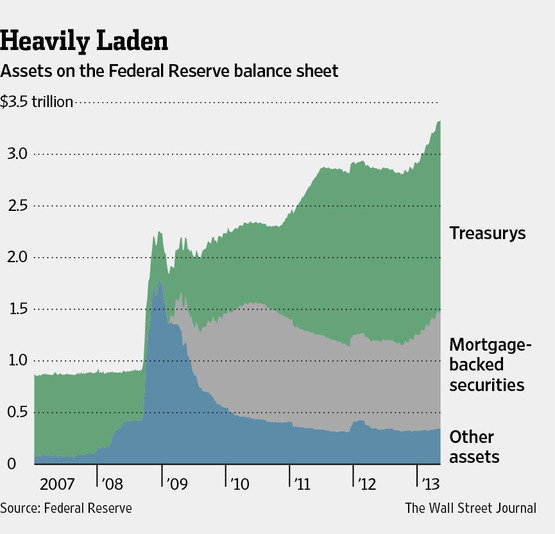
Federal Reserve officials have mapped out a strategy for winding down an unprecedented $85 billion-a-month bond-buying program meant to spur the economy—an effort to preserve flexibility and manage highly unpredictable market expectations. Officials say they plan to reduce the amount of bonds they buy in careful and potentially halting steps, varying their purchases as their confidence about the job market and inflation evolves. The timing on when to start is still being debated. The Fed’s strategy for how and when to wind down the program is of intense interest in financial markets. While the strategy being debated leaves the Fed plenty of flexibility, it might not be the clear and steady path markets expect based on past experience. Officials are focusing on clarifying the strategy so markets don’t overreact about their next moves. For example, officials want to avoid creating expectations that their retreat will be a steady, uniform process like their approach from 2003 to 2006, when they raised short-term interest rates in a series of quarter-percentage-point increments over 17 straight policy meetings. Read more of this post

How Is an IPO Like a Marriage? The Billionaire Founder of China’s Alibaba Goes Public. “I’m like a bride on her wedding day. All she knows how to do is grin.”

May 10, 2013, 8:38 p.m. ET

Weekend Confidential: Jack Ma of Alibaba

How Is an IPO Like a Marriage? The Billionaire Founder of China’s Alibaba Goes Public.

By ALEXANDRA WOLFE

OB-XK963_wolfew_DV_20130510115032

‘I want to get back to normal,’ he insists. ‘I think if you asked Bill Gates, he wants to be back to himself.’

A week before he was set to step down as chief executive of Alibaba, one of the world’s largest e-commerce companies, Jack Ma was enjoying breakfast on an outdoor patio in Santa Monica, Calif. Worth an estimated $4.2 billion, the Chinese entrepreneur may grow even richer if the company he founded 14 years ago goes public. Philanthropy has brought him to California on this trip, but he has no intention of joining the famous billionaires’ pledge and donating at least half his money to charity. “This idea of giving your money out was not created by Gates and Buffett. It was created by the Communist Party in the 1950s!” he says with a laugh.

That wasn’t the only thing that had Mr. Ma, 48, chuckling. Since he announced his transition to executive chairman in January—he handed over the reins Friday—he has stoked speculation about a potential Alibaba IPO. With an estimated value of about $60 billion, the company could be one of the year’s hottest tech offerings if it makes the move. Read more of this post

How the Rich Play the Market, making the most of their advantages—and how they mess up

Updated May 10, 2013, 7:55 p.m. ET

How the Rich Play the Market

By JASON ZWEIG

BF-AE943_INVEST_G_20130510175323

F. Scott Fitzgerald wasn’t entirely right. The very rich are different from you and me—but not by much. A new study offers a comprehensive look at the portfolios and investment decisions of several hundred of the wealthiest families in the U.S. Every investor, rich or otherwise, can learn from how these people make the most of their advantages—and from how they mess up. These households, with an average net worth of roughly $90 million, invest intelligently, for the most part, spreading their bets widely, seldom trading and keeping their investing taxes to a minimum. But the superrich also commit rookie mistakes. Their approach to diversification might not always be ideal. They chase investment fads like dogs chasing parked cars. They freeze with fear just when bravery is most likely to be rewarded. Maybe the “smart money” isn’t so different from the middle-class “dumb money” that Wall Street likes to mock. Read more of this post

Carbon dioxide in atmosphere at highest level for 5 million years

Carbon dioxide in atmosphere at highest level for 5 million years

Atmosphere rising at fastest rate since records began

TOM BAWDEN 

FRIDAY 10 MAY 2013

The concentration of carbon dioxide in the atmosphere has breached the symbolically important level of 400 parts per million (ppm) for the first time in 5 million years after rising at its fastest rate since records began. Average daily CO2 levels jumped by 2.74 ppm in the first 17 weeks of 2013, compared to last year, the biggest increase since the benchmark monitoring stations high on the Hawaiian volcano of Mauna Loa began taking measurements in 1958. Read more of this post

Mattel Continuously Innovates to Keep Barbie Alive in a Tech World

Mattel Continuously Innovates to Keep Barbie Alive in a Tech World

by Abram Brown | May 11, 2013

US_Barbie.indd

In an era when iPad apps and videogames practically demand children’s attention, Mattel continues to lead by innovating with its old-school plastic playthings

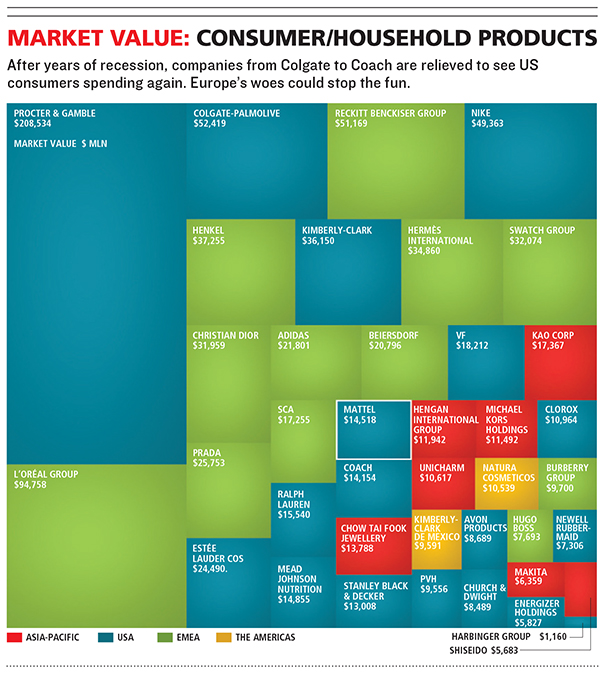
Head 10 minutes south of Los Angeles international airport on the 405, exit at El Segundo and you’ll blunder upon a 200,000-square-foot concrete bunker lurking among the strip malls in this seedy bit of Los Angeles County. The low-slung structure, surrounded by a black iron fence, was once an aircraft parts factory. It now houses the design laboratories of Mattel, Inc, the world’s largest toymaker, and deep inside the high-security facility, a crack 12-person team of screenwriters, computer animators, comic book artists and industrial designers are busy engineering the next great American toy: Max Steel.  In physical form, Steel will be a 6-inch plastic superhero action figure, with a well-developed  backstory: His mission is to harness the turbo energy he possesses to morph into different cyborg forms and save the world from monsters bearing names like Elementor and Dredd. And, just like Superman, he has a mild-mannered alter ego: Maxwell McGrath, a 16-year-old high school kid with brown hair and a square jaw. The Max Steel doll won’t be appearing on US retail shelves until August, but his launch is already well under way. Pull up maxsteel.com and you can play the Max Steel: Hero’s Journey videogame, watch videos introducing him or download a Max Steel mask. In March, a Max Steel cartoon premiered on Disney’s XD digital cable and satellite channel and will soon be available in more than 100 different markets worldwide. Toys used to spring from entertainment. Now entertainment supports the toys. “Having an action hero that’s on for a steady basis—on television, on webisodes, on digital—is going to create a more consistent demand for that product,” says Mattel’s chairman and chief executive, Bryan Stockton. Read more of this post

Markers of Schizophrenia Are Found in the Nose

May 10, 2013, 6:58 p.m. ET

Markers of Schizophrenia Are Found in the Nose

By DANIEL AKST

Mental illness isn’t like diabetes or cancer. It is usually diagnosed based on subjective evaluation rather than on definitive lab findings, which makes it hard to say for sure who has it. The result, in the eyes of critics, is a bogus epidemic and vast overmedication.

But more rigorous methods may be on the way. A recent study found telltale biological markers of schizophrenia in people’s noses. A reliable test for the disorder—which is believed to afflict 1 in 100 people—has long been a holy grail for psychiatrists, who lack a safe way to sample the living brain tissue.

As it turns out, the olfactory epithelium, which contains neurons and their stem cells, offers a window into the central nervous system—and thus access to physical indicators of the disease. Researchers who biopsied nasal tissue in 38 individuals found that, on average, the subset of 20 who met the diagnostic criteria for schizophrenia had more of a key genetic regulator, miR-382, than did the 18 normal volunteers.

The genetic difference wasn’t present in all the schizophrenic participants, but because their diagnoses were based on standard clinical assessments, without biological confirmation, it’s conceivable that some of them suffer from a different disease altogether. Read more of this post

Man vs. Machine: The Great Stock Showdown

Updated May 10, 2013, 8:25 p.m. ET

Man vs. Machine: The Great Stock Showdown

By MARK HULBERT

It has always been difficult for investors to consistently beat index funds. It has been nearly impossible lately. And there’s a double whammy: The small number of advisers who outperform the market rarely can keep doing so. One big culprit, experts say: the rise of sophisticated computer-trading programs. Consider the 51 advisers out of more than 200 on the Hulbert Financial Digest’s list who beat the market in the decade-long period that ended April 30, 2012, as measured by the Wilshire 5000 Total Market index, including reinvested dividends. Of that group, just 11—or 22%—have outperformed the overall market since then. That’s no better than the percentage that applies to all advisers, regardless of past performance. Over the past year, on average, the group has lagged the Wilshire index by 6.2 percentage points. In other words, going with a recent market beater doesn’t increase your odds of future success. Read more of this post

Wikipedia’s crystal ball: Hedge funds must raise their game to beat web analytics

May 10, 2013 6:58 pm

Wikipedia’s crystal ball

Hedge funds must raise their game to beat web analytics

First it was the factory worker who was made obsolete by technology. Now it is the hedge fund manager who looks increasingly redundant – and not just any hedgie but Wall Street’s finest. The Financial Times this week revealed that tips given by the best and brightest at last year’s Ira Sohn conference – where the industry’s stars offer their investment advice to raise money for charity – failed to outperform a passive US tracker fund. But even trackers struggle to compete with Wikipedia or Google. Academics have found a direct correlation between market movements and the number of visitors to articles on companies or financial topics. Wikipedia, the online encyclopedia, is best for predicting when the market is about to tumble, according to a paper published this week by academics from Warwick Business School, University College London and Boston University. The more page views on financial subjects, the greater the chance the Dow Jones index will fall. Last month the same team found that a trading strategy based on Google searches for the words debt, profit and loss could deliver well above average returns. Read more of this post

Cooper Union recently announced that it would begin charging tuition, a decision made after decades of bad financial choices and recent treacherous markets

May 10, 2013

How Cooper Union’s Endowment Failed in Its Mission

By JAMES B. STEWART

Since Peter Cooper’s heirs gave the Cooper Union for the Advancement of Science and Art the land under the Chrysler Building in 1902, the school’s endowment has enabled it to offer students a high-quality, tuition-free education through two world wars, the Great Depression and multiple stock market crashes and financial crises. So why does Cooper Union now find itself forced to charge tuition of an estimated $20,000 a year, abandoning what many consider its most important legacy? This week, angry students were occupying the president’s office in protest. They might be even angrier to learn that some of their future tuition dollars could be going to support wealthy hedge fund managers who oversee some of the school’s $666.7 million endowment.

Cooper Union may be an extreme example, but it’s hardly the only college suffering from a combination of decades of bad decisions and recent treacherous markets. Its endowment was typical of the many endowments and pension funds that took the plunge into so-called alternative investments like hedge funds, which have lured investors with the promise of generous and steady returns in both good times and bad. And compared with many universities, Cooper Union did a good job managing its endowment through the recent financial crisis. As recently as 2009, the school maintains, it ranked first among all American universities for endowment performance. Read more of this post

Mediocre results have raised questions about the very basis of the hedge fund industry

May 10, 2013 7:05 pm

Finance: In search of the big idea

By Dan McCrum and Sam Jones

Mediocre results have raised questions about the very basis of the hedge fund industry

Lincoln Center, home of the Metropolitan Opera and the New York Philharmonic, exchanged art for avarice this week. Taking the stage of Avery Fisher Hall, where Leonard Bernstein used to conduct, was a very select group of performers: the billionaire virtuosos of the hedge fund world. Gathered there were investors who had made big money by making bold calls. Some had made money by taking on governments: Stanley Druckenmiller made a fortune helping George Soros drive sterling out of the European exchange rate mechanism, while Paul Singer, founder of Elliott Management, last year attempted to repossess an Argentine naval vessel to settle a debt. There were also corporate agitators with ambitious ideas. David Einhorn of Greenlight Capital has spent this year fighting Apple over its cash pile. Bill Ackman of Pershing Square wants to shake up Procter & Gamble, the US consumer goods group. The investors were there to promote their latest big ideas and perhaps move markets in their favour, to gain some good publicity and to benefit a good cause. Each man – there were no women – pitched an investment idea from their portfolio to a sold-out crowd of investors, all for a charity set up to honour the late Ira Sohn, a financial analyst who died of cancer at 29. But they also came to get the next big idea, that elusive concept that will generate “alpha” – the hedge fund term for beating markets. Read more of this post

Currency Funds Falter as Policies Shift; “All the old models that said currencies should do X if Y happens are not working.”

Updated May 10, 2013, 9:40 p.m. ET

Currency Funds Falter as Policies Shift

By MATTHEW WALTER

BF-AE953_FXFUND_NS_20130510160903

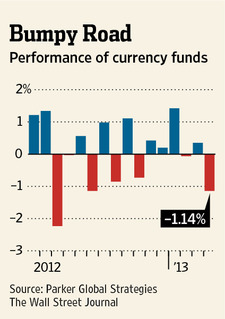
Foreign-exchange funds suffered their worst performance in 10 months in April, as currency managers struggled with a market frequently swayed by central-bank policies. The Parker Global Currency Managers index, which tracks the performance of funds in which the firm invests, fell 1.14% last month. The decline left the index up just 0.57% in the first four months of the year. Even as the easy monetary policies at major central banks have fueled a bumper year for investors in a broad range of assets, from Japanese stocks to European bonds, funds that mainly invest in currencies have underperformed, and there are signs that their clients are losing patience. Investors pulled $1.5 billion from currency funds in the first three months of 2013, even as they piled into hedge funds as a whole at their fastest clip in almost three years, according to Hedge Fund Research Inc. Foreign-exchange funds had $14.4 billion under management in March, down 58% from their peak in 2007. Investors and analysts say the outflows from currency funds are a sign that large asset managers are skeptical that financial markets have truly found their footing. Currency funds proved especially vulnerable when central banks stepped into the market to stimulate growth and calm panics, often with measures that involved printing money or deliberately weakening exchange rates. Investors say they see no sign that central banks are relaxing in their new role policing markets. Read more of this post

China’s Import Data Doubted by Nomura as Tariff Revenue Slumps

China’s Import Data Doubted by Nomura as Tariff Revenue Slumps

China’s “surprisingly strong” import growth in the first four months may have been inflated by fake invoices as companies circumvented capital controls to move funds into China, according to Nomura Holdings Inc.

A 28 percent slump in the value of import tariffs in the first quarter compared with a year earlier casts doubt over the credibility of official data that show imports (CNFRIMPY) rose 8 percent in the period, economists Zhang Zhiwei in Hong Kong and Wendy Chen in Shanghai wrote in a research note today. The two indicators have generally moved in tandem in the past, they said.

Skepticism over import figures in the world’s second-biggest economy adds to concerns that the nation’s trade data are inaccurate after analysts at Bank of America Corp. and Royal Bank of Scotland Group Plc said export figures this year were inflated by fabricated reports. Hot money flooding into China helped push the yuan to a 19-year high yesterday and regulators this week announced a crackdown on companies using trade reports to disguise speculative inflows.

“Some companies may have moved products between Hong Kong and China’s special trade zones to circumvent capital controls and move funds into China,” the Nomura economists wrote. “Such trade is free of import tariffs, so it pushes up imports and exports but not import duties.” Read more of this post

The Impact of Brand Rating Dispersion on Firm Value

The Impact of Brand Rating Dispersion on Firm Value

Xueming Luo University of Texas at Arlington

Sascha Raithel Ludwig Maximilians University of Munich – Munich School of Management

Michael Wiles Arizona State University (ASU) – Marketing Department

April 30, 2013
Journal of Marketing Research, Forthcoming.

Abstract: 
This study examines brand dispersion — variance in brand ratings across consumers — and its role in the translation of brand assets into firm value. Dispersion captures the covert heterogeneity in evaluations of brands among consumers who like or dislike the brands, which would affect an investor’s decision to buy or sell a stock. The higher the dispersion, the more inconsistent and polarized cross-consumer ratings of the brands. Multiple analyses — from simple, model-free to time-series models — on 730,818 brand-day observations provide robust evidence that changes in brand dispersion matter for stock prices. Brand dispersion has Januslike effects: it harms returns but reduces firm risk. Further, downside dispersion has a stronger impact on abnormal returns than upside dispersion, indicating an asymmetry in brand dispersion’s effects. Moreover, dispersion tempers the risk-reduction benefits of higher brand rating in both short and long runs. Without modeling dispersion, brand rating’s impact on firm value can be over- or under-estimated. Managers should consider dispersion a vital brand-management metric and add this metric to the brand-performance dashboard.

Wharton’s Wachter, Raff, Yan: Real Estate Prices in Beijing, 1644 to 1840

Real Estate Prices in Beijing, 1644 to 1840

Daniel Raff and Susan Wachter, Wharton School of Management, University of Pennsylvania

Se Yan, Guanghua School of Management, Peking University

Abstract:

This paper provides the first estimates of housing price movements for Beijing in late pre-modern China. We hand-collect from archival sources transaction prices and other house attribute information from the 498 surviving house sale contracts for Beijing during the first two centuries of the Qing Dynasty (1644-1840), a long period without major wars, political turmoil, or significant institutional change in the Chinese capital. We use hedonic methods to construct a real estate price index for Beijing for the period. The regression analysis explains a major proportion of the variance of housing prices. We find that house prices grew steadily for the first half-century of the Qing Dynasty and declined afterwards in both nominal and real terms through the late eighteenth century. Nominal prices grew starting in the late eighteenth century and declined from the early nineteenth century through 1840. But these price changes occurred with contemporaneous price changes in basic measures of the cost of living: there was little change in real terms to the end of our period.