Chinese Women Aren’t Taking Buffett’s Advice on Gold; “It’s almost Mother’s Day. My mother bluntly told me to buy her gold.”

Chinese Women Aren’t Taking Buffett’s Advice on Gold

On Sunday afternoon, a microblogger in Beijing logged into Sina Weibo, China’s leading social media platform, to gossip about the “auntie” next door. It’s a broad term of respect for an older woman, and his followers understood precisely what he meant when he tweeted, “The auntie next door used all of her retirement savings to buy gold. When asked what she’d do if prices keep dropping, she replied that if everyone kept buying gold, the price wouldn’t drop…”

This might strike a conservative investor as reckless. But in China, where gold has long been a national obsession, a mid-April record crash in global gold prices has been seen as an unprecedented buying opportunity. According to reports in China, Chinese have purchased 300 tons of gold worth more than $16 billion since the crash. Read more of this post

SocGen: Nearly Every Company We Met ‘Admitted’ That Chinese Trade Is About More Than Moving Goods + Chart of the Day: China Exports to Taiwan

SocGen: Nearly Every Company We Met ‘Admitted’ That Chinese Trade Is About More Than Moving Goods

Sam Ro | May 8, 2013, 8:48 AM | 2,044 | 

The better-than-expected Chinese trade data has everyone crying foul. Nomura’s Zhiwei ZhangBank of America Merrill Lynch‘s Weijun Hu and Ting Lu, and Societe Generale’s Wei Yao have all pointed to discrepancies between China’s numbers and the numbers of its trading partners. Furthermore, all point to companies using inflated bills as a way to circumvent strict Chinese capital controls and move money in and out of the mainland. “In 1Q13, China’s export data were heavily distorted due to over-reporting by exporters who might bring in hot money through fake exports and arbitrage the differential between CNH/USD and CNY/USD by moving goods in and out of HK,” said BAML’s Hu and Lu. SocGen’s Yao is actually having a hard time finding people who aren’t engaged in this practice. “As for reasons, our observation from the trips to the mainland led us to believe that there is indeed a large amount of speculative capital flows,” wrote Yao in a note to clients. “Nearly all corporates we met admitted that they were conducting some forms of interest rate arbitrage on the expectation of further yuan appreciation.

CHART OF THE DAY: It Doesn’t Take A Genius To See Something Fishy In China’s Trade Data

Sam Ro | May 8, 2013, 7:29 AM | 4,509 | 4

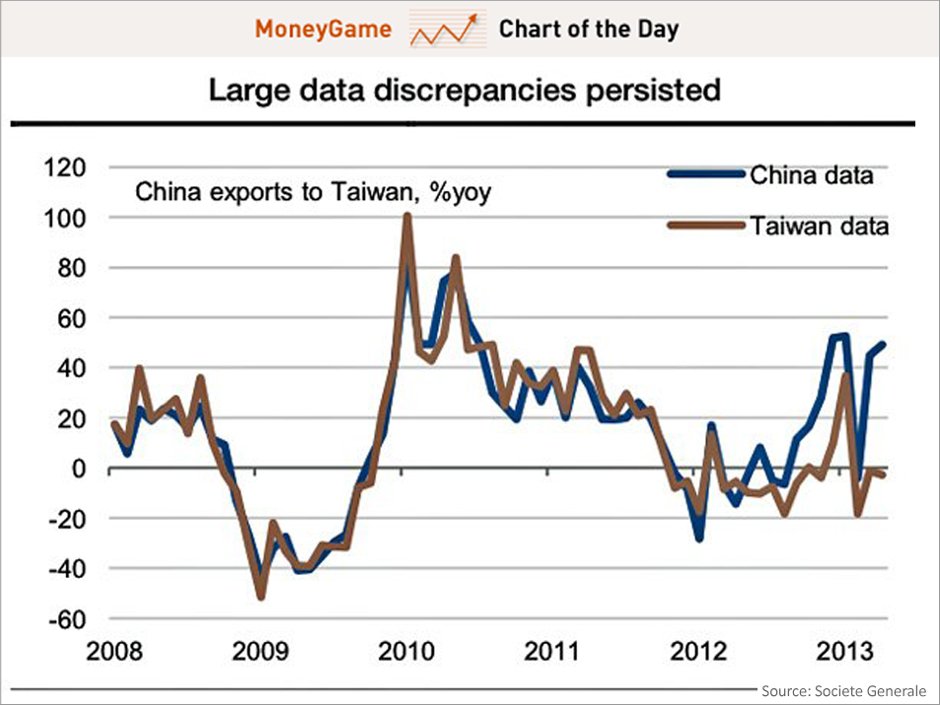
Earlier today, China published its official April trade figures. And while the numbers for both imports and exports were much stronger than expected, experts have been left scratching their heads over the unusual discrepancies. For one thing, exports surged 14.7% year-over-year even as exports to the U.S. fell by 0.7%. Exports to the EU fell by 6.4%. In a note to clients, Nomura’s Zhiwei Zhang attributed it to companies trying to get around strict Chinese capital controls. “We believe exports to destinations like Hong Kong, a major financial hub, are likely being over-invoiced in an attempt to circumvent capital controls and bring foreign capital into China,” said Zhang who pointed out that exports to Hong Kong surged by 57.2%. Societe Generale’s Wei Yao agrees with Zhang.  “As for reasons, our observation from the trips to the mainland led us to believe that there is indeed a large amount of speculative capital flows,” wrote Yao in a note to clients. “Nearly all corporates we met admitted that they were conducting some forms of interest rate arbitrage on the expectation of further yuan appreciation.” But Hong Kong wasn’t the only discrepancy. Yao noted a whopper in the Taiwan numbers. “Head-scratching discrepancies in bilateral data comparison persisted on both sides of the ledger,” she wrote. “Compared with the data from Taiwan – the only economy besides China that has published the complete set of April data – growth of mainland exports to Taiwan was 57.7 ppt faster based on China’s data (+49.2% yoy vs. -2.7% yoy) and that of mainland’s imports from Taiwan was 58.6ppt faster (+55.7% yoy vs. -2.9% yoy)! The gaps narrowed only marginally from March.” No wonder people question the reliability of the data.

moneygame-cotd-050813

Corporate auditors would be required to look more closely at insider business deals, like those used in many Chinese company frauds, under a rule the US audit regulator has proposed

Thursday May 9, 2013

US audit watchdog wants more scrutiny

WASHINGTON: Corporate auditors would be required to look more closely at insider business deals, like those used in many Chinese company frauds, under a rule the US audit regulator has proposed.

The Public Company Accounting Oversight Board’s (PCAOB) rule takes aim at socalled “related party transactions,” or deals between a company and corporate insiders. These kinds of transactions have played a role in many accounting frauds. Read more of this post

All Malaysian-listed China firms end in the red after listing

Most Bursa-listed China firms end in the red

LIM CIAN YAI

Published: 2013/05/09

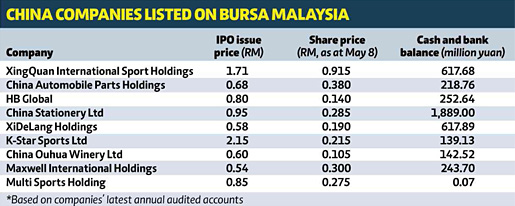
KUALA LUMPUR: China-based companies listed on Bursa Malaysia mostly ended the trading day in the red yesterday, following HB Global Ltd’s investor alert announcement on Tuesday.

This is the first time a China company listed here has reported to the stock exchange a wide discrepancy between its unaudited results and that prepared by its external auditors. Bursa Malaysia leapt into action yesterday, directing HB Global to appoint a special auditor to probe the company’s affairs, particularly its financials, and identify any irregularities.

pix_bottom Read more of this post

Beijing Puzzles Over Urban Growth; Government Entertains Debate on How to Manage Population Gains as It Seeks Lift From Bigger Cities

Updated May 8, 2013, 7:55 p.m. ET

Beijing Puzzles Over Urban Growth

Government Entertains Debate on How to Manage Population Gains as It Seeks Lift From Bigger Cities

By BOB DAVIS

WO-AN688_CURBAN_G_20130508183017

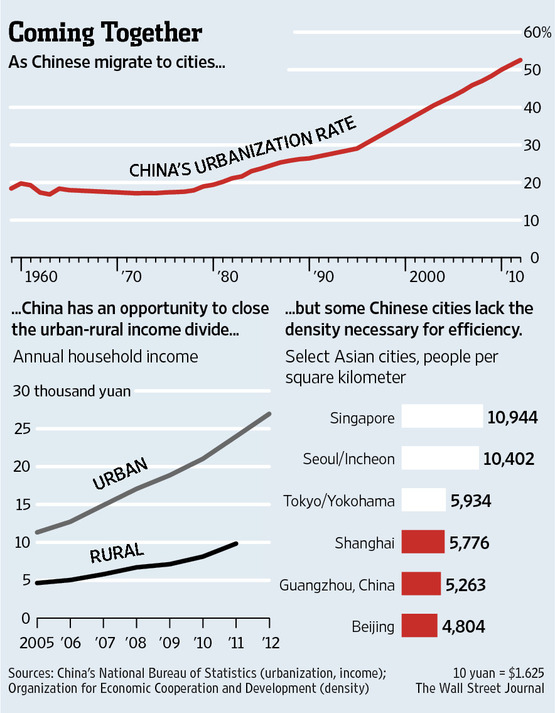
BEIJING—China’s new leaders are counting on urbanization to remake the economy but have tried to limit the flow to the country’s largest cities, fearing that a surge in migration could turn them into Latin American-style slums. Some urbanization specialists inside and outside China argue that the fear is largely misplaced. The problem with Beijing, Shanghai and other Chinese megacities, they say, is that they aren’t even more densely packed—or better planned. Adding more people to Beijing, for example—on top of the 18 million or so who already live here—would encourage better public transportation, boost land prices so high that factories would move away, and attract talented people with fresh ideas, according to these specialists. Imagine, say, Manhattan or Tokyo. “We have to let the market play a bigger role in the development of cities and dismantle barriers” to urban growth, said He Fan, a senior economist at the Chinese Academy of Social Sciences, the government’s most prestigious think tank. “People prefer to move to larger cities because there is more opportunity there.” Angel Gurría, secretary-general of the Organization for Economic Cooperation and Development, is another big-city booster. “When you see the situation in the large urban conglomerations, you say, ‘Let’s stop the growth,’ ” he said during an interview in Beijing. “But you probably don’t want to stop the growth [because] a well-organized, predictable process of urbanization allows for a much better allocation of resources.” Urban planners talk about “agglomeration” effects—the idea that cities gain by having people more tightly packed. That’s because travel by car becomes impractical and is replaced by public transportation. Also, old-line industries are forced to relocate because of rising prices, and lightly polluting service industries take their place. The influx of people brings an energy to a city that helps create new businesses and investment. Read more of this post

Galaxy’s secret sauce: Samsung components; “Samsung’s strength is this ability to in-source to itself”

May 8, 2013, 7:15 p.m. ET

Galaxy’s secret sauce: Samsung components

By ARIK HESSELDAHL

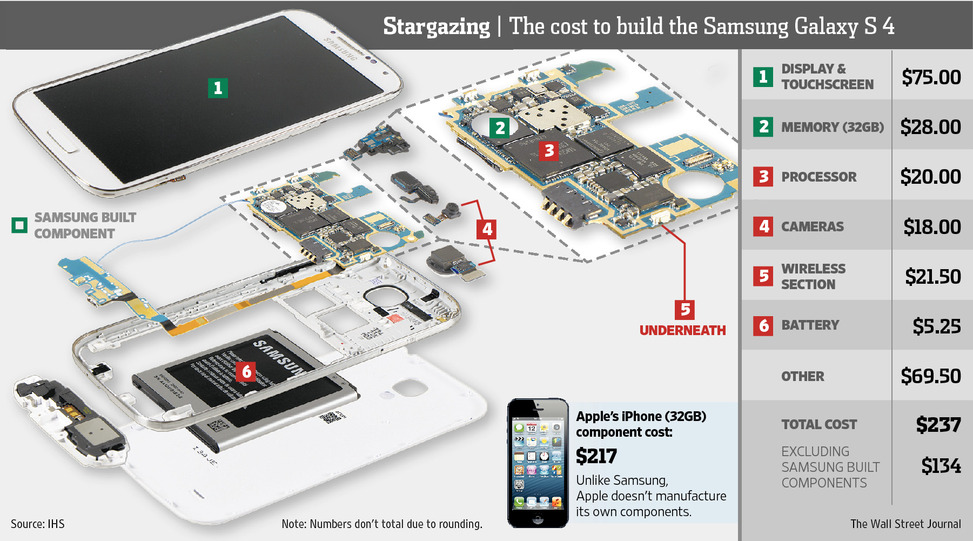
Samsung Electronics Co 005930.SE +1.01% .’s latest smartphone, the Galaxy S 4, takes advantage of the South Korean electronics company’s chip- and display-manufacturing prowess to get its material costs closer to Apple Inc AAPL +1.13% .’s costs for the iPhone 5. An analysis conducted by market-research firm IHS Inc. IHS +1.66% estimates Samsung’s cost of materials and manufacturing to produce the U.S. version of the S 4 is slightly above $237 a unit, according to a report expected to be released on Thursday. That is higher than Apple’s $217 production cost for a 32-gigabyte iPhone 5, which has a smaller and less-costly display screen. Without a two-year contract, the 16-gigabyte version of the Samsung phone sells for $639 at AT&T Inc., T +0.83%and the iPhone 5 with 32 gigabytes costs $749 at an Apple store.

MK-CD089A_GALAX_G_20130508185108 Read more of this post

Earnings Not Yet a Viral Sensation

ay 8, 2013, 7:48 p.m. ET

Earnings Not Yet a Viral Sensation

By JEAN EAGLESHAM

When Facebook Inc. FB +0.86% boss Mark Zuckerberg announced first-quarter results, he didn’t break the news with a Facebook post. He stuck with an old-fashioned news release. Across the U.S., earnings season came and went with few signs that companies are taking advantage of the Securities and Exchange Commission’s green light to tweet or post market-moving information. On April 2, the SEC announced that companies “can use social media outlets like Facebook and Twitter to announce key information…so long as investors have been alerted about which social media will be used to disseminate such information.” Since then, only about a dozen firms have said they might break news on Facebook, Twitter and the like. And few of those companies make much noise online. Read more of this post

‘Open Data’ Brings Potential And Perils for Government

May 8, 2013, 4:27 p.m. ET

‘Open Data’ Brings Potential And Perils for Government

By BEN ROONEY

Open Data: the very name is a virtuous pairing of transparency and science. No one is going to argue against openness, and data has the appeal of nonjudgmental objectivity.

Governments and public officials are rushing to embrace the concept, throwing open the vast panoply of publicly collected information for the digitally savvy to mine and exploit. The poster child of the movement is Mike Flowers, chief analytics officer for the City of New York. By mashing together all of the city’s numerous data sources, his team has more than doubled the hit rate for discovering stores selling bootlegged cigarettes and had a fivefold increase in the success rate of building inspectors looking for illegal conversions.

With that sort of track record, it is clear why Open Data is very appealing for politicians. At the last count almost 30 countries—mainly in Europe and other developed nations but also including Costa Rica, Kenya and India—plus a number of municipal areas have launched sites.

However, the use of government data throws up many issues surrounding privacy, policy-making and the uses to which the data has been put. These need to be tackled before simply opening up these digital to all comers. Read more of this post

Will Health-Care Law Beget Entrepreneurs? Thousands of would-be entrepreneurs want to start their own businesses, but are shackled to their current employer by the need for affordable health insurance

Updated May 8, 2013, 7:59 p.m. ET

Will Health-Care Law Beget Entrepreneurs?

By EMILY MALTBY and ANGUS LOTEN

Thousands of would-be entrepreneurs are itching to start their own businesses, but many are shackled to their current employer by health-care benefits they don’t think they could otherwise afford. Economists call this phenomenon “job lock,” or “entrepreneurship lock.”

But the pressure some Americans feel to cling to a corporate job chiefly for the health insurance could, conceivably, ease in coming years. Under provisions of the health-care law, new-business owners will be able to get coverage through public marketplaces, or “exchanges,” beginning in October, for policies that will take effect starting in January. Read more of this post

Yen’s Slide No Panacea For Japan Inc.

May 7, 2013, 10:59 p.m. ET

Yen’s Slide No Panacea For Japan Inc.

By AARON BACK

Japanese Prime Minister Shinzo Abe has weakened the yen and sent stocks soaring. Boosting long-term earnings growth for Japanese companies will be more difficult. Increasing domestic consumption is an important objective of Mr. Abe’s plan. But much depends on the impact of a weaker yen on Japan’s export-focused businesses. In the current fiscal year, companies on the main Tokyo stock exchange could see profits jump 30% to 40% year-over-year if the yen averages between 100 and 115 to the dollar, saysCitigroup C +2.45% . The yen’s slide has two main effects on corporate earnings. First, revenue earned overseas is immediately worth more in yen terms. Nomura’s survey of large Japanese nonfinancial companies that have reported earnings for the three months ended March 31 shows profits up 7.7% on the previous year. That is down from a 33.2% jump in the previous quarter, though some major companies haven’t reported yet. The second benefit is that Japanese companies should become more competitive as the cheaper yen means foreigners pay less for the country’s exports. While this should boost sales volumes, not all exporters will be able to take advantage.

Take Canon 7751.TO -0.29% . Revenue from its imaging business fell 1.8% year-over-year in the three months to March 31. The fall would have been 14% but for the effect of the weakening yen. But Canon faces fundamental problems that can’t be fixed by currency movements. The company’s core digital-camera business is in decline because amateur photographers can now snap photos with increasingly high-resolution smartphones. In addition, because Canon mainly competes with other Japanese camera makers like Nikon 7731.TO -0.14% and Olympus7733.TO -1.10%its rivals will also benefit from the yen’s slide. Read more of this post

Weeds Grow in the Stock Market’s Yield of Dreams; Investors’ intense focus on dividends could yield problems for them later on

May 7, 2013, 5:35 p.m. ET

Weeds Grow in the Stock Market’s Yield of Dreams

By JUSTIN LAHART

Investors’ intense focus on dividends could yield problems for them later on.

Usually when the Federal Reserve is in easing mode, investors set their sights on the stocks of companies whose fortunes are most likely to rise fastest with rising economic growth. But with the Fed sopping up $85 billion in Treasurys and mortgage bonds each month—and driving yields across a spectrum of bonds lower in the process—the hunt for investments that can provide a modicum of income has intensified. So the shares of companies with a history of paying dividends, which investors more typically eschew when the Fed’s foot is on the gas, have been in favor. Read more of this post

Mao Zedong’s granddaughter and her husband appear on the latest rich list as survey suggests that who, not what, you know is still important

Mao Zedong granddaughter on rich list, prompting debate

Thursday, 09 May, 2013, 12:00am

Cary Huang in Beijing cary.huang@scmp.com

Mao Zedong’s granddaughter and her husband appear on the latest rich list as survey suggests that who, not what, you know is still important

The addition of the granddaughter of Mao Zedong to a list of the richest Chinese – along with a survey suggesting that graduates from well-connected families tend to find better jobs – has triggered fresh debate about political connections and personal wealth.

With family assets estimated at 5 billion yuan (HK$6.25 billion), Kong Dongmei , granddaughter of the late leader, and husband Chen Dongsheng are 242nd on the 2013 New Fortune 500 Rich List [1], media reports said yesterday. Read more of this post

HK vs Beijing: A Battle to Become Art Capital of China

May 8, 2013

A Battle to Become Art Capital of China

By KEVIN HOLDEN PLATT

BEIJING — The sometimes-tense relationship between Hong Kong and Beijing appears set to move to another front: the world of art.

With the National Art Museum of China — or Namoc — planning to open in a new building in 2017, and Hong Kong projected to open its M+ museum in a new cultural district about the same time, the cities could emerge as twin titans of contemporary Chinese culture.

Namoc attracted some of the world’s leading architects, including Zaha HadidFrank Gehry and Jean Nouvel, to its design contest for the new museum in Olympic park in Beijing. Xie Xiaofan, a deputy director at Namoc, informally announced at theE.U.-China High Level Cultural Forum in November that Mr. Nouvel’s design had been selected, although the decision is subject to the approval of China’s new leadership. Read more of this post

HP and Autonomy: how to lose $8.8bn

May 8, 2013 9:29 pm

HP and Autonomy: how to lose $8.8bn

By Robert Armstrong and Stuart Kirk

Hewlett-Packard appears to be in a difficult position whatever the court rules on its disastrous purchase of the software group

AutonomyHP

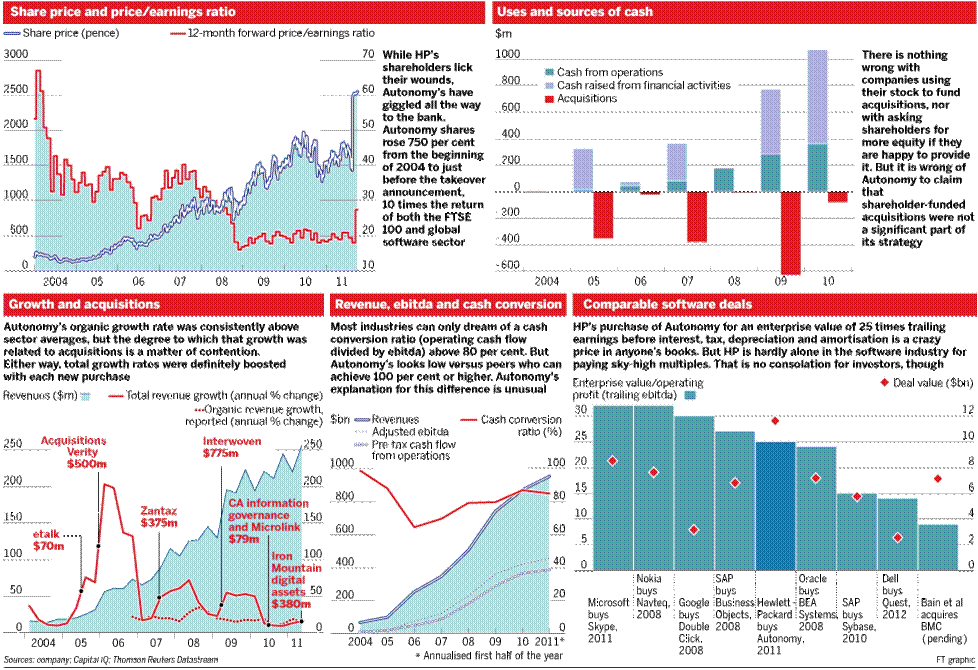
Making $8.8bn disappear is not easy.Hewlett-Packard managed it, and quickly, when it bought the information management software company Autonomyin 2011 for $11.6bn and wrote off 80 per cent of the purchase price a year later. HP’s history is rife with self-inflicted injuryand the Autonomy affair is, in part, a depressingly familiar story: a company in crisis overpaying for an acquisition it can tout as transformative. Heads have already rolled. Léo Apotheker, HP’s boss at the time of the deal, departed almost immediately afterwards and Raymond Lane, the board’s chairman at the time, and two other directors followed him last month. HP, however, attributed more than $5bn of the writedown to “accounting improprieties, disclosure failures and outright misrepresentations”. It alleges that low-margin hardware sales were disguised as high-margin software sales and that products were sold into the distribution channel when there was no buyer. Read more of this post

Brazil has plenty of entrepreneurs but many lack ambition when it comes to expanding companies

May 8, 2013 7:27 pm

A spirit for enterprise

By Joe Leahy

When Linda Rottenberg moved to Latin America in the 1990s, she was surprised to find there was no word for “entrepreneur” in the local Spanish or Portuguese. Ms Rottenberg, president of Endeavor, a global non-governmental organisation that supports entrepreneurship, says every university student she met wanted to work for the government. Over the years, however, with the opening of the region’s economies and the rise of its stock markets, that attitude has changed so much that a Portuguese word for entrepreneur has emerged: empreendedor. “One of my favourite days was when the editor of a Portuguese dictionary told me he was adding the word for ‘entrepreneur’,” Ms Rottenberg said recently, before the Global Entrepreneurship Conference, a summit for service providers in the field, which was held in Rio de Janeiro.

Few people, particularly the participants milling around the conference, would question the existence of a Brazilian entrepreneurial spirit. On the global stage, there is Brazil’s most prominent entrepreneur, Jorge Paulo Lemann, who is teaming up with Warren Buffett to buy Heinz. Or Embraer, the world’s third-largest commercial aircraft maker, which continues to practise “intrapreneurship” by taking risks on new products and investing in fresh business lines. At home, there are businessmen such as Andre Esteves, who is building BTG Pactual, the country’s biggest independent investment bank, or Peixe Urbano, the collective buying platform that is Brazil’s version of Groupon. The idea of the entrepreneur has become such a celebrated part of Brazilian culture that one of the main characters in Avenida Brasil, a popular soap opera, was an entrepreneur selling hair products developed in her shop in a favela.

But in a country dominated by huge companies, some state run and most recipients of state credit, how much is this idea of the great Brazilian entrepreneur myth or reality? Rather than patting itself on the back, should Brazil, facing increasing doubts over its international competitiveness, be doing much more to foster entrepreneurship? “You need more Embraers, you need more Brazilian companies participating in higher value-added production chains,” says Paulo Sotero, director of the Brazil Institute at the Woodrow Wilson International Centre for Scholars in Washington. Read more of this post
Norges, the world’s largest sovereign wealth fund, is fleeing out of inflation-linked bonds in a sign of how many large investors are souring on the asset class

May 8, 2013 4:44 pm

Norway’s oil fund dumps inflation-linked bonds

By Richard Milne in Oslo and Robin Wigglesworth in London

The world’s largest sovereign wealth fund is fleeing out of inflation-linked bonds in a sign of how many large investors are souring on the asset class. Norway’s oil fund has cut its holdings of inflation-linked bonds by 73 per cent in the past year and almost halved them in the first three months of this year alone. Yngve Slyngstad, head of the oil fund, told the Financial Times that, in theory, inflation-linked debt was one of the ways investors could hedge the risk of negative real yields in government bond portfolios. But he added that the oil fund was in fact reducing its exposure to inflation-linked bonds sharply because it had concluded that it was not a big enough market. Read more of this post

University endowments trim holdings in US Treasuries from as much as 30 per cent in 2008-09 to zero in some cases, fearing they could be caught flat-footed by a reversal of the Federal Reserve’s low interest-rate policy

May 8, 2013 7:34 pm

University endowments trim holdings in US Treasuries

By Henny Sender in New York

Some of the smartest money in America is getting out of US government debt. Many university endowments have scaled back their holdings of Treasury securities from as much as 30 per cent in 2008-09 to zero in some cases, say people familiar with their investment strategies. The sell-off reflects a big change in the way fund managers view US government debt. The traditional attraction of Treasuries for US investors was that they were certain to be repaid. But with interest rates at such low levels, investors worry that bond prices could fall dramatically. “Treasuries were a core holding,” said one university fund manager. “Now everyone is holding less than 5 per cent.” The fear on campuses is that universities, which profited in recent years from the rally in Treasury prices, could be caught flat-footed by a reversal of the Federal Reserve’s low interest-rate policy. “If you think you can change allocations quarter by quarter, and you believe rates will be low for longer, and you think you can make a quick switch, then maybe it is OK,” the university fund manager said. “But that isn’t the way we invest. Today government bonds should come with a warning about interest rate risk.” Princeton’s $17bn endowment has converted its Treasury holdings to cash, according to published reports. Duke’s $5.5bn endowment has also shifted from Treasuries to US stocks with high dividends and emerging market equities, a person familiar with the university fund said. Last week, Cornell’s $5bn endowment decided to reduce its investments in Treasury securities to just over 3 per cent of assets. As of June last year, Yale’s $19bn endowment had only 4 per cent of its holdings in Treasuries. “Yale is not particularly attracted to fixed income assets as they have the lowest expected returns of the seven asset classes that make up the endowment,” the university’s fund said in its annual report. According to one survey of 831 US universities, the average endowment lost 0.3 per cent in the fiscal year ending June 2012, with gains on holdings of government debt offsetting losses elsewhere in their portfolios. By contrast, endowments earned an average return of 19.2 per cent in the year to June 2011.


Jim Chanos: ‘If I Had To Pick One Short, It Would Be Seagate’; Companies like Samsung are exiting the HDD business as quickly as they can

JIM CHANOS: ‘If I Had To Pick One Short, It Would Be Seagate’

Linette Lopez | May 8, 2013, 6:03 PM | 1,556 | 1

Jim Chanos believes in the mobile revolution, and that means the death of the PC and all the businesses that exist within the PC family. At the annual Sohn Investing Conference today, he focused on one branch of that family (which he identified as value traps, of course) in a presentation called, Mobile Computing Revolution: Collateral Damage in Hard Disk Drives. “Most people have way too much storage as it is on their laptops and desktops,” he explained. “The move to the cloud is actually more efficient… The amount of storage out there still exceeds the needs as fast as data is growing.” In short, no one needs hard drives anymore. Companies like Samsung are exiting the business as quickly as they can. In fact, he pointed out, Samsung sold their disk drive business to his short pick at half of revenues in 2011 — the short pick is Seagate. He mentioned another company, Western Digital, in his presentation as well, but he particularly focused on Seagate because it’s exhibiting all the characteristics of a classic Chanos short. First off, there are, of course, accounting issues. It wouldn’t be a Chanos short if there weren’t. Seagate put about $1 billion of goodwill on the books after its Samsung acquisition, which can be great way to mask cash flow problems. Not only that, but the top 3 person in the company quit last night. And if this isn’t enough for you, Chanos put up a table that shows that the top Seagate stock holders are selling like crazy. “I think it’d probably be best if you did too,” he closed. The stock was trading at $42.32, and is now down 3.36% in after hours trading.

The Complex World of Marketing Technology

This Insane Graphic Shows How Complex Marketing Technology Is Right Now

Laura Stampler | May 8, 2013, 4:08 PM | 12,101 | 7

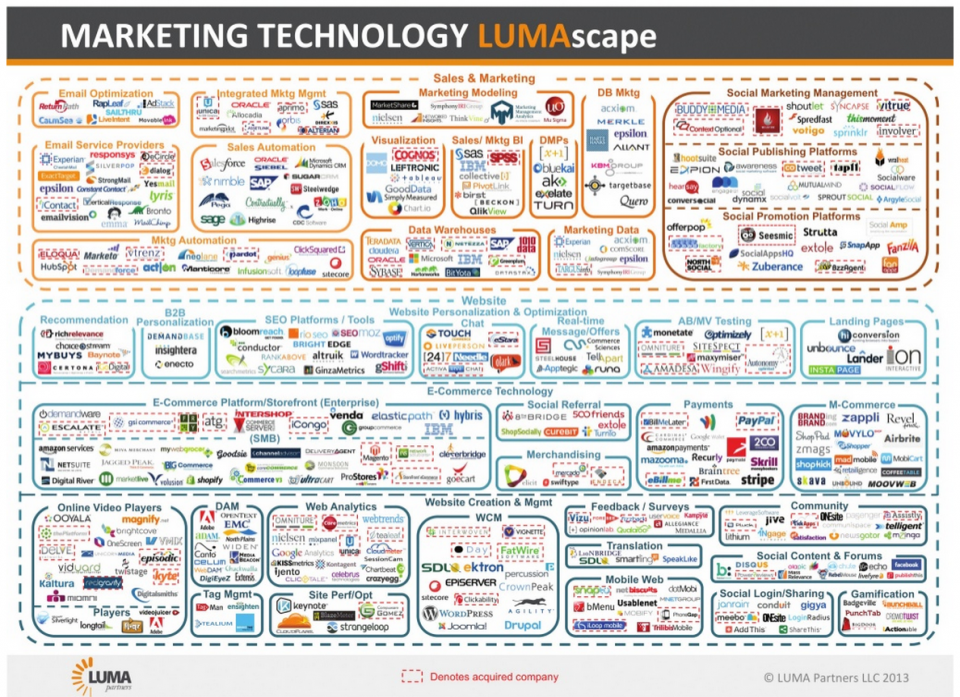
The marketing technology world is insanely specialized and complex. How complex? This new chart from LUMA Partners breaks down the world’s many different components, from sales and marketing to e-commerce technology to website creation and management.

screen shot 2013-05-08 at 3.56.56 pm

Once-Hot App Viddy Returns $18 Million To Investors And Prepares A Final Attempt To Turn Around

Once-Hot App Viddy Returns $18 Million To Investors And Prepares A Final Attempt To Turn Around

Alyson Shontell | May 8, 2013, 9:23 AM | 1,362 | 2

Last summer, social video app Viddy was in a much different place. It was in a battle to be the “Instagram of Video” alongside competitor SocialCam, and its number of users surged higher every day. Viddy used that momentum to raise a $30 million Series B round from investors such as Khosla VenturesNEA and Goldman Sachs. Even Shakira invested. But the traffic was temporary. Viddy grew quickly on Facebook‘s platform, but Facebook cut off the traffic hose when news broke that people were getting spammed by social video apps. Viddy’s executive team has all but left, including its CEO and its head of business development. In February, one-third of the staff was laid off. Now, Viddy is giving itself one last go. It’s returning $18 million to investors and keeping the remaining millions to try a few more product launches. “Viddy raised a substantial amount of capital last year, during different market conditions,” Viddy’s president, JJ Aguhob, told AllThingsD. “A year later, Viddy is a leaner, product-focused organization that is steadily growing its audience and will soon be releasing new products. Our late-stage investors have been very supportive, but it just makes good business sense to return capital we do not need and have a clean balance sheet in the process.” Having to return all that cash isn’t the most painful part of Viddy’s story either. Last year, Viddy reportedly turned down a $100 million buyout offer from Twitter when the app was on the upswing.

Billionaire Taizo Son Emerges With ‘Puzzle & Dragons’ App after shares of GungHo soared more than 10-fold this year. “Puzzle & Dragons” was the world’s top-grossing game app for smartphones in March

Billionaire Taizo Son Emerges With ‘Puzzle & Dragons’ App

Taizo Son, the youngest brother of SoftBank Corp. (9984) magnate Masayoshi Son, has become a billionaire after shares of his company GungHo Online Entertainment Inc. (3765) soared more than 10-fold (3765) this year. The GungHo chairman holds a 27.8 percent stake in the Tokyo-based company. The shares account for almost all of his $3.3 billion fortune, according to the Bloomberg Billionaires Index. Taizo Son has never appeared on an international wealth ranking. His older brother’s SoftBank holds a 40 percent stake and was an early GungHo investor in 2002. GungHo’s flagship app, “Puzzle & Dragons,” is the world’s best-selling game for Apple Inc (AAPL).’s iPhones and smartphones using Google Inc. (GOOG)’s Android software. The app has been downloaded more than 13 million times in Japan, or about 10 percent of the nation’s population. While free to play, the role-playing game encourages participants to buy and collect characters. It generates about $3 million a day in revenue, according to Macquarie Group Ltd. analyst David Gibson.

“It has become the ‘Angry Birds’ of Japan, the default game users download and play once they buy a smartphone,” Gibson, who has an outperform rating on the stock, wrote in an e-mail interview from Tokyo. “Puzzle & Dragons” was the world’s top-grossing game app for smartphones in March, according to the App Annie Index, which measures revenue and downloads.

Read more of this post

‘Fruit Ninja’ Will Add China Content to Narrow ‘Angry Birds’ Gap; The Brisbane, Australia-based company’s game has been downloaded 500 million times, less than a third of the 1.7 billion downloads for “Angry Birds.”

‘Fruit Ninja’ Will Add China Content to Narrow ‘Angry Birds’ Gap

Halfbrick Studios Pty, creator of the “Fruit Ninja” smartphone game, will add China-specific content to win users in the world’s most populous nation and narrow the gap with Rovio Entertainment Oy’s “Angry Birds.”

In the next three months, Halfbrick will release a China version of Fruit Ninja that will include special weapons and backgrounds designed to increase its local appeal, Phil Larsen, chief marketing officer for Halfbrick, said in an interview in Beijing yesterday. The Brisbane, Australia-based company’s game has been downloaded 500 million times, less than a third of the 1.7 billion downloads for “Angry Birds.”

Halfbrick has its work cut out to match Rovio, which has made tailoring products for China a key strategy. Espoo, Finland based Rovio built an update of its “Angry Birds Seasons” game around China’s Moon Festival, sells Angry Birds-themed mooncakes during the holiday and publishes comic books that use its bird and pig characters to tell Chinese legends, according to Chief Marketing Officer Peter Vesterbacka.

“A lot of foreign companies have this hubris that we are going to bring you this great product and you are going to love it,” said Mark Natkin, managing director of Marbridge Consulting Ltd., a market research firm in Beijing. “It’s a common mistake to think that localization means translation from English to Chinese and then you’re done.” Read more of this post

Why mobile wallets alone will fail; Smartphones are the key to revolutionizing shopping—but not in the way many think.

Why mobile wallets alone will fail

May 8, 2013: 11:18 AM ET

Smartphones are the key to revolutionizing shopping—but not in the way many think.

By Cyriac Roeding

FORTUNE — Mobile wallets as they are defined today are unfortunately a solution in search of a problem. Consumers are quite happy with their credit and debit cards…they work, they’re fast and they’re familiar. And retailers, while they may complain about credit card fees, have bigger strategic issues with online competition and showrooming than to worry about installing the next “wallet” created to replace tried and true payment systems they’ve already invested in – and successfully process millions of transactions every day. The problem with mobile payments is that payment isn’t a problem in the shopping world.

So, what is the problem? The problem is the experience of shopping. One hundred years ago, as a customer, you’d have been greeted by name when you walked into a local store. The shopkeeper would have asked you whether your kids liked the cereal he sold you last week. Nowadays no one “greets” you until you swipe your credit card because it isn’t until that point when the store finds out you are even there – that means, as you leave, when you are no longer looking for items to purchase. No one shows you something that *you* might like at the store while shopping – everything is impersonal. By scaling retail, shopping has become inhuman. Read more of this post

China may not overtake America this century after all; world’s tallest tower in Changsha should have been built by now when officials announced said last year the great edifice would be erected in 3 months

China may not overtake America this century after all

Doubts are growing about whether China can pass the US to become the world’s biggest economy this century amid warnings that the country’s 30-year miracle is nearing exhaustion.

China’s catch-up spurt has a few more years to run in the Western hinterlands perhaps, but when the full story comes out we may find that nationwide growth has already fallen below 7pc. Photo: Getty

By Ambrose Evans-Pritchard

3:21PM BST 08 May 2013

The world’s tallest tower should have been built by now. Officials said last year that the great edifice with 220 floors would be erected in three months flat in China’s inland city of Changsha by March, snatching the crown from Dubai’s Burj Khalifa. The deadline has come and gone, yet the wasteland sits untouched. It now looks as if the fin d’époque project – using prefab blocs – may never be approved. Even China knows its limits. Read more of this post

The US will match China on the cost of manufacturing by 2015. Companies in both countries must adapt

The parity puzzle

Thursday, May 9, 2013

The US will match China on the cost of manufacturing by 2015. Companies in both countries must adapt, write Ivo Naumann and Steve Maurer

Ivo Naumann and Steve Maurer are managing directors at AlixPartners, a global business advisory firm. Naumann heads the firm’s activities in mainland China, and Maurer leads the firm’s manufacturing practice for the Americas.

It happens regularly in virtually every segment of every industry: A newcomer arrives, offers an advantage that competitors in the segment can’t match and rapidly begins to build both its business and market share.

What often follows, however, is also predictable: The market adapts, the advantage diminishes and the newcomer finds that it is in a vulnerable, rather than valued, situation. Read more of this post

U.S. taxpayers employ more low-wage workers than Wal-Mart, McDonald’s combined

Study: U.S. taxpayers employ more low-wage workers than Wal-Mart, McDonald’s combined

By Jim Tankersley and Marjorie Censer, Published: May 8

_tn_1001.7.822064553_Ud14mreGEeKS8_KRgBk2uA_w-cheapgov

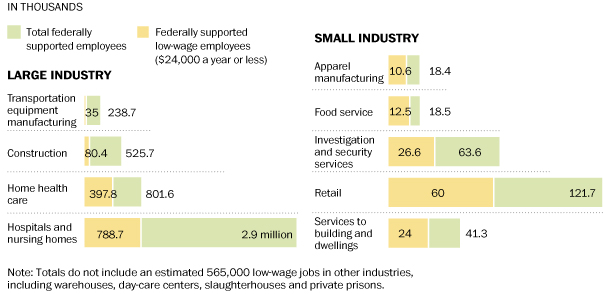
Federal taxpayers employ more low-wage workers than Wal-Mart and McDonald’s combined, a new study calculates.

The report from a public policy organization Demos, set to be released Wednesday, estimates that taxpayer dollars fund nearly 2 million private-sector jobs that pay $24,000 a year — about $12 an hour — or less. Those workers owe their incomes to government contracts, Medicare and Medicaid spending, and federal infrastructure funds, among other public sources. In contrast, Demos estimates that about 1.4 million workers earn that amount or less at Wal-Mart and McDonald’s, which are two of the largest employers of low-wage workers.

The findings highlight inequality within the government contracting industry; as chief executives of major contractors rake in millions, many contract employees are struggling to get by, according to the report from Demos, which advocates for worker-friendly policies. It is a situation that could be worsened by the budget pressures of sequestration, which is pushing the federal government to spend fewer dollars and pursue lower-priced contracts. Read more of this post

Google Translate For Android Can Now Interpret 16 Additional Languages By Camera, Adds Phrasebook Support

Google Translate For Android Can Now Interpret 16 Additional Languages By Camera, Adds Phrasebook Support

FREDERIC LARDINOIS

posted 7 hours ago

One of the coolest features of the Google Translate for Android app is that you can just point your camera at a text, tap the word you want to translate and get a translation back.Starting today, this feature supports 16 additional languages. Those are Bulgarian, Catalan, Danish, Estonian, Finnish, Croatian, Hungarian, Indonesian, Icelandic, Lithuanian, Latvian, Norwegian, Romanian, Slovak, Slovenian and Swedish. That’s in addition to Czech, Dutch, English, French, German, Italian, Polish, Portuguese, Russian, Spanish, and Turkish, which the app already supported in its first release. Google uses optical character recognition and its machine translation tools to make all of this work. In addition, Google is making its recently introducedphrasebook feature available in that app. The phrasebook, Google said at the time, allows “you to save the most useful phrases to you, for easy reference later on, exactly when you need them,” and revisiting them regularly should help you turn these translations “into lasting knowledge.” The phrasebook is now available in Translate’s app menu, where it replaces the app’s ‘favorite’ feature. The service will automatically sync with your Google Account (assuming you are signed in), so any changes you make on your phone will also be reflected on the Google Translate desktop site. “With your favorite phrases synced across devices,” Google writes, “we hope you’ll never be at a loss for words again.” It’s worth noting that the iOS version of the app does not currently support translate by camera.

Huawei founder gives first ever interview

Huawei founder gives first ever interview

May 9, 2013 – 2:21PM

Tom Pullar-Strecker

The founder and president of Chinese technology giant Huawei, Ren Zhengfei, has used a visit to New Zealand to speak to the media for the first time in his career.

Ren, 68, had never previously consented to media interviews inside or outside of China, but this morning fielded questions from a handful of journalists at Wellington’s Museum Hotel on topics ranging from his personal view of China’s human rights record to a rumour he will soon retire.

Responding to speculation about Huawei’s relations with the Chinese government, he said they were no different to those that might exist between a New Zealand firm and the New Zealand government.

His visit follows a trade trip to China by Prime Minister John Key and a large entourage last month to celebrate the fifth anniversary of the countries’ free-trade agreement, during which relations between the governments appeared to hit a new high. Read more of this post

Kuroda stimulus policies backfire as mortgage costs rise

Kuroda stimulus policies backfire as mortgage costs rise

BY YUMI IKEDA

BLOOMBERG

MAY 9, 2013

Bank of Japan Gov. Haruhiko Kuroda’s stimulus policies are backfiring in the housing market, where mortgage rates are rising even as the central bank floods the financial system with cash. Fixed 35-year home-loan costs rose to 1.81 percent this month, the first increase since February and up from an all-time low of 1.8 percent in April, according to data compiled by the Japan Housing Finance Agency. The BOJ’s April 4 announcement that it would double bond buying to generate 2 percent inflation unleashed the highest government-debt volatility in a decade and pushed 10-year yields up by five basis points. The benchmark lending rate for large corporations, known as the prime rate, increased five basis points from its record low to 1.2 percent on April 10, despite the BOJ’s aim of stoking the economy through cheaper funding.

“It makes little economic sense for rates to decline when the BOJ says it will raise consumer prices,” said Toru Suehiro, a market economist at Mizuho Securities Co. “Yields are higher than before the monetary easing to reflect the volatility risk, and lending rates have risen because they are set based on bond yields.” Read more of this post

Meltdown of company triggers suicides in India; Failing to repay investors’ money after the Saradha Group meltdown, an agent and a director of two different deposit mobilising companies committed suicide

Meltdown of company triggers suicides in India


Thu, May 09, 2013
The States Man/Asia News Network

Indian activists of the Congress party shout slogans against the arrested Chairman of Saradha group, Sudipta Sen, outside the court in Kolkata on April 25, 2013.

Failing to repay investors’ money after the Saradha Group meltdown, an agent and a director of two different deposit mobilising companies committed suicide. Ten persons have committed suicide in the state so far following the multi-million dollar scam.

Indrajit Roy, one of the directors of Hello India, a chit fund company, committed suicide by hanging himself from the ceiling of a room in his residence off 14 Brindaban Mallick Lane at Amherst Street today. Read more of this post