Run silent, run deep: The life of new CEO Brian Krzanich at Intel

Run silent, run deep: The life of Brian Krzanich at Intel

5:57pm EDT

By Noel Randewich

SAN FRANCISCO (Reuters) – It took him 30 years, but Brian Krzanich – the understated, analytical engineer who started his career at an Intel chip factory in New Mexico – quietly worked his way up to the top. Now, the man who once prided himself on halving production times will have to act swiftly to move the company into new areas of growth.

Krzanich will take over as chief executive beginning on May 16 at the annual shareholder meeting, replacing Paul Otellini, who in November unexpectedly announced his plan to retire. Under Otellini, Intel has been sidelined in smartphones and tablets while demand for its PC processors is on the wane.

To turn around the $53 billion-a-year empire, Krzanich will have to depend on trusted lieutenants, something he shouldn’t have a problem doing, say former employees, analysts and industry executives who have worked with him.

In 2010, Krzanich was on the brink of a weighty decision: whether to break with tradition and open up Intel’s top-secret manufacturing facilities and make chips for other companies. He called a teleconference of 8-10 key people – executives from marketing, investor relations and sales among them – and began firing off questions. Read more of this post


Buffett’s Iscar workers anxious; “We’re feeling a real slowdown in the market. For months, there has been only enough work for half a day, and most of the day we drag out the hours.”

Iscar workers anxious

“We’re feeling a real slowdown in the market, and the depreciation of the dollar and euro have not helped.”

2 May 13 17:40, Shay Niv

While the Israeli economy celebrates the deal between the Wertheimer family and Warren Buffett, uncertainty, and even fear, reigns at Iscar Ltd’s plant in the Tefen Industrial Zone in the Galilee. “I heard that Buffett promised that as long as he lived, Iscar would continue to operate in Israel. But with all due respect, and I wish him a long life, how much longer does he have?” a production employee told “Globes”.

Iscar may have broken profit records in 2012, but the Wertheimer family may have sold its remaining stake at the right time: the same source at the company said that, for at least six months, production has been slumping, and that, as a result, management has slashed employees’ overtime and even ended the night and Friday shifts in some departments.

“We’re feeling a real slowdown in the market, and the depreciation of the dollar and euro have not helped us either, as most of our business is exports,” he said. “If during last Passover, we worked all the time, except for the Seder meal, this year, most departments were closed. For months, there has been only enough work for half a day, and most of the day we drag out the hours.” Read more of this post

Marc Andreessen and Peter Thiel debate whether we’re still innovating

Andreessen and Thiel debate whether we’re still innovating

BY SARAH LACY 
ON MAY 2, 2013

Marc Andreessen and Peter Thiel will pretty much debate anyone, anytime, anywhere about most anything. They’re both frighteningly good at it. It’s not fun to be on the other side of the barrage of obscure facts and rhetorical tricks both can easily employ.

So, The Milken Institute decided to sick them on one another. At an event earlier this week, the two debated whether innovation has stalled, with Thiel taking the pro and Andreessen taking the con position.

This issue is obviously a major one for the startup world, and one we’ve debated quite a bit as well. I’m typically more aligned with Andreessen’s view of the world. Yes, we could be doing more. But let’s not underestimate the impact of things like Twitter and smartphones on the world. As Andreessen says in this video, “The whole basis of civilization is communication.” It’s the catalyst for multi-cultural understanding and, ultimately, innovation itself. Massive advances in globally available free communication aren’t exactly trivial. Read more of this post

Flexing antitrust muscle, China is a new merger hurdle; “Companies are thinking about the cost of doing business in China. In some cases, it’s a poison pill you have to swallow”

Insight: Flexing antitrust muscle, China is a new merger hurdle

Thu, May 2 2013

By Michael Martina

BEIJING (Reuters) – China’s new-found clout in regulating global mergers is causing headaches for companies seeking high-stakes deals that need Beijing’s approval. Where corporate lawyers and advisers were once primarily concerned with merger clearance in the United States and Europe, China’s anti-monopoly law – just five years old – has altered the calculus, as Beijing forces often painful delays with an antitrust regime that some see as an industrial policy tool. “It’s to the point where China is one of the key concerns that global companies now have when doing merger clearance deals,” said Peter Wang, an antitrust expert and Shanghai-based partner for law firm Jones Day. Tucked into the hulking Commerce Ministry (MOFCOM) a stone’s throw from Tiananmen Square, a handful of antitrust officials are what stands between multi-billion dollar mergers and access to the world’s second-largest economy. The hiccups in China’s system have the potential to gum up the works – extending firms’ funding needs and creating uncertainty around mergers.

Recent deals highlight concerns over the long delays in China’s merger reviews and the tough conditions that some experts see as limiting operational control for companies while not being particularly designed to curtail monopoly. Read more of this post

The Generosity Strategies that Help Companies Grow

The Generosity Strategies that Help Companies Grow

by Eddie Yoon  |   2:00 PM May 2, 2013

Netflix reported another great quarter last month, with big subscriber and stock growth. It’s hard to believe it was just two years ago that the company and its CEO were widely ridiculed — and even subject to a Saturday Night Live parody.

Certainly much credit is due to adding new tricks to its tool kit by creating new content like House of Cards, a programming success that’s highlighted how it is using its analytic power to find news ways to satisfy customers.

I’ve written three HBR posts on Netflix since its difficult 2011. All were bullish on its future. I had many left-brain reasons why to be bullish — the quantified upside of digital streaming, its leadership, distribution and analytics advantages, etc. But I think there was emotional ‘data’ that I’ve acquired as a 10 year subscriber that stitches all the rational reasons together and amplifies them.

Put simply, Netflix is a generous company. And generosity can be a highly effective growth strategy. Read more of this post

Corporate Jet Center Exposes Silicon Valley’s Class Divide

May 2, 2013

Corporate Jet Center Exposes Silicon Valley’s Class Divide

By NORIMITSU ONISHI

SAN JOSE, Calif. — The approval of a new corporate jet center at this city’s struggling airport might have been just another losing skirmish in the battle between Silicon Valley billionaires and middle-class neighborhoods worried about noise pollution. Instead, it is becoming the latest symbol for the rapidly growing gap between the region’s haves, with their private jets and untold wealth, and the have-nots, clinging to more modest lives in the dwindling number of communities they can afford.

Google, which is responsible for many of the jets that will use the new $82 million center, is helping bring badly needed cash to Mineta San Jose International Airport, just as the tech industry is creating jobs and wealth in Silicon Valley. But the tech boom is also sharpening income inequality and fueling a housing boom that is squeezing families out of many Silicon Valley communities.

Whether it is the possibility of private jets’ disturbing the sleep of San Jose homeowners, or the transformation of Palo Alto’s last mobile home park into luxury apartments, local developments throughout Silicon Valley highlight how the tech boom is leaving many behind. Local officials worry about the trend, which experts say will only accelerate, and its effects on the valley’s work force and diversity. Read more of this post

Suddenly, Google Plus Is Outpacing Twitter To Become The World’s Second Largest Social Network

Suddenly, Google Plus Is Outpacing Twitter To Become The World’s Second Largest Social Network

Thomas WatkinsAgence France Presse | May 1, 2013, 7:53 AM | 24,019 | 18

When Google launched its social networking service, Google Plus, during the summer of 2011, tens of millions of people clamoured to sign up for an account.

But within months, critics had panned the new service, pointing to user pages bereft of meaningful content and exchanges. They said the new social site just wasn’t, well, social. It seemed as though Facebook had cornered the market — Google was too late to the party.

Perhaps not. According to data released this week by Internet analytics firm GlobalWebIndex, Google Plus is racking up large numbers of new users and continues to outpace Twitter as the world’s number two social network, behind perennial titan Facebook.

The reasons behind Google Plus’s growth — it now can boast 359 million active users, up 33 percent from 269 million users at the end of June 2012, according to GlobalWebIndex — are complex and tied to Google’s effort to build a connecting layer across all its services, including search, YouTube, maps and other products. Log into one, and you’ve logged into the lot. Read more of this post

Next Time You’re About To Call A Startup ‘Stupid’ Remember These Two Stories

Next Time You’re About To Call A Startup ‘Stupid’ Remember These Two Stories

Megan Rose Dickey | May 1, 2013, 8:07 AM | 3,707 | 7

When a startup is in its early stages, it’s not always easy to determine if the product will be a hit.

Dustin Curtis, the creator of online magazine platform Svbtle, initially thought two startups that are now extremely successful were stupid when he first saw them.

“For some cruel reason, I keep finding myself in the position of being introduced to things in their infancy (often before they are even launched), dismissing them as stupid, and then watching them become unbelievably popular,” Curtis writes on Svbtle. “This has happened to me at least four times. Each time I vow never to call anything stupid again, and then, invariably, it happens again.”

It happened with Pinterest, the social bookmarking service worth around $2 billion. And then it happened again with Vine, the video app that Twitter acquired last year.

With Pinterest, Curtis wasn’t sold on the idea that middle-aged women would flock to a fashion- and design-oriented site for collecting and sharing products. Especially not one created by a twenty-something guy, Pinterest founder and CEO Ben Silbermann.

When Curtis met with Silbermann, he quickly dismissed the idea, concluding the product was stupid. Read more of this post

How To Read Through A Company’s SEC Filings Like A Pro

How To Read Through A Company’s SEC Filings Like A Pro

Ashley KinderganThe Financialist | May 1, 2013, 12:40 PM | 3,554 | 3

Checking out a company’s annual report is a must for investors.

The 10-K forms that public companies file with the Securities and Exchange Commission include audited financial statements, which along with other pertinent information, provides an overview of a firm’s financial health. Luckily, Credit Suisse’s accounting and tax research team says “you don’t need to be an accountant laureate” to interpret these dense documents. In a two-part series, The Financialist will offer practical tips on how to mine a 10-K, based on a recent Credit Suisse note entitled “10-K Checklist.” Click our annotated images below to zoom in.

The Checklist: An Annotated Overview Read more of this post

Doug Kass: Kass: Warren Buffett and Me

Kass: Warren and Me

By Doug Kass05/01/13 – 06:00 AM EDT

TheStreet Premium Services

A complimentary preview of Real Money. This column originally appeared on Real Money Pro at 8:45 a.m. EDT on April 30.

NEW YORK (Real Money) — Yesterday, I outlined how my pilgrimage to Omaha got started, what my initial reaction was to Buffett’s invite, how unusual his invitation was, how I conducted my research, the challenge of the research process, what I expect to achieve in my questions, how I plan to conduct myself at the Berkshire Hathaway (BRK.A)/ (BRK.B) annual shareholders meeting and I finally gave some brief impressions I had of Warren Buffett based on my research over the past six weeks months.

Today, I shift to a different subject. I want to write about some of the similarities between Warren Buffett and myself. In doing my research, I was surprised how many things we have in common, though it certainly isn’t our net worths!

Prostate cancer: Both Warren Buffett and I were diagnosed with cancer in 2012. I had my prostate removed in a robotic-assisted laparoscopic prostatectomy in December 2012. (I am now cancer-free.) Warren Buffett underwent successful radiation treatment last year.

Wharton School: We both attended Wharton. After graduating from the Woodrow Wilson High School in Omaha in 1947, Warren Buffett entered the Wharton School at the University of Pennsylvania. He studied at Wharton for two years, and in 1950, he transferred to the University of Nebraska-Lincoln where he graduated with a Bachelor of Science in business administration. I attended Wharton in 1970 and received my MBA in finance in 1972.

Horse tip sheet: We both published and sold a horse tip sheet. Handicapping horses combined two traits that Warren Buffett was good at, collecting information and mathematics. With his friend, Bob “Russ” Russell, Warren hawked a tip sheet,Stable-Boy Selections, at Ak-Sar-Ben racetack. At $0.25 apiece, his tip sheet undercut the “Blue Sheet,” a staple at racetracks. I hawked a tip sheet, “Wharton’s Picks,” an independent study project in which I regressed variables in a computer and delivered the output in a computer-generated printout, for the same $0.25 cents at Liberty Bell Park racetrack, competing against “Lawton” and the “Orange Sheet,” while attending business school. Read more of this post

Banks’ taste for ‘zombie’ companies feeds overcapacity

Last updated: May 3, 2013 12:06 am

Banks’ taste for ‘zombie’ companies feeds overcapacity

By Louise Lucas

Banks are slimming down, but they still have a hand in the cookie jar – literally, in the case of Canadian Imperial Bank of Commerce.

CIBC is part owner of Burton’s Biscuits, maker of Jammie DodgersBarclays, better known for paying jaw-busting bonuses, owns a slice of Soreen’s fruity malt bread, while JPMorgan Chase houses fish fingers alongside the London Whale.

Critics charge that these incongruous larders explain why Schumpeterian creative destruction has failed to curb overcapacity in Britain’s £75bn-turnover food and drink industry.

By seizing control of companies through debt-for-equity swaps, as Barclays did with Soreen manufacturer McCambridge in 2008, or rolling over loans to companies barely able to service their debts, critics say banks are supporting “zombie companies”. The continued existence of such companies allows retailers to pummel suppliers’ margins, critics charge. Read more of this post

Malaysia: Climate for change; Despite impressive economic growth, there is pressure for change ahead of Sunday’s election

May 2, 2013 6:31 pm

Malaysia: Climate for change

By Jeremy Grant

Despite impressive economic growth, there is pressure for change ahead of Sunday’s election

Suhail Anwar Mohamed gathers a ball of rice and fish in his right hand and puts it in his mouth. The 24-year-old fire safety engineer is having lunch with a friend at a food court in Shah Allam, a town an hour’s drive from Kuala Lumpur, the Malaysian capital. Like many his age, Mr Suhail Anwar is a first-time voter in the country, whose 13.3m eligible voters go to the polls in a general election this Sunday – widely expected to be the closest in Malaysia’s history. The ruling coalition, which has dominated Malaysian politics since independence from Britain in 1957, faces a struggle. For the first time in generations it cannot count on the support of younger voters, such as Mr Suhail Anwar. He plans to vote for the opposition coalition because he is disgusted by what he says is pervasive corruption and an out-of-touch leadership. “I think we need a change in the economy and society,” he says. A Muslim, he especially likes the opposition coalition’s Islamist party, which he thinks will tackle corruption hard.

Read more of this post

Ron Paul & Jim Rogers: “There’s More Chaos To Come”

Ron Paul & Jim Rogers: “There’s More Chaos To Come”

Tyler Durden on 05/02/2013 17:14 -0400

These are clear warnings signs that a rational person simply cannot ignore.

Bottom line, Nations are going bust. And the worse things get, the more desperate their tactics become. This isn’t the first time that the world has been in this position. This time is not different. History shows that there are serious, serious consequences to running unsustainably high debts and deficits. And those consequences have almost invariably involved pillaging people’s wealth, savings, livelihoods and liberties… either directly or indirectly.

What’s happening right now is playing out in textbook fashion. More taxes, more debt, more printing, more confiscation, less freedom. I’m not talking about the end of the world here, I’m talking about difficult times ahead, and the things that go beyond economics. It’s time to face facts and look at how society will change (and has already changed).

Many people will resist the change and instead cling desperately to the old system – the cycle of debt and consumption that provided jobs, stability, and prosperity. These people will have their lives turned upside down because that system is gone forever. And in case it still weren’t obvious, here is three minutes of clarity from Ron Paul and Jim Rogers…“I would expect that there is going to be a lot more chaos still to come.” – Ron Paul; “They won’t take our bank accounts…they will take our retirement accounts.” – Jim Rogers

Read more of this post

Sony’s First-Mover Disadvantage in Smart Watches

Sony’s First-Mover Disadvantage in Smart Watches

By Mariko YasuGrace Huang, and Olga Kharif on May 02, 2013

tech_sony1913__01__630x420

With growth slowing in the $358 billion smartphone and tablet market, Apple (AAPL) and Samsung (005930) are said to be developing digital watches that allow users to make calls, check map coordinates, or monitor physical activity. They might want to talk to Sony (SNE), whose feature-laden SmartWatch, on sale for more than a year, isn’t exactly mesmerizing the masses.

Priced at $130, Sony’s 1.3-inch touchscreen watch wirelessly connects to Android (GOOG) smartphones using Bluetooth technology. The gadget alerts users to incoming calls and allows them to reply to e-mails or texts with an array of prewritten messages. It even connects to Facebook (FB) and Twitter and controls a wearer’s phone-based music library. The SmartWatch, about the size of an iPod nano, is a slightly smaller successor to Sony’s LiveView watch. Introduced in 2010, LiveView had more limited features and was hobbled by kinks. Read more of this post

Finland’s Supercell: Mobile Games With Megaprofits

Finland’s Supercell: Mobile Games With Megaprofits

By Bernhard Warner on May 02, 2013

tech_supercell19__01__630x420tech_supercell19__01__inline405

As the gaming masses shift from consoles and big screens to smartphones and tablets, game design studios such asElectronic Arts (EA) and Zynga (ZNGA) are having a tough time pivoting resources and talent to mobile platforms, where the profit margin can border on obscene. That’s why it’s very good to be Finnish mobile games developer Supercell, a two-year-old startup familiar to few outside Helsinki. With only 95 employees, Supercell is taking in $2.5 million a day from virtual goods sold in its top-grossing games, the medieval tower-defense game Clash of Clans and crop-tending simulatorHay Day. Launched last summer, both free apps feature vivid graphics and addictive gameplay. With a combined 8.5 million registered users, the apps have stayed at the top of Apple’s (AAPL) iOS game charts since December, a rare feat for typically flash-in-the-pan mobile games. Supercell needs plenty more hits to survive over the long haul, but it’s flourishing now by charging real money for resources to buy the virtual suits of armor or sacks of seed needed to advance to higher levels within its games. The privately held company turned an operating profit of $104 million on revenue of $179 million in the quarter ended March 31, says Ilkka Paananen, its 34-year-old chief executive officer and founder.Photograph by Adriana Dobrin/Helsingin Sanomat/MVPhotos/PolarisPaananen’s two hit games have 8.5 million registered users

That 58 percent operating margin is unheard of in the console video game business, where top earners typically see margins of roughly 25 percent. In April, the game developer closed a $130 million round of financing that valued it at $780 million, creating a lot of paper millionaires. Backers led by Index Ventures, which also funded Dropbox and Path, include early Facebook (FB) investor Accel Partners and Atomico, the fund started by Skype (MSFT) co-founder Niklas Zennström. “Going from zero to $2.5 million in revenues a day, all in less than two years—we haven’t seen that kind of growth before,” says Index partner and co-founder Neil Rimer. Read more of this post

Why Natural Gas-Powered Vehicles Are Catching On

Why Natural Gas-Powered Vehicles Are Catching On

By Bradley Olson on May 02, 2013

feat_naturalgasmap_605

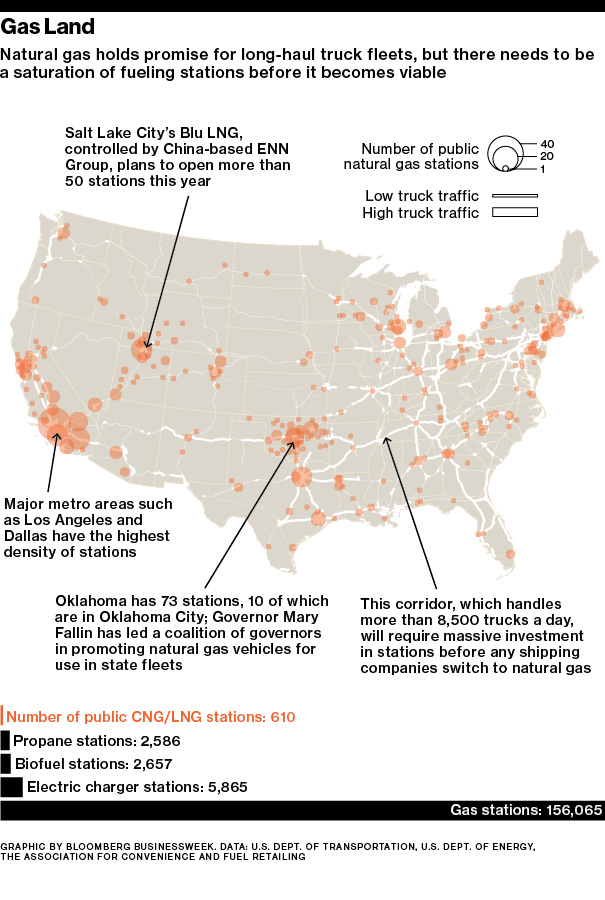
Facing soaring gasoline prices in 2011 and more than 100 miles of daily driving for his job as a traveling nurse, Daniel Piekarek confronted an uneasy choice: find cheaper gas or start updating his résumé. So, a few years before many of the world’s biggest companies would follow suit, Piekarek crossed his fingers and turned his life over to natural gas. On EBay (EBAY) he bought a used Honda Civic GX, the only commercially available natural gas vehicle in the U.S. at the time. “My costs went from $30 a day to $5 a day,” says Piekarek, who lives in Michigan and pays as low as the equivalent of $1.50 a gallon to fill up. “It’s been a real moneymaker.” Read more of this post

China’s Parents Crave Illegally Imported Baby Formula

China’s Parents Crave Illegally Imported Baby Formula

By Liza Lin and Julie Cruz on May 02, 2013

comp_babyformula19__01__630x420

For Hong Kong customs agents, baby formula is the new heroin. On March 1 a law went into effect limiting the amount of powdered milk travelers can carry out of Hong Kong to two 2-pound cans each. Since then, more people have been arrested for smuggling baby formula than were caught all of last year with heroin and cocaine. As of April 23, border officials say they’d seized nearly 20,000 pounds of powdered milk and arrested 879 people, many of whom were part of a smuggling syndicate. In 2012, 420-plus people were arrested for smuggling illegal drugs through Hong Kong.

Many Chinese parents are desperate to get their hands on foreign-made baby formula after numerous food safety scandals in recent years. In 2008 at least 22 Chinese companies were found to have sold dairy products containing melamine, a toxic chemical that can make diluted milk appear to have a higher protein content. Six babies died as a result. In 2011, China’s largest milk producer, China Mengniu Dairy (2319), said in a statement that moldy cattle feed led to excessive toxin levels in its milk. Last year another large milk producer, Inner Mongolia Yili Industrial Group (600887), recalled formula tainted with mercury. “Chinese consumers are so frightened and so sensitive to safety issues with milk powder that they are willing to pay a higher premium than consumers anywhere else,” says James Roy, a Shanghai-based senior analyst at China Market Research Group. That willingness to pay has led to baby formula shortages in Hong Kong, where food safety standards are higher. The surge in Chinese demand has even hit foreign markets, where baby formula is often cheaper than in China. Over the past year, stores in Germany, the U.K., and New Zealand have put limits on all bulk purchases of formula, such as Danone’s (BN)Aptamil and Mead Johnson Nutrition’s (MJN) Enfamil. Read more of this post

Passed Over for GE CEO, Dave Cote Thrives at Honeywell

Passed Over for GE CEO, Dave Cote Thrives at Honeywell

By Thomas Black on May 02, 2013

comp_honeywell19_630

In the spring of 1999, General Electric (GE) Chief Executive Officer Jack Welch invited Dave Cote to dinner in his private dining room at GE’s headquarters in Fairfield, Conn. At the time, Cote was a 25-year GE veteran who’d worked his way up from an hourly job on the floor of GE’s aircraft engine plant in Hooksett, N.H. Since 1996, he’d been running GE’s appliances unit and was now one of a half-dozen GE executives competing to succeed Welch as CEO. Welch cut to the chase: Cote would not get the job.

The news wasn’t a surprise. “I could see the handwriting on the wall that it wasn’t going to be me,” Cote says. Not only was GE Appliances missing short-term financial targets, it was also the company’s only unit to see its profit decline in 1998. Meanwhile, Cote’s rivals were thriving. Earnings at GE’s medical systems division, run by Jeff Immelt, grew 25 percent in 1999. Jim McNerney’s aircraft engines unit had doubled its revenue over the previous five years. Under the direction of Robert Nardelli, GE’s power systems division had increased sales of its steam turbines and gas-fired generators by 33 percent since 1994. Although Welch told him he could stay at GE, Cote was gone by that fall, making him the first to bow out of the competition. “I wanted to see what I was capable of,” Cote, now 60, says. Read more of this post

Dr Copper ‘telling us the party’s over…’

Dr Copper, ‘telling us the party’s over…’

Paul Murphy

| May 02 16:19 | 9 comments Share

Screen-shot-2013-05-02-at-3.35.46-PM-e1367505448407

With the S&P 500 making a fresh run higher at pixel time, it would be rude not to share the latest thoughts of Albert Edwards, Socgen’s Ice Age bear. Rather than gawping stocks, he reckons we should be mindful of the red metal… Edwards’ central argument is that just as both the US and Europe are slipping towards outright deflation, investors have convinced themselves they just have to participate in the liquidity fueled frenzy offered by unlimited QE. But the copper price is saying something different — and it offers a solid reminder that liquidity itself can disappear very quickly indeed, as it did when Edwards’ last drew our attention to ‘Dr Copper’ (and Wile E. Coyote) back in January, 2007… Read more of this post

SEC Zeroing In on ‘Prime’ Funds; Money Funds Viewed as Most Vulnerable to Flight by Anxious Investors Would Face Tighter Rules

Updated May 2, 2013, 7:01 p.m. ET

SEC Zeroing In on ‘Prime’ Funds

Money Funds Viewed as Most Vulnerable to Flight by Anxious Investors Would Face Tighter Rules

By ANDREW ACKERMAN

WASHINGTON—U.S. securities regulators, under pressure to address risks posed by the $2.6 trillion money-market-mutual fund industry, are considering a scaled-back approach that would tighten rules for about half of the sector that is seen as most vulnerable to investor runs, according to people familiar with staff discussions. Read more of this post

Exam cramming is not learning

Exam cramming is not learning

It is common and natural for students to cram ahead of examinations, but unless they have a better concept of the various subjects, they will soon forget what they have learnt in school, defeating the purpose and value of education.

4 HOURS 32 MIN AGO

It is common and natural for students to cram ahead of examinations, but unless they have a better concept of the various subjects, they will soon forget what they have learnt in school, defeating the purpose and value of education.

Memory and retention is a key ingredient in learning. The frequent occurrence of memories, thoughts and ideas help with the interpretation and understanding of new experiences and ideas. Read more of this post

Antifragile Black Swan’s Taleb Against Establishment Economists

Nicholas Taleb Against Establishment Economists

Tyler Durden on 05/02/2013 18:35 -0400

Submitted by Pater Tenebrarum of Acting-Man blog,

Throwing Down the Gauntlet

Nicholas Taleb is making waves again – and in a good way, as we will explain below. It began with an altercation between him and a few mainstream economists on Twitter (what is apparently called a ‘Twitter brawl’). Here is a post from Taleb’s Facebook page that he put up in the wake of said brawl – Taleb announced that he will go with a fine comb through the papers of one Karl Whelan, one of the countless ‘monetary economists’ who are writing papers for the Fed and are thereby providing justifications for its meddling with the markets. Here is his post:

“We Can Start Exposing Economists: I just finished a very rough draft of *Fat Tails & (Anti)Fragility* (~100 pages).

PART I provides a mathematical toolkit to detect anything that is bullshit in economic modeling (particularly macroeconomics), figure out which papers are flawed from a scientific standpoint, etc. When I mean flawed, it is on the basis that the math used impresses nonmathematicians but does not support the stated policy conclusions.

So I start by putting one Karl Whelan “scientific” work under severe mathematical scrutiny. I select him to start as he worked with central banks, the perfect profile of the person supported by the taxpayer against the taxpayer’s own interests. I also had a disgraceful encounter with him and his macro peers on twitter. Mr Whelan’s papers can be found here: http://ideas.repec.org/e/pwh23.html We can progressively expose mathematized social science that way, as I am refining the text, adding words and examples.” Read more of this post

Malaysia Risks Post-Election Protests as Group Cites Vote Buying

Malaysia Risks Post-Election Protests as Group Cites Vote Buying

Malaysia faces the risk of public protests over the accuracy of results from the May 5 national election after an opposition-backed group cited evidence of vote buying and bias by the official ballot oversight agency.

The Coalition for Clean and Fair Elections, known as Bersih, has captured vote-buying on video and received complaints ranging from improper electoral rolls to government abuse of state-run media, according to co-chairwoman Ambiga Sreenevasan. The group, whose protests in recent years have drawn thousands of people onto Kuala Lumpur’s streets, has yet to decide on organizing demonstrations, she said this week.

A contested result between Prime Minister Najib Razak’s ruling coalition and Anwar Ibrahim’s opposition alliance threatens to spark protests in a country that has never seen a transfer of power since independence from Britain in 1957. A tight finish would be the worst outcome for Malaysian stocks because it would lead to policy paralysis and may end Najib’s tenure, Bank of America Merrill Lynch analysts said this week.

“Anything over a 15-to-20 seat victory margin will lead to suspicion — the race is that close,” said Bridget Welsh, associate professor of political science at Singapore Management University, who has edited two books on Malaysian politics. “You’re going to see people on the streets” if election observers produce solid evidence of fraud, she said. Read more of this post

Goldman Sachs CEO Blankfein warned that the interest- rate environment has parallels to 1994, when a sudden and sharp increase in rates caught many investors off-guard

Blankfein Sees Parallels to 1994 Interest-Rate Increases

Goldman Sachs Group Inc. Chief Executive Officer Lloyd C. Blankfein warned that the interest- rate environment has parallels to 1994, when a sudden and sharp increase in rates caught many investors off-guard. “I worry now — I look out of the corner of my eye to the ‘94 period,’’ Blankfein, 58, said today at a conference in Washington sponsored by the Investment Company Institute. He recalled how investors got used to low interest rates and were shocked by losses when borrowing costs rose.

The Federal Reserve increased its benchmark rate 3 percentage points from February 1994 to February 1995, from a then record-low 3 percent to 6 percent. The yield on the 30-year U.S. Treasury bond surged above 8 percent in late 1994 from below 6 percent 12 months earlier. The rate increase and corresponding collapse in bond prices and stock markets caused losses for Wall Street trading desks and investors. Goldman Sachs, which at the time was a private partnership, suffered a drop in its capital and raised $250 million by selling a stake in the firm to a Hawaiian trust. Partners exited the firm, including then-Chairman Stephen Friedman, who now serves on the company’s board. The rate increase was something ‘‘you’d think in hindsight should have been expected,” Blankfein said, although it “really was stunning.”

Read more of this post

REIT firm may buy low-quality properties – or overpay for real estate – to boost the portfolio size and increase management fees; “If you have money to spend and it’s not your money, your decision-making might be different than if it was your own money,”

Lucrative Fees Behind Property Management Spark Fights

CommonWealth REIT (CWH) owns office buildings throughout the U.S., yet employs no one. Cole Credit Property Trust III Inc., which leases about a thousand stores around the country to retailers such as CVS, Lowe’s and Wal- Mart, also had no workers until a recent acquisition. Instead, both real estate investment trusts have been run by outside managers who are paid to choose properties to buy and at what prices, and which ones to sell and when. That has raised criticism from some investors, who say a management company may make decisions for its own benefit — decisions not necessarily right for REIT shareholders. “It’s a good business if you can get it,” said Jim Sullivan, a managing director at Green Street Advisors Inc., a Newport Beach, California-based research company. “The adviser does well if the REIT gets bigger, but the shareholders may not be well-served by the REIT getting bigger.” That conflict has been at the heart of two of the biggest REIT fights this year. CommonWealth, based in Newton, Massachusetts, is battling an attempt by its second-biggest investor to remove its board. Phoenix-based Cole Credit had to fend off a rival’s buyout offer after announcing plans to purchase the firm that oversaw its properties. CommonWealth — and other REITs that share the same external manager — are among the few publicly traded property trusts with the structure, Sullivan said. It’s a common setup among REITs not listed on stock exchanges, such as Cole.

The problem with using an outside manager is that the firm may buy low-quality properties — or overpay for real estate — to boost the REIT’s portfolio size and increase management fees, Sullivan said. The manager may be focused more on its own income than in building the best portfolio for investors, he said. Read more of this post

Hong Kong Overheating Risk Seen by HKMA’s Chan as Debt Rises

Hong Kong Overheating Risk Seen by HKMA’s Chan as Debt Rises

Hong Kong’s economy is at risk of overheating after household debt rose to a record 61 percent of gross domestic product, said Norman Chan, chief executive of the Hong Kong Monetary Authority.

“Hong Kong’s consumption and personal-debt growth have consistently outpaced overall economic growth,” Chan told lawmakers today, citing risks to “macroeconomic stability.”

While the housing market has shown signs of cooling after extra curbs in February, it’s too early to say that it’s in a downward cycle, Chan said. A declining current-account balance is a “warning signal” that consumption and the economy are at risk of overheating, he said.

Hong Kong home prices, the most expensive among major global cities, last month fell the most in three years after the government imposed its harshest measures yet to curb prices and as lenders raised mortgage rates for the first time since 2011. Chan’s comments come amid signs that the global economic recovery is faltering, with industrial and manufacturing data from China, Japan and South Korea less than estimates.

In December, the HKMA said the overheated property market is increasingly disconnected from the rest of the economy. Sanford C. Bernstein H.K. Ltd. said prices could fall as much as 25 percent after the government stepped up measures to curb an asset bubble and banks raised mortgage rates. Read more of this post

Baht’s Rally Seen Throttling Thai Rice Shipments: Southeast Asia

Baht’s Rally Seen Throttling Thai Rice Shipments: Southeast Asia

The Thai baht’s rally to the highest level in 16 years is hindering exports from the world’s biggest rice shipper, curbing the government’s efforts to diminish record state stockpiles and threatening to increase its losses.

Overseas buyers have rejected attempts by the government to boost prices in dollars to offset reduced revenues as the baht has strengthened, according to Commerce Minister Boonsong Teriyapirom. Thai stockpiles are set to double to 11.6 million metric tons in 2012-2013 from two years ago, according to data from the U.S. Department of Agriculture.

Prime Minister Yingluck Shinawatra’s administration began buying rice from farmers at above-market rates in 2011 to boost rural incomes. While benefiting growers, the program has spurred the buildup of the biggest-ever stockpiles. Even as the USDA forecasts Thailand will regain its role as the largest exporter this year, displacing India, the estimated 8 million tons shipped would be about 25 percent less than two years ago.

“If it’s maintained at this level, our sales will definitely be seriously affected,” Boonsong said at his office in Nonthaburi, outside Bangkok on May 1, referring to the baht. “If we cannot sell to exporters, we might have to open bids here in Thailand for the local market.” Read more of this post

Gridlocked Jakarta launches subway project, 20 years late

Gridlocked Jakarta launches subway project, 20 years late

4:42am EDT

JAKARTA (Reuters) – Jakarta’s popular new governor, who threatens to shake up Indonesian crony politics, has launched the first mass transit railway project to help end the gridlock that brings the capital to a near halt during rush hour.

It is also the first major test of Joko Widodo, popularly known as Jokowi, who swept to office seven months ago with the promise to sweep away the corruption and inefficiency that has long been the hallmark of Indonesian politics and the way the world’s 17th-largest city has been run.

The project, announced late on Thursday and which has been delayed for over two decades, would mark a rare bright spot in Indonesia’s growing infrastructure bottleneck which threatens to throttle what have been record levels of investment in Southeast Asia’s biggest economy.

“Jokowi has no choice but to build the MRT (Mass Rapid Transit railway) to satisfy the emerging middle class,” said Marco Kusumawijaya, head of Rujak, a Jakarta-based urban planning think-tank. “But this will not solve the traffic problems of the city in the long run because the backlog of demand for public transport here is so huge. You can’t solve this with one or two inner-city (subway) lines.” Read more of this post

Bug-Eyed Camera With 200 Lenses Seen Improving Surgery

Bug-Eyed Camera With 200 Lenses Seen Improving Surgery

Bugs, the bane of Sunday afternoon picnics, are opening a new horizon for researchers who are mimicking some of their more extraordinary attributes in a wave of research that may save lives in the future.

A digital camera with 200 lenses that mimics the compound eyes of ants may help improve endoscopes, the tiny cameras doctors use to explore the insides of patients. A tiny robot that borrows the aerial prowess of a house fly may one day help find injured victims buried in rubble after disasters.

The two technologies, announced separately in science journals this week, are the latest advances that use biological systems as models to design materials and machines. While copying nature has long been a staple of human innovation, recent technology advances that let scientists look more closely at insects and stronger collaboration between engineers and biologists have set off a wave of new discoveries.

“The walls that divided the life sciences and the physical sciences are sort of becoming transparent, so we’re trading ideas,” said Kevin Ma, a mechanical engineering graduate student at Harvard University in Cambridge, Massachusetts, who helped design the robotic fly. “That also helps with the trend toward biologically inspired technologies, because of the cross- pollination of the fields.” Read more of this post

China has the option of selling to the public some assets from its $3.44 trillion foreign-exchange reserves. China could follow practices of the Tracker Fund (2800) of Hong Kong to sell off the “best, the most complete, and the most liquid” assets to investors

China Magazine Floats Idea of Selling Parts of Currency Reserves

China has the option of selling to the public some assets from its $3.44 trillion foreign-exchange reserves, according to an opinion piece in Caixin Century Weekly, a Chinese magazine. The article, “How to Cope With ‘Excessive’ Foreign- Exchange Reserves,” was published in the April 29 issue under the pseudonym Xiao Yi. Caixin said the author is a “senior economist” without elaborating and that a more detailed account of the proposal will be published in a sister magazine, China Reform.

One possibility is that the author is an official involved in management of the reserves, said Zhang Bin, a Beijing-based researcher with the government’s Chinese Academy of Social Sciences. China could follow practices of the Tracker Fund (2800) of Hong Kong to sell off the “best, the most complete, and the most liquid” assets to investors, according to the piece. Read more of this post