As Australia’s decadelong mining boom evaporates, the government is girding for what the finance minister calls a harsh “new reality.”

May 1, 2013, 6:22 a.m. ET

Australia’s ‘New Reality’ Sets In as Mining Boom Wanes

By ENDA CURRAN

SYDNEY—Australia faces a harsh “new reality” as a decadelong mining boom evaporates, forcing future governments to seek unpopular savings to avert steep deficits, Finance Minister Penny Wong said. “We have to deal with this new reality,” Ms. Wong said from her Sydney offices ahead of a budget in two weeks that the government already has warned will miss its revenue forecast by about 12 billion Australian dollars (US$12.4 billion). “The new norm is, certainly in the near term, a lower level of revenue growth,” she said. “This budget has to deal with that economic reality, and that is not a popular thing to go out and sell to the public.” And controlling deficits will become even harder in future, Ms. Wong said., as the mining boom fueled by Asia’s demand for Australian raw materials peaks this year and begins to cool.

Read more of this post

Tough times for hedge funds that bet on market tumult using complex trading strategies

Tough times for hedge funds that bet on market tumult

7:06am EDT

By Katya Wachtel

NEW YORK (Reuters) – Nelson Saiers, a trader and math whiz, runs the type of hedge fund that tends to perform best when markets are going haywire. The $600 million Saiers Capital fund and other so-called volatility funds use complex trading strategies to take advantage of pricing discrepancies caused by gyrations in global financial markets. These funds flourished in the years after the financial crisis, when volatility was running hot, but this year is a different story. Financial markets have been largely moving upwards with few wild swings along the way. The Standard & Poor’s 500 index is up about 11 percent and the closely watched CBOE Volatility Index hit a six-year low in March. Saiers Capital’s fund is down about 1.24 percent through April 26, according to an investor. Overall, volatility funds gained 1.16 percent in the first quarter, according to hedge fund tracking firm eVestment, underperforming the broader hedge fund industry’s 3.7 percent gain. Read more of this post

Wall Street to Best Buy – Now, get out of China

Wall Street to Best Buy – Now, get out of China

1:06am EDT

By Dhanya Skariachan

NEW YORK (Reuters) – Best Buy’s move to exit Europe has many on Wall Street hoping the big box retailer does the same in China.

The company sold its stake in a European joint venture to Carphone Warehouse Group this week for less than half of what it paid five years ago. Despite the loss, investors welcomed the news and sent shares up to their highest level in a year.

Many are betting that the next move for the world’s largest consumer electronics chain will be out of China, where it has struggled to fend off local rivals and failed to carve a niche in a cluttered market. That unit has also been without a leader for more than a month.

“They are really struggling in China, much more so than they were in Europe,” said BB&T Capital Markets analyst Anthony Chukumba, who predicted the company could divest its assets there later this year. “There are no strategic benefits to them being in China.” Read more of this post

China Past Due: Hukou ‘Economic Apartheid’

China Past Due: Hukou ‘Economic Apartheid’

APRIL 30, 2013 ⋅ POST A COMMENT

After school in her scruffy Shanghai migrant neighborhood, Yang Liping strolls over to a community center for migrant kids, sits down with an ancient Chinese stringed instrument, and loses herself in the music. “I started playing the guzheng here, three years ago, “ says Yang, an affable 16-year-old in a ponytail and a navy and white tracksuit. She moved to Shanghai from Sichuan in 2008, just after the earthquake, to join her migrant worker parents. And she’s impressed with Shanghai. “There’s a lot more going on here than in my hometown – a lot more ways I can improve myself.” Yang would like to stay in Shanghai for senior high school, so she’ll be likely to do better on the all-important college entrance exam. Not only are Shanghai schools better funded, with better facilities and teachers, but the better universities in Shanghai also require higher scores from those outside Shanghai than from those who go through the school system here. But staying in the city through senior high school and into college is not an option for Yang, or for millions of other migrant schoolchildren like her. That’s thanks to the household registration – or hukou – system, which requires students to take the college entrance exam in the place where their parents are registered. And very few migrant workers can move their hukous to the cities where they work. So some 260 million Chinese migrants – about 20 percent of China’s total population — live as second-class citizens in their adopted cities, in them, but not of them.

China has had a hukou system for at least a couple thousand years, mostly, to keep track of who was in what family. But it was only under Communist Party rule, starting in the late 1950s, that the hukou system started to be used to restrict movement and enforce a kind of economic apartheid. Read more of this post

It is indisputable that China is over-issuing currency. But the reasons behind China’s massive liquidity growth – and the most effective strategy for controlling it – are less obvious

Zhang Monan is a fellow of the China Information Center, a fellow of the China Foundation for International Studies, and a researcher at the China Macroeconomic Research Platform.

Controlling China’s Currency

01 May 2013

BEIJING – It is indisputable that China is over-issuing currency. But the reasons behind China’s massive liquidity growth – and the most effective strategy for controlling it – are less obvious.

The last decade has been a “golden age” of high growth and low inflation in China. From 2003 to 2012, China’s annual GDP growth averaged 10.5%, while prices rose by only 3% annually. But the unprecedented speed and scale of China’s monetary expansion remain a concern, given that it could still trigger high inflation and lead to asset-price bubbles, debt growth, and capital outflows.

Data from the People’s Bank of China (PBOC) show that, as of the end of last year, China’s M2 (broad money supply) stood at ¥97.4 trillion ($15.6 trillion), or 188% of GDP. To compare, M2 in the United States amounts to only roughly 63% of GDP. In fact, according to Standard Chartered Bank, China ranks first worldwide in terms of both overall M2 and newly issued currency. In 2011, China accounted for an estimated 52% of the world’s added liquidity. Read more of this post

Where the Chinese credit is going; there is plenty of evidence to suggest that financial distress is another reason why credit expansion has not worked well

Where the Chinese credit is going…

Kate Mackenzie | May 01 10:51 | 3 comments Share

Part of the CHINA’S CREDIT CONUNDRUM SERIES

China-debt-comparisons-devt-countries-Asian-countries-UBS-Tao-Wang

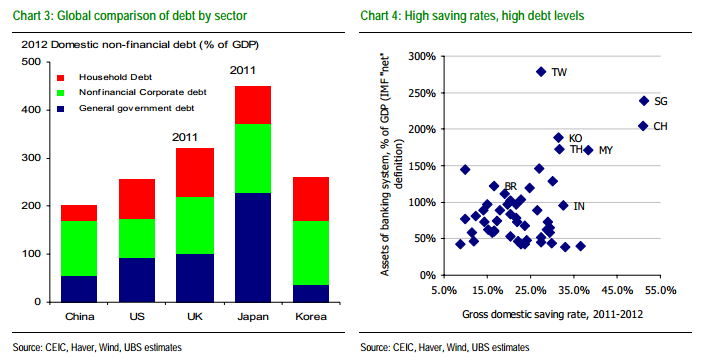
After Chinese first quarter GDP missed expectations, there was some hope that the relatively strong manufacturing PMIs in March would point to a better second quarter. Now that we know China’s April PMIs are definitely not supporting that notion, it is worth revisiting, again, the whole question of the country’s recent surging credit growth. The significance of the debt-to-GDP ratio can be argued over, and it’s impossible to say at what level it might become a big problem. But here are a couple of ideas to consider. First, UBS’ China economist Wang Tao has taken a look at the debt/GDP question. Her estimate is that government debt was about 55 per cent of GDP at the end of 2012, and total debt is about 210 per cent of GDP. (China’s official government debt to GDP ratio is only about 15 per cent, going purely on government bonds, but that ignores many government corporations, local debt, and the asset management companies that took on bad debt in the early 2000s financial crisis.) Anyway, 210 per cent is broadly in line with other credible estimates. Wang argues this absolute level in itself is not cause for dismay. In comparison to developed economies it may seem high, but it’s less dramatic measured against other emerging and Asian economies, which she points out typically have high savings rates which in turn provide some of that credit: There are a couple of other reasons not to worry. The growth might simply be lagging the credit surge, and some credit might have been double-counted: To be fair, we think credit growth has a delayed effect on economic growth, and expect construction an investment to pick up in Q2 and Q3 this year on the back of strong credit growth so far. Also, the TSF may overstate (or double count) the leverage increase in the real economy – corporates that engage in interest arbitrage by borrowing cheaply in the interbank credit market and lend to other corporate and/or local governments have both legs of their transaction included in TSF. While Wang doesn’t think a debt crisis is imminent, she does believe there are certainly reasons to worry. One is the recent rapid increase in the debt-to-GDP ratio. This is a very good point which we mentioned in February and forgot to point out in our ruminations of the past couple of weeks. To recap: Morgan Stanley’s Ruchir Sharma sums up some of these reasons in a WSJ op-ed, citing a BIS paper by Mathias Drehmann and Mikael Juselius which finds that if the private debt-to-GDP ratio increases by 6 per cent or more above its 15-year average, that is a “very strong indication that a crisis may be imminent”.

Wang believes there’s another reason for worry:

However, there is also plenty of evidence to suggest that financial distress is another reason why credit expansion has not worked well. Some local governments and companies do not have sufficient cash flow to pay interest on their existing debt, and have to borrow new debt to help service older debt. This is not hard to imagine for local governments – even if they have invested in sound projects in the last stimulus program, most of the projects do not yet have a cash return. In a downturn where local governments face weak tax revenue, dropping land sales, and more demand for pushing up investment and GDP from higher levels of government, the logical solution would be to incur more debt to keep the ball rolling. Read more of this post

China: Subprime for the masses

China: Subprime for the masses

May 1, 2013 11:54am by Simon Rabinovitch and Naomi Rovnick

With Chinese workers enjoying a break from their travails on May 1 for Labour Day, it is an opportune time to look at one gift recently bestowed on them by the country’s financiers. The gift is a new investment opportunity going by the name ‘fund of trusts’, which conjures up a sense of diversification and safety. But a more accurate name might be ‘subprime for the masses’. China’s funds of trusts are inspired by the funds of funds that are common in developed financial markets, allowing people to invest in a blend of other funds – whether mutual funds or hedge funds – to gain broader and more dispersed exposure. In China, the funds are invested in a cocktail of different trust products, which include some of the riskiest, high-yielding investments legally available in the country.

This innovation is notable for one major reason. Until now trust products have typically required minimum investments of Rmb1mn ($162,000) as a way of ensuring that only wealthy individuals put their money at risk. With funds of trusts, the entry barrier has been cut to as little as Rmb100,000 ($16,200). That puts trust investments within the reach of tens of millions of middle-class Chinese. Read more of this post

Chinese officials ‘taking lavish displays, banquets and secret sauna parties underground’

Chinese officials ‘taking lavish displays, banquets underground’

BEIJING — China’s top newspaper warned yesterday that some government officials were finding ways around President Xi Jinping’s graft-busting instructions to be frugal by taking banquets and other lavish displays underground, including hiding liquor in water bottles.

BY –

6 HOURS 35 MIN AGO

BEIJING — China’s top newspaper warned yesterday that some government officials were finding ways around President Xi Jinping’s graft-busting instructions to be frugal by taking banquets and other lavish displays underground, including hiding liquor in water bottles. Mr Xi has made battling pervasive corruption a top priority of his administration, warning the problem is so severe it could threaten the party’s survival. But despite his repeated admonitions for officials to practice frugality and stop wasting public funds, some people still have not got the message or are finding ways around it, the Communist Party’s official newspaper, People’s Daily, reported.

“In some places, the use of public money for eating and drinking has switched from high-end hotels to private venues and places of business … which has become known as ‘low-key luxury’,” the paper said. Cases had come to light of “saunas in farmhouses” and “maotai being put in mineral water bottles”, it said, in reference to the expensive spirit traditionally drunk at banquets. “These ways of pulling the wool over people’s eyes is typical of not following instructions and not stopping what is banned,” the commentary added. This phenomenon has reminded the party of the need to strictly enclose power “in the fence of supervision” and “the cage of regulation”, it said.  Read more of this post

Biofuel Pioneer Alan Shaw Forsakes Renewables to Make Gas-Fed Fuels; “Everybody but me is still in this nightmare. This model is broken.”

Biofuel Pioneer Forsakes Renewables to Make Gas-Fed Fuels

Alan Shaw, the chemist and executive who led a six-year effort to turn inedible crops into fuels to displace gasoline, has renounced the industry he helped pioneer and decided the future instead lies with natural gas.

Formerly chief executive officer of Codexis Inc. (CDXS), the first advanced biofuel technology company to trade on a U.S. exchange, Shaw now says it’s impossible to economically turn crop waste, wood and plants like switchgrass into fuel. He’s trying to do it instead with gas, in his new post as CEO of Calysta Energy LLC.

Shaw’s views put him at odds with the emerging segment of biofuels that’s invested about $3 billion since 2008 in the U.S. developing processes that turn biomass into new types of fuel. Amyris Inc. (AMRS) and Gevo Inc. (GEVO) are among producers that have yet to make fuel on commercial scales and slid since their initial public offerings.

“Everybody but me is still in this nightmare,” Shaw, 50, said in an interview in San Francisco. “This model is broken.” Read more of this post

Buffett Bear, Doug Kass, Adds Spice to Meeting as Rally Lulls Investors; Kass, 64, has shorted Berkshire stock in a bet the price will fall

Kass, Berkshire’s Bear, is ready to “surprise” Buffett

1:25am EDT

By Jennifer Ablan and Jonathan Stempel

Doug Kass, founder of hedge fund Seabreeze Partners Management Inc, sits at his desk at his home in Palm Beach

(Reuters) – Hedge fund trader Doug Kass had his first brush with fame at the age of 10, when he appeared on a television quiz show, Tic-Tac-Dough, and won every day for a week.

More than five decades later, Kass might find another sort of celebrity this Saturday when he will have the opportunity to quiz billionaire investor Warren Buffett at Berkshire Hathaway Inc’s annual meeting in Omaha, Nebraska. Buffett in March handpicked Kass, founder of hedge fund Seabreeze Partners Management Inc, to be Berkshire’s first “credentialed bear” to attend the meeting, and “spice things up. Kass, 64, has shorted Berkshire stock in a bet the price will fall. He is one of three members of an analyst panel that, along with shareholders and journalists, gets to question Buffett and Berkshire Vice Chairman Charlie Munger for five hours at the meeting, which draws more than 35,000 people to Omaha each year. “I had a lot of fun going to the Woodstock music festival on Max Yasgur’s farm in Bethel, New York in August 1969. I expect to have almost as much fun – and remember it – going to the Woodstock of Capitalism in Omaha,” Kass said in an interview. He declined to disclose the size of his Berkshire short, but called it an “average-sized position” that he initiated only a few days before Buffett’s invitation. Kass is known for his maverick positions, and his stock picks and pans have been followed widely by virtue of his prolific writings for TheStreet.com. He has a column – at one time called “The Contrarian” – to discuss neglected or undervalued stocks and sectors that he calls “purchase candidates,” as well as fully exploited or overvalued investments that he thinks are worth selling short. In April, Kass told clients and readers that he was bearish on economic growth and stocks.

Read more of this post

Buffett Further Trims Moody’s Stake as Shares Surge 21%; “What was once a bulletproof franchise may not be bulletproof”

Buffett Further Trims Moody’s Stake as Shares Surge 21%

Berkshire Hathaway Inc. (BRK/A), led by billionaire Chairman Warren Buffett, further trimmed its holdings of Moody’s Corp. (MCO) as the credit-ratings firm’s stock has surged this year. Berkshire sold about 1.75 million shares this week at prices ranging from $59.93 to $60.94 apiece, according to a filing issued yesterday. New York-based Moody’s has advanced 21 percent in 2013. Moody’s plunged in February when its larger competitor, Standard & Poor’s, said it could face a U.S. lawsuit over inflated mortgage-bond ratings. Buffett, 82, has pared his stake from 48 million shares in 2009. Buffett has said Moody’s didn’t anticipate a slide in housing prices.

“What was once a bulletproof franchise may not be bulletproof,” the billionaire said in a 2010 Bloomberg Television interview. “It’s still quite a franchise.” Read more of this post

Buffett Pays $2.05 Billion for Remaining 20% Stake in Iscar at $10B Valuation, Doubled from $5B Value in 2006 When Berkshire Bought 80% In Cutting Gear Firm

Buffett Pays $2.05 Billion for Remaining Stake in Iscar

Berkshire Hathaway Inc. (BRK/A) agreed to pay $2.05 billion for the 20 percent of IMC International Metalworking Cos. that it doesn’t already own as Chairman Warren Buffett expands his bet on the Israeli manufacturer.

IMC, known as Iscar, makes cutting gear for industries including aerospace and auto manufacturing. Jacob Harpaz will remain chief executive officer of Tefen, Israel-based IMC, the companies said today in a statement.

Buffett has structured deals to buy Marmon Holdings and IMC to allow the selling families to retain a stake in the companies they built. Omaha, Nebraska-based Berkshire can then increase its ownership with the price based on the results after the initial deal. He said in 2006 that he bought 80 percent of Iscar in a transaction that valued the company at $5 billion.

“As you can surmise from the price we’re paying for the remaining interest, IMC has enjoyed very significant growth over the last seven years,” Buffett, 82, said in the statement. Read more of this post

Feedback Loops And The Unsustainability Of China’s ‘Moderate’ Growth; the ‘rage’ among the Chinese at any suggestion of the sustainability of their growth model suggest a level of fragility in China’s social fabric

Feedback Loops And The Unsustainability Of China’s ‘Moderate’ Growth

Tyler Durden on 05/01/2013 19:11 -0400

With last night’s China PMI disappointing expectations and eking out a just-expansionary miasma of hope for the growth enthusiasts, the very real question of global growth sustainability (while not on US equity market participants’ minds) is coming to the fore. As Michael Pettis notes, Martin Wolf’s recent perspective that it may be useful to think about Japan as a model for understanding the adjustment process in China since the Japanese model shows how risky it is to shift to a slow-growth model.

Being in the significant non-consensus camp of “malevolent outsiders”, Pettis fears the ‘rage’ among the Chinese at any suggestion of the sustainability of their growth model suggest a level of fragility in China’s social fabric and its self-confidence that could make any slowdown more difficult to manage. The reason he is most-concerned is ‘feedback loops’; self-reinforcing mechanisms that are virtuous (with surprising growth expectations on the way up), but become vicious in an equally destructive manner. Read more of this post

Crude Inventories Surge To Record High As Energy Demand Collapses

Crude Inventories Surge To Record High As Energy Demand Collapses

Tyler Durden on 05/01/2013 11:38 -0400

20130501_DOE_0

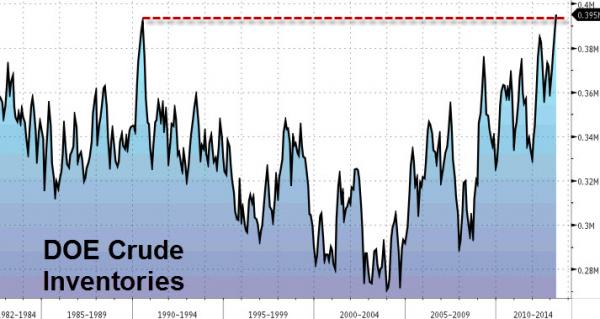
A month ago we highlighted the somewhat stunning reality of the real economy via the EIA’s detailed energy supply and demand data. The key takeaway was  that we hoped this did not represent the true state of the economy since the data was so dismal. Fast forward to today and the DOE just released a much higher than expected build in crude inventories that took the stuffed-channel of oil products to all-time highs.The 395.3 million barrels is higher than the previous record in July 1990. There appears to be a number of factors at play – none of which are positive. There is a surge in supply due to the incessant harvesting of shale oil (which could have its own problems as we noted here). Second, we suspect there is a degree of ‘channel-stuffing’ occurring – if we pump it, they will buy – as producers and transporters are desperate to keep active and show incremental business (despite fading railcar loadings). But perhaps most important, as EIA data has shown, there has been a collapse in end demand for crude products not seen since the 1990s. Today’s surge in inventories appears to confirm demand remains subdued at best.

Crude Declines for Second Day on Record Inventories

West Texas Intermediate oil fell for a second day as U.S. inventories reached a record high last week and on signs of economic slowdown in the U.S. and China.  Read more of this post

Bloomberg has calculated ratios of CEO compensation relative to average employees for the Top 250 companies in the S&P 500

How Much More Is Your CEO Making Than You?

Tyler Durden on 04/30/2013 13:32 -0400
Three years after Congress first told the SEC that it required public companies to uncloak the details of their CEO compensation relative to his lowly employees; the ever-ready SEC has yet to implement any rules. However, in an effort to ease the tough job that the SEC has, Bloomberg has calculated ratios for the Top 250 companies in the S&P 500, based on industry-specific averages for pay and benefits for the rank-and-file (since companies don’t disclose median worker pay). The table below, of the top 50 companies (meaning highest CEO pay relative to workers), suggests it remains good to be king (and Ron Johnson just made another #1 Spot earning an estimated 1,795x the average JCP employee – money well spent…).

20130430_CEO_0

Hybrid Innovation in Meiji, Japan

Hybrid Innovation in Meiji, Japan

Tom Nicholas Harvard University – Entrepreneurial Management Unit

May 2013
International Economic Review, Vol. 54, Issue 2, pp. 575-600, 2013

Abstract: 
Japan’s hybrid innovation system during the Meiji era provides a useful laboratory for examining the effectiveness of complementary incentives to patents. Patents were introduced in 1885, and by 1911 1.2 million mostly nonpecuniary prizes were awarded at 8,503 competitions. Prizes provided a strong boost to patents, especially in less developed prefectures, and they also induced large spillovers of technical knowledge in prefectures adjacent to those with prizes, relative to distant control prefectures without prizes. Linking competition expenditures with the expected market value of patents induced by the prizes permits a cost–benefit assessment of the prize competitions to be made.

NBER: Informed Trading and Expected Returns

Informed Trading and Expected Returns

Stocks with the greatest information asymmetry have annualized returns that are 10.8 percentage points higher than stocks with the least information asymmetry.

In Informed Trading and Expected Returns (NBER Working Paper No. 18680), co-authors James ChoiLi Jin, andHongjun Yan use daily institutional ownership data from the Shanghai Stock Exchange to examine whether information asymmetry affects expected stock returns. They argue that focusing on China is useful because there is likely to be significant variation across companies in how much private information is shared with select investors, largely as a result of the state of Chinese legal institutions and regulations. The authors first show that stocks bought heavily by institutions subsequently outperform stocks sold heavily by institutions. Thus, institutions appear to have a strong information advantage over individual investors, and that is true for stocks of all sizes. Moreover, the authors confirm that the institutional sector’s future information advantage is larger in stocks that it previously traded more aggressively. Therefore, the aggressiveness of institutional trading in a stock, as measured by prior institutional ownership volatility, can be used as an ex ante predictor of future information asymmetry in this stock. Sorting stocks based on this predictor of information asymmetry, the authors find that the 20 percent of stocks with the greatest information asymmetry have future annualized returns that are 10.8 percentage points higher than the 20 percent of stocks with the least information asymmetry. This difference remains significant for ten months after the initial sorting month—the same amount of time that the difference in institutional information advantage between the two portfolios lasts. There is no evidence of subsequent return reversals. They conclude that information asymmetry increases the cost of capital. –Claire Brunel

Informed Trading and Expected Returns

James J. Choi, Li Jin, Hongjun Yan

NBER Working Paper No. 18680
Issued in January 2013
Does information asymmetry affect the cross-section of expected stock returns? Using institutional ownership data from the Shanghai Stock Exchange, we show that institutions have a strong information advantage over individual investors. We then show that the aggressiveness of institutional trading in a stock—measured by the average absolute weekly change in institutional ownership during the past year—is an ex ante predictor of future information asymmetry in this stock. Sorting stocks on this information asymmetry predictor, we find that the top quintile outperforms the bottom quintile next month by 10.8% annualized, suggesting that information asymmetry raises the cost of capital.

In China, a Persistent Edge for Big Insiders: Study

April 30, 2013, 1:30 P.M. ET

In China, a Persistent Edge for Big Insiders: Study

By Ben Levisohn

The U.S. has gone to great lengths to root out insider trading–just ask Martha StewartRajat Gupta or any one of the folks at SAC Capital that have been charged with the crime. In China, however, it might just be how the game is played. In the NBER working paper Informed Trading and Expected Returns, authors James Choi,Li Jin, and Hongjun Yan tracked institutional buying of Chinese stocks. Their finding: Stocks that are bought aggressively by institutions outperform those with the least by a wide margin. NBER summed up the report,which is available here:

The authors first show that stocks bought heavily by institutions subsequently outperform stocks sold heavily by institutions. Thus, institutions appear to have a strong information advantage over individual investors, and that is true for stocks of all sizes. Moreover, the authors confirm that the institutional sector’s future information advantage is larger in stocks that it previously traded more aggressively. Therefore, the aggressiveness of institutional trading in a stock, as measured by prior institutional ownership volatility, can be used as an ex ante predictor of future information asymmetry in this stock.

…the authors find that the 20 percent of stocks with the greatest information asymmetry have future annualized returns that are 10.8 percentage points higher than the 20 percent of stocks with the least information asymmetry. Read more of this post

The History of Creating Value

The History of Creating Value, from Jeff Watson

April 29, 2013 | Leave a Comment
the-history-of-opportunity

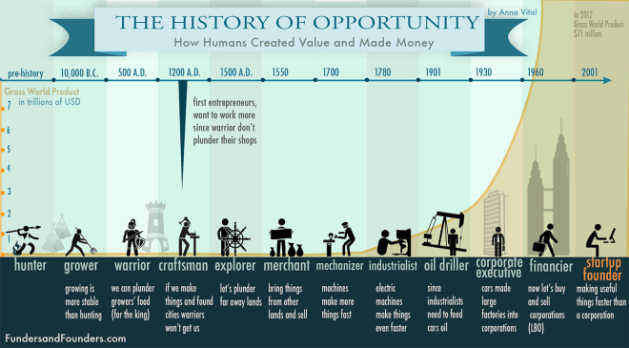
I really enjoyed this article “The History of Creating Value“. It has a great timeline showing how people made money through the ages. Stefan Jovanovich writes:

Warrior — “We can plunder grower’s food for the King”. Actually, not. Food is grown and taxed under the King’s authority so that the King can afford a standing army that picks fights with other standing armies.

Craftsman — “If we make things and found cities, warriors won’t get us.” Kings need palaces and priests need temples and they are sure as hell not going to be stuck out in the boonies.

Skipping forward…

Oil Driller — “since industrialists need to feed cars, oil” . Oil was used first for illumination, then for furnaces (both for direct heat and for steam), and only then for gasoline, which begins its history because the Russian oil production has created a kerosene glut.

Corporate Executive — “cars made large factories into corporations” – So this is why the East India Company and the Pennsylvania Railroad are really outliers.

Ms. Vital is the new winner of the Historicity Prize and is entitled to a full case of scuppernog.

Gibbons Burke writes:

The underlying thrust of this timeline is to argue that being a startup founder is the route to wealth and value creation today. Which is a great idea, and in line with Distributist economic organization, which holds that the main problem with capitalism is not when you have too many capitalists, but too few. The more owners there are in the society, the better.

But while the idea is a good one, the reality is that the road to wealth proposed by these startup evangelists is not to found and create a company which will provide a way to generate value for the owner over his lifetime, but to come up with a novel idea, develop it to the point where it has a proprietary advantage, and sell it to some corporate behemoth who has decided it it easier and much less risky to outsource its research and development to masses of proles living the startup dream. When one emerges with a good idea, simply snap it up and bring it into the corporate umbrella, and either monetize it and develop it further, or kill it because of the disruptive threat it poses to the existing herd of corporate cash cows.

The History of Creating Value

Anna Vital  /  April 24, 2013

At this point in history, startup entrepreneurship has become the fastest way to create value, and thus the fastest way to move upward in life. But this opportunity is unlike other opportunities humans had in history. Here is how you could create value before:
The Hunter Age. After hunter-gatherers became growers and herders, some people realized that it is faster and easier to go take other people’s crops and cattle than grow your own. War became popular. And wealth got a bad reputation. Read more of this post
Sun Yat-sen portrait up on Tiananmen Square for May Day

Sun Yat-sen portrait up on Tiananmen Square for May Day

2013-05-01 03:42:19 GMT2013-05-01 11:42:19(Beijing Time)  SINA.com

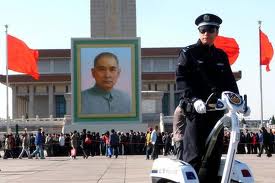
A portrait of Dr. Sun Yat Sen, a revered revolutionary leader who played a pivotal role in overthrowing imperial rule in China, is now up on Tiananmen Square for the May Day holiday.

SYS

Warren Buffett’s Analogy About About Boobs And Porn Shop Operators Is Just Brilliant

Warren Buffett’s Analogy About About Boobs And Porn Shop Operators Is Just Brilliant

Sam Ro | Apr. 30, 2013, 10:02 PM | 6,067 |

This week is the annual shareholder meeting for Berkshire Hathaway, the gigantic conglomerate run by billionaire Warren Buffett.

Buffett has a way of explaining complicated finance topics so that they’re fun and understandable.

Carleton English of Belus Capital Advisors points us to this gem of a quote from 2008 where he takes a jab at private equity.

Someone had asked the Oracle of Omaha why people sell their companies to him instead of private equity firms.  This is the type of question that you might hear later this week.  Here’s Buffett’s response: “You can sell it to Berkshire, and we’ll put it in the Metropolitan Museum; it’ll have a wing all by itself; it’ll be there forever. Or you can sell it to some porn shop operator, and he’ll take the painting and he’ll make the boobs a little bigger and he’ll stick it up in the window, and some other guy will come along in a raincoat, and he’ll buy it.”

According to Bloomberg, Buffett delivered this doozy during some Q&A with a 300 executives in Toronto. He’s basically explaining that there is more than one way for a company to get to a certain market value. Private equity often involves a lot of debt, a lot of cuts, and usually a lot of risk before a company is turned around and sold back on the market. Berkshire and Buffett, on the other hand, often take a more passive approach.  Typically, Buffett seeks out what he considers to be undervalued, yet well run companies.  And then he just waits for them to get to their intrinsic values. Anyways, we hope this weekend’s events in Omaha yield some more great quotes.

Warren Buffett Says Sell to Me, Not `Porn Shop,’ as Growth Dips

By Richard Teitelbaum – Jun 25, 2008

June 25 (Bloomberg) — Warren Buffett is in Toronto, fielding questions from a crowd of 300 executives. One asks what makes people want to sell their companies to him.

The Berkshire Hathaway Inc. chief executive officer replies that he tells a prospective seller to think of the company as a work of art.

“You can sell it to Berkshire, and we’ll put it in the Metropolitan Museum; it’ll have a wing all by itself; it’ll be there forever,” he says at the February meeting. “Or you can sell it to some porn shop operator, and he’ll take the painting and he’ll make the boobs a little bigger and he’ll stick it up in the window, and some other guy will come along in a raincoat, and he’ll buy it.” Read more of this post

The Ozery brothers, who have expanded Pita Break into their market into the U.S. and come up with new product lines, say innovation is in the company’s DNA

Ozery’s Pita Break makes healthy eating its bread and butter

Denise Deveau | 13/04/30 | Last Updated: 13/04/30 2:53 PM ET

0430pita

Alon Ozery’s success story started out in a small neighbourhood sandwich shop in Toronto. Within 15 years, he grew his fledgling bakery operation into the renowned Ozery’s Pita Break brand. After numerous expansions, he and his brother Guy continue to introduce new flatbread and snack products to a market hungry for healthy baked goods. In 2010, the brothers decided it was time to take the biggest leap of faith since the business started. Not only did they invest in doubling production capacity, they made their first serious efforts to expand into the U.S. market in earnest. Mr. Ozery says throughout the growth and upheaval, the key to success was staying true to the brand’s quality standards.

Read more of this post

Don’t fear the fire: Why entrepreneurs need all the criticism they can get

Don’t fear the fire: Why entrepreneurs need all the criticism they can get

Rick Spence | 13/04/29 8:54 AM ET
Last week, I took part in a business event in Peterborough, Ont., called Bears’ Lair. As you might guess, it’s a Dragons’ Den type format where entrepreneurs compete to win prizes for making the most compelling pitch for their business.

Sponsored by the local Workforce Development Board and organized by three dynamic women entrepreneurs, Bears’ Lair was done right. The competition started in January with 25 entrepreneurs entering on Facebook, and ended in April with four finalists facing off in front of a panel of four judges and 150 boisterous fans. The winner received $5,000 in cash and $20,000 in products and services from various sponsors, which included office equipment, advertising credits, Web development, Internet marketing coaching, accounting services and even fashion consultation. That the runners-up also won a number of free services showed the generosity of Peterborough’s business community.

But this event got me thinking: Why bears? Why dragons? Why do we associate entrepreneur pitch-offs with such violent concepts? “If you don’t win, you’ll be eaten by bears. Or consumed in dragon fire.” This doesn’t happen to aspiring singers (they become “Idols”) or apprentices (after being fired by Donald, they go home in a limo).

Still, I think there’s good reason for adopting this carnivorous imagery. Entrepreneurs deserve it. Read more of this post

How to Influence People with Your Ideas

How to Influence People with Your Ideas

by John Butman  |  11:00 AM April 30, 2013

One of my young clients, let’s call her Julie, is on a mission. Julie has an idea, one that has been gestating in her mind for quite some time, but now she realizes that for her idea to have any impact at all she will have to “go public” with it. Julie believes there are countless intelligent, talented but disadvantaged kids who, for a variety of reasons, have been shut out of traditional educational pathways and are therefore at risk of never achieving their full potential. Her idea, which she is passionate about, is to help these forgotten kids realize their potential by offering them practical guidance for achieving their goals and dreams. She has done some public speaking on the topic to educational groups and associations, and her ideas have been featured in various content venues, but now she wants to crank it up a level. She wants to start a movement.

She asked me: What do I have to do to get my idea out there? Should I blog and tweet? Write a book? Conduct a survey? Try for TEDx? Lead a seminar? In what combination? In what order? In essence, Julie wants to become what I call an “idea entrepreneur” — a person who builds a coordinated effort around a deeply-felt idea with the goal of achieving influence, affecting how people think and behave, and thus making some change in an organization or system. Aspiring idea entrepreneurs are everywhere: in businesses, classrooms, and communities of all kinds, all over the world. Maybe you know one. Maybe you are one. But you don’t have a massive influence-creation machine behind you (few people do) and you wonder how to get your idea heard above all the others competing for attention. How do you proceed?

You have to take your idea public, which means entering the “ideaplex” — that glamorous, treacherous place where videos go viral, TED stardom beckons, a thousand new authors publish each day, and think shops like IDEO make a business of idea generation. Julie’s inclinations were right. She would certainly need to do plenty of blogging, tweeting, surveying, speaking — the works. But none of these would be totally effective without answering the following questions, too:

1. What is my purpose? People are driven to go public for all kinds of reasons, from the thirst for fame and fortune to the dream of leading a crusade. Those who gain genuine, long-lasting influence are the ones who want to create positive change for other people. So ask yourself: Why am I doing this? Idea entrepreneur Cesar Millan (he has built quite an empire around his ideas including books, tv shows, DVDs and merchandise) is a dog behavioralist (“the dog whisperer”), but his deeper motive is to reduce maltreatment of animals — and kids — in our society.  Read more of this post

Tensions in Korea could freeze electronics manufacturing: IHS; South Korea owns half of all DRAM, two-thirds of NAND flash and 70 per cent of tablet display production

Tensions in Korea could freeze electronics manufacturing: IHS

South Korea owns half of all DRAM, two-thirds of NAND flash and 70 per cent of tablet display production.

Adam Bender (Computerworld), 01 May, 2013 10:43

If war comes to the Korean peninsula, there will be “chaos” for the global electronics supply chain, according to an IHS analyst. “Any type of manufacturing disruption of six months would prevent the shipment of hundreds of millions of mobile phones and tens of millions of PCs and media tablets,” warned IHS analyst Mike Howard. IHS views that “such a major conflagration and disruption” is “unlikely,” but said the industry should be prepared for the worst, given escalating tensions in the region.

“South Korea now plays a more important role than ever in the global electronics business,” said Howard. Read more of this post

Chinese Way of Doing Business: In Cash We Trust; Many experts say it is not a refusal to enter the 21st century as much as wariness, of the government toward its citizens and vice versa

April 30, 2013

Chinese Way of Doing Business: In Cash We Trust

By DAVID BARBOZA

SHANGHAI — Lin Lu remembers the day last December when a Chinese businessman showed up at the car dealership he works for in north China and paid for a new BMW 5 Series Gran Turismo — entirely in cash. “He drove here with two friends in a beat-up Honda,” Mr. Lin recalled. “One of his friends carried about $60,000 in a big white bag, and the buyer had the rest in a heavy black backpack.” Lugging nearly $130,000 in cash into a dealership might sound bizarre, but it’s not exactly uncommon in China, where hotel bills, jewelry purchases and even the lecture fees for visiting scholars are routinely settled with thick wads of renminbi, China’s currency. This is a country, after all, where home buyers make down payments with trunks filled with cash. And big-city law firms have been known to hire armored cars to deliver the cash needed to pay monthly salaries.

For all China’s modern trappings — the new superhighways, high-speed rail networks and soaring skyscrapers — analysts say this country still prefers to pay for things the old-fashioned way, with ledgers, bill-counting machines and cold, hard cash. Many experts say it is not a refusal to enter the 21st century as much as wariness, of the government toward its citizens and vice versa. Doing business in China takes a lot of cash because Chinese authorities refuse to print any bill larger than the 100-renminbi note. That’s equivalent to $16. Since 1988, the 100-renminbi note, graced by Mao Zedong’s visage, has been the largest note in circulation, even though the economy has grown fiftyfold. (The country’s national icon, Chairman Mao, appears on nearly every note: the 1-, 5-, 10-, 20, 50- and 100- renminbi note.) Read more of this post

Qianhai zone may become China’s Cayman Islands

Qianhai zone may become China’s Cayman Islands

Staff Reporter

2013-05-01

Many foreign private equity firms are interested in registering their companies in the Qianhai Special Financial Zone in Shenzhen, although most have no interest in actually operating there. This makes the zone akin to a Chinese version of the Cayman Islands tax haven, the Guangzhou-based 21st Century Business Herald reports.

At least two private equity firms have already registered in Qianhai, and several others are considering a move. The firms are less interested in actually operating within the zone but instead are seeking the tax breaks offered to businesses there, the report said. The zone is desirable because it enables the inflow of overseas-held renminbi, since firms registered in the zone can invest in China’s economy using assets they raise overseas. The zone will start to look something like the Cayman Islands if firms don’t actually rent offices or hire staff in Qianhai, effectively negating the government’s plans to boost the local economy, said one accountant.

Read more of this post

Economic revolution sprung from China’s grassroots rather than top-down approach

Economic revolution sprung from China’s grassroots: scholars

Staff Reporter

2013-05-01

China’s economic reforms, which begun under the late Deng Xiaoping more than 30 years ago, are often thought of as a top-down revolution presided over by the ruling Communist Party. The country’s rapid economic growth in the last three decades proves that the party’s plan was well-conceived and executed and the credit for China’s economic miracle thus accrues to them, says the Beijing-based Economic Observer.

This view has been challenged however by Nobel laureate Ronald Coase, an economist at the University of Chicago, and his coauthor Wang Ning. Coase and Wang have pointed to the vital role played in China’s economic reforms by people at the grassroots level. Read more of this post

Puffer-fish protests and Xi’s China dream; ordinary Chinese have been watching their unelected representatives gorge themselves on their tax renminbi for decades

April 30, 2013 6:19 pm

Puffer-fish protests and Xi’s China dream

By Patti Waldmeir in Shanghai

Officials are discovering the power of the middle-class Nimby, writes Patti Waldmeir

Something about the tale just did not add up: several hundred people turn up to protest because officials of a provincial city in China are eating swordfish, puffer fish and other forms of lethal seafood at the taxpayer’s expense?

Sure, there’s an austerity drive on in China: these days, bloated bureaucrats are not meant to be eating, drinking or being merry at public expense. But ordinary Chinese have been watching their unelected representatives gorge themselves on their tax renminbi for decades. Surely it takes more than another government anti-corruption campaign to rouse them to revolution? Read more of this post

Korea behind Japan in entrepreneurship; Only 11 of Korea’s top 50 richest businesspeople are self-made, the rest inherited their fortunes

2013-04-30 17:13

Korea behind Japan in entrepreneurship

By Na Jeong-ju
Only 11 of Korea’s top 50 richest businesspeople are self-made, the rest inherited their fortunes from their father or grandfather, a survey showed Tuesday.
In contrast, 34 of the 50 richest people in Japan earned their success through Their own means.  Read more of this post