North Dakota Has Way More Energy Than We Previously Thought, US Government says

US GOVERNMENT: North Dakota Has Way More Energy Than We Previously Thought

Rob Wile | Apr. 30, 2013, 3:58 PM | 2,905 | 15

The USGS just doubled the amount of oil it thinks can be recovered from North Dakota’s Bakken formation. According to its release, the agency now puts the figure at 7.38 billion barrels, compared with 3.65 in their 2008 estimate. They also tripled their gas estimates for the area — to 6.7 trillion cubic feet of undiscovered, technically recoverable gas and gas liquids. The revisions are almost entirely the result of adding a new section, Three Forks, to the estimates. Anne-Berry Wade told us hydraulic fracturing — fracking — in that section has allowed geologists to up their estimates for what is technically recoverable.  Here’s new Interior Secretary Sally Jewell’s comment:

These world-class formations contain even more energy resource potential than previously understood, which is important information as we continue to reduce our nation’s dependence on foreign sources of oil. We must develop our domestic energy resources armed with the best available science, and this unbiased, objective information will help private, nonprofit and government decision makers at all levels make informed decisions about the responsible development of these resources.

Peak oil: still dead.
In Venture Capital Deals, Not Every Founder Will Be a Zuckerberg; dream can be dashed as the venture capitalists make millions in a sale, leaving the founders with nothing

APRIL 30, 2013, 4:52 PM

In Venture Capital Deals, Not Every Founder Will Be a Zuckerberg

By STEVEN M. DAVIDOFF

It’s the dream of entrepreneurs to sell their company for millions of dollars. But the dirty secret of venture capital is that the dream can be dashed as the venture capitalists make millions in a sale, leaving the founders with nothing. A recent Delaware court case arising from the 2011 sale of Bloodhound Technologies illustrates how this happens.

Bloodhound was founded in the mid-1990s by Joseph A. Carsanaro to create fraud-monitoring software for health care claims. After several years of going it alone with a handful of colleagues, Mr. Carsanaro was able to raise Bloodhound’s first venture capital round for $1.9 million in 1999, followed by a second $3.1 million round in 2000. When the Internet bubble burst, the company underwent rocky times. It was then that the venture capitalists seized control. Mr. Carsanaro was pushed out as chief executive. By 2000, he was gone from the company, as were four other members of his founding team.

For the next decade, Bloodhound recovered and slowly grew, raising seven more rounds of financing. In April 2011, the company was sold for $82.5 million. It was a time for Mr. Carsanaro and his founding team to celebrate their millionaire status. But venture capital investments are structured to ensure that the venture capitalists are paid before founders and employees. When venture capitalists invest, they typically demand preferred shares that accrue a yearly dividend of about 8 percent. The dividend goes unpaid until the company is sold. In a sale, the original amount and the interest all come due. It must be paid out before the common shares, which are typically held by the founders and other employees. Read more of this post

Craving Wi-Fi, Preferably Free and Really Fast; “If everybody flushes the toilet at the same time, you wouldn’t want the building to come down. I’m not sure why they wouldn’t design the Internet service the same way.”

April 30, 2013

Craving Wi-Fi, Preferably Free and Really Fast

By SUSAN STELLIN

TRAVELERS hitting the road with their mobile electronic devices have three questions about staying connected away from home: will there be Wi-Fi, how much will it cost and how well will it work? Increasingly, it is that last question that matters most.

Hotels, airports and airlines are struggling to keep up with customers streaming movies on their tablets and hosting online meetings on their laptops, with varying degrees of success. While hoteliers and airport authorities have been fighting the bandwidth battle for years, airlines are still installing Wi-Fi on many aircraft and are already confronting challenges. Travelers who want Wi-Fi in the air cannot always tell if a plane will have Internet service when they book their tickets. Prices for service are still evolving, and the quality of the connection does not come close to matching what most people are used to on the ground. Read more of this post

Electric car maker Coda files for bankruptcy after selling just 100 of its all-electric sedans, another example of battery-powered vehicles’ failure to break into the mass market

Electric car maker Coda files for bankruptcy

3:18am EDT

By Nichola Groom

May 1 – Green car startup Coda Holdings Inc filed for Chapter 11 bankruptcy protection on Wednesday after selling just 100 of its all-electric sedans, another example of battery-powered vehicles’ failure to break into the mass market. The filing with U.S. Bankruptcy Court in Delaware will allow the Los Angeles company to exit the auto sector and refocus on energy storage, a far less capital-intensive business. The company uses the same technology it used in cars to build systems for utilities and building operators to store power. Read more of this post

Best Performing Russell 3,000 Stocks YTD

bestytd430

S&P 500’s Best and Worst Months of May Since 1928

S&P 500’s Best and Worst Months of May Since 1928

TUESDAY, APRIL 30, 2013 AT 10:22AM

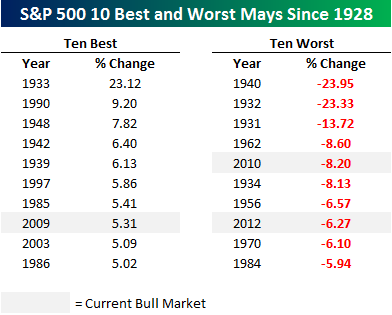
With the month of May beginning tomorrow, we wanted to highlight the best and worst S&P 500 performances during the month since 1928.  Overall, the S&P 500 has averaged a decline of 0.15% during the month, which is among the weaker average monthly performances of the year.

While investors debate the merits of sell in may and go away, we thought it was worth pointing out that May has increasingly become a volatile month in recent years.  As shown in the table below, two of the ten worst months of May going all the way back to 1928 have both occurred during the current bull market (2010 & 2012).  Furthermore, one of the ten best Mays of all time also came during the current bull market (2009).  In other words, three of the four Mays during the current bull market have qualified as one of the ten best or worst Mays of all time.  That leaves 2011 as the only year where May was not one of the ten best or worst Mays ever.  In that year, the S&P 500 declined 1.4%.  With the month of May averaging a decline of 2.64% during the current bull market, you can’t blame bulls for wanting to take the month off in 2013.

Mays best and Worst

Using MD&A to Improve Earnings Forecasts

Using MD&A to Improve Earnings Forecasts

Khrystyna Bochkay Rutgers, The State University of New Jersey – Rutgers Business School at Newark & New Brunswick

Carolyn B. Levine Rutgers, The State University of New Jersey – Rutgers Business School at Newark & New Brunswick

April 17, 2013

Abstract: 
We estimate and compare quantitative and text-enhanced earnings forecasting models to evaluate the extent to which MD&A disclosures improve earnings forecasts. Incorporating MD&A disclosures into forecasting models significantly improves forecasting accuracy. The gains in accuracy are much greater following regulatory reforms, providing some of the first large-sample empirical evidence on the success of recent MD&A regulatory actions. The MD&A section is less informative between 2007-2009, particularly for those firms hardest hit by the financial crisis (i.e., firms with low cash and large changes in performance). Further, we find that text improves forecast accuracy most for firms in the consumer staples sector, firms with low profit margins, large changes in performance, high political and/or legal costs and high complexity. Last, we find that models enhanced by MD&A disclosures are generally less accurate than analysts’ consensus forecasts for large and medium sized firms, but equally accurate for small firms.

10 Years Later: Where in the World is Equal Weight Indexing Now?

10 Years Later: Where in the World is Equal Weight Indexing Now?

Liyu Zeng Standard & Poor’s

Frank Luo Standard & Poor’s

April 20, 2013

Abstract: 
Often the most powerful investment ideas are simple. The S&P 500 EWI 10 years ago pioneered the simple concept of equal weighted indexing. It has now expanded in the U.S. into the S&P 100, a MegaCap index, S&P MidCap 400® and S&P SmallCap 600®. The equal weighting idea has also been applied to international equities, as well as in other asset classes such as fixed income indices and commodity indices. It has become one of the most popular alternatively-weighted ideas. While the headline cause of asset flows has been outperformance over market-cap indices, sophisticated investors have realized that equal weighting creates a different set of risk factor exposures than market cap weighting that seem to have worked over the long-term as noted in the paper. Furthermore, the concept randomizes factor mispricings in the market, and it can serve as a performance benchmark for alternative-weighted indices.

Berkshire size, Buffett age cloud annual gathering

Berkshire size, Buffett age cloud annual gathering

12:11pm EDT

By Jonathan Stempel and Jennifer Ablan

(Reuters) – Warren Buffett may be on safari for major acquisitions, which he likes to call elephants, but shareholders may wonder if his Berkshire Hathaway Inc has become the biggest elephant in the room. Berkshire has grown to look more and more like corporate America, as Buffett expands outside its core insurance business into such areas as energy, industrial products, newspapers, and in February ketchup, when he teamed up with Brazil’s 3G Capital investment firm to buy H.J. Heinz Co for $23.2 billion. Few of the 35,000 or more people who will this weekend make a pilgrimage to Berkshire’s hometown of Omaha, Nebraska for the company’s annual shareholder weekend, which Buffett calls “Woodstock for Capitalists,” are likely to criticize that strategy. While Buffett has managed to handily beat the Standard & Poor’s 500 so far this year, outperforming the overall market is getting tougher for Berkshire as it grows and diversifies, investors and analysts said.

Buffett, 82, and Vice Chairman Charlie Munger, 89, will at Saturday’s annual meeting field five hours of questions about the company, governance, the economy and – with a $15 billion cash cushion even after the Heinz purchase is completed – their next elephant. “Larger deals are needed to move the needle,” said Doug Kass, founder of hedge fund Seabreeze Partners Management Inc, who has shorted Berkshire stock partly because its size, including a $262 billion market value, makes it more difficult to record market-beating returns. Kass has been tapped by Buffett as a “credentialed bear” to ask questions and “spice up” the meeting. Buffett himself recognized the performance question when he noted in his March shareholder letter that Berkshire has lagged the broader market since the latter bottomed out four years ago. Read more of this post

Monster parents breeding brats in HK; “The city is at high risk as it is producing spoilt children who are overconfident about themselves”

Monster parents breeding brats in HK

“The city is at high risk as it is producing spoilt children who are overconfident about themselves,” said Associate Professor Annis Fung from City University of Hong Kong. -ST

Tue, Apr 30, 2013
The Straits Times

HONG KONG – “Monster” parents in Hong Kong are turning out a generation of spoilt brats with an inflated view of their abilities and who may resort to aggression to get ahead, the South China Morning Post (SCMP) reported on Wednesday, citing a latest study.

“The city is at high risk as it is producing spoilt children who are overconfident about themselves,” said Associate Professor Annis Fung from City University of Hong Kong.

“Monster” parents, who practise an authoritarian education style and over-emphasise children’s academic performance, could increase their children’s complacency, reported the Wen Wei Po newspaper on Wednesday. Read more of this post

“It grows very well, this virus”: Scientists Infect Chicks in Race to Halt Lethal H7N9 Bird Flu Spread; “If one in five people getting infected die, that’s a pretty frightening infection”

Scientists Infect Chicks in Race to Halt Bird Flu Spread

Deep inside a high-security laboratory an hour from Melbourne, scientists working behind air-locked doors inject six-week-old chickens with a virus that has killed one in five people it’s known to have infected. The pathogen is H7N9 bird flu, and it came to Australia’s second-biggest city 12 days ago in a 0.5 milliliter sample — 10 would fit on a teaspoon — from a patient in China’s Anhui province. Antibodies from the chickens will help create tests for the virus, part of a race to head off a global outbreak. While disease trackers have yet to pinpoint how the 127 human infections in China and Taiwan occurred, they say contact with poultry is the most likely cause. Birds carry the disease without showing symptoms, making tests to monitor farms and markets vital to halting its spread, said Peter Daniels, assistant director of the Australian Animal Health Laboratory.

“If one in five people getting infected die, that’s a pretty frightening infection,” said Daniels, 64, whose lab is the world’s largest high-security bio-containment research facility. “It may be that it won’t start spreading person to person. But if it does, the world is facing a severe disease situation.” Read more of this post

Lethal H7N9 bird flu virus batters China’s holiday travel bug; number of tourists to some eastern Chinese cities where the outbreak is concentrated has plunged by half

Bird flu virus batters China’s holiday travel bug

The number of tourists to some eastern Chinese cities where the outbreak is concentrated has plunged by half for some tour agencies over H7N9 fears. -ST 
Grace Ng

Wed, May 01, 2013
The Straits Times

Women wear face masks on a street in Shanghai on April 16, 2013 as China’s H7N9 bird flu virus spreads further afield. In spite of the deadly bird flu virus outbreak that has spread to new locations in China including south-eastern Fujian province and central Henan, Beijing housewife Xu Jia, 44, and her family decided to press on with their trip to Xiamen for the three-day Labour Day holiday which started on Tuesday. The family booked their trip to the scenic coastal city in Fujian earlier this month. Last Friday, news broke that one case of the H7N9 virus had surfaced in the province. Still, this has not stopped them from setting off two days ago. “We’re not concerned about the avian flu. There are just 100-odd cases across the whole country and there hasn’t been discovery of human-to-human transmission,” Ms Xu told The Straits Times. But her gung-ho attitude does not appear to be shared by many of her countrymen.

The number of tourists to some eastern Chinese cities – where the outbreak, which has sickened 124 people and killed 24, is concentrated – has plunged by half for some tour agencies over H7N9 fears. This is traditionally a peak tourism period, with tour prices rising as much as 30 per cent last year. Read more of this post

China Manufacturers Survive by Moving to Asian Neighbors

April 30, 2013, 4:00 p.m. ET

China Manufacturers Survive by Moving to Asian Neighbors

By KATHY CHU

MK-CC856_CLABOR_G_20130430141203

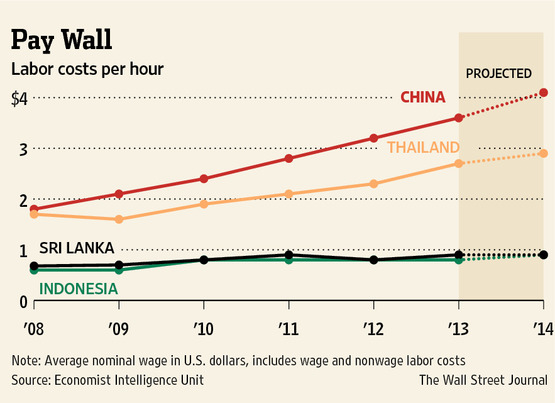
SHENZHEN, China—In a corner of a sprawling factory in this coastal southern city, sewing machines that stitched blouses and shirts for Lever Style Inc.’s clients now gather dust. As the din on the factory floor has dropped, so, too, has the payroll. Over the past two years, Lever Style’s employee count in China has declined by one-third to 5,000 workers. The company in April began moving apparel production for Japanese retail chain Uniqlo to Vietnam, where wages can be half those in China. Lever Style also is testing a shift to India for U.S. department-store chain Nordstrom Inc. JWN +0.09% and moving production for other customers. It’s a matter of survival. After a decade of nearly 20% annual wage increases in China, Lever Style says it can no longer make money here. Read more of this post

Chinese President Xi follows in Mao’s footsteps on path to consolidate power

Xi follows in Mao’s footsteps on path to consolidate power

Monday, 29 April, 2013, 12:00am

Wang Xiangwei xiangwei.wang@scmp.com

The president’s push to clean up the party may employ old tactics, but there’s reason to hope he wants more than just another purge

“Look in the mirror, dress properly, take a bath and see a doctor.”

Such advice might strike the ears of most people as plain and harmless. But that kind of order coming from the president and party chief surely sends shivers down the spines of many of the Communist Party’s 80 million members. Most of them understood that when the Politburo announced Xi Jinping’s campaign rid the party of “formalism, bureaucratism and behaviour that suggests mediocrity, laziness, laxity and extravagance”, what it really meant was: “Clean up your act. Or we’ll clean it up for you.” The year-long campaign, unveiled on April 19, requires any officials from the county level or higher to “reflect on their own practices and correct any misbehaviour”, according to Xinhua. It aims is to improve the party’s bond with the people, as well as fight corruption. Read more of this post

China Affair With Cheap Diamonds Heats Mass Market

China Affair With Cheap Diamonds Heats Mass Market: Commodities

China’s burgeoning middle class is buying diamonds so quickly that the price of mass-market stones is rising faster around the world than for top-quality jewels affordable only to the super-rich. Prices for a 1-carat internally flawless “top white” diamond have gained about 7 percent in two years, while a stone of similar size and color with slight imperfections jumped 24 percent, according to consultant PolishedPrices.com data. “The Chinese consumer’s fascination with luxury goods has grown dramatically, along with their pockets,” said Angelito Tan, founding partner of Robert, Tan & Gao, a consulting firm on luxury market strategy with offices in Shanghai and Beijing.

The price jump in more flawed diamonds benefits producers such as Russia’s OAO Alrosa, the world’s biggest by volume with 30 percent of output in 2011, and De Beers, the largest by revenue. Chow Tai Fook Jewellery Group Ltd. (1929), a retailer with a $13.5 billion market value, said its average selling price dropped in the last six months as it sold more pieces. Even as shoppers go down market in China, the world’s second-largest diamond buyer since 2011, the gap to top-flight stones is still large: A flawless 1 carat “top white” round diamond would cost about $28,800, according to online retailer Blue Nile, while a benchmark middle-market SI1-category diamond of the same size and color would cost about $7,200. China’s market was initially fueled by a rich elite pursuing the best diamonds available. As the economy grew, a new wave of buyers emerged, opening the market to lower-quality stones that form the bedrock of U.S. and European demand.

Read more of this post

Negatively geared Australian property investors lost an astonishing $13.2 billion in 2010-11, up from $10.1 billion the year before

Negative geared investors lose $13 billion

May 1, 2013

Peter Martin

Negatively geared property investors lost an astonishing $13.2 billion in 2010-11, up from $10.1 billion the year before. The latest Tax Office statistics show the average loss per negatively geared investor was $10,950, up from $9130 the year before. The average loss for a high-income negatively geared investor earning more than $180,000 was $23,800. Higher interest rates and rising property prices during 2010-11 swelled the losses. The figures identify negative gearing as one of the key drains on personal tax collections with one in every seven Australian taxpayers now a property investor and one in every 10 negatively geared.

Read more of this post

How eBay CEO John Donahoe Keeps Founders From Leaving After Acquisitions; “We need to create a culture where they can realize their visions”

How eBay CEO John Donahoe Keeps Founders From Leaving After Acquisitions

FREDERIC LARDINOIS

posted 2 hours ago

At TechCrunch Disrupt 2013 NY, eBay’s CEO John Donahoe talked to Bloomberg’s chief content editor Norm Pearlstine about how the company screens its acquisitions and how he keeps founders from leaving after the acquisition. Since becoming eBay’s CEO, Donahoe said, the company has made about 20 acquisitions. Currently, fifteen of the founders that joined eBay and PayPal after their companies were acquired are still at eBay and most of them are in executive positions. After the company acquired Zong in 2011, for example, Zong’s founder David Marcus became PayPal’s vice president for mobile. After essentially getting tested in that position, he became the President of PayPal last year. Similarly, when eBay acquired Hunch (also in 2011), its team of co-founders, including Chris Dixon, Tom Pinckney and Matt Gattis joined the company (with Dixon leaving after about a year). Today, this team is in charge of eBay’s homepage. Donahoe believes that in order to keep founders from leaving, eBay needs to give them the opportunity to grow inside the company. Because of this, he is also most interested in acquiring companies where the management team believes that they can execute their vision inside eBay. “We are always looking for companies that have a strong vision,” Donahoe said. “And then we allow them to innovate at a higher level.” The kind of founders he likes, he said, are “founders come to us and say we founded our company to do x and would like to take it to the next level.”

In his view, this strategy has been a key ingredient to eBay’s and PayPal’s success. Acquisitions, in his view, drive innovation inside a large company like eBay and bringing in founders as executives – and giving them monetary incentives to stay as well, of course – is a key part of this strategy. As for the details of these incentives, Donahoe noted that “most of the founders make money in the acquisition In some cases the acquisition price is tied to staying for a two-three year period. But yes – we provide incentives to stay. We provide good compensation, but at the end of the day, we need to create a culture where they can realize their visions.” He does, for example, regularly meet with founders to discuss the state of the company. These discussions have, for example, lead to the redesign of the eBay’s homepage. It’s that kind of impact, he believes, that keeps founders at eBay.