The Cost Accounting Whale Curve to Understand Accounting Fraud in Asia

 image001

“Bamboo Innovators bend, not break, even in the most terrifying storm that would snap the mighty resisting oak tree. It survives, therefore it conquers.”

BAMBOO LETTER UPDATE | September 8, 2014
Bamboo Innovator Insight (Issue 49)

  • The weekly insight is a teaser into the opportunities – and pitfalls! – in the Asian capital jungles.
  • Get The Moat Report Asia– a monthly in-depth presentation report of around 30-40 pages covering the business model of the company, why it has a wide moat and why the moat may continue to widen, a special section on “Inside the Leader’s Mind” to understand their thinking process in building up the business, the context – why now (certain corporate or industry events or groundbreaking news), valuations (why it can compound 2-3x in the next 5 years), potential risks and how it is part of the systematic process in the Bamboo Innovator Index of 200+ companies out of 15,000+ in the Asia ex-Japan universe.
  • Our paid Members from North America, Europe, the Oceania and Asia include professional value investors with over $20 billion in asset under management in equities, some of the world’s biggest secretive global hedge fund giants, and savvy private individual investors who are lifelong learners in the art of value investing.
 

The Cost Accounting Whale Curve to Understand Accounting Fraud in Asia

image002

“It struck me as a business I didn’t know anything about initially. You know, you’re talking about petroleum additives… Are there competitive moats, is there ease of entry, all that sort of thing. I did not have any understanding of that at all initially. And I talked to Charlie a few days later…and Charlie says, ‘I don’t understand it either.’ I decided there’s probably a good size moat on this. They’ve got lots and lots of patents, but more than thatthey have a connection with customers… Lubrizol is exactly the sort of company with which we love to partner—the global leader in several market applications run by a talented CEO, James Hambrick.”

– Warren Buffett on Lubrizol, the $9.7 billion oil additives, lubricants and specialty chemicals company that Berkshire Hathaway bought into in March 2011


“It’s hard to imagine that three years after the fall of Sino-Forest, a fraud twice its size could navigate through a sea of regulators, investment bankers, and auditors to list on a global stock exchange.”

– Anonymous Analytics on Tianhe Chemicals, the “Lubrizol of China” in their 67-page report


Information may be used to inform or deceive. Accounting is at the heart of the information system in economies and companies, providing information to lubricate the market and internal working parts of an organization, thus contributing to their smooth functioning.


When accounting frauds and financial failures pop up as what appear to be rather sudden surprise while the most recent financial statements indicate a sound condition, accounting loses their legitimacy and effectiveness. Where were the accountants and auditors?


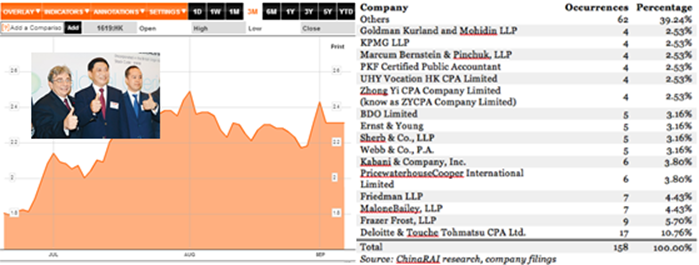
We were left asking this question last week when HK-listed Tianhe Chemicals (1619 HK, MV $7.6bn) was suspended on Tuesday after Anonymous Analytics (AA) issued a report detailing how the chemicals company, who raised $650 million in its June IPO deal brought to the market by sponsors Morgan Stanley, Bank of America Merrill Lynch and UBS, massively inflate its revenue and profits and “is one of the largest stock market frauds ever conceived.”


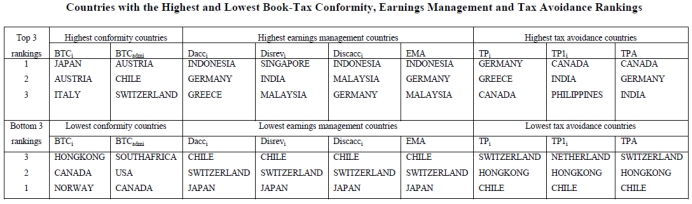
The role of two independent experts have come into the spotlight: the auditor verifying the accounting numbers, and the market research firm Frost & Sullivan producing industry and market share data which was heavily relied upon by analysts and investors. Tianhe is audited by Hong Kong’s Deloitte. According to data compiled by ChinaRAI in May 2013, Deloitte has more “occurrences” of fraud and other accounting issues in China than the other Big 4 firms combined (table above). AA said that original filings made by Tianhe’s main Chinese operating subsidiaries to the SAIC (State Administration for Industry and Commerce) showed revenue and profit that were 85 to nearly 100% less than what the company declared in its filings to investors in its HK IPO.


In another alleged accounting fraud, Emerson Analytics detailed how the sausage-casing maker Shenguan (829 HK, MV $1.1bn) inflated revenue (selling price to its largest customer was over 40% higher than what it charged others on average in the same standardized product) and concealed high cost of raw materials (cattle skin). Ernst & Young’s audit coverage excluded the BVI and PRC subsidiaries were audited by local firm Shenzhen Pengcheng, which had its securities business permit revoked by the CSRC in May 2013 for its failure to perform due diligence in the IPO of Yunnan Green-Land Biological Technology (002200 CH).

image003

Tianhe claims to be a top five player in the world in terms of lubricant additive sales, behind Lubrizol of the US, the number-one manufacturer, and also number two behind DuPont of the US in speciality fluorochemicals (SFC).Tianhe’s lubricant additive make up 40% of sales with margins at 27% while its SFC clocks in a breath-taking 85% margin. Tianhe, with a market value of $7.6bn, is relatively large as compared to Buffett’s Lubrizol at $9.7bn. So what is the difference in the business model between Lubrizol and Tianhe?


Both Buffett and Munger initially did not understand about the competitive dynamics of this seemingly-commoditized business and wonder whether it has an economic moat and pricing power. After all, around two-thirds of Lubrizol’s sales come from oil lubricants and additives, which are oil-based and the company must purchase some heavy hydrocarbons such as crude to make them. That means that Lubrizol is exposed to fluctuations in the volatile oil market. When the price of base oil is high and keeps rising, a key question is whether Lubrizol can effectively passed that higher price on to consumers in a cost-plus pricing model based on volume.


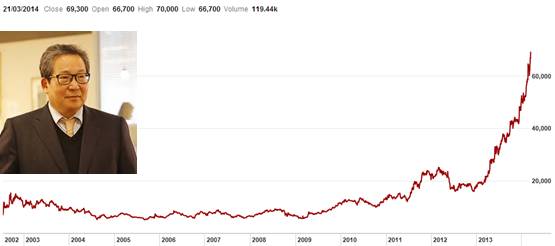
Buffett gave us the all-important clue to assessing the moat of true compounders and Bamboo Innovators such as Lubrizol or Huchems Fine Chemical (069260 KS, MV $943m), Korea’s sole supplier of polyurethane (PU) intermediate materials: “They have a connection with customers”. A close customer relationship minimizes earnings volatility inherent in the petrochemical business.


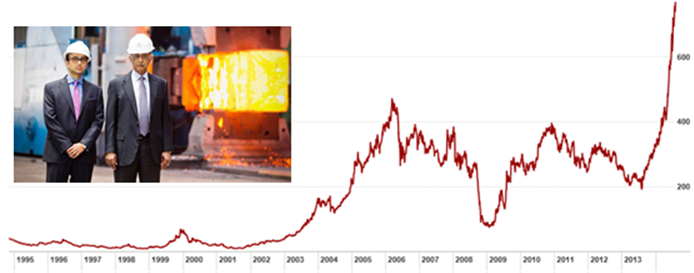
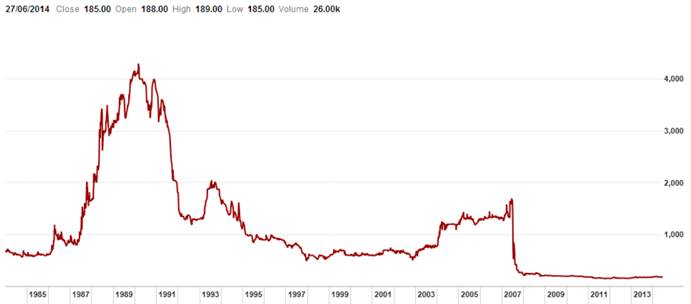
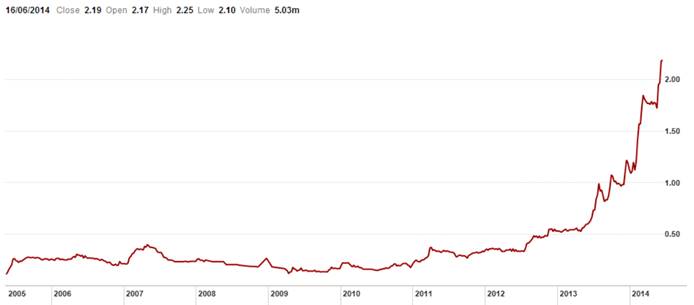
Huchems Fine Chemical (069260 KS) – Stock Price Performance, 2002-2014

image012

For instance, one of the secrets for Huchems…


<Article snipped>


As the late management accounting pioneer Dr Charles Horngren puts it aptly, “You need to understand the business first, before you can understand the accounting of the business.”


An observation is that too often students today walk away from an accounting course in which they learned models, standards and techniques, were tested on computations, and now know a laundry list of standards, but have no clue about the accounting way of thinking and what accounting as a subject is all about.


Accounting is not just about reporting numbers but is also about structuring incentives, generating information that guides decisions, providing disciplinary feedback on decisions, and inspiring innovations. The accounting way of thinking gives us a language to analyze in a systematic manner and help us reach informed opinions. The accounting way of thinking requires logic and interpretation, an ability to grasp problems and offer solutions, and an ability to ponder deeper questions and offer tentative answers in an ongoing conversation and learning by inquiry.


When accounting frauds occur, accounting loses their legitimacy and effectiveness: Where were the accountants and auditors? As accounting educators, we cannot seek to answer this unless we have managed to think deeper about these two important questions:


  • Are students excited when they sit in an accounting class?
  • Are business and investment professionals excited when they read about the latest analysis of accounting ideas and concepts?


It would not be very often that we encounter someone who says, “Oh, how exciting, it really impacted my life and the way I think about the world.” We need to teach and research accounting as an intellectually exciting and world-illuminating discipline. Accounting doyen Ray Ball had bemoaned: “The absence of a solidly grounded worldview – a deep understanding of the function of financial reporting in the economy – is a major threat to accounting.”


Some of the most exciting developments for the next generation lie at the periphery of accounting even though information is often said to lie at the heart of accounting. We need to find ways to make investors feel the importance of bias in accounting and financial information through the interdisciplinary lenses: the ways that conflicts of interest affect the financial reporting process, the institutional mechanisms that limit or exacerbate this behavior, the power held by the preparers and reporters of information in the context of the countries and companies that do not permit a transparent flow of information. This is particularly true in Asia which is not a monolithic homogenous bloc and can be a heterogeneous mess for users of accounting information without a resilient mental model.


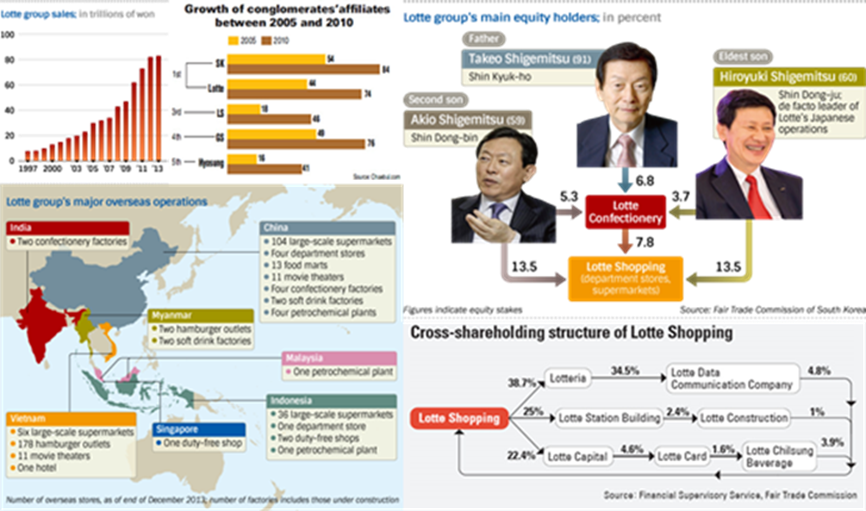
By expanding the accounting way of thinking to the cost accounting of whale curve to understand more about customer profitability and the business model in serving customers, value investors can better understand tunneling and expropriation acts by companies via related party transactions to generate artificial sales.


Warm regards,

KB

Managing Editor

The Moat Report Asia

www.moatreport.com

SMU: http://accountancy.smu.edu.sg/faculty/profile/108141/Kee%20Koon%20Boon


To read the exclusive article in full to find out more about the story of Korea’s bamboo innovator Huchems and the cost accounting whale curve to understand accounting fraud in Asia, please visit:


  • The Cost Accounting Whale Curve to Understand Accounting Fraud in Asia, Sep 8, 2014 (Moat Report Asia, BeyondProxy)


The Moat Report Asia
 

“In business, I look for economic castles protected by unbreachable ‘moats’.”

– Warren Buffett


The Moat Report Asia is a research service focused exclusively on competitively advantaged, attractively priced public companies in Asia. Together with our European partners BeyondProxy and The Manual of Ideas, the idea-oriented acclaimed monthly research publication for institutional and private investors, we scour Asia to produce The Moat Report Asia, a monthly in-depth presentation report highlighting an undervalued wide-moat business in Asia with an innovative and resilient business model to compound value in uncertain times. Our Members from North America, the Nordic, Europe, the Oceania and Asia include professional value investors with over $20 billion in asset under management in equities, secretive global hedge fund giants, and savvy private individual investors who are lifelong learners in the art of value investing.


Learn more about membership benefits here: http://www.moatreport.com/subscription/


  • Individual subscription at $1,994 per year:

https://www.moatreport.com/individual-subscription/?s2-ssl=yes


Our latest monthly issue for the month of August investigates an Asian-listed company who’s the leading ecommerce group in its home country with the complete platform coverage in the Amazon-type of B2C ecommerce of selling directly to end consumers (Sales/Net Profit: 90%/78%), Rakuten-type of B2B2C platform (Sales/Net Profit: 4%/12%) to support the online SME merchants who in turn sell to the end consumers, and the eBay-type of C2C auction site (Sales/Net Profit: 2%/21%) where individuals buy and sell to one another. This “Amazon-Alibaba” is highly profitable with recurring free cashflow (FCF yield 4.6-5% compounding at 25% in the next 3-5 years) bypioneering the world’s-first 24-hour delivery promise and guarantee when world-class logistics experts said it cannot be done. In emerging markets and Asia where logistics costs is 15-20% of GDP, most ecommerce companies fail to scale up due to lack of fulfillment capabilities and inventory risk became the killing blow as they pursue growth without the intangible know-how. The company designs and builds its own warehouses to provide fast and efficient delivery with 99.68% on-time rate and also complete backend services to suppliers, widening the gap between itself and peers. With its superior infrastructure, the company is able to provide consumers a one-stop shopping experience with all goods purchased from different vendors packaged into a single box and delivered to the client’s door. The company has consignment agreements with suppliers which allow it to have control over inventory management but carry no liability of inventory on its balance sheet, in other words, there is minimal inventory riskfor the company to scale up sustainably and without the usual accounting risks that plagued the ecommerce companies.


With (1) a superior ROE of 23.6% due to its wide-moat business model in 24-hour delivery system, (2) negative cash conversion cycle (-29 days) in its unique warehouse system with minimal inventory risk, (3) a sustained 25-30% recurring earnings and cashflow growth per annum in the next 5 years, especially a long run-way in disrupting traditional retailers, and (4) potential exponential growth in its option value in the third-party electronic payment business, the company can scale up multiple times. Short-term downside risk is protected by its healthy$128m net-cash balance sheet (15% of MV) and proven management execution in prudent capex expansion to support sustainable quality earnings growth. Its terminal value and long-term downside risk will be protected by giants Alibaba, Rakuten, eBay, Amazon who wish to swallow it up to possess its valuable trust and brand equity support it enjoys and its wide-moat business model in 24-hour delivery system. The company is one of the few Asian ecommerce companies with good governance and low accounting risks with its net-value revenue recognition method and it deserves a valuation premium. Upcoming deregulation in third-party electronic payment with the passing of the law in Sep 2014 will result in various government restrictions to be removed, paving the way for the company to introduce stored-value payments, O2O payment, P2P payment (money transfer without transactions), multiple currencies’ payments, big data analysis, payment services for customers outside the group to boost transaction volume and scale up its existing proprietary PayPal/AliPay businessLed by the inspiring and highly-determined founder and Chairman who established and listed the company in 1998 and 2003 respectively, the company has overcome the multiple obstacles to ecommerce transactions in its home market. The founder described the obstacles to ecommerce transactions as ‘friction’, and that he “resolve to take on the Life’s Task to reduce this ‘friction’”.


Our past monthly issues examine:


  • An Asian-listed company who’s the global #1 and #2 maker of two types of patient monitoring devices for both clinical- and home-use. Founded in 1981 and listed in 2001, the company’s reliable manufacturing technology platform for over 30 years has enabled it to build a global durable franchise in the niche patient monitoring device market that has stable resilient growth and yet is experiencing potential disruptions led by its new innovation. A secret to its success is its in-house capabilities to combine Swiss design, high-precision electronics and sensors components with clinical healthcare to produce world-class products with cost competitiveness. The firm has competitive technology and patents especially its core competence of having an algorithm to allow fast reading/filtering of signals and outputting the accurate results in a short period of time. Thecompany has the potential to consolidate the market further. The company is also a sticky ODM partner to reputable companies including Wal-Mart, Costco, CVS and it has a diversified customer base with none of the customers accounting for more than 10% of its sales. The company demonstrated that it has bargaining power over its powerful customers with the ability to build its own brand since 1998 (62% of overall sales). 91% of its sales are to developed markets in US and Europe. The company is trading at EV/EBIT 9.7x and EV/EBITDA 8.8x and has an attractive dividend yield at 5.6% and a strong balance sheet with net cash as percentage of market value and book equity at 23% and 47% respectively. The firm has also undertaken the unusual capital management program to reduce 10% of its shares outstanding in Sep 2012 to boost capital efficiency by utilizing the comfortable net cash position. The proactive shareholder-friendly stance backed by its strong net cash position should limit any downside in share price. The company’s terminal value and downside risk will be protected by giants such as J&J, Bayer, Abbott etc who wish to swallow it up to possess its valuable manufacturing technology platform and worldwide patents in algorithm-technology. The company’s worldwide patents in algorithm-technology has been commercialized into an innovative product series that is at the heart of its total solution service business model. This valuable intangible asset is not factored into long-term valuation.The innovative product with the algorithm measurement technology are not merely additional features; it “forces” the clinical community to adopt them as the standard, which in turn helps drive home-use penetration as patients seek a consistent and integrated healthcare experience. It transforms the product into a unique strategy that incorporates software development to create value-added services for health monitoring and collaborating with hospitals and governments on tele-healthcare projects. As a result of its wide-moat, the company has a far superior ROE at 20.9% that is nearly double that of its key giant conglomerate rival. When we compare EV/EBIT relative to ROE and ROA, the company is cheaper by as much as 120-150% when compared to its key giant conglomerate rival. The stock price of the company is down nearly 20% from its recent high in end March 2014 on profit-taking by short-term investors. Share price is back to May 2013 level, representing an attractive opportunity to take position in this long-term durable franchise. The stable long-term shareholdings and patient capital by the founder and the management team who together own around 48% of the equity has enabled the firm to adopt a very long-term approach to building its business and cultivating new growth areas. While he may sometimes be slightly over-optimistic and thinking too far ahead with his long-term opinions, this  idealistic engineer-visionary-philosopher has done a fantastic job in continuously defying the odds of many skeptics by growing the company from a small startup into one of the world’s leading patient monitoring equipment company. He is the rare Asian entrepreneur who was persistent in building his own brand despite the threat of offending his ODM customers. He was also early in cultivating and coordinating a global network with high-tech component, R&D and manufacturing in his home country, manufacturing, assembly and packaging in Shenzhen, China and medical R&D and clinical testing center in Europe, including making the difficult decision to establish a direct marketing sales force in Europe and North America given the high cost. Unlike most Asian business owners whose interest and focus in the core business starts to wane due to complacency from growing personal wealth and the inability to scale the core business, the founder is genuinely passionate in the company’s ability to add value to the patients and society. The firm can effectively run without the founder with the long-term corporate culture and management system in place, yet he can inject great value as the steward in new innovations; we believe that this combination is rare for an Asian company and deserves a valuation premium.


  • The world’s #1 ODM (Original Design Manufacturer) and global #5 manufacturer of a consumer healthcare device product that is used frequently, even daily, thus providing the foundation for stable recurring cashflow. This company is also a hidden champion in a niche product segment (50-55% of group’s sales) that has become a high-growth fashion product currently accounting for less than 10% of the overall industry. The company is able to mass-manufacture this niche product, but not the giants, because of its unique process IP in flexible manufacturing system and know-how to handle large-scale complex orders. The manufacture of this product itself is difficult to replicate and requires FDA/CE licenses because of its medical device nature and the entry barrier is not capital but the know-how and R&D expertise. In particular, the manufacturing integrates different fields of science including polymer chemistry, physics, optics, engineering, materials control, process control, microbiology, and, injection molding. The firm has also developed a proprietary system of tracking the manufacturing process of different sets of product so that if a quality issue arose, when and where the problem set of products was being produced could be swiftly identified, thus diminishing the scale and cost of product recall. This system has helped the firm win the long-term trust of its ODM customers to place stable large orders. The Big Four giants do not have such a system and have to incur substantial losses from product recalls. The company also possess its own brand which has many loyal followers and support in its home market where it enjoys a 30% market share and contributes to 25% of group’s saleswhile sticky ODM customers account for 75% of group’s sales, mainly from the Japan market. As a result of its wide-moat advantages, the firm enjoys a consistently high ROE of 41%, double or triple that of the giants. From FY07 onwards, even during the depths of the Global Financial Crisis in 2007/09, the firm has not raised equity. Since listing in Mar 2004, the company has only done one rights issue in May 2005. Also, it is able to sustain a strong stable cash dividend payout (>70% with 3% yield) with its healthy net-cash balance sheet (net cash $30m; net cash-to-equity ratio 23%) and proven management execution in prudent capex expansion to support sustainable quality earnings growth. M&A deals in the healthcare and medical device sector has been growing due to their strong defensive nature and giants seeking growth to overcome their own patent cliff. The firm will always be an attractive takeover target by giants who wish to swallow it up to possess its valuable flexible manufacturing system and know-how to fill their own missing competency gap and hence will enjoy long-term downside protection in its terminal value. In the battle between “ODM vs Brand”, we find the story of the company to be quite similar to that of TSMC (2330 TT, MV $103bn), now the largest ODM foundry in the world. “Skate to where the puck is going to be, not where it has been,” as hockey legend Wayne Gretzky advised. In our view, the profit and valuation premium in the value chain will start to skate to the “Inno-facturers” who are the hidden ODM innovators (the brand behind brands) consolidating the industry, such as TSMC and this company. While its valuation is not cheap with EV/EBIT (FY13) at 20.6x, when we compare EV/EBIT relative to ROE, the company is relatively cheap, by as much as 130-220% when compared to giants and other comparables. When we compare EV/EBITDA relative to ROE, the valuation gap is 90-160%. This long-term valuation gap implies that the company, with its far superior and sustainable ROE, could potentially double to $2.4bn, as it continues to consolidate its niche product segment and enter into a new product cycle of an innovative product whose patents are expiring in 2014/15 (US/worldwide) to make ASP/margin improvements in sustaining quality profits and cashflow. Its share price has dropped 18% from its recent high and underperformed the index by 26% in the last six months. This will present a buying opportunity for long-term value investors who can penetrate beyond conventional valuation metrics because of a deep understanding of its business model and underlying source of its wide-moat advantages. In Asia, many firms break apart or become value traps due to shareholder conflict, envy and differences in opinion on the business direction of the company. The stable long-term corporate culture infused by the late founder, who established the company in 1986 with the current executive chairman and 2 other key shareholders, to combine the energy and ideas of everyone to work hard to keep the business running forever is underappreciated.


  • The Home Depot of Asiawhich has the largest market share in its home country and now seeks to expand regionally. It is one of the few home improvement retailers in the world which is able to achieve a structural negative cash conversion cycle (CCC) at -39 days for resilient, recurring and sustainable operating cashflow to enable the expansion of its store network while keeping a healthy balance sheet. It is hard to achieve negative cash conversion cycle (CCC) as a home retailer as compared to a supermarket retailer as the product nature is more durable. Even Home Depot, Lowe’s and Bed Bath & Beyond (BBBY) are not able to achieve a negative CCC. Led by the capable owner-operators since 1995, the company is a pioneer in proactively creating awareness and demand in the minds of consumers that upgrading your home can be fun and in incremental affordable steps. Its creative branding has resulted in the firm to become the “first on customers’ mind”, or what Charlie Munger elucidated as the “psychological wide-moat” advantage. 80% of sales are generated customers looking for home improvement and renovation ideas and solutions.  Growth is supported by the management’s proven ability to identify and cater to dynamic changes in customer preferences. The firm’s comprehensive pre and aftersales service creates brand loyalty and sustains long-term sales. The merchandizing management is tailored to the peculiarities of customer preferences in each area to drive same store sales growth with creative customization by store, location, season and events. Its key strategy to expand its profit margin is to increase its higher-margin house brands and product-mix management. Its EBITDA/sqm of $400/sqm was higher than Home Depot until Home Depot experienced a rebound last year to $500/sqm. The firm’s resilient sales are supported by its unrivalled network of diverse locations throughout the country. Its bold vision and successful “Blue Ocean” execution in the highly fragmented second-tier markets has created a powerful wide-moat advantage that will last for many years to come. In short, the management have proven their ability to execute in difficult market and industry conditions especially in the past 5 to 7 years during the 2007/09 global financial crisis with the firm emerging much stronger. The Illinois Institute of Technology engineering graduate and quiet billionaire owner behind the home retailer is one of the few Asian business tycoons who has the thirst to scale up the business in a sustainable way, as opposed to opportunistic ventures, having been largely influenced by his early years experience observing the success of American wide-moat firms. If we can adjust the EV/EBITDA valuation metric to reflect the CCC, the company’s EV/EBITDA of 18.5x will be lower at 10-11x, while Home Depot’s EV/EBITDA 11x will be higher at 13x. Noteworthy is that Home Depot has a negative free cashflow throughout FY1989-2001 (13 consecutive years!) and yet market cap has climbed from $1.5bn to $103bn. Home Depot compounded despite the ugly valuations during the capex ramp-up. This once again highlights that the power of wide-moat is often underappreciated, misunderstood and overlooked. When Home Depot generated $180m in operating cashflow in FY1992, quite similar to this Asian firm now, Home Depot is valued at $5bn (vs $3bn). Store network is expected to double in the next 4-5 years, representing a potential doubling in market value.


  • The Northeast Asian-listed companywho is the world’s largest maker of an essential component with applications in apparel, shoes, diapers, car seats etc. All top 20 global athletic shoe brands, including Nike, Adidas, Reebok, Sketchers, UnderArmor are customers and this Asian innovator with R&D capabilities has forged long-term “spec-in” partnerships with them. Its broad product offering is protected by over 110 patents. By locating its Pan-Asian production plant network in China, Taiwan, Vietnam and Indonesia close to its major clients, including sales/customer service centers and warehouses in US and Europe, the firm is better positioned to understand their requirements, deliver fast and meet their needs. While top 10 athletic shoe brands account 40% of its revenue, the firm has a diversified clientele base of over 10,000 customers, giving it resilience and growth with both the established and emerging brands as clients. The company is trading at PE14e 12x, EV/EBITDA 7.1x and EV/EBIT 10.6x with a dividend yield of 3.9%. Interestingly, its EBITDA margin is double that of Adidas and its 8.7% net margin is higher than Adidas’ 5.4%, though below Nike’s 9.8%. Given the tipping point of its Pan-Asian production network and contributions from its new products and as capex tapers off in the next few years, free cashflow could be around $50-60m and applying a P/FCF of 15x would yield a market value of $750-900m,, representing apotential upside of 100-150%. Thus, the firm offers a similar quality growth trajectory to Nike/Adidas with its unique knowledge-based business model and yet trades at a more attractive valuation and higher dividend yield as downside protection.


  • The Middleby of Asia commanding a dominant market share of over 80% in hypermarkets, 50% in chain outlets, 30% in 4- to 5-star hotels in China and an overall 30% in its home market. Yet, no single customer accounts for more than 5% of its revenue. Just to recall for value investors, NYSE-listed Middleby, with its sleepy and boring business, has compounded 100-fold from around $50m to $5.7bn since its tipping point in 1999. The founders of this Asian family business demonstrated clear dedication in building up the company with its wide-moat business model backed by a strong and unique distribution/marketing network in finding, winning and binding new customers to build massive brand equity and long-lasting relationships with clients over time. Their devotion to its core product for nearly 20 years results in maximum problem-solving skills, innovative strength and product leadership and hence, to ever greater customer benefit that will protect the company to consolidate the fragmented market and provide ample opportunities to continue its profitable growth. The company is currently trading at PE13e 15.8x and an undemanding EV/EBIT 10.1x and EV/EBITDA 9.5xand its growth potential based on its unique business model is not priced in. There is a structural re-rerating of niche business models with (1) diversified client base, (2) steady revenue streams, (3) lean capex requirements that creates ample free cashflow and defensive growth. Based on PE, P/CFO and EV/EBIT, the company is trading at a 40-50% discount to the foreign listed comparables despite more efficient use of assets in generating profits and cashflow. It has an attractive 7% earnings yield growing at 20% over the next 3-5 years and a 3.8% dividend yield that is supported by its strong cashflow generation ability, steady revenue stream and lean capex requirements to limit downside risks in valuation. Based on the growth plans to penetrate new product and customer segments; build its third plant in India in addition to the ones in its home market and in China; and potential bolt-on acquisition opportunities with its healthy balance sheet in net-cash position, it has the potential to double its operating cashflow in the next 3-5 years and market value could double, representing an upside potential of 100-140%.


The Moat Report Asia Members’ Forum has been getting penetrating quality dialogues from our subscribers.Questions range from:


  • The nuances of internal dealings in Asia, including the case discussion of the recent deal in which HK billionaire’s Lee Shau-kee Henderson Landacquiring Towngas or Hong Kong & China Gas (3 HK) from his family holdings, seemingly déjà vu from the early Oct 2007 transaction when the market peak.
  • The case of F&N Singaporespinning out its property unit FCL Trust and getting “free” special dividend-in-specie and the potential risk in asset swap restructuring to deleverage the hidden debt in the entire Group balance sheet.
  • The dilemma of whether to invest in a Southeast Asian-listed company and hidden champion with a domestic market share of 60% due to family squabbles and a legal suit over the company’s ownership.
  • Discussion of the wise and thoughtful 107-year-old Irving Kahn’s investment into a US-listed but Hong Kong-based electronics company with development property project in Shenzhen’s Qianhai zone and the possible corporate governance risks that could be underestimated or overlooked, as well as their history of listing some assets in HK in 2004.. This is also a case study of “buy one get one free” in John’s highly-acclaimed book The Manual of Ideasin which the “free” property is lumped together with the (eroding) core business to make the combined entity look cheap and undervalued. What are the potential areas that value investors need to watch out for when adapting the SOTP (sum-of-the-parts) valuation method in Asia?
  • And many more intriguing questions.


Do find out more in how you can benefit from authentic and candid on-the-ground insights that sell-side analysts and brokers, with their inherent conflict-of-interests, inevitable focus on conventional stock coverage and different clientele priorities, are unwilling or unable to share. Think of this as pressing the Bloomberg “Help Help” button to navigate the Asian capital jungle. Institutional subscribers also get access to the Bamboo Innovator Index of 200+ companies and Watchlist of 500+ companies in Asia and the Database has eliminated companies with a higher probability of accounting frauds and  misgovernance as well as the alluring value traps.


Professional Development Workshops for Executives and Lifelong Learners
 

Our 8th run of the series of workshop From the Fund Management Jungles: Value Investing Exposed and Explored – (Part 1) Moat Analysis, (Part 2) Tipping Point Analysis and (Part 3) Detecting Accounting Fraud – on 14 June 2014 has been well-received with serious value investors, professionals, and serious lifelong learners attending, with some who flew in from Jakarta and KL!..


Our 9th workshop will be on Detecting Accounting Fraud Ahead of the Curve sometime later in the year.


Thank you for your support all this while!


Thank you so much for reading as always.


Warm regards,

KB Kee

Managing Editor

The Moat Report Asia

Singapore

Mobile: +65 9695 1860


A Service of BeyondProxy LLC

1608 S. Ashland Avenue #27878

Chicago, Illinois 60608-2013

Other offices: London, Singapore, Zurich


P.S.1 Here is a little more about my background:

KB Kee has been rooted in the principles of value investing for over a decade as an analyst in Asian capital markets. He was head of research and fund manager at a Singapore-based value investment firm. As a member of theinvestment committee, he helped the firm’s Asia-focused equity funds significantly outperform the benchmark index. He was previously the portfolio manager for Asia-Pacific equities at Korea’s largest mutual fund company.


He holds a Masters in Finance and degrees in Accountancy and Business Management, summa cum laude, from Singapore Management University (SMU) and had also published articles on governance and investing in the media, as well as published an empirical research paper Why ‘Democracy’ and ‘Drifter’ Firms Can Have Abnormal Returns: The Joint Importance of Corporate Governance and Abnormal Accruals in Separating Winners from Losers in the Special Issue of Istanbul Stock Exchange 25th Year Anniversary Best Paper Competition, Boğaziçi JournalReview of Social, Economic and Administrative Studies, Vol. 25(1): 3-55. KB has also presented his thought leadership as a keynote speaker in global investing conferences. KB has trained CEOs, entrepreneurs, CFOs, management executives in business strategy, value investing, macroeconomic, industry trends, and detecting accounting frauds in Singapore, HK and China, and had taught accounting at the SMU where he is currently an adjunct lecturer.


P.S.2  Why do I care so much about doing The Moat Report Asia for you?

My personal motivation in embarking on this lifelong journey has been driven by disappointment from observing up close and personal the hard-earned assets of many investors, including friends and their families, burnt badly by the popular mantra: “Ride the Asian Growth Story!” I witnessed firsthand the emotional upheavals that they go through when they invest their hard-earned money – and their family’s – in these “Ride The Asian Growth Story” stocks either by themselves or through money managers, and these stocks turned out to be the subject of some exciting “theme” but which are inherently sick and prey to economic vicissitudes. They may seem to grow faster initially but the sustainable harvest of their returns is far too uncertain to be the focus of a wise program in investment. Worse still, the companies turned out to be involved in accounting frauds. Their financial numbers were “propped up” artificially to lure in funds from investors and the studiously-assessed asset value has already been “tunnelled out” or expropriated. And western-based fraud detection tools and techniques have not been adapted to the Asian context to avoid these traps.


After a decade-plus journey in the Asian capital jungles, it has been somewhat disheartening as I observe many fraud perpetrators go away scot-free and live a life of super luxury on minority investors’ hard-earned money. And these perpetrators make tempting offers to various parties in the financial community to go along with their schemes. When investors have knowledge in their hands, we have a choice to stay away from these people and away from temptations and do the things that we think are right. With knowledge, we have a choice to invest in the hardworking Asian entrepreneurs and capital allocators who are serious in building a wide-moat business.


CONNECT WITH US image003image004image006image005image007
MOAT REPORT ASIA    OUR TEAM    SUBSCRIBE    MEMBERS    CONTACT US

The Moat Report Asia
A Service of BeyondProxy LLC
1608 S. Ashland Avenue #27878
Chicago, Illinois 60608-2013

Other offices: London, Singapore, Zurich


Medicines on Call in Asia

  image001

“Bamboo Innovators bend, not break, even in the most terrifying storm that would snap the mighty resisting oak tree. It survives, therefore it conquers.”

BAMBOO LETTER UPDATE | September 1, 2014
Bamboo Innovator Insight (Issue 48)

  • The weekly insight is a teaser into the opportunities – and pitfalls! – in the Asian capital jungles.
  • Get The Moat Report Asia– a monthly in-depth presentation report of around 30-40 pages covering the business model of the company, why it has a wide moat and why the moat may continue to widen, a special section on “Inside the Leader’s Mind” to understand their thinking process in building up the business, the context – why now (certain corporate or industry events or groundbreaking news), valuations (why it can compound 2-3x in the next 5 years), potential risks and how it is part of the systematic process in the Bamboo Innovator Index of 200+ companies out of 15,000+ in the Asia ex-Japan universe.
  • Our paid Members from North America, Europe, the Oceania and Asia include professional value investors with over $20 billion in asset under management in equities, some of the world’s biggest secretive global hedge fund giants, and savvy private individual investors who are lifelong learners in the art of value investing.
 

Can You Guess This Asian Wide-Moat Company? Medicines on Call in Asia

image010

If you live in North America, there’s a one in two chances that the medicine that you use is distributed by hidden giants McKesson (MCK US, MV $44.4bn) and AmerisourceBergen (ABC US, MV $17.4bn).

This Asian wide-moat company is the McKesson of its home country as the #1 private pharmaceutical wholesaler. For the business model of a pharmaceutical wholesaler-distributor, working capital management is critical. In terms of inventory management efficiency, at the inventory turnover period of 42 days, the company is nearly twice as efficient as state-linked giants and is nearly on par with world leaders McKesson and AmerisourceBergen, an impressive feat given the logistics challenge in emerging markets. The company’s 9.6% ROA is nearly double that of state-linked leader.


In an economy where business fortunes are built from government concessions or licenses, the company has forged a different path by relying on its own capabilities to provide quality pharmaceutical products and healthcare largely in the private sector. Dr K, the chairman and CEO, and his management team have exercised prudence and discipline in executing their operations and capex plans with a strong balance sheet fortified by net cash that’s around 10.5% of market value while deepening their core competencies in warehousing, logistics, sales and marketing to connect to the fragmented market of over 4,000 clients.


Public healthcare services in Asia face the problem of social and financial sustainability. The cost of medicare is pushed higher and higher, driving more and more people who cannot afford such healthcare into crowded public hospitals. Doctors get paid so well in private healthcare that public hospitals cannot afford to attract and hire the best. There is growing demand for reasonably-priced quality private healthcare services, generic drugs and consumer healthcare products of which the company is a key provider and beneficiary.


#1 Private Pharma Wholesaler and Integrated Manufacturing-Wholesale-Distribution Platform with New Growth in Making Orthopedic Components


Our latest monthly issue for the month of September investigates an Asian-listed company who is the #1 private pharmaceutical wholesaler and also one of the largest private sector manufacturer of off-patent medicines in its domestic market. Its integrated business model from pharma manufacturing to wholesale, distribution and marketing has carved out top-selling own-branded products such as #1 in medicated powder, #1 cough mixture, #1 cough expectorant etc. With its network of warehouses strategically located throughout the country, the company is able to provide comprehensive coverage and rapid access to markets and customers, delivering the “Medicines on Call” value proposition to over 4,000 private-sector customers from private hospitals, pharmacies to supermarkets and also serves as the long-term channel partner to international brands such as GSK, J&J, 3M, Colgate Palmolive, Nestle for over 30 years etc.


From FY2014 onwards, the company has operationalized the business to contract manufacture orthopedic components for top MNCs with the full array of machining, casting, coating and forging capabilities. In an economy where fortunes are built from government concessions or licenses, the company has forged a different path by relying on its own capabilities to provide quality pharmaceutical products and healthcare services largely in the private sector.


In an economy where fortunes are built from government concessions or licenses, the company has forged a different path by relying on its own capabilities to provide quality pharmaceutical products and healthcare. Dr K, the chairman and CEO, and his management team have exercised prudence and discipline in executing their operations and capex plans with a strong balance sheet fortified by net cash that’s around 10.5% of market value while deepening their core competencies in warehousing, logistics, sales and marketing to connect to the fragmented market of over 4,000 clients.


For the business model of a pharmaceutical wholesaler-distributor, working capital management is critical. In terms of inventory management efficiency, at the inventory turnover period of 42 days, the company is nearly twice as efficient as state-linked giants and is nearly on par with world leaders McKesson and AmerisourceBergen, an impressive feat given the logistics challenge in emerging markets. The company’s9.6% ROA is nearly double that of state-linked leader.


At EV/EBIT 10.1x, EV/EBBITDA 8.4x, PE14e 10.2x and P/Book 1.9x, the company is reasonably decent in valuations for its resilient earnings and cashflow growth. Giant drug dealers McKesson (MCK US, MV $44.4bn) and AmerisourceBergen (ABC, MV $17.4bn) are also on the global hunt for acquisition targets; McKesson has bought Germany’s Celesio, one of Europe’s largest drug distributors, for $5.4bn in 4Q13, to link up the supply chains of Europe and US; ABC has acquired a 19.9% stake in Brazilian drug wholesaler Profarma in March 2014 for $100m. More consolidation in the sector globally is likely and could be the catalyst to drive up the valuation of quality emerging market companies in the sector. Long-term downside protection in terminal value is provided by MNCs who will be interested to acquire or partner with the company to possess its valuable wide-moat advantage in its network of warehouses and wholesale-distribution know-how to reach the fragmented customers.


The company has achieved an impressively consistent and improving performance in difficult times and is well-positioned in the local pharmaceutical industry which is among the few industries quite unaffected by economic cycles as the demand for drugs will continue even in difficult times. Public healthcare services in Asia face the problem of social and financial sustainability and the overcrowded public hospitals and clinics have sparked growing demand for reasonably-priced and quality private healthcare services, generic drugs and consumer healthcare products of which the company is a key provider and beneficiary.


Warm regards,

KB

Managing Editor

The Moat Report Asia

www.moatreport.com

SMU: http://accountancy.smu.edu.sg/faculty/profile/108141/Kee%20Koon%20Boon

The Purging Rain on Asia’s SOEs and Implications for Value Investors

 image001

“Bamboo Innovators bend, not break, even in the most terrifying storm that would snap the mighty resisting oak tree. It survives, therefore it conquers.”

BAMBOO LETTER UPDATE | August 25, 2014
Bamboo Innovator Insight (Issue 47)

  • The weekly insight is a teaser into the opportunities – and pitfalls! – in the Asian capital jungles.
  • Get The Moat Report Asia– a monthly in-depth presentation report of around 30-40 pages covering the business model of the company, why it has a wide moat and why the moat may continue to widen, a special section on “Conversation with Management” to understand their thinking process in building up the business, the context – why now (certain corporate or industry events or groundbreaking news), valuations (why it can compound 2-3x in the next 5 years), potential risks and how it is part of the systematic process in the Bamboo Innovator Index of 200+ companies out of 15,000+ in the Asia ex-Japan universe.
  • Our paid Members from North America, Europe, the Oceania and Asia include professional value investors with over $20 billion in asset under management in equities, some of the world’s biggest secretive global hedge fund giants, and savvy private individual investors who are lifelong learners in the art of value investing.
 

The Purging Rain on Asia’s SOEs and Implications for Value Investors


They say reform is the painful rain that purges the ills; the resilient one emerges stronger and purified, while the corrupt dissolves under the cleansing process.


No one knows such pain more deeply than Deng Xiaoping, the reformist leader credited with opening up and transforming the Chinese economy. Deng’s 110th birthday last week on Aug 22 was celebrated by a poignant scene reacted and broadcast on national TV: Deng was drawing water in the rain to swab his disabled son who was tortured and thrown out of the window of a three-storeyed building at Beijing University by the Red Guards during the Cultural Revolution, when Deng was purged.

image011

State broadcaster CCTV has produced the 48-part drama Deng Xiaoping at History’s Crossroads 《历史转折中的邓小平》 in honor of Deng, with the propaganda campaign eclipsing the official remembrance of the 120th anniversary of Mao’s birth last December. While washing his son’s back, Deng asked, “Son, what is your level of competency in wireless telegraphy?” Deng’s son replied, “Dad, you don’t worry, if the policy permits, I can repair radios. Not only can I be independent, but I can also earn a living for the family.” Deng was comforted and said, “Good, to rely on real knowledge and capability to earn a living, it’s definitely reliable” (“靠真本事吃饭,靠得住”).


Come September, the final plan for the state-owned enterprise (SOE) reform in China will be published, a move to reform bloated inefficient SOE to rely on its own capability to compete. The pilot plan to improve corporate governance and attract private investment includes (1) “mixed ownership,” the Communist Party jargon for introducing more private capital into government assets in a partial privatization, (2) major asset restructuring such as asset purchases, sales and swaps can proceed without approval from the CSRC, (3) curbs on “unreasonably high” executive pay and perks such as spending on cars and accommodations, (4) board-led human resources management, which will allow the boards of directors to hire, evaluate and pay top executives, rather than SASAC (State-owned Assets Supervision and Administration Commission) to appoint senior management and set performance metrics. The goal is to reduce political interference in the management of SOEs by designing the holding companies to focus purely on maximising shareholder value rather than advancing the government’s policy goals and political agenda that seeks to first and foremost legitimize the party in power. The reform process is described in one of Deng’s immortal words: “crossing the river by feeling for the stones.” The launch of the pilot and implementation work is likely to start next year.


What are the implications for value investors in China and Asia? Will the valuation pendulum shift back in favor of selected SOEs? Will this be a re-run of the last round of SOE reform in the late 1990s? Between 1997 and 2003, premier Zhu Rongji oversaw China’s last round of SOE reform. Under the mantra of “Grasp the large, release the small,” thousands of poorly performing SOEs were privatised or liquidated. Stronger firms were restructured and often listed on the stock market. But since 2003 the government has drifted away from this model and shown unwillingness to exit from weak SOEs. Loose monetary policy during the 2008 economic stimulus plan, along with political directives for SOEs to support the economy with new investment, caused many state firms to become bloated and return on assets to decline. SOEs in Shanghai introduced management shareholding arrangements as incentive measures in 2000, but state assets were being lost. A case is Shanghai Lianhua Supermarket (980 HK, MV $676m) which was preparing for a listing in Hong Kong. More than 50 managers set up a company that was suspected of conducting illegal trading with Lianhua, causing the government a loss.


In China companies in which the state is a majority shareholder account for 60% of stockmarket capitalisation. SASAC is the powerful body who controls 113 central SOEs, compared to 98,554 companies owned at the local level, and central SOEs control 53% of overall SOE assets totalling RMB95.7tn. Chinese economists have estimated that the entire Chinese SOE sector – around half of China’s output – actually subtracts six to eight times as much economic value as it produces. SOEs are “value-subtractors” in the economy and would be only 30% as profitable as they are today if not for direct government subsidies, “Implicit guarantees” on cheap loans made to SOEs, trade protection and preferential government procurement deals.


China’s huge SOEs are seen by the public as both too corrupt to save and too powerful to fail. The latest crackdown on SOE corruption to clear obstacles in the push to reform wasteful and inefficient SOEs offers some hope for change. Former head of the SASAC…


<Article snipped>


China’s strategy for “indigenous innovation” has been to employ its organs of the state to tempt and coerce leading foreign firms to part with world-class technologies so that local firms can copy, adopt or steal them. Multinationals have poured in with Deng’s welcome to foreign firms, especially more so after…


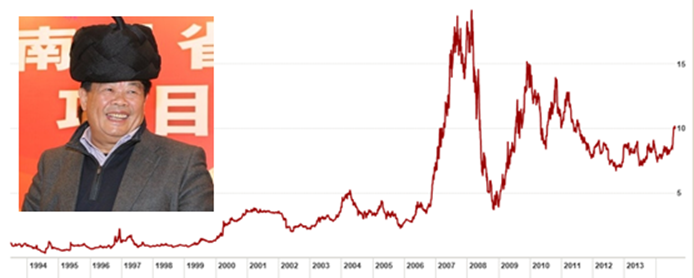
This development caught our attention to explore the rise of selected Chinese automotive component suppliers, both SOE and privately-owned entrepreneurial companies. They are helped not only by the lost in trust with the price cartel breakup but also a Chinese rule: 40% of the components in cars produced in China had to be made by local companies. It is generally understood that aftermarket service and part contribute more than half of the profits to the global automotive industry. China is a bustling market for auto parts. In 2012, auto suppliers’ output in China totaled RMB2.2tr ($360bn), up from about RMB1.6tr yuan in 2010. The sector was dominated by foreign players. We believe that the domestic auto parts proportion will be higher in China going forward. To achieve economies of scale, the government is accelerating domestic consolidation and major vehicle manufacturers are restructuring their component operations to improve investment efficiency and accelerate development. One automotive component SOE beneficiary is The other automotive component company that we find interesting isFuyao Glass (600660 CH, MV $3.2bn), the Fujian-based entrepreneurial firm founded by Cao Dewang in 1987 that has a 50% domestic market share in automotive glass and is the world’s second largest auto glass firm by unit volume behind Saint-Gobain and after Japan’s Asahi Glass, supplying everyone from Toyota, Honda, VW, GM, Ford, BMW, Audi, Bentley….


Interestingly, Fuyao’s Cao credits his rise to Deng’s economic reform which allowed enterprising personalities to express themselves. After the Cultural Revolution, Fuyao’s Cao found a job at a factory that made…

image012


Fuyao Glass (600660 CH) – Stock Price Performance, 1993-2014


Cao has an interesting view about competitive advantage:


“I always think good faith is a kind of competitive ability. I carefully studied the Japanese industry development history in the 1960s. Many Japanese companies also once appeared to seek short-term profits and use unscrupulous tactics to make money. But a mighty wave crashing on a sandy shore calls their bluff and deceitful businesses have disappeared. Those that survive are truly honest business with integrity. Fuyao always adhere to the integrity of business as the basic operating principle. For example, the most expensive cost in making automotive glass is the PVB film (windshield consists of two glass pressed into a thin film). PVB film thickness of the automotive glass is 0.76 mm, and the price is very high, about $5 per square metre. Many accessories manufacturers feel that users simply do not see the importance of film thickness, and in the process, will make the film into only 0.38 mm thick (this thickness is usually used for architectural glass). A square meters can save more than $2. While the price is lower by around half, it will give the user hidden trouble. We never do such a wicked thing. In my opinion, in the competition between enterprises, not only do we just compete in the strategy, technology and innovation, but the final decisive key often lies in character. The integrity of the enterprise is unable to quantify in terms of the competitive advantage. Entrepreneurship, in my opinion, not only means starting from scratch to create a career spirit, but also it includes “integrity management”. If you do not adhere to integrity as a business principle, regardless of how much money you earn, you also cannot say you have the entrepreneur’s spirit. You can only be at most a profiteer. I think all the time that the responsibility of entrepreneur has three areas: towards the country, towards social progress, and towards people. Carry out these three responsibilities in order to be worthy of the title of entrepreneur.”


Deng famously justified China’s capitalist path with the saying, “It doesn’t matter whether a cat is white or black, as long as it catches mice.” With the emergence and rise of selected SOE innovators and entrepreneurial firms such as Fuyao Glass, the resilient Chinese cat is able to have nine lives in bouncing back from reform purges and be the intrepid explorer and fearless acrobat to dance in the rain and create value in uncertain times.


Warm regards,

KB

Managing Editor

The Moat Report Asia

www.moatreport.com

SMU: http://accountancy.smu.edu.sg/faculty/profile/108141/Kee%20Koon%20Boon


To read the exclusive article in full to find out more about the stories of the SOE automotive component company and Fuyao Glass and the implications of the SOE reform in Asia for value investors, please visit:


The Moat Report Asia
 

“In business, I look for economic castles protected by unbreachable ‘moats’.”

– Warren Buffett


The Moat Report Asia is a research service focused exclusively on competitively advantaged, attractively priced public companies in Asia. Together with our European partners BeyondProxy and The Manual of Ideas, the idea-oriented acclaimed monthly research publication for institutional and private investors, we scour Asia to produceThe Moat Report Asia, a monthly in-depth presentation report highlighting an undervalued wide-moat business in Asia with an innovative and resilient business model to compound value in uncertain times. Our Members from North America, the Nordic, Europe, the Oceania and Asia include professional value investors with over $20 billion in asset under management in equities, secretive global hedge fund giants, and savvy private individual investors who are lifelong learners in the art of value investing.


Learn more about membership benefits here: http://www.moatreport.com/subscription/


  • Individual subscription at $1,994 per year:

https://www.moatreport.com/individual-subscription/?s2-ssl=yes


Our latest monthly issue for the month of August investigates an Asian-listed company who’s the leading ecommerce group in its home country with the complete platform coverage in the Amazon-type of B2C ecommerce of selling directly to end consumers (Sales/Net Profit: 90%/78%), Rakuten-type of B2B2C platform (Sales/Net Profit: 4%/12%) to support the online SME merchants who in turn sell to the end consumers, and the eBay-type of C2C auction site (Sales/Net Profit: 2%/21%) where individuals buy and sell to one another. This “Amazon-Alibaba” is highly profitable with recurring free cashflow (FCF yield 4.6-5% compounding at 25% in the next 3-5 years) by pioneering the world’s-first 24-hour delivery promise and guarantee when world-class logistics experts said it cannot be done. In emerging markets and Asia where logistics costs is 15-20% of GDP, most ecommerce companies fail to scale up due to lack of fulfillment capabilities and inventory risk became the killing blow as they pursue growth without the intangible know-how. The company designs and builds its own warehouses to provide fast and efficient delivery with 99.68% on-time rate and also complete backend services to suppliers, widening the gap between itself and peers. With its superior infrastructure, the company is able to provide consumers a one-stop shopping experience with all goods purchased from different vendors packaged into a single box and delivered to the client’s door. The company has consignment agreements with suppliers which allow it to have control over inventory management but carry no liability of inventory on its balance sheet, in other words, there is minimal inventory risk for the company to scale up sustainably and without the usual accounting risks that plagued the ecommerce companies.


With (1) a superior ROE of 23.6% due to its wide-moat business model in 24-hour delivery system, (2) negative cash conversion cycle (-29 days) in its unique warehouse system with minimal inventory risk, (3) a sustained 25-30% recurring earnings and cashflow growth per annum in the next 5 years, especially a long run-way in disrupting traditional retailers, and (4) potential exponential growth in its option value in the third-party electronic payment business, the company can scale up multiple times. Short-term downside risk is protected by its healthy$128m net-cash balance sheet (15% of MV) and proven management execution in prudent capex expansion to support sustainable quality earnings growth. Its terminal value and long-term downside risk will be protected by giants Alibaba, Rakuten, eBay, Amazon who wish to swallow it up to possess its valuable trust and brand equity support it enjoys and its wide-moat business model in 24-hour delivery system. The company is one of the few Asian ecommerce companies with good governance and low accounting risks with its net-value revenue recognition method and it deserves a valuation premium. Upcoming deregulation in third-party electronic payment with the passing of the law in Sep 2014 will result in various government restrictions to be removed, paving the way for the company to introduce stored-value payments, O2O payment, P2P payment (money transfer without transactions), multiple currencies’ payments, big data analysis, payment services for customers outside the group to boost transaction volume and scale up its existing proprietary PayPal/AliPay businessLed by the inspiring and highly-determined founder and Chairman who established and listed the company in 1998 and 2003 respectively, the company has overcome the multiple obstacles to ecommerce transactions in its home market. The founder described the obstacles to ecommerce transactions as ‘friction’, and that he “resolve to take on the Life’s Task to reduce this ‘friction’”.


Our past monthly issues examine:


  • An Asian-listed company who’s the global #1 and #2 maker of two types of patient monitoring devices for both clinical- and home-use. Founded in 1981 and listed in 2001, the company’s reliable manufacturing technology platform for over 30 years has enabled it to build a global durable franchise in the niche patient monitoring device market that has stable resilient growth and yet is experiencing potential disruptions led by its new innovation. A secret to its success is its in-house capabilities to combine Swiss design, high-precision electronics and sensors components with clinical healthcare to produce world-class products with cost competitiveness. The firm has competitive technology and patents especially its core competence of having an algorithm to allow fast reading/filtering of signals and outputting the accurate results in a short period of time. Thecompany has the potential to consolidate the market further. The company is also a sticky ODM partner to reputable companies including Wal-Mart, Costco, CVS and it has adiversified customer base with none of the customers accounting for more than 10% of its sales. The company demonstrated that it has bargaining power over its powerful customers with the ability to build its own brand since 1998 (62% of overall sales). 91% of its sales are to developed markets in US and Europe. The company is trading at EV/EBIT 9.7x and EV/EBITDA 8.8x and has an attractive dividend yield at 5.6% and a strong balance sheet with net cash as percentage of market value and book equity at 23% and 47% respectively. The firm has also undertaken the unusual capital management program to reduce 10% of its shares outstanding in Sep 2012 to boost capital efficiency by utilizing the comfortable net cash position. The proactive shareholder-friendly stance backed by its strong net cash position should limit any downside in share price. The company’s terminal value and downside risk will be protected by giants such as J&J, Bayer, Abbott etc who wish to swallow it up to possess its valuable manufacturing technology platform and worldwide patents in algorithm-technology. The company’s worldwide patents in algorithm-technology has been commercialized into an innovative product series that is at the heart of its total solution service business model. This valuable intangible asset is not factored into long-term valuation. The innovative product with the algorithm measurement technology are not merely additional features; it “forces” the clinical community to adopt them as the standard, which in turn helps drive home-use penetration as patients seek a consistent and integrated healthcare experience. It transforms the product into a unique strategy that incorporates software development to create value-added services for health monitoring and collaborating with hospitals and governments on tele-healthcare projects. As a result of its wide-moat, the company has a far superior ROE at 20.9% that is nearly double that of its key giant conglomerate rival. When we compare EV/EBIT relative to ROE and ROA, the company is cheaper by as much as 120-150% when compared to its key giant conglomerate rival. The stock price of the company is down nearly 20% from its recent high in end March 2014 on profit-taking by short-term investors. Share price is back to May 2013 level, representing an attractive opportunity to take position in this long-term durable franchise. The stable long-term shareholdings and patient capital by the founder and the management team who together own around 48% of the equity has enabled the firm to adopt a very long-term approach to building its business and cultivating new growth areas. While he may sometimes be slightly over-optimistic and thinking too far ahead with his long-term opinions, this  idealistic engineer-visionary-philosopher has done a fantastic job in continuously defying the odds of many skeptics by growing the company from a small startup into one of the world’s leading patient monitoring equipment company. He is the rare Asian entrepreneur who was persistent in building his own brand despite the threat of offending his ODM customers. He was also early in cultivating and coordinating a global network with high-tech component, R&D and manufacturing in his home country, manufacturing, assembly and packaging in Shenzhen, China and medical R&D and clinical testing center in Europe, including making the difficult decision to establish a direct marketing sales force in Europe and North America given the high cost. Unlike most Asian business owners whose interest and focus in the core business starts to wane due to complacency from growing personal wealth and the inability to scale the core business, the founder is genuinely passionate in the company’s ability to add value to the patients and society. The firm can effectively run without the founder with the long-term corporate culture and management system in place, yet he can inject great value as the steward in new innovations; we believe that this combination is rare for an Asian company and deserves a valuation premium.


  • The world’s #1 ODM (Original Design Manufacturer) and global #5 manufacturer of a consumer healthcare device product that is used frequently, even daily, thus providing the foundation for stable recurring cashflow. This company is also a hidden champion in a niche product segment (50-55% of group’s sales) that has become a high-growth fashion product currently accounting for less than 10% of the overall industry. The company is able to mass-manufacture this niche product, but not the giants, because of its unique process IP in flexible manufacturing system and know-how to handle large-scale complex orders. The manufacture of this product itself is difficult to replicate and requires FDA/CE licenses because of its medical device nature and the entry barrier is not capital but the know-how and R&D expertise. In particular, the manufacturing integrates different fields of science including polymer chemistry, physics, optics, engineering, materials control, process control, microbiology, and, injection molding. The firm has also developed a proprietary system of tracking the manufacturing process of different sets of product so that if a quality issue arose, when and where the problem set of products was being produced could be swiftly identified, thus diminishing the scale and cost of product recall. This system has helped the firm win the long-term trust of its ODM customers to place stable large orders. The Big Four giants do not have such a system and have to incur substantial losses from product recalls. The company also possess its own brand which has many loyal followers and support in its home market where it enjoys a 30% market share and contributes to 25% of group’s saleswhile sticky ODM customers account for 75% of group’s sales, mainly from the Japan market. As a result of its wide-moat advantages, the firm enjoys a consistently high ROE of 41%, double or triple that of the giants. From FY07 onwards, even during the depths of the Global Financial Crisis in 2007/09, the firm has not raised equity. Since listing in Mar 2004, the company has only done one rights issue in May 2005. Also, it is able to sustain a strong stable cash dividend payout (>70% with 3% yield) with its healthy net-cash balance sheet (net cash $30m; net cash-to-equity ratio 23%) and proven management execution in prudent capex expansion to support sustainable quality earnings growth. M&A deals in the healthcare and medical device sector has been growing due to their strong defensive nature and giants seeking growth to overcome their own patent cliff. The firm willalways be an attractive takeover target by giants who wish to swallow it up to possess its valuable flexible manufacturing system and know-how to fill their own missing competency gap and hence will enjoy long-term downside protection in its terminal value. In the battle between “ODM vs Brand”, we find the story of the company to be quite similar to that of TSMC (2330 TT, MV $103bn), now the largest ODM foundry in the world. “Skate to where the puck is going to be, not where it has been,” as hockey legend Wayne Gretzky advised. In our view, the profit and valuation premium in the value chain will start to skate to the “Inno-facturers” who are the hidden ODM innovators (the brand behind brands) consolidating the industry, such as TSMC and this company. While its valuation is not cheap with EV/EBIT (FY13) at 20.6x, when we compare EV/EBIT relative to ROE, the company is relatively cheap, by as much as 130-220% when compared to giants and other comparables. When we compare EV/EBITDA relative to ROE, the valuation gap is 90-160%. This long-term valuation gap implies that the company, with its far superior and sustainable ROE, could potentially double to $2.4bn, as it continues to consolidate its niche product segment and enter into a new product cycle of an innovative product whose patents are expiring in 2014/15 (US/worldwide) to make ASP/margin improvements in sustaining quality profits and cashflow. Its share price has dropped 18% from its recent high and underperformed the index by 26% in the last six months. This will present a buying opportunity for long-term value investors who can penetrate beyond conventional valuation metrics because of a deep understanding of its business model and underlying source of its wide-moat advantages. In Asia, many firms break apart or become value traps due to shareholder conflict, envy and differences in opinion on the business direction of the company. The stable long-term corporate culture infused by the late founder, who established the company in 1986 with the current executive chairman and 2 other key shareholders, to combine the energy and ideas of everyone to work hard to keep the business running forever is underappreciated.


  • The Home Depot of Asiawhich has the largest market share in its home country and now seeks to expand regionally. It is one of the few home improvement retailers in the world which is able to achieve a structural negative cash conversion cycle (CCC) at -39 days for resilient, recurring and sustainable operating cashflow to enable the expansion of its store network while keeping a healthy balance sheet. It is hard to achieve negative cash conversion cycle (CCC) as a home retailer as compared to a supermarket retailer as the product nature is more durable. Even Home Depot, Lowe’s and Bed Bath & Beyond (BBBY) are not able to achieve a negative CCC. Led by the capable owner-operators since 1995, the company is a pioneer in proactively creating awareness and demand in the minds of consumers that upgrading your home can be fun and in incremental affordable steps. Its creative branding has resulted in the firm to become the “first on customers’ mind”, or what Charlie Munger elucidated as the “psychological wide-moat” advantage. 80% of sales are generated customers looking for home improvement and renovation ideas and solutions.  Growth is supported by the management’s proven ability to identify and cater to dynamic changes in customer preferences. The firm’s comprehensive pre and aftersales service creates brand loyalty and sustains long-term sales. The merchandizing management is tailored to the peculiarities of customer preferences in each area to drive same store sales growth with creative customization by store, location, season and events. Its key strategy to expand its profit margin is to increase its higher-margin house brands and product-mix management. Its EBITDA/sqm of $400/sqm was higher than Home Depot until Home Depot experienced a rebound last year to $500/sqm. The firm’s resilient sales are supported by its unrivalled network of diverse locations throughout the country. Its bold vision and successful “Blue Ocean” execution in the highly fragmented second-tier markets has created a powerful wide-moat advantage that will last for many years to come. In short, the management have proven their ability to execute in difficult market and industry conditions especially in the past 5 to 7 years during the 2007/09 global financial crisis with the firm emerging much stronger. The Illinois Institute of Technology engineering graduate and quiet billionaire owner behind the home retailer is one of the few Asian business tycoons who has the thirst to scale up the business in a sustainable way, as opposed to opportunistic ventures, having been largely influenced by his early years experience observing the success of American wide-moat firms. If we can adjust the EV/EBITDA valuation metric to reflect the CCC, the company’s EV/EBITDA of 18.5x will be lower at 10-11x, while Home Depot’s EV/EBITDA 11x will be higher at 13x. Noteworthy is that Home Depot has a negative free cashflow throughout FY1989-2001 (13 consecutive years!) and yet market cap has climbed from $1.5bn to $103bn. Home Depot compounded despite the ugly valuations during the capex ramp-up. This once again highlights that the power of wide-moat is often underappreciated, misunderstood and overlooked. When Home Depot generated $180m in operating cashflow in FY1992, quite similar to this Asian firm now, Home Depot is valued at $5bn (vs $3bn). Store network is expected to double in the next 4-5 years, representing a potential doubling in market value.


  • The Northeast Asian-listed companywho is the world’s largest maker of an essential component with applications in apparel, shoes, diapers, car seats etc. All top 20 global athletic shoe brands, including Nike, Adidas, Reebok, Sketchers, UnderArmor are customers and this Asian innovator with R&D capabilities has forged long-term “spec-in” partnerships with them. Its broad product offering is protected by over 110 patents. By locating its Pan-Asian production plant network in China, Taiwan, Vietnam and Indonesia close to its major clients, including sales/customer service centers and warehouses in US and Europe, the firm is better positioned to understand their requirements, deliver fast and meet their needs. While top 10 athletic shoe brands account 40% of its revenue, the firm has a diversified clientele base of over 10,000 customers, giving it resilience and growth with both the established and emerging brands as clients. The company is trading at PE14e 12x, EV/EBITDA 7.1x and EV/EBIT 10.6x with a dividend yield of 3.9%. Interestingly, its EBITDA margin is double that of Adidas and its 8.7% net margin is higher than Adidas’ 5.4%, though below Nike’s 9.8%. Given the tipping point of its Pan-Asian production network and contributions from its new products and as capex tapers off in the next few years, free cashflow could be around $50-60m and applying a P/FCF of 15x would yield a market value of $750-900m,, representing a potential upside of 100-150%. Thus, the firm offers a similar quality growth trajectory to Nike/Adidas with its unique knowledge-based business model and yet trades at a more attractive valuation and higher dividend yield as downside protection.


  • The Middleby of Asia commanding a dominant market share of over 80% in hypermarkets, 50% in chain outlets, 30% in 4- to 5-star hotels in China and an overall 30% in its home market. Yet, no single customer accounts for more than 5% of its revenue. Just to recall for value investors, NYSE-listed Middleby, with its sleepy and boring business, has compounded 100-fold from around $50m to $5.7bn since its tipping point in 1999. The founders of this Asian family business demonstrated clear dedication in building up the company with its wide-moat business model backed by a strong and unique distribution/marketing network in finding, winning and binding new customers to build massive brand equity and long-lasting relationships with clients over time. Their devotion to its core product for nearly 20 years results in maximum problem-solving skills, innovative strength and product leadership and hence, to ever greater customer benefit that will protect the company to consolidate the fragmented market and provide ample opportunities to continue its profitable growth. The company is currently trading at PE13e 15.8x and an undemanding EV/EBIT 10.1x and EV/EBITDA 9.5xand its growth potential based on its unique business model is not priced in. There is a structural re-rerating of niche business models with (1) diversified client base, (2) steady revenue streams, (3) lean capex requirements that creates ample free cashflow and defensive growth. Based on PE, P/CFO and EV/EBIT, the company is trading at a 40-50% discount to the foreign listed comparables despite more efficient use of assets in generating profits and cashflow. It has an attractive 7% earnings yield growing at 20% over the next 3-5 years and a 3.8% dividend yield that is supported by its strong cashflow generation ability, steady revenue stream and lean capex requirements to limit downside risks in valuation. Based on the growth plans to penetrate new product and customer segments; build its third plant in India in addition to the ones in its home market and in China; and potential bolt-on acquisition opportunities with its healthy balance sheet in net-cash position, it has the potential to double its operating cashflow in the next 3-5 years and market value could double, representing an upside potential of 100-140%.


The Moat Report Asia Members’ Forum has been getting penetrating quality dialogues from our subscribers.Questions range from:


  • The nuances of internal dealings in Asia, including the case discussion of the recent deal in which HK billionaire’s Lee Shau-kee Henderson Landacquiring Towngas or Hong Kong & China Gas (3 HK) from his family holdings, seemingly déjà vu from the early Oct 2007 transaction when the market peak.
  • The case of F&N Singaporespinning out its property unit FCL Trust and getting “free” special dividend-in-specie and the potential risk in asset swap restructuring to deleverage the hidden debt in the entire Group balance sheet.
  • The dilemma of whether to invest in a Southeast Asian-listed company and hidden champion with a domestic market share of 60% due to family squabbles and a legal suit over the company’s ownership.
  • Discussion of the wise and thoughtful 107-year-old Irving Kahn’s investment into a US-listed but Hong Kong-based electronics company with development property project in Shenzhen’s Qianhai zone and the possible corporate governance risks that could be underestimated or overlooked, as well as their history of listing some assets in HK in 2004.. This is also a case study of “buy one get one free” in John’s highly-acclaimed book The Manual of Ideasin which the “free” property is lumped together with the (eroding) core business to make the combined entity look cheap and undervalued. What are the potential areas that value investors need to watch out for when adapting the SOTP (sum-of-the-parts) valuation method in Asia?
  • And many more intriguing questions.


Do find out more in how you can benefit from authentic and candid on-the-ground insights that sell-side analysts and brokers, with their inherent conflict-of-interests, inevitable focus on conventional stock coverage and different clientele priorities, are unwilling or unable to share. Think of this as pressing the Bloomberg “Help Help” button to navigate the Asian capital jungle. Institutional subscribers also get access to the Bamboo Innovator Index of 200+ companies and Watchlist of 500+ companies in Asia and the Database has eliminated companies with a higher probability of accounting frauds and  misgovernance as well as the alluring value traps.


Professional Development Workshops for Executives and Lifelong Learners
 

Our 8th run of the series of workshop From the Fund Management Jungles: Value Investing Exposed and Explored– (Part 1) Moat Analysis, (Part 2) Tipping Point Analysis and (Part 3) Detecting Accounting Fraud – on 14 June 2014 has been well-received with serious value investors, professionals, and serious lifelong learners attending, with some who flew in from Jakarta and KL!..


Our 9th workshop will be on Detecting Accounting Fraud Ahead of the Curve sometime later in the year.


Thank you for your support all this while!


Thank you so much for reading as always.


Warm regards,

KB Kee

image002

Managing Editor

The Moat Report Asia

Singapore

Mobile: +65 9695 1860


A Service of BeyondProxy LLC

1608 S. Ashland Avenue #27878

Chicago, Illinois 60608-2013

Other offices: London, Singapore, Zurich


P.S.1 Here is a little more about my background:

KB Kee has been rooted in the principles of value investing for over a decade as an analyst in Asian capital markets. He was head of research and fund manager at a Singapore-based value investment firm. As a member of theinvestment committee, he helped the firm’s Asia-focused equity funds significantly outperform the benchmark index. He was previously the portfolio manager for Asia-Pacific equities at Korea’s largest mutual fund company.


He holds a Masters in Finance and degrees in Accountancy and Business Management, summa cum laude, from Singapore Management University (SMU) and had also published articles on governance and investing in the media, as well as published an empirical research paper Why ‘Democracy’ and ‘Drifter’ Firms Can Have Abnormal Returns: The Joint Importance of Corporate Governance and Abnormal Accruals in Separating Winners from Losers in the Special Issue of Istanbul Stock Exchange 25th Year Anniversary Best Paper Competition, Boğaziçi JournalReview of Social, Economic and Administrative Studies, Vol. 25(1): 3-55. KB has also presented his thought leadership as a keynote speaker in global investing conferences. KB has trained CEOs, entrepreneurs, CFOs, management executives in business strategy, value investing, macroeconomic, industry trends, and detecting accounting frauds in Singapore, HK and China, and had taught accounting at the SMU where he is currently an adjunct lecturer.


P.S.2  Why do I care so much about doing The Moat Report Asia for you?

My personal motivation in embarking on this lifelong journey has been driven by disappointment from observing up close and personal the hard-earned assets of many investors, including friends and their families, burnt badly by the popular mantra: “Ride the Asian Growth Story!” I witnessed firsthand the emotional upheavals that they go through when they invest their hard-earned money – and their family’s – in these “Ride The Asian Growth Story” stocks either by themselves or through money managers, and these stocks turned out to be the subject of some exciting “theme” but which are inherently sick and prey to economic vicissitudes. They may seem to grow faster initially but the sustainable harvest of their returns is far too uncertain to be the focus of a wise program in investment. Worse still, the companies turned out to be involved in accounting frauds. Their financial numbers were “propped up” artificially to lure in funds from investors and the studiously-assessed asset value has already been “tunnelled out” or expropriated. And western-based fraud detection tools and techniques have not been adapted to the Asian context to avoid these traps.


After a decade-plus journey in the Asian capital jungles, it has been somewhat disheartening as I observe many fraud perpetrators go away scot-free and live a life of super luxury on minority investors’ hard-earned money. And these perpetrators make tempting offers to various parties in the financial community to go along with their schemes. When investors have knowledge in their hands, we have a choice to stay away from these people and away from temptations and do the things that we think are right. With knowledge, we have a choice to invest in the hardworking Asian entrepreneurs and capital allocators who are serious in building a wide-moat business.


CONNECT WITH USimage004image005image006image007
MOAT REPORT ASIA    OUR TEAM    SUBSCRIBE    MEMBERS    CONTACT US

The Moat Report Asia
A Service of BeyondProxy LLC
1608 S. Ashland Avenue #27878
Chicago, Illinois 60608-2013

Other offices: London, Singapore, Zurich


Swadeshi Innovators in Asia: Fluid, Fast and Nonlinear to Compound Value

 image001

“Bamboo Innovators bend, not break, even in the most terrifying storm that would snap the mighty resisting oak tree. It survives, therefore it conquers.”

BAMBOO LETTER UPDATE | August 18, 2014
Bamboo Innovator Insight (Issue 46)

  • The weekly insight is a teaser into the opportunities – and pitfalls! – in the Asian capital jungles.
  • Get The Moat Report Asia– a monthly in-depth presentation report of around 30-40 pages covering the business model of the company, why it has a wide moat and why the moat may continue to widen, a special section on “Conversation with Management” to understand their thinking process in building up the business, the context – why now (certain corporate or industry events or groundbreaking news), valuations (why it can compound 2-3x in the next 5 years), potential risks and how it is part of the systematic process in the Bamboo Innovator Index of 200+ companies out of 15,000+ in the Asia ex-Japan universe.
  • Our paid Members from North America, Europe, the Oceania and Asia include professional value investors with over $20 billion in asset under management in equities, some of the world’s biggest secretive global hedge fund giants, and savvy private individual investors who are lifelong learners in the art of value investing.
 

Swadeshi Innovators in Asia: Fluid, Fast and Nonlinear to Compound Value


“We need to build up the manufacturing sector. I want to tell the world: Come, make in India, manufacture in India. Sell in any country of the world but manufacture here. Be it plastics or cars or satellites or agricultural products, come make in India. We have the skills, we have the strength, we have the people. Our dream should be to see the ‘Made in India’ signs in every corner of the world.”

– Maiden speech of India’s Prime Minister Narendra Modi at the country’s 68th Independence Day on Aug 15 at the Agra Red Fort, emphasizing the future of India lies in enabling manufacturing and industrial success


“My Swadeshi chiefly centres around the handspun khaddar and extends to everything that can and is produced in India.” – M. Gandhi


“Power is no longer simply the sum of capability and capacity but now, disproportionately, includes speed – speed of action but especially speed of decision making. Countering the need for speed is often paralyzing volumes of information, which often create an illusion of control and optimal decision making. But we may not be considering the very real costs of lengthy deliberation. Being willing and able to make sound decisions faster means that leadership must become more agile and innovative. Our future security will demand it.”

– General Martin Dempsey, Chairman of the Joint Chiefs of Staff


“We believe in being speedy, agile and responsive in coming up with new designs, new products and innovative engineering solutions even before the need exists because of our in-depth research know-how and to gain wide acceptance in the market with our customers,” the co-founder and managing director of Singapore’s largest bus-manufacturer shared with me last week.


She added thoughtfully, “While our on-the-ground engineers may not document and file all of these executions administratively in reporting back, these are the value-added acts of innovations that propel our company ahead of the competition.”


This innovative hidden champion has been able to hold its own when competing with the Chinese giants – Yutong(Shanghai: 600066 CH, MV $3.8bn), King Long (Shanghai: 600686 CH, MV $853m) – Brazil’s Marcopolo SA(Bovespa: POMO3 BZ, MV $1.6bn) owned by the Bellini family, and the divisions of MNCs that include Daimler, MAN AG, Volvo, Scania. The bus market is less cyclical, which makes it a significant vector of growth during economic downturns that dramatically impact other automotive segments such as trucks and passenger cars. We have highlighted the story of Yutong/YX Tang and how Buffett was believed to have considered Marcopolo on his “radar screen” in our previous article “’Must-Have’ Vs ‘Nice-to-Have’: Exploiting the Sector-Company Gap in Asia”.


Other than the chassis, over 95% of the company’s products are designed, engineered, produced and assembled in-house with no sub-contractors. The company also reinvented the production process with its own set of robotic welding arms and CNC metalworking machines to have the capability of assembling a coach in record-breaking seven days.

image005

This self-reliance that stems from a certain deep intangible knowledge reminds us of the principles of Swadeshi. The word Swadeshi derives from Sanskrit and is a sandhi or conjunction of two Sanskrit words. Swa means “self” or “own” and desh means country. Swadeshi, as a strategy, was a key focus of Mahatma Gandhi, who described it as the soul of Swaraj (self-rule). Now, the term Swadeshi has become extinct and is replaced by “inclusive growth”. Interestingly in a positive move, at his inaugural Independence Day speech, Modi talked about abolishing the Planning Commission that was created by Nehru in 1950 to give grand one-size-fit-all plans to guide the economy and replaced it with a new institution that gave more weight to India’s 29 states. Singapore’s founding Prime Minister Lee Kuan Yew had also argued that “India is not a real country. Instead, it is thirty-two separate nations that happen to be arrayed along the British rail line.” India is not a single investment destination or even a coherent, unified economic entity, presenting new insights to rethink about growth and business development. We will elaborate on the relevance of Modi’s “maximum governance, minimum government” later.


This Swadeshi innovator has over 100 designs registered with the Intellectual Property of Singapore (IPOS), including patents on the unique aesthetically-pleasing glass designs; curved windscreens that make buses lighter, more stable and fuel-efficient; and the interior engineering design of the coach to fit in more seats than its competitors with the same chassis. The company had once designed a rear engine cover that could be lifted vertically to allow the mechanic to easily access the inside of the bus to shorten repair time. The design was not patented and competitors rushed to copy.


We mentioned how the joint venture of Tata Motors (TM IN, MV $24bn) with Marcopolo (TTML) since May 2006 was built upon the philosophy of leveraging off one another’s strength to create a unique form of self-reliance. Tata Motors is responsible for…


<Article snipped>


We also briefly talked about the business models of other innovators in different industries that are relevant for them, including the breakthrough strategy of Paccar (PCAR US, MV $22bn) in technology-enabling its entire supply chain-manufacturing process-dealer chain and building a world-class call center to win an entirely new customer segment with the individual ‘truck-preneurs’. When we visited the facilities of this Singapore innovator, we were surprised that it does not have any reception desk and in its place is a customer call center, demonstrating its customer-centricity.


To scale up a SME sustainably requires innovation not just for the product offerings but more importantly in the business model. Since fourth-generation leader Mark Pigott took over as CEO in Jan 1997, Paccar is up nearly 100-fold from $230m to $22bn. To create and sustain long-term profitability within this industry, Paccar chose to…


<Article snipped>


Over the decade plus of interacting with entrepreneurs and innovators in Asia at various stages in their corporate lifecycle, monitoring the consistency of their words and actions, and observing the consequent changes in market valuation, we noticed one hallmark feature that distinguish the true compounders: A sense of urgency that is manifested in the no-nonsense speed to quietly tinker and improve things and an abhorrence for bureaucratic obstacles arising from “positional-based leaders” perceiving their involvement with handling rules, policies and procedures as a form of power.


The Singapore innovator has demonstrated the ability to rapidly take an idea from inspiration to fully formed expression, keeping their people curious, engaged and focused. This gravity force draws together enthusiasm, determination and the ability to solve new problems with original thought. Many companies we have seen over the decade plus do not possess this gravity force and are left in a state of weightlessness, searching for relevance and focus.


When people see the external world clearly because of their deep intangible knowledge, their sense of urgency is increased. They come to work each day determined to achieve something important, and they shed irrelevant and low-priority activities to move faster and smarter, now. There will be no idle time to waste for every moment has a strategic importance. Those with a sense of true urgency are the opposite of complacent. False urgency has a frantic feeling: running from meeting to meeting, producing volumes of paper, all with a dysfunctional orientation that often prevents people from exploiting key opportunities and addressing gnawing problems. Most often people are merely in a hurry, acting and reacting frantically to events, all of which makes them prone to errors and wasting time in the long run.


Urgency is becoming increasingly important because change is shifting from episodic to continuous. With episodic change, there is one big issue, such as making and integrating the largest acquisition in a firm’s history. With continuous change, some combination of acquisitions, new strategies, big IT projects, reorganizations, and the like comes at you in an almost ceaseless flow. With episodic change, the challenge of creating a sufficient sense of urgency comes in occasional spurts. With continuous change, creating and sustaining a sufficient sense of urgency are always a necessity. The role of the leader in this continuous change environment is to enable people experience new, often very ambitious goals, as exciting, meaningful, and uplifting – creating a call to action and a deeply felt determination to move, make it happen, and win, now. The disconnect between the outside and the inside will shrink. Complacency will be reduced.


One of the key to increasing speed and a sense of urgency is removing bureaucracy from creative thinkers. This is not the same as removing rules. It requires leaders to walk through a process to ensure that it satisfies common sense rules of working. If they find they would be annoyed by it, they should fix it or remove it. Improving the process this way engenders respect and fosters exploration over hesitation, a prerequisite to unlocking creativity. When there is a strong culture, there is no need to have prescribed policies for every permutation of a situation. Employees can rely on cultural influences to help determine what they should do – they will act with speed, and they will take initiative.


Talking about bureaucracy, we are reminded of India, which remains a notoriously difficult place to do business. In the World Bank’s most recent ease of doing business survey, India ranked 134th out of 189 countries. Even the most successful industrialists are weary of fighting through the thickets of legislative and bureaucratic obstacles planted in their way by successive governments. Hence, we are positive on Modi’s “maximum governance, minimum government” stand and quiet implementation on…


<Article snipped>


Despite its large domestic market, India’s industrial weakness means it depends on China and other exporters for goods from industrial machinery and mobile phones to more basic products such as lights and toys. The country is largely absent from the global supply chains for mass-produced items. India imported $580bn of capital goods in the past seven years. A National Manufacturing Policy launched three years ago by the Congress-led government has so far failed in its aim to create 100m manufacturing jobs and raise manufacturing as a share of GDP from 16% to 25% within a decade. Instead, the share declined further, to 15% today. Contributing factors include India’s burdensome labour regulations, poor transport and power infrastructure, the difficulty of acquiring land for factories and the failings of its bureaucracy. For instance, the much-feared postwar Industrial Disputes Act requires companies with more than 100 employees to ask permission to lay off workers – permission that is almost never given, making hiring and firing all but impossible for larger enterprises.


The rise of modern facilities in and around Pune in western India – with companies including Germany’s Volkswagen, Indian carmaker Mahindra & Mahindra (MM IN, MV $13.3bn), and autoparts maker Bharat Forge(BHFC IN, MV $2.9bn) helping turn India into a car exporting hub – suggests the industrial success is possible in parts of India. Pune is also the base for niche innovators such as Kirloskar Brothers (KKB IN, MV $353m), one of India’s oldest industrial group and India’s largest maker of pumps and valves, as well as a global exporter of industrial pumps used in everything from nuclear power stations to large buildings such as London’s Shard skyscraper.  In Gurgaon and Manesar (New Gurgaon), southwest of New Delhi, this industrialization effort is led by Maruti Suzuki(MSIL IN, MV $13.2bn) and wiring harness and auto parts maker Motherson Sumi Systems (MSS IN, MV $5.1bn).


The story of Bharat Forge, the flagship vehicle of the Kalyani Group founded by Nilkanthrao Kalyani in 1961 and built by Baba Kalyani, has been fascinating and controversial…
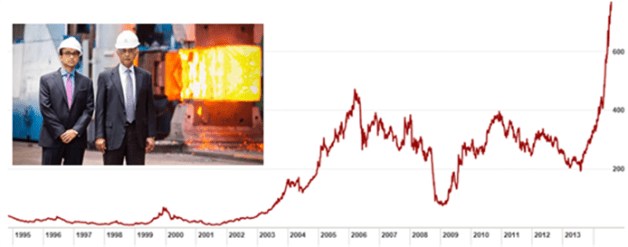
image012

Bharat Forge (BHFC IN) – Stock Price Performance, 194-2014


<Article snipped>


Can Bharat Forge follow the growth trajectory of Precision Castparts Corp (PCP), which we highlighted in an earlier article Can Asia Produce a Precision Castparts, a 1,000x Compounder? PCP grew from a small metal casting workshop to become one of the best compounders in American capital history, up over 1,700x in three decades plus to a global giant with a market cap of $34.7 billion. Bharat Forge believed…


<Article snipped>


Speed and the agility advantage is of essence (兵贵为神速) to be ready and fit for growth, as we shared with the MD of the Singapore innovator. The story of Napoleon and George Washington are worth savoring.


For thousands of years, war had been fought in essentially the same way: the commander led his large and unified army into battle against an opponent of roughly equal size. He would never break up his army into smaller units, for that would violate the military principle of keeping one’s forces concentrated; furthermore, scattering his forces would make them harder to monitor, and he would lose control over the battle. Suddenly, Napoleon changed all that. In the years of peace between 1800 and 1805, he reorganized the French military, bringing different forces together to form the Grande Armée, 210,000 men strong. He divided his army into several corps, each with its own cavalry, infantry, artillery, and general staff. Each was led by a marshal general, usually a young officer of proven strength in previous campaigns. Varying in size from 15,000 to 30,000 men, each corps was a miniature army headed by a miniature Napoleon. The key to the system was the speed with which the corps could move. Napoleon would give the marshals their mission, then let them accomplish it on their own. Little time was wasted with the passing of orders back and forth, and smaller armies, needing less baggage, could march with greater speed. Instead of a single army moving in a straight line, Napoleon could disperse and concentrate his corps in limitless patterns, which to the enemy seemed chaotic and unreadable. This was the monster that Napoleon unleashed on Europe in September 1805. Similarly, George Washington let his young leaders make their own strategic decisions in the field – capitalizing on the speed and agility advantage they had over their larger and better-trained competitors.


Understand: the future belongs to Swadeshi countries and innovators who are fluid, fast, and nonlinear. Your natural tendency as a leader may be to want to control the group, to coordinate its every movement, but that will just tie you to the past and to the slow-moving armies of history. It takes strength of character to allow for a margin of chaos and uncertainty – to let go a little – but by decentralizing your army and segmenting it into teams, you will gain in mobility what you lose in complete control. Give your different corps clear missions that fit your strategic goals, then let them accomplish them as they see fit. Smaller teams are faster, more creative, more adaptable; their officers and soldiers are more engaged, more motivated. By making officers and soldiers feel more creatively engaged, this strategy improved their performance and sped up the decision-making process. In the end, fluidity will bring you far more power and control than petty domination. With the transformational Swadeshi process which leverages on internal capabilities to exploit external opportunities with fluidity and speed, the wide-moat Bamboo Innovator is able to master the art of riding the powerful waves and staying resilient in crisis to compound value in uncertain times.


Warm regards,

KB

Managing Editor

The Moat Report Asia

www.moatreport.com

SMU: http://accountancy.smu.edu.sg/faculty/profile/108141/Kee%20Koon%20Boon


To read the exclusive article in full to find out more about the story of Bharat Forge, please visit:


The Moat Report Asia
 

“In business, I look for economic castles protected by unbreachable ‘moats’.”

– Warren Buffett


The Moat Report Asia is a research service focused exclusively on competitively advantaged, attractively priced public companies in Asia. Together with our European partners BeyondProxy and The Manual of Ideas, the idea-oriented acclaimed monthly research publication for institutional and private investors, we scour Asia to produceThe Moat Report Asia, a monthly in-depth presentation report highlighting an undervalued wide-moat business in Asia with an innovative and resilient business model to compound value in uncertain times. Our Members from North America, the Nordic, Europe, the Oceania and Asia include professional value investors with over $20 billion in asset under management in equities, secretive global hedge fund giants, and savvy private individual investors who are lifelong learners in the art of value investing.


Learn more about membership benefits here: http://www.moatreport.com/subscription/


  • Individual subscription at $1,994 per year:

https://www.moatreport.com/individual-subscription/?s2-ssl=yes


Our latest monthly issue for the month of August investigates an Asian-listed company who’s the leading ecommerce group in its home country with the complete platform coverage in the Amazon-type of B2C ecommerce of selling directly to end consumers (Sales/Net Profit: 90%/78%), Rakuten-type of B2B2C platform (Sales/Net Profit: 4%/12%) to support the online SME merchants who in turn sell to the end consumers, and the eBay-type of C2C auction site (Sales/Net Profit: 2%/21%) where individuals buy and sell to one another. This “Amazon-Alibaba” is highly profitable with recurring free cashflow (FCF yield 4.6-5% compounding at 25% in the next 3-5 years) by pioneering the world’s-first 24-hour delivery promise and guarantee when world-class logistics experts said it cannot be done. In emerging markets and Asia where logistics costs is 15-20% of GDP, most ecommerce companies fail to scale up due to lack of fulfillment capabilities and inventory risk became the killing blow as they pursue growth without the intangible know-how. The company designs and builds its own warehouses to provide fast and efficient delivery with 99.68% on-time rate and also complete backend services to suppliers, widening the gap between itself and peers. With its superior infrastructure, the company is able to provide consumers a one-stop shopping experience with all goods purchased from different vendors packaged into a single box and delivered to the client’s door. The company has consignment agreements with suppliers which allow it to have control over inventory management but carry no liability of inventory on its balance sheet, in other words, there is minimal inventory risk for the company to scale up sustainably and without the usual accounting risks that plagued the ecommerce companies.


With (1) a superior ROE of 23.6% due to its wide-moat business model in 24-hour delivery system, (2) negative cash conversion cycle (-29 days) in its unique warehouse system with minimal inventory risk, (3) a sustained 25-30% recurring earnings and cashflow growth per annum in the next 5 years, especially a long run-way in disrupting traditional retailers, and (4) potential exponential growth in its option value in the third-party electronic payment business, the company can scale up multiple times. Short-term downside risk is protected by its healthy$128m net-cash balance sheet (15% of MV) and proven management execution in prudent capex expansion to support sustainable quality earnings growth. Its terminal value and long-term downside risk will be protected by giants Alibaba, Rakuten, eBay, Amazon who wish to swallow it up to possess its valuable trust and brand equity support it enjoys and its wide-moat business model in 24-hour delivery system. The company is one of the few Asian ecommerce companies with good governance and low accounting risks with its net-value revenue recognition method and it deserves a valuation premium. Upcoming deregulation in third-party electronic payment with the passing of the law in Sep 2014 will result in various government restrictions to be removed, paving the way for the company to introduce stored-value payments, O2O payment, P2P payment (money transfer without transactions), multiple currencies’ payments, big data analysis, payment services for customers outside the group to boost transaction volume and scale up its existing proprietary PayPal/AliPay businessLed by the inspiring and highly-determined founder and Chairman who established and listed the company in 1998 and 2003 respectively, the company has overcome the multiple obstacles to ecommerce transactions in its home market. The founder described the obstacles to ecommerce transactions as ‘friction’, and that he “resolve to take on the Life’s Task to reduce this ‘friction’”.


Our past monthly issues examine:


  • An Asian-listed company who’s the global #1 and #2 maker of two types of patient monitoring devices for both clinical- and home-use. Founded in 1981 and listed in 2001, the company’s reliable manufacturing technology platform for over 30 years has enabled it to build a global durable franchise in the niche patient monitoring device market that has stable resilient growth and yet is experiencing potential disruptions led by its new innovation. A secret to its success is its in-house capabilities to combine Swiss design, high-precision electronics and sensors components with clinical healthcare to produce world-class products with cost competitiveness. The firm has competitive technology and patents especially its core competence of having an algorithm to allow fast reading/filtering of signals and outputting the accurate results in a short period of time. Thecompany has the potential to consolidate the market further. The company is also a sticky ODM partner to reputable companies including Wal-Mart, Costco, CVS and it has adiversified customer base with none of the customers accounting for more than 10% of its sales. The company demonstrated that it has bargaining power over its powerful customers with the ability to build its own brand since 1998 (62% of overall sales). 91% of its sales are to developed markets in US and Europe. The company is trading at EV/EBIT 9.7x and EV/EBITDA 8.8x and has an attractive dividend yield at 5.6% and a strong balance sheet with net cash as percentage of market value and book equity at 23% and 47% respectively. The firm has also undertaken the unusual capital management program to reduce 10% of its shares outstanding in Sep 2012 to boost capital efficiency by utilizing the comfortable net cash position. The proactive shareholder-friendly stance backed by its strong net cash position should limit any downside in share price. The company’s terminal value and downside risk will be protected by giants such as J&J, Bayer, Abbott etc who wish to swallow it up to possess its valuable manufacturing technology platform and worldwide patents in algorithm-technology. The company’s worldwide patents in algorithm-technology has been commercialized into an innovative product series that is at the heart of its total solution service business model. This valuable intangible asset is not factored into long-term valuation. The innovative product with the algorithm measurement technology are not merely additional features; it “forces” the clinical community to adopt them as the standard, which in turn helps drive home-use penetration as patients seek a consistent and integrated healthcare experience. It transforms the product into a unique strategy that incorporates software development to create value-added services for health monitoring and collaborating with hospitals and governments on tele-healthcare projects. As a result of its wide-moat, the company has a far superior ROE at 20.9% that is nearly double that of its key giant conglomerate rival. When we compare EV/EBIT relative to ROE and ROA, the company is cheaper by as much as 120-150% when compared to its key giant conglomerate rival. The stock price of the company is down nearly 20% from its recent high in end March 2014 on profit-taking by short-term investors. Share price is back to May 2013 level, representing an attractive opportunity to take position in this long-term durable franchise. The stable long-term shareholdings and patient capital by the founder and the management team who together own around 48% of the equity has enabled the firm to adopt a very long-term approach to building its business and cultivating new growth areas. While he may sometimes be slightly over-optimistic and thinking too far ahead with his long-term opinions, this  idealistic engineer-visionary-philosopher has done a fantastic job in continuously defying the odds of many skeptics by growing the company from a small startup into one of the world’s leading patient monitoring equipment company. He is the rare Asian entrepreneur who was persistent in building his own brand despite the threat of offending his ODM customers. He was also early in cultivating and coordinating a global network with high-tech component, R&D and manufacturing in his home country, manufacturing, assembly and packaging in Shenzhen, China and medical R&D and clinical testing center in Europe, including making the difficult decision to establish a direct marketing sales force in Europe and North America given the high cost. Unlike most Asian business owners whose interest and focus in the core business starts to wane due to complacency from growing personal wealth and the inability to scale the core business, the founder is genuinely passionate in the company’s ability to add value to the patients and society. The firm can effectively run without the founder with the long-term corporate culture and management system in place, yet he can inject great value as the steward in new innovations; we believe that this combination is rare for an Asian company and deserves a valuation premium.


  • The world’s #1 ODM (Original Design Manufacturer) and global #5 manufacturer of a consumer healthcare device product that is used frequently, even daily, thus providing the foundation for stable recurring cashflow. This company is also a hidden champion in a niche product segment (50-55% of group’s sales) that has become a high-growth fashion product currently accounting for less than 10% of the overall industry. The company is able to mass-manufacture this niche product, but not the giants, because of its unique process IP in flexible manufacturing system and know-how to handle large-scale complex orders. The manufacture of this product itself is difficult to replicate and requires FDA/CE licenses because of its medical device nature and the entry barrier is not capital but the know-how and R&D expertise. In particular, the manufacturing integrates different fields of science including polymer chemistry, physics, optics, engineering, materials control, process control, microbiology, and, injection molding. The firm has also developed a proprietary system of tracking the manufacturing process of different sets of product so that if a quality issue arose, when and where the problem set of products was being produced could be swiftly identified, thus diminishing the scale and cost of product recall. This system has helped the firm win the long-term trust of its ODM customers to place stable large orders. The Big Four giants do not have such a system and have to incur substantial losses from product recalls. The company also possess its own brand which has many loyal followers and support in its home market where it enjoys a 30% market share and contributes to 25% of group’s saleswhile sticky ODM customers account for 75% of group’s sales, mainly from the Japan market. As a result of its wide-moat advantages, the firm enjoys a consistently high ROE of 41%, double or triple that of the giants. From FY07 onwards, even during the depths of the Global Financial Crisis in 2007/09, the firm has not raised equity. Since listing in Mar 2004, the company has only done one rights issue in May 2005. Also, it is able to sustain a strong stable cash dividend payout (>70% with 3% yield) with its healthy net-cash balance sheet (net cash $30m; net cash-to-equity ratio 23%) and proven management execution in prudent capex expansion to support sustainable quality earnings growth. M&A deals in the healthcare and medical device sector has been growing due to their strong defensive nature and giants seeking growth to overcome their own patent cliff. The firm willalways be an attractive takeover target by giants who wish to swallow it up to possess its valuable flexible manufacturing system and know-how to fill their own missing competency gap and hence will enjoy long-term downside protection in its terminal value. In the battle between “ODM vs Brand”, we find the story of the company to be quite similar to that of TSMC (2330 TT, MV $103bn), now the largest ODM foundry in the world. “Skate to where the puck is going to be, not where it has been,” as hockey legend Wayne Gretzky advised. In our view, the profit and valuation premium in the value chain will start to skate to the “Inno-facturers” who are the hidden ODM innovators (the brand behind brands) consolidating the industry, such as TSMC and this company. While its valuation is not cheap with EV/EBIT (FY13) at 20.6x, when we compare EV/EBIT relative to ROE, the company is relatively cheap, by as much as 130-220% when compared to giants and other comparables. When we compare EV/EBITDA relative to ROE, the valuation gap is 90-160%. This long-term valuation gap implies that the company, with its far superior and sustainable ROE, could potentially double to $2.4bn, as it continues to consolidate its niche product segment and enter into a new product cycle of an innovative product whose patents are expiring in 2014/15 (US/worldwide) to make ASP/margin improvements in sustaining quality profits and cashflow. Its share price has dropped 18% from its recent high and underperformed the index by 26% in the last six months. This will present a buying opportunity for long-term value investors who can penetrate beyond conventional valuation metrics because of a deep understanding of its business model and underlying source of its wide-moat advantages. In Asia, many firms break apart or become value traps due to shareholder conflict, envy and differences in opinion on the business direction of the company. The stable long-term corporate culture infused by the late founder, who established the company in 1986 with the current executive chairman and 2 other key shareholders, to combine the energy and ideas of everyone to work hard to keep the business running forever is underappreciated.


  • The Home Depot of Asiawhich has the largest market share in its home country and now seeks to expand regionally. It is one of the few home improvement retailers in the world which is able to achieve a structural negative cash conversion cycle (CCC) at -39 days for resilient, recurring and sustainable operating cashflow to enable the expansion of its store network while keeping a healthy balance sheet. It is hard to achieve negative cash conversion cycle (CCC) as a home retailer as compared to a supermarket retailer as the product nature is more durable. Even Home Depot, Lowe’s and Bed Bath & Beyond (BBBY) are not able to achieve a negative CCC. Led by the capable owner-operators since 1995, the company is a pioneer in proactively creating awareness and demand in the minds of consumers that upgrading your home can be fun and in incremental affordable steps. Its creative branding has resulted in the firm to become the “first on customers’ mind”, or what Charlie Munger elucidated as the “psychological wide-moat” advantage. 80% of sales are generated customers looking for home improvement and renovation ideas and solutions.  Growth is supported by the management’s proven ability to identify and cater to dynamic changes in customer preferences. The firm’s comprehensive pre and aftersales service creates brand loyalty and sustains long-term sales. The merchandizing management is tailored to the peculiarities of customer preferences in each area to drive same store sales growth with creative customization by store, location, season and events. Its key strategy to expand its profit margin is to increase its higher-margin house brands and product-mix management. Its EBITDA/sqm of $400/sqm was higher than Home Depot until Home Depot experienced a rebound last year to $500/sqm. The firm’s resilient sales are supported by its unrivalled network of diverse locations throughout the country. Its bold vision and successful “Blue Ocean” execution in the highly fragmented second-tier markets has created a powerful wide-moat advantage that will last for many years to come. In short, the management have proven their ability to execute in difficult market and industry conditions especially in the past 5 to 7 years during the 2007/09 global financial crisis with the firm emerging much stronger. The Illinois Institute of Technology engineering graduate and quiet billionaire owner behind the home retailer is one of the few Asian business tycoons who has the thirst to scale up the business in a sustainable way, as opposed to opportunistic ventures, having been largely influenced by his early years experience observing the success of American wide-moat firms. If we can adjust the EV/EBITDA valuation metric to reflect the CCC, the company’s EV/EBITDA of 18.5x will be lower at 10-11x, while Home Depot’s EV/EBITDA 11x will be higher at 13x. Noteworthy is that Home Depot has a negative free cashflow throughout FY1989-2001 (13 consecutive years!) and yet market cap has climbed from $1.5bn to $103bn. Home Depot compounded despite the ugly valuations during the capex ramp-up. This once again highlights that the power of wide-moat is often underappreciated, misunderstood and overlooked. When Home Depot generated $180m in operating cashflow in FY1992, quite similar to this Asian firm now, Home Depot is valued at $5bn (vs $3bn). Store network is expected to double in the next 4-5 years, representing a potential doubling in market value.


  • The Northeast Asian-listed companywho is the world’s largest maker of an essential component with applications in apparel, shoes, diapers, car seats etc. All top 20 global athletic shoe brands, including Nike, Adidas, Reebok, Sketchers, UnderArmor are customers and this Asian innovator with R&D capabilities has forged long-term “spec-in” partnerships with them. Its broad product offering is protected by over 110 patents. By locating its Pan-Asian production plant network in China, Taiwan, Vietnam and Indonesia close to its major clients, including sales/customer service centers and warehouses in US and Europe, the firm is better positioned to understand their requirements, deliver fast and meet their needs. While top 10 athletic shoe brands account 40% of its revenue, the firm has a diversified clientele base of over 10,000 customers, giving it resilience and growth with both the established and emerging brands as clients. The company is trading at PE14e 12x, EV/EBITDA 7.1x and EV/EBIT 10.6x with a dividend yield of 3.9%. Interestingly, its EBITDA margin is double that of Adidas and its 8.7% net margin is higher than Adidas’ 5.4%, though below Nike’s 9.8%. Given the tipping point of its Pan-Asian production network and contributions from its new products and as capex tapers off in the next few years, free cashflow could be around $50-60m and applying a P/FCF of 15x would yield a market value of $750-900m,, representing a potential upside of 100-150%. Thus, the firm offers a similar quality growth trajectory to Nike/Adidas with its unique knowledge-based business model and yet trades at a more attractive valuation and higher dividend yield as downside protection.


  • The Middleby of Asia commanding a dominant market share of over 80% in hypermarkets, 50% in chain outlets, 30% in 4- to 5-star hotels in China and an overall 30% in its home market. Yet, no single customer accounts for more than 5% of its revenue. Just to recall for value investors, NYSE-listed Middleby, with its sleepy and boring business, has compounded 100-fold from around $50m to $5.7bn since its tipping point in 1999. The founders of this Asian family business demonstrated clear dedication in building up the company with its wide-moat business model backed by a strong and unique distribution/marketing network in finding, winning and binding new customers to build massive brand equity and long-lasting relationships with clients over time. Their devotion to its core product for nearly 20 years results in maximum problem-solving skills, innovative strength and product leadership and hence, to ever greater customer benefit that will protect the company to consolidate the fragmented market and provide ample opportunities to continue its profitable growth. The company is currently trading at PE13e 15.8x and an undemanding EV/EBIT 10.1x and EV/EBITDA 9.5xand its growth potential based on its unique business model is not priced in. There is a structural re-rerating of niche business models with (1) diversified client base, (2) steady revenue streams, (3) lean capex requirements that creates ample free cashflow and defensive growth. Based on PE, P/CFO and EV/EBIT, the company is trading at a 40-50% discount to the foreign listed comparables despite more efficient use of assets in generating profits and cashflow. It has an attractive 7% earnings yield growing at 20% over the next 3-5 years and a 3.8% dividend yield that is supported by its strong cashflow generation ability, steady revenue stream and lean capex requirements to limit downside risks in valuation. Based on the growth plans to penetrate new product and customer segments; build its third plant in India in addition to the ones in its home market and in China; and potential bolt-on acquisition opportunities with its healthy balance sheet in net-cash position, it has the potential to double its operating cashflow in the next 3-5 years and market value could double, representing an upside potential of 100-140%.


  • An emerging Asian Walgreens which is a top 3 community pharmacy operator in its home market. Walgreens is a classic neglected American compounder up over 272-fold to $54 billion from under $200m as it quietly consolidates the market. Over the decade, we observed that it is difficult to scale services-based businesses without an entrepreneurial mindset, committment and execution and the bold and unique management system of the company since 2000 allowed the pharmacists to be part-owner of the business which will lead to increased level of commitment and an owner’s mindset in growing the business for the long-term in the community. The firm has strong cash generation ability due to its negative cash conversion cycle (CCC) in the business modelto help the business stay resilient during difficult times and to fund capex needs internally without straining the business model scalability as the network expands. The centralized logistics system provide regular deliveries to all of its community pharmacies enables the outlets to maximize retail space without the need to have space to keep stocks. This also enables the community pharmacies to optimize retail space to carry a wide range of products which is important as consumers increasingly have top-of-mind recall for the company as the destination to go to for their healthcare needs. Like Walgreens, the company believed in the power of embedding technology into the business model to better compete and its financial and warehousing/inventory management systems are integrated with its in-house POS (point-of-sale) system which is linked among all its community pharmacies and head office via virtual private network. The company is founded by five college friends who were somewhat frustrated that their pharmacy degrees were underappreciated and under-rewarded as compared to their medical degree counterparts even though they had studied hard for 4-5 years and had in-depth medical knowledge. They were eager to prove themselves that they are as capable, if not more so. This restless spirit to prove their capabilities resulted in them coming together to be entrepreneurs and they wish to provide the platform for similar restless pharmacists to apply their hard-earned knowledge acquired in the university. We find that this common purpose and camaraderie spirit is rare in Asian companies and makes the company unique to scale up sustainably. The company is currently trading at a EV/EBIT of 13.9x and EB/EBITDA 12.6%. In the next two to three years as the company expands its network of outlets, operating cashflow (CFO) could increase 50-60% and a re-rerating could result in a doubling in market value.


  • An Asian-listed pharmaceutical company which has a dominant franchise in a neglected but growing diseaseand is a leader with a domestic market share of 49% in this niche segment and is the only fully-integrated player amongst the few pre-qualified WHO firms, giving it >30% EBITDA margin, better pricing power compared to the competition, and significant advantage over other players in ramping up the global business from the current 30% market share in the most-common treatment drug (vs Novartis 50%). Furthermore, the pharma company has the second-highest GP/TA (gross profit/ total asset) ratio in the industry at 56.3% and the most conservative accounting practice in the industry which “depresses” earnings relative to its peers i.e. it is the only domestic firm which expenses, and does not capitalize, all R&D. With the new plant for formulations export to US, the deepening of the niche drug franchise, growing wins in chronic pain and other niche areas and the commercialization of the potential blockbuster product of blood thinner by FY16/17, EBITDA could potentially double to $200m in the next 4-5 years, triggering a valuation re-rating to a market value of $3.4bn, a 130% upside.


  • An Australian-listed company with market value $405m, EV/EBITDA 7.5x, EV/EBIT 10x, div 3%, 70% domestic market sharewhose management made the controversial bold decision to stop overseas exports in order to focus on cultivating the higher-margin domestic market with innovative marketing strategy and new products and is potentially doubling its supply in the next 3-5 years. It is in its 10th year of listing after piling the foundation in consolidation, investment, rationalization for its next stage. It has an all-time low debt-equity position 18.6% with healthy balance sheet. “Buffett of Nordic” recently increased position between Apr-Sep this year in the peer comparable of the company and the billionaire investor announced in Nov an acquisition of a rival in a wave of global consolidation and with the view on a sustained recovery in product prices.


  • Northeast Asia-listed company with global #1 market share leadership in 4 different products, including making the components for an innovative consumer product whose sales have climbed from $90 million to $526 million in the recent three years. The company is a hidden global consolidator with underappreciated growth. The stock is trading at PE 11.5x, EV/EBITDA 9x and generates a sustainable dividend yield 5.75%.


  • Taiwanand Southeast-Asian-listed entrepreneurial company, both with a dominant 80% domestic market share and have innovative business models to generate substantial cashflow to support both expansion and a 4-5% dividend yield.


  • There is also a behind-the-scene conversation with the CEOsof the companies to understand their thinking process in building up the business.


The Moat Report Asia Members’ Forum has been getting penetrating quality dialogues from our subscribers.Questions range from:


  • The nuances of internal dealings in Asia, including the case discussion of the recent deal in which HK billionaire’s Lee Shau-kee Henderson Landacquiring Towngas or Hong Kong & China Gas (3 HK) from his family holdings, seemingly déjà vu from the early Oct 2007 transaction when the market peak.
  • The case of F&N Singaporespinning out its property unit FCL Trust and getting “free” special dividend-in-specie and the potential risk in asset swap restructuring to deleverage the hidden debt in the entire Group balance sheet.
  • The dilemma of whether to invest in a Southeast Asian-listed company and hidden champion with a domestic market share of 60% due to family squabbles and a legal suit over the company’s ownership.
  • Discussion of the wise and thoughtful 107-year-old Irving Kahn’s investment into a US-listed but Hong Kong-based electronics company with development property project in Shenzhen’s Qianhai zone and the possible corporate governance risks that could be underestimated or overlooked, as well as their history of listing some assets in HK in 2004.. This is also a case study of “buy one get one free” in John’s highly-acclaimed book The Manual of Ideasin which the “free” property is lumped together with the (eroding) core business to make the combined entity look cheap and undervalued. What are the potential areas that value investors need to watch out for when adapting the SOTP (sum-of-the-parts) valuation method in Asia?
  • And many more intriguing questions.


Do find out more in how you can benefit from authentic and candid on-the-ground insights that sell-side analysts and brokers, with their inherent conflict-of-interests, inevitable focus on conventional stock coverage and different clientele priorities, are unwilling or unable to share. Think of this as pressing the Bloomberg “Help Help” button to navigate the Asian capital jungle. Institutional subscribers also get access to the Bamboo Innovator Index of 200+ companies and Watchlist of 500+ companies in Asia and the Database has eliminated companies with a higher probability of accounting frauds and  misgovernance as well as the alluring value traps.


Professional Development Workshops for Executives and Lifelong Learners
 

Our 8th run of the series of workshop From the Fund Management Jungles: Value Investing Exposed and Explored– (Part 1) Moat Analysis, (Part 2) Tipping Point Analysis and (Part 3) Detecting Accounting Fraud – on 14 June 2014 has been well-received with serious value investors, professionals, and serious lifelong learners attending, with some who flew in from Jakarta and KL!..


Our 9th workshop will be on Detecting Accounting Fraud Ahead of the Curve sometime later in the year.


Thank you for your support all this while!


Thank you so much for reading as always.


Warm regards,

KB Kee

Managing Editor

The Moat Report Asia

Singapore

Mobile: +65 9695 1860


A Service of BeyondProxy LLC

1608 S. Ashland Avenue #27878

Chicago, Illinois 60608-2013

Other offices: London, Singapore, Zurich


P.S.1 Here is a little more about my background:

KB Kee has been rooted in the principles of value investing for over a decade as an analyst in Asian capital markets. He was head of research and fund manager at a Singapore-based value investment firm. As a member of theinvestment committee, he helped the firm’s Asia-focused equity funds significantly outperform the benchmark index. He was previously the portfolio manager for Asia-Pacific equities at Korea’s largest mutual fund company.


He holds a Masters in Finance and degrees in Accountancy and Business Management, summa cum laude, from Singapore Management University (SMU) and had also published articles on governance and investing in the media, as well as published an empirical research paper Why ‘Democracy’ and ‘Drifter’ Firms Can Have Abnormal Returns: The Joint Importance of Corporate Governance and Abnormal Accruals in Separating Winners from Losers in the Special Issue of Istanbul Stock Exchange 25th Year Anniversary Best Paper Competition, Boğaziçi JournalReview of Social, Economic and Administrative Studies, Vol. 25(1): 3-55. KB has also presented his thought leadership as a keynote speaker in global investing conferences. KB has trained CEOs, entrepreneurs, CFOs, management executives in business strategy, value investing, macroeconomic, industry trends, and detecting accounting frauds in Singapore, HK and China, and had taught accounting at the SMU where he is currently an adjunct lecturer.


P.S.2  Why do I care so much about doing The Moat Report Asia for you?

My personal motivation in embarking on this lifelong journey has been driven by disappointment from observing up close and personal the hard-earned assets of many investors, including friends and their families, burnt badly by the popular mantra: “Ride the Asian Growth Story!” I witnessed firsthand the emotional upheavals that they go through when they invest their hard-earned money – and their family’s – in these “Ride The Asian Growth Story” stocks either by themselves or through money managers, and these stocks turned out to be the subject of some exciting “theme” but which are inherently sick and prey to economic vicissitudes. They may seem to grow faster initially but the sustainable harvest of their returns is far too uncertain to be the focus of a wise program in investment. Worse still, the companies turned out to be involved in accounting frauds. Their financial numbers were “propped up” artificially to lure in funds from investors and the studiously-assessed asset value has already been “tunnelled out” or expropriated. And western-based fraud detection tools and techniques have not been adapted to the Asian context to avoid these traps.


After a decade-plus journey in the Asian capital jungles, it has been somewhat disheartening as I observe many fraud perpetrators go away scot-free and live a life of super luxury on minority investors’ hard-earned money. And these perpetrators make tempting offers to various parties in the financial community to go along with their schemes. When investors have knowledge in their hands, we have a choice to stay away from these people and away from temptations and do the things that we think are right. With knowledge, we have a choice to invest in the hardworking Asian entrepreneurs and capital allocators who are serious in building a wide-moat business.


CONNECT WITH US image004image005image007image006
MOAT REPORT ASIA    OUR TEAM    SUBSCRIBE    MEMBERS    CONTACT US

The Moat Report Asia
A Service of BeyondProxy LLC
1608 S. Ashland Avenue #27878
Chicago, Illinois 60608-2013

Other offices: London, Singapore, Zurich


“Choinomics” and Implications of Corporate Tax Policies in Asia for Value Investors

 image001

“Bamboo Innovators bend, not break, even in the most terrifying storm that would snap the mighty resisting oak tree. It survives, therefore it conquers.”

BAMBOO LETTER UPDATE | August 11, 2014
Bamboo Innovator Insight (Issue 45)

  • The weekly insight is a teaser into the opportunities – and pitfalls! – in the Asian capital jungles.
  • Get The Moat Report Asia– a monthly in-depth presentation report of around 30-40 pages covering the business model of the company, why it has a wide moat and why the moat may continue to widen, a special section on “Conversation with Management” to understand their thinking process in building up the business, the context – why now (certain corporate or industry events or groundbreaking news), valuations (why it can compound 2-3x in the next 5 years), potential risks and how it is part of the systematic process in the Bamboo Innovator Index of 200+ companies out of 15,000+ in the Asia ex-Japan universe.
  • Our paid Members from North America, Europe, the Oceania and Asia include professional value investors with over $20 billion in asset under management in equities, some of the world’s biggest secretive global hedge fund giants, and savvy private individual investors who are lifelong learners in the art of value investing.
 

“Choinomics” and Implications of Corporate Tax Policies in Asia for Value Investors


“The hardest thing to understand in the world is the income tax.”

– Albert Einstein


“In this world nothing can be said to be certain, except death and taxes.”

– Benjamin Franklin


“The income tax created more criminals than any other single act of the government.”

– Barry Goldwater (1909-1998), the late United States senator and Presidential nominee


Over the five years prior to its bankruptcy, Enron reported $13bn of income to investors, and $63m to the tax authorities: A 200-to-1 book-tax difference (BTD). The unravelling of Chinese accounting frauds often reveal the grave inconsistency of the revenue and profit numbers in the financial statements and in the tax filings to the Chinese authorities in a “two-book” system. The BTD measure, to be elaborated later, is an overlooked tool to detect accounting fraud, tunneling/expropriation and earnings management risks.


The focus on legal institutions has been helpful in explaining cross-country variation in capital market developments, dividend policies, capital allocation, firm valuation, and insider private control risks. However, extra-legal institutions, specifically tax policies, have the potential to expand our current knowledge about corporate ownership and control structures and their associated agency costs.  The role of extra-legal institution in mitigating corporate governance risks and limiting insider income management and tunnelling/ expropriation has come to the forefront of the investing landscape in Asia with the controversial tax code revision plan unveiled on Aug 6 by Korea’s deputy prime minister and finance minister Choi Kyung-hwan to buttress the $40bn “Choinomics” stimulus plan.

image003-2

A cornerstone of the tax reform plan is the taxing of the excess corporate cash holdings of companies with the intent to induce companies to tap cash reserves to pay higher dividends, raise wages or invest to boost household income. Finance Ministry data show South Korea’s ratio of dividends as percentage of profits in 2013 was 21.1% – about half the world average. The ratio is 34.6% in the U.S., 30.1% in Japan, 55.1% in France, and 43.3% in Germany. Korea now followed the steps of Taiwan who currently imposes a punitive tax on enterprises with excessive idle funds, a move intended to encourage enterprises to release more dividends to shareholders and attract more international capital.


The new tax code aims at imposing 10% on companies that do not spend 60 to 80% of their corporate income on investment, dividends and salaries. The new tax code will be applied for three years for corporate income to be generated from 2015. Tax on corporate cash holdings targets companies whose equity capital exceeds W50bn ($48.5m). SMEs will be excluded from the tax code. Around 4,000 companies will be subjected to the new code. 200 KOSPI-listed firms have to pay a combined W331.2bn in tax. To avert the tax burden, they have to spend around W3.3tr ($3.1bn), 10 times higher than the tax, for dividends, investments and wages. Of 200 KOSPI-listed companies, 46 are subject to tax on excess corporate cash holdings. The internal reserves, including cash and cash equivalents, of South Korea’s top 10 enterprises totalled W341tr at the end of 2013. It is estimated that the top 10 conglomerates would have to pay up to W1.1tr ($1.07bn) in extra taxes under the new plan. Samsung Electronics (KOSPI: 005930 KS, MV $178bn) is at the top of the list, with an extra annual tax bill of $360m, though in 2013, it spent roughly 85% of its W30.5tr net profit on capital expenditures and dividend payments, exempting it from the additional taxation. The key to determining the hit on these large companies is whether overseas investment would count toward the expenditure target. The Finance Ministry had not yet decided whether to distinguish between investment in South Korea and investment that occurs overseas. More than half of Samsung’s capex were spent overseas.


Some of the unintended ills of this tax policy will be companies mal-investing in real estate or other forms of liquid assets to avoid the punitive tax. Korean business leaders have not demonstrated a good track record in capital allocation. It will be critical for the government to restrict the investments in the tax plan to productive capex, R&D and innovation to widen the economic moat.


Perhaps this tax policy can also mitigate the governance risk of Asian controlling shareholders, such as the case of Satyam’s Ramalinga Raju with the “missing” billion dollar cash, from tunnelling or expropriating cash through related-party transactions hidden under the opaque group business structure. Many value investors are attracted to invest in the Asian companies with high net cash in the balance sheet, and some even tried the activist approach to force the owners to disburse the cash through dividend payouts or share buybacks. However, the net-cash in the balance sheet could be a case of “cash equivalent” that are promissory notes or short-term loans to related companies (repayable in say 20 days and classified by the auditors as “cash equivalent”) which are rolled forward and never repaid. It will be interesting to assess the impact of this new tax policy on the performance and valuation of Korea companies.


As was pointed out in one of our previous Weekly articles (Willingness to be Misunderstood and the Swedish Corporate Model to Scale an Asian Wide-Moat Compounder: The Story of “Korea’s IKEA” Hanssem), we have been intrigued by the Swedish tax system whereby tax rules that regulate cashflows within the business pyramid substitute for weak minority protection and limits incentives for outright stealing (expropriation/ tunneling) that is prevalent in Asian firms. In essence, Swedish holding company’s…


<Article snipped>


The tax reforms in Korea and Taiwan also reminded us of what the grandmaster in accounting researcher Ray Ball had boldly argued in his Journal of Accounting & Economics paper “Incentives versus Standards: Properties of Accounting Income in Four East Asian Countries”. Ball commented that the East Asian countries of Hong Kong, Malaysia, Singapore and Thailand have accounting standards that are generally viewed as “high-quality” as their standards derive from common law sources that are viewed as higher quality than code law standards, but they have institutional structures that give preparers incentives to issue low-quality financial reports. Thus, it is misleading to classify countries by standards (the “form”), ignoring incentives (the “substance”). Transparency ratings, such as PwC’s “opacity index” (which ranks Singapore higher than US and Britain), are largely based on standards.


… In the table below… countries with high earnings management include Indonesia, Malaysia, India, Germany and Greece. We like to point out that Thailand is the only country with…

image009-2

BTC = Book-tax conformity index; Dacc = Discretionary accruals; Discacc = Discretionary current accruals; Disrev = Discretionary revenue; EMA = Aggregate earnings management index; TP = Tax avoidance index; TPA = Aggregate tax planning index


<Article snipped>


The School of Accountancy of the Singapore Management University (SMU) has recently partnered with the Tax Academy of Singapore (TA) to launch the SMU-TA Centre for Excellence in Taxation (CET) to produce impactful research in international and regional tax issues for policy development.


To guarantee a form of corporate governance that is capable of sustaining long-term value creation, it is critical that firm performance is reported in a true and fair manner so that external stakeholders can monitor their claims and exercise their rights. We hope that future tax research in accounting led by SMU-TA CET can broaden our thinking by integrating the multi-disciplines of economics and finance and incorporating the effects of firm-level corporate governance structures. Like Roosevelt who eliminated the pyramid business group structure by applying double taxation to intercorporate dividends, we look forward to the tax authorities in Asia acting as the additional governance mechanism for the firm in an integral part of the extra-legal institutional fabric. Hopefully, minority investors in Asian companies will suffer less of the abuse of the prevalent tunneling and expropriation risks enacted by the controlling shareholders.


Warm regards,

KB

Managing Editor

The Moat Report Asia

  1. moatreport.com

Singapore Management University: http://accountancy.smu.edu.sg/faculty/profile/108141/Kee%20Koon%20Boon


To read the exclusive article in full to find out more about the BTD (boot-tax differences) measure to detect earnings management and China’s unique institutional setting for tax, as well as the implications of the tax policy in Asia for value investors, please visit:


  • “Choinomics” and Implications of Corporate Tax Policies in Asia for Value Investors, Aug 11, 2014 (Moat Report AsiaBeyondProxy)


The Moat Report Asia
 

“In business, I look for economic castles protected by unbreachable ‘moats’.”

– Warren Buffett


The Moat Report Asia is a research service focused exclusively on competitively advantaged, attractively priced public companies in Asia. Together with our European partners BeyondProxy and The Manual of Ideas, the idea-oriented acclaimed monthly research publication for institutional and private investors, we scour Asia to produce The Moat Report Asia, a monthly in-depth presentation report highlighting an undervalued wide-moat business in Asia with an innovative and resilient business model to compound value in uncertain times. Our Members from North America, the Nordic, Europe, the Oceania and Asia include professional value investors with over $20 billion in asset under management in equities, secretive global hedge fund giants, and savvy private individual investors who are lifelong learners in the art of value investing.


Learn more about membership benefits here: http://www.moatreport.com/subscription/


  • Individual subscription at $1,994 per year:

https://www.moatreport.com/individual-subscription/?s2-ssl=yes


Our latest monthly issue for the month of August investigates an Asian-listed company who’s the leading ecommerce group in its home country with the complete platform coverage in the Amazon-type of B2C ecommerce of selling directly to end consumers (Sales/Net Profit: 90%/78%), Rakuten-type of B2B2C platform (Sales/Net Profit: 4%/12%) to support the online SME merchants who in turn sell to the end consumers, and the eBay-type of C2C auction site (Sales/Net Profit: 2%/21%) where individuals buy and sell to one another. This “Amazon-Alibaba” is highly profitable with recurring free cashflow (FCF yield 4.6-5% compounding at 25% in the next 3-5 years) by pioneering the world’s-first 24-hour delivery promise and guarantee when world-class logistics experts said it cannot be done. In emerging markets and Asia where logistics costs is 15-20% of GDP, most ecommerce companies fail to scale up due to lack of fulfillment capabilities and inventory risk became the killing blow as they pursue growth without the intangible know-how. The company designs and builds its own warehouses to provide fast and efficient delivery with 99.68% on-time rate and also complete backend services to suppliers, widening the gap between itself and peers. With its superior infrastructure, the company is able to provide consumers a one-stop shopping experience with all goods purchased from different vendors packaged into a single box and delivered to the client’s door. The company has consignment agreements with suppliers which allow it to have control over inventory management but carry no liability of inventory on its balance sheet, in other words, there is minimal inventory risk for the company to scale up sustainably and without the usual accounting risks that plagued the ecommerce companies.


With (1) a superior ROE of 23.6% due to its wide-moat business model in 24-hour delivery system, (2) negative cash conversion cycle (-29 days) in its unique warehouse system with minimal inventory risk, (3) a sustained 25-30% recurring earnings and cashflow growth per annum in the next 5 years, especially a long run-way in disrupting traditional retailers, and (4) potential exponential growth in its option value in the third-party electronic payment business, the company can scale up multiple times. Short-term downside risk is protected by its healthy $128m net-cash balance sheet (15% of MV) and proven management execution in prudent capex expansion to support sustainable quality earnings growth. Its terminal value and long-term downside risk will be protected by giants Alibaba, Rakuten, eBay, Amazon who wish to swallow it up to possess its valuable trust and brand equity support it enjoys and its wide-moat business model in 24-hour delivery system. The company is one of the few Asian ecommerce companies with good governance and low accounting risks with its net-value revenue recognition method and it deserves a valuation premium. Upcoming deregulation in third-party electronic payment with the passing of the law in Sep 2014 will result in various government restrictions to be removed, paving the way for the company to introduce stored-value payments, O2O payment, P2P payment (money transfer without transactions), multiple currencies’ payments, big data analysis, payment services for customers outside the group to boost transaction volume and scale up its existing proprietary PayPal/AliPay businessLed by the inspiring and highly-determined founder and Chairman who established and listed the company in 1998 and 2003 respectively, the company has overcome the multiple obstacles to ecommerce transactions in its home market. The founder described the obstacles to ecommerce transactions as ‘friction’, and that he “resolve to take on the Life’s Task to reduce this ‘friction’”.


Our past monthly issues examine:


  • An Asian-listed company who’s the global #1 and #2 maker of two types of patient monitoring devices for both clinical- and home-use. Founded in 1981 and listed in 2001, the company’s reliable manufacturing technology platform for over 30 years has enabled it to build a global durable franchise in the niche patient monitoring device market that has stable resilient growth and yet is experiencing potential disruptions led by its new innovation. A secret to its success is its in-house capabilities to combine Swiss design, high-precision electronics and sensors components with clinical healthcare to produce world-class products with cost competitiveness. The firm has competitive technology and patents especially its core competence of having an algorithm to allow fast reading/filtering of signals and outputting the accurate results in a short period of time. Thecompany has the potential to consolidate the market further. The company is also a sticky ODM partner to reputable companies including Wal-Mart, Costco, CVS and it has a diversified customer base with none of the customers accounting for more than 10% of its sales. The company demonstrated that it has bargaining power over its powerful customers with the ability to build its own brand since 1998 (62% of overall sales). 91% of its sales are to developed markets in US and Europe. The company is trading at EV/EBIT 9.7x and EV/EBITDA 8.8x and has an attractive dividend yield at 5.6% and a strong balance sheet with net cash as percentage of market value and book equity at 23% and 47% respectively. The firm has also undertaken the unusual capital management program to reduce 10% of its shares outstanding in Sep 2012 to boost capital efficiency by utilizing the comfortable net cash position. The proactive shareholder-friendly stance backed by its strong net cash position should limit any downside in share price. The company’s terminal value and downside risk will be protected by giants such as J&J, Bayer, Abbott etc who wish to swallow it up to possess its valuable manufacturing technology platform and worldwide patents in algorithm-technology. The company’s worldwide patents in algorithm-technology has been commercialized into an innovative product series that is at the heart of its total solution service business model. This valuable intangible asset is not factored into long-term valuation. The innovative product with the algorithm measurement technology are not merely additional features; it “forces” the clinical community to adopt them as the standard, which in turn helps drive home-use penetration as patients seek a consistent and integrated healthcare experience. It transforms the product into a unique strategy that incorporates software development to create value-added services for health monitoring and collaborating with hospitals and governments on tele-healthcare projects. As a result of its wide-moat, the company has a far superior ROE at 20.9% that is nearly double that of its key giant conglomerate rival. When we compare EV/EBIT relative to ROE and ROA, the company is cheaper by as much as 120-150% when compared to its key giant conglomerate rival. The stock price of the company is down nearly 20% from its recent high in end March 2014 on profit-taking by short-term investors. Share price is back to May 2013 level, representing an attractive opportunity to take position in this long-term durable franchise. The stable long-term shareholdings and patient capital by the founder and the management team who together own around 48% of the equity has enabled the firm to adopt a very long-term approach to building its business and cultivating new growth areas. While he may sometimes be slightly over-optimistic and thinking too far ahead with his long-term opinions, this  idealistic engineer-visionary-philosopher has done a fantastic job in continuously defying the odds of many skeptics by growing the company from a small startup into one of the world’s leading patient monitoring equipment company. He is the rare Asian entrepreneur who was persistent in building his own brand despite the threat of offending his ODM customers. He was also early in cultivating and coordinating a global network with high-tech component, R&D and manufacturing in his home country, manufacturing, assembly and packaging in Shenzhen, China and medical R&D and clinical testing center in Europe, including making the difficult decision to establish a direct marketing sales force in Europe and North America given the high cost. Unlike most Asian business owners whose interest and focus in the core business starts to wane due to complacency from growing personal wealth and the inability to scale the core business, the founder is genuinely passionate in the company’s ability to add value to the patients and society. The firm can effectively run without the founder with the long-term corporate culture and management system in place, yet he can inject great value as the steward in new innovations; we believe that this combination is rare for an Asian company and deserves a valuation premium.


  • The world’s #1 ODM (Original Design Manufacturer) and global #5 manufacturer of a consumer healthcare device product that is used frequently, even daily, thus providing the foundation for stable recurring cashflow. This company is also a hidden champion in a niche product segment (50-55% of group’s sales) that has become a high-growth fashion product currently accounting for less than 10% of the overall industry. The company is able to mass-manufacture this niche product, but not the giants, because of its unique process IP in flexible manufacturing system and know-how to handle large-scale complex orders. The manufacture of this product itself is difficult to replicate and requires FDA/CE licenses because of its medical device nature and the entry barrier is not capital but the know-how and R&D expertise. In particular, the manufacturing integrates different fields of science including polymer chemistry, physics, optics, engineering, materials control, process control, microbiology, and, injection molding. The firm has also developed a proprietary system of tracking the manufacturing process of different sets of product so that if a quality issue arose, when and where the problem set of products was being produced could be swiftly identified, thus diminishing the scale and cost of product recall. This system has helped the firm win the long-term trust of its ODM customers to place stable large orders. The Big Four giants do not have such a system and have to incur substantial losses from product recalls. The company also possess its own brand which hasmany loyal followers and support in its home market where it enjoys a 30% market share and contributes to 25% of group’s saleswhile sticky ODM customers account for 75% of group’s sales, mainly from the Japan market. As a result of its wide-moat advantages, the firm enjoys a consistently high ROE of 41%, double or triple that of the giants. From FY07 onwards, even during the depths of the Global Financial Crisis in 2007/09, the firm has not raised equity. Since listing in Mar 2004, the company has only done one rights issue in May 2005. Also, it is able to sustain a strong stable cash dividend payout (>70% with 3% yield) with its healthy net-cash balance sheet (net cash $30m; net cash-to-equity ratio 23%) and proven management execution in prudent capex expansion to support sustainable quality earnings growth. M&A deals in the healthcare and medical device sector has been growing due to their strong defensive nature and giants seeking growth to overcome their own patent cliff. The firm will always be an attractive takeover target by giants who wish to swallow it up to possess its valuable flexible manufacturing system and know-how to fill their own missing competency gap and hence will enjoy long-term downside protection in its terminal value. In the battle between “ODM vs Brand”, we find the story of the company to be quite similar to that of TSMC (2330 TT, MV $103bn), now the largest ODM foundry in the world. “Skate to where the puck is going to be, not where it has been,” as hockey legend Wayne Gretzky advised. In our view, the profit and valuation premium in the value chain will start to skate to the “Inno-facturers” who are the hidden ODM innovators (the brand behind brands) consolidating the industry, such as TSMC and this company. While its valuation is not cheap with EV/EBIT (FY13) at 20.6x, when we compare EV/EBIT relative to ROE, the company is relatively cheap, by as much as 130-220% when compared to giants and other comparables. When we compare EV/EBITDA relative to ROE, the valuation gap is 90-160%. This long-term valuation gap implies that the company, with its far superior and sustainable ROE, could potentially double to $2.4bn, as it continues to consolidate its niche product segment and enter into a new product cycle of an innovative product whose patents are expiring in 2014/15 (US/worldwide) to make ASP/margin improvements in sustaining quality profits and cashflow. Its share price has dropped 18% from its recent high and underperformed the index by 26% in the last six months. This will present a buying opportunity for long-term value investors who can penetrate beyond conventional valuation metrics because of a deep understanding of its business model and underlying source of its wide-moat advantages. In Asia, many firms break apart or become value traps due to shareholder conflict, envy and differences in opinion on the business direction of the company. The stable long-term corporate culture infused by the late founder, who established the company in 1986 with the current executive chairman and 2 other key shareholders, to combine the energy and ideas of everyone to work hard to keep the business running forever is underappreciated.


  • The Home Depot of Asiawhich has the largest market share in its home country and now seeks to expand regionally. It is one of the few home improvement retailers in the world which is able to achieve a structural negative cash conversion cycle (CCC) at -39 days for resilient, recurring and sustainable operating cashflow to enable the expansion of its store network while keeping a healthy balance sheet. It is hard to achieve negative cash conversion cycle (CCC) as a home retailer as compared to a supermarket retailer as the product nature is more durable. Even Home Depot, Lowe’s and Bed Bath & Beyond (BBBY) are not able to achieve a negative CCC. Led by the capable owner-operators since 1995, the company is a pioneer in proactively creating awareness and demand in the minds of consumers that upgrading your home can be fun and in incremental affordable steps. Its creative branding has resulted in the firm to become the “first on customers’ mind”, or what Charlie Munger elucidated as the “psychological wide-moat” advantage. 80% of sales are generated customers looking for home improvement and renovation ideas and solutions.  Growth is supported by the management’s proven ability to identify and cater to dynamic changes in customer preferences. The firm’s comprehensive pre and aftersales service creates brand loyalty and sustains long-term sales. The merchandizing management is tailored to the peculiarities of customer preferences in each area to drive same store sales growth with creative customization by store, location, season and events. Its key strategy to expand its profit margin is to increase its higher-margin house brands and product-mix management. Its EBITDA/sqm of $400/sqm was higher than Home Depot until Home Depot experienced a rebound last year to $500/sqm. The firm’s resilient sales are supported by its unrivalled network of diverse locations throughout the country. Its bold vision and successful “Blue Ocean” execution in the highly fragmented second-tier markets has created a powerful wide-moat advantage that will last for many years to come. In short, the management have proven their ability to execute in difficult market and industry conditions especially in the past 5 to 7 years during the 2007/09 global financial crisis with the firm emerging much stronger. The Illinois Institute of Technology engineering graduate and quiet billionaire owner behind the home retailer is one of the few Asian business tycoons who has the thirst to scale up the business in a sustainable way, as opposed to opportunistic ventures, having been largely influenced by his early years experience observing the success of American wide-moat firms. If we can adjust the EV/EBITDA valuation metric to reflect the CCC, the company’s EV/EBITDA of 18.5x will be lower at 10-11x, while Home Depot’s EV/EBITDA 11x will be higher at 13x. Noteworthy is that Home Depot has a negative free cashflow throughout FY1989-2001 (13 consecutive years!) and yet market cap has climbed from $1.5bn to $103bn. Home Depot compounded despite the ugly valuations during the capex ramp-up. This once again highlights that the power of wide-moat is often underappreciated, misunderstood and overlooked. When Home Depot generated $180m in operating cashflow in FY1992, quite similar to this Asian firm now, Home Depot is valued at $5bn (vs $3bn). Store network is expected to double in the next 4-5 years, representing a potential doubling in market value.


  • The Northeast Asian-listed companywho is the world’s largest maker of an essential component with applications in apparel, shoes, diapers, car seats etc. All top 20 global athletic shoe brands, including Nike, Adidas, Reebok, Sketchers, UnderArmor are customers and this Asian innovator with R&D capabilities has forged long-term “spec-in” partnerships with them. Its broad product offering is protected by over 110 patents. By locating its Pan-Asian production plant network in China, Taiwan, Vietnam and Indonesia close to its major clients, including sales/customer service centers and warehouses in US and Europe, the firm is better positioned to understand their requirements, deliver fast and meet their needs. While top 10 athletic shoe brands account 40% of its revenue, the firm has a diversified clientele base of over 10,000 customers, giving it resilience and growth with both the established and emerging brands as clients. The company is trading at PE14e 12x, EV/EBITDA 7.1x and EV/EBIT 10.6x with a dividend yield of 3.9%. Interestingly, its EBITDA margin is double that of Adidas and its 8.7% net margin is higher than Adidas’ 5.4%, though below Nike’s 9.8%. Given the tipping point of its Pan-Asian production network and contributions from its new products and as capex tapers off in the next few years, free cashflow could be around $50-60m and applying a P/FCF of 15x would yield a market value of $750-900m,, representing a potential upside of 100-150%. Thus, the firm offers a similar quality growth trajectory to Nike/Adidas with its unique knowledge-based business model and yet trades at a more attractive valuation and higher dividend yield as downside protection.


  • The Middleby of Asia commanding a dominant market share of over 80% in hypermarkets, 50% in chain outlets, 30% in 4- to 5-star hotels in China and an overall 30% in its home market. Yet, no single customer accounts for more than 5% of its revenue. Just to recall for value investors, NYSE-listed Middleby, with its sleepy and boring business, has compounded 100-fold from around $50m to $5.7bn since its tipping point in 1999. The founders of this Asian family business demonstrated clear dedication in building up the company with its wide-moat business model backed by a strong and unique distribution/marketing network in finding, winning and binding new customers to build massive brand equity and long-lasting relationships with clients over time. Their devotion to its core product for nearly 20 years results in maximum problem-solving skills, innovative strength and product leadership and hence, to ever greater customer benefit that will protect the company to consolidate the fragmented market and provide ample opportunities to continue its profitable growth. The company is currently trading at PE13e 15.8x and an undemanding EV/EBIT 10.1x and EV/EBITDA 9.5xand its growth potential based on its unique business model is not priced in. There is a structural re-rerating of niche business models with (1) diversified client base, (2) steady revenue streams, (3) lean capex requirements that creates ample free cashflow and defensive growth. Based on PE, P/CFO and EV/EBIT, the company is trading at a 40-50% discount to the foreign listed comparables despite more efficient use of assets in generating profits and cashflow. It has an attractive 7% earnings yield growing at 20% over the next 3-5 years and a 3.8% dividend yield that is supported by its strong cashflow generation ability, steady revenue stream and lean capex requirements to limit downside risks in valuation. Based on the growth plans to penetrate new product and customer segments; build its third plant in India in addition to the ones in its home market and in China; and potential bolt-on acquisition opportunities with its healthy balance sheet in net-cash position, it has the potential to double its operating cashflow in the next 3-5 years and market value could double, representing an upside potential of 100-140%.


  • An emerging Asian Walgreens which is a top 3 community pharmacy operator in its home market. Walgreens is a classic neglected American compounder up over 272-fold to $54 billion from under $200m as it quietly consolidates the market. Over the decade, we observed that it is difficult to scale services-based businesses without an entrepreneurial mindset, committment and execution and the bold and unique management system of the company since 2000 allowed the pharmacists to be part-owner of the business which will lead to increased level of commitment and an owner’s mindset in growing the business for the long-term in the community. The firm has strong cash generation ability due to its negative cash conversion cycle (CCC) in the business modelto help the business stay resilient during difficult times and to fund capex needs internally without straining the business model scalability as the network expands. The centralized logistics system provide regular deliveries to all of its community pharmacies enables the outlets to maximize retail space without the need to have space to keep stocks. This also enables the community pharmacies to optimize retail space to carry a wide range of products which is important as consumers increasingly have top-of-mind recall for the company as the destination to go to for their healthcare needs. Like Walgreens, the company believed in the power of embedding technology into the business model to better compete and its financial and warehousing/inventory management systems are integrated with its in-house POS (point-of-sale) system which is linked among all its community pharmacies and head office via virtual private network. The company is founded by five college friends who were somewhat frustrated that their pharmacy degrees were underappreciated and under-rewarded as compared to their medical degree counterparts even though they had studied hard for 4-5 years and had in-depth medical knowledge. They were eager to prove themselves that they are as capable, if not more so. This restless spirit to prove their capabilities resulted in them coming together to be entrepreneurs and they wish to provide the platform for similar restless pharmacists to apply their hard-earned knowledge acquired in the university. We find that this common purpose and camaraderie spirit is rare in Asian companies and makes the company unique to scale up sustainably. The company is currently trading at a EV/EBIT of 13.9x and EB/EBITDA 12.6%. In the next two to three years as the company expands its network of outlets, operating cashflow (CFO) could increase 50-60% and a re-rerating could result in a doubling in market value.


  • An Asian-listed pharmaceutical company which has a dominant franchise in a neglected but growing diseaseand is a leader with a domestic market share of 49% in this niche segment and is the only fully-integrated player amongst the few pre-qualified WHO firms, giving it >30% EBITDA margin, better pricing power compared to the competition, and significant advantage over other players in ramping up the global business from the current 30% market share in the most-common treatment drug (vs Novartis 50%). Furthermore, the pharma company has the second-highest GP/TA (gross profit/ total asset) ratio in the industry at 56.3% and the most conservative accounting practice in the industry which “depresses” earnings relative to its peers i.e. it is the only domestic firm which expenses, and does not capitalize, all R&D. With the new plant for formulations export to US, the deepening of the niche drug franchise, growing wins in chronic pain and other niche areas and the commercialization of the potential blockbuster product of blood thinner by FY16/17, EBITDA could potentially double to $200m in the next 4-5 years, triggering a valuation re-rating to a market value of $3.4bn, a 130% upside.


  • An Australian-listed company with market value $405m, EV/EBITDA 7.5x, EV/EBIT 10x, div 3%, 70% domestic market sharewhose management made the controversial bold decision to stop overseas exports in order to focus on cultivating the higher-margin domestic market with innovative marketing strategy and new products and is potentially doubling its supply in the next 3-5 years. It is in its 10th year of listing after piling the foundation in consolidation, investment, rationalization for its next stage. It has an all-time low debt-equity position 18.6% with healthy balance sheet. “Buffett of Nordic” recently increased position between Apr-Sep this year in the peer comparable of the company and the billionaire investor announced in Nov an acquisition of a rival in a wave of global consolidation and with the view on a sustained recovery in product prices.


  • Northeast Asia-listed company with global #1 market share leadership in 4 different products, including making the components for an innovative consumer product whose sales have climbed from $90 million to $526 million in the recent three years. The company is a hidden global consolidator with underappreciated growth. The stock is trading at PE 11.5x, EV/EBITDA 9x and generates a sustainable dividend yield 5.75%.


  • Taiwanand Southeast-Asian-listed entrepreneurial company, both with a dominant 80% domestic market share and have innovative business models to generate substantial cashflow to support both expansion and a 4-5% dividend yield.


  • There is also a behind-the-scene conversation with the CEOsof the companies to understand their thinking process in building up the business.


The Moat Report Asia Members’ Forum has been getting penetrating quality dialogues from our subscribers.Questions range from:


  • The nuances of internal dealings in Asia, including the case discussion of the recent deal in which HK billionaire’s Lee Shau-kee Henderson Landacquiring Towngas or Hong Kong & China Gas (3 HK) from his family holdings, seemingly déjà vu from the early Oct 2007 transaction when the market peak.
  • The case of F&N Singaporespinning out its property unit FCL Trust and getting “free” special dividend-in-specie and the potential risk in asset swap restructuring to deleverage the hidden debt in the entire Group balance sheet.
  • The dilemma of whether to invest in a Southeast Asian-listed company and hidden champion with a domestic market share of 60% due to family squabbles and a legal suit over the company’s ownership.
  • Discussion of the wise and thoughtful 107-year-old Irving Kahn’s investment into a US-listed but Hong Kong-based electronics company with development property project in Shenzhen’s Qianhai zone and the possible corporate governance risks that could be underestimated or overlooked, as well as their history of listing some assets in HK in 2004.. This is also a case study of “buy one get one free” in John’s highly-acclaimed book The Manual of Ideasin which the “free” property is lumped together with the (eroding) core business to make the combined entity look cheap and undervalued. What are the potential areas that value investors need to watch out for when adapting the SOTP (sum-of-the-parts) valuation method in Asia?
  • And many more intriguing questions.


Do find out more in how you can benefit from authentic and candid on-the-ground insights that sell-side analysts and brokers, with their inherent conflict-of-interests, inevitable focus on conventional stock coverage and different clientele priorities, are unwilling or unable to share. Think of this as pressing the Bloomberg “Help Help” button to navigate the Asian capital jungle. Institutional subscribers also get access to the Bamboo Innovator Index of 200+ companies and Watchlist of 500+ companies in Asia and the Database has eliminated companies with a higher probability of accounting frauds and  misgovernance as well as the alluring value traps.


Professional Development Workshops for Executives and Lifelong Learners
 

Our 8th run of the series of workshop From the Fund Management Jungles: Value Investing Exposed and Explored – (Part 1) Moat Analysis, (Part 2) Tipping Point Analysis and (Part 3) Detecting Accounting Fraud – on 14 June 2014 has been well-received with serious value investors, professionals, and serious lifelong learners attending, with some who flew in from Jakarta and KL!..


Our 9th workshop will be on Detecting Accounting Fraud Ahead of the Curve sometime later in the year.


Thank you for your support all this while!


Thank you so much for reading as always.


Warm regards,

KB Kee

Managing Editor

image002

The Moat Report Asia

Singapore

Mobile: +65 9695 1860


A Service of BeyondProxy LLC

1608 S. Ashland Avenue #27878

Chicago, Illinois 60608-2013

Other offices: London, Singapore, Zurich


  1. S.1 Here is a little more about my background:

KB Kee has been rooted in the principles of value investing for over a decade as an analyst in Asian capital markets. He was head of research and fund manager at a Singapore-based value investment firm. As a member of the investment committee, he helped the firm’s Asia-focused equity funds significantly outperform the benchmark index. He was previously the portfolio manager for Asia-Pacific equities at Korea’s largest mutual fund company.


He holds a Masters in Finance and degrees in Accountancy and Business Management, summa cum laude, from Singapore Management University (SMU) and had also published articles on governance and investing in the media, as well as published an empirical research paper Why ‘Democracy’ and ‘Drifter’ Firms Can Have Abnormal Returns: The Joint Importance of Corporate Governance and Abnormal Accruals in Separating Winners from Losers in the Special Issue of Istanbul Stock Exchange 25th Year Anniversary Best Paper Competition, Boğaziçi JournalReview of Social, Economic and Administrative Studies, Vol. 25(1): 3-55. KB has also presented his thought leadership as a keynote speaker in global investing conferences. KB has trained CEOs, entrepreneurs, CFOs, management executives in business strategy, value investing, macroeconomic, industry trends, and detecting accounting frauds in Singapore, HK and China, and had taught accounting at the SMU where he is currently an adjunct lecturer.


  1. S.2 Why do I care so much about doing The Moat Report Asiafor you?

My personal motivation in embarking on this lifelong journey has been driven by disappointment from observing up close and personal the hard-earned assets of many investors, including friends and their families, burnt badly by the popular mantra: “Ride the Asian Growth Story!” I witnessed firsthand the emotional upheavals that they go through when they invest their hard-earned money – and their family’s – in these “Ride The Asian Growth Story” stocks either by themselves or through money managers, and these stocks turned out to be the subject of some exciting “theme” but which are inherently sick and prey to economic vicissitudes. They may seem to grow faster initially but the sustainable harvest of their returns is far too uncertain to be the focus of a wise program in investment. Worse still, the companies turned out to be involved in accounting frauds. Their financial numbers were “propped up” artificially to lure in funds from investors and the studiously-assessed asset value has already been “tunnelled out” or expropriated. And western-based fraud detection tools and techniques have not been adapted to the Asian context to avoid these traps.


After a decade-plus journey in the Asian capital jungles, it has been somewhat disheartening as I observe many fraud perpetrators go away scot-free and live a life of super luxury on minority investors’ hard-earned money. And these perpetrators make tempting offers to various parties in the financial community to go along with their schemes. When investors have knowledge in their hands, we have a choice to stay away from these people and away from temptations and do the things that we think are right. With knowledge, we have a choice to invest in the hardworking Asian entrepreneurs and capital allocators who are serious in building a wide-moat business.


CONNECT WITH US image003image004image005image007image006
MOAT REPORT ASIA    OUR TEAM    SUBSCRIBE    MEMBERS    CONTACT US

The Moat Report Asia
A Service of BeyondProxy LLC
1608 S. Ashland Avenue #27878
Chicago, Illinois 60608-2013

Other offices: London, Singapore, Zurich


Singapore’s National Day Special: Reminscence of Economic Wizard Dr KS Goh and the SG50 Economic Vision

image001

“Bamboo Innovators bend, not break, even in the most terrifying storm that would snap the mighty resisting oak tree. It survives, therefore it conquers.”

BAMBOO LETTER UPDATE | August 8, 2014
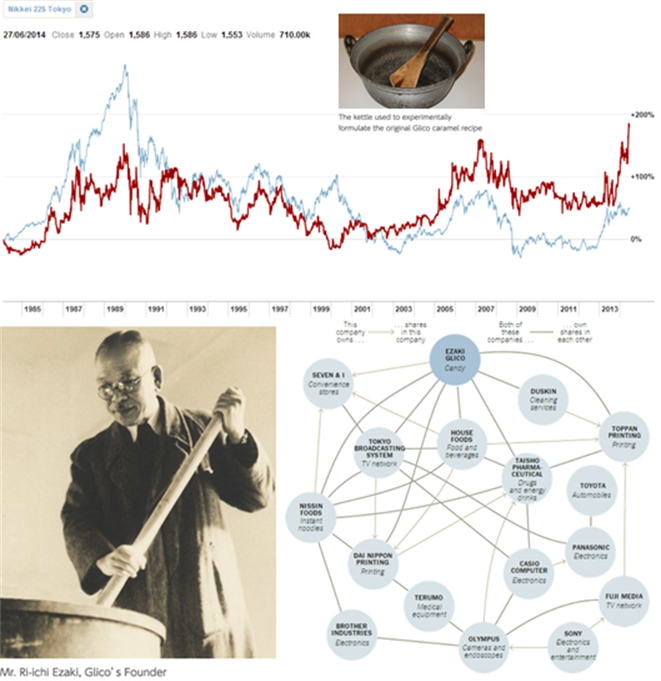
Bamboo Innovator Insight (Issue 44)

  • The weekly insight is a teaser into the opportunities – and pitfalls! – in the Asian capital jungles.
  • Get The Moat Report Asia– a monthly in-depth presentation report of around 30-40 pages covering the business model of the company, why it has a wide moat and why the moat may continue to widen, a special section on “Conversation with Management” to understand their thinking process in building up the business, the context – why now (certain corporate or industry events or groundbreaking news), valuations (why it can compound 2-3x in the next 5 years), potential risks and how it is part of the systematic process in the Bamboo Innovator Index of 200+ companies out of 15,000+ in the Asia ex-Japan universe.
  • Our paid Members from North America, Europe, the Oceania and Asia include professional value investors with over $20 billion in asset under management in equities, some of the world’s biggest secretive global hedge fund giants, and savvy private individual investors who are lifelong learners in the art of value investing.
 

Dear Friends and All,


Singapore’s National Day Special: Reminiscence of Economic Wizard Dr KS Goh and the SG50 Economic Vision


Every year on August 9, Singapore celebrates our National Day commemorating our independence in 1965. Question: What do Berkshire Hathaway (the $318 billion conglomerate) and Singapore (GDP $300 billion) have in common?


Both are “listed” in the same year – in 1965. Both have visionary founders who bring important experiences and make critical choices early in the firm’s or country’s history that leave a lasting organisational imprint. Buffett is the capital allocation genius and investor-extraordinaire at Berkshire; Lee Kuan Yew is credited by Charlie Munger, the vice-chairman of Berkshire and billionaire partner of Mr Buffett, at the Wesco 2010 Annual Meeting, as a ‘very practical man’ who ‘tuned a country with no resources or agriculture into a prosperous country, starting from zero miles per hour’. Also, both Berkshire and Singapore took off from a winning combination of teamwork. Mr Munger’s contribution was to nudge Mr Buffett towards ‘the direction of not just paying for bargains’, as was taught to Mr Buffett by Ben Graham. Mr Buffett went on to add: ‘It took a powerful force to move me on from Graham’s limiting view. It was the power of Charlie’s mind. Boy, if I had listened only to Ben, would I ever be a lot poorer; I became very interested in buying a wonderful business at a moderate price.’ Singapore had the winning team of Lee Kuan Yew as the political visionary, Goh Keng Swee as the economic and financial architect, and Hon Sui Sen as the builder and administrator par excellence. The Ministry of Finance, Monetary Authority of Singapore (MAS), Economic Development Board (EDB), Temasek and GIC that Singapore has today were the creations of the entrepreneurs of Singapore Inc.


Four years ago, we wrote a trilogy series together with Hock about Berkshire Hathaway and Singapore that was published in Business Times Singapore, archived now in the Singapore Management University. In the end, we painted a bold SG50 (Singapore’s next 50 years) scenario: To reach a US$2 trillion GDP in 2065, Singapore must create and build commercial assets with a special quality. A Chinese version was also published in the local Lianhe Zaobao newspaper on August 9, 2010. Time flies. We like to share them with you in this Singapore’s National Day special.


The first article about the business and investment insights from the Berkshire-Singapore connection that we wrote inBusiness Times Singapore was actually published on May 15, 2010, a day after Singapore’s economic wizard Dr. Goh Keng Swee (KS) passed away. So the very first article was very meaningful to me on a personal level because I have great respect for the wise KS Goh. This is one of my all-time favorite stories that illuminates the whole-hearted dedication of KS:


Ngiam Tong Dow: “When I started work in the Singapore EDB in 1961, our mission was to do everything possible to find jobs for Singaporeans. Ten percent of a workforce of about 2m was unemployed. What nearly overwhelmed us were the 25,000 to 30,000 school-leavers entering the labor market each year. Our first Minister for Finance, Dr Goh Keng Swee, one day told me that he felt depressed every time he passed by a school at the end of the school day at 1pm, or 6pm. Because of a shortage of classrooms, Singapore operated a two-session school day, 7.30am to 1pm, and from 1.30pm to 6pm. When I asked Dr Goh why he felt depressed, he asked me how we were going to find gainful employment for the 25,000 to 30,000 school-leavers each year.”


KS believed that sincere words and actions can connect to the heartbeats of his fellow men, and he desired “to explain, exhort, encourage, inform, educate, advise”. Like the painter descending into the clay pits to study the rudiments of colour, value investors go deep down into the jungles of markets to study companies, their business models, and the people who build and manage them, including their actions and words. And in the dangerous jungle, the ground in the bamboo grove hold firm even in earthquakes and the wise investors stay amongst the Bamboo Innovators.


We have, and will, never forget our original motivation to do up the Moat Report Asia in highlighting the overlooked, neglected, misunderstood, underappreciated and undervalued wide-moat Bamboo Innovators: “to explain, exhort, encourage, inform, educate, advise”, in the spirit of the timeless wise words of KS.


Enjoy reading!


Part 1: The power of vision

The success of Berkshire Hathaway and Singapore can be traced to their visionary leaders who work with winning teams

http://www.smu.edu.sg/sites/default/files/smu/news_room/smu_in_the_news/2010/sources/LHZB_20100809_2.pdf

Part 2: Lion Infrastructure and value investing

Both of them are an ongoing team process that demands sacrifice, hard work and soberness to scale new heights

http://www.businesstimes.com.sg/?dlink=/sub/views/story/0,4574,389848,00.html

Part 3: Lion Infrastructure is the way to go

To reach a US$2 trillion GDP in 2065, Singapore must create and build commercial assets with a special quality

http://www.smu.edu.sg/sites/default/files/smu/news_room/smu_in_the_news/2010/sources/BT_20101230_1.pdf

The Trilogy in One Document:

http://www.slideshare.net/KeeKoonBoon/lion-trilogy-lion-entrepreneurs-and-lion-infrastructure-media-articles


Warm regards,

KB

Managing Editor

The Moat Report Asia

  1. moatreport.com


The Moat Report Asia
 

“In business, I look for economic castles protected by unbreachable ‘moats’.”

– Warren Buffett


The Moat Report Asia is a research service focused exclusively on competitively advantaged, attractively priced public companies in Asia. Together with our European partners BeyondProxy and The Manual of Ideas, the idea-oriented acclaimed monthly research publication for institutional and private investors, we scour Asia to produce The Moat Report Asia, a monthly in-depth presentation report highlighting an undervalued wide-moat business in Asia with an innovative and resilient business model to compound value in uncertain times. Our Members from North America, the Nordic, Europe, the Oceania and Asia include professional value investors with over $20 billion in asset under management in equities, secretive global hedge fund giants, and savvy private individual investors who are lifelong learners in the art of value investing.


Learn more about membership benefits here: http://www.moatreport.com/subscription/


  • Individual subscription at $1,994 per year:

https://www.moatreport.com/individual-subscription/?s2-ssl=yes


Our latest monthly issue for the month of August investigates an Asian-listed company who’s the leading ecommerce group in its home country with the complete platform coverage in the Amazon-type of B2C ecommerce of selling directly to end consumers (Sales/Net Profit: 90%/78%), Rakuten-type of B2B2C platform (Sales/Net Profit: 4%/12%) to support the online SME merchants who in turn sell to the end consumers, and the eBay-type of C2C auction site (Sales/Net Profit: 2%/21%) where individuals buy and sell to one another. This “Amazon-Alibaba” is highly profitable with recurring free cashflow (FCF yield 4.6-5% compounding at 25% in the next 3-5 years) by pioneering the world’s-first 24-hour delivery promise and guarantee when world-class logistics experts said it cannot be done. In emerging markets and Asia where logistics costs is 15-20% of GDP, most ecommerce companies fail to scale up due to lack of fulfillment capabilities and inventory risk became the killing blow as they pursue growth without the intangible know-how. The company designs and builds its own warehouses to provide fast and efficient delivery with 99.68% on-time rate and also complete backend services to suppliers, widening the gap between itself and peers. With its superior infrastructure, the company is able to provide consumers a one-stop shopping experience with all goods purchased from different vendors packaged into a single box and delivered to the client’s door. The company has consignment agreements with suppliers which allow it to have control over inventory management but carry no liability of inventory on its balance sheet, in other words, there is minimal inventory risk for the company to scale up sustainably and without the usual accounting risks that plagued the ecommerce companies.


With (1) a superior ROE of 23.6% due to its wide-moat business model in 24-hour delivery system, (2) negative cash conversion cycle (-29 days) in its unique warehouse system with minimal inventory risk, (3) a sustained 25-30% recurring earnings and cashflow growth per annum in the next 5 years, especially a long run-way in disrupting traditional retailers, and (4) potential exponential growth in its option value in the third-party electronic payment business, the company can scale up multiple times. Short-term downside risk is protected by its healthy $128m net-cash balance sheet (15% of MV) and proven management execution in prudent capex expansion to support sustainable quality earnings growth. Its terminal value and long-term downside risk will be protected by giants Alibaba, Rakuten, eBay, Amazon who wish to swallow it up to possess its valuable trust and brand equity support it enjoys and its wide-moat business model in 24-hour delivery system. The company is one of the few Asian ecommerce companies with good governance and low accounting risks with its net-value revenue recognition method and it deserves a valuation premium. Upcoming deregulation in third-party electronic payment with the passing of the law in Sep 2014 will result in various government restrictions to be removed, paving the way for the company to introduce stored-value payments, O2O payment, P2P payment (money transfer without transactions), multiple currencies’ payments, big data analysis, payment services for customers outside the group to boost transaction volume and scale up its existing proprietary PayPal/AliPay businessLed by the inspiring and highly-determined founder and Chairman who established and listed the company in 1998 and 2003 respectively, the company has overcome the multiple obstacles to ecommerce transactions in its home market. The founder described the obstacles to ecommerce transactions as ‘friction’, and that he “resolve to take on the Life’s Task to reduce this ‘friction’”.


Our past monthly issues examine:


  • An Asian-listed company who’s the global #1 and #2 maker of two types of patient monitoring devices for both clinical- and home-use. Founded in 1981 and listed in 2001, the company’s reliable manufacturing technology platform for over 30 years has enabled it to build a global durable franchise in the niche patient monitoring device market that has stable resilient growth and yet is experiencing potential disruptions led by its new innovation. A secret to its success is its in-house capabilities to combine Swiss design, high-precision electronics and sensors components with clinical healthcare to produce world-class products with cost competitiveness. The firm has competitive technology and patents especially its core competence of having an algorithm to allow fast reading/filtering of signals and outputting the accurate results in a short period of time. Thecompany has the potential to consolidate the market further. The company is also a sticky ODM partner to reputable companies including Wal-Mart, Costco, CVS and it has a diversified customer base with none of the customers accounting for more than 10% of its sales. The company demonstrated that it has bargaining power over its powerful customers with the ability to build its own brand since 1998 (62% of overall sales). 91% of its sales are to developed markets in US and Europe. The company is trading at EV/EBIT 9.7x and EV/EBITDA 8.8x and has an attractive dividend yield at 5.6% and a strong balance sheet with net cash as percentage of market value and book equity at 23% and 47% respectively. The firm has also undertaken the unusual capital management program to reduce 10% of its shares outstanding in Sep 2012 to boost capital efficiency by utilizing the comfortable net cash position. The proactive shareholder-friendly stance backed by its strong net cash position should limit any downside in share price. The company’s terminal value and downside risk will be protected by giants such as J&J, Bayer, Abbott etc who wish to swallow it up to possess its valuable manufacturing technology platform and worldwide patents in algorithm-technology. The company’s worldwide patents in algorithm-technology has been commercialized into an innovative product series that is at the heart of its total solution service business model. This valuable intangible asset is not factored into long-term valuation. The innovative product with the algorithm measurement technology are not merely additional features; it “forces” the clinical community to adopt them as the standard, which in turn helps drive home-use penetration as patients seek a consistent and integrated healthcare experience. It transforms the product into a unique strategy that incorporates software development to create value-added services for health monitoring and collaborating with hospitals and governments on tele-healthcare projects. As a result of its wide-moat, the company has a far superior ROE at 20.9% that is nearly double that of its key giant conglomerate rival. When we compare EV/EBIT relative to ROE and ROA, the company is cheaper by as much as 120-150% when compared to its key giant conglomerate rival. The stock price of the company is down nearly 20% from its recent high in end March 2014 on profit-taking by short-term investors. Share price is back to May 2013 level, representing an attractive opportunity to take position in this long-term durable franchise. The stable long-term shareholdings and patient capital by the founder and the management team who together own around 48% of the equity has enabled the firm to adopt a very long-term approach to building its business and cultivating new growth areas. While he may sometimes be slightly over-optimistic and thinking too far ahead with his long-term opinions, this  idealistic engineer-visionary-philosopher has done a fantastic job in continuously defying the odds of many skeptics by growing the company from a small startup into one of the world’s leading patient monitoring equipment company. He is the rare Asian entrepreneur who was persistent in building his own brand despite the threat of offending his ODM customers. He was also early in cultivating and coordinating a global network with high-tech component, R&D and manufacturing in his home country, manufacturing, assembly and packaging in Shenzhen, China and medical R&D and clinical testing center in Europe, including making the difficult decision to establish a direct marketing sales force in Europe and North America given the high cost. Unlike most Asian business owners whose interest and focus in the core business starts to wane due to complacency from growing personal wealth and the inability to scale the core business, the founder is genuinely passionate in the company’s ability to add value to the patients and society. The firm can effectively run without the founder with the long-term corporate culture and management system in place, yet he can inject great value as the steward in new innovations; we believe that this combination is rare for an Asian company and deserves a valuation premium.


  • The world’s #1 ODM (Original Design Manufacturer) and global #5 manufacturer of a consumer healthcare device product that is used frequently, even daily, thus providing the foundation for stable recurring cashflow. This company is also a hidden champion in a niche product segment (50-55% of group’s sales) that has become a high-growth fashion product currently accounting for less than 10% of the overall industry. The company is able to mass-manufacture this niche product, but not the giants, because of its unique process IP in flexible manufacturing system and know-how to handle large-scale complex orders. The manufacture of this product itself is difficult to replicate and requires FDA/CE licenses because of its medical device nature and the entry barrier is not capital but the know-how and R&D expertise. In particular, the manufacturing integrates different fields of science including polymer chemistry, physics, optics, engineering, materials control, process control, microbiology, and, injection molding. The firm has also developed a proprietary system of tracking the manufacturing process of different sets of product so that if a quality issue arose, when and where the problem set of products was being produced could be swiftly identified, thus diminishing the scale and cost of product recall. This system has helped the firm win the long-term trust of its ODM customers to place stable large orders. The Big Four giants do not have such a system and have to incur substantial losses from product recalls. The company also possess its own brand which has many loyal followers and support in its home market where it enjoys a 30% market share and contributes to 25% of group’s saleswhile sticky ODM customers account for 75% of group’s sales, mainly from the Japan market. As a result of its wide-moat advantages, the firm enjoys a consistently high ROE of 41%, double or triple that of the giants. From FY07 onwards, even during the depths of the Global Financial Crisis in 2007/09, the firm has not raised equity. Since listing in Mar 2004, the company has only done one rights issue in May 2005. Also, it is able to sustain a strong stable cash dividend payout (>70% with 3% yield) with its healthy net-cash balance sheet (net cash $30m; net cash-to-equity ratio 23%)and proven management execution in prudent capex expansion to support sustainable quality earnings growth. M&A deals in the healthcare and medical device sector has been growing due to their strong defensive nature and giants seeking growth to overcome their own patent cliff. The firm will always be an attractive takeover target by giants who wish to swallow it up to possess its valuable flexible manufacturing system and know-how to fill their own missing competency gap and hence will enjoy long-term downside protection in its terminal value. In the battle between “ODM vs Brand”, we find the story of the company to be quite similar to that of TSMC (2330 TT, MV $103bn), now the largest ODM foundry in the world. “Skate to where the puck is going to be, not where it has been,” as hockey legend Wayne Gretzky advised. In our view, the profit and valuation premium in the value chain will start to skate to the “Inno-facturers” who are the hidden ODM innovators (the brand behind brands) consolidating the industry, such as TSMC and this company. While its valuation is not cheap with EV/EBIT (FY13) at 20.6x, when we compare EV/EBIT relative to ROE, the company is relatively cheap, by as much as 130-220% when compared to giants and other comparables. When we compare EV/EBITDA relative to ROE, the valuation gap is 90-160%. This long-term valuation gap implies that the company, with its far superior and sustainable ROE, could potentially double to $2.4bn, as it continues to consolidate its niche product segment and enter into a new product cycle of an innovative product whose patents are expiring in 2014/15 (US/worldwide) to make ASP/margin improvements in sustaining quality profits and cashflow. Its share price has dropped 18% from its recent high and underperformed the index by 26% in the last six months. This will present a buying opportunity for long-term value investors who can penetrate beyond conventional valuation metrics because of a deep understanding of its business model and underlying source of its wide-moat advantages. In Asia, many firms break apart or become value traps due to shareholder conflict, envy and differences in opinion on the business direction of the company. The stable long-term corporate culture infused by the late founder, who established the company in 1986 with the current executive chairman and 2 other key shareholders, to combine the energy and ideas of everyone to work hard to keep the business running forever is underappreciated.


  • The Home Depot of Asiawhich has the largest market share in its home country and now seeks to expand regionally. It is one of the few home improvement retailers in the world which is able to achieve a structural negative cash conversion cycle (CCC) at -39 days for resilient, recurring and sustainable operating cashflow to enable the expansion of its store network while keeping a healthy balance sheet. It is hard to achieve negative cash conversion cycle (CCC) as a home retailer as compared to a supermarket retailer as the product nature is more durable. Even Home Depot, Lowe’s and Bed Bath & Beyond (BBBY) are not able to achieve a negative CCC. Led by the capable owner-operators since 1995, the company is a pioneer in proactively creating awareness and demand in the minds of consumers that upgrading your home can be fun and in incremental affordable steps. Its creative branding has resulted in the firm to become the “first on customers’ mind”, or what Charlie Munger elucidated as the “psychological wide-moat” advantage. 80% of sales are generated customers looking for home improvement and renovation ideas and solutions.  Growth is supported by the management’s proven ability to identify and cater to dynamic changes in customer preferences. The firm’s comprehensive pre and aftersales service creates brand loyalty and sustains long-term sales. The merchandizing management is tailored to the peculiarities of customer preferences in each area to drive same store sales growth with creative customization by store, location, season and events. Its key strategy to expand its profit margin is to increase its higher-margin house brands and product-mix management. Its EBITDA/sqm of $400/sqm was higher than Home Depot until Home Depot experienced a rebound last year to $500/sqm. The firm’s resilient sales are supported by its unrivalled network of diverse locations throughout the country. Its bold vision and successful “Blue Ocean” execution in the highly fragmented second-tier markets has created a powerful wide-moat advantage that will last for many years to come. In short, the management have proven their ability to execute in difficult market and industry conditions especially in the past 5 to 7 years during the 2007/09 global financial crisis with the firm emerging much stronger. The Illinois Institute of Technology engineering graduate and quiet billionaire owner behind the home retailer is one of the few Asian business tycoons who has the thirst to scale up the business in a sustainable way, as opposed to opportunistic ventures, having been largely influenced by his early years experience observing the success of American wide-moat firms. If we can adjust the EV/EBITDA valuation metric to reflect the CCC, the company’s EV/EBITDA of 18.5x will be lower at 10-11x, while Home Depot’s EV/EBITDA 11x will be higher at 13x. Noteworthy is that Home Depot has a negative free cashflow throughout FY1989-2001 (13 consecutive years!) and yet market cap has climbed from $1.5bn to $103bn. Home Depot compounded despite the ugly valuations during the capex ramp-up. This once again highlights that the power of wide-moat is often underappreciated, misunderstood and overlooked. When Home Depot generated $180m in operating cashflow in FY1992, quite similar to this Asian firm now, Home Depot is valued at $5bn (vs $3bn). Store network is expected to double in the next 4-5 years, representing a potential doubling in market value.


  • The Northeast Asian-listed companywho is the world’s largest maker of an essential component with applications in apparel, shoes, diapers, car seats etc. All top 20 global athletic shoe brands, including Nike, Adidas, Reebok, Sketchers, UnderArmor are customers and this Asian innovator with R&D capabilities has forged long-term “spec-in” partnerships with them. Its broad product offering is protected by over 110 patents. By locating its Pan-Asian production plant network in China, Taiwan, Vietnam and Indonesia close to its major clients, including sales/customer service centers and warehouses in US and Europe, the firm is better positioned to understand their requirements, deliver fast and meet their needs. While top 10 athletic shoe brands account 40% of its revenue, the firm has a diversified clientele base of over 10,000 customers, giving it resilience and growth with both the established and emerging brands as clients. The company is trading at PE14e 12x, EV/EBITDA 7.1x and EV/EBIT 10.6x with a dividend yield of 3.9%. Interestingly, its EBITDA margin is double that of Adidas and its 8.7% net margin is higher than Adidas’ 5.4%, though below Nike’s 9.8%. Given the tipping point of its Pan-Asian production network and contributions from its new products and as capex tapers off in the next few years, free cashflow could be around $50-60m and applying a P/FCF of 15x would yield a market value of $750-900m,, representing a potential upside of 100-150%. Thus, the firm offers a similar quality growth trajectory to Nike/Adidas with its unique knowledge-based business model and yet trades at a more attractive valuation and higher dividend yield as downside protection.


  • The Middleby of Asia commanding a dominant market share of over 80% in hypermarkets, 50% in chain outlets, 30% in 4- to 5-star hotels in China and an overall 30% in its home market. Yet, no single customer accounts for more than 5% of its revenue. Just to recall for value investors, NYSE-listed Middleby, with its sleepy and boring business, has compounded 100-fold from around $50m to $5.7bn since its tipping point in 1999.The founders of this Asian family business demonstrated clear dedication in building up the company with its wide-moat business model backed by a strong and unique distribution/marketing network in finding, winning and binding new customers to build massive brand equity and long-lasting relationships with clients over time. Their devotion to its core product for nearly 20 years results in maximum problem-solving skills, innovative strength and product leadership and hence, to ever greater customer benefit that will protect the company to consolidate the fragmented market and provide ample opportunities to continue its profitable growth. The company is currently trading at PE13e 15.8x and an undemanding EV/EBIT 10.1x and EV/EBITDA 9.5xand its growth potential based on its unique business model is not priced in. There is a structural re-rerating of niche business models with (1) diversified client base, (2) steady revenue streams, (3) lean capex requirements that creates ample free cashflow and defensive growth. Based on PE, P/CFO and EV/EBIT, the company is trading at a 40-50% discount to the foreign listed comparables despite more efficient use of assets in generating profits and cashflow. It has an attractive 7% earnings yield growing at 20% over the next 3-5 years and a 3.8% dividend yield that is supported by its strong cashflow generation ability, steady revenue stream and lean capex requirements to limit downside risks in valuation. Based on the growth plans to penetrate new product and customer segments; build its third plant in India in addition to the ones in its home market and in China; and potential bolt-on acquisition opportunities with its healthy balance sheet in net-cash position, it has the potential to double its operating cashflow in the next 3-5 years and market value could double, representing an upside potential of 100-140%.


  • An emerging Asian Walgreens which is a top 3 community pharmacy operator in its home market. Walgreens is a classic neglected American compounder up over 272-fold to $54 billion from under $200m as it quietly consolidates the market. Over the decade, we observed that it is difficult to scale services-based businesses without an entrepreneurial mindset, committment and execution and the bold and unique management system of the company since 2000 allowed the pharmacists to be part-owner of the business which will lead to increased level of commitment and an owner’s mindset in growing the business for the long-term in the community. The firm has strong cash generation ability due to its negative cash conversion cycle (CCC) in the business modelto help the business stay resilient during difficult times and to fund capex needs internally without straining the business model scalability as the network expands. The centralized logistics system provide regular deliveries to all of its community pharmacies enables the outlets to maximize retail space without the need to have space to keep stocks. This also enables the community pharmacies to optimize retail space to carry a wide range of products which is important as consumers increasingly have top-of-mind recall for the company as the destination to go to for their healthcare needs. Like Walgreens, the company believed in the power of embedding technology into the business model to better compete and its financial and warehousing/inventory management systems are integrated with its in-house POS (point-of-sale) system which is linked among all its community pharmacies and head office via virtual private network. The company is founded by five college friends who were somewhat frustrated that their pharmacy degrees were underappreciated and under-rewarded as compared to their medical degree counterparts even though they had studied hard for 4-5 years and had in-depth medical knowledge. They were eager to prove themselves that they are as capable, if not more so. This restless spirit to prove their capabilities resulted in them coming together to be entrepreneurs and they wish to provide the platform for similar restless pharmacists to apply their hard-earned knowledge acquired in the university. We find that this common purpose and camaraderie spirit is rare in Asian companies and makes the company unique to scale up sustainably. The company is currently trading at a EV/EBIT of 13.9x and EB/EBITDA 12.6%. In the next two to three years as the company expands its network of outlets, operating cashflow (CFO) could increase 50-60% and a re-rerating could result in a doubling in market value.


  • An Asian-listed pharmaceutical company which has a dominant franchise in a neglected but growing diseaseand is a leader with a domestic market share of 49% in this niche segment and is the only fully-integrated player amongst the few pre-qualified WHO firms, giving it >30% EBITDA margin, better pricing power compared to the competition, and significant advantage over other players in ramping up the global business from the current 30% market share in the most-common treatment drug (vs Novartis 50%). Furthermore, the pharma company has the second-highest GP/TA (gross profit/ total asset) ratio in the industry at 56.3% and the most conservative accounting practice in the industry which “depresses” earnings relative to its peers i.e. it is the only domestic firm which expenses, and does not capitalize, all R&D. With the new plant for formulations export to US, the deepening of the niche drug franchise, growing wins in chronic pain and other niche areas and the commercialization of the potential blockbuster product of blood thinner by FY16/17, EBITDA could potentially double to $200m in the next 4-5 years, triggering a valuation re-rating to a market value of $3.4bn, a 130% upside.


  • An Australian-listed company with market value $405m, EV/EBITDA 7.5x, EV/EBIT 10x, div 3%, 70% domestic market sharewhose management made the controversial bold decision to stop overseas exports in order to focus on cultivating the higher-margin domestic market with innovative marketing strategy and new products and is potentially doubling its supply in the next 3-5 years. It is in its 10th year of listing after piling the foundation in consolidation, investment, rationalization for its next stage. It has an all-time low debt-equity position 18.6% with healthy balance sheet. “Buffett of Nordic” recently increased position between Apr-Sep this year in the peer comparable of the company and the billionaire investor announced in Nov an acquisition of a rival in a wave of global consolidation and with the view on a sustained recovery in product prices.


  • Northeast Asia-listed company with global #1 market share leadership in 4 different products, including making the components for an innovative consumer product whose sales have climbed from $90 million to $526 million in the recent three years. The company is a hidden global consolidator with underappreciated growth. The stock is trading at PE 11.5x, EV/EBITDA 9x and generates a sustainable dividend yield 5.75%.


  • Taiwanand Southeast-Asian-listed entrepreneurial company, both with a dominant 80% domestic market share and have innovative business models to generate substantial cashflow to support both expansion and a 4-5% dividend yield.


  • There is also a behind-the-scene conversation with the CEOsof the companies to understand their thinking process in building up the business.


The Moat Report Asia Members’ Forum has been getting penetrating quality dialogues from our subscribers. Questions range from:


  • The nuances of internal dealings in Asia, including the case discussion of the recent deal in which HK billionaire’s Lee Shau-kee Henderson Landacquiring Towngas or Hong Kong & China Gas (3 HK) from his family holdings, seemingly déjà vu from the early Oct 2007 transaction when the market peak.
  • The case of F&N Singaporespinning out its property unit FCL Trust and getting “free” special dividend-in-specie and the potential risk in asset swap restructuring to deleverage the hidden debt in the entire Group balance sheet.
  • The dilemma of whether to invest in a Southeast Asian-listed company and hidden champion with a domestic market share of 60% due to family squabbles and a legal suit over the company’s ownership.
  • Discussion of the wise and thoughtful 107-year-old Irving Kahn’s investment into a US-listed but Hong Kong-based electronics company with development property project in Shenzhen’s Qianhai zone and the possible corporate governance risks that could be underestimated or overlooked, as well as their history of listing some assets in HK in 2004.. This is also a case study of “buy one get one free” in John’s highly-acclaimed book The Manual of Ideasin which the “free” property is lumped together with the (eroding) core business to make the combined entity look cheap and undervalued. What are the potential areas that value investors need to watch out for when adapting the SOTP (sum-of-the-parts) valuation method in Asia?
  • And many more intriguing questions.


Do find out more in how you can benefit from authentic and candid on-the-ground insights that sell-side analysts and brokers, with their inherent conflict-of-interests, inevitable focus on conventional stock coverage and different clientele priorities, are unwilling or unable to share. Think of this as pressing the Bloomberg “Help Help” button to navigate the Asian capital jungle. Institutional subscribers also get access to the Bamboo Innovator Index of 200+ companies and Watchlist of 500+ companies in Asia and the Database has eliminated companies with a higher probability of accounting frauds and  misgovernance as well as the alluring value traps.


Professional Development Workshops for Executives and Lifelong Learners
 

Our 8th run of the series of workshop From the Fund Management Jungles: Value Investing Exposed and Explored – (Part 1) Moat Analysis, (Part 2) Tipping Point Analysis and (Part 3) Detecting Accounting Fraud – on 14 June 2014 has been well-received with serious value investors, professionals, and serious lifelong learners attending, with some who flew in from Jakarta and KL!..


Our 9th workshop will be on Detecting Accounting Fraud Ahead of the Curve sometime later in the year.


Thank you for your support all this while!


Thank you so much for reading as always.


Warm regards,

KB Kee

Managing Editor

image002

The Moat Report Asia

Singapore

Mobile: +65 9695 1860


A Service of BeyondProxy LLC

1608 S. Ashland Avenue #27878

Chicago, Illinois 60608-2013

Other offices: London, Singapore, Zurich


  1. S.1 Here is a little more about my background:

KB Kee has been rooted in the principles of value investing for over a decade as an analyst in Asian capital markets. He was head of research and fund manager at a Singapore-based value investment firm. As a member of the investment committee, he helped the firm’s Asia-focused equity funds significantly outperform the benchmark index. He was previously the portfolio manager for Asia-Pacific equities at Korea’s largest mutual fund company.


He holds a Masters in Finance and degrees in Accountancy and Business Management, summa cum laude, from Singapore Management University (SMU) and had also published articles on governance and investing in the media, as well as published an empirical research paper Why ‘Democracy’ and ‘Drifter’ Firms Can Have Abnormal Returns: The Joint Importance of Corporate Governance and Abnormal Accruals in Separating Winners from Losers in the Special Issue of Istanbul Stock Exchange 25th Year Anniversary Best Paper Competition, Boğaziçi JournalReview of Social, Economic and Administrative Studies, Vol. 25(1): 3-55. KB has also presented his thought leadership as a keynote speaker in global investing conferences. KB has trained CEOs, entrepreneurs, CFOs, management executives in business strategy, value investing, macroeconomic, industry trends, and detecting accounting frauds in Singapore, HK and China, and had taught accounting at the SMU where he is currently an adjunct lecturer.


  1. S.2 Why do I care so much about doing The Moat Report Asiafor you?

My personal motivation in embarking on this lifelong journey has been driven by disappointment from observing up close and personal the hard-earned assets of many investors, including friends and their families, burnt badly by the popular mantra: “Ride the Asian Growth Story!” I witnessed firsthand the emotional upheavals that they go through when they invest their hard-earned money – and their family’s – in these “Ride The Asian Growth Story” stocks either by themselves or through money managers, and these stocks turned out to be the subject of some exciting “theme” but which are inherently sick and prey to economic vicissitudes. They may seem to grow faster initially but the sustainable harvest of their returns is far too uncertain to be the focus of a wise program in investment. Worse still, the companies turned out to be involved in accounting frauds. Their financial numbers were “propped up” artificially to lure in funds from investors and the studiously-assessed asset value has already been “tunnelled out” or expropriated. And western-based fraud detection tools and techniques have not been adapted to the Asian context to avoid these traps.


After a decade-plus journey in the Asian capital jungles, it has been somewhat disheartening as I observe many fraud perpetrators go away scot-free and live a life of super luxury on minority investors’ hard-earned money. And these perpetrators make tempting offers to various parties in the financial community to go along with their schemes. When investors have knowledge in their hands, we have a choice to stay away from these people and away from temptations and do the things that we think are right. With knowledge, we have a choice to invest in the hardworking Asian entrepreneurs and capital allocators who are serious in building a wide-moat business.


CONNECT WITH US  image003image004image005image006image007
MOAT REPORT ASIA    OUR TEAM    SUBSCRIBE    MEMBERS    CONTACT US

The Moat Report Asia
A Service of BeyondProxy LLC
1608 S. Ashland Avenue #27878
Chicago, Illinois 60608-2013

Other offices: London, Singapore, Zurich


Rebirth: The Acid Test for an Outstanding Asian Entrepreneur

 image001

“Bamboo Innovators bend, not break, even in the most terrifying storm that would snap the mighty resisting oak tree. It survives, therefore it conquers.”

BAMBOO LETTER UPDATE | August 4, 2014
Bamboo Innovator Insight (Issue 43)

  • The weekly insight is a teaser into the opportunities – and pitfalls! – in the Asian capital jungles.
  • Get The Moat Report Asia– a monthly in-depth presentation report of around 30-40 pages covering the business model of the company, why it has a wide moat and why the moat may continue to widen, a special section on “Conversation with Management” to understand their thinking process in building up the business, the context – why now (certain corporate or industry events or groundbreaking news), valuations (why it can compound 2-3x in the next 5 years), potential risks and how it is part of the systematic process in the Bamboo Innovator Index of 200+ companies out of 15,000+ in the Asia ex-Japan universe.
  • Our paid Members from North America, Europe, the Oceania and Asia include professional value investors with over $20 billion in asset under management in equities, some of the world’s biggest secretive global hedge fund giants, and savvy private individual investors who are lifelong learners in the art of value investing.
 

Dear Friends and All,


Rebirth: The Acid Test for an Outstanding Capital Allocator


They say we experience a rebirth when we have our children as we see the world through their eyes. Their joys and pains are felt in the parents’ bones and fiber. Can we better understand and sense an Asian innovator-entrepreneur in the same light?


In our latest monthly issue of the Moat Report Asia for our valued Members who continued to be so encouraging (Mr K: I enjoy the Moat Report Asia immensely”), we highlighted one of Asia’s largest listed but almost unknown ecommerce group (see below “Can You Guess This Asian Company?”). We were inspired by the experience of the founder and Chairman Mr. J whom we felt has experienced a “rebirth”, the acid test for an outstanding capital allocator beyond the accounting numbers. Specifically, in our observation and interaction with the entrepreneurs, tycoons and family business owners (and their scions) over the past decade plus in the Asian capital jungle, we feel that like the loving parent who is reborn, these exceptional Compounders embody the following:


1)      They cherish and nurture the relationship with their creation with astonishingly gentleness, quiet thoughtfulness and tough grit. Mr J: “[The Company wants] to become the trusted and credible partner of online consumers, so that we will boldly bear any problems for our consumers whom we treasure dearly. The online customer relationship is worthy of treasuring. Just think, in the vast internet universe, they manage to find your website. Just imagine the difficulties that they face when they make purchases, such as the lack of information, and they need to overcome their fears, so this relationship that is established is not easy and needs to be cherished.”


2)       They work hard to be the role model to their creation – this profound feeling is special as it underscores the idea that they deeply understand that the creation is distinctive and separate from them, that the creation is outside of their body, and yet inside their heart. Most Asian entrepreneurs and family business owners simply treat their companies as their own personal ATM machines and honeypot to fund their lifestyle, or to use the money success from the creation to buy personal fame and power, rationalizing that it is the owner’s right, after all the stress and strain of getting the business off the ground and keeping it afloat. This is the kiss of death for anyone with a long-term view to building a strong business. It is also thoroughly demotivating for employees. Whether you are working for a large or small business, there’s nothing worse than watching owners siphon off the profits. Your business is a third party, separate from you, and the profits belong to the business. Do this, and you will have created a clear moral universe for your employees to work within, with a far healthier business as a result.


3)      Above all, they understand that their creation is not just an extension of themselves but also that the living creature stands for something and belongs to world to create value for others, to be useful in society, to grow stronger with time, to co-involve others to build something lasting together. Mr J: “I describe the obstacles to ecommerce transactions as ‘friction’, and I resolve to take on the Life’s Task to reduce this ‘friction’.”


Below is (A) an excerpt from the section on “Inside the Asian Leader’s Mind” from the monthly Moat Report Asia for the month of August, translated into English from the local language used by Mr J, as well as (B) a brief description of the company:


(A) Excerpt from “Inside the Asian Leader’s Mind”:


Q: “You have been an inspiring leader and resilient entrepreneur. You really embody the characteristics of a Bamboo Innovator, bend and not break with the ability to bounce back and emerge stronger. What advice do you have for people?”


Mr J: “I am not the best entrepreneur but I believe in the power of perseverance. Any things that you encounter and feel strongly for, just do it, just try if you have the opportunity. By embracing that particular risk and challenge that you are afraid to take on could lead you, at every twist and corner, something unexpectedly beautiful. If you see the right direction, then you must continue to persevere, to press on, to stand fast, no matter the hardships and sacrifices. To persevere in walking a lonely and misunderstood path is very difficult, to grit up the teeth to withstand and endure the immense pressure is even harder. To create new ventures and new ideas requires courage, to defend the emerging innovation and to build a competitive moat requires persistence and determination, to withstand the pressure requires transforming it with the evolving times. A person has to do only one thing to the best of ability in one’s lifetime and that is the definition that one is successful. The key is that you must believe strongly in the work and you must do it. Above all, endure the pain and sufferings that no one else is willing to; take on the hardship that no one else can; embrace the risk that no one else dares; carry the burden that that no one is willing to.”


(B) Brief description of the company:


Our latest monthly issue for the month of August investigates an Asian-listed company who’s the leading ecommerce group in its home country with the complete platform coverage in the Amazon-type of B2C ecommerce of selling directly to end consumers (Sales/Net Profit: 90%/78%), Rakuten-type of B2B2C platform (Sales/Net Profit: 4%/12%) to support the online SME merchants who in turn sell to the end consumers, and the eBay-type of C2C auction site (Sales/Net Profit: 2%/21%) where individuals buy and sell to one another. This “Amazon-Alibaba” is highly profitable with recurring free cashflow (FCF yield 4.6-5% compounding at 25% in the next 3-5 years) by pioneering the world’s-first 24-hour delivery promise and guarantee when world-class logistics experts said it cannot be done. In emerging markets and Asia where logistics costs is 15-20% of GDP, most ecommerce companies fail to scale up due to lack of fulfillment capabilities and inventory risk became the killing blow as they pursue growth without the intangible know-how. The company designs and builds its own warehouses to provide fast and efficient delivery with 99.68% on-time rate and also complete backend services to suppliers, widening the gap between itself and peers. With its superior infrastructure, the company is able to provide consumers a one-stop shopping experience with all goods purchased from different vendors packaged into a single box and delivered to the client’s door. The company has consignment agreements with suppliers which allow it to have control over inventory management but carry no liability of inventory on its balance sheet, in other words, there is minimal inventory risk for the company to scale up sustainably and without the usual accounting risks that plagued the ecommerce companies.


With (1) a superior ROE of 23.6% due to its wide-moat business model in 24-hour delivery system, (2) negative cash conversion cycle (-29 days) in its unique warehouse system with minimal inventory risk, (3) a sustained 25-30% recurring earnings and cashflow growth per annum in the next 5 years, especially a long run-way in disrupting traditional retailers, and (4) potential exponential growth in its option value in the third-party electronic payment business, the company can scale up multiple times. Short-term downside risk is protected by its healthy $128m net-cash balance sheet (15% of MV) and proven management execution in prudent capex expansion to support sustainable quality earnings growth. Its terminal value and long-term downside risk will be protected by giants Alibaba, Rakuten, eBay, Amazon who wish to swallow it up to possess its valuable trust and brand equity support it enjoys and its wide-moat business model in 24-hour delivery system. The company is one of the few Asian ecommerce companies with good governance and low accounting risks with its net-value revenue recognition method and it deserves a valuation premium. Upcoming deregulation in third-party electronic payment with the passing of the law in Sep 2014 will result in various government restrictions to be removed, paving the way for the company to introduce stored-value payments, O2O payment, P2P payment (money transfer without transactions), multiple currencies’ payments, big data analysis, payment services for customers outside the group to boost transaction volume and scale up its existing proprietary PayPal/AliPay businessLed by the inspiring and highly-determined founder and Chairman who established and listed the company in 1998 and 2003 respectively, the company has overcome the multiple obstacles to ecommerce transactions in its home market. The founder described the obstacles to ecommerce transactions as ‘friction’, and that he “resolve to take on the Life’s Task to reduce this ‘friction’”.


********

Note: We will be making some changes in order to create more value-added content and insights for our Members. During the week when the Monthly Moat Report Asia is published, there will be no Bamboo Innovator Weekly Insight article. In additional to the continuous building up of knowledge, the time will be devoted to starting the book project “Compounders Vs Extractors: Value Investing in the Asian Capital Jungle”. Thank you for your understanding as always.


The pursuit of the lifelong fascination on why economies, institutions and companies wax and wane, why people rise and fall, and how and why they experience that exponential “flood” at the “tipping point” has led to the idea of Resilience. Whenever anyone talks about resilience, the mental image that first comes to mind must be the Bamboo, which bend and not break even in the wildest storm that would snapped the mighty oak tree. There is much more to resilience than simplistic oak-like strength, which is achieved typically by efficiency in the hardening of assets of a system. The unique characteristics of the Bamboo led to the “R.E.S.-ilience framework in value creation” to use in the search for wide-moat compounders in the Asian capital jungles. The Bamboo led to a sort of rebirth with the creation of the Moat Report Asia in partnership and friendship with John and Oliver.


We sincerely hope that the love for the timeless principles of what the Bamboo stands for can inspire us all to become a better person and stay resilient in the face of the inevitable traumatic knocks of life and bounce back to scale greater heights. We are also living during an epidemic crisis of conditional love. Many parents bestow or withdraw affection depending on how well their children are achieving, producing millions of outwardly oak-like young people without secure emotional foundations, who pine for any kind of approval. Only when the humanizing emotion of love is kept alive within us all is our rebirth complete.


Hopefully, the flames of the Bamboo can keep burning… so that the Bamboo will belong, economically and emotionally, to the co-creators, friends and partners.


We like to give our congratulations and best wishes to Oliver and wife who are going to become proud loving parents with the upcoming birth of their child!


Warm regards,

KB

Managing Editor

The Moat Report Asia

  1. moatreport.com


The Moat Report Asia
 

“In business, I look for economic castles protected by unbreachable ‘moats’.”

– Warren Buffett


The Moat Report Asia is a research service focused exclusively on competitively advantaged, attractively priced public companies in Asia. Together with our European partners BeyondProxy and The Manual of Ideas, the idea-oriented acclaimed monthly research publication for institutional and private investors, we scour Asia to produce The Moat Report Asia, a monthly in-depth presentation report highlighting an undervalued wide-moat business in Asia with an innovative and resilient business model to compound value in uncertain times. Our Members from North America, the Nordic, Europe, the Oceania and Asia include professional value investors with over $20 billion in asset under management in equities, secretive global hedge fund giants, and savvy private individual investors who are lifelong learners in the art of value investing.


Learn more about membership benefits here: http://www.moatreport.com/subscription/


  • Individual subscription at $1,994 per year:

https://www.moatreport.com/individual-subscription/?s2-ssl=yes


Our latest monthly issue for the month of August investigates an Asian-listed company who’s the leading ecommerce group in its home country with the complete platform coverage in the Amazon-type of B2C ecommerce of selling directly to end consumers (Sales/Net Profit: 90%/78%), Rakuten-type of B2B2C platform (Sales/Net Profit: 4%/12%) to support the online SME merchants who in turn sell to the end consumers, and the eBay-type of C2C auction site (Sales/Net Profit: 2%/21%) where individuals buy and sell to one another. This “Amazon-Alibaba” is highly profitable with recurring free cashflow (FCF yield 4.6-5% compounding at 25% in the next 3-5 years) by pioneering the world’s-first 24-hour delivery promise and guarantee when world-class logistics experts said it cannot be done. In emerging markets and Asia where logistics costs is 15-20% of GDP, most ecommerce companies fail to scale up due to lack of fulfillment capabilities and inventory risk became the killing blow as they pursue growth without the intangible know-how. The company designs and builds its own warehouses to provide fast and efficient delivery with 99.68% on-time rate and also complete backend services to suppliers, widening the gap between itself and peers. With its superior infrastructure, the company is able to provide consumers a one-stop shopping experience with all goods purchased from different vendors packaged into a single box and delivered to the client’s door. The company has consignment agreements with suppliers which allow it to have control over inventory management but carry no liability of inventory on its balance sheet, in other words, there is minimal inventory risk for the company to scale up sustainably and without the usual accounting risks that plagued the ecommerce companies.


With (1) a superior ROE of 23.6% due to its wide-moat business model in 24-hour delivery system, (2) negative cash conversion cycle (-29 days) in its unique warehouse system with minimal inventory risk, (3) a sustained 25-30% recurring earnings and cashflow growth per annum in the next 5 years, especially a long run-way in disrupting traditional retailers, and (4) potential exponential growth in its option value in the third-party electronic payment business, the company can scale up multiple times. Short-term downside risk is protected by its healthy $128m net-cash balance sheet (15% of MV) and proven management execution in prudent capex expansion to support sustainable quality earnings growth. Its terminal value and long-term downside risk will be protected by giants Alibaba, Rakuten, eBay, Amazon who wish to swallow it up to possess its valuable trust and brand equity support it enjoys and its wide-moat business model in 24-hour delivery system. The company is one of the few Asian ecommerce companies with good governance and low accounting risks with its net-value revenue recognition method and it deserves a valuation premium. Upcoming deregulation in third-party electronic payment with the passing of the law in Sep 2014 will result in various government restrictions to be removed, paving the way for the company to introduce stored-value payments, O2O payment, P2P payment (money transfer without transactions), multiple currencies’ payments, big data analysis, payment services for customers outside the group to boost transaction volume and scale up its existing proprietary PayPal/AliPay businessLed by the inspiring and highly-determined founder and Chairman who established and listed the company in 1998 and 2003 respectively, the company has overcome the multiple obstacles to ecommerce transactions in its home market. The founder described the obstacles to ecommerce transactions as ‘friction’, and that he “resolve to take on the Life’s Task to reduce this ‘friction’”.


Our past monthly issues examine:


  • An Asian-listed company who’s the global #1 and #2 maker of two types of patient monitoring devices for both clinical- and home-use. Founded in 1981 and listed in 2001, the company’s reliable manufacturing technology platform for over 30 years has enabled it to build a global durable franchise in the niche patient monitoring device market that has stable resilient growth and yet is experiencing potential disruptions led by its new innovation. A secret to its success is its in-house capabilities to combine Swiss design, high-precision electronics and sensors components with clinical healthcare to produce world-class products with cost competitiveness. The firm has competitive technology and patents especially its core competence of having an algorithm to allow fast reading/filtering of signals and outputting the accurate results in a short period of time. Thecompany has the potential to consolidate the market further. The company is also a sticky ODM partner to reputable companies including Wal-Mart, Costco, CVS and it has a diversified customer base with none of the customers accounting for more than 10% of its sales. The company demonstrated that it has bargaining power over its powerful customers with the ability to build its own brand since 1998 (62% of overall sales). 91% of its sales are to developed markets in US and Europe. The company is trading at EV/EBIT 9.7x and EV/EBITDA 8.8x and has an attractive dividend yield at 5.6% and a strong balance sheet with net cash as percentage of market value and book equity at 23% and 47% respectively. The firm has also undertaken the unusual capital management program to reduce 10% of its shares outstanding in Sep 2012 to boost capital efficiency by utilizing the comfortable net cash position. The proactive shareholder-friendly stance backed by its strong net cash position should limit any downside in share price. The company’s terminal value and downside risk will be protected by giants such as J&J, Bayer, Abbott etc who wish to swallow it up to possess its valuable manufacturing technology platform and worldwide patents in algorithm-technology. The company’s worldwide patents in algorithm-technology has been commercialized into an innovative product series that is at the heart of its total solution service business model. This valuable intangible asset is not factored into long-term valuation. The innovative product with the algorithm measurement technology are not merely additional features; it “forces” the clinical community to adopt them as the standard, which in turn helps drive home-use penetration as patients seek a consistent and integrated healthcare experience. It transforms the product into a unique strategy that incorporates software development to create value-added services for health monitoring and collaborating with hospitals and governments on tele-healthcare projects. As a result of its wide-moat, the company has a far superior ROE at 20.9% that is nearly double that of its key giant conglomerate rival. When we compare EV/EBIT relative to ROE and ROA, the company is cheaper by as much as 120-150% when compared to its key giant conglomerate rival. The stock price of the company is down nearly 20% from its recent high in end March 2014 on profit-taking by short-term investors. Share price is back to May 2013 level, representing an attractive opportunity to take position in this long-term durable franchise. The stable long-term shareholdings and patient capital by the founder and the management team who together own around 48% of the equity has enabled the firm to adopt a very long-term approach to building its business and cultivating new growth areas. While he may sometimes be slightly over-optimistic and thinking too far ahead with his long-term opinions, this  idealistic engineer-visionary-philosopher has done a fantastic job in continuously defying the odds of many skeptics by growing the company from a small startup into one of the world’s leading patient monitoring equipment company. He is the rare Asian entrepreneur who was persistent in building his own brand despite the threat of offending his ODM customers. He was also early in cultivating and coordinating a global network with high-tech component, R&D and manufacturing in his home country, manufacturing, assembly and packaging in Shenzhen, China and medical R&D and clinical testing center in Europe, including making the difficult decision to establish a direct marketing sales force in Europe and North America given the high cost. Unlike most Asian business owners whose interest and focus in the core business starts to wane due to complacency from growing personal wealth and the inability to scale the core business, the founder is genuinely passionate in the company’s ability to add value to the patients and society. The firm can effectively run without the founder with the long-term corporate culture and management system in place, yet he can inject great value as the steward in new innovations; we believe that this combination is rare for an Asian company and deserves a valuation premium.


  • The world’s #1 ODM (Original Design Manufacturer) and global #5 manufacturer of a consumer healthcare device product that is used frequently, even daily, thus providing the foundation for stable recurring cashflow. This company is also a hidden champion in a niche product segment (50-55% of group’s sales) that has become a high-growth fashion product currently accounting for less than 10% of the overall industry. The company is able to mass-manufacture this niche product, but not the giants, because of its unique process IP in flexible manufacturing system and know-how to handle large-scale complex orders. The manufacture of this product itself is difficult to replicate and requires FDA/CE licenses because of its medical device nature and the entry barrier is not capital but the know-how and R&D expertise. In particular, the manufacturing integrates different fields of science including polymer chemistry, physics, optics, engineering, materials control, process control, microbiology, and, injection molding. The firm has also developed a proprietary system of tracking the manufacturing process of different sets of product so that if a quality issue arose, when and where the problem set of products was being produced could be swiftly identified, thus diminishing the scale and cost of product recall. This system has helped the firm win the long-term trust of its ODM customers to place stable large orders. The Big Four giants do not have such a system and have to incur substantial losses from product recalls. The company also possess its own brand which hasmany loyal followers and support in its home market where it enjoys a 30% market share and contributes to 25% of group’s saleswhile sticky ODM customers account for 75% of group’s sales, mainly from the Japan market. As a result of its wide-moat advantages, the firm enjoys a consistently high ROE of 41%, double or triple that of the giants. From FY07 onwards, even during the depths of the Global Financial Crisis in 2007/09, the firm has not raised equity. Since listing in Mar 2004, the company has only done one rights issue in May 2005. Also, it is able to sustain a strong stable cash dividend payout (>70% with 3% yield) with its healthy net-cash balance sheet (net cash $30m; net cash-to-equity ratio 23%) and proven management execution in prudent capex expansion to support sustainable quality earnings growth. M&A deals in the healthcare and medical device sector has been growing due to their strong defensive nature and giants seeking growth to overcome their own patent cliff. The firm will always be an attractive takeover target by giants who wish to swallow it up to possess its valuable flexible manufacturing system and know-how to fill their own missing competency gap and hence will enjoy long-term downside protection in its terminal value. In the battle between “ODM vs Brand”, we find the story of the company to be quite similar to that of TSMC (2330 TT, MV $103bn), now the largest ODM foundry in the world. “Skate to where the puck is going to be, not where it has been,” as hockey legend Wayne Gretzky advised. In our view, the profit and valuation premium in the value chain will start to skate to the “Inno-facturers” who are the hidden ODM innovators (the brand behind brands) consolidating the industry, such as TSMC and this company. While its valuation is not cheap with EV/EBIT (FY13) at 20.6x, when we compare EV/EBIT relative to ROE, the company is relatively cheap, by as much as 130-220% when compared to giants and other comparables. When we compare EV/EBITDA relative to ROE, the valuation gap is 90-160%. This long-term valuation gap implies that the company, with its far superior and sustainable ROE, could potentially double to $2.4bn, as it continues to consolidate its niche product segment and enter into a new product cycle of an innovative product whose patents are expiring in 2014/15 (US/worldwide) to make ASP/margin improvements in sustaining quality profits and cashflow. Its share price has dropped 18% from its recent high and underperformed the index by 26% in the last six months. This will present a buying opportunity for long-term value investors who can penetrate beyond conventional valuation metrics because of a deep understanding of its business model and underlying source of its wide-moat advantages. In Asia, many firms break apart or become value traps due to shareholder conflict, envy and differences in opinion on the business direction of the company. The stable long-term corporate culture infused by the late founder, who established the company in 1986 with the current executive chairman and 2 other key shareholders, to combine the energy and ideas of everyone to work hard to keep the business running forever is underappreciated.


  • The Home Depot of Asiawhich has the largest market share in its home country and now seeks to expand regionally. It is one of the few home improvement retailers in the world which is able to achieve a structural negative cash conversion cycle (CCC) at -39 days for resilient, recurring and sustainable operating cashflow to enable the expansion of its store network while keeping a healthy balance sheet. It is hard to achieve negative cash conversion cycle (CCC) as a home retailer as compared to a supermarket retailer as the product nature is more durable. Even Home Depot, Lowe’s and Bed Bath & Beyond (BBBY) are not able to achieve a negative CCC. Led by the capable owner-operators since 1995, the company is a pioneer in proactively creating awareness and demand in the minds of consumers that upgrading your home can be fun and in incremental affordable steps. Its creative branding has resulted in the firm to become the “first on customers’ mind”, or what Charlie Munger elucidated as the “psychological wide-moat” advantage. 80% of sales are generated customers looking for home improvement and renovation ideas and solutions.  Growth is supported by the management’s proven ability to identify and cater to dynamic changes in customer preferences. The firm’s comprehensive pre and aftersales service creates brand loyalty and sustains long-term sales. The merchandizing management is tailored to the peculiarities of customer preferences in each area to drive same store sales growth with creative customization by store, location, season and events. Its key strategy to expand its profit margin is to increase its higher-margin house brands and product-mix management. Its EBITDA/sqm of $400/sqm was higher than Home Depot until Home Depot experienced a rebound last year to $500/sqm. The firm’s resilient sales are supported by its unrivalled network of diverse locations throughout the country. Its bold vision and successful “Blue Ocean” execution in the highly fragmented second-tier markets has created a powerful wide-moat advantage that will last for many years to come. In short, the management have proven their ability to execute in difficult market and industry conditions especially in the past 5 to 7 years during the 2007/09 global financial crisis with the firm emerging much stronger. The Illinois Institute of Technology engineering graduate and quiet billionaire owner behind the home retailer is one of the few Asian business tycoons who has the thirst to scale up the business in a sustainable way, as opposed to opportunistic ventures, having been largely influenced by his early years experience observing the success of American wide-moat firms. If we can adjust the EV/EBITDA valuation metric to reflect the CCC, the company’s EV/EBITDA of 18.5x will be lower at 10-11x, while Home Depot’s EV/EBITDA 11x will be higher at 13x. Noteworthy is that Home Depot has a negative free cashflow throughout FY1989-2001 (13 consecutive years!) and yet market cap has climbed from $1.5bn to $103bn. Home Depot compounded despite the ugly valuations during the capex ramp-up. This once again highlights that the power of wide-moat is often underappreciated, misunderstood and overlooked. When Home Depot generated $180m in operating cashflow in FY1992, quite similar to this Asian firm now, Home Depot is valued at $5bn (vs $3bn). Store network is expected to double in the next 4-5 years, representing a potential doubling in market value.


  • The Northeast Asian-listed companywho is the world’s largest maker of an essential component with applications in apparel, shoes, diapers, car seats etc. All top 20 global athletic shoe brands, including Nike, Adidas, Reebok, Sketchers, UnderArmor are customers and this Asian innovator with R&D capabilities has forged long-term “spec-in” partnerships with them. Its broad product offering is protected by over 110 patents. By locating its Pan-Asian production plant network in China, Taiwan, Vietnam and Indonesia close to its major clients, including sales/customer service centers and warehouses in US and Europe, the firm is better positioned to understand their requirements, deliver fast and meet their needs. While top 10 athletic shoe brands account 40% of its revenue, the firm has a diversified clientele base of over 10,000 customers, giving it resilience and growth with both the established and emerging brands as clients. The company is trading at PE14e 12x, EV/EBITDA 7.1x and EV/EBIT 10.6x with a dividend yield of 3.9%. Interestingly, its EBITDA margin is double that of Adidas and its 8.7% net margin is higher than Adidas’ 5.4%, though below Nike’s 9.8%. Given the tipping point of its Pan-Asian production network and contributions from its new products and as capex tapers off in the next few years, free cashflow could be around $50-60m and applying a P/FCF of 15x would yield a market value of $750-900m,, representing a potential upside of 100-150%. Thus, the firm offers a similar quality growth trajectory to Nike/Adidas with its unique knowledge-based business model and yet trades at a more attractive valuation and higher dividend yield as downside protection.


  • The Middleby of Asia commanding a dominant market share of over 80% in hypermarkets, 50% in chain outlets, 30% in 4- to 5-star hotels in China and an overall 30% in its home market. Yet, no single customer accounts for more than 5% of its revenue. Just to recall for value investors, NYSE-listed Middleby, with its sleepy and boring business, has compounded 100-fold from around $50m to $5.7bn since its tipping point in 1999. The founders of this Asian family business demonstrated clear dedication in building up the company with its wide-moat business model backed by a strong and unique distribution/marketing network in finding, winning and binding new customers to build massive brand equity and long-lasting relationships with clients over time. Their devotion to its core product for nearly 20 years results in maximum problem-solving skills, innovative strength and product leadership and hence, to ever greater customer benefit that will protect the company to consolidate the fragmented market and provide ample opportunities to continue its profitable growth. The company is currently trading at PE13e 15.8x and an undemanding EV/EBIT 10.1x and EV/EBITDA 9.5xand its growth potential based on its unique business model is not priced in. There is a structural re-rerating of niche business models with (1) diversified client base, (2) steady revenue streams, (3) lean capex requirements that creates ample free cashflow and defensive growth. Based on PE, P/CFO and EV/EBIT, the company is trading at a 40-50% discount to the foreign listed comparables despite more efficient use of assets in generating profits and cashflow. It has an attractive 7% earnings yield growing at 20% over the next 3-5 years and a 3.8% dividend yield that is supported by its strong cashflow generation ability, steady revenue stream and lean capex requirements to limit downside risks in valuation. Based on the growth plans to penetrate new product and customer segments; build its third plant in India in addition to the ones in its home market and in China; and potential bolt-on acquisition opportunities with its healthy balance sheet in net-cash position, it has the potential to double its operating cashflow in the next 3-5 years and market value could double, representing an upside potential of 100-140%.


  • An emerging Asian Walgreens which is a top 3 community pharmacy operator in its home market. Walgreens is a classic neglected American compounder up over 272-fold to $54 billion from under $200m as it quietly consolidates the market. Over the decade, we observed that it is difficult to scale services-based businesses without an entrepreneurial mindset, committment and execution and the bold and unique management system of the company since 2000 allowed the pharmacists to be part-owner of the business which will lead to increased level of commitment and an owner’s mindset in growing the business for the long-term in the community. The firm has strong cash generation ability due to its negative cash conversion cycle (CCC) in the business modelto help the business stay resilient during difficult times and to fund capex needs internally without straining the business model scalability as the network expands. The centralized logistics system provide regular deliveries to all of its community pharmacies enables the outlets to maximize retail space without the need to have space to keep stocks. This also enables the community pharmacies to optimize retail space to carry a wide range of products which is important as consumers increasingly have top-of-mind recall for the company as the destination to go to for their healthcare needs. Like Walgreens, the company believed in the power of embedding technology into the business model to better compete and its financial and warehousing/inventory management systems are integrated with its in-house POS (point-of-sale) system which is linked among all its community pharmacies and head office via virtual private network. The company is founded by five college friends who were somewhat frustrated that their pharmacy degrees were underappreciated and under-rewarded as compared to their medical degree counterparts even though they had studied hard for 4-5 years and had in-depth medical knowledge. They were eager to prove themselves that they are as capable, if not more so. This restless spirit to prove their capabilities resulted in them coming together to be entrepreneurs and they wish to provide the platform for similar restless pharmacists to apply their hard-earned knowledge acquired in the university. We find that this common purpose and camaraderie spirit is rare in Asian companies and makes the company unique to scale up sustainably. The company is currently trading at a EV/EBIT of 13.9x and EB/EBITDA 12.6%. In the next two to three years as the company expands its network of outlets, operating cashflow (CFO) could increase 50-60% and a re-rerating could result in a doubling in market value.


  • An Asian-listed pharmaceutical company which has a dominant franchise in a neglected but growing diseaseand is a leader with a domestic market share of 49% in this niche segment and is the only fully-integrated player amongst the few pre-qualified WHO firms, giving it >30% EBITDA margin, better pricing power compared to the competition, and significant advantage over other players in ramping up the global business from the current 30% market share in the most-common treatment drug (vs Novartis 50%). Furthermore, the pharma company has the second-highest GP/TA (gross profit/ total asset) ratio in the industry at 56.3% and the most conservative accounting practice in the industry which “depresses” earnings relative to its peers i.e. it is the only domestic firm which expenses, and does not capitalize, all R&D. With the new plant for formulations export to US, the deepening of the niche drug franchise, growing wins in chronic pain and other niche areas and the commercialization of the potential blockbuster product of blood thinner by FY16/17, EBITDA could potentially double to $200m in the next 4-5 years, triggering a valuation re-rating to a market value of $3.4bn, a 130% upside.


  • An Australian-listed company with market value $405m, EV/EBITDA 7.5x, EV/EBIT 10x, div 3%, 70% domestic market sharewhose management made the controversial bold decision to stop overseas exports in order to focus on cultivating the higher-margin domestic market with innovative marketing strategy and new products and is potentially doubling its supply in the next 3-5 years. It is in its 10th year of listing after piling the foundation in consolidation, investment, rationalization for its next stage. It has an all-time low debt-equity position 18.6% with healthy balance sheet. “Buffett of Nordic” recently increased position between Apr-Sep this year in the peer comparable of the company and the billionaire investor announced in Nov an acquisition of a rival in a wave of global consolidation and with the view on a sustained recovery in product prices.


  • Northeast Asia-listed company with global #1 market share leadership in 4 different products, including making the components for an innovative consumer product whose sales have climbed from $90 million to $526 million in the recent three years. The company is a hidden global consolidator with underappreciated growth. The stock is trading at PE 11.5x, EV/EBITDA 9x and generates a sustainable dividend yield 5.75%.


  • Taiwanand Southeast-Asian-listed entrepreneurial company, both with a dominant 80% domestic market share and have innovative business models to generate substantial cashflow to support both expansion and a 4-5% dividend yield.


  • There is also a behind-the-scene conversation with the CEOsof the companies to understand their thinking process in building up the business.


The Moat Report Asia Members’ Forum has been getting penetrating quality dialogues from our subscribers.Questions range from:


  • The nuances of internal dealings in Asia, including the case discussion of the recent deal in which HK billionaire’s Lee Shau-kee Henderson Landacquiring Towngas or Hong Kong & China Gas (3 HK) from his family holdings, seemingly déjà vu from the early Oct 2007 transaction when the market peak.
  • The case of F&N Singaporespinning out its property unit FCL Trust and getting “free” special dividend-in-specie and the potential risk in asset swap restructuring to deleverage the hidden debt in the entire Group balance sheet.
  • The dilemma of whether to invest in a Southeast Asian-listed company and hidden champion with a domestic market share of 60% due to family squabbles and a legal suit over the company’s ownership.
  • Discussion of the wise and thoughtful 107-year-old Irving Kahn’s investment into a US-listed but Hong Kong-based electronics company with development property project in Shenzhen’s Qianhai zone and the possible corporate governance risks that could be underestimated or overlooked, as well as their history of listing some assets in HK in 2004.. This is also a case study of “buy one get one free” in John’s highly-acclaimed book The Manual of Ideasin which the “free” property is lumped together with the (eroding) core business to make the combined entity look cheap and undervalued. What are the potential areas that value investors need to watch out for when adapting the SOTP (sum-of-the-parts) valuation method in Asia?
  • And many more intriguing questions.


Do find out more in how you can benefit from authentic and candid on-the-ground insights that sell-side analysts and brokers, with their inherent conflict-of-interests, inevitable focus on conventional stock coverage and different clientele priorities, are unwilling or unable to share. Think of this as pressing the Bloomberg “Help Help” button to navigate the Asian capital jungle. Institutional subscribers also get access to the Bamboo Innovator Index of 200+ companies and Watchlist of 500+ companies in Asia and the Database has eliminated companies with a higher probability of accounting frauds and  misgovernance as well as the alluring value traps.


Professional Development Workshops for Executives and Lifelong Learners
 

Our 8th run of the series of workshop From the Fund Management Jungles: Value Investing Exposed and Explored – (Part 1) Moat Analysis, (Part 2) Tipping Point Analysis and (Part 3) Detecting Accounting Fraud – on 14 June 2014 has been well-received with serious value investors, professionals, and serious lifelong learners attending, with some who flew in from Jakarta and KL!..


Our 9th workshop will be on Detecting Accounting Fraud Ahead of the Curve sometime later in the year.


Thank you for your support all this while!


Thank you so much for reading as always.


Warm regards,

KB Kee

Managing Editor

image002

The Moat Report Asia

Singapore

Mobile: +65 9695 1860


A Service of BeyondProxy LLC

1608 S. Ashland Avenue #27878

Chicago, Illinois 60608-2013

Other offices: London, Singapore, Zurich


  1. S.1 Here is a little more about my background:

KB Kee has been rooted in the principles of value investing for over a decade as an analyst in Asian capital markets. He was head of research and fund manager at a Singapore-based value investment firm. As a member of the investment committee, he helped the firm’s Asia-focused equity funds significantly outperform the benchmark index. He was previously the portfolio manager for Asia-Pacific equities at Korea’s largest mutual fund company.


He holds a Masters in Finance and degrees in Accountancy and Business Management, summa cum laude, from Singapore Management University (SMU) and had also published articles on governance and investing in the media, as well as published an empirical research paper Why ‘Democracy’ and ‘Drifter’ Firms Can Have Abnormal Returns: The Joint Importance of Corporate Governance and Abnormal Accruals in Separating Winners from Losers in the Special Issue of Istanbul Stock Exchange 25th Year Anniversary Best Paper Competition, Boğaziçi JournalReview of Social, Economic and Administrative Studies, Vol. 25(1): 3-55. KB has also presented his thought leadership as a keynote speaker in global investing conferences. KB has trained CEOs, entrepreneurs, CFOs, management executives in business strategy, value investing, macroeconomic, industry trends, and detecting accounting frauds in Singapore, HK and China, and had taught accounting at the SMU where he is currently an adjunct lecturer.


  1. S.2 Why do I care so much about doing The Moat Report Asiafor you?

My personal motivation in embarking on this lifelong journey has been driven by disappointment from observing up close and personal the hard-earned assets of many investors, including friends and their families, burnt badly by the popular mantra: “Ride the Asian Growth Story!” I witnessed firsthand the emotional upheavals that they go through when they invest their hard-earned money – and their family’s – in these “Ride The Asian Growth Story” stocks either by themselves or through money managers, and these stocks turned out to be the subject of some exciting “theme” but which are inherently sick and prey to economic vicissitudes. They may seem to grow faster initially but the sustainable harvest of their returns is far too uncertain to be the focus of a wise program in investment. Worse still, the companies turned out to be involved in accounting frauds. Their financial numbers were “propped up” artificially to lure in funds from investors and the studiously-assessed asset value has already been “tunnelled out” or expropriated. And western-based fraud detection tools and techniques have not been adapted to the Asian context to avoid these traps.


After a decade-plus journey in the Asian capital jungles, it has been somewhat disheartening as I observe many fraud perpetrators go away scot-free and live a life of super luxury on minority investors’ hard-earned money. And these perpetrators make tempting offers to various parties in the financial community to go along with their schemes. When investors have knowledge in their hands, we have a choice to stay away from these people and away from temptations and do the things that we think are right. With knowledge, we have a choice to invest in the hardworking Asian entrepreneurs and capital allocators who are serious in building a wide-moat business.


CONNECT WITH US  image003image004image005image006image007
MOAT REPORT ASIA    OUR TEAM    SUBSCRIBE    MEMBERS    CONTACT US

The Moat Report Asia
A Service of BeyondProxy LLC
1608 S. Ashland Avenue #27878
Chicago, Illinois 60608-2013

Other offices: London, Singapore, Zurich


When Heirs Become Major Shareholders in Asia’s Family Business Groups: Accounting Tunneling or Valuation Takeoff?

 image001

“Bamboo Innovators bend, not break, even in the most terrifying storm that would snap the mighty resisting oak tree. It survives, therefore it conquers.”

BAMBOO LETTER UPDATE | July 28, 2014
Bamboo Innovator Insight (Issue 42)

  • The weekly insight is a teaser into the opportunities – and pitfalls! – in the Asian capital jungles.
  • Get The Moat Report Asia – a monthly in-depth presentation report of around 30-40 pages covering the business model of the company, why it has a wide moat and why the moat may continue to widen, a special section on “Conversation with Management” to understand their thinking process in building up the business, the context – why now (certain corporate or industry events or groundbreaking news), valuations (why it can compound 2-3x in the next 5 years), potential risks and how it is part of the systematic process in the Bamboo Innovator Index of 200+ companies out of 15,000+ in the Asia ex-Japan universe.
  • Our paid Members from North America, Europe, the Oceania and Asia include professional value investors with over $20 billion in asset under management in equities, some of the world’s biggest secretive global hedge fund giants, and savvy private individual investors who are lifelong learners in the art of value investing.
 

Dear Friends and All,


Our presentation at the Value Unplugged event organized by John and Oliver in Naples and at the Value Investing Summit (VIS) by Ciccio in Trani went well based on the feedback of the participants. We are very honoured to be invited back to speak again at the event, including at a potential new event that is to be held and organized in Denmark by the country’s top value investor. It is really wonderful to be able to meet up with friends from around the world in person and to get to understand one another better. We look forward to sharing more insights with like-minded value investors who appreciate the value of having a knowledge-based process in the marathon of value investing and life. The Value Unplugged presentation material and video “To Catch an Asian Snake: Detecting Accounting Fraud Ahead of the Curve” will be made available for our Moat Report Asia Members.


Warm regards,
KB

The Moat Report Asia

www.moatreport.com

——–


When Heirs Become Major Shareholders in Asia’s Family Business Groups: Accounting Tunneling or Valuation Takeoff?


“For investors who do not rely on professional advisers, stocks are usually more than just the abstract ‘bundles of returns’ of our economic modes. Behind each holding may be a story of family business, family quarrels, legacies received, divorce settlements, almost totally irrelevant to our theories of portfolio selection. That we abstract from all these stories in building our model is not because the stories are uninteresting but because they may be too interesting and thereby distract us from the pervasive market forces that should be our principal concern.”

– Nobel laureate Merton Miller (1923-2000)


The silent but fierce battle to control one of Asia’s top family business groups with sales of over $80 billion and asset of $86 billion has intensified last week as two sons worked to become the handpicked successor of their patriarch father who turned 92 this October and who had underwent emergency surgery late last year after falling down.


Could this be a precursor to the succession and in-fighting risk that will take place in Asia’s family business groups which could override any advantages of the family model? Are there opportunities arising from capitalizing on the uncertainty surrounding the event?


The opening quote and investment insight by Merton Miller could ring true for regimes where the dominant corporate form are companies with dispersed, widely-held shareholding structure, but may be less relevant in Asia where entrepreneurial firms are typically tightly-controlled by a family. Many patriarchs in Asia built their fortunes with risky bets in the early post-war years, when Hong Kong was a desolate rock and Singapore was a swamp. They have shifted to become “rent-collectors” from property and related businesses (ports, hotels, retail) or from government concessions (electricity, telco, gas, casino licences). The simplicity of the underlying businesses may account for the ferocity of the family battles since it does not require sacrifice and knowhow for those who take over the business to continue to make money. Asian patriarchs and matriarchs add value in ways that do not appear on balance-sheets through their relationship-based deal-making capabilities. These strengths and tacit knowledge are difficult to bequeath or transfer to one’s children, and these specialized and intangible assets cannot be capitalized easily in the markets. This is why Asian empires systematically struggle to outlive their founders and succession tended to coincide with tremendous destruction of value.


Importantly, many of the crown-jewel assets in Asia are either not in the listed vehicles (these are in the private holdings of the tycoons) or that a tycoon has multiple vehicles through complicated shareholding structure for the family to exercise controlling rights with minimal capital. Thus the questions: Why is it that when heirs become major shareholders in Asia, the succession of controlling equity stake to next generation is often associated with tunneling of resources through related-party transactions to firms where the heir holds significant equity stake? What are the accounting properties around the leadership/ownership succession? We will examine these issues, which have important implications for value investors in Asia in the next decade, through the case of Korean and Hong Kong family business groups and two accounting research papers.


But first, back to the silent battle. Last week, more than 10 affiliates of Lotte Group exchanged part of their shares with one another to streamline the complex cross-shareholding structure ahead of the implementation of a law banning it. Early this month, the Fair Trade Commission (FTC) had rebuked Lotte Group for having cyclical shareholding structures within the group that form an intricate web for controlling its affiliates. Among the 74 affiliates, Lotte Confectionery (004990 KS, MV $2.8bn), Lotte Shopping (023530 KS, MV $9.4bn) and the unlisted Lotte Hotel, Asia’s third largest hotel chain, are the most important assets in terms of business and the governance structure. Lotte is one of the top conglomerates in Korea and Asia, thanks to its stable cash flow and unique portfolio composed of cash-rich industries. The two successors to the Lotte empire have been accumulating stakes in the key affiliate Lotte Confectionery since last year. Lotte Confectionery is up 31% this year and still trades at price-to-book of 1x. The power struggle and sibling rivalry was started decades ago when the patriarch Shin Kyuk-ho sent the elder son Shin Dong-ju to Japan and the younger Shin Dong-bin to stay in Korea. But the Korean operations have grown ten times bigger than the Jap ops in the past decades. The cooperative relationship between Japan’s and South Korea’s Lotte groups is cemented only by a marginal capital tie-up, so it could be terminated if the balance of power, underpinned by this capital alliance, tilts too far to one side.

image002

Lotte Confectionery (Kospi: 004990 KS) – Stock Price Performance, 1983-2014

image003

Inspired by the German author Goethe’s novel The Sorrow of Young Werther which Napoleon Bonaparte considered as one of the great works of European literature, Shin Kyuk-ho named Lotte Group after the character Charlotte in the book. Founded in 1948 as a chewing gum maker in Tokyo, Shin built Lotte with his marketing flair. Lotte later expanded to Korea with the establishment of Lotte Confectionery in Seoul in 1967, after Korea and Japan re-established diplomatic ties in 1965. Shin had gone to Japan in 1942 during the Japanese occupation period to study. Desperately wanting his career in literature, Shin overcame the disadvantage as ‘a Korean’ through his extraordinary diligence. He obtained investment from a Japanese who witnessed his diligence and built a factory that manufactured cutting oil in 1944. It was his first step as a businessman. However, he had to suffer hardships as his factory was completely destroyed by the bombs in the chaos of World War II. He was able to bounce back from the failure and now, Lotte grew to become Korea’s fifth largest chaebol in businesses ranging from snacks, beverages, department stores, to insurance, construction, amusement parks and hotels.


<Article snipped>


Is there an opportunity for value investors to accumulate Lotte Group’s key affiliates in the governance battle for control in the succession ahead?…… But first, we need to understand the accounting issues, specifically why the succession of controlling equity stake to next generation is often associated with tunneling of resources through related-party transactions to firms where the heir holds significant equity stake.


<Article snipped>


Lotte reminds us of the case of Vitasoy (345 HK, MV $1.3bn), in that most succession events are not smooth and that it takes an idea greater than oneself for different parties to work together harmoniously, especially during crisis periods.


Vitasoy was started by Dr. KS Lo with a little bean in 1940 at a factory located at Causeway Bay. KS (Kwee-seong) was the eldest son of Lo Chun-hing, a loyal employee of Eu Tong-sen, patriarch of Singapore’s Eu Yan Sang (SGX: EYSAN SP, MV $290m). In the late 1930s, KS returned to the Chinese mainland and HK to seek out opportunities and was surprised to see severe malnutrition in children caused by diseases in both places. Having got the idea that soybeans could be turned into a milk-like drink with high protein content after attending a talk entitled “Soya Bean: The Cow of China” presented by the American Julean Arnold, KS experimented in 1939 and successfully produced a cheap, nutritious, high-protein soya milk.


<Article snipped>


Both Shin and KS were inspired by the idea larger than oneself: to bring about kindness and betterment to children and people in ruined lands through food technology and quality products and services. This larger idea has galvanized the trust and support among the community of customers, business partners and suppliers throughout the years. Whenever this core value is diluted, without the accompanying culture of trust and decentralization to empower the people in the pursuit of growth, globalization, size and diversification, chinks in the mighty armour start to appear and can deteriorate quickly into major problems that would bring down the organization.


As value investors in Asia over the decade plus, we have often observed that the emperor-like and FFF (fight-for-favors) culture in companies is the #1 factor that has resulted in tremendous value destruction around the succession event and why the business does not scale further. There will be doubts about the ability, intention, motivation and fairness in rewards with people not trusting another to act in good faith; there will be envy, anger, and schadenfreude (joy at someone’s misery). How can a system be in place to eliminate doubt, envy, and schadenfreude?


<Article snipped>


Beyond the financial numbers, we like to look for this intangible idea larger than oneself to overcome and transcend beyond the vicious political fight for distributive tangible pools of money and power in Asia’s family business groups. Only then can we be more certain that accounting tunnelling is less likely to occur and valuation takeoff will take place.


To read the exclusive article in full to find out more about the accounting tunneling risks when heirs become major shareholders, as well as the inspiring stories of Korea’s Lotte Group/Shin and HK’s Vitasoy/KS, please visit:


  • When Heirs Become Major Shareholders in Asia’s Family Business Groups: Accounting Tunneling or Valuation Takeoff?, Jul 28, 2014 (Moat Report AsiaBeyondProxy)


The Moat Report Asia
 

“In business, I look for economic castles protected by unbreachable ‘moats’.”

– Warren Buffett


The Moat Report Asia is a research service focused exclusively on competitively advantaged, attractively priced public companies in Asia.Together with our European partners BeyondProxy and The Manual of Ideas, the idea-oriented acclaimed monthly research publication for institutional and private investors, we scour Asia to produce The Moat Report Asia, a monthly in-depth presentation report highlighting an undervalued wide-moat business in Asia with an innovative and resilient business model to compound value in uncertain times. Our Members from North America, the Nordic, Europe, the Oceania and Asia include professional value investors with over $20 billion in asset under management in equities, secretive global hedge fund giants, and savvy private individual investors who are lifelong learners in the art of value investing.


Learn more about membership benefits here: http://www.moatreport.com/subscription/


  • Individual subscription at $1,994 per year:

https://www.moatreport.com/individual-subscription/?s2-ssl=yes


Our latest monthly issue for the month of July investigates an Asian-listed company who’s the global #1 and #2 maker of two types of patient monitoring devices for both clinical- and home-use. Founded in 1981 and listed in 2001, the company’s reliable manufacturing technology platform for over 30 years has enabled it to build a global durable franchise in the niche patient monitoring device market that has stable resilient growth and yet is experiencing potential disruptions led by its new innovation. A secret to its success is its in-house capabilities to combine Swiss design, high-precision electronics and sensors components with clinical healthcare to produce world-class products with cost competitiveness.The firm has competitive technology and patents especially its core competence of having an algorithm to allow fast reading/filtering of signals and outputting the accurate results in a short period of time. The company has the potential to consolidate the market further. The company is also a sticky ODM partner to reputable companies including Wal-Mart, Costco, CVS and it has a diversified customer base with none of the customers accounting for more than 10% of its sales. The company demonstrated that it has bargaining power over its powerful customers with the ability to build its own brand since 1998 (62% of overall sales). 91% of its sales are to developed markets in US and Europe. The company is trading at EV/EBIT 9.7x and EV/EBITDA 8.8x and has an attractive dividend yield at 5.6% and a strong balance sheet with net cash as percentage of market value and book equity at 23% and 47% respectively. The firm has also undertaken the unusual capital management program to reduce 10% of its shares outstanding in Sep 2012 to boost capital efficiency by utilizing the comfortable net cash position. The proactive shareholder-friendly stance backed by its strong net cash position should limit any downside in share price. The company’s terminal value and downside risk will be protected by giants such as J&J, Bayer, Abbott etc who wish to swallow it up to possess its valuable manufacturing technology platform and worldwide patents in algorithm-technology. The company’s worldwide patents in algorithm-technology has been commercialized into an innovative product series that is at the heart of its total solution service business model. This valuable intangible asset is not factored into long-term valuation. The innovative product with the algorithm measurement technology are not merely additional features; it “forces” the clinical community to adopt them as the standard, which in turn helps drive home-use penetration as patients seek a consistent and integrated healthcare experience. It transforms the product into a unique strategy that incorporates software development to create value-added services for health monitoring and collaborating with hospitals and governments on tele-healthcare projects. As a result of its wide-moat, the company has a far superior ROE at 20.9% that is nearly double that of its key giant conglomerate rival. When we compare EV/EBIT relative to ROE and ROA, the company is cheaper by as much as 120-150% when compared to its key giant conglomerate rival. The stock price of the company is down nearly 20% from its recent high in end March 2014 on profit-taking by short-term investors. Share price is back to May 2013 level, representing an attractive opportunity to take position in this long-term durable franchise. The stable long-term shareholdings and patient capital by the founder and the management team who together own around 48% of the equity has enabled the firm to adopt a very long-term approach to building its business and cultivating new growth areas. While he may sometimes be slightly over-optimistic and thinking too far ahead with his long-term opinions, this  idealistic engineer-visionary-philosopher has done a fantastic job in continuously defying the odds of many skeptics by growing the company from a small startup into one of the world’s leading patient monitoring equipment company. He is the rare Asian entrepreneur who was persistent in building his own brand despite the threat of offending his ODM customers. He was also early in cultivating and coordinating a global network with high-tech component, R&D and manufacturing in his home country, manufacturing, assembly and packaging in Shenzhen, China and medical R&D and clinical testing center in Europe, including making the difficult decision to establish a direct marketing sales force in Europe and North America given the high cost. Unlike most Asian business owners whose interest and focus in the core business starts to wane due to complacency from growing personal wealth and the inability to scale the core business, the founder is genuinely passionate in the company’s ability to add value to the patients and society. The firm can effectively run without the founder with the long-term corporate culture and management system in place, yet he can inject great value as the steward in new innovations; we believe that this combination is rare for an Asian company and deserves a valuation premium.


Our past monthly issues examine:


  • The world’s #1 ODM (Original Design Manufacturer) and global #5 manufacturer of a consumer healthcare device product that is used frequently, even daily, thus providing the foundation for stable recurring cashflow. This company is also a hidden champion in a niche product segment (50-55% of group’s sales) that has become a high-growth fashion product currently accounting for less than 10% of the overall industry. The company is able to mass-manufacture this niche product, but not the giants, because of its unique process IP in flexible manufacturing system and know-how to handle large-scale complex orders. The manufacture of this product itself is difficult to replicate and requires FDA/CE licenses because of its medical device nature and the entry barrier is not capital but the know-how and R&D expertise. In particular, the manufacturing integrates different fields of science including polymer chemistry, physics, optics, engineering, materials control, process control, microbiology, and, injection molding. The firm has also developed a proprietary system of tracking the manufacturing process of different sets of product so that if a quality issue arose, when and where the problem set of products was being produced could be swiftly identified, thus diminishing the scale and cost of product recall. This system has helped the firm win the long-term trust of its ODM customers to place stable large orders. The Big Four giants do not have such a system and have to incur substantial losses from product recalls. The company also possess its own brand which has many loyal followers and support in its home market where it enjoys a 30% market share and contributes to 25% of group’s sales while sticky ODM customers account for 75% of group’s sales, mainly from the Japan market. As a result of its wide-moat advantages, the firm enjoys a consistently high ROE of 41%, double or triple that of the giants. From FY07 onwards, even during the depths of the Global Financial Crisis in 2007/09, the firm has not raised equity. Since listing in Mar 2004, the company has only done one rights issue in May 2005. Also, it is able to sustain a strong stable cash dividend payout (>70% with 3% yield) with its healthy net-cash balance sheet (net cash $30m; net cash-to-equity ratio 23%) and proven management execution in prudent capex expansion to support sustainable quality earnings growth. M&A deals in the healthcare and medical device sector has been growing due to their strong defensive nature and giants seeking growth to overcome their own patent cliff. The firm will always be an attractive takeover target by giants who wish to swallow it up to possess its valuable flexible manufacturing system and know-how to fill their own missing competency gap and hence will enjoy long-term downside protection in its terminal value. In the battle between “ODM vs Brand”, we find the story of the company to be quite similar to that of TSMC (2330 TT, MV $103bn), now the largest ODM foundry in the world. “Skate to where the puck is going to be, not where it has been,” as hockey legend Wayne Gretzky advised. In our view, the profit and valuation premium in the value chain will start to skate to the “Inno-facturers” who are the hidden ODM innovators (the brand behind brands) consolidating the industry, such as TSMC and this company. While its valuation is not cheap with EV/EBIT (FY13) at 20.6x, when we compare EV/EBIT relative to ROE, the company is relatively cheap, by as much as 130-220% when compared to giants and other comparables. When we compare EV/EBITDA relative to ROE, the valuation gap is 90-160%. This long-term valuation gap implies that the company, with its far superior and sustainable ROE, could potentially double to $2.4bn, as it continues to consolidate its niche product segment and enter into a new product cycle of an innovative product whose patents are expiring in 2014/15 (US/worldwide) to make ASP/margin improvements in sustaining quality profits and cashflow. Its share price has dropped 18% from its recent high and underperformed the index by 26% in the last six months. This will present a buying opportunity for long-term value investors who can penetrate beyond conventional valuation metrics because of a deep understanding of its business model and underlying source of its wide-moat advantages. In Asia, many firms break apart or become value traps due to shareholder conflict, envy and differences in opinion on the business direction of the company. The stable long-term corporate culture infused by the late founder, who established the company in 1986 with the current executive chairman and 2 other key shareholders, to combine the energy and ideas of everyone to work hard to keep the business running forever is underappreciated.


  • The Home Depot of Asia which has the largest market share in its home country and now seeks to expand regionally. It is one of the few home improvement retailers in the world which is able to achieve a structural negative cash conversion cycle (CCC) at -39 days for resilient, recurring and sustainable operating cashflow to enable the expansion of its store network while keeping a healthy balance sheet. It is hard to achieve negative cash conversion cycle (CCC) as a home retailer as compared to a supermarket retailer as the product nature is more durable. Even Home Depot, Lowe’s and Bed Bath & Beyond (BBBY) are not able to achieve a negative CCC. Led by the capable owner-operators since 1995, the company is a pioneer in proactively creating awareness and demand in the minds of consumers that upgrading your home can be fun and in incremental affordable steps. Its creative branding has resulted in the firm to become the “first on customers’ mind”, or what Charlie Munger elucidated as the “psychological wide-moat” advantage. 80% of sales are generated customers looking for home improvement and renovation ideas and solutions.  Growth is supported by the management’s proven ability to identify and cater to dynamic changes in customer preferences. The firm’s comprehensive pre and aftersales service creates brand loyalty and sustains long-term sales. The merchandizing management is tailored to the peculiarities of customer preferences in each area to drive same store sales growth with creative customization by store, location, season and events. Its key strategy to expand its profit margin is to increase its higher-margin house brands and product-mix management. Its EBITDA/sqm of $400/sqm was higher than Home Depot until Home Depot experienced a rebound last year to $500/sqm. The firm’s resilient sales are supported by its unrivalled network of diverse locations throughout the country. Its bold vision and successful “Blue Ocean” execution in the highly fragmented second-tier markets has created a powerful wide-moat advantage that will last for many years to come. In short, the management have proven their ability to execute in difficult market and industry conditions especially in the past 5 to 7 years during the 2007/09 global financial crisis with the firm emerging much stronger. The Illinois Institute of Technology engineering graduate and quiet billionaire owner behind the home retailer is one of the few Asian business tycoons who has the thirst to scale up the business in a sustainable way, as opposed to opportunistic ventures, having been largely influenced by his early years experience observing the success of American wide-moat firms. If we can adjust the EV/EBITDA valuation metric to reflect the CCC, the company’s EV/EBITDA of 18.5x will be lower at 10-11x, while Home Depot’s EV/EBITDA 11x will be higher at 13x. Noteworthy is that Home Depot has a negative free cashflow throughout FY1989-2001 (13 consecutive years!) and yet market cap has climbed from $1.5bn to $103bn. Home Depot compounded despite the ugly valuations during the capex ramp-up. This once again highlights that the power of wide-moat is often underappreciated, misunderstood and overlooked. When Home Depot generated $180m in operating cashflow in FY1992, quite similar to this Asian firm now, Home Depot is valued at $5bn (vs $3bn). Store network is expected to double in the next 4-5 years, representing a potential doubling in market value.


  • The Northeast Asian-listed company who is the world’s largest maker of an essential component with applications in apparel, shoes, diapers, car seats etc. All top 20 global athletic shoe brands, including Nike, Adidas, Reebok, Sketchers, UnderArmor are customers and this Asian innovator with R&D capabilities has forged long-term “spec-in” partnerships with them. Its broad product offering is protected by over 110 patents. By locating its Pan-Asian production plant network in China, Taiwan, Vietnam and Indonesia close to its major clients, including sales/customer service centers and warehouses in US and Europe, the firm is better positioned to understand their requirements, deliver fast and meet their needs. While top 10 athletic shoe brands account 40% of its revenue, the firm has a diversified clientele base of over 10,000 customers, giving it resilience and growth with both the established and emerging brands as clients. The company is trading at PE14e 12x, EV/EBITDA 7.1x and EV/EBIT 10.6x with a dividend yield of 3.9%. Interestingly, its EBITDA margin is double that of Adidas and its 8.7% net margin is higher than Adidas’ 5.4%, though below Nike’s 9.8%. Given the tipping point of its Pan-Asian production network and contributions from its new products and as capex tapers off in the next few years, free cashflow could be around $50-60m and applying a P/FCF of 15x would yield a market value of $750-900m,, representing apotential upside of 100-150%. Thus, the firm offers a similar quality growth trajectory to Nike/Adidas with its unique knowledge-based business model and yet trades at a more attractive valuation and higher dividend yield as downside protection.


  • The Middleby of Asia commanding a dominant market share of over 80% in hypermarkets, 50% in chain outlets, 30% in 4- to 5-star hotels in China and an overall 30% in its home market. Yet, no single customer accounts for more than 5% of its revenue. Just to recall for value investors, NYSE-listed Middleby, with its sleepy and boring business, has compounded 100-fold from around $50m to $5.7bn since its tipping point in 1999. The founders of this Asian family business demonstrated clear dedication in building up the company with its wide-moat business model backed by a strong and unique distribution/marketing network in finding, winning and binding new customers to build massive brand equity and long-lasting relationships with clients over time. Their devotion to its core product for nearly 20 years results in maximum problem-solving skills, innovative strength and product leadership and hence, to ever greater customer benefit that will protect the company to consolidate the fragmented market and provide ample opportunities to continue its profitable growth. The company is currently trading at PE13e 15.8x and an undemanding EV/EBIT 10.1x and EV/EBITDA 9.5x and its growth potential based on its unique business model is not priced in. There is a structural re-rerating of niche business models with (1) diversified client base, (2) steady revenue streams, (3) lean capex requirements that creates ample free cashflow and defensive growth. Based on PE, P/CFO and EV/EBIT, the company is trading at a 40-50% discount to the foreign listed comparables despite more efficient use of assets in generating profits and cashflow. It has an attractive 7% earnings yield growing at 20% over the next 3-5 years and a 3.8% dividend yield that is supported by its strong cashflow generation ability, steady revenue stream and lean capex requirements to limit downside risks in valuation. Based on the growth plans to penetrate new product and customer segments; build its third plant in India in addition to the ones in its home market and in China; and potential bolt-on acquisition opportunities with its healthy balance sheet in net-cash position, it has the potential to double its operating cashflow in the next 3-5 years and market value could double, representing an upside potential of 100-140%.


  • An emerging Asian Walgreens which is a top 3 community pharmacy operator in its home market. Walgreens is a classic neglected American compounder up over 272-fold to $54 billion from under $200m as it quietly consolidates the market. Over the decade, we observed that it is difficult to scale services-based businesses without an entrepreneurial mindset, committment and execution and thebold and unique management system of the company since 2000 allowed the pharmacists to be part-owner of the business which will lead to increased level of commitment and an owner’s mindset in growing the business for the long-term in the community. The firm has strong cash generation ability due to its negative cash conversion cycle (CCC) in the business model to help the business stay resilient during difficult times and to fund capex needs internally without straining the business model scalability as the network expands. The centralized logistics system provide regular deliveries to all of its community pharmacies enables the outlets to maximize retail space without the need to have space to keep stocks. This also enables the community pharmacies to optimize retail space to carry a wide range of products which is important as consumers increasingly have top-of-mind recall for the company as the destination to go to for their healthcare needs. Like Walgreens, the company believed in the power of embedding technology into the business model to better compete and its financial and warehousing/inventory management systems are integrated with its in-house POS (point-of-sale) system which is linked among all its community pharmacies and head office via virtual private network. The company is founded by fivecollege friends who were somewhat frustrated that their pharmacy degrees were underappreciated and under-rewarded as compared to their medical degree counterparts even though they had studied hard for 4-5 years and had in-depth medical knowledge. They were eager to prove themselves that they are as capable, if not more so. This restless spirit to prove their capabilities resulted in them coming together to be entrepreneurs and they wish to provide the platform for similar restless pharmacists to apply their hard-earned knowledge acquired in the university. We find that this common purpose and camaraderie spirit is rare in Asian companies and makes the company unique to scale up sustainably. The company is currently trading at a EV/EBIT of 13.9x and EB/EBITDA 12.6%. In the next two to three years as the company expands its network of outlets, operating cashflow (CFO) could increase 50-60% and a re-rerating could result in a doubling in market value.


  • An Asian-listed pharmaceutical company which has a dominant franchise in a neglected but growing disease and is a leader with a domestic market share of 49% in this niche segment and is the only fully-integrated player amongst the few pre-qualified WHO firms,giving it >30% EBITDA margin, better pricing power compared to the competition, and significant advantage over other players in ramping up the global business from the current 30% market share in the most-common treatment drug (vs Novartis 50%). Furthermore, the pharma company has the second-highest GP/TA (gross profit/ total asset) ratio in the industry at 56.3% and the most conservative accounting practice in the industry which “depresses” earnings relative to its peers i.e. it is the only domestic firm which expenses, and does not capitalize, all R&D. With the new plant for formulations export to US, the deepening of the niche drug franchise, growing wins in chronic pain and other niche areas and the commercialization of the potential blockbuster product of blood thinner by FY16/17, EBITDA could potentially double to $200m in the next 4-5 years, triggering a valuation re-rating to a market value of $3.4bn, a 130% upside.


  • An Australian-listed company with market value $405m, EV/EBITDA 7.5x, EV/EBIT 10x, div 3%, 70% domestic market share whose management made the controversial bold decision to stop overseas exports in order to focus on cultivating the higher-margin domestic market with innovative marketing strategy and new products and is potentially doubling its supply in the next 3-5 years. It is in its 10thyear of listing after piling the foundation in consolidation, investment, rationalization for its next stage. It has an all-time low debt-equity position 18.6% with healthy balance sheet. “Buffett of Nordic” recently increased position between Apr-Sep this year in the peer comparable of the company and the billionaire investor announced in Nov an acquisition of a rival in a wave of global consolidation andwith the view on a sustained recovery in product prices.


  • Northeast Asia-listed company with global #1 market share leadership in 4 different products, including making the components for an innovative consumer product whose sales have climbed from $90 million to $526 million in the recent three years. The company is a hidden global consolidator with underappreciated growth. The stock is trading at PE 11.5x, EV/EBITDA 9x and generates a sustainable dividend yield 5.75%.


  • Taiwan and Southeast-Asian-listed entrepreneurial company, both with a dominant 80% domestic market share and have innovative business models to generate substantial cashflow to support both expansion and a 4-5% dividend yield.


  • There is also a behind-the-scene conversation with the CEOs of the companies to understand their thinking process in building up the business.


The Moat Report Asia Members’ Forum has been getting penetrating quality dialogues from our subscribers. Questions range from:


  • The nuances of internal dealings in Asia, including the case discussion of the recent deal in which HK billionaire’s Lee Shau-kee Henderson Land acquiring Towngas or Hong Kong & China Gas (3 HK) from his family holdings, seemingly déjà vu from the early Oct 2007 transaction when the market peak.
  • The case of F&N Singapore spinning out its property unit FCL Trust and getting “free” special dividend-in-specie and the potential risk in asset swap restructuring to deleverage the hidden debt in the entire Group balance sheet.
  • The dilemma of whether to invest in a Southeast Asian-listed company and hidden champion with a domestic market share of 60% due to family squabbles and a legal suit over the company’s ownership.
  • Discussion of the wise and thoughtful 107-year-old Irving Kahn’s investment into a US-listed but Hong Kong-based electronics company with development property project in Shenzhen’s Qianhai zone and the possible corporate governance risks that could be underestimated or overlooked, as well as their history of listing some assets in HK in 2004.. This is also a case study of “buy one get one free” in John’s highly-acclaimed book The Manual of Ideas in which the “free” property is lumped together with the (eroding) core business to make the combined entity look cheap and undervalued. What are the potential areas that value investors need to watch out for when adapting the SOTP (sum-of-the-parts) valuation method in Asia?
  • And many more intriguing questions.


Do find out more in how you can benefit from authentic and candid on-the-ground insights that sell-side analysts and brokers, with their inherent conflict-of-interests, inevitable focus on conventional stock coverage and different clientele priorities, are unwilling or unable to share. Think of this as pressing the Bloomberg “Help Help” button to navigate the Asian capital jungle. Institutional subscribers also get access to the Bamboo Innovator Index of 200+ companies and Watchlist of 500+ companies in Asia and the Database has eliminated companies with a higher probability of accounting frauds and  misgovernance as well as the alluring value traps.


Professional Development Workshops for Executives and Lifelong Learners
 

Our 8th run of the series of workshop From the Fund Management Jungles: Value Investing Exposed and Explored – (Part 1) Moat Analysis, (Part 2) Tipping Point Analysis and (Part 3) Detecting Accounting Fraud – on 14 June 2014 has been well-received with serious value investors, professionals, and serious lifelong learners attending, with some who flew in from Jakarta and KL!..


Our 9th workshop will be on Detecting Accounting Fraud Ahead of the Curve sometime later in the year.


Thank you for your support all this while!


Thank you so much for reading as always.


Warm regards,

KB Kee

image004

Managing Editor

The Moat Report Asia

Singapore

Mobile: +65 9695 1860


A Service of BeyondProxy LLC

1608 S. Ashland Avenue #27878

Chicago, Illinois 60608-2013

Other offices: London, Singapore, Zurich


P.S.1 Here is a little more about my background:

KB Kee has been rooted in the principles of value investing for over a decade as an analyst in Asian capital markets. He was head of research and fund manager at a Singapore-based value investment firm. As a member of the investment committee, he helped the firm’s Asia-focused equity funds significantly outperform the benchmark index. He was previously the portfolio manager for Asia-Pacific equities at Korea’s largest mutual fund company.


He holds a Masters in Finance and degrees in Accountancy and Business Management, summa cum laude, from Singapore Management University (SMU) and had also published articles on governance and investing in the media, as well as published an empirical research paper Why ‘Democracy’ and ‘Drifter’ Firms Can Have Abnormal Returns: The Joint Importance of Corporate Governance and Abnormal Accruals in Separating Winners from Losers in the Special Issue of Istanbul Stock Exchange 25th Year Anniversary Best Paper Competition,Boğaziçi JournalReview of Social, Economic and Administrative Studies, Vol. 25(1): 3-55. KB has also presented his thought leadership as a keynote speaker in global investing conferences. KB has trained CEOs, entrepreneurs, CFOs, management executives in business strategy, value investing, macroeconomic, industry trends, and detecting accounting frauds in Singapore, HK and China, and had taught accounting at the SMU where he is currently an adjunct lecturer.


P.S.2  Why do I care so much about doing The Moat Report Asia for you?

My personal motivation in embarking on this lifelong journey has been driven by disappointment from observing up close and personal the hard-earned assets of many investors, including friends and their families, burnt badly by the popular mantra: “Ride the Asian Growth Story!” Iwitnessed firsthand the emotional upheavals that they go through when they invest their hard-earned money – and their family’s – in these “Ride The Asian Growth Story” stocks either by themselves or through money managers, and these stocks turned out to be the subject of some exciting “theme” but which are inherently sick and prey to economic vicissitudes. They may seem to grow faster initially but the sustainable harvest of their returns is far too uncertain to be the focus of a wise program in investment. Worse still, the companies turned out to be involved in accounting frauds. Their financial numbers were “propped up” artificially to lure in funds from investors and the studiously-assessed asset value has already been “tunnelled out” or expropriated. And western-based fraud detection tools and techniques have not been adapted to the Asian context to avoid these traps.


After a decade-plus journey in the Asian capital jungles, it has been somewhat disheartening as I observe many fraud perpetrators go away scot-free and live a life of super luxury on minority investors’ hard-earned money. And these perpetrators make tempting offers to various parties in the financial community to go along with their schemes. When investors have knowledge in their hands, we have a choice to stay away from these people and away from temptations and do the things that we think are right. With knowledge, we have a choice to invest in the hardworking Asian entrepreneurs and capital allocators who are serious in building a wide-moat business.


CONNECT WITH US  image005 image006 image007 image008 image009
MOAT REPORT ASIA    OUR TEAM    SUBSCRIBE    MEMBERS    CONTACT US

The Moat Report Asia
A Service of BeyondProxy LLC
1608 S. Ashland Avenue #27878
Chicago, Illinois 60608-2013

Other offices: London, Singapore, Zurich


To Catch An Asian Snake: Detecting Accounting Fraud Ahead of the Curve – Value Unplugged 2014 in Naples and Value Investing Seminar 2014 in Trani

“Bamboo Innovators bend, not break, even in the most terrifying storm that would snap the mighty resisting oak tree. It survives, therefore it conquers.”

BAMBOO LETTER UPDATE | July 12, 2014
Bamboo Innovator Insight (Issue 41)

  • The weekly insight is a teaser into the opportunities – and pitfalls! – in the Asian capital jungles.
  • Get The Moat Report Asia – a monthly in-depth presentation report of around 30-40 pages covering the business model of the company, why it has a wide moat and why the moat may continue to widen, a special section on “Conversation with Management” to understand their thinking process in building up the business, the context – why now (certain corporate or industry events or groundbreaking news), valuations (why it can compound 2-3x in the next 5 years), potential risks and how it is part of the systematic process in the Bamboo Innovator Index of 200+ companies out of 15,000+ in the Asia ex-Japan universe.
  • Our paid Members from North America, Europe, the Oceania and Asia include professional value investors with over $20 billion in asset under management in equities, some of the world’s biggest secretive global hedge fund giants, and savvy private individual investors who are lifelong learners in the art of value investing.
 

To Catch An Asian Snake: Detecting Accounting Fraud Ahead of the Curve

– Value Unplugged 2014 in Naples and Value Investing Seminar 2014 in Trani


Dear Friends and All,


We will be making our way to Italy to present in two definitive events for serious value investors:


(1)    John and Oliver Mihaljevic’s Value Unplugged 2014 in Naples on July 14-16

(2)    Ciccio Azzollini’s Value Investing Seminar 2014 in Trani on July 17-18.


Value Unplugged:

Why are western-based red flags, fraud detection tools and techniques inadequate in analyzing and detecting accounting fraud in Asian companies? Many have snapped forensic scenes of the fraudulent, but it was usually with a sense of distance, as if they were outsiders peeking in. To paraphrase Sherlock Holmes, to murder (to engage in earnings management) is easy, but to dispose the murdered body (to expropriate or tunnel out the cash and assets out of the company) is harder as it is detectable. We don’t discover the “murderer” or fraud perpetuators by separating ourselves from them or just following clues. We need to delve deep into the psychological state where we can most easily identify with the “murderer”. Yet, too close an immersion can be very harmful when we fail to extricate ourselves out of the situation.


At the Value Unplugged, we will be doing a mini-workshop on “To Catch An Asian Snake: Detecting Accounting Fraud Ahead of the Curve” that draws upon our experience of interacting with the diverse players and “Extractors” in the Asian capital jungles, including the true-north focus on the positive “Compounders” who create sustainable value, to dissect multiple actual and potential cases of Asian corporates. We have been approached by the White Collar CrimeInvestigation special unit from the relevant Singapore government authorities and we are potentially conducting a workshop for them on detecting accounting fraud.


The exclusive 208-slides workshop material will be available for our Members after the Value Unplugged event. To download the proprietary content, please click here.


image003

Value Investing Seminar:

Q: Why is it that throughout the financial crisis, Italy has remained Europe’s second-largest export economy, after Germany, despite Italy being ranked as the 80th place in the World Bank’s “Ease of Doing Business” survey because of his strong labor unions, seemingly boundless bureaucracy, organized crime, and endemic tax evasion?


At Ciccio’s Value Investing Seminar, we will attempt to shed light on how even in the most austere of environment, wide-moat Bamboo Innovators such as the low-profile IMA SpA, who is the hidden global champion behind our tea bag packaging and pharmaceutical packaging controlled by the Vacchi family, are able to compound value in uncertain times. The predominant form of ownership that drives sustainable value creation in Italy/Europe and Asia is that of the family business. While some family business are known for their patient capital, in both regions, most are value destroyers given that the salient corporate governance risk is expropriation or tunneling of cash and assets by the controlling shareholders. Yet, while corporate control is highly concentrated in both Europe and Asia, there are critical differences to take note at the firm-level, particularly relevant given that Asia is at a critical transition phase in succession risk (and opportunity) with the patriarchs and matriarchs handing over the reins of their business empires to the right capital allocators. We will share briefly about:


(1)    Our investment framework to systematically uncover the misunderstood, overlooked, underappreciated and undervalued wide-moat compounder

(2)    An investment idea in Asia

(3)    Talk about a mistake and at the end

(4)    Recommend some amazing books for the audience who are lifelong learners in the art of value investing.


The exclusive 79-slides workshop material at the Value Investing Seminar event is available for our Members. To download the proprietary content, please click here.


Our plans to provide potential value-added content over the long-term:


1)      Video interviews with hidden Asian business leaders

2)      Analysis on Asian financial footnotes for the accounting and governance pitfalls

3)      New Moat Report Asia product focusing on Japan wide-moat compounders, and hopefully China A-share equities

4)      Leadership framework and insights of Bamboo Innovators

5)      Book project on “Compounders Vs Extractors in the Asian Capital Jungles”


We thank you for your patience and understanding while we dedicate our life and energy towards executing and delivering these content. We also seek friends and business partners who wish to collaborate.


The Moat Report Asia
 image001

“In business, I look for economic castles protected by unbreachable ‘moats’.”

– Warren Buffett


The Moat Report Asia is a research service focused exclusively on competitively advantaged, attractively priced public companies in Asia. Together with our European partners BeyondProxy and The Manual of Ideas, the idea-oriented acclaimed monthly research publication for institutional and private investors, we scour Asia to produce The Moat Report Asia, a monthly in-depth presentation report highlighting an undervalued wide-moat business in Asia with an innovative and resilient business model to compound value in uncertain times. Our Members from North America, the Nordic, Europe, the Oceania and Asia include professional value investors with over $20 billion in asset under management in equities, secretive global hedge fund giants, and savvy private individual investors who are lifelong learners in the art of value investing.


Learn more about membership benefits here: http://www.moatreport.com/subscription/


  • Individual subscription at $1,994 per year:

https://www.moatreport.com/individual-subscription/?s2-ssl=yes


Our latest monthly issue for the month of July investigates an Asian-listed company who’s the global #1 and #2 maker of two types of patient monitoring devices for both clinical- and home-use. Founded in 1981 and listed in 2001, the company’s reliable manufacturing technology platform for over 30 years has enabled it to build a global durable franchise in the niche patient monitoring device market that has stable resilient growth and yet is experiencing potential disruptions led by its new innovation. A secret to its success is its in-house capabilities to combine Swiss design, high-precision electronics and sensors components with clinical healthcare to produce world-class products with cost competitiveness. The firm has competitive technology and patents especially its core competence of having an algorithm to allow fast reading/filtering of signals and outputting the accurate results in a short period of time. Thecompany has the potential to consolidate the market further. The company is also a sticky ODM partner to reputable companies including Wal-Mart, Costco, CVS and it has a diversified customer base with none of the customers accounting for more than 10% of its sales. The company demonstrated that it has bargaining power over its powerful customers with the ability to build its own brand since 1998 (62% of overall sales). 91% of its sales are to developed markets in US and Europe. The company is trading at EV/EBIT 9.7x and EV/EBITDA 8.8x and has an attractive dividend yield at 5.6% and a strong balance sheet with net cash as percentage of market value and book equity at 23% and 47% respectively. The firm has also undertaken the unusual capital management program to reduce 10% of its shares outstanding in Sep 2012 to boost capital efficiency by utilizing the comfortable net cash position. The proactive shareholder-friendly stance backed by its strong net cash position should limit any downside in share price. The company’s terminal value and downside risk will be protected by giants such as J&J, Bayer, Abbott etc who wish to swallow it up to possess its valuable manufacturing technology platform and worldwide patents in algorithm-technology. The company’s worldwide patents in algorithm-technology has been commercialized into an innovative product series that is at the heart of its total solution service business model. This valuable intangible asset is not factored into long-term valuation. The innovative product with the algorithm measurement technology are not merely additional features; it “forces” the clinical community to adopt them as the standard, which in turn helps drive home-use penetration as patients seek a consistent and integrated healthcare experience. It transforms the product into a unique strategy that incorporates software development to create value-added services for health monitoring and collaborating with hospitals and governments on tele-healthcare projects. As a result of its wide-moat, the company has a far superior ROE at 20.9% that is nearly double that of its key giant conglomerate rival. When we compare EV/EBIT relative to ROE and ROA, the company is cheaper by as much as 120-150% when compared to its key giant conglomerate rival. The stock price of the company is down nearly 20% from its recent high in end March 2014 on profit-taking by short-term investors. Share price is back to May 2013 level, representing an attractive opportunity to take position in this long-term durable franchise. The stable long-term shareholdings and patient capital by the founder and the management team who together own around 48% of the equity has enabled the firm to adopt a very long-term approach to building its business and cultivating new growth areas. While he may sometimes be slightly over-optimistic and thinking too far ahead with his long-term opinions, this  idealistic engineer-visionary-philosopher has done a fantastic job in continuously defying the odds of many skeptics by growing the company from a small startup into one of the world’s leading patient monitoring equipment company. He is the rare Asian entrepreneur who was persistent in building his own brand despite the threat of offending his ODM customers. He was also early in cultivating and coordinating a global network with high-tech component, R&D and manufacturing in his home country, manufacturing, assembly and packaging in Shenzhen, China and medical R&D and clinical testing center in Europe, including making the difficult decision to establish a direct marketing sales force in Europe and North America given the high cost. Unlike most Asian business owners whose interest and focus in the core business starts to wane due to complacency from growing personal wealth and the inability to scale the core business, the founder is genuinely passionate in the company’s ability to add value to the patients and society. The firm can effectively run without the founder with the long-term corporate culture and management system in place, yet he can inject great value as the steward in new innovations; we believe that this combination is rare for an Asian company and deserves a valuation premium.


Our past monthly issues examine:


  • The world’s #1 ODM (Original Design Manufacturer) and global #5 manufacturer of a consumer healthcare device product that is used frequently, even daily, thus providing the foundation for stable recurring cashflow. This company is also a hidden champion in a niche product segment (50-55% of group’s sales) that has become a high-growth fashion product currently accounting for less than 10% of the overall industry. The company is able to mass-manufacture this niche product, but not the giants, because of its unique process IP in flexible manufacturing system and know-how to handle large-scale complex orders. The manufacture of this product itself is difficult to replicate and requires FDA/CE licenses because of its medical device nature and the entry barrier is not capital but the know-how and R&D expertise. In particular, the manufacturing integrates different fields of science including polymer chemistry, physics, optics, engineering, materials control, process control, microbiology, and, injection molding. The firm has also developed a proprietary system of tracking the manufacturing process of different sets of product so that if a quality issue arose, when and where the problem set of products was being produced could be swiftly identified, thus diminishing the scale and cost of product recall. This system has helped the firm win the long-term trust of its ODM customers to place stable large orders. The Big Four giants do not have such a system and have to incur substantial losses from product recalls. The company also possess its own brand which has many loyal followers and support in its home market where it enjoys a 30% market share and contributes to 25% of group’s sales while sticky ODM customers account for 75% of group’s sales, mainly from the Japan market. As a result of its wide-moat advantages, the firm enjoys a consistently high ROE of 41%, double or triple that of the giants. From FY07 onwards, even during the depths of the Global Financial Crisis in 2007/09, the firm has not raised equity. Since listing in Mar 2004, the company has only done one rights issue in May 2005. Also, it is able to sustain a strong stable cash dividend payout (>70% with 3% yield) with its healthy net-cash balance sheet (net cash $30m; net cash-to-equity ratio 23%) and proven management execution in prudent capex expansion to support sustainable quality earnings growth. M&A deals in the healthcare and medical device sector has been growing due to their strong defensive nature and giants seeking growth to overcome their own patent cliff. The firm will always be an attractive takeover target by giants who wish to swallow it up to possess its valuable flexible manufacturing system and know-how to fill their own missing competency gap and hence will enjoy long-term downside protection in its terminal value. In the battle between “ODM vs Brand”, we find the story of the company to be quite similar to that of TSMC (2330 TT, MV $103bn), now the largest ODM foundry in the world. “Skate to where the puck is going to be, not where it has been,” as hockey legend Wayne Gretzky advised. In our view, the profit and valuation premium in the value chain will start to skate to the “Inno-facturers” who are the hidden ODM innovators (the brand behind brands) consolidating the industry, such as TSMC and this company. While its valuation is not cheap with EV/EBIT (FY13) at 20.6x, when we compare EV/EBIT relative to ROE, the company is relatively cheap, by as much as 130-220% when compared to giants and other comparables. When we compare EV/EBITDA relative to ROE, the valuation gap is 90-160%. This long-term valuation gap implies that the company, with its far superior and sustainable ROE, could potentially double to $2.4bn, as it continues to consolidate its niche product segment and enter into a new product cycle of an innovative product whose patents are expiring in 2014/15 (US/worldwide) to make ASP/margin improvements in sustaining quality profits and cashflow. Its share price has dropped 18% from its recent high and underperformed the index by 26% in the last six months. This will present a buying opportunity for long-term value investors who can penetrate beyond conventional valuation metrics because of a deep understanding of its business model and underlying source of its wide-moat advantages. In Asia, many firms break apart or become value traps due to shareholder conflict, envy and differences in opinion on the business direction of the company. The stable long-term corporate culture infused by the late founder, who established the company in 1986 with the current executive chairman and 2 other key shareholders, to combine the energy and ideas of everyone to work hard to keep the business running forever is underappreciated.


  • The Home Depot of Asia which has the largest market share in its home country and now seeks to expand regionally. It is one of the few home improvement retailers in the world which is able to achieve a structural negative cash conversion cycle (CCC) at -39 days for resilient, recurring and sustainable operating cashflow to enable the expansion of its store network while keeping a healthy balance sheet. It is hard to achieve negative cash conversion cycle (CCC) as a home retailer as compared to a supermarket retailer as the product nature is more durable. Even Home Depot, Lowe’s and Bed Bath & Beyond (BBBY) are not able to achieve a negative CCC. Led by the capable owner-operators since 1995, the company is a pioneer in proactively creating awareness and demand in the minds of consumers that upgrading your home can be fun and in incremental affordable steps. Its creative branding has resulted in the firm to become the “first on customers’ mind”, or what Charlie Munger elucidated as the “psychological wide-moat” advantage. 80% of sales are generated customers looking for home improvement and renovation ideas and solutions.  Growth is supported by the management’s proven ability to identify and cater to dynamic changes in customer preferences. The firm’s comprehensive pre and aftersales service creates brand loyalty and sustains long-term sales. The merchandizing management is tailored to the peculiarities of customer preferences in each area to drive same store sales growth with creative customization by store, location, season and events. Its key strategy to expand its profit margin is to increase its higher-margin house brands and product-mix management. Its EBITDA/sqm of $400/sqm was higher than Home Depot until Home Depot experienced a rebound last year to $500/sqm. The firm’s resilient sales are supported by its unrivalled network of diverse locations throughout the country. Its bold vision and successful “Blue Ocean” execution in the highly fragmented second-tier markets has created a powerful wide-moat advantage that will last for many years to come. In short, the management have proven their ability to execute in difficult market and industry conditions especially in the past 5 to 7 years during the 2007/09 global financial crisis with the firm emerging much stronger. The Illinois Institute of Technology engineering graduate and quiet billionaire owner behind the home retailer is one of the few Asian business tycoons who has the thirst to scale up the business in a sustainable way, as opposed to opportunistic ventures, having been largely influenced by his early years experience observing the success of American wide-moat firms. If we can adjust the EV/EBITDA valuation metric to reflect the CCC, the company’s EV/EBITDA of 18.5x will be lower at 10-11x, while Home Depot’s EV/EBITDA 11x will be higher at 13x. Noteworthy is that Home Depot has a negative free cashflow throughout FY1989-2001 (13 consecutive years!) and yet market cap has climbed from $1.5bn to $103bn. Home Depot compounded despite the ugly valuations during the capex ramp-up. This once again highlights that the power of wide-moat is often underappreciated, misunderstood and overlooked. When Home Depot generated $180m in operating cashflow in FY1992, quite similar to this Asian firm now, Home Depot is valued at $5bn (vs $3bn). Store network is expected to double in the next 4-5 years, representing a potential doubling in market value.


  • The Northeast Asian-listed company who is the world’s largest maker of an essential component with applications in apparel, shoes, diapers, car seats etc. All top 20 global athletic shoe brands, including Nike, Adidas, Reebok, Sketchers, UnderArmor are customers and this Asian innovator with R&D capabilities has forged long-term “spec-in” partnerships with them. Its broad product offering is protected by over 110 patents. By locating its Pan-Asian production plant network in China, Taiwan, Vietnam and Indonesia close to its major clients, including sales/customer service centers and warehouses in US and Europe, the firm is better positioned to understand their requirements, deliver fast and meet their needs. While top 10 athletic shoe brands account 40% of its revenue, the firm has a diversified clientele base of over 10,000 customers, giving it resilience and growth with both the established and emerging brands as clients. The company is trading at PE14e 12x, EV/EBITDA 7.1x and EV/EBIT 10.6x with a dividend yield of 3.9%. Interestingly, its EBITDA margin is double that of Adidas and its 8.7% net margin is higher than Adidas’ 5.4%, though below Nike’s 9.8%. Given the tipping point of its Pan-Asian production network and contributions from its new products and as capex tapers off in the next few years, free cashflow could be around $50-60m and applying a P/FCF of 15x would yield a market value of $750-900m,, representing a potential upside of 100-150%. Thus, the firm offers a similar quality growth trajectory to Nike/Adidas with its unique knowledge-based business model and yet trades at a more attractive valuation and higher dividend yield as downside protection.


  • The Middleby of Asia commanding a dominant market share of over 80% in hypermarkets, 50% in chain outlets, 30% in 4- to 5-star hotels in China and an overall 30% in its home market. Yet, no single customer accounts for more than 5% of its revenue. Just to recall for value investors, NYSE-listed Middleby, with its sleepy and boring business, has compounded 100-fold from around $50m to $5.7bn since its tipping point in 1999. The founders of this Asian family business demonstrated clear dedication in building up the company with its wide-moat business model backed by a strong and unique distribution/marketing network in finding, winning and binding new customers to build massive brand equity and long-lasting relationships with clients over time. Their devotion to its core product for nearly 20 years results in maximum problem-solving skills, innovative strength and product leadership and hence, to ever greater customer benefit that will protect the company to consolidate the fragmented market and provide ample opportunities to continue its profitable growth. The company is currently trading at PE13e 15.8x and an undemanding EV/EBIT 10.1x and EV/EBITDA 9.5x and its growth potential based on its unique business model is not priced in. There is a structural re-rerating of niche business models with (1) diversified client base, (2) steady revenue streams, (3) lean capex requirements that creates ample free cashflow and defensive growth. Based on PE, P/CFO and EV/EBIT, the company is trading at a 40-50% discount to the foreign listed comparables despite more efficient use of assets in generating profits and cashflow. It has an attractive 7% earnings yield growing at 20% over the next 3-5 years and a 3.8% dividend yield that is supported by its strong cashflow generation ability, steady revenue stream and lean capex requirements to limit downside risks in valuation. Based on the growth plans to penetrate new product and customer segments; build its third plant in India in addition to the ones in its home market and in China; and potential bolt-on acquisition opportunities with its healthy balance sheet in net-cash position, it has the potential to double its operating cashflow in the next 3-5 years and market value could double, representing an upside potential of 100-140%.


  • An emerging Asian Walgreens which is a top 3 community pharmacy operator in its home market. Walgreens is a classic neglected American compounder up over 272-fold to $54 billion from under $200m as it quietly consolidates the market. Over the decade, we observed that it is difficult to scale services-based businesses without an entrepreneurial mindset, committment and execution and the bold and unique management system of the company since 2000 allowed the pharmacists to be part-owner of the business which will lead to increased level of commitment and an owner’s mindset in growing the business for the long-term in the community. The firm has strong cash generation ability due to its negative cash conversion cycle (CCC) in the business model to help the business stay resilient during difficult times and to fund capex needs internally without straining the business model scalability as the network expands. The centralized logistics system provide regular deliveries to all of its community pharmacies enables the outlets to maximize retail space without the need to have space to keep stocks. This also enables the community pharmacies to optimize retail space to carry a wide range of products which is important as consumers increasingly have top-of-mind recall for the company as the destination to go to for their healthcare needs. Like Walgreens, the company believed in the power of embedding technology into the business model to better compete and its financial and warehousing/inventory management systems are integrated with its in-house POS (point-of-sale) system which is linked among all its community pharmacies and head office via virtual private network. The company is founded by five college friends who were somewhat frustrated that their pharmacy degrees were underappreciated and under-rewarded as compared to their medical degree counterparts even though they had studied hard for 4-5 years and had in-depth medical knowledge. They were eager to prove themselves that they are as capable, if not more so. This restless spirit to prove their capabilities resulted in them coming together to be entrepreneurs and they wish to provide the platform for similar restless pharmacists to apply their hard-earned knowledge acquired in the university. We find that this common purpose and camaraderie spirit is rare in Asian companies and makes the company unique to scale up sustainably. The company is currently trading at a EV/EBIT of 13.9x and EB/EBITDA 12.6%. In the next two to three years as the company expands its network of outlets, operating cashflow (CFO) could increase 50-60% and a re-rerating could result in a doubling in market value.


  • An Asian-listed pharmaceutical company which has a dominant franchise in a neglected but growing diseaseand is a leader with a domestic market share of 49% in this niche segment and is the only fully-integrated player amongst the few pre-qualified WHO firms, giving it >30% EBITDA margin, better pricing power compared to the competition, and significant advantage over other players in ramping up the global business from the current 30% market share in the most-common treatment drug (vs Novartis 50%). Furthermore, the pharma company has the second-highest GP/TA (gross profit/ total asset) ratio in the industry at 56.3% and the most conservative accounting practice in the industry which “depresses” earnings relative to its peers i.e. it is the only domestic firm which expenses, and does not capitalize, all R&D. With the new plant for formulations export to US, the deepening of the niche drug franchise, growing wins in chronic pain and other niche areas and the commercialization of the potential blockbuster product of blood thinner by FY16/17, EBITDA could potentially double to $200m in the next 4-5 years, triggering a valuation re-rating to a market value of $3.4bn, a 130% upside.


  • An Australian-listed company with market value $405m, EV/EBITDA 7.5x, EV/EBIT 10x, div 3%, 70% domestic market share whose management made the controversial bold decision to stop overseas exports in order to focus on cultivating the higher-margin domestic market with innovative marketing strategy and new products and is potentially doubling its supply in the next 3-5 years. It is in its 10th year of listing after piling the foundation in consolidation, investment, rationalization for its next stage. It has an all-time low debt-equity position 18.6% with healthy balance sheet. “Buffett of Nordic” recently increased position between Apr-Sep this year in the peer comparable of the company and the billionaire investor announced in Nov an acquisition of a rival in a wave of global consolidation and with the view on a sustained recovery in product prices.


  • Northeast Asia-listed company with global #1 market share leadership in 4 different products, including making the components for an innovative consumer product whose sales have climbed from $90 million to $526 million in the recent three years. The company is a hidden global consolidator with underappreciated growth. The stock is trading at PE 11.5x, EV/EBITDA 9x and generates a sustainable dividend yield 5.75%.


  • Taiwan and Southeast-Asian-listed entrepreneurial company, both with a dominant 80% domestic market share and have innovative business models to generate substantial cashflow to support both expansion and a 4-5% dividend yield.


  • There is also a behind-the-scene conversation with the CEOs of the companies to understand their thinking process in building up the business.


The Moat Report Asia Members’ Forum has been getting penetrating quality dialogues from our subscribers.Questions range from:


  • The nuances of internal dealings in Asia, including the case discussion of the recent deal in which HK billionaire’s Lee Shau-kee Henderson Land acquiring Towngas or Hong Kong & China Gas (3 HK) from his family holdings, seemingly déjà vu from the early Oct 2007 transaction when the market peak.
  • The case of F&N Singapore spinning out its property unit FCL Trust and getting “free” special dividend-in-specie and the potential risk in asset swap restructuring to deleverage the hidden debt in the entire Group balance sheet.
  • The dilemma of whether to invest in a Southeast Asian-listed company and hidden champion with a domestic market share of 60% due to family squabbles and a legal suit over the company’s ownership.
  • Discussion of the wise and thoughtful 107-year-old Irving Kahn’s investment into a US-listed but Hong Kong-based electronics company with development property project in Shenzhen’s Qianhai zone and the possible corporate governance risks that could be underestimated or overlooked, as well as their history of listing some assets in HK in 2004.. This is also a case study of “buy one get one free” in John’s highly-acclaimed book The Manual of Ideas in which the “free” property is lumped together with the (eroding) core business to make the combined entity look cheap and undervalued. What are the potential areas that value investors need to watch out for when adapting the SOTP (sum-of-the-parts) valuation method in Asia?
  • And many more intriguing questions.


Do find out more in how you can benefit from authentic and candid on-the-ground insights that sell-side analysts and brokers, with their inherent conflict-of-interests, inevitable focus on conventional stock coverage and different clientele priorities, are unwilling or unable to share. Think of this as pressing the Bloomberg “Help Help” button to navigate the Asian capital jungle. Institutional subscribers also get access to the Bamboo Innovator Index of 200+ companies and Watchlist of 500+ companies in Asia and the Database has eliminated companies with a higher probability of accounting frauds and  misgovernance as well as the alluring value traps.


Professional Development Workshops for Executives and Lifelong Learners
 

Our 8th run of the series of workshop From the Fund Management Jungles: Value Investing Exposed and Explored – (Part 1) Moat Analysis, (Part 2) Tipping Point Analysis and (Part 3) Detecting Accounting Fraud – on 14 June 2014 has been well-received with serious value investors, professionals, and serious lifelong learners attending, with some who flew in from Jakarta and KL!..


Our 9th workshop will be on Detecting Accounting Fraud Ahead of the Curve sometime later in the year.


Thank you for your support all this while!


Thank you so much for reading as always.


Warm regards,

KB Kee

image004

Managing Editor

The Moat Report Asia

Singapore

Mobile: +65 9695 1860


A Service of BeyondProxy LLC

1608 S. Ashland Avenue #27878

Chicago, Illinois 60608-2013

Other offices: London, Singapore, Zurich


P.S.1 Here is a little more about my background:

KB Kee has been rooted in the principles of value investing for over a decade as an analyst in Asian capital markets. He was head of research and fund manager at a Singapore-based value investment firm. As a member of the investment committee, he helped the firm’s Asia-focused equity funds significantly outperform the benchmark index. He was previously the portfolio manager for Asia-Pacific equities at Korea’s largest mutual fund company.


He holds a Masters in Finance and degrees in Accountancy and Business Management, summa cum laude, from Singapore Management University (SMU) and had also published articles on governance and investing in the media, as well as published an empirical research paper Why ‘Democracy’ and ‘Drifter’ Firms Can Have Abnormal Returns: The Joint Importance of Corporate Governance and Abnormal Accruals in Separating Winners from Losers in the Special Issue of Istanbul Stock Exchange 25th Year Anniversary Best Paper Competition, Boğaziçi JournalReview of Social, Economic and Administrative Studies, Vol. 25(1): 3-55. KB has also presented his thought leadership as a keynote speaker in global investing conferences. KB has trained CEOs, entrepreneurs, CFOs, management executives in business strategy, value investing, macroeconomic, industry trends, and detecting accounting frauds in Singapore, HK and China, and had taught accounting at the SMU where he is currently an adjunct lecturer.


P.S.2  Why do I care so much about doing The Moat Report Asia for you?

My personal motivation in embarking on this lifelong journey has been driven by disappointment from observing up close and personal the hard-earned assets of many investors, including friends and their families, burnt badly by the popular mantra: “Ride the Asian Growth Story!” I witnessed firsthand the emotional upheavals that they go through when they invest their hard-earned money – and their family’s – in these “Ride The Asian Growth Story” stocks either by themselves or through money managers, and these stocks turned out to be the subject of some exciting “theme” but which are inherently sick and prey to economic vicissitudes. They may seem to grow faster initially but the sustainable harvest of their returns is far too uncertain to be the focus of a wise program in investment. Worse still, the companies turned out to be involved in accounting frauds. Their financial numbers were “propped up” artificially to lure in funds from investors and the studiously-assessed asset value has already been “tunnelled out” or expropriated. And western-based fraud detection tools and techniques have not been adapted to the Asian context to avoid these traps.


After a decade-plus journey in the Asian capital jungles, it has been somewhat disheartening as I observe many fraud perpetrators go away scot-free and live a life of super luxury on minority investors’ hard-earned money. And these perpetrators make tempting offers to various parties in the financial community to go along with their schemes. When investors have knowledge in their hands, we have a choice to stay away from these people and away from temptations and do the things that we think are right. With knowledge, we have a choice to invest in the hardworking Asian entrepreneurs and capital allocators who are serious in building a wide-moat business.


CONNECT WITH US   image005 image006image007image008image009
MOAT REPORT ASIA    OUR TEAM    SUBSCRIBE    MEMBERS    CONTACT US

The Moat Report Asia
A Service of BeyondProxy LLC
1608 S. Ashland Avenue #27878
Chicago, Illinois 60608-2013

Other offices: London, Singapore, Zurich


Abe’s Stewardship Arrow to Shoot Down Criss-Crossed Accounting Woes

image001

“Bamboo Innovators bend, not break, even in the most terrifying storm that would snap the mighty resisting oak tree. It survives, therefore it conquers.”

BAMBOO LETTER UPDATE | June 30, 2014
Bamboo Innovator Insight (Issue 40)

  • The weekly insight is a teaser into the opportunities – and pitfalls! – in the Asian capital jungles.
  • Get The Moat Report Asia – a monthly in-depth presentation report of around 30-40 pages covering the business model of the company, why it has a wide moat and why the moat may continue to widen, a special section on “Conversation with Management” to understand their thinking process in building up the business, the context – why now (certain corporate or industry events or groundbreaking news), valuations (why it can compound 2-3x in the next 5 years), potential risks and how it is part of the systematic process in the Bamboo Innovator Index of 200+ companies out of 15,000+ in the Asia ex-Japan universe.
  • Our paid Members from North America, Europe, the Oceania and Asia include professional value investors with over $20 billion in asset under management in equities, some of the world’s biggest secretive global hedge fund giants, and savvy private individual investors who are lifelong learners in the art of value investing.
 

Abe’s Stewardship Arrow to Shoot Down Criss-Crossed Accounting Woes


猫に鰹節(ねこにかつおぶし neko ni katsuobushi)

– Local Japanese proverb translated as “fish to a cat”. It means a situation where one cannot let their guard down (because the cat can’t resist stealing your fish).


猫を追うより皿を引け(ねこをおうよりさらをひけ neko o ou yori sara o hike)

– Local Japanese proverb translated as “rather than chase the cat, take away the plate”. It means attack problems at their root.


The swooshing sound of the arrow pierces through the hazy air last Tuesday with Abe’s televised address of Japan’s first corporate governance code. More than 120 institutional investors have signed up for the new seven-point Stewardship Code for them to engage with and monitor management team on strategy and governance and speak up for better returns.


The Code is voluntary yet forceful since it requires companies to comply or explain why they cannot follow the rules and would give backbone to the stewardship rules. To understand the implications of Abe’s third arrow aimed at shooting down the cozy cross-shareholding structure that shielded managers from failed investments and bringing shareholders perennially low profitability and returns, we need to travel back to a fishing village in 1921 and also have knowledge of the shortcomings of Japanese consolidated financial statements.


Ezaki Glico (2206 JP) – Stock Price Performance, 1984-2014

image002

Greatly saddened after the death of his sons, Ri-ichi Ezaki sought solace in trip to a fishing village. Ezaki noticed a group of children playing by the seashore and was struck by how healthy they were. He determined that their diet of oysters containing glycogen contributed to their good health. Ezaki began experimenting with means of extracting glycogen for use in other foods, particularly in confectionery, in order to improve the health of other Japanese children. By 1921, Ezaki had launched initial production of his first sweet, a caramel containing glycogen named “Glico.”


Thus, the oyster-to-candy Ezaki Glico (2206 JP, MV $2.1bn) was born in 1922 and is now a confectionery giant with over $3.1bn in sales. Its intangible knowledge in food science technology has also created the hugely popular flagship product for the firm in 1965: Pocky Chocolate, a chocolate-coated, stick-shaped cookie product, which is also known as Mikado for western markets. The name for the product came from the Japanese rendering of the sound (“pokki”) made when the sticks were broken. Pocky is arguably the Asian success story equivalent to that of Oreo biscuit, owned by Kraft’s Mondelez (MDLZ US, MV $63bn), which registered over $2bn in sales. While Oreo has a patent for the secret method to give cocoa powder its characteristic black color, Pocky has no patents. Yet, besides Pepero by Korea’s Lotte Confectionery (004990 KS, MV $2.7bnbn), no other companies has the intangible knowledge to manufacture this seemingly simple coated stick snack. Even wide-moat companies including Mayora Indah (MYOR IJ, MV $2.2bn), Southeast Asia’s largest confectionery maker, Chinese rice-cracker giant Want Want(151 HK, MV $18.6bn) Apollo Food (APOF MK, MV $124m), Hup Seng (HSI MK, MV $286m) were sheepish in admitting they do not possess the manufacturing know-how much as they would like to add this super-seller to their portfolio.


With a brand franchise backed by a relatively strong balance sheet with $558m in gross cash ($275m in “short-term investments”) and over a billion in net asset, Glico has always been the target of many activist investors to push the managers to adopt more shareholder-friendly proposals such as paying out higher dividends and conduct share buybacks. American hedge fund Steel Partners, led by billionaire Warren Lichtenstein, had been the largest single shareholder in Glico since 2004 and tried to force the management to reduce its complicated cross-shareholdings in Japanese companies (see above chart) which resulted in financial losses and eroded the company’s profitability. “Management is responsible for running a good company, not an investment portfolio”, wrote Steel’s boss in 2008. Glico’s keiretsu-like cross-shareholdings include mutual stakes in companies as diverse as Duskin (a cleaning services company which also operates Mister Donut chain), Toppan Printing, TV network Tokyo Broadcasting System, instant noodles Nissin Foods. Steel Partners wanted to overhaul management and bring themselves in as an outside board member. Glico’s network of allies gathered and approved a poison-pill measure that fended off the “abusive acquirer”. By the end of 2008, Steel Partners dumped its 11.8-14.4% stake in Glico.


Steel suffered losses in its activist role in other Japanese companies such as Bull-Dog Sauce (2804 JP, MV $127m) and wig-maker Aderans (8170 JP, MV $618m). Japanese courts ruled in Aug 2007 that Steel was an “abusive acquirer” and cleared the way for Bull-Dog to issue a massive number of shares with 88% of the shareholders voted to adopt a poison pill to defeat Steel’s tender offer bid which was at a 26.7% premium to the previous month’s average price. Similarly, Steel has been in dispute with Aderans since 2007 when the company adopted a poison pill takeover defence. Steel had a 28.9% voting rights in Aderans and value investor Dodge & Cox had 9.3%. Steel had the rare success of replacing the board but still suffered losses from its average price of ¥2,700, according to an analysis of its regulatory filings by RiskMetrics (current price ¥1,560). The travails of Steel and Dodge & Cox had followed from the failed 1989 hostile takeover by T. Boone Pickens of Koito Manufacturing (7276 JP, MV $4bn), a first-tier supplier in the Toyota vertical keiretsu. Even after he became the largest single shareholder with 20% of Koito, Pickens could not put himself on Koito’s board. This was because other members of the Toyota keiretsucollectively controlled more Koito’s shares than Pickens and acted in concert to block him. Thus, cross-shareholdings made it hard for investors to have a voice and the Stewardship Code aims to dismantle this.


Bull-Dog Sauce (2804 JP) – Stock Price Performance, 1985-2014

image003 

Japan is both “developed” and “developing” at the same time: developed in the sense of its economic significance as the world’s second largest economy with depth and liquidity in its capital markets, but developing-status when it comes to corporate governance and shareholders’ rights protection due to the legacy of…


<Article Snipped>


Still, it is critical for value investors to understand the accounting dynamics of Japanese companies. Currently, major differences between Japanese accounting standards and international standards deal with accounting for business combinations and consolidations as philosophical differences persist between Japanese GAAP and IFRS. The key difference lie in that cross-shareholdings and interlocking ownership structures often make it difficult to differentiate between a parent company and subsidiaries, particularly if holding companies are involved. Below are a summary of the accounting risks, governance pitfalls and institutional dynamics distilled from our past decade plus of investing in Asia and Japan:


1) Parent and Consolidated Financial Statements – The case of Kanebo


One important feature of consolidation reporting in Japan is that both the parent company financial statements are disclosed as well as the consolidated financial statements. Sales between parents and subsidiaries may be recognized as revenue if consolidated financial statements are disclosed (this is prohibited in the United States). The Japanese began to use consolidated financial statements in 1978, at least half a century later than many of the other industrialized countries of the world. Beginning in March 2000…


<Article Snipped>


Anyone who has spent time around cats knows that cats, unlike dogs, bury their deposits with sand or dirt in various concealment actions. Thus, beyond the keiretsu-like hidden accounting woes and governance risks that cannot be identified by western-based quant screens and checklists, value investors should attempt to add the all-important third analytical dimension in identifying Asian wide-moat compounders such as… whether there is a corporate culture that fosters innovation and a resilient business model that have persistent influence on firm performance and value. Otherwise, the opaqueness and complexities of Japanese and Asian companies beyond their accounting numbers can engulf the value investor who is the fish to the keiretsu cat.


To read the exclusive article in full to find out more about the unique governance pitfalls and accounting risk of Japanese companies, including consolidation report and the Tobashi accounting method to disguise losses, as well as the implications of the Stewardship Code for institutional investors that was announced in both Japan and Malaysia, please visit:


  • Abe’s Stewardship Arrow to Shoot Down Criss-Crossed Accounting Woes, Jun 30, 2014 (Moat Report Asia, BeyondProxy)


Some updates:


1)      KB will be going for his two-weeks mandatory military training with night exercises from 1 Jul to 12 Jul, following which KB will be on a business trip to Italy on 13 to 21 Jul as a keynote speaker in Ciccio Azzollini’s sold-out Value Investing Seminar and to attend Value Unplugged 2014. We will resume the Weekly on 28 Jul. Many thanks for understanding.


2)      Value Unplugged 2014 and Value Investing Seminar in July in Italy

Value Unplugged 2014 (www.valueunplugged.com) in Naples, Italy is now full. We’ll gather in a small, relaxed setting to learn and make friends. We’ll also attend Ciccio Azzollini’s sold-out Value Investing Seminar in July in Trani, Italy — the definitive summer conference for value investors – as one of the keynote speakers.

http://www.valueinvestingseminar.it/content_/relatori.asp?lan=eng&anno=2014


3)     We have lined up potential video interviews with hidden business leaders in Singapore to value-add to our Members. One of them is an ASEAN-listed subsidiary of a Swiss-listed MNC and one of our savvy subscribers Mr K had quadrupled his investments after listening to our interview on BeyondProxy in March 2013. Another is a business model akin to the early stages of wide-moat compounders Hero Motocorp and Bajaj Auto which one of subscriber, a hugely successful value investor, commented that one of his biggest mistakes (error of omission) is not investing during the early days of Hero and Bajaj because he thought these were heavy capex animals like the automakers but their business model is frugal innovations in assembly know-how and they are agile creatures with the bamboo characteristics in the “core-periphery network” that is the underlying source of their wide-moat. Because of our lifelong dedication towards investigating the pitfalls of value investing and the underlying sources of wide-moat in both the West and Asia at an early stage, we will contextualize the information in ways no one else had thought about to value-add to you.


4)     Our latest Moat Report for the month of July is out. It investigates an Asian-listed company who’s theglobal #1 and #2 maker of two types of patient monitoring devices for both clinical- and home-use. The company is trading at EV/EBIT 9.7x and EV/EBITDA 8.8x and has an attractive dividend yield at 5.6% and a strong balance sheet with net cash as percentage of market value and book equity at 23% and 47% respectively.


The Moat Report Asia
 

“In business, I look for economic castles protected by unbreachable ‘moats’.”

– Warren Buffett


The Moat Report Asia is a research service focused exclusively on competitively advantaged, attractively priced public companies in Asia. Together with our European partners BeyondProxy and The Manual of Ideas, the idea-oriented acclaimed monthly research publication for institutional and private investors, we scour Asia to produceThe Moat Report Asia, a monthly in-depth presentation report highlighting an undervalued wide-moat business in Asia with an innovative and resilient business model to compound value in uncertain times. Our Members from North America, the Nordic, Europe, the Oceania and Asia include professional value investors with over $20 billion in asset under management in equities, secretive global hedge fund giants, and savvy private individual investors who are lifelong learners in the art of value investing.


Learn more about membership benefits here: http://www.moatreport.com/subscription/


  • Individual subscription at $1,994 per year:

https://www.moatreport.com/individual-subscription/?s2-ssl=yes


Our latest monthly issue for the month of July investigates an Asian-listed company who’s the global #1 and #2 maker of two types of patient monitoring devices for both clinical- and home-use. Founded in 1981 and listed in 2001, the company’s reliable manufacturing technology platform for over 30 years has enabled it to build a global durable franchise in the niche patient monitoring device market that has stable resilient growth and yet is experiencing potential disruptions led by its new innovation. A secret to its success is its in-house capabilities to combine Swiss design, high-precision electronics and sensors components with clinical healthcare to produce world-class products with cost competitiveness. The firm has competitive technology and patents especially its core competence of having an algorithm to allow fast reading/filtering of signals and outputting the accurate results in a short period of time. The company has the potential to consolidate the market further. The company is also a sticky ODM partner to reputable companies including Wal-Mart, Costco, CVS and it has a diversified customer base with none of the customers accounting for more than 10% of its sales. The company demonstrated that it has bargaining power over its powerful customers with the ability to build its own brand since 1998 (62% of overall sales). 91% of its sales are to developed markets in US and Europe. The company is trading at EV/EBIT 9.7x and EV/EBITDA 8.8x and has an attractive dividend yield at 5.6% and a strong balance sheet with net cash as percentage of market value and book equity at 23% and 47% respectively. The firm has also undertaken the unusual capital management program to reduce 10% of its shares outstanding in Sep 2012 to boost capital efficiency by utilizing the comfortable net cash position. The proactive shareholder-friendly stance backed by its strong net cash position should limit any downside in share price. The company’s terminal value and downside risk will be protected by giants such as J&J, Bayer, Abbott etc who wish to swallow it up to possess its valuable manufacturing technology platform and worldwide patents in algorithm-technology. The company’s worldwide patents in algorithm-technology has been commercialized into an innovative product series that is at the heart of its total solution service business model. This valuable intangible asset is not factored into long-term valuation. The innovative product with the algorithm measurement technology are not merely additional features; it “forces” the clinical community to adopt them as the standard, which in turn helps drive home-use penetration as patients seek a consistent and integrated healthcare experience. It transforms the product into a unique strategy that incorporates software development to create value-added services for health monitoring and collaborating with hospitals and governments on tele-healthcare projects. As a result of its wide-moat, the company has a far superior ROE at 20.9% that is nearly double that of its key giant conglomerate rival. When we compare EV/EBIT relative to ROE and ROA, the company is cheaper by as much as 120-150% when compared to its key giant conglomerate rival. The stock price of the company is down nearly 20% from its recent high in end March 2014 on profit-taking by short-term investors. Share price is back to May 2013 level, representing an attractive opportunity to take position in this long-term durable franchise. The stable long-term shareholdings and patient capital by the founder and the management team who together own around 48% of the equity has enabled the firm to adopt a very long-term approach to building its business and cultivating new growth areas. While he may sometimes be slightly over-optimistic and thinking too far ahead with his long-term opinions, this  idealistic engineer-visionary-philosopher has done a fantastic job in continuously defying the odds of many skeptics by growing the company from a small startup into one of the world’s leading patient monitoring equipment company. He is the rare Asian entrepreneur who was persistent in building his own brand despite the threat of offending his ODM customers. He was also early in cultivating and coordinating a global network with high-tech component, R&D and manufacturing in his home country, manufacturing, assembly and packaging in Shenzhen, China and medical R&D and clinical testing center in Europe, including making the difficult decision to establish a direct marketing sales force in Europe and North America given the high cost. Unlike most Asian business owners whose interest and focus in the core business starts to wane due to complacency from growing personal wealth and the inability to scale the core business, the founder is genuinely passionate in the company’s ability to add value to the patients and society. The firm can effectively run without the founder with the long-term corporate culture and management system in place, yet he can inject great value as the steward in new innovations; we believe that this combination is rare for an Asian company and deserves a valuation premium.


Our past monthly issues examine:


  • The world’s #1 ODM (Original Design Manufacturer) and global #5 manufacturer of a consumer healthcare device product that is used frequently, even daily, thus providing the foundation for stable recurring cashflow. This company is also a hidden champion in a niche product segment (50-55% of group’s sales) that has become a high-growth fashion product currently accounting for less than 10% of the overall industry. The company is able to mass-manufacture this niche product, but not the giants, because of its unique process IP in flexible manufacturing system and know-how to handle large-scale complex orders. The manufacture of this product itself is difficult to replicate and requires FDA/CE licenses because of its medical device nature and the entry barrier is not capital but the know-how and R&D expertise. In particular, the manufacturing integrates different fields of science including polymer chemistry, physics, optics, engineering, materials control, process control, microbiology, and, injection molding. The firm has also developed a proprietary system of tracking the manufacturing process of different sets of product so that if a quality issue arose, when and where the problem set of products was being produced could be swiftly identified, thus diminishing the scale and cost of product recall. This system has helped the firm win the long-term trust of its ODM customers to place stable large orders. The Big Four giants do not have such a system and have to incur substantial losses from product recalls. The company also possess its own brand which has many loyal followers and support in its home market where it enjoys a 30% market share and contributes to 25% of group’s sales while sticky ODM customers account for 75% of group’s sales, mainly from the Japan market. As a result of its wide-moat advantages, the firm enjoys a consistently high ROE of 41%, double or triple that of the giants. From FY07 onwards,even during the depths of the Global Financial Crisis in 2007/09, the firm has not raised equity. Since listing in Mar 2004, the company has only done one rights issue in May 2005. Also, it is able to sustain a strong stable cash dividend payout (>70% with 3% yield) with its healthy net-cash balance sheet (net cash $30m; net cash-to-equity ratio 23%) and proven management execution in prudent capex expansion to support sustainable quality earnings growth. M&A deals in the healthcare and medical device sector has been growing due to their strong defensive nature and giants seeking growth to overcome their own patent cliff. The firm will always be an attractive takeover target by giants who wish to swallow it up to possess its valuable flexible manufacturing system and know-how to fill their own missing competency gap and hence will enjoy long-term downside protection in its terminal value. In the battle between “ODM vs Brand”, we find the story of the company to be quite similar to that of TSMC (2330 TT, MV $103bn), now the largest ODM foundry in the world. “Skate to where the puck is going to be, not where it has been,” as hockey legend Wayne Gretzky advised. In our view, the profit and valuation premium in the value chain will start to skate to the “Inno-facturers” who are the hidden ODM innovators (the brand behind brands) consolidating the industry, such as TSMC and this company. While its valuation is not cheap with EV/EBIT (FY13) at 20.6x, when we compare EV/EBIT relative to ROE, the company is relatively cheap, by as much as 130-220% when compared to giants and other comparables. When we compare EV/EBITDA relative to ROE, the valuation gap is 90-160%. This long-term valuation gap implies that the company, with its far superior and sustainable ROE, could potentially double to $2.4bn, as it continues to consolidate its niche product segment and enter into a new product cycle of an innovative product whose patents are expiring in 2014/15 (US/worldwide) to make ASP/margin improvements in sustaining quality profits and cashflow. Its share price has dropped 18% from its recent high and underperformed the index by 26% in the last six months. This will present a buying opportunity for long-term value investors who can penetrate beyond conventional valuation metrics because of a deep understanding of its business model and underlying source of its wide-moat advantages. In Asia, many firms break apart or become value traps due to shareholder conflict, envy and differences in opinion on the business direction of the company. The stable long-term corporate culture infused by the late founder, who established the company in 1986 with the current executive chairman and 2 other key shareholders, to combine the energy and ideas of everyone to work hard to keep the business running forever is underappreciated.


  • The Home Depot of Asia which has the largest market share in its home country and now seeks to expand regionally. It is one of the few home improvement retailers in the world which is able to achieve a structural negative cash conversion cycle (CCC) at -39 days for resilient, recurring and sustainable operating cashflow to enable the expansion of its store network while keeping a healthy balance sheet. It is hard to achieve negative cash conversion cycle (CCC) as a home retailer as compared to a supermarket retailer as the product nature is more durable. Even Home Depot, Lowe’s and Bed Bath & Beyond (BBBY) are not able to achieve a negative CCC. Led by the capable owner-operators since 1995, the company is a pioneer in proactively creating awareness and demand in the minds of consumers that upgrading your home can be fun and in incremental affordable steps. Its creative branding has resulted in the firm to become the “first on customers’ mind”, or what Charlie Munger elucidated as the “psychological wide-moat” advantage. 80% of sales are generated customers looking for home improvement and renovation ideas and solutions.  Growth is supported by the management’s proven ability to identify and cater to dynamic changes in customer preferences. The firm’s comprehensive pre and aftersales service creates brand loyalty and sustains long-term sales. The merchandizing management is tailored to the peculiarities of customer preferences in each area to drive same store sales growth with creative customization by store, location, season and events. Its key strategy to expand its profit margin is to increase its higher-margin house brands and product-mix management. Its EBITDA/sqm of $400/sqm was higher than Home Depot until Home Depot experienced a rebound last year to $500/sqm. The firm’s resilient sales are supported by its unrivalled network of diverse locations throughout the country. Its bold vision and successful “Blue Ocean” execution in the highly fragmented second-tier markets has created a powerful wide-moat advantage that will last for many years to come. In short, the management have proven their ability to execute in difficult market and industry conditions especially in the past 5 to 7 years during the 2007/09 global financial crisis with the firm emerging much stronger. The Illinois Institute of Technology engineering graduate and quiet billionaire owner behind the home retailer is one of the few Asian business tycoons who has the thirst to scale up the business in a sustainable way, as opposed to opportunistic ventures, having been largely influenced by his early years experience observing the success of American wide-moat firms. If we can adjust the EV/EBITDA valuation metric to reflect the CCC, the company’s EV/EBITDA of 18.5x will be lower at 10-11x, while Home Depot’s EV/EBITDA 11x will be higher at 13x. Noteworthy is that Home Depot has a negative free cashflow throughout FY1989-2001 (13 consecutive years!) and yet market cap has climbed from $1.5bn to $103bn. Home Depot compounded despite the ugly valuations during the capex ramp-up. This once again highlights that the power of wide-moat is often underappreciated, misunderstood and overlooked. When Home Depot generated $180m in operating cashflow in FY1992, quite similar to this Asian firm now, Home Depot is valued at $5bn (vs $3bn). Store network is expected to double in the next 4-5 years, representing a potential doubling in market value.


  • The Northeast Asian-listed company who is the world’s largest maker of an essential component with applications in apparel, shoes, diapers, car seats etc. All top 20 global athletic shoe brands, including Nike, Adidas, Reebok, Sketchers, UnderArmor are customers and this Asian innovator with R&D capabilities has forged long-term “spec-in” partnerships with them. Its broad product offering is protected by over 110 patents. By locating its Pan-Asian production plant network in China, Taiwan, Vietnam and Indonesia close to its major clients, including sales/customer service centers and warehouses in US and Europe, the firm is better positioned to understand their requirements, deliver fast and meet their needs. While top 10 athletic shoe brands account 40% of its revenue, the firm has a diversified clientele base of over 10,000 customers, giving it resilience and growth with both the established and emerging brands as clients. The company is trading at PE14e 12x, EV/EBITDA 7.1x and EV/EBIT 10.6x with a dividend yield of 3.9%. Interestingly, its EBITDA margin is double that of Adidas and its 8.7% net margin is higher than Adidas’ 5.4%, though below Nike’s 9.8%. Given the tipping point of its Pan-Asian production network and contributions from its new products and as capex tapers off in the next few years, free cashflow could be around $50-60m and applying a P/FCF of 15x would yield a market value of $750-900m,, representing a potential upside of 100-150%. Thus, the firm offers a similar quality growth trajectory to Nike/Adidas with its unique knowledge-based business model and yet trades at a more attractive valuation and higher dividend yield as downside protection.


  • The Middleby of Asia commanding a dominant market share of over 80% in hypermarkets, 50% in chain outlets, 30% in 4- to 5-star hotels in China and an overall 30% in its home market. Yet, no single customer accounts for more than 5% of its revenue. Just to recall for value investors, NYSE-listed Middleby, with its sleepy and boring business, has compounded 100-fold from around $50m to $5.7bn since its tipping point in 1999. The founders of this Asian family business demonstrated clear dedication in building up the company with its wide-moat business model backed by a strong and unique distribution/marketing network in finding, winning and binding new customers to build massive brand equity and long-lasting relationships with clients over time. Their devotion to its core product for nearly 20 years results in maximum problem-solving skills, innovative strength and product leadership and hence, to ever greater customer benefit that will protect the company to consolidate the fragmented market and provide ample opportunities to continue its profitable growth. The company is currently trading at PE13e 15.8x and an undemanding EV/EBIT 10.1x and EV/EBITDA 9.5x and its growth potential based on its unique business model is not priced in. There is a structural re-rerating of niche business models with (1) diversified client base, (2) steady revenue streams, (3) lean capex requirements that creates ample free cashflow and defensive growth. Based on PE, P/CFO and EV/EBIT, the company is trading at a 40-50% discount to the foreign listed comparables despite more efficient use of assets in generating profits and cashflow. It has an attractive 7% earnings yield growing at 20% over the next 3-5 years and a 3.8% dividend yield that is supported by its strong cashflow generation ability, steady revenue stream and lean capex requirements to limit downside risks in valuation. Based on the growth plans to penetrate new product and customer segments; build its third plant in India in addition to the ones in its home market and in China; and potential bolt-on acquisition opportunities with its healthy balance sheet in net-cash position, it has the potential to double its operating cashflow in the next 3-5 years and market value could double, representing an upside potential of 100-140%.


  • An emerging Asian Walgreens which is a top 3 community pharmacy operator in its home market. Walgreens is a classic neglected American compounder up over 272-fold to $54 billion from under $200m as it quietly consolidates the market. Over the decade, we observed that it is difficult to scale services-based businesses without an entrepreneurial mindset, committment and execution and the bold and unique management system of the company since 2000 allowed the pharmacists to be part-owner of the business which will lead to increased level of commitment and an owner’s mindset in growing the business for the long-term in the community. The firm has strong cash generation ability due to its negative cash conversion cycle (CCC) in the business model to help the business stay resilient during difficult times and to fund capex needs internally without straining the business model scalability as the network expands. The centralized logistics system provide regular deliveries to all of its community pharmacies enables the outlets to maximize retail space without the need to have space to keep stocks. This also enables the community pharmacies to optimize retail space to carry a wide range of products which is important as consumers increasingly have top-of-mind recall for the company as the destination to go to for their healthcare needs. Like Walgreens, the company believed in the power of embedding technology into the business model to better compete and its financial and warehousing/inventory management systems are integrated with its in-house POS (point-of-sale) system which is linked among all its community pharmacies and head office via virtual private network. The company is founded by five college friends who were somewhat frustrated that their pharmacy degrees were underappreciated and under-rewarded as compared to their medical degree counterparts even though they had studied hard for 4-5 years and had in-depth medical knowledge. They were eager to prove themselves that they are as capable, if not more so. This restless spirit to prove their capabilities resulted in them coming together to be entrepreneurs and they wish to provide the platform for similar restless pharmacists to apply their hard-earned knowledge acquired in the university. We find that this common purpose and camaraderie spirit is rare in Asian companies and makes the company unique to scale up sustainably. The company is currently trading at a EV/EBIT of 13.9x and EB/EBITDA 12.6%. In the next two to three years as the company expands its network of outlets, operating cashflow (CFO) could increase 50-60% and a re-rerating could result in a doubling in market value.


  • An Asian-listed pharmaceutical company which has a dominant franchise in a neglected but growing disease and is a leader with a domestic market share of 49% in this niche segment and is the only fully-integrated player amongst the few pre-qualified WHO firms, giving it >30% EBITDA margin, better pricing power compared to the competition, and significant advantage over other players in ramping up the global business from the current 30% market share in the most-common treatment drug (vs Novartis 50%). Furthermore, the pharma company has the second-highest GP/TA (gross profit/ total asset) ratio in the industry at 56.3% and the most conservative accounting practice in the industry which “depresses” earnings relative to its peers i.e. it is the only domestic firm which expenses, and does not capitalize, all R&D. With the new plant for formulations export to US, the deepening of the niche drug franchise, growing wins in chronic pain and other niche areas and the commercialization of the potential blockbuster product of blood thinner by FY16/17, EBITDA could potentially double to $200m in the next 4-5 years, triggering a valuation re-rating to a market value of $3.4bn, a 130% upside.


  • An Australian-listed company with market value $405m, EV/EBITDA 7.5x, EV/EBIT 10x, div 3%, 70% domestic market share whose management made the controversial bold decision to stop overseas exports in order to focus on cultivating the higher-margin domestic market with innovative marketing strategy and new products and is potentially doubling its supply in the next 3-5 years. It is in its 10th year of listing after piling the foundation in consolidation, investment, rationalization for its next stage. It has an all-time low debt-equity position 18.6% with healthy balance sheet. “Buffett of Nordic” recently increased position between Apr-Sep this year in the peer comparable of the company and the billionaire investor announced in Nov an acquisition of a rival in a wave of global consolidation and with the view on a sustained recovery in product prices.


  • Northeast Asia-listed company with global #1 market share leadership in 4 different products, including making the components for an innovative consumer product whose sales have climbed from $90 million to $526 million in the recent three years. The company is a hidden global consolidator with underappreciated growth. The stock is trading at PE 11.5x, EV/EBITDA 9x and generates a sustainable dividend yield 5.75%.


  • Taiwan and Southeast-Asian-listed entrepreneurial company, both with a dominant 80% domestic market share and have innovative business models to generate substantial cashflow to support both expansion and a 4-5% dividend yield.


  • There is also a behind-the-scene conversation with the CEOs of the companies to understand their thinking process in building up the business.


The Moat Report Asia Members’ Forum has been getting penetrating quality dialogues from our subscribers.Questions range from:


  • The nuances of internal dealings in Asia, including the case discussion of the recent deal in which HK billionaire’s Lee Shau-kee Henderson Land acquiring Towngas or Hong Kong & China Gas (3 HK) from his family holdings, seemingly déjà vu from the early Oct 2007 transaction when the market peak.
  • The case of F&N Singapore spinning out its property unit FCL Trust and getting “free” special dividend-in-specie and the potential risk in asset swap restructuring to deleverage the hidden debt in the entire Group balance sheet.
  • The dilemma of whether to invest in a Southeast Asian-listed company and hidden champion with a domestic market share of 60% due to family squabbles and a legal suit over the company’s ownership.
  • Discussion of the wise and thoughtful 107-year-old Irving Kahn’s investment into a US-listed but Hong Kong-based electronics company with development property project in Shenzhen’s Qianhai zone and the possible corporate governance risks that could be underestimated or overlooked, as well as their history of listing some assets in HK in 2004.. This is also a case study of “buy one get one free” in John’s highly-acclaimed book The Manual of Ideas in which the “free” property is lumped together with the (eroding) core business to make the combined entity look cheap and undervalued. What are the potential areas that value investors need to watch out for when adapting the SOTP (sum-of-the-parts) valuation method in Asia?
  • And many more intriguing questions.


Do find out more in how you can benefit from authentic and candid on-the-ground insights that sell-side analysts and brokers, with their inherent conflict-of-interests, inevitable focus on conventional stock coverage and different clientele priorities, are unwilling or unable to share. Think of this as pressing the Bloomberg “Help Help” button to navigate the Asian capital jungle. Institutional subscribers also get access to the Bamboo Innovator Index of 200+ companies and Watchlist of 500+ companies in Asia and the Database has eliminated companies with a higher probability of accounting frauds and  misgovernance as well as the alluring value traps.


Professional Development Workshops for Executives and Lifelong Learners
 

Our 8th run of the series of workshop From the Fund Management Jungles: Value Investing Exposed and Explored– (Part 1) Moat Analysis, (Part 2) Tipping Point Analysis and (Part 3) Detecting Accounting Fraud – on 14 June 2014 has been well-received with serious value investors, professionals, and serious lifelong learners attending, with some who flew in from Jakarta and KL!..


Our 9th workshop will be on Detecting Accounting Fraud Ahead of the Curve sometime later in the year.


Thank you for your support all this while!


Thank you so much for reading as always.


Warm regards,

KB Kee

image004

Managing Editor

The Moat Report Asia

Singapore

Mobile: +65 9695 1860


A Service of BeyondProxy LLC

1608 S. Ashland Avenue #27878

Chicago, Illinois 60608-2013

Other offices: London, Singapore, Zurich


P.S.1 Here is a little more about my background:

KB Kee has been rooted in the principles of value investing for over a decade as an analyst in Asian capital markets. He was head of research and fund manager at a Singapore-based value investment firm. As a member of theinvestment committee, he helped the firm’s Asia-focused equity funds significantly outperform the benchmark index. He was previously the portfolio manager for Asia-Pacific equities at Korea’s largest mutual fund company.


He holds a Masters in Finance and degrees in Accountancy and Business Management, summa cum laude, from Singapore Management University (SMU) and had also published articles on governance and investing in the media, as well as published an empirical research paper Why ‘Democracy’ and ‘Drifter’ Firms Can Have Abnormal Returns: The Joint Importance of Corporate Governance and Abnormal Accruals in Separating Winners from Losers in the Special Issue of Istanbul Stock Exchange 25th Year Anniversary Best Paper Competition,Boğaziçi JournalReview of Social, Economic and Administrative Studies, Vol. 25(1): 3-55. KB has also presented his thought leadership as a keynote speaker in global investing conferences. KB has trained CEOs, entrepreneurs, CFOs, management executives in business strategy, value investing, macroeconomic, industry trends, and detecting accounting frauds in Singapore, HK and China, and had taught accounting at the SMU where he is currently an adjunct lecturer.


P.S.2  Why do I care so much about doing The Moat Report Asia for you?

My personal motivation in embarking on this lifelong journey has been driven by disappointment from observing up close and personal the hard-earned assets of many investors, including friends and their families, burnt badly by the popular mantra: “Ride the Asian Growth Story!” I witnessed firsthand the emotional upheavals that they go through when they invest their hard-earned money – and their family’s – in these “Ride The Asian Growth Story” stocks either by themselves or through money managers, and these stocks turned out to be the subject of some exciting “theme” but which are inherently sick and prey to economic vicissitudes. They may seem to grow faster initially but the sustainable harvest of their returns is far too uncertain to be the focus of a wise program in investment. Worse still, the companies turned out to be involved in accounting frauds. Their financial numbers were “propped up” artificially to lure in funds from investors and the studiously-assessed asset value has already been “tunnelled out” or expropriated. And western-based fraud detection tools and techniques have not been adapted to the Asian context to avoid these traps.


After a decade-plus journey in the Asian capital jungles, it has been somewhat disheartening as I observe many fraud perpetrators go away scot-free and live a life of super luxury on minority investors’ hard-earned money. And these perpetrators make tempting offers to various parties in the financial community to go along with their schemes. When investors have knowledge in their hands, we have a choice to stay away from these people and away from temptations and do the things that we think are right. With knowledge, we have a choice to invest in the hardworking Asian entrepreneurs and capital allocators who are serious in building a wide-moat business.


image005image006image007image008image009CONNECT WITH US
MOAT REPORT ASIA    OUR TEAM    SUBSCRIBE    MEMBERS    CONTACT US

The Moat Report Asia
A Service of BeyondProxy LLC
1608 S. Ashland Avenue #27878
Chicago, Illinois 60608-2013

Other offices: London, Singapore, Zurich

Warehouse Collateral Fraud Vs Warehouse-System Business Moats in Asia to Store Value

     image001

“Bamboo Innovators bend, not break, even in the most terrifying storm that would snap the mighty resisting oak tree. It survives, therefore it conquers.”

BAMBOO LETTER UPDATE | June 23, 2014
Bamboo Innovator Insight (Issue 39)

The weekly insight is a mere teaser into the opportunities – and pitfalls! – in the Asian capital jungles. Get The Moat Report Asia – a monthly in-depth presentation report of around 30-40 pages covering the business model of the company, why it has a wide moat and why the moat may continue to widen, a special section on “Conversation with Management”, the context – why now (certain corporate or industry events or groundbreaking news), valuations (why it can compound 2-3x in the next 5 years), potential risks and how it is part of the systematic process in the Bamboo Innovator Index of 200+ companies out of 15,000+ in the Asia ex-Japan universe.


Warehouse Collateral Fraud Vs Warehouse-System Business Moats in Asia to Store Value


“From saving comes having.”

“If ye like the nut, crack it.”

– Local Scottish proverbs, meaning nothing is achieved without effort.


A Scottish pelican flew by the Omaha of Singapore and Asia last week. Over coffee at the Singapore Management University away from the syndicates, two value investors – and one of our valued Moat Report Asia subscribers – from an illustrious Scottish-origin global fund house with investment offices from Botswana (arguably Africa’s best-managed nation) to Australia explained that their corporate symbol of pelican, characterized by their long beaks and large warehouse-like throat pouch, represents the prudent storage of value and wealth.


We exchanged our views on Asia, including how one Asian watch retailer, with attractive quantitative financial numbers and a “capex-light” business model with concessionary-fees paid to departmental store outlets, had a shareholder-syndicate that is responsible for quite a number of misgovernance-prone firms such as Asia Cassava(841 HK), Natural Beauty Bio-Tech (157 HK), LifeTech Scientific (1302 HK), China Distance Education (DL US) etc. Hidden related-party transactions have cast doubts on the quality of its receivables and other receivables used to prop up artificial sales. We also talked about briefly how we have both visited a prominent consumer brand in China – and that their neighbor on the same floor was a HK-listed green food processor, a market darling and “compounder” whose stock price had plunged over 90% coincidentally after our article was published in the local newspaper revealing its connections with a Singapore-listed company embroiled in accounting fraud – the chairmen of both companies are brothers.


The recent warehouse collateral rehypothecation fraud in China’s Qingdao port unravelled in early July was also of interest and relevance to understanding the governance risks in Asia.  According to the 21st Century Business Heraldat least 17 financial institutions involved in copper, aluminum and other nonferrous metals financing business face losses of almost RMB15bn ($2.4bn) (not including the contagious rehypothecated collateral chains) in which the same stock of cooper stored at the port as collateral against loans was suspected to be illegally pledged by trading firms to more than one lender to obtain multiple loans. Qingdao Port ranks as China’s largest iron ore port and third-largest foreign trade port and the world’s seventh-largest port. Traders have used metals and commodities as collateral to bring into China around $160bn, about 31% of the China’s total short-term foreign exchange loans (duration < 1 year) and 14% of China’s total FX loans. Of these deals, gold, copper and iron ore are three leading commodities, followed by soybean, palm oil, natural rubber, nickel, zinc and aluminum. Some of this cheaper overseas money is used to speculate in “higher-yielding”, short-term investments in China via loans to local government financing vehicles (LGFVs) and property developers. Rather than being used to meet actual demand, these stocks are imported into bonded warehouse zones, areas where import taxes don’t apply, and re-exported when they are no longer needed as collateral. Such commodity finance loans to circumvent China’s capital controls allow traders to take advantage of the fact that interest rates in China are higher than on the offshore loans. The catalyst for the unravelling could be due to the sharp decline in profitability of such commodity financing due to lower RMB/USD rate differentials, higher RMB volatilities against USD and higher LME rolling costs. Since mid-2013, the Chinese government moved to reduce the amount of money that can be borrowed per commodity unit i.e. larger amounts of commodities are needed to raise the same amount of low cost foreign funding. The risks of the shadow banking sector and commodity financing are that no one knows who the ultimate borrower is, how indebted they are or how many people they owe. CITIC Resources (1205 HK), part of the powerful CITIC Group, had reported that half of its alumina stockpiles, worth $50m, at Qingdao port cannot be located after applying to courts in Qingdao to secure metal assets it owns in warehouses.


The trader at the heart of the fraud, Qingdao Decheng Resources, has a trading subsidiary office in Singapore’s financial hub called Zhong Jun Resources, headed by Chen Jihong, a Singapore mainland-Chinese citizen. Chen was detained by Chinese authorities in late April over the corruption probe related to Western Mining (601168 CH), a mining major in northwestern Qinghai province. Chen had shares in Qingdao Port (6198 HK) which went public in Hong Kong on June 6. Decheng’s parent, Dezheng Resources, bills itself as China’s lowest-cost aluminium producer, with smelters sited alongside power plants and open pit coal mines in Inner Mongolia and elsewhere. Many western banks were said to not realize they are involved in the Qingdao fraud. Citibank had made a loan to Swiss commodities trading firm Mercuria Energy Group that ended up sending money to China by way of the Qingdao port. Mercuria had agreed in March to buy the physical commodities business of JP Morgan Chase. Banks around the world lent $687bn to commodities-based businesses, according to Bloomberg. JPMorgan was the top U.S. lender worldwide, at $57bn, followed by Wells Fargo $47bn.


Interestingly, we have come to know about the Qingdao gang in Singapore around four years ago in 2010. A friend’s lady friend, a fresh graduate, was employed by the huge Qingdao firm at a relatively high monthly salary of US$6,000. The girl was spotted carrying expensive luxury branded bags and had boasted about how easy and comfortable her job was at this big company. The girl’s previous job in Singapore was at a Chinese “educational institute” and she was responsible for marketing the courses to overseas Chinese students – and getting lucrative commission for each successful case; the school folded. The Qingdao gang was one of the many entrepreneurs from China lured by the Singapore government to set up trading subsidiaries to build up the financial services sector and help its ambitions as the offshore centre for renminbi trade. They are in Singapore to seek cheaper US dollar loans for their commodity purchases on terms that are cheaper than dollar funding offered in China. Many of these commodity trading firms have no legally-enforceable assets in Singapore.

Many businesses in Asia are simply “asset-shifters”…

<Article snipped>

The archetypal compounders Wal-Mart and Amazon have warehouse-system business moats to support their overall business model and strategy to compete to get closer to the end consumer with consumer intelligence and to deliver better service. The warehouses aren’t mere tangible assets for investment purposes but are embedded with intangible knowledge to win customers. For instance, Wal-Mart …

<Article snipped>

The case of Wal-Mart and Amazon illuminates the power of warehouse-system business moats in storing value for investors. How about the case of Asia?

GD Express – Stock Price Performance, 2005-2014

image002-3

We are reminded of one of our overseas due diligence exercises conducted in late March 2012 on several companies, including Malaysia’s GD Express (Bursa: GDX MK, MV $569m). Interestingly, after we saw the company which was at the cusp of a major expansion, share price compounded 7-folds to $569m in market value…

<Article snipped>

Asian Company X Vs Amazon – Stock Price Performance, 2009-2014

image003-1

Asian Company X Vs Amazon – Stock Price Performance, 2011-2014

image004

There is another Asian company with a warehouse-system business moat that we might highlight in our monthlyMoat Report Asia at the opportune time. This weekly insight is a mere teaser into the opportunities – and pitfalls! – in the Asian capital jungles beyond the “cheap” statistical stocks whose stock prices, volume and accounting numbers are often manipulated by syndicates and “insiders” (dubbed “Zhuang Jia” 庄家). The Moat Report, on the other hand, is a monthly in-depth presentation report of around 30-40 pages covering the business model of the company, why it has a wide moat and why the moat may continue to widen, a special section on “Conversation with Management”, the context – why now (certain corporate or industry events or groundbreaking news), valuations (why it can compound 2-3x in the next 5 years), potential risks and how it is part of the systematic process in the Bamboo Innovator Index of 200+ companies out of 15,000+ in the Asia ex-Japan universe. Above are the 5-year and 3-year price charts of the Asian company vs Amazon; its market value is between $500m-$1bn.

The company has differentiated itself by providing…

<Article snipped>

Thus, like the good old Scottish values in the opening proverbs that nothing is achieved without effort, investing in physical tangible assets which are structured in the balance sheet for passive investment purposes might generate attractive short-term high-yielding returns effortlessly. However, these “effortless” arbitrage returns may not be sustainable and can unwind violently like the Qingdao fraud case. Seemingly long-term debt capital became short-term capital creating a duration mismatch between left-hand side arbitrage opportunities and right-hand side liabilities. Consequently, arbitrageurs became unable to maintain prices of assets. Most Asian entrepreneurs and business owners do not believe in “impractical” knowledge to build a wide-moat business, preferring opportunistic maneuvers in active asset-shifting and passive investments in property and warehouses for their yields and potential capital appreciation in an “effortless” way to make money. Thankfully, there are some low-profile resilient Asian innovators who see fit to crack the tough nut of knowledge in building a wide moat with a warehouse-system business model to reach out to their customers and serve them better. Instead of indulging in an ostentatious lifestyle with various forms of trophy assets, the quiet innovators save and reinvest the profits back into the business to widen the moat. Because the Bamboo Innovators know that building a wide moat is the only sustainable way to store value and wealth.


To read the exclusive article in full to find out more about the story of PT Davomas Abadi, APP, Golden Key, Astra, including the impact of hidden controlling ownership on governance risks and business valuation, please visit:


  • Warehouse Collateral Fraud Vs Warehouse-System Business Moats in Asia to Store Value, Jun 23, 2014 (Moat Report Asia, BeyondProxy)


Some updates:


1)      We will be away from July 1 to July 11 for our mandatory military camp training in Singapore, following which we will be on a business trip in Italy from July 13-20.


2)      Value Unplugged 2014 and Value Investing Seminar in July in Italy


Value Unplugged 2014 (www.valueunplugged.com) in Naples, Italy is now full. We’ll gather in a small, relaxed setting to learn and make friends. We’ll also attend Ciccio Azzollini’s sold-out Value Investing Seminar in July in Trani, Italy — the definitive summer conference for value investors – as one of the keynote speakers.

http://www.valueinvestingseminar.it/content_/relatori.asp?lan=eng&anno=2014


The Moat Report Asia
 

“In business, I look for economic castles protected by unbreachable ‘moats’.”

– Warren Buffett


The Moat Report Asia is a research service focused exclusively on competitively advantaged, attractively priced public companies in Asia. Together with our European partners BeyondProxy and The Manual of Ideas, the idea-oriented acclaimed monthly research publication for institutional and private investors, we scour Asia to produceThe Moat Report Asia, a monthly in-depth presentation report highlighting an undervalued wide-moat business in Asia with an innovative and resilient business model to compound value in uncertain times. Our Members from North America, the Nordic, Europe, the Oceania and Asia include professional value investors with over $20 billion in asset under management in equities, secretive global hedge fund giants, and savvy private individual investors who are lifelong learners in the art of value investing.


Learn more about membership benefits here: http://www.moatreport.com/subscription/


  • Individual subscription at $1,994 per year:

https://www.moatreport.com/individual-subscription/?s2-ssl=yes


Our latest monthly issue for the month of June investigates the world’s #1 ODM (Original Design Manufacturer) and global #5 manufacturer of a consumer healthcare device product that is used frequently, even daily, thus providing the foundation for stable recurring cashflow. This company is also a hidden champion in a niche product segment (50-55% of group’s sales) that has become a high-growth fashion product currently accounting for less than 10% of the overall industry. The company is able to mass-manufacture this niche product, but not the giants, because of its unique process IP in flexible manufacturing system and know-how to handle large-scale complex orders. The manufacture of this product itself is difficult to replicate and requires FDA/CE licenses because of its medical device nature and the entry barrier is not capital but the know-how and R&D expertise. In particular, the manufacturing integrates different fields of science including polymer chemistry, physics, optics, engineering, materials control, process control, microbiology, and, injection molding. The firm has also developed a proprietary system of tracking the manufacturing process of different sets of product so that if a quality issue arose, when and where the problem set of products was being produced could be swiftly identified, thus diminishing the scale and cost of product recall. This system has helped the firm win the long-term trust of its ODM customers to place stable large orders. The Big Four giants do not have such a system and have to incur substantial losses from product recalls. The company also possess its own brand which has many loyal followers and support in its home market where it enjoys a 30% market share and contributes to 25% of group’s sales while sticky ODM customers account for 75% of group’s sales, mainly from the Japan market. As a result of its wide-moat advantages, the firm enjoys a consistently high ROE of 41%, double or triple that of the giants. From FY07 onwards, even during the depths of the Global Financial Crisis in 2007/09, the firm has not raised equity. Since listing in Mar 2004, the company has only done one rights issue in May 2005. Also, it is able to sustain a strong stable cash dividend payout (>70% with 3% yield) with its healthy net-cash balance sheet (net cash $30m; net cash-to-equity ratio 23%) and proven management execution in prudent capex expansion to support sustainable quality earnings growth. M&A deals in the healthcare and medical device sector has been growing due to their strong defensive nature and giants seeking growth to overcome their own patent cliff. The firm will always be an attractive takeover target by giants who wish to swallow it up to possess its valuable flexible manufacturing system and know-how to fill their own missing competency gap and hence will enjoy long-term downside protection in its terminal value. In the battle between “ODM vs Brand”, we find the story of the company to be quite similar to that of TSMC (2330 TT, MV $103bn), now the largest ODM foundry in the world. “Skate to where the puck is going to be, not where it has been,” as hockey legend Wayne Gretzky advised. In our view, the profit and valuation premium in the value chain will start to skate to the “Inno-facturers” who are the hidden ODM innovators (the brand behind brands) consolidating the industry, such as TSMC and this company. While its valuation is not cheap with EV/EBIT (FY13) at 20.6x, when we compare EV/EBIT relative to ROE, the company is relatively cheap, by as much as 130-220% when compared to giants and other comparables. When we compare EV/EBITDA relative to ROE, the valuation gap is 90-160%. This long-term valuation gap implies that the company, with its far superior and sustainable ROE, could potentially double to $2.4bn, as it continues to consolidate its niche product segment and enter into a new product cycle of an innovative product whose patents are expiring in 2014/15 (US/worldwide) to make ASP/margin improvements in sustaining quality profits and cashflow. Its share price has dropped 18% from its recent high and underperformed the index by 26% in the last six months. This will present a buying opportunity for long-term value investors who can penetrate beyond conventional valuation metrics because of a deep understanding of its business model and underlying source of its wide-moat advantages. In Asia, many firms break apart or become value traps due to shareholder conflict, envy and differences in opinion on the business direction of the company. The stable long-term corporate culture infused by the late founder, who established the company in 1986 with the current executive chairman and 2 other key shareholders, to combine the energy and ideas of everyone to work hard to keep the business running forever is underappreciated.


Our past monthly issues examine:


  • The Home Depot of Asia which has the largest market share in its home country and now seeks to expand regionally. It is one of the few home improvement retailers in the world which is able to achieve a structural negative cash conversion cycle (CCC) at -39 days for resilient, recurring and sustainable operating cashflow to enable the expansion of its store network while keeping a healthy balance sheet. It is hard to achieve negative cash conversion cycle (CCC) as a home retailer as compared to a supermarket retailer as the product nature is more durable. Even Home Depot, Lowe’s and Bed Bath & Beyond (BBBY) are not able to achieve a negative CCC. Led by the capable owner-operators since 1995, the company is a pioneer in proactively creating awareness and demand in the minds of consumers that upgrading your home can be fun and in incremental affordable steps. Its creative branding has resulted in the firm to become the “first on customers’ mind”, or what Charlie Munger elucidated as the “psychological wide-moat” advantage. 80% of sales are generated customers looking for home improvement and renovation ideas and solutions.  Growth is supported by the management’s proven ability to identify and cater to dynamic changes in customer preferences. The firm’s comprehensive pre and aftersales service creates brand loyalty and sustains long-term sales. The merchandizing management is tailored to the peculiarities of customer preferences in each area to drive same store sales growth with creative customization by store, location, season and events. Its key strategy to expand its profit margin is to increase its higher-margin house brands and product-mix management. Its EBITDA/sqm of $400/sqm was higher than Home Depot until Home Depot experienced a rebound last year to $500/sqm. The firm’s resilient sales are supported by its unrivalled network of diverse locations throughout the country. Its bold vision and successful “Blue Ocean” execution in the highly fragmented second-tier markets has created a powerful wide-moat advantage that will last for many years to come. In short, the management have proven their ability to execute in difficult market and industry conditions especially in the past 5 to 7 years during the 2007/09 global financial crisis with the firm emerging much stronger. The Illinois Institute of Technology engineering graduate and quiet billionaire owner behind the home retailer is one of the few Asian business tycoons who has the thirst to scale up the business in a sustainable way, as opposed to opportunistic ventures, having been largely influenced by his early years experience observing the success of American wide-moat firms. If we can adjust the EV/EBITDA valuation metric to reflect the CCC, the company’s EV/EBITDA of 18.5x will be lower at 10-11x, while Home Depot’s EV/EBITDA 11x will be higher at 13x. Noteworthy is that Home Depot has a negative free cashflow throughout FY1989-2001 (13 consecutive years!) and yet market cap has climbed from $1.5bn to $103bn. Home Depot compounded despite the ugly valuations during the capex ramp-up. This once again highlights that the power of wide-moat is often underappreciated, misunderstood and overlooked. When Home Depot generated $180m in operating cashflow in FY1992, quite similar to this Asian firm now, Home Depot is valued at $5bn (vs $3bn). Store network is expected to double in the next 4-5 years, representing a potential doubling in market value.
  • The Northeast Asian-listed company who is the world’s largest maker of an essential component with applications in apparel, shoes, diapers, car seats etc. All top 20 global athletic shoe brands, including Nike, Adidas, Reebok, Sketchers, UnderArmor are customers and this Asian innovator with R&D capabilities has forged long-term “spec-in” partnerships with them. Its broad product offering is protected by over 110 patents. By locating its Pan-Asian production plant network in China, Taiwan, Vietnam and Indonesia close to its major clients, including sales/customer service centers and warehouses in US and Europe, the firm is better positioned to understand their requirements, deliver fast and meet their needs. While top 10 athletic shoe brands account 40% of its revenue, the firm has a diversified clientele base of over 10,000 customers, giving it resilience and growth with both the established and emerging brands as clients. The company is trading at PE14e 12x, EV/EBITDA 7.1x and EV/EBIT 10.6x with a dividend yield of 3.9%. Interestingly, its EBITDA margin is double that of Adidas and its 8.7% net margin is higher than Adidas’ 5.4%, though below Nike’s 9.8%. Given the tipping point of its Pan-Asian production network and contributions from its new products and as capex tapers off in the next few years, free cashflow could be around $50-60m and applying a P/FCF of 15x would yield a market value of $750-900m,, representing a potential upside of 100-150%. Thus, the firm offers a similar quality growth trajectory to Nike/Adidas with its unique knowledge-based business model and yet trades at a more attractive valuation and higher dividend yield as downside protection.
  • The Middleby of Asia commanding a dominant market share of over 80% in hypermarkets, 50% in chain outlets, 30% in 4- to 5-star hotels in China and an overall 30% in its home market. Yet, no single customer accounts for more than 5% of its revenue. Just to recall for value investors, NYSE-listed Middleby, with its sleepy and boring business, has compounded 100-fold from around $50m to $5.7bn since its tipping point in 1999. The founders of this Asian family business demonstrated clear dedication in building up the company with its wide-moat business model backed by a strong and unique distribution/marketing network in finding, winning and binding new customers to build massive brand equity and long-lasting relationships with clients over time. Their devotion to its core product for nearly 20 years results in maximum problem-solving skills, innovative strength and product leadership and hence, to ever greater customer benefit that will protect the company to consolidate the fragmented market and provide ample opportunities to continue its profitable growth. The company is currently trading at PE13e 15.8x and an undemanding EV/EBIT 10.1x and EV/EBITDA 9.5x and its growth potential based on its unique business model is not priced in. There is a structural re-rerating of niche business models with (1) diversified client base, (2) steady revenue streams, (3) lean capex requirements that creates ample free cashflow and defensive growth. Based on PE, P/CFO and EV/EBIT, the company is trading at a 40-50% discount to the foreign listed comparables despite more efficient use of assets in generating profits and cashflow. It has an attractive 7% earnings yield growing at 20% over the next 3-5 years and a 3.8% dividend yield that is supported by its strong cashflow generation ability, steady revenue stream and lean capex requirements to limit downside risks in valuation. Based on the growth plans to penetrate new product and customer segments; build its third plant in India in addition to the ones in its home market and in China; and potential bolt-on acquisition opportunities with its healthy balance sheet in net-cash position, it has the potential to double its operating cashflow in the next 3-5 years and market value could double, representing an upside potential of 100-140%.
  • An emerging Asian Walgreens which is a top 3 community pharmacy operator in its home market. Walgreens is a classic neglected American compounder up over 272-fold to $54 billion from under $200m as it quietly consolidates the market. Over the decade, we observed that it is difficult to scale services-based businesses without an entrepreneurial mindset, committment and execution and the bold and unique management system of the company since 2000 allowed the pharmacists to be part-owner of the business which will lead to increased level of commitment and an owner’s mindset in growing the business for the long-term in the community. The firm has strong cash generation ability due to its negative cash conversion cycle (CCC) in the business model to help the business stay resilient during difficult times and to fund capex needs internally without straining the business model scalability as the network expands. The centralized logistics system provide regular deliveries to all of its community pharmacies enables the outlets to maximize retail space without the need to have space to keep stocks. This also enables the community pharmacies to optimize retail space to carry a wide range of products which is important as consumers increasingly have top-of-mind recall for the company as the destination to go to for their healthcare needs. Like Walgreens, the company believed in the power of embedding technology into the business model to better compete and its financial and warehousing/inventory management systems are integrated with its in-house POS (point-of-sale) system which is linked among all its community pharmacies and head office via virtual private network. The company is founded by five college friends who were somewhat frustrated that their pharmacy degrees were underappreciated and under-rewarded as compared to their medical degree counterparts even though they had studied hard for 4-5 years and had in-depth medical knowledge. They were eager to prove themselves that they are as capable, if not more so. This restless spirit to prove their capabilities resulted in them coming together to be entrepreneurs and they wish to provide the platform for similar restless pharmacists to apply their hard-earned knowledge acquired in the university. We find that this common purpose and camaraderie spirit is rare in Asian companies and makes the company unique to scale up sustainably. The company is currently trading at a EV/EBIT of 13.9x and EB/EBITDA 12.6%. In the next two to three years as the company expands its network of outlets, operating cashflow (CFO) could increase 50-60% and a re-rerating could result in a doubling in market value.
  • An Asian-listed pharmaceutical company which has a dominant franchise in a neglected but growing disease and is a leader with a domestic market share of 49% in this niche segment and is the only fully-integrated player amongst the few pre-qualified WHO firms, giving it >30% EBITDA margin, better pricing power compared to the competition, and significant advantage over other players in ramping up the global business from the current 30% market share in the most-common treatment drug (vs Novartis 50%). Furthermore, the pharma company has the second-highest GP/TA (gross profit/ total asset) ratio in the industry at 56.3% and the most conservative accounting practice in the industry which “depresses” earnings relative to its peers i.e. it is the only domestic firm which expenses, and does not capitalize, all R&D. With the new plant for formulations export to US, the deepening of the niche drug franchise, growing wins in chronic pain and other niche areas and the commercialization of the potential blockbuster product of blood thinner by FY16/17, EBITDA could potentially double to $200m in the next 4-5 years, triggering a valuation re-rating to a market value of $3.4bn, a 130% upside.
  • An Australian-listed company with market value $405m, EV/EBITDA 7.5x, EV/EBIT 10x, div 3%, 70% domestic market share whose management made the controversial bold decision to stop overseas exports in order to focus on cultivating the higher-margin domestic market with innovative marketing strategy and new products and is potentially doubling its supply in the next 3-5 years. It is in its 10th year of listing after piling the foundation in consolidation, investment, rationalization for its next stage. It has an all-time low debt-equity position 18.6% with healthy balance sheet. “Buffett of Nordic” recently increased position between Apr-Sep this year in the peer comparable of the company and the billionaire investor announced in Nov an acquisition of a rival in a wave of global consolidation and with the view on a sustained recovery in product prices.
  • Northeast Asia-listed company with global #1 market share leadership in 4 different products, including making the components for an innovative consumer product whose sales have climbed from $90 million to $526 million in the recent three years. The company is a hidden global consolidator with underappreciated growth. The stock is trading at PE 11.5x, EV/EBITDA 9x and generates a sustainable dividend yield 5.75%.
  • Taiwan and Southeast-Asian-listed entrepreneurial company, both with a dominant 80% domestic market share and have innovative business models to generate substantial cashflow to support both expansion and a 4-5% dividend yield.
  • There is also a behind-the-scene conversation with the CEOs of the companies to understand their thinking process in building up the business.


The Moat Report Asia Members’ Forum has been getting penetrating quality dialogues from our subscribers.Questions range from:


  • The nuances of internal dealings in Asia, including the case discussion of the recent deal in which HK billionaire’s Lee Shau-kee Henderson Land acquiring Towngas or Hong Kong & China Gas (3 HK) from his family holdings, seemingly déjà vu from the early Oct 2007 transaction when the market peak.
  • The case of F&N Singapore spinning out its property unit FCL Trust and getting “free” special dividend-in-specie and the potential risk in asset swap restructuring to deleverage the hidden debt in the entire Group balance sheet.
  • The dilemma of whether to invest in a Southeast Asian-listed company and hidden champion with a domestic market share of 60% due to family squabbles and a legal suit over the company’s ownership.
  • Discussion of the wise and thoughtful 107-year-old Irving Kahn’s investment into a US-listed but Hong Kong-based electronics company with development property project in Shenzhen’s Qianhai zone and the possible corporate governance risks that could be underestimated or overlooked, as well as their history of listing some assets in HK in 2004.. This is also a case study of “buy one get one free” in John’s highly-acclaimed book The Manual of Ideas in which the “free” property is lumped together with the (eroding) core business to make the combined entity look cheap and undervalued. What are the potential areas that value investors need to watch out for when adapting the SOTP (sum-of-the-parts) valuation method in Asia?
  • And many more intriguing questions.


Do find out more in how you can benefit from authentic and candid on-the-ground insights that sell-side analysts and brokers, with their inherent conflict-of-interests, inevitable focus on conventional stock coverage and different clientele priorities, are unwilling or unable to share. Think of this as pressing the Bloomberg “Help Help” button to navigate the Asian capital jungle. Institutional subscribers also get access to the Bamboo Innovator Index of 200+ companies and Watchlist of 500+ companies in Asia and the Database has eliminated companies with a higher probability of accounting frauds and  misgovernance as well as the alluring value traps.


Professional Development Workshops for Executives and Lifelong Learners
 

Our 8th run of the series of workshop From the Fund Management Jungles: Value Investing Exposed and Explored– (Part 1) Moat Analysis, (Part 2) Tipping Point Analysis and (Part 3) Detecting Accounting Fraud – on 14 June 2014 has been well-received with serious value investors, professionals, and serious lifelong learners attending, with some who flew in from Jakarta and KL!..


Our 9th workshop will be on Detecting Accounting Fraud Ahead of the Curve sometime later in the year.


Thank you for your support all this while!


Thank you so much for reading as always.


Warm regards,

KB Kee

image005

Managing Editor

The Moat Report Asia

Singapore

Mobile: +65 9695 1860


A Service of BeyondProxy LLC

1608 S. Ashland Avenue #27878

Chicago, Illinois 60608-2013

Other offices: London, Singapore, Zurich


P.S.1 Here is a little more about my background:

KB Kee has been rooted in the principles of value investing for over a decade as an analyst in Asian capital markets. He was head of research and fund manager at Aegis Portfolio Managers, a Singapore-based value investment firm. As a member of Aegis’ investment committee, he helped the firm’s Asia-focused equity funds significantly outperform the benchmark index. He was previously the portfolio manager for Asia-Pacific equities at Mirae Asset Global Investments, Korea’s largest mutual fund company. He holds a Masters in Finance and degrees in Accountancy and Business Management, summa cum laude, from Singapore Management University (SMU). KB had taught accounting at his alma mater in Singapore Management University and had also published an empirical research paper Why ‘Democracy’ and ‘Drifter’ Firms Can Have Abnormal Returns: The Joint Importance of Corporate Governance and Abnormal Accruals in Separating Winners from Losers in the Special Issue of Istanbul Stock Exchange 25th Year Anniversary Best Paper Competition, Boğaziçi JournalReview of Social, Economic and Administrative Studies, Vol. 25(1): 3-55. KB has trained CEOs, entrepreneurs, CFOs, management executives in business strategy, macroeconomic and industry trends in Singapore, HK and China.


P.S.2  Why do I care so much about doing The Moat Report Asia for you?

My personal motivation in embarking on this lifelong journey has been driven by disappointment from observing up close and personal the hard-earned assets of many investors, including friends and their families, burnt badly by the popular mantra: “Ride the Asian Growth Story!” I witnessed firsthand the emotional upheavals that they go through when they invest their hard-earned money – and their family’s – in these “Ride The Asian Growth Story” stocks either by themselves or through money managers, and these stocks turned out to be the subject of some exciting “theme” but which are inherently sick and prey to economic vicissitudes. They may seem to grow faster initially but the sustainable harvest of their returns is far too uncertain to be the focus of a wise program in investment. Worse still, the companies turned out to be involved in accounting frauds. Their financial numbers were “propped up” artificially to lure in funds from investors and the studiously-assessed asset value has already been “tunnelled out” or expropriated. And western-based fraud detection tools and techniques have not been adapted to the Asian context to avoid these traps.


After a decade-plus journey in the Asian capital jungles, it has been somewhat disheartening as I observe many fraud perpetrators go away scot-free and live a life of super luxury on minority investors’ hard-earned money. And these perpetrators make tempting offers to various parties in the financial community to go along with their schemes. When investors have knowledge in their hands, we have a choice to stay away from these people and away from temptations and do the things that we think are right. With knowledge, we have a choice to invest in the hardworking Asian entrepreneurs and capital allocators who are serious in building a wide-moat business.


CONNECT WITH US
MOAT REPORT ASIA    OUR TEAM    SUBSCRIBE    MEMBERS    CONTACT US

The Moat Report Asia
A Service of BeyondProxy LLC
1608 S. Ashland Avenue #27878
Chicago, Illinois 60608-2013

Other offices: London, Singapore, Zurich


The CITIC Wind in the Chinese Tower – Brief Thoughts on Adapting the New Revenue Recognition Standard IFRS 15 in Asia

                       image014

“Bamboo Innovators bend, not break, even in the most terrifying storm that would snap the mighty resisting oak tree. It survives, therefore it conquers.”

BAMBOO LETTER UPDATE | Jun 2, 2014
Bamboo Innovator Insight (Issue 36)
 

Dear Friends and All,


The CITIC Wind in the Chinese Tower – Brief Thoughts on Adapting the New Revenue Recognition Standard IFRS 15 in Asia


山雨欲来,风满楼。

“Wind in the Tower warns of Storms in the Mountains.”

– Tang dynasty poem by Xu Han, meaning coming troubles cast their shadows before them


400 of China’s brightest political minds were vigorously debating the nation’s future in smoke-clouded halls at a strategy meeting in a Beijing hotel. This was April 1989, a decade of economic transformation after paramount leader Deng Xiaoping opened up China to the outside world for business in 1978, two years after Mao Zedong’s death, when GDP per person was $165. Days later, protests erupted in Tiananmen Square – and escalated. A crackdown was ordered and tanks rolled into the Tiananmen Square on June 4, transforming the lives of the elites at the meeting and the millions more.


“Big Cannon” General Wang Zhen, one of the only two Chinese commanders authorized to carry guns when visiting Mao because he saved Mao’s army from starvation, was one of the “Eight Immortals” Party elders who led the Tiananmen charge. His son Wang Jun is now behind two of China’s biggest state-owned empires – CITIC Group and China Poly Group. Three children of the Eight Immortals – Wang Jun; Deng’s son-in-law, He Ping; and Chen Yun’s son Chen Yuan – headed or still run state-owned companies with combined assets of about $1.6 trillion in 2011, equivalent to more than a fifth of China’s annual economic output, according to Bloomberg findings. For backing his visionary economic reform in 1978, Deng gave his blessings to Chen Yun, the architect of China’s planned economy, who wanted to keep control of the state in the hands of Party veterans and their families because they were considered more trustworthy to run the new state conglomerates. This trust intensified after the Tiananmen incident as Deng and elders entrusted key assets of the state to their supporters and their descendants.


CITIC Pacific Vs Hang Seng Index and S&P500 – Stock Price Performance, 1986-2014

image004

CITIC Group, China’s largest state-owned conglomerate by revenue, made news in March on plans to list in HK by reversing into its HK-listed unit CITIC Pacific (267 HK, MV $7.9bn) in a parent-to-child asset injection transaction worth $36bn, the biggest-ever public market asset transfer in Chinese history. Rather than relinquishing control, in the short term CITIC Group could raise its stake in CITIC Pacific from 57.5% to close to 90%. Sovereign wealth funds China Investment Corp and Singapore’s Temasek Holdings are said to be approached about buying into the offering.However, an alarming piece of news broke out in mid-May that cast a shadow on the back-door listing deal that the market loved. CITIC had invested more than $50bn in shadow banking products over the past three years. Its “maximum loss exposure” to wealth management products (WMPs) and other non-standard higher-yielding investments reached RMB322bn ($52bn) at the end of 2013, 36 times higher than its 2011 exposure of RMB9bn. CITIC Group is also an active conduit for the sale of WMPs and other non-standard credit instruments, selling RMB976bn on behalf of third-party issuers last year. China’s largest bank ICBC had sold RMB1.1tr. To understand the potential implications of the CITIC deal, perhaps we need to go back to the winds of history that were howling around Tiananmen and CITIC…


<Article snipped>


One of the critical accounting insights of the GITIC failure was…


<Article snipped>


Will the new revenue recognition standard be useful to gain insight into truthful top lines of Asian enterprises? After more than a decade of deliberation and effort, the Financial Accounting Standards Board (FASB) and the International Accounting Standards Board (IASB) have released their long-awaited converged standard on revenue recognition last week. Coming into effect in January 2017, IFRS 15 will require companies to use a new five-step model to recognize revenue that shows…


<Article snipped>


To read the exclusive article in full to find out more about the story of CITIC, GITIC and the accounting insights, as well as the implications of the new revenue recognition standard IFRS 15 in Asia for value investors; please visit:


  • The CITIC Wind in the Chinese Tower – Brief Thoughts on Adapting the New Revenue Recognition Standard IFRS 15 in Asia, Jun 2, 2014 (Moat Report AsiaBeyondProxy)


Value Unplugged 2014 and Value Investing Seminar in July in Italy

Value Unplugged 2014 (www.valueunplugged.com) in Naples, Italy is now full. We’ll gather in a small, relaxed setting to learn and make friends. We’ll also attend Ciccio Azzollini’s sold-out Value Investing Seminar in July in Trani, Italy — the definitive summer conference for value investors – as one of the keynote speakers.

http://www.valueinvestingseminar.it/content_/relatori.asp?lan=eng&anno=2014

The Moat Report Asia
 

“In business, I look for economic castles protected by unbreachable ‘moats’.”

– Warren Buffett


The Moat Report Asia is a research service focused exclusively on competitively advantaged, attractively priced public companies in Asia. Together with our European partners BeyondProxy and The Manual of Ideas, the idea-oriented acclaimed monthly research publication for institutional and private investors, we scour Asia to produce The Moat Report Asia, a monthly in-depth presentation report highlighting an undervalued wide-moat business in Asia with an innovative and resilient business model to compound value in uncertain times. Our Members from North America, the Nordic, Europe, the Oceania and Asia include professional value investors with over $20 billion in asset under management in equities and savvy private individual investors who are lifelong learners in the art of value investing.


Learn more about membership benefits here: http://www.moatreport.com/subscription/


  • Individual subscription at $1,994 per year:

https://www.moatreport.com/individual-subscription/?s2-ssl=yes


Our latest monthly issue for the month of June investigates the world’s #1 ODM (Original Design Manufacturer) and global #5 manufacturer of a consumer healthcare device product that is used frequently, even daily, thus providing the foundation for stable recurring cashflow. This company is also a hidden champion in a niche product segment (50-55% of group’s sales) that has become a high-growth fashion product currently accounting for less than 10% of the overall industry. The company is able to mass-manufacture this niche product, but not the giants, because of its unique process IP in flexible manufacturing system and know-how to handle large-scale complex orders. The manufacture of this product itself is difficult to replicate and requires FDA/CE licenses because of its medical device nature and the entry barrier is not capital but the know-how and R&D expertise. In particular, the manufacturing integrates different fields of science including polymer chemistry, physics, optics, engineering, materials control, process control, microbiology, and, injection molding. The firm has also developed a proprietary system of tracking the manufacturing process of different sets of product so that if a quality issue arose, when and where the problem set of products was being produced could be swiftly identified, thus diminishing the scale and cost of product recall. This system has helped the firm win the long-term trust of its ODM customers to place stable large orders. The Big Four giants do not have such a system and have to incur substantial losses from product recalls.The company also possess its own brand which has many loyal followers and support in its home market where it enjoys a 30% market share and contributes to 25% of group’s sales while sticky ODM customers account for 75% of group’s sales, mainly from the Japan market. As a result of its wide-moat advantages, the firm enjoys a consistently high ROE of 41%, double or triple that of the giants. From FY07 onwards, even during the depths of the Global Financial Crisis in 2007/09, the firm has not raised equity. Since listing in Mar 2004, the company has only done one rights issue in May 2005. Also, it is able to sustain a strong stable cash dividend payout (>70% with 3% yield) with its healthy net-cash balance sheet (net cash $30m; net cash-to-equity ratio 23%) and proven management execution in prudent capex expansion to support sustainable quality earnings growth. M&A deals in the healthcare and medical device sector has been growing due to their strong defensive nature and giants seeking growth to overcome their own patent cliff. The firm will always be an attractive takeover target by giants who wish to swallow it up to possess its valuable flexible manufacturing system and know-how to fill their own missing competency gap and hence will enjoy long-term downside protection in its terminal value. In the battle between “ODM vs Brand”, we find the story of the company to be quite similar to that of TSMC (2330 TT, MV $103bn), now the largest ODM foundry in the world. “Skate to where the puck is going to be, not where it has been,” as hockey legend Wayne Gretzky advised. In our view, the profit and valuation premium in the value chain will start to skate to the “Inno-facturers” who are the hidden ODM innovators (the brand behind brands) consolidating the industry, such as TSMC and this company. While its valuation is not cheap with EV/EBIT (FY13) at 20.6x, when we compare EV/EBIT relative to ROE, the company is relatively cheap, by as much as 130-220% when compared to giants and other comparables. When we compare EV/EBITDA relative to ROE, the valuation gap is 90-160%. This long-term valuation gap implies that the company, with its far superior and sustainable ROE, could potentially double to $2.4bn, as it continues to consolidate its niche product segment and enter into a new product cycle of an innovative product whose patents are expiring in 2014/15 (US/worldwide) to make ASP/margin improvements in sustaining quality profits and cashflow. Its share price has dropped 18% from its recent high and underperformed the index by 26% in the last six months. This will present a buying opportunity for long-term value investors who can penetrate beyond conventional valuation metrics because of a deep understanding of its business model and underlying source of its wide-moat advantages. In Asia, many firms break apart or become value traps due to shareholder conflict, envy and differences in opinion on the business direction of the company. The stable long-term corporate culture infused by the late founder, who established the company in 1986 with the current executive chairman and 2 other key shareholders, to combine the energy and ideas of everyone to work hard to keep the business running forever is underappreciated.


Our past monthly issues examine:


  • The Home Depot of Asia which has the largest market share in its home country and now seeks to expand regionally. It is one of the few home improvement retailers in the world which is able to achieve a structural negative cash conversion cycle (CCC) at -39 days for resilient, recurring and sustainable operating cashflow to enable the expansion of its store network while keeping a healthy balance sheet. It is hard to achieve negative cash conversion cycle (CCC) as a home retailer as compared to a supermarket retailer as the product nature is more durable. Even Home Depot, Lowe’s and Bed Bath & Beyond (BBBY) are not able to achieve a negative CCC. Led by the capable owner-operators since 1995, the company is a pioneer in proactively creating awareness and demand in the minds of consumers that upgrading your home can be fun and in incremental affordable steps. Its creative branding has resulted in the firm to become the “first on customers’ mind”, or what Charlie Munger elucidated as the “psychological wide-moat” advantage. 80% of sales are generated customers looking for home improvement and renovation ideas and solutions.  Growth is supported by the management’s proven ability to identify and cater to dynamic changes in customer preferences. The firm’s comprehensive pre and aftersales service creates brand loyalty and sustains long-term sales. The merchandizing management is tailored to the peculiarities of customer preferences in each area to drive same store sales growth with creative customization by store, location, season and events. Its key strategy to expand its profit margin is to increase its higher-margin house brands and product-mix management. Its EBITDA/sqm of $400/sqm was higher than Home Depot until Home Depot experienced a rebound last year to $500/sqm. The firm’s resilient sales are supported by its unrivalled network of diverse locations throughout the country. Its bold vision and successful “Blue Ocean” execution in the highly fragmented second-tier markets has created a powerful wide-moat advantage that will last for many years to come. In short, the management have proven their ability to execute in difficult market and industry conditions especially in the past 5 to 7 years during the 2007/09 global financial crisis with the firm emerging much stronger. The Illinois Institute of Technology engineering graduate and quiet billionaire owner behind the home retailer is one of the few Asian business tycoons who has the thirst to scale up the business in a sustainable way, as opposed to opportunistic ventures, having been largely influenced by his early years experience observing the success of American wide-moat firms. If we can adjust the EV/EBITDA valuation metric to reflect the CCC, the company’s EV/EBITDA of 18.5x will be lower at 10-11x, while Home Depot’s EV/EBITDA 11x will be higher at 13x. Noteworthy is that Home Depot has a negative free cashflow throughout FY1989-2001 (13 consecutive years!) and yet market cap has climbed from $1.5bn to $103bn. Home Depot compounded despite the ugly valuations during the capex ramp-up. This once again highlights that the power of wide-moat is often underappreciated, misunderstood and overlooked. When Home Depot generated $180m in operating cashflow in FY1992, quite similar to this Asian firm now, Home Depot is valued at $5bn (vs $3bn). Store network is expected to double in the next 4-5 years, representing a potential doubling in market value.
  • The Northeast Asian-listed company who is the world’s largest maker of an essential component with applications in apparel, shoes, diapers, car seats etc. All top 20 global athletic shoe brands, including Nike, Adidas, Reebok, Sketchers, UnderArmor are customers and this Asian innovator with R&D capabilities has forged long-term “spec-in” partnerships with them. Its broad product offering is protected by over 110 patents. By locating its Pan-Asian production plant network in China, Taiwan, Vietnam and Indonesia close to its major clients, including sales/customer service centers and warehouses in US and Europe, the firm is better positioned to understand their requirements, deliver fast and meet their needs. While top 10 athletic shoe brands account 40% of its revenue, the firm has a diversified clientele base of over 10,000 customers, giving it resilience and growth with both the established and emerging brands as clients. The company is trading at PE14e 12x, EV/EBITDA 7.1x and EV/EBIT 10.6x with a dividend yield of 3.9%. Interestingly, its EBITDA margin is double that of Adidas and its 8.7% net margin is higher than Adidas’ 5.4%, though below Nike’s 9.8%. Given the tipping point of its Pan-Asian production network and contributions from its new products and as capex tapers off in the next few years, free cashflow could be around $50-60m and applying a P/FCF of 15x would yield a market value of $750-900m,, representing apotential upside of 100-150%. Thus, the firm offers a similar quality growth trajectory to Nike/Adidas with its unique knowledge-based business model and yet trades at a more attractive valuation and higher dividend yield as downside protection.
  • The Middleby of Asia commanding a dominant market share of over 80% in hypermarkets, 50% in chain outlets, 30% in 4- to 5-star hotels in China and an overall 30% in its home market. Yet, no single customer accounts for more than 5% of its revenue. Just to recall for value investors, NYSE-listed Middleby, with its sleepy and boring business, has compounded 100-fold from around $50m to $5.7bn since its tipping point in 1999. The founders of this Asian family business demonstrated clear dedication in building up the company with its wide-moat business model backed by a strong and unique distribution/marketing network in finding, winning and binding new customers to build massive brand equity and long-lasting relationships with clients over time. Their devotion to its core product for nearly 20 years results in maximum problem-solving skills, innovative strength and product leadership and hence, to ever greater customer benefit that will protect the company to consolidate the fragmented market and provide ample opportunities to continue its profitable growth. The company is currently trading at PE13e 15.8x and an undemanding EV/EBIT 10.1x and EV/EBITDA 9.5x and its growth potential based on its unique business model is not priced in. There is a structural re-rerating of niche business models with (1) diversified client base, (2) steady revenue streams, (3) lean capex requirements that creates ample free cashflow and defensive growth. Based on PE, P/CFO and EV/EBIT, the company is trading at a 40-50% discount to the foreign listed comparables despite more efficient use of assets in generating profits and cashflow. It has an attractive 7% earnings yield growing at 20% over the next 3-5 years and a 3.8% dividend yield that is supported by its strong cashflow generation ability, steady revenue stream and lean capex requirements to limit downside risks in valuation. Based on the growth plans to penetrate new product and customer segments; build its third plant in India in addition to the ones in its home market and in China; and potential bolt-on acquisition opportunities with its healthy balance sheet in net-cash position, it has the potential to double its operating cashflow in the next 3-5 years and market value could double, representing an upside potential of 100-140%.
  • An emerging Asian Walgreens which is a top 3 community pharmacy operator in its home market. Walgreens is a classic neglected American compounder up over 272-fold to $54 billion from under $200m as it quietly consolidates the market. Over the decade, we observed that it is difficult to scale services-based businesses without an entrepreneurial mindset, committment and execution and the bold and unique management system of the company since 2000 allowed the pharmacists to be part-owner of the business which will lead to increased level of commitment and an owner’s mindset in growing the business for the long-term in the community. The firm has strong cash generation ability due to its negative cash conversion cycle (CCC) in the business model to help the business stay resilient during difficult times and to fund capex needs internally without straining the business model scalability as the network expands. The centralized logistics system provide regular deliveries to all of its community pharmacies enables the outlets to maximize retail space without the need to have space to keep stocks. This also enables the community pharmacies to optimize retail space to carry a wide range of products which is important as consumers increasingly have top-of-mind recall for the company as the destination to go to for their healthcare needs. Like Walgreens, the company believed in the power of embedding technology into the business model to better compete and its financial and warehousing/inventory management systems are integrated with its in-house POS (point-of-sale) system which is linked among all its community pharmacies and head office via virtual private network. The company is founded by five college friends who were somewhat frustrated that their pharmacy degrees were underappreciated and under-rewarded as compared to their medical degree counterparts even though they had studied hard for 4-5 years and had in-depth medical knowledge. They were eager to prove themselves that they are as capable, if not more so. This restless spirit to prove their capabilities resulted in them coming together to be entrepreneurs and they wish to provide the platform for similar restless pharmacists to apply their hard-earned knowledge acquired in the university. We find that this common purpose and camaraderie spirit is rare in Asian companies and makes the company unique to scale up sustainably. The company is currently trading at a EV/EBIT of 13.9x and EB/EBITDA 12.6%. In the next two to three years as the company expands its network of outlets, operating cashflow (CFO) could increase 50-60% and a re-rerating could result in a doubling in market value.
  • An Asian-listed pharmaceutical company which has a dominant franchise in a neglected but growing disease and is a leader with a domestic market share of 49% in this niche segment and is the only fully-integrated player amongst the few pre-qualified WHO firms, giving it >30% EBITDA margin, better pricing power compared to the competition, and significant advantage over other players in ramping up the global business from the current 30% market share in the most-common treatment drug (vs Novartis 50%). Furthermore, the pharma company has the second-highest GP/TA (gross profit/ total asset) ratio in the industry at 56.3% and the most conservative accounting practice in the industry which “depresses” earnings relative to its peers i.e. it is the only domestic firm which expenses, and does not capitalize, all R&D. With the new plant for formulations export to US, the deepening of the niche drug franchise, growing wins in chronic pain and other niche areas and the commercialization of the potential blockbuster product of blood thinner by FY16/17, EBITDA could potentially double to $200m in the next 4-5 years, triggering a valuation re-rating to a market value of $3.4bn, a 130% upside.
  • An Australian-listed company with market value $405m, EV/EBITDA 7.5x, EV/EBIT 10x, div 3%, 70% domestic market share whose management made the controversial bold decision to stop overseas exports in order to focus on cultivating the higher-margin domestic market with innovative marketing strategy and new products and is potentially doubling its supply in the next 3-5 years. It is in its 10th year of listing after piling the foundation in consolidation, investment, rationalization for its next stage. It has an all-time low debt-equity position 18.6% with healthy balance sheet. “Buffett of Nordic” recently increased position between Apr-Sep this year in the peer comparable of the company and the billionaire investor announced in Nov an acquisition of a rival in a wave of global consolidation and with the view on a sustained recovery in product prices.
  • Northeast Asia-listed company with global #1 market share leadership in 4 different products, including making the components for an innovative consumer product whose sales have climbed from $90 million to $526 million in the recent three years. The company is a hidden global consolidator with underappreciated growth. The stock is trading at PE 11.5x, EV/EBITDA 9x and generates a sustainable dividend yield 5.75%.
  • Taiwan and Southeast-Asian-listed entrepreneurial company, both with a dominant 80% domestic market share and have innovative business models to generate substantial cashflow to support both expansion and a 4-5% dividend yield.
  • There is also a behind-the-scene conversation with the CEOs of the companies to understand their thinking process in building up the business.


The Moat Report Asia Members’ Forum has been getting penetrating quality dialogues from our subscribers.Questions range from:


  • The nuances of internal dealings in Asia, including the case discussion of the recent deal in which HK billionaire’s Lee Shau-kee Henderson Land acquiring Towngas or Hong Kong & China Gas (3 HK) from his family holdings, seemingly déjà vu from the early Oct 2007 transaction when the market peak.
  • The case of F&N Singapore spinning out its property unit FCL Trust and getting “free” special dividend-in-specie and the potential risk in asset swap restructuring to deleverage the hidden debt in the entire Group balance sheet.
  • The dilemma of whether to invest in a Southeast Asian-listed company and hidden champion with a domestic market share of 60% due to family squabbles and a legal suit over the company’s ownership.
  • Discussion of the wise and thoughtful 107-year-old Irving Kahn’s investment into a US-listed but Hong Kong-based electronics company with development property project in Shenzhen’s Qianhai zone and the possible corporate governance risks that could be underestimated or overlooked, as well as their history of listing some assets in HK in 2004.. This is also a case study of “buy one get one free” in John’s highly-acclaimed book The Manual of Ideas in which the “free” property is lumped together with the (eroding) core business to make the combined entity look cheap and undervalued. What are the potential areas that value investors need to watch out for when adapting the SOTP (sum-of-the-parts) valuation method in Asia?
  • And many more intriguing questions.


Do find out more in how you can benefit from authentic and candid on-the-ground insights that sell-side analysts and brokers, with their inherent conflict-of-interests, inevitable focus on conventional stock coverage and different clientele priorities, are unwilling or unable to share. Think of this as pressing the Bloomberg “Help Help” button to navigate the Asian capital jungle. Institutional subscribers also get access to the Bamboo Innovator Index of 200+ companies and Watchlist of 500+ companies in Asia and the Database has eliminated companies with a higher probability of accounting frauds and  misgovernance as well as the alluring value traps.


Professional Development Workshops for Executives and Lifelong Learners
 

Our 7th run of the series of workshop From the Fund Management Jungles: Value Investing Exposed and Explored – (Part 1) Moat Analysis, (Part 2) Tipping Point Analysis and (Part 3) Detecting Accounting Fraud – on 8 Mar 2014 has been well-received with serious value investors, professionals, and serious lifelong learners attending.


Our 8th workshop on Tipping Point Analysis will be held in June 14; we are taking a short break as our business partner Linda is delivering her new baby!


Thank you for your support all this while!

http://www.eventbrite.sg/e/in-search-of-compounding-stocks-in-uncertain-times-tickets-10057477185?aff=eorg


Thank you so much for reading as always.


Warm regards,

KB Kee

Managing Editor

image013

The Moat Report Asia

Singapore

Mobile: +65 9695 1860


A Service of BeyondProxy LLC

1608 S. Ashland Avenue #27878

Chicago, Illinois 60608-2013

Other offices: London, Singapore, Zurich


P.S.1 Here is a little more about my background:

KB Kee has been rooted in the principles of value investing for over a decade as an analyst in Asian capital markets. He was head of research and fund manager at Aegis Portfolio Managers, a Singapore-based value investment firm. As a member of Aegis’ investment committee, he helped the firm’s Asia-focused equity funds significantly outperform the benchmark index. He was previously the portfolio manager for Asia-Pacific equities at Mirae Asset Global Investments, Korea’s largest mutual fund company. He holds a Masters in Finance and degrees in Accountancy and Business Management, summa cum laude, from Singapore Management University (SMU). KB had taught accounting at his alma mater in Singapore Management University and had also published an empirical research paper Why ‘Democracy’ and ‘Drifter’ Firms Can Have Abnormal Returns: The Joint Importance of Corporate Governance and Abnormal Accruals in Separating Winners from Losers in the Special Issue of Istanbul Stock Exchange 25thYear Anniversary Best Paper Competition, Boğaziçi JournalReview of Social, Economic and Administrative Studies, Vol. 25(1): 3-55. KB has trained CEOs, entrepreneurs, CFOs, management executives in business strategy, macroeconomic and industry trends in Singapore, HK and China.


P.S.2  Why do I care so much about doing The Moat Report Asia for you?

My personal motivation in embarking on this lifelong journey has been driven by disappointment from observing up close and personal the hard-earned assets of many investors, including friends and their families, burnt badly by the popular mantra: “Ride the Asian Growth Story!” I witnessed firsthand the emotional upheavals that they go through when they invest their hard-earned money – and their family’s – in these “Ride The Asian Growth Story” stocks either by themselves or through money managers, and these stocks turned out to be the subject of some exciting “theme” but which are inherently sick and prey to economic vicissitudes. They may seem to grow faster initially but the sustainable harvest of their returns is far too uncertain to be the focus of a wise program in investment. Worse still, the companies turned out to be involved in accounting frauds. Their financial numbers were “propped up” artificially to lure in funds from investors and the studiously-assessed asset value has already been “tunnelled out” or expropriated. And western-based fraud detection tools and techniques have not been adapted to the Asian context to avoid these traps.


After a decade-plus journey in the Asian capital jungles, it has been somewhat disheartening as I observe many fraud perpetrators go away scot-free and live a life of super luxury on minority investors’ hard-earned money. And these perpetrators make tempting offers to various parties in the financial community to go along with their schemes. When investors have knowledge in their hands, we have a choice to stay away from these people and away from temptations and do the things that we think are right. With knowledge, we have a choice to invest in the hardworking Asian entrepreneurs and capital allocators who are serious in building a wide-moat business.

image001-2

CONNECT WITH US
MOAT REPORT ASIA    OUR TEAM    SUBSCRIBE    MEMBERS    CONTACT US

The Moat Report Asia
A Service of BeyondProxy LLC
1608 S. Ashland Avenue #27878
Chicago, Illinois 60608-2013

Other offices: London, Singapore, Zurich


Asia and the X Origins of Politics-Business Nexus: Days of Future Past and Implications for Value Investors

 image021

“Bamboo Innovators bend, not break, even in the most terrifying storm that would snap the mighty resisting oak tree. It survives, therefore it conquers.”

BAMBOO LETTER UPDATE | May 26, 2014
Bamboo Innovator Insight (Issue 35)
 

Dear Friends and All,


Asia and Her X Origins in Politics-Business Nexus: Days of Future Past and Implications for Value Investors


“Politics and business are inseparable. We have to accept this reality. Politics is like the sun, and business like the earth. If the earth goes close, it will be too hot, and if it moves far away, it will be too cold. But they are inseparable.”

– Thaksin Shinawatra in an interview on 22 March 1992


It is said that to understand Thailand’s business and politics, all you need is to master the understanding of Page 4 of the newspaper Thairath, which is Thailand’s most widely circulated newspaper with at least 1 million copies sold daily, and the underlying philosophy of “Boon Khun”. The Thairath has a long history of publishing a daily column on high-society weddings, including a color picture of the wedding reception. The photo typically shows the couple, their parents, and the most distinguished guests in attendance, for example members of the royal family and top business and political leaders. “Boon Khun” is the gratitude from the traditional Thai belief that parents have done their children the biggest favor possible by giving them life and raising them to adulthood; therefore children should be grateful to their parents and must fulfil filial duties, respecting their wishes, including marriage decisions.


Such “network marriages” and family politics to breed wisely by combining the bride and groom’s family firms to form horizontal or vertical alliances has influenced the growth, direction and even survival of family businesses. For instance, Thaksin was once pursued by angry creditors and clients from his failed business ventures in 1979 as recounted in Thaksin: The Business of Politics in Thailand but his fortunes turned around with the help of his wife Pojaman, the daughter of a powerful general whom he married in July 1976, in winning a computer contract to the police department in 1986 and the first government telecommunication concession that played a pivotal role in establishing the foundation of the powerful Shinawatra kongsi (or family business).  Thaksin’s career from the start was in the twin fields of politics and business. His success arose from his ability to synergize the two. He added his understanding that political regulation of business is the source of abnormal rates of profits. The Thai stock market from late 1980s, pumped up by financial liberalization and a worldwide enthusiasm for “emerging markets” translated the high profits into even higher net worth.


Could the lenses of family politics help investors see better the recent event in Thailand? From high-level sources in the Thai establishment dominated by the military, old money families and the bureaucracy obtained by WikiLeaks, the May 22 coup, Thailand’s 19th since the end of the absolute monarchy in 1932, was a result of..

Read more of this post

Takeaways from the Berkshire Hathaway AGM 2014 and the Pearl River Delta (PRD) Trip

image006

“Bamboo Innovators bend, not break, even in the most terrifying storm that would snap the mighty resisting oak tree. It survives, therefore it conquers.”

BAMBOO LETTER UPDATE | May 19, 2014
Bamboo Innovator Insight (Issue 34)
 

Dear Friends and All,


Takeaways from the Berkshire Hathaway AGM 2014 and the Pearl River Delta (PRD) Trip


Q: “How does management factor into valuing intrinsic value?”

Read more of this post

Bamboo Innovator Weekly Insight – Baking Up a Korean Unification: The Globalization of Wide-Moat Compounder Samlip

image001“Bamboo Innovators bend, not break, even in the most terrifying storm that wouldsnap the mighty resisting oak tree. It survives, therefore it conquers.”
BAMBOO LETTER UPDATE | March 31, 2014
Bamboo Innovator Insight (Issue 29)
Dear Friends and All, 

Baking Up a Korean Unification: The Globalization of Wide-Moat Compounder Samlip


“‘Wir sind ein Volk!’ The day will soon come when these powerful words that united the people of East and West Germany echoes across the Korean Peninsula.” 

– Korean President Park Geun-hye at the Dresden’s Technical University on Mar 28, 2014


“Thirty years later, when I am 90, I will come to Seoul, and then I will be able to go to Pyongyang and Kaesong on the KTX. In Pyongyang, I will drink coffee at Paris Baguette or Starbucks. I can at least predict that will happen.”

– Hans-Ulrich Seidt, German Ambassador to Korea

Read more of this post

Willingness to be Misunderstood and the Swedish Corporate Model to Scale an Asian Wide-Moat Compounder: The Story of “Korea’s IKEA” Hanssem

“Bamboo Innovators bend, not break, even in the most terrifying storm that wouldsnap the mighty resisting oak tree. It survives, therefore it conquers.”

BAMBOO LETTER UPDATE | March 17, 2014
Bamboo Innovator Insight (Issue 27)
 

Dear Friends and All,

Willingness to be Misunderstood and the Swedish Corporate Model to Scale an Asian Wide-Moat Compounder: The Story of “Korea’s IKEA” Hanssem


“Inventing and pioneering requires a long-term willingness to be misunderstood.”

– Amazon’s Jeff Bezos


“We have decided once and for all to side with the many.. All nations and societies in both the East spend a disproportionate amount of their resources on satisfying a minority of the population.. Part of creating a better everyday life for the many people also consists of breaking free from status and convention – becoming freer as human beings. We aim to make our name synonymous with that concept too – for our own benefit and for the inspiration of others. We must, however, always bear in mind that freedom implies responsibility, meaning that we must demand much of ourselves.” 

– Ingvar Kamprad wrote in IKEA’s Testament of a Furniture Dealer, 20 December 1976


Home is where the heart is. Misunderstood for over four decades, Ingvar Kamprad, 87, has moved back home on March 20 to his small town of Älmhult in a province known as the Bible belt of Sweden after leaving in 1973 for Denmark and later Switzerland in 1976 when he wrote the Testament of a Furniture Dealer. The multi-billionaire was misunderstood for years over his decision to outsource to communist Poland in the middle of the Cold War in 1961 when the Berlin Wall was just going up. Most people would not even think of doing business in the land of the enemy for fear of being branded as a traitor. Not Kamprad, who built IKEA from a garden shed selling watches, stockings and Christmas cards. It was a crucial point in building IKEA which was facing ruins when Swedish furniture dealers pressed suppliers to boycott IKEA as they were angry and envious at his low prices and growing success and they stopped filling his orders. Kamprad responded by designing his own furniture and created a covert network of suppliers to get the timber and textile he needed to scale up his flatpack DIY furniture idea. IKEA now owns and operates 349 stores in 43 countries with sales of $38 billion and 139,000 “co-workers” (the word employee is banned).

image009

Hanssem (009240 KS), the “IKEA of Korea” – Stock Price Performance, 2002-2014

The willingness to be misunderstood in order to invent and pioneer new ventures and initiatives is what defines wide-moat compounders. Are there similar “misunderstood” stories of emerging compounders like IKEA in the 60s/70s in Asia at present? Before we highlight the story of Cho Chang-gul’s Hanssem (009240 KS, MV $1.5bn), the “IKEA of Korea”, on 20 Mar at the Singapore Management University, we catch up over lunch with Shiv Puri, the Managing Director at VS Capital, after our special dinner gathering with Moat Report Asia members in Singapore on 28 Feb. Shiv mentioned that he finds the Moat Report Asia to be interesting because we encapsulate value investing in Asia with the appropriate mental model of “Compounders vs Extractors” and that he liked our founding spirit was based upon observing up close and personal the hard-earned assets of many investors burnt badly in “extractor” companies turned out to be involved in accounting frauds. Their nice financial numbers were “propped up” artificially to lure in funds from investors and the studiously-assessed asset value has already been “tunnelled out” or expropriated. Having expounded this investment philosophy of identifying wide-moat innovators as an alternative path in the Asian capital jungles as opposed to chasing the statistically cheap and syndicate-pushed stocks and being misunderstood for the past decade, we founded the Moat Report Asia to add value to like-minded serious value investors. In addition to sharing our Bamboo Innovator framework at the 11th Value Investing Summit in Molfetta, Italy, in July as a keynote speaker, we will also be presenting at the upcoming Asian Investing Summit 2014 on April 8-9 in which famed value investor Jean-Marie Eveillard, SVP at First Eagle Investment, will also be answering live questions on investing in Asia and globally.


At a cursory glance, Asian and Swedish corporations are strikingly similar in terms of how the controlling families and business groups exploit the strong separation between ownership and control in complex pyramiding, cross-holding and dual-class share structure to establish control over several firms’ internal cash flows via a very small capital investment. For instance, the Wallenberg family has voting control over ABB (ABB SS, MV $58.3bn) even though they have a cash flow rights stake of only about 5%. This gives rise to the agency problem of tunneling or the transfer/stealing of corporate assets to the controlling owners, usually carried out via related-party transactions. Yet, why tunneling is prevalent amongst Asian firms but less so in Swedish firms is worthy of value investors to examine and reflect upon. Two large pyramidal business groups control firms amounting to roughly half of the stock market capitalization of all listed Swedish businesses, although their influence has increasingly waned. For instance, the Wallenberg group ownership sphere, which is organized around Skandinaviska Enskilda Banken (SEBA SS, MV $30.6bn) and Investor AB (INVEA SS, MV $26.9bn), held controlling positions in 42% of the market cap of the SSE (Stockholm Stock Exchange) in 1998; by 2011, their control (defined as controlling at least 10% of the votes) had declined to around 15% of the total market cap. Other core investments of the Wallenberg include Atlas Copco (ATCOA SS, MV $33.7bn), Electrolux (ELUXA SS, MV $7bn), AstraZeneca (AZN SS, MV $82bn), Husqvarna(HUSQA, MV $3.8bn), SAAB (SAABB, MV $3.1bn), SAS (SAS SS, MV $745m), NASDAQ OMX(NDAQ US, MV $6.4bn).  Another outstanding super value investor is Melker Schörling whose investment company MSAB (MELK SS, MV $6.1bn) has core investments in ASSA Abloy(ASSAB, MV $19.3bn), Securitas (SECUB SS, MV $4.1bn), Hexagon (HEXAB SS, MV $11.9bn),Hexpol (HPOLB SS, $2.9bn), Loomis (LOOMB SS, MV $1.8bn).


<Article snipped>


Shiv and I discussed about the implications of the China escalating debt problems on Asian and ASEAN stocks after we have highlighted in our Jan 13 weekly insight article that a massive amount of debt will come due in April/ May 2014; back in January, market expectations were for a recovery in its economic growth engine with the reforms and that Chinese stocks were cheap bargains. The problems appear to have compounded when China central bank suspended the use of two forms of smartphone payments on Mar 14 and is considering regulations that would significantly limit the size of payments made through the Chinese internet giants Alibaba and Tencent in an announcement on Mar 18. Alibaba’s online money-market fund called Yu’er Bao launched nine months ago last June now has more investors (81m) than the country’s active equity trading accounts (77m) that attracted more than RMB500bn ($81bn) in deposits, making it the fourth largest money-market fund in the world.That means more than RMB1.3m worth of net investments flew into Yu’Er Bao every minute since it was launched in June. Investors have been attracted to Yu’er Bao and other online funds by annual interest rates of about 6% for deposits that can be withdrawn on demand, compared with the government-imposed upper limit of 3.3% that banks can offer on one-year deposits. The rate on offer for ordinary demand deposits in savings accounts at major banks is just 0.35% a year while the banks issue prime loans yielding around 6%. Such rapid expansion in a sector of the financial system that did not exist a year ago could pose risks to China’s debt-laden economy. Importantly, it provided depositors an alternative solution for their hard-earned assets and lured much-needed deposits away from the Chinese banks facing credit crunch with rising bad loans as they face refinancing woes in rolling-over their low-quality loans without the cheap funding source.


<Article snipped>


Hanssem was founded in 1970 by co-founders Cho Chang-gul and former president Kim Young-chul who started out in a 23-square-meter office in Seoul..


<Article snipped>


To read the exclusive article in full to find out more about the story of Cho Chang-gul’s Hanssem, “Korea’s IKEA” with its unique business model adapted for its home market; the origins of the Swedish Corporate Model and the super value investors in Sweden; why Sweden differs from Asia; the follow-up discussion with value investor Shiv Puri; please visit:


  • Willingness to be Misunderstood and the Swedish Corporate Model to Scale an Asian Wide-Moat Compounder: The Story of “Korea’s IKEA” Hanssem, Mar 24, 2014 (Moat Report AsiaBeyondProxy)


The Moat Report Asia
 

“In business, I look for economic castles protected by unbreachable ‘moats’.”

– Warren Buffett


The Moat Report Asia is a research service focused exclusively on competitively advantaged, attractively priced public companies in Asia. Together with our European partners BeyondProxyand The Manual of Ideas, the idea-oriented acclaimed monthly research publication for institutional and private investors, we scour Asia to produce The Moat Report Asia, a monthly in-depth presentation report highlighting an undervalued wide-moat business in Asia with an innovative and resilient business model to compound value in uncertain times.


Learn more about membership benefits here: http://www.moatreport.com/subscription/


  • Individual subscription at $1,994 per year:

https://www.moatreport.com/individual-subscription/?s2-ssl=yes


Our latest monthly issue for the month of March investigates the Middleby of Asia commanding a dominant market share of over 80% in hypermarkets, 50% in chain outlets, 30% in 4- to 5-star hotels in China and an overall 30% in its home market. Yet, no single customer accounts for more than 5% of its revenue. Just to recall for value investors, NYSE-listed Middleby, with its sleepy and boring business, has compounded 100-fold from around $50m to $5.7bn since its tipping point in 1999. The founders of this Asian family business demonstrated clear dedication in building up the company with its wide-moat business model backed by a strong and unique distribution/marketing network in finding, winning and binding new customers to build massive brand equity and long-lasting relationships with clients over time. Their devotion to its core product for nearly 20 years results in maximum problem-solving skills, innovative strength and product leadership and hence, to ever greater customer benefit that will protect the company to consolidate the fragmented market and provide ample opportunities to continue its profitable growth. The company is currently trading at PE13e 15.8x and an undemanding EV/EBIT 10.1x and EV/EBITDA 9.5x and its growth potential based on its unique business model is not priced in. There is a structural re-rerating of niche business models with (1) diversified client base, (2) steady revenue streams, (3) lean capex requirements that creates ample free cashflow and defensive growth. Based on PE, P/CFO and EV/EBIT, the company is trading at a 40-50% discount to the foreign listed comparables despite more efficient use of assets in generating profits and cashflow. It has an attractive 7% earnings yield growing at 20% over the next 3-5 years and a 3.8% dividend yield that is supported by its strong cashflow generation ability, steady revenue stream and lean capex requirements to limit downside risks in valuation. Based on the growth plans to penetrate new product and customer segments; build its third plant in India in addition to the ones in its home market and in China; and potential bolt-on acquisition opportunities with its healthy balance sheet in net-cash position, it has the potential to double its operating cashflow in the next 3-5 years and market value could double, representing an upside potential of 100-140%.


Our past monthly issues examine:


  • An emerging Asian Walgreens which is a top 3 community pharmacy operator in its home market. Walgreens is a classic neglected American compounder up over 272-fold to $54 billion from under $200m as it quietly consolidates the market. Over the decade, we observed that it is difficult to scale services-based businesses without an entrepreneurial mindset, committment and execution and the bold and unique management system of the company since 2000 allowed the pharmacists to be part-owner of the business which will lead to increased level of commitment and an owner’s mindset in growing the business for the long-term in the community. The firm has strong cash generation ability due to its negative cash conversion cycle (CCC) in the business model to help the business stay resilient during difficult times and to fund capex needs internally without straining the business model scalability as the network expands. The centralized logistics system provide regular deliveries to all of its community pharmacies enables the outlets to maximize retail space without the need to have space to keep stocks. This also enables the community pharmacies to optimize retail space to carry a wide range of products which is important as consumers increasingly have top-of-mind recall for the company as the destination to go to for their healthcare needs. Like Walgreens, the company believed in the power of embedding technology into the business model to better compete and its financial and warehousing/inventory management systems are integrated with its in-house POS (point-of-sale) system which is linked among all its community pharmacies and head office via virtual private network. The company is founded by five college friends who were somewhat frustrated that their pharmacy degrees were underappreciated and under-rewarded as compared to their medical degree counterparts even though they had studied hard for 4-5 years and had in-depth medical knowledge. They were eager to prove themselves that they are as capable, if not more so. This restless spirit to prove their capabilities resulted in them coming together to be entrepreneurs and they wish to provide the platform for similar restless pharmacists to apply their hard-earned knowledge acquired in the university. We find that this common purpose and camaraderie spirit is rare in Asian companies and makes the company unique to scale up sustainably. The company is currently trading at a EV/EBIT of 13.9x and EB/EBITDA 12.6%. In the next two to three years as the company expands its network of outlets, operating cashflow (CFO) could increase 50-60% and a re-rerating could result in a doubling in market value.
  • An Asian-listed pharmaceutical company which has a dominant franchise in a neglected but growing disease and is a leader with a domestic market share of 49% in this niche segment and is the only fully-integrated player amongst the few pre-qualified WHO firms, giving it >30% EBITDA margin, better pricing power compared to the competition, and significant advantage over other players in ramping up the global business from the current 30% market share in the most-common treatment drug (vs Novartis 50%). Furthermore, the pharma company has the second-highest GP/TA (gross profit/ total asset) ratio in the industry at 56.3% and the most conservative accounting practice in the industry which “depresses” earnings relative to its peers i.e. it is the only domestic firm which expenses, and does not capitalize, all R&D. With the new plant for formulations export to US, the deepening of the niche drug franchise, growing wins in chronic pain and other niche areas and the commercialization of the potential blockbuster product of blood thinner by FY16/17, EBITDA could potentially double to $200m in the next 4-5 years, triggering a valuation re-rating to a market value of $3.4bn, a 130% upside.
  • An Australian-listed company with market value $405m, EV/EBITDA 7.5x, EV/EBIT 10x, div 3%, 70% domestic market share whose management made the controversial bold decision to stop overseas exports in order to focus on cultivating the higher-margin domestic market with innovative marketing strategy and new products and is potentially doubling its supply in the next 3-5 years. It is in its 10th year of listing after piling the foundation in consolidation, investment, rationalization for its next stage. It has an all-time low debt-equity position 18.6% with healthy balance sheet. “Buffett of Nordic” recently increased position between Apr-Sep this year in the peer comparable of the company and the billionaire investor announced in Nov an acquisition of a rival in a wave of global consolidation and with the view on a sustained recovery in product prices.
  • Northeast Asia-listed company with global #1 market share leadership in 4 different products, including making the components for an innovative consumer product whose sales have climbed from $90 million to $526 million in the recent three years. The company is a hidden global consolidator with underappreciated growth. The stock is trading at PE 11.5x, EV/EBITDA 9x and generates a sustainable dividend yield 5.75%.
  • Taiwan and Southeast-Asian-listed entrepreneurial company, both with a dominant 80% domestic market share and have innovative business models to generate substantial cashflow to support both expansion and a 4-5% dividend yield.
  • There is also a behind-the-scene conversation with the CEOs of the companies to understand their thinking process in building up the business.


The Moat Report Asia Members’ Forum has been getting penetrating quality dialogues from our existing institutional subscribers from North America, Europe, the Oceania and Asia,including professional value investors with over $20 billion in asset under management in equities, secretive Singapore-based billionaire entrepreneur who’s a super value investor and successful European multi-billion family offices. Questions range from:


  • The nuances of internal dealings in Asia, including the case discussion of the recent deal in which HK billionaire’s Lee Shau-kee Henderson Land acquiring Towngas or Hong Kong & China Gas (3 HK) from his family holdings, seemingly déjà vu from the early Oct 2007 transaction when the market peak.
  • The case of F&N Singapore spinning out its property unit FCL Trust and getting “free” special dividend-in-specie and the potential risk in asset swap restructuring to deleverage the hidden debt in the entire Group balance sheet.
  • The dilemma of whether to invest in a Southeast Asian-listed company and hidden champion with a domestic market share of 60% due to family squabbles and a legal suit over the company’s ownership.
  • Discussion of the wise and thoughtful 107-year-old Irving Kahn’s investment into a US-listed but Hong Kong-based electronics company with development property project in Shenzhen’s Qianhai zone and the possible corporate governance risks that could be underestimated or overlooked, as well as their history of listing some assets in HK in 2004.. This is also a case study of “buy one get one free” in John’s highly-acclaimed book The Manual of Ideas in which the “free” property is lumped together with the (eroding) core business to make the combined entity look cheap and undervalued. What are the potential areas that value investors need to watch out for when adapting the SOTP (sum-of-the-parts) valuation method in Asia?
  • And many more intriguing questions.


Do find out more in how you can benefit from authentic and candid on-the-ground insights that sell-side analysts and brokers, with their inherent conflict-of-interests, inevitable focus on conventional stock coverage and different clientele priorities, are unwilling or unable to share. Think of this as pressing the Bloomberg “Help Help” button to navigate the Asian capital jungle. Institutional subscribers also get access to the Bamboo Innovator Index of 200+ companies and Watchlist of 500+ companies in Asia and the Database has eliminated companies with a higher probability of accounting frauds and  misgovernance as well as the alluring value traps.

Read more of this post

Emergence of Mittelstand Compounders in Asia? The Case of PT Selamat Sempurna

Dear Friends and All,


Emergence of Mittelstand Compounders in Asia? The Case of PT Selamat Sempurna


It was a busy day on March 11 at the grave of a hero in Blitar, a city located right at the foot of the explosive Mount Kelud, and 167 kilometers from the East Java capital of Surabaya city, Indonesia. Megawati, daughter of Indonesia’s first president Soekarno, and Jakarta’s governor Joko “Jokowi” Widodo went together to visit Soekarno’s grave to pay their respects to the independence fighter of the world’s third biggest democracy with a trillion in GDP, or the near-equivalent of South Korea or China’s Guangdong province. Two days later on March 13, Megawati announced Jokowi, the furniture-seller who first became the mayor of the ancient Javanese city of Solo and later Jakarta, as the party’s presidential candidate for the July 9 elections. Read more of this post

Special Dinner Gathering with the Moat Report Asia Members in Singapore

Dear Friends and All,


Special Dinner Gathering with the Moat Report Asia Members in Singapore


Dear Moat Report Asia Members and friends,


“Any definition of a successful life must include service to others.”

– Irving Grousbeck, billionaire, former co-founder of Continental Cablevision, principal owner of the Boston Celtics and professor of entrepreneurship at Stanford Business School


“Strive not to be a success, but rather to be of value.”

– Albert Einstein


It’s been a pleasure to have our inaugural dinner gathering recently at the Standing Sushi Bar located near the Singapore Management University, the Omaha of Singapore that’s far from the syndicates and speculative crowd! Read more of this post

Bamboo Innovator Weekly Insight – The KS Way to Scale Up a Compounder: The Case of WhatsApp, Phison and Naver

Dear Friends and All,


The KS Way to Scale Up a Compounder: The Case of WhatsApp, Phison and Naver


“I want to do one thing, and do it well.. On the internet there is a lot of flash and fad. What we are trying to build here is a long-term persistent sustainability.. The simplicity and utility of our product is really what drives us. We won’t stop until every single person on the planet has an affordable and reliable way to communicate with their friends and loved ones.. People starting companies for a quick sale are a disgrace to the Valley. If you run a startup and your goal is to get on techcrunch, you are doing it wrong. Next person to call me an entrepreneur is getting punched in the face by my bodyguard. Seriously. ”

– Jan Koum, WhatsApp founder


“We are our own worst enemy. We have to be patient and concentrate on the things we are doing.. The first question I asked them was, why do they want to create their own startups and be an entrepreneur. About 70% of them immediately replied me that they want to be rich. If that is the case, then I believe that 99% of them will fail.”

– KS Pua, CEO of Taiwan-listed Phison Electronics


How can 55 full-time employees (32 engineers) handle more than 19 billion messages and simultaneous connections per day (50 billion across seven platforms), equivalent to the total worldwide volume of SMS text messages, with speed, reliability and few technical errors (99.9% uptime)? Disruptions under load – whether coming from hardware failures (servers, network gear), software breakdowns or management misadventures in serving the growing user population base – has prevented the scalability of business model as the business grows bigger. The value destruction risk that comes from limitations in scaling up the core business inevitably diverts the attention of entrepreneurs to seek alternative growth paths, often self-dealing ones, resulting in fads and fashion in the business and tech world with no genuine compounders to last the distance in a bubbly valuation playground. Read more of this post

Doing One’s Job as a Value Investor and Entrepreneur in Asia, or How to Avoid Value Traps

Dear Friends and All,

Doing One’s Job as a Value Investor and Entrepreneur in Asia, or How to Avoid Value Traps

“Management must be willing to submit themselves to the disciplines required for growth.”

– Philip Fisher, Warren Buffett’s mentor


You are now a changed man. But you were just doing your job.” This is a feedback comment received by one of Singapores top-notch professionals in his conversation years ago with another outstanding top brass whos a shrewd observer of people. The professional shared this recollection with the Bamboo Innovator last Friday. The seemingly simple and unremarkable comment made in the course of a classic Asian-style conversation with its underlying  wisdom, reflects the inner sense of purpose of this highly dedicated professional when he was in a position that had made him possibly Singapore’s most feared professional in uncovering financial lapses and irregularities.

Often times, people only see the glamorous side of a leader, their eye-popping remuneration and big title, the power and influence they wield from their position, the perquisites and social respect they enjoy. In the case of a value investor, many think that it is attractive as a career and lifestyle with “work-life balance” given that one only has to do some readings without the long working hours and make twenty-idea punch card investment decisions to become another Buffett. Whether one is a Professional, Entrepreneur, Value Investor or Educator in “doing one’s job”, it is critical to think about what skill-set, professional care and personal sacrifices that job requires in order to become the best in that field so as to create value for the people around him or her. Everything else such as the perquisites is simply a distraction. True professionalism means the pursuit of excellence, which inspires the extra level of intensity and dedication to serve. True professionals understood that their time belong not to themselves but to creating value for others so it’s no longer about “retiring before 40” or having more perquisites to enjoy as all these thoughts and activities are secondary and distractions from “doing one’s job”. They care only about two simple yet profound things which we will elaborate shortly. Read more of this post

Institutional Imperative and Differentiating Between the Tech Innovators, the Imitators, and Swarming Incompetents in Asia (Part 2)

Bamboo Innovator Insight (Issue 21)
Dear Friends and All,

Institutional Imperative and Differentiating Between the Tech Innovators, the Imitators, and Swarming Incompetents in Asia (Part 2)

“If I had asked people what they wanted, they would have said faster horses.”

– Henry Ford

“Good is not the absence of evil” was the common insight that value investors share as the Bamboo Innovator met up over coffee last week with two successful fund managers who run their own asset management firms when they flew in from London and India to the Omaha of Singapore at the Singapore Management University. Read more of this post

Any Benjamin Franklins in Asia (Part 2)? Reflections from the Story of Linkabit-Qualcomm and the Inverted U-Curve of Singapore/Asia

Dear Friends and All,

Any Benjamin Franklins in Asia (Part 2)? Reflections from the Story of Linkabit-Qualcomm and the Inverted U-Curve of Singapore/Asia

Without Dr Irwin Jacobs, Sam Walton most probably cannot scale up Wal-Mart with the VSAT technology enabling Captain Sam to solve the inventory management problem that comes from scaling up at the VSAT-network of distribution centers and to video-call his managers to give pep talks for Saturday meetings; and San Diego will not be able to transform from a sleepy West Coast town to a successful innovation hub. That was one of the many insights that the Bamboo Innovator had gotten after hearing the presentation on Driving Growth Through Science and Innovation on 23 January at the Singapore Management University (SMU) by the billionaire inventor-entrepreneur of the CDMA technology that makes over 3 billion cell phones possible. Jacobs, Andrew Viterbi and five others have founded Qualcomm (Nasdaq: QCOM) (to deliver “QUALity COMMunications”), a super-compounder up over 130-fold to a market value of $125 billion or over 40% of the GDP of the country Singapore, and the fact of its scale and continued business model scalability has eluded most in the audience. Not surprisingly, Jacobs was told then that his big idea of CDMA digital wireless technology that creates a unique code for each call and so allows greater sharing of the airwaves simply violated the laws of physics. Thankfully he and his like-minded partners preserved. Qualcomm, through a combination of technological superiority, cunning business acumen to build an innovative business model that collects 3% of the price of virtually every handset sold in the world as royalty, and sheer tenacity, has become the undisputed standard by which telecom companies now measure themselves. Qualcomm’s rise mirrors that of the cell phone: Both are ubiquitous, both continue to evolve rapidly, and both turned the status quo on its head. Read more of this post

The Asian Superlative Horse for Value Investors: The Tale of Cosmax Vs L’Oreal

Dear Friends and All,

The Asian Superlative Horse for Value Investors: The Tale of Cosmax Vs L’Oreal

The Three Apples was on my mind in August 2007 when the Bamboo Innovator was in Seoul presenting to a group of about 50 Korean SME CEOs and the commerce minister at the KITIA-PwC conference. The first, “Eve’s apple,” the apple of morality. The second, the “Apple of Beauty,” the one which was given to Aphrodite by the Trojan prince. The third, “Newton’s apple of science”, the one that inspired Newton for the development of his theory of universal gravitation. The Three Apples is the corporate symbol of Korea’s Cosmax (Kospi: 044820 KS, MV $720 million), an ugly-duckling cosmetics company that the Bamboo Innovator decided to pay a visit amongst the over two thousand companies listed in Korea after the conference.

Cosmax was shunned by both foreign and local investors then because it doesn’t have its own brand – it does the contract manufacturing (ODM/OEM) for L’Oreal, Shu Uemura, Maybelline, J&J, Mary Kay, Amorepacific and so on. Companies with brands are the ones who command valuation premium, the veterans would sneer. The financial numbers of Cosmax was also ugly as it was undertaking a capex exercise to expand in China, depressing its profit margins while the plants are being constructed. KS (Kyung-soo) Lee (photo), founder and chairman of Cosmax, explained: “These three symbols hinged on the apple, explain the leaders, reflect exactly our industrial philosophy based on honesty, on our mission to contribute to a life more beautiful and finally on our goal for R&D.”

The Bamboo Innovator remembered the management sharing how Cosmax/KS were often advised by investors to go with the trend and venture downstream to building their own brand. Cosmax will not compete with its clients and adds value with new ODM products that are developed only after analyzing trends, KS Lee emphasized, stamping his integrity to stay independent to innovate with its own business model. The company highlighted its ability to create “formulas” and boasts that nearly all of its products are manufactured from them. One of the company’s most popular products is a gel eyeliner it devised for L’Oreal. KS had worked at Dong-A Pharmaceutical and Daewoong Pharmaceutical before starting Cosmax in 1992, then called Miroto Korea. President and CEO CH (Chul-hun) Song rose through the ranks of LG Household & Health Care’s cosmetics manufacturing division before joining Cosmax in 2004. At Cosmax’s R&D center, many heads of departments have joined Cosmax from Amorepacific, including company director Kim Joo-ho and directors Park Myeong-sam and Moon Seong-joon. Since August 2007 as the company expanded with a new factory in Shanghai (constructed in 2006 and the tipping point of commercialization in 2008) and Guangzhou, Cosmax has rose over 13-fold to a market value of $720 million from around W4,000 to W56,000, but not before enduring a gut-wrenching plunge to W1,410 in Oct 2008 during the Global Financial Crisis.

The recent exit of L’Oreal’s Garnier brand and Revlon from China and the continued success of Cosmax in China goes to highlight that beauty in Asia should not be judged skin-deep in chasing brands and pretty financial numbers. The porcelain beauty of Chinese women takes $35 billion to upkeep so exiting from such a seemingly attractive market speaks volume about the increasing difficulties faced by established western brands in China and emerging markets. L’Oreal made the surprising announcement less than two weeks ago that it is pulling its successful Garnier brand from the rapidly evolving Chinese market, which made up a little over 1% of L’Oreal’s $2 billion sales in China. The positioning of the Garnier line with relatively mass-market pricing has seen an initial promising start as the #1-selling brand in China since launching in 2006 with superstar Zhang Ziyi but it failed to gain traction as consumer grew wary of mass-market products and they no longer believe mass-market products are good for them. Revlon also said it was cutting its ailing operations in China, which account for about 2% of its total sales, and slashing more than 15% of its workforce, or 1,100 jobs, including those of 940 beauty advisers.

As hockey legend Waynes Gretzsky would say, skate to where the puck is going to be, not where it has been. The Bamboo Innovator was of the view that the profits and valuation premium in the value chain is possibly shifting to manufacturers with R&D/ODM capabilities to handle large batch orders as product lifecycle shortens and speed-to-market is crucial and there will only be a few of these companies, including Cosmax, who have the capability and capacity to handle these orders. Cosmax is capable of…

<Article snipped>

The story of Cosmax also reminded the Bamboo Innovator of an old Taoist tale of the Superlative Horse on how to find the neglected, the misunderstood opportunities, and its age-old wisdom is particularly apt as we approach the Chinese Lunar Year of the Horse at the month end of January:

Duke Mu of Chin said to Po Lo: ‘You are now advanced in years. Is there any member of your family whom I could employ to look for horses in your stead?’

Po Lo replied: ‘A good horse can be picked out by its general build and appearance. But the superlative horse – one that raises no dust and leaves no track – it is something evanescent and fleeting, elusive as thin air. The talents of my sons lie on a lower plane altogether; they can tell a good horse when they see one, but they cannot tell a Superlative Horse. I have a friend, however, one Chiu-fang Kao, a hawker of fuel and vegetables, who in things appertaining to horses is nowise my inferior. Pray see him.’

Duke Mu did so, and subsequently dispatched him on a quest for a steed. Three months later, he returned with the news that he had found one. ‘It is now in Shach’iu,’ he said.

‘What kind of a horse is it?’ asked the Duke.

‘Oh, it is a dun-coloured mare,’ was the reply.

However, the animal turned out to be a coal-black stallion. Much displeased, the Duke sent for Po Lo. ‘That friend of yours,’ he said, ‘whom I commissioned to look for a horse, has made a fine mess of it. Why, he cannot even distinguish a beast’s colour or sex. What on earth can he know about horses?’

Po Lo heaved a sigh of satisfaction. ‘Has he really got as far as that?’ he cried. ‘Ah, then he is worth ten thousand of me put together. There is no comparison between us. What Kao keeps in view is the spiritual mechanism. In making sure of the essential, he forgets the homely details; intent on the inward qualities, he loses sight of the external. ‘He sees what he wants to see, and not what he does not want to see. He looks at things he ought to look at, and neglects those that need not be looked at. So clever a judge of horses is Kao that he has it in him to judge something better than horses.’

And when the horse finally arrived, it turned out, indeed, to be a superlative animal.

his is a fabulous tale of Superlative Horses and of men who have the patience and the uncanny instinct to identify horses that raise no dust and leave no track. One cannot escape noticing the relationship among the three men – the underlying trust, the sense of self-worth, the respect for one another’s views and, of course, the obvious loyalty. In value investing, the payoff/returns might not be immediate, as in the case of Cosmax and Duke Mu’s judgment of Kao’s assessment of the Superlative Horse, and usually result in fray nerves, anxiety and unhappiness. Trust and support of one another is critical. At the Moat Report Asia and Bamboo Innovator community, which recently saw the addition of clients who raise no dust and leave no track – a secretive Singapore-based billionaire who’s a highly successful super value investor and a European-based multi-billion family office – we believe our value-add is in the authentic and independent sharing of investment opinions and views in order to get closer to the Truth – and this means that we need to take the social and business risk of being disagreeable at times. For value investing to be productive, there has to be a candid dialogue with a group of people who genuinely care for one another.

The more over-powering message, one that is relevant in our search for the resilient compounder, is that we should go beyond the external – the nice financial numbers, the certificates, the accolades, the family links and the PR – and seek out the intrinsic leadership qualities in individuals and the wide-moat of the companies.

To read the exclusive article in full to find out more about the story of Cosmax and Sa Sa (HKSE: 178 HK) and the value investing lessons from the old Taoist tale of the Superlative Horse, please visit:

Cosmax

The Chinese Emperor and His Number Two: Xi-Li Power Shift, What It Means for Value Investors and the Story of Hangzhou Robam

The following article is extracted from the Bamboo Innovator Insight weekly column blog related to the context and thought leadership behind the stock idea generation process of Asian wide-moat businesses that are featured in the monthly entitled The Moat Report Asia. Fellow value investors get to go behind the scene to learn thought-provoking timely insights on key macro and industry trends in Asia, as well as benefit from the occasional discussion of potential red flags, misgovernance or fraud-detection trails ahead of time to enhance the critical-thinking skill about the myriad pitfalls of investing in Asia at the microstructure- and firm-level.

Dear Friends and All,

The Chinese Emperor and His Number Two: Xi-Li Power Shift, What It Means for Value Investors and the Story of Hangzhou Robam

Deng Xiaoping needs the number two man Zhu Rongji in China’s quest for prosperity in the 1990s as “Zhu Laoban” (朱老板, “Zhu the Boss”) pushed through wrenching state-sector reform and terrorized corrupt officials. Singapore’s Lee Kuan Yew has Goh Keng Swee, the economic architect who is said to feel depressed every time he passed by a school at the end of the school day as his thoughts were on how to find gainful employment for the school-leavers every year. The late Indonesian strongman Suharto is aided by Widjojo Nitisastro, the legendary architect of Suharto’s New Order economy. Wal-Mart is unstoppable when Sam Walton has David Glass as the key architect to implement the automated distribution vision at Wal-Mart since 1978 and is since up 1,000-fold to $250 billion in market value. Thailand’s Thaksin had Somkid Jatusripitak but the once-successful Thaksinomics ended with Somkid’s departure in 2006. The importance of a good number two man has been neglected and Thaksin’s parting shot then at the co-founder of the Thai Rak Thai Party has been predictive of his own future downfall: “Whether Somkid is in my next government or not is irrelevant to confidence in my government among business leaders. Nowadays, I am the main person who works. Everybody else in my cabinet is just my helper.”

15-1024x450

Chinese President Xi Jinping (Right) and Premier Li Keqiang (Left) hold umbrellas as they arrive for a tribute ceremony marking the 64th anniversary of the founding of the People’s Republic of China at Tiananmen Square on October 1, 2013 in Beijing. On the right is a chart on credit to non-financial private sector as percent of GDP (Source: Bank for International Settlements, Haver Analytics, and Guggenheim Investments). 

How about China’s President Xi Jinping? In an important shift that has bearings on China’s economic reform, Xi is weakening the role of his number two man Premier Li Keqiang and assuming the primary duty of overseeing economic reforms, particularly after the Plenum in November 2013. “Likonomics” is replaced by “Jinpingnomics”. Xi had personally led the drafting of the Plenum economic reform plan – the first time a party chief had done so since 2000. Xi is subverting a nearly two-decade-old division of power whereby the president, who is also party chief, handles politics, diplomacy and security, while the premier manages the economy. Xi’s predecessor Hu Jintao had played a negligible role in the economy and shared power evenly with former premier Wen Jiabao who was in charge of the massive RMB4 trillion ($660 billion) stimulus plan to respond to the 2008-09 global financial crisis which led to over RMB20 trillion ($3.3 trillion) of local government debt and concerns by investors such as George Soros who wrote recently what is perceived as a prediction of an economic crash in China: “There is an unresolved self-contradiction in China’s current policies: restarting the furnaces also reignites exponential debt growth, which cannot be sustained for much longer than a couple of years.” After rapidly consolidating power over the party and the military in his first year, Xi is now stepping in on the economy, making him the most individually powerful leader since Deng who launched China’s economic liberalization in 1978. Xi is also said to want to avoid the mistake of Hu who was outshined by Wen during the ten-year Hu-Wen administration from 2002.

Interestingly, in the February and May 2011 monthly editions of On the Ground in Asia, the predecessor of the Bamboo Innovator Insight and the Moat Report Asia, we had highlighted how the weak emperors in China and Asia would attempt to consolidate and take back power from the powerful local warlords:

“Local provinces now have greater autonomy and real power and the local warlords strive to create political dynasties capable of controlling or influencing a wide range of government projects to entrench themselves. A key risk for Asia that has not been particularly publicly highlighted is that the weakened central authority, unhappy at how his power and money base is eroded by so many different local factions, attempts to first attract all the FDI and investment flows into the regions with buzz transformational projects and privatization or PPP plans, and then, after getting a critical pool of funds, “shuts down” the place partially to reallocate power and money back to the central authority. This is a potential macro risk in Asia that investors have to keep in mind.. leverage is flattened, particularly at the LGFVs (local government financing vehicles), so as to weaken the elitist grip in local provinces through controlling the finances, resulting in China taking a “big bath writedown”, contrary to market expectations of a relatively smooth economic condition.. The new (benign elitist) leader Xi Jinping can also start to quickly produce fruits on the burnt-and-fallowed grounds when he takes over to demonstrate his competence and authority.”

The Bamboo Innovator recalled when we wrote about the above opinion in early 2011, we were derided both by some external parties and even internally for being an unnecessary alarmist, especially when Asia had rebounded strongly for almost two years from the bottom in March 2009 and everyone was minting money from property, gold, commodities and so on. The local government debt risk is not something new or unexpected and is already a known risk factored into the markets, some commented. If the information is out there, someone is already worrying about it and the risk will be impounded into the prices, they added. Shanghai Composite index is down 30% since then, Hang Seng index is still slightly down, gold down 11%, while the S&P index is up nearly 40% over the same period. Yes, while the local debt risk is not new, it definitely isn’t weighted enough by the market….

<Article snipped>

… Asian patriarchs and matriarchs add value in ways that do not appear on balance-sheets through their relationship-based deal-making capabilities. These strengths and tacit knowledge are difficult to bequeath or transfer to one’s children, and these specialized and intangible assets cannot be capitalized easily in the markets. This is why some Asian empires struggle to outlive their founders and succession tended to coincide with tremendous destruction of value. Because most Asian companies are “one-man-shop” operations with the founder making all the decisions, one of our favorite due diligence questions for Asian entrepreneurs and managers: the willingness to build a culture of decentralization/ empowerment and invest in a system to cascade decision rights throughout the organization is an important signal that the founder desires and cares to scale up the company in a sustainable manner by not hoarding knowledge.

That is why the Bamboo Innovator likes to see whether the company or country has a David Glass, a Zhu Rongji. Often, in our interaction with the Asian management, we can sense whether the emperor is playing mind games on the people around him or her so as to ascertain the worthiness of the “successor”. True Asian compounders and Bamboo Innovators have no time to waste – they build an idea or a vehicle that is larger than them so that others can be co-creators and involved in the value creation process, rather than having to fight for favors and permission and engaging in time-wasting posturing acts to be perceived in a good light by the emperor. There is a palpable sense of urgency in wanting to get things done, to realize the intangible ideas and Purpose, to keep the flames burning..

To read the exclusive article in full to find out more about the implications of the Xi-Li power shift and the story of Hangzhou Robam, please visit:

  • The Chinese Emperor and His Number Two: Xi-Li Power Shift, What It Means for Value Investors and the Story of Hangzhou Robam, Jan 13, 2014 (Moat Report AsiaBeyondProxy)

Emperor

New Year’s Greetings by Asian Patriarchs: Implications for Value Investors (Bamboo Innovator Insight)

Updates:

  • One of our recent new subscribers last month is a Singapore-based billionaire who’s a secretive low-profile super value investor with his own multi-billion family office and we have another European-based multi-billion family office signing up too.
  • The Bamboo Innovator also met up with one of our Institutional Subscribers over  Saturday at the Detecting Accounting Frauds Ahead of the Investment Curve workshop (our 6th run of the workshop series) and he commented that while he has been cautious on the macro front, he finds the investment philosophy, the thinking process and the stock ideas highlighted in the monthly reports to be carefully researched and useful for his professional and personal growth as a value investor in taking high-conviction bets of wide-moat business models with peace of mind in an uncertain macro environment.
  • We are grateful to have the support of our subscribers and readers, an unusual and exceptional group who are not traders seeking short-term momentum, get-rich-quick, syndicates-driven ideas. We are especially grateful to our initial subscribers including the astute private investors Mr K (whose investments in Malaysia’s wide-moat innovator DKSH is up nearly 200% since March 2013) and Mr W. This reminds the Bamboo Innovator of what Harvard’s Michael Porter remarked in a recent interview last month:

“The concern is that it seems like the vast majority of energy and effort in investing has become about other things. It’s about momentum. It’s about program trading to capitalize on tiny movements in share prices. It’s about locating your servers closer to the exchange so you can trade in and out a little faster. I’m all for price discovery and liquidity, but improvements here have diminishing returns for fundamental wealth creation. One investor’s gain is often another investor’s loss.. I believe that the fundamental purpose of investing is to deploy capital to productive uses in the real economy. It’s the ability of businesses to use capital well to meet needs at a profit and grow that creates all the wealth in society. Directing capital to companies that can use it productively to create economic value, and thus wealth, is ultimately the most profound benefit investors can have on society.”

With knowledge, we have a choice to invest in the hardworking Asian entrepreneurs and capital allocators who are serious in building a wide-moat business. And we are intrinsically motivated to keep the flames burning to highlight these exceptional innovators for our subscribers who are just as unique!

The following article is extracted from the Bamboo Innovator Insight weekly column blog related to the context and thought leadership behind the stock idea generation process of Asian wide-moat businesses that are featured in the monthly entitled The Moat Report Asia. Fellow value investors get to go behind the scene to learn thought-provoking timely insights on key macro and industry trends in Asia, as well as benefit from the occasional discussion of potential red flags, misgovernance or fraud-detection trails ahead of time to enhance the critical-thinking skill about the myriad pitfalls of investing in Asia at the microstructure- and firm-level.

Dear Friends and All,

New Year’s Greetings by Asian Patriarchs: Implications for Value Investors

“Let us boldly throw away the business models and strategies of the past five and ten years,” said the 71-year-old Lee Kun-hee in a New Year message to Samsung Group’s 420,000 employees around the world. More than 60% of the profits of Samsung come from the flagship vehicle Samsung Electronics (005930 KS, MV $180bn), and 60% of Samsung Electronics’ profits come from mobile phones. “Let us move beyond our hardware-oriented processes and corporate culture. “Our leading businesses are constantly being challenged by competitors, while time is running out for our less dynamic businesses. It is therefore time to change once again. Economic slowdowns can present opportunities too. Let us see farther from a higher vantage point and create new technologies and markets. We must push ourselves to improve our business structure so that we can lead industry trends. We must innovate technologies that can help us compete in an uncertain future. And we must invest in systems to enhance our global management capabilities. As we move forward, we must resist complacency and thoughts of being good enough, as these will prevent us from becoming better. We should not be complacent and be armed again with a sense of crisis. We need to be a management that thrives on innovation, autonomy and creativity, that accepts challenge and is not afraid of failure. We must create an environment of ingenuity, where autonomy and creativity abound. There are social expectations on us. We will take another first step toward becoming an eternal, super first-class corporation that can’t be shaken by any obstacle. Once again, we will move strongly.” Like Nokia and Blackberry, Samsung was also disrupted by Apple but it managed to accomplish something the others did not — it bounced back, stronger than ever; to bend, and not break, like the bamboo.

New Year_Samsung

Top: On June 7, 1993, at an emergency executives meeting in Frankfurt, Germany, he told his assembled managers: “Change everything except your wife and children.” Bottom left: Samsung Electronics Chairman Lee Kun-hee walks into the Hotel Shilla in Seoul, holding hands with the hotel’s CEO and his daughter Boo-jin, to attend the 2014 New Year’s greeting ceremony; Bottom right: Hyundai Motor Group Chairman Chung Mong-koo walks into a hall to attend a New Year’s greeting ceremony at the group’s headquarters in Yangje-dong, Seoul.

“The economic condition is still difficult, especially with the strengthening of the won and the dragging out of the economic recovery,” said Koo Bon-moo, chairman of LG Group, as he asked each employee to be ready for the challenge of difficult times ahead. “We are in a crisis,” he said. “A leading firm could collapse due to a careless mistake.” LG Electronics (066570 KS, MV $10bn) has since lagged far behind Samsung Electronics. Hyundai Motor (005380 KS, MV $46bn) Chairman Chung Mong-koo, 75, also called for innovative approaches to tackle challenges. “The global economy has entered the era of low growth, which has led to a fiercer competition. Uncertainty has grown, due to technological conversions,” Chung said. “It is necessary to innovate the management system of global networks to obtain efficiency to cope with challenges.” Hyundai Group Chairwoman Hyun Jeong-eun said 2014 will be a turning point for the group. “We are in a time we can’t survive with old sales strategies, business models and management measures,” she said. “We should be reborn to carry out innovative strategies.” Hyundai Group has recently decided to sell all three of its financial affiliates – Hyundai Securities, Hyundai Savings Bank and Hyundai Asset Management – for $3.1 billion in a bid to avoid a liquidity crisis and lower its high debt ratio from nearly 500% to less than 300%. It also expects to raise $320 million by selling the Banyan Tree Hotel in Seoul which it acquired for $155 million in 2012. Hyundai Group is a conglomerate with businesses ranging from shipping and logistics to finance and machinery, but it does not include Hyundai Motor or Hyundai Heavy Industries (009540 KS, MV $18bn), which were spun off following the 1997/98 Asian Financial Crisis. Creditors have piled pressure on cash-strapped industrial conglomerates to accelerate restructuring, following a string of bankruptcies including STX, Tongyang and Woongjin.

The New Year message by these successful and crisis-aware Asian patriarchs and entrepreneurs has been sober. What are the implications for value investors? The increasing pace of business disruptive changes will accelerate the restructuring efforts of many Asian business groups to spin-off, divest, merge and acquire the different business parts to stay relevant and competitive, to make decisions and execute faster on business opportunities, and to aim for the highest valuation with an improved governance structure. Take for instance Korea’s internet giant NHN which announced the spin-off of its games division (Hangame, renamed NHN Entertainment) on 8 March 2013 from its search and mobile chatapp LINE business (Naver) with the actual split date on August 29. The rationale is for the separate entities to respond to challenges and opportunities more nimbly and quickly. Naver Corp (035420 KS, MV $21.8bn) is up 57% since the split as shown in the price chart, compared to a flat Kospi index over the same corresponding period. Understanding the company’s motivations for restructuring is critical to provide clues to the future values of new and existing entities.

Naver

To read the exclusive article in full to find out more about how restructuring aimed at improving corporate governance will be a major investment theme in Korea and Asia in 2014, please visit:

New Year


Impatient Optimists Vs Value Investors in the New Year 2014: The Billion Dollar Stories of Bill-Melinda and Lupin (Bamboo Innovator Insight)

The following article is extracted from the Bamboo Innovator Insight weekly column blog related to the context and thought leadership behind the stock idea generation process of Asian wide-moat businesses that are featured in the monthly entitled The Moat Report Asia. Fellow value investors get to go behind the scene to learn thought-provoking timely insights on key macro and industry trends in Asia, as well as benefit from the occasional discussion of potential red flags, misgovernance or fraud-detection trails ahead of time to enhance the critical-thinking skill about the myriad pitfalls of investing in Asia at the microstructure- and firm-level.

Dear Friends and All,

Nearly ten years ago, the Bamboo Innovator had met with the founder of a Chinese drugmaker who was seeking to list his firm in Singapore. As this Chinese entrepreneur hails from the northeastern Shandong province and Shandong men are generally stocky like rugby players, this particular entrepreneur stood out for being unusually small-build. So the Bamboo Innovator asked him and found out that he had been afflicted with polio when he was young and he managed to recover from the disease. The gritty entrepreneur remarked that I am the only fund manager who observed this condition and made an effort to ask; he is usually bombarded by questions about profit margins and guidance on sales figures. The Bamboo Innovator is positive on people who have overcome personal adversities in life as they tend to be resilient in creating value for others. We invested in the shares of this Chinese pharmaceutical company and not only did the market value climbed four-fold from around $75 million to $300 million, but importantly it was also possibly the only Chinese S-Chip firm whose accounting was clean and did not suffer when the wave of accounting fraud revelation swept across the statistically-cheap Singapore-listed Chinese firms during the 2007/09 Global Financial Crisis.

******

As we step forward into the New Year 2014, the Bamboo Innovator was captivated by a WSJ article “What I Learned in the Fight Against Polio” written by Bill Gates on Nov 10. It talks about how the Bill and Melinda Gates Foundation has helped India stayed polio-free for more than two years and the lessons for solving other human welfare issues worldwide. Impatient Optimists is the name of the blog (www.impatientoptimists.org) of the influential Bill & Melinda Gates Foundation featuring the work and stories of the people working every day to help alleviate suffering, poverty, diseases, promote health, and to help students realize his or her full potential. These are all urgent problems requiring innovative solutions that have long-term investment implications which we will discuss shortly with the story of the Indian compounder Lupin (NSE: Lupin, MV $6.5 billion) and how its focus in the neglected niche of anti-TB drugs transformed the firm into India’s third-most valuable listed pharmaceutical firm, compounding shareholders’ wealth by over 138-fold. Bill Gates wrote in a blog post on Dec 23 about a summary of “Good News You Might Have Missed in 2013” that include how we got smarter and faster at fighting polio and that funding commitment to the Global Fund to fight TB and malaria was renewed. Gates also shared a tweet expressing his excitement on what he is looking forward to seeing in 2014: a new vaccine called pentavalent that can prevent five diseases.

Gates

Lupin

Lupin (NSE: LUPIN) – Stock Price Performance, 1995-2013

To read the exclusive article to find out more about the story of Lupin, of Australia’s CSL which is up 85-fold to $29 billion and how value investors can potentially gaze at the next Lupin/CSL, please visit:

  • Impatient Optimists Vs Value Investors in the New Year 2014: The Billion Dollar Stories of Bill-Melinda and Lupin, Dec 27, 2013 (Moat Report AsiaBeyondProxy)

Impatient Optimists


Keepers of the Flame: Revisit into the Origins of Compounders in India and Asia (Bamboo Innovator Insight)

The following article is extracted from the Bamboo Innovator Insight weekly column blog related to the context and thought leadership behind the stock idea generation process of Asian wide-moat businesses that are featured in the monthly entitled The Moat Report Asia. Fellow value investors get to go behind the scene to learn thought-provoking timely insights on key macro and industry trends in Asia, as well as benefit from the occasional discussion of potential red flags, misgovernance or fraud-detection trails ahead of time to enhance the critical-thinking skill about the myriad pitfalls of investing in Asia at the microstructure- and firm-level.

Dear Friends and All,

Keepers of the Flame: Revisit into the Origins of Compounders in India and Asia

“A person or an organization may be down temporarily due to circumstances beyond himself or herself. But he or she may rise up from the values they held fast as keepers of the flame”, a Tata executive shared with me this belief over lunch during our business trip to India from 7-17 Dec and he handed us the Keepers of the Flame: A Century of Trust, a limited-copy DVD film on the life and times of the three great Tata stalwarts: Jamsetji, JRD and Naval.

Tata Group, with a total revenue of over $100 billion, is special among all MNCs in the world. Its mission is more than just economic. What makes Tata different is that its societal purpose powered its economic progress. Like Korea’s Samsung Group with Samsung Electronics as the flagship cashcow vehicle accounting for 70% of the market value of the sprawling conglomerate, the flagship Tata company is Tata Consultancy Services (TCS IN) which has a market value of $67 billion. Other major listed companies include Tata Motors (TTMT IN, MV $17.7bn), Tata Steel (TATA IN, MV $6.5bn), Tata Power (TPWR IN, MV $3.5bn), Titan Industries (TTAN IN, MV $3.2 billion), Tata Global Beverages (TGBL IN, MV $1.5bn), Tata Communications (TCOM IN, MV $1.3bn), Tata Chemicals (TTCH IN, MV $1.1bn), Taj Hotels (IH IN, MV $750m), Voltas (VOLT IN, MV $610M), Tata Teleservices (TTLS IN, MV $222M) and Tata Elxsi (TELX IN, MV $182m). The increasing criticism for these mega Asian giants is that they have grown too diverse and unwieldy to manage and potential internal family conflicts fighting over the economic ownership of the flagship cashcow vehicle has distracted the management in neglecting the value creation of the other multiple smaller pieces in the entire group.

As I buy a Titan Edge watch as a gift for my dad, the Bamboo Innovator pondered upon how Tata demonstrated their commitment to the idea that local society can develop local talent in the most adverse of circumstances. In 1987, the Tata Group formed a JV with the Tamil Nadu government (TIDCO) to open a watch-making factory in the remote south Indian city of Hosur, training the locals to be world-class horologists instead of taking the “efficient” short-cut way of staffing the place with professional engineers from elsewhere. Today, Titan Industries is the world’s fifth largest wrist watch manufacturer with more than 60% domestic market share and exports watches to 32 countries around the world, with their core expertise in precision engineering powering innovations such as the world’s slimmest wrist watch branded as Titan Edge. The Tata Group talks not of conquering markets but of serving people. As JRD always say, “What comes from the people must go back to the people, many times over.” The Tata experience suggests that the most resilient value companies are those created by action, by doing things, by engaging with people, by revealing and making explicit the firm’s values and then living by them, consistently, day after day after day.

What was shared by the Tata executive echoed the lifelong research work of the Bamboo Innovator: Why is it that some companies or people are able to bounce back from a crisis or challenge to scale greater heights, while others, particularly previously successful ones, remain in a state of protracted consolidation or even decline? Answering this question will illuminate the path for value investors to identify and invest in the emerging compounders and undervalued wide-moat innovators in Asia in the next five years.

Having spent the past decade plus in the miasmic Asian capital jungles interacting with the top management of Asian companies in various countries and sectors, we started to see how the mental model of the Bamboo can help to explain the underlying sources of moat creation and sustainability in outperforming value creators. We coined these compounders Bamboo Innovators, compounders who bend, not break even in the wildest of storms that would snap the mighty resisting oak tree. Due to their unique business models, the Bamboo Innovators are often overlooked, neglected, misunderstood and underappreciated, presenting mispricing opportunities for the value investors. The usual statistically cheap stocks in Asia are Extractors, either value traps with misgovernance issues with the controlling share owners extracting wealth from minority investors or fraudulent companies with the syndicates-insiders lying in wait.

As we head towards 2014, it is worthwhile for value investors to pause and relook into the wealth creation and destruction process of Compounders Vs Extractors. Value investors need to look beyond the aggregate market PE figures since the widening valuation chasm between the Compounders and the Extractors has distorted the “average” overall PE number; the quality wealth creators are rather pricey while most of the “cheap” companies are Extractors. In one of the figures extracted from Motilal Oswal’s 18th Annual Wealth Creation Study (2008-2013) forwarded to me by the accomplished and thoughtful value investor Hemant Amin (Part 1, Part 2), also head of the BRKets (www.brkets.com), we can see that the wealth destroyed in the Indian market during 2008-13 is at an unprecedented high of INR 17 trillion ($276 billion), nearly the equivalent of the total wealth created by the top 100 companies!

Wealth DestroyedSource: Motilal Oswal 18th Annual Wealth Creation Study (2008-2013)

Value investors in Asia cannot look purely at quant “valuation” metrics since many business models and moats are “permanently impaired” and these stocks are the fertile ground for momentum traders and nefarious insiders who have the incentive and power to manipulate prices and volumes. Value investors who attempted to invest in these statistically cheap stocks in Asia have found themselves facing deadweight losses in their portfolio. We observed firsthand how these compounders grew from strength to strength, especially in difficult times during the 2007-09 Global Financial Crisis, while others, such as some Singapore SME business owners, grew to become either contented with what they have achieved or disillusioned with their core business, straying to seek “growth” for their private interests such as property development, or simply numbing/”exciting” their senses with destructive lifestyle at the MBS/RWS casinos while treating both their listed business vehicles as a personal ATM and their employees as disposable expenses rather than as valuable intangible assets. The listed companies belonging to the latter group become dangerous value traps; some even slipped into conniving with “syndicates”. Financial numbers were “propped up” artificially with the prospects of sexy growth projects to lure in funds from investors and the studiously-assessed asset value has already been “tunnelled out” or expropriated. Western-based accounting fraud detection tools and techniques have not been adapted to the Asian context to avoid these traps. And the Bamboo Innovator has seen how the perpetrators go away scot-free and live a life of super luxury on minority investors’ hard-earned money. Of course, it is often said that if one’s hands are kept clean in the front-office of financial services industry in Asia, one cannot be wealthy. When investors have knowledge in their hands, we have a choice to stay away from these people and away from temptations and do the things that we think are right. With knowledge, we have a choice to invest in the hardworking Asian entrepreneurs and capital allocators who are serious in building a wide-moat business.

Note also that the percentage of wealth created by the top 100 wealth creators during 2008-2013 is also at an all-time high of 93%, as compared to merely 2% from the start of the Asian bull market during 2005-2010 when the Sensex index was 6,000 (now 21,000), while the Shanghai index is up from 1,200 to around 2,100 over the same period. The situation in India is a reflection of the broader Asian market: Shareholder wealth gain is increasingly concentrated amongst a core group of compounders whose management have been focused on building up scalable business models quietly to last the distance and were consolidating the industry to make market share gains or introduce new innovative products and services to fulfill unmet needs of the customers.

The Godrej Group is part of this core group of around 200-plus Asian Compounders which have the “highest order of competitive advantage” that is beyond fitting them into the usual Porter-style matrix of “low-cost” or “differentiation” strategy, as shared with us by Mr G Sunderraman, the Head of Innovation and EVP at Godrej & Boyce, the holding company of the reputable Godrej family at their corporate headquarters at Vikhroli in northeast Mumbai…

To read the exclusive article about the inner workings of the Indian and Asian compounders in full, please visit:

Keepers of the Flame

How to Live In a Grey World with Black-and-White Values? Musings on the Indian Accounting Standards 18, “Willful Defaulters”, Frugal Innovations and Avalokiteśvara

The following article is extracted from the Bamboo Innovator Insight weekly column blog related to the context and thought leadership behind the stock idea generation process of Asian wide-moat businesses that are featured in the monthly entitled The Moat Report Asia. Fellow value investors get to go behind the scene to learn thought-provoking timely insights on key macro and industry trends in Asia, as well as benefit from the occasional discussion of potential red flags, misgovernance or fraud-detection trails ahead of time to enhance the critical-thinking skill about the myriad pitfalls of investing in Asia at the microstructure- and firm-level.

The weekly Bamboo Innovator Insight series brings to you:

  • How to Live In a Grey World with Black-and-White Values? Musings on the Indian Accounting Standards 18, “Willful Defaulters”, Frugal Innovations and Avalokiteśvara, Dec 2, 2013 (Moat Report AsiaBeyondProxy)

Grey World

How to Live In a Grey World with Black-and-White Values? Musings on the Indian Accounting Standards 18, “Willful Defaulters”, Frugal Innovations and Avalokiteśvara

“Mr Murthy, if we have black-and-white values like yourself, how can we live in the real world that is grey?” This brilliant question to Infosys Chairman Narayana Murthy was posed by Hemant Amin, the Singapore-based value investor who compounded his investment in Infosys by 60-folds, amongst his other concentrated portfolio holdings in his multi-million single family office. Last Thursday was the second time that the Bamboo Innovator has met over lunch with Hemant, also the head of the BRKets (www.brkets.com), after our rendezvous at the Singapore Cricket Club on 7 Nov. We also wanted to catch up before the Bamboo Innovator flies over to India on a work trip from 7 to 17 December.

The Bamboo Innovator is grateful to have the experience to have met with people from all walks of life during the past decade plus in the Asian capital jungles. They range from competent pioneering intra-preneurs such as Tong Chong Heong who nurtured Singapore’s Keppel FELS (KEP SP, MV $16.3B); gritty entrepreneurs such as Lim Hock Chee who built Singapore’s supermarket chain Sheng Siong (SSG SP, MV $672M) against the odds of competing with the Davids of state-owned FairPrice and giant Jardine Group’s Dairy Farm, China’s natural gas pipeline and equipment baron Wang Yusuo of ENN Energy (2688 HK, $7.6B) and spinoff Enric (3899 HK, MV $3.2B) and many more; kind and wise professors from the School of Accounting at Singapore Management University; to exposing the accounting frauds of billionaire imposters such as Eddy Groves of Australia’s ABC Learning and the “extractor” CEOs of S-chips and P-chips. Perhaps the Bamboo has acquired some sensitivity in differentiating between the “Compounders” and the “Extractors” in a harsh and cruel world over the years. Hence, we are always excited to meet with a super value investor or/and outstanding entrepreneur with upright values and Hemant is amongst them.

The answer by Narayana Murthy was equally brilliant and profound. “You have to be able to live with the consequences of your values system. You have to be comfortable under your own skin.” An example would be how Murthy would rather acquire plots of land to expand his business at three times the price than he would otherwise pay for if he had gone through the “grey market” of middlemen who would most probably bully and rape the rural poor residents and force them into “illegal” eviction.

Besides Infosys, another concentrated compounding bets that returned multiple-fold for Hemant include HDFC (HDFC IN, MV $20.6B) and its subsidiary spinoff GRUH Finance (GRHF IN, MV $671M). As Asia slows down, many tycoons have been considering spinoffs as part of their corporate restructuring efforts to battle sluggishness and improve managerial efficiency. As explained in our earlier articles, not all spinoffs are value-creating opportunities. Heavily-indebted firms are in deleveraging mode to dispose highly-geared businesses to investors in spinoffs. The upcoming spinoff events in Asia need to be examined carefully for their business fundamentals (whether they have a wide moat and a unique scalable business model) and their motivation. In India, one of the more useful accounting clues to separate the Compounders vs the Extractors in India has been the Indian Accounting Standards 18 (IAS 18), which we will elaborate after understanding the (hidden) debt problem in India and Asia.

Despite the entrenched problems in India, both Hemant and the Bamboo Innovator share the same investment insight that India is a unique vibrant and versatile hub for “frugal innovations”: cost-effective and affordable solutions of various varieties that cater to price-sensitive consumers. Like the three sources of wide-moat in Bamboo Innovators to separate the resilient compounders vs the extractors, India’s Frugal Innovators are those with the:

1)       Indestructible intangible know-how in proprietary know-how in the system to scale up or know-how in unique products or trust and support in the community of customers and suppliers, such as Tata Consultancy Services TCS; NBFCs such as HDFC and its subsidiary GRUH with their accumulated knowledge base in assessing the credit quality of its borrowers which cultivates and snowballs trust and support from its customer base; the “unique” products of Bosch India, Pidilite Industries, Britannia, Jyothy, Eicher, Emami;

2)       Core-periphery network with the strong touch-points and periphery network eg Asian Paints, Godrej Consumer, Mahindra & Mahindra;

3)       Open innovation in co-creating value with external partners, such as the MNCs Nestle India etc, Amara Raja vs Exide, Hero Motocorp.

One prominent Buddhist story according to Mahāyāna doctrine tells of Avalokiteśvara (Sanskrit: अवलोकितेश्वर lit. “Lord who looks down”), the bodhisattva vowing never to rest until he had freed all sentient beings from samsara. Despite strenuous effort, he realizes that still many unhappy beings were yet to be saved. After struggling to comprehend the needs of so many, his head splits into eleven pieces. Amitabha Buddha, seeing his plight, gives him eleven heads with which to hear the cries of the suffering. Upon hearing these cries and comprehending them, Avalokiteśvara attempts to reach out to all those who needed aid, but found that his two arms shattered into pieces. Once more, Amitabha Buddha comes to his aid and invests him with a thousand arms with which to aid the suffering multitudes. The Chinese name of Avalokiteśvara is Guanyin (观音菩萨), which means “Observing the Sounds or Cries of the World”. The Goddess of Mercy goes all out to hear and see the pains and sorrows and negative things to help with her thousand hands and eyes (“即发誓言,若我当来堪能利益安乐一切众生者,令我即时身千手千眼具足.” 《千手千眼观世音菩萨广大圆满无碍大悲心陀罗尼经》). In their own ways, Frugal Innovators attempt to design cost-effective, “good enough” solutions that can reach out to meet the aspirations and solve the problems of millions of consumers with the indestructible intangible asset in the form of their first-hand knowledge of the ground situation of targeted customer group. Seeking to hear and see the negative things and acknowledging sadness and failures is perhaps the first step to becoming a Bamboo Innovator and resilient compounder.

The Bamboo Innovator will be away to India on a work trip from 7 to 17 December and will resume the weekly Bamboo Innovator Insight article in the last week of December. We are grateful for your support and understanding all this while.

Mockingjay and IFRS 10/FRS 110 in Asia 2014: Changing Balance Sheet and The Rebellion Year for Accounting Frauds?

The following article is extracted from the Bamboo Innovator Insight weekly column blog related to the context and thought leadership behind the stock idea generation process of Asian wide-moat businesses that are featured in the monthly entitled The Moat Report Asia. Fellow value investors get to go behind the scene to learn thought-provoking timely insights on key macro and industry trends in Asia, as well as benefit from the occasional discussion of potential red flags, misgovernance or fraud-detection trails ahead of time to enhance the critical-thinking skill about the myriad pitfalls of investing in Asia at the microstructure- and firm-level.

The weekly Bamboo Innovator Insight series brings to you:

  • Mockingjay and IFRS 10/FRS 110 in Asia 2014: Changing Balance Sheet and The Rebellion Year for Accounting Frauds? Nov 25, 2013 (Moat Report Asia, BeyondProxy)

Rebellion

Dear Friends and All,

Mockingjay and IFRS 10/FRS 110 in Asia 2014: Changing Balance Sheet and The Rebellion Year for Accounting Frauds? 

“Fire is catching! And if we burn, you burn with us!” 
― Katniss Everdeen in Mockingjay, series #3 of The Hunger Games

When you’re in the arena … you just remember who the enemy is.”

– Haymitch in Catching Fire, series #2 of The Hunger Games

Audit firms that show up year after year to express their “true and fair” opinion on the financial statements to be free of material misstatements run the risk of getting complacent and, worse still, in cahoots with their clients in their chemical dependence on the comfortable audit fees, like the victors of previous Hunger Games who show up annually at the event and spend the rest of their time in the relative comfort of the Victor’s Village in each district. Last week on Nov 19, an arrow struck into the client-auditor nexus that perpetuates frauds in Asia: The Seoul Central District Court ordered Samil-PwC, the largest auditor in Korea, to pay a $13 million fine to a group of 137 shareholders for failing to conduct its audit in Kosdaq-delisted software firm Forhuman with due care. The shareholders filed the lawsuit to claim compensation for their losses after the company was delisted from the Kosdaq exchange over embezzlement and accounting fraud scandals. Lee Yong-hee, the company’s CEO, was ordered to pay more than $23 million on charges of embezzling $9.4 million. Forhuman was listed on the Kosdaq market in 2002. From 2008 to 2010 it recorded $15.5 million of net losses. However, the software developer forged its accounting records, recording $39 million of net profit instead. During that period, Samil-PwC consistently gave Forhuman high evaluation scores.

This is the first time that a court has ruled to hold big accounting firms such as Samil-PwC responsible for poor auditing, whether in Korea or in Asia. And this ruling came despite the financial regulator defending Samil-PwC, arguing that it would be wrong if an auditor should assume responsibility for what was perpetrated by a client company. Both retail and institutional investors in Asia have frequently fallen prey to the negligence of auditors in terms of their duties or collusion with companies, as has been seen in the savings banks and Tongyang Group scandals which prompted the unprecedented ruling in Korea. Over the last three years in Korea, accounting firms had to pay a total of only $3.2 million for partial responsibility and settlements in accounting scandal cases. Incorporated accounting companies also came up with clever ways to escape responsibility over charged of negligence. The ruling against Samil PricewaterhouseCoopers was the second decision made by the same court in the same month that an accounting firm is responsible for negligence. The Seoul Central District Court ruled on Nov 9 that BDO-Daejoo is partially responsible for compensating investors of the failed Samhwa Mutual Savings Bank.

Accounting fraud has long been a prevalent and deep-seated problem. There had been various measures to tackle it, but fraudulent practices continue. In Hunger Games, the mockingjay bird becomes a symbol of rebellion in the second series Catching Fire. Hopefully, the Forhuman is the “mockingjay” symbol that can spread throughout Asia to unravel more accounting frauds with the various colluders from auditors to financial advisors/dealmakers with the company’s insiders. The S-chip (or Singapore-listed Chinese companies) scandals have also cases of auditor partners directly or indirectly involved, such as Ziwo in which the Deloitte Singapore audit partner was advertised to have invested in the company as one of the largest shareholders. As explained in our series on Detecting Accounting Frauds (Part 1 and Part 2), Ziwo is a typical case in employing the capex inflation (“Grand Capex”) and consolidation trick in accounting by using balance-sheet items in the “Subsidiary”, “Amount Due from Subsidiary” and “Prepayment/Advances” accounts (“Roll-Away Loans or Advances”) to generate artificial sales and mask possible acts of tunneling and expropriation of cash and assets. Since the media blitz which includes the audit partner’s investment, the all-expense-paid IR trip and bullish sell-side research piece, share price of Ziwo is down nearly 90% from S$0.42 to S$0.05.

Like Ziwo, the fraudulent accounts of Korea’s Forhuman are detected via their affiliate overseas business partners in Japan. These are all part of the related-party transactions atypical of Asian firms. Noteworthy for Forhuman, Ziwo and Prince Frog is that if their hidden “related-party” entities (subsidiaries, associates, SPEs/VIEs (special purpose entities/ variable interest entities), JVs, pool arrangements, financial assets/instruments) are consolidated into the balance sheet as they ought to be, a far clearer picture on the financial health, particularly the hidden liabilities and debt, of the group (of companies) can be analyzed and evaluated. Value investors would be able to observe the explosion in the hidden debt and liabilities for Korea’s Forhuman at the group level once the Japanese affiliated entities are consolidated into their balance sheet and not be misled by the nice quant numbers of just the listed vehicle at the company level.

IFRS10

What are the implications of the new IFRS 10 Consolidated Financial Statements (the outgoing IAS 27), effective for annual periods beginning on or after Jan 1, 2013 but delayed in Singapore to allow more time for implementation. In Singapore, the FRS 110 will be effective for annual periods beginning on or after Jan 1, 2014. The power of control is one of the most difficult questions to answer in accounting since it involves subjective judgment, leading to diversity in practice related to consolidation. What is the impact on family business groups such as Jindal, Jaypee/Jaiprakash, Essar, Adani, JSW, GMR, Lanco, Videocon, and GVK? Or the chaebols in Korea such as Doosan, Dongbu, Hanjin and Kolon? Or to the REIT/real estate/construction industry and shipping industry? Yet, all these accounting standard changes are not impactful if the auditors are not held accountable for any material misstatements and fraud revelation. Hence the importance of the mockingjay symbolized by the court ruling case for delisted Kosdaq tech firm Forhuman last week. The auditors are now in the fire. What are the 4 key Bamboo Innovator takeaways?

Are You Crafty Enough? Yellen’s Non-Bubble, Henry Ford’s Art Book Present and Korea’s Com2Us-Gamevil (Bamboo Innovator Insight)

The following article is extracted from the Bamboo Innovator Insight weekly column blog related to the context and thought leadership behind the stock idea generation process of Asian wide-moat businesses that are featured in the monthly entitled The Moat Report Asia. Fellow value investors get to go behind the scene to learn thought-provoking timely insights on key macro and industry trends in Asia, as well as benefit from the occasional discussion of potential red flags, misgovernance or fraud-detection trails ahead of time to enhance the critical-thinking skill about the myriad pitfalls of investing in Asia at the microstructure- and firm-level.

The weekly Bamboo Innovator Insight series brings to you:

  • Are You Crafty Enough? Yellen’s Non-Bubble, Henry Ford’s Art Book Present and Korea’s Com2Us-Gamevil, Nov 18, 2013 (Moat Report AsiaBeyondProxy)

Bubble

Dear Friends and All,

Are You Crafty Enough? Yellen’s Non-Bubble, Henry Ford’s Art Book Present and Korea’s Com2Us-Gamevil

“Mirror, mirror on the wall, who’s the bubble of them all?”

Checking the various Fed quant valuation models that attempt to mirror the actual world’s fundamentals and prospects, Fed chair Janet Yellen replied at her confirmation hearing before the Senate Banking Committee on Thursday 14 Nov asking about bubbles: “Stock prices have risen pretty robustly, but I think that if you look at traditional valuation measures, you would not see stock prices in territory that suggests bubble-like conditions.” Yet, the very action of artificially driving down interest rates is what’s making stocks look cheap. When pressed further by the senators, Yellen reassured them that she does not see the era of low interest rates and quantitative easing continuing indefinitely. “This program cannot continue forever,” Yellen said. The FOMC “is focused on a variety of risks and recognizes that the longer this program continues, the more we will need to worry about those risks,” she said.

Yellen’s non-bubble proclamation reminded me of a closed-door presentation two-plus years ago that the Bamboo Innovator did to the CEO and top management team of an Asean-listed tech company that had a market value of over S$500 million then. I deliberately asked rhetorically a difficult question that would embarrass myself in front of the group of tech veterans: “Is there a bubble in tech stocks? What’s the difference between now and the Internet bubble that burst in 2000/01?”

Legs shuffle, some murmurings, people look uncomfortably at one another before settling their piercing eyes on me, waiting to shred apart my comments since everyone knows firmly that no one has the clear answer to this question. Before I made my remarks, the word regret did flash quickly through my brain but I believe in asking the authentic and uncomfortable questions to bring forth a meaningful dialogue, even if it makes me look painfully stupid. “Do you observe that this time round, there’re more large sophisticated giant buyers such as the likes of Tencent, Baidu, Alibaba holding sway the valuation – and overvaluation – of the off-market new assets created whose present fundamentals may still be awkward? In the previous round, it’s the mom-and-pop retail investors and fund managers driving the craze in the public market. Now, there’s an active private market for trade sellers with spillovers to the public market. These mega trade buyers believe they can integrate these smaller companies into their own business model as an offensive strategy to create bigger value for their customers. The mom-and-pop and fund managers hold paper; the trade buyers wring value – hopefully.” This is an important but less-visible fringe activity around the visible “bubble” that they have also observed but did not articulate it out to one another. The palpable tension in the room eased and positive energy ensued in our interesting discussion on wide-moat business models in Asia’s tech sector.

Observing the less-visible fringe activities that are not and cannot be captured in the traditional valuation measures has yielded interesting insights on the evolution of bubbles. Now, (too) many smaller private investors seek access to the party, lured by the explosion of VCs, PEs and dealmakers promising multibaggers. They want to be part of the thrill and become the conversational life of the party: “Oh, I have invested in that Unicorn”. Partly blinded by the “social returns” of investing in promising growth companies, the blasé attitude of private investors to the investment risks, believing that they are clever and crafty enough to discern the right VC, PE and dealmaker and right investments reminds me of the thought-provoking story of Henry Ford’s art book present and Joseph Duveen:

The year of 1920 had been a particularly bad one for American art dealers. Big buyers – the robber-baron generation of the previous century – were getting to an age where they were dying off like flies, and no new millionaires had emerged to take their place. Things were so bad that a number of the major dealers decided to pool their resources, an unheard-of-event, since art dealers usually get along like cats and dogs.

Joseph Duveen, art dealer to the richest tycoons of America, was suffering more than the others that year, so he decided to go along with this alliance. The group now consisted of the five biggest dealers in the country. Looking around for a new client, they decided that their last best hope was Henry Ford, then the wealthiest man in America. Ford had yet to venture into the art market, and he was such a big target that it made sense for them to work together.

The dealers decided to assemble a list, “The 100 Greatest Paintings in the World” (all of which they happened to have in stock), and to offer the lot of them to Ford. With one purchase, he could make himself the world’s greatest collector. The consortium worked for weeks to produce a magnificent object: a three-volume set of books containing beautiful reproductions of the paintings, as well as scholarly texts accompanying each picture. Next they made a personal visit to Ford at his home in Dearborn, Michigan. There they were surprised by the simplicity of his house: Mr Ford was obviously an extremely unaffected man.

Ford received them in his study. Looking through the book, he expressed astonishment and delight. The excited dealers began imaging the millions of dollars that would shortly flow into their coffers. Finally, however, Ford looked up from the book and said, “Gentlemen, beautiful books like these, with beautiful coloured pictures like these, must cost an awful lot!” “But Mr Ford!” exclaimed Duveen, “we don’t expect you to buy these books. We got them up especially for you, to show you the pictures. These books are a present to you.” Ford seemed puzzled. “Gentlemen,” he said, “it is extremely nice of you, but I really don’t see how I can accept a beautiful, expensive present like this from strangers.” Duveen explained that the reproductions in the books showed paintings they had hoped to sell to him. Ford finally understood. “But gentlemen,” he exclaimed, “what would I want with the original pictures when the ones right here in these books are so beautiful?”

Duveen prided himself on studying his victims and clients in advance, figuring out their weaknesses and the peculiarities of their tastes before he ever met them. He was driven by desperation to drop this tactic just once, in his assault on Henry Ford. It took him months to recover from his misjudgement, both mentally and monetarily. Ford was the unassuming, plain-man type who just isn’t worth the bother. He was the incarnation of those literal-minded folks who do not possess enough imagination to be deceived. From then on, Duveen saved his energies for the Mellons and Morgans of the world – men crafty enough for him to entrap in his snares.

The tone of the fringe activities in the past two-plus years in Asia has changed from one of healthy doubt to that of “craftiness”. Most of every private investors and high-net-worth entrepreneurs these days believe that they are “crafty enough” to invest in the right “art piece”, the right lottery-like multibagger company and exit at the right time and avoid losses during this evolution of the muddle-through bubble period. After all, the negative news and expectations are supposed to be already all out there in the market and prices have already impounded these informational content. In some sense, they resemble the sophisticated investors whom art dealer Joseph Duveen – the VCs, PEs, dealmakers – sought to court: “the Mellons and Morgans of the world – men crafty enough for him to entrap in his snares.” Sometimes, we ourselves determine the kind of people whom we attract and value investors who are lifelong learners are never crafty enough – we are simple-minded folks who appreciate the value of having a authentic dialogue with a group of like-minded people who genuinely care about one another.

Also, what are the implications of the recent merger of Korea’s top mobile gaming operators Com2Us and Gamevil? What are the 4 key Bamboo Innovator takeaways?