Major law firms are thriving on providing legal advice for high-profile litigation involving big Korean chaebol firms

2013-06-05 20:46

Law firms thrive on chaebol plight

By Kim Tae-gyu
Major law firms are thriving on providing legal advice for high-profile litigation involving big firms, industry officials said Wednesday.
“The legal fees for the first trial of SK Chairman Chey Tae-won are known to be higher than 10 billion won. And there are a number of pending lawsuits involving chaebol tycoons,” said a lawyer who asked not to be named.
“From their perspective, the 30-plus firms associated with the four-river project probes are also their potential customers. They would be simply happy with the windfall.”
Currently, the domestic law firm market is ruled by perennial run-away leader Kim & Chang, followed by a few second-tier groups like Bae, Kim & Lee and Lee & Ko.
Through luring many influential former bureaucrats, judges and prosecutors onto their payroll as de-facto lobbyists, such big players almost dominate the market for large-sized legal services including the above-mentioned cases. Read more of this post

Singapore-listed STX Pan Ocean, the shipping arm of South Korean conglomerate STX Group, will make a decision on applying for court receivership or restructuring after hearing from its largest creditor

STX Pan Ocean’s receivership request hinges on creditor

SINGAPORE — Singapore-listed STX Pan Ocean, the shipping arm of South Korean conglomerate STX Group, will make a decision on applying for court receivership or restructuring after hearing from its largest creditor, the Korea Development Bank (KDB), on its request for funding.

BY – 6 HOURS 23 MIN AGO

SINGAPORE — Singapore-listed STX Pan Ocean, the shipping arm of South Korean conglomerate STX Group, will make a decision on applying for court receivership or restructuring after hearing from its largest creditor, the Korea Development Bank (KDB), on its request for funding. Read more of this post

Shortages of Drugs Threaten TB Fight

June 5, 2013, 10:35 p.m. ET

Shortages of Drugs Threaten TB Fight

By GEETA ANAND, SHREYA SHAH and BETSY MCKAY

The U.S., India and other nations are facing shortages of tuberculosis drugs—threatening to reverse decades of progress against a deadly disease that is becoming increasingly untreatable.

In India, some clinics are turning away sick children due to short supplies of pediatric doses, and in a risky move, adult pills are sometimes being split to approximate children’s dosages. In the U.S., some patients who are infected, but not yet suffering symptoms, have lacked access to the most commonly used drug for that form of TB, leaving them instead to wait for the supply to improve or take another drug that doctors fear could worsen drug resistant TB if not properly used. The U.S. has also had repeated shortages of medicines that work against drug-resistant TB strains. Read more of this post

Global Ice Cream Brands Home in on India’s Growing Affluent Class

Global Ice Cream Brands Home in on India’s Growing Affluent Class

Posted on May 30, 2013

Magnum-510x261_tcm114-351817

The formidable Indian summer is attracting a host of international ice cream brands. Magnum, Unilever’s biggest ice cream brand globally, entered India a few weeks ago. It was followed by the U.S.-based Mini Melts. Ben & Jerry, a wholly-owned subsidiary of Unilever, is also expected to enter India soon. Other international premium brands such as Baskin-Robbins, Häagen-Dazs, London Dairy, and Movenpick are already present in the country and vying for a share of the ice cream segment.

According to New Delhi-based research and consultancy firm Technopak Advisors, India’s frozen desserts market (this includes ice cream, frozen yogurt, gelatos and sorbets) was estimated at $450 million in 2009-2010 and is expected to cross $900 million by 2014-2015. Read more of this post

Gazprom once symbolised Russia’s claim to be an energy superpower but is losing its hold

June 5, 2013 6:44 pm

A cap on Gazprom’s ambitions

By Guy Chazan and Neil Buckley

Gazprom once symbolised Russia’s claim to be an energy superpower but is losing its hold

It is more than 20 years since Lithuania broke free from the Soviet Union. But the Baltic state remains tethered to Moscow, relying on Gazprom, the Russian state-controlled energy group, for its gas.

Now, aided by new EU rules, Lithuania is fighting to shake off Gazprom’s grip. Its way of doing so illustrates the challenges confronting Russia’s energy champion in Europe, its biggest market. Read more of this post

China Blogger Questioning Home Prices Taken to Tea Party

China Blogger Questioning Home Prices Taken to Tea Party

Two men greeted him at the police station as he was escorted in from the January cold. Peng Chengxian didn’t ask who they were. Each wore a light-colored jacket and carried a dark handbag.

They must be “Guo Bao,” Peng says he thought. That’s the name of China’s secret police in charge of keeping order among more than 1.3 billion people for the ruling Communist Party.

“You’ve been invited here for a chat,” one of the men, who looked about a decade older than the other, told Peng. “No need to be nervous.”

“I know,” Peng, 32, replied. “It’s a ‘tea chat,’ isn’t it?” Read more of this post

Snake Gall Bladders Ditched for Drugs by Balding Chinese

Snake Gall Bladders Ditched for Drugs by Balding Chinese

(Corrects year of warning requirement in seventh paragraph.)

After raw-ginger scalp rubs and walnut snacks failed to counter Shi Yang’s receding hairline, the 26-year-old Shanghai engineer says he’s ready to ditch his mother’s advice and give Western drugs a go.

Traditional herbal remedies for male pattern baldness are losing ground to treatments such as Merck & Co. (MRK)’s Propecia and Johnson & Johnson (JNJ)’s Rogaine in China, where a full head of black hair on a man is a sign of health and virility. Shi, a slim, bespectacled college graduate, has a better chance of landing a girlfriend with a thick thatch of hair like President Xi Jinping or Premier Li Keqiang, both of whom are in their 50s, he said. Read more of this post

China’s regulations are hampering taxi-hailing app providers, but leaving room for state-owned players to enter the market

Governments Move in on Taxi Apps

By Zhang Chunwei (张春蔚)
Issue 622, June 3, 2013

On June 1, Beijing began regulating software applications that allow users to hail a taxi online or by phone. Other cities like Guangzhou and Shenzhen have also recently issued new rules controlling or banning taxi-hailing apps.
An app called 1039 Yi Da Che (1039易打车)  in Beijing is likely to be one of the lucky survivors under the new regulations. Launched in April, the software is already used by more than 2,000 drivers, but the fact that the company is state-owned has made many other established taxi app players a bit uncomfortable.
1039 Yi Da Che was a late-comer to the industry and spawned from the traffic radio station FM103.9. Using the station’s resources, it’s combined information from traffic reports and taxi booking systems while increasing “interactive recommendation (互动推荐)” on its radio programs. As a result, taxi drivers have been anxious to become members. “All the drivers who installed our devices have considered membership an honor,” said Li Yang (李洋), who hosts a traffic program on the station that’s popular with taxi drivers. Read more of this post

Brides become expensive in China; Shanghai tops the table with an average bride price of at least 1 million yuan (S$204,000) plus an apartment, followed by Tianjin

Brides become expensive in China

Shanghai tops the table with an average bride price of at least 1 million yuan (S$204,000) plus an apartment, followed by Tianjin. -China Daily/ANN
Thu, Jun 06, 2013
China Daily/Asia News Network

A Chinese map labeled with “bride prices” (money or property given by the bridegroom to the family of his bride, also known as a dowry) has become popular on micro blogs. The map labels bride prices in provinces and provincial-level cities such as Shanghai and Chongqing. More than 300 samples were collected to make the map and its accompanying table, which divides the country by bride price into five areas: 1 million yuan (S$204,000), half a million yuan, 100,000 yuan area, 10,000 yuan and zero yuan. Read more of this post

China Export Gains Seen Halved With Fake-Data Crackdown

China Export Gains Seen Halved With Fake-Data Crackdown

China’s crackdown on fake export invoices used to disguise money flows is probably trimming the nation’s trade figures, revealing subdued global demand that will weigh on economic growth.

Outbound shipments may have grown 7.1 percent in May from a year earlier, less than half the previous month’s reported 14.7 percent, based on the median estimate of 34 economists ahead of data due June 8. Import growth probably slowed to 6.9 percent from April’s 16.8 percent, a Bloomberg News survey showed.

Successful deterrence of fraudulent data through regulatory scrutiny of companies and banks would help restore trust in trade figures, while more accurate numbers may also highlight the urgency for Premier Li Keqiang to shift growth toward domestic consumption. The trade slowdown may be set to test Li’s reluctance to add stimulus that would help China meet this year’s expansion target. Read more of this post

White-collar workers setting up stalls become popular; “Setting up a stall will cost a lot of energy, which will affect a person’s original career”

White-collar workers setting up stalls become popular

By Lu Na (China.org.cn)

08:08, June 06, 2013   

Various kinds of street vendors are helping the city become more dynamic; and moreand more white-collar workers are now part of this group of small retailers. According to a recent survey by China Youth Daily, about 79.2 percent of 1,891interviewees said they saw white-collar workers setting up street stalls. Besides, 68.1percent said they supported this initiative.  Read more of this post

EU Chamber of Commerce: only 64% of European Companies in China Profitable and those noting profitability growth decreased to 44%

EU Chamber of Commerce: only 64% of European Companies in China Profitable

05-30 16:40 Caijing

The number of EU companies reporting revenue growth shrank to just 62% and those noting profitability growth decreased to 44%

Beijing, 30 May 2013 – Pressures from increasingly challenging market and economic conditions in China, which are exacerbated by a regulatory environment that continues to be demanding and at times discriminatory, have led to a clear downturn in profitability and revenue growth for European companies. While the outlook on profitability has declined to an all-time low, reforms to promote greater rule of law and fairer competition are clearly identified as major potential drivers to stimulate Chinese economic performance in the future. However, companies remain unsure as to whether China’s leaders have the appetite to seriously address these necessary economic reforms, according to the Business Confidence Survey 2013 released today by the European Union Chamber of Commerce in China and Roland Berger Strategy Consultants. Read more of this post

Why eBay Failed in China? – Former eBay China Exec Wang Jianshuo

Why eBay Failed in China? – Former eBay China Exec Wang Jianshuo

By Guest Editor on June 6, 2013

Editor’s Note: This post is written by Wang Jianshuo, founder and CEO of Baixing, one of the leading classifieds sites in China, and a former eBay China exec. Mr. Wang joined eBay China in 2005 to run its classifieds ads site which was renamed Baixing in 2008. Before eBay China he was an exec at Microsoft China. You can read more of his thoughts on China’s tech industry on his blog. Let me give you some background information. Almost all US Internet companies failed in China in the last 10 years. Yahoo! entered China by acquiring 3721.com (some argued it was a keyword based search engine that dominated the space before Baidu.com came out), and turned it into nothing, before Yahoo! China was sold to Alibaba. eBay acquired EachNet.com, the largest C2C website, and spent few hundred million dollars on marketing, and successfully turned its market share from 90+% to less than 10%, and then sold it to Tom Online. Google entered China and with years’ of efforts only to turn its market share from 30% to 10%, and claimed to move China site to Hong Kong. Who else? Here is the question: Why eBay failed in China? Why Yahoo! failed in China, and why almost all US-based Internet giant failed miserably in China? Read more of this post

China Seen in Push to Gain Technology Insights

June 5, 2013

China Seen in Push to Gain Technology Insights

By EDWARD WONG and DIDI KIRSTEN TATLOW

SHENZHEN, China — A government-financed research institute in the Pearl River Delta here boasts an impressive range of specialties, from robotics to nanomedicine to magnetic resonance imaging.

But not all the cutting edge developments may be the result of indigenous innovation, according to American prosecutors, who last month charged three Chinese scientists at the New York University School of Medicine with taking bribes to share research findings with their real employers: the Shenzhen institute and a separate Shanghai medical technology company. Read more of this post

Hong Kong’s brilliant, macabre newspaper section

Hong Kong’s brilliant, macabre newspaper section

June 5, 2013: 6:59 AM ET

There’s nothing like the two columns called China Briefs in the South China Morning Post.

By David Whitford, editor at large

Ritual.

FORTUNE — There are lots of things I’ll miss when I leave Hong Kong next week after having lived here for the past three months: Jogging around the Peak on Lugard Road; the Star Ferry; the bar at the Foreign Correspondents’ Club; dim sum at Luk Yu Tea House; massages at Sunny Paradise; and not least, the pleasure I get six days a week from perusing the “China Briefs” section in the South China Morning Post. It’s brilliant. Two columns of dependably maudlin, macabre, simply amazing or merely perplexing dispatches from the mainland, culled from local news agencies by someone who has an instinctual understanding of why newspapers came to be in the first place, and why, in one form or another, they’ll always be with us. Do these juicy tidbits give us an accurate and representative picture of life in China? Hardly. But the people exist. The stories are true. And to those of us on the outside looking in, the fascination is real. I’ve culled and edited a few standouts from the past couple of weeks:

A manager at an Internet café in Jinan Province was fined 1000 yuan ($163) for helping a customer register with a website affiliated with the People’s Daily using a false ID card that carried the name, address and photograph of President Barack Obama.

A middle-aged woman from Haikou was sentenced to life in prison after a dispute with a 40-year-old man over a parking space. The woman grabbed the man’s genitals and squeezed so hard for so long that he lost consciousness and later died. Read more of this post

Governance is Key for Chinese IPO Success in U.S., Experts Say

June 5, 2013, 4:16 PM ET

Governance is Key for Chinese IPO Success in U.S., Experts Say

Ben DiPietro

Wall Street Journal

Demonstrating good governance practices will be a key component in determining whether Chinese companies will have success in their latest attempts to break into U.S. capital markets with initial public offerings, governance experts say.

The U.S. market for Chinese company IPOs petered out in 2011 after problems with accounting  led to the delisting of five Chinese companies.

That was followed by a dispute between the Securities and Exchange Commission and the affiliates of five U.S.-based accounting firms, which refused to hand over work papers for audits in China, saying Chinese law prohibited them from doing so. Read more of this post

Why China lacks the romantic advantage; In the race to be the world’s dominant economy, Americans have at least one clear advantage over the Chinese. We are much better at branding; 94 per cent of Americans cannot name even a single brand from the world’s second-largest economy

Why China lacks the romantic advantage

In the race to be the world’s dominant economy, Americans have at least one clear advantage over the Chinese. We are much better at branding.

6 HOURS 20 MIN AGO

In the race to be the world’s dominant economy, Americans have at least one clear advantage over the Chinese. We are much better at branding. United States companies have these eccentric failed novelists and personally difficult visionary founders who are fantastic at creating brands that consumers around the world flock to and will pay extra for. Chinese companies are terrible at this. Every few years, Chinese officials say they are going to start an initiative to create compelling brands, and the results are always disappointing. According to a recent survey by HD Trade services, 94 per cent of Americans cannot name even a single brand from the world’s second-largest economy. Whatever else they excel at, the Chinese have not been able to produce a style of capitalism that is culturally important, globally attractive and spiritually magnetic. Read more of this post

China’s sense of superiority and injustice is a potent mix

China’s sense of superiority and injustice is a potent mix

David Pilling – FT4 hours ago

On December 16 1773, a group of American patriots boarded three British vessels and destroyed the tea they were carrying by chucking hundreds of chests into Boston harbour. The rebellion that came to be known as the Boston Tea Party was a milestone in the American Revolution, which triumphed a few years later when the US threw off its colonial yoke.

The Canton opium party (never so named) of 1839 ended rather less triumphantly. Lin Zexu, an imperial commissioner, had written to Queen Victoria asking her why the British were so bent on selling “poison” to the Chinese. When he received no reply, he ordered 20,000 crates of opium to be set alight and sluiced into the sea. Britain reacted furiously, sending in warships, and China was forced to sign the ignominious Treaty of Nanking, in which it indemnified London, opened up five “treaty ports” and ceded Hong Kong island. Lin was sent into exile.

While America’s act of defiance gave birth to a great nation – and two centuries of optimism – China’s rebellion ushered in a period of imperial collapse, Japanese invasion and extended impoverishment. Read more of this post

Consumers don’t care about most brands; Brand owners have never been less sure of ad spending returns; P&G and Mondelez recently squeeze ad agencies by delaying payments for 75 days and 120 days respectively

June 5, 2013 4:18 pm

Inside Business: Consumers don’t care about most brands

By Andrew Edgecliffe-Johnson

Brand owners have never been less sure of ad spending returns

Marketing can sound woefully fluffy. The language of “emotional engagement”, “consumer passion-points” and “key influencers” the industry has become so fond of is a tough sell to senior executives under pressure to deliver hard returns from their investment in advertising.

Little wonder that executives at Procter & Gamble and Mondelez International have felt able to recently squeeze ad agencies by delaying payments for 75 days and 120 days respectively. Read more of this post

Foie Gras Now Served in Coach Class as Airlines Spice Up Profit

Foie Gras Now Served in Coach Class as Airlines Spice Up Profit

The days of bland economy-class food are numbered, with Europe’s full-service carriers dishing up gourmet menus reminiscent of the golden age of air travel as they look for ways to squeeze more revenue out of passengers.

Air France (AF) is tempting economy-class customers with paid-for meal upgrades featuring foie gras terrine, and Austrian Airlines has Wiener schnitzel and sushi among its 15-euro ($19.60) in-flight nourishments. They’re part of a growing trend of carriers charging for auxiliary services, including lounge access or individual aircraft seat choice. Read more of this post

Real-Linked Bond’s 13% Wipeout Hits Foreigners: Brazil Credit

Real-Linked Bond’s 13% Wipeout Hits Foreigners: Brazil Credit

Foreign investors are dumping Brazilian real-denominated bonds sold overseas after the currency posted the second-biggest plunge in emerging markets.

Yields on the country’s real-linked debt due in 2028 have jumped 1.12 percentage points in the past month, touching a record 8.73 percent on June 3. The bonds lost 13.4 percent in dollars in the period, the worst among local-currency government notes issued abroad after Peruvian debt. That exceeds the 12.3 percent loss in real-denominated bonds issued locally, which foreigners had shunned because of taxes. The government pared back those taxes late yesterday, eliminating a levy on foreign investment on fixed-income assets that was implemented to slow the real’s rally in 2009.

Investors are fleeing Brazil’s $6.4 billion market for overseas real bonds after the real sank 6.5 percent in May, the most among developing nations after South Africa’s rand and part of a global selloff sparked by concern the Federal Reserve could trim its bond buying. While central bank President Alexandre Tombini intervened for the first time in two months to shore up the real after it fell to a four-year low on May 31, he said this week the slide will have a limited effect on inflation, fueling speculation he’s comfortable with the currency’s level. Read more of this post

Western Australia, the engine room of Australia’s growth in recent years, is now in recession.

WA in recession as growth slows to a trickle

June 6, 2013 Glenda Kwek

GDPln-300x0

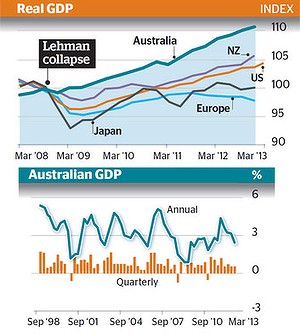
WA’s State Final Demand, an indicator of growth that excludes exports, fell a seasonally adjusted 3.9 per cent in the March quarter.

Western Australia, the engine room of Australia’s growth in recent years, is now in recession.

Growth in the mining state remained contracted for the second consecutive quarter as the national economy expanded 0.6 per cent in the first quarter of 2013, reflecting the peaking of resources investment, but a shortfall in the expansion of other sectors, analysts said. Read more of this post

Taurus Shuts Gold Fund on Redemptions After Price Tumbles; product once held as much as A$250 million ($240 million)

Taurus Shuts Gold Fund on Redemptions After Price Tumbles

Taurus Funds Management Pty Ltd. shut its precious metals fund because of investor redemptions after gold slumped, according to an executive, who said that the product once held as much as A$250 million ($240 million).

Assets in Taurus Precious Metals peaked last year before the closure in May, Gordon Galt, a principal at the Sydney-based fund manager, said in an interview today, declining to comment on the level last month. As of February, the fund had invested mostly in physical gold, according to a report to investors for that month, which was confirmed by Galt.

Taurus Funds’ decision reflects a shift by some investors away from bullion and into other assets as signs that the global economy was recovering drove gold into a bear market while equities rallied. Withdrawals from gold-backed exchange-traded products reached a record pace this year, and Nouriel Roubini has forecast that gold may fall toward $1,000 an ounce by 2015. Read more of this post

Man Group, the world’s second largest hedge fund, tumbled as much as 15 per cent in London after steep losses for the company’s flagship $16.4bn “black box” fund; Almost all of the losses are attributable to long positions in global bond markets

Last updated: June 5, 2013 3:06 pm

Man Group shares tumble after steep losses by flagship AHL fund

By Sam Jones, Hedge Fund Correspondent

Shares in Man Group, the world’s second largest hedge fund, tumbled as much as 15 per cent in London after steep losses for the company’s flagship fund.

Man’s $16.4bn “black box” fund AHL, which uses complex computer models to spot and ride trends in hundreds of markets around the world, lost more than 10 per cent of its value in May and is down more than 12 per cent from a peak earlier this year.

Almost all of the losses are attributable to long positions in global bond markets, which have been hit hard in the past two weeks on investors’ anticipation of an end to the US Federal Reserve’s quantitative easing measures. Read more of this post

Some of the world’s biggest quant hedge funds have suffered steep losses in the past two weeks following the sell-off in global bond markets.

Last updated: June 5, 2013 3:10 pm

Quant hedge funds hit by US bonds sell-off

By Sam Jones

Some of the world’s biggest quant hedge funds have suffered steep losses in the past two weeks following the sell-off in globalbond markets.

So-called “CTAs”, which use computer models to automatically spot and ride market trends, were caught out as investors anticipated an end to the Federal Reserve’s measures to stimulate the US economy, triggering a global rout in fixed income investments.

Bond yields have risen sharply from some of their lowest levels in decades in the past fortnight, leaving funds with large holdings badly hit. Many quant funds have been major buyers of bonds over the past few years as their algorithms have followed yields lower. Read more of this post

US dividend play at risk of overrunning

June 5, 2013 9:30 am

US dividend play at risk of overrunning

By Michael Mackenzie in New York

Some investment trends are like a long-running Broadway or West End show. No matter how stale the storyline, an infusion of new cast members can attract renewed interest from audiences.

When it comes to buying stocks, owning high dividend paying companies has been the trend to follow for some years. But, with the US equity bull market in its fifth year and the S&P 500 occupying record territory, the preference for owning stocks that pay hefty dividends is under assault.

High yielding stocks in the utilities and telecoms sectors have fallen sharply over the past month, thanks to the sharp jump in bond yields that has reduced the attractiveness of such companies. The pressure on these traditional high dividend paying sectors is the first sign that their high valuations have finally became too lofty for investors seeking income. Read more of this post

Fed ‘tapering’ fears push up US mortgage rates

Last updated: June 4, 2013 11:59 pm

Fed ‘tapering’ fears push up US mortgage rates

By Stephen Foley and Michael Mackenzie in New York

The average rate on a US mortgage has soared above 4 per cent for the first time in more than a year, reflecting recent turmoil in the bond market and threatening to undermine the Federal Reserve’s efforts to stoke the US recovery.

The rise has outstripped even the sharp jump in rates on US Treasury debt, whichtook many traders by surprise in May.

Economists said the upswing in homeowner borrowing costs is one of the first significant impacts of concern in the financial markets that the Fed will taper its purchases of Treasuries and mortgage-backed securities, measures which have been holding mortgage rates at historic lows. Read more of this post

What Enron and the IRS Have in Common; Ethical meltdowns are rarely the work of a few rogue workers. They take their cues from toxic leadership

June 5, 2013, 7:10 p.m. ET

What Enron and the IRS Have in Common

Ethical meltdowns are rarely the work of a few rogue workers. They take their cues from toxic leadership.

By STEVEN LAW

Any good CEO will tell you that ethical meltdowns like the IRS political-targeting scandal are rarely the work of a few rogue employees. Such messes are the result of a toxic culture that has been allowed to fester.

When I was chief of staff at the Labor Department, we investigated the ethical and financial disintegration of Enron in connection with the collapse of its pension funds in 2001. What we found was a small circle of certifiably bad actors who acted without regard for the law or for anyone else. Surrounding this inner circle was a culture that gave these employees tacit permission to run roughshod over others and break the law. Read more of this post

Stock Jitters Spread to REIT IPOs as Colony American Deal Delayed

Jun 5, 2013

Stock Jitters Spread to REIT IPOs as Colony American Deal Delayed

By Matthew Jarzemsky

The jitters hitting the stock market in recent weeks are spreading to what had been a red hot market for high-yielding initial public offerings.

Late Tuesday evening, executives at Colony American Homes Inc. and its bankers decided to delay the real-estate investment trust’s IPO, which had been expected to raise some $245 million. The last minute decision to put off the IPO was due to adverse market conditions, according to a person familiar with the deal. Read more of this post

‘Dark Pools’ Face Scrutiny; Regulators Ask for Details on Stock Trading in Murkiest Parts of the Market

June 5, 2013, 9:55 p.m. ET

‘Dark Pools’ Face Scrutiny

Regulators Ask for Details on Stock Trading in Murkiest Parts of the Market

By SCOTT PATTERSON

MI-BW409_DARKPO_G_20130605182106

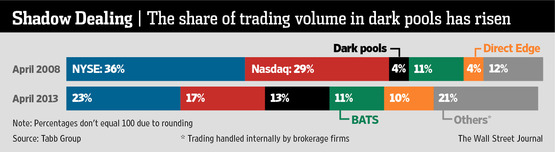
WASHINGTON—Regulators are ramping up scrutiny of an opaque corner of the market where stocks change hands in the dark.

The Financial Industry Regulatory Authority, Wall Street’s self-regulatory body, last month sent 15 examination letters to operators of “dark pools”—lightly regulated, off-exchange trading venues that have been a rising concern for regulators and some investors as more activity shifts away from exchanges.

Finra is seeking details about how the increasingly popular venues operate, what they disclose to clients and whether they adequately police trades. It could bring enforcement action against dark-pool operators or issue recommendations for tighter oversight, depending on the answers it receives and additional examinations, said John Malitzis, executive vice president of market regulation at Finra. The letters are a follow-up to an initial round of questions the regulator circulated last fall. Read more of this post