Western Australia, the engine room of Australia’s growth in recent years, is now in recession.
June 6, 2013 Leave a comment
WA in recession as growth slows to a trickle
June 6, 2013 Glenda Kwek
WA’s State Final Demand, an indicator of growth that excludes exports, fell a seasonally adjusted 3.9 per cent in the March quarter.
Western Australia, the engine room of Australia’s growth in recent years, is now in recession.
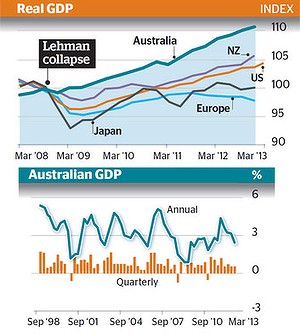
Growth in the mining state remained contracted for the second consecutive quarter as the national economy expanded 0.6 per cent in the first quarter of 2013, reflecting the peaking of resources investment, but a shortfall in the expansion of other sectors, analysts said.”It drives home the point that the peak in resource investment and capital expenditure will occur later this year, and perhaps we are already seeing preliminary signs of that,” JPMorgan economist Tom Kennedy said.
The economy expanded for the 22nd consecutive year, but grew at the slowest pace in almost two years, with an annual gain of 2.5 per cent. The growth was led by net exports and consumer spending as mining investment fell.
WA’s State Final Demand, an indicator of growth that excludes exports, fell a seasonally adjusted 3.9 per cent in the March quarter. It fell 0.9 per cent in the December quarter.
The latest figures came despite Port Hedland’s record exports during May. It shipped 27.9 million metric tonnes of exports last month, up from 26 million in April, dominated by iron ore bound for China.
The Northern Territory contracted by 10.2 per cent, Tasmania fell by 1.1. per cent, while growth in South Australia declined by 0.3 per cent. Victoria had a 0.8 per cent gain, Queensland had 0.6 per cent growth and NSW expanded by 0.4 per cent. The ACT was unchanged.
Commonwealth Bank senior economist Michael Workman said the GDP data showed the transition to non-resources-led growth was still ”fairly hesitant and slow”.
”Annual growth running at 2.5 per cent is well below the trend outcomes that could be occurring of about 3.15 per cent,” he said.
UBS chief economist Scott Haslem said while the latest figures reflected an increase in consumption boosted by lower interest rates, other data showed that business investment and activity was not improving.
”When we take away the net export contribution of about 1 per cent in the quarter, the domestic economy was clearly negative,” he said.
The soft figures increased expectations of another rate cut, with financial markets pricing in a 40 per cent chance of a cut next month and another by year’s end.
Goldman Sachs analysts revised their interest rate forecast and said they were expecting the RBA to ease rates by 25 basis points in July, and again in November.
The Australian dollar lost a quarter of a cent, dropping to US96.11¢ shortly after the data release. It was trading at US95.83¢ late Wednesday.
The sharemarket closed lower on Wednesday, with the S&P/ASX 200 index falling 1.3 per cent, to 4835.2 points. The broader All Ordinaries Index slipped 61.5 points, or 1.3 per cent, to 4825.2.
The finance, mining, transport and retail industries drove growth in the March quarter, the data showed. But the growth was offset by a 0.9 per cent fall in public investment and a 0.4 per cent drop in inventory changes.
 About bambooinnovator

