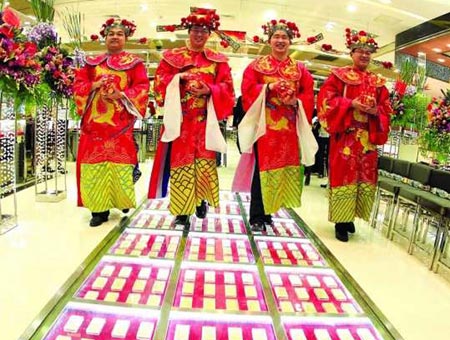
Guangzhou store front grins with 300kg of gold teeth; The building’s initiative was widely criticized as a grand waste

Guangzhou store front grins with 300kg of gold teeth

Staff Reporter

2013-05-06

goldgold-175533_copy1

Nearly 300 kilograms in gold bars caught the glare of the sun — and the eyes of shoppers — as the yellow brick road leading the way to a jewelry store in Guangzhou in southern China. The store was laying its intentions bare for the Labor Day holiday, Chinese media reported. The building authorities used 252 gold bars, each weighing 1 kilogram, to pave the front of the building for almost five meters. Dozens of gold ingots, each weighing 10kg, were also displayed on the fourth floor of the building. The building’s initiative was widely criticized as a grand waste. The Guangzhou jewelry was apparently not alone in its decadent decor. A jewelry store in Shandong also went with the gold standard, going with 1,000 bricks of gold, each of 1 kg, for its store front display. Both buildings assured critics of adequate security when asked about the safety of broadcasting their bling. The stores were apparently bringing attention to the all-time low price of gold on the world market.

Most Chinese investors don’t trust wealth management agencies

Most Chinese investors don’t trust wealth management agencies

Staff Reporter

2013-05-06

People in China have their own system of wealth management, choosing to keep their own counsel rather than put their trust in professional organizations, valuing gains but ignoring risks, preferring to follow group sentiment and rushing to invest, and being fond of putting their eggs in one basket. These are the major findings of the newly issued Chinese Wealth Management 2013 white paper published by Golden Securities, a wealth management publication.

A survey in the white paper showed that 86.8% of the people surveyed preferred to manage their money by themselves, and only 13.2% of them would commission professional organizations to manage their assets for them. “Many wealth management professionals in financial institutions rarely put clients in an important position, and they rarely care if the products are appropriate for investments or how big the risks are,” said one woman. Even if clients are losing money, they don’t even mention it, she added. Read more of this post

“All go unto one place; all are of the dust, and all turn to dust again”: Behind the hype of high-yield corporate bonds and investors’ understandable desire to make money, bad habits are creeping back in

Updated May 6, 2013, 8:51 p.m. ET

Reaping Wisdom On ‘Junk’

By FRANCESCO GUERRERA

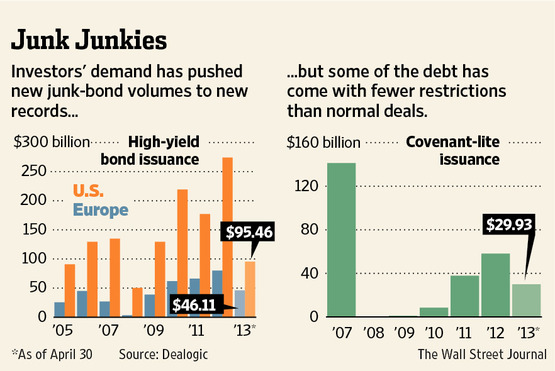
In 1977, a band of Los Angeles-based traders led by Michael Milken helped Texas International, an oil company, raise the first “junk” bond. The small issue—$30 million—opened a chapter in the history of finance. From then on, companies with less-than-pristine balance sheets were able to tap capital markets, while investors had the option of betting on securities with higher risks, and potentially higher returns, than traditional corporate bonds.

MI-BV784_GUERCO_G_20130506182703 Read more of this post

Fraud survey says bosses across much of the world ‘cook the books to meet tough targets’

Published: Tuesday May 7, 2013 MYT 7:58:00 AM

Fraud survey says world over bosses ‘cook the books to meet tough targets’

LONDON: Hard-pressed company bosses across much of the world are under so much pressure to deliver on growth that many have resorted to cooking the books, Ernst & Young says in its latest Fraud Survey published on Tuesday. One in five of almost 3,500 staff quizzed in 36 countries in Europe, the Middle East, Africa and India said they had seen financial manipulation in their companies in the last 12 months, the accounting and consultancy firm said. In addition 42 percent of board directors and top managers surveyed said they were aware of “some type of irregular financial reporting”. And despite scandals and regulatory failures in the wake of the credit crunch, almost a quarter of top financial services staff surveyed said they were aware of manipulation and almost 10 percent of all staff said their companies had understated costs, overstated revenues or used unprincipled sales tactics. Read more of this post

Fortune 500 profits near record; Wal-Mart replaces ExxonMobil as biggest revenue maker

Fortune 500 profits near record; Wal-Mart replaces ExxonMobil as biggest revenue maker

By AFP | 7 May, 2013, 03.17AM IST

NEW YORK: The 500 largest US companies scored near-record profits last year and retailer Wal-Mart replaced ExxonMobil as the biggest revenue maker on the annual list,Fortune magazine said Monday. Apple cracked into the top 10 companies for the first time, vaulting into sixth place from the prior year’s number 17 slot.  The combined earnings of the Fortune 500 came in at $820 billion in 2012, slipping from the all-time high of $824.5 billion in 2011.  Earnings amounted to 6.8 percent of sales, well above the historical average of around 5.5 percent, the magazine said. “For the future the overriding question for the 500 is whether the era of abundant profits will continue,” said Fortune senior editor-at-large Shawn Tully. Tully predicted that companies would be forced to increase their staff and pay higher salaries as the economy continues to improve. “Most likely that will hold profit growth to the low single digits in the next year or two, in line with sales, as gravitational forces pull earnings back to the mean.”

Tully characterized 2012 as a year that saw the return of “animal spirits,” or an urge to action, reflected in an increase in the number of spinoffs and mergers and acquisitions.
“For several years, players have been hoarding cash and shunning expansion,” Tully said. “In 2012 they put that cash — and their rapidly appreciating shares — to work in the best year for M&A in over a decade.”

Wal-Mart reclaimed the top spot on the list from energy titan ExxonMobil after posting $469.2 billion in revenues, or $19.3 billion more than Exxon. However, Exxon’s profits of $44.9 billion dwarfed the retailer’s $17.0 billion. Exxon and Wal-Mart have traded the top two positions repeatedly in recent years. This year marks the ninth time Wal-Mart has topped the list. Energy companies continued to play a prominent role in the group, with Chevron in third place and refiners Phillips 66 and Valero Energy placing fourth and ninth, respectively. Rounding out the rest of the top 10 were Warren Buffett’s Berkshire Hathaway, ranked in fifth place, Apple (six), General Motors (seven), General Electric (eight) and Ford Motor (10).  The magazine classified financial services as the “comeback” sector of the year, leading all industry groups with $200 billion in total profits, ahead of the technology sector. JPMorgan Chase ranked 18th, Bank of America placed 21st, Wells Fargo was 25th andCitigroup finished 26th.
Is Soros shorting the Aussie dollar?

Is Soros shorting the dollar?

May 7, 2013 – 9:11AM

Mark Hawthorne

The Australian dollar fell in overnight trade on the back of rumours that billionaire US investor George Soros is betting the local currency will fall.

The Aussie dollar slipped from $US1.0284 in late local trade to as low as $US1.0222 in offshore trade as traders reacted to unconfirmed rumours that Mr Soros – who famously shorted the British pound back in 1992 – was planning a raid on the dollar ahead of today’s interest rate announcement.

The dollar has since recovered some of its overnight losses and was buying $US1.0253 this morning.

A large number trades shorting* the dollar totalling $US1 billion were placed via Hong Kong and Singapore late Monday, believed to be by Soros Fund Management.

“Someone … seems to be betting on a rate cut,” said one Sydney-based FX trader. “I’ve heard the George Soros rumour tonight. A billion dollars sounds like a lot, but it’s not enough to move the Australian dollar and it’s not a lot for George Soros, but there is a play happening  in the FX market. Read more of this post

Indian Ponzi Scheme Gets a Political Bailout

Indian Ponzi Scheme Gets a Political Bailout

As the head of the conglomerate the Saradha Group, Sudipta Sen persuaded small investors in West Bengal to entrust more than $500 million to his business between 2008 and 2013. What wasn’t to trust? After all, Sen ran a network of around 300,000 agents, owned a set of TV channels and newspapers and had influential patrons in politics, including a member of Parliament who agreed to run his media operations for him.

Last month, Sen (who so disliked being photographed that his “message” on his company’s website has a picture of an empty chair accompanying it) went AWOL after the Ponzi scheme sustained by him for five years finally went bust. He was eventually tracked down in the north Indian state of Kashmir, but not before he had embarrassed the chief minister of West Bengal, the mercurial and autocratic politician Mamata Banerjee. Sen accused two members of Parliament belonging to her party, the Trinamool Congress, of having accepted millions of dollars to buy him protection from the law.

Meanwhile, as thousands of defrauded investors thronged the offices of the Saradha Group, Banerjee’s advice to them was the austere “Ja gechchey, ta gechchey” (“What’s gone is gone”). The same might soon be said of her own political credibility. This was only the most inflammatory of a number of paranoid and perverse steps she has taken since coming to power in West Bengal two years ago, ending more than three decades of Communist rule in the state. Read more of this post

Buffett Has No New Investment Plan in China, Says There’s No Competitive Advantage; The pessimistic remarks about China came as a strong contrast with five years ago when he said China has huge growth potential

Buffett Has No New Investment Plan in China, Says There’s No Competitive Advantage

05-06 13:58 Caijing

The Buffet-backed BYD in March reported a drop of over 94% in net profit for the year 2012 largely due to weakening demands in the world’s second largest economy amid a downturn.

Warren Buffett, the Berkshire Hathaway CEO, said he has no new plans to invest in China, as the Oracle of Omaha remained conservative about competitive edges of the world’s second largest economy, following disappointing performance of his once favored investment in Chinese auto-maker BYD. There’s no competitive advantage in China, said the billionaire in taking up a question from a shareholder from Shanghai as the annual meeting of Berkshire Shareholders was drawing to a close in Omaha on May 4th. The pessimistic remarks about China came as a strong contrast with five years ago when he invested in a new plant of Iscar Metalworking Companies (IMC) in Dalian, a coastal city in northeast China, saying China has huge growth potential.  Buffett purchased 1.3% stake in PetroChina, China’s largest oil and gas producer, with $488million between 2002 and 2003 before selling all the shares in November, 2011, which gained the investor as much as $4billion. Berkshire Hathaway bought 225million shares of BYD, a Chinese auto and battery maker, or just under 10% of the company’s stock at 8 HKD a share before it soared to over 80HKD in 2010. The company, however, had seen slumping businesses since then with its shares dropping as much as over 80% to 12.44HKD in October, 2011. The Buffett-backed BYD in March reported a drop of over 94% in net profit for the year 2012 largely due to weakening demands in the world’s second largest economy amid a downturn. Buffett said he would prefer Chinese companies that export quality goods, especially consumer goods at last year’s annual shareholder’s meeting for Berkshire Hathaway. Berkshire vice chairman Charlie Munger said China has a huge auto market which is BYD’s main focus, and the number of cars he expected BYD to sell in the U.S. would be very small.

Investors having tough time copying Buffett’s strategies these days; Sage of Omaha’s transition to master financier baffles some, but homey advice still rings true

Investors having tough time copying Buffett’s strategies these days

Sage of Omaha’s transition to master financier baffles some, but homey advice still rings true

BY JOSH FUNK

AP MAY 6, 2013

Israel’s inverted economic pyramid and how to flip it

Israel’s inverted economic pyramid and how to flip it

The opposing examples of IDB Group and Iscar indicate a pressing need to shift the economic narrative from financiers who specialize in gimmicks toward businessmen who build something of real value.

By Sami Peretz | May.03, 2013 | 2:20 PM

Over a hundred years ago, the socialist Zionist leader Dov Ber Borochov defined the structure of Jewish labor in the Diaspora as an inverted pyramid. The narrow base consisted of a few productive workers employed in industry and agriculture and, above them, in a much wider layer, were those dealing in “airy-fairy” jobs (“luftgescheft” in Yiddish), such as middlemen, small merchants and moneylenders.

At that time, the inverted pyramid was the result of Jews being denied access to other jobs and thus pushed into these professions by default. The need, therefore, to transform the Jew from a person dealing with such impractical or insubstantial work into a productive, industrial person was deeply embedded and an integral part of the drive to create a Jewish national home in Israel. A hundred years later, the financial news from this week may confirm this Zionist ideal.

On one hand, we have the Wertheimer family, founders of Iscar, a shining example of a productive industrial business, which just sold another 20 percent stake in the company to Warren Buffett for $2 billion, a deal that reflected a total company worth of $10 billion. On the other hand, a court has nominated an observer to supervise activity at IDB Development, one of the companies in Nochi Dankner’s collapsing pyramid.  Read more of this post

Korean chaebol forced to reduce cross-affiliate deals

2013-05-05 10:48

Chaebol forced to reduce cross-affiliate deals

Regulations feared to drive large firms out of country
By Lee Hyo-sik
05-06-22-0105-06-22-03
President Park Geun-hye’s pledge to penalize inter-subsidiary dealings has been troubling Korea’s family-controlled conglomerates. She has vowed to curb business transactions among chaebol affiliates in the name of “economic democratization,” which her advisors say seeks to correct unfair business practices by large family-run groups, as well as protect small businesses.

The government expects the National Assembly will approve the revised Fair Trade Act in July, designed to discourage intra-group transactions by imposing fines on and prosecuting those orchestrating them.

Policymakers and civic groups argue that generating the bulk of revenues from exclusive dealings with affiliated companies is tantamount to unfair business practices. Such transactions, they say, deprive unrelated firms, most of which are small- and medium-sized enterprises, of potential business opportunities.

They also say the exclusive intra-group dealing is misused, serving to boost the wealth of offspring and other family members of group chairmen. These family members often hold substantial stakes in the benefiting entities. Read more of this post

More chaebol children stock-rich

2013-05-05 6:49 p.m.

More chaebol children stock-rich

By Cho Mu-hyun

The number of parents and grandparents transferring stocks worth more than 100 million won ($ 91,300) to childrens names has soared to a record high, according to a report released Sunday.Chaebul.com, which tracks large conglomerates and their owners said, as of April, there were 118 102 children under the age of 12 who had stocks worth 100 million won The figure was a year ago, thirty one such offspring had stocks worth more than 1 billion won, and two had more than 10 billion won The richest child in Korea is the 12-year-old son of Huh Yong-soo, senior vice president of GS Energy and cousin of GS Group Chairman Huh Chang-soo. The boy had 42.9 billion won worth of stocks. Huhs son topped the list last year as well, when his stocks were valued at 45.3 billion won. He received 259,000 of stocks GS Holdings when he was four years old in 2004, and currently has 740,341 His nine-year-old younger brother was runner-up with 17.4 billion won worth of stocks Relatives Lim Sung-Gi, chairman and CEO of Hanmi Pharmaceutical, hold seven spots in the top ten aged between five and ten, they each own stocks valued at more than 8.44 billion won in the company’s subsidiaries Hanmi Science and Hanmi Pharm LB Investment CEO Koo Bon-chuns two sons, aged 12 and 10, had stocks worth 6.05 billion won and 55.5 billion won. The elder son first appeared on the annual list two years ago, when his stocks were worth 7.5 billion won. Koo is the son-in-law of Lee Sang-deuk, a former lawmaker of The Saenuri ruling Party and the elder brother of former President Lee Myung-bak, Seoul Pharma CEO Hwang Woo-sungs two 9-year-old sons both had stocks valued at 4.25 billion won four of the grandchildren of Hankook Tire Chairman Cho Yang-rae appeared on the list. The 7-year-old son and 10-year-old daughter of sis son and Hankook Tire President Cho Hyun-bum, who is also the son-in-low of former president Lee Myung-bak, owned stocks worth 810 and 800 million won, respectively, there are also stock-rich Infants The granddaughters of Koo and the Korea Watos Chairman Song Gong-suk, both just turned 1 who own stocks valued at 160 and 100 million won Critics say owners of conglomerates have been transferring stocks larger to relatives so they can accumulate fortunes by receiving dividends or making it easier for them to control their BUSINESSES One example is the Hyosung Group, whose Chairman Cho Suk-Raes three grandchildren owned stock in the company worth around 80 million won in 2008. When the stock price quadrupled in 2010, it was sold for a profit of 300 million won each. Another advantage of the ploy includes avoiding heavy taxes.

China-only Iron Man 3: whatever it takes to profit

China-only Iron Man 3: whatever it takes to profit

Staff Reporter

2013-05-06

The special edition of Hollywood blockbuster Iron Man 3 made exclusively for Chinese audiences reflects the compromises that movie producers are willing to make to crack the lucrative Chinese film market, reports the Commercial Times, our Chinese-language sister paper.

Iron Man 3, co-produced by US Marvel Studios and China’s DMG Entertainment Group, debuted in China last week with four minutes of additional footage and featuring the so-called “Chinese elements” required by Beijing to satisfy tight controls designed to protect the domestic film industry. This highly anticipated China-exclusive version, however, has been widely panned for coming across as awkward and adding nothing to advance the flow and plot points of the film.

According to Chinese viewers, the extra four minutes of footage were dominated by domestic product placement, including the milk product Guo Li Duo and domestic electronics makers TCL and Zoomlion. Veteran Chinese actor Wang Xueqi, who made a five-second cameo in the international version of the film, was given more screen time as a doctor prescribing Chinese medicine to aid Iron Man, while Chinese superstar Fan Bingbing, who did not appear at all in the international version, played Wang’s nameless assistant. Iron Man is also seen on a television screen with cheering Chinese school children. Read more of this post

China Intensifies Scrutiny of Importer, Exporter Capital Flows

China Intensifies Scrutiny of Importer, Exporter Capital Flows

China’s currency regulator said it will increase scrutiny of cross-border capital flows by importers and exporters to prevent speculative funds entering the country disguised as trade bills. The State Administration of Foreign Exchange will send out risk-warning notices to companies whose goods and capital flows do not match, as well as those that are bringing big amounts of cash into China, it said in a statement on its website. Recipients of such notices have 10 days to explain the need for their transactions and those that fail to comply or are unable to provide satisfactory proof will then be placed on SAFE’s so-called B list, which means their activities will be closely monitored for a period of at least three months. A return to SAFE’s A list can only take place once relevant indicators return to a normal range, the statement said. SAFE said it would finalize the B list and send out the first batch of warnings before May 10. It also ordered banks to adjust their foreign-exchange positions to comply with regulations. The yuan fell 0.03 percent to 6.1572 per dollar as of 12:01 p.m. in Shanghai, after earlier touching a 19-year high of 6.1521.

–Judy Chen. Editors: James Regan, Robin Ganguly

To contact Bloomberg News staff for this story: Judy Chen in Shanghai at xchen45@bloomberg.net.

German euro founder calls for ‘catastrophic’ currency to be broken up

German euro founder calls for ‘catastrophic’ currency to be broken up

Oskar Lafontaine, the German finance minister who launched the euro, has called for a break-up of the single currency to let southern Europe recover, warning that the current course is “leading to disaster”.

Mr Lafontaine said on the parliamentary website of Germany’s Left Party that Chancellor Angela Merkel will “awake from her self-righteous slumber” once the countries in trouble unite to force a change in crisis policy at Germany’s expense. Photo: Reuters

By Ambrose Evans-Pritchard, International Business Editor

9:30PM BST 05 May 2013

“The economic situation is worsening from month to month, and unemployment has reached a level that puts democratic structures ever more in doubt,” he said.

“The Germans have not yet realised that southern Europe, including France, will be forced by their current misery to fight back against German hegemony sooner or later,” he said, blaming much of the crisis on Germany’s wage squeeze to gain export share. Read more of this post

Buffett worries about Fed’s ‘huge experiment’, thinks the Fed chief may have overplayed his hand

Buffett worries about Fed’s ‘huge experiment’

By Stephen Gandel, senior editor May 4, 2013: 3:17 PM ET

Says he admires Ben Bernanke, but thinks the Fed chief may have overplayed his hand.

Warren Buffett

FORTUNE — Warren Buffett has a piece of advice for Ben Bernanke: It’s easier to buy than it is to sell.

Buffett, speaking on Saturday at Berkshire Hathaway’s (BRKA) annual meeting in Omaha, said he is worried about what will happen when the Federal Reserve tries to wind down its recent efforts to stimulate the economy. Via a program nicknamed QE, short for quantitative easing, the Fed in recent years has bought up over $2 trillion in bonds in order to lower interest rates and promote borrowing and investment.

Some have warned that when the Fed decides to sell its trove of bonds, or even just stops adding to it, stock markets could tank. Rising interest rates could cause banks to lose billions, perhaps igniting another financial crisis. Buffett says we don’t know what will happen, but he is concerned.

“QE is like watching a good movie, because I don’t know how it will end,” says Buffett. “Anyone who owns stocks will re-evaluate his hand when it happens and that will happen very quickly.” Read more of this post

The Chinese Are Freaking Out About A Potential Drop In Housing Prices

The Chinese Are Freaking Out About A Potential Drop In Housing Prices

The Economist | May 4, 2013, 5:54 PM | 10,113 | 9

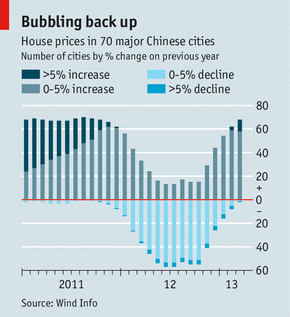
ASK ordinary people about their own Chinese dream, and you find owning a home is high on the list.

But years of rising house prices have put that dream out of reach of many. A slowing economy appeared to take some of the heat out.

Now, alas, the residential property market is soaring again (see chart). A new survey of developers and property firms on May 2nd showed average house prices up more than 5% in April on a year earlier.

20130504_cnc511 Read more of this post

Companies Add to Lineups of ‘Free’ ETFs

Updated May 3, 2013, 1:29 p.m. ET

EXCHANGE-TRADED FUNDS

Companies Add to Lineups of ‘Free’ ETFs

Still, trading commissions are only one cost, so other funds may be more attractive on balance

By ARI I. WEINBERG

IF-AB141_IFETF_G_20130501151506

How attractive is “free”? Some of the largest online brokers of exchange-traded funds are determined to find out.

Two have recently expanded the lineups of ETFs they offer without trading commissions, bringing their menus closer to the size of their competitors’.

In February, Charles Schwab Corp.SCHW +6.27% expanded its commission-free ETF menu to 105 funds, up from just its own 15 broad-based index offerings. A few weeks later, Fidelity Investments expanded its exclusive partnership with BlackRock Inc.BLK +3.43% to offer 65 of BlackRock’s iShares ETFs commission-free, up from 30, in addition to Fidelity’s one ETF.

Both programs now challenge TD Ameritrade Holding Corp. AMTD +6.08% and Vanguard Group, whose commission-free ETF choices were already large and diverse. TD Ameritrade offers 101 funds and exchange-traded notes selected by researcher Morningstar Inc., and Vanguard features all 65 of its own ETFs. Read more of this post

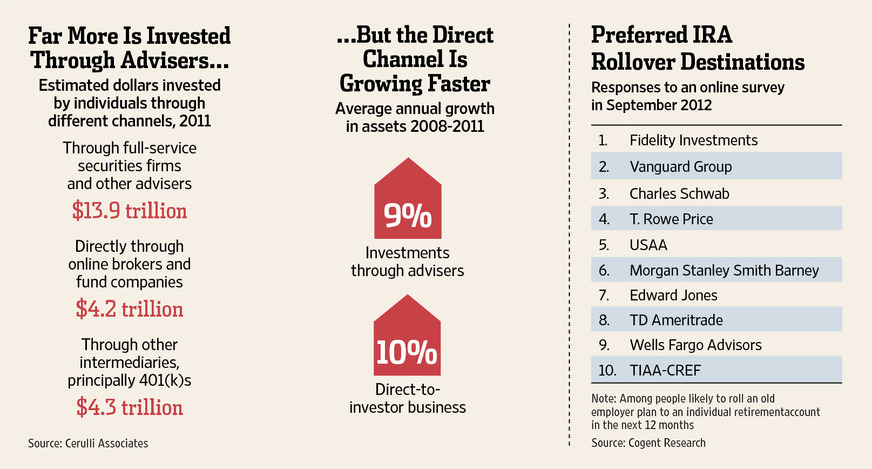
A New Era for Do-It-Yourself Investing. Many investors want to call the shots—while turning to tools and people for help as needed

Updated May 3, 2013, 11:37 a.m. ET

A New Era for Do-It-Yourself Investing

Many investors want to call the shots—while turning to tools and people for help as needed

Instead of going it entirely on their own, more investors are pursuing a kind of modified DIY approach, tapping an array of increasingly sophisticated online tools and a-la-carte advice services offered by financial firms. The result is that there has been strong growth in customer assets at the mutual-fund and discount-brokerage companies that have traditionally served the do-it-yourself market, a group that includes Vanguard Group, Fidelity Investments and Charles Schwab Corp.SCHW +6.27%

IF-AB144_DIYcov_G_20130502113550IF-AB146_DIYjum_G_20130501151515 Read more of this post

Shedding some light on the dark world of party discipline in China

Shedding some light on the dark world of party discipline

Monday, 06 May, 2013, 12:00am

Wang Xiangwei xiangwei.wang@scmp.com

Lawyers and media commentators say the harsh system known as shuanggui contravenes efforts to push for rule of law

In China’s uphill battle against rampant corruption, no other Communist Party agency evokes more fear among officials than the Central Commission for Discipline Inspection (CCDI), the country’s top anti-graft watchdog.

The commission’s name may sound innocuous, and so does its most potent weapon, known as shuanggui – a two-word abbreviation from a clause in the party’s regulations that requires members to explain their so-called disciplinary violations at a specific time and venue.

But those two words have given the commission sweeping powers to indefinitely detain and question any official suspected of wrongdoing. Read more of this post

‘Boring’ Blue Chips Lead Record-Setting Market Runup; Bufett’s Bear Doug Kass says when the market is led by defensive stocks, “it is time to be fearful of the broader markets.”

May 5, 2013

‘Boring’ Blue Chips Lead Record-Setting Market Runup

By GREGORY ZUCKERMAN

SJ-AG455_05LEDE_G_20130503164204

Boring bulls are powering the market higher.

That the stock market has climbed as much as it has this year surprises many analysts. Perhaps the biggest shocker: the kinds of companies leading the charge.

Technology, Internet or other companies making cutting-edge products? Hardly. A group of decidedly unsexy companies—from Procter & Gamble PG +0.55% (PG) and Johnson & Johnson JNJ +0.69% (JNJ) to Colgate-Palmolive CL +0.35% (CL), Clorox (CLX) and General Mills GIS +0.54% (GIS)—are en vogue. Read more of this post

Buffett devotees stick by him even as growth slows; Buffett Says Next CEO to Bolster Berkshire Aura for Crisis Deals

Buffett devotees stick by him even as growth slows

4:04pm EDT

By Jonathan Stempel and Jennifer Ablan

OMAHA, Nebraska (Reuters) – Short-seller Douglas Kass, Warren Buffett’s handpicked bear, raised a concern on the minds of many shareholders at the “Woodstock for capitalists” this weekend: Has Berkshire Hathaway Inc become so big that it will find it hard to grow?

Many retail investors who converged on Omaha, Nebraska, for Berkshire’s annual meeting on Saturday acknowledged that its fastest growth days are likely behind it. But they said Berkshire is still a good long-term bet as faith remains in Buffett and his management team’s more than 4-decade-long record of stellar returns, and the company’s tentacles into many sectors of the U.S. economy.

“Yes, it is a concern, but I have to get my expectations in line,” said Julie Fehrnstrom, a mother of three from Orinda, California, attending her fifth meeting. “They are not driven by short-term decision making and they have really smart management. You really don’t always find that.” Read more of this post

Leaders Pore Over Southeast Asia’s Investment Hurdles

May 5, 2013, 10:14 p.m. ET

Leaders Pore Over Southeast Asia’s Investment Hurdles

By NATASHA BRERETON-FUKUI

GREATER NOIDA, India—Asian policy makers have been working hard to improve access to funding for regional infrastructure projects, but other hurdles could be a bigger constraint to investment in the sector. Read more of this post

Warren Buffett Says He’s Not a Buyer of Gold After Price Slump

Warren Buffett Says He’s Not a Buyer of Gold After Price Slump

Billionaire investor Warren Buffett, the chairman and chief executive officer of Berkshire Hathaway Inc., comments on the investment appeal of gold. He spoke to reporters in Omaha, Nebraska, on May 2. Gold rallied 4.9 percent in the past two weeks after entering a bear market April 12. Futures in New York are still down 13 percent this year to $1,464.20 an ounce. On whether he would buy gold after recent declines:

“No. Gold’s not reproduced or anything since I wrote about it a year or two ago. It just sits there, and you hope somebody pays you more for it. ‘‘If gold went to $1,000 I wouldn’t be a buyer. If it went to $800, I wouldn’t be a buyer. It’s never interested me. If you go back to 1965, Berkshire was at $15 and gold was at $35, so you could’ve bought two shares of Berkshire for an ounce of gold, a little more than two shares. And so far, two shares of Berkshire’s been better.” Read more of this post

Sweden a Crisis Casualty No More Shows How Haven Appeal Is Won

Sweden a Crisis Casualty No More Shows How Haven Appeal Is Won

After suffering through devaluations, three years of economic contraction and a banking crisis in the 1990s, Sweden has learned how to handle financial turmoil.

Now, the largest Nordic economy is emerging as a permanent haven from global market turbulence, according to the nation’s debt office.

“Sweden is looked at in a different light than before,” Thomas Olofsson, head of the Swedish government’s debt management, said in an interview in Stockholm. “There’s definitely a completely different interest in Sweden than five to 10 years ago. In the past, the Swedish exchange rate and interest rates often suffered during times of turbulence in a way that we haven’t seen this time around.”

The country cemented its status as a haven from Europe’s debt crisis last year, after posting the biggest economic rebound in the European Union in 2010 while keeping its budgets in surplus. Sweden boasts the lowest default risk in the world, after oil-rich Norway, credit derivatives suggest, and has managed to produce some of Europe’s best-capitalized banks.

The success in navigating way through the current crisis follows lessons learned two decades ago. Swedes suffered three years of economic decline from 1991 through 1993, culminating in the 1992 currency crisis, when the Riksbank abandoned the krona peg after failing to stem capital flight even with a 500 percent interest rate. Read more of this post

Berkshire Skips Apple Bonds as Buffett Says Not at Those Yields

Berkshire Skips Apple Bonds as Buffett Says Not at Those Yields

Warren Buffett, the billionaire chairman and chief executive officer of Berkshire Hathaway Inc. (BRK/A), said he isn’t investing in corporate debt, including Apple Inc. (AAPL)’s record offering, because yields are too low. “We’re not buying corporate bonds of any kind now,” Buffett, 82, said May 4 during an interview with Bloomberg Television’s Betty Liu in Omaha, Nebraska, where Berkshire held its annual meeting. “Not at those yields.” Berkshire held $12.2 billion of corporate bonds as of March 31, according to a quarterly filing issued on May 3. That’s down 14 percent from two years earlier. The value of Berkshire’s equity portfolio climbed 54 percent to $97.2 billion in the two years ended March 31 as markets rallied and Buffett added shares of International Business Machines Corp. Yields on debt from corporate securities to Treasuries have tumbled as the Federal Reserve slashed interest rates and bought bonds to help the economy recover from recession. The payout rate on dollar-denominated company debt fell to a record 3.35 percent on May 2, according to the Bank of America Merrill Lynch U.S. Corporate & High Yield Index. Yields have averaged 5.87 percent during the past decade.

Read more of this post

Asian Leaders’ Tough Talk Hides Failure of Leadership

Asian Leaders’ Tough Talk Hides Failure of Leadership

Visiting China in 1928, when a rising Japan had begun to prey on its neighbor, the Japanese poet Akiko Yosano took a surprisingly broad-minded view of anti-Japanese passion among the Chinese: “It’s surely frightful from the imperialists’ point of view,” she wrote in her travelogue, “but for the Chinese people it must be celebrated in the name of humanity.”

Writing last year in the Asahi Shimbun, as anti-Japanese rioting erupted in China, the writer Haruki Murakami had a wholly unsympathetic take on the same phenomenon. He assailed the “cheap alcohol” of nationalism that “makes you speak loudly and act rudely” and leaves you “with nothing but an awful headache the next morning.”

I was recently reminded of these contrasting responses, as Chinese and Korean leaders protested high-profile Japanese visits to Tokyo’s Yasukuni Shrine, which commemorates, among others, Japanese indicted for war crimes during Japan’s early 20th-century invasions and occupations of China and Korea.

The South Korean foreign minister canceled his visit to Japan. Japan’s conservative Prime Minister Shinzo Abe then caused further outrage by appearing to question whether Japan had actually invaded its neighboring countries. Read more of this post

Banks in Singapore agonize over rich clients in tax evasion clampdown

Banks in Singapore agonize over rich clients in tax evasion clampdown

5:29pm EDT

By Rachel Armstrong, Saeed Azhar and John O‘Callaghan

SINGAPORE (Reuters) – Banks in Singapore are urgently scrutinizing their account holders as an imminent deadline on stricter tax evasion measures forces them to decide whether to send some of their wealthiest clients packing.

The Southeast Asian city-state has grown into the world’s fourth-biggest offshore financial center but, with U.S. and European regulators on the hunt for tax cheats, the government is clamping down to forestall the kind of onslaught from foreign authorities that is now hitting Switzerland’s banks.

Before July 1, all financial institutions in Singapore must identify accounts they strongly suspect hold proceeds of fraudulent or wilful tax evasion and, where necessary, close them. After that, handling the proceeds of tax crimes will be a criminal offence under changes to the city-state’s anti-money laundering law.

“Because of banking secrecy, Singapore used to be an attractive place to put money if you didn’t want the authorities back home to know about it,” said Erik Wilgenhof Plante, head of compliance at Germany’s DZ Privatbank in Singapore.

“That has left legacy problems for some banks.” Read more of this post

Chinese Growth – Real Or Imagined?

Chinese Growth – Real Or Imagined?

Tyler Durden on 05/05/2013 16:15 -0400

We toyed with titling this post “Lies, Damned Lies, And Chinese Statistics” but perhaps that is a little harsh, though one glance at the chart below and one instantly comprehends the efforts that are being undertaken to ‘show’ the world that China’s transition is on target (and crumbling into collapse). As we recently noted, it is actually unlikely that China can complete this transition to organic (as opposed to investment-led) growth (with moderate growth the exception not the rule), and China’s recent trade data does not pass the smell test. As GREED & Fear’s Chris Wood notes, with the Hong Kong trade data being released last week, it is worth noting a growing discrepancy between the data on China’s exports to Hong Kong reported by mainland’s customs department and the corresponding data on Hong Kong’s imports from China reported by Hong Kong’s Census and Statistics Department in March. Such inconsistency in China’s export numbers relative to the imports data from its trading partners has generated growing speculation about the credibility of China’s trade figures. Various explanations have been put forward (below) but the divergence would seem far too large to be simply explained by “different statistical methods” as the Chinese government’s official line notes.

Via GREED & Fear,

…Hong Kong’s reported imports from China rose by “only” 13.8%YoY to US$20.6bn in March and were up 10%YoY to US$56bn in 1Q13. By contrast, China reported that exports to Hong Kong surged by 93%YoY to US$48.4bn in March and were up 74%YoY to US$106bn in 1Q13. As a result, the ratio between China’s reported exports to Hong Kong and Hong Kong’s reported imports from China has surged to 2.35 times in March, up from 1.36x in 2012 and an average of 1.11x during the previous five years between 2007 and 2011. Such inconsistency in China’s export numbers relative to the imports data from its trading partners has generated growing speculation about the credibility of China’s trade figures.

20130505_china_0 Read more of this post

‘Speed money’ puts the brakes on India’s retail growth; “You get excited about the Indian middle class but then you wonder – is it really worth it?”

Insight: ‘Speed money’ puts the brakes on India’s retail growth

6:02am EDT

By Nandita Bose

MUMBAI (Reuters) – Hong-Kong entrepreneur Ramesh Tainwala spent 18 months operating branded clothing retail stores in India before deciding it was impossible to succeed without paying bribes.

Tainwala, a 55-year-old expatriate Indian, owns Planet Retail, which held the India franchise rights for U.S. fashion labels Guess and Nautica as well as UK retailers Next and Debenhams. He sold the brands last September to various Indian businesses.

“Right now it’s not possible to do business in India without greasing palms, without paying bribes,” said Tainwala, who is also luggage maker Samsonite’s president for Asia Pacific and West Asia. Tainwala said he himself refused to pay bribes to licensing officials, though that could not be independently confirmed. Read more of this post