Bamboo Innovator Daily: 20 May (Wed) – Inside the Magic: The definitive history of ILM, the special effects powerhouse that revolutionized moviemaking and changed entertainment forever

Life

  • Inside the Magic: The definitive history of ILM, the special effects powerhouse that revolutionized moviemaking and changed entertainment forever: Wired
  • 6 strategies great leaders use for long-term success:BI
  • 11 pieces of life-changing advice from commencement speeches by tech celebrities: BI
  • Here’s what’s on Bill Gates’ summer reading list: GatesNotes
  • How To Stop Worrying: Barker
  • ‘Despicable Me’ founder shares secret of success: KT
  • When it comes to you and your group, keep your verbs humble: JT
  • With yoji jukugo (四字熟語), four little characters can say so much: JT
  • Management Accounting Skills Found Lacking in Entry-Level Talent: WSJ
  • Warren Buffett impressed by children’s money-making ideas: reuters
  • “Competitive Intelligence” Shouldn’t Just Be About Your Competitors; It’s about seeing the market as a whole. HBR
  • Explain Your New Strategy By Emphasizing What It Isn’t; Contrasts will help your team understand how to prioritize. HBR
  • Andreessen Horowitz’s lessons for Asian VCs and founders: e27
  • Buddhism played a key role in Korea: KT
  • David Letterman: Comedian, late night legend. and shrewd businessman?: Fortune
  • Dogbert Explains What CEOs Do: Zerohedge
  • Why Thought Leadership Is Absolutely Essential To Professional Services Firms: Forbes
  • That’s billion, with a bee: Measuring the massive cost of hive collapse: Reuters

Books

  • The Magic of Reality: How We Know What’s Really True: Amazon

Read more of this post

Bamboo Innovator Daily: 19 May (Tues) – Berkshire Hathaway’s Disintermediation: Buffett’s New Managerial Model; A conductor who’s taught classes at Google and Goldman Sachs explains how great leaders inspire brilliance

Life

  • A conductor who’s taught classes at Google and Goldman Sachs explains how great leaders inspire brilliance: BI
  • From welfare to one of the world’s wealthiest women – the incredible rags-to-riches story of J.K. Rowling: BI
  • Families Find the Principles That Keep the Business Going: NYT
  • Learning From Mistakes: The question, would you go back and undo your errors is unanswerable. The question is: What wisdom have you learned that will help you going forward? : NYT
  •  ICE’s Jeffrey Sprecher Has Built a Global Trading Powerhouse: II
  • How Doctors Deliver Bad News; Doctors are trying new ways of solving an old problem—how to tell patients they aren’t going to get well: WSJ
  • The Plain-Vanilla Accountant Goes Out of Style: WSJ
  • Leading Teams through Change at the Speed of Business: Strategy&
  • The crazy story of an ex-cop busted for running a website that taught people how to cheat polygraphs: BI
  • Leadership Lessons From the Brothers Grimm; Whether it’s kissing frogs, slaying dragons or battling wits with the wicked witch, fairy tales hold salient leadership lessons for today’s executives. Insead

Books

  • The Ignorant Maestro: How Great Leaders Inspire Unpredictable Brilliance: Amazon

Investing Process

  • Berkshire Hathaway’s Disintermediation: Buffett’s New Managerial Model : SSRN

Read more of this post

Long-Term Contract Accounting Fraud in Asia From Construction to Software

 “Bamboo Innovators bend, not break, even in the most terrifying storm that would snap the mighty resisting oak tree. It survives, therefore it conquers.”
BAMBOO LETTER UPDATE | May 18, 2015
Bamboo Innovator Insight (Issue 83)

  • The weekly insight is a teaser into the opportunities – and pitfalls! – in the Asian capital jungles.
  • Get The Moat Report Asia – a monthly in-depth presentation report of around 30-40 pages covering the business model of the company, why it has a wide moat and why the moat may continue to widen, a special section on “Inside the Leader’s Mind” to understand their thinking process in building up the business, the context – why now (certain corporate or industry events or groundbreaking news), valuations (why it can compound 2-3x in the next 5 years), potential risks and how it is part of the systematic process in the Bamboo Innovator Index of 200+ companies out of 15,000+ in the Asia ex-Japan universe.
  • Our paid Members from North America, Europe, the Oceania and Asia include professional value investors with over $20 billion in asset under management in equities, some of the world’s biggest secretive global hedge fund giants, and savvy private individual investors who are lifelong learners in the art of value investing.
Dear Friends,Long-Term Contract Accounting Fraud in Asia From Construction to SoftwareA Dreamer and an Accountant is a lethal combination. McDonald’s Ray Kroc had financial wizard Harry Sonneborn to advise him that real estate was the key to a franchise’s financial success. Thomas Edison had his right-hand business partner Samuel Insull who took care of financing, operations, hirings, firings and mergers.Tanaka Hisashige and Ichisuke Fujioka, the “Thomas Edisons of Japan”, must have wished there is a competent accountant to exercise financial stewardship over their business creation Toshiba (6502 JP, MV $14.6bn). Toshiba was involved in an accounting scandal in inflating profits by over ¥50bn ($419m) for the three year cumulative period through FY13 after calling for an urgent press conference at its headquarters in Minato City, Tokyo, on 15 May 2015 to appoint an independent investigation committee to probe the accounting issues, four years after the Olympus accounting fraud revelation in 2011 that hid $1.7bn in losses in a 13-year cover-up.Starting from a small workshop rented from the second floor of a temple in Roppongi, Tokyo in 1873, six years after the Meiji Restoration and at the age of 74, Hisashige-san produced the first telegraph equipment in Japan. After meeting Thomas Edison in 1884 while on a tour in the United States, Fujiioka-san pledged to devote himself to establishing a Japanese electric power industry, succeeded in developing an economical, durable light bulb and in constructing an electric railway, taking Japan into the age of electricity. Hisashige’s firm, later renamed Shibaura Engineering Works, merged with Fujiioka’s Tokyo Electric Company to form Tokyo Shibaura Electric, which soon became known as Toshiba.

The in-house investigation into the accounting scandal relates to the underestimation of costs for 9 out of the 250 projects using the percentage-of-completion (POC) accounting method: 4 projects totalling ¥6bn at the power systems company, 4 projects totalling ¥30bn at the social infrastructure systems company and one project totalling ¥14bn at the community solutions company. Toshiba derived around 11% of operating income from its power and social infrastructure business. This is the second accounting investigation in less than two years for Toshiba, which has twice delayed reporting its earnings for the year ended in March because of irregularities. The new panel’s probe will extend to Toshiba’s 593 consolidated subsidiaries, including electrical engineering giant Westinghouse Electric, owned by Toshiba since 2007.

Toshiba and one of its listed subsidiaries, Toshiba Plant Systems & Services (1983 JP, MV $1.2bn), are also members of the JPX-Nikkei Index 400, which was started last year to showcase Japan’s best shares to institutional investors and shame executives of companies that weren’t picked into improving capital efficiency to make the cut. It selects the 400 companies in Japan with the highest return on equity and profit over the past three years. Corporate governance is another factor in choosing the members. The gauge recalculates its constituents every year using data from the last business day of June, and publishes the results in August. Sony Corp was among 31 members that got replaced in 2014. Interestingly, Toshiba has four outside board directors, an apparent sign of good “corporate governance” to keep checks and balances on the managers. Toshiba is now in a race to report its restated earnings before the June 30 deadline. Toshiba risks losing the attention of about ¥650bn tracking the JPX-Nikkei 400 in exchange-traded and mutual funds should it get kicked out of the JPX-Nikkei Index.

We wish to highlight the area of revenue recognition and the accounting for long-term contracts, in particular the percentage-of-completion (POC) accounting method, which has received relatively little inspection from academics and practitioners. There are important implications for value investors given that the POC accounting method is common across industries from construction/infrastructure/property and defence to software.

In essence, long-term contracts present special problems for revenue recognition, which allows for both the POC method and the completed contract method (CCM). Under the CCM, no revenue is recognized until the project is 100% complete; and, the related project costs are held as inventory. The POC method recognizes revenue and costs as measurable important progress milestones on a project (output-based measure) or based on a ratio of costs incurred to date over expected total contract costs (input-based measure 1: cost-to-cost method) or based on comparing measures such as labor hours, labor dollars, machine hours or quantities of material consumed to date to the total quantity estimated forte entire project (input-based measure 2: efforts-expended method). Under the POC method, managers can opportunistically manipulate the percentage of completion to recognize revenue prematurely and conceal contract overruns.

The following can be manipulated to affect revenue recognition:

  • Concealing subcontractor, labor and other project costs
  • Subjective estimation of costs to complete the projects
  • Shifting costs between projects
  • Improper allocation of indirect overheads to projects
  • Misallocation between project and non-project costs
  • Improperly deferring project costs
  • Premature expensing of pre-contract costs
  • Commingling of project and other costs
  • Recognition of unapproved change orders and claims that have no basis for inclusion in contract value
  • Setting improper project milestones where cost-to-cost is the more appropriate basis

Note: Should the above red flags be found, value investors should adjust downward the revenue by an amount that is the difference between unbilled receivables (or amount due from customers in contract work) and the work-in-progress (WIP).

Past prominent cases involving POC accounting fraud include:

  • Defence contractor Halliburton (HAL US) had increased revenue by $434m during 1998-2001 by booking cost overruns on construction projects before clients agreed to pay for them. In the wake of the recent Toshiba scandal, South Carolina Electric & Gas, a client of Westinghouse and its business partner Chicago Bridge & Iron (CBI US), had filed a petition on the incremental capital costs on a nuclear plant construction that total $698m, of which $539m are associated with delays and other contested costs.
  • Data-mining software company MicroStrategy (MSTR US), worth $31.1bn at its peak as compared to its present market cap of $2bn, had recognized over half ($17.5m) of the licensing revenue immediately in a $27.5m multi-year licensing agreement with NCR. The foundation of MicroStrategy’s product had been its corporate data-mining program which combs through terabytes of data looking for interesting relationships; MicroStrategy’s customers McDonald’s, Wal-Mart, NCR could use the program to detect customer buying patterns. According to the NCR order, because MicroStrategy’s software license sales were part of multiple-element transactions that included other services such as product support and development and consulting, the company was required to apply POC accounting. However, for a number of transactions that were subsequently restated due to a misapplication of the accounting standard, MicroStrategy had (1) improperly separated software license sales from their service elements and (2) characterized revenue in multiple element transactions as product or software revenue and recognized it at the time of the transaction. Without this $17.5m addition to third quarter revenue in 1999, MicroStrategy would have reported a revenue decline of 20% from the previous quarter and a loss instead of a profit.
  • Similar accounting issues to MicroStrategy arose for…

Recent accounting scandals in Asia who had potentially abused the POC accounting method include water treatment company Sound Global (967 HK, $1.36bn) whose auditors identified audit issues of missing RMB2bn cash shortfall and had reported matters to Singapore’s Ministry of Finance in an announcement on May 4, around three months after allegations of fraud by Emerson Analytics which the company denied with the media supporting the management and blasting the short-seller for the unfair attack. For instance, unbilled receivables (amount due from customer for contract work) at Sound Global soared over five-folds from RMB203m in FY09 to RMB1.1bn in FY13, representing around 15% and 35% of sales respectively, an indication of aggressive revenue recognition before projects are actually completed in the subjective use of the POC accounting method. Managers often opportunistically manipulate the estimates under the POC accounting method to inflate revenue and profits to achieve compliance with existing and future debt covenants and to raise more external financing in debt and equity. Note that the total debt at Sound Global had jumped from RMB227m in FY09 to RMB3.8bn in FY13.

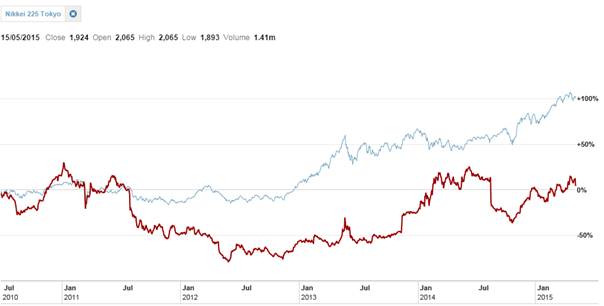
Another example is Japanese vacuum machinery company Ulvac (6728 JP, MV $796m). Around 2010, Ulvac reported that its full year ended Jun 2010 sales were down 1% and operating profit was up 38%. However, the result was due to the switch to POC accounting method and aggressive accounting in revenue recognition much earlier. Interestingly, Ulvac disclosed in the footnotes that had it used the same revenue recognition method as before, its sales would have been down 21% and there would be a loss. Since Jun 2010, Ulvac’s share price is flat, underperforming the 100% rise in the Nikkei index.

Ulvac (TSE: 6728 JP) Stock Price Performance 2010-2015

Ulvac

********

When Samuel Insull was not named the president of what is now known as General Electric, he left and went on to build a electricity utilities empire using financial engineering and complex holding companies structure carrying out M&As and became one of the richest man in the world with a personal worth of over $150m (over $1.7bn in today’s dollars). To pay for expansion, Insull had sold low-price bonds and stock. Over a million middle-class Americans bought in – but their investments were made worthless by the Great Depression. Overnight, Insull went from a hero on the cover of Time magazine to the villain who had stolen the people’s money. It was said that before Enron, there was Insull. Charged with fraud, Insull was tried in 1934 and acquitted of the charges. But his reputation was destroyed, and he left the country for good. Four years later, Insull died of a heart attack in the Paris subway in 1938 with 84 cents in his pocket.

When financial and accounting wizards Harry Sonneborn and Samuel Insull left Ray Kroc and Thomas Edison respectively, they were in a “percentage of completion” mode in not being able to build an idea larger than themselves to complete the work. The awkward Dreamer and the suave professional Accountant is the “completed contract”. When separated from the Dreamer and her vision, the Accountant often flounders and loses his Way. Similarly, the technical interpretation and application of the POC accounting method cannot be separated from the wide-moat business model analysis of the company since the long-term nature of the contract with the customer determines the economic substance and viability of the business’ work in progress, of an idea larger than oneself.

Warm regards,

KB

The Moat Report Asia

www.moatreport.com

http://accountancy.smu.edu.sg/faculty/profile/108141/KEE-Koon-Boon

A new monthly issue of The Moat Report Asia is now available!

Access the in-depth idea presentation:

http://www.moatreport.com/members/

This month, we highlight a wide-moat innovator who is the #1 in Asia in a patented automotive electronics part that is part of the fast-growing Advanced Driver Assistance System (ADAS) market worth >$22bn by 2018, doubled from $11bn in 2014. The ADAS market is driven by more stringent safety requirements from governments forcing the automotive industry to develop automotive electronics solutions to increase vehicle safety. [Company’s name] is the third-largest in the world behind Valeo (FR EN) and Bosch. It has >50% market share in new cars sold in China, and the installation rate of this ADAS product on China’s auto is still low (35%+ on new cars vs 80%+ in developed markets). Established in 1979 by founder and Chairman Mr. C, [Company’s name] is one of the rare Tier-1 automotive suppliers in Asia to major OEM car makers that include Ford, GM, Daimler, Hyundai, Nissan, China’s top 10 auto companies such as Great Wall Motor, thereby directly shipped to them and involved in their R&D processes and early stage processes of concept car design and prototyping, creating a pre-emptive advantage in winning new orders. Over the past 36 years, [Company’s name] has forged formidable competitive advantages in scale, product quality, technological know-how and R&D capabilities and in May 2012, [Company’s name] outgunned illustrious industrial automotive giants Valeo (founded in 1923) and Bosch (founded in 1886) to sign a breakthrough global 10-year contract with GM, with the commencement of worldwide shipment to 18 countries and 25 factories at the end of 2016.

Paid subscribers get:

  • The Monthly Moat Report Asia (20 issues)
  • Bonus Content: The Weekly Bamboo Innovator Insight Articles (>70 Issues)
  • Bonus Content: Access to the Members’ Forum
  • Bonus Content: Videos and Presentations by Thoughts Leaders, Entrepreneurs and Business Leaders in Asia

Bamboo Innovator Daily: 18 May (Mon) – Fashion designer Diane von Furstenberg says this is the key to success: Trusting Yourself

Life

  • Apple CEO Tim Cook Urges GWU Graduates To Develop Moral Compass; ““The sidelines are not where you want to live your life. The world needs you in the arena.”: VIMEO
  • Fashion designer Diane von Furstenberg says this is the key to success: Trusting Yourself: BI
  • Listening well in a chorus of data: Markit’s focus on quality sets it apart from its competitors, says co-founder and president Kevin Gould.: BT
  • Mozart-loving chickens may answer quest for healthier nugget: Reuters
  • 5 Challenges When Startups Move Into the Big Leagues: WSJ
  • Does body language help a TED Talk go viral? 5 nonverbal patterns from blockbuster talks: TED

Read more of this post

Apple CEO Tim Cook Urges GWU Graduates To Develop Moral Compass; “The sidelines are not where you want to live your life. The world needs you in the arena.”

http://www.huffingtonpost.com/2015/05/17/tim-cook-commencement_n_7301156.html

http://recode.net/2015/05/17/tim-cook-to-college-grads-dont-spend-your-life-on-the-sidelines/

http://venturebeat.com/2015/05/17/apple-ceo-tim-cook-tells-graduates-values-and-justice-belong-in-the-workplace/

http://bigstory.ap.org/article/1807cd2e9c284851b5a6adeb2f079bb4/apple-ceo-tells-george-washington-u-grads-live-values

Apple CEO Tim Cook Urges GWU Graduates To Develop Moral Compass

The Huffington Post  |  By Irina Ivanova

Posted: 05/17/2015 3:36 pm EDT Updated: 5 hours ago

Apple CEO Tim Cook urged graduating George Washington University students to follow their values and find a job that helps them do good in a commencement speech delivered Sunday. Cook talked of justice and injustice in a speech that paid homage to Martin Luther King Jr., Robert F. Kennedy and Jimmy Carter, delivered to a crowd on the National Mall in Washington, D.C., VentureBeat reported. The university expected about 25,000 people to attend the commencement exercises, according to the outlet.

Read more of this post

Bamboo Innovator Daily: 17 May (Sun) – The fastest way to figure out if you’re doing something truly important with your life; Inside Zappos CEO Tony Hsieh’s radical management experiment that prompted 14% of employees to quit

Life

  • Why leaders need to focus on how they treat employees: Fortune
  • The fastest way to figure out if you’re doing something truly important with your life: BI
  • Kierkegaard on Popular Opinion, the Petty Jealousies of Criticism, and the Only Cure for Embitterment in Creative Work” BP
  • LA tech guru and ex-MySpace CEO reveals the 2 keys to successful startups: BI
  • Inside Zappos CEO Tony Hsieh’s radical management experiment that prompted 14% of employees to quit: BI
  • What Art Collectors Can Learn From Art Thief Larry Salander; Advice from burned collectors, robbed of $100 million.: Barron’s

Read more of this post

Bamboo Innovator Daily: 16 May (Sat) – The Upright Thinkers: The Human Journey from Living in Trees to Understanding the Cosmos; Isaac Newton stuck needlelike bodkins into his eyes to better understand changes in light and color; Antoine Lavoisier drank nothing but milk for two weeks to examine its effects on his body

Life

  • It Is, in Fact, Rocket Science; Why do we reduce great discoveries to epiphany myths? NYT
  • Imagination as a Journey of Survival and Discovery: WSJ
  • Rather Than Fight or Flee, Take Responsibility: NYT
  • The Greatest Generation of Scientists: NYT
  • When Personal Tragedy Strikes, Downshifting at Work Doesn’t Always Help: HBR
  • A psychiatrist says this skill is the best indicator of a person’s ability to succeed: BI
  • The man who oversaw electronics design on Dyson’s first robotic vacuum cleaner came to Silicon Valley this week to deliver a blunt message: keep it simple and test relentlessly. EETimes
  • Where Would the Kardashians Be Without Kris Jenner? The mother, and manager, of reality TV’s most famous clan has created a strange new form of family business — and changed the nature of celebrity. NYT
  • CEO who raised the minimum wage at his company to $70,000 a year reveals the most important quality he looks for when hiring: BI
  • How removing fear can be your innovation trump card; WaPo
  • To Lead Effectively, You Must Handle Uncertainty: Forbes
  • Nikesh Arora: Tough player at SoftBank; Armed with $100 and two suitcases, he rose to the top of US tech. Now he is taking on Japan: FT
  • MIT lecturer explains 5 key skills that separate innovators from imitators: BI
  • 4 psychological tricks to instantly appear more competent: BI
  • Why Tesla employees fear Elon Musk, as told by one of the company’s co-founders: BI
  • In Praise of Moonshots: WSJ
  • The Future Is in the Quaking Swamps; the remarkable connection between Peter Thiel and H.D. Thoreau: IFG
  • Why the art market is about Piketty and Picasso; Paintings are of high value because of inequality: FT
  • How to Get People to Pitch In: We cooperate because it makes us look good. NYT
  • How to Understand Italy: NYT
  • Decoding the Enigma of Satoshi Nakamoto and the Birth of Bitcoin: NYT
  • Use Stress to Your Advantage: To perform under pressure, research finds that welcoming anxiety is more helpful than calming down: WSJ
  • How Homo Economicus Went Extinct: Consumers and investors don’t act rationally, but for generations economists have pretended they do.: WSJ

Books

  • The Upright Thinkers: The Human Journey from Living in Trees to Understanding the Cosmos: Amazon
  • The Lucifer Effect: Understanding How Good People Turn Evil: Amazon
  • Numbers Rule Your World: The Hidden Influence of Probabilities and Statistics on Everything You Do: Amazon
  • Mistakes Were Made (But Not by Me): Why We Justify Foolish Beliefs, Bad Decisions, and Hurtful Acts: Amazon

Read more of this post

Bamboo Innovator Daily Insight: 15 May (Fri) – Mark Zuckerberg: Let your kids play video games; The Magic of Moss and What It Teaches Us About the Art of Attentiveness to Life at All Scales

Life

  • Mark Zuckerberg: Let your kids play video games: BI
  • The Diffusion of Useful Ignorance: Thoreau on the Hubris of Our Knowledge and the Transcendent Humility of Not-Knowing: BP
  • The Magic of Moss and What It Teaches Us About the Art of Attentiveness to Life at All Scales: BP
  • How to Make Use of Our Suffering: Simone Weil on Ameliorating Our Experience of Pain, Hunger, Fatigue, and All That Makes the Soul Cry: BP
  • Want a new invention? Organise a competition and offer a prize: Economist
  • Management training: Keeping it on the company campus; As more firms have set up their own “corporate universities”, they have become less willing to pay for their managers to go to business school: Economist
  • Minding the Family Store for the Next Generation: A century-old retail business lays the groundwork for succession; Only 30 percent of family businesses survive into the second generation, and only 12 percent are viable into the third. Bloomberg
  • Asia’s richest man blames ‘Western education’ for controversial son: WCT
  • If you want to be the next Menulog, you’ve got to be prepared to fail: BRW

Read more of this post

Bamboo Innovator Daily Insight: 14 May (Thurs) – The one thing Bill Gates understood immediately but took 20 years for Steve Jobs to realize; Warren Buffett on How he Keeps up with Information

Life

  • The one thing Bill Gates understood immediately but took 20 years for Steve Jobs to realize: BI
  • Warren Buffett on How he Keeps up with Information: Farnam
  • Happy birthday, Mark Zuckerberg! 13 quotes that show how he built the social network that took over the world: BI
  • From a college dropout to a $54 billion fortune – the incredible rags-to-riches story of Oracle founder Larry Ellison: BI
  • The real story behind Android’s little green robot mascot: BI
  • When Do You Do Your Best Thinking? How six innovators work through their work problems: Bloomberg
  • Why Hitler was such a successful orator: BI
  • Bond Trader’s Judge Asks What’s Puffery and What’s Fraud; “Our hope going forward is that people will just stop lying, about anything.”: Bloomberg
  • Elon Musk’s Space Dream Almost Killed Tesla: Bloomberg
  • The Psychology of Choking Under Pressure: NYT
  • Asian Families Slow to Consider Succession: Nearly 90% of Asia’s wealthy lack a plan to transfer control of the family business to the next generation. Barron’s
  • 11 Things Ultra-Productive People Do Differently: Forbes
  • A leader needs a sidekick: Greatness is not accomplished nobly, and the glorious achievement of Lincoln was made from muck. JA
  • A former exec realized how big Alibaba was going to be when Jeff Bezos copied part of its founder’s speech: BI
  • Picasso is not just a valuable abstract: The financial worth of any work of art remains as mysterious and unknowable as Mona Lisa’s smile: FT
  • How do you govern a disrupted world?: McKinsey

Read more of this post

Bamboo Innovator Daily Insight: 13 May (Wed) – Gates: 50 Years of Warren’s Wisdom; Marc Andreessen paid a midnight visit to the founders of Airbnb that ‘changed the company forever’; From pumping gas to a $6 billion fortune — the impressive rags-to-riches story of Forever 21′s husband-and-wife cofounders

Life

  • 50 Years of Warren’s Wisdom: GatesNotes
  • Marc Andreessen paid a midnight visit to the founders of Airbnb that ‘changed the company forever’: BI
  • From pumping gas to a $6 billion fortune — the impressive rags-to-riches story of Forever 21′s husband-and-wife cofounders: BI
  • Mr HDB Mr Lim Km San: He proved HDB critics wrong: AsiaOne
  • Warren Buffett tells Bill Gates why he’s such an optimist: BI
  • How playing World of Warcraft every day for a year led Robert Hohman to found a US$1 billion start-up: SCMP
  • A UK productivity evangelist with eyes on £300bn prize; John Neill believes ‘Unipart Way’ can help UK business compete: FT
  • Bill Gates, Andy Grove and Steve Jobs: The Strategies They Shared: NYT
  • What the Starbucks CEO Learned from Gen. McChrystal: Generalship is more like gardening than playing chess says the man who tracked down Saddam Hussein and al-Zarqawi.: WSJ
  • To Win People Over, Speak to Their Wants and Needs: HBR
  • What sets LeBron James truly apart? His mind. Fortune
  • The incredible life of Jimmy Choo founder Tamara Mellon: BI
  • CEO: How a small shift in my language opened up massive growth opportunities: BI
  • What Is Strategy, Again?: HBR
  • Schwarzman: Harvard Admitted Rejecting Me Was a Mistake: Bloomberg
  • Elon Musk’s childhood was ‘excruciating’ and he got beaten up a lot: BI
  • Comic book writer explains how she gets paid to make people uncomfortable: BI
  • 10 proven tactics for reading people’s body language: BI
  • Google has a secret apartment where Larry Page and Elon Musk meet to discuss crazy ideas about the future: BI
  • The world’s lust for new technology is creating a ‘hell on Earth’ in Mongolia: BI
  • Banks Rethink Common Sales Tricks: Long-acceptable trading tactics on Wall Street become potential criminal offenses: WSJ
  • Buddhist Monk in Thailand Relies on Karma for Lending Success; Microlender sets interest according to borrower’s good deeds, avoids defaults with neighborly peer pressure: WSJ
  • ‘Revolution of the Eye: Modern Art and the Birth of American Television’ Review: WSJ

Books

  • Team of Teams: New Rules of Engagement for a Complex World: Amazon

Read more of this post

Bamboo Innovator Daily Insight: 12 May (Tues) – Hulu founder to new grads: Don’t be afraid to pave your own road to success

Life 

  • Hulu founder to new grads: Don’t be afraid to pave your own road to success: BI
  • What’s the Point of a Professor? We used to be mentors and moral authorities. Now we just hand out A’s. NYT
  • How to spot a compliment with an ulterior motive: BI
  • Words in Japanese that describe timing and conditions make it easy for speakers to be incredibly precise using very few words. JT
  • The 22 most memorable quotes from the new Elon Musk book, ranked: WaPo
  • 15 Words of Wisdom on Finding an Edge: JJ

Read more of this post

Beyond Ordinary Succession to Transgenerational Legacy: The Berkshire Hathaway Way to Identify Asian Family Innovators from the German Louis Deal

 “Bamboo Innovators bend, not break, even in the most terrifying storm that would snap the mighty resisting oak tree. It survives, therefore it conquers.”
BAMBOO LETTER UPDATE | May 11, 2015
Bamboo Innovator Insight (Issue 82)

  • The weekly insight is a teaser into the opportunities – and pitfalls! – in the Asian capital jungles.
  • Get The Moat Report Asia – a monthly in-depth presentation report of around 30-40 pages covering the business model of the company, why it has a wide moat and why the moat may continue to widen, a special section on “Inside the Leader’s Mind” to understand their thinking process in building up the business, the context – why now (certain corporate or industry events or groundbreaking news), valuations (why it can compound 2-3x in the next 5 years), potential risks and how it is part of the systematic process in the Bamboo Innovator Index of 200+ companies out of 15,000+ in the Asia ex-Japan universe.
  • Our paid Members from North America, Europe, the Oceania and Asia include professional value investors with over $20 billion in asset under management in equities, some of the world’s biggest secretive global hedge fund giants, and savvy private individual investors who are lifelong learners in the art of value investing.
Dear Friends,Beyond Ordinary Succession to Transgenerational Legacy: The Berkshire Hathaway Way to Identify Asian Family Innovators from the German Louis Deal“I like it that we have cracked the code in Germany.. I would really be surprised if we don’t make at least one deal in Germany in the next five years. I’ve had probably four or five letters in the last couple months, ever since the Louis deal was announced. We’re eager, we have the money, and we do fit the family situation occasionally. Prices may be a little more attractive than in the US.. We would like more companies from around the world to buy.”– Buffett at the Berkshire Hathaway AGM 2015Ordinary succession describes processes, family and successor attributes that characterize the transfer of ownership and control, but does not explain how features and conditions of entrepreneurship can be transferred and how succession can be performed to ensure transgenerational legacy. Thus, whether a professional manager or a family member is chosen as the successor is of second-order importance in accomplishing transgenerational entrepreneurship unless a missing essential ingredient is first established.This missing ingredient can be found in Detlev Louis Motorrad-Vertriebs, Berkshire’s first ever direct investment in a family business innovator in Europe in Feb 2015. The Detlev deal is essential in not only understanding the essence of “Berkshire Beyond Buffett”, but also offers an update to Buffett’s 1996 “An Owner’s Manual” to guide value investors in asking a different sort of right questions in determining whether the wide-moat characteristics of a business can endure beyond ordinary succession to transgenerational legacy, as well as to identify potential family innovators in Asia which we will highlight later with the case of Japan’s low-profile innovator Workman Co (7564 JP, MV $1.1bn) with a similar business model to Louis.First, a deceptively simple question: Why would you want to buy a family business that wants to sell itself? Families’ commitment to entrepreneurship declines precipitously once control is passed from the founding to later successive generation. Also, the really good ones will not want to sell out. If so, how to attract the really good ones to come to you – voluntarily?

When the late German entrepreneur Detlev Louis passed away in Oct 2012 at the age of 93, the eponymous-named firm endured and continued to grow to extend its as Europe’s #1 for motorcycle clothing, helmets and accessories with 74 stores in Germany and Austria and annual sales of Euro 270m. This was despite the setback of the sudden death of the second generation Stephan Louis in Jul 2011 due to heart attack at the age of 57, as well as changing consumer dynamics with the disruption of online ecommerce that bankrupted its rival Polo in Dec 2011.

The wide-moat characteristics of Detlev Louis that attracted Buffett to pay $450m is a microcosm of Berkshire Hathaway, itself a collection of companies acquired over the past 50 years to propel it to eclipse General Electric to become the largest conglomerate in the world worth $365bn and perched at #4 in the Fortune 500 list. Berkshire’s essence is that of a family business innovator, run by executives who consider themselves owners nurturing the company for the next generation, rather than hired hands. And sellers of businesses sometimes sell out to Berkshire at a price less than what they could have received elsewhere.

When asked in 2008 why family business owners would want to sell to Berkshire, Buffett quipped:  “You can sell it to Berkshire, and we’ll put it in the Metropolitan Museum; it’ll have a wing all by itself; it’ll be there forever. Or you can sell it to some pawn shop operator, and he’ll take the painting and he’ll make the boobs a little bigger and he’ll stick it up in the window, and some other guy will come along in a raincoat, and he’ll buy it.” In other words, Berkshire offered the family businesses and entrepreneurs a sense of a permanent home and the autonomy to continue running the business, as argued by Lawrence Cunningham, author of the insightful book Berkshire Beyond Buffett. And this distinctive corporate culture of permanence and decentralized autonomy has been a core set of values and the glue that unites Berkshire’s bewildering variety of companies, such that bigger is not riskier and there isn’t the (steep) holding company discount to its book asset value.
Louis

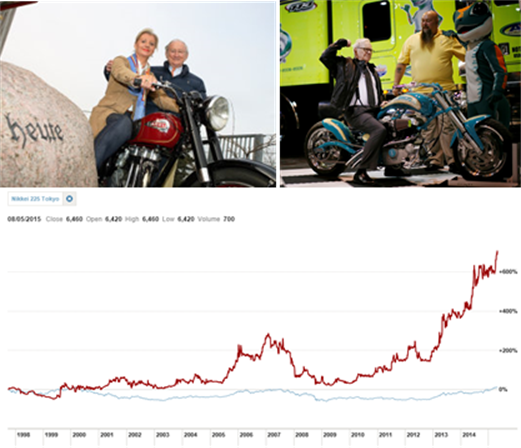
Top Left: The late Detlev Louis in a photo with his congenial wife Ute; Top Right: Buffett the biker at the AGM; Bottom: Workman (TSE: 7564 JP) Stock Price Performance 1997-2015

Buffett and Munger also emphasized the point of Berkshire’s culture at the AGM 2015:

Shareholder question from Lawrence from Germany: “You are heralded for your integrity. How can investors judge the state of Berkshire’s culture long after the two of you are gone?”

Buffett: “I think you will be very pleased with the outcome. I think BRK’s culture runs as deep as any large company should. A few days ago, the company closed on a transaction in Germany. The owners had spent 35 years or more building a retail business… it’s a vital part of Berkshire to have a clearly defined, deeply embedded culture that pervades the company. Once Charlie and I aren’t around, it will be clear that it’s not a force of personality, that it’s institutionalized.”

Munger: “As I said in the annual report, I think BRK is going to do fine after we’re gone. In fact, it will do a lot better… but at any rate, it will never again at the rate it did in the early years. There are worse tragedies in life.”

Underlying the corporate culture traits at Berkshire is the “missing ingredient” that we hope will help spark the generation of deeper questions in understanding the persistency of wide-moat: Imprinting.

Imprinting is a learning process that initiates a development trajectory that produces persistent outcomes. Building on the work of Stinchcombe (1965) in his work “Social Structure and Organizations”, organizational research on imprinting has highlighted the enduring impact of prior history on organizational outcomes by demonstrating how organizations assume elements of their environment that persist well beyond their founding phase. Imprinting has to take place and take root before the succession process can become successful.

We have observed that transgenerationally entrepreneurial families possess entrepreneurial legacy, the reconstructed narratives of the family’s entrepreneurial behavior and resilience that motivate and give meaning to entrepreneurship with today’s risks in perspective, motivating current and next-generation leaders to engage in strategic activities that go beyond ordinary succession and thereby nurture transgenerational legacy. Actions that leaders take and routines that develop during periods of environmental stress and organizational change, such as frugality in spending and calculated boldness in expansion during a severe recession, lead to profound differences in structures, strategies, and product offerings that become “imprinted” in that they persist over time. Transgenerational entrepreneurial family firms are stronger and quicker in creating new products and services as niches develop, enter new markets, adopt new technologies, and implement new ways of organizing business activities.

At Louis, the imprinting over the years enabled the firm to endure the death of both the founder and the second-generation. Founded in 1936 as a small repair shop and built by Detlev since 1946, the firm was a pioneering innovator in multi-channel sales offering an extensive range of over 32,000 products, launching its first motorcycle accessories mail-order catalogue in 1967. This was a time when motorcycle was pushed massively into the background by the car. But Detlev believed in the unique fascination with motorcycling in which he developed tuning and accessories for his races. The wide range of products, reasonable prices and almost always good services made the consumer experience at Louis more enjoyable, garnering it a loyal customer base of a million mostly very satisfied customers. The popularity of Louis stores prompted the development of a modern logistics center with conveyor technology in 1991 to supply its growing network of store branches. In 1997, the reach into the consumer was extended by online trade which generated around 20% of its sales in 2014. Throughout its history, Louis has taken care to imprint the values of economic foresight, openness to new ideas, hard work and excellent people management into its corporate culture and into its successors Nico Frey and Joachim Grub- Nail. Thus, value investors can utilize the imprinting idea to generate interesting general questions to assess the sustainability of the wide-moat beyond ordinary succession. These include:

  • What was the breakthrough or innovation story in the corporate history (eg first motorcycle accessories catalogue) that enabled the company to grow and differentiate itself amidst the competition? Did the founder and management sought to imprint the intangible values (eg determination and economic foresight in establishing multi-channel sales) in the culture?
  • How did the firm cope during environmental stress (eg online ecommerce threat, price war amongst rivals), organizational change (death of second generation), and periods of expansion (eg complacent vs sober in setting up the modern logistics center)? Were the intangible values (eg frugality in spending, openness to new ideas, boldness) imprinted?

To run a distribution and store network effectively takes a decentralized “core-periphery” system, an essential source of “emptiness” in Bamboo Innovators in which fibers of greatest strength occur in increasing concentration toward the periphery of the bamboo, a powerful architecture from a builder’s viewpoint. At the “periphery”, the Louis stores have penetrated into the hearts of the motorcycle culture. At the “core”, the centralized support of the modern logistics center enabled the vitality of the stores to provide a comprehensive range of products with efficient inventory and working capital management. The core-periphery business model at Louis is a microcosm of Berkshire itself: Operating managers at the “periphery” like Louis with autonomy in doing their jobs are greatly motivated by the trust and empowerment to outperform. The operating subsidiaries are all united by the distinctive corporate culture and values at the “core”.

Are there similar Louis in Asia? How can value investors use imprinting and the core-periphery business model to identify these family innovators?

One such transgenerational Bamboo Innovator is Japan’s Workman Co (7564 JP, MV $1.1bn), dubbed the “Uniqlo of workwear market” and owned by the Tsuchiya family with a majority control of over 52%. Established in 1982 as an “artisan workshop” in Gunma prefecture, Workman is a specialty retailer of work uniforms and related goods including work gloves and safety shoes, operating 700 stores (both its own stores and franchised stores) in 41 prefectures in Japan, generating around $49m in profits from $404m in sales in FY14. Since its listing in 1997, it has compounded over 600% as compared to a flattish Nikkei 225 index.

Like Louis, Workman offers a wide range of over 7,500 items that meet customers’ needs.  Workman uses sales data and other feedback from its outlet managers to jointly develop with manufacturers its own brand of products that are tailored to meet specific customer needs and price demands, in the same way that Uniqlo is both developing and making its products. Own-brand products make up over 60% of Workman’s product line-up. The remaining products sold are purchased from manufacturers produced nearly exclusively for it at low prices in exchange for assuming risks of stock valuation losses. The firm enjoys economies of scale as the number of its outlets has increased substantially. In addition, the firm has found ways to effectively reduce costs by procuring goods from overseas and by using private brand products, especially for consumable supply goods. For instance, a set of dozen cotton work gloves is priced at around ¥160, half of the regular market price.

Workman is a member of the low-profile unlisted Beisia (Iseya) group of companies, a large distribution group founded in 1958 in the northern Kanto region with ¥8,300bn ($69bn) in group sales, making it one of the top 20 business groups in Japan. which also includes the shopping mall chain Beisia (107 stores in Tokyo metropolitan area), the home center Cainz (188 stores throughout Japan), the convenience store chain Save On (582 stores in Kanto district), car parts and accessories chain AutoR (60 outlets). Yoshio Tsuchiya is the chairman of Workman since 1984 and is also chairman of Beisia since Jun 2009. Like Berkshire and Louis who have imprinted distinctive values into the culture, the Beisia group imprinted the unconventional idea in hierarchical Japan of a profit-sharing system in 1967 and was an early pioneer in adopting the IT system to be more efficient in its inventory management in 1974. Beisia was also an innovator in management system with the overseas training system in 1975. Beisia opened its modern Isesaki logistics and distribution in 1980, followed by the Tokyo Information Center in 1984 in the application of data analytics of supplier and consumer intelligence.

Importantly, Workman has the core-periphery business model in applying the know-how at the “core” of the Beisia group to maintain efficient systems for distribution, inventory management and information gathering and application. Due to its clout and dominance, Workman receives income in the form of centre fees from…

There is an interesting story imprinted about the frugal culture, the mechanism and unconventional measures built and maintained throughout the company’s history that allows Workman to sell products at amazingly low prices. In its new product presentation launches in which Workman unveils new products to the owners of its franchise stores, the highlight of the presentation event is a fashion show featuring new work wear. All of the models that appear in the show are young people who are Workman’s newly recruited employees. “It would cost about 100,000 yen to hire one professional fashion model for the show. So we use our employees instead,” said Workman’s president with an unconcerned look. Workman is determined to cut costs whenever it can do so. There is simply no room for compromise about this.

Indeed, there is no compromise at Workman, the low-profile Asian Bamboo Innovators, and BRK’s operating businesses in imprinting these BERKSHIRE values elucidated by Cunningham and value investors will do well by observing and assessing the imprinting to identify the longevity of the wide-moat innovators:

Budget conscious, as in thriftiness

Earnest, as in keeping promises

Reputation, as in personal and corporate integrity

Kinship, in terms of legacy and a family orientation

Self-starters, as in entrepreneurial behavior

Hands off, as in delegating decisions and responsibility

Investor savvy, in terms of capital investment

Rudimentary, as in easy-to-understand businesses

Eternal, as in a long-term perspective

Warm regards,

KB

The Moat Report Asia

www.moatreport.com

http://accountancy.smu.edu.sg/faculty/profile/108141/KEE-Koon-Boon

A new monthly issue of The Moat Report Asia is now available!

Access the in-depth idea presentation:

http://www.moatreport.com/members/

This month, we highlight a wide-moat innovator who is the #1 in Asia in a patented automotive electronics part that is part of the fast-growing Advanced Driver Assistance System (ADAS) market worth >$22bn by 2018, doubled from $11bn in 2014. The ADAS market is driven by more stringent safety requirements from governments forcing the automotive industry to develop automotive electronics solutions to increase vehicle safety. [Company’s name] is the third-largest in the world behind Valeo (FR EN) and Bosch. It has >50% market share in new cars sold in China, and the installation rate of this ADAS product on China’s auto is still low (35%+ on new cars vs 80%+ in developed markets). Established in 1979 by founder and Chairman Mr. C, [Company’s name] is one of the rare Tier-1 automotive suppliers in Asia to major OEM car makers that include Ford, GM, Daimler, Hyundai, Nissan, China’s top 10 auto companies such as Great Wall Motor, thereby directly shipped to them and involved in their R&D processes and early stage processes of concept car design and prototyping, creating a pre-emptive advantage in winning new orders. Over the past 36 years, [Company’s name] has forged formidable competitive advantages in scale, product quality, technological know-how and R&D capabilities and in May 2012, [Company’s name] outgunned illustrious industrial automotive giants Valeo (founded in 1923) and Bosch (founded in 1886) to sign a breakthrough global 10-year contract with GM, with the commencement of worldwide shipment to 18 countries and 25 factories at the end of 2016.

Paid subscribers get:

  • The Monthly Moat Report Asia (20 issues)
  • Bonus Content: The Weekly Bamboo Innovator Insight Articles (>70 Issues)
  • Bonus Content: Access to the Members’ Forum
  • Bonus Content: Videos and Presentations by Thoughts Leaders, Entrepreneurs and Business Leaders in Asia

Bamboo Innovator Daily Insight: 11 May (Mon) – People laughed at this entrepreneur’s idea – now it’s a $500 million business, thanks to his mom’s encouraging words

Life

  • People laughed at this entrepreneur’s idea – now it’s a $500 million business, thanks to his mom: BI
  • How The HondaJet Took Flight: An Engineer’s 29-Year Obsession: Forbes
  • From New Zealand to Pittsburgh, a Moneyball Approach to Helping Troubled Kids; In a program pioneered in New Zealand and arriving soon in Allegheny County, Pennsylvania, social workers use data to figure out who’s most at risk. Bloomberg
  • How Uncertainty Fuels Anxiety: An inability to live with life’s unknowns can lead to worry and distress. Atlantic
  • Your Brain Is Primed To Reach False Conclusions: 538
  • Will White-Collar Work Get an Uber Disruption? Bloomberg
  • How To Improve Self-Esteem: A New Secret From Research: Barker
  • Celframe billionaire Arun Pudur is Asia’s wealthiest entrepreneur under 40; the software firm now produces the world’s second most popular word processor after Microsoft: AsiaOne

Read more of this post

Bamboo Innovator Daily Insight: 10 May (Sun) – Presidents, Mother’s Day and American Tradition

Life 

  • Presidents, Mother’s Day and American Tradition: Forbes
  • Creating grit in students; What if the secret of success is failure? Should an educator ever cause a student to feel frustated, even to fail?: JP
  • Gen. Stanley McChrystal’s Lessons Learned: Five years after his firing, the former U.S. commander in Afghanistan on modern warfare, Islamic State and applying military lessons to the business world: WSJ
  • Rodents Could Predict the Next Big Quake: bloomberg
  • How Hells Angels and criminal gangs came to control much of the Vancouver docks: NP
  • Is the Game Hive the Next Chess? The game Hive, in which players control bugs of different types, has unique tactics, but it echoes some concepts from chess: WSJ

Read more of this post

Bamboo Innovator Daily Insight: 9 May (Sat) – 25 daily habits that will make you smarter; The Navy SEAL Art of War: Leadership Lessons from the World’s Most Elite Fighting Forc

Life

  • 25 daily habits that will make you smarter: BI
  • 9 Ways Mentally Strong People Prevent Self-Pity From Sabotaging Their Success: Forbes
  • How one woman survived a bad career break, then launched a life-changing business; The inspiring, never-say-die story of Homa Dashtaki and White Moustache yogurt.: FastCo
  • How to be good: Biologists and philosophers offer different answers on how to help altruism flourish. By Stephen Cave: FT
  • How WisdomTree’s Jonathan Steinberg Made Good on a Second Chance: NYT
  • The Life of the Mind: Can biographies really help us understand the scientific ideas that shape our world?: WSJ
  • Boyz II Men’s Nathan Morris And Shawn Stockman, On Their Formula For Success: Forbes
  • Behavioural economics has made headway, but still has a long way to go: Economist
  • The long hard task of America’s founding fathers: Economist
  • Tired Of Recruiting’s Broken Image, Airbnb Rewrites The Playbook: Forbes
  • Scents of Smell Rooted in Math: Nose knows different odors, no matter how powerful, thanks to predictable patterns transmitted to brain: WSJ
  • How Our Brains Judge Crime Cases: WSJ

Books

  • The Navy SEAL Art of War: Leadership Lessons from the World’s Most Elite Fighting Force : Amazon, BI

Read more of this post

Bamboo Innovator Daily Insight: 8 May (Fri) – What 13 highly successful people read every morning: Buffett reads the Wall Street Journal, the Financial Times, the New York Times, USA Today, the Omaha World-Herald, and the American Banker in the mornings

Life

  • What 13 highly successful people read every morning: BI
  • Danger of doing the right thing; We all have a moral accounting system. We need to become aware of the process, and learn to stay the repeat the good: KT
  • 11 years ago, a mom wrote one letter a day to her daughter to help her through 6th grade – and her advice is timeless: BI
  • Competing With Ordinary Resources: MIT
  • 10 Core Questions That Will Tell You If You’re Ready To Become A Thought Leader: Forbes
  • Here’s how standardized tests like the SAT have poisoned America’s classrooms: BI
  •  Twitter CEO Dick Costolo Q&A: What to Do When People Say ‘You Suck’: Bloomberg
  • Chess champion Magnus Carlsen told us how he decides to make a move, and it’s not what we expected: BI
  • The eight essentials of innovation; Strategic and organizational factors are what separate successful big-company innovators from the rest of the field. McKinsey
  • Dogbert Explains ‘Diversification’ In Today’s Market: Zerohedge
  • Daniel Loeb Criticizes Warren Buffett, in a Rare Public Swipe: Hedge-fund investor Loeb sees a ‘disconnect’ between words and deeds of esteemed Berkshire CEO: WSJ
  • Learning the Language of Indirectness: HBR
  • What Big Companies Get Wrong About Innovation Metrics: HBR
  • How to Give a Killer Presentation: HBR
  • Warren Buffett Under Attack On Multiple Fronts: Forbes
  • Kynikos Associates Jim Chanos thinks the weak minded follow personalities, while the strong follow ideas: VW
  • In the NBA, No Job Is Safe; Why winning coaches are still getting fired despite success on the sidelines: WSJ
  • My Number One Advice for Startups or VCs: Conviction > Consensus: BSOTT
  • Why Compassion Is a Better Managerial Tactic than Toughness: HBR

Read more of this post

Bamboo Innovator Daily Insight: 7 May (Thurs) – Questions of Character: Illuminating the Heart of Leadership Through Literature; What Hollywood Can Teach Us About the Future of Work: The winners will have curiosity, creativity and more tools available to help them connect with their audience

Life

  • What Hollywood Can Teach Us About the Future of Work: The winners will have curiosity, creativity and more tools available to help them connect with their audience: NYT
  • CEO of the Bill & Melinda Gates Foundation explains the most important leadership lesson she’s ever learned; Sue Desmond-Hellmann: Helping People Find Their Sweet Spot: BI, NYT
  • Baby Buffett: Will Bill Ackman Resurrect The Ghost Of Howard Hughes And Build A Corporate Empire?: Forbes
  • Forbes think Bill Ackman might be the next Warren Buffett: BI
  • 10 lessons to learn from world’s fastest growing startups: Dailysocial
  • Hargreaves Lansdown founder: ‘Most fund managers are complete morons’; Peter Hargreaves, who became a billionaire by selling funds, has made an outspoken attack on the managers who run them: Telegraph
  • How Not to Drown in Numbers: The key question isn’t “What did I measure?” but “What did I miss?”: NYT
  • These are the richest billionaires in every European country – and how they made their money: BI
  • The World’s Largest Companies: Forbes
  • Volkswagen battle highlights contrast between family-run firms in Asia and Europe: SCMP
  • The origin of complex life: Shape-shifters; The ancient ancestors of animal and plant cells have just been identified: Economist
  • We can already send thoughts from one brain to another – and that might eventually let us download skills: BI
  • Op-Ed: Dear startup founders, don’t be thankless; Founders should not forget that along with the huge sums, comes an obligation to act responsibly: e27
  • Is this the rudest CEO resignation letter ever?: Telegraph
  • Relying on Product Reviews? Knowing How a Company Treats Its Customers Is Just as Valuable: NYT
  • Get in the Right State of Mind for Any Negotiation: HBR

Books

  • Questions of Character: Illuminating the Heart of Leadership Through Literature: Amazon

Read more of this post

Bamboo Innovator Daily Insight: 6 May (Wed) – 7 Important Life Lessons Everyone Learns the Hard Way. What Is Your Purpose? We need to forge new ways to seriously discuss the deepest questions in life with modern tools

Life

  • What Is Your Purpose? We need to forge new ways to seriously discuss the deepest questions in life with modern tools. NYT
  • 7 Important Life Lessons Everyone Learns the Hard Way: Marc&Angel
  • The $112 Billion CEO Succession Problem: Strategy&
  • The growing business of detecting unconscious bias: FastCo
  •  The New Rules for Growing Outside Your Core Business: HBR
  • Growing by adapting at speed; How do companies stay ahead when everyone is accelerating? Not by merely adapting to changing conditions, but by doing so quickly and decisively: McKinsey
  • Singapore PM Lee Hsien Loong shares source code for Sudoku project: e27
  • Walmart CEO: Waiting for consensus “can kill you”: Forbes
  • In face of IS successes, al-Qaida adapts, grows stronger: ChinaPost
  • 52 Years and Counting: America’s Longest-Serving CEOs: WSJ
  • In ‘Misbehaving,’ an Economics Professor Isn’t Afraid to Attack His Own: NYT

Read more of this post

Bamboo Innovator Daily Insight: 5 May (Tues) – The Philosophy of Warren E. Buffett

Life

  •  The Philosophy of Warren E. Buffett: NYT
  • Meet the father-son team making $1.3 million on YouTube; 9-year-old Evan and his dad have turned their love of toys into a seven-figure YouTube business: FastCo
  • A neuroscientist explains how being aware of your emotions can make you super-productive: BI
  • Here’s what Warren Buffett told a 7th grader who asked for his advice: BI
  • Berkshire’s Warren Buffett Shows His Teddy Bear Image Has Tough Side: NYT
  • Kick forced ranking out of the office; Ignore Jack Welch: Yahoo’s quarterly reviews show how employee ‘leagues’ cause turbulence: FT
  • Art of the Japanese company apology: It’s all in the bow: JT
  • Inside the school Silicon Valley thinks will save education: Wired
  • Restoring Humanity to Leadership: Insead

Read more of this post

An Asian Innovator in the Race Towards the Autonomous Car and the Next Bosch India for Buffett’s Growing Auto Empire

 “Bamboo Innovators bend, not break, even in the most terrifying storm that would snap the mighty resisting oak tree. It survives, therefore it conquers.”
BAMBOO LETTER UPDATE | May 4, 2015
Bamboo Innovator Insight (Issue 81)

  • The weekly insight is a teaser into the opportunities – and pitfalls! – in the Asian capital jungles.
  • Get The Moat Report Asia – a monthly in-depth presentation report of around 30-40 pages covering the business model of the company, why it has a wide moat and why the moat may continue to widen, a special section on “Inside the Leader’s Mind” to understand their thinking process in building up the business, the context – why now (certain corporate or industry events or groundbreaking news), valuations (why it can compound 2-3x in the next 5 years), potential risks and how it is part of the systematic process in the Bamboo Innovator Index of 200+ companies out of 15,000+ in the Asia ex-Japan universe.
  • Our paid Members from North America, Europe, the Oceania and Asia include professional value investors with over $20 billion in asset under management in equities, some of the world’s biggest secretive global hedge fund giants, and savvy private individual investors who are lifelong learners in the art of value investing.
Dear Friends,Can You Guess This Asian Wide-Moat Company? An Asian Innovator in the Race Towards the Autonomous Car and the Next Bosch India for Buffett’s Growing Auto EmpireIs Berkshire Hathaway building an automotive empire next?Following up on the Oct 2014 acquisition of auto dealer Van Tuyl with $9bn in sales, Buffett bought German bike gear maker Devlet Louis Motorradvertriebs for $450m in Feb 2015 and splurged $560m for a 8.7% stake in Axalta Coating (AXTA US), the former DuPont auto coatings business and the world’s biggest supplier of coatings to auto repair shops and the second-largest provider to manufacturers of cars and lights trucks in Apr 2015. Interestingly, BRK invested in Axalta when it is trading at an all-time high. The valuation of the Axalta deal was not cheap at EV/EBIT 21x and EV/EBITDA 13x, highlighting the confidence that Buffett has in the well-managed consolidators in the automotive sector with a long-term reputation amongst clients. BRK also controlled a 2.6% stake in General Motors (GM US) and is exposed to the automotive sector through Lubrizol, a maker of lubricants for automobiles and machinery, which was acquired for $9bn in 2011.Are there worthy automotive candidates in Asia for BRK to pounce upon, beyond auto dealers?This month, we highlight a wide-moat innovator who is the #1 in Asia in a patented automotive electronics part that is part of the fast-growing Advanced Driver Assistance System (ADAS) market worth >$22bn by 2018, doubled from $11bn in 2014. The ADAS market is driven by more stringent safety requirements from governments forcing the automotive industry to develop automotive electronics solutions to increase vehicle safety. [Company’s name] is the third-largest in the world behind Valeo (FR EN) and Bosch. It has >50% market share in new cars sold in China, and the installation rate of this ADAS product on China’s auto is still low (35%+ on new cars vs 80%+ in developed markets). Established in 1979 by founder and Chairman Mr. C, [Company’s name] is one of the rare Tier-1 automotive suppliers in Asia to major OEM car makers that include Ford, GM, Daimler, Hyundai, Nissan, China’s top 10 auto companies such as Great Wall Motor, thereby directly shipped to them and involved in their R&D processes and early stage processes of concept car design and prototyping, creating a pre-emptive advantage in winning new orders.

Over the past 36 years, [Company’s name] has forged formidable competitive advantages in scale, product quality, technological know-how and R&D capabilities and in May 2012, [Company’s name] outgunned illustrious industrial automotive giants Valeo (founded in 1923) and Bosch (founded in 1886) to sign a breakthrough global 10-year contract with GM, with the commencement of worldwide shipment to 18 countries and 25 factories at the end of 2016. The journey has not been easy for Mr. C who recounted his days of carrying the same brief case containing the auto parts to knock on doors..

********

Q: “Can you share with us what is so difficult about making these [Company’s flagship product] and automotive electronics parts beyond having more capital and money?”

Mr. C: “Time. Time is the most difficult thing. The closed, protected automotive industry demands an exceptionally high standard of safety, durability and reliability of the 8,000 to 15,000 auto parts that go into the car, even more so for automotive electronics products since these are integrated into a system and platform as opposed to some stand-alone parts. It’s not a case of whether you can produce the parts with high quality and people will then use them.

Only AFTER you produce the parts and somehow manage to convince someone to test it for at least a year or more, ensure that the parts stay defect-free, zero PPM (parts per million), under rigorous test conditions, can the OEM carmaker say, OK, we will try it. But the actual truth is, when you have produced what you think is a high quality part and approach the OEM carmakers, they will all say, ‘Why don’t you bring this to other factories to test it out first. If the others are ok, we will look at it. Every car factory will say the same to you. No one wants to be the guinea pig, the lab rat. As a result, you will never get in to their supply chain.

To win their trust is not easy. I remembered in those years, I would carry the same brief case that I use to knock on doors. In it contained the auto parts. Everyone would say that they are interested and to send them the samples. However, when the samples are sent, the rock sinks to the ocean and there is no news. Hence, time is the biggest cost and the most difficult thing.

One might think that automotive electronics products could be similar to consumer electronics parts. Hence, the barriers to entry are low and there could be new entrants. This thinking could not be more wrong.

On our flagship product itself, do you know that a [Company’s flagship product] would have to withstand extreme hot and cold temperature changes, withstand vibration, stay water-resistant, anti-dust, anti-humidity, anti-signal disruption, and a battery of tests. Amongst these tests is the requirement to continue functioning in the sudden change from minus 40 degrees Celsius to 85 degrees Celsius. And our engineers have to go with the OEM carmakers to actual sites in Northern Europe, China’s Heilongjiang and the Gobi desert to do the tests.

[Company’s name] is proud that our production quality has reached over 36 months (and still running) of zero PPM (parts per million) defect. This is the real reason why we are able to win Valeo and Bosch and win the hearts of our customers to place orders with us.

********

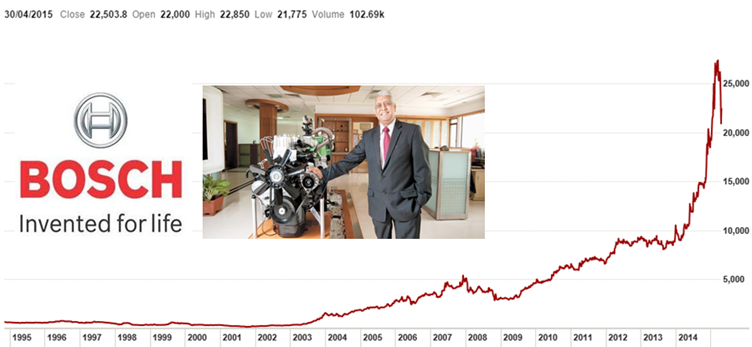
Bosch India (NSI: BOSCHLTD) Stock Price Performance 1994-2015

Bosch India

In the ruthless cut-throat automotive industry, the fact that Bosch India (BOS IN, MV $11bn) and [Company’s name] have strikingly similar EBITDA margin at 15.6% and ROE of around 14.5% (although Bosch India is net-cash but has low dividend payout) speaks volume about [Company’s name]’s wide-moat advantage in securing long-term pricing power and earnings sustainability with the major OEM carmakers by winning their trust to strike long-term partnership in global platform deals. Bosch India trades at an expensive valuation premium of EV/EBITDA 45.7x as compared to 15x for [Company’s name].

While [Company’s name] has a dividend yield of 2.2%, it is not cheap in valuation at EV/EBIT 18.4x and EV/EBITDA 15.1x. We believe that the key to valuation success for an innovative automotive supplier is a Tier-1 status (as opposed to the “cheap” Tier-2 or 3 players) and the long-term visibility and sustainability in generating quality growth by offering products and technology that play into the upcoming movement towards either (1) “Efficiency”: fuel efficiency, emissions and environmental footprint of a car, or/and (2) “Content”: comfort, convenience and safety features that help improve the ownership experience of the automobile. Bosch India belongs to the “Efficiency” category when it was re-rated since its tipping point moment in 2006 when it set up the manufacturing facilities for CRDi-based passenger diesel engine system in India and market value compounded 8-fold in 9 years to $11bn while sales climbed 150% over the same period to generate a doubling in earnings growth from Rs5.5bn in FY06 to Rs10.5bn ($160m) in FY14. [Company’s name] belongs to the “Content” category and is also one of the rare few Tier-1 auto suppliers in Asia. We believe the technical superiority of [Company’s name] in developing low-cost innovative solutions that enabled it to command a >50% market share for new cars in China deserves to command a higher valuation.

We are impressed by Mr C’s dedication, patience and focus in not only building up a rare Tier-1 supplier capability but also in forging a corporate culture that feels like an enterprise of engineers, reminding us of automotive parts innovator Gentex (GNTX US, MV $5.2bn)/John Bauer. [Company’s name] has around 400 engineers and R&D specialists, comprising 20% of the workforce, a similar ratio to Gentex. We like how [Company’s name] has consistently reinvested back into the business to develop its R&D and new product innovation capabilities beyond its flagship product that are now building up sales momentum as well as set the company on a long-term growth trajectory path in the fast-growing multi-billion ADAS market and the race towards the autonomous car.

As Mr C puts it aptly:

“What’s next for [Company’s name] isn’t about how many cars there are; it is about how electronic the cars can be. There is great long-term potential for automotive electronics parts in the future car, which will jump from the present 10% of the total cost of making a car to 40%. To capture this long-term opportunity, [Company’s name] will continue to build upon our 36 years of accumulated know-how, capabilities, global partnership platform and underlying trust with our global clients to enable [Company’s name] to shine bright in the global automotive industry!”

Who is Mr. C and this wide-moat Bamboo Innovator?

A new monthly issue of The Moat Report Asia is now available!

Access the in-depth idea presentation:

http://www.moatreport.com/members/

Warm regards,

KB

The Moat Report Asia

www.moatreport.com

http://accountancy.smu.edu.sg/faculty/profile/108141/KEE-Koon-Boon

A new monthly issue of The Moat Report Asia is now available!

Access the in-depth idea presentation:

http://www.moatreport.com/members/

Paid subscribers get:

  • The Monthly Moat Report Asia (20 issues)
  • Bonus Content: The Weekly Bamboo Innovator Insight Articles (>70 Issues)
  • Bonus Content: Access to the Members’ Forum
  • Bonus Content: Videos and Presentations by Thoughts Leaders, Entrepreneurs and Business Leaders in Asia

Bamboo Innovator Daily Insight: 4 May (Mon) – The most brilliant things Warren Buffett and Charlie Munger said at Berkshire’s annual meeting

Life

  • The most brilliant things Warren Buffett and Charlie Munger said at Berkshire’s annual meeting: BI
  • How To Win Like PayPal Co-founder Peter Thiel: Six Of His Rules for Business Success: Forbes
  • Charlie Munger – Part Nine: Colorful Charlie And The Cinderella Principle: VW
  • 40 Busy Years Later, Paul Allen, a Microsoft Founder, Considers His Creation: NYT
  • Warren Buffett forced to defend relationship with Brazil’s 3G Capital: FT
  • Fantastic words with no easy translation in other languages: Quartz
  • How To Get Smarter: barker

Read more of this post

Bamboo Innovator Daily Insight: 3 May (Sun) – The Case Against Competing; Buffett Says Next Berkshire CEO Should Be More Than Stock Picker

Berkshire Hathaway 50th Anniversary

  • Buffett Says Next Berkshire CEO Should Be More Than Stock Picker: Bloomberg
  • What You Should – and Shouldn’t – Learn from Warren Buffett: WSJ
  • Berkshire Shareholders Pepper Warren Buffett With Some Hard Questions: WSJ, Reuters, Fortune
  • 50 Years of Warren Buffett in The Wall Street Journal: WSJ
  • WSJ Recap: The 2015 Berkshire Hathaway Annual Meeting: WSJ
  • 7 Takeaways From the Berkshire Hathaway Annual Meeting: WSJ

Life

  • The Case Against Competing: HBR
  • The Workhorse and the Butterfly: Ann Patchett on Writing and Why Self-Forgiveness Is the Most Important Ingredient of Great Art: BP
  • JFK on Poetry, Power, and the Artist’s Role in Society: His Eulogy for Robert Frost, One of the Greatest Speeches of All Time: BP
  • Creating values through horizontal leadership: Mayora Indah’s Ricky Afrianto is strengthening brand positioning and boosting sales by saying now to bureaucratic management constraints. JP
  • 3 Steps to Break Out in a Tired Industry: HBR
  • Mental Model: Bias from Overconfidence: Farnam
  • Michael Mauboussin on Intuition, Experts, Technology, and Making Better Decisions: Farnam
  • The Procrastination Doom Loop-and How to Break It: Atlantic
  • The Art of Staying Focused in a Distracting World: Atlantic
  • Mixed Signals: Why People Misunderstand Each Other; The psychological quirks that make it tricky to get an accurate read on someone’s emotions: Atlantic
  • SurveyMonkey CEO Dave Goldberg Dies Suddenly at 47: WSJ

Read more of this post

Bamboo Innovator Daily Insight: 2 May (Sat) – The Enduring Hunt for Personal Value; Spend Your Day With Berkshire Hathaway (Whether You Want to or Not): Warren Buffett’s products and services are everywhere

Berkshire Hathaway 50th Anniversary

  • Spend Your Day With Berkshire Hathaway (Whether You Want to or Not); Warren Buffett’s products and services are everywhere. Just look at what you’re doing Saturday: Bloomberg
  • Berkshire Hathaway’s meeting: Fun at fifty; The sage of Omaha celebrates half a century on top of the world: Economist
  • Woodstock of Capitalism’s odd couple: FT
  • I’ve Followed Warren Buffett For Decades And These 10 Quotes Are What I Keep Coming Back To: LinkedIn
  • What Will Berkshire Look Like Over the Next 50 Years?: Morningstar
  • Warren Buffett: ‘If You’re Looking for a Wonderful Business, It’s Hard to Beat Coca-Cola’: Coca-Cola
  • Timeless Investment Lessons From Warren Buffett’s Business Partner, Charlie Munger: Morningstar
  • Why Warren Buffett considers the deal he made with an 89-year-old woman one of the best of his career: BI

Life 

  • The Enduring Hunt for Personal Value: NYT
  • David Letterman Reflects on 33 Years in Late-Night Television: NYT
  • Self-image matters: Helping kids see themselves as readers: WaPo
  • Ancient DNA Tells a New Human Story; Armed with old bones and new DNA sequencing technology, scientists are getting a much better understanding of the prehistory of the human species: WSJ
  • The Rise and Fall of the Term ‘Third World’; Report says the phrase ‘Third World’ had its start at a 1955 conference, but the words grew out of the work of French social scientists: WSJ
  • Distaff Scientists: Is it wrong to be captivated by a great thinker’s personality, rather than the drier stuff of résumés? WSJ
  • The Half-Life of Physicists: In 1947 Erwin Schrödinger boasted of a big new result that would beat his sometime collaborator Albert Einstein. They were both wrong.: WSJ
  • Billionaire investor Peter Thiel: ‘Always aim for a monopoly. From society’s perspective, it’s complicated. But from the inside, I always want to have a monopoly.’: BI
  • Ten Golden Nuggets: SeekingWisdom
  • Addiction to Truth: David Carr, the Measure of a Person, and the Uncommon Art of Elevating the Common Record: BP
  • A Dozen Things I’ve Learned From Comedians About the Business of Life: 25iq
  • An eminent scientist posits a new theory of how life came to be; The Vital Question: Why Is Life the Way It Is? By Nick Lane: Economist

Read more of this post

Bamboo Innovator Daily Insight: 1 May (Fri) – After Warren Buffett: Berkshire Prepares for Life Without Legendary Leader

Berkshire Hathaway 50th Anniversary

  • What Is Berkshire Hathaway? WSJ
  • Warren Buffett losing some mojo on his economic ‘moats’: Reuters
  • Warren Buffett Has a Tough Act to Follow; Berkshire Hathaway’s Warren Buffett hasn’t lost his touch, but future returns aren’t likely to match his historical record. WSJ
  • 11 Picks from Warren Buffett’s Bookshelf: WSJ
  • After Warren Buffett: Berkshire Prepares for Life Without Legendary Leader; Berkshire Hathaway’s octogenarian CEO does ‘everything humanly possible’ to make sure culture grows without him: WSJ

Life 

  • Shredding the rules: A striking number of innovative companies have business models that flout the law: Economist
  • The eight essentials of innovation: Strategic and organizational factors are what separate successful big-company innovators from the rest of the field. McKinsey
  • Say This, Not This: The Words to Use and the Words to Lose: Milken
  • When It’s Safe to Rely on Intuition (and When It’s Not): HBR
  • An exam board chief wants British students to use Google to find answers in their tests: BI
  • The 9 biggest mistakes people make in their 30s: BI

Read more of this post

Bamboo Innovator Daily Insight: 30 Apr (Thurs) – Francois Michelin, Who Took French Tiremaker Global, Dies at 88; The 13 most valuable skills that anyone could have

Life 

  • Francois Michelin, Who Took French Tiremaker Global, Dies at 88: Bloomberg, ST
  • The 13 most valuable skills that anyone could have: BI
  • The Art Of Giving Feedback: Techcrunch
  • Life advice upon turning age 30, from the president of Y Combinator: Quartz
  • Author Brian Little on Personality and the ‘Art of Well-being’: K@W
  • Business Owners Rethink Legacy: Barron’s
  • A Radical Idea: Own Your Supply Chain; As most companies outsource trucks and drivers, Ashley Furniture takes a different path: WSJ
  • Texas A&M professor gave us a detailed explanation for why he failed his entire ‘entitled’ management class: BI
  • Should the law serve humans, or should humans serve the law?: JP
  • The art of apology for bosses in Japan: AsiaOne
  • So you think you can get out of finance? An anthropologist says no: efc
  • What to Do When Your Future Strategy Clashes with Your Present: HBR
  • Science explains how people can lie and cheat – and still feel good about themselves:BI
  • Corporate power without responsibility on the board; Instead of long-termism at Industrivärden and Volkswagen, there was corporate self-indulgence: FT

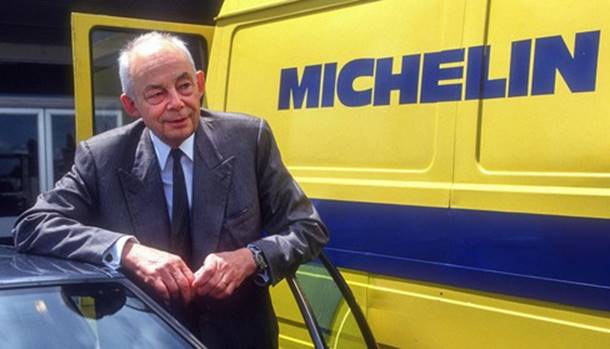
Michelin Read more of this post

Bamboo Innovator Daily Insight: 29 Apr (Wed) – Why you need to commit to something to find your calling

Life 

  • Why you need to commit to something to find your calling: BI
  • Charlie Munger’s 2015 Daily Journal Annual Meeting: Forbes1, Forbes2, Forbes3, Forbes4
  • Don’t Force Decisions; Just Back Off and Adjust. Or Go for a Walk. NYT
  • How You Make Decisions Is as Important as What You Decide: HBR
  • The Art of Evangelism: HBR
  • Old Management Systems Stifle New Business Models: HBR
  • Charlatans exist, in finance (and medicine), because we crave certainty: ReformedBroker
  • Why this CEO believes an MBA is worthless: Fortune
  • Are You OK? Xiaomi CEO’s Awkward English Goes Viral, Sparks Debate: WSJ
  • Manny Pacquiao: Where It All Began; In General Santos, there are signs of the local hero’s success everywhere across the city: WSJ
  • Why Buffett’s Capitalist Woodstock Won’t Endure Like Garcia Jams: bloomberg
  • Ten things I learned studying ten of the world’s fastest growing startups: Quartz
  • How ‘doing the kind thing’ is changing the way we snack and give back one bite at a time: FP
  • The ship of fools and the country of fools; The ship of fools is an allegory ascribed to Plato that describes a captainless ship drifting at sea, carrying deranged and disoriented passengers entirely oblivious to their course: KH
  • LKY: Singapore’s anti-corruption visionary: BT
  • New Spore: Hwa Chong boy boasts loudly on bus about getting teacher fired: AsiaOne

Read more of this post

Bamboo Innovator Daily Insight: 28 Apr (Tues) – The remarkable life and lessons of the $8 million janitor; Warren Buffett’s ‘Ringmaster’ Turns Grand Ideas Into Reality

Life 

  • Warren Buffett’s ‘Ringmaster’ Turns Grand Ideas Into Reality; At Berkshire Hathaway’s annual meeting, Carrie Sova makes sure everything runs smoothly: WSJ
  • The remarkable life and lessons of the $8 million janitor: WaPo
  • ‘Safest bike ever’ devised by British entrepreneur: Reuters
  • There’s No Such Thing as Corporate DNA: BCG
  • The Eight Outsiders In One Chart: VW
  • Lessons from Intraco, Singapore’s original trailblazer: TODAY
  • The Future of Reading: There’s No Mystery About It; Walter Mosley, best-selling author of the Easy Rawlins series, has good news for those who love to read: WSJ
  • Contortions are required for Cirque du Soleil to keep its magic; The steps to take to prevent innovative businesses turning into bland production lines: FT
  • Lotte chief stresses importance of ‘agile workers’: KT
  • The 5 Requirements of a Truly Innovative Company: HBR
  • The innovators: mist system offers a safer way to control fires; The creators of Automist explain how a fine mist can cool and suppress fires more effectively than sprinkler systems, especially when caused by chip pans: Guardian
  • Why A Corporate Culture of ‘Kindness’ Is Great For Your Brand: Forbes
  • Junk Science at the F.B.I.: NYT

Read more of this post

Bamboo Innovator Daily Insight: 27 Apr (Mon) – The Reasons We Deny Luck

Life

  • The Reasons We Deny Luck: Farnam
  • The mystery of billionaires’ long marriages; It is remarkable how many of the super-successful have stuck by their first spouse: FT
  • Why Coding Is Your Child’s Key to Unlocking the Future; Educators call for making computer science a cornerstone of the curriculum, even for grade-school kids: WSJ
  • How To Get Organized: 2 Solutions From Philosophy And Kindergarten: Barker
  • Starving for Wisdom: NYT
  • Leo McKee, BrightHouse CEO: unrepentant about rent-to-own: FT
  • Turning a Children’s Rating System Into an Advocacy Army; James Steyer’s nonprofit organization, Common Sense Media, is known for offering parents guidance on games and videos, but he has a grander vision. NYT

Read more of this post

Bamboo Innovator Daily Insight: 26 Apr (Sun) – The Art of Stumbling: David Brooks on Character, “Résumé Virtues” vs. “Eulogy Virtues,” and the Humility Code of Living a Meaningful Life

Life

  • The Art of Stumbling: David Brooks on Character, “Résumé Virtues” vs. “Eulogy Virtues,” and the Humility Code of Living a Meaningful Life: BP
  • How We Elevate Each Other: Viktor Frankl on the Human Spirit and Why Idealism Is the Best Realism: BP
  • The Remedy for Unproductive Busyness: HBR
  • Finally: A Business Memoir That Owes More To Nassim Taleb Than To Jack Welch: Forbes
  • The 50 Most Trustworthy Companies In Western Europe: Forbes
  • How to Help Someone Develop Emotional Intelligence: HBR
  • Trial and Error Is No Way to Make Strategy: HBR
  • Fooled by Experience: HBR
  • A Journey To Intelligent Design: Techcrunch
  • Taking a business legacy and changing with the times; Scion of an affluent business family, Lance Gokongwei is reaching new heights with his own acumen. JP

Read more of this post

Bamboo Innovator Daily Insight: 25 Apr (Sat) – David Brooks’s new book: ‘The Road to Character’ and a path to grace

Life 

  • David Brooks’s new book: ‘The Road to Character’ and a path to grace: WaPo
  • Love and Merit: Parenting in America is experiencing a silent epidemic of conditional love. NYT
  • Language Shapes Thoughts—and Storm Preparations; Why gendered names of hurricanes may be a bad idea: WSJ
  • Startup founders describe how they got through the hardest part: BI
  • How to Save American Colleges; The Purdue president on freezing tuition, how to reduce student debt, and busting the accreditation cartel. WSJ
  • Do Strong Religious Beliefs Stifle Innovation?: WSJ
  • The Economics of Suspense: NYT
  • Transferring and sustaining the family wealth: BT
  • A psychological trick to instantly feel more productive: BI
  • Why Bad News Is Good News; Consuming bad news is evolutionarily adaptive, but the nature of the social Web might limit its supply. PSmag
  • Why can’t we read anymore? Or, can books save us from what digital does to our brains?: Medium
  • An Academic Job Slump is Making Graduate Students Depressed: Bloomberg
  • Inside the Podcast Brain: Why Do Audio Stories Captivate? The emotional appeal of listening; “Our brain is trying to save resources and energy. We only want to give attention to something when it matters.” Atlantic

Read more of this post