Bamboo Innovator Weekly Insight – Buffett’s (Non)Cash-Hitter and the Wide-Moat Asian Beauty Creator

 “Bamboo Innovators bend, not break, even in the most terrifying storm that would snap the mighty resisting oak tree. It survives, therefore it conquers.”
BAMBOO LETTER UPDATE | November 17, 2014
Bamboo Innovator Insight (Issue 59)

§  The weekly insight is a teaser into the opportunities – and pitfalls! – in the Asian capital jungles.

§  Get The Moat Report Asia – a monthly in-depth presentation report of around 30-40 pages covering the business model of the company, why it has a wide moat and why the moat may continue to widen, a special section on “Inside the Leader’s Mind” to understand their thinking process in building up the business, the context – why now (certain corporate or industry events or groundbreaking news), valuations (why it can compound 2-3x in the next 5 years), potential risks and how it is part of the systematic process in the Bamboo Innovator Index of 200+ companies out of 15,000+ in the Asia ex-Japan universe.

§  Our paid Members from North America, Europe, the Oceania and Asia include professional value investors with over $20 billion in asset under management in equities, some of the world’s biggest secretive global hedge fund giants, and savvy private individual investors who are lifelong learners in the art of value investing.

 Dear All,

Buffett’s (Non)Cash-Hitter and the Wide-Moat Asian Beauty Creator

“Instead, our problem has been that we own a truly marvellous collection of businesses, which means that trading away a portion of them for something new almost never makes sense. An example from sports will illustrate the difficulty we face: For a baseball team, acquiring a player who can be expected to bat .350 is almost always a wonderful event — except when the team must trade a .380 hitter to make the deal. Because our roster is filled with .380 hitters, we have tried to pay cash for acquisitions, and here our record has been far better.”

– Buffett in his 1997 Annual Letter to Shareholders

“I will be on the phone and out there on a regular basis to convince them that we’re still a very good investment.”

– P&G’s CEO A.G. Lafley at the analyst meeting after the Duracell divestment to Buffett’s Berkshire Hathaway who paid for the deal using P&G shares instead of cash

Is Buffett partly defeated by the “Water Sleeping Pack” and “Cushion Compact” when he signaled that P&G (PG US, MV $238bn) is possibly overvalued by using $4.7bn worth of its stock to acquire P&G’s Duracell business into Berkshire Hathaway (BRK/A, MV $358bn) despite having accumulated a cash hoard of over $62 billion?

While the billion-dollar tax savings is an important factor in the deal since BRK’s cost basis of P&G was $336m and corporate capital gains are taxed at 35%, the beauty engine behind P&G’s growth, led by the billion-dollar Japanese cosmetics brand SK-II, looks to have slowed down. P&G’s beauty business contributed 24% and 23% of sales and earnings respectively in FY2014, flat since 2011 and down from 30-31% in 2007. In Korea, one of the largest beauty markets in Asia, the import of Japanese cosmetics had plunged over 22% since 2012 and SK-II is one of the brands hit hardest. SK-II is considered a must-have item among adult career women despite the relatively high prices.

Since the Fukushima nuclear incident in Mar 2011, savvy Korean and Chinese women have increasingly stopped using Japanese cosmetics due to safety concerns. The Kanebo incident in 2013 had also shattered some confidence after its skin-whitening products left ugly blotches on the faces of over 15,000 customers. Kanebo is Japan’s second-largest cosmetics firm with more than a century old history and was acquired in Feb 2006 by Kao Corp (4452 JP, MV $20bn) after the infamous Kanebo/PwC-ChuoAoyama accounting fraud in 2004-05 that was comparable to the Enron scandal in size and social impact. Amid falling sales in Korea, Japanese cosmetics firm Orbis (4927 JP, MV $2bn) has shut its Korean office in Feb this year. Japanese brand DHC has closed over 10 outlets in Korea.

The losers are Japanese cosmetics and P&G’s SK-II. The winner can be found in visa-free Jeju Island, 60 miles off the southern coast of South Korea. 2.3 million Chinese tourists have stomped the island this year, up by nearly 50% a year ago. At the Shilla Duty Free Jeju, the island’s largest duty-free store owned by Hotel Shilla (008770 KS, MV $3.3bn), they are snapping up Korean cosmetics that include the “Water Sleeping Pack”, a gel-like nighttime facial moisturizer and one of the hottest cosmetic products under the brand Laneige that is owned by Korea’s largest cosmetics maker AmorePacific Corp (090430 KS, $11.8bn) and the holding company AmorePacific Group (002790 KS, MV $8.1bn). Another hugely popular product is the world’s first “cushion compact”, a mixture of colored foundation, sunscreen and moisturizer that users apply by touching a foam pad to a spongy, liquid-filled air cushion that blocks UV rays and covers imperfections naturally. Unlike BB cream, it can be reapplied throughout the day. Developed by AmorePacific’s research labs in 2008, women around the world have snapped up more than 30 million of them. AmorePacific reported 1H14 duty-free sales in South Korea to customers from China, Taiwan and Hong Kong surged 184% versus 1H13. Korean cosmetics are arguably the hottest category in travel retail worldwide. AmorePacific has also entered the global duty-free market since May 2010 in Singapore’s Changi Airport Terminal 3 with the Laneige shop.

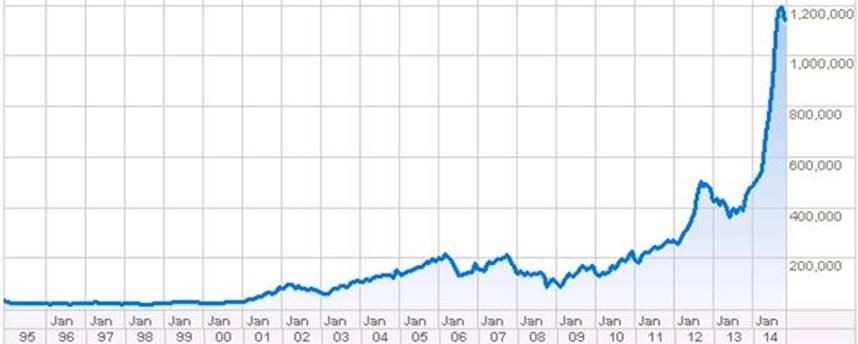
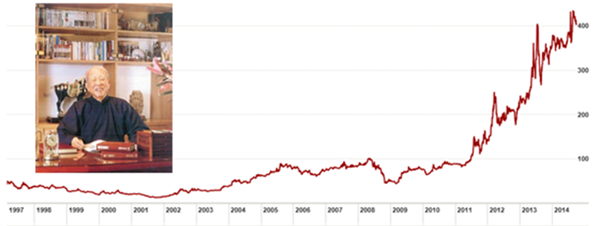
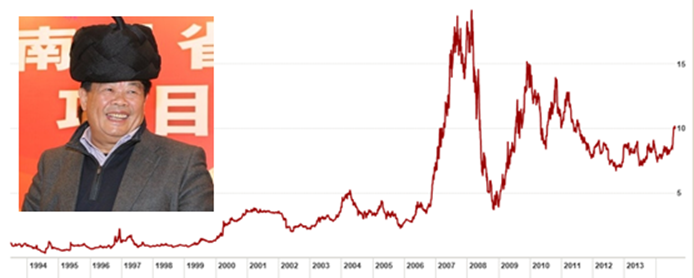
AmorePacific Group (KOSPI: 002790 KS) Stock Price Performance, 1995-2014

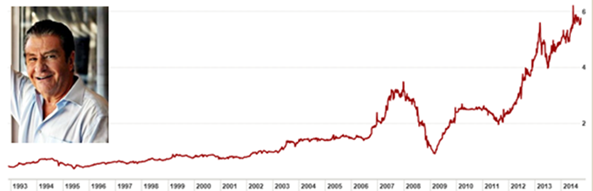
AmorePacific Group

Value investors in Asia cannot look purely at quant “valuation” metrics since many business models are “permanently impaired”. Once-successful “Stage 1” entrepreneurs have scaled their companies by multiple-folds to say under a billion dollar in market cap in the past decade. But as a result of them mishandling risks, or preventing them in the first place through business model design, the companies fail to make the successful transition from a billion to $10bn in market value and are stuck. Often, these successful, achievement-oriented entrepreneurs start to “stray” as they find it easier to seek “growth” by engaging in private business interests outside of the listed vehicles, particularly in property development. Thus, under KB Suh’s leadership, AmorePacific is an exemplary example of a Bamboo Innovator who has been able to stay focused and give a good fight to the resourceful MNCs.

We often wondered aloud and lament at the low valuations in Asia as compared to the West. Alfred Chandler’s 1977 Pulitzer-Prize masterpiece, The Visible Hand: The Managerial Revolution in American Business, offered timeless practical insights and fundamental lessons for diligent value investors to stay ahead of the curve in Asia, uplifting us beyond the unsustainable realm of trading in and out and manipulating share prices and volumes in syndicates. Chandler narrated the emergence in 19th century America, the age of robber barons, of firms which transform themselves by “organizational innovation” and “managerial innovation” to generate and sustain competitive advantage – to become Bamboo Innovators like AmorePacific.

Besides GE in 1890s…

<Article snipped>

Warm regards,

KB

Managing Editor

The Moat Report Asia

www.moatreport.com

SMU: http://accountancy.smu.edu.sg/faculty/profile/108141/Kee%20Koon%20Boon

 To read the exclusive article in full to find out more about the story of AmorePacific and KB Suh’s leadership, and Alfred Chandler’s business wisdom for value investors in Asia, please visit:

·        Buffett’s (Non)Cash-Hitter and the Wide-Moat Asian Beauty Creator, Nov 17, 2014 (Moat Report Asia, BeyondProxy)

 A new monthly issue of The Moat Report Asia is now available!

Access the in-depth idea presentation:

http://www.moatreport.com/members/

Daily Bamboo Innovator Insight: Mon 17 Nov 2014 – ‘Death bond’ investors face heavy losses up to 70 per cent of their original investment and cannot access their money for at least three years

Life

‘Death bond’ investors face heavy losses up to 70 per cent of their original investment and cannot access their money for at least three years: FT

Buffett’s family business tests the ties that bind; Lawrence Cunningham’s ‘Berkshire Beyond Buffett’ outlines an orphanage for the corporate homeless: FT

7 steps to becoming the next Leonardo da Vinci: Try and obsess over something: Today

The Future of Writing In the Age of Information: FarnamStreet

How to Make a Bestselling Book: Atlantic

Ben Horowitz Lecture 15: How to Manage (Anotated Transcript): StartupClass

Is Entrepreneurship Addictive? Forbes

‘Don’t think, just play’: MIT engineers football success: Reuters

The Knowledge, London’s Legendary Taxi-Driver Test, Puts Up a Fight in the Age of GPS: NYTimes

If active managers’ fees were a country, it would have the GDP of Switzerland: TheReformedBroker

Marcus Aurelius: Debts and Lessons: FarnamStreet

How This 25-Year-Old Made $66,000 In A Month By Teaching An Online Course: BusinessInsider

“I don’t know” and the need for humility in an unprecedented era. InstitutionalInvestor

Follow These 10 Steps To Achieve Transformational Change: Forbes

The Great Escape Business; In troubled times, corporate evacuation planners are thriving. Fortune

Small businessman’s Chinese Dream; public thought he was crazy to give up an engineering job to start a small grilled pig trotter business in Shanghai and now he earns over 8x than before; two-thirds of sales were ordered online: AsiaOne

Spared in war, Italy’s ‘greatest picture’ saved again by benefactor: Reuters

Renowned Buddhist leader Sik Kok Kwong, co-founder of Hong Kong’s largest Buddhist organization, has died at the age of 95. TheStandard

Books

How Great Leaders Think: The Art of Reframing: Amazon

Learn or Die: Using Science to Build a Leading-Edge Learning Organization: Amazon

Investing Process

Norway Wealth Fund Outsmarts Flash Boys as Algorithms Abandoned: Bloomberg

Asia’s Top Investment Managers Focus on Fundamental Value: InstitutionalInvestor

Greater China

Now absolutely everyone can invest in China’s risky, fraud-ridden stock market: Quartz

Shanghai Stocks Out of Step With World Is Key to Allure: Bloomberg

Exploring China’s stock market: Even non-investors can glean insights from the financial statements of the A-Share “small-caps”. Time to brush up on your Chinese and separate the wheat from the chaff: BT

It’s not art thieves but tax evaders the Chinese gov must worry about: WantChinaTimes

Rinehart’s Formula For Success: Feed the Babies; Got Milk? Australian billionaire’s deal to supply China with baby formula shows milk is vital to every portfolio. Barron’s

With 2 New Jets, Chinese Manufacturer May Become Global Contender: NYTimes

China’s New Old Financial Capital; A stock-exchange deal shows Hong Kong’s advantage over Shanghai. WSJ

China’s Shadow Banking Grinds To A Halt As Bad Debt Surges Most In A Decade: ZeroHedge

Chinese policymakers eye e-commerce as linchpin of growth: Reuters

Ting Hsin taking heat over NT$3 billion promised Food Safety Fund (食安基金) to take responsibility for their actions in the food contamination scandal. ChinaPost

Pepsico’s Chinese partner Tingyi hit by downturn: FT

How Taiwan Will Make Its People Think Harder To Stoke The Economy: Forbes

India

Modi Moves Like Jagger as Indian Diaspora Flocks to Sydney: Bloomberg

Indian government: The full lotus; Smaller government? That’s a stretch: Economist

India’s Narendra Modi faces awkward fiscal challenge: FT

India Seeks to Cash In on Global Demand for Ancient Remedies: JakartaGlobe

ASEAN

Tiger Economy Loses Its Roar as Thailand’s Exports Slump: Bloomberg

No one home as Singapore executive condominiums wait for occupants: AsiaOne

Japanese entertainment firms flock to Thailand: Nation

Anies’s Education Reform Quiets Critics; Stressful Exams: Teachers and students are eager to change national exams, which don’t reflect student achievements: JakartaGlobe

Nathaniel Rothschild, the British financier and scion of a centuries-old banking dynasty, has proposed debt-stricken Asia Resource Minerals raise funds in a share sale next year that he’s prepared to underwrite. JakartaGlobe

Smartphones Will Mediate the Future Business Models in Indonesia: JakartaGlobe

Indonesia’s ‘Energy Mafia’ in the Crosshairs: JakartaGlobe

Jokowi Goes All-In on Fuel Subsidies; It’s time to allocate the money spent on the subsidy to more productive uses: JakartaGlobe

Dicey times ahead for gaming sector; The gaming story for the Genting group is far from over, although the jackpot remains a tad elusive for now. TheStar

In lean times, Singapore shopping malls face the problem of plenty: AsiaOne

Japan

Corporate Japan keeps production abroad; Aggressive monetary easing is undermining the yen, but that is not stopping Japanese companies from producing more of their goods overseas. FT

Weak yen fuels Japan Inc: FT

Japan’s Abe should seek more than a mandate if he calls election; It may take a tough tax on accumulated earnings to force businesses to act: FT

Abe is a man on a mission – destination unknown: FT

Korea

Victims in Korea’s pyramid scheme team up to track down con artist: JoongAng

Samsung in internet of things push as phone profits fade: TheAge

IKEA pricing under fire in Korea; IKEA seems to be mimicking Korean conglomerates that “regard local consumers as pushovers.” KoreaTimes

Yen weakness painful for S. Korean companies: Maeil

The Korean government pledged to grow a regional cluster of food businesses, called Foodpolis, into a hub of Northeast Asian food markets. KoreaTimes

Fortress Korea car market cracks under German luxury barrage: Reuters

Australia

Ultranet’s costly failure an education in politics and procurement; Good intentions and vision undermined by cost-cutting and flawed bidding process. TheAge

Australian stocks shine as global dividends get set to hit record $1.4 trillion next year: TheAge

Macro

BoE to come up with anti-orthodox research as a “bulwark against hubris, overconfidence and group-think”. FT

Stringent rules for hedge funds make the financial system fragile; Charging 2 per cent to hold assets when returns are low is wrong: FT

A Call for Stricter Rules for Bankers in Britain: DealBook

Rising dollar America’s currency, everybody’s problem: Reuters

We Need Stock Prices to Fall 25%; At Current Prices, Investors Should Have Mixed Feelings: WSJ

TMT

Virtual Reality Fails Its Way to Success; For decades, V.R. was a complete flop. But now with the nausea-free Oculus Rift, it may be a total win: NYTimes

Little-known Taiwanese chip designer spawns low-priced smartphone boom: Reuters

mAirbus patents flying doughnuts; Experimental design could redefine widebody aircraft: FT

Fuel-cell cars will be commercially viable by 2025: Bosch executive: Reuters

UPS Sees Wider Margins as E-Tailing Nears Business Shipping: Bloomberg

Can Lenovo replicate PC success in smartphone sector? WantChinaTimes

BYD considers joining Ramos to enter tablet computer market; BYD seems to have missed the golden period for entering the consumer electronics market and has put its investment at risk for entering the mature mobile phone market: WantChinaTimes

The Kingmaker Strategy: Pioneered By The Chinese Internet Giants, Coming To America? TechCrunch

Many teachers say the ClassDojo app helps them automate the task of recording classroom conduct, but some critics say such apps are being adopted without sufficiently considering the ramifications for data privacy and fairness. NYTimes

The Web Is Dying; Apps Are Killing It: WSJ

Evernote Chief Executive Phil Libin is focused on making people more productive during a time of rapid technological change. WSJ

Healthcare

Ebola Vaccine Challenge: Motorbikes and Kerosene Fridges: Bloomberg

Alzheimer’s Test Detects Disease Decade Ahead of Onset: Bloomberg

Electrical Scalp Device Can Slow Progression of Deadly Brain Tumors: NYTimes

Anticlotting Push Urged for Heart Patients With Stents: WSJ

Corruption tars drug industry drive to improve access for poor: Reuters

Energy & Commodities

José Manuel Entrecanales, Acciona CEO: establishment eco-warrior; Spanish conglomerate boss does not regret costly bet on renewables: FT

World’s first oil well still bubbling up black gold in Poland: AsiaOne

Falling Oil Prices Test OPEC Unity: WSJ

Shale Boom Helps North Dakota Bank Earn Returns Goldman Would Envy: WSJ

Risk of sour grapes as wine prices continue to disappoint: FT

Diners could soon be paying more for their plate of sushi as the price of fishmeal, the crucial feed for shrimp, prawns and salmon leaps to an all-time high. FT

Standard Chartered Is Stung by Mining Loans; Bank’s Push Into Lending to Commodity Firms Has Contributed to a Jump in Its Soured Loans: WSJ

Consumer & Others

Estee Lauder Cos., seeking to capitalize on Kendall Jenner’s 30 million social-media followers, hired the model to represent its flagship cosmetics brand worldwide. Bloomberg

Law gets fashionable as labels learn to love litigation: France24

Daily Bamboo Innovator Insight: Sun 16 Nov 2014 – The New China? Surging exports are making Vietnam, Cambodia, Laos, and Myanmar dynamic economic rivals to their much larger neighbor

Life

Welcome to the Failure Age! In this economy, losers will be the biggest winners. NYTimes

Three years ago, Matt Haag was flipping burgers at McDonald’s. Today he makes his living playing video games and has 1.5 million YouTube subscribers and a million-dollar income: NYTimes

How successful people stay productive: Quartz

3 Reasons You Can’t Just Ask Customers What They Want: TechCrunch

One way to lose money even when you’ve made 5000% on your home: FP

Why You Don’t Want to Give Financial Information to All of Your Investors + How founders get screwed on convertible notes: Both Sides of the Table

Lessons from rainbow: Even in the midst of an impending storm, something beautiful and colourful can emerge. TheStar

Amanda Palmer on the Art of Asking and What Thoreau Teaches Us about Accepting Love; “You’re an artist when you say you are. And you’re a good artist when you make somebody else experience or feel something deep or unexpected.” BrainPickings

Rewriting the Book of Belonging: Anne Lamott on the True Gift of Friendship and the Uncomfortable Art of Letting Yourself Be Seen; “Trappings and charm wear off. Let people see you.” BrainPickings

The Language of Lying: Animated Primer on How to Detect Deception: BrainPickings

Diane Ackerman on What Working at a Suicide Prevention Hotline Taught Her about the Human Spirit: BrainPickings

Adrienne Rich on Lying, What “Truth” Really Means, and the Alchemy of Human Possibility: BrainPickings

The Fluid Dynamics of “The Starry Night”: How Vincent Van Gogh’s Masterpiece Explains the Scientific Mysteries of Movement and Light; “In a period of intense suffering, Van Gogh was somehow able to perceive and represent one of the most supremely difficult concepts nature has ever brought before mankind.” BrainPickings

The Day Dostoyevsky Discovered the Meaning of Life in a Dream: BrainPickings

Showroom vs. Sanctuary: Rebecca Solnit on What Our Dream Homes Reveal about Our Inner Lives: BrainPickings

The Day Dostoyevsky Discovered the Meaning of Life in a Dream: BrainPickings

Pico Iyer on What Leonard Cohen Teaches Us about Presence and the Art of Stillness; “Faith is the ability to honor stillness at some moments, and at others to ride the passion and exuberance.” BrainPickings

Failure Has Never Been More Successful; With Fuck-Up Nights and Other Storytelling Venues, People Are Sharing Stories of Business Disasters Like Never Before: Fast Company

Books

The Innovation Paradox: Why Good Businesses Kill Breakthroughs and How They Can Change: Amazon, CFA

China

Swat the “flies” dead; In China many “flies”, political jargon for corrupt low-ranking officials, have grown bigger than the tigers by feeding on money. Xinhua

Beijing denies blocking G20 graft initiative on shell companies and hidden assets: SCMP

Loss prevention safeguards key to SOE reform in China: WantChinaTimes

Economic integration: The flying factory; Asia has built a web of economic interdependence which China would be ill-advised to unravel: Economist

India

Change Of Guard At Havells – India’s Leading Electrical Goods Company: Forbes

Japan

‘Godfather’ of Abenomics: Japan’s sales tax hike must be delayed; Koichi Hamada, one of the key architects of Abenomics, says Japan’s “Ponzi game situation” will be made worse if policymakers go ahead with second hike: Telergraph

ASEAN

The New China: Surging exports are making Vietnam, Cambodia, Laos, and Myanmar dynamic economic rivals to their much larger neighbor. Barron’s

Australia

Aussie fat cats rake in super-sized fees; Brycki’s study of 496 of Australia’s largest managed funds found that no less than 45 per cent of returns were frittered away in fees in five years: TheAge

Aussie Budget cuts spark fears of muzzled watchdogs: TheAge

Macro

Banking is changing, slowly, but its culture is still corrupt: Guardian

Height of ambition, or of folly? London’s rising skyline knows no limit: Guardian

Keeping Active: The $2 trillion exchange-traded fund industry offers specificity and flexibility, but these experts haven’t ruled out active management. Barron’s

Pandora’s Box Or Panacea? Lessons From The U.K.’s Liberalization Of Law-Firm Ownership: Forbes

Oil-Producing Countries’ Currencies Are Getting Crushed; oil exporters are now pulling liquidity out of financial markets rather than putting money in: Zerohedge

TMT

Henry Blodget: Now I Know Why Investors Are Going Hog Wild About Uber; How Uber Is Changing the U.S. Economy Like No One Ever Imagined: BusinessInsider, TheStreet

Apple Pay Gives Glimpse of Mainstream Appeal for Mobile Payments: NYTimes

Energy & Commodities

In Oil’s Slide, Echoes of a Fall; Adapted From the Paperback Edition of ‘The Frackers: The Outrageous Inside Story of the New Billionaire Wildcatters: WSJ

Oil and water: North America’s energy revolution will have a ripple effect around the Pacific: Economic Times

Consumer & Others

Supermarkets could start to close, warns Waitrose boss; The ‘Big Four’ grocers may be forced to close existing stores as the industry struggles to cope with falling sales and profits: Telegraph

Mike Ashley looks to add Kitbag to sportswear empire; Sports Direct is circling Findel’s Kitbag, which sells replica football strips for major teams including Manchester United: Telegraph

Savile Row tailor fears overseas threat to rich tapestry of tradition; Shirtmaker believes buyouts detract from street’s fashion cachet, with only two family-owned tailoring houses left on Savile Row: Guardian

Carolyn McCall’s easyJet success could catch the eye of a retailer: Telegraph

Caesars warns of potential casino bankruptcy: Fortune

Brunswick, the maker of Boston Whaler boats and Mercury engines has restructured, which is beginning to pay off. Barron’s

Cummins: Plenty of Gas in the Tank: Barron’s

Vail Resorts’ CEO: Transforming the Business of Skiing:  Barron’s

McDonald’s Won’t Buy Simplot’s GMO Potato: WSJ

Investing Process

A Dozen Things I’ve Learned From Henry Singleton About Value Investing & Venture Capital: 25iq

Top Lessons Learned From Great Angel Investors: RobGo

Building a Better Beta: Combining Fundamentals Weighting, Low Volatility, and Momentum Strategies: Research Affiliates

The Lesson of Forex Trading: Learn From Your Losses: WSJ

Daily Bamboo Innovator Insight: Sat 15 Nov 2014 – Oranges, lemons and forex: How to understand the market-rigging scandal

Life 

Oranges, lemons and forex: How to understand the market-rigging scandal: Medium

The importance of sparking entrepreneurial spirit in family businesses: FP

Google CEO on moonshots: Find a ‘zero million dollar’ research problem; To succeed at a moonshot, you need curiosity, impulse, and a problem that no one seems to be investing in. Fortune

13 Misconceptions 20-Somethings Have About Success: BusinessInsider

This 5-Year-Old Genius Just Aced A Computer Science Test From Microsoft; The boy, now 6, is officially a Microsoft Certified Professional which is highly regarded in the information technology industry: BusinessInsider

Prospects for growth: An interview with Robert Solow; The economist who won a Nobel Prize for advancing our understanding of technology looks at the past and future of productivity-led growth.: McKinsey

Thinking Like a Writer: Steven Pressfield

9 Powerful Leadership Lessons From The US Military: BusinessInsider

The Man Who Made the Modern Music Industry; Ralph Peer became the father of country through sheer commercial calculation: Southern folk music, he realized, was a vast untapped well of copyright-free songs: WSJ

The Life of Ivan Pavlov: His discoveries fueled grandiose hopes of curing psychiatric illness and breeding humans with more refined nervous systems—in short, of saving the world through physiology. WSJ

Nike’s Martin Lotti on Just Doing It; The Nike Football vice president and creative director talks about the importance of design, the future of shoes and the place where he’s happiest: WSJ

Where to Look for Insight: HBR

Being Happy at Work Matters: HBR

Bring Agile to the Whole Organization: HBR

How to Motivate Yourself When Your Boss Doesn’t: HBR

Why No One’s Reading Your Marketing Content: HBR

John Kotter (2001): What Leaders Really Do; The idea of getting people moving in the same direction appears to be an organizational problem. But what executives need to do is not organize people but align them. HBR

Galleons and gunships: Pacific history has been defined by bullies enforcing their rules: Economist

Large family businesses are in decline in Spain, but their ability to innovate has renewed interest in the sector. CampedenFB

Finding Our Place in the Stars; The physicist who kept the ‘Interstellar’ science sharp talks about black holes, space travel and his optimistic vision of human possibility. WSJ

The Classical Roots of ‘The Hunger Games’; The blockbuster film franchise reaches back to the myth of Theseus, ancient Greece and Rome, and the very foundations of Western culture: WSJ

Do You Want To Know About Your Brain? New research suggests many peopledon’t think that much about brain science. Should they? NYTimes

Is Quantum Entanglement Real? Einstein thought not. But experiments suggest so. NYTimes

How To Make Transparency Part Of Organizational Culture: Forbes

How ColaLife learned to think outside the crate; The award-winning charity used to distribute medicines packaged with Coke bottles to remote rural areas, but it had to adapt and move on as it became more successful: Guardian

Demand-based pricing strategy: A matter of avoidance or appreciation; Uber reintroduced the world to the basic economic theory of dynamic pricing when demand and supply are at play, naming it “surge pricing”. Nation

A Malaysian company called Heart and Shawl is using e-commerce to change the way headscarves are priced and the way they are acquired by Muslim women. TheStar

‘The Art of Things’: Pioneering Product Design; “The industrial revolution was made by engineers,” she writes. “Today it is the designers who are building machines.”: WSJ

Seth Klarman: The Patient Investor: ValueWalk

Multitasking: No more than a mirage? AsiaOne

Sick of scams: but what is the cure? AsiaOne

China

China finance official says shadow banking major issue: Reuters

China Busts Underground Banks With $23 Billion Transactions: Bloomberg

The Not-So-Mighty Chinese Consumer: WSJ

NQ Mobile Inc Dumped By Uber Bull Oberweis: ValueWalk

ASEAN

Three megatrends for Asean growth: TheStar

Sleepless in Singapore; The property market in Singapore, described by a developer “to be in a (state) of slumber” and by a Singaporean analyst that it “could get worse”: TheStar

More luxury homes go under the hammer as defaults spike in Singapore: Today

Japan & Korea

Why Subaru’s Profit Is Surging; Weaker Yen, Sluggish Demand at Home Gives Big Car Exporter Strong Lift: WSJ

Samsung SDS strong debut frees cash for Lee’s successors; Samsung SDS became the 5th most valuable company on the South Korean bourse with a market capitalisation of about US26bil: TheStar

Macro

Jim Rogers On Putin, His Suspicions About Oil Prices, And Why 26-Year-Olds On Wall Street Have The Biggest Advantage: BusinessInsider

“World’s Richest Restaurateur” Sees An Imminent Crash In America’s “Crazy” Real-Estate Market: ZeroHedge

Economic integration: The flying factory; Asia has built a web of economic interdependence which China would be ill-advised to unravel: Economist

A Once Bullish Crispin Odey Fears Recession In Emerging Markets: ValueWalk

Spreading deflation across East Asia threatens fresh debt crisis; Asia’s currency skirmishes are happening in a region of festering grievances and territorial disputes, with no Nato-style security structure to dampen down fires: Telegraph

Corporate buybacks fuel all-time highs – but for how long? US companies will buy $450bn of their stock this year, but when will this become too expensive? FT

Regulation: Banks count the risks and rewards; Crackdown on money laundering threatens to leave parts of developing world cut off from global finance: FT

Mexico Hit by Unrest and Scandal; Mexico’s Spreading Unrest and Sense of Lawlessness Are Shaping Up as Major Political and Economic Challenges to President Enrique Peña Nieto: WSJ

TMT

What Steve Wozniak Got Wrong About The iPhone 6; Apple is almost never first-to-market in any product category. Their strategy is to come up with dramatic, generational improvements to products that others have done not as well. BusinessInsider

Kinpo’s (金寶) subsidiary –YZprinting unveiled its new 3D Food Printer yesterday, which allows users to prepare healthy and delicious snacks simply by feeding food ingredients into the machine. ChinaPost

Is YouTube the new television? Why the video website is rewriting the rules of broadcasting: FT

Twitter Is Junk. Why Are You Surprised? Bloomberg

Russia plans alternative version of ‘Wikipedia’: Reuters

Apple Could Swallow Whole Russian Stock Market: Bloomberg

Sam Jain’s CheapOair is really taking off; His CheapOair website has kept its focus in air tickets-and human customer service. Fortune

How Formula One Teams Are Using Big Data To Get The Inside Edge: Forbes

CHART OF THE DAY: Mobile Messaging Is Poised To Overtake Social Networks: BusinessInsider

Apple doesn’t own applepay.com: Fortune

Google Glass future clouded as some early believers lose faith: Reuters

Marc Andreessen: the ’90s Had It Right; In a Q&A at WSJD Live, the Venture Capitalist Said the Dot-Com Crash Was Catastrophic but the Ideas Weren’t: WSJ

Jualo, in Emulation to eBay, Woos Indonesia’s Secondhand Market: JakartaGlobe

BlackBerry Has no Immediate Plans to Crack ‘Sensitive’ China Market: JakartaGlobe

Stanley Gibbons enters the internet age with stamp auction site; Stamps worth less than £50 can now be bought and sold via the philately auctioneer’s online marketplace: Guardian

5 Ways Product Design Needs to Evolve for the Internet of Things: HBR

Healthcare

The Dengue Fever Scourge; Vaccines in the pipeline could help control a pandemic that sickens millions each year. NYTimes

In India, Latrines Are Truly Lifesavers: NYTimes

What the U.S. Can Learn From India and Brazil About Preventive Health Care: HBR

Energy & Commodities

Shipbrokers in merger talks after 30% plunge in oil price; Clarkson hoping to acquire Platou, while Icap and Howe Robinson also say they are considering their options: Guardian

Oil price slump to trigger new US debt default crisis as Opec waits; Falling oil prices and and US shale drillers drowning in a sea of debt could be the spark for a new credit crunch: Telegraph

Plunging oil price triggers warning of defaults and ‘distress’ in the energy sector; Who will blink first as global oil prices collapse? FP1, FP2

How a Halliburton-Baker Hughes deal would shake up the Canadian oil field services market: FP

Proposed merger of oilfield firms poses challenge to Schlumberger: Reuters

IEA sees new era, no quick rebound in oil prices: Reuters

There Will Be Blood – How The Fed Has Flooded The Shale Patch With Junk Debt: ZeroHedge

The Fall of a National Champion: Petróleo Brasileiro offers an epic lesson in how to squander a windfall. Petrobras Scandal Widens, Earnings Delayed; Former Engineering Director at Brazil’s Oil Firm Arrested Along With 17 Others; Shares Plunge: WSJ1, WSJ2

Cotton stockpiles are swelling so large that there will be enough in global warehouses to make about 23 billion pairs of jeans, or three for every person on the planet. The glut sent prices to a five-year low: Bloomberg

Taming the Wild Tuna: Why Farmed Fish Are Taking Over Our Dinner Plates: WSJ

Consumer & Others

Wei family to sell their Taipei 101 shares? WantChinaTimes

McDonald’s CEO: Here’s Why We Don’t Want To Be Like Chipotle: BusinessInsider

McDonald’s Created Broccoli That Tastes Like Bubble Gum: BusinessInsider

Insiders Think Lululemon Is In Serious Trouble: BusinessInsider

The New Breed of High-Performance Wool Clothing; Long a tried-and-true textile for outdoor apparel, wool is getting engineered for higher performance by companies like Voormi, Duckworth and others: WSJ

Inventure Foods has succeeded when it comes to healthier snacks and even healthier margins: Forbes

Nestlé Explores Sale of Frozen Food Unit Davigel; Swiss Food Giant Presses Ahead With Consolidation of its Portfolio of Fringe Businesses: WSJ

Daily Bamboo Innovator Insight (Life & Books): Friday 14 Nov 2014 – A popular currency trading website vanished overnight and $1-billion of investors’ money disappeared with it

Life

Building Legacies: Family business succession in South-east Asia: Economist, CampdenFB

A popular currency trading website vanished overnight and $1-billion of investors’ money disappeared with it: FP

From crew member to CEO of McDonald’s Singapore; “Somewhere, some time in my career, someone gave me a break. Someone saw some potential in me and opened that door.” AsiaOne

Open letter to the G20: exposing the corporate shell game is good for business – and the world: Guardian

Billionaire Investor Ray Dalio Says These 5 Habits Made Him Successful: BusinessInsider

Family Businesses of the First World War: CampdenFB

Avian navigation: Flight risk; Pigeons appear to use gravity to set a course back to their lofts: Economist

European history: Reactionary days; How Europe invented the modern repressive state: Economist

Veterans break 50-year silence on China’s first nuclear test: WantChinaTimes

What the stock market can teach you about your own personality; Money brings out the insecurity in everyone. But here’s the good news: you can defeat it: Guardian

Why cats never became man’s best friend: Quartz

Why the Wagner family has outsourced almost nothing at its $200 million airport: BRW

The evolution of a TED Book cover: TED

Unraveling Why Some Mammals Kill Off Infants: NYTimes

The meaning of solitude: KoreaTimes

Auto Parts Billionaire Shahid Khan: I Felt The American Dream In My First 24 Hours Here: Forbes

Five Smart Risks To Set Yourself Apart In Cautious Times: Forbes

Transportation, divergence, and the industrial revolution (and the oil tanker king John Fredriksen), Climateer Investing

Plants talk to each other using an internet of fungus: Hidden under your feet is an information superhighway that allows plants to communicate and help each other out. It’s made  of fungi: BBC

Cost management: A path to sustainable performance improvement: Nation

Taylor Swift Is the Music Industry: BusinessWeek

In the sleepy world of podcasts, ‘Serial’ murder mystery is a sensation and a global phenomenon —a testament to the power of great story-telling. WSJ

Three ways CEOs can improve the supply chain. CEOs increasingly view the supply chain as a critical point of competitive differentiation. Here’s how to make it better. McKinsey

Books

The Liar’s Ball: The Extraordinary Saga of How One Building Broke the World’s Toughest Tycoons: Amazon

Zeckendorf: The autobiography of the man who played a real-life game of Monopoly and won the largest real estate empire in history: Amazon

Daily Bamboo Innovator Insight (Investing Process, Research): Friday 14 Nov 2014 – AP investigation shows Tianhe is a fraud

Investing Process

AP investigation shows Tianhe is a fraud: AA, AP

Research

A Disruption Mechanism for Bribes: Review of Law & Economics

The 52-Week High and Momentum Investing: AlphaArchitect, JF

Daily Bamboo Innovator Insight (Investing Process, Research): Thursday 13 Nov 2014 – Michael Mauboussin: Attributes of a Good Investment Process

Investing Process

Michael Mauboussin: Attributes of a Good Investment Process: ValueWalk, PPT

Legendary Finance Professor Ben Graham Revealed The Problem With Earnings Announcements Decades Ago: BusinessInsider

Asset Management: A Systematic Approach to Factor Investing: Amazon

Buffett Said He Paid a Lot. $15 Billion Later, BNSF Is a Cash Machine. ‘He Stole It’: Bloomberg

Research

Does Culture Matter for Development? SSRN

Acquisition Decisions of Zero-Leverage Firms: SSRN

Daily Bamboo Innovator Insight (Sector): Thursday 13 Nov 2014 – Cathay Financial to Buy $92 Billion Asset Manager Conning for $240m, or 0.26% of AUM

Consumer, Financial and Others

Coke CEO faces super-sized challenges: ValueWalk

British supermarkets: A trolley-load of pain; Even Sainsbury’s, an upmarket grocer, is feeling the heat from the discount retailers: Economist

Billionaire Corona Beer Heir Mesmerizes Junk Bond Buyers: Bloomberg

Cathay Financial to Buy $92 Billion Asset Manager Conning for $240m, or 0.26% of AUM: Bloomberg

Why Tesla Motors Inc. Is Simplifying Its Vehicle Lineup: Nasdaq

Commodities and Energy

Brent Falls Below $80 For First Time in 4 Years on Glut: Bloomberg

Economic and practical obstacles limit Mexico’s shale ambitions: FT

Accuracy of Bakken Volatility Tests Face More Challenges; Industry, Canadian Officials Fear That Explosive Risk of North Dakota Oil Is Understated: WSJ

Ford in vanguard of aluminium revolution: FT

Daily Bamboo Innovator Insight (Macro & Country): Thursday 13 Nov 2014 – Wison Stock Collapses After Halt Lifted And Billionaire Chairman Charged

Greater China

Wison Stock Collapses After Halt Lifted And Chairman Charged: Bloomberg

China’s Property Market Bottoming Out? Not So Fast: WSJ

Hong Kong fund managers eye Shanghai stock linkup as China investment quotas run out: Reuters

China Hunger for Clean Energy to Leave No Rooftop Behind: Bloomberg

19 Chinese provinces to reform and securitize state-own businesses: WantChinaTimes

China transforming from world’s factory into world’s investor: WantChinaTimes

In China, small potatoes corrupt big: OffBeat

Japan and Korea

Yen Capitulation Awakens Intervention Ghosts: Chart of the Day: Bloomberg

Japan actions risk igniting currency war; Devaluation is becoming a habit in an economy that has lost its edge: FT

Japan firms overwhelmingly want Abe to delay tax hike: TheStar

Honda grandees chide CEO over quality, recalls: TheStar

Novelis, the world’s leading aluminum rolling and recycling company, has recycled 20 billion aluminum beverage cans in Korea; Novelis recycles about 50 billion used beverage cans a year across the globe. KoreaTimes

ASEAN

Vietnam Tightens Valuations to Clean Up Bad Debt: Southeast Asia: Bloomberg

Singapore to Face Fire Sales With Home Curbs, Developer Says: Bloomberg

Joko Widodo — CEO of Indonesia Inc. JakartaPost

‘Thailand could become financial hub’ rivalling Singapore, Malaysia: Nation

Shedding light on a company that is increasingly subject to public scrutiny. From humble beginnings, the company is on its way to becoming a leading player in Malaysia’s real estate sector: TheStar

Pelikan is transferring RM1.05bil assets to its 71.32%-owned Germany-listed subsidiary Herlitz AG at a discount, as the struggling stationery maker seeks to boost current stock valuations and raise fresh funding for future growth: TheStar

To lure the bull, SGX must look beyond the China shop: BT

Shanghai-HK link leaves a Singapore divide: BT

Bakries say ‘no easy fixes’ to Bumi default: JakartaPost

Myanmar Paper Replays Junta’s Tunes; Makeover for State-Run New Light of Myanmar Appears to Be Short-Lived: WSJ

Australia

Million-Dollar Homes in Sydney Highlights RBA’s Dilemma: Bloomberg

Macro

Italians Say No to Risk as Slump Takes Toll on Startups: Bloomberg

The US is a huge hedge fund: FT

An imperfect plan for fixing the next crisis; In a serious crunch, it would be every bank regulator for itself: FT

Tim Geithner reveals in the raw how Europe’s leaders tried to commit financial suicide; Taped transcripts of the former US Treasury Secretary expose a catalogue of errors that will haunt Europe for years, made worse by misplaced righteousness: Telegraph

Japan-China Face Off in Asian Currency War; A snap Japan election may undermine reforms and put Asia’s two economic titans on a collision course. Barron’s

The Wolves of Forex; Foul-mouthed traders aren’t the biggest manipulators of currency markets. WSJ

Asian Companies Flock Into Aircraft Leasing; Li Ka-shing, Chinese Players, Japanese Seek Assets: WSJ

Daily Bamboo Innovator Insight (TMT): Thursday 13 Nov 2014 – MediaTek chief named as one of world’s best CEOs

TMT

MediaTek chief named as one of world’s best CEOs: ChinaPost

As YouTube pushes into paid content, other online music outlets are being forced to defend or change their business models to better compensate artists: NYTimes

Hasbro Said to Be in Talks to Buy DreamWorks Animation: NYTimes

Tokopedia to initiate ‘Silicon Valley’ in Indonesia: JakartaPost

Samsung Electronics chases curved smartphone wave to beat flat-screen crowd: Reuters

CIOs Turn to “Deputies’ So They Can Stay ‘Out of the Weeds’: WSJ

Venture capital world changing as hedge funds target tech startups: ValueWalk

Amazon to keep investing in cloud despite margin pressure: Reuters

Amazon: ARM Chipmakers Aren’t Matching Intel’s Innovation: Bloomberg

In One Word, Here’s Why Microsoft Should Copy Amazon’s Echo: BusinessInsider

Daily Bamboo Innovator Insight (Life & Books): Thursday 13 Nov 2014 – Peter Thiel’s very negative – and very useful – advice for entrepreneurs

Life 

Peter Thiel’s very negative – and very useful – advice for entrepreneurs: Fortune

America’s Youngest Female Billionaire Explains How She’s Transforming Medicine: BusinessInsider

Some Of The Most Successful Businesses In The US Were Started By Entrepreneurs Over Age 50: BusinessInsider

Why Panera’s CEO Wrote A 20-Page Memo About How He Would Destroy Panera: BusinessInsider

Jerry Seinfeld Explains How He’s Remained Consistently Successful: BusinessInsider, WNYC

China’s Philosopher-CEO Zhang Ruimin; Haier’s leader describes how he built a winning global company by continually reframing his management philosophy. Strategy&

The books that illuminate a turbulent decade in business: FT

6 Hustles Warren Buffett Used To Make $53,000 By Age 16: BusinessInsider

From the Knowledge Economy to the Human Economy: HBR

Why Time — Not Money — Is the Key to Happiness: Knowledge@Wharton

Nicholas Kristof’s ‘Path’ to More Effective Giving; New York Times columnist Nicholas Kristof discusses how to use your time and money for the greatest good. Knowledge@Wharton

The ‘Too Rich to Succeed’ Challenge Facing Start-ups: Knowledge@Wharton

Customer Loyalty in the Age of Big Data: Knowledge@Wharton

CEO of SAP: Why Writing About the Past Helped Me Lead in the Present: 250 words

Bringing a healthy dose of pragmatism to strategy: McKinsey

The Most Underutilized Tool in Making People Happier at Work: LinkedIn

Is It Legit? A Quick Look At Different Types Of Financial Fraud: Aleph

Scientific Insights From Rats Filled With Regrets; Researchers learn that rodents share what appears to be a uniquely human emotion: WSJ

Problems Plagued Virgin Galactic Rocket Ship Long Before Crash; Richard Branson’s Projections on Launch Ran Counter to Technical Capabilities: WSJ

Making ‘Profit’ a Dirty Word in Higher Education; A million students may lose financial aid thanks to rules that don’t apply to public universities. WSJ

Inventiveness isn’t always the exclusive realm of educated boffins: TheStar

Tatsumi: Godfather of alternative manga is reborn on film: JapanTimes

What would you like to learn today? Building a center for research into Self-Organized Learning: TED

Let it go, let it go: 4 strategies to help you stop micromanaging: BRW

The 7 secrets to Gail Kelly’s success: BRW

Study Reveals The Career Strategy That Top CEOs Have In Common: BusinessInsider

The productivity of PhDs: Lazy graduate students? Economist

8 Ways to Motivate People to Say Yes More Often: FastCompany

Books

Scaling Up: How a Few Companies Make It…and Why the Rest Don’t: Amazon

The Innovator’s Method: Bringing the Lean Start-up into Your Organization: Amazon

My role model is Fuzukawa Yukichi, the Benjamin Franklin of Japan

http://www.moatreport.com/wp-content/uploads/2013/04/moatreportasia-460x156.png

Bamboo Innovators bend, not break, even in the most terrifying storm that wouldsnap the mighty resisting oak tree. It survives, therefore it conquers.”

BAMBOO LETTER UPDATE | November 3, 2014

Bamboo Innovator Insight (Issue 57)

§  The weekly insight is a teaser into the opportunities – and pitfalls! – in the Asian capital jungles.

§  Get The Moat Report Asia – a monthly in-depth presentation report of around 30-40 pages covering the business model of the company, why it has a wide moat and why the moat may continue to widen, a special section on “Inside the Leader’s Mind” to understand their thinking process in building up the business, the context – why now (certain corporate or industry events or groundbreaking news), valuations (why it can compound 2-3x in the next 5 years), potential risks and how it is part of the systematic process in the Bamboo Innovator Index of 200+ companies out of 15,000+ in the Asia ex-Japan universe.

§  Our paid Members from North America, Europe, the Oceania and Asia include professional value investors with over $20 billion in asset under management in equities, some of the world’s biggest secretive global hedge fund giants, and savvy private individual investors who are lifelong learners in the art of value investing.


Can You Guess This Asian Wide-Moat Company?

“My role model is Fuzukawa Yukichi, the Benjamin Franklin of Japan.”

Q: “Who has influenced you the most? Any role model(s) that you have?”

Mr. H: “There are many people who have influenced me. My role model is … Fuzukawa Yukichi. Yukichi-san is regarded as one of the founders of modern Japan and is called the Voltaire and Benjamin Franklin of Japan. His ideas about government and social institutions made a lasting impression on a rapidly changing Japan during the Meiji Era. He is an author, writer, teacher, translator, journalist, and entrepreneur who also founded the newspaper Jiji-Shinpo and the Institute for Study of Infectious Diseases. He is also a civil rights activist and liberal ideologist, believing that whether one is a child of a samurai or farmer, male or female, they should have the right to be educated. An interesting story about his creativity to overcoming resistance. During his era, Japanese don’t eat beef. Besides religious belief and cultural influences, an aversion to beef is because of its taste. So Fuzukawa added soya sauce, spring onion, sugar into what we now know as the hugely popular Sukiyaki, the Japanese beef hot pot. From this small story, you can see that without Yukichi-san, there is no modern Japan! In those conservative and stifling times, he is able to see Japan a hundred years ahead with incredible foresight. Hence the Japanese commemorate his contributions by putting him on the highest-denomination (¥10,000) of the Japanese yen currency note.”

http://3.bp.blogspot.com/-Zp7NE9Ywsw4/UMha7amXEJI/AAAAAAAADl0/SPSHrN90afk/s1600/scan0001.jpghttp://images.rapgenius.com/a7v9dhs4ei4z6q7kmjlianie7.512x212x1.jpghttps://encrypted-tbn3.gstatic.com/images?q=tbn:ANd9GcS-oEsHiEsSdtGs5jK3QWKtmfNmPid4VuxYPi7w7YbVyJgBdZcAhttp://upload.wikimedia.org/wikipedia/commons/4/4d/Usdollar100front.jpg

Can you guess who is this Asian entrepreneur? Our latest monthly Moat Report Asia for November investigates an Asian-listed company who is the global #3 leader in a product with multiple applications from shale gas to submarines, overtaking General Electric (GE). For a world-class company possessing deep intangible know-how, the company has an undemanding valuation at EV/EBITDA 10.2x and Price-to-book value 1.45x. Its P/B is even lower at 1.2x after taking in account the property revaluation gains from unlocking the value of its land bank near the MRT earmarked for urban renewal and development that would drive up its book value by 21%. The firm’s short-term downside is also protected by its healthy balance sheet with net cash of $230m and a decent dividend yield of 3.23%.


From Mr. H’s role model, we get to perhaps examine Kuroda’s massive monetary stimulus from a different perspective by traveling back in time. Japan’s postwar economic miracle was driven especially by companies that exported materials, parts and industrial products – not by consumer-goods companies. Hitachi, Toshiba and NEC have grew after the war by exporting industrial products like locomotives, gas turbines. Now, quietly, some Japanese giants have returned back to their industrial and robotics roots. In recent years, the three – Hitachi, Toshiba, NEC – have shed many consumer operations and doubled down on businesses like heavy machinery, industrial electronics. Take the case of Hitachi. After posting cumulative losses of ¥985bn for four fiscal years ended Mar 2010, Hitachi swung back to a cumulative net income of ¥1.03tr in the four years since then. Panasonic has quit the consumer smartphone market, stopped making plasma screen TV sets and sharply reduced its camera output.


Besides Japan, America is also experiencing a manufacturing-industrial renaissance and re-shoring driven by the decline in energy costs, the increase in American labor productivity and the rising wages in China and Asia. American factories are producing more expensive and complicated goods – medical equipment, computer chips, commercial and military jets and oil and gas equipment.

And Mr. H’s products are part of these structural trends that will take place in the years ahead.

Who is Mr. H and his company?

His personification is Fuzukawa Yukichi and Benjamin Franklin – Mr. H is also you.

Warm regards,

KB

Managing Editor

The Moat Report Asia

www.moatreport.com

SMU: http://accountancy.smu.edu.sg/faculty/profile/108141/Kee%20Koon%20Boon

A new monthly issue of The Moat Report Asia is now available!

Access the in-depth idea presentation:

http://www.moatreport.com/members/

PS: We have also posted the presentation slides to a talk given by Mr Wai Phyo Kyaw (the technopreneur behind Rebbiz: MyanmarCarsDB, MyanmarJobsDB, MyanmarHouseDB) and Ms Chua Mei Mei (executive director of Beauty Palace) to the students in the Singapore Management University (SMU) for the official course Accounting Study Mission to Myanmar (Dec 2014) upon the invitation of KB Kee, managing editor of The Moat Report Asia and adjunct faculty (accounting) in SMU. Wai Phyo is akin to the early days of Greg Roebuck who founded the highly successful carsales.com.au (CRZ, MV $2.2bn). Beauty Palace, a former distribution partner of Unilever, demonstrates how emerging companies stay relevant and competitive to the extent that they become the targets of MNCs/Unilever who send people to learn from them. Beauty Palace also sheds insights into the dynamics of the listed Asian operations of Unilever –Unilever Indonesia (UNVR IJ, MV $18.9bn), Hindustan Unilever (HUVR IN, MV $25.4bn). KB wrote the following thank-you note to Wai Phyo and Mei Mei on behalf of SMU:

Dear Mei Mei (and Kenneth), Wai Phyo and Ye Lin,


Many thanks for coming down to SMU to share with the students your hands-on experience in building up businesses in the rapidly-evolving Myanmar with its distinctive challenges and opportunities.

One thing that all of us felt very strongly from all three of you is the sense of national pride that you have in being involved in the transformational changes gripping the country as both an entrepreneur and a citizen!

Indeed, from urban Yangon/Mandalay to the rural towns/villages, every Burmese desire an improvement in their lot in life, whether they be shampoo-toothpaste or trustworthy information about cars-houses-jobs.


Mei Mei: You remind all of us of Hyflux’s Olivia Lum who was the first woman to win the Ernst & Young World Entrepreneur of the Year. Both of you are willing to brave uncertainties and hardship in traveling to far-flung, dangerous places to sell products and forge relationships – Olivia had shared with the world the tale of her trip to Maldives where she was the lone passenger in a boat manned by two men; a storm broke during the four-hour trip to an island and sea water gushed through a crack that had opened up in the bottom of her boat. You have shared with us your inspiring story of courage and grit in traveling to different parts of Myanmar to do business with integrity and values.

·        One question that all of us would like to learn from you in an ongoing conversation is this: Your unique background has shaped your outstanding character, values and success – from having the sense of responsibility as the eldest in the family of five siblings to the heightened sense of business awareness in the family business relationship with Unilever over the years that the foreign partner could go independent one day and hence a need to stay hungry and capable. So how can someone “ordinary” have the drive and grit that you have?

Wai Phyo: Startups are all-consuming and we are thankful for your sharing on the tech startup scene in Myanmar and your inspiring leap of faith (long working hours, commitment, and responsibility) that resulted in your business success in Rebbiz (MyanmarCarsDB, MyanmarJobsDB, MyanmarHouseDB)! Your success remind us of what Facebook co-founder Dustin Moskovitz shared in the photos “What It’s Actually Like” below: “This is an actual scene from Palo Alto, [Mark Zuckerberg] spent a lot of time at this desk, head down and focused…this is just him signaling his intention to be focused and keep working, not be social.”

https://static-ssl.businessinsider.com/image/5422bf37ecad0456680c1bf3-960-720/so-a-scene-from-the-social-network-this-is-us-partying-and-working-at-the-same-timesomebodys-spraying-champagne-everywhere.jpgdustin moskovitz startup entrepreneurship launch advice deck

·        One question that all of us would like to learn from you in an ongoing conversation is this: In building up a Minimum Viable Product (MVP) in a startup to improve from the interaction and feedback from the actual users, how does one overcome the anxiety and fear when bigger, more resourceful rivals (eg Rocket Internet) actually emerge with a seemingly better product, especially since everyday the entrepreneur and his team are fighting fire with limited time and resources?

“In what you burn, you ignite in others.” – We are inspired by your authentic sharing today and all of us look forward to continuing our conversation with you in Yangon in the Alumni Event on 7 Dec! Thank you once again for your valuable time in sharing with all of us your knowledge and wisdom!


Warm regards,

KB

Value Investing in a “Bursty” World

 image001

Bamboo Innovators bend, not break, even in the most terrifying storm that would snap the mighty resisting oak tree. It survives, therefore it conquers.”

BAMBOO LETTER UPDATE | October 20, 2014

Bamboo Innovator Insight (Issue 55)

§  The weekly insight is a teaser into the opportunities – and pitfalls! – in the Asian capital jungles.

§  Get The Moat Report Asia – a monthly in-depth presentation report of around 30-40 pages covering the business model of the company, why it has a wide moat and why the moat may continue to widen, a special section on “Inside the Leader’s Mind” to understand their thinking process in building up the business, the context – why now (certain corporate or industry events or groundbreaking news), valuations (why it can compound 2-3x in the next 5 years), potential risks and how it is part of the systematic process in the Bamboo Innovator Index of 200+ companies out of 15,000+ in the Asia ex-Japan universe.

§  Our paid Members from North America, Europe, the Oceania and Asia include professional value investors with over $20 billion in asset under management in equities, some of the world’s biggest secretive global hedge fund giants, and savvy private individual investors who are lifelong learners in the art of value investing.

Dear All,

Value Investing in a “Bursty” World

“If we have low growth sustained over a long period, we will always be vulnerable, vulnerable to geopolitical risks … vulnerable to ‘financial Ebolas’ which are bound to happen from time to time.”

– Singapore’s Deputy Prime Minister Tharman Shanmugaratnam and Chairman of the IMF Committee at the IMFC press conference on 11 Oct.

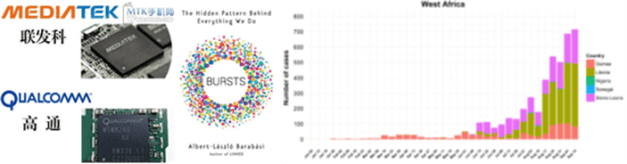
Bursts – the short flourishes of intensive activity preceded or followed by long periods of nothingness, stagnation, low growth – appear to be the hidden order that govern phenomena from the Ebola to 4G LTE (Long-Term Evolution), yielding deep insights into how value investors, entrepreneurs and governments can respond effectively to rapid, non-linear, complex changes happening around us.

Looking through this “bursty” lens can hopefully help value investors better understand the chip battle between Qualcomm (QCOM, MV $121.4bn) and MediaTek (2454 TT, MV $21.7bn) to identify the long-term “winner” and whether the request from the Bill & Melinda Gates Foundation to CSL Ltd (CSL AU, MV $31bn) to produce a hyper-immune plasma product collected from the plasma of people who have recovered from Ebola can be an effective antidote when transfused in patients. Since the first Ebola case occurred quietly in Guinea and West Africa in Dec 2013, the rate of spreading has multiplied exponentially from a few cases to more than 9,000 confirmed cases and over 4,000 deaths and the virus has jumped to urban centers in Dallas and Madrid this month, posing unprecedented dangers. The worst-case scenario from the US Centres for Disease Control foresees 1.4m cases in West Africa by late Jan 2015. While hospitals have “surge capacity” to open more beds and call upon more doctors in a time of need, using such resources is very expensive and as crisis hits, the robust-yet-fragile healthcare system can break down. Other bursts are also pressing ominously on us: bursts in accounting frauds from Chinese companies to Tesco; bursts in capex spending that led to oversupply in energy and commodities which led to recent declines; bursts in borrowings to be repaid by Asian corporates, property developers and REITs; potential bursts in bad debt and default of credit-binged Chinese firms; bursts in regulatory actions against foreign companies in China and so on.

image002

A conversation with our Institutional Subscriber Mr. W over Qualcomm and Mediatek had triggered the link to a thought-provoking book that we bought in Omaha in 2012 by Albert-László Barabási titled: Bursts: The Hidden Pattern Behind Everything We Do, The “power law” that governs many networked structures and human behavior resulted in bursty patterns. We attend to our health, for instance, in bursty patterns, overlooking symptoms until a health problem suddenly becomes too serious to ignore, producing a bursts of medical visits in a short time. Most emails are replied fast while several emails could wait for a long time before being handled. “Once you understand the origins of these bursts,” Barabási says, “it can really change your perspective on how you do things, and how you expect other people to respond.” Consider this example for IoT (Internet of Things) entrepreneurs and the Apple Watch. Japanese doctors discovered that they could predict the impending onset of depression by monitoring their physical movements with motion-sensitive watches. Since depressed people often report feeling physically sluggish, when there is a change in the patients’ normally bursty physical activity, it signalled the onset of a depressive incident.

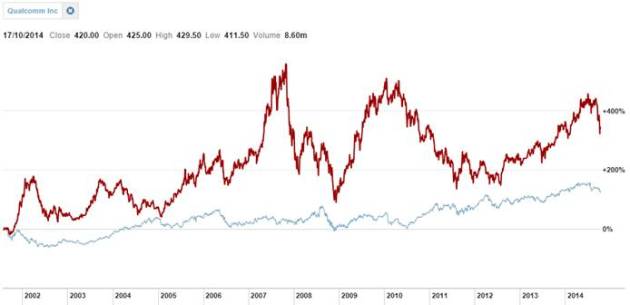
MediaTek (2454 TT) Vs Qualcomm (QCOM) Stock Price Performance, 2001-2014

image003

Back to Qualcomm on its bursts of crisis in China – and how its own bursty deep intangible knowledge in LTE helps it to stay resilient…

<Article snipped>

Having met with Qualcomm’s Dr. Irwin Jacobs when he was in SMU in Jan (Any Benjamin Franklins in Asia? Part 2), we think that the complexity of the LTE technology is underestimated by the industry given the bursty nature in how we use our smartphones and data in diverse types of environment and heterogeneous networks for seamless mobile connectivity. This deep intangible knowhow embedded in their LTE/4G baseband SoC chipset solution to have more capacity for bursty usage and connect to telecom carriers and different spectrum is unique and not easily replicable in terms of high-performance by MediaTek and is beyond the hardware and turnkey-solution wide-moat that Mediatek is good in. As Qualcomm’s SVP Bill Davidson commented, “It’s not about how many cores; it’s how you use them. We can do things more efficiently with fewer cores.” The “power law” that governs Qualcomm in building up its micro-architecture and intangible knowledge in advanced LTE should continue to help it widen its wide-moat advantage and leadership…

<Article snipped>

Thus, value investors should ask:

·        Does the business model…

<Article snipped>

Bursts, the deep structure of empirical reality, enable value investors to better understand the process that governs complex wide-moat networks and to understand the processes that cover human activity patterns, which hopefully can help value investors to have a fresh perspective on nonlinear growth and sustained value creation.

Warm regards,

KB

Managing Editor

The Moat Report Asia

www.moatreport.com

SMU: http://accountancy.smu.edu.sg/faculty/profile/108141/Kee%20Koon%20Boon

To read the exclusive article in full to find out more about the story of Qualcomm Vs MediaTek and some of questions that value investors should ask and look for in companies to navigate a “bursty” world, please visit:

·        Value Investing in a “Bursty” World, Oct 20, 2014 (Moat Report Asia, BeyondProxy)

Morning Bamboo Insight: 14 Oct 2014

Morning Bamboo Insight: 14 Oct 2014

Macro

  1. (Macro) – U.S. regulators press banks for more on auto loan exposure to assess risks

http://www.reuters.com/article/2014/10/12/us-autos-lending-regulators-idUSKCN0I10T320141012

  1. Deutsche clampdown on bad behaviour prompts exodus of traders –FT

http://uk.reuters.com/article/2014/10/12/deutsche-bank-regulator-idUKL2N0S70X920141012

Asia Pacific

  1. (Spore) – Bears Crowd to Sembcorp Marine After Stock’s 18% Drop in Value

http://www.bloomberg.com/news/print/2014-10-12/bears-crowd-to-sembcorp-after-stock-s-18-drop-in-value.html

  1. (Isia) – Indonesia needs new growth model to boost GDP

http://news.asiaone.com/print/news/asia/indonesia-needs-new-growth-model-boost-gdp

  1. (China) – U.S. ETFs to take aim at China’s onshore bond market

http://www.reuters.com/article/2014/10/12/us-china-bond-etfs-analysis-idUSKCN0I10F320141012

  1. (India) – Modi seeks to revive India’s ‘zombie factories’, not abandon them

http://uk.reuters.com/article/2014/10/12/uk-india-industry-zombies-idUKKCN0I10X920141012

  1. (Korea) – Pardoning tycoons for economic growth; Parole’s not special treatment; Stimulus will be of no use if it fails to move companies and consumers to spend.

http://koreajoongangdaily.joins.com/news/article/article.aspx?aid=2995917&cloc=joongangdaily|home|newslist2

  1. (Taiwan) – A campaign to boycott Ting Hsin (頂新集團)food products picked up momentum yesterday as food conglomerate tycoon Wei Ying-chung (魏應充) made his first public appearance since the latest tainted oil scandal erupted to apologize to the nation

http://www.chinapost.com.tw/print/419237.htm

Life

  1. Remembering the impact Lee Kuan Yew’s speeches made

http://news.asiaone.com/print/news/singapore/remembering-impact-lee-kuan-yews-speeches-made

  1. The Science of Conquering Your Greatest Fears; It may be the oldest emotion. Before happiness, before sorrow, before exhilaration, and way, way before the urge to climb mountains and bomb down steeps, there was fear

http://www.outsideonline.com/outdoor-adventure/science/The-Science-of-Conquering-Your-Greatest-Fears.html

  1. A Dozen Things I’ve Learned From Jeffrey Gundlach About Investing

http://25iq.com/2014/10/04/a-dozen-things-ive-learned-from-jeffrey-gundlach-about-investing/

  1. ‘Grit’ might be more important than IQ. Now schools need to learn to teach it.

http://www.vox.com/2014/10/9/6835197/grit-kipp-noncognitive-skills-duckworth-teaching

  1. One Great Idea From Jean Tirole, the Nobel Economist

http://www.businessweek.com/printer/articles/230302-one-great-idea-from-jean-tirole-the-nobel-economist

  1. Startup God Paul Graham Reveals The Single Most Important Quality To Look For In Company: Authenticity

http://www.businessinsider.sg/paul-graham-startups-bloomberg-2014-10/#.VDwEj_mSyCk

TMT

  1. How Hewlett-Packard lost its way

http://fortune.com/2012/05/08/how-hewlett-packard-lost-its-way/

  1. Why Programmatic Is Killing Creativity In Advertising

http://www.businessinsider.sg/programmatic-advertising-and-creativity-2014-10/#.VDwDV_mSyCk

  1. (Korea/Tech) – Maker of Korean Chat App to Ignore Legal Demands for Users’ Messages; Daum Kakao Has Stopped Honoring Warrants From Government Prosecutors in Bid to Keep KakaoTalk Users

http://online.wsj.com/articles/maker-of-korean-chat-app-to-ignore-legal-demands-for-users-messages-1413202926

  1. Competitive Pressures Loom over TSMC; As Mobile Devices Become Smaller, Race is On to Pack More Computing Capability into Each Chip.

http://online.wsj.com/articles/competitive-pressures-loom-over-tsmc-1413191871

  1. (Korea/Tech) – Tax-evading blog shopping malls mushrooming

http://news.mk.co.kr/english/newsRead.php?sc=30800003&cm=Economy&year=2014&no=1307749&selFlag=sc&relatedcode=&wonNo=&sID=308

Investing Process

  1. Vltava Fund’s Q3 2014 Letter to Investors

http://www.valuewalk.com/2014/10/vltava-funds-letter-investors

  1. How to Read an Annual Report

http://janav.wordpress.com/2014/10/03/how-to-read-an-annual-report/

  1. The Family Business Map: Framework, Selective Survey, and Evidence from Chinese Family Firm Succession

http://papers.ssrn.com/sol3/papers.cfm?abstract_id=2501364

  1. The New Lyrics of the Old Folks: The Role of Family Ownership in Corporate Innovation

http://papers.ssrn.com/sol3/papers.cfm?abstract_id=2487083


Buffett’s Van Tuyl Auto Dealership: Starfish Vs Spider and Any Wide-Moat Asian Starfish?

image001

“Bamboo Innovators bend, not break, even in the most terrifying storm that would snap the mighty resisting oak tree. It survives, therefore it conquers.”

BAMBOO LETTER UPDATE | October 6, 2014
Bamboo Innovator Insight (Issue 53)

  • The weekly insight is a teaser into the opportunities – and pitfalls! – in the Asian capital jungles.
  • Get The Moat Report Asia– a monthly in-depth presentation report of around 30-40 pages covering the business model of the company, why it has a wide moat and why the moat may continue to widen, a special section on “Inside the Leader’s Mind” to understand their thinking process in building up the business, the context – why now (certain corporate or industry events or groundbreaking news), valuations (why it can compound 2-3x in the next 5 years), potential risks and how it is part of the systematic process in the Bamboo Innovator Index of 200+ companies out of 15,000+ in the Asia ex-Japan universe.
  • Our paid Members from North America, Europe, the Oceania and Asia include professional value investors with over $20 billion in asset under management in equities, some of the world’s biggest secretive global hedge fund giants, and savvy private individual investors who are lifelong learners in the art of value investing.
 

Buffett’s Van Tuyl Auto Dealership: Starfish Vs Spider and Any Wide-Moat Asian Starfish?

image012

“Well, Larry Van Tuyl talked to me six or seven years ago. I understand the business and I think that it is a decent business overall and I think the way Larry runs it is extraordinary. He has these partners in 78 dealerships and so he works on a partner basis. He’s got a terrific record over the years, and you know, it is something that we will own for 100 years. It really fits Berkshire – it’s the kind of business we can expand a lot because there are 17,000 dealers in the country and we are buying 78 of them through this means. So we will get a lot of opportunity to expand the business. This will be a big business for Berkshire. The Van Tuyl Group fits perfectly into Berkshire Hathaway from both a financial and cultural viewpoint. Larry Van Tuyl along with his father, Cecil, spent decades building outstanding dealerships operated by local partners. The Van Tuyl Group enjoys excellent relations with the major auto manufacturers and delivers unusually high volumes at its 78 locations.

– Warren Buffett commenting on Berkshire Hathaway’s acquisition of Van Tuyl Group, the fifth largest auto dealership firm in the U.S. with $8 billion in sales, at an undisclosed price estimated at around $3 billion


“One thing that business, institutions, governments and key individuals will have to realize is spiders and starfish may look alike, but starfish have a miraculous quality to them. Cut off the leg of a spider,  you have a seven-legged creature on your hands; cut off its head and you have a dead spider. But cut off the arm of a starfish and it will grow a new one. Not only that, but the severed arm can grow an entirely new body. Starfish can achieve this feat because, unlike spiders, they are decentralized; every major organ is replicated across each arm.”

– Rod Beckstrom and Ori Brafman in their 2008 book “The Starfish and the Spider: The Unstoppable Power of Leaderless Organizations


Starfish and Spiders seem to have crawled over the phenomena from Hong Kong’s “leaderless” protests to Buffett’s purchase of Van Tuyl’s network of 78 auto dealers, most of them located in the Southwest and Midwest.


Using the metaphor of “Spider” to depict traditional, top-down organizations and the “Starfish” to represent groups that lack structure, leadership and formal organizations, authors Rod Beckstrom and Ori Brafman in their book “The Starfish and the Spider: The Unstoppable Power of Leaderless Organizations” presented a thought-provoking view on how “Spider” organizations are increasingly being challenged and defeated by the “starfish”. Decentralized organizations exploiting strong networks are creating a wide-moat competitive advantage over conventional, centralized operations and they are incredibly resilient. Power and knowledge is disseminated across the “starfish” organization, and individual units can respond quickly to the increasingly complex internal and external forces of today.


Van Tuyl has a unique operating structure in which general managers of the individual dealerships typically retain a stake in their local business. The Van Tuyls commented: “I believe in people, people, people. There is no substitute for good people who really care and do a good job. We cut all of our people in on ownership because we believe that’s the way to go. We’re waiting to get more guys ready for general manager and partner. If they’re part owner, they’re going to look after business a little bit better.” Thus, the starfish organizations like Van Tuyl recognize that in today’s fast-changing and competitive environment, it’s the folks on the ground who have the best real-time information on how the battle is shaping up. They build an environment that respects their opinion, which seeks to make sure they understand the mission, and simultaneously empowers them to take the fight to the enemy in a way that optimizes their chances of success in whatever conditions they might find themselves.


Because each of Van Tuyl’s 78 dealerships is itself a partnership, a separate legal entity, like a starfish, the details of Berkshire’s acquisition took many months. Buffett added: “I like the Van Tuyl people enormously. But if I had had to deal with the contract’s complications, I probably wouldn’t have lasted it out.” The accounting for partnerships and joint ventures is also complicated by the IFRS 11 Joint Arrangements accounting standard. Under the US GAAP, JVs are accounted for using the equity method. Before IFRS 11, JVs may be accounted for under either the equity method or proportional consolidation but now IASB requires the use of equity method to bring about comparability of financial statements on a global basis.


<Article snipped>


“It’s easy to mistake starfish organizations for spiders,” the authors warn. Both have the appearance of multiple “legs” or divisions/units. So what are the distinctive characteristics of these “starfish”? There are five legs to a decentralized organization that can help it take off: (1) circles, (2) the catalyst, (3) the pre-existing network, (4) an ideology, and (5) a champion. Circles are essentially independent, autonomous groups that function on the basis of some implicit norms. The catalyst is the person who initiates a circle and then cedes control to its members, developing the idea, sharing it with others, and leading by example. Ideology is the glue that holds people together within such circles. Without access to the culture of trust prevalent in a pre-existing network, it is almost quixotic to attempt to build a decentralized organization. There is a champion who promotes the idea relentlessly. Instead of command and control through rational, powerful, directive instruments to organize and bring about order, the catalyst is a peer connecting people, who show: a genuine interest in others, a desire to help, a tolerance for ambiguity, and the ability to map new connections, to meet people where they are, to inspire others, to let go.


So is the starfish really undefeatable? The starfish can disintegrate quickly once the indestructible intangible ideology or trust is weakening. For instance, if the HK student protesters start to be aware that their actions have caused tremendous distress to the livelihoods and rights of the ordinary citizens that they are fighting for, confusion strikes the starfish about the legitimacy of its ideology and the terrifying strength starts to fade away. Similarly, the introduction of wealth and tangible rules and rights into the starfish may disperse the power of the starfish. The U.S. government finally bested the Apaches, for instance, when it provided its leaders with cattle, a form of wealth that reshaped the amorphous, nomadic tribes into easily manageable hierarchies. As the authors put it, “The moment you introduce property rights into the equation [be they intellectual, physical, or otherwise], everything changes: The starfish organization turns into a spider.”


Having got a clearer understanding about starfish organizations, are there any Asian starfish? From our Bamboo Innovator Index of 200+ companies, we think … have qualities of the starfish just like Van Tuyl, Jim Pattinson Auto and O’Reilly Automotive.


Asian Wide-Moat Starfish #1 and #2 – Stock Price Performance

 image013image014

<Article snipped>

********

“When you give people freedom, you get chaos, but you also get incredible creativity”. Starfish organizations are incredibly resilient and powerful because they work on the fundamental premise that their employees and business partners are good, can be trusted and wish to contribute. However, the powerful forces of the starfish can be abused like in the case of the “leaderless” terrorist networks al-Qaeda and ISIS. German philosopher Friedrich Nietzsche said, “One must still have chaos in oneself to be able to give birth to a dancing star.” To this, we add, “One must cultivate ‘emptiness’ as a Bamboo Innovator to be able to give birth to a resilient and positive dancing Starfish.”


Warm regards,

KB

Managing Editor

The Moat Report Asia

www.moatreport.com

SMU: http://accountancy.smu.edu.sg/faculty/profile/108141/Kee%20Koon%20Boon


To read the exclusive article in full to find out more about the story of the wide-moat starfish business model and companies in Asia, please visit:


  • Buffett’s Van Tuyl Auto Dealership: Starfish Vs Spider and Any Asian Starfish? Oct 6, 2014 (Moat Report Asia, BeyondProxy)
The Moat Report Asia
 

“In business, I look for economic castles protected by unbreachable ‘moats’.”

– Warren Buffett


The Moat Report Asia is a research service focused exclusively on competitively advantaged, attractively priced public companies in Asia. Together with our European partners BeyondProxy and The Manual of Ideas, the idea-oriented acclaimed monthly research publication for institutional and private investors, we scour Asia to produce The Moat Report Asia, a monthly in-depth presentation report highlighting an undervalued wide-moat business in Asia with an innovative and resilient business model to compound value in uncertain times. Our Members from North America, the Nordic, Europe, the Oceania and Asia include professional value investors with over $20 billion in asset under management in equities, secretive global hedge fund giants, and savvy private individual investors who are lifelong learners in the art of value investing.


Learn more about membership benefits here: http://www.moatreport.com/subscription/


  • Individual subscription at $1,994 per year:

https://www.moatreport.com/individual-subscription/?s2-ssl=yes


The Moat Report Asia Members’ Forum has been getting penetrating quality dialogues from our subscribers.Questions range from:


  • The nuances of internal dealings in Asia, including the case discussion of the recent deal in which HK billionaire’s Lee Shau-kee Henderson Landacquiring Towngas or Hong Kong & China Gas (3 HK) from his family holdings, seemingly déjà vu from the early Oct 2007 transaction when the market peak.
  • The case of F&N Singaporespinning out its property unit FCL Trust and getting “free” special dividend-in-specie and the potential risk in asset swap restructuring to deleverage the hidden debt in the entire Group balance sheet.
  • The dilemma of whether to invest in a Southeast Asian-listed company and hidden champion with a domestic market share of 60% due to family squabbles and a legal suit over the company’s ownership.
  • Discussion of the wise and thoughtful 107-year-old Irving Kahn’s investment into a US-listed but Hong Kong-based electronics company with development property project in Shenzhen’s Qianhai zone and the possible corporate governance risks that could be underestimated or overlooked, as well as their history of listing some assets in HK in 2004.. This is also a case study of “buy one get one free” in John’s highly-acclaimed book The Manual of Ideasin which the “free” property is lumped together with the (eroding) core business to make the combined entity look cheap and undervalued. What are the potential areas that value investors need to watch out for when adapting the SOTP (sum-of-the-parts) valuation method in Asia?
  • And many more intriguing questions.


Do find out more in how you can benefit from authentic and candid on-the-ground insights that sell-side analysts and brokers, with their inherent conflict-of-interests, inevitable focus on conventional stock coverage and different clientele priorities, are unwilling or unable to share. Think of this as pressing the Bloomberg “Help Help” button to navigate the Asian capital jungle. Institutional subscribers also get access to the Bamboo Innovator Index of 200+ companies and Watchlist of 500+ companies in Asia and the Database has eliminated companies with a higher probability of accounting frauds and  misgovernance as well as the alluring value traps.


Professional Development Workshops for Executives and Lifelong Learners
Our 8th run of the series of workshop From the Fund Management Jungles: Value Investing Exposed and Explored – (Part 1) Moat Analysis, (Part 2) Tipping Point Analysis and (Part 3) Detecting Accounting Fraud – on 14 June 2014 has been well-received with serious value investors, professionals, and serious lifelong learners attending, with some who flew in from Jakarta and KL!..


Our 9th workshop will be sometime later in the year.


Thank you for your support all this while!


Thank you so much for reading as always.


Warm regards,

KB Kee

Managing Editor

The Moat Report Asia

Singapore

Mobile: +65 9695 1860


A Service of BeyondProxy LLC

1608 S. Ashland Avenue #27878

Chicago, Illinois 60608-2013

Other offices: London, Singapore, Zurich


P.S.1 Here is a little more about my background:

KB Kee has been rooted in the principles of value investing for over a decade as an analyst in Asian capital markets. He was head of research and fund manager at a Singapore-based value investment firm. As a member of the investment committee, he helped the firm’s Asia-focused equity funds significantly outperform the benchmark index. He was previously the portfolio manager for Asia-Pacific equities at Korea’s largest mutual fund company.


He holds a Masters in Finance and degrees in Accountancy and Business Management, summa cum laude, from Singapore Management University (SMU) and had also published articles on governance and investing in the media, as well as published an empirical research paper Why ‘Democracy’ and ‘Drifter’ Firms Can Have Abnormal Returns: The Joint Importance of Corporate Governance and Abnormal Accruals in Separating Winners from Losers in the Special Issue of Istanbul Stock Exchange 25th Year Anniversary Best Paper Competition,Boğaziçi JournalReview of Social, Economic and Administrative Studies, Vol. 25(1): 3-55. KB has also presented his thought leadership as a keynote speaker in global investing conferences. KB has trained CEOs, entrepreneurs, CFOs, management executives in business strategy, value investing, macroeconomic, industry trends, and detecting accounting frauds in Singapore, HK and China, and had taught accounting at the SMU where he is currently an adjunct lecturer.


P.S.2  Why do I care so much about doing The Moat Report Asia for you?

My personal motivation in embarking on this lifelong journey has been driven by disappointment from observing up close and personal the hard-earned assets of many investors, including friends and their families, burnt badly by the popular mantra: “Ride the Asian Growth Story!” I witnessed firsthand the emotional upheavals that they go through when they invest their hard-earned money – and their family’s – in these “Ride The Asian Growth Story” stocks either by themselves or through money managers, and these stocks turned out to be the subject of some exciting “theme” but which are inherently sick and prey to economic vicissitudes. They may seem to grow faster initially but the sustainable harvest of their returns is far too uncertain to be the focus of a wise program in investment. Worse still, the companies turned out to be involved in accounting frauds. Their financial numbers were “propped up” artificially to lure in funds from investors and the studiously-assessed asset value has already been “tunnelled out” or expropriated. And western-based fraud detection tools and techniques have not been adapted to the Asian context to avoid these traps.


After a decade-plus journey in the Asian capital jungles, it has been somewhat disheartening as I observe many fraud perpetrators go away scot-free and live a life of super luxury on minority investors’ hard-earned money. And these perpetrators make tempting offers to various parties in the financial community to go along with their schemes. When investors have knowledge in their hands, we have a choice to stay away from these people and away from temptations and do the things that we think are right. With knowledge, we have a choice to invest in the hardworking Asian entrepreneurs and capital allocators who are serious in building a wide-moat business.


CONNECT WITH US
MOAT REPORT ASIA    OUR TEAM    SUBSCRIBE    MEMBERS    CONTACT US

The Moat Report Asia
A Service of BeyondProxy LLC
1608 S. Ashland Avenue #27878
Chicago, Illinois 60608-2013

Other offices: London, Singapore, Zurich


Morning Bamboo Insight: 6 Oct 2014

Morning Bamboo Insight: 6 Oct 2014

Macro

  1. Agricultural land: Farmland prices are outperforming prime London property

http://www.economist.com/news/britain/21621884-farmland-prices-are-outperforming-prime-london-property-raking-it

  1. The world’s biggest container ships, longer than the Eiffel Tower is high, are a symbol of an increasingly global marketplace. But they also face strong economic headwinds

http://www.nytimes.com/2014/10/05/business/international/aboard-a-cargo-colossus-maersks-new-container-ships.html?ref=business&_r=0

  1. Investors Are Sick of Convertible Notes

http://pointsandfigures.com/2014/10/01/investors-are-sick-of-convertible-notes/

  1. “You buy emerging markets because per capita GDP is half in Indonesia what it is in Thailand, and half in the Philippines what it is in Indonesia, and half in Cambodia what it is in the Philippines. It remains a long-tail story.”

http://online.barrons.com/news/articles/SB51517841841143733463604580184331222965518

  1. The incredible shrinking dividend payout

http://online.wsj.com/articles/not-your-fathers-dividend-stocks-1412345258

Asia Pacific

  1. (HK/China) – Stark choices face Beijing over any PLA on Hong Kong streets

http://uk.reuters.com/article/2014/10/05/uk-hongkong-china-pla-insight-idUKKCN0HU02C20141005

  1. (HK) – Tremors from Hong Kong: Are protests over China’s broken promise doomed to end in violence?

http://business.financialpost.com/2014/10/04/tremors-from-hong-kong-are-protests-over-chinas-broken-promise-doomed-to-end-in-violence/

  1. (China) – China’s Inscrutable Contraction

http://www.project-syndicate.org/print/questioning-chinese-economic-climate-by-kenneth-rogoff-2014-10

  1. (Isia) – Blue Bird IPO Could Be One of Indonesia’s Largest Ever

http://thejakartaglobe.beritasatu.com/business/blue-bird-ipo-one-indonesias-largest-ever/

  1. (Isia) – Red-and-White Coalition Gives Jokowi the Blues as Prabowo Rides Over President-Elect

http://thejakartaglobe.beritasatu.com/news/red-white-coalition-gives-jokowi-blues-prabowo-rides-president-elect/

  1. (Isia) – With limited space available and skyrocketing land prices in Jakarta, theme park operators have started looking to areas outside the capital city to expand their amusement center businesses

http://www.thejakartapost.com/news/2014/10/03/theme-park-businesses-expand-regions.html

  1. (Isia) – Indonesian conglomerates need to scale down to stay relevant in business

http://www.thejakartapost.com/news/2014/10/04/ri-conglomerates-need-scale-down-stay-relevant-business.html

Life

  1. Paul Graham: Before the Startup

http://paulgraham.com/before.html

  1. What Can the McLaren Racing Team Teach the Rest of Us?

http://www.businessweek.com/printer/articles/228594-what-can-the-mclaren-racing-team-teach-the-rest-of-us

  1. Maker’s Schedule, Manager’s Schedule, Investor’s Schedule

http://hunterwalk.com/2014/09/30/makers-schedule-managers-schedule-investors-schedule/

  1. VCs Are Not Your Friends

https://www.linkedin.com/today/post/article/20141001120038-95015-vcs-are-not-your-friends

  1. There is No Such Thing as a Great Team, Only Great Habits

http://www.thisisgoingtobebig.com/blog/2014/9/29/there-is-no-such-thing-as-a-great-team-only-great-habits.html

  1. Why It’s Important to Reinvent Yourself

https://www.linkedin.com/today/post/article/20140929234617-29478030-why-it-s-important-to-reinvent-yourself

  1. How American parenting is killing the American marriage

http://qz.com/273255/how-american-parenting-is-killing-the-american-marriage/

  1. The Self-Made Man: The story of America’s most pliable, pernicious, irrepressible myth

http://www.slate.com/articles/news_and_politics/history/2014/09/the_self_made_man_history_of_a_myth_from_ben_franklin_to_andrew_carnegie.html

  1. The Four New Breeds of Entrepreneurs? To run a successful start-up, figure out if you’re a diamond, a star, a transformer or a rocket ship

http://online.wsj.com/articles/the-four-new-breeds-of-entrepreneurs-1412282673

  1. Jane Goodall on Empathy and How to Reach Our Highest Human Potential

http://www.brainpickings.org/2014/09/30/jane-goodall-empathy/

  1. Too-ticky’s Guide to Life: Wisdom on Uncertainty, Presence, and Self-Reliance from Beloved Children’s Book Author Tove Jansson

http://www.brainpickings.org/2014/09/29/too-ticky-quotes-tove-jansson/

TMT

  1. (Korea/Tech) – Samsung Raises Its Venture-Capital Profile; South Korean Electronics Firm Pushes Into New Businesses, Acts More Quickly With Acquisitions

http://online.wsj.com/articles/samsung-raises-its-venture-capital-profile-1412373782

  1. Google Working on Large-Scale Video Displays: Google X Is Developing Screens That Can Connect Like Legos to Form a Big Seamless Image

http://online.wsj.com/articles/google-working-on-large-scale-display-technology-1412346897

Commodities

  1. JP Morgan sells commodity arm to Mercuria for $800 million instead of the original $3.5 billion

http://www.reuters.com/article/2014/10/03/us-mercuria-jpmorgan-idUSKCN0HS1JA20141003

Energy

  1. (Energy) – World on the brink of oil war as Opec bickers over price; Oil prices ended last week in freefall as the world’s largest group of producers from petro-states in the Middle East dithered over whether to cut output

http://www.telegraph.co.uk/finance/newsbysector/energy/oilandgas/11140156/World-on-the-brink-of-oil-war-as-Opec-bickers-over-price.html

Comeback Kid and Reinventing the Family Business

 image003

“Bamboo Innovators bend, not break, even in the most terrifying storm that would snap the mighty resisting oak tree. It survives, therefore it conquers.”

BAMBOO LETTER UPDATE | September 30, 2014
Bamboo Innovator Insight (Issue 52)

  • The weekly insight is a teaser into the opportunities – and pitfalls! – in the Asian capital jungles.
  • Get The Moat Report Asia– a monthly in-depth presentation report of around 30-40 pages covering the business model of the company, why it has a wide moat and why the moat may continue to widen, a special section on “Inside the Leader’s Mind” to understand their thinking process in building up the business, the context – why now (certain corporate or industry events or groundbreaking news), valuations (why it can compound 2-3x in the next 5 years), potential risks and how it is part of the systematic process in the Bamboo Innovator Index of 200+ companies out of 15,000+ in the Asia ex-Japan universe.
  • Our paid Members from North America, Europe, the Oceania and Asia include professional value investors with over $20 billion in asset under management in equities, some of the world’s biggest secretive global hedge fund giants, and savvy private individual investors who are lifelong learners in the art of value investing.
 

Can You Guess This Asian Wide-Moat Company? Comeback Kid and Reinventing the Family Business

Our latest monthly Moat Report Asia for October investigates an Asian-listed company who is the#1 healthy niche snack king in its domestic market with a market share of >73%. The company has spent over 30 years to build up an extensive wide-moat nationwide distribution network penetrating 200,000 Point-of-Sales (POS), including both modern trade (MT) (supermarkets,hypermarkets, convenience stores, gas stations, wholesales stores) and traditional trade (TT) (sundry stores, traditional shops). The company cultivates long-term customer relationships with its strong direct sales team of 200 professionals regularly visiting the stores with over 400 vehicles, comprising of trucks and the innovative mobile cash vans.


We observed that super compounders Ecolab (ECL, MV $34.8bn) and Keyence (6861 JP, MV $26.7bn) have a strong solutions-sales specialist team and we think this Asian company has accumulated deep know-how infused in its direct salesforce team over the years to sustain resilient growth. The company distributes 5 product categories: (1) Snacks eg the Japanese snack brand Calbee; (2) Confectionery, (3) F&B, (4) Medicine, pastille, nutrition food, (5) Personal care and household products. 75% of its sales are domestic while the rest are exported, mainly to Japan (20% of sales).


The company empowers its salesforce, particularly those traveling on mobile sales vans, with the utilization of modern technology in receiving orders, data verification, issuance of sales documents, delivery of goods. The company has created a sophisticated product storage and inventory management system and a delivery system that is flexible, convenient and fast. In terms of inventory management and working capital efficiency, the company performs far better with inventory period at 23 days (comparable peer 73 days) and cash conversion cycle (CCC) of 33 days (comparable peer 89 days). These long-term competitive advantages have translated to a superior ROE of 27.7% and sustainable cashflow generation.


Even when compared to Asian MNC giants Universal Robina Corp (URC PM, MV $9bn) and Calbee(2229 JP, MV $4.3bn) who have scale advantages in cost efficiency and pricing power, the company has surprisingly better fundamental performance in ROE and profitability and is trading at a huge relative valuation discount at its current EV/EBIT 10.7x and EV/EBITDA 10.4x. Net cash at 9% of market value is a healthy reserve that can be productively allocated to capitalize on future growth opportunities without straining the balance sheet. Its attractive 5.6% dividend yield, the highest in the industry, also limits short-term downside risks.

image009

Its unique low-fat high-protein healthy snack and wide-moat distribution network makes the company either an attractive takeover target or long-term strategic partner to the giant snack producers from URC to Mondelez and General Mills, thus providing long-term downside protection in its terminal value.


Organic food and healthy snack company Annie’s was acquired In Sep 2014 by General Mills for $820M at Price/Sales 4x (vs the company’s P/Sales 1.5x), following similar moves by General Mills, Kellogg, Campbell Soup, Hillshire Brands, Tyson Foods, JM Smucker, TreeHouse Goods, WhiteWave etc. The trend of forgoing meals in favor of healthy snacks is accelerating.


It is the flagship vehicle of a family business group whose storied history has been long forgotten following unusual succession challenges in the third generation. Led by the capable son-in-law to the daughter of the third-generation scion, the Group is the ‘comeback kid’ who has successfully resurrected from the 1997/98 Asian Financial Crisis and has listed 4 of its 6 major business assets to derisk the business group governance risk and instill a strong sense of accountability and transparency for long-term going-concern viability. As the flagship vehicle, this Asian listed company will be the most important vehicle in the Group to equitize the governance goodwill and long-term strategic partnerships seeking to leverage its wide-moat distribution network and global export potential. We are impressed by the company’s efforts over the years to develop its human capital in caring about their knowledge by providing them training opportunities and multiple opportunities to engage in company activities to foster sharing and commitment. This is rare in Asian firms and the company deserves credit and a long-term valuation premium.


Warm regards,

KB

Managing Editor

The Moat Report Asia

www.moatreport.com

SMU: http://accountancy.smu.edu.sg/faculty/profile/108141/Kee%20Koon%20Boon


The Moat Report Asia
 

“In business, I look for economic castles protected by unbreachable ‘moats’.”

– Warren Buffett


The Moat Report Asia is a research service focused exclusively on competitively advantaged, attractively priced public companies in Asia. Together with our European partners BeyondProxy andThe Manual of Ideas, the idea-oriented acclaimed monthly research publication for institutional and private investors, we scour Asia to produce The Moat Report Asia, a monthly in-depth presentation report highlighting an undervalued wide-moat business in Asia with an innovative and resilient business model to compound value in uncertain times. Our Members from North America, the Nordic, Europe, the Oceania and Asia include professional value investors with over $20 billion in asset under management in equities, secretive global hedge fund giants, and savvy private individual investors who are lifelong learners in the art of value investing.


Learn more about membership benefits here: http://www.moatreport.com/subscription/


  • Individual subscription at $1,994 per year:

https://www.moatreport.com/individual-subscription/?s2-ssl=yes


The Moat Report Asia Members’ Forum has been getting penetrating quality dialogues from our subscribers. Questions range from:


  • The nuances of internal dealings in Asia, including the case discussion of the recent deal in which HK billionaire’s Lee Shau-kee Henderson Landacquiring Towngas or Hong Kong & China Gas (3 HK) from his family holdings, seemingly déjà vu from the early Oct 2007 transaction when the market peak.
  • The case of F&N Singaporespinning out its property unit FCL Trust and getting “free” special dividend-in-specie and the potential risk in asset swap restructuring to deleverage the hidden debt in the entire Group balance sheet.
  • The dilemma of whether to invest in a Southeast Asian-listed company and hidden champion with a domestic market share of 60% due to family squabbles and a legal suit over the company’s ownership.
  • Discussion of the wise and thoughtful 107-year-old Irving Kahn’s investment into a US-listed but Hong Kong-based electronics company with development property project in Shenzhen’s Qianhai zone and the possible corporate governance risks that could be underestimated or overlooked, as well as their history of listing some assets in HK in 2004.. This is also a case study of “buy one get one free” in John’s highly-acclaimed book The Manual of Ideasin which the “free” property is lumped together with the (eroding) core business to make the combined entity look cheap and undervalued. What are the potential areas that value investors need to watch out for when adapting the SOTP (sum-of-the-parts) valuation method in Asia?
  • And many more intriguing questions.


Do find out more in how you can benefit from authentic and candid on-the-ground insights that sell-side analysts and brokers, with their inherent conflict-of-interests, inevitable focus on conventional stock coverage and different clientele priorities, are unwilling or unable to share. Think of this as pressing the Bloomberg “Help Help” button to navigate the Asian capital jungle. Institutional subscribers also get access to the Bamboo Innovator Index of 200+ companies and Watchlist of 500+ companies in Asia and the Database has eliminated companies with a higher probability of accounting frauds and  misgovernance as well as the alluring value traps.


Professional Development Workshops for Executives and Lifelong Learners
 

Our 8th run of the series of workshop From the Fund Management Jungles: Value Investing Exposed and Explored – (Part 1) Moat Analysis, (Part 2) Tipping Point Analysis and (Part 3) Detecting Accounting Fraud – on 14 June 2014 has been well-received with serious value investors, professionals, and serious lifelong learners attending, with some who flew in from Jakarta and KL!..


Our 9th workshop will be sometime later in the year.


Thank you for your support all this while!


Thank you so much for reading as always.


Warm regards,

KB Kee

Managing Editor

The Moat Report Asia

Singapore

Mobile: +65 9695 1860


A Service of BeyondProxy LLC

1608 S. Ashland Avenue #27878

Chicago, Illinois 60608-2013

Other offices: London, Singapore, Zurich


P.S.1 Here is a little more about my background:

KB Kee has been rooted in the principles of value investing for over a decade as an analyst in Asian capital markets. He was head of research and fund manager at a Singapore-based value investment firm. As a member of the investment committee, he helped the firm’s Asia-focused equity funds significantly outperform the benchmark index. He was previously the portfolio manager for Asia-Pacific equities at Korea’s largest mutual fund company.


He holds a Masters in Finance and degrees in Accountancy and Business Management, summa cum laude, from Singapore Management University (SMU) and had also published articles on governance and investing in the media, as well as published an empirical research paper Why ‘Democracy’ and ‘Drifter’ Firms Can Have Abnormal Returns: The Joint Importance of Corporate Governance and Abnormal Accruals in Separating Winners from Losers in the Special Issue of Istanbul Stock Exchange 25th Year Anniversary Best Paper Competition, Boğaziçi JournalReview of Social, Economic and Administrative Studies, Vol. 25(1): 3-55. KB has also presented his thought leadership as a keynote speaker in global investing conferences. KB has trained CEOs, entrepreneurs, CFOs, management executives in business strategy, value investing, macroeconomic, industry trends, and detecting accounting frauds in Singapore, HK and China, and had taught accounting at the SMU where he is currently an adjunct lecturer.


P.S.2  Why do I care so much about doing The Moat Report Asia for you?

My personal motivation in embarking on this lifelong journey has been driven by disappointment from observing up close and personal the hard-earned assets of many investors, including friends and their families, burnt badly by the popular mantra: “Ride the Asian Growth Story!” I witnessed firsthand the emotional upheavals that they go through when they invest their hard-earned money – and their family’s – in these “Ride The Asian Growth Story” stocks either by themselves or through money managers, and these stocks turned out to be the subject of some exciting “theme” but which are inherently sick and prey to economic vicissitudes. They may seem to grow faster initially but the sustainable harvest of their returns is far too uncertain to be the focus of a wise program in investment. Worse still, the companies turned out to be involved in accounting frauds. Their financial numbers were “propped up” artificially to lure in funds from investors and the studiously-assessed asset value has already been “tunnelled out” or expropriated. And western-based fraud detection tools and techniques have not been adapted to the Asian context to avoid these traps.


After a decade-plus journey in the Asian capital jungles, it has been somewhat disheartening as I observe many fraud perpetrators go away scot-free and live a life of super luxury on minority investors’ hard-earned money. And these perpetrators make tempting offers to various parties in the financial community to go along with their schemes. When investors have knowledge in their hands, we have a choice to stay away from these people and away from temptations and do the things that we think are right. With knowledge, we have a choice to invest in the hardworking Asian entrepreneurs and capital allocators who are serious in building a wide-moat business.


CONNECT WITH US
MOAT REPORT ASIA    OUR TEAM    SUBSCRIBE    MEMBERS    CONTACT US

The Moat Report Asia
A Service of BeyondProxy LLC
1608 S. Ashland Avenue #27878
Chicago, Illinois 60608-2013

Other offices: London, Singapore, Zurich


Morning Bamboo Insight: 4 Oct 2014

Morning Bamboo Insight: 4 Oct 2014

Macro

  1. Wealth without workers, workers without wealth: The digital revolution is bringing sweeping change to labour markets in both rich and poor worlds

http://www.economist.com/news/leaders/21621800-digital-revolution-bringing-sweeping-change-labour-markets-both-rich-and-poor

  1. Pimco: ‘Bonds are meant to be boring’; What Bill Gross’s exit means for the industry and the company he left behind

http://www.ft.com/intl/cms/s/0/2113c320-4a12-11e4-8de3-00144feab7de.html#axzz3F3bpNb7W

  1. Breaking research out of the lab: Canada doesn’t lack innovators, it lacks entrepreneurial innovators

http://business.financialpost.com/2014/10/01/breaking-research-out-of-the-lab-canada-doesnt-lack-innovators-it-lacks-entrepreneurs/?__lsa=216d-fbd3

  1. Auto Loans: A Subprime Market Grows in the Shadows

http://www.businessweek.com/printer/articles/228876-auto-loans-a-subprime-market-grows-in-the-shadows

  1. Market Manipulation Should Be a Crime

http://www.businessweek.com/printer/articles/228924-market-manipulation-should-be-a-crime

  1. Depression Denial Syndrome; The fall of Bill Gross at Pimco is an example of how decision-makers refuse to acknowledge that the rules are different in a persistently depressed economy

http://www.nytimes.com/2014/10/03/opinion/paul-krugman-depression-denial-syndrome.html?ref=opinion

  1. Co-chief executives run the risk of in-fighting and mutual over-reliance; As Oracle appoints two chief executives, Katherine Rushton asks whether corporate double acts can ever really work.

http://www.telegraph.co.uk/finance/newsbysector/mediatechnologyandtelecoms/digital-media/11136605/Co-chief-executives-run-the-risk-of-in-fighting-and-mutual-over-reliance.html

  1. Byron Wien: So Much to Worry About; The Wall Street pro’s concerns include valuations, housing, and a group scarier than ISIS.

http://online.barrons.com/news/articles/SB51517841841143733463604580190562922585580

Asia Pacific

  1. (HK/China) – Protests Dim Hong Kong’s Allure for Rich Chinese; Singapore May View Pro-Democracy Protests as an Opportunity to Grab Some Business

http://online.wsj.com/articles/protests-dim-hong-kongs-allure-for-rich-chinese-1412335181

  1. (China) – China Won’t Bail Out Local Governments; Beijing Will Impose Ceilings on Localities’ Borrowing

http://online.wsj.com/articles/china-wont-bail-out-local-governments-puts-cap-on-borrowing-1412333311?tesla=y&mg=reno64-wsj&url=http://online.wsj.com/article/SB12753519717962134038504580191702614415356.html

  1. (HK) – Hong Kong clashes break out away from Central protest site

http://www.reuters.com/article/2014/10/03/us-hongkong-china-idUSKCN0HN03Q20141003

  1. (Korea) – Korean private equity funds (PEF) taking over small family businesses unable to find successor

http://news.mk.co.kr/english/newsRead.php?sc=30800001&cm=Top%20Story&year=2014&no=1271857&selFlag=&relatedcode=&wonNo=&sID=308

  1. (Japan) – From free Wi-Fi to prayer rooms, Japan’s retailers are devising creative ways to encourage foreign tourists to spend.

http://www.japantimes.co.jp/news/2014/10/02/business/stores-see-profit-in-prayer-as-they-cater-to-foreign-tourists/

  1. (Korea) – Dozens of Korean corporate leaders will face questioning during the upcoming parliamentary audit of government agencies and public companies.

http://www.koreatimes.co.kr/www/news/biz/2014/10/123_165637.html

  1. (Isia) – Jokowi Urges Batik Resurgence to Boost Local Industry

http://thejakartaglobe.beritasatu.com/news/jokowi-urges-batik-resurgence-boost-local-industry/

  1. (Japan) – The weakening yen is starting to squeeze Japanese consumers as prices rise for everything from Burgundy wine to instant noodles, threatening Prime Minister Shinzo Abe’s plans to revive the country’s economy.

http://thejakartaglobe.beritasatu.com/business/burgundy-noodle-prices-rise-weaker-yen-hurts-consumers/

  1. (Isia) – In a House Far Removed From the People, Indonesia’s Oligarchic Forces Wage Battle

http://thejakartaglobe.beritasatu.com/opinion/house-far-removed-people-indonesias-oligarchic-forces-wage-battle/

  1. (India) – Honoring the Mahatma’s Legacy Through the Clean India Campaign

http://thejakartaglobe.beritasatu.com/opinion/honoring-mahatmas-legacy-clean-india-campaign/

  1. (Isia) – Insanity the Norm in Indonesian Politics

http://thejakartaglobe.beritasatu.com/opinion/editorial-insanity-norm-indonesian-politics/

  1. (Spore) – Singapore Sukuk Hub Goal Leaves a Lonely Sabana: Islamic Finance

http://www.bloomberg.com/news/print/2014-10-02/singapore-sukuk-hub-goal-leaves-a-lonely-sabana-islamic-finance.html

  1. (Isia) – Indonesian Conglomerates Warned not to Under-Invest Amid Competition

http://thejakartaglobe.beritasatu.com/business/indonesian-conglomerates-warned-invest-amid-competition/

Life

  1. Meeting deadlines: Deadlines in the future are more likely to be met if they are linked to the mind’s slippery notions of the present

http://www.economist.com/blogs/babbage/2014/10/meeting-deadlines

  1. Scientists check the engine of cheetahs, animal world’s ‘Ferrari’

http://www.reuters.com/article/2014/10/02/us-science-cheetah-idUSKCN0HR2DK20141002

  1. Billionaire Peter Thiel Explains Why He Would Tell His Younger Self To Be Less Competitive

http://www.businessinsider.sg/peter-thiel-on-success-2014-10/#.VC45xPmSyCk

  1. One CEO Uses Warren Buffett’s Strategy Of Looking For These 3 Traits In Every Job Candidate

http://www.businessinsider.sg/warren-buffett-hiring-strategy-2014-10/#.VC440_mSyCk

  1. (HK/China) – Hong Kong’s value to China goes beyond numbers

http://www.ft.com/intl/cms/s/0/acfff900-4a0b-11e4-8de3-00144feab7de.html#axzz3F3bpNb7W

  1. (China) – China’s central administration will impose hard caps on local government borrowing, its boldest move yet to control financial risks from an explosive rise in regional debt.

http://www.ft.com/intl/cms/s/0/a2fb9fec-4a18-11e4-8de3-00144feab7de.html#axzz3F3bpNb7W

  1. Yummia founder Mia McCarthy talks creating a category as her product hits Woolworths big time

http://www.brw.com.au/p/entrepreneurs/yummia_founder_woolworths_mccarthy_zr0bKlaoLOZcSQRJTVYE9L

  1. The Problem With Pragmatism: Our dominant political mind-set (pragmatism) tends dangerously toward rationalism uninformed by moral emotion

http://www.nytimes.com/2014/10/03/opinion/david-brooks-the-problem-with-pragmatism.html?ref=opinion

  1. The Evolution of Sleep: 700 Million Years of Melatonin

http://www.nytimes.com/2014/10/02/science/the-evolution-of-sleep-700-million-years-of-melatonin.html?ref=science

  1. Young, Brilliant and Underfunded; We’ll never know what breakthroughs were missed because young investigators were not provided with resource

http://www.nytimes.com/2014/10/03/opinion/young-brilliant-and-underfunded.html?ref=opinion&_r=0

  1. How Thomson Reuters Is Creating a Culture of Innovation

http://blogs.hbr.org/2014/10/how-thomson-reuters-is-creating-a-culture-of-innovation/

  1. The Most Engaging Ideas Leave Something Out

http://blogs.hbr.org/2014/10/the-most-engaging-ideas-leave-something-out/

  1. The Mysterious Popularity Of The Meaningless Myers-Briggs (MBTI)

http://www.forbes.com/sites/toddessig/2014/09/29/the-mysterious-popularity-of-the-meaningless-myers-briggs-mbti/

TMT

  1. Bill Gates: Apple Pay Is A ‘Fantastic’ Idea

http://www.businessinsider.sg/bill-gates-apple-pay-is-a-fantastic-idea-2014-10/#.VC43x_mSyCk

  1. Yahoo and eBay pressed to return to cores; With a return to their original cores, both groups might get a fresh chance to reinvent themselves

http://www.ft.com/intl/cms/s/0/fc45aa50-4a4c-11e4-bc07-00144feab7de.html#axzz3F3bpNb7W

  1. (India/Tech) – Can the Internet of Things transform India?

http://e27.co/can-the-internet-of-things-transform-india-20141002/

Investing Process

  1. Here’s Why Warren Buffett Is Buying Car Dealerships; Dealerships Do More Than Sell New Cars

http://www.businessinsider.sg/heres-why-warren-buffett-is-buying-car-dealerships-2014-10/#.VC430_mSyCk

Morning Bamboo Insight: 2 Oct 2014

Morning Bamboo Insight: 2 Oct 2014

Macro

  1. FASB is gaining support for its projects to streamline rules around disclosure of extraordinary items and inventory accounting

http://blogs.wsj.com/cfo/2014/09/30/fasb-accounting-simplification-projects-see-early-support/?mod=WSJ_hpp_sections_cfo

  1. Markets Diverging in Emerging World; India and Indonesia Have Been Recent Winners; Not So Brazil and Turkey

http://online.wsj.com/articles/markets-are-diverging-in-the-emerging-world-1412119148

Asia Pacific

  1. (Japan) – $617 Billion in Japan Stock Orders Scrapped After Error

http://www.bloomberg.com/news/print/2014-10-01/oops-possible-617-billion-trading-error-in-japan.html

  1. (Australia/China) – Australia frets as property blows hot at home, cold in China

http://thejakartaglobe.beritasatu.com/business/australia-frets-property-blows-hot-home-cold-china/

  1. (Isia) – KPK Launches Theme Park-Style Anti-Graft Mobile App

http://thejakartaglobe.beritasatu.com/news/kpk-launches-theme-park-style-anti-graft-mobile-app/

  1. (Spore) – Should SGX allow dual-class structures?

http://www.businesstimes.com.sg/premium/editorial-opinion/opinion/should-sgx-allow-dual-class-structures-20141001

  1. (Asia) – Rectify Asia’s ‘governance deficit’

http://www.businesstimes.com.sg/premium/editorial-opinion/editorial/rectify-asias-governance-deficit-20141001

  1. (Spore) – Herbal product in health scare is Eu Yan Sang’s best seller

http://www.businesstimes.com.sg/premium/companies/others/herbal-product-health-scare-eu-yan-sangs-best-seller-20141001

  1. (Thai/Asean) – Acquisition sprees ‘hits credit quality’ of large Thai corporations, according to S&P

http://www.nationmultimedia.com/business/Acquisition-sprees-hits-credit-quality-30244481.html

  1. (HK) – Hong Kong’s Status as Financial Hub Likely a Factor for Beijing; Heavy Crackdown on Protests Would Deepen Financial Firms’ Concerns About Autonomy

http://online.wsj.com/articles/hong-kongs-status-as-financial-hub-likely-a-factor-for-beijing-1412080251

  1. (HK) – Hong Kong Protests Have History of Success in Challenging Government

http://online.wsj.com/articles/hong-kong-protests-have-succeeded-in-other-challenges-against-government-1412081966

  1. (China) – Chinese Nets and Bolts Ensnare Basketball Hoops in Litigation; Should Lifetime Products’ Basketball Hoops Use ‘Made in USA’ Labels?

http://online.wsj.com/articles/chinese-nets-and-bolts-ensnare-basketball-hoops-in-litigation-1412099954

  1. (China) – A Chinese Investment on Fracking Fails to Deliver; How a Shanghai Real-Estate Mogul’s Bet in Canada’s Bakken Shale Went Sour

http://online.wsj.com/articles/a-chinese-investment-on-fracking-fails-to-deliver-1412118451?tesla=y&mg=reno64-wsj&url=http://online.wsj.com/article/SB12584803618636143833504580170103161794186.html

  1. (Isia) – Good news for planters, Indonesia drops foreign ownership clause in bill; New law requires plantation companies to allocate 20% of their concessions to people living in the nearby areas

http://www.thestar.com.my/Business/Business-News/2014/10/01/Good-news-for-planters-Indonesia-drops-foreign-ownership-clause-in-bill/?style=biz

  1. REDtone auditors give ‘qualified opinion’ on group’s financial statement due to “other receivables” in the financial statements

http://www.thestar.com.my/Business/Business-News/2014/10/01/REDtone-auditors-give-qualified-opinion/?style=biz

  1. (Macau) – Macau Publishes The Worst Numbers Since The Global Financial Meltdown

3-2014-9/#.VCrYFvmSyCk

Life

  1. Warren Buffett’s Best Productivity Hack Is A Simple 2-List System; Even though everybody wants a piece of his time, Warren Buffett stays focused. Here’s his approach

http://www.businessinsider.sg/warren-buffett-productivity-trick-2014-9/#.VCvOzfmSyCk

  1. PayPal’s New CEO Once Spent 24 Hours Living On The Streets Of NYC As A Homeless Person

http://www.businessinsider.sg/dan-schulman-new-paypal-ceo-spent-24-hours-on-streets-of-nyc-2014-9/#.VCrZ-_mSyCk

  1. Victoria’s Other Secret: The Low-Key Billionaire Behind The Lingerie Giant

http://www.forbes.com/sites/danalexander/2014/09/30/victorias-other-secret-the-low-key-billionaire-behind-the-lingerie-giant/print/

TMT

  1. (Isia/Tech) – Japanese Venture Capital Firm Funds Indonesian Startup Developing a News App; Kurio searches the Internet and filters millions of articles every day to find content that meets a user’s interest.

http://thejakartaglobe.beritasatu.com/business/japanese-venture-capital-firm-funds-indonesian-startup-developing-news-app/

  1. Wall Street’s Chat Plan Turns to Perzo Chief; David Gurle, CEO of an Instant-Messaging Company That Is Near a Deal to Be Acquired, Is No Stranger on Wall Street

http://online.wsj.com/articles/wall-streets-chat-plan-turns-to-perzo-chief-1412092673?mod=WSJ_hpp_sections_management

  1. More Cable Companies Take TV Off Menu; Customers Care More About Broadband, They Say, and Programming Has Gotten Too Expensive

http://online.wsj.com/articles/more-cable-companies-take-tv-off-menu-1412120310

  1. (Tech/Media) – Netflix Pushes Into Movies With First Original Film; ‘Crouching Tiger’ Sequel to Premiere Same Day in August 2015 on Netflix and in Some IMAX Theaters

http://online.wsj.com/articles/netflix-pushes-into-movie-making-with-first-original-film-1412081193

  1. Analytical Value From Data That Cries Wolf

http://sloanreview.mit.edu/article/analytical-value-from-data-that-cries-wolf/

  1. Apps re-invent smartphone keyboards to reduce typing frustration

http://www.reuters.com/article/2014/09/30/us-apps-keyboards-idUSKCN0HP1NO20140930

  1. The Ten Startup Nation Movers and Shakers You Need To Know

http://www.forbes.com/sites/ilyapozin/2014/09/26/the-ten-startup-nation-movers-shakers-you-need-to-know/print/

Consumer

  1. (Consumer) – New Balance Acknowledges Shoe Materials Aren’t All U.S. Made; Only About 70% of Their Value Reflects Domestic Content and Labor

http://online.wsj.com/articles/new-balance-shoe-materials-arent-all-u-s-made-1412109111

  1. Global health and wellness sales to hit US$774bil in 2014

http://www.thestar.com.my/Business/Business-News/2014/09/30/Global-health-and-wellness-sales-to-hit-US$774bil-in-2014/?style=biz

Healthcare

  1. Medical Mergers Are Driving Up Health Costs; Insurer health-care payments are up 3%-a fortune, given the $900 billion spent annually.

http://online.wsj.com/articles/suzanne-f-delbanco-medical-mergers-are-driving-up-health-costs-1412119178

  1. Doctors Net Billions From Drug Firms, financial ties that some critics say have compromised medical care

http://online.wsj.com/articles/u-s-agency-reveals-drug-makers-payments-to-doctors-1412100323

Investing Process

  1. FASB Revisits the Cash-Flow Statement

http://ww2.cfo.com/cash-flow/2014/09/fasb-revisits-cash-flow-statement/

Energy

  1. Oil trading mired in crude oversupply

http://www.businesstimes.com.sg/premium/top-stories/oil-trading-mired-crude-oversupply-20141001

Morning Bamboo Insight: 30 Sep 2014

Morning Bamboo Insight: 30 Sep 2014

Macro

  1. Economics needs to reflect a post-crisis world; The dismal science should be grounded in reality to stay relevant

http://www.ft.com/intl/cms/s/0/f9f65e88-44a3-11e4-ab0c-00144feabdc0.html#axzz3EUQLj0VS

  1. Investor groups urge nominee rethink

http://www.ft.com/intl/cms/s/0/3c6e8e3a-43db-11e4-baa7-00144feabdc0.html#axzz3EUQLj0VS

  1. Modern realities are increasing the discomfort of the comfortably off; The last time similarly privileged people felt such fear was a century ago

http://www.ft.com/intl/cms/s/0/74726658-4403-11e4-baa7-00144feabdc0.html#axzz3EUQLj0VS

  1. Testing times loom for emerging markets; Not all developing economies are ready for higher interest rates

http://www.ft.com/intl/cms/s/0/31cdf0be-4571-11e4-ab86-00144feabdc0.html#axzz3EUQLj0VS

Asia Pacific

  1. Analysis: Chinese Central Banker’s Departure Wouldn’t Necessarily Signal Policy Shift

http://blogs.wsj.com/economics/2014/09/24/analysis-chinese-central-bankers-departure-wouldnt-necessarily-signal-policy-shift/

  1. (China) – ETFs related to China’s A shares become hot targets

http://www.chinapost.com.tw/print/418210.htm

  1. (China) – From Zong Qinghou to Jack Ma, Zhejiang excels at the hard sell

http://www.wantchinatimes.com/news-subclass-cnt.aspx?id=20140927000074&cid=1102

  1. (Philippines) – Universal expects one-year delay in launch of $2 bln Manila casino-resort

http://www.reuters.com/article/2014/09/26/philippines-universal-ent-casino-idUSL3N0RR17Z20140926

  1. (Spore) – S’pore property outlook challenging until 2020: report

http://www.propertyguru.com.sg/property-management-news/2014/9/65493/s-pore-property-outlook-challenging-until-2020-rep

  1. (Spore) – Luck running out for Singapore’s two casinos?

http://news.asiaone.com/print/news/singapore/luck-running-out-singapores-two-casinos

  1. (Isia) – After nearly 12 years of uncertainty, the process of unification of state estate enterprises under one holding company has made a big step forward in Indonesia

http://www.thejakartapost.com/news/2014/09/27/other-opinions-the-long-awaited-restructuring.html

  1. (Msia) – Food trucks start to gain traction in the Klang Valley

http://www.thestar.com.my/Business/SME/2014/09/26/My-restaurant-has-a-handbrake-Food-trucks-start-to-gain-traction-in-the-Klang-Valley/?style=biz

  1. (China/HK) – China, Hong Kong Reveal New Rules on Stock Market Link; Stock Connect Program Will Allow Chinese Investors to Buy Hong Kong-Listed Stocks For First Time

http://online.wsj.com/articles/china-hong-kong-reveal-new-rules-on-stock-market-link-1411807815

  1. (Korea) – Jeju aims for high-tech future

http://business.asiaone.com/print/news/jeju-aims-high-tech-future

  1. Msia/Spore) – Iskandar launches hit by delays; Launches by Singapore property players in the Iskandar Malaysia development zone appear to have stalled amid a subdued market.

http://business.asiaone.com/print/news/iskandar-launches-hit-delays


Life

  1. Minority languages: Cookies, caches and cows; Translating technological terms throws up some peculiar challenges

http://www.economist.com/news/international/21620221-translating-technological-terms-throws-up-some-peculiar-challenges-cookies-caches-and-cows

  1. 7 Simple Ways To Expand Your Thinking And Find Original Ideas

http://www.businessinsider.sg/how-to-broaden-your-thinking-find-ideas-2014-9/#.VCZQ0_mSyCk

  1. Here’s What Google Teaches Employees In Its Course On Unconscious Bias

http://www.businessinsider.sg/google-course-on-unconscious-bias-2014-9/#.VCZP1fmSyCk

  1. 10 Must-Read Books On Happiness Summarized In One Sentence Each

http://www.businessinsider.sg/must-read-books-on-happiness-2014-9/#.VCZO-vmSyCk

  1. How Multitasking Reshapes Your Brain To Be Constantly Distracted

http://www.businessinsider.sg/multitasking-changes-your-brain-2014-9/#.VCZO4_mSyCk

  1. 如果孔子在今天

http://opinion.huanqiu.com/culture/2014-09/5153476.html

  1. The practice of practicing

http://blogs.telegraph.co.uk/culture/stephenhough/100070997/the-practice-of-practising/

  1. The secret world of the Dunkin’ Donuts franchise kings

http://www.bostonglobe.com/magazine/2014/09/17/the-secret-world-dunkin-donuts-franchise-kings/pb2UmxauJrZv08wcBig6CO/story.html

  1. Harper Lee on Reading and Loving Books

http://www.farnamstreetblog.com/2014/09/harper-lee-on-reading/

  1. What If? Serious Scientific Answers to Absurd Hypothetical Questions

http://www.farnamstreetblog.com/2014/09/what-if-serious-scientific-answers-to-absurd-hypothetical-questions/

  1. The Cult Deficit; every transformative business enterprise, every radical political movement, every truly innovative project contains some cultish elements and impulses

http://www.nytimes.com/2014/09/28/opinion/sunday/ross-douthat-the-cult-deficit.html?emc=edit_th_20140928&nl=todaysheadlines&nlid=36114517&_r=0

  1. Tips From a Hedge Fund That Bets Big in Tough Situations; The managers of the Latigo Ultra Fund look for ways to profit from business events, many of them adverse like American Airlines’ bankruptcy.

http://online.barrons.com/news/articles/SB52133021052493823286804580160083951766838?mod=BOL_hp_mag

TMT

  1. (Tech/Healthcare) – Apple’s HealthKit Ecosystem Is Finally Working

http://www.businessinsider.sg/apples-healthkit-ecosystem-is-working-2014-9/#.VCZQlvmSyCk

  1. Top Investor Explains Why VCs Throw Tons Of Money At ‘Reckless Founders At Out-Of-Control Startups’

http://www.businessinsider.sg/andreessen-on-investing-in-reckless-startups-and-founders-2014-9/#.VCZPFvmSyCk

  1. This Explains Why Samsung Has Twice The Number Of Engineers That Google Has, Yet It Still Relies On Android

http://www.businessinsider.sg/samsung-has-twice-the-number-of-engineers-that-google-has-2014-9/#.VCZOZfmSyCk

  1. (Japan/Tech) – SoftBank in talks to buy DreamWorks Animation

http://www.ft.com/intl/cms/s/0/e5f624f4-46bf-11e4-8820-00144feab7de.html#axzz3Ea5WTadL

  1. Giving Away Software to Make It More Valuable; Continuuity, a big-data start-up that spent three years developing data-analysis software, is donating it to the world as open source, and big business is taking notice.

http://bits.blogs.nytimes.com/2014/09/27/more-open-source-for-big-data/?_php=true&_type=blogs&ref=technology&_r=0

  1. Brave New Phone Call: Ray Ozzie’s new app Talko hopes to give people their voices back

https://medium.com/@stevenlevy/brave-new-phone-call-f4064a4e720f

  1. (Taiwan/Tech) – TSMC to get 84% share of global tech market

http://www.chinapost.com.tw/print/418220.htm

  1. (China/Tech) – Matrix Partners China co-founder David Zhang recently stirred heated discussion among Chinese investors with his forecast that investments in internet firms will wind down

http://www.wantchinatimes.com/news-subclass-cnt.aspx?id=20140928000006&cid=1202

  1. (China/Tech) – Tencent is game for global growth

http://fortune.com/2014/09/26/tencent/

  1. (Tech) – Why digital marketers should be excited about Apple Pay

http://fortune.com/2014/09/26/digital-marketing-apple-pay/

  1. The Blitz of Unstructured Data; Pulled together the right way, unstructured data can spot a terrorist or spotlight a new product people will want.

http://online.wsj.com/ad/article/narratives_brocade_67186.html?prx_t=NZQBA0a4BAgu8DA

Consumer

  1. Investigation into Tesco’s £250m profit shortfall unearths ‘corruption’ of culture

http://www.telegraph.co.uk/finance/newsbysector/epic/tsco/11125723/Tesco-could-be-forced-to-restate-accounts.html

  1. Why companies repudiate their own products

http://fortune.com/2014/09/26/soda-food-marketing/

Healthcare

  1. Why We Don’t Have A Cure For The Common Cold

http://www.businessinsider.sg/how-to-cure-a-cold-2014-9/#.VCZQ6fmSyCk

Can the Market Add and Subtract? The Puzzling Yahoo Negative Stub from Alibaba’s Soaring Value and Are There Other Stubs in Asia?

image001

“Bamboo Innovators bend, not break, even in the most terrifying storm that would snap the mighty resisting oak tree. It survives, therefore it conquers.”

BAMBOO LETTER UPDATE | September 22, 2014
Bamboo Innovator Insight (Issue 51)

  • The weekly insight is a teaser into the opportunities – and pitfalls! – in the Asian capital jungles.
  • Get The Moat Report Asia– a monthly in-depth presentation report of around 30-40 pages covering the business model of the company, why it has a wide moat and why the moat may continue to widen, a special section on “Inside the Leader’s Mind” to understand their thinking process in building up the business, the context – why now (certain corporate or industry events or groundbreaking news), valuations (why it can compound 2-3x in the next 5 years), potential risks and how it is part of the systematic process in the Bamboo Innovator Index of 200+ companies out of 15,000+ in the Asia ex-Japan universe.
  • Our paid Members from North America, Europe, the Oceania and Asia include professional value investors with over $20 billion in asset under management in equities, some of the world’s biggest secretive global hedge fund giants, and savvy private individual investors who are lifelong learners in the art of value investing.
 

Can the Market Add and Subtract? The Puzzling Yahoo Negative Stub from Alibaba’s Soaring Value and Are There Other Stubs in Asia?


Do you believe in “reincarnation” in asset pricing? We seem to have entered into such a vortex with the explosive listing of Alibaba, China’s dominant ecommerce company, on 19 Sep, 2014. Yahoo (YHOO, MV $40.7bn) is now valued at less than its $45bn stake in its Asian assets, which include 16% in Alibaba (BABA, MV $231.4bn) and 35% in Yahoo Japan (4689 JP, MV $23.1bn), or an implied valuation of negative $5bn (excluding $6.6bn in cash from selling bits of Alibaba over the years) for the core online-ad business.


The earlier version happened on March 2, 2000 when 3Com carved out 5% of Palm for a public listing to unleash its true value and declared that it would eventually spin off its remaining 95% stake to 3Com shareholders at a ratio of 1.5 Palm shares for every 3Com share before the end of the year. The 3Com shares thus represented 95% ownership of Palm and its non-Palm core business which were less fashionable but more profitable than Palm. At its height, 3Com also owned the naming rights to the San Francisco stadium where the city’s 49ers football team plays. In other words, 3Com should trade for more than 1.5 times the price of Palm stock. The day before the Palm IPO, 3Com closed at $104 per share. After the first day of trading, Palm closed at $95 and soared 4-folds in value to $53.4bn, implying that 3Com should have jumped to at least $145. Instead, 3Com fell to $81.8 and languished at $28bn. Investors were willing to buy expensive shares of Palm rather than to buy the cheap Palm shares embedded in 3Com and get 3Com thrown in. The “stub value” of 3Com was negative $63 per share: the non-Palm core business of its parent had an implied valuation of negative $25bn. Yet, this mispricing does not create exploitable arbitrage opportunities. Over the next two years, Palm shares plunged by more than 90%. 3Com was later acquired in 2009 by HP (HPQ, MV $68.6bn) for $2.7bn.


An even earlier version happened in 1923 when the young fund manager Benjamin Graham noticed that althoughDu Pont (DD, MV $65.2bn) owned a substantial number of GM (GM, MV $54.5bn) shares, DuPont’s market capitalization was about the same as the value of its stake in GM. Pierre du Pont, under his presidency, had used surplus cash to buy a large block of GM shares. Du Pont had a stub value of zero despite the fact that Du Pont was one of America’s leading industrial firms. Graham bought Du Pont and shorted seven times as many shares of GM and profited when Du Pont subsequently rose.


3Com, Du Pont and Yahoo are “equity stubs” in which publicly-traded subsidiaries or investments make up a surprisingly large fraction of the value of their parent company, so that the equity stub – the claim to the parent company’s businesses outside of the subsidiary – has low or even negative value.


<Article snipped>


An important question for value investors is whether there are other stubs in Asia that are not seductive value traps? We wish to distinguish stubs from sum-of-the-parts (SOTP) situations which are mainly a hodgepodge of multiple diversified bets and mainly comprise of some property assets. Stubs are akin to the investments Naspers (NPN SJ, MV $50.4bn) made by capital allocator Koos Bekker in Tencent (700 HK, MV $151bn). Naspers paid $30m to buyout 50% of Tencent in 2005 before its 2007 listing and now its 33.85% stake in Tencent is worth $51B, more than its $50.4bn market value.


From our observation, most Asian entrepreneurs are…

image002

<Article snipped>


An Asian-Listed ‘Stub’ Helmed by Third-Generation Leader Mr. S – Stock Price Performance, 1982-2014

Charles Kettering (1876-1958), the American inventor-entrepreneur, had said, “You will never stub your toe standing still. The faster you go, the more chance there is of stubbing your toe, but the more chance you have of getting somewhere.” To avoid being stubbed in the toe by sum-of-the-parts (SOTP) value traps that are prevalent in the Asian capital jungles such as Taihan, it is critical to keep in mind the underlying wide-moat business model that is the foundation to generate sustainable cashflow in quality stubs such as … in order to journey far in Asia.


Warm regards,

KB

Managing Editor

The Moat Report Asia

www.moatreport.com

SMU: http://accountancy.smu.edu.sg/faculty/profile/108141/Kee%20Koon%20Boon


To read the exclusive article in full to find out more about the story of the other “stubs” in Asia, please visit:


  • Can the Market Add and Subtract? The Puzzling Yahoo Negative Stub from Alibaba’s Soaring Value and Are There Other Stubs in Asia? Sep 22, 2014 (Moat Report Asia, BeyondProxy)
The Moat Report Asia
 

“In business, I look for economic castles protected by unbreachable ‘moats’.”

– Warren Buffett


The Moat Report Asia is a research service focused exclusively on competitively advantaged, attractively priced public companies in Asia. Together with our European partners BeyondProxy and The Manual of Ideas, the idea-oriented acclaimed monthly research publication for institutional and private investors, we scour Asia to produce The Moat Report Asia, a monthly in-depth presentation report highlighting an undervalued wide-moat business in Asia with an innovative and resilient business model to compound value in uncertain times. Our Members from North America, the Nordic, Europe, the Oceania and Asia include professional value investors with over $20 billion in asset under management in equities, secretive global hedge fund giants, and savvy private individual investors who are lifelong learners in the art of value investing.


Learn more about membership benefits here: http://www.moatreport.com/subscription/


  • Individual subscription at $1,994 per year:

https://www.moatreport.com/individual-subscription/?s2-ssl=yes


Our latest monthly issue for the month of September investigates a Malaysian-listed company who is the #1 private pharmaceutical wholesaler and also one of the largest private sector manufacturer of off-patent medicines in its domestic market. Its integrated business model from pharma manufacturing to wholesale, distribution and marketing has carved out top-selling own-branded products such as #1 in medicated powder, #1 cough mixture, #1 cough expectorant etc. With its network of warehouses strategically located throughout the country, the company is able to provide comprehensive coverage and rapid access to markets and customers, delivering the “Medicines on Call” value proposition to over 4,000 private-sector customers from private hospitals, pharmacies to supermarkets and also serves as the long-term channel partner to international brands such as GSK, J&J, 3M, Colgate Palmolive, Nestle for over 30 years etc. From FY2014 onwards, the company has operationalized the business to contract manufacture orthopedic components for top MNCs with the full array of machining, casting, coating and forging capabilities. In an economy where fortunes are built from government concessions or licenses, the company has forged a different path by relying on its own capabilities to provide quality pharmaceutical products and healthcare services largely in the private sector. In an economy where fortunes are built from government concessions or licenses, the company has forged a different path by relying on its own capabilities to provide quality pharmaceutical products and healthcare. Dr K, the chairman and CEO, and his management team have exercised prudence and discipline in executing their operations and capex plans with a strong balance sheet fortified by net cash that’s around 10.5% of market value while deepening their core competencies in warehousing, logistics, sales and marketing to connect to the fragmented market of over 4,000 clients. For the business model of a pharmaceutical wholesaler-distributor, working capital management is critical. In terms of inventory management efficiency, at the inventory turnover period of 42 days, the company is nearly twice as efficient as state-linked giants and is nearly on par with world leaders McKesson and AmerisourceBergen, an impressive feat given the logistics challenge in emerging markets. The company’s 9.6% ROA is nearly double that of state-linked leader. AtEV/EBIT 10.1x, EV/EBBITDA 8.4x, PE14e 10.2x and P/Book 1.9x, the company is reasonably decent in valuations for its resilient earnings and cashflow growth. Giant drug dealers McKesson (MCK US, MV $44.4bn) and AmerisourceBergen (ABC, MV $17.4bn) are also on the global hunt for acquisition targets; McKesson has bought Germany’s Celesio, one of Europe’s largest drug distributors, for $5.4bn in 4Q13, to link up the supply chains of Europe and US; ABC has acquired a 19.9% stake in Brazilian drug wholesaler Profarma in March 2014 for $100m. More consolidation in the sector globally is likely and could be the catalyst to drive up the valuation of quality emerging market companies in the sector. Long-term downside protection in terminal value is provided by MNCs who will be interested to acquire or partner with the company to possess its valuable wide-moat advantage in its network of warehouses and wholesale-distribution know-how to reach the fragmented customers. The company has achieved an impressively consistent and improving performance in difficult times and is well-positioned in the local pharmaceutical industry which is among the few industries quite unaffected by economic cycles as the demand for drugs will continue even in difficult times. Public healthcare services in Asia face the problem of social and financial sustainability and the overcrowded public hospitals and clinics have sparked growing demand for reasonably-priced and quality private healthcare services, generic drugs and consumer healthcare products of which the company is a key provider and beneficiary.


Our past monthly issues examine:


  • An Asian-listed company who’s the leading ecommerce group in its home country with the complete platform coveragein the Amazon-type of B2C ecommerce of selling directly to end consumers (Sales/Net Profit: 90%/78%), Rakuten-type of B2B2C platform (Sales/Net Profit: 4%/12%) to support the online SME merchants who in turn sell to the end consumers, and the eBay-type of C2C auction site (Sales/Net Profit: 2%/21%) where individuals buy and sell to one another. This “Amazon-Alibaba” is highly profitable with recurring free cashflow (FCF yield 4.6-5% compounding at 25% in the next 3-5 years) by pioneering the world’s-first 24-hour delivery promise and guarantee when world-class logistics experts said it cannot be done. In emerging markets and Asia where logistics costs is 15-20% of GDP, most ecommerce companies fail to scale up due to lack of fulfillment capabilities and inventory risk became the killing blow as they pursue growth without the intangible know-how. The company designs and builds its own warehouses to provide fast and efficient delivery with 99.68% on-time rate and also complete backend services to suppliers, widening the gap between itself and peers. With its superior infrastructure, the company is able to provide consumers a one-stop shopping experience with all goods purchased from different vendors packaged into a single box and delivered to the client’s door. The company has consignment agreements with suppliers which allow it to have control over inventory management but carry no liability of inventory on its balance sheet, in other words, there is minimal inventory risk for the company to scale up sustainably and without the usual accounting risks that plagued the ecommerce companies. With (1) a superior ROE of 23.6% due to its wide-moat business model in 24-hour delivery system, (2) negative cash conversion cycle (-29 days) in its unique warehouse system with minimal inventory risk, (3) a sustained 25-30% recurring earnings and cashflow growth per annum in the next 5 years, especially a long run-way in disrupting traditional retailers, and (4) potential exponential growth in its option value in the third-party electronic payment business, the company can scale up multiple times. Short-term downside risk is protected by its healthy $128m net-cash balance sheet (15% of MV) and proven management execution in prudent capex expansion to support sustainable quality earnings growth. Its terminal value and long-term downside risk will be protected by giants Alibaba, Rakuten, eBay, Amazon who wish to swallow it up to possess its valuable trust and brand equity support it enjoys and its wide-moat business model in 24-hour delivery system. The company is one of the few Asian ecommerce companies with good governance and low accounting risks with its net-value revenue recognition method and it deserves a valuation premium. Upcoming deregulation in third-party electronic payment with the passing of the law in Sep 2014 will result in various government restrictions to be removed, paving the way for the company to introduce stored-value payments, O2O payment, P2P payment (money transfer without transactions), multiple currencies’ payments, big data analysis, payment services for customers outside the group to boost transaction volume and scale up its existing proprietary PayPal/AliPay businessLed by the inspiring and highly-determined founder and Chairman who established and listed the company in 1998 and 2003 respectively, the company has overcome the multiple obstacles to ecommerce transactions in its home market. The founder described the obstacles to ecommerce transactions as ‘friction’, and that he “resolve to take on the Life’s Task to reduce this ‘friction’”.


  • An Asian-listed company who’s the global #1 and #2 maker of two types of patient monitoring devices for both clinical- and home-use. Founded in 1981 and listed in 2001, the company’s reliable manufacturing technology platform for over 30 years has enabled it to build a global durable franchise in the niche patient monitoring device market that has stable resilient growth and yet is experiencing potential disruptions led by its new innovation. A secret to its success is its in-house capabilities to combine Swiss design, high-precision electronics and sensors components with clinical healthcare to produce world-class products with cost competitiveness. The firm has competitive technology and patents especially its core competence of having an algorithm to allow fast reading/filtering of signals and outputting the accurate results in a short period of time. Thecompany has the potential to consolidate the market further. The company is also a sticky ODM partner to reputable companies including Wal-Mart, Costco, CVS and it has a diversified customer base with none of the customers accounting for more than 10% of its sales. The company demonstrated that it has bargaining power over its powerful customers with the ability to build its own brand since 1998 (62% of overall sales). 91% of its sales are to developed markets in US and Europe. The company is trading at EV/EBIT 9.7x and EV/EBITDA 8.8x and has an attractive dividend yield at 5.6% and a strong balance sheet with net cash as percentage of market value and book equity at 23% and 47% respectively. The firm has also undertaken the unusual capital management program to reduce 10% of its shares outstanding in Sep 2012 to boost capital efficiency by utilizing the comfortable net cash position. The proactive shareholder-friendly stance backed by its strong net cash position should limit any downside in share price. The company’s terminal value and downside risk will be protected by giants such as J&J, Bayer, Abbott etc who wish to swallow it up to possess its valuable manufacturing technology platform and worldwide patents in algorithm-technology. The company’s worldwide patents in algorithm-technology has been commercialized into an innovative product series that is at the heart of its total solution service business model. This valuable intangible asset is not factored into long-term valuation.The innovative product with the algorithm measurement technology are not merely additional features; it “forces” the clinical community to adopt them as the standard, which in turn helps drive home-use penetration as patients seek a consistent and integrated healthcare experience. It transforms the product into a unique strategy that incorporates software development to create value-added services for health monitoring and collaborating with hospitals and governments on tele-healthcare projects. As a result of its wide-moat, the company has a far superior ROE at 20.9% that is nearly double that of its key giant conglomerate rival. When we compare EV/EBIT relative to ROE and ROA, the company is cheaper by as much as 120-150% when compared to its key giant conglomerate rival. The stock price of the company is down nearly 20% from its recent high in end March 2014 on profit-taking by short-term investors. Share price is back to May 2013 level, representing an attractive opportunity to take position in this long-term durable franchise. The stable long-term shareholdings and patient capital by the founder and the management team who together own around 48% of the equity has enabled the firm to adopt a very long-term approach to building its business and cultivating new growth areas. While he may sometimes be slightly over-optimistic and thinking too far ahead with his long-term opinions, this  idealistic engineer-visionary-philosopher has done a fantastic job in continuously defying the odds of many skeptics by growing the company from a small startup into one of the world’s leading patient monitoring equipment company. He is the rare Asian entrepreneur who was persistent in building his own brand despite the threat of offending his ODM customers. He was also early in cultivating and coordinating a global network with high-tech component, R&D and manufacturing in his home country, manufacturing, assembly and packaging in Shenzhen, China and medical R&D and clinical testing center in Europe, including making the difficult decision to establish a direct marketing sales force in Europe and North America given the high cost. Unlike most Asian business owners whose interest and focus in the core business starts to wane due to complacency from growing personal wealth and the inability to scale the core business, the founder is genuinely passionate in the company’s ability to add value to the patients and society. The firm can effectively run without the founder with the long-term corporate culture and management system in place, yet he can inject great value as the steward in new innovations; we believe that this combination is rare for an Asian company and deserves a valuation premium.


  • The world’s #1 ODM (Original Design Manufacturer) and global #5 manufacturer of a consumer healthcare device product that is used frequently, even daily, thus providing the foundation for stable recurring cashflow. This company is also a hidden champion in a niche product segment (50-55% of group’s sales) that has become a high-growth fashion product currently accounting for less than 10% of the overall industry. The company is able to mass-manufacture this niche product, but not the giants, because of its unique process IP in flexible manufacturing system and know-how to handle large-scale complex orders. The manufacture of this product itself is difficult to replicate and requires FDA/CE licenses because of its medical device nature and the entry barrier is not capital but the know-how and R&D expertise. In particular, the manufacturing integrates different fields of science including polymer chemistry, physics, optics, engineering, materials control, process control, microbiology, and, injection molding. The firm has also developed a proprietary system of tracking the manufacturing process of different sets of product so that if a quality issue arose, when and where the problem set of products was being produced could be swiftly identified, thus diminishing the scale and cost of product recall. This system has helped the firm win the long-term trust of its ODM customers to place stable large orders. The Big Four giants do not have such a system and have to incur substantial losses from product recalls. The company also possess its own brand which has many loyal followers and support in its home market where it enjoys a 30% market share and contributes to 25% of group’s saleswhile sticky ODM customers account for 75% of group’s sales, mainly from the Japan market. As a result of its wide-moat advantages, the firm enjoys a consistently high ROE of 41%, double or triple that of the giants. From FY07 onwards, even during the depths of the Global Financial Crisis in 2007/09, the firm has not raised equity. Since listing in Mar 2004, the company has only done one rights issue in May 2005. Also, it is able to sustain a strong stable cash dividend payout (>70% with 3% yield) with its healthy net-cash balance sheet (net cash $30m; net cash-to-equity ratio 23%) and proven management execution in prudent capex expansion to support sustainable quality earnings growth. M&A deals in the healthcare and medical device sector has been growing due to their strong defensive nature and giants seeking growth to overcome their own patent cliff. The firm will always be an attractive takeover target by giants who wish to swallow it up to possess its valuable flexible manufacturing system and know-how to fill their own missing competency gap and hence will enjoy long-term downside protection in its terminal value. In the battle between “ODM vs Brand”, we find the story of the company to be quite similar to that of TSMC (2330 TT, MV $103bn), now the largest ODM foundry in the world. “Skate to where the puck is going to be, not where it has been,” as hockey legend Wayne Gretzky advised. In our view, the profit and valuation premium in the value chain will start to skate to the “Inno-facturers” who are the hidden ODM innovators (the brand behind brands) consolidating the industry, such as TSMC and this company. While its valuation is not cheap with EV/EBIT (FY13) at 20.6x, when we compare EV/EBIT relative to ROE, the company is relatively cheap, by as much as 130-220% when compared to giants and other comparables. When we compare EV/EBITDA relative to ROE, the valuation gap is 90-160%. This long-term valuation gap implies that the company, with its far superior and sustainable ROE, could potentially double to $2.4bn, as it continues to consolidate its niche product segment and enter into a new product cycle of an innovative product whose patents are expiring in 2014/15 (US/worldwide) to make ASP/margin improvements in sustaining quality profits and cashflow. Its share price has dropped 18% from its recent high and underperformed the index by 26% in the last six months. This will present a buying opportunity for long-term value investors who can penetrate beyond conventional valuation metrics because of a deep understanding of its business model and underlying source of its wide-moat advantages. In Asia, many firms break apart or become value traps due to shareholder conflict, envy and differences in opinion on the business direction of the company. The stable long-term corporate culture infused by the late founder, who established the company in 1986 with the current executive chairman and 2 other key shareholders, to combine the energy and ideas of everyone to work hard to keep the business running forever is underappreciated.


  • The Home Depot of Asiawhich has the largest market share in its home country and now seeks to expand regionally. It is one of the few home improvement retailers in the world which is able to achieve a structural negative cash conversion cycle (CCC) at -39 days for resilient, recurring and sustainable operating cashflow to enable the expansion of its store network while keeping a healthy balance sheet. It is hard to achieve negative cash conversion cycle (CCC) as a home retailer as compared to a supermarket retailer as the product nature is more durable. Even Home Depot, Lowe’s and Bed Bath & Beyond (BBBY) are not able to achieve a negative CCC. Led by the capable owner-operators since 1995, the company is a pioneer in proactively creating awareness and demand in the minds of consumers that upgrading your home can be fun and in incremental affordable steps. Its creative branding has resulted in the firm to become the “first on customers’ mind”, or what Charlie Munger elucidated as the “psychological wide-moat” advantage. 80% of sales are generated customers looking for home improvement and renovation ideas and solutions.  Growth is supported by the management’s proven ability to identify and cater to dynamic changes in customer preferences. The firm’s comprehensive pre and aftersales service creates brand loyalty and sustains long-term sales. The merchandizing management is tailored to the peculiarities of customer preferences in each area to drive same store sales growth with creative customization by store, location, season and events. Its key strategy to expand its profit margin is to increase its higher-margin house brands and product-mix management. Its EBITDA/sqm of $400/sqm was higher than Home Depot until Home Depot experienced a rebound last year to $500/sqm. The firm’s resilient sales are supported by its unrivalled network of diverse locations throughout the country. Its bold vision and successful “Blue Ocean” execution in the highly fragmented second-tier markets has created a powerful wide-moat advantage that will last for many years to come. In short, the management have proven their ability to execute in difficult market and industry conditions especially in the past 5 to 7 years during the 2007/09 global financial crisis with the firm emerging much stronger. The Illinois Institute of Technology engineering graduate and quiet billionaire owner behind the home retailer is one of the few Asian business tycoons who has the thirst to scale up the business in a sustainable way, as opposed to opportunistic ventures, having been largely influenced by his early years experience observing the success of American wide-moat firms. If we can adjust the EV/EBITDA valuation metric to reflect the CCC, the company’s EV/EBITDA of 18.5x will be lower at 10-11x, while Home Depot’s EV/EBITDA 11x will be higher at 13x. Noteworthy is that Home Depot has a negative free cashflow throughout FY1989-2001 (13 consecutive years!) and yet market cap has climbed from $1.5bn to $103bn. Home Depot compounded despite the ugly valuations during the capex ramp-up. This once again highlights that the power of wide-moat is often underappreciated, misunderstood and overlooked. When Home Depot generated $180m in operating cashflow in FY1992, quite similar to this Asian firm now, Home Depot is valued at $5bn (vs $3bn). Store network is expected to double in the next 4-5 years, representing a potential doubling in market value.


  • The Northeast Asian-listed companywho is the world’s largest maker of an essential component with applications in apparel, shoes, diapers, car seats etc. All top 20 global athletic shoe brands, including Nike, Adidas, Reebok, Sketchers, UnderArmor are customers and this Asian innovator with R&D capabilities has forged long-term “spec-in” partnerships with them. Its broad product offering is protected by over 110 patents. By locating its Pan-Asian production plant network in China, Taiwan, Vietnam and Indonesia close to its major clients, including sales/customer service centers and warehouses in US and Europe, the firm is better positioned to understand their requirements, deliver fast and meet their needs. While top 10 athletic shoe brands account 40% of its revenue, the firm has a diversified clientele base of over 10,000 customers, giving it resilience and growth with both the established and emerging brands as clients. The company is trading at PE14e 12x, EV/EBITDA 7.1x and EV/EBIT 10.6x with a dividend yield of 3.9%. Interestingly, its EBITDA margin is double that of Adidas and its 8.7% net margin is higher than Adidas’ 5.4%, though below Nike’s 9.8%. Given the tipping point of its Pan-Asian production network and contributions from its new products and as capex tapers off in the next few years, free cashflow could be around $50-60m and applying a P/FCF of 15x would yield a market value of $750-900m,, representing apotential upside of 100-150%. Thus, the firm offers a similar quality growth trajectory to Nike/Adidas with its unique knowledge-based business model and yet trades at a more attractive valuation and higher dividend yield as downside protection.


  • The Middleby of Asia commanding a dominant market share of over 80% in hypermarkets, 50% in chain outlets, 30% in 4- to 5-star hotels in China and an overall 30% in its home market. Yet, no single customer accounts for more than 5% of its revenue. Just to recall for value investors, NYSE-listed Middleby, with its sleepy and boring business, has compounded 100-fold from around $50m to $5.7bn since its tipping point in 1999. The founders of this Asian family business demonstrated clear dedication in building up the company with its wide-moat business model backed by a strong and unique distribution/marketing network in finding, winning and binding new customers to build massive brand equity and long-lasting relationships with clients over time. Their devotion to its core product for nearly 20 years results in maximum problem-solving skills, innovative strength and product leadership and hence, to ever greater customer benefit that will protect the company to consolidate the fragmented market and provide ample opportunities to continue its profitable growth. The company is currently trading at PE13e 15.8x and an undemanding EV/EBIT 10.1x and EV/EBITDA 9.5xand its growth potential based on its unique business model is not priced in. There is a structural re-rerating of niche business models with (1) diversified client base, (2) steady revenue streams, (3) lean capex requirements that creates ample free cashflow and defensive growth. Based on PE, P/CFO and EV/EBIT, the company is trading at a 40-50% discount to the foreign listed comparables despite more efficient use of assets in generating profits and cashflow. It has an attractive 7% earnings yield growing at 20% over the next 3-5 years and a 3.8% dividend yield that is supported by its strong cashflow generation ability, steady revenue stream and lean capex requirements to limit downside risks in valuation. Based on the growth plans to penetrate new product and customer segments; build its third plant in India in addition to the ones in its home market and in China; and potential bolt-on acquisition opportunities with its healthy balance sheet in net-cash position, it has the potential to double its operating cashflow in the next 3-5 years and market value could double, representing an upside potential of 100-140%.


The Moat Report Asia Members’ Forum has been getting penetrating quality dialogues from our subscribers.Questions range from:


  • The nuances of internal dealings in Asia, including the case discussion of the recent deal in which HK billionaire’s Lee Shau-kee Henderson Landacquiring Towngas or Hong Kong & China Gas (3 HK) from his family holdings, seemingly déjà vu from the early Oct 2007 transaction when the market peak.
  • The case of F&N Singaporespinning out its property unit FCL Trust and getting “free” special dividend-in-specie and the potential risk in asset swap restructuring to deleverage the hidden debt in the entire Group balance sheet.
  • The dilemma of whether to invest in a Southeast Asian-listed company and hidden champion with a domestic market share of 60% due to family squabbles and a legal suit over the company’s ownership.
  • Discussion of the wise and thoughtful 107-year-old Irving Kahn’s investment into a US-listed but Hong Kong-based electronics company with development property project in Shenzhen’s Qianhai zone and the possible corporate governance risks that could be underestimated or overlooked, as well as their history of listing some assets in HK in 2004.. This is also a case study of “buy one get one free” in John’s highly-acclaimed book The Manual of Ideasin which the “free” property is lumped together with the (eroding) core business to make the combined entity look cheap and undervalued. What are the potential areas that value investors need to watch out for when adapting the SOTP (sum-of-the-parts) valuation method in Asia?
  • And many more intriguing questions.


Do find out more in how you can benefit from authentic and candid on-the-ground insights that sell-side analysts and brokers, with their inherent conflict-of-interests, inevitable focus on conventional stock coverage and different clientele priorities, are unwilling or unable to share. Think of this as pressing the Bloomberg “Help Help” button to navigate the Asian capital jungle. Institutional subscribers also get access to the Bamboo Innovator Index of 200+ companies and Watchlist of 500+ companies in Asia and the Database has eliminated companies with a higher probability of accounting frauds and  misgovernance as well as the alluring value traps.


Professional Development Workshops for Executives and Lifelong Learners
 

Our 8th run of the series of workshop From the Fund Management Jungles: Value Investing Exposed and Explored – (Part 1) Moat Analysis, (Part 2) Tipping Point Analysis and (Part 3) Detecting Accounting Fraud – on 14 June 2014 has been well-received with serious value investors, professionals, and serious lifelong learners attending, with some who flew in from Jakarta and KL!..


Our 9th workshop will be sometime later in the year.


Thank you for your support all this while!


Thank you so much for reading as always.


Warm regards,

KB Kee

Managing Editor

The Moat Report Asia

Singapore

Mobile: +65 9695 1860


A Service of BeyondProxy LLC

1608 S. Ashland Avenue #27878

Chicago, Illinois 60608-2013

Other offices: London, Singapore, Zurich


P.S.1 Here is a little more about my background:

KB Kee has been rooted in the principles of value investing for over a decade as an analyst in Asian capital markets. He was head of research and fund manager at a Singapore-based value investment firm. As a member of theinvestment committee, he helped the firm’s Asia-focused equity funds significantly outperform the benchmark index. He was previously the portfolio manager for Asia-Pacific equities at Korea’s largest mutual fund company.


He holds a Masters in Finance and degrees in Accountancy and Business Management, summa cum laude, from Singapore Management University (SMU) and had also published articles on governance and investing in the media, as well as published an empirical research paper Why ‘Democracy’ and ‘Drifter’ Firms Can Have Abnormal Returns: The Joint Importance of Corporate Governance and Abnormal Accruals in Separating Winners from Losers in the Special Issue of Istanbul Stock Exchange 25th Year Anniversary Best Paper Competition, Boğaziçi JournalReview of Social, Economic and Administrative Studies, Vol. 25(1): 3-55. KB has also presented his thought leadership as a keynote speaker in global investing conferences. KB has trained CEOs, entrepreneurs, CFOs, management executives in business strategy, value investing, macroeconomic, industry trends, and detecting accounting frauds in Singapore, HK and China, and had taught accounting at the SMU where he is currently an adjunct lecturer.


P.S.2  Why do I care so much about doing The Moat Report Asia for you?

My personal motivation in embarking on this lifelong journey has been driven by disappointment from observing up close and personal the hard-earned assets of many investors, including friends and their families, burnt badly by the popular mantra: “Ride the Asian Growth Story!” I witnessed firsthand the emotional upheavals that they go through when they invest their hard-earned money – and their family’s – in these “Ride The Asian Growth Story” stocks either by themselves or through money managers, and these stocks turned out to be the subject of some exciting “theme” but which are inherently sick and prey to economic vicissitudes. They may seem to grow faster initially but the sustainable harvest of their returns is far too uncertain to be the focus of a wise program in investment. Worse still, the companies turned out to be involved in accounting frauds. Their financial numbers were “propped up” artificially to lure in funds from investors and the studiously-assessed asset value has already been “tunnelled out” or expropriated. And western-based fraud detection tools and techniques have not been adapted to the Asian context to avoid these traps.


After a decade-plus journey in the Asian capital jungles, it has been somewhat disheartening as I observe many fraud perpetrators go away scot-free and live a life of super luxury on minority investors’ hard-earned money. And these perpetrators make tempting offers to various parties in the financial community to go along with their schemes. When investors have knowledge in their hands, we have a choice to stay away from these people and away from temptations and do the things that we think are right. With knowledge, we have a choice to invest in the hardworking Asian entrepreneurs and capital allocators who are serious in building a wide-moat business.


CONNECT WITH US
MOAT REPORT ASIA    OUR TEAM    SUBSCRIBE    MEMBERS    CONTACT US

The Moat Report Asia
A Service of BeyondProxy LLC
1608 S. Ashland Avenue #27878
Chicago, Illinois 60608-2013

Other offices: London, Singapore, Zurich


Morning Bamboo Insight: 27 Sep 2014

Morning Bamboo Insight: 27 Sep 2014

Macro

  1. Goldilocks nationalism: The size and homogeneity of a country’s population has a big bearing on its economic policies

http://www.economist.com/news/finance-and-economics/21620204-size-and-homogeneity-countrys-population-has-big-bearing-its-economic

  1. The future of banking: You’re boring. Get used to it; Big banks have changed a lot, but there is more restructuring to come

http://www.economist.com/news/leaders/21620201-big-banks-have-changed-lot-there-more-restructuring-come-youre-boring-get-used

Asia Pacific

  1. (China) – China’s communist party expels senior internet regulator for graft

http://www.reuters.com/article/2014/09/26/us-china-corruption-idUSKCN0HL11M20140926

  1. (India) – India’s economy: Reform à la Modi; The new government’s modest policies will not bring back 9% growth

http://www.economist.com/news/finance-and-economics/21620231-new-governments-modest-policies-will-not-bring-back-9-growth-reform-la-modi

  1. (China) – Investing in Chinese shares: Rickety rails; A new tie-up opens Shanghai’s stockmarket to foreigners

http://www.economist.com/news/finance-and-economics/21620233-new-tie-up-opens-shanghais-stockmarket-foreigners-rickety-rails

  1. (Japan) – Gambling in Japan: Legal gambling and changing tastes threaten the huge pachinko business

http://www.economist.com/news/business/21620248-legal-gambling-and-changing-tastes-threaten-huge-pachinko-business-balls-air

  1. (Korea) – Taxing corporate cash: A tempting target; South Korea’s government tries to get firms to spend their accumulated riches

http://www.economist.com/news/finance-and-economics/21620287-south-koreas-government-tries-get-firms-spend-their-accumulated-riches

  1. (India) – India in space: MOMs are from Mars; A giant step for national pride

http://www.economist.com/news/asia/21620254-giant-step-national-pride-moms-are-mars

  1. (India) – India’s ruling party: Floating high; The ruling Bharatiya Janata Party eyes a new round of electoral gains

http://www.economist.com/news/asia/21620251-ruling-bharatiya-janata-party-eyes-new-round-electoral-gains-floating-high

  1. (Asia) – Corporate saving in Asia: A $2.5 trillion problem; Japanese and South Korean firms are the world’s biggest cash-hoarders. This hurts their economies

http://www.economist.com/news/leaders/21620203-japanese-and-south-korean-firms-are-worlds-biggest-cash-hoarders-hurts-their

  1. (China) – China’s water crisis: Grand new canals; Vast new waterways will not solve China’s desperate water shortages

http://www.economist.com/news/leaders/21620202-vast-new-waterways-will-not-solve-chinas-desperate-water-shortages-grand-new-canals

  1. (Korea) – South Korea embezzlement probe of Kumho Asiana highlights governance woes

http://www.ft.com/intl/cms/s/0/25ecc192-4492-11e4-ab0c-00144feabdc0.html#axzz3EOrJvHPA

  1. (China) – Shaolin Temple kicks out at administration over ticket revenue

http://www.wantchinatimes.com/news-subclass-cnt.aspx?id=20140926000020&cid=1103

Life

  1. The Show-Off Society; Has there been an explosion of elite ostentation? If so, does it reflect moral decline, or a change in circumstances?

http://www.nytimes.com/2014/09/26/opinion/paul-krugman-the-show-off-society.html?emc=edit_th_20140926&nl=todaysheadlines&nlid=36114517

  1. The arduous work of imposing order is critical to success in any realm, from the international state system to one’s own mind

http://www.nytimes.com/2014/09/26/opinion/david-brooks-routine-creativity-and-president-obamas-un-speech.html?emc=edit_th_20140926&nl=todaysheadlines&nlid=36114517&_r=0

  1. Scrambled signals: Did financial journalists fail to spot the crisis?

http://www.economist.com.libproxy.smu.edu.sg/news/finance-and-economics/21620232-did-financial-journalists-fail-spot-crisis-scrambled-signals

  1. The look of a leader: Getting to the top is as much to do with how you look as what you achieve

http://www.economist.com/news/business/21620197-getting-top-much-do-how-you-look-what-you-achieve-look-leader

  1. Human evolution: Fireside tales; The invention of fire may explain the preference for evening entertainment

http://www.economist.com/news/science-and-technology/21620048-invention-fire-may-explain-preference-evening

  1. Scientific publishing: Changes that will bring scientific discovery more freely into the public domain are happening. About time too

http://www.economist.com/news/science-and-technology/21620051-changes-will-bring-scientific-discovery-more-freely-public-domain

  1. A Billionaire Facebook Co-Founder’s Guide To Becoming An Awesome Entrepreneur

http://www.businessinsider.sg/dustin-moskovitzs-startup-advice-deck-2014-9/#.VCUIvfmSyCk

http://tech.genius.com/Sam-altman-lecture-1-how-to-start-a-startup-annotated

  1. How Tory Burch Built A $3.5 Billion Company In Less Than A Decade

http://www.businessinsider.sg/tory-burch-success-story-2014-9/#.VCUH5_mSyCk

  1. How to market brand Beyoncé; The R&B megastar is fond of risky commercial decisions

http://www.ft.com/intl/cms/s/2/9ebce5a6-43d0-11e4-8abd-00144feabdc0.html#axzz3EOrJvHPA

  1. China: Restaurant ‘sold opium-laced noodles’ in an apparent effort to keep customers coming back

http://www.bbc.com/news/blogs-news-from-elsewhere-29312562?print=true

TMT

  1. Decrypting Google: Don’t be modest; The search giant shares some of its business methods

http://www.economist.com/news/books-and-arts/21620056-search-giant-shares-some-its-business-methods-dont-be-modest

  1. Oracle’s boss resigns: Transition, not succession; Larry Ellison’s job swap is only the start of a big transition at the firm he founded

http://www.economist.com/news/business/21620196-larry-ellisons-job-swap-only-start-big-transition-firm-he-founded-transition

  1. US media mergers have dried up but Univision may be on the cards

http://www.ft.com/intl/cms/s/0/b00eac04-4498-11e4-bce8-00144feabdc0.html#axzz3EOrJvHPA

  1. Peter Thiel: Robots are our saviours, not the enemy; The alternative is a world in which wages fall and prices rise

http://www.ft.com/intl/cms/s/0/db02d75c-4400-11e4-baa7-00144feabdc0.html#axzz3EOrJvHPA

  1. (China/Tech) – E-commerce supply chain platform CCIG Mall brings Italian products to China

http://www.wantchinatimes.com/news-subclass-cnt.aspx?id=20140926000045&cid=1202

Consumer


Healthcare

  1. (Healthcare/Tech) – Market for Online Sales of Prescription Drugs Grows in Fits and Starts

http://english.caixin.com/2014-09-25/100732994.html

Investing Process

  1. The Securities and Exchange Commission has charged a Silicon Valley software company and two former executives in an accounting fraud where timesheets were falsified to hit quarterly financial targets.

http://www.accountingtoday.com/news/accounting-news/silicon-valley-co-charged-in-accounting-fraud-72103-1.html

Commodities


Energy

  1. Oil majors’ R&D into conventional and renewable energy at risk; The companies that own the world’s most powerful supercomputers for commercial use are not in the information technology industry, neither in biotech nor even finance.

http://www.ft.com/intl/cms/s/0/c69618a0-4050-11e4-a343-00144feabdc0.html#axzz3EOrJvHPA


Morning Bamboo Insight: 26 Sep 2014

Morning Bamboo Insight: 26 Sep 2014

Macro

  1. Former GM Product Czar Says Tesla Is ‘Grossly Overvalued’

http://www.businessinsider.sg/former-gm-product-czar-bob-lutz-says-tesla-is-grossly-overvalued-2014-9/#.VCO5xvmSyCk

  1. Property: Land of opportunity; To its advocates, land value tax has almost magical powers. Has its moment finally come?

http://www.ft.com/intl/cms/s/0/c92e084a-4300-11e4-8a43-00144feabdc0.html#axzz3EIwi0OhO

  1. We have to hope smart beta is not another example of dumb alpha

http://www.ft.com/intl/cms/s/2/e1ed6bd6-382a-11e4-a687-00144feabdc0.html#axzz3EIwi0OhO

  1. After nearly a decade, the NYFSE’s comeback is finally complete. (Suck it, NASDAQ)

http://pando.com/2014/09/23/after-nearly-a-decade-the-nyfses-come-back-is-finally-complete-suck-it-nasdaq/

  1. 2 & 20 is Dead – 1 & 15 is on the Way Out in Hedge Funds..

http://pragcap.com/2-20-is-dead-1-15-is-on-the-way-out

Asia Pacific

  1. (Viet) – Vietnam Growth Worst Since 1980s Seen on Credit Crunch: Economy

http://www.bloomberg.com/news/print/2014-09-24/vietnam-growth-worst-since-1980s-opening-as-credit-crunch-hits.html

  1. (Korea) – Korea’s Wealth Fund Doubling Staff to Pick Buffett-Style Stocks

http://www.bloomberg.com/news/print/2014-09-25/korea-s-wealth-fund-doubling-staff-to-pick-buffett-style-stocks.html

  1. (India) – Sugar Turns Bitter for India Mills as Losses Increase

http://www.bloomberg.com/news/print/2014-09-24/sugar-turns-bitter-for-india-mills-as-losses-increase.html

  1. (Japan) – Yen Befuddles as Kuroda-Inspired Selloff Accelerates: Currencies

http://www.bloomberg.com/news/print/2014-09-24/yen-befuddles-as-kuroda-inspired-selloff-accelerates-currencies.html

  1. (China) – China Watchdog Finds $10 Billion in Fake Currency Trade

http://www.bloomberg.com/news/print/2014-09-25/china-foreign-exchange-watchdog-finds-10-billion-in-fake-trade.html

  1. (India) – India Supreme Court confirms cancellation of coal licences

http://www.ft.com/intl/cms/s/0/c96d9e30-43d0-11e4-8abd-00144feabdc0.html#axzz3EJ1IMQtF

http://online.wsj.com/articles/indias-supreme-court-cancels-most-coal-licenses-given-since-1993-1411552912

  1. (Asia) – Corporate policing in Asia has improved even as companies’ own governance has slowed, according to a study that names Japan as the most-improved market while South Korean groups’ standards have deteriorated.

http://www.ft.com/intl/cms/s/0/f70e3366-4459-11e4-baa7-00144feabdc0.html#axzz3EJ1IMQtF

  1. (Isia) – Widodo seeks to pin old Jakarta on to the tourist map

http://www.ft.com/intl/cms/s/0/674c56d2-3cc9-11e4-9733-00144feabdc0.html#slide0

  1. (Asia) – Corruption is messy for business in Asia; Managers have to figure out how to avoid paying bribes – or how to pay without being caught

http://www.ft.com/intl/cms/s/0/598aa4dc-426d-11e4-9818-00144feabdc0.html#axzz3EIwi0OhO

  1. (India) – These numbers capture India’s historic and incredibly frugal Mars mission

http://qz.com/270270/these-numbers-capture-indias-historic-and-incredibly-frugal-mars-mission/

Life

  1. Trust Me, Trust Me Not; when to – when not to – believe what others say from The Power of Noticing by Max Bazerman

http://www.strategy-business.com/article/ac00063?gko=efb9e&cid=BL20140925&utm_campaign=BL20140925

  1. How Uber CEO Travis Kalanick Went From A Startup Failure To One Of The Hottest Names In Silicon Valley

http://www.businessinsider.sg/uber-ceo-travis-kalanicks-success-story-2014-9/#.VCO6pvmSyCk

  1. 26 Quotes On Getting Ahead From The World’s Hottest CEOs

http://www.businessinsider.sg/quotes-on-getting-ahead-from-hottest-ceos-2014-9/#.VCO6l_mSyCk

  1. 12 Teddy Roosevelt Quotes On Courage, Leadership, And Success

http://www.businessinsider.sg/teddy-roosevelt-quotes-2014-9/#.VCO6WPmSyCk

  1. Shortlist unveiled for FT and McKinsey Business Book of the Year

http://www.ft.com/intl/cms/s/0/f8009f8e-43ff-11e4-8abd-00144feabdc0.html#axzz3EJ1IMQtF

  1. Review: ‘Leading The Life You Want’ by Stew Friedman

http://www.ft.com/intl/cms/s/0/7017ab04-429b-11e4-9818-00144feabdc0.html#axzz3EIwi0OhO

  1. The Intuitive Investor: Non-Attachment Is the Key Intuition Skill

http://blogs.cfainstitute.org/investor/2014/09/24/the-intuitive-investor-non-attachment-is-the-key-intuition-skill/

TMT

  1. (China/Tech) – Shorting Alibaba Costs 7% to Borrow Shares After IPO

http://www.bloomberg.com/news/print/2014-09-24/shorting-alibaba-costs-7-to-borrow-shares-after-ipo.html

  1. Apple’s Manufacturing Costs Reveal The Profits It Will Make On iPhone 6; You’re paying a whole lot more for iPhone 6 Plus even though it doesn’t cost Apple that much more to make it

http://www.businessinsider.sg/analysis-iphone-6-plus-costs-prices-and-profits-2014-9/#.VCO7vvmSyCk

  1. Here Are The Next Three Industries Apple Is Likely To Reinvent

http://www.businessinsider.sg/three-products-apple-is-likely-to-make-2014-9/#.VCO7QPmSyCk

  1. The Guy Who Turned Down $500 Million For His Startup Just Landed $1 Billion Valuation; Qualtrics lets companies perform sophisticated employee and customer surveys in the cloud

http://www.businessinsider.sg/qualtrics-becomes-1-billion-business-2014-9/#.VCO5V_mSyCk

  1. Rocket Internet: red glare; Lots of good things, and nothing but losses

http://www.ft.com/intl/cms/s/3/80bab180-438c-11e4-be3f-00144feabdc0.html#axzz3EJ1IMQtF

  1. MailOnline and the next page for the ‘sidebar of shame’; Martin Clarke has made the MailOnline site a traffic magnet

http://www.ft.com/intl/cms/s/0/cf2e53d2-425e-11e4-a9f4-00144feabdc0.html#axzz3EIwi0OhO

  1. (Isia/Tech) – Indonesia’s Telkom set to build 20 “Digital Valleys”

http://e27.co/indonesias-telkom-set-to-build-20-digital-valleys-20140919-2/

Consumer

  1. (Japan/Consumer) – Domino’s Revamps Pizza Menus to Win Japan’s Working Women

http://www.bloomberg.com/news/print/2014-09-24/domino-s-revamps-pizza-menus-to-win-japan-s-working-women.html

  1. (Consumer) – Tesco May Be Cut to Junk on Overstated Profit Forecast, S&P Says

http://www.bloomberg.com/news/print/2014-09-24/tesco-may-be-cut-to-junk-on-overstated-profit-forecast-s-p-says.html

  1. (Consumer/Japan) – 12 Reasons Why Eating At KFC Japan Is Completely Different Than It Is In The US

http://www.businessinsider.sg/kfc-japan-vs-america-2014-9/#.VCO6E_mSyCk

  1. United Biscuits shortlists potential buyers including Kellogg’s

http://www.ft.com/intl/cms/s/0/822c9be0-440a-11e4-baa7-00144feabdc0.html#axzz3EJ1IMQtF


Evening Bamboo Insight: 25 Sep 2014

Evening Bamboo Insight: 25 Sep 2014

Macro

  1. Aircraft lessors wary as new rivals crowd into aviation

http://www.reuters.com/article/2014/09/24/us-airlines-financing-idUSKCN0HJ06R20140924?feedType=RSS&feedName=businessNews

  1. Let there be bubbles! Declining capex may be a key aspect of secular decline, which began in advanced economies and is now spreading to emerging markets

http://ftalphaville.ft.com/2014/09/23/1980442/let-there-be-bubbles/

  1. Latin American brands gain ground on global names

http://www.ft.com/intl/cms/s/0/94296020-1eef-11e4-9d7d-00144feabdc0.html#axzz3EE4l5liN

  1. Low-cost airlines face a bumpier ride on long-haul routes; It will be hard to replicate short-haul success on longer routes, even though barriers have fallen

http://www.ft.com/intl/cms/s/2/31a382d4-f6f2-11e3-8ed6-00144feabdc0.html#axzz3EE29cMPA

  1. Hamburg: Germany’s start-up alternative to Berlin

http://www.ft.com/intl/cms/s/0/46b99722-424b-11e4-9818-00144feabdc0.html#axzz3EE29cMPA

  1. Wanted: real reforms to sustain growth in emerging markets

http://www.ft.com/intl/cms/s/0/5ab958e4-3fe8-11e4-a381-00144feabdc0.html#axzz3EDzjBsMZ

  1. Germany’s Economic Mirage

http://www.project-syndicate.org/print/philippe-legrain-pokes-large-holes-in-the-myth-of-german-success

Asia Pacific

  1. (Korea) – Crisis time at Hyundai Heavy

http://koreajoongangdaily.joins.com/news/article/article.aspx?aid=2995275

  1. (Korea) – South Korea regulator appeals for private equity investment

http://www.ft.com/intl/cms/s/0/ebf5ccac-3e3a-11e4-b7fc-00144feabdc0.html#axzz3EE29cMPA

  1. (Isia) – Indonesia looks to retail investors of the future

http://www.ft.com/intl/cms/s/0/1df5c6ae-430d-11e4-9a58-00144feabdc0.html#axzz3EDzjBsMZ

  1. (Australia) – Australia’s 8th richest person Harry Triguboff is now its biggest builder

http://www.brw.com.au/p/business/australia_builder_richest_person_1NjblDzo5cESqIbl8WGRPM

  1. (China) – China’s Search For Technology, Returns Leads To Growing VC Investment In Israel

http://www.forbes.com/sites/russellflannery/2014/09/23/chinas-search-for-technology-returns-leads-to-growing-vc-investment-in-israel/print/

  1. (India) – What India Could Learn from Alibaba

http://www.forbes.com/sites/anaswanson/2014/09/23/what-india-could-learn-from-alibaba/print/

  1. (Korea) – In the name of ‘gwanchi’ or government control on banks and nonbank financial institutions. Gwanchi has been too deeply-entrenched to be eliminated in the banking sector

http://www.koreatimes.co.kr/www/news/opinon/2014/09/164_165152.html

  1. (HK) – Hong Kong’s de facto central bank warned yesterday that the city’s lenders might face “very high” risks from rising interest rates, which will threaten to drain liquidity at a time when banks have heavy loan commitments.

http://www.thestandard.com.hk/news_detail.asp?we_cat=2&art_id=149790&sid=43040218&con_type=1&d_str=20140924&fc=4

  1. (Korea) – CJ vice president quits after being indicted on tax evasion charges

http://www.koreatimes.co.kr/www/news/biz/2014/09/123_165085.html

  1. (Spore) – SGX must overcome market’s cynicism and skepticism

http://www.businesstimes.com.sg/premium/companies/others/sgx-must-overcome-markets-cynicism-and-scepticism-20140924

Life

  1. 5 Ways to Stay Motivated Even When You Really, Really Don’t Want To

http://www.fastcompany.com/3036120/hit-the-ground-running/5-non-bs-ways-to-find-your-lost-motivation

  1. Terminate The Terminator: Hack Your Emotional Intelligence And Control Your Future

http://www.forbes.com/sites/ericschiffer/2014/09/15/terminate-the-terminator-hack-your-emotional-intelligence-and-control-your-future/print/

  1. Measure for Measure: When Quantitative Meets Qualitative; Leadership, collaboration and trust are soft measures that translate into ‘hard’ results

http://forbesindia.com/printcontent/38635

  1. OCBC CEO: The evolving role of a bank CEO; Under ‘New Normal’ operating environment, CEOs need new attributes as they have to deal with many more areas

http://www.businesstimes.com.sg/premium/editorial-opinion/opinion/evolving-role-bank-ceo-20140924

http://www.businesstimes.com.sg/premium/top-stories/bank-ceos-have-juggle-smart-says-ocbc-chief-20140924

TMT

  1. (China/Tech) – CHART OF THE DAY: People Spend Over $9,000 On Alibaba Every Second?

http://www.businessinsider.sg/chart-of-the-day-people-spend-over-9000-on-alibaba-every-second-2014-9/#.VCKbkfmSyCk

  1. Tech bubble or no tech bubble?

http://ftalphaville.ft.com/2014/09/24/1979322/tech-bubble-or-no-tech-bubble/

  1. (India/Tech) – Yahoo acquires Bangalore startup, sparking excitement all around

http://qz.com/269199/yahoo-said-to-have-acquired-bangalore-startup-sparking-excitement-all-around/

  1. Africa’s MTN reinvents itself via music; Mobile operator seeks to transform itself into content provider

http://www.ft.com/cms/s/0/8ccde890-3e4e-11e4-a620-00144feabdc0.html#axzz3EE4l5liN

  1. Arm launches latest chip to power the internet of things

http://www.ft.com/intl/cms/s/0/46b08ff2-4321-11e4-8a43-00144feabdc0.html#axzz3EE29cMPA

  1. (China/Tech) – WPP partners with Chinese ecommerce company Polestar

http://www.ft.com/intl/cms/s/0/55f7fec8-4312-11e4-8a43-00144feabdc0.html#axzz3EDzjBsMZ

  1. (Spore/Tech) – Will KungfuMath help Singaporean students love the subject?

http://e27.co/will-kungfumath-help-singaporean-students-love-the-subject-20140924/

  1. Several websites and apps are transforming the way that players and coaches practice, scout other teams and analyze their own performance.

http://www.nytimes.com/2014/09/24/technology/high-school-football-gets-its-own-technological-revolution.html?ref=technology

  1. Where Profit Margins Are Hefty, Online Upstarts Muscle In

http://www.nytimes.com/2014/09/24/technology/24shave.html?ref=business&_r=0

  1. (China/Tech) – 3D printing making inroads in China

http://www.wantchinatimes.com/news-subclass-cnt.aspx?id=20140924000095&cid=1204

Consumer

  1. Tesco’s board is seriously lacking in retail experience; General business skills are not nearly enough

http://www.ft.com/cms/s/0/2c0f73a2-4245-11e4-9818-00144feabdc0.html#axzz3EE29cMPA

http://www.ft.com/intl/cms/s/0/42403074-3fe0-11e4-a381-00144feabdc0.html#axzz3EDzjBsMZ

Part 2: A Day in the Cost Accounting 101 Class: The Case of 21Vianet and Cloud Computing Accounting Fraud

image001

“Bamboo Innovators bend, not break, even in the most terrifying storm that would snap the mighty resisting oak tree. It survives, therefore it conquers.”

BAMBOO LETTER UPDATE | September 15, 2014
Bamboo Innovator Insight (Issue 50)

  • The weekly insight is a teaser into the opportunities – and pitfalls! – in the Asian capital jungles.
  • Get The Moat Report Asia– a monthly in-depth presentation report of around 30-40 pages covering the business model of the company, why it has a wide moat and why the moat may continue to widen, a special section on “Inside the Leader’s Mind” to understand their thinking process in building up the business, the context – why now (certain corporate or industry events or groundbreaking news), valuations (why it can compound 2-3x in the next 5 years), potential risks and how it is part of the systematic process in the Bamboo Innovator Index of 200+ companies out of 15,000+ in the Asia ex-Japan universe.
  • Our paid Members from North America, Europe, the Oceania and Asia include professional value investors with over $20 billion in asset under management in equities, some of the world’s biggest secretive global hedge fund giants, and savvy private individual investors who are lifelong learners in the art of value investing.
 

A Day in the Cost Accounting 101 Class: The Case of 21Vianet and Cloud Computing Accounting Fraud


The following is an email excerpt sent by KB Kee, Managing Editor of The Moat Report Asia, to his students in his cost accounting 101 class at the Singapore Management University (SMU) to discuss briefly about the recent alleged accounting fraud case of 21Vianet (VNET US, MV $1.3bn).


From: KEE Koon Boon

Sent: Thursday, September 11, 2014 10:56 AM

Subject: ACCT 102 – Fraud Overhead: Cost accounting system of data centers? Alleged massive accounting fraud at 21Vianet (VNET)


Dear All,


21Vianet, dubbed the “Rackspace of China”, has been involved in an alleged accounting fraud yesterday in a 121-page report by a short-seller.


This is another interesting perspective on “cost allocation” of “service department costs”, the topic which we covered yesterday, including the article on “Fraud Overhead” that talks about indirect costs that are hard to allocate to individual “jobs”, manifested in the other article about billionaire Elon Musk’s SolarCity (SCTY US, MV $6.9bn) embroiled in accounting woes from the cost overhead allocation problem.


Companies have been outsourcing their IT service department costs, including data center costs, to reduce capex investments and cost allocation problems – but how about the other side, the data center operator that is taking on such business? What is their cost and financial accounting system like in the revenue and expense recognition as they take on different “jobs” with the “shared” infrastructure at different usage and capacity utilization?


21Vianet could have potentially employed two or three of the four basic related-party transaction (RPT) ideas that are prevalently used by many listed Asian companies to engage in the “propping” and “tunneling” of assets and escape western-based fraud detection techniques such as the abnormal accruals analysis used by both institutional investors and auditors; it’s part of the framework and proposed course elective on Accounting Fraud in Asia that I hope to launch and share in SMU. One of these used by the actual “syndicates” and “manipulators” is the “Deals Potion” to extinguish fake receivables that were used to book artificial sales when the receivables are cancelled and the set-off are booked as Goodwill, Intangible Asset and Other Long-Term Assets that inflate the balance sheet. The accounting transgression thumbprint left behind via these related-party transactions usually correspond to the artificial sales created and can serve as a value-added predictive tool to highlight potential accounting fraud.


In the 121-page report on 21Vianet, you can also find that it talks about cost behavior and Operating Leverage (what we covered in Week 2 Cost Behavior and CVP Cost Volume Profitability Analysis) on Pages 20-21 etc. Hopefully, through 21Vianet, we get to see how cost and financial accounting interact to help us understand the problem of cost allocation (in the case of 21Vianet, the indirect cost overheads are likely improperly “capitalized” and shifted into the balance sheet to inflate income) and capex investment (capital budgeting in Week 11) in building a business.


The accounting for costs associated with cloud computing is also more complex that it seems and those who are interested can go on to read more in this interesting article by Deloitte. SEC’sinvestigation on IBM’s cloud computing accounting in May last year is also a harbinger of the potential accounting fraud problems and a good summary is provided on the accounting impact on business valuation:


“Cloud computing gives rise to two overarching accounting considerations. First, with respect to revenues, how does one appropriately recognize revenue and expenses on service contracts that have “multiple elements,” such as platform development, data migration and hosting, training, and support services?… Important for potential accounting fraud, the effect of premature recognition could be to record revenue before it is earned or realized, artificially inflating revenues in current periods. One area of revenue accounting that is especially tricky and subject to significant judgment is determining the “Best Estimate of Selling Price” or BESP. That occurs when one element of a multiple-element transaction cannot be objectively verified based on internal or external evidence of value and must be estimated using management’s “best judgment.”


Second, with respect to costs, which costs should be capitalized and amortized over the life of the service and which costs should be expensed in the year incurred?… Were costs improperly capitalized, the effect could be to reduce costs and increase income in a given period, although the offsetting capitalization may lower return on assets.


More articles about SEC’s investigation of IBM’s cloud computing accounting can be found here:

  • IBM Defends Cloud-Computing Accounting Amid SEC Probe (Bloomberg)
  • IBM and others facing the cloudy business of accounting for the cloud (Fortune)


An old email excerpt (edited) that triggered my memory about the company 21Vianet in Jun 2013, when I was also in HK doing up a one-day workshop for the top management team of an Asian-listed tech company about tech business models and innovation:


From: Bamboo Innovator [mailto:bambooinnovator@gmail.com]

Sent: Thursday, 27 June, 2013 11:34 AM

Subject: RE: Bamboo Innovator Letter – Uprising in HK + Institutional Imperative and Differentiating Between the Tech Innovators, the Imitators and the Swarming Incompetents in Asia


One of the stocks – 21Vianet – in the article was mentioned by Straits Times last week in the Cover Page Story(!)… the accounting looks funny..


PS: Here are some links to the Straits Times/Forbes article.


Have a good week ahead and all the best to your Test 1 next week.


Warm regards,

KB

Managing Editor

The Moat Report Asia

www.moatreport.com

SMU: http://accountancy.smu.edu.sg/faculty/profile/108141/Kee%20Koon%20Boon


The Moat Report Asia
 

“In business, I look for economic castles protected by unbreachable ‘moats’.”

– Warren Buffett


The Moat Report Asia is a research service focused exclusively on competitively advantaged, attractively priced public companies in Asia. Together with our European partners BeyondProxy andThe Manual of Ideas, the idea-oriented acclaimed monthly research publication for institutional and private investors, we scour Asia to produce The Moat Report Asia, a monthly in-depth presentation report highlighting an undervalued wide-moat business in Asia with an innovative and resilient business model to compound value in uncertain times. Our Members from North America, the Nordic, Europe, the Oceania and Asia include professional value investors with over $20 billion in asset under management in equities, secretive global hedge fund giants, and savvy private individual investors who are lifelong learners in the art of value investing.


Learn more about membership benefits here: http://www.moatreport.com/subscription/


  • Individual subscription at $1,994 per year:

https://www.moatreport.com/individual-subscription/?s2-ssl=yes


Our latest monthly issue for the month of August investigates an Asian-listed company who’s the leading ecommerce group in its home country with the complete platform coverage in the Amazon-type of B2C ecommerce of selling directly to end consumers (Sales/Net Profit: 90%/78%), Rakuten-type of B2B2C platform (Sales/Net Profit: 4%/12%) to support the online SME merchants who in turn sell to the end consumers, and the eBay-type of C2C auction site (Sales/Net Profit: 2%/21%) where individuals buy and sell to one another. This “Amazon-Alibaba” is highly profitable with recurring free cashflow (FCF yield 4.6-5% compounding at 25% in the next 3-5 years) by pioneering the world’s-first 24-hour delivery promise and guarantee when world-class logistics experts said it cannot be done. In emerging markets and Asia where logistics costs is 15-20% of GDP, most ecommerce companies fail to scale up due to lack of fulfillment capabilities and inventory risk became the killing blow as they pursue growth without the intangible know-how. The company designs and builds its own warehouses to provide fast and efficient delivery with 99.68% on-time rate and also complete backend services to suppliers, widening the gap between itself and peers. With its superior infrastructure, the company is able to provide consumers a one-stop shopping experience with all goods purchased from different vendors packaged into a single box and delivered to the client’s door. The company has consignment agreements with suppliers which allow it to have control over inventory management but carry no liability of inventory on its balance sheet, in other words, there is minimal inventory risk for the company to scale up sustainably and without the usual accounting risks that plagued the ecommerce companies.


With (1) a superior ROE of 23.6% due to its wide-moat business model in 24-hour delivery system, (2) negative cash conversion cycle (-29 days) in its unique warehouse system with minimal inventory risk, (3) a sustained 25-30% recurring earnings and cashflow growth per annum in the next 5 years, especially a long run-way in disrupting traditional retailers, and (4) potential exponential growth in its option value in the third-party electronic payment business, the company can scale up multiple times. Short-term downside risk is protected by its healthy $128m net-cash balance sheet (15% of MV) and proven management execution in prudent capex expansion to support sustainable quality earnings growth. Its terminal value and long-term downside risk will be protected by giants Alibaba, Rakuten, eBay, Amazon who wish to swallow it up to possess its valuable trust and brand equity support it enjoys and its wide-moat business model in 24-hour delivery system. The company is one of the few Asian ecommerce companies with good governance and low accounting risks with its net-value revenue recognition method and it deserves a valuation premium. Upcoming deregulation in third-party electronic payment with the passing of the law in Sep 2014 will result in various government restrictions to be removed, paving the way for the company to introduce stored-value payments, O2O payment, P2P payment (money transfer without transactions), multiple currencies’ payments, big data analysis, payment services for customers outside the group to boost transaction volume and scale up its existing proprietary PayPal/AliPay businessLed by the inspiring and highly-determined founder and Chairman who established and listed the company in 1998 and 2003 respectively, the company has overcome the multiple obstacles to ecommerce transactions in its home market. The founder described the obstacles to ecommerce transactions as ‘friction’, and that he “resolve to take on the Life’s Task to reduce this ‘friction’”.


Our past monthly issues examine:


  • An Asian-listed company who’s the global #1 and #2 maker of two types of patient monitoring devices for both clinical- and home-use. Founded in 1981 and listed in 2001, the company’s reliable manufacturing technology platform for over 30 years has enabled it to build a global durable franchise in the niche patient monitoring device market that has stable resilient growth and yet is experiencing potential disruptions led by its new innovation. A secret to its success is its in-house capabilities to combine Swiss design, high-precision electronics and sensors components with clinical healthcare to produce world-class products with cost competitiveness. The firm has competitive technology and patents especially its core competence of having an algorithm to allow fast reading/filtering of signals and outputting the accurate results in a short period of time. Thecompany has the potential to consolidate the market further. The company is also a sticky ODM partner to reputable companies including Wal-Mart, Costco, CVS and it has adiversified customer base with none of the customers accounting for more than 10% of its sales. The company demonstrated that it has bargaining power over its powerful customers with the ability to build its own brand since 1998 (62% of overall sales). 91% of its sales are to developed markets in US and Europe. The company is trading at EV/EBIT 9.7x and EV/EBITDA 8.8x and has an attractive dividend yield at 5.6% and a strong balance sheet with net cash as percentage of market value and book equity at 23% and 47% respectively. The firm has also undertaken the unusual capital management program to reduce 10% of its shares outstanding in Sep 2012 to boost capital efficiency by utilizing the comfortable net cash position. The proactive shareholder-friendly stance backed by its strong net cash position should limit any downside in share price. The company’s terminal value and downside risk will be protected by giants such as J&J, Bayer, Abbott etc who wish to swallow it up to possess its valuable manufacturing technology platform and worldwide patents in algorithm-technology. The company’s worldwide patents in algorithm-technology has been commercialized into an innovative product series that is at the heart of its total solution service business model. This valuable intangible asset is not factored into long-term valuation. The innovative product with the algorithm measurement technology are not merely additional features; it “forces” the clinical community to adopt them as the standard, which in turn helps drive home-use penetration as patients seek a consistent and integrated healthcare experience. It transforms the product into a unique strategy that incorporates software development to create value-added services for health monitoring and collaborating with hospitals and governments on tele-healthcare projects. As a result of its wide-moat, the company has a far superior ROE at 20.9% that is nearly double that of its key giant conglomerate rival. When we compare EV/EBIT relative to ROE and ROA, the company is cheaper by as much as 120-150% when compared to its key giant conglomerate rival. The stock price of the company is down nearly 20% from its recent high in end March 2014 on profit-taking by short-term investors. Share price is back to May 2013 level, representing an attractive opportunity to take position in this long-term durable franchise. The stable long-term shareholdings and patient capital by the founder and the management team who together own around 48% of the equity has enabled the firm to adopt a very long-term approach to building its business and cultivating new growth areas. While he may sometimes be slightly over-optimistic and thinking too far ahead with his long-term opinions, this  idealistic engineer-visionary-philosopher has done a fantastic job in continuously defying the odds of many skeptics by growing the company from a small startup into one of the world’s leading patient monitoring equipment company. He is the rare Asian entrepreneur who was persistent in building his own brand despite the threat of offending his ODM customers. He was also early in cultivating and coordinating a global network with high-tech component, R&D and manufacturing in his home country, manufacturing, assembly and packaging in Shenzhen, China and medical R&D and clinical testing center in Europe, including making the difficult decision to establish a direct marketing sales force in Europe and North America given the high cost. Unlike most Asian business owners whose interest and focus in the core business starts to wane due to complacency from growing personal wealth and the inability to scale the core business, the founder is genuinely passionate in the company’s ability to add value to the patients and society. The firm can effectively run without the founder with the long-term corporate culture and management system in place, yet he can inject great value as the steward in new innovations; we believe that this combination is rare for an Asian company and deserves a valuation premium.


  • The world’s #1 ODM (Original Design Manufacturer) and global #5 manufacturer of a consumer healthcare device product that is used frequently, even daily, thus providing the foundation for stable recurring cashflow. This company is also a hidden champion in a niche product segment (50-55% of group’s sales) that has become a high-growth fashion product currently accounting for less than 10% of the overall industry. The company is able to mass-manufacture this niche product, but not the giants, because of its unique process IP in flexible manufacturing system and know-how to handle large-scale complex orders. The manufacture of this product itself is difficult to replicate and requires FDA/CE licenses because of its medical device nature and the entry barrier is not capital but the know-how and R&D expertise. In particular, the manufacturing integrates different fields of science including polymer chemistry, physics, optics, engineering, materials control, process control, microbiology, and, injection molding. The firm has also developed a proprietary system of tracking the manufacturing process of different sets of product so that if a quality issue arose, when and where the problem set of products was being produced could be swiftly identified, thus diminishing the scale and cost of product recall. This system has helped the firm win the long-term trust of its ODM customers to place stable large orders. The Big Four giants do not have such a system and have to incur substantial losses from product recalls. The company also possess its own brand which has many loyal followers and support in its home market where it enjoys a 30% market share and contributes to 25% of group’s saleswhile sticky ODM customers account for 75% of group’s sales, mainly from the Japan market. As a result of its wide-moat advantages, the firm enjoys a consistently high ROE of 41%, double or triple that of the giants. From FY07 onwards, even during the depths of the Global Financial Crisis in 2007/09, the firm has not raised equity. Since listing in Mar 2004, the company has only done one rights issue in May 2005. Also, it is able to sustain a strong stable cash dividend payout (>70% with 3% yield) with its healthy net-cash balance sheet (net cash $30m; net cash-to-equity ratio 23%) and proven management execution in prudent capex expansion to support sustainable quality earnings growth. M&A deals in the healthcare and medical device sector has been growing due to their strong defensive nature and giants seeking growth to overcome their own patent cliff. The firm will always be an attractive takeover target by giants who wish to swallow it up to possess its valuable flexible manufacturing system and know-how to fill their own missing competency gap and hence will enjoy long-term downside protection in its terminal value. In the battle between “ODM vs Brand”, we find the story of the company to be quite similar to that of TSMC (2330 TT, MV $103bn), now the largest ODM foundry in the world. “Skate to where the puck is going to be, not where it has been,” as hockey legend Wayne Gretzky advised. In our view, the profit and valuation premium in the value chain will start to skate to the “Inno-facturers” who are the hidden ODM innovators (the brand behind brands) consolidating the industry, such as TSMC and this company. While its valuation is not cheap with EV/EBIT (FY13) at 20.6x, when we compare EV/EBIT relative to ROE, the company is relatively cheap, by as much as 130-220% when compared to giants and other comparables. When we compare EV/EBITDA relative to ROE, the valuation gap is 90-160%. This long-term valuation gap implies that the company, with its far superior and sustainable ROE, could potentially double to $2.4bn, as it continues to consolidate its niche product segment and enter into a new product cycle of an innovative product whose patents are expiring in 2014/15 (US/worldwide) to make ASP/margin improvements in sustaining quality profits and cashflow. Its share price has dropped 18% from its recent high and underperformed the index by 26% in the last six months. This will present a buying opportunity for long-term value investors who can penetrate beyond conventional valuation metrics because of a deep understanding of its business model and underlying source of its wide-moat advantages. In Asia, many firms break apart or become value traps due to shareholder conflict, envy and differences in opinion on the business direction of the company. The stable long-term corporate culture infused by the late founder, who established the company in 1986 with the current executive chairman and 2 other key shareholders, to combine the energy and ideas of everyone to work hard to keep the business running forever is underappreciated.


  • The Home Depot of Asiawhich has the largest market share in its home country and now seeks to expand regionally. It is one of the few home improvement retailers in the world which is able to achieve a structural negative cash conversion cycle (CCC) at -39 days for resilient, recurring and sustainable operating cashflow to enable the expansion of its store network while keeping a healthy balance sheet. It is hard to achieve negative cash conversion cycle (CCC) as a home retailer as compared to a supermarket retailer as the product nature is more durable. Even Home Depot, Lowe’s and Bed Bath & Beyond (BBBY) are not able to achieve a negative CCC. Led by the capable owner-operators since 1995, the company is a pioneer in proactively creating awareness and demand in the minds of consumers that upgrading your home can be fun and in incremental affordable steps. Its creative branding has resulted in the firm to become the “first on customers’ mind”, or what Charlie Munger elucidated as the “psychological wide-moat” advantage. 80% of sales are generated customers looking for home improvement and renovation ideas and solutions.  Growth is supported by the management’s proven ability to identify and cater to dynamic changes in customer preferences. The firm’s comprehensive pre and aftersales service creates brand loyalty and sustains long-term sales. The merchandizing management is tailored to the peculiarities of customer preferences in each area to drive same store sales growth with creative customization by store, location, season and events. Its key strategy to expand its profit margin is to increase its higher-margin house brands and product-mix management. Its EBITDA/sqm of $400/sqm was higher than Home Depot until Home Depot experienced a rebound last year to $500/sqm. The firm’s resilient sales are supported by its unrivalled network of diverse locations throughout the country. Its bold vision and successful “Blue Ocean” execution in the highly fragmented second-tier markets has created a powerful wide-moat advantage that will last for many years to come. In short, the management have proven their ability to execute in difficult market and industry conditions especially in the past 5 to 7 years during the 2007/09 global financial crisis with the firm emerging much stronger. The Illinois Institute of Technology engineering graduate and quiet billionaire owner behind the home retailer is one of the few Asian business tycoons who has the thirst to scale up the business in a sustainable way, as opposed to opportunistic ventures, having been largely influenced by his early years experience observing the success of American wide-moat firms. If we can adjust the EV/EBITDA valuation metric to reflect the CCC, the company’s EV/EBITDA of 18.5x will be lower at 10-11x, while Home Depot’s EV/EBITDA 11x will be higher at 13x. Noteworthy is that Home Depot has a negative free cashflow throughout FY1989-2001 (13 consecutive years!) and yet market cap has climbed from $1.5bn to $103bn. Home Depot compounded despite the ugly valuations during the capex ramp-up. This once again highlights that the power of wide-moat is often underappreciated, misunderstood and overlooked. When Home Depot generated $180m in operating cashflow in FY1992, quite similar to this Asian firm now, Home Depot is valued at $5bn (vs $3bn). Store network is expected to double in the next 4-5 years, representing a potential doubling in market value.


  • The Northeast Asian-listed companywho is the world’s largest maker of an essential component with applications in apparel, shoes, diapers, car seats etc. All top 20 global athletic shoe brands, including Nike, Adidas, Reebok, Sketchers, UnderArmor are customers and this Asian innovator with R&D capabilities has forged long-term “spec-in” partnerships with them. Its broad product offering is protected by over 110 patents. By locating its Pan-Asian production plant network in China, Taiwan, Vietnam and Indonesia close to its major clients, including sales/customer service centers and warehouses in US and Europe, the firm is better positioned to understand their requirements, deliver fast and meet their needs. While top 10 athletic shoe brands account 40% of its revenue, the firm has a diversified clientele base of over 10,000 customers, giving it resilience and growth with both the established and emerging brands as clients. The company is trading at PE14e 12x, EV/EBITDA 7.1x and EV/EBIT 10.6x with a dividend yield of 3.9%.Interestingly, its EBITDA margin is double that of Adidas and its 8.7% net margin is higher than Adidas’ 5.4%, though below Nike’s 9.8%. Given the tipping point of its Pan-Asian production network and contributions from its new products and as capex tapers off in the next few years, free cashflow could be around $50-60m and applying a P/FCF of 15x would yield a market value of $750-900m,, representing a potential upside of 100-150%. Thus, the firm offers a similar quality growth trajectory to Nike/Adidas with its unique knowledge-based business model and yet trades at a more attractive valuation and higher dividend yield as downside protection.


  • The Middleby of Asia commanding a dominant market share of over 80% in hypermarkets, 50% in chain outlets, 30% in 4- to 5-star hotels in China and an overall 30% in its home market. Yet, no single customer accounts for more than 5% of its revenue. Just to recall for value investors, NYSE-listed Middleby, with its sleepy and boring business, has compounded 100-fold from around $50m to $5.7bn since its tipping point in 1999. The founders of this Asian family business demonstrated clear dedication in building up the company with its wide-moat business model backed by a strong and unique distribution/marketing network in finding, winning and binding new customers to build massive brand equity and long-lasting relationships with clients over time. Their devotion to its core product for nearly 20 years results in maximum problem-solving skills, innovative strength and product leadership and hence, to ever greater customer benefit that will protect the company to consolidate the fragmented market and provide ample opportunities to continue its profitable growth. The company is currently trading at PE13e 15.8x and an undemanding EV/EBIT 10.1x and EV/EBITDA 9.5xand its growth potential based on its unique business model is not priced in. There is a structural re-rerating of niche business models with (1) diversified client base, (2) steady revenue streams, (3) lean capex requirements that creates ample free cashflow and defensive growth. Based on PE, P/CFO and EV/EBIT, the company is trading at a 40-50% discount to the foreign listed comparables despite more efficient use of assets in generating profits and cashflow. It has an attractive 7% earnings yield growing at 20% over the next 3-5 years and a 3.8% dividend yield that is supported by its strong cashflow generation ability, steady revenue stream and lean capex requirements to limit downside risks in valuation. Based on the growth plans to penetrate new product and customer segments; build its third plant in India in addition to the ones in its home market and in China; and potential bolt-on acquisition opportunities with its healthy balance sheet in net-cash position, it has the potential to double its operating cashflow in the next 3-5 years and market value could double, representing an upside potential of 100-140%.


The Moat Report Asia Members’ Forum has been getting penetrating quality dialogues from our subscribers. Questions range from:


  • The nuances of internal dealings in Asia, including the case discussion of the recent deal in which HK billionaire’s Lee Shau-kee Henderson Landacquiring Towngas or Hong Kong & China Gas (3 HK) from his family holdings, seemingly déjà vu from the early Oct 2007 transaction when the market peak.
  • The case of F&N Singaporespinning out its property unit FCL Trust and getting “free” special dividend-in-specie and the potential risk in asset swap restructuring to deleverage the hidden debt in the entire Group balance sheet.
  • The dilemma of whether to invest in a Southeast Asian-listed company and hidden champion with a domestic market share of 60% due to family squabbles and a legal suit over the company’s ownership.
  • Discussion of the wise and thoughtful 107-year-old Irving Kahn’s investment into a US-listed but Hong Kong-based electronics company with development property project in Shenzhen’s Qianhai zone and the possible corporate governance risks that could be underestimated or overlooked, as well as their history of listing some assets in HK in 2004.. This is also a case study of “buy one get one free” in John’s highly-acclaimed book The Manual of Ideasin which the “free” property is lumped together with the (eroding) core business to make the combined entity look cheap and undervalued. What are the potential areas that value investors need to watch out for when adapting the SOTP (sum-of-the-parts) valuation method in Asia?
  • And many more intriguing questions.


Do find out more in how you can benefit from authentic and candid on-the-ground insights that sell-side analysts and brokers, with their inherent conflict-of-interests, inevitable focus on conventional stock coverage and different clientele priorities, are unwilling or unable to share. Think of this as pressing the Bloomberg “Help Help” button to navigate the Asian capital jungle. Institutional subscribers also get access to the Bamboo Innovator Index of 200+ companies and Watchlist of 500+ companies in Asia and the Database has eliminated companies with a higher probability of accounting frauds and  misgovernance as well as the alluring value traps.


Professional Development Workshops for Executives and Lifelong Learners
 

Our 8th run of the series of workshop From the Fund Management Jungles: Value Investing Exposed and Explored – (Part 1) Moat Analysis, (Part 2) Tipping Point Analysis and (Part 3) Detecting Accounting Fraud – on 14 June 2014 has been well-received with serious value investors, professionals, and serious lifelong learners attending, with some who flew in from Jakarta and KL!..


Our 9th workshop will be on Detecting Accounting Fraud Ahead of the Curve sometime later in the year.


Thank you for your support all this while!


Thank you so much for reading as always.


Warm regards,

KB Kee

Managing Editor

The Moat Report Asia

Singapore

Mobile: +65 9695 1860


A Service of BeyondProxy LLC

1608 S. Ashland Avenue #27878

Chicago, Illinois 60608-2013

Other offices: London, Singapore, Zurich


P.S.1 Here is a little more about my background:

KB Kee has been rooted in the principles of value investing for over a decade as an analyst in Asian capital markets. He was head of research and fund manager at a Singapore-based value investment firm. As a member of the investment committee, he helped the firm’s Asia-focused equity funds significantly outperform the benchmark index. He was previously the portfolio manager for Asia-Pacific equities at Korea’s largest mutual fund company.


He holds a Masters in Finance and degrees in Accountancy and Business Management, summa cum laude, from Singapore Management University (SMU) and had also published articles on governance and investing in the media, as well as published an empirical research paper Why ‘Democracy’ and ‘Drifter’ Firms Can Have Abnormal Returns: The Joint Importance of Corporate Governance and Abnormal Accruals in Separating Winners from Losers in the Special Issue of Istanbul Stock Exchange 25th Year Anniversary Best Paper Competition, Boğaziçi JournalReview of Social, Economic and Administrative Studies, Vol. 25(1): 3-55. KB has also presented his thought leadership as a keynote speaker in global investing conferences. KB has trained CEOs, entrepreneurs, CFOs, management executives in business strategy, value investing, macroeconomic, industry trends, and detecting accounting frauds in Singapore, HK and China, and had taught accounting at the SMU where he is currently an adjunct lecturer.


P.S.2  Why do I care so much about doing The Moat Report Asia for you?

My personal motivation in embarking on this lifelong journey has been driven by disappointment from observing up close and personal the hard-earned assets of many investors, including friends and their families, burnt badly by the popular mantra: “Ride the Asian Growth Story!” I witnessed firsthand the emotional upheavals that they go through when they invest their hard-earned money – and their family’s – in these “Ride The Asian Growth Story” stocks either by themselves or through money managers, and these stocks turned out to be the subject of some exciting “theme” but which are inherently sick and prey to economic vicissitudes. They may seem to grow faster initially but the sustainable harvest of their returns is far too uncertain to be the focus of a wise program in investment. Worse still, the companies turned out to be involved in accounting frauds. Their financial numbers were “propped up” artificially to lure in funds from investors and the studiously-assessed asset value has already been “tunnelled out” or expropriated. And western-based fraud detection tools and techniques have not been adapted to the Asian context to avoid these traps.


After a decade-plus journey in the Asian capital jungles, it has been somewhat disheartening as I observe many fraud perpetrators go away scot-free and live a life of super luxury on minority investors’ hard-earned money. And these perpetrators make tempting offers to various parties in the financial community to go along with their schemes. When investors have knowledge in their hands, we have a choice to stay away from these people and away from temptations and do the things that we think are right. With knowledge, we have a choice to invest in the hardworking Asian entrepreneurs and capital allocators who are serious in building a wide-moat business.


CONNECT WITH US
MOAT REPORT ASIA    OUR TEAM    SUBSCRIBE    MEMBERS    CONTACT US

The Moat Report Asia
A Service of BeyondProxy LLC
1608 S. Ashland Avenue #27878
Chicago, Illinois 60608-2013

Other offices: London, Singapore, Zurich


Part 1: Apple Watch and The Digital Pulse From Asia

image001“Bamboo Innovators bend, not break, even in the most terrifying storm that would snap the mighty resisting oak tree. It survives, therefore it conquers.”
BAMBOO LETTER UPDATE | September 15, 2014
Bamboo Innovator Insight (Issue 50)

  • The weekly insight is a teaser into the opportunities – and pitfalls! – in the Asian capital jungles.
  • Get The Moat Report Asia– a monthly in-depth presentation report of around 30-40 pages covering the business model of the company, why it has a wide moat and why the moat may continue to widen, a special section on “Inside the Leader’s Mind” to understand their thinking process in building up the business, the context – why now (certain corporate or industry events or groundbreaking news), valuations (why it can compound 2-3x in the next 5 years), potential risks and how it is part of the systematic process in the Bamboo Innovator Index of 200+ companies out of 15,000+ in the Asia ex-Japan universe.
  • Our paid Members from North America, Europe, the Oceania and Asia include professional value investors with over $20 billion in asset under management in equities, some of the world’s biggest secretive global hedge fund giants, and savvy private individual investors who are lifelong learners in the art of value investing.
Apple Watch and The Digital Pulse From Asia 

What can the Apple Watch do that the iPhone can’t?


The most “wow” that Tim Cook elicited in his launch of the Apple Watch last Tuesday was a Starwood app that will let you bypass the check-in queues and check into a hotel room by just waving your Apple Watch to open the door of the properties which include the Westin, Sheraton, W and so on.


The answer to the elusive “killer-app” for smartwatches – the feature that will make them indispensable in people’s lives – will unlock the estimated value of the $93-billion wearable devices market, of which smartwatches are believed to account for two-thirds of the value. There is, however, growing disillusionment on the prospect for wearables: Nike has already abandoned its initially-promising Fuelband unit which ran up $60m in sales in 2013 andeBay has been flooded with Samsung Galaxy Gear smartwatches which clocked in $240m in sales last year.


Instead of thinking about Apple Watch as a stand-alone product that Swiss watchmakers scoffed at, imagine if the Apple Watch can work together with the iPhone to do a two-factor authentication for payments to replace your wallet, including new things that the two connected devices can do together. As Apple assumes a more central role in the financial universe with its Apple Pay service that uses the near-field communication (NFC) to exchange information wirelessly between devices, the 50-year-old antiquated credit card system might be transformed and new types of transactions previously done with cash and other payment methods might be processed, creating a new wave of demand. “It’s all about the wallet. Our vision is to replace this,” Tim Cook warmed up the crowd. Visa,MasterCard and American Express – who account for 83% of all credit card volumes in US – are all signed up for the Apple Pay launch, including a significant number of merchants including StarbucksDisneyWhole Foods,McDonald’s.


The Apple Watch is the company’s first major advance into a new product category since the iPad in 2010. Apple was not exclusively about the discovery and commercialisation of the innovative new products from iPod (unveiled in October 2001), iPhone (June 2007) to the latest iPad (April 2010). Its wide-moat success comes from wrapping the new products around the “emptiness” of deep know-how to provide game-changing portable digital lifestyle experience to the consumer by combining hardware, software, service, and an ecosystem of partners, making downloading of digital music, video, games and apps via iTunes Store (since April 2003) easy and convenient. Imitators of the hardware all burn down because they fail to appreciate and replicate the amount of deep thoughts, details and executions that go into integrating the device into the lives of the consumer.


The potential winners in the vast Apple supply chain in Asia will also be in focus. However, there are cautionary tales for value investors. Currently, these Asian suppliers include main assembler Quanta Computer (2382 TT, MV $10.3bn), packaging and testing company ASE (2311 TT, MV $9.5bn), power control IC designer Richtek (6286 TT, MV $770m), IC substrate company Kinsus (3189 TT, MV $1.7bn), flexible printed circuit board Career Tech (6153 TT, MV $439m), electro-acoustic components makers Merry (2439 TT, MV $1bn), AAC (2018 HK, MV $7.5bn) andGoerTek (002241 CH, MV $6.9bn), GPS system RoyalTek (3306 TT, MV $75m), quartz crystal and clock control modules TXC (3042 TT, MV $427m), curved flexible AMOLED display screen from LG Display (034220 KS, MV $12bn).


Should you invest in Apple or attempt to pick its winning Asian suppliers, especially when Apple is now the world’s most valuable company with a dizzying $608-billion market cap? A cautionary tale comes from TPK Holding (3673 TT, $2.1bn), the world’s largest touch panel vendor, which generates around 41% of its revenue from Apple. TPK was an early beneficiary of the iPhone, providing…


<Article snipped>

image002

TPK Holding (3673 TT) Vs Apple (AAPL US) – Stock Price Performance, 2010-2014

Apple Watch invoked an interesting twist to the fabled tale of how cheap, accurate quartz watches from Japan’s Casio and Seiko in the 1970-80s put many traditional mechanical Swiss watchmakers into bankruptcy. Within a decade of inventing the first quartz watch, the Swiss saw their export volume decrease from 45% to 10% of watches produced globally. By 1983, two-thirds of all watch industry jobs in Switzerland had vanished and over half of all watchmaking companies in Switzerland had gone bankrupt. Swatch Group’s Nicholas Hayek and LVMH watch president Jean-Claude Biver repositioned mechanical watches as luxury and self-identity pieces and the Swiss watch industry no longer competes on the same dimensions as quartz watches.


Apple Watch is a new twist as quartz crystals are key components in frequency generation and control devices for signal timing in smartphones and smartwatches. If the Qualcomm chip is the smartphone’s heart, then the quartz crystal component would be the delivery system, which supplies blood (digital signals) to every part of the body (product). The unassuming quartz crystal serves as the “pulse” of the digital products, propelling all personal computers, digital cameras and mobile phones. The digitization of auto electronics has increased the demand for quartz crystal components from 4 per car to over 40. For mobile phones, that figure has increased from 1-2 per phone to 4-5 per phone, and quartz crystal components are becoming ever smaller and more intricate.


Of the 700m smartphones globally, one of the five uses the quartz crystals produced by Taiwan’s TXC (3042 TT, MV $427m), who overtook Japan’s KDS in April 2013 to become the third largest quartz crystal component maker in the world, only behind Seiko Epson (6724 JP, MV $10.1bn) and NDK (Nihon Dempa Kogyo) (6779 JP, MV $185m). TXC also accounts for 75% of the quartz crystal components of Apple’s mobile devices and its customers also include all the top brands such as Samsung, HTC, Huawei, ZTE etc. TXC currently has 3 production plants in Taoyuan, China’s Ningbo and Chongqing. Its 200+ automated production lines churn out 260m+ monthly quartz crystals. TXC expanded its R&D team six times to 400+ engineers in 10 years, accounting for 20% of the workforce at its Taoyuan factory. Mobile communications remain the largest contributor to TXC at 35% of revenue. New growth applications include motion sensors and bio sensors. Interestingly, since iPhone was launched in June 2007, Apple is up nearly 6-fold while TXC is flat. TXC generates $31m in profits from $316m in sales last year with a ROE of 11.2% and ROA of 7.2%. TXC trades at around PE 11.7x, P/Book 1.6x, EV/EBIT 14.1x, EV/EBITDA 7.3x and a dividend yield of 5.3%.


For a long time, the Japanese dominated with 80% of the global market for quartz crystal components. How did two brothers – Paul Lin Jin-biao and Peter Lin Wan-xin from a Taiwanese farming family break the Japanese monopoly to make TXC third in the world?

image003

<Article snipped>


Warm regards,

KB

Managing Editor

image002

The Moat Report Asia

www.moatreport.com

SMU: http://accountancy.smu.edu.sg/faculty/profile/108141/Kee%20Koon%20Boon


To read the exclusive article in full to find out more about the story of the implications of Apple Watch on the Asian supply chain and the story of Taiwan’s TXC, please visit:


  • Apple Watch and the Digital Pulse from Asia, Sep 15, 2014 (Moat Report Asia, BeyondProxy)


The Moat Report Asia
“In business, I look for economic castles protected by unbreachable ‘moats’.”– Warren Buffett


The Moat Report Asia is a research service focused exclusively on competitively advantaged, attractively priced public companies in Asia. Together with our European partners BeyondProxy and The Manual of Ideas, the idea-oriented acclaimed monthly research publication for institutional and private investors, we scour Asia to produceThe Moat Report Asia, a monthly in-depth presentation report highlighting an undervalued wide-moat business in Asia with an innovative and resilient business model to compound value in uncertain times. Our Members from North America, the Nordic, Europe, the Oceania and Asia include professional value investors with over $20 billion in asset under management in equities, secretive global hedge fund giants, and savvy private individual investors who are lifelong learners in the art of value investing.


Learn more about membership benefits here: http://www.moatreport.com/subscription/


  • Individual subscription at $1,994 per year:

https://www.moatreport.com/individual-subscription/?s2-ssl=yes


Our latest monthly issue for the month of August investigates an Asian-listed company who’s the leading ecommerce group in its home country with the complete platform coverage in the Amazon-type of B2C ecommerce of selling directly to end consumers (Sales/Net Profit: 90%/78%), Rakuten-type of B2B2C platform (Sales/Net Profit: 4%/12%) to support the online SME merchants who in turn sell to the end consumers, and the eBay-type of C2C auction site (Sales/Net Profit: 2%/21%) where individuals buy and sell to one another. This “Amazon-Alibaba” is highly profitable with recurring free cashflow (FCF yield 4.6-5% compounding at 25% in the next 3-5 years) bypioneering the world’s-first 24-hour delivery promise and guarantee when world-class logistics experts said it cannot be done. In emerging markets and Asia where logistics costs is 15-20% of GDP, most ecommerce companies fail to scale up due to lack of fulfillment capabilities and inventory risk became the killing blow as they pursue growth without the intangible know-how. The company designs and builds its own warehouses to provide fast and efficient delivery with 99.68% on-time rate and also complete backend services to suppliers, widening the gap between itself and peers. With its superior infrastructure, the company is able to provide consumers a one-stop shopping experience with all goods purchased from different vendors packaged into a single box and delivered to the client’s door. The company has consignment agreements with suppliers which allow it to have control over inventory management but carry no liability of inventory on its balance sheet, in other words, there is minimal inventory riskfor the company to scale up sustainably and without the usual accounting risks that plagued the ecommerce companies.


With (1) a superior ROE of 23.6% due to its wide-moat business model in 24-hour delivery system, (2) negative cash conversion cycle (-29 days) in its unique warehouse system with minimal inventory risk, (3) a sustained 25-30% recurring earnings and cashflow growth per annum in the next 5 years, especially a long run-way in disrupting traditional retailers, and (4) potential exponential growth in its option value in the third-party electronic payment business, the company can scale up multiple times. Short-term downside risk is protected by its healthy$128m net-cash balance sheet (15% of MV) and proven management execution in prudent capex expansion to support sustainable quality earnings growth. Its terminal value and long-term downside risk will be protected by giants Alibaba, Rakuten, eBay, Amazon who wish to swallow it up to possess its valuable trust and brand equity support it enjoys and its wide-moat business model in 24-hour delivery system. The company is one of the few Asian ecommerce companies with good governance and low accounting risks with its net-value revenue recognition method and it deserves a valuation premium. Upcoming deregulation in third-party electronic payment with the passing of the law in Sep 2014 will result in various government restrictions to be removed, paving the way for the company to introduce stored-value payments, O2O payment, P2P payment (money transfer without transactions), multiple currencies’ payments, big data analysis, payment services for customers outside the group to boost transaction volume and scale up its existing proprietary PayPal/AliPay businessLed by the inspiring and highly-determined founder and Chairman who established and listed the company in 1998 and 2003 respectively, the company has overcome the multiple obstacles to ecommerce transactions in its home market. The founder described the obstacles to ecommerce transactions as ‘friction’, and that he “resolve to take on the Life’s Task to reduce this ‘friction’”.


Our past monthly issues examine:


  • An Asian-listed company who’s the global #1 and #2 maker of two types of patient monitoring devices for both clinical- and home-use. Founded in 1981 and listed in 2001, the company’s reliable manufacturing technology platform for over 30 years has enabled it to build a global durable franchise in the niche patient monitoring device market that has stable resilient growth and yet is experiencing potential disruptions led by its new innovation. A secret to its success is its in-house capabilities to combine Swiss design, high-precision electronics and sensors components with clinical healthcare to produce world-class products with cost competitiveness. The firm has competitive technology and patents especially its core competence of having an algorithm to allow fast reading/filtering of signals and outputting the accurate results in a short period of time. Thecompany has the potential to consolidate the market further. The company is also a sticky ODM partner to reputable companies including Wal-Mart, Costco, CVS and it has a diversified customer base with none of the customers accounting for more than 10% of its sales. The company demonstrated that it has bargaining power over its powerful customers with the ability to build its own brand since 1998 (62% of overall sales). 91% of its sales are to developed markets in US and Europe. The company is trading at EV/EBIT 9.7x and EV/EBITDA 8.8x and has an attractive dividend yield at 5.6% and a strong balance sheet with net cash as percentage of market value and book equity at 23% and 47% respectively. The firm has also undertaken the unusual capital management program to reduce 10% of its shares outstanding in Sep 2012 to boost capital efficiency by utilizing the comfortable net cash position. The proactive shareholder-friendly stance backed by its strong net cash position should limit any downside in share price. The company’s terminal value and downside risk will be protected by giants such as J&J, Bayer, Abbott etc who wish to swallow it up to possess its valuable manufacturing technology platform and worldwide patents in algorithm-technology. The company’s worldwide patents in algorithm-technology has been commercialized into an innovative product series that is at the heart of its total solution service business model. This valuable intangible asset is not factored into long-term valuation.The innovative product with the algorithm measurement technology are not merely additional features; it “forces” the clinical community to adopt them as the standard, which in turn helps drive home-use penetration as patients seek a consistent and integrated healthcare experience. It transforms the product into a unique strategy that incorporates software development to create value-added services for health monitoring and collaborating with hospitals and governments on tele-healthcare projects. As a result of its wide-moat, the company has a far superior ROE at 20.9% that is nearly double that of its key giant conglomerate rival. When we compare EV/EBIT relative to ROE and ROA, the company is cheaper by as much as 120-150% when compared to its key giant conglomerate rival. The stock price of the company is down nearly 20% from its recent high in end March 2014 on profit-taking by short-term investors. Share price is back to May 2013 level, representing an attractive opportunity to take position in this long-term durable franchise. The stable long-term shareholdings and patient capital by the founder and the management team who together own around 48% of the equity has enabled the firm to adopt a very long-term approach to building its business and cultivating new growth areas. While he may sometimes be slightly over-optimistic and thinking too far ahead with his long-term opinions, this  idealistic engineer-visionary-philosopher has done a fantastic job in continuously defying the odds of many skeptics by growing the company from a small startup into one of the world’s leading patient monitoring equipment company. He is the rare Asian entrepreneur who was persistent in building his own brand despite the threat of offending his ODM customers. He was also early in cultivating and coordinating a global network with high-tech component, R&D and manufacturing in his home country, manufacturing, assembly and packaging in Shenzhen, China and medical R&D and clinical testing center in Europe, including making the difficult decision to establish a direct marketing sales force in Europe and North America given the high cost. Unlike most Asian business owners whose interest and focus in the core business starts to wane due to complacency from growing personal wealth and the inability to scale the core business, the founder is genuinely passionate in the company’s ability to add value to the patients and society. The firm can effectively run without the founder with the long-term corporate culture and management system in place, yet he can inject great value as the steward in new innovations; we believe that this combination is rare for an Asian company and deserves a valuation premium.


  • The world’s #1 ODM (Original Design Manufacturer) and global #5 manufacturer of a consumer healthcare device product that is used frequently, even daily, thus providing the foundation for stable recurring cashflow. This company is also a hidden champion in a niche product segment (50-55% of group’s sales) that has become a high-growth fashion product currently accounting for less than 10% of the overall industry. The company is able to mass-manufacture this niche product, but not the giants, because of its unique process IP in flexible manufacturing system and know-how to handle large-scale complex orders. The manufacture of this product itself is difficult to replicate and requires FDA/CE licenses because of its medical device nature and the entry barrier is not capital but the know-how and R&D expertise. In particular, the manufacturing integrates different fields of science including polymer chemistry, physics, optics, engineering, materials control, process control, microbiology, and, injection molding. The firm has also developed a proprietary system of tracking the manufacturing process of different sets of product so that if a quality issue arose, when and where the problem set of products was being produced could be swiftly identified, thus diminishing the scale and cost of product recall. This system has helped the firm win the long-term trust of its ODM customers to place stable large orders. The Big Four giants do not have such a system and have to incur substantial losses from product recalls. The company also possess its own brand which has many loyal followers and support in its home market where it enjoys a 30% market share and contributes to 25% of group’s saleswhile sticky ODM customers account for 75% of group’s sales, mainly from the Japan market. As a result of its wide-moat advantages, the firm enjoys a consistently high ROE of 41%, double or triple that of the giants. From FY07 onwards, even during the depths of the Global Financial Crisis in 2007/09, the firm has not raised equity. Since listing in Mar 2004, the company has only done one rights issue in May 2005. Also, it is able to sustain a strong stable cash dividend payout (>70% with 3% yield) with its healthy net-cash balance sheet (net cash $30m; net cash-to-equity ratio 23%) and proven management execution in prudent capex expansion to support sustainable quality earnings growth. M&A deals in the healthcare and medical device sector has been growing due to their strong defensive nature and giants seeking growth to overcome their own patent cliff. The firm will always be an attractive takeover target by giants who wish to swallow it up to possess its valuable flexible manufacturing system and know-how to fill their own missing competency gap and hence will enjoy long-term downside protection in its terminal value. In the battle between “ODM vs Brand”, we find the story of the company to be quite similar to that of TSMC (2330 TT, MV $103bn), now the largest ODM foundry in the world. “Skate to where the puck is going to be, not where it has been,” as hockey legend Wayne Gretzky advised. In our view, the profit and valuation premium in the value chain will start to skate to the “Inno-facturers” who are the hidden ODM innovators (the brand behind brands) consolidating the industry, such as TSMC and this company. While its valuation is not cheap with EV/EBIT (FY13) at 20.6x, when we compare EV/EBIT relative to ROE, the company is relatively cheap, by as much as 130-220% when compared to giants and other comparables. When we compare EV/EBITDA relative to ROE, the valuation gap is 90-160%. This long-term valuation gap implies that the company, with its far superior and sustainable ROE, could potentially double to $2.4bn, as it continues to consolidate its niche product segment and enter into a new product cycle of an innovative product whose patents are expiring in 2014/15 (US/worldwide) to make ASP/margin improvements in sustaining quality profits and cashflow. Its share price has dropped 18% from its recent high and underperformed the index by 26% in the last six months. This will present a buying opportunity for long-term value investors who can penetrate beyond conventional valuation metrics because of a deep understanding of its business model and underlying source of its wide-moat advantages. In Asia, many firms break apart or become value traps due to shareholder conflict, envy and differences in opinion on the business direction of the company. The stable long-term corporate culture infused by the late founder, who established the company in 1986 with the current executive chairman and 2 other key shareholders, to combine the energy and ideas of everyone to work hard to keep the business running forever is underappreciated.


  • The Home Depot of Asiawhich has the largest market share in its home country and now seeks to expand regionally. It is one of the few home improvement retailers in the world which is able to achieve a structural negative cash conversion cycle (CCC) at -39 days for resilient, recurring and sustainable operating cashflow to enable the expansion of its store network while keeping a healthy balance sheet. It is hard to achieve negative cash conversion cycle (CCC) as a home retailer as compared to a supermarket retailer as the product nature is more durable. Even Home Depot, Lowe’s and Bed Bath & Beyond (BBBY) are not able to achieve a negative CCC. Led by the capable owner-operators since 1995, the company is a pioneer in proactively creating awareness and demand in the minds of consumers that upgrading your home can be fun and in incremental affordable steps. Its creative branding has resulted in the firm to become the “first on customers’ mind”, or what Charlie Munger elucidated as the “psychological wide-moat” advantage. 80% of sales are generated customers looking for home improvement and renovation ideas and solutions.  Growth is supported by the management’s proven ability to identify and cater to dynamic changes in customer preferences. The firm’s comprehensive pre and aftersales service creates brand loyalty and sustains long-term sales. The merchandizing management is tailored to the peculiarities of customer preferences in each area to drive same store sales growth with creative customization by store, location, season and events. Its key strategy to expand its profit margin is to increase its higher-margin house brands and product-mix management. Its EBITDA/sqm of $400/sqm was higher than Home Depot until Home Depot experienced a rebound last year to $500/sqm. The firm’s resilient sales are supported by its unrivalled network of diverse locations throughout the country. Its bold vision and successful “Blue Ocean” execution in the highly fragmented second-tier markets has created a powerful wide-moat advantage that will last for many years to come. In short, the management have proven their ability to execute in difficult market and industry conditions especially in the past 5 to 7 years during the 2007/09 global financial crisis with the firm emerging much stronger. The Illinois Institute of Technology engineering graduate and quiet billionaire owner behind the home retailer is one of the few Asian business tycoons who has the thirst to scale up the business in a sustainable way, as opposed to opportunistic ventures, having been largely influenced by his early years experience observing the success of American wide-moat firms. If we can adjust the EV/EBITDA valuation metric to reflect the CCC, the company’s EV/EBITDA of 18.5x will be lower at 10-11x, while Home Depot’s EV/EBITDA 11x will be higher at 13x. Noteworthy is that Home Depot has a negative free cashflow throughout FY1989-2001 (13 consecutive years!) and yet market cap has climbed from $1.5bn to $103bn. Home Depot compounded despite the ugly valuations during the capex ramp-up. This once again highlights that the power of wide-moat is often underappreciated, misunderstood and overlooked. When Home Depot generated $180m in operating cashflow in FY1992, quite similar to this Asian firm now, Home Depot is valued at $5bn (vs $3bn). Store network is expected to double in the next 4-5 years, representing a potential doubling in market value.


  • The Northeast Asian-listed companywho is the world’s largest maker of an essential component with applications in apparel, shoes, diapers, car seats etc. All top 20 global athletic shoe brands, including Nike, Adidas, Reebok, Sketchers, UnderArmor are customers and this Asian innovator with R&D capabilities has forged long-term “spec-in” partnerships with them. Its broad product offering is protected by over 110 patents. By locating its Pan-Asian production plant network in China, Taiwan, Vietnam and Indonesia close to its major clients, including sales/customer service centers and warehouses in US and Europe, the firm is better positioned to understand their requirements, deliver fast and meet their needs. While top 10 athletic shoe brands account 40% of its revenue, the firm has a diversified clientele base of over 10,000 customers, giving it resilience and growth with both the established and emerging brands as clients. The company is trading at PE14e 12x, EV/EBITDA 7.1x and EV/EBIT 10.6x with a dividend yield of 3.9%. Interestingly, its EBITDA margin is double that of Adidas and its 8.7% net margin is higher than Adidas’ 5.4%, though below Nike’s 9.8%. Given the tipping point of its Pan-Asian production network and contributions from its new products and as capex tapers off in the next few years, free cashflow could be around $50-60m and applying a P/FCF of 15x would yield a market value of $750-900m,, representing a potential upside of 100-150%. Thus, the firm offers a similar quality growth trajectory to Nike/Adidas with its unique knowledge-based business model and yet trades at a more attractive valuation and higher dividend yield as downside protection.


  • The Middleby of Asia commanding a dominant market share of over 80% in hypermarkets, 50% in chain outlets, 30% in 4- to 5-star hotels in China and an overall 30% in its home market. Yet, no single customer accounts for more than 5% of its revenue. Just to recall for value investors, NYSE-listed Middleby, with its sleepy and boring business, has compounded 100-fold from around $50m to $5.7bn since its tipping point in 1999. The founders of this Asian family business demonstrated clear dedication in building up the company with its wide-moat business model backed by a strong and unique distribution/marketing network in finding, winning and binding new customers to build massive brand equity and long-lasting relationships with clients over time. Their devotion to its core product for nearly 20 years results in maximum problem-solving skills, innovative strength and product leadership and hence, to ever greater customer benefit that will protect the company to consolidate the fragmented market and provide ample opportunities to continue its profitable growth. The company is currently trading at PE13e 15.8x and an undemanding EV/EBIT 10.1x and EV/EBITDA 9.5xand its growth potential based on its unique business model is not priced in. There is a structural re-rerating of niche business models with (1) diversified client base, (2) steady revenue streams, (3) lean capex requirements that creates ample free cashflow and defensive growth. Based on PE, P/CFO and EV/EBIT, the company is trading at a 40-50% discount to the foreign listed comparables despite more efficient use of assets in generating profits and cashflow. It has an attractive 7% earnings yield growing at 20% over the next 3-5 years and a 3.8% dividend yield that is supported by its strong cashflow generation ability, steady revenue stream and lean capex requirements to limit downside risks in valuation. Based on the growth plans to penetrate new product and customer segments; build its third plant in India in addition to the ones in its home market and in China; and potential bolt-on acquisition opportunities with its healthy balance sheet in net-cash position, it has the potential to double its operating cashflow in the next 3-5 years and market value could double, representing an upside potential of 100-140%.


The Moat Report Asia Members’ Forum has been getting penetrating quality dialogues from our subscribers.Questions range from:


  • The nuances of internal dealings in Asia, including the case discussion of the recent deal in which HK billionaire’s Lee Shau-kee Henderson Landacquiring Towngas or Hong Kong & China Gas (3 HK) from his family holdings, seemingly déjà vu from the early Oct 2007 transaction when the market peak.
  • The case of F&N Singaporespinning out its property unit FCL Trust and getting “free” special dividend-in-specie and the potential risk in asset swap restructuring to deleverage the hidden debt in the entire Group balance sheet.
  • The dilemma of whether to invest in a Southeast Asian-listed company and hidden champion with a domestic market share of 60% due to family squabbles and a legal suit over the company’s ownership.
  • Discussion of the wise and thoughtful 107-year-old Irving Kahn’s investment into a US-listed but Hong Kong-based electronics company with development property project in Shenzhen’s Qianhai zone and the possible corporate governance risks that could be underestimated or overlooked, as well as their history of listing some assets in HK in 2004.. This is also a case study of “buy one get one free” in John’s highly-acclaimed book The Manual of Ideasin which the “free” property is lumped together with the (eroding) core business to make the combined entity look cheap and undervalued. What are the potential areas that value investors need to watch out for when adapting the SOTP (sum-of-the-parts) valuation method in Asia?
  • And many more intriguing questions.


Do find out more in how you can benefit from authentic and candid on-the-ground insights that sell-side analysts and brokers, with their inherent conflict-of-interests, inevitable focus on conventional stock coverage and different clientele priorities, are unwilling or unable to share. Think of this as pressing the Bloomberg “Help Help” button to navigate the Asian capital jungle. Institutional subscribers also get access to the Bamboo Innovator Index of 200+ companies and Watchlist of 500+ companies in Asia and the Database has eliminated companies with a higher probability of accounting frauds and  misgovernance as well as the alluring value traps.


Professional Development Workshops for Executives and Lifelong Learners
Our 8th run of the series of workshop From the Fund Management Jungles: Value Investing Exposed and Explored – (Part 1) Moat Analysis, (Part 2) Tipping Point Analysis and (Part 3) Detecting Accounting Fraud – on 14 June 2014 has been well-received with serious value investors, professionals, and serious lifelong learners attending, with some who flew in from Jakarta and KL!.. 

Our 9th workshop will be on Detecting Accounting Fraud Ahead of the Curve sometime later in the year.


Thank you for your support all this while!


Thank you so much for reading as always. 

Warm regards,

KB Kee

Managing Editor

The Moat Report Asia

Singapore

Mobile: +65 9695 1860


A Service of BeyondProxy LLC

1608 S. Ashland Avenue #27878

Chicago, Illinois 60608-2013

Other offices: London, Singapore, Zurich


 P.S.1 Here is a little more about my background:KB Kee has been rooted in the principles of value investing for over a decade as an analyst in Asian capital markets. He was head of research and fund manager at a Singapore-based value investment firm. As a member of theinvestment committee, he helped the firm’s Asia-focused equity funds significantly outperform the benchmark index. He was previously the portfolio manager for Asia-Pacific equities at Korea’s largest mutual fund company.


He holds a Masters in Finance and degrees in Accountancy and Business Management, summa cum laude, from Singapore Management University (SMU) and had also published articles on governance and investing in the media, as well as published an empirical research paper Why ‘Democracy’ and ‘Drifter’ Firms Can Have Abnormal Returns: The Joint Importance of Corporate Governance and Abnormal Accruals in Separating Winners from Losers in the Special Issue of Istanbul Stock Exchange 25th Year Anniversary Best Paper Competition, Boğaziçi JournalReview of Social, Economic and Administrative Studies, Vol. 25(1): 3-55. KB has also presented his thought leadership as a keynote speaker in global investing conferences. KB has trained CEOs, entrepreneurs, CFOs, management executives in business strategy, value investing, macroeconomic, industry trends, and detecting accounting frauds in Singapore, HK and China, and had taught accounting at the SMU where he is currently an adjunct lecturer.


P.S.2  Why do I care so much about doing The Moat Report Asia for you?

My personal motivation in embarking on this lifelong journey has been driven by disappointment from observing up close and personal the hard-earned assets of many investors, including friends and their families, burnt badly by the popular mantra: “Ride the Asian Growth Story!” I witnessed firsthand the emotional upheavals that they go through when they invest their hard-earned money – and their family’s – in these “Ride The Asian Growth Story” stocks either by themselves or through money managers, and these stocks turned out to be the subject of some exciting “theme” but which are inherently sick and prey to economic vicissitudes. They may seem to grow faster initially but the sustainable harvest of their returns is far too uncertain to be the focus of a wise program in investment. Worse still, the companies turned out to be involved in accounting frauds. Their financial numbers were “propped up” artificially to lure in funds from investors and the studiously-assessed asset value has already been “tunnelled out” or expropriated. And western-based fraud detection tools and techniques have not been adapted to the Asian context to avoid these traps.


After a decade-plus journey in the Asian capital jungles, it has been somewhat disheartening as I observe many fraud perpetrators go away scot-free and live a life of super luxury on minority investors’ hard-earned money. And these perpetrators make tempting offers to various parties in the financial community to go along with their schemes. When investors have knowledge in their hands, we have a choice to stay away from these people and away from temptations and do the things that we think are right. With knowledge, we have a choice to invest in the hardworking Asian entrepreneurs and capital allocators who are serious in building a wide-moat business.


CONNECT WITH US
MOAT REPORT ASIA    OUR TEAM    SUBSCRIBE    MEMBERS    CONTACT USThe Moat Report Asia
A Service of BeyondProxy LLC
1608 S. Ashland Avenue #27878
Chicago, Illinois 60608-2013Other offices: London, Singapore, Zurich


Morning Bamboo Insight: 20 Sep 2014

Morning Bamboo Insight: 20 Sep 2014

Macro

  1. The Accidental Billionaire Activists; From Russia to Argentina, the ultra-wealthy sometimes inadvertently strike a blow for liberty and the rule of law.

http://online.wsj.com/articles/romain-hatchuel-the-accidental-billionaire-activists-1411081115

  1. Bridgewater Asssociates Launches New Strategy For First Time In 18 Years

http://www.valuewalk.com/2014/09/bridgewater-asssociates-new-strategy

Asia Pacific

  1. (Thai) – The Stock Exchange of Thailand has discussed with the Securities and Exchange Commission ways to control overheating of stock prices and their irregular movement, and the rapid gains of IPO shares of listed companies

http://www.nationmultimedia.com/business/SET-SEC-watch-for-overheating-30243624.html

  1. (India) – Reining in Goat Funds to Curtail Fraud in India

http://www.businessweek.com/printer/articles/226310-reining-in-goat-funds-to-curtail-fraud-in-india

  1. (Japan) – Nuclear Power-less Japan Must Pay for Fuel Imports in Weak Yen

http://www.businessweek.com/printer/articles/226352-nuclear-power-less-japan-must-pay-for-fuel-imports-in-weak-yen

  1. (Isia) – Indonesia to hike subsidised fuel price to cut budget deficit

http://uk.reuters.com/article/2014/09/18/indonesia-fuel-subsidies-idUKL3N0RJ2D620140918

  1. (Spore) – A regulatory body separate from SGX?

http://www.businesstimes.com.sg/premium/companies/others/regulatory-body-separate-sgx-20140919

  1. (Spore/China) – S’pore seriously considering third China park project; It will focus on connectivity and modern services

http://www.businesstimes.com.sg/premium/top-stories/spore-seriously-considering-third-china-park-project-20140919

  1. (Japan) – Leading Japanese entrepreneurs race to burnish global image

http://www.businesstimes.com.sg/premium/world/leading-japanese-entrepreneurs-race-burnish-global-image-20140919

  1. Abe in WSJ op-ed: The Next Stage of Abenomics Is Coming; Make no mistake, Japan will emerge from economic contraction and carry out needed structural reforms.

http://online.wsj.com/articles/shinzo-abe-the-next-stage-of-abenomics-is-coming-1411080939

  1. (China) – China’s Housing Slump Accelerates, Worst In Over Three Years

http://www.zerohedge.com/news/2014-09-18/chinas-housing-slump-accelerates-worst-over-three-years

  1. (Japan) – Bullish on Japanese Small-Caps

http://www.roycefunds.com/insights/2014/09/bullish-japanese-small-caps

Life

  1. Ken Burns on “The Roosevelts” and American Leadership

http://blogs.hbr.org/2014/09/ken-burns-on-the-roosevelts-and-american-leadership/

  1. Better Teachers Receive Worse Student Evaluations

http://blogs.hbr.org/2014/09/better-teachers-receive-worse-student-evaluations/

  1. IBM CEO Ginny Rometty on leadership, challenges, and reinvention

http://fortune.com/2014/09/18/ibm-ceo-ginny-rometty-on-leadership-challenges-and-reinvention/

  1. The Glock Family Feud: Founder’s Ex-Wife and Kids Speak Out for the First Time

http://www.businessweek.com/printer/articles/225934-the-glock-family-feud-founders-ex-wife-and-kids-speak-out-for-the-first-time

  1. Where some see forests, others see distinct trees; The varying world views of culturally mixed groups raises implications for managing them

http://www.businesstimes.com.sg/premium/editorial-opinion/opinion/where-some-see-forests-others-see-distinct-trees-20140919

  1. Looking for a disruptive edge; Singapore companies must look beyond just new technologies and products to come up with disruptive innovations that will achieve game-changing performance

http://www.businesstimes.com.sg/premium/companies/others/looking-disruptive-edge-20140919

http://www.businesstimes.com.sg/premium/companies/others/fostering-business-model-innovation-20140919

  1. Singapore’s pioneer generation card is overhyped. Medical bill of $76 gives $3.20 discount

http://forums.hardwarezone.com.sg/eat-drink-man-woman-16/pioneer-generation-card-overhyped-4808333.html

  1. Strange photo of Lee Kuan Yew’s birthday on ST …

http://forums.asiaone.com/showthread.php?t=72780#1

TMT

  1. IBM CEO Ginni Rometty gets past the Big Blues

http://fortune.com/2014/09/18/ginni-rometty-ibm/

  1. There’s a Downside to Making Parts for Apple; At least nine publicly traded companies receive more than 40 percent of their revenue from Apple.

http://www.businessweek.com/printer/articles/226338-theres-a-downside-to-making-parts-for-apple

  1. Tim Cook Interview: The iPhone 6, the Apple Watch, and Remaking a Company’s Culture

http://www.businessweek.com/printer/articles/226386-tim-cook-interview-the-iphone-6-the-apple-watch-and-remaking-a-companys-culture

  1. (China/Tech) – Alibaba’s plan: Today, China. Tomorrow, the world

http://www.thejakartapost.com/news/2014/09/18/alibabas-plan-today-china-tomorrow-world.html

  1. (China/Tech) – Alibaba Mania Isn’t Built to Last

http://online.wsj.com/articles/alibaba-mania-isnt-built-to-last-ahead-of-the-tape-1411065709?tesla=y&mg=reno64-wsj&url=http://online.wsj.com/article/SB10772401218227423777504580162171642567534.html

  1. (Japan/Tech) – Sony Plans to Turn Game Division into Hub

http://online.wsj.com/articles/sony-plans-to-turn-game-division-into-hub-1411042349

  1. Oracle’s Power-Sharing Deal Carries Challenges; Safra Catz, Mark Hurd Inherit From Larry Ellison a Company Beset by Rivals

http://online.wsj.com/articles/the-musk-family-plan-for-transforming-the-worlds-energy-1411055676

  1. Status-Seekers and ‘Wantrepreneurs’: Still Far From Thiel’s Tech Utopia

http://blogs.wsj.com/digits/2014/09/18/status-seekers-and-wantrepreneurs-still-far-from-thiels-tech-utopia/?mod=WSJ_hpp_sections_tech

  1. (China/Tech) – Alibaba’s Political Risk; The giant IPO is a business triumph, but Beijing’s blessing can be fleeting

http://online.wsj.com/articles/alibabas-political-risk-1411059836

  1. (China/Tech) – China’s Tencent Wants to Make Movies (Just Like Everyone Else)

http://blogs.wsj.com/chinarealtime/2014/09/18/chinas-tencent-wants-to-make-movies-just-like-everyone-else/

  1. (China/Tech) – With A Market Cap Of $168 Billion, Alibaba Is Bigger Than…

http://www.zerohedge.com/news/2014-09-18/market-cap-168-billion-alibaba-bigger

  1. (China/Tech) – How Alibaba’s Tmall and Taobao Affect Overall Results

http://www.valuewalk.com/2014/09/alibabas-tmall-and-taobao

Consumer

  1. (Consumer/Tech) – Need Liquor Delivered Now? The Startup World’s Got You Covered

http://www.businessweek.com/printer/articles/226346-need-liquor-delivered-now-the-startup-worlds-got-you-covered

  1. Is Your Local Craft Beer From Out of State?

http://www.businessweek.com/printer/articles/226384-is-your-local-craft-beer-from-out-of-state

  1. Hair-Care Companies Roll Out More Dry Shampoos

http://www.businessweek.com/printer/articles/226378-hair-care-companies-roll-out-more-dry-shampoos

Investing Process

  1. Michael Mauboussin: Lessons from Freestyle Chess, Merging Fundamental and Quant Analysis

http://cdn1.valuewalk.com/wp-content/uploads/2014/09/document-1038113391.pdf

  1. Undisclosed Insider Activities at 21Vianet (VNET), Says Trinity

http://www.valuewalk.com/2014/09/undisclosed-insider-activities-21vianet-group-inc-vnet/

Energy

  1. The Musk Family Plan for Transforming the World’s Energy; As Cousins and Business Partners, Tesla’s Musk and SolarCity’s Rive Have a Grand Plan for Power Storage

http://online.wsj.com/articles/the-musk-family-plan-for-transforming-the-worlds-energy-1411055676

Evening Bamboo Insight: 18 Sep 2014

Evening Bamboo Insight: 18 Sep 2014

Macro

  1. US warns of further insider trading charges

http://www.ft.com/intl/cms/s/0/1ac65c00-3ead-11e4-adef-00144feabdc0.html#axzz3Ddz1FK5T

  1. Calpers gives up on the hedge fund dream; A $300bn pension fund cannot make these investments pay

http://www.ft.com/intl/cms/s/0/32537b84-3d8e-11e4-8797-00144feabdc0.html#axzz3Ddz1FK5T

  1. Why Germans pay cash for almost everything

http://qz.com/262595/why-germans-pay-cash-for-almost-everything/

  1. A case of buyer’s remorse? What went wrong at U.S. Steel Canada

http://business.financialpost.com/2014/09/17/us-steel-canada-stelco/

Asia Pacific

  1. (Taiwan) – Taiwan’s GreTai exchange to explore links with Hong Kong, Shanghai

http://www.chinapost.com.tw/print/417489.htm

  1. (Korea) – Both POSCO and KT implemented big bath accounting to drive down shares to the lowest level before and after the new CEOs took office while enhancing financial structure through aggressive restructuring plans

http://news.mk.co.kr/english/newsRead.php?sc=30800016&cm=Finance&year=2014&no=1211290&selFlag=sc&relatedcode=&wonNo=&sID=308

  1. (Japan) – SoftBank’s Son dethrones Uniqlo’s Yanai as Japan’s richest person

http://www.japantimes.co.jp/news/2014/09/17/business/corporate-business/softbanks-son-dethrones-uniqlos-yanai-as-japans-richest-person/#.VBp0m_mSyCk

  1. (Japan) – Sony says it won’t pay a dividend this year for the first time since it listed on the Tokyo Stock Exchange in 1958

http://www.ft.com/intl/cms/s/0/b1fc9c88-3e35-11e4-b7fc-00144feabdc0.html#axzz3Ddz1FK5T

  1. (India) – India Inc’s Fund-Finding Mission; A brightened market sentiment and the need to deleverage are driving corporates to use tools such as QIPs to raise funds; this buoyancy is also beginning to show in the slow but sure revival of IPOs

http://forbesindia.com/printcontent/38629

  1. (Spore) – The new Creative Productivity Index ranks Laos one spot in front of Singapore

http://www.businesstimes.com.sg/premium/editorial-opinion/editorial/provocative-prod-singapore-20140918

  1. (Spore) – SGX details plans for minimum share price

http://www.businesstimes.com.sg/premium/top-stories/sgx-details-plans-minimum-share-price-20140918

  1. (China) – China Hunger Inspires Fortescue’s Forrest to Bet on Beef; Andrew ‘Twiggy’ Forrest to Sell Beef to China as Iron-Ore Prices Remain Low

http://online.wsj.com/articles/china-hunger-inspires-fortescues-forrest-to-bet-on-beef-1410929560

  1. (Japan) – Sony Turnaround Effort Falters, Expects $2.15 Billion Yearly Loss; Company to Cut Jobs at Mobile Unit, Whose Struggles Led to Impairment Charge

http://online.wsj.com/articles/sony-net-loss-forecast-raised-higher-for-current-fiscal-year-1410935006?tesla=y&mg=reno64-wsj&url=http://online.wsj.com/article/SB10772401218227423777504580159213330112660.html

  1. (Philippines) – Philippines Power Crisis: The Battle to Keep the Lights On; The Philippines Faces an Electricity Shortage as the Grid Struggles to Keep Up With Growth

http://online.wsj.com/articles/philippines-power-crisis-the-battle-to-keep-the-lights-on-1410989402?tesla=y&mg=reno64-wsj&url=http://online.wsj.com/article/SB10772401218227423777504580159311522668440.html

Life

  1. Your Kindness Is Good for You; Why we could all use a little more self-examination

http://www.psmag.com/navigation/health-and-behavior/kindness-good-76846/

  1. The Work Required To Have An Opinion

http://www.farnamstreetblog.com/2013/04/the-work-required-to-have-an-opinion/

  1. Hesitate! Quick decision-making might seem bold, but the agony of indecision is your brain’s way of making a better choice

http://aeon.co/magazine/psychology/indecision-is-sometimes-the-best-way-to-decide/

  1. Reading: The Struggle

http://www.nybooks.com/blogs/nyrblog/2014/jun/10/reading-struggle/?printpage=true

  1. The Time Suck of Collaboration

http://www.farnamstreetblog.com/2014/09/the-time-suck-of-collaboration/

  1. The Power of Noticing: What the Best Leaders See

http://www.amazon.com/exec/obidos/ASIN/147670029X

http://www.farnamstreetblog.com/2014/09/the-power-of-noticing-max-bazerman/

  1. Artificial sweeteners: Saccharin solution? Sugar substitutes may mess with gut bacteria-causing obesity in the process

http://www.economist.com/news/science-and-technology/21613311-sugar-substitutes-may-mess-gut-bacteriacausing-obesity

  1. 12 Quotes That Take You Inside The Mind Of Billionaire Mavs Owner Mark Cuban

http://www.businessinsider.sg/mark-cuban-quotes-2014-9/#.VBqAc_mSyCk

  1. This 8-Year-Old Makes $1.3 Million A Year By Posting YouTube Videos

http://www.businessinsider.sg/who-is-evantubehd-2014-9/#.VBp-SPmSyCk

  1. The Chief Innovation Officer’s 100-Day Plan

http://blogs.hbr.org/2014/09/the-chief-innovation-officers-100-day-plan/

TMT

  1. Peter Thiel: Yahoo And HP Are Not Technology Companies Anymore

http://www.businessinsider.sg/peter-thiel-yahoo-hp-not-tech-firms-2014-9/#.VBp___mSyCk

  1. Tim Cook Ripped Apart Google’s Business Model In Two Paragraphs

http://www.businessinsider.sg/tim-cook-privacy-letter-2014-9/#.VBp_dvmSyCk

  1. SanDisk looks to grow its commerical business

http://koreajoongangdaily.joins.com/news/article/article.aspx?aid=2995007&cloc=joongangdaily|home|newslist2

  1. (China/Tech) – Tencent: The Alibaba That’s Already Listed

http://www.forbes.com/sites/chriswright/2014/09/16/tencent-the-alibaba-thats-already-listed/print/

  1. (Taiwan/Tech) – Trickle of Taiwan Tech Income From The iPhone 6

http://www.forbes.com/sites/ralphjennings/2014/09/17/trickle-of-taiwan-tech-income-from-the-iphone-6/print/

  1. Creating an Online Marketplace for Tutors and Students

http://www.forbes.com/sites/brucerogers/2014/09/17/creating-an-online-marketplace-for-tutors-and-students/print/

  1. (Tech/China/India) – Alibaba in talks with Snapdeal to enter India

http://in.reuters.com/article/2014/09/18/snapdeal-alibaba-idINKBN0HD0AQ20140918

  1. Robots Work Their Way Into Small Factories; For as Little $20,000, Machines Handle the Tedious-With No Lunch Breaks; ‘Fred, Hand Me That Wrench’

http://online.wsj.com/articles/robots-work-their-way-into-small-factories-1410979100

Consumer


Healthcare

  1. (China/Healthcare) – China Just Gave Foreign Pharmacy Retailers A Big Green Light

http://www.forbes.com/sites/benjaminshobert/2014/09/17/china-just-gave-foreign-pharmacy-retailers-a-big-green-light/print/

Investing Process

  1. Is Warren Buffett’s Commentary on Accounting, Governance and Investing Practices Reflected in the Investment Decisions and Subsequent Influence of Berkshire Hathaway?

http://papers.ssrn.com/sol3/papers.cfm?abstract_id=2472125

  1. The Mysterious Factor ‘P’: Charlie Munger, Robert Novy-Marx And The Profitability Factor

http://www.forbes.com/sites/phildemuth/2013/06/27/the-mysterious-factor-p-charlie-munger-robert-novy-marx-and-the-profitability-factor/print/

Morning Bamboo Insight: 14 Sep 2014

Morning Bamboo Insight: 14 Sep 2014

Macro

  1. The corporate M&A genotype theory

http://ftalphaville.ft.com/2014/09/12/1968512/the-corporate-ma-genotype-theory/

  1. Scotland’s fateful choice; The case for union is overwhelming. The path of separation is a fool’s errand; How a Yes would make enemies and alienate peoples

http://www.ft.com/intl/cms/s/2/b5c48254-376e-11e4-bd0a-00144feabdc0.html#axzz3D4kdGbh3

  1. The world is saying No to Scottish separation; The Yes campaign has elected to play a cynical, bewildering and finite game of identity politics

http://www.ft.com/intl/cms/s/2/443a23d6-3841-11e4-a687-00144feabdc0.html#axzz3D4kdGbh3

  1. Banco Espírito Santo: Family fortunes; Bank chief Ricardo Espírito Santo Salgado faces allegations that his group engaged in a fraud

http://www.ft.com/intl/cms/s/0/a63a4a56-32c0-11e4-93c6-00144feabdc0.html#axzz3D4kdGbh3

  1. How important is the financial sector to Scotland’s economy? Scotland has a long, rich history in the financial sector. Money manager Standard Life has had its headquarters in Scotland for 189 years

http://www.bbc.com/news/business-29140457?print=true

  1. How Aaron Klein and Riskalyze are Revolutionizing the Industry?

http://www.thereformedbroker.com/2014/09/10/how-aaron-klein-and-riskalyze-are-revolutionizing-the-industry/

  1. Corruption Fighter Gooch Tackles Abusive Shell Companies

http://www.bloomberg.com/news/print/2014-09-11/corruption-fighter-gooch-tackles-abusive-shell-companies.html

Asia Pacific

  1. (Japan) – Banking group wants access to NPA’s yakuza database

http://www.japantimes.co.jp/news/2014/09/11/business/banking-group-hopes-to-check-info-on-yakuza-via-police-database/#.VBP3b_mSyCk

  1. (Korea/China) – Backed by LVMH, Psy producer charts course into China fashion, music

http://www.reuters.com/article/2014/09/12/us-yg-entertainment-china-idUSKBN0H70H720140912

  1. (China) – As China Opens Stock Market to Foreign Investors, Bargains Await Risk Takers; Amid Dismal Performance, Country Is Granting Foreigners Direct Access to Mainland Stocks

http://online.wsj.com/articles/as-china-opens-stock-market-to-foreign-investors-bargains-await-risk-takers-1410471001

  1. (Asia) – Asia Less Vulnerable to Taper Tantrum, But Risks Remain

http://blogs.wsj.com/economics/2014/09/12/asia-less-vulnerable-to-taper-tantrum-but-risks-remain/

  1. (Japan) – Japan is creating jobs but workers do not prosper; Casualisation of the workforce is stifling the reflationary experiment

http://www.ft.com/intl/cms/s/0/ff22e590-374a-11e4-8472-00144feabdc0.html#axzz3D4kdGbh3

  1. (China/Japan) – China could be the next Japan: Merrill Lynch analysts

http://www.theage.com.au/business/china/china-could-be-the-next-japan-merrill-lynch-analysts-20140912-10fiqm.html

  1. (HK/China) – SFC leads class action against ex-CITIC bosses

http://www.thestandard.com.hk/news_detail.asp?pp_cat=30&art_id=149395&sid=42971247&con_type=1

  1. (China) – ‘Energy Delta’ becomes victim of China’s coal price slump

http://www.wantchinatimes.com/news-subclass-cnt.aspx?id=20140911000122&cid=1502

  1. (China) – Will herd investors sabotage Hong Kong-Shanghai Stock Connect?

http://www.wantchinatimes.com/news-subclass-cnt.aspx?id=20140912000032&cid=1703

  1. (China) – High-speed rail boom in China spawns network of ghost towns

http://www.wantchinatimes.com/news-subclass-cnt.aspx?cid=1202&MainCatID=12&id=20140912000044

  1. (China) – China’s shift to high-end electronics takes time: HSBC

http://www.wantchinatimes.com/news-subclass-cnt.aspx?cid=1205&MainCatID=12&id=20140907000111

Life

  1. Highest-paid female executive seeks immortality-digitally

http://fortune.com/2014/09/12/highest-paid-female-executive-seeks-immortality-digitally/

  1. Steve Jobs’ office is exactly as he left it

http://fortune.com/2014/09/12/steve-jobs-office-is-exactly-as-he-left-it/

  1. Dr M: I failed to change lazy Malays

http://news.asiaone.com/print/news/malaysia/dr-m-i-failed-change-lazy-malays

  1. As music sales fall, sax player Kenny G turns to stockpicking

http://www.reuters.com/article/2014/09/12/us-kennyg-stocks-idUSKBN0H70AU20140912

  1. In a Study, Text Messages Add Up to a Balance Sheet of Everyday Morality; A study looking at daily attitudes provided a rough idea of just what constitutes the moral content of a random day

http://www.nytimes.com/2014/09/12/science/a-window-into-everyday-morality-via-text-message.html?emc=edit_th_20140912&nl=todaysheadlines&nlid=36114517&_r=0

  1. Reading ‘Harry Potter’ Makes You A Better Person, Research Shows

http://www.businessinsider.sg/harry-potter-teaches-empathy-2014-9/#.VBKFp_mSyCk

  1. Scientists unlock secrets of coffee DNA; Research may help produce higher-yielding disease-resistant crops

http://www.ft.com/cms/s/0/656db45e-38f1-11e4-9526-00144feabdc0.html#axzz3D4mu277F

  1. Angst, acne and capitalism at commerce summer camps for teens; Joline Godfrey is the founder of Camp Start-up, which charges up to £2,500 for a 10-day residential course

http://www.ft.com/intl/cms/s/0/2f613bb2-3354-11e4-85f1-00144feabdc0.html#axzz3D4kdGbh3

  1. Intro to computer science is now the most popular course at Harvard

http://qz.com/264044/intro-to-computer-science-is-now-the-most-popular-course-at-harvard/

TMT

  1. Apple working on products no one has guessed at, says Tim Cook; Apple chief Tim Cook talks about new products, Apple TV and the legacy of Steve Jobs in US interview

http://www.telegraph.co.uk/technology/apple/11093888/Apple-working-on-products-no-one-has-guessed-at-says-Tim-Cook.html

  1. With a new version out and millions hooked, WordPress creator Matt Mullenweg’s unconventional model can make or break the web.

http://www.fastcolabs.com/3035463/how-matts-machine-works

  1. (China/Tech) – For U.S. tech firms, China entices in spite of tight state control

http://www.reuters.com/article/2014/09/12/us-china-tech-business-idUSKBN0H70KP20140912

  1. (Japan/Tech) – Convenience, points fuel spread of e-money in Japan

http://news.asiaone.com/print/news/asia/convenience-points-fuel-spread-e-money-japan

  1. EBay CFO: Making Acquisition Sprees Work

http://blogs.wsj.com/cfo/2014/09/12/ebay-cfo-making-acquisition-sprees-work/

  1. (Tech) – For UPS, E-Commerce Brings Big Business and Big Problems; Delivery company is squeezed by free shipping, fierce competition and the power of Amazon.com

http://online.wsj.com/articles/for-ups-e-commerce-brings-big-business-and-big-problems-1410489642

http://blogs.wsj.com/corporate-intelligence/2014/09/11/q-and-a-with-upss-david-abney/

  1. (Tech/Japan) – Sony Edges Toward Apple-Like Ecosystem

http://online.wsj.com/articles/sony-edges-toward-apple-like-ecosystem-heard-on-the-street-1410498633?tesla=y&mg=reno64-wsj&url=http://online.wsj.com/article/SB10001424052970203898604580149022352873174.html

  1. Peter Thiel Reveals The Worst Investment Decision He’s Ever Made

http://www.businessinsider.sg/peter-thiels-bad-investment-2014-9/#.VBKFtvmSyCk

  1. (Tech) – Robot capable of handling unfamiliar objects unveiled

http://www.ft.com/intl/cms/s/0/e83c085e-39b9-11e4-93da-00144feabdc0.html#axzz3D4mu277F

  1. (China/Tech) – Alibaba defends payments unit split-off; Investors voice concern about corporate governance

http://www.ft.com/intl/cms/s/0/dba294ac-39cb-11e4-8aa2-00144feabdc0.html#axzz3D4mu277F

  1. (Korea/Tech) – A time for nimbleness: Alarm bells are ringing in Korea’s IT industry – an ominous reminder of Japan’s fate

http://koreajoongangdaily.joins.com/news/article/article.aspx?aid=2994744

  1. Smartphone wars get really brutal: Samsung is squeezed by Lenovo below and Apple in the top tier

http://koreajoongangdaily.joins.com/news/article/article.aspx?aid=2994731

Consumer

  1. Green Monsters: The Electric Bike Wars, Who Will be the Tesla of Motorcycles? Harley-Davidson, Energica, Zero and other electric-motorcycle manufacturers are battling to become the king of these green machines.

http://www.forbes.com/sites/hannahelliott/2014/09/10/green-monsters-the-electric-bike-wars/

  1. Britain’s big supermarkets rewrite their grocery lists; Food price war forces UK retailers to reconsider their offerings

http://www.ft.com/intl/cms/s/0/a2d9daac-39c8-11e4-83c4-00144feabdc0.html#axzz3D4mu277F

  1. How the fast-fashion supply chain became drug cartels’ favorite place to launder cash

http://qz.com/263779/how-the-fast-fashion-supply-chain-became-drug-cartels-favorite-place-to-launder-cash/

  1. (China/Consumer) – Accenture: Mid, low-income consumer market worth US$4tn in China?

http://www.wantchinatimes.com/news-subclass-cnt.aspx?cid=1202&MainCatID=12&id=20140911000052

Healthcare

  1. (India/Healthcare) – 5 Things to know about India’s Healthcare System

http://forbesindia.com/blog/health/5-things-to-know-about-the-indias-healthcare-system/

Vijay Ramnath Jayaraman

Investing Process

  1. Investing Process – Carson Block’s Value Investing Congress Presentation: Short 500.com

http://www.marketfolly.com/2014/09/carson-blocks-value-investing-congress.html

Commodities

  1. (Australia/Commodities) – Asian Iron-Ore Investments in Australia Fail to Pay Off

http://online.wsj.com/articles/asian-investors-iron-ore-bets-fail-to-pay-off-1410411784

The Cost Accounting Whale Curve to Understand Accounting Fraud in Asia

 image001

“Bamboo Innovators bend, not break, even in the most terrifying storm that would snap the mighty resisting oak tree. It survives, therefore it conquers.”

BAMBOO LETTER UPDATE | September 8, 2014
Bamboo Innovator Insight (Issue 49)

  • The weekly insight is a teaser into the opportunities – and pitfalls! – in the Asian capital jungles.
  • Get The Moat Report Asia– a monthly in-depth presentation report of around 30-40 pages covering the business model of the company, why it has a wide moat and why the moat may continue to widen, a special section on “Inside the Leader’s Mind” to understand their thinking process in building up the business, the context – why now (certain corporate or industry events or groundbreaking news), valuations (why it can compound 2-3x in the next 5 years), potential risks and how it is part of the systematic process in the Bamboo Innovator Index of 200+ companies out of 15,000+ in the Asia ex-Japan universe.
  • Our paid Members from North America, Europe, the Oceania and Asia include professional value investors with over $20 billion in asset under management in equities, some of the world’s biggest secretive global hedge fund giants, and savvy private individual investors who are lifelong learners in the art of value investing.
 

The Cost Accounting Whale Curve to Understand Accounting Fraud in Asia

image002

“It struck me as a business I didn’t know anything about initially. You know, you’re talking about petroleum additives… Are there competitive moats, is there ease of entry, all that sort of thing. I did not have any understanding of that at all initially. And I talked to Charlie a few days later…and Charlie says, ‘I don’t understand it either.’ I decided there’s probably a good size moat on this. They’ve got lots and lots of patents, but more than thatthey have a connection with customers… Lubrizol is exactly the sort of company with which we love to partner—the global leader in several market applications run by a talented CEO, James Hambrick.”

– Warren Buffett on Lubrizol, the $9.7 billion oil additives, lubricants and specialty chemicals company that Berkshire Hathaway bought into in March 2011


“It’s hard to imagine that three years after the fall of Sino-Forest, a fraud twice its size could navigate through a sea of regulators, investment bankers, and auditors to list on a global stock exchange.”

– Anonymous Analytics on Tianhe Chemicals, the “Lubrizol of China” in their 67-page report


Information may be used to inform or deceive. Accounting is at the heart of the information system in economies and companies, providing information to lubricate the market and internal working parts of an organization, thus contributing to their smooth functioning.


When accounting frauds and financial failures pop up as what appear to be rather sudden surprise while the most recent financial statements indicate a sound condition, accounting loses their legitimacy and effectiveness. Where were the accountants and auditors?


We were left asking this question last week when HK-listed Tianhe Chemicals (1619 HK, MV $7.6bn) was suspended on Tuesday after Anonymous Analytics (AA) issued a report detailing how the chemicals company, who raised $650 million in its June IPO deal brought to the market by sponsors Morgan Stanley, Bank of America Merrill Lynch and UBS, massively inflate its revenue and profits and “is one of the largest stock market frauds ever conceived.”


The role of two independent experts have come into the spotlight: the auditor verifying the accounting numbers, and the market research firm Frost & Sullivan producing industry and market share data which was heavily relied upon by analysts and investors. Tianhe is audited by Hong Kong’s Deloitte. According to data compiled by ChinaRAI in May 2013, Deloitte has more “occurrences” of fraud and other accounting issues in China than the other Big 4 firms combined (table above). AA said that original filings made by Tianhe’s main Chinese operating subsidiaries to the SAIC (State Administration for Industry and Commerce) showed revenue and profit that were 85 to nearly 100% less than what the company declared in its filings to investors in its HK IPO.


In another alleged accounting fraud, Emerson Analytics detailed how the sausage-casing maker Shenguan (829 HK, MV $1.1bn) inflated revenue (selling price to its largest customer was over 40% higher than what it charged others on average in the same standardized product) and concealed high cost of raw materials (cattle skin). Ernst & Young’s audit coverage excluded the BVI and PRC subsidiaries were audited by local firm Shenzhen Pengcheng, which had its securities business permit revoked by the CSRC in May 2013 for its failure to perform due diligence in the IPO of Yunnan Green-Land Biological Technology (002200 CH).

image003

Tianhe claims to be a top five player in the world in terms of lubricant additive sales, behind Lubrizol of the US, the number-one manufacturer, and also number two behind DuPont of the US in speciality fluorochemicals (SFC).Tianhe’s lubricant additive make up 40% of sales with margins at 27% while its SFC clocks in a breath-taking 85% margin. Tianhe, with a market value of $7.6bn, is relatively large as compared to Buffett’s Lubrizol at $9.7bn. So what is the difference in the business model between Lubrizol and Tianhe?


Both Buffett and Munger initially did not understand about the competitive dynamics of this seemingly-commoditized business and wonder whether it has an economic moat and pricing power. After all, around two-thirds of Lubrizol’s sales come from oil lubricants and additives, which are oil-based and the company must purchase some heavy hydrocarbons such as crude to make them. That means that Lubrizol is exposed to fluctuations in the volatile oil market. When the price of base oil is high and keeps rising, a key question is whether Lubrizol can effectively passed that higher price on to consumers in a cost-plus pricing model based on volume.


Buffett gave us the all-important clue to assessing the moat of true compounders and Bamboo Innovators such as Lubrizol or Huchems Fine Chemical (069260 KS, MV $943m), Korea’s sole supplier of polyurethane (PU) intermediate materials: “They have a connection with customers”. A close customer relationship minimizes earnings volatility inherent in the petrochemical business.


Huchems Fine Chemical (069260 KS) – Stock Price Performance, 2002-2014

image012

For instance, one of the secrets for Huchems…


<Article snipped>


As the late management accounting pioneer Dr Charles Horngren puts it aptly, “You need to understand the business first, before you can understand the accounting of the business.”


An observation is that too often students today walk away from an accounting course in which they learned models, standards and techniques, were tested on computations, and now know a laundry list of standards, but have no clue about the accounting way of thinking and what accounting as a subject is all about.


Accounting is not just about reporting numbers but is also about structuring incentives, generating information that guides decisions, providing disciplinary feedback on decisions, and inspiring innovations. The accounting way of thinking gives us a language to analyze in a systematic manner and help us reach informed opinions. The accounting way of thinking requires logic and interpretation, an ability to grasp problems and offer solutions, and an ability to ponder deeper questions and offer tentative answers in an ongoing conversation and learning by inquiry.


When accounting frauds occur, accounting loses their legitimacy and effectiveness: Where were the accountants and auditors? As accounting educators, we cannot seek to answer this unless we have managed to think deeper about these two important questions:


  • Are students excited when they sit in an accounting class?
  • Are business and investment professionals excited when they read about the latest analysis of accounting ideas and concepts?


It would not be very often that we encounter someone who says, “Oh, how exciting, it really impacted my life and the way I think about the world.” We need to teach and research accounting as an intellectually exciting and world-illuminating discipline. Accounting doyen Ray Ball had bemoaned: “The absence of a solidly grounded worldview – a deep understanding of the function of financial reporting in the economy – is a major threat to accounting.”


Some of the most exciting developments for the next generation lie at the periphery of accounting even though information is often said to lie at the heart of accounting. We need to find ways to make investors feel the importance of bias in accounting and financial information through the interdisciplinary lenses: the ways that conflicts of interest affect the financial reporting process, the institutional mechanisms that limit or exacerbate this behavior, the power held by the preparers and reporters of information in the context of the countries and companies that do not permit a transparent flow of information. This is particularly true in Asia which is not a monolithic homogenous bloc and can be a heterogeneous mess for users of accounting information without a resilient mental model.


By expanding the accounting way of thinking to the cost accounting of whale curve to understand more about customer profitability and the business model in serving customers, value investors can better understand tunneling and expropriation acts by companies via related party transactions to generate artificial sales.


Warm regards,

KB

Managing Editor

The Moat Report Asia

www.moatreport.com

SMU: http://accountancy.smu.edu.sg/faculty/profile/108141/Kee%20Koon%20Boon


To read the exclusive article in full to find out more about the story of Korea’s bamboo innovator Huchems and the cost accounting whale curve to understand accounting fraud in Asia, please visit:


  • The Cost Accounting Whale Curve to Understand Accounting Fraud in Asia, Sep 8, 2014 (Moat Report Asia, BeyondProxy)


The Moat Report Asia
 

“In business, I look for economic castles protected by unbreachable ‘moats’.”

– Warren Buffett


The Moat Report Asia is a research service focused exclusively on competitively advantaged, attractively priced public companies in Asia. Together with our European partners BeyondProxy and The Manual of Ideas, the idea-oriented acclaimed monthly research publication for institutional and private investors, we scour Asia to produce The Moat Report Asia, a monthly in-depth presentation report highlighting an undervalued wide-moat business in Asia with an innovative and resilient business model to compound value in uncertain times. Our Members from North America, the Nordic, Europe, the Oceania and Asia include professional value investors with over $20 billion in asset under management in equities, secretive global hedge fund giants, and savvy private individual investors who are lifelong learners in the art of value investing.


Learn more about membership benefits here: http://www.moatreport.com/subscription/


  • Individual subscription at $1,994 per year:

https://www.moatreport.com/individual-subscription/?s2-ssl=yes


Our latest monthly issue for the month of August investigates an Asian-listed company who’s the leading ecommerce group in its home country with the complete platform coverage in the Amazon-type of B2C ecommerce of selling directly to end consumers (Sales/Net Profit: 90%/78%), Rakuten-type of B2B2C platform (Sales/Net Profit: 4%/12%) to support the online SME merchants who in turn sell to the end consumers, and the eBay-type of C2C auction site (Sales/Net Profit: 2%/21%) where individuals buy and sell to one another. This “Amazon-Alibaba” is highly profitable with recurring free cashflow (FCF yield 4.6-5% compounding at 25% in the next 3-5 years) bypioneering the world’s-first 24-hour delivery promise and guarantee when world-class logistics experts said it cannot be done. In emerging markets and Asia where logistics costs is 15-20% of GDP, most ecommerce companies fail to scale up due to lack of fulfillment capabilities and inventory risk became the killing blow as they pursue growth without the intangible know-how. The company designs and builds its own warehouses to provide fast and efficient delivery with 99.68% on-time rate and also complete backend services to suppliers, widening the gap between itself and peers. With its superior infrastructure, the company is able to provide consumers a one-stop shopping experience with all goods purchased from different vendors packaged into a single box and delivered to the client’s door. The company has consignment agreements with suppliers which allow it to have control over inventory management but carry no liability of inventory on its balance sheet, in other words, there is minimal inventory riskfor the company to scale up sustainably and without the usual accounting risks that plagued the ecommerce companies.


With (1) a superior ROE of 23.6% due to its wide-moat business model in 24-hour delivery system, (2) negative cash conversion cycle (-29 days) in its unique warehouse system with minimal inventory risk, (3) a sustained 25-30% recurring earnings and cashflow growth per annum in the next 5 years, especially a long run-way in disrupting traditional retailers, and (4) potential exponential growth in its option value in the third-party electronic payment business, the company can scale up multiple times. Short-term downside risk is protected by its healthy$128m net-cash balance sheet (15% of MV) and proven management execution in prudent capex expansion to support sustainable quality earnings growth. Its terminal value and long-term downside risk will be protected by giants Alibaba, Rakuten, eBay, Amazon who wish to swallow it up to possess its valuable trust and brand equity support it enjoys and its wide-moat business model in 24-hour delivery system. The company is one of the few Asian ecommerce companies with good governance and low accounting risks with its net-value revenue recognition method and it deserves a valuation premium. Upcoming deregulation in third-party electronic payment with the passing of the law in Sep 2014 will result in various government restrictions to be removed, paving the way for the company to introduce stored-value payments, O2O payment, P2P payment (money transfer without transactions), multiple currencies’ payments, big data analysis, payment services for customers outside the group to boost transaction volume and scale up its existing proprietary PayPal/AliPay businessLed by the inspiring and highly-determined founder and Chairman who established and listed the company in 1998 and 2003 respectively, the company has overcome the multiple obstacles to ecommerce transactions in its home market. The founder described the obstacles to ecommerce transactions as ‘friction’, and that he “resolve to take on the Life’s Task to reduce this ‘friction’”.


Our past monthly issues examine:


  • An Asian-listed company who’s the global #1 and #2 maker of two types of patient monitoring devices for both clinical- and home-use. Founded in 1981 and listed in 2001, the company’s reliable manufacturing technology platform for over 30 years has enabled it to build a global durable franchise in the niche patient monitoring device market that has stable resilient growth and yet is experiencing potential disruptions led by its new innovation. A secret to its success is its in-house capabilities to combine Swiss design, high-precision electronics and sensors components with clinical healthcare to produce world-class products with cost competitiveness. The firm has competitive technology and patents especially its core competence of having an algorithm to allow fast reading/filtering of signals and outputting the accurate results in a short period of time. Thecompany has the potential to consolidate the market further. The company is also a sticky ODM partner to reputable companies including Wal-Mart, Costco, CVS and it has a diversified customer base with none of the customers accounting for more than 10% of its sales. The company demonstrated that it has bargaining power over its powerful customers with the ability to build its own brand since 1998 (62% of overall sales). 91% of its sales are to developed markets in US and Europe. The company is trading at EV/EBIT 9.7x and EV/EBITDA 8.8x and has an attractive dividend yield at 5.6% and a strong balance sheet with net cash as percentage of market value and book equity at 23% and 47% respectively. The firm has also undertaken the unusual capital management program to reduce 10% of its shares outstanding in Sep 2012 to boost capital efficiency by utilizing the comfortable net cash position. The proactive shareholder-friendly stance backed by its strong net cash position should limit any downside in share price. The company’s terminal value and downside risk will be protected by giants such as J&J, Bayer, Abbott etc who wish to swallow it up to possess its valuable manufacturing technology platform and worldwide patents in algorithm-technology. The company’s worldwide patents in algorithm-technology has been commercialized into an innovative product series that is at the heart of its total solution service business model. This valuable intangible asset is not factored into long-term valuation.The innovative product with the algorithm measurement technology are not merely additional features; it “forces” the clinical community to adopt them as the standard, which in turn helps drive home-use penetration as patients seek a consistent and integrated healthcare experience. It transforms the product into a unique strategy that incorporates software development to create value-added services for health monitoring and collaborating with hospitals and governments on tele-healthcare projects. As a result of its wide-moat, the company has a far superior ROE at 20.9% that is nearly double that of its key giant conglomerate rival. When we compare EV/EBIT relative to ROE and ROA, the company is cheaper by as much as 120-150% when compared to its key giant conglomerate rival. The stock price of the company is down nearly 20% from its recent high in end March 2014 on profit-taking by short-term investors. Share price is back to May 2013 level, representing an attractive opportunity to take position in this long-term durable franchise. The stable long-term shareholdings and patient capital by the founder and the management team who together own around 48% of the equity has enabled the firm to adopt a very long-term approach to building its business and cultivating new growth areas. While he may sometimes be slightly over-optimistic and thinking too far ahead with his long-term opinions, this  idealistic engineer-visionary-philosopher has done a fantastic job in continuously defying the odds of many skeptics by growing the company from a small startup into one of the world’s leading patient monitoring equipment company. He is the rare Asian entrepreneur who was persistent in building his own brand despite the threat of offending his ODM customers. He was also early in cultivating and coordinating a global network with high-tech component, R&D and manufacturing in his home country, manufacturing, assembly and packaging in Shenzhen, China and medical R&D and clinical testing center in Europe, including making the difficult decision to establish a direct marketing sales force in Europe and North America given the high cost. Unlike most Asian business owners whose interest and focus in the core business starts to wane due to complacency from growing personal wealth and the inability to scale the core business, the founder is genuinely passionate in the company’s ability to add value to the patients and society. The firm can effectively run without the founder with the long-term corporate culture and management system in place, yet he can inject great value as the steward in new innovations; we believe that this combination is rare for an Asian company and deserves a valuation premium.


  • The world’s #1 ODM (Original Design Manufacturer) and global #5 manufacturer of a consumer healthcare device product that is used frequently, even daily, thus providing the foundation for stable recurring cashflow. This company is also a hidden champion in a niche product segment (50-55% of group’s sales) that has become a high-growth fashion product currently accounting for less than 10% of the overall industry. The company is able to mass-manufacture this niche product, but not the giants, because of its unique process IP in flexible manufacturing system and know-how to handle large-scale complex orders. The manufacture of this product itself is difficult to replicate and requires FDA/CE licenses because of its medical device nature and the entry barrier is not capital but the know-how and R&D expertise. In particular, the manufacturing integrates different fields of science including polymer chemistry, physics, optics, engineering, materials control, process control, microbiology, and, injection molding. The firm has also developed a proprietary system of tracking the manufacturing process of different sets of product so that if a quality issue arose, when and where the problem set of products was being produced could be swiftly identified, thus diminishing the scale and cost of product recall. This system has helped the firm win the long-term trust of its ODM customers to place stable large orders. The Big Four giants do not have such a system and have to incur substantial losses from product recalls. The company also possess its own brand which has many loyal followers and support in its home market where it enjoys a 30% market share and contributes to 25% of group’s saleswhile sticky ODM customers account for 75% of group’s sales, mainly from the Japan market. As a result of its wide-moat advantages, the firm enjoys a consistently high ROE of 41%, double or triple that of the giants. From FY07 onwards, even during the depths of the Global Financial Crisis in 2007/09, the firm has not raised equity. Since listing in Mar 2004, the company has only done one rights issue in May 2005. Also, it is able to sustain a strong stable cash dividend payout (>70% with 3% yield) with its healthy net-cash balance sheet (net cash $30m; net cash-to-equity ratio 23%) and proven management execution in prudent capex expansion to support sustainable quality earnings growth. M&A deals in the healthcare and medical device sector has been growing due to their strong defensive nature and giants seeking growth to overcome their own patent cliff. The firm will always be an attractive takeover target by giants who wish to swallow it up to possess its valuable flexible manufacturing system and know-how to fill their own missing competency gap and hence will enjoy long-term downside protection in its terminal value. In the battle between “ODM vs Brand”, we find the story of the company to be quite similar to that of TSMC (2330 TT, MV $103bn), now the largest ODM foundry in the world. “Skate to where the puck is going to be, not where it has been,” as hockey legend Wayne Gretzky advised. In our view, the profit and valuation premium in the value chain will start to skate to the “Inno-facturers” who are the hidden ODM innovators (the brand behind brands) consolidating the industry, such as TSMC and this company. While its valuation is not cheap with EV/EBIT (FY13) at 20.6x, when we compare EV/EBIT relative to ROE, the company is relatively cheap, by as much as 130-220% when compared to giants and other comparables. When we compare EV/EBITDA relative to ROE, the valuation gap is 90-160%. This long-term valuation gap implies that the company, with its far superior and sustainable ROE, could potentially double to $2.4bn, as it continues to consolidate its niche product segment and enter into a new product cycle of an innovative product whose patents are expiring in 2014/15 (US/worldwide) to make ASP/margin improvements in sustaining quality profits and cashflow. Its share price has dropped 18% from its recent high and underperformed the index by 26% in the last six months. This will present a buying opportunity for long-term value investors who can penetrate beyond conventional valuation metrics because of a deep understanding of its business model and underlying source of its wide-moat advantages. In Asia, many firms break apart or become value traps due to shareholder conflict, envy and differences in opinion on the business direction of the company. The stable long-term corporate culture infused by the late founder, who established the company in 1986 with the current executive chairman and 2 other key shareholders, to combine the energy and ideas of everyone to work hard to keep the business running forever is underappreciated.


  • The Home Depot of Asiawhich has the largest market share in its home country and now seeks to expand regionally. It is one of the few home improvement retailers in the world which is able to achieve a structural negative cash conversion cycle (CCC) at -39 days for resilient, recurring and sustainable operating cashflow to enable the expansion of its store network while keeping a healthy balance sheet. It is hard to achieve negative cash conversion cycle (CCC) as a home retailer as compared to a supermarket retailer as the product nature is more durable. Even Home Depot, Lowe’s and Bed Bath & Beyond (BBBY) are not able to achieve a negative CCC. Led by the capable owner-operators since 1995, the company is a pioneer in proactively creating awareness and demand in the minds of consumers that upgrading your home can be fun and in incremental affordable steps. Its creative branding has resulted in the firm to become the “first on customers’ mind”, or what Charlie Munger elucidated as the “psychological wide-moat” advantage. 80% of sales are generated customers looking for home improvement and renovation ideas and solutions.  Growth is supported by the management’s proven ability to identify and cater to dynamic changes in customer preferences. The firm’s comprehensive pre and aftersales service creates brand loyalty and sustains long-term sales. The merchandizing management is tailored to the peculiarities of customer preferences in each area to drive same store sales growth with creative customization by store, location, season and events. Its key strategy to expand its profit margin is to increase its higher-margin house brands and product-mix management. Its EBITDA/sqm of $400/sqm was higher than Home Depot until Home Depot experienced a rebound last year to $500/sqm. The firm’s resilient sales are supported by its unrivalled network of diverse locations throughout the country. Its bold vision and successful “Blue Ocean” execution in the highly fragmented second-tier markets has created a powerful wide-moat advantage that will last for many years to come. In short, the management have proven their ability to execute in difficult market and industry conditions especially in the past 5 to 7 years during the 2007/09 global financial crisis with the firm emerging much stronger. The Illinois Institute of Technology engineering graduate and quiet billionaire owner behind the home retailer is one of the few Asian business tycoons who has the thirst to scale up the business in a sustainable way, as opposed to opportunistic ventures, having been largely influenced by his early years experience observing the success of American wide-moat firms. If we can adjust the EV/EBITDA valuation metric to reflect the CCC, the company’s EV/EBITDA of 18.5x will be lower at 10-11x, while Home Depot’s EV/EBITDA 11x will be higher at 13x. Noteworthy is that Home Depot has a negative free cashflow throughout FY1989-2001 (13 consecutive years!) and yet market cap has climbed from $1.5bn to $103bn. Home Depot compounded despite the ugly valuations during the capex ramp-up. This once again highlights that the power of wide-moat is often underappreciated, misunderstood and overlooked. When Home Depot generated $180m in operating cashflow in FY1992, quite similar to this Asian firm now, Home Depot is valued at $5bn (vs $3bn). Store network is expected to double in the next 4-5 years, representing a potential doubling in market value.


  • The Northeast Asian-listed companywho is the world’s largest maker of an essential component with applications in apparel, shoes, diapers, car seats etc. All top 20 global athletic shoe brands, including Nike, Adidas, Reebok, Sketchers, UnderArmor are customers and this Asian innovator with R&D capabilities has forged long-term “spec-in” partnerships with them. Its broad product offering is protected by over 110 patents. By locating its Pan-Asian production plant network in China, Taiwan, Vietnam and Indonesia close to its major clients, including sales/customer service centers and warehouses in US and Europe, the firm is better positioned to understand their requirements, deliver fast and meet their needs. While top 10 athletic shoe brands account 40% of its revenue, the firm has a diversified clientele base of over 10,000 customers, giving it resilience and growth with both the established and emerging brands as clients. The company is trading at PE14e 12x, EV/EBITDA 7.1x and EV/EBIT 10.6x with a dividend yield of 3.9%. Interestingly, its EBITDA margin is double that of Adidas and its 8.7% net margin is higher than Adidas’ 5.4%, though below Nike’s 9.8%. Given the tipping point of its Pan-Asian production network and contributions from its new products and as capex tapers off in the next few years, free cashflow could be around $50-60m and applying a P/FCF of 15x would yield a market value of $750-900m,, representing apotential upside of 100-150%. Thus, the firm offers a similar quality growth trajectory to Nike/Adidas with its unique knowledge-based business model and yet trades at a more attractive valuation and higher dividend yield as downside protection.


  • The Middleby of Asia commanding a dominant market share of over 80% in hypermarkets, 50% in chain outlets, 30% in 4- to 5-star hotels in China and an overall 30% in its home market. Yet, no single customer accounts for more than 5% of its revenue. Just to recall for value investors, NYSE-listed Middleby, with its sleepy and boring business, has compounded 100-fold from around $50m to $5.7bn since its tipping point in 1999. The founders of this Asian family business demonstrated clear dedication in building up the company with its wide-moat business model backed by a strong and unique distribution/marketing network in finding, winning and binding new customers to build massive brand equity and long-lasting relationships with clients over time. Their devotion to its core product for nearly 20 years results in maximum problem-solving skills, innovative strength and product leadership and hence, to ever greater customer benefit that will protect the company to consolidate the fragmented market and provide ample opportunities to continue its profitable growth. The company is currently trading at PE13e 15.8x and an undemanding EV/EBIT 10.1x and EV/EBITDA 9.5xand its growth potential based on its unique business model is not priced in. There is a structural re-rerating of niche business models with (1) diversified client base, (2) steady revenue streams, (3) lean capex requirements that creates ample free cashflow and defensive growth. Based on PE, P/CFO and EV/EBIT, the company is trading at a 40-50% discount to the foreign listed comparables despite more efficient use of assets in generating profits and cashflow. It has an attractive 7% earnings yield growing at 20% over the next 3-5 years and a 3.8% dividend yield that is supported by its strong cashflow generation ability, steady revenue stream and lean capex requirements to limit downside risks in valuation. Based on the growth plans to penetrate new product and customer segments; build its third plant in India in addition to the ones in its home market and in China; and potential bolt-on acquisition opportunities with its healthy balance sheet in net-cash position, it has the potential to double its operating cashflow in the next 3-5 years and market value could double, representing an upside potential of 100-140%.


The Moat Report Asia Members’ Forum has been getting penetrating quality dialogues from our subscribers.Questions range from:


  • The nuances of internal dealings in Asia, including the case discussion of the recent deal in which HK billionaire’s Lee Shau-kee Henderson Landacquiring Towngas or Hong Kong & China Gas (3 HK) from his family holdings, seemingly déjà vu from the early Oct 2007 transaction when the market peak.
  • The case of F&N Singaporespinning out its property unit FCL Trust and getting “free” special dividend-in-specie and the potential risk in asset swap restructuring to deleverage the hidden debt in the entire Group balance sheet.
  • The dilemma of whether to invest in a Southeast Asian-listed company and hidden champion with a domestic market share of 60% due to family squabbles and a legal suit over the company’s ownership.
  • Discussion of the wise and thoughtful 107-year-old Irving Kahn’s investment into a US-listed but Hong Kong-based electronics company with development property project in Shenzhen’s Qianhai zone and the possible corporate governance risks that could be underestimated or overlooked, as well as their history of listing some assets in HK in 2004.. This is also a case study of “buy one get one free” in John’s highly-acclaimed book The Manual of Ideasin which the “free” property is lumped together with the (eroding) core business to make the combined entity look cheap and undervalued. What are the potential areas that value investors need to watch out for when adapting the SOTP (sum-of-the-parts) valuation method in Asia?
  • And many more intriguing questions.


Do find out more in how you can benefit from authentic and candid on-the-ground insights that sell-side analysts and brokers, with their inherent conflict-of-interests, inevitable focus on conventional stock coverage and different clientele priorities, are unwilling or unable to share. Think of this as pressing the Bloomberg “Help Help” button to navigate the Asian capital jungle. Institutional subscribers also get access to the Bamboo Innovator Index of 200+ companies and Watchlist of 500+ companies in Asia and the Database has eliminated companies with a higher probability of accounting frauds and  misgovernance as well as the alluring value traps.


Professional Development Workshops for Executives and Lifelong Learners
 

Our 8th run of the series of workshop From the Fund Management Jungles: Value Investing Exposed and Explored – (Part 1) Moat Analysis, (Part 2) Tipping Point Analysis and (Part 3) Detecting Accounting Fraud – on 14 June 2014 has been well-received with serious value investors, professionals, and serious lifelong learners attending, with some who flew in from Jakarta and KL!..


Our 9th workshop will be on Detecting Accounting Fraud Ahead of the Curve sometime later in the year.


Thank you for your support all this while!


Thank you so much for reading as always.


Warm regards,

KB Kee

Managing Editor

The Moat Report Asia

Singapore

Mobile: +65 9695 1860


A Service of BeyondProxy LLC

1608 S. Ashland Avenue #27878

Chicago, Illinois 60608-2013

Other offices: London, Singapore, Zurich


P.S.1 Here is a little more about my background:

KB Kee has been rooted in the principles of value investing for over a decade as an analyst in Asian capital markets. He was head of research and fund manager at a Singapore-based value investment firm. As a member of theinvestment committee, he helped the firm’s Asia-focused equity funds significantly outperform the benchmark index. He was previously the portfolio manager for Asia-Pacific equities at Korea’s largest mutual fund company.


He holds a Masters in Finance and degrees in Accountancy and Business Management, summa cum laude, from Singapore Management University (SMU) and had also published articles on governance and investing in the media, as well as published an empirical research paper Why ‘Democracy’ and ‘Drifter’ Firms Can Have Abnormal Returns: The Joint Importance of Corporate Governance and Abnormal Accruals in Separating Winners from Losers in the Special Issue of Istanbul Stock Exchange 25th Year Anniversary Best Paper Competition, Boğaziçi JournalReview of Social, Economic and Administrative Studies, Vol. 25(1): 3-55. KB has also presented his thought leadership as a keynote speaker in global investing conferences. KB has trained CEOs, entrepreneurs, CFOs, management executives in business strategy, value investing, macroeconomic, industry trends, and detecting accounting frauds in Singapore, HK and China, and had taught accounting at the SMU where he is currently an adjunct lecturer.


P.S.2  Why do I care so much about doing The Moat Report Asia for you?

My personal motivation in embarking on this lifelong journey has been driven by disappointment from observing up close and personal the hard-earned assets of many investors, including friends and their families, burnt badly by the popular mantra: “Ride the Asian Growth Story!” I witnessed firsthand the emotional upheavals that they go through when they invest their hard-earned money – and their family’s – in these “Ride The Asian Growth Story” stocks either by themselves or through money managers, and these stocks turned out to be the subject of some exciting “theme” but which are inherently sick and prey to economic vicissitudes. They may seem to grow faster initially but the sustainable harvest of their returns is far too uncertain to be the focus of a wise program in investment. Worse still, the companies turned out to be involved in accounting frauds. Their financial numbers were “propped up” artificially to lure in funds from investors and the studiously-assessed asset value has already been “tunnelled out” or expropriated. And western-based fraud detection tools and techniques have not been adapted to the Asian context to avoid these traps.


After a decade-plus journey in the Asian capital jungles, it has been somewhat disheartening as I observe many fraud perpetrators go away scot-free and live a life of super luxury on minority investors’ hard-earned money. And these perpetrators make tempting offers to various parties in the financial community to go along with their schemes. When investors have knowledge in their hands, we have a choice to stay away from these people and away from temptations and do the things that we think are right. With knowledge, we have a choice to invest in the hardworking Asian entrepreneurs and capital allocators who are serious in building a wide-moat business.


CONNECT WITH US image003image004image006image005image007
MOAT REPORT ASIA    OUR TEAM    SUBSCRIBE    MEMBERS    CONTACT US

The Moat Report Asia
A Service of BeyondProxy LLC
1608 S. Ashland Avenue #27878
Chicago, Illinois 60608-2013

Other offices: London, Singapore, Zurich