Teenager Dies of Food Poisoning After Jakarta Hospitals Deny Treatment — the latest in a series of deaths after hospitals rejected sick poor people.
March 14, 2013 Leave a comment
Teenager Dies of Food Poisoning After Jakarta Hospitals Deny Treatment
Lenny Tristia Tambun & SP/Deti Mega | March 12, 2013
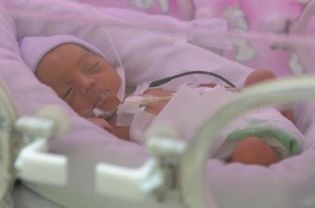
Indonesian baby girl Dara Nur Anggraini, whose twin sister, Dera, died on Feb. 16. Jakarta’s hospitals were ill-prepared for governor Joko Widodo’s granting of free medical care to a larger number of the city’s poor. (AFP Photo).
A teenager on Saturday died of a severe intestinal infection after several Jakarta hospitals denied her treatment — the latest in a series of deaths after hospitals rejected sick people. Ana Mudrika, 15, told her family on March 5 that she felt pain in her stomach and vomited after she ate meatballs at school. Her family brought her to a clinic, but the medicine she received proved ineffective.
“At 10 p.m. [that night] we brought her to Firdaus Hospital [in Cilincing, North Jakarta],” Endang, Ana’s father, told Kompas.com on Monday, adding that the hospital provided a bed for her.
On Thursday night, a doctor from Firdaus Hospital called the family to report that the patient’s condition was not improving and they should search for another hospital.
“Firdaus Hospital is a respiratory hospital and considered not competent enough to treat her disease,” Jakarta Health Agency head Dien Emmawati said on Monday. “That’s why the hospital asked the family to search other hospital.”
According to Kompas.com, Ana’s parents went to Islam Sukapura Hospital in Cilincing, North Jakarta, and brought her Jakarta Health Card (KJS) so she could receive free treatment. The hospital official said that all rooms in the third-class ward — the location where KJS holders are treated — were occupied, so the patient’s parents searched for other hospitals.
The family got the same answer from North Jakarta’s Koja and Pelabuhan Hospitals, so the family went to Mulyasari Hospital, but staff refused to treat her because it does not participate in the KJS program.
With Ana’s deteriorating condition — her belly swollen and her urine turned red — her family decided to bring her to back to Islam Sukapura hospital. The official said Ana could stay for four hours in the emergency room because there were no vacant rooms in the third-class ward or the intensive care unit.
In the meantime, the family returned to Koja, Pelabuhan and Mulyasari hospitals, but the patient was still denied treatment.
On Friday morning, Islam Sukapura hospital informed the family that another patient canceled an appointment and Ana could use the bed. A doctor told the family that Ana should be treated in an ICU, but no slots were available there.
Royati, her mother, complained to hospital officials who told her to search for other hospitals.
“Try first, there are many hospitals in Jakarta,” Royati, quoting the official, told Kompas.com.
Her family visited other hospitals to East Jakarta, where Admira Hospital agreed to accept her as long as there was a diagnosis from Islam Sukapura hospital.
But when they returned to Islam Sukapura hospital to get the diagnosis letter, the official said that an ICU bed opened up for Ana, but it wouldn’t be ready for a few hours.
“There was one [ICU] patient that had gotten better and moved to ordinary room,” health office head Dien said. “Ana was moved to an ICU room, but her deteriorating condition made the doctor decide not to do surgery on her [because it could endanger her life]. The patient later died.”
Dien said that both Firdaus and Islam Sukapura hospitals had gone through the standard operational procedure when they treated the patient. However, she admitted that there was a breakdown in communication between the hospitals and the family.
After summoning officials of the five hospitals, Dien vowed that Ana’s case would be the last of the series of patient deaths after being rejected from hospitals.
“This is the last case, I don’t want to hear such cases again,” she said. “I don’t want the patient’s family to be referred to hospitals.”
She said that both Firdaus and Islam Sukapura had violated the 2009 Law on Hospitals and the 2009 bylaw on the Regional Health System, which require hospitals to refer patients directly to other treatment centers if there are no beds available. The other hospitals the family visited were not in violation because Ana was not with them at the time.
“We will coordinate with the Health Ministry to discuss the sanction for the five hospitals,” she said, adding that both Firdaus and Islam Sukapura hospital have access to the 119 emergency call service to help find empty slots in other hospitals for patients.
The city recently launched the emergency medical hotline (119) to prevent sick people from having to go from one hospital to another in order to obtain treatment.
A lung doctor at Firdaus Hospital, Bachtiar, said that medical staff of hospitals are not well-informed about the 119 emergency system.
Dien also said that hospitals were not allowed to reject an patient in need of urgent care.
Meanwhile, Islam Sukapura Hospital medical director Henny Hanna admitted that the hospital failed to establish good communication with patient.
“We were busy trying to find a slot in our hospital’s ICU, by moving other patients with better conditions to let the other patient [Ana] get a slot in the ICU,” she said.
Ana’s father said that while he accepts Ana’s death, he believes she would have received better treatment if she was not a KJS member.
“My daughter’s death might be a fate from God,” Endang said, as quoted by Kompas.com. “But if she’s not KJS patient, the service might not be that complicated.”
Jakarta’s health services have been under increased scrutiny after tales of mistaken diagnoses, inadequate care and unavailable facilities spread throughout the city.
In February, a premature baby died from a respiratory problem just one week after she was born after she was denied treatment from eight hospitals in Jakarta. In a separate occurrence, doctors at the Kartini Maternal Hospital pronounced a still-breathing premature baby dead shortly after it was delivered.
Jakarta Governor Joko Widodo instituted the KJS system in November of last year in an attempt to increase the capital’s health service capacity. The card entitles holders to free medical treatment at community health centers and third-class wards in local hospitals.
He acknowledged that even though the city provided the KJS, Jakarta’s health care sector was not yet fully integrated.
 About bambooinnovator
 Bamboo Innovator