‘Wash Trades’ Scrutinized; U.S. regulators are investigating whether high-frequency traders are routinely distorting stock and futures markets by illegally acting as buyer and seller in the same transactions
March 18, 2013 Leave a comment
Updated March 17, 2013, 9:42 p.m. ET
‘Wash Trades’ Scrutinized
Issue Is Whether High-Speed Firms Illegally Buy, Sell Futures in Same Deals
By SCOTT PATTERSON, JENNY STRASBURG and JAMILA TRINDLE
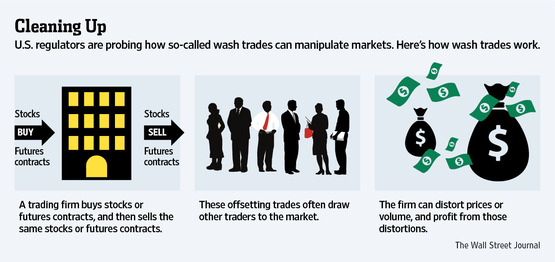
U.S. regulators are investigating whether high-frequency traders are routinely distorting stock and futures markets by illegally acting as buyer and seller in the same transactions, according to people familiar with the probes.
Such transactions, known as wash trades, are banned by U.S. law because they can feed false information into the market and be used to manipulate prices. Intentionally taking both sides of a trade can minimize financial risk for the trading firm while potentially creating a false impression of higher volume in the market.
The Commodity Futures Trading Commission is focused on suspected wash trades by high-speed firms in futures contracts tied to the value of crude oil, precious metals, agricultural commodities and the Standard & Poor’s 500-stock index, among other underlying instruments, the people said.
The agency is looking at potential wash trades by multiple high-speed firms, although it isn’t known which ones investigators are scrutinizing. Firms found guilty of intentionally distorting the market through wash trades could face hefty fines.
Investigators also are looking at the two primary exchange operators that handle such trades, CME Group Inc. andIntercontinentalExchange Inc., the Atlanta company that in December agreed to purchase NYSE Euronext for $8.2 billion, the people said. Regulators are concerned the exchanges’ systems aren’t sophisticated enough to flag or stop wash trades, the people said.
“We actively enforce rules prohibiting wash trading, and we’re in the process of developing technology to prevent wash trades as prohibited by CME and CFTC at the trading-engine level,” a CME spokeswoman said. CME plans to introduce new technology the middle of this year, she said.
An ICE spokeswoman said the exchange operator has employed wash-trade filters for years, and “we continue to enhance them.”
Neither firm would discuss details of communications with regulators about their filters. No exchange operator has been accused of wrongdoing.
Separately, the Financial Industry Regulatory Authority is examining similar issues related to computer-driven trading firms’ transactions in stocks, a person with knowledge of that inquiry said.
The investigations highlight how regulators continue to struggle with today’s complex high-speed markets and the ties between exchanges and their valued high-frequency customers. Securities and Exchange Commission investigators have been probing whether stock exchanges have provided certain advantages to sophisticated firms that allow them to trade at the expense of regular investors.
Exchanges say such advantages allow the firms to trade aggressively and provide better prices for regular investors who are trying to buy or sell.
Regulators also have pressed exchanges to improve their oversight in the wake of a flurry of computer-driven glitches last year, including the debacle that caused Knight Capital Group to suffer losses of more than $450 million and the flubbed Facebook Inc. public offering by Nasdaq OMX Group Inc.
“High Frequency Trading-Controlling the Risks” was the first agenda item in a nonpublic meeting of CFTC commissioners and international regulators last week at the closely watched Futures Industry Association conference in Florida, a copy of the meeting agenda reviewed by The Wall Street Journal shows.
European and U.S regulators questioned industry representatives on whether high-frequency traders hurt or helped the markets, people at the meeting said.
With wash trades, one difficulty regulators face is proving the suspect trading is intentional, a standard required by many securities and commodities laws. In today’s fast-moving markets, some firms say it is relatively easy for their buy and sell orders to cross by mistake.
But the scale of the suspicious trading activity is so large that it appears to some market watchdogs to be intentional, said people familiar with the matter. Futures-trading data from 2012 being scrutinized by CFTC examiners show that often, several hundred thousand potential wash trades occur a day on futures exchanges, the people said. Regulators have zeroed in on CME, where the majority of the potential wash trades have occurred, the people said.
Another problem: It is hard for examiners to tell whether the trades are coming from two separate parts of a firm or whether both sides of the trade are part of the same trading strategy. If the orders are coming from two strategies, they might be valid.
CFTC officials are weighing whether new powers granted the agency by the Dodd-Frank financial overhaul could aid them in cracking down on wash trades. The 2010 law allows the CFTC to prosecute firms whose practices disrupt the market, even if they aren’t intentional. But agency officials aren’t sure if the new powers can be applied to wash trades, according to people familiar with the agency’s thinking.
Finra officials are proposing to apply a no scienter legal standard to wash trades, meaning the agency wouldn’t have to prove firms intentionally were attempting to manipulate the market with wash trades, according to people involved in the matter. They simply would need to show that the trading distorts markets in ways that can harm other investors.
One way wash trades can affect other market players is that a burst in volume can lure more traders, creating the impression of more action than is actually taking place. That can distort prices in ways that benefit some market participants, regulators and traders said.
Firms often can benefit from trading at higher volumes, such as through reduced transaction costs and other incentives provided by exchanges. Higher volumes also can create more opportunities for traders to profit from rising and falling prices.
CFTC Commissioner Bart Chilton plans to highlight issues around wash trades Monday in a speech in San Francisco to a commodities-industry group, according to prepared comments reviewed by the Journal.
Mr. Chilton, who has previously expressed concerns about wash trades, plans to say high-frequency traders engage in wash trades “in voluminous instances,” according to the comments.
He calls for “more review” of algorithmic trading firms and exchanges to better understand the effect of improper trades and how they are allowed to happen, suggesting they create “fantasy liquidity” that distorts the market.
 About bambooinnovator
 Bamboo Innovator