Biosimilars Lure Major Drugmakers Into the Generics Biz; Generic medicine makers may have a harder time succeeding with biologic drugs, which are dynamic and more difficult to replicate.

Biosimilars Lure Major Drugmakers Into the Generics Biz

By Makiko Kitamura and David Wainer on March 21, 2013http://www.businessweek.com/articles/2013-03-21/biosimilars-lure-major-drugmakers-into-the-generics-biz

Call it the Revenge of Big Pharma. Generic drug companies such as Teva Pharmaceutical Industries (TEVA) have made billions since the late 1980s by reverse engineering best-selling drugs that came off patent—escaping hefty development and marketing costs—and selling them cheaply. When it comes to copying the best-selling treatments that are coming off patent today—a category known as biologics, medicines produced using the body’s own cells rather than through chemical reactions in a lab—the companies with the expertise to develop and market them are pharmaceutical giants. That leaves companies like Israel-based Teva, the largest maker of generics, increasingly on the sidelines.

The biologics losing patent protection over the next six years had total annual sales of $47 billion in 2012, according to Bloomberg Industries. However, the rules of the lucrative knockoff drug game are being altered. The derivatives of biologics, known as biosimilars, are far more complex to make than chemical generics. Drug companies that want to sell copies of biologic medicines such as Roche Holding’s (RHHBF) $7 billion-a-year rheumatoid arthritis treatment Rituxan require expertise and money to produce and market to the public and physicians. “There’s this dawning realization that biosimilars are in many ways the same as branded products,” says Duncan Emerton, Datamonitor Consulting’s biosimilars practice leader. Read more of this post
IMF: borrowing is back to pre-crisis levels; Meier didn’t actually invite listeners to read between the lines of all the numbers he was presenting, but the meaning was clear to the veterans in the auditorium.

IMF: borrowing is back to pre-crisis levels

22 March 2013

Author: Simon Osborne

Are we meant to cheer, or boo? Borrowing is back to where it was in 2007. In Asia, gearing ratios are back at 96%, the same level as they were pre-crisis. Is that good or bad? Was it not borrowing that got us into this fine mess? “It might be ok now, but given a few years of that trend, that view might change,” says Andre Meier, the International Monetary Fund’s resident representative in Hong Kong, at the Private Equity International Asia Forum. He adds the Chinese are gearing up, last year recording 17% bank loan growth, 80% for Trust loans, 40% for corporate bonds and 30% for entrusted loans. He looked mellow about the bank loan growth, but was that a flicker of a conservative frown for the other three? “These markets are yet to be tested in strained scenarios. For example, there has been no default yet in Chinese domestic corporate bonds.” He pointed a stern finger at a slide with vertiginous lines showing that Dim Sum Bond issuance was $25bn in 2011, $250bn now, and QFII was $75bn in 2011, $140bn now. “The average ratio of credit to GDP is higher now than it was in 1997, the boom is striking.” All those in the audience who were in high school in 1997 smiled. Yes, yes, this is all good news of boom and prosperity……….isn’t it? Capital flows in funds are rushing back to Asia at a rate of $1.75bn per week this year, compared to outflows in 2011. That money is chasing the 7.5% GDP growth that the IMF predicts for Asia in each of the next two years. However, if some “reversal” took place, (could he mean a once-in-a-century crisis that-nobody-sees-coming that now seems to happen every other year), then Asia is vulnerable, as money could be pulled out again. Non-resident holdings of Indonesian, Malaysian and Thai government debt are at 35%, 30% and 25%. Would foreigners whisk their money out of Asia if something goes wrong? Tick, that sounds plausible. He sees less tail risk in Europe, thanks to the ECB medicine in 2012, and growth being shored up elsewhere, and a slump being prevented – by the Bank of England quadrupling the size of its balance sheet, and the Fed multiplying its by 3.5x. Meier didn’t actually invite listeners to read between the lines of all the numbers he was presenting, but the meaning was clear to the veterans in the auditorium.

The Odd, Enduring Power of ‘Praying Hands’; How a 16th-century sketch became an international symbol for piety—and an inspiration for kitsch; “Without a doubt, it’s the most famous drawing in the world. In every gas station, in every bank behind the teller, you have an image of the ‘Praying Hands’.”

Updated March 21, 2013, 8:32 p.m. ET

The Odd, Enduring Power of ‘Praying Hands’

How a 16th-century sketch became an international symbol for piety—and an inspiration for kitsch

By ANNA RUSSELL

AR-AB849_Bottom_DV_20130321174906AR-AB850_Prayer_G_20130321175148

DRAWING POWER: Albrecht Dürer

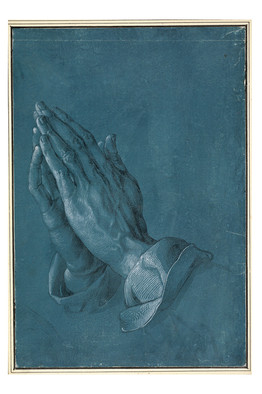
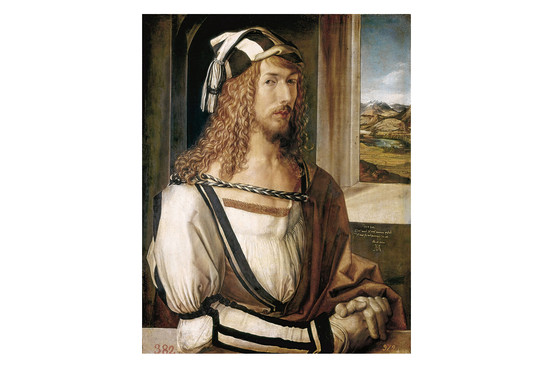
The image at the center of Albrecht Dürer’s drawing “Praying Hands” has traveled a long way from its roots in the German Renaissance. It is the most enduring work by one of the greatest draftsmen in the history of Western art, but it has also taken on a pop-culture life of its own, all over the world.

It is found on posters, dishes, washcloths, urns, aprons, coffee mugs, cellphone cases and pocketknives—and tattooed onto Justin Bieber‘s leg. Its likeness appears on Andy Warhol’s tombstone. Singer and songwriter Trey Bruce has a song called “Velvet Elvis and Prayin’ Hands.” Of the many tattoo takes on the image, one of the more exotic is that of pro basketball player Stephen Jackson, of the San Antonio Spurs, who has on his torso a rendering of “Praying Hands”—holding a handgun.

Now, the real thing will be on view at the National Gallery in Washington. The last time the drawing came to the U.S. was in 1984-85, when it was shown in Washington and New York. From Sunday through June 9, the museum will host “Albrecht Dürer: Master Drawings, Watercolors, and Prints From the Albertina,” comprising 118 works on loan from the Albertina Museum in Vienna.

“Without a doubt, it’s the most famous drawing in the world,” says Andrew Robison, a senior curator of prints and drawings at the museum. And one of the most appropriated. “In every gas station in the South, in every bank behind the teller, you have an image of the ‘Praying Hands,’ ” says Mr. Robison, who grew up in Memphis, Tenn. Read more of this post

Because of bias and ignorance, Western companies in Singapore have failed to build up local leadership and talent in their management

PUBLISHED MARCH 22, 2013

Western firms don’t build up local talent: study

Their competitive edge in Asia may be hurt in long haul if such practices stay

BY CHUANG PECK MINGPRINT |EMAIL THIS ARTICLE

[SINGAPORE] Because of bias and ignorance, Western companies in Singapore have failed to build up local leadership and talent in their management, says a study backed by the Tripartite Alliance for Fair Employment. And it warns that this may blunt the competitive edge of these multinational corporations in Asia in the long haul. “Our research shows that Singaporean talent brings unique strengths to leadership and organisational success, yet we observe that local employees often do not rise up through organisations to secure leadership positions,” says Kate Verson, a co-author of the study titled “Adopting an Asian lens to talent development – a Singapore study”. “There is a concern that approaches towards talent development may not be truly inclusive and that companies are potentially overlooking key local talent in the pipeline,” she adds.

Keep flats simple and affordable: Ex-HDB chief Dr Liu Thai Ker; the man who played a pivotal role in Singapore’s successful public housing programme in the early years yesterday made the call to return to the basics.

Keep flats simple and affordable: Ex-HDB chief

SINGAPORE — As the debate rages on over the role and nature of public housing, following National Development Minister Khaw Boon Wan’s call earlier this month to relook the long-term direction, the man who played a pivotal role in the Republic’s successful public housing programme in the early years yesterday made the call to return to the basics.

BY NG JING YNG –

4 HOURS 52 MIN AGO

SINGAPORE — As the debate rages on over the role and nature of public housing, following National Development Minister Khaw Boon Wan’s call earlier this month to relook the long-term direction, the man who played a pivotal role in the Republic’s successful public housing programme in the early years yesterday made the call to return to the basics.

Forget the bells and the whistles, and build more flats than needed — the end goal is affordability, said Dr Liu Thai Ker, whose 20-year career in the Housing and Development Board (HDB) began in 1969 when he was the head of the Design and Research Section.

He rose through the ranks to become its Chief Architect and ultimately, the Chief Executive Officer, before he left in 1989 to become the CEO and Chief Planner of the Urban Redevelopment Authority.

And his call was backed by former Senior Minister of State and HDB Chairman Aline Wong, who reiterated that the purpose of public housing is to “provide a shelter over everybody’s heads”.

“The asset part comes along because … property appreciates over a long time. But that is not our primary objective. People make money, accumulate savings … but we cannot promise that they will not lose (value in their property), depending on the property cycle,” she said. Read more of this post