World’s Best CEOs; Profiles of the World’s Best CEOs — Many Paths to Greatness
March 24, 2013 Leave a comment
SATURDAY, MARCH 23, 2013
Profiles of the World’s Best CEOs — Many Paths to Greatness
Profiles of our 30 superstars at Google, BlackRock, BMW — and more.
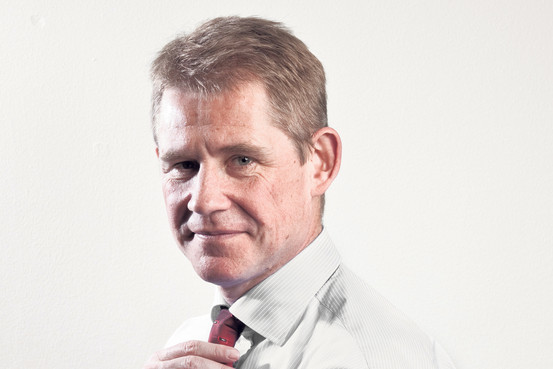
Bernard Arnault
LVMH Moët Hennessy Louis Vuitton, CEO since 1989
Why: The king of luxury keeps feeding our status cravings.
Louis Vuitton is the “it” brand in handbags today, which is a credit to — and a bit of a headache for — Arnault, whose family controls 46.5% of LVMH. So, the CEO plans to slow the growth of new LV stores to avoid diluting the brand’s exclusivity.
It is typical of Arnault to put brand appeal ahead of short-term gain. Yet, in the past quarter-century, he has managed to nurture both, building an $86 billion luxury-goods empire that piles up profits. Louis Vuitton leather goods and Moët Hennessy wines and spirits still account for 75% of earnings, but he has been adding other labels like Bulgari to the mix.
A billionaire philanthropist who likes classical music and modern art, Arnault recently drew fire for seeking Belgian citizenship after France’s Socialist government tried to raise the top income-tax rate to 75%. Belgium is balking, but he has made his point.
— Vito J.Racanelli
LVMH Moët Hennessy Louis Vuitton Annualized Total Return
| One Year | 4.6% |
| While CEO | 11.3% |
| S&P 500 | 8.9% |
| 2013 P/E | 17.2 |
| 5-Yr. Profit Growth | 11.0% |
Jeff Bezos
Amazon.com, CEO since 1994
Why: He changed the way people shop and read.
Bezos belongs in an exclusive club, along with Steve Jobs and Google’s Larry Page and Sergey Brin, because he created one of the most innovative and disruptive companies of the past 20 years.
As the top Internet retailer and developer of the Kindle, Amazon has helped change the way people shop and read. Obsessed with customer satisfaction, Bezos has developed services like Amazon Prime, giving customers free two-day shipping for $79 a year. He then added streaming video at no extra charge.
Bezos, 49, is a dreamer, and he has the money to fund his dreams, including manned space travel and a massive $42 million clock on his Texas ranch.
Perhaps Bezos’ biggest challenge lies ahead: making a lot of money. Amazon’s earnings have fallen in recent years as it has sacrificed profits for growth. Wall Street may get impatient.
— Andrew Bary
Amazon.com Annualized Total Return
| Annualized Total Return | |
| One Year | 47.1% |
| While CEO | 38.8% |
| S&P 500 | 5.6% |
| 2013 P/E | 179.3 |
| 5-Yr. Profit Growth | 5.2% |
Carlos Brito
Anheuser-Busch InBev, CEO since 2005
Why: Built a beer behemoth that generates champagne-like returns.
Through aggressive acquisitions, effective cost-cutting, and shrewd brand-building, Brito, 53, turned a small Brazilian brewer into the world’s dominant beer company, with a $155 billion market value. Along the way, he made Budweiser the leading premium brand in China.
Brito’s thirst is unslaked. After buying Anheuser-Busch for $55 billion in 2008, he is seeking full control of Grupo Modelo, Mexico’s largest brewer.
He favors an informal corporate culture and works at a table surrounded by his top managers. “Great people like open environments. Mediocre people like sitting behind closed doors,” he says.
At business schools, he extols his meritocratic management philosophy. “If you can’t please everyone, please the most talented people,” he says. Brito is entitled to a beer. His favorite: Bud.
— AB
Anheuser-Busch InBev Annualized Total Return
| Annualized Total Return | |
| One Year | 42.4% |
| While CEO | 21.1% |
| S&P 500 | 5.0% |
| 2013 P/E | 18.6 |
| 5-Yr. Profit Growth | 12.5% |
Warren Buffett
Berkshire Hathaway, CEO since 1965
Why: A brilliant value creator for almost 50 years.
Buffett’s creation is one of the great achievements in business history. Investors fortunate enough to have gone along for the ride have enjoyed an 8,000-fold rise in the stock price since 1965. Berkshire is now the fourth-largest company in the market, with a capitalization exceeding $250 billion.
Buffett continues to do things in his own way. He hates meetings, and gives free rein to the managers of Berkshire Hathaway’s 80-plus subsidiaries. At 82, his talents look undiminished.
Burlington Northern could be worth 50% more than what Berkshire paid for the railroad in 2010. Buffett’s $5 billion investment in 2011 in Bank of America preferred stock already is generating big returns due to equity warrants. It’s a good bet Buffett will be at the helm in 2015 for his 50th anniversary as CEO. That would be great news for investors.
— A.B.
Berkshire Hathaway Annualized Total Return
| Annualized Total Return | |
| One Year | 29.4% |
| While CEO | 21.0% |
| S&P 500 | 9.4% |
| 2013 P/E | 17.7 |
| 5-Yr. Profit Growth | 4.1% |
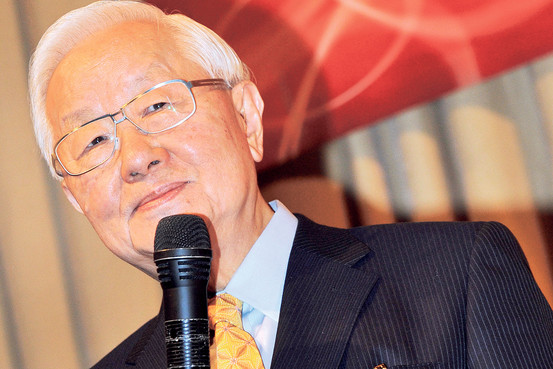
Morris Chang
Taiwan Semiconductor, CEO since 1987
Why: Built Taiwan’s largest company, with a market value of $88 billion.
Chang, 81, is the soul of efficiency. The MIT grad, who cut his teeth as an engineer at Texas Instruments, built the first semiconductor foundry in 1987, freeing designers to focus on smaller, faster, and more complex chips, rather than production. Today, Taiwan Semi controls half of the $39.3 billion market for contract chip-manufacturing.
Plenty of opportunity lies ahead, as smartphone and tablet-computer makers create ever more powerful devices to connect with the Internet. Chang plans to spend a record $9 billion this year on new fabrication plants to make tiny chips for mobile devices.
Despite his fame, the dean of Taiwan’s booming tech sector remains down-to-earth. He takes mass transit to avoid traffic; a photo of him sitting on the train went viral last year.
— Leslie P. Norton
Taiwan Semiconductor Annualized Total Return
| One Year | 33.6% |
| While CEO | 17.7% |
| S&P 500 | 8.9% |
| 2013 P/E | 15.0 |
| 5-Yr. Profit Growth | 9.4% |
Ed Clark
TD Bank Group, CEO since 2002
Why: His risk aversion has kept TD strong and healthy.
TDBank emerged from the financial crisis as one of the world’s strongest big banks. Clark’s insistence on strict mortgage-underwriting standards and an obsessive customer focus have helped drive results.
TD refused to issue subprime mortgages after entering the U.S. market in 2005. “We understand risk,” says Clark, 65. “We’re not going to be a bank that blows up every five to seven years.”
Branches are open seven days a week and offer treats for depositors and their pets. Clark recognized that TD couldn’t compete with Goldman Sachs and JPMorgan in U.S. investment banking, and unlike some foreign banks, didn’t waste money trying.
TD earns higher returns than Goldman or JPMorgan, and rewards shareholders with regular dividend increases. Current yield: 3.8%.
— A.B.
TD Bank Group Annualized Total Return
| One Year | 4.7% |
| While CEO | 17.9% |
| S&P 500 | 7.7% |
| 2013 P/E | 10.8 |
| 5-Yr. Profit Growth | 6.6% |
David Cote
Honeywell, CEO since 2002
Why: Repaired and revved up Honeywell’s engine.
At Honeywell, the runway is long and the tail winds are strong. There has been no letup on the throttle since Cote came on board in 2002, masterfully remaking a money-losing mishmash of businesses into a profitable leader in technology and manufacturing. “The trick is in the doing,” as he likes to say.
Honeywell’s stock responded, and the financial picture keeps improving. The company’s sales and earnings are on the rise, despite an outlook for sluggish growth in the global economy.
For Cote, 60, a man with more than 10,000 songs on his iPod, the music never stops. Now he has become a power player in Washington, too, working to fix the nation’s budget woes.
— Sandra Ward
Honeywell Annualized Total Return
| One Year | 20.3% |
| While CEO | 8.4% |
| S&P 500 | 5.0% |
| 2013 P/E | 14.2 |
| 5-Yr. Profit Growth | 7.2% |
Jamie Dimon
JPMorgan Chase, CEO since 2006
Why: Savvy leader of the world’s most important bank.
As the world’s leading banker, Dimon is a forceful advocate for his company and much-maligned industry. He defends size, saying multinational clients need the broad array of services that only big global banks can provide.
JPMorgan Chase emerged from the financial crisis as the world’s most important bank. It now has top positions in consumer and corporate banking, credit cards, investment banking, and asset management.
A recent Senate report criticized the bank’s handling of $6 billion in trading losses last year. Dimon, 57, should have moved more quickly to contain the losses, which he called a “stupid error” and “embarrassing personally.” JPMorgan expects to earn $7 a share in the next few years, up from about $5 in 2012. That could lessen the sting of the so-called London Whale fiasco.
— A.B.
JPMorgan Chase Annualized Total Return
| One Year | 28.4% |
| While CEO | 5.4% |
| S&P 500 | 4.6% |
| 2013 P/E | 8.9 |
| 5-Yr. Profit Growth | 3.5% |
Warren East
ARM Holdings, CEO since 2001
Why: Intel who? Put ARM chips in nearly every smartphone.
ARM Holdings microprocessors run almost all the world’s smartphones and many other mobile devices. Now the company is looking to outmaneuver Intel in servers, too. ARM’s competitive strength owes much to East’s steady leadership. When he steps down this summer—his retirement was announced last week — he’ll be leaving the company in fighting trim.
East, 51, an Oxford graduate, left Texas Instruments to join ARM in 1994 to set up its consulting business. He should have no trouble keeping busy: He enjoys skiing, dinghy sailing, and running, and has completed a marathon in under three hours, a major achievement. He is proud of his Welsh heritage, and plays the organ in his local church.
— Jonathan Buck
ARM Holdings Annualized Total Return
| One Year | 56.6% |
| While CEO | 10.5% |
| S&P 500 | 5.3% |
| 2013 P/E | 51.0 |
| 5-Yr. Profit Growth | 29.0% |
Larry Ellison
Oracle, CEO since 1977
Why: Brilliant deal maker: Acquisitions helped lift profit 17% last year.
As he often does, the brazen Silicon Valley veteran generated big headlines last year, paying about $500 million to buy Lanai, Hawaii’s sixth-largest island. He followed up with the purchase of Island Air, the state’s island hopper. It’s the kind of connective deal that Ellison has been making for years at Oracle, his enterprise-software giant.
The deals have helped make Oracle the most profitable company in the software industry, with earnings approaching $10 billion last year. Its success is a testament to founder Ellison, 68, who has kept the company relevant for four decades.
Oracle was slow to embrace cloud computing, one reason for last week’s quarterly revenue miss. Now Ellison is pushing to make up for lost time. Almost all of the company’s 12 acquisitions in the past year were focused on cloud services.
— Alexander Eule
Oracle Annualized Total Return
| One Year | 17.9% |
| While CEO | 25.7% |
| S&P 500 | 9.7% |
| 2013 P/E | 12.7 |
| 5-Yr. Profit Growth | 19.5% |
José AntonioFernández Carbajal
Fomento Economico Mexicano, CEO since 1995
Why: Civic-minded visionary built a Latin beverage behemoth.
During Fernández’s tenure, FEMSA has grown from a $1.2 billion Mexican beverage company into a $36 billion Latin American powerhouse. It operates the world’s largest Coca-Cola bottler and the region’s fastest-growing retailer, the Oxxo convenience-store chain.
When it became clear that global giants were transforming the beer industry, this pragmatist sold the beer business that his wife’s family founded in 1890, to Heineken, in a lucrative deal that gave FEMSA a 20% stake.
As a child, Fernández was called Diablo, a common nickname for hyperactive kids. He still has energy to spare. After two FEMSA security guards were killed in a drug shootout, he sought new ways to make the city of Monterrey safer, focusing more on community and social programs to improve prospects for youth. He also teaches an engineering course at his alma mater, the Tecnológico de Monterrey.
— Reshma Kapadia
Fomento Economico Mexicano Annualized Total Return
| One Year | 51.6% |
| While CEO | 22.8% |
| S&P 500 | 8.7% |
| 2013 P/E | 24.9 |
| 5-Yr. Profit Growth | 14.6% |
Larry Fink
BlackRock, CEO since 1988
Why: This markets maven built the world’s biggest money manager.
Equities are the place to be. When Fink, a former bond trader who co-founded BlackRock 25 years ago as a bond investment firm, makes such pronouncements, it’s time to listen. Today, his firm is the world’s biggest money manager, overseeing $3.8 trillion in fixed income, equities, and alternatives, including real estate and hedge funds. It acquired the iShares exchange-traded-fund franchise in 2009.
Fink, 60, has been spending time lately thinking about building BlackRock’s brand, particularly in retail channels around the world. A consultant to central bankers, politicians, and other power players, he was rumored to be leaving Wall Street for the Obama administration, but that didn’t happen. “I can’t think of a better place to provide advice than from my seat at BlackRock,” he says.
— Lawrence C. Strauss
BlackRock Annualized Total Return
| Annualized Total Return | |
| One Year | 24.9% |
| While CEO | 25.3% |
| S&P 500 | 3.2% |
| 2013 P/E | 15.5 |
| 5-Yr. Profit Growth | 10.8% |
Hugh Grant
Monsanto, CEO since 2003
Why: Monsanto’s shares are up tenfold in his 10 years at the helm.
Scottish-born Grant may have earned a degree in molecular biology and zoology, but his job at Monsanto demands an understanding of politics, negotiating tactics, and weather patterns.
The world’s leading developer of genetically modified seeds, Monsanto is expanding aggressively in South America, boosting growth in the first quarter when U.S. sales tend to be weak. Grant plans to roll out drought-tolerant corn this year — well timed after last year’s devastating drought — which will help to push sales and profits to record levels.
Having successfully faced down an attempt in California last year to require labeling of genetically modified food, Grant now faces similar opposition from supermarket chain Whole Foods. Giving no quarter, he recently called GMOs “the most-tested food product that the world has ever seen.”
— Avi Salzman
Monsanto Annualized Total Return
| Annualized Total Return | |
| One Year | 32.6% |
| While CEO | 28.4% |
| S&P 500 | 6.9% |
| 2013 P/E | 22.1 |
| 5-Yr. Profit Growth | 13.3% |
Nick Hayek
Swatch Group, CEO since 2003
Why: Dominates the watch industry. Tripled earnings in 10 years.
Hayek went to film school in Paris and ran his own production company before joining the family business in 1994. His father built Swatch in the 1980s, when the Swiss watchmaking industry was on its knees, and is widely regarded as its savior. But Hayek, 58, deserves credit for expanding Swatch through retail outlets, slick marketing, and acquisitions. In January, he added jeweler Harry Winston to a portfolio that includes luxe brands like Omega, Blancpain, and Breguet.
At a recent earnings presentation, Hayek was combative with analysts and investors while puffing on a fat cigar. Given the stock’s returns, no one can accuse him of blowing smoke.
— J.B.
Swatch Group Annualized Total Return
| One Year | 27.6% |
| While CEO | 22.6% |
| S&P 500 | 8.0% |
| 2013 P/E | 16.3 |
| 5-Yr. Profit Growth | 9.7% |
Pablo Isla
Inditex, CEO since 2005
Why: Took Spain’s fashionable Zara stores global.
Isla, 49, succeeded Amancio Ortega Gaona, founder of Spain’s Inditex, in 2005. He earns plaudits for ramping up the international rollout of the company’s Zara retail chain and other Inditex brands, and has been opening new stores at a rate of 500 a year. Last year, Inditex opened its 6,000th store.
An exemplar of “fast fashion,” Zara takes designs from sketchbook to store floor in just a few weeks. This puts the retailer on the cutting edge of fashion, and low-cost manufacturing keeps expenses down.
Isla hasn’t altered the Inditex culture. Based in Arteixo, a small town in northwest Spain, the company doesn’t advertise, and its executives won’t give on-the-record interviews. A lawyer by training, Isla was general director of state assets at Spain’s Ministry of Economy and Finance earlier in his career. Bet he doesn’t miss that job now.
— J.B.
Inditex Annualized Total Return
| One Year | 46.7% |
| While CEO | 25.7% |
| S&P 500 | 5.1% |
| 2013 P/E | 23.8 |
| 5-Yr. Profit Growth | 13.5% |
Ma Huateng
Tencent, CEO since 1997
Why: His instant-message services have attracted over a billion users.
When a rumor about Ma’s death hit the blogosphere in February, it was probably read tens of millions of times before the founder and CEO of Tencent, China’s largest Internet service provider, jumped on weibo, Tencent’s popular microblogging service, and proclaimed himself very much alive. It’s not hard to understand how the rumor spread.
Shenzhen-based Tencent owns the QQ instant-messaging platform, with a user base of 798 million. The company’s WeChat mobile-messaging app, introduced in January 2011, already has more than 300 million users, and some see it growing to 500 million this year.
Known as Pony — his given name literally means horse — Ma has galloped into the top ranks of China’s wealthiest. This year, the ambitious 41-year- old is expected to expand WeChat in the U.S.
— L.P.N.
Tencent Annualized Total Return
| One Year | 34.0% |
| While CEO | 61.9% |
| S&P 500 | 5.5% |
| 2013 P/E | 24.5 |
| 5-Yr. Profit Growth | 50.7% |
Carol Meyrowitz
TJX, CEO since 2007
Why: The queen of off-price retailing runs a tight ship.
It’s not easy hiding in plain sight while leading a major U.S. retailer, but Meyrowitz, who refuses press interviews, has managed the trick. She has also perfected others. Frequently changing assortments of discounted designer goods keep customers coming back to T.J. Maxx, Marshalls, HomeGoods, and other TJX chains, producing a profit windfall for the Framingham, Mass.-based company.
Meyrowitz, 59, got her start as an assistant buyer at Saks Fifth Avenue, and joined TJX in 1983. She led the company successfully through the recession, opening stores and taking market share.
Next, she aims to boost annual sales to $40 billion from a current $26 billion, by speeding store openings in the U.S. and abroad, jumping into e-commerce, and targeting younger shoppers.
— Christopher C. Williams
TJX Annualized Total Return
| Annualized Total Return | |
| One Year | 22.9% |
| While CEO | 21.7% |
| S&P 500 | 3.1% |
| 2013 P/E | 16.0 |
| 5-Yr. Profit Growth | 21.6% |
Leslie Moonves
CBS, CEO since 2006
Why: Resuscitated CBS and made network TV relevant again.
If someone were to pitch Moonves, 63, an idea for a winning television show based on his life, the story line might go something like this: Actor-turned-TV-executive rises to the top of a big entertainment company just when the pundits have written off traditional TV programming and news. Not only does he make good but he also makes shareholders a bundle.
That’s pretty much the way the script has played out since Moonves became CEO of CBS after its 2006 spinoff from Viacom. He has shown an eye for creative talent, as well as programming with global appeal. He also loves the art of the deal.
Moonves’ rich pay package — $70 million in cash, plus stock, for the four years ending in June 2017 — has drawn criticism. “Clearly, my board thinks I’m of value to the company,” he says.
— Robin Goldwyn Blumenthal
CBS Annualized Total Return
| One Year | 46.4% |
| While CEO | 10.5% |
| S&P 500 | 4.6% |
| 2013 P/E | 14.5 |
| 5-Yr. Profit Growth | 6.3% |
Alan Mulally
Ford, CEO since 2006
Why: Rescued Ford from the brink, then hit the gas pedal.
Mulally took Ford from a $17 billion loss in 2006 to a $5.7 billion profit last year, without so much as a penny from Uncle Sam. Along the way, he right-sized production to a recessionary market, cut costs, and planned new vehicle models. Ford regained an investment-grade credit rating, and did we mention, it doubled its dividend?
For an encore, the 67-year-old CEO must groom a successor — the smart money’s on Ford COO Mark Shields — before retiring, likely after 2014. He also needs to lift production to meet rising U.S. demand, and reinvigorate Ford’s upmarket but moribund Lincoln brand, while avoiding recalls of the sort that recently dogged the company’s Escape and Fusion models. He also has to win new customers in Asia.
Given Ford’s performance so far, the betting is that Mulally will drive it home.
— V.J.R.
Ford Annualized Total Return
| One Year | 5.2% |
| While CEO | 7.6% |
| S&P 500 | 4.2% |
| 2013 P/E | 9.0 |
| 5-Yr. Profit Growth | 18.2% |
David Novak
Yum! Brands, CEO since 2000
Why: Made U.S. fast food a huge hit in China.
The Chinese market is notoriously tough for big companies to crack. Just ask Home Depot and Best Buy, which tried and gave up. Yum! Brands is a happy exception. Novak shrewdly repositioned its KFC unit as an upscale restaurant catering to Chinese tastes, with spicy chicken and breakfast porridge on the menu.
China is the main reason for Yum’s 11 straight years of 13%-plus earnings growth, although the company recently came under fire there after publicity about chicken from local suppliers that contained excessive amounts of antibiotics. Yum! responded by upgrading its supplier network.
Novak’s leadership ideas, collected in a book, Taking People With You, include thinking big, showing vulnerability, recognizing even modest achievements, and dumping malcontents.
— A.B.
Yum! Brands Annualized Total Return
| Annualized Total Return | |
| One Year | 1.1% |
| While CEO | 19.8% |
| S&P 500 | 2.6% |
| 2013 P/E | 20.9 |
| 5-Yr. Profit Growth | 14.1% |
Michael O’Leary
Ryanair, CEO since 1994
Why: Found blue skies above Europe, despite turbulence below.
O’Leary, one of Ireland’s leading racehorse owners, likes to breed winners. In Ryanair, he has created what looks like a sure thing: a low-cost carrier that has become one of Europe’s biggest airlines. Ryanair offers “no frills” service with quick airport-turnaround times, and charges for extras from baggage to in-flight refreshments.
Ryanair’s business model has helped it survive and thrive amid Europe’s prolonged economic downturn. In the past five years, strong earnings growth has enabled the company to return more than 1.5 billion euros ($1.94 billion) to shareholders.
O’Leary, 52, who often wears rugby jerseys and jeans, was an accountant at KPMG before joining the fledgling carrier more than 20 years ago. He is abrasive and confrontational, and a hardball negotiator who will walk away rather than give in.
— J.B.
Ryanair Annualized Total Return
| One Year | 43.8% |
| While CEO | 18.7% |
| S&P 500 | 5.6% |
| 2013 P/E | 14.9 |
| 5-Yr. Profit Growth | 5.5% |
Larry Page
Google, CEO since 2011
Why: Google’s market value is up $100 billion on his watch.
The nerd who co-founded Google 15 years ago is turning out to be far savvier than anyone gave him credit for. Page, who turns 40 on Tuesday, has ruthlessly cut Google’s side projects to focus on building revenue. YouTube, thought to be folly when the company paid $1.65 billion for it in 2006, is expected to rack up $4.5 billion in sales this year, and mobile advertising via its Android operating system could bring in $6 billion.
But Page’s biggest bet is last year’s $12.5 billion acquisition of Motorola Mobility, which pits it against Android’s biggest customer, Samsung Electronics. Expect a slick new Google phone to heat up the smartphone wars by year end.
In a sign of Page’s seriousness, he even canceled his 13-year-old newsletter on Google tips and tricks. Investors get the picture.
— Tiernan Ray
Google Annualized Total Return
| Annualized Total Return | |
| One Year | 29.6% |
| While CEO | 23.4% |
| S&P 500 | 8.3% |
| 2013 P/E | 17.6 |
| 5-Yr. Profit Growth | 20.6% |
Norbert Reithofer
BMW, CEO since 2006
Why: Delivers a smooth ride on a boulder-strewn road.
The unflappable CEO of the world’s biggest premium car maker has deftly negotiated some nasty economic turns since 2008. BMW sold 1.85 million cars last year, up 11% from 2011, and expects to have even higher unit sales in 2013.
The future will be no picnic, however. In addition to Europe’s woes, the Munich-based sports-car maker must meet tighter emissions rules while still building cars that offer “sheer driving pleasure.” BMW also must fend off hard-charging competitors like Audi. The company’s famous cost flexibility will help, especially as Reithofer makes a big and risky bet on the BMW i series of electric cars.
A mountain biker and trained engineer from Bavaria, Reithofer isn’t half as exciting as his cars. But shareholders don’t mind, so long as he keeps up the financial joy ride.
— V.J.R.
BMW Annualized Total Return
| One Year | 2.1% |
| While CEO | 10.9% |
| S&P 500 | 4.2% |
| 2013 P/E | 9.1 |
| 5-Yr. Profit Growth | 10.2% |
Howard Schultz
Starbucks, CEO since 2008
Why: Revolutionized what America means by coffee.
Starbucks serves about 70 million customers a week at more than 18,000 owned and franchised stores in 62 countries. Yet Schultz, who built the company, ran it from 1987 to 2000, and returned as CEO in 2008, keeps the brand as fresh as your morning joe. An inspirational leader with a rags-to-riches personal tale, he brought Europe’s coffee culture to the U.S., and now hopes to take it to Asia.
With Starbucks’ recent purchase of the Teavana chain, he proclaims, “We will do for tea what we’ve done for coffee.” Among other things, that could include further enriching investors, whose shares have returned 700% since late 2008.
Starbucks offers generous benefits to employees, whom it calls partners. The company’s investment in Square, a mobile-payments platform, has added a shot of hipster cool to its buzzing cafes.
— R.G.B.
Starbucks Annualized Total Return
| One Year | 13.8% |
| While CEO | 24.4% |
| S&P 500 | 8.7% |
| 2013 P/E | 26.6 |
| 5-Yr. Profit Growth | 15.5% |
David Simon
Simon Property Group, CEO since 1995
Why: A real-estate whiz who knows his malls.
Shrewd acquisitions and development projects have transformed Indianapolis-based Simon Property Group from a regional-mall operator into the world’s largest real-estate company, with a $50 billion market value and market-shellacking returns. For that, investors can thank Simon, who has run the company founded by his father and uncle since he was 33.
Simon’s success shows that well-run malls in good locations, like Boston’s Copley Place, can thrive despite the growth of big-box retailers and Internet shopping. “Simon runs malls better than anyone in the world,” says Mike Kirby of Green Street Advisors, who calls the company’s 2004 acquisition of outlet-mall specialist Chelsea Property Group “the smartest deal ever” in the REIT market. Simon’s rich pay, via restricted stock, has elicited criticism, but he’s worth it.
— A.B.
Simon Property Group Annualized Total Return
| Annualized Total Return | |
| One Year | 19.8% |
| While CEO | 17.4% |
| S&P 500 | 8.7% |
| 2013 P/E | 18.6 |
| 5-Yr. Profit Growth | 17.8% |
Fred Smith
FedEx, CEO since 1971
Why: He continues to innovate in the industry he created 42 years ago.
Smith delivers. The company he founded 42 years ago created the overnight package-delivery business, but lately it has been grounded. And that’s not a bad thing.
The sluggish global economy curtailed growth in FedEx’s global air network, but its ground-delivery service has taken off. In the fiscal year that ends in May, FedEx Ground will likely chip in 24% of the company’s $45 billion in revenue, and 60% of its profits.
Smith got his pilot’s license at 15 and flew on reconnaissance missions in Vietnam — and at 68, he still isn’t sitting still. His latest mission: to boost pre-tax profits 55%, to a record $4.8 billion, in three years by consolidating facilities, restructuring staff, and purchasing fuel-efficient aircraft. Don’t bet against him.
— L.C.S.
FedEx Annualized Total Return
| One Year | 16.6% |
| While CEO | 15.2% |
| S&P 500 | 8.4% |
| 2013 P/E | 16.6 |
| 5-Yr. Profit Growth | -0.2% |
Lars Sorensen
Novo Nordisk, CEO since 2000
Why: Turned the Danish drug maker into a diabetes powerhouse.
Novo Nordisk’s CEO knows a lot about endurance. A passionate cyclist who bikes to work in the Copenhagen suburbs, Sorensen transformed a little-known Danish drug maker into the world’s largest diabetes-care company, with 26% of the market.
It wasn’t an easy ride. After several failed attempts, the company finally established a presence in the U.S., the world’s biggest pharma market, a decade ago. Nordisk also built a global production base, and a strong footprint in emerging markets.
Sorensen, CEO since 2000, presided over some critical decisions in the lab, too, including a decision to focus on protein-based treatments such as insulin. The launch of a key new diabetes drug has been delayed in the U.S., however, due to regulatory concerns.
The boss pedals for the cause, in races like the 105-mile Ride to Cure Diabetes, in Death Valley, Calif.
— J.B.
Novo Nordisk Annualized Total Return
| Annualized Total Return | |
| One Year | 23.1% |
| While CEO | 21.4% |
| S&P 500 | 3.1% |
| 2013 P/E | 21.6 |
| 5-Yr. Profit Growth | 23.6% |
Miles White
Abbott Laboratories, CEO since 1999
Why: Consistently finds the right Rx for growth.
During White’s 14 years as CEO, Abbott has been the envy of much of the drug industry, with its consistent earnings growth and excellent shareholder returns. To unlock even more value, White got board approval to split the company in two.
The separation, which took effect on Jan. 1, created AbbVie, the branded pharmaceutical business, and Abbott Labs, which sells diagnostic products, coronary stents, and infant formula. The breakup was risky because AbbVie depends largely on Humira, an arthritis treatment with $9 billion of annual sales.
White, 58, who is leading the new Abbott, speaks often about the need for “balance.” It isn’t only about making money for shareholders, he says, but also “doing the right thing” for employees, health-care providers, and patients.
— A.B.
Abbott Laboratories Annualized Total Return
| One Year | 28.3% |
| While CEO | 5.7% |
| S&P 500 | 3.4% |
| 2013 P/E | 16.8 |
| 5-Yr. Profit Growth | 12.3% |
Tadashi Yanai
Fast Retailing, CEO since 1984
Why: His stylish basics transcend borders.
Yanai, 64, the founder of Fast Retailing, grew up in a traditional Japanese household, where he was taught to fear only “earthquake, fire, and Father.” So, when told to work in his dad’s small menswear shop, he obeyed. It proved a smart move on every level.
When Japan grew obsessed with designer labels in the 1980s, Yanai seized the chance to start producing inexpensive, well-made basics. Today, his global apparel empire clothes both the masses and the classes, and is anchored by more than 1,000 Uniqlo stores, which focus on fastidiously minimalist basics in multiple hues. Fast also has purchased tonier labels such as Helmut Lang and Theory.
When retailers downsized after the financial crisis, Japan’s richest man expanded. He hopes to make Uniqlo ubiquitous one day, just like Coca-Cola.
— Kopin Tan
Fast Retailing Annualized Total Return
| One Year | 34.2% |
| While CEO | 19.0% |
| S&P 500 | 8.7% |
| 2013 P/E | 29.1 |
| 5-Yr. Profit Growth | 17.7% |
Yang Yuanqing
Lenovo, CEO since 2009
Why: Devouring market share in PCs.
Lenovo’s CEO is a native of Hefei city, home to some famed warriors in ancient China. Perhaps that’s why his “protect and attack” strategy on behalf of the world’s largest computer maker has worked so well. The company, which bought IBM’s PC business in 2005, has boosted profits in more-mature developing markets, including China, while ruthlessly winning share in the emerging world and vanquishing rivals like Hewlett-Packard and Dell. Now Lenovo is gunning for Apple and Samsung, with PC Plus devices to connect to the ‘Net.
Born in 1964, the Year of the Dragon in Chinese astrology, Yang has Dragon attributes that serve Lenovo well. Dragons are great computer analysts, inventors, PR people, and politicians. Last year, this master politician made a popular — and populist — move, giving $3 million of his $5.2 million bonus to employees.
— L.P.N.
Lenovo Annualized Total Return
| One Year | 29.6% |
| While CEO | 58.8% |
| S&P 500 | 22.4% |
| 2013 P/E | 16.0 |
| 5-Yr. Profit Growth | 3.7% |
SATURDAY, MARCH 23, 2013
World’s Best CEOs
By ANDREW BARY | MORE ARTICLES BY AUTHOR
Shareholder return is the mark of a great CEO. Shares of the companies run by this year’s top managers have all beat the market during their tenure. From LVMH’s Arnault to Lenovo’s Yang.
Warren Buffett bluntly tells shareholders in his recent annual letter that if he can’t increase Berkshire Hathaway‘s intrinsic value at a faster clip than the gain in the Standard & Poor’s 500 index over a long stretch, there’s little point in owning Berkshire stock. A low-cost index fund would be a better investment. As usual, Buffett is on to something, and he has delivered in a big way during 48 years as Berkshire’s CEO. His stock is up 8,000-fold, turning many original investors into billionaires.
Shareholder returns are a key criterion for inclusion in our ninth annual list of the 30 best CEOs in the world. We look for innovative and financially savvy leaders who can motivate employees and develop products that resonate with customers. But if they can’t translate that into consistent profit growth and market-beating shareholder gains, they ultimately aren’t adding a lot of value.
All 30 of the CEOs on our list for 2013 meet the Buffett test. The share prices of their companies have outstripped the S&P 500’s return during their tenures. Some even have better annualized numbers than Buffett, although none can match Berkshire’s total gain since 1965.
Under Larry Fink, BlackRock‘s total return since its 1999 initial public offering has averaged 25.3% annually, versus 21% for Berkshire during Buffett’s tenure. Even more impressive is what Amazon.com has done with Jeff Bezos at the helm since its 1997 initial public offering. The stock has risen to $253 from a split-adjusted $1.50, a 39% annualized return.
Other CEOs whose shares have produced 25%-plus yearly total returns are Oracle‘sLarry Ellison, Monsanto‘s Hugh Grant, and three overseas chiefs: Pablo Isla ofInditex, which owns the Zara clothing retailer; Ma Huateng of Tencent, one of China’s top Internet companies; and Yang Yuanqing of Lenovo, the fast-growing maker of personal computers that is giving fits to Dell and Hewlett-Packard .
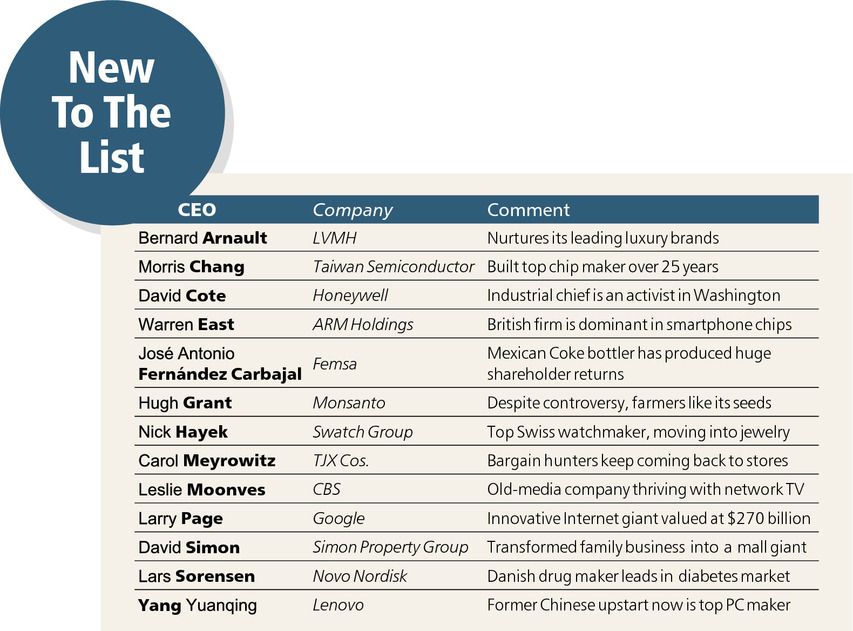
For the second straight year, there’s a lot of turnover in our list, as 13 new CEOs are joining our shrine. Yang is among the newcomers, along with Leslie Moonves of CBS,Bernard Arnault of LVMH Moët Hennessy Louis Vuitton, David Cote ofHoneywell, and Carol Meyrowitz of TJX .
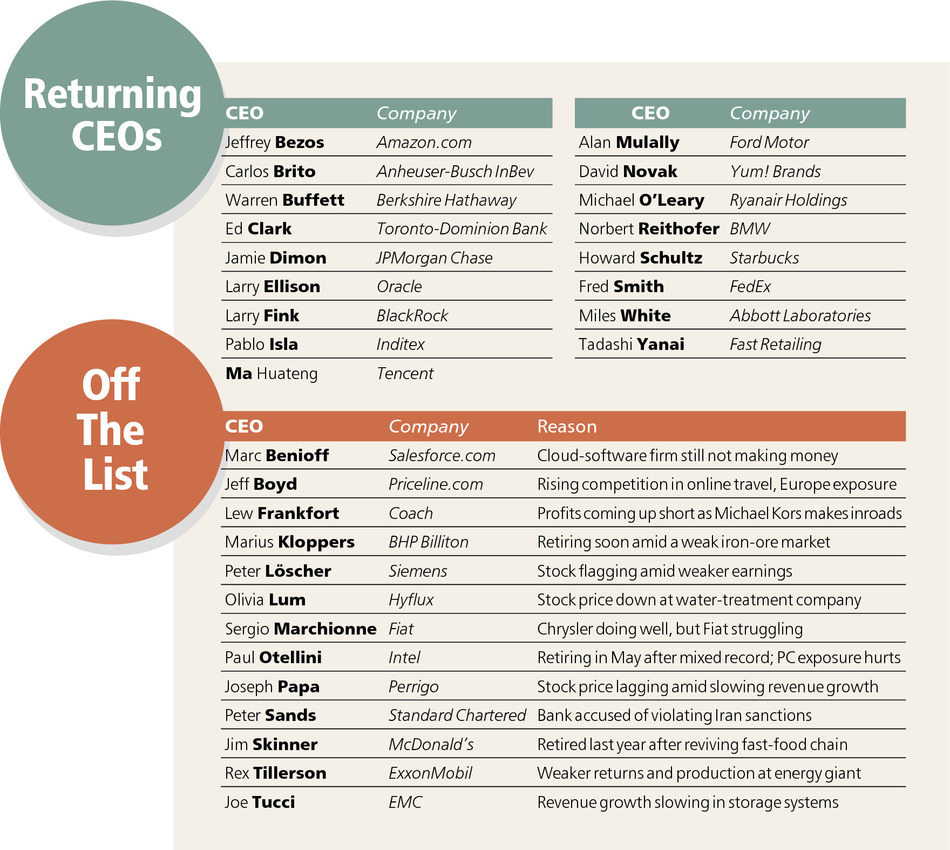
We try to set a high bar for keeping CEOs on our list. We removed 13 from last year’s list. Some deletions were an easier call than others. Rex Tillerson of ExxonMobil is gone because the oil giant’s production and returns are under pressure. Joe Tucci of EMC is out because revenue growth is slowing at the maker of data-storage systems. Lew Frankfort of Coach is off, as his firm’s profit growth has slowed and the stock price has slumped. It’s contending with competitive pressure in handbags and other accessories from hot brands like Michael Kors and Kate Spade.
Our group is global. Sixteen CEOs come from the U.S., eight from Europe, four from Asia, and one each from Canada and Mexico. For profiles of the 30 leaders in alphabetical order click here.
We don’t rely on any formula to draw up this list. It’s based on the views of Barron’sreporters and editors, and reflects insights from investors, analysts, and industry executives.
We like to see CEOs on the job for at least three years before we consider them, and we prefer a five-year minimum. It takes time to have an impact on a large organization, and developments in the initial year of a CEO’s tenure often have more to do with what the predecessor did than any new initiatives. We made an exception for Google‘s Larry Page, who became CEO in 2011, because he’s a co-founder of the company along with Sergey Brin and has played a key role in building the Internet giant into the country’s third-largest company, with a market value of $270 billion.
THERE ARE NO EASY JOBS at the helm of large companies, but some businesses are particularly hard due to narrow “moats” around their markets. A longtime member of our list, Michael O’Leary, heads Ryanair, the no-frills European airline that has thrived in a brutal industry. The outspoken O’Leary last week inked a huge order for Boeing 737s and defended the aircraft maker, saying “regulatory crap” was behind the grounding of its 787s amid concerns about battery fires.
The pressures are unrelenting in retailing, and the CEOs of Japan’s Fast Retailingand Spain’s Inditex have done especially good jobs. Fast Retailing’s Uniqlo chain and Inditex’s Zara aren’t well known in the U.S., but they have become two of the leading clothing retailers in the world.
TJX has built a business with a $33 billion market value — double that of Macy’s — by selling designer labels at sharp discounts in its T.J. Maxx and Marshalls stores. Shoppers like the treasure-hunt aspect of the stores and the ability to get a Michael Kors handbag for $150 that supposedly once retailed for $350. TJX somehow manages to regularly source enough designer stuff to fill almost 2,000 domestic stores. Credit CEO Carol Meyrowitz with that feat.
You probably won’t find Louis Vuitton bags at T.J. Maxx. CEO Arnault of LVMH zealously protects the image of his company’s most important brand and insists that slow-selling items be destroyed rather than marked down or sold to off-price retailers. That attitude has helped create the world’s top luxury-goods company.
Moonves has generated strong returns through superior management of an old-media portfolio that was deemed to be inferior to that of Viacom, with its cable networks, at the time of the two companies’ split in 2005. CBS is the longtime leader in prime-time ratings, and Moonves has pushed hard to get paid for its costly content, wresting sizable annual “retransmission” revenue from cable operators.
Sometimes we make mistakes in jettisoning CEOs. Warren East of ARM Holdings and Grant of Monsanto return to our pantheon this year.
East, who announced last week that he would retire in July, has fended off larger competitors, notably Intel, to dominate the processor market for mobile devices. He goes out on a high note, with ARM Holdings shares at a record. Since we removed Grant in 2010, Monsanto has cemented its hold on the market for genetically modified seeds, and profits have rebounded. We welcome them back.
 About bambooinnovator
 Bamboo Innovator