China Says Elected Hong Kong Leader Cannot Oppose Beijing Rule

China Says Elected Hong Kong Leader Cannot Oppose Beijing Rule

China won’t allow Hong Kong to choose a chief executive who opposes Chinese government rule, as some lawmakers in the former British colony demand universal suffrage earlier than planned in 2017.

The leader of Hong Kong “can’t plot to overthrow the rule of the Chinese Communist Party,” Qiao Xiaoyang, chairman of the law committee of the National People’s Congress, said in a March 24 speech, according to a transcript posted online today. “Opposition isn’t defined to mean criticizing Beijing. If it’s for the good for the country, any sort of criticism is allowed.” Read more of this post

In the shadow of well-known brands like Volvo and Ericsson, an acquisition-packed decade has made technology firm Hexagon one of Sweden’s most valuable companies and a rare newcomer among its top blue chips.

From tuna to tech, Hexagon breaks Swedish mould

Rollen, the president and chief executive officer of Hexagon, poses by the London Eye in London

11:44am EDT

By Niklas Pollard and Johannes Hellstrom

STOCKHOLM (Reuters) – In the shadow of well-known brands like Volvo and Ericsson, an acquisition-packed decade has made technology firm Hexagon one of Sweden’s most valuable companies and a rare newcomer among its top blue chips.

The company, market leader in precision measurement technology used in fields from microchip making to surveying dam construction, is now worth more than Swedish world number two white goods maker Electrolux after taking its business so far from its roots as to be unrecognizable.

When Ola Rollen stepped through the doors at Hexagon as CEO in 2000, leaving a job as head of a division at engineer Sandvik, he entered a company with lots of businesses but no business idea and scarcely any growth prospects.

Founded in 1975, Hexagon was then a sprawling conglomerate with its fingers in everything from tuna fish imports to vehicle hydraulics and, as financier Melker Schorling told Rollen at a meeting in downtown Stockholm in 1999, it was basically garbage.

Schorling had bought a controlling stake in the company the year before, aiming to build something from the ground up. Rollen, who first made a name for himself as a young CEO of metals firm Kanthal, had attracted his attention. Read more of this post

Do Countries Falsify Economic Data Strategically? Some Evidence that They Do

Do Countries Falsify Economic Data Strategically? Some Evidence that They Do

Tomasz Kamil Michalski HEC Paris – Department of Economics and Decision Sciences

Gilles Stoltz Ecole Normale Superieure de Cachan; HEC Paris – Department of Economics and Decision Sciences

The Review of Economics and Statistics, Forthcoming
HEC Paris Research Paper No. 930/2010 

Abstract: 
We find evidence supporting the hypothesis that countries at times misreport their economic data in a strategic manner. Among those suspected are countries with
fixed exchange rate regimes, high negative net foreign asset positions or negative current account balances, which corroborates the intuition developed with a simple economic model. We also find that countries with bad institutional quality rankings and those in Africa, Middle East, Eastern Europe and Latin America release economic data of questionable veracity. Our evidence calls for models with public signals to consider strategic misinformation and for establishing independent statistical agencies to assure the delivery of high quality economic data.

100 Years of Georg Wilhelm Claussen: A Century for Brands and People. He stands for continuity and innovation, for successful brand management and humane cooperation.

100 Years of Georg Wilhelm Claussen: A Century for Brands and People

  • For almost 75 years Georg W. Claussen has been part of the success story of Beiersdorf
  • For more than three decades he shaped the development of world brands like NIVEA, Eucerin, Labello, 8×4, Hansaplast and tesa as Chairman of the Board and on the Supervisory Board
  • On June 5th the Hamburg-native will turn 100

Hamburg, June 4, 2012 – Georg W. Claussen is an unusual German company figure – the grand nephew of Dr. Oscar Troplowitz, the man who in 1911 invented the largest skincare brand with NIVEA – he consistently lived corporate responsibility and embodies like no other the values of Beiersdorf. He stands for continuity and innovation, for successful brand management and humane cooperation.

_Original_9916_1477624_georg_w_claussen_beiersdorf
Record Setting Life Achievement
As a young man in 1938, Claussen entered the company and starting in 1952, he was a member of the board. In 1957 he became the Chairman of the Managing Board of the then 75-year old Beiersdorf AG. For 22 years he held this position until he switched to the Supervisory Board for another nine years. More than three decades long he shaped the development of world brands like NIVEA, Hansaplast, 8×4 and tesa. Since 1989, he has been part of the company as an Honorary Chairman of the Company. He completed 58 Annual General Meetings behind the podium, first as Chairman of the Board, later as Chairman of the Supervisory Board, then as Honorary Chairman of the Company – surely a unique record in German economy.

An Impressive Figure
The “Elder”, as he is lovingly and respectfully named at Beiersdorf, is in very close contact with the company. Until recently he still worked regularly in his office on the 5th floor of company headquarters on Unnastrasse. “Mr. Claussen was a partner in dialogue for the board and management on many subjects,” said HR and Finance Board Member Dr. Ulrich Schmidt, who has known Claussen for almost 30 years. “As a businessman, not only the brands and markets were important to Claussen, but also the people.” And he embodies something that has become rare today: “Hanseatic Understatement.” He does good without having to talk about it. In this way his outstanding engagement for his home city of Hamburg, and his generous support of numerous institutions and facilities of art, culture, science and social work have earned great respect. The Claussen Simon Foundation, for example, founded in 1982, supports science and its offspring. Read more of this post

Beiersdorf’s Longest-Serving Chief Claussen Dies at 100; Nivea, which Troplowitz developed from the discovery of water-and-oil emulsifier Eucerit, is Hamburg-based Beiersdorf’s biggest source of revenue.

Beiersdorf’s Longest-Serving Chief Claussen Dies at 100

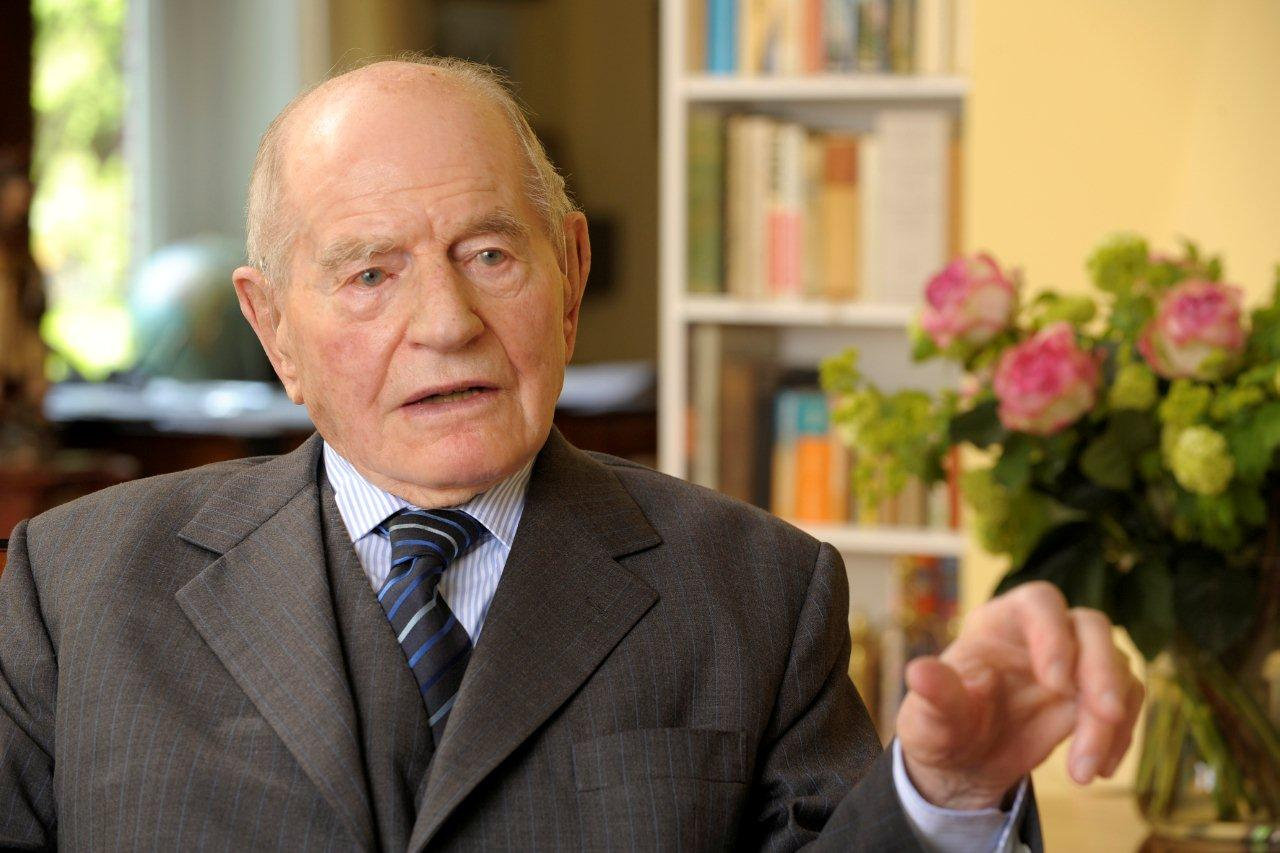
Georg W. Claussen, who was the longest-serving chief executive officer at Nivea skin-cream producer Beiersdorf AG (BEI), has died. He was 100.

Claussen, died on March 21 in his hometown of Hamburg surrounded by his family, Beiersdorf said on its website today. He was the grand nephew of Oscar Troplowitz, who invented Nivea in 1911, it said. Claussen joined Beiersdorf’s management board in 1954 and was CEO from 1957 until 1979.

Nivea, which Troplowitz developed from the discovery of water-and-oil emulsifier Eucerit, is Hamburg-based Beiersdorf’s biggest source of revenue. CEO Stefan Heidenreich, who joined the company at the beginning of 2012, has pledged to return the Nivea brand to its roots, creating a new logo and packaging inspired by the product’s traditional box.

“We have lost a towering businessman and luminary,” Heidenreich said in today’s statement. Claussen “has left a lasting mark on Beiersdorf, and what he achieved laid the foundation for today’s success.” Read more of this post

EMC Losing Ground as Smartphones Displace RSA Tokens; “There’s a lot of innovation going on right now because it’s a dangerous world,” Lee Congdon, chief information officer at Red Hat

EMC Losing Ground as Smartphones Displace RSA Tokens

Security tokens used to safeguard computer networks risk going the way of the rotary phone as EMC Corp. (EMC)’s RSA unit, the top maker of the devices, is challenged by smartphones deployed as cyber-protection tools. Vasco Data Security International Inc. (VDSI) and Gemalto NV (GTO), two companies with identification-software that runs on tokens, tablets and smartphones, saw their market share roughly double last year, reducing RSA’s portion to 60 percent from 76 percent in 2011, according to WinterGreen Research Inc. As an increasing number of consumers shop and bank online and more workers access corporate networks via mobile devices, global sales of identity-protection products will surge to $6.43 billion by 2016, from $4.51 billion last year, according to IDC. Software startups seized on an opening created after hackers compromised millions of RSA tokens two years ago to promise corporate customers better protection at a lower price.

“There’s a lot of innovation going on right now because it’s a dangerous world,” Lee Congdon, chief information officer at Red Hat Inc. (RHT), said in an interview. “Malicious people are becoming more adept. Folks are actively trying to steal your secrets and money.” Red Hat, the biggest seller of Linux operating system software, began replacing RSA tokens with Gemalto’s tools last month, Congdon said. “It’s considerably less expensive,” Congdon said. Gemalto’s tokens, paired with a free mobile application, cost less than half the price of protection from RSA, he said. Read more of this post