Food Fraud Hits New Low: Dog Meat In British Curry

Food Fraud Hits New Low: Dog Meat In British Curry

03/28/2013 15:34 -0400

Submitted by Michael Krieger of Liberty Blitzkrieg blog,

The food fraud story has now progressed from somewhat humorous with the undersized Subway footlong subs, to the highly disturbing with the revelations of horse meat and fake tuna, to the really creepy with the now potential emergence of dog meat in UK lamb curry.  No you can’t print lamb folks, which is exactly why many humans are now eating worse than their pets in the Western world.

A mystery meat, which has defied the best efforts of scientists to identify it, has been found in a lamb curry as part of an investigation into food fraud. The discovery raises new questions about just what is going into the nation’s takeaways and processed foods. The meat in a Beef in Black Bean Sauce dish turned out to contain high levels of chicken material including blood, while a burger contained no beef at all, other than blood and heart. However, most alarming of all was a curry. A spokesman for the programme said: ‘Just when we thought things couldn’t get any worse, the results came in for an Indian Lamb Curry. ‘It did contain meat, but that meat was not lamb, not pork, nor was it chicken or beef. Not horse, and not goat either. All of the many tests to date by the lab used by the programme have failed to identify exactly which animal was the source of the meat. The revelation raises many grim possibilities. There is evidence from Spain, for example, of meat from dog carcasses being processed for use in pet food. At the same time, a meat cutting plant in Wales has been accused of supplying horsemeat from an abattoir in Yorkshire to companies making kebabs and burgers for hundreds of independent take-aways. Read more of this post

Small companies struggling to repay loans in Italy and Spain signal bigger problems on the horizon for the euro zone after the dust has settled on Cyprus’s last-ditch bailout

Small businesses spell big problems for Italy and Spain

2:10am EDT

By Silvia Aloisi and Sarah White

MILAN/MADRID (Reuters) – Small companies struggling to repay loans in Italy and Spain signal bigger problems on the horizon for the euro zone after the dust has settled on Cyprus’s last-ditch bailout this week.

Defaults by small and medium-sized enterprises (SMEs), easily the biggest employers in Spain and Italy, are rising at a worrying clip, spelling trouble for the banks and two countries at the heart of Europe’s debt crisis.

“You can be sure that if these companies’ bad debts rise, you’re going to see more bad loans to families, and credit card bills that won’t be paid,” said Javier Santoma, finance professor at Spain’s IESE business school.

The ability of Italy and Spain, which account for 28 percent of the euro zone economy compared with Cyprus’s 0.2 percent, to pull themselves out of crisis and avoid full-blown bailouts depends on the health of their banks; weak banks conserve capital rather than lend to get the economy moving. Read more of this post

Student loan write-offs hit $3 billion in first two months of year as many graduates remain jobless, underemployed or cash-strapped in a slow U.S. economic recovery

Student loan write-offs hit $3 billion in first two months of year

By Elvina Nawaguna | Reuters – Mon, Mar 25, 2013

By Elvina Nawaguna

WASHINGTON (Reuters) – Banks wrote off $3 billion of student loan debt in the first two months of 2013, up more than 36 percent from the year-ago period, as many graduates remain jobless, underemployed or cash-strapped in a slow U.S. economic recovery, an Equifax study showed. Read more of this post

Missing Tycoon Mars Overseas Push of China’s Private Businesses; Liu’s rise to riches and sudden disappearance aren’t just the makings of a made-for-Hollywood potboiler. They’re a warning of the risks investors take when dealing with opaque private businesses in China, where fortunes depend on political ties and the favors of state entities, and even the wealthiest entrepreneurs can vanish if they lose the patronage of powerful government allies

Missing Tycoon Mars Overseas Push of China’s Private Businesses

Even by the standards of China’s rough and tumble breed of entrepreneurs, billionaire Liu Han’s brushes with death mark him out.

After dodging a hitman’s bullets in 1997, which led to the execution of a rival tycoon and two of his relatives almost a decade later, Liu, 47, finds himself ensnared in more killings. This time, his own brother is the suspect, and the Sichuan Hanlong Group founder is being held by police for helping him evade capture over a 2009 triple murder, state media reported.

The arrest throws into jeopardy Hanlong’s planned mining investments, casting doubt on the future of Sundance Resources Ltd. (SDL)’s $4.7 billion iron-ore project in West Africa and General Moly Inc. (GMO)’s Mt. Hope, Nevada, molybdenum mine. His detention still hasn’t been confirmed by authorities and there has been no official indication of who is now running Liu’s empire, which spans energy, real estate, chemicals and technology.

Liu’s rise to riches and sudden disappearance aren’t just the makings of a made-for-Hollywood potboiler. They’re a warning of the risks investors take when dealing with opaque private businesses in China, where fortunes depend on political ties and the favors of state entities, and even the wealthiest entrepreneurs can vanish if they lose the patronage of powerful government allies. Read more of this post

Emerging Stocks Head for Worst First Quarter Since 2008

Emerging Stocks Head for Worst First Quarter Since 2008

Emerging stocks fell, extending the biggest first-quarter slump since 2008, as China’s banking regulator tightened rules on wealth-management products and the cabinet called for new measures to deregulate interest rates. Read more of this post

Hunt Brothers Becomes Billionaire on Bakken Oil After Bankruptcy from Silver Manipulation 33 Years Ago

Hunt Becomes Billionaire on Bakken Oil After Bankruptcy

William Herbert Hunt was once one of the wealthiest men on Earth. With his brother, Nelson Bunker Hunt, the billionaire bought more than 195 million ounces of silver — 60 percent of the U.S. market — in the 1970s. By early 1980, their stake was valued at more than $9 billion.

The Hunts’ position imploded when silver prices plummeted 80 percent over the course of a few weeks in March 1980, culminating 33 years ago this week on what traders called Silver Thursday. The crash rattled Wall Street and sent the Texas brothers into bankruptcy.

Hunt is once again a billionaire, this time with oil. In October, he sold 43 percent of the North Dakota petroleum assets owned by his closely held Petro-Hunt LLC for $1.45 billion to Houston-based Halcon Resources Corp. (HK) The cash and stock deal made Hunt Halcon’s largest shareholder and boosted his net worth to $4.2 billion, according to the Bloomberg Billionaires Index. Read more of this post

Matthew 25 Fund Inspired by Scripture Returns 27%

Matthew 25 Fund Inspired by Scripture Returns 27%

When the Matthew 25 Fund fell 40 percent in 2008, it kept Mark Mulholland awake at night.

Mulholland, the founder and sole manager of the mutual fund — named after a Bible passage — says he would lie in bed thinking about the damage he had done to his investors, particularly the elderly whose nest eggs might not recover before they died. The assets he managed dwindled to $22 million from $115 million, Bloomberg Markets will report in its May issue.

What Mulholland didn’t worry about were the stocks in his portfolio.

“The companies we owned were so cheap that barring a total collapse of the economic system, I knew at some point we were going to make a lot of money,” he says.

That time has come. Mulholland, 53, bought smartphone maker Apple Inc. (AAPL) in 2008 for $80 to $128 a share. He also hung onto his investment in companies such as Sidney, Nebraska-based Cabela’s Inc., (CAB) a retailer of hunting and fishing products, and Medina, Minnesota-based Polaris Industries Inc. (PII), which makes all-terrain vehicles.

The rebound in those stocks helped propel the now-$452 million fund to gains that beat the Standard & Poor’s 500 Index by a wide margin. The fund returned 13.1 percent annualized during the five years ended on Feb. 15 compared with 4.7 percent for the S&P 500 (SPX). Matthew 25 (MXXVX) gained 26.8 percent over three years and 25.4 percent in one year. Read more of this post

Aberdeen, Manulife Seek More Independent Boards: Southeast Asia

Aberdeen, Manulife Seek More Independent Boards: Southeast Asia

Southeast Asia’s companies need to add more independent directors to their boards and boost diversity to attract foreign investors including Aberdeen Asset Management Plc (ADN) and Manulife Asset Management.

One of the biggest obstacles is strengthening the roles of independent directors because many publicly traded companies in the region are family-owned, Stephen Schuster, a financial sector specialist at the Asian Development Bank, said in an interview yesterday from Manila. Other challenges include disclosure and cross-border dispute resolution, he said. Read more of this post

Hong Kong Drops New Law Restricting Access to Directors’ Details

Hong Kong Drops New Law Restricting Access to Directors’ Details

Hong Kong’s government dropped legislation that would restrict public access to the personal details of company directors, following opposition from unions, small businesses and journalists.

The Financial Services and Treasury Bureau removed provisions obscuring company directors’ residential addresses and full identification numbers from an overhaul of the city’s companies ordinance, according to a legislative briefing document sent by e-mail from Shirley Wong, the department’s spokeswoman.

Opponents of the change said it would protect bosses from scrutiny and erode the city’s reputation by making it easier to launder money and cheat on taxes. Trade unions have used the database to track down runaway employers who owed wages, and small businesses use the information to conduct background checks on trading partners. Read more of this post

Zoomlion, China’s second-biggest construction equipment maker, Misses Estimates on Finance Costs, Demand Weakness; The stock has slumped 21 percent since Ming Pao reported on Jan. 8 that it had received an unsigned letter alleging that Zoomlion’s sales are exaggerated

Zoomlion Net Misses Estimates on Finance Costs, Demand Weakness

Zoomlion Heavy Industry Science and Technology Co., China’s second-biggest construction equipment maker, posted profit that missed analyst estimates as government measures to cool the property market damped demand while finance costs and provision for bad debts increased.

Net income in 2012 fell 9.1 percent to 7.33 billion yuan ($1.18 billion) from 8.07 billion yuan in the prior year, according to a filing to the Hong Kong stock exchange today. That compares with the 8.49 billion yuan average of 26 analysts’ estimates compiled by Bloomberg. Sales climbed 3.8 percent to 48 billion yuan.

Zoomlion, based in Changsha, Hunan province, and bigger rival Sany Heavy Industry Co. face a drop in orders as slowing economic growth and government curbs on the property market sap demand. Zoomlion is also seeking to boost investor confidence after its shares slumped following a January report in Hong Kong’s Ming Pao newspaper that the company’s sales may have been exaggerated.

“Economic growth in China remained slackened with low investment in infrastructure,” the company said in today’s statement, “The construction machinery industry was also under severe challenges brought by the sluggish growth of production and sales and the increase in credit risks.”

Shares (1157) of Zoomlion rose 0.9 percent to HK$9.37 at the close in Hong Kong trading, before the earnings were released. The stock has slumped 21 percent since Ming Pao reported on Jan. 8 that it had received an unsigned letter alleging that Zoomlion’s sales are exaggerated. Read more of this post

When Will Deposit Haircuts Take Place In Other European Countries?

When Will Deposit Haircuts Take Place In Other European Countries?

Tyler Durden on 03/28/2013 11:55 -0400

When all is said and done, what happened in Cyprus over the past two weeks, is nothing but the culmination of re-marking the “assets” in the country’s financial system (which as noted previously, were a preponderance of worthless Greek bonds and countless other non-performing loans), long priced at assorted “myth” levels, to a long overdue reality. As a result of delaying resolving the mismatch between non-performing assets and liabilities for years, the resolution was one which saw some €16 billion of the total asset base impaired, which in turn necessitated the impairment of billions of deposits: the primary liability funding the Cypriot financial system. Furthermore, as a result of the “Freudian Slip” by the Eurogroup’s new head earlier this week, we know that Cyprus will be the template for all future bank resolutions, which seek to avoid a democratic popular vote of depositor self-impairment (a vote which is now known will never actually pass) and proceed to restructuring the banking sector a la carte, by liquidating bad banks and impairing liabilities to the point where the balance sheet is once again viable (however briefly).

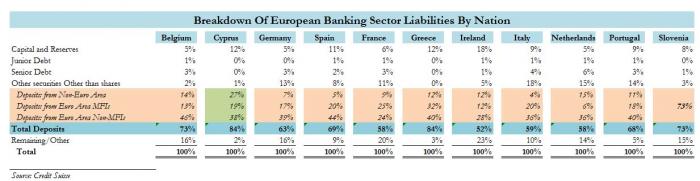
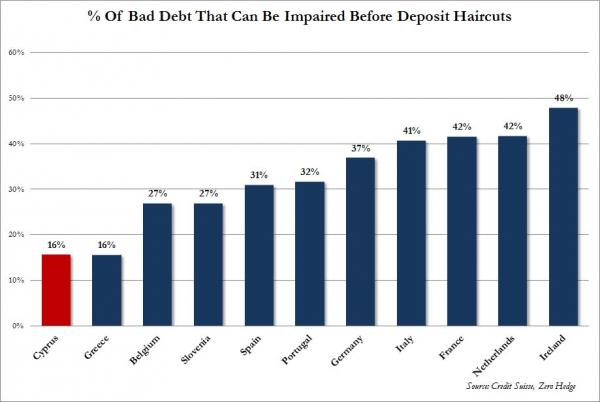
The bottom line is that at its core, it is all simply a bad-debt problem, and the more the bad debt, the greater the ultimate liability impairments become, including deposits. Which means that the real question in Europe is: how much impairment capacity is there in the various European nations before deposits have to be haircut? Thanks to Credit Suisse we now know the answer. The chart below shows the liability breakdown for various Eurozone nations, of which the key line item is the Total Deposits, and which in Europe comprises the bulk of bank funding. It becomes obvious why Cyprus had no choice but to crush depositors: they make up a whopping 84% of all liabilities (the highest in Europe and matched only by Greece), so assuming all other liabilities are liquidated, there still would be impairments if the total bad assets (assuming all bank assets are loans which in Europe, unlike the US, is more or less the case) pushed above 16% which in Cyprus they did. So applying some simple balance sheet equality math, one can quickly calculate how much of a “Bad-Debt Impairment” assorted European financial systems can withstand before they too have no choice but to follow in Cyprus’ footsteps and begin crushing depositors, who in bankruptcy court are known by a different, less friendly term: General Unsecured Claims.

Euro Financial Liabilities_2_0

Bad Debt Capacity_0 Read more of this post

Chart of the day: Euro area M3 growth vs Bank lending to euro area private sector

M3 Credit February Europe_0

James Altucher: Unschool Yourself!

Unschool Yourself!

Posted by James Altucher on March 28th, 2013 at 9:36 am

I want to put on Google Glasses, stare at the sun until I go blind, and have a Google Hangout with all my friends at the same time while the sun burns my vision away. Everyone will see what I will be seeing (or not seeing. Because of going blind) because of the Google Glasses. I feel like that would make me a master of the universe. My teachers from grade school would be proud. They might rename the school after me. I told my kids, “You’re always complaining about school. If you don’t like school just don’t go. I don’t care at all.” And guess what? They practically spit in my face in rebellion. They didn’t shoot up crack heroin. Or get tattoos. They went to school. HOW DARE THEY! I wasn’t even trying to do any reverse psychology on them. Reverse psychology is for people afraid to say the truth. It was like reverse reverse psychology. My kids can do what they want. What I give them is not freedom but choice. They choose to go to prison. That’s fine. School was like a mental institution for me where I was force fed the following drugs:

1) Lots of facts. At talks I ask people, “When was Charlemagne born?” I have yet to get a response that is correct within 200 years. Research shows that 90% of what we learn in a class we forget after 45 minutes. The reason is: our brain likes to have 2 or more things going for it before it is convinced it has a worthy fact for memory. So, “passion + awe” are two things. But boring facts disappear quickly.

2) Perfectionism. Schools celebrate the A+ and punish the C-. Whenever my daughter tells me she got an A+ I ask her why she wants to take a class that is too easy for her. The C- shows you so much more: What you need to learn. What you might not be interested in. How to deal with imperfection. How to deal with the pride of others. How to deal with insecurity. As some woman tweeted on twitter the other day, @jaltucher is a C-. I have room to improve!

3) Cliques. My best friend Jimmy Biondo punched me in the back at my locker and I fell to the ground and started crying. I think I was 15. In school you have a small group of people to choose from for friendship. This makes for political, spiteful, gossip-filled, often Lord-of-the-Flies-style friendships. Yeah, I’m the ugly kid that got killed in the book. And no, I did not read the book in school. I read the Cliff’s Notes.

) Science and Math. While these are beautiful subjects I often feel that my kids are encouraged to drop their creativity at the door if it involves art or storytelling. Everything is rote, then tested. Then rote again, then tested again. For twenty years. That’s only a tiny part of the brain. Humans are meant to use their entire brain. It’s our entire brain that let’s us DESTROY and RULE the animal kingdom.

5) Work. From 7am to often 10pm, my kids are “working”. They sit in classrooms all day, barely moving, and then they are often working on homework until they fall asleep. They learn to work hard. But…

But as an adult, if you want to succeed, be creative, learn to fail, learn to sell ideas, learn to build momentum around your life, you need to UNLEARN:

HOW TO UNSCHOOL YOURSELF:

A) Play. Playing (however you want to define that word) reduces stress, encourages creativity, increases happiness, is FUN. Nothing wrong with that. Maybe people think they HAVE to be working. Else they are unproductive. They get this reactive stress when they aren’t “at work”. Because we got addicted to working back in our school daze. What should you play at? I don’t know! Do whatever you want. Go to a museum. Or a movie in the middle of the day. Or pee in public places, take pictures of the pee, and make a photo exhibit. Who cares? Homework! – think of five things you can “play” at today.

B) Creativity.  Sometimes I’m sick of writing this blog. So I do other stuff. I draw. Or I take photographs of my urine in public places. Or I plan my upcoming run for Congress! (Don’t tell Claudia. She is against it). This makes my brain feel good. I can literally feel the neurons light up. It makes my brain feel loved by me. Every day I try and exercise different parts of my brain. Homework! – What are some ways you can be creative today outside your normal work schedule?

C) Friendship. It turns out we don’t have to be friends with the people immediately around us. That was only a school thing. We can choose to be friends, instead, just with the people who love us and who we love. Like how I’m friends with Oprah. Hi honey! I didn’t learn this for a long time. And this one aspect of my life made me desperately unhappy. Maybe I finally learned it in 2010. I was 42 years old. Some people, thank god, learn it much earlier. But I had to “unschool” myself from all that I learned about friendship in ninth grade.

D) Imperfectionism. A friend of mine once told me she wanted to go to Paris because she’d really be able to paint there. Good fucking luck. Situations are never perfect. We’re never perfect. It’s 20 years later and she hasn’t gone through one color on her watercolor set. Being comfortable with imperfection gives us a lot more opportunities. And helps us love ourselves more. And we don’t get easily ashamed, which translates to deeper honesty and relationships. Perfectionism is a cage that has captured our happiness and won’t let it out. I lost a lot of friends when I stopped pretending to be perfect. I was afraid people would not like and I was right. That’s ok. See “C” above. Finally, all of life is a sculpture chiseled with the knife of imperfection. Realizing that allows us to be kind to the chaos we see everywhere. We’re all going through a hard time just trying to live.

E) Make shit up. Facts are for boring people. I can look up any fact on Google. It doesn’t make me stupid. It makes room in my brain to have fun. I only read the things I’m passionate about. I look up the things I could care less about but maybe need to know for a split-second every now and then. (Charlemagne was born in 742 AD. Thank you Wikipedia!). So just read about stuff you’re interested  in. Today I’m reading “New Ideas in Backgammon” so I can crush Dubner the next time I play him. (MEGA-CHAMPION!)

F) Independence. Finally, they never teach this in school. So it’s hard to learn it as an adult. We lose the habit. But once you learn to be creative, to have positive friendships. to have ideas, to be imperfect, you also have to learn how to sell your ideas to people who believe in them. This is the beginnings of independence. This means you graduate life and get the keys to the kingdom. Start unschooling yourself today. Unschooling is not ust for kids. Read more of this post
How Multilatinas Are Taking Over the World

How Multilatinas Are Taking Over the World

25 MAR 2013 – JONATHAN KANDELL

HERE’S A TEST OF YOUR GLOBAL BUSINESS IQ. Where would you find each of the following: the world’s largest baker, the leading iron miner and the second most valuable airline by market capitalization?

Answer: Latin America. Mexico’s Grupo Bimbo has built the world’s largest bakery products company through a string of acquisitions, Brazil’s Vale is the biggest producer of iron ore, and Latam Airlines Group, a Chilean-controlled company that combines Chile’s LAN and Brazil’s TAM airlines, is the continent’s dominant carrier, with a stock market value of $11.4 billion, second only to Delta Air Lines.

These companies are far from alone. Latin America’s economic renaissance over the past two decades has fostered the emergence of a new generation of corporate champions with regional, and sometimes global, ambitions. Read more of this post

Layoffs trigger panic among Chinese multinational employees; Last year, many multinational employees became eager to change jobs due to worries of being laid off, which was very rare in the past

Layoffs trigger panic among Chinese multinational employees

SHANGHAI, March 28 (Xinhua) — Chinese employees of multinationals are finding their jobs no longer secure and enviable as a massive round of layoffs has hit such companies. Read more of this post