Economists: China Mirrors U.S. on Eve of Financial Crisis

March 18, 2013, 5:20 PM

Economists: China Mirrors U.S. on Eve of Financial Crisis

The same three warning lights that preceded America’s real estate crash and financial crisis are now flashing over China, two economists say, leaving the government limited time to get out of trouble.

In a research note published on Saturday, Nomura economists Zhiwei Zhang and Wendy Chen outline the way that elevated property prices, a rapid build-up of leverage and a slide in the country’s potential growth rate could lead to a systemic crisis.

House prices in the U.S. racked up an 84% rise between 2001 and 2006, Mr. Zhang and Ms. Chen say, citing the Case-Shiller housing price index. The Nomura economists have their doubts about China’s official index, which shows a “rather benign” 113% rise in the major cities from 2004 to 2012. They argue that it is too broad, including older, lower-quality property across the nation. By contrast, a recent academic paper taking into account these quality differentials found prices climbed 250% from 2004 to 2009, they say.

“The government obviously recognizes the risks in the property sector,” Mr. Zhang and Ms. Chen write. “It has introduced a series of progressively tighter policies to contain property prices over the past several years… The pattern has been for house prices to initially dip after tightening policies are introduced, then to rebound, which suggests that the risks have not been mitigated.” Read more of this post

Magazine-Cover Curse Takes on New Meaning in Asia

Magazine-Cover Curse Takes on New Meaning in Asia

Will Shinzo Abe’s plan to revive Japan suffer the magazine-cover curse? Might Benigno Aquino meet the same fate in the Philippines?

What both leaders have in common is everyone slapping the “-nomics” suffix onto their growth strategies. “Abenomics” has excited investors, not to mention the pundit class, with its aim of ending 15 years of deflation. The same is true of “Aquinomics” in a country long deemed the sick man of Asia, now an investment darling.

Such bouts of euphoria often end in tears: “Reaganomics,” “Rubinomics” and “Bushonomics” in the U.S.; “Thatchernomics” in the U.K.; “Berlusconomics” in Italy; and “Thaksinomics” in Thailand. Sometimes the reckoning comes in short order; other times it takes decades. The track records of all too many of these supposedly new formulas for prosperity are questionable.

The problem is hype versus real change. Having one of these splashy appendages added to your ideas tends to have the same reverse karma payoff as being on the cover of a large- circulation magazine. By the time a trend or ideology is popular enough to warrant such a tribute, the game is already up. So, is the buzz about the Japanese and Philippine economies overdone? It will be if leaders put too much stock in their own press. Read more of this post

Pimco’s Kiesel Says Corporate Bondholders ‘Wake Up’ to Risks

Pimco’s Kiesel Says Corporate Bondholders ‘Wake Up’ to Risks

Investors are “finally” acknowledging the risks of holding corporate bonds with yields hovering at about record lows as the Federal Reserve holds benchmark interest rates at close to zero for a fifth year, according to Pacific Investment Management Co.

“Bondholders are finally starting to wake up to the fact that easy monetary policy for an extended period can also have adverse consequences,” Mark Kiesel, global head of corporate bond portfolios at the manager of the world’s biggest bond fund, wrote today on the firm’s website. “This trend has helped reignite shareholder activism and corporate animal spirits.” Read more of this post

Ex-Calpers CEO Buenrostro Indicted Over Apollo Investment

Ex-Calpers CEO Buenrostro Indicted Over Apollo Investment

Ex-California Public Employees’ Retirement System Chief Executive Officer Federico Buenrostro was charged with conspiring to trick the pension fund into paying millions of dollars in fees for a $3 billion investment into funds managed by Apollo Global Management LLC. (APO) Read more of this post

Iceland’s Lost Billionaires Unmourned as Riches Draw Ire; “Greed can’t again lead the way,” said Prime Minister Johanna Sigurdardottir. “We’ve taken that route before with terrible consequences for this nation and its people.”

Iceland’s Lost Billionaires Unmourned as Riches Draw Ire

Iceland, a country with a $13 billion economy, had six dollar billionaires before the financial crisis struck in 2008. Now it has none.

Five of the men — including former West Ham soccer team owner Bjorgolfur Gudmundsson and Baugur Group hf founder Jon Asgeir Johannesson — have lost all, or most of, their fortunes after building empires on loans from banks that used the island’s investment bubble to stretch their assets to 10 times the size of gross domestic product.

At least three of Iceland’s ex-billionaires are, or have been, the subject of financial misconduct probes. Johannesson, who once flew around in a pin-striped private jet and owned luxury apartments in New York and London, received a suspended one-year jail sentence in February for violations including accounting fraud. He and Gudmundsson, who filed for bankruptcy in 2009, personified the boom-to-bust cycle that dragged Iceland away from fishing and tourism and turned it into a center for high finance.

“Greed can’t again lead the way,” said Prime Minister Johanna Sigurdardottir, 70, whose Social Democrat-led government took over from the coalition that led Iceland into the crisis just over four years ago. “We’ve taken that route before with terrible consequences for this nation and its people.” Read more of this post

Traders Short Junk-Bond ETFs as Gains Top 100%: Credit Markets

Traders Short Junk-Bond ETFs as Gains Top 100%: Credit Markets

Wall Street’s biggest credit brokers are for the first time using exchange-traded funds as a way to wager that junk bonds are overvalued.

Bank of America Corp. (BAC) traders who helped dealers move $1.5 trillion of credit-default swaps index contracts last year began offering clients the ability to trade blocks of bond ETF (HYG) shares in February, according to three people familiar with the trading and an e-mail sent to customers. Shares borrowed to make bearish bets on State Street Corp. (STT)’s $12 billion speculative-grade bond ETF soared to a record 11.5 percent of the total outstanding on March 1, up from 4 percent at year-end. Read more of this post

Sweden Laments ‘Crazy’ Devaluations Amid Krona Strength

Sweden Laments ‘Crazy’ Devaluations Amid Krona Strength

Sweden took another step to distance itself from policies targeting competitive devaluations as exporters were told a strong krona provides opportunities to make their businesses more efficient.

“It’s good for companies that they need to understand that they have to compete with real tools rather than the imaginary tool that the exchange rate is,” Financial Markets Minister Peter Norman said in a March 15 interview in the Swedish town of Karlstad, where his Moderate Party laid out the foundations for its 2014 election campaign.

While Swedish exporters have warned that continued krona appreciation will force them to cut jobs, the government and central bank have repeatedly rejected talk of boosting trade competitiveness through the exchange rate. And while policy makers from France to Japan argue in favor of weaker currencies, the Swedes have praised their krona’s strength. Central bank governor Stefan Ingves in an interview last month said he was “happy” with the currency’s gains.

Sweden didn’t always have such a hands-off approach. Between 1976 and 1981, when the krona was linked to the Deutschmark and later to a basket of currencies dominated by the U.S. dollar, it was devalued four times. In 1982, its value was again cut, by 16 percent. After the Riksbank was unable to defend the fixed exchange rate inside the European Exchange Rate Mechanism — even resorting to a 500 percent marginal interest rate in 1992 — the peg was scrapped and a free float was introduced. Read more of this post

China’s Largest Mass Merchant Auchan/RT-Mart Turns to Its Own Brands for Growth

China’s Largest Mass Merchant Turns to Its Own Brands for Growth

Sun Art Retail Group Ltd. (6808), China’s largest operator of big-box stores, will boost its own brand offerings and add higher-margin items to increase sales after opening new stores helped raise 2012 profit by half.

The company’s RT-Mart and Auchan chains will add at least 700 more own-label products including stationary and cutlery this year and reduce local brands in favor of higher-end lines, Peter Huang, executive director, said in an interview. The retailer plans to boost own-brand sales to 10 percent of revenue in two years from 8 percent now, he said.

Huang’s shift to higher-end products is intended to help the Shanghai-based venture between Taiwan’s RT-Mart and France’s Groupe Auchan SA maintain its lead over Wal Mart Stores Inc. (WMT) and Carrefour SA (CA), its biggest rivals. Retailers can earn gross profit margins of between 10 percent to 25 percent on own branded non-food items, said Nice Wang, an analyst with Yuanta Securities HK Co. Read more of this post

Big Mac Fights Subway Shrimp in Russia Fast-Food Fracas

Big Mac Fights Subway Shrimp in Russia Fast-Food Fracas

More than two decades after McDonald’s Corp. (MCD)’s outlet on Moscow’s Pushkin Square began offering a golden-arched alternative to grey communist eateries, the fast-food pioneer is on the defensive.

McDonald’s, which virtually created the market for burgers and fries in the country and convinced Russians it’s okay to eat with their hands, must fend off a growing challenge from rivals Burger King Worldwide Inc. (BKW), Subway Restaurants, Yum! Brands Inc. (YUM) and Wendy’s Co. (WEN)

“A huge number of Subways have appeared in Moscow in recent years, I pass about five of them on my way home,” said Dmitry Mikhailov, a 30-year-old consultant. McDonald’s “is crowded — it’s just for pigging out quickly and running away.” Read more of this post

Wheelchair Patients Find Obstacles at Doctor’s Offices

Wheelchair Patients Find Obstacles at Doctor’s Offices

Almost one-fourth of doctors are unable to accommodate and treat patients who use wheelchairs more than 20 years after the passing of the Americans with Disabilities Act, a study found.

About 22 percent of 256 doctor’s offices surveyed said they couldn’t assist people in wheelchairs, with most of those saying it was because they weren’t able to safely transfer the patient to an exam table, according to research published today in the Annals of Internal Medicine. Lack of access to the building was a secondary reason, the researchers said.

The Americans with Disabilities Act, passed by the U.S. Congress in 1990, is aimed at ending discrimination for people with disabilities in everyday activities including access to medical care facilities and the services provided there. Today’s findings are one of the first to show where barriers to medical services remain for wheelchair-bound patients, said Tara Lagu, the study’s lead author.

“This is affecting a large number of patients, certainly the 3 million who use a wheelchair, but many more than that who have difficulty getting up to an exam table,” said Lagu, an academic hospitalist at Baystate Medical Center in Springfield, Massachusetts, and an assistant professor at Tufts University School of Medicine, in a March 15 telephone interview. “The point of the study is to help doctors realize what the problems are and to help them become more aware of the Americans with Disabilities Act and to identify what the difficulties patients who use wheelchairs are having in accessing health care.” Read more of this post

“Off-label” use of anti-drowsiness drug skyrockets 10-fold over the past decade

“Off-label” use of anti-drowsiness drug skyrockets

4:18pm EDT

By Genevra Pittman

NEW YORK (Reuters Health) – The number of Americans taking the narcolepsy and shift work sleep disorder drug modafinil has increased almost 10-fold over the past decade, according to a new study.

What’s more, the majority of those prescriptions were written for so-called off-label conditions, such as depression and multiple sclerosis, researchers found. Read more of this post

Analysis: Antibiotics crisis prompts rethink on risks, rewards

Analysis: Antibiotics crisis prompts rethink on risks, rewards

12:39pm EDT

By Ben Hirschler

LONDON (Reuters) – Thirty years ago, when the world faced the terrifying prospect of an untreatable disease known as AIDS, big drugmakers scented an opportunity and raced to develop new medicines.

Today, as the world confronts another crisis, this time one of antibiotic resistance, the industry is doing the opposite. It is cutting research in a field that offers little scope for making money.

Antibiotics have become victims of their own success. Seen as cheap, routine treatments, they are overprescribed and taken haphazardly, creating “superbugs” they can no longer fight.

These “superbugs” are growing, but are not yet widespread, so the costly research needed to combat them is not worthwhile. Medical experts say this dilemma could return medicine to an era before Alexander Fleming discovered penicillin in 1928.

Fixing the problem will need both faster approval of last-resort drugs and new ways to guarantee rewards for companies, according to both industry leaders and public health officials who have been sounding the alarm. Read more of this post

Malls must move beyond shopping to survive in Internet era; Malls must become more like full-service community centers to survive in the face of a growing list of failed retailers like HMV and Blockbuster

Malls must move beyond shopping to survive in Internet era

10:13am EDT

By Tom Bill

CANNES, France (Reuters) – As growing numbers of shoppers move online, European mall owners are looking to pull in customers by including services that can’t be replicated on the Web like hospital care and government offices.

Malls must become more like full-service community centers to survive in the face of a growing list of failed retailers like HMV and Blockbuster, property experts at the annual MIPIM trade fair in Cannes, France, told Reuters.

On the flip side of that retail revolution, the experts see big gains in warehousing as more goods are sent and returned via post.

“The days of the stand-alone mall are numbered,” said David Roberts, the chief executive of architect Aedas, one of the five largest practices in the world. The company has been involved in city masterplan projects in Asia, Europe and the Middle East.

“In 20 years time you will find stores that sell books and DVDs replaced by sites that give people a reason to go the mall … art galleries, education centers and health and spa treatments.” Read more of this post

Taiwan’s Alishan cherry blossom season expected to draw huge crowds

Taiwan’s Alishan cherry blossom season expected to draw huge crowds

CNA 

  • 2013-03-17

Alishan

Alishan cherry blossoms and the famous forest railway. (Photo/CNA)

The Alishan National Scenic Area Administration on Friday launched the area’s cherry blossom annual celebrations, and said that the popular tourist destination in southern Taiwan could draw thousands of visitors per day during the flower season.

The celebration, which will run until April 15, marks the last of a series of cherry blossom festivals that have won huge popularity in Taiwan over recent years.

Priding itself on the approximately 5,000 cherry trees it has, Alishan might attract 14,000 tourists per day during the festival, said administration head Tseng Han-chou. Read more of this post

Moody’s Investor Services said China’s local-government financing vehicles face greater risk of default, as regulators warn 20 percent of their loans are risky.

Moody’s Sees Defaults as PBOC Warns on Local Risks

Moody’s Investor Services said China’s local-government financing vehicles face greater risk of default, as regulators warn 20 percent of their loans are risky.

A rally in LGFV bonds may reverse, particularly should delinqencies emerge, Christine Kuo, a Moody’s analyst, wrote in an e-mailed response to questions on March 8. The average yield may rise to 7 percent by June from 6 percent now, according to Shenyin & Wanguo Securities Co., the first brokerage incorporated in China and ranked the nation’s most influential research provider by New Fortune magazine in 2010.

“I see increased risk of LGFV defaults because the financial profiles of many remain weak and heavy refinancing is needed,” Hong Kong-based Kuo said. “Regulators have asked banks to control their LGFV exposures. Some of the projects could default unless other sources of funds are found.”

People’s Bank of China Governor Zhou Xiaochuan said in a March 13 press briefing that about one-fifth of loans to the financing arms of local governments are risky. Net debt issuance by these entities surged 179 percent in 2012 to 1.132 trillion yuan ($182 billion), accounting for 50 percent of corporate bond sales, according to Bank of America Corp. data. Read more of this post

Where ‘Channel-Stuffed’ German Cars Go To Die

Where ‘Channel-Stuffed’ German Cars Go To Die

Tyler Durden on 03/17/2013 21:57 -0400

With the collapse of Europe’s auto market, and the channel-stuffing that is rife in every car manufacturer in the world, it is no surprise that at the end of their brief lease periods, European cars (Audi in this case) are being led to this ‘graveyard’ in Germany (70 miles north of Munich). This car park of chaos is full of nearly-new cars meant for destruction so as never to enter the car market as a cheap alternative and to maintain a high-priced spare parts market. It seems the Keynesian profligacy or digging a hole to fill it in has progressed in the 21st century to building a car and crushing that car as the engine of growth for our economies. The site can be found here…

20130317_audi_0

Forecast: What Physics, Meteorology, and the Natural Sciences Can Teach Us About Economics

Forecast: What Physics, Meteorology, and the Natural Sciences Can Teach Us About Economics [Hardcover]

Mark Buchanan (Author)

Release date: March 26, 2013 | ISBN-10: 1608198510 | ISBN-13: 978-1608198511 | Edition: 1

Picture an early scene from The Wizard of Oz: Dorothy hurries home as a tornado gathers in what was once a clear Kansas sky. Hurriedly, she seeks shelter in the storm cellar under the house, but, finding it locked, takes cover in her bedroom. We all know how that works out for her.

Many investors these days are a bit like Dorothy, putting their faith in something as solid and trustworthy as a house (or, say, real estate). But market disruptions–storms–seem to arrive without warning, leaving us little time to react. Why are we so often blindsided by these things, left outdoors with nothing but our little dogs? More to the point: how did Kansas go from blue skies to tornadoes in such a short time?

In this deeply researched and piercingly intelligent book, physicist Mark Buchanan shows how a simple feedback loop can lead to major consequences, the kind predictable by mathematical models but hard for most people to anticipate. From his unique perspective, Buchanan argues that our basic assumptions about economic markets–that they are for the most part stable, with occasional interruptions–are simply wrong. Markets really act more like the weather: a brief heat wave can become a massive storm in a matter of a few days, or even hours.

The Physics of Finance reimagines the basics of how economics, with consequences that affect everyone. Read more of this post

The Insupportable Equilibrium of Economic Thought; In one form or another, positive feedback lies behind almost everything that makes our world rich and surprising, changeable and dynamic, lively and unpredictable

The Insupportable Equilibrium of Economic Thought

Conjure an image in your mind: a pencil resting on a small table, perhaps next to a notebook. In what position did you imagine the pencil? Lying on its side, right? Why not upright, with either the eraser or the graphite tip touching the table and the rest pointing into the air?

In terms of strict physical forces, it’s possible to position a pencil this way. We never see it happen because even the tiniest vibration, from the rumble of someone tapping the table to a slight shift in air currents, will knock it over.

The upright pencil is in what’s called unstable equilibrium, a state of being that can exist if unperturbed, but that will change rapidly if given the tiniest shock from the physical world. By contrast, a pencil lying on its side is in stable equilibrium. Blow on it, even slam your fist on the table, and the pencil will stay in that position or bounce around momentarily and then go back to it.

Stable equilibria are generally more important than unstable, because things in such states stay there. Whether we’re thinking of forces affecting a pencil or the Dow Jones Industrial Average, we can expect something to remain near a stable equilibrium but to wander away from an unstable one. So whenever we consider a state of equilibrium, we’ve got to ask whether it’s stable. Read more of this post

Cereal With 70% Sugar Hooks Kids on Junk-Food Bliss Point

Cereal With 70% Sugar Hooks Kids on Junk-Food Bliss Point

After E. coli from a burger paralyzed 22-year-old Stephanie Smith, Michael Moss’s newspaper story tracing the meat’s origins helped win him a Pulitzer Prize in 2010.

The titular villains of Moss’s new book, “Salt Sugar Fat: How the Food Giants Hooked Us,” aren’t much less malign. The three substances are tied to rising obesity, diabetes, hypertension and heart disease. They’re also the pillars on which the $1 trillion food-manufacturing industry is built.

Moss, a New York Times reporter, digs into the history, science, commerce and politics behind processed foods and Americans’ addiction to them. It’s a craving he tracks from lab bench and corporate memo to working moms and the mantra of convenience, from Wall Street’s relentless pressure for profit and the feckless regulators in Washington.

Moss makes the digestion of hard facts easier with a keen sense of the telling anecdote and detail. When he interviews the legendary Al Clausi in 2010, 64 years after he started as a food chemist for General Foods (MO), Moss observes a copy of the patent for Jell-O instant pudding hanging in the retiree’s office and on a shelf “a toy replica of the trucks that delivered Tang, another one of his iconic inventions.” Read more of this post

Chinese Kids Who Ignore Confucius Face State Backlash

Chinese Kids Who Ignore Confucius Face State Backlash

By Bloomberg News  Mar 17, 2013

In 10 years as head of an elder- care center in Confucius’s hometown of Qufu, Yang Youling has seen the Chinese philosopher’s exhortation of filial piety turned on its head.

Many children never visit their aged parents in the 50-bed home in eastern China’s Shandong province to avoid being criticized for not taking care of them at home, said Yang, 47. “The children are ashamed of being seen,” she said.

They may soon have no choice. From July 1, parents in China can sue their kids who don’t visit often enough, under a broadened law mandating children take better care of the aged. With China’s elderly population forecast to more than double to 487 million in the next 40 years, the government needs to try and limit the cost of caring for seniors.

“China’s aging problem is at a scale and speed not comparable with anywhere else in the world,” said Yuan Xin, director of Nankai University’s Aging Development Strategy Research Center in Tianjin, and a member of an advisory committee on the new rule. “My concern is how we can have sustainable economic development” while maintaining Confucian values such as respect and care for one’s parents, he said.

Traditionally, children lived with their parents and looked after them in accordance with Confucian beliefs. The ancient Chinese philosopher emphasized filial piety as the foundation of all values and placed great importance on harmony and a proper order of social relationships especially within families. Read more of this post

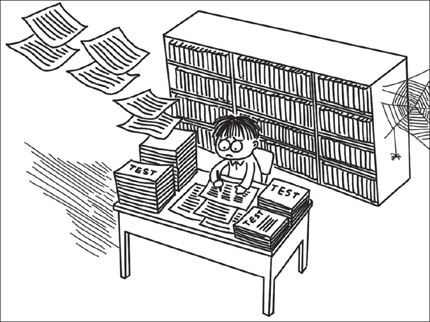
Test culture makes love of learning a waste

Test culture makes love of learning a waste

Created: 2013-3-18

Author:Wan Linxin

20130318_526209_01

RECENTLY while taking a stroll along nearby Weihai Road near Yan’an Road, I found a number of fashionable shops were closed and being remodeled. These shops come and go, and I would never have noticed them if they were not disappearing. But surprisingly, the opposite Jing’an Book Club remained open. It always puzzles me how any entity today can pretend not to care about turning a good profit. If it were not for the shelves of books, the club might well pass for an exclusive lobby, complete with beige lounges, fancy stools, long ivory-colored tables, all tastefully arranged in an ornate setting. No book reader can help being a bit flattered to be admitted – freely – into such a cultured milieu, at a time when brick-and-mortar bookstores are retreating or vanishing. The flagship Jifeng Bookstore in Shanxi Road S. metro station announced early this month it would close and move to another location after 15 years of operation, even though the rentals for the bookstore were only 10 percent the normal rates, for the bookstore had been seen somewhat as part of Shanghai’s cultural scene. Often have I strolled into this classy book club, and rarely did I find many readers. On the door was a notice to the effect that students can be admitted after 3pm by showing a pass issued by the club.

Of course, no one expects students to be readers. They are there doing their homework. I usually gave my third grader son a pat on the shoulder if he successfully prevents his homework from invading his sleep hours. One colleague of mine said that homework typically keeps his daughter busy until 10pm. My son has shown early promise of being an avid reader, but he has little time for reading, being perennially busy cracking problems meant to, among other things, assess his Chinese vocabulary, comprehension, and analytical skills. These ingeniously designed test items – cloze, multiple choice, summary – reduce to an ordeal a process that should be inspiring, exhilarating, and enchanting. Read more of this post

China is engineering genius babies; NYU Geoff Miller: BGI Shenzhen the biggest genetic research center in China, and I think the biggest in the world, by a considerable margin

CHINA IS ENGINEERING GENIUS BABIES

By Aleks Eror

It’s not exactly news that China is setting itself up as a new global superpower, is it? While Western civilization chokes on its own gluttony like a latter-day Marlon Brando, China continues to buy up American debt and lock away the world’s natural resources. But now, not content to simply laugh and make jerk-off signs as they pass us on the geopolitical highway, they’ve also developed a state-endorsed genetic-engineering project.

At BGI Shenzhen, scientists have collected DNA samples from 2,000 of the world’s smartest people and are sequencing their entire genomes in an attempt to identify the alleles which determine human intelligence. Apparently they’re not far from finding them, and when they do, embryo screening will allow parents to pick their brightest zygote and potentially bump up every generation’s intelligence by five to 15 IQ points. Within a couple of generations, competing with the Chinese on an intellectual level will be like challenging Lena Dunham to a getting-naked-on-TV contest.

Geoffrey Miller, an evolutionary psychologist and lecturer at NYU, is one of the 2,000 braniacs who contributed their DNA. I spoke to him about what this creepy-ass program might mean for the future of Chinese kids.

VICE: Hey, Geoffrey. Does China have a history of eugenics?
Geoffrey Miller: As soon as Deng Xiaoping took power in the late 70s, he took the whole focus of the Chinese government from trying to manage the economy, to trying to manage the quality and quantity of people. In the 90s, they started to do widespread prenatal testing for birth defects with ultrasound, and more recently, they’ve spent a lot of money researching human genetics to figure out which genes make people smarter.

What do you know about BGI Shenzhen?
It’s the biggest genetic research center in China, and I think the biggest in the world, by a considerable margin. They’re not just doing human genetics; BGI is also doing lots of plant genetics, animal genetics, anything that’s economically relevant or scientifically interesting. Read more of this post

Lagoon In Rio De Janeiro Is So Polluted That Thousands Of Fish Just Floated Up Dead [PHOTO]

Lagoon In Rio De Janeiro Is So Polluted That Thousands Of Fish Just Floated Up Dead [PHOTO]

Henry Blodget | Mar. 17, 2013, 10:43 AM | 3,591 | 11

Here’s the scene in Rio de Janeiro… This lagoon, called Rodrigo de Freitas, is where the Olympic rowing competitions will be held in 2016.  The fish died after oxygen levels in the water dropped because of pollution, local media said.

rtr3ey19

Twitter Just Crushed Wall Street After The Cyprus Bailout

Twitter Just Crushed Wall Street After The Cyprus Bailout

Joe Weisenthal | Mar. 17, 2013, 3:32 PM | 20,602 | 24

twitter-8

This process has been happening for a long time, but for those in finance, the value of Twitter is increasingly equaling or surpassing the value of traditional sell-side research from Wall Street analysts.

This weekend’s surprise bailout of Cyprus (surprise, because of the fact that depositors in Cypriot banks are seeing a ‘one-off’ tax) is a major moment in the evolution of financial information.

Because the news was so surprising, and because there’s so little time between when the bailout was announced early Saturday morning, and when trading begins Sunday evening, there’s been an aggressive thirst for information and analysis on what it all means.

But the sell-side has been fairly slow, and the Twittersphere has come to the rescue. Read more of this post

Burmese startups have both foreign competitors and local cronies to contend with

Burmese startups have both foreign competitors and local cronies to contend with

By Sam Petulla — 7 hours ago

facebook-shop-myanmar

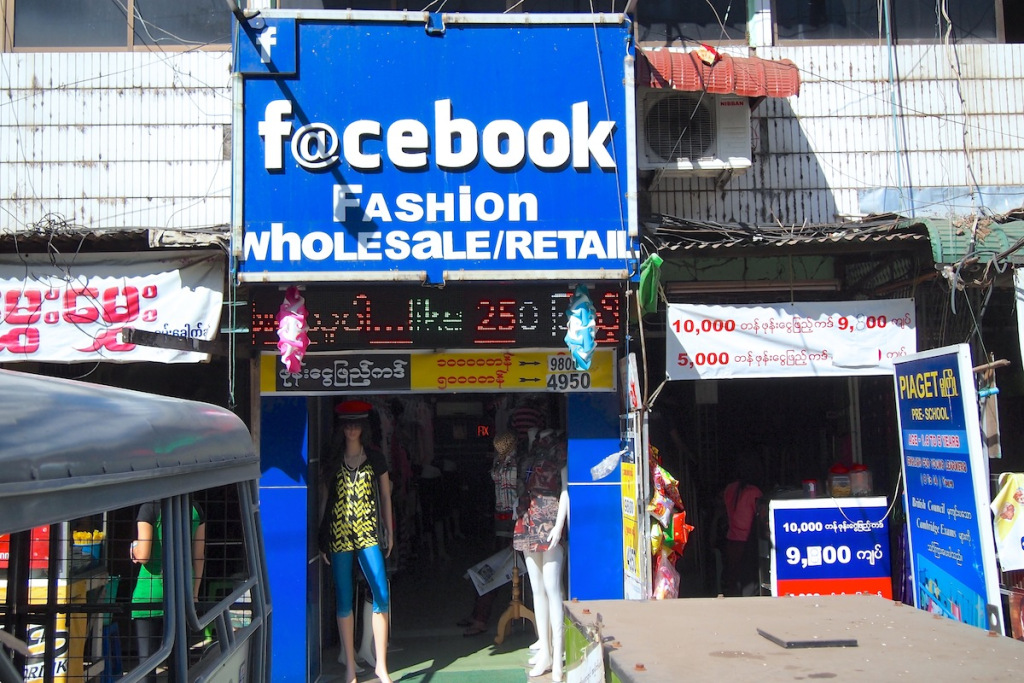
Doesn’t matter what it sells—just call it Facebook.Sam Petulla

YANGON— To hear him talk, Thiha Aye Kyaw sounds pretty much like an ambitious young entrepreneur anywhere on the planet. The 20-year-old computer science student has already built an app that makes him about as much money as a full-time software engineer. Businesses seek him out, and he no plans to join a large IT company after he graduates. He and his friends “don’t want to get the salary and work under other people.”

Except that Thiha lives in Myanmar, which makes realizing his entrepreneurial dreams a little more complicated.

With Google’s chairman, Eric Schmidt, visiting Myanmar this week, there’s a lot of attention on the country’s untapped potential for investment, especially in technology and communications. Myanmar is implementing a new foreign investment law and plans to dramatically increase internet and mobile connectivity from its current levels of less than 10%. In January it hosted Barcamp Yangon, the country’s largest tech conference, attended by an estimated 6,000 people, where Thiha rubbed shoulders with entrepreneurs and digital activists from all over the planet; there were also a few of Schmidt’s colleagues from Google.

But Burmese startups have to contend both with foreign companies that are much better financed and more experienced, and with powerful local businessmen with ties to the regime. Read more of this post

There are fresh allegations that some of the money that went missing from a Chinese company once listed on the Nasdaq may have been laundered through slot machines in Las Vegas casinos

More on the Chinese missing millions that may have been laundered through Las Vegas

By Naomi Rovnick — 2 hours ago

There are fresh allegations that some of the money that went missing from a Chinese company once listed on the Nasdaq may have been laundered through slot machines in Las Vegas casinos.

As we reported in December, medical equipment maker China Medical Technologies was listed on the Nasdaq from 2005 until February last year, and had the bluest of blue-chip advisers, underwriters, investors and creditors. It was wound up last July after missing interest payments. According to court filings since our last report, the company’s liquidators now claim that $670 million of cash the company raised in its 2005 IPO and subsequent equity and bond sales cannot be located, upping their estimate from a previous $400 million. Read more of this post

Life Discovered in the Deepest Ocean; “Nobody realized there is so much biodiversity”

March 17, 2013, 7:33 p.m. ET

Life Discovered in the Deepest Ocean

By JONATHAN D. ROCKOFF

Researchers probing the deepest ocean have found a surprisingly high concentration of microbes, the latest evidence of organisms thriving in inhospitable environments that is reshaping scientists’ understanding of the conditions necessary for life.

The bacteria were found nearly 6.8 miles below sea level, on the floor of the Pacific Ocean’s Mariana Trench, according to the researchers, whose findings were published online Sunday by the journal Nature Geoscience. No light reaches that part of the ocean, where the temperature is an estimated 36 degrees Fahrenheit.

Extremophiles

Extremophiles are organisms that can thrive in harsh conditions, such as high pressure or freezing temperatures. Researchers have found life in a number of unlikely environments: Read more of this post

‘Wash Trades’ Scrutinized; U.S. regulators are investigating whether high-frequency traders are routinely distorting stock and futures markets by illegally acting as buyer and seller in the same transactions

Updated March 17, 2013, 9:42 p.m. ET

‘Wash Trades’ Scrutinized

Issue Is Whether High-Speed Firms Illegally Buy, Sell Futures in Same Deals

By SCOTT PATTERSONJENNY STRASBURG and JAMILA TRINDLE

MI-BU744B_WASHT_G_20130317201803

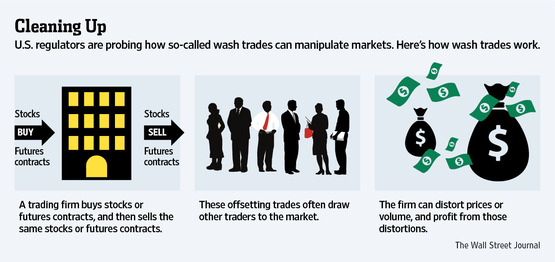
U.S. regulators are investigating whether high-frequency traders are routinely distorting stock and futures markets by illegally acting as buyer and seller in the same transactions, according to people familiar with the probes.

Such transactions, known as wash trades, are banned by U.S. law because they can feed false information into the market and be used to manipulate prices. Intentionally taking both sides of a trade can minimize financial risk for the trading firm while potentially creating a false impression of higher volume in the market.

The Commodity Futures Trading Commission is focused on suspected wash trades by high-speed firms in futures contracts tied to the value of crude oil, precious metals, agricultural commodities and the Standard & Poor’s 500-stock index, among other underlying instruments, the people said.

The agency is looking at potential wash trades by multiple high-speed firms, although it isn’t known which ones investigators are scrutinizing. Firms found guilty of intentionally distorting the market through wash trades could face hefty fines. Read more of this post

Philippines Bets Big on Casinos; Manila Wants to Be as Big as Vegas

Updated March 17, 2013, 6:27 p.m. ET

Philippines Bets Big on Casinos

New $1.2 Billion Solaire Resort Opens, Raising Asian Pressure on U.S. Gambling Industry

By KATE O’KEEFFE

MANILA—The Philippines this weekend launched its bid to become Asia’s third gambling hub with the opening of a $1.2 billion casino, as the region battles the U.S. for supremacy in the global gambling market.

In China, Macau’s $38 billion gambling industry already generates six times the revenue of the Las Vegas Strip. In Southeast Asia, Singapore’s gambling revenue matched that of the U.S. casino capital within a year of the island opening its first resorts in 2010. Now Manila is gunning for Vegas, too. Read more of this post

Fashion chain’s Johnnie Boden turned his neurosis into a strength; The 2012 Sunday Times Rich List puts Boden at number 255 of the UK’s richest estates, valued at £320m. Boden is cursed by self-doubt, but gifted with personableness and entrepreneurial skill. That’s why people love the brand – because it bears the name and spirit and set of values of a truly likeable character.

Johnnie Boden’s fashion brand is the love of his life

In an exclusive extract from their forthcoming book on the new breed of entrepreneurs who made their names by making names into brands, David Hopper and Charles Vallance meet British success story Johnnie Boden

cut_Johnnie-Boden__2511986b

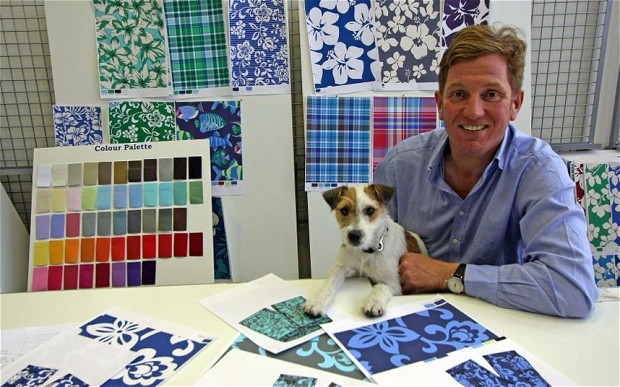
Johnnie Boden set up the fashion brand that bears his name. Photo: Rex Features

David Hopper and Charles Vallance

8:00PM GMT 17 Mar 2013

The Boden headquarters do not conform to any known middle-class stereotype. The architectural cues of the concrete-rich buildings in North Acton feel more North Korean than Etonian. The sign on the rectangular column outside says, “Ugly building. Nice clothes”.

Johnnie Boden’s office is an ill-defined composite of artistic creativity and box-files. His welcome is warm and open. He is a well built, tallish man, so he cuts a presence in a room, helped by a head of tawny-auburn hair.

For a person who makes everyone else feel so good about themselves, Boden is an anxious individual — wanting to be helpful whilst hoping not to disappoint. He would probably say “Sorry” spontaneously to someone who elbowed him in the ribs. He is permanently self-critical.

“My father was quite old at 45 when I was born; a strong, successful soldier, old-fashioned, but a complicated man and he was very hard on me,” Boden explains. “He had such high expectations, so I always felt I was never good enough. My parents were not big on praise. So I always wanted to do better. If I got 7 out of 10, I was just cross with myself. A lot of people are very comfortable in their own skin. I wasn’t.”

Boden speaks a lot about the slim margin between success and failure. Indeed, he puts a figure on it: “51pc is successful, but 49pc is awful”. Read more of this post