Canberra Wasn’t Built in a Day; Australia’s capital city celebrated its 100th anniversary this week

Canberra Wasn’t Built in a Day
Catriona Richards | March 17, 2013

20130317110418156

A couple admires the National Library of Australia, lit with colorful light projections as part of the Enlighten festival to celebrate Canberra\’s 100th anniversary. (JG Photo/Catriona Richards)

On the site of a former sheep station not so far from here, Australia’s capital city celebrated its 100th anniversary this week.

Canberra, the seat of Australia’s parliament and home to more than 370,000 people, is one of a handful of cities around the world that was built with the express purpose of serving as a nation’s administrative capital.

Before there was Naypyidaw in Myanmar or Putrajaya in Malaysia, the newly federated nation of Australia began to lay foundations for the city it believed would not only house its parliament, but also express the character of its people.

One hundred years on and deriding the sparsely populated, bureaucratic city has become a national sport — so much so that the phrase “Canberra bashing” entered Oxford’s Australian National Dictionary just weeks ahead of the city’s centenary celebrations.

Indonesia has long toyed with the idea of relocating its administrative capital away from the crowds and infrastructure problems of Jakarta.

The issue most recently came to the fore when floodwaters inundated the central business district in January, killing dozens of people and spilling embarrassingly into the grounds of the presidential palace.

But the experience of Indonesia’s neighbor to the south shows that building a capital city from scratch and finding acceptance from the people it seeks to represent is no easy feat.  Read more of this post
Thailand: The government’s rice pledging scheme appears to have created a new worry for consumers. Many people now wonder if is it safe to eat rice that has been kept in warehouses for years; Doctor warns against eating mouldy grains

How safe is our rice?

Doctor warns against eating mouldy grains

The government’s rice pledging scheme appears to have created a new worry for consumers.

Besides concerns over whether the government can manage its huge rice stockpile to prevent any severe impact on the country’s budget, many people now wonder if is it safe to eat rice that has been kept in warehouses for years.

Their worries will likely increase after Dr Banchob Junhasavasdikul questioned the quality of rice and whether it had become rotten and mouldy.

In an interview with Isranews, the founder of the Balavi Natural Medicine Center said he believes many consumers are eating fungal or mouldy rice that can be poisonous and increase the risk of cancer.

The pledging scheme has reduced the competitiveness of Thai rice exports, so the government is selling the grain locally at cheap prices, he said. Read more of this post

Pension and Investment Research Consultants, global independent research provider, disclosed that the British sizable banks have undisclosed losses of up to 31.8 bn pounds; HSBC tops list with 10.4 bn pounds in undisclosed losses

(5) HSBC:
Pension and Investment Research Consultants, global independent research provider, disclosed that the British sizable banks have undisclosed losses of up to 31.8 bn pounds. In particular, HSBC HOLDINGS (00005.HK) accounted for 10.4 bn pounds, topping the list
(5 HK) @ HK$130.9: market cap. US$200,315.1m, daily liquidity US$526.8m. Broker forecasts: 12 buys, 13 holds, 8 sells, 95.8x current year P/E, 0.7% yield.

British banks may have £30bn hidden losses

British banks may be harbouring a black hole of as much as £50bn in undeclared losses that do not show up in their accounts but hamper their efforts to lend, a shareholder group has warned.

By Louise Armitstead, Chief Business Correspondent

6:20AM GMT 12 Mar 2013

PIRC has calculated the amount of bad debts the banks may have to write off in coming years but have yet to subtract from profits, together with other items such as deferred bonuses not booked.

HSBC, which is the biggest bank by assets, was shown to have £10.4bn of hidden losses, the Royal Bank of Scotland has £9.4bn, and Barclays has £7.3bn. Lloyds Banking Group has £2.5bn and Standard Chartered £2.2bn. Together the undeclared losses total £31.8bn.

The research shows the distorting impact the accounting rules, which allow bad loans to remain hidden, have on bank results. PIRC applied old-style UK GAAP accounting rules, which applied for 100 years until 2005, to the figures released in the 2012 banks’ accounts. Read more of this post

‘Nightmare’ superbug alarm; Patients fall ill with ”nightmare bacteria” that caused the deaths of many people worldwide.

‘Nightmare’ superbug alarm

Date

March 18, 2013

Julia Medew

A widely feared superbug has contaminated hand-washing sinks in Dandenong Hospital’s intensive care unit, causing 10 patients to fall ill with the ”nightmare bacteria” that have killed many people worldwide.

A report published in the Medical Journal of Australia on Monday says the 440-bed hospital in Melbourne’s south-east has been struggling to contain the multi-drug-resistant bacteria since 2009. Ten patients have been infected since then, but none died from the infection.

An infectious disease physician at the hospital, Rhonda Stuart, said doctors had been concerned about a string of cases in the intensive care unit between 2009 and last year, but only acquired the technology last August to test surfaces for the bacteria known as CRE. Associate Professor Stuart said the tests revealed the bacteria were in the sinks where healthcare workers washed their hands. While it could not be proved, she said, this might have spread the infection to patients because the sinks’ poor design caused water to splash back off the drain. Read more of this post

Could The “Cyprus Fiasco” Occur In The United States? The bottom line is that the Rubicon has been crossed and deposits have now been forcefully confiscated

Could The “Cyprus Fiasco” Occur In The United States?

Tyler Durden on 03/17/2013 12:37 -0400

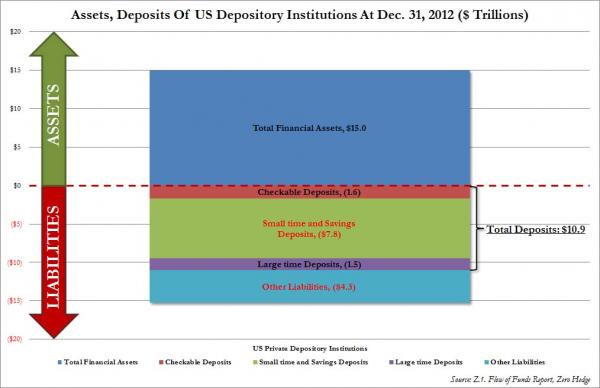
global write offs_0US Deposits_0

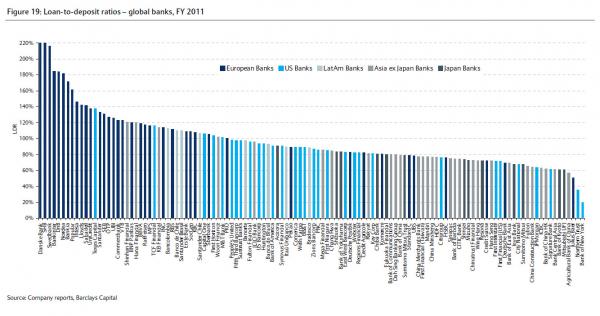
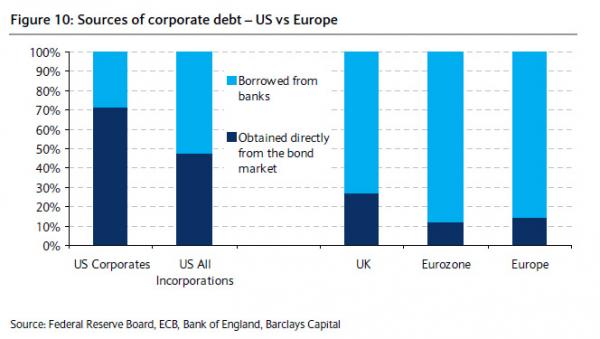
As has been assiduously explained by members of the European statist oligarchy, the reason for the deposit tax levy, in addition to the broader unsecured debt “bail-in” bailout of Cyprus, was due to the unique funding structure of Cypriot banks, in which the bulk of funding was in the form of deposits (whether Russian or domestic), leaving a tiny €2 billion in the form of junior bonds. Since the bailout would require realigning the balance sheet to a new, sustainable “fresh start” in which assets were remarked to a realistic value, it would mean impairing liabilities all the way down the capital structure. Naturally, politics played a big part in the decision to impair what Germany primarily saw as a Russian money-laundering haven, while local depositors were merely “collateral damage.”

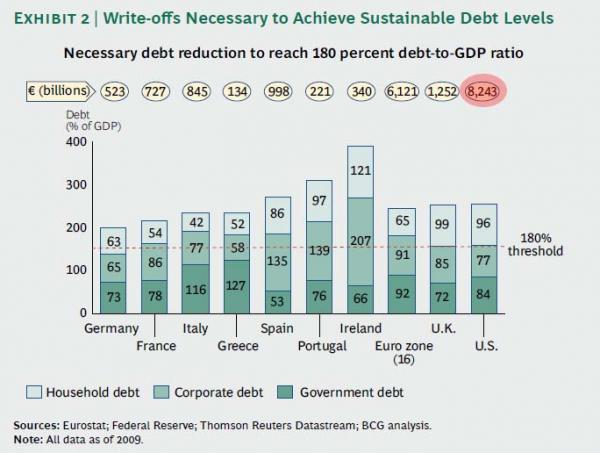
Politics aside, the bottom line is that the Rubicon has been crossed, and deposits have now been forcefully confiscated in what Europe promises to be a standalone case. What is certain, is that nobody will wait to find out how long it takes before Europe’s class of increasingly more desperate and ill-meaning despots is found to be have lied once more (as it has about everything else since the start of the European crisis). And while the mainstream media will be focused primarily on Europe in the coming days, as BCG and we have warned, the topic of “wealth taxation” is now front and center, and it stars not only Europe, but the US as well. Read more of this post

Europe Braces for Renewed Turmoil as Cyprus Deposit Levy at Risk; “Cyprus will turn into Libya”; The levy is “a worrying precedent with potentially systemic consequences if depositors in other periphery countries fear a similar treatment in the future”

Europe Braces for Renewed Turmoil as Cyprus Deposit Levy at Risk

Europe braced for renewed turmoil as outrage in Cyprus over an unprecedented levy on bank deposits threatened to derail the nation’s bailout and spark a new round in the debt crisis.

Cypriot President Nicos Anastasiades, who bowed to demands by euro-area finance ministers to raise 5.8 billion euros ($7.6 billion) by taking a piece of every bank account in Cyprus, delayed a parliamentary vote to pass the measure by a day. The European Central Bank pushed for a vote today, according to two people with knowledge of the discussions. Anastasiades plans to address the nation later today.

The levy is “a worrying precedent with potentially systemic consequences if depositors in other periphery countries fear a similar treatment in the future,” Joachim Fels, chief economist at Morgan Stanley in London, wrote in a note to clients.

Scenes of Cypriots lining up at cash machines raised the specter of capital flight elsewhere and threatened to disrupt a market calm that settled over the 17-member bloc since the ECB’s pledge in September to backstop troubled nations’ debt. With no government in Italy, Spain in the throes of a political scandal and Greece struggling to meet the terms of its own bailout, more turmoil could hamper efforts to end the crisis.

Anticipating gains in haven markets, Bill Gross, who runs the world’s biggest bond fund at Pacific Investment Management Co. in Newport Beach, California, said on Twitter that the concern in Cyprus “moves risk-on trade to backseat.”

“Sell euro as well,” he wrote. Read more of this post

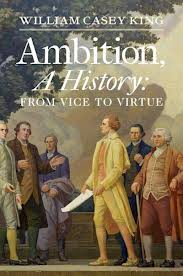
Ambition, A History: From Vice to Virtue

Ambition, A History: From Vice to Virtue [Hardcover]

William Casey King (Author)

images (1)

Release date: January 7, 2013

From rags to riches, log house to White House, enslaved to liberator, ghetto to CEO, ambition fuels the American Dream. Americans are driven by ambition. Yet at the time of the nation’s founding, ambition was viewed as a dangerous vice, everything from “a canker on the soul” to the impetus for original sin. This engaging book explores ambition’s surprising transformation, tracing attitudes from classical antiquity to early modern Europe to the New World and America’s founding. From this broad historical perspective, William Casey King deepens our understanding of the American mythos and offers a striking reinterpretation of the introduction to the Declaration of Independence.

Through an innovative array of sources and authors—Aquinas, Dante, Machiavelli, the Geneva Bible, Marlowe, Shakespeare, Thomas Jefferson, and many others—King demonstrates that a transformed view of ambition became possible the moment Europe realized that Columbus had discovered not a new route but a new world. In addition the author argues that reconstituting ambition as a virtue was a necessary precondition of the American republic. The book suggests that even in the twenty-first century, ambition has never fully lost its ties to vice and continues to exhibit a dual nature, positive or negative depending upon the ends, the means, and the individual involved. Read more of this post

Apple to produce Siri-driven vehicle iMove

Apple to produce Siri-driven vehicle iMove: Yicai.com

Staff Reporter

2013-03-15

20130313imove-172039_copy1

A computer-generated image of iMove. (Internet photo)

Apple is secretly developing a vehicle incorporating its voice assistant technology Siri and map service, said China-based financial news media Yicai.com. Steve Jobs, the US technology firm’s co-founder, was said to be a car enthusiast and had planned to develop the vehicle before he died of cancer in Oct. 2011.

The development has been continued by the present Apple CEO Tim Cook after Jobs died. The vehicle, called iMove, and has a minimalist, chic design likes other Apple products. The top of its body is covered by solar panel, glass and ABS plastic, which greatly reduces its weight and energy consumption. The rest of the vehicle’s body is painted in chameleon patterns.

The vehicle is also completely electric-powered. Apple is riding the wave of alternative energy vehicles, a movement receiving considerable investment and commercialization in developed countries and China.

Read more of this post

Better Colleges Failing to Lure Talented Poor, Study Shows

March 16, 2013

Better Colleges Failing to Lure Poorer Strivers

By DAVID LEONHARDT

IncomeCollege

Most low-income students who have top test scores and grades do not even apply to the nation’s best colleges, according to a new analysis of every high school student who took the SAT in a recent year.

The pattern contributes to widening economic inequality and low levels of mobility in this country, economists say, because college graduates earn so much more on average than nongraduates do. Low-income students who excel in high school often do not graduate from the less selective colleges they attend.

Only 34 percent of high-achieving high school seniors in the bottom fourth of income distribution attended any one of the country’s 238 most selective colleges, according to the analysis, conducted by Caroline M. Hoxby of Stanford and Christopher Avery of Harvard, two longtime education researchers. Among top students in the highest income quartile, that figure was 78 percent.

The findings underscore that elite public and private colleges, despite a stated desire to recruit an economically diverse group of students, have largely failed to do so. Read more of this post

Coffee’s Economics, Rewritten by Farmers; Some coffee farmers are taking control of more of the supply chain, roasting and marketing their own beans for greater profit

March 16, 2013

Coffee’s Economics, Rewritten by Farmers

By NICOLE LaPORTE

IN 2005, Kenneth Lander, a lawyer in Monroe, Ga., moved with his wife, stepdaughter and the youngest three of his seven children to a coffee farm in San Rafael de Abangares, Costa Rica. He always “had a heart,” he said, for Latin America, and after a vacation to the lush cloud forests near Monteverde in 2004, he was determined to return on a more permanent basis.

He was also looking for more balance in his work-driven life. And so, after buying a coffee farm from a farmer he’d met on his earlier trip, he packed up his life and moved.

“It was like Swiss Family Robinson,” Mr. Lander jokes. “We just left.”

In Costa Rica, Mr. Lander, who is now 46, didn’t have to worry about making money. He had received a cash windfall from selling a portion of a residential subdivision he had helped develop in Georgia; the plan was to keep selling more lots and live off the proceeds. So he grew coffee for fun.

Then, in 2008, the financial crisis hit. The value of his subdivision plummeted. Suddenly, he had to support himself as a coffee farmer. Very quickly, he realized how difficult that was going to be. He had just 12 acres that produced 6,000 pounds of specialty-grade coffee beans a year.

He belonged to a “fair trade” co-op, which guarantees farmers a minimum price, but was making only $1.30 a pound on coffee that retailed in the United States for $12 a pound. His net profit was so low that at one point he was down to $120 that had to last two weeks.

“I was at the register debating whether or not to buy shampoo or a bag of rice,” Mr. Lander recalls.

Why wasn’t he seeing more of that final price?

That question has been asked by farmers throughout history, particularly in developing countries, where growers of commodity crops like coffee and cocoa often live in poverty. Over the last few decades, a worldwide movement under the broad banner of fair trade has tried to rectify that imbalance.

In exchange for receiving “fair” prices for their products, fair trade farmers must adhere to environmental and labor standards set by certification groups, the largest of which is Fairtrade International, a nonprofit organization based in Bonn, Germany. It represents 1.24 million farmers and workers in industries including coffee, bananas and honey.

But Mr. Lander started to think that he might improve on the idea. He began to experiment. Using a roaster he had bought in better times, he started roasting his beans and selling them on Facebook to friends in the United States. He also opened a coffee shop, called the Common Cup, in Monteverde, and sold his coffee to tourists.

When he ran out of beans, he teamed up with two other area coffee farmers, Jorge Fonseca and Alejandro Garcia — who also had a coffee shop, the Colibri — and began shipping greater volumes. Suddenly, he was making money. Read more of this post

IMF Says EU Banks Face Further Losses

March 15, 2013, 12:18 p.m. ET

IMF Says EU Banks Face Further Losses

By PAUL HANNON

With anemic economic growth likely to lead to more losses on loans, risks to the financial stability of the European Union remain “elevated,” and urgent action is needed to adequately capitalize the bloc’s banks and establish a shared system for closing down or restructuring failing institutions, the International Monetary Fund said Friday.

In its first-ever review of the health of the financial system across all 27 EU members, the IMF said the bloc has made some progress in addressing the weaknesses that have exacerbated its fiscal crisis and stalled its economic recovery.

But it said much work remains to be done, with banks likely to face higher losses on loans to households and businesses to add to the losses they have suffered on their holdings of government bonds. The Fund added that low economic growth and low interest rates may also weaken insurance companies and pension funds.

“Risks remain elevated, especially in a context of low growth and fiscal retrenchment,” the IMF’s board of directors said. “Regulatory and policy uncertainty, and gaps in policy frameworks also continue to pose vulnerabilities. Further ambitious steps are thus necessary to rebuild confidence and achieve long-lasting financial stability in the region.” Read more of this post

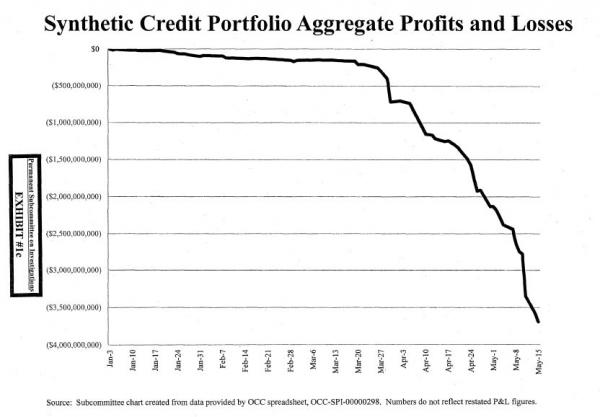
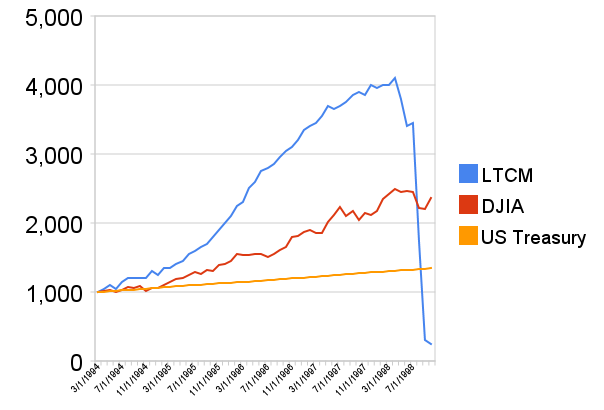
JPMorgan… Or Long-Term Capital Management?

JPMorgan… Or Long-Term Capital Management?

Tyler Durden on 03/15/2013 10:57 -0400

Compare and contrast to the performance of LTCM just before it had to be bailed out, ushering in the modern era of of Too Big To Fail.

CIO P&L_0LTCM P&L

Europe Does It Again: Cyprus Depositor Haircut “Bailout” Turns Into Saver “Panic”, Frozen Assets, Bank Runs, Broken ATMs, Bulldozer Parks Outside Bank; After Cyprus, Who Is Next?

Europe Does It Again: Cyprus Depositor Haircut “Bailout” Turns Into Saver “Panic”, Frozen Assets, Bank Runs, Broken ATMs

Tyler Durden on 03/16/2013 10:33 -0400

Loan to Deposit ratio_0Euro Banks Loans vs Total vs US_0

Europe has done it again.

Late last night, after markets closed for the weekend, following an extended discussion the European finance ministers announced their “bailout” solution for Russian oligarch depositor-haven Cyprus: a €13 billion bailout (Europe’s fifth) with a huge twist: the implementation of what has been the biggest taboo in European bailouts to date – the  impairment of depositors, and a fresh, full blown escalation in the status quo’s war against savers everywhere.

Specifically, Cyprus will impose a levy of 6.75% on deposits of less than €100,000 – the ceiling for European Union account insurance, which is now effectively gone following this case study – and 9.9% above that. The measures will raise €5.8 billion, Dutch Finance Minister Jeroen Dijsselbloem, who leads the group of euro-area ministers, said. Read more of this post

Poultry farmer Ho Seng Choon, 90, is still the prince of quails; “We should be billionaires,” said the younger Mr Ho. “But while dad is an excellent and passionate farmer, he has never been a good businessman.”

Poultry farmer, 90, is still the prince of quails

20130314.143953_poultry-farner_st

He has tried his hand at goat, turtle and crocodile farming – but at the age of 90 he is now rearing quails with his son. -ST
Melody Zaccheus
Sat, Mar 16, 2013
The Straits Times

SINGAPORE – He has tried his hand at goat, turtle and crocodile farming – but at the age of 90 he is now rearing quails with his son.

Meet Mr Ho Seng Choon, a poultry farmer credited with modernising farming techniques in Singapore over six decades.

Together with son William Ho, 48, he runs Lian Wah Hang, one of two quail farms here. It provides Singapore with 11 million quail eggs every year.

These come from their brood of 130,000 quails and are sold at supermarkets or served at restaurants such as Crystal Jade.

But this could be the “last frontier” for their 2.7ha farm in Lim Chu Kang, said the younger Mr Ho. “Just two years remain on our tenancy and we cannot expand our business on such terms. We are worried about our future.”

The older Mr Ho, who features in the National Heritage Board’s Trading Stories exhibition, has been credited with introducing the battery system for livestock in the 1950s. Born in China’s Fujian province, Mr Ho came to Singapore in 1929. His father ran a provision shop but business was disrupted by World War II.

Mr Ho saw poultry farming’s potential as the population grew, so he sold his dad’s shop and headed to Japan and the Netherlands to pick up livestock techniques.

“Farming techniques in Japan were very modern compared to Singapore where chickens would roam freely and farmhands would have to run around with their baskets in search of eggs,” said Mr Ho. He has published a series of journals on poultry farming and in 1963, he led a rally fighting for a three-cent tax on imported chicken eggs to benefit local farmers.

Two years later, he organised a farming exhibition at Kallang Airport and played host to then Prime Minister Lee Kuan Yew.

“We should be billionaires,” said the younger Mr Ho. “But while dad is an excellent and passionate farmer, he has never been a good businessman.” Read more of this post

Private Equity’s $36 Billion Retail Bet Not Going So Well

Private Equity’s $36 Billion Retail Bet Not Going So Well

In the years before the recession, private-equity firms put so much faith in the future of U.S. brick-and-mortar retailers that they spent $36 billion on them.

That hasn’t worked out so well, especially for the era’s biggest spender, Bain Capital LLC. The firm started by Mitt Romney inked four deals valued at $17 billion from 2004 to 2007 and still owns all of the purchases. The largest of the bunch was Toys “R” Us Inc., which posted a drop in sales during the holidays, followed by Chief Executive Officer Gerald Storch stepping down.

The private-equity model — load up an acquisition with debt, cut costs and take it public — hasn’t gone according to the usual script with most of Bain’s retail acquisitions. That’s largely because the firm, which has $67 billion in assets under management, doubled down on specialty retailers just as they were about to be pummeled by the likes of Amazon.com Inc. (AMZN)

“There isn’t anything special about specialty anymore,” said Leon Nicholas, an analyst for Kantar Retail in Boston. Their advantages on product assortment, expertise and price have disappeared, he said. Read more of this post

China firms desert US stock markets amid scrutiny by US regulators and short-sellers

China firms desert US stock markets

More than two dozen US-listed Chinese companies have retreated from the US stock market in the past 15 months, amid scrutiny by US regulators and short-sellers. -China Daily/ANN
Michael Barris

Sat, Mar 16, 2013
China Daily/Asia News Network

NEW YORK – When 7 Days Group Holdings Ltd announced in September that it had received a buyout proposal to be taken private, the Chinese budget hotel operator’s US-listed shares soared to a four-month high.

Prior to the announcement, the shares, which trade on the New York Stock Exchange, had tumbled 23 per cent in 12 months, amid investor worries over corporate governance that hurt valuations of Chinese companies.

Last week, 7 Days became the latest US-traded Chinese company to go dark, after a group that included Washington-based private equity firm Carlyle Group LP and the company’s co-chairmen sweetened its offer to $688 million (S$854.7 million).

More than two dozen US-listed Chinese companies have retreated from the US stock market in the past 15 months, amid scrutiny by US regulators and short-sellers and shrinking advantages from US listings. Read more of this post

Why some think China is approaching a political tipping point

The old regime and the revolution

Why some think China is approaching a political tipping point

Mar 16th 2013 |From the print edition

20130316_CND000_0

FOR some of China’s more than 500m internet users the big news story of the week has not been the long-scheduled one that their country has a new president, Xi Jinping, who already has more important jobs running the Communist Party and chairing its military commission. Rather it was the unscheduled, unwelcome and unexplained arrival down a river into Shanghai of the putrescent carcasses of thousands of dead pigs, apparently dumped there by farmers upstream. The latest in an endless series of public-health, pollution and corruption scandals, it is hard to think of a more potent (and disgusting) symbol of the view, common among internet users, that, for all its astonishing economic advance, there is something rotten in the state of China, and that change will have to come.

Many think it will. According to Andrew Nathan, an American scholar, “the consensus is stronger than at any time since the 1989 Tiananmen crisis that the resilience of the authoritarian regime in…China is approaching its limits.” Mr Nathan, who a decade ago coined the term “authoritarian resilience” to describe the Chinese Communist Party’s ability to adapt and survive, was contributing, in the Journal of Democracy, an American academic quarterly, to a collection of essays with the titillating title: “China at the tipping point?” Read more of this post

How cricket has lost its working class tradition; The game is better for having its working-class heroes

Class and cricket

A lower-order collapse

Mar 12th 2013, 19:54 by B.R.

20130316_woc227_0

IT USED to be said that when England needed a fast bowler, all it had to do was whistle down a Nottinghamshire coal mine. Harold Larwood (pictured), the most fearsome bowler of his generation, was destined for a life in the pits before he was spotted while playing for his village team and offered a contract by Nottinghamshire in 1923. Nuncargate, the tiny mining village in which he was born, unearthed four further England cricketers, including Bill Voce, who shared the new ball with Larwood during the 1932-33 bodyline tour of Australia.

England’s great batsmen, too, often came from humble beginnings. Jack Hobbs, one of the country’s most revered players, grew up in poverty in Cambridge. Herbert Sutcliffe’s father was a pub landlord in Yorkshire. Indeed, from Fred Trueman, the first bowler to take 300 Test wickets, whose father spent time in the coal mines, to Ian Botham and Freddie Flintoff, working-class heroes have always bestrode the game.

This is not to say that English cricket has not been subject to class division. On the contrary, it is enshrined in its history. The first recorded games, in the 17th and 18th centuries, were often between teams playing under the patronage of the landed gentry, such as the Second Duke of Richmond, who employed local farm hands in fixtures convened for toffs to bet on. Until 1962, England’s first-class cricketers were formally divided into two categories, gentlemen and players—the nobs who could afford to play cricket as amateurs, versus working-class professionals who needed to be paid. At Lord’s, the home of the game, teammates entered the field through separate gates dependent on this distinction. There was even an annual fixture between the two which was, for a while, the highlight of the domestic season (and in which the professionals usually prevailed). It was not until 1952 that a non-gentleman, Len Hutton, captained the Test side.

Class is even enshrined in the game’s aesthetic. Some shots—particularly front foot drives—are to this day considered more elegant, to be purred over by purists. This may be because they are also associated with the upper classes. In “More Tales from a Long Room”, a satire of the game, Peter Tinniswood relates the story of an aristocrat who undertakes “a missionary crusade to the dourlands of the north to preach to the working classes his fervent belief that the cover drive, the late cut and the wristy leg glance were not the sole province of the upper classes.” In contrast, brutal, clubbing back foot shots, such as pulls and cuts, were considered professionals’ shots, born of those who cared little about art and much about efficacy.

Yet if there was once a class battle in cricket, it is on the verge of being conceded. Today, fewer working-class players reach the top of the English game than probably at any time in the sport’s history. If one takes a very broad measure of class—whether a player attended a state or private school—the majority of England’s Test cricketers since the second world war could be said to have come from relatively modest backgrounds (see chart). In 1993, nine of the starting XI who played in the first Test against Australia had been to a state school. By the 2009 series, only half did (one, Monty Panesar, attended both types). In the last Test match England played, against New Zealand last week, that proportion had gone down to a third. Read more of this post

China’s ‘new farmer:’ an investor, manager and & decision maker; mass exodus from the countryside has left China asking, “Who will till the farmlands and feed 1.4 billion Chinese people?”

China’s ‘new farmer:’ an investor, manager and & decision maker

  • Xinhua

2013-03-15

China is going to great lengths to foster a “new type” of professional farmer to inhabit the empty farmhouses across its vast rural areas and entice more migrant workers to return home to till fields and feed the world’s largest population.

If it succeeds, China will solve a major problem that cropped up after its urbanization process resulted in a population split 50:50 between rural and urban areas. Decades ago, nine in 10 people lived in rural areas, where their lives were not as good as that of their urban peers.

As large numbers of farmers, especially young farmers, have flocked to cities and towns, they have left the countryside largely inhabited by the elderly, women and children.

This mass exodus from the countryside has left China asking, “Who will till the farmlands and feed 1.4 billion Chinese people?” Read more of this post

Tinkering key to innovation

Tinkering key to innovation

Created: 2013-3-16

Author:Wang Yong

DESPITE the global success of Apple iPhones, the US suffers a stasis in technological innovation – at least in the eye of American journalist Alec Foege, author of “The Tinkerers: The Amateurs, DIYers, and Inventors Who Make America Great.” While Thomas Edison (1847-1931) tinkered with projects in an unstructured way, the author says that a modern-day American would more often than not be enslaved by standardized test scores that leach creativity. American children today are also less creative, observes the author, who believes that many busy parents deprive their children of any opportunities for unstructured play – the setting where taking old things apart and creating new things used to be part of growing up. Partly because of this rigid education that suppresses the spirit and skills of tinkering, the US is no longer the biggest producer of engineers and scientists. As the author points out, it has fallen behind many other countries in filing new patents. “True tinkering is all about risk and unusual behavior. The far-flung fanaticism that world-class tinkering requires rarely thrives in an institutional setting,” says the author. Because the education system cannot be overhauled any time soon – most universities and colleges in America still survive and will continue to survive on mass-producing standard graduates and diplomas – one way to improve the nation’s creative spirit and capacity is for the government and corporations to fund pure experiments.  Read more of this post

Crisis bodes grim for Dutch housing market

Crisis bodes grim for Dutch housing market

by Christien van den Brink

English.news.cn   2013-03-15 21:36:28

THE HAGUE, Mar. 15 (Xinhua) — The happily married young couple Petra and Bert live in a suburban area of the fourth biggest city of the Netherlands, Utrecht.

Bert has just signed a long term contract at the ministry of Infrastructure, while Petra holds a part time job. They would be in the perfect position to buy their dream house, and yet, they rent it.

“Jobwise, it is really difficult to predict where we will be in 3, 4 years. We could be sent to other regions by our employers. Or we could even lose our job. This makes it hard to chose a location for our future house. We don’t want to commit to something until we are more financially stable,” Petra said.

Petra and Bert are not the only ones who have opted for renting in the Netherlands. According to figures published by CBS on Friday, 2.9 million dwellings of the 7.1 million households are rented apartments and houses.

Due to a growing incertainty at the job market, flexibility has become the main argument for renting. Renting offers the ability to pick up and leave if you have to take a job in an other region of the Netherlands. Read more of this post

The man who once saved New York City from bankruptcy explains why Detroit may go under; “We couldn’t do this today,” says Felix Rohatyn. “The various stakeholders are no longer around the same table.”

The man who once saved New York City from bankruptcy explains why Detroit may go under

By Tim Fernholz — 10 hours ago

The US city of Detroit is in deep financial trouble. Years of fiscal mismanagement and a shrinking population have left it with $14 billion in debt and a $300-million deficit last year, the auto capital of the country is headed toward bankruptcy. Michigan Governor Rick Snyder just appointed Kevyn Orr, a Washington bankruptcy attorney, to be the city’s “emergency manager,” a role with the power to implement budget measures without the consent of local officials.

Orr led the 2010 restructuring of Chrysler, the US automaker based in Detroit, during the the American government’s rescue of the auto industry. But his current challenge is what he calls “the Olympics of restructuring.” It might very well be: If the city doesn’t get back on its feet soon, it will become the largest municipal default in US history.

Felix Rohatyn faced similar problems in 1975, when he chaired a commission that extricated New York City from its financial crisis, a similar $14 billion debt load and an astounding $2.2-billion operating deficit (pdf). Rohatyn and a deputy were referred to as the “Batman and Robin of New York.” The legendary Lazard bankertalked to Quartz about his worries that the same tools he used might not be available in Detroit.

“We couldn’t do this today,” says Rohatyn. “The various stakeholders are no longer around the same table.” Read more of this post

Craig Winkler on a winner at NZ cloud-accounting software Xero which cracks the billion dollar mark in market cap

Winkler on a winner at Xero

March 16, 2013

Brian Robins

EBL-art353-craig-winkler-20130315190507269540-200x0

Craig Winkler Photo: James Davies

II is more than most of us can expect to make in a lifetime, but entrepreneur Craig Winkler’s worth has risen a stunning $20 million just over the past week alone. Mr Winkler made his first $100 million from accounting software company MYOB and then put part of his gains into Xero, a start-up New Zealand rival, when he sold. With an internet cloud-based product, it claims to have a lower cost offering than its competitors. Xero listed on the stock exchange in October. Since then its share price has nearly doubled, surging 7 per cent on Friday to hit a record $8.60, before closing up 49¢ at $8.48. It first traded on the ASX around $4.50. It listed on the New Zealand Stock Exchange in 2007. The rally in Xero’s share price has more than doubled Mr Winkler’s worth, even though the company is yet to make a dollar. He holds 16 million Xero shares after selling 2.5 million shares at $NZ6 in December, only to watch the share price surge. Part of the reason for the rally in recent weeks has been a series of product promotions in Australia, coupled with optimism about the incorporation of new product features.

But with Xero’s market valuation topping $1 billion on Friday, it seems investors are pricing in success not just in Australia, but in the US market as well, where it has established a presence. Last month Xero said monthly revenue was running at $NZ4 million ($3.2 million), up from December quarter revenue of $NZ10 million, with revenue in the year to March to double from the $NZ19 million booked last year. Xero is challenging market incumbents MYOB and Reckon in the Australian market. Since selling out of MYOB, Mr Winkler has spent most of his time working in the not-for-profit sector.

Dr Reddy’s Laboratories Founder Anji Reddy Dies; Considered as a pioneer of reverse engineering, Dr Reddy made significant contributions in making pharmaceutical products globally competitive and also affordable to the common man

March 15, 2013, 12:50 p.m. ET

Dr Reddy’s Laboratories Founder Anji Reddy Dies

By DHANYA ANN THOPPIL

BANGALORE–K. Anji Reddy, the founder and chairman of drug maker Dr. Reddy’s Laboratories Ltd., 500124.BY +0.29% died Friday in the southern Indian city of Hyderabad. Mr. Reddy was ailing for some time, the company said in a statement, but didn’t give details. Mr. Reddy founded Dr. Reddy’s Laboratories in 1984. The Hyderabad-based company, which is listed in India and on the New York Stock Exchange, is now one of India’s largest drug makers.

Founder chairman of Dr Reddy Laboratories Anji Reddy dead

Indo-Asian News Service | Updated: March 15, 2013 21:20 IST

HyderabadKallam Anji Reddy, the founder chairman of Dr Reddy’s Laboratories, died today at a hospital in Hyderabad following brief illness. He was 73. He is survived by wife Samrajyam, daughter Anuradha and son K Satish Reddy, who is managing director and COO of the pharma giant. One of the most well-known faces of Indian pharma industry, Dr Reddy was suffering from lung disorder for last few months and was admitted to a private hospital 10 days ago. The technocrat-turned-entrepreneur, who started Reddy’s Laboratories with a meagre outlay of Rs. 25 lakh in early 1980s, transformed it into $1.6 billion global entity. Considered as a pioneer of reverse engineering, Dr Reddy made significant contributions in making pharmaceutical products globally competitive and also affordable to the common man. Read more of this post

China’s Top E-Commerce Sites Saw 600% Growth in Mobile Shopping Last Year; An average of 220,000 products were sold every hour through mobile devices in 2012 on Alibaba’s Tmall and Taobao

China’s Top E-Commerce Sites Saw 600% Growth in Mobile Shopping Last Year

Mar 15, 2013 at 22:18 PM by Steven Millward, in BusinessE-commerceMobile

We know that China’s netizens love shopping online – and collectively spend about $40,000 per second on local e-commerce sites – but most of that has been happening on desktop computers and laptops. Finally that’s changing. China’s top online stores, Tmall andTaobao, have revealed that purchases made via mobile devices soared 600 percent last year on the two sites. Alibaba, the company that runs those two e-stores, says that the number of unique visitors to Taobao last year on its apps or on any mobile browser reached 300 million last year. The company’s blog says that, of those mobile visitors, 57 million (19 percent) made purchases on their phones. While that’s a sizable shift to m-commerce, mobile purchases still made up just 6.87 percent of all Taobao transactions in 2012. At least that’s way up from a mere 1.77 percent in 2011.

Indeed, as we noted previously in iResearch data for 2012 Q2, Taobao and Tmall lead the way in mobile commerce in China, punching above their general market share by accounting for 75.6 percent of mobile e-shopping buys. A few other sites also perform better than average, such as fashion e-tailers Vancl and MaiBaoBao. But quite a number of others are underrepresented on mobile, such as Amazon China. “The speed of mobile adoption has been much faster than we thought it would be,” says Alibaba’s general manager for the mobile business unit, Alex Qiu. With booming smartphone adoption in China – now accounting for 73 percent of all phones sold – there’s still a lot of market share to be won and lost in the transition to greater m-commerce. Read more of this post

Former Thai deputy premier Supachai Panitchpakdi warned that there were signs of a “bubble” in the Thai economy, with massive fund inflows heading mostly to the property sector.

Supachai sees signs of a bubble

March 16, 2013 1:00 am

Unctad chief urges officials to monitor property prices and bank lending

Former deputy premier Supachai Panitchpakdi warned yesterday that there were signs of a “bubble” in the Thai economy, with massive fund inflows heading mostly to the property sector.

Supachai, secretary-general of the UN Conference on Trade and Development (Unctad), expressed concern over a bubble in Thailand’s property sector, which he said could expand and create problems for the economy in the future. 

He called on the responsible agencies to pay attention to property prices, such as for condominiums, and to closely monitor bank lending. Expressing concern over overheated lending by banks, he said asset prices in some sectors are likely to exceed reasonable levels. Read more of this post

Tan Sri Andrew Sheng: The wonton vs sushi story; So what is the right business model for small businesses in the age of massive social and technological change?

Saturday March 16, 2013

The wonton vs sushi story

Think Asian by ANDREW SHENG

MY friends know that I am a noodle foodie. Everywhere I go throughout Asia, I try the noodles, from laksa in Penang, pad thai in Bangkok, beefpho in Hanoi to mohinga in Yangon; each bowl showcases the culture and flavour of the place, through the different texture, spices, and taste. Somehow, I remember a place by the quality of its noodles.

There is nothing quite like the great wonton and noodle shops in Hong Kong. They are not fancy places, but have been in the same location for ages, and have become beloved local institutions with lifetime customers. In the past few months. several historic Hong Kong noodle shops and cafes have closed from rising rents. The closure of the 42-year-old Lei Yuen Congee Noodles in Causeway Bay this January made the South China Morning Post. Hundreds of tourists and residents flocked to the shop in its last days, waiting in hour-long queues at lunch time for their last chance to eat there.

Rising rent in Hong Kong is nothing new. Hong Kong competes with Tokyo as one of the world’s most expensive real estate markets. Yet Tokyo is full of small ramen and sushi shops that have been around for decades brought to international attention recently by the film Jiro Dreams of Sushi about a dedicated Michelin star sushi shop in the Tokyo subway. Tokyo sushi shops also have to pay the high rent demanded by landlords, but perhaps their landlords realise that Japanese culture is poorer if there is no local sushi and ramen shop around. Read more of this post

Information innovator

Saturday March 16, 2013

Information innovator

By JENNIFER LO

INFORMATION technology (IT) is all about innovation. Vish Iyer can’t agree more.

Mobility, social media and big data are all hot-button topics. Cloud computing frees up people from the desk, so an IT system can be managed even on the road. “For a bank, it could be payment via Internet banking or mobile phone,” says the high-flying corporate executive.

“For an insurance company, it could mean enabling an agent to get quotations and conduct transactions on his or her mobile.” For an airline, pilots no longer carry huge bags with heavy operating manuals. “We put that on an iPad,” he adds.

Few would believe the president for Asia Pacific at Tata Consultancy Services (TCS) has neither training in IT nor a background in engineering. He learns by doing.

Born and raised in Kolkata around the time when India’s first computer arrived, Iyer graduated from St Xavier’s College, one of the city’s best-known educational institutions with a major in taxation and economics.

Now the head of the largest service provider in the Asia-Pacific region based in Singapore, he manages 10,000 employees in 13 countries including Australia, Japan, China and South Korea.

The 45-year-old Indian company, whose clients include Microsoft andING Group, is the provider of IT services and business solutions, with a turnover exceeding US$12bil and market capitalisation of US$45bil on the Bombay Stock Exchange.

It is part of the Tata group, India’s largest conglomerate in seven sectors including communications, engineering and energy, with a revenue of more than US$100bil in the fiscal year 2011-12. Read more of this post

Money Advice for People in Boom-or-Bust Fields; Jay Reynolds borrowed heavily to buy the company in 1980. He then struggled for nearly two decades as demand suffered until the business finally revived

March 8, 2013

Money Advice for People in Boom-or-Bust Fields

By PAUL SULLIVAN

09wealth-articleLarge

Jay Reynolds, president and chief executive of Rod Ric Drilling in Midland, Tex., borrowed heavily to buy the company in 1980. He then struggled for nearly two decades as demand suffered until the business finally revived. 

MORE financial advisers are focusing on a single clientele, say, doctors or athletes. That would seem to make sense, since concentrating on a single group of people gives advisers greater insight into the needs of those people. And if the advisers do a good job, they will get that client’s colleagues as clients.

Advisers can, of course, organize their practices in other ways. Many focus on a dollar amount. They promise to give good advice to any client with more than $1 million, $5 million or more, regardless of where that money came from. By taking this tack, they are also eliminating the need to have more, less wealthy clients.

And some advisers organize a practice around a life event, like retirement or divorce. But what does a divorced woman with three young children and a deadbeat former husband have in common with Elaine Wynn, who received nearly $1 billion when she divorced Steve Wynn, the casino mogul?

Still, is managing money for a group of lawyers, say, any different from managing money for another high earner? A dollar is a dollar, after all. Or is it just a way for advisers to market themselves? Read more of this post

What Should Business Schools Teach Managers?

What Should Business Schools Teach Managers?

Martin Parker University of Leicester

Gordon Pearson Keele University

Spring 2013
Business and Society Review, Vol. 118, Issue 1, pp. 1-22, 2013 

Abstract: 
This article is the fourth dialogue in a series in which two characters, a pro‐business experienced manager and a critical management academic idealist, debate contemporary management. In this dialogue, the discussion concerns the curriculum of business and management courses. Though as usual there is little agreement between the two participants, the discussion clearly shows just how difficult it will be to change business education without also changing the market position of business schools. Other topics concern the sort of economic assumptions embedded in much of the curriculum, and the relationship between practical skills and political descriptions of capitalism.