Is China’s ‘Real’ Economy Crashing?

Is China’s ‘Real’ Economy Crashing?

Tyler Durden on 03/15/2013 09:55 -0400
20130314_ChinElec_0

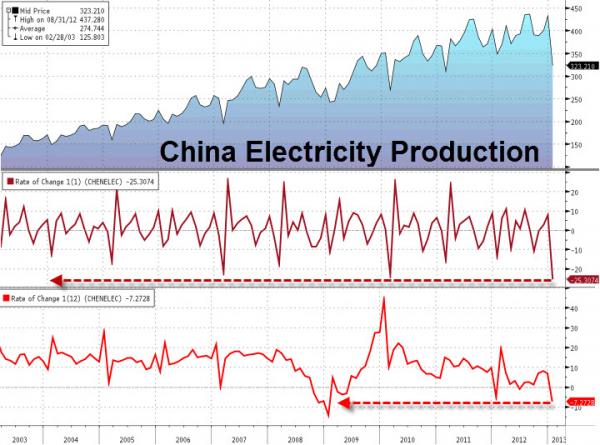
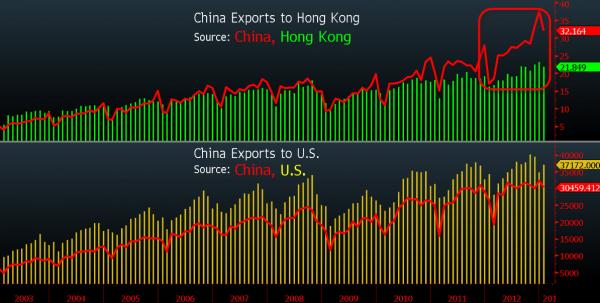
As Marc Faber noted, we hardly expect China to report GDP growth rates that do not perfectly fit the goal-seeked solution for utopian society, but under the covers, there appears to be some considerably more ugly real data. One of the hardest to manipulate, manage, or mitigate for a centrally planned economy is Electricity production. The year-over-year drop in China’s electricity production is the largest since the slump in Q1 2009; and the seasonal drop (associated with the New Year) is the largest on record at 25.3%! So on one hand China is discussing tightening monetary policy amid inflation anxiety and a potential real estate bubble – thanks to the rest of the world pumping free money – and on the other hand Chinese officials are faced with the reality of a drastically slowing ‘real’ economy. At the same time, we note that it appearsChina’s export-import data appears overstatedRock meet hard place. Biggest seasonal drop ever in China electricity production and worst YoY drop since the crash in 2009… And as Bloomberg notes today: Widening differences in bilateral trade data reported by China and Hong Kong suggest export-import activity is being overstated by the mainland as companies report inflated figures, according to Mizuho Securities Asia Ltd. The chart below compares China’s data on monthly exports to Hong Kong the past two years, with counterpart figures from the city on imports.  
20130314_ChinElec1_0

China’s numbers were 47 percent higher than Hong Kong’s in January, compared with a 13 percent difference two years earlier. The lower panel shows reports during the same period for China’s overseas shipments to the U.S., using each nation’s official statistics, where the differential has remained more consistent. Exaggerated trade figures would mean that China’s new leaders, who take over the government at the National People’s Congress this week, are failing to get the boost from global demand that the data indicate as they try to sustain a rebound in the world’s second-biggest economy. Hong Kong passed the U.S. in November to become the biggest export market in China data. Exports to Hong Kong from China rose 60.9 percent in the first two months of 2013 from a year earlier, compared with last year’s 20.7 percent gain for the full year. “This seems inconsistent with the pictures of the final demand in both Hong Kong and the countries for Hong Kong re-exporting,”  Read more of this post

Innovator: Martin Riddiford’s Gravity-Powered Lamp to replace hazardous kerosene lamps still used in many developing countries

Innovator: Martin Riddiford’s Gravity-Powered Lamp

By Caroline Winter on March 14, 2013

tech_innovator1213__01__630x420

Hazardous kerosene lamps, still used in many developing countries, are a major expense for many of the world’s estimated 1.5 billion families without electricity. Poor households typically spend at least 10 percent of their income on kerosene, as much as $36 billion a year worldwide, according to the World Bank. So far, efforts to use solar energy to power lights in developing nations have run up against cost and technical challenges. Attempts to use hydroelectric microgrids or repurpose old car batteries have also been problematic, says Joe Hale, president of the nonprofit Global BrightLight Foundation. Gravity could help. British industrial designer Martin Riddiford has created a pineapple-size lamp powered by a 25-pound weight that falls about six feet in a half-hour. That may not sound like much, but it’s enough to drive a silent motor at thousands of rotations per second. The GravityLight, which shines slightly brighter than most kerosene lamps, requires a certain amount of elbow grease: Once the weight reaches bottom, it must be manually lifted to repeat the process.

Riddiford, 57, a co-founder of London-based product design firm Therefore, got the idea four years ago after leaving a meeting with a charity interested in solar tech. “I just sort of had this vision of, well, why can’t you use human power and store it as potential energy rather than in a battery,” he says. The designer, whose Brinlock Abacus calculator was the first with number-shaped buttons, and whose firm has developed products for Toshiba, Samsonite, and Nike (NKE), says he regrets not having done charitable work overseas in his youth and hopes to make up for it with his light. The first prototype, a large-scale contraption involving a bicycle wheel and a windup LED flashlight, was refined over four years into its current cheap yet durable plastic version. “It’s technically quite tricky to get it so it doesn’t jam, but we solved that problem through lots of experimentation,” Riddiford says. GravityLight will have its first field tests this summer in Africa, Asia, Latin America, and the Middle East. Once Riddiford’s team works out the final kinks, the basic model will retail for about $5. Therefore is also weighing development of a brighter version with more settings for camping and emergencies, and may eventually use its gravity-based technology to develop a cell phone charger. In December, Therefore pitched the lamp on crowdfunding site Indiegogo to help cover production costs, and in a month received $400,000, far more than the $55,000 it sought. Bill Gates called GravityLight “a pretty cool innovation,” and Therefore says donors and potential partners range from soda companies to the U.S. Department of Defense. “It’s such a clean source of light, and it’s easy to operate,” says Global BrightLight Foundation’s Hale. “The market is unlimited for them.” Still, before GravityLight goes to market, Riddiford says, “It will have to stand the test of four continents trying to kill it, trying to stamp on it, destroy it, and use it and abuse it.”

Problem: Kerosene light is a big cost for 1.5 billion families worldwide

A solution: A $5 lamp powered by a 25-pound falling weight

Early response: Plaudits from Bill Gates, interest from the Pentagon

History Channel’s ‘The Bible’ Is a Marketing Miracle

History Channel’s ‘The Bible’ Is a Marketing Miracle

By Bilge Ebiri on March 14, 2013

It’s a tense night in Sodom. God’s judgment has arrived, and fire rains down from the skies. The beleaguered, henpecked Lot, a nephew of Abraham, shuffles two mysterious Jedi-like figures into his home. A group of armed Sodomites soon bursts through the door and demands that the men be given up. One of the “Jedis” unsheathes two swords and swiftly dismembers the men.

The scene ends the first episode of a new, 10-part miniseries on the History Channel called The Bible, which garnered 14.1 million viewers last week—more than any other show on cable television in 2013. Produced by Mark Burnett, the reality-TV pioneer best known for SurvivorThe Apprentice, and Shark Tank, and his wife, Touched by an Angel actor Roma Downey (who also plays the Virgin Mary), the miniseries appears to have been conceived primarily for religious audiences—or at least those knowledgeable of scripture. It’s also packaged with enough bloodlust to capture channel surfers. In that regard, the series resembles Mel Gibson’s 2004 film, The Passion of the Christ, a movie bloggers called The Jesus Chainsaw Massacre—and which raked in more than $600 million at the box office. Read more of this post

Men’s Nail Polish Joins the Cosmetics Market; Former Ultimate Fighting Championship star Chuck Liddell famously sported dainty pink fingernail polish in fights

Men’s Nail Polish Joins the Cosmetics Market

By Joel Stein on March 14, 2013

A few years ago, Josh Espley, a former marketing exec for a sex toy company called Fleshlight, noticed that his kickboxing friends were wearing polish to cover their banged-up nails. The practice was becoming popular, he noted, with the mixed martial arts crowd: Former Ultimate Fighting Championship star Chuck Liddell famously sported dainty pink fingernail polish in fights. Espley occasionally reads Us Weekly—to help him chat up women, he says—and saw polish on male celebrities such as Zac Efron, Jared Leto, Dave Navarro, and Johnny Depp. So in 2009, as a way to supplement his income, he created Blakk Cosmetics. Its first product was Alpha Nail paint, which the company sold in $12 pens in colors like “cocaine” (creamy white), “burnin’ rubber” (dark navy), and “gasoline” (charcoal gray). Read more of this post

Sparking Innovation and More: “Eureka moments are overrated. ‘Innovations must assume that their plans are partly right and partly wrong. And then work hard at figuring out which part of the plan is wrong.”

etc_cc12lineup_950

HE SHOULD HAVE FINISHED HIS SMOOTHIE: How One VC Passed On A 2,500X Return; At SXSW, Brian Chesky, co-founder and CEO of Airbnb, reminisced about the difficulties of building a business.

HE SHOULD HAVE FINISHED HIS SMOOTHIE: How One VC Passed On A 2,500X Return

Megan Rose Dickey | Mar. 15, 2013, 8:51 AM | 1,908 | 1

Airbnb CEO Brian Chesky InterviewAt SXSW, Brian Chesky, co-founder and CEO of Airbnb, reminisced about the difficulties of building a business.

Airbnb, an online marketplace for renting out rooms and homes, is a $2.5 billion company, according to Bloomberg.

But in the company’s early days, Airbnb founder and CEO Brian Chesky had a hard time convincing investors to back his company.

At one point, Chesky was asking for $100,000 in exchange for a 10 percent stake in the company, Bloomberg’s Adam Satariano reports. But Chesky couldn’t seem to get anyone to bite. In fact, one investor even walked out mid-pitch, leaving his half-finished smoothie behind.

Today, that investment would be worth roughly $250 million — a 2,500x return.

Earlier this year, Wedbush Securities analyst Michael Pachter estimated that Airbnb booked 12 million to 15 million nights in 2012. He thinks that could increase to 100 million nights, whereby Airbnb could generate $1 billion a year in revenues. Read more of this post

Before growing into a global fashion business with high-profile collaborations and over $112m in revenue, Acne Studios began as a boutique creative consulting firm that played by a few counterintuitive rules—ones it still stands by today.

March 14, 2013, 2:08 p.m. ET

How to Succeed in Fashion Without Trying Too Hard

Before growing into a global fashion business with high-profile collaborations, its own culture magazine and an ever-evolving product line, Acne Studios began as a boutique creative consulting firm that played by a few counterintuitive rules—ones it still stands by today.

By LYNN YAEGER

OB-WN334_mag041_G_20130228154859

THE BRAND PLAYED ON | Mikael Schiller, left, the executive chairman of Acne Studios, and creative director Jonny Johansson, at the Acne store in Tokyo, which opened in December.

WHILE HE WAS WORKING ON Acne’s spring 2013 collection—the long, floaty parachute-fabric skirts and T-shirts emblazoned with the word “music” that are in stores now—Jonny Johansson listened to a lot of Emmylou Harris. “It was a bit surreal. She talks about women, the difference between a woman who has experience and a woman who is young and free. She was painting pictures in a sense,” he says dreamily. “I could see this woman, in a white dress.”

Johannson, the cofounder and designer of Acne Studios, is sharing this reverie in a lofty room in the company’s world headquarters, a spectacular art nouveau former bank building on an almost ridiculously picturesque cobblestone street in Stockholm’s Old Town. Vintage copies of Flair are enshrined under plexiglass near the entrance; a grand staircase still shows off its original gilded wood paneling and stained glass. The uniformly youthful staff is clad in the kind of clothing that has become the company’s hallmark: edgy and slightly twisted, managing to walk a tightrope between slightly avant-garde and eminently wearable—or, put another way, unthreateningly bohemian.

In an era when every high street from Altoona to Zanzibar is crammed with identical chain stores selling identical merchandise, Acne is perceived as different: Its legions of fans think of it as a brand with integrity, a company that makes principled aesthetic decisions and never resorts to marketing tricks, even though they have hundreds of outlets.

If the most difficult challenge in the fashion industry is to remain relevant and desirable in an ever more crowded marketplace—and the whole project of predicting what customers will want in any given season is at best an ephemeral enterprise—Acne’s ability to play the game while appearing to remain mysteriously above the fray is a deeply impressive accomplishment. The company was founded in 1996 by four guys who threw 10,000 euros into a pot and launched a multidisciplinary digital film–design–creative consulting collective in Stockholm, an enterprise that, by a combination of frankly nutty decisions and shrewd business practices, has become a highly profitable business—$112 million in revenue last year alone—encompassing men’s and women’s ready to wear, footwear, accessories and premium denim. Read more of this post

Why Companies Like Groupon, Yelp And ReachLocal Aren’t Dominating The Local Space

3/14/2013 @ 8:19AM |1,929 views

Why Companies Like Groupon, Yelp And ReachLocal Aren’t Dominating The Local Space

The local newspaper and the yellow pages have been slowly dying for more than a decade, leaving small businesses and merchants few options for local advertising. In its place, Internet companies like Groupon, Yelp, and ReachLocal arrived on the scene to reinvent local advertising online – but none has proved to be a digital nirvana for local businesses, because these solutions do not provide a simple and scalable way to connect with consumers who have a real-time need for their services. Read more of this post

Disappearing Subsidiaries: The Cases of Google and Oracle

Disappearing Subsidiaries: The Cases of Google and Oracle

Jeffrey D. Gramlich University of Southern Maine – School of Business

Janie Whiteaker-Poe University of Kansas

March 6, 2013

Abstract: 
From 2009 to 2010, 98 percent of Google’s and 99 percent of Oracle’s subsidiaries disappeared from the Exhibit 21s filed with their SEC Form 10Ks. However, a March 2012 search of available public company registries revealed that at least 65 percent of the missing subsidiaries remained active as of the companies’ 2010 filing dates. The decisions of Google and Oracle to disclose fewer subsidiaries stands in contrast to the literature documenting that firms providing more information enjoy lower costs of debt and equity capital. We employ legitimacy theory, institutional theory, agency theory, and political cost theory to explain the Google and Oracle decisions. Ultimately, however, we develop a new insight, that tax avoidance represents an additional source of capital beyond debt and equity, and this capital source exists in a unique setting that encourages less disclosure of certain types of information.

BRICs Abandoned by Locals With Fund Outflows Highest Since 1996

BRICs Abandoned by Locals With Fund Outflows Highest Since 1996

The 2.5 million rupees ($45,984) Nirav Vora had in the Indian stock market six years ago have plunged by 72 percent. Now the 39-year-old father of two in Mumbai, who depends on investment income for his livelihood, is plowing money into government bonds.

“The confidence of small investors is rock bottom,” Vora said by phone on Feb. 26. “They have no faith in the markets.”

Vora’s exit from equities is being repeated across the biggest emerging markets as disappointing profits and growing state intervention cause stocks to trail global shares for a fourth year. Trading by Brazilian individuals has dropped to the lowest level since 1999, exchange data show. Russian mutual funds posted 16 straight months of outflows, the most since at least 1996, and withdrawals in India are the biggest in more than two years. Chinese investors emptied more than 2 million stock accounts in the past 12 months.

After amassing unprecedented wealth during 14 years of world-beating economic expansion, citizens of the so-called BRIC countries are losing their appetite for shares even as U.S. households return to stocks. While the Dow Jones Industrial Average (INDU) is trading at an all-time high, the MSCI BRIC Index remains 37 percent below its 2007 peak as economic growth disappoints investors and policy makers do little to improve the treatment of minority shareholders. Read more of this post

Hedge-Fund Liquidations Jumped in 2012 on European Crisis

Hedge-Fund Liquidations Jumped in 2012 on European Crisis

Hedge-fund liquidations rose to a three-year high in 2012 as the European debt crisis and concerns about global economic growth hurt performance for the $2.3 trillion industry, according to Hedge Fund Research Inc.

The number of firms shut jumped to 873, the most since 2009, the Chicago-based data provider said in a statement today. Still, the net number of hedge funds increased after money managers started 1,108 firms last year, it said.

Smaller hedge funds have been hardest hit by the global financial turmoil that has made it more difficult to raise money from investors since the collapse of Lehman Brothers Holdings Inc. in 2008. Hedge funds managing more than $5 billion got 65 percent of the $3.4 billion of assets that flowed into the industry in last year’s fourth quarter while firms with less than $1 billion reaped 8.7 percent, Hedge Fund Research said.

“The capital-raising environment continued to be challenging for emerging managers, including both small and mid- sized funds, as well as newly launched funds,” Kenneth Heinz, Hedge Fund Research’s president, said in the statement. “To raise new investor capital, hedge funds must not only demonstrate both superior performance and an innovative strategy, but also increased organizational efficiencies.” Read more of this post

The Incredible Science Behind How Nature Solves Every Engineering Problem

The Incredible Science Behind How Nature Solves Every Engineering Problem

Jennifer Welsh | Mar. 14, 2013, 9:13 AM | 2,470 | 

A new trend is emerging, where researchers, designers, and everyone in between are starting to ask, “how can we be more like nature — more renewable, more constructive and more sustainable?”

In a world filled with 7 billion people crammed into mega cities, human kind will have to adapt before we can continue to grow, or else we will destroy the only home we’ve ever known. We need to look to nature for instructions on how to survive on this planet in ways that are “conductive to life,” according to biomimicry pioneer Janine Benyus.

Benyus is the founder of Biomimicry 3.8 (the name is a play on the 3.8 billion years that life on Earth has spent evolving). She’s also the author of a book called Biomimicry: Innovation Inspired By Nature (William Morrow Paperbacks, 2002).

Benyus’s Biomimicry 3.8 workshops have spawned dozens of groups at local levels, bringing together people from all over the world to discuss, talk to scientists, and learn about biomimcry.

Adiel Gavish attended one of these workshops in Costa Rica in 2007, and set up the BiomimicryNYC group in December of 2011.

“Our network is really just here to create a community, to connect these people who are really excited about this next frontier of sustainability,” Gavish said. The program brings people together “to inform one another of all the exciting things we are doing and to catalyze some biomimcry projects and programs in the New York City metro region.”

Read more of this post

In China, owning an oversized dog is the newest form of political dissent

In China, owning an oversized dog is the newest form of political dissent

By Damien Ma — March 14, 2013

Damien Ma is a fellow at The Paulson Institute, focused on investment and policy programs. Previously, he was a lead China analyst at Eurasia Group, a political risk research and advisory firm.

chinadog

Most Americans will likely have a preconceived notion of the Chinese relationship with dogs. When a developing country can barely take care of all its own people, animal rights tend to sit very low on the totem pole. But the reality is much more complicated, especially with a burgeoning dog culture associated with the rise of young urban elites with disposable income.

That complex reality is being captured in a soon-to-be-released documentary on China and dogs. The film, Oversized Dogs: Chinese Dog Laws and the People Who Break Them,is ostensibly about what the title suggests. It follows several Beijing residents who own dogs that are technically illegal because they are above the size limit stipulated in an antiquated Beijing law. It’s not just the Chinese capital — these size limitation rules have popped up in other parts of China, yet Chinese dog owners seem to be flouting them with impunity. Beyond the legal issue, dog ownership in China turns out to be an interesting examination of evolving attitudes in Chinese society today. In particular, it indirectly reflects the rise of rights consciousness among the growing legion of Chinese who count themselves among the middle class. Read more of this post

Web Video: Bigger and Less Profitable

March 14, 2013, 10:14 p.m. ET

Web Video: Bigger and Less Profitable

By SUZANNE VRANICA

MK-CB612_VIDEO__NS_20130314181828

People in the media business say that the future is online video. Just how many companies will be able to profit is the big question.

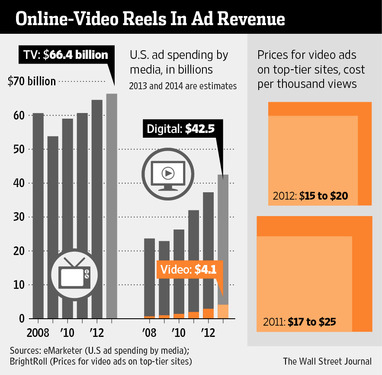
Online video-advertising rates continue to fall. Prices for ads on top-tier sites last year were down by 10% to 15% from 2011, estimates BrightRoll, a video-ad company.

That reflects two developments: the number of companies offering online video continues to rise. All kinds of traditional media companies, including those with roots in newspapers, magazines or broadcast television, want a piece of the fast-growing online video advertising market.

Consequently, the amount of online space available for ads—the inventory—is exploding. Of the 39 billion content videos viewed on the Web in December, about 23% carried video ads, up from just 14% a year earlier, according to comScore. Read more of this post

The Real Exit: Selling Strategies Subsequent to Private Equity Backed IPOs

The Real Exit: Selling Strategies Subsequent to Private Equity Backed IPOs

Nikolai Visnjic Goethe University Frankfurt

March 4, 2013

Abstract: 
This study examines the exit strategy of private equity investors after they take their portfolio companies public. Recent empirical studies considering private equity exit channel and timing generally fail to expose the investor’s strategy after the IPO. For this purpose I use a comprehensive set of PE backed IPOs from 1996 to 2005 in the United States and subsequently track governance characteristics until investors exit their controlling stakes. I find strong evidence that PE investors strategically choose whether to sell their position en bloc in a trade sale or gradually to dispersed shareholders on the secondary market. Severe governance differences between the two groups of exit strategies at IPO and evolving from IPO to exit suggest that PE investors anticipate and actively plan an eventual trade sale well in advance.

Buffett’s book recommendation this year: Investing Between the Lines: How to Make Smarter Decisions By Decoding CEO Communications

Investing Between the Lines: How to Make Smarter Decisions By Decoding CEO Communications [Hardcover]

L.J. Rittenhouse (Author)

Book Description

Publication Date: December 18, 2012

The essential guide to making smarter decisions by decoding CEO Communications

Recommended reading in Warren Buffet’s 2013 Shareholder Letter

Investing Between the Lines introduces a revolutionary method for evaluating the financial integrity of a company. You don’t need special access to “insider” information or a degree in accounting to figure it out. In fact, the secret is right in front of you—in black and white—in the words of every shareholder letter, annual report, and corporate correspondence you receive.

Investing Between the Lines shows you how to:

  • Decipher the “FOG” of confusing company communications
  • Decode the real meaning behind corporate jargon and platitudes
  • Separate the facts from the fluff in annual reports and quarterly earnings calls
  • Safeguard your money by investing in companies that steward investor capital

Too often, corporate executives and investment professionals are expected to deliver short-term results. As a result, they are compelled to turn to accounting techniques and unclear language to meet these expectations.

In Investing Between the Lines, L.J. Rittenhouse lays out her time-tested approach for recognizing at-risk businesses before trouble hits. This is the same method she used to predict the collapse of Enron and the fall of Lehman.

From comparing the statements of Ford, GM, and Toyota to revealing why FedEx and Wells Fargo have been so successful, Investing Between the Lines shows that Rittenhouse’s system is one of the most powerful tools a corporate leader or investor can have. Once you learn the clues to decode CEO communications, you will be able to invest between the lines—to figure out exactly what a company’s CEO is or isn’t telling you.

Whether you’re a professional investor, a new shareholder, or a CEO who wants to improve how your company communicates, Investing Between the Lines is one of the best investments you’ll ever make. Read more of this post

China’s Billionaire Bubble Stands in Xi Jinping’s Way

China’s Billionaire Bubble Stands in Xi Jinping’s Way

Now that Xi Jinping officially holds the reins in Beijing, the world is asking this question: Can China’s new leader revamp an economy that may become the world’s largest during his 10-year term? Here’s an even better one: Will Beijing let him? Much is being made of how quickly Xi is replacing Hu Jintao in China’s fastest formal transfer of power in more than a generation. Although it took Hu almost two years to get all top three positions — president, Communist Party head and chairman of the military commission — Xi has them right out of the gate. The sense is that Xi has been empowered to rebalance an economy that’s producing a dangerous gap between rich and poor. That would sound more plausible if not for China’s billionaire bubble. The real big money in China isn’t in the private sector, but the public one. A March 7 Bloomberg News story dramatized the point: The ranks of the ultra-wealthy in China’s legislature swelled 20 percent this year. The list of China’s 1,000 richest people published by the Shanghai-based Hurun Report contains 90 members of the National People’s Congress. That, Bloomberg calculates, is up from 75 in 2012. It’s worth noting that everyone on the Hurun list had a fortune of at least 1.8 billion yuan ($289.4 million), more than former Republican presidential candidate Mitt Romney.

Chinese politics is proving to be a bit too lucrative for the nation’s own good. Corruption, of course, doesn’t taint every member of Beijing’s inner circle. Yet the vast financial empires being amassed by some and the lack of transparency about wealth among politicians require attention and, where needed, legal action. Xi must break this cycle. As more and more politicians get rich through questionable land grabs, insider trading and old- fashioned rent seeking, there is less incentive to retool the economy. Political will shrinks as overseas bank accounts swell. All that money sloshing around conspires to widen China’s rich- poor divide. But can Xi do it? The plot thickens when you consider Bloomberg’s June story on how Xi’s extended family accumulated a fortune estimated at $376 million. Only time will tell if history remembers Xi as China’s great reformer or the great enricher of a party that’s become communist in name only.

(William Pesek is a Bloomberg View columnist. Follow him on Twitter.)

Buffett’s BYD Threatened by Prius in China Hybrid Shift

Buffett’s BYD Threatened by Prius in China Hybrid Shift

Toyota Motor Corp. (7203)’s Prius hybrid is emerging as the likeliest winner from China’s faltering attempt to dictate the future of world motoring.

Policies favoring Warren Buffett-backed BYD Co. (1211) and other electric-vehicle makers were meant to help China vie for global leadership in a technology the government expected to replace clunkers that run on gasoline. Except, as Chairman Mao Zedong put it, “seek truth from facts,” and the fact is: EVs flopped.

Consumer appetite failed to materialize even with financial incentives that halved the price tag of a BYD e6. The 27,800 EVs on Chinese roads are fewer than 6 percent of the government’s 2015 target — and 0.02 percent of the total civilian fleet. For now, China needs to promote other technologies to cut the tailpipe fumes choking its cities, says one minister.

“We’re very anxious” about worsening air pollution, Miao Wei, industry minister and a three-decade veteran of China’s auto industry, said during last week’s annual National People’s Congress in Beijing. “I’ve never believed that you can gain global leadership in one leap.” Read more of this post

China WMPs raise liquidity, transparency worries; Banks are reportedly now required to finish examining and – where needed – make changes to their capital-pool WMPs before April.

China WMPs raise liquidity, transparency worries

By Elva Muk | 15 March 2013 (2 hours ago)
As the China Banking Regulatory Commission sets out requirements for wealth-management product providers, analysts highlight issues around WMPs.

As China’s banking regulator seeks to limit the risk of wealth management products (WMPs) in the banking sector, some market participants are looking to clarify what they see as the major issues: chiefly liquidity and transparency.

Banks are reportedly now required to finish examining and – where needed – make changes to their capital-pool WMPs before April. If they don’t satisfy the China Banking Regulatory Commission (CBRC), it might consider halting the firm’s WMP business. Read more of this post

Germany’s Model Stresses Execution Over Innovation

March 13, 2013, 4:48 p.m. ET

Germany’s Model Stresses Execution Over Innovation

By BEN ROONEY

BERLIN—Henning Wehn has carved a niche for himself as Germany’s comedy ambassador to the U.K. On a recent TV program when asked what was the worst thing to overhear about yourself, playing to the German stereotype he replied “he isn’t all that efficient.”

The Wall Street Journal Deutschland recently held a tech cafe event in the heart of the capital’s startup district, Mitte, and much of the talk around the tables of the Kaffeemitte was on German entrepreneurship. The general consensus was that while Germany may not culturally be the most entrepreneurial country, the emphasis on execution was a national strength.

It should come as no surprise, then, that a particularly German way of building startups is emerging from the capital city; companies that are less focused on product innovation, and instead hone their execution.

Stepping away from the accelerator model (find existing exciting startups that are doing innovative things, provide them with mentors and a working space in return for equity), Berlin appears to be favoring the incubator (create companies that target specific and identified markets, hire smart people to run with the idea and provide them with the tools to execute).

Leading the way is the powerhouse of the German online economy, Rocket Internet. Founded by the media-shy Samwer brothers, it takes a proven business model, clones it and then just out-executes its competitors. According to the company’s youthful managing director, Alexander Kudlich, “We are able to launch within 3 1/2 weeks—from decision to launching.”

“It’s only about operationally doing every little thing right and faster and better than the others.” Read more of this post

SAP as Most Valuable German Company Validates Deals Spree: Tech

SAP as Most Valuable German Company Validates Deals Spree: Tech

When SAP AG (SAP) changed leadership in 2010, the software maker had just been through its first major job cuts in 38 years, clients were upset with price increases, and analysts considered the company a takeover target.

There’s little chance of a takeover now. SAP’s stock has gained 92 percent since Bill McDermott and Jim Hagemann Snabe took over as co-chief executive officers. SAP has vaulted past Siemens AG (SIE) and Volkswagen AG (VOW) to become Germany’s most valuable company despite revenue that’s 10 percent of Volkswagen’s and one-fifth that of Siemens.

McDermott, 51, and Snabe, 47, have made key acquisitions in cloud-computing and mobile applications, invested in a database that can analyze mountains of numbers in seconds, and hastened the development of new products. That has helped SAP increase sales to clients ranging from automakers to central banks to the National Football League.

SAP “oils the engine of the economy and lends it better momentum,” said Stephan Thomas, a portfolio manager at Frankfurt Trust, which oversees about $21 billion in assets and has recently increased its holding in SAP.

With a market capitalization of $102 billion, SAP is the world’s ninth-most-valuable technology company and the only European in the top 10. SAP’s price-to-earnings ratio, a gauge of how much investors are willing pay for the stock relative to profit, is the highest of the top 10. At 27 times earnings, SAP’s P/E exceeds Google Inc. (GOOG)’s 24.5 and 16.7 for archrival Oracle Corp. (ORCL), according to data compiled by Bloomberg. Read more of this post

Samsung Needs No Steve Jobs as Low-Profile Mobile Chief JK Shin Showcases Galaxy

Samsung Needs No Steve Jobs as Low-Profile Shin Showcases Galaxy

Samsung Electronics Co. will hold a very Apple-like event to unveil its latest smartphone in New York today. The Korean company will take the wraps off the Galaxy 4S at Radio City Music Hall and stream the event live on video screens in Times Square.

Samsung has no Steve Jobs, however. Instead, the person hosting the festivities will be J.K. Shin, the company’s low- profile head of mobile.

Shin can’t compare with Jobs, the Apple Inc. (AAPL) chief executive who set the standard for product introductions, dazzling audiences with crisp presentations honed over weeks of rehearsals. The Samsung executive, who favors blue blazers and tan slacks in contrast to Jobs’s jeans and black mock turtlenecks, tends to let devices take the spotlight. Still, any lack of charisma on Shin’s part isn’t hurting Samsung, which has surged past Apple in the global smartphone market.

“Over the last four or five years, Samsung has done a great job in stealth mode without a Jobs-like figure to help them,” said Tim Bajarin, president of technology consulting firm Creative Strategies. “Without a lot of fanfare, they’ve just made great advances and taken a strong position in the market.”

Shin introduced the previous version of the flagship phone, the Galaxy S3, in London last year during a press event that featured the London Metropolitan Orchestra and soaring floor-to- ceiling video displays. Read more of this post

Turkey’s $580,000 Taxi Plates Drive Free-Wheeling Market

Turkey’s $580,000 Taxi Plates Drive Free-Wheeling Market

Beyond the polished Fiats and Fords parked at the Oto Center in a remote working class district of Istanbul, traders tout an investment vehicle that has tripled in value over the last nine years: license plates for taxis that fetch about 1.05 million liras ($580,000).

Prices quoted inside stores that act as a private bourse have risen about 10 percent from 885,000 liras a year ago, with the number of permits issued by Istanbul’s government unchanged for two decades even as the population in Turkey’s commercial capital grew, according to the taksiplakasi.com website. The 4,600 liras a month paid by drivers to rent plates add another 5 percentage points of investment income, the website shows.

Slices of permits called plates, wheels and nuts trade like bonds and lure investors wishing to comply with Islam’s ban on earning interest in a country where almost all of the 80 million population is Muslim. The licenses are an alternative to real estate and resemble investments created by bankers in Islamic finance, such as rent certificates.

The market has become so liquid that “one can sell in half an hour and get the cash in less than a week, not much different from the Istanbul Stock Exchange,” Gursoy Atli, sales manager at Kale Ticaret, one of a handful of closely-held companies that trade licenses, said in a phone interview Feb. 19. There is little regulation and no guarantees. Read more of this post

Mayo Prostate Cancer Test Gives Hope When Tumors Return

Mayo Prostate Cancer Test Gives Hope When Tumors Return

Mike Hawker travels 3,200 miles from his home in Anchorage to the Mayo Clinic every six months to get a test for microscopic signs that a rare form of prostate cancer he beat three years ago may have returned.

For Hawker, a Republican state representative in Alaska, the trips are a matter of life and death. About 200,000 men who had been treated for prostate cancer learn each year, sometimes too late, that their malignancies have returned. The Mayo Clinic test offers the promise of catching recurring tumors early, before they can kill.

Mayo’s medical center in Rochester, Minnesota, is the only facility in the Western Hemisphere to offer the 20-minute scan, enhanced by an injected radioactive drug that lets doctors see rapidly dividing cancer cells. Demand is surging, though scans are limited to eight patients a day, three days a week.

Hawker, who survived an aggressive form of prostate cancer in 2010 that invaded everything from his knees to his eye sockets, sees the twice-yearly visits as his best hope.

“No one can figure out quite why I am alive,” said Hawker in an interview. “That machine is one of the diagnostic tools that is keeping me alive.”

Prostate cancer is the most commonly diagnosed malignancy, killing about 28,000 men last year. Lung cancer, the second-most common cancer is more deadly and claimed the lives of about 88,000 men. For at least one-quarter of the men whose prostate cancer recurs, the reappearance of the disease is life- threatening, said Eugene Kwon, a urologist and cancer researcher at the Mayo Clinic. Read more of this post

Networking Battles to Run the World: Cisco and VMware talked about ambitious strategies to create powerful data centers and networks, tied to millions of sensors and devices, with an eye on everything we do

MARCH 13, 2013, 6:38 PM

Networking Battles to Run the World

By QUENTIN HARDY

Cisco has a simple message: the world has bought so much of its equipment, why stop now?

Both Cisco Systems and one of its biggest competitors, VMware, talked about ambitious strategies Wednesday. The powerful data centers and networks they want to build, tied to millions of sensors and devices, promise to create all kinds of efficient systems with an eye on everything we do. Just as much, they talked about competing with each other.

Even before Cisco spoke, VMware was making its claim to a world where billions of devices were sensing the world and suggesting efficient actions. Rather than depending on legacy customers, VMware is counting on inspiring thousands of software developers, who will use computer networks as a platform for new business.

It is similar to the way Microsoft used outside developers to give it an edge on the personal computer, and Google used them on the Web. Networks are more specialized technologies, however, so it’s not clear they can attract a mass of outside talent. Cisco is hoping big companies will be better allies.

Speaking at a gathering of journalists and networking industry analysts, several Cisco executives outlined what they called a “$14 trillion opportunity” in bringing sensors, communications and data analysis to all the world’s traffic systems, hospitals, refineries, and other civil and business infrastructure.

“The first 10 years (of the commercial Internet) were really about transactions, and the last 10 were about interactions,” said Padmasree Warrior, Cisco’s chief technology and strategy officer. “The next 10 is about processes being more efficient.” Read more of this post

Private Equity Squeezes Out Cash Long After Its Exit

MARCH 13, 2013, 6:26 PM

Private Equity Squeezes Out Cash Long After Its Exit

By LYNNLEY BROWNING

When the Berry Plastics Group, a container and packaging company, went public last October, it generated up to $350 million in tax savings. But the company won’t collect the bulk of the benefits. Rather, Berry Plastics will hand over 85 percent of the savings, in cash, to its former private equity owners.

The obscure tax strategy is the latest technique that private equity firms are using to extract money from their companies, in this case long after the initial public offering.

In a typical buyout, the owners make money by sprucing up the operations and selling the business to another company or public investors. Private equity firms have also found ways to profit before the so-called exit with special one-time dividends and annual management fees.

Now, buyout specialists are increasingly collecting continuing payouts from their former portfolio companies. The strategy, known as an income tax receivable agreement, has been quietly employed in dozens of recent private equity-backed offerings, including those involving PBF Energy, Vantiv and Dynavox. Read more of this post

Why the ‘most innovative companies’ aren’t; Leaders of complex organizations tend to surround themselves with likeminded people, which reinforces conventional approaches. At every stage in the life of a new idea or initiative, compliance crushes dissent.

Why the ‘most innovative companies’ aren’t

March 13, 2013: 3:32 PM ET

You may recognize their brands, but these admired companies have few practices in common that would distinguish them from the rest of the rabble.

By Jeff DeGraff

(TheMIX) — Pull out the list of the “most innovative companies” from your favorite business magazine. With the exception of their brand recognition, which is the entry fee for these beauty pageants, they have few innovation practices in common that would distinguish them from the rest of the rabble, whether it’s unique strategies, unusual financing, or novel ways of hiring and staffing.

The fact is that one size never fits all. What makes innovation companies unique is, well, unique. They are highly adapted for their specific situation.

Corporations spend billions of dollars on innovation training every year. Take a close look at popular leading innovation programs and you are likely to find a wide array of distinct subjects and approaches. Read more of this post

Teenager Dies of Food Poisoning After Jakarta Hospitals Deny Treatment — the latest in a series of deaths after hospitals rejected sick poor people.

Teenager Dies of Food Poisoning After Jakarta Hospitals Deny Treatment
Lenny Tristia Tambun & SP/Deti Mega | March 12, 2013

20130301132411104

Indonesian baby girl Dara Nur Anggraini, whose twin sister, Dera, died on Feb. 16. Jakarta’s hospitals were ill-prepared for governor Joko Widodo’s granting of free medical care to a larger number of the city’s poor. (AFP Photo).

A teenager on Saturday died of a severe intestinal infection after several Jakarta hospitals denied her treatment — the latest in a series of deaths after hospitals rejected sick people.  Read more of this post

Angry Birds Cartoons Head for Indonesian TV Screen

Angry Birds Cartoons Head for Indonesian TV Screen
March 13, 2013

Reuters

Helsinki, Finland. The makers of Angry Birds are launching a cartoon series this weekend, expanding further beyond its highly addictive games in a bid to expand entertainment and merchandising. Rovio, the company behind the popular mobile app game Angry Birds, said the cartoons will feature adventures of birds that appear in its games. Angry Birds Toons can be downloaded through on-demand services, and will also air on television channels such as FOX8 in Australia, ANTV in Indonesia, Cartoon Network in India, and MTV3 Juniori and MTV3 in Finland, it said. Rovio has expanded into merchandising and licensing in the past few years and its colorful, round bird characters are sold as stuffed animals and appear on everything from T-shirts to soda cans. It announced in December that it hired Hollywood executive David Maisel as executive producer of a 3D animated film planned for release in 2016.


Indonesia: Buyers and Sellers Blame Govt for Skyrocketing Price of Garlic and Shallots

Buyers and Sellers Blame Govt for Skyrocketing Price of Garlic and Shallots
Jakarta Globe | March 13, 2013

The cost of shallots and garlic has skyrocketed in the past week, causing complaints from buyers and sellers who blame government policy for the increased prices.

Detik.com reported on Wednesday the price of garlic has hit Rp 75,000 per kilogram in some places — more than five times the usual price of Rp 13,000 per kilogram— while the current price of shallots has hit Rp 48,000 per kilogram from the usual Rp 12,000 per kilogram.

In an effort to bring the price down, the Trade Ministry on Thursday announced it would import 29,136 tons of garlic from China and India. Srie Agustina, director general of domestic trade at the Trade Ministry, told Investor Daily over the weekend that the imported garlic would arrive in Jakarta in the next two weeks.

A housewife named Agnes said she’s going to avoid buying shallots and garlic until the price returns to normal.

“Shallot and garlic prices are so high. I usually buy them for Rp 14,000 per kilogram but now it’s Rp 40,000 per kilogram. It’s better if we don’t consume it for a while,” she told beritasatu.com at the Kramat Jati Market on Tuesday. Read more of this post