Better, smarter support needed for Australian innovation; Departing Google Australia managing director Nick Leeder thinks the reason founders are leaving Australia has more to do with the lack of a critical mass in the Australian ecosystem than a lack of initial funding

Better, smarter support needed for Australian innovation

March 6, 2013 – 9:50AM

Jana Matthews

The PM’s $1b jobs plan doesn’t feel like a boost, says leading entrepreneur and mentor Jana Matthews.

“If we want Australian companies to go global, we need to teach and prepare them…”, says Jana Matthews, program director for ANZ Innovyz START.Photo: Michele Mossop

At first, the Prime Minister’s proposed $1 billion investment to boost jobs by supporting start-ups sounds good. But is it enough and is it focused on the right kinds of programs to accelerate the growth of more companies? Read more of this post

Learning From the Octopus: How Secrets from Nature Can Help Us Fight Terrorist Attacks, Natural Disasters, and Disease

Learning From the Octopus: How Secrets from Nature Can Help Us Fight Terrorist Attacks, Natural Disasters, and Disease

Rafe Sagarin (Author)

Book Description

Publication Date: March 27, 2012 | ISBN-10: 0465021832

Despite the billions of dollars we’ve poured into foreign wars, homeland security, and disaster response, we are fundamentally no better prepared for the next terrorist attack or unprecedented flood than we were in 2001. Our response to catastrophe remains unchanged: add another step to airport security, another meter to the levee wall. This approach has proved totally ineffective: reacting to past threats and trying to predict future risks will only waste resources in our increasingly unpredictable world.

In Learning from the Octopus, ecologist and security expert Rafe Sagarin rethinks the seemingly intractable problem of security by drawing inspiration from a surprising source: nature. Biological organisms have been living—and thriving—on a risk-filled planet for billions of years. Remarkably, they have done it without planning, predicting, or trying to perfect their responses to complex threats. Rather, they simply adapt to solve the challenges they continually face.

Military leaders, public health officials, and business professionals would all like to be more adaptable, but few have figured out how. Sagarinargues that we can learn from observing how nature is organized, how organisms learn, how they create partnerships, and how life continually diversifies on this unpredictable planet.

As soon as we dip our toes into a cold Pacific tidepool and watch what we thought was a rock turn into an octopus, jetting away in a cloud of ink, we can begin to see the how human adaptability can mimic natural adaptation. The same mechanisms that enabled the octopus’s escape also allow our immune system to ward off new infectious diseases, helped soldiers in Iraq to recognize the threat of IEDs, and aided Google in developing faster ways to detect flu outbreaks.

While we will never be able to predict the next earthquake, terrorist attack, or market fluctuation, nature can guide us in developing security systems that are not purely reactive but proactive, holistic, and adaptable. From the tidepools of Monterey to the mountains of Kazakhstan, Sagarin takes us on an eye-opening tour of the security challenges we face, and shows us how we might learn to respond more effectively to the unknown threats lurking in our future. Read more of this post

To Become More Adaptable, Take a Lesson from Biology. Decentralization. The most successful biological organisms are structured or organized in such a way as to eschew centralized control in favor of allowing multiple agents to independently sense and quickly respond to change

To Become More Adaptable, Take a Lesson from Biology

by Rafe Sagarin  |  12:30 PM March 5, 2013

Remember when Apple’s stock traded at $7 a share? I do, because that’s when I sold my shares. Tech experts’ sage predictions had convinced me that the Mac would never make a dent in the PC market. As it turned out, the Mac didn’t need to make a dent, because Apple mutated its cute computer DNA into cute music players and phones that fit massive unfilled niches. Yet even the genius architect of this turnaround made faulty predictions sometimes. Remember the invention Steve Jobs said was going to be “bigger than the PC”? You may have seen a mall cop riding onerecently.

Even the best of us are horrible at predicting the future. That’s too bad, because our world is full of risk that we’d love to avoid and opportunity that we’d love to seize.

Fortunately, there’s a rich source of lessons on how to thrive in an unpredictable world, and it has been cranking out success stories for 3.5 billion years. It’s called biology.

All of Earth’s successful organisms have thrived without analyzing past crises or trying to predict the next one. They haven’t held “planning exercises” or created “predictive frameworks.” Instead, they’ve adapted. Adaptability is the power to detect and respond to change in the world, no matter how surprising or inconvenient it may be.

While there’s much chatter in the management world about the need to be adaptable, only a few creative companies and innovative managers have probed the natural world for its adaptability secrets. But when they have, they’ve been remarkably successful. A study of nature offers straightforward guidance through four key practices of adaptable systems.

Decentralization. The most successful biological organisms are structured or organized in such a way as to eschew centralized control in favor of allowing multiple agents to independently sense and quickly respond to change. An octopus, despite its surprisingly intelligent brain, doesn’t order each arm to change a certain color when it needs to hide quickly. Rather, individual skin cells across its body sense and respond to change and give the octopus a collective camouflage. Read more of this post

A Revolution in China’s Search Market? Sogou Integrates Search into its Input Method

A Revolution in China’s Search Market? Sogou Integrates Search into its Input Method

Mar 6, 2013 at 08:00 AM by C. Custer, in BusinessMobileWeb

China’s Sogou has been a player in the search market here since the early days. At present, it commands around 8 percent of the search market share, which makes it one of China’s top three search engines but still puts it way, waybehind the dominant Baidu (which has more than 70 percent of the market). But Sogou does dominate the Chinese input method market, with reportedly more than 100 million usersacross its mobile and PC input methods.

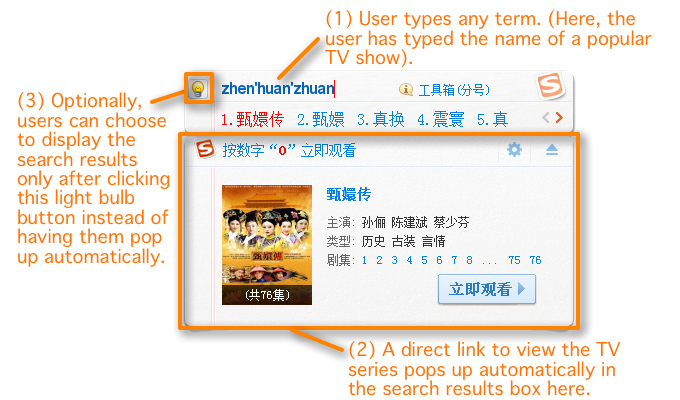
Yesterday, Sogou announced an update to the “smart” version of its PC input method softwarethat seems to signal the company is placing increased importance on search. Users of the latest version of the smart input method (which you can get here) will find that when they type certain terms, relevant search results pop up directly below the character selection bar. Sogou says this will save users massive amounts of time, as where previously they needed to open a browser and search for certain kinds of content, now they can get direct links from anywhere on their computer by simply by typing their search terms. Here’s how it works:

sogou-search-input-method2

Read more of this post

“The Big Mac Mirage”: America is actually terrible at globalization; U.S. companies derived less than 10% of their overall revenues from emerging markets

“The Big Mac Mirage”: America is actually terrible at globalization

By Tim Fernholz — 6 hours ago

Coke is so prevalent around the world that non-profits look to its supply chain for help on distributing aid. McDonalds, in 122 different countries, is so widespread that there’s a foreign relations theory that no two countries hosting the burger franchise will go to war, although the strong version of that theory is well dead. And Wal-Mart is the world’s third largest global employer, after the American and Chinese militaries, respectively.

The US must be great at globalization, right?

Unfortunately, no, according to Bhaskar Chakravorti, the director of Tufts’ University’s Institute for Business in the Global Context. He says all these examples represent “the myth of American global market power”—they are outliers that disguise the real failing of American multinationals to succeed around the world, and especially in fast-growing emerging markets. Despite what you might hear, he says “we are extremely under globalized.” Here’s an excerpt from a forthcoming paper he’s written with fellow economist Gita Rao (emphasis mine):

In 2010, emerging markets represented 36% of global GDP; these markets already account for the majority of the world’s oil and steel consumption, 46% of world retail sales, 52% of all purchases of motor vehicles and 82% of mobile phone subscriptions. With two-thirds of global growth coming from these markets, in a decade they will account for the majority of the world’s economic value. Yet U.S. companies derived less than 10% of their overall revenues from emerging markets: about as little as 7%, according to HSBC estimates for 2010. The 100 largest companies from the developed world overall made 17% of their revenues from emerging markets, according to a McKinsey report; in other words, the U.S. lags not only emerging market firms in capturing share in emerging markets, but it lags the developed world overall. By considering the difference between the “absolute potential” represented by the 36% number or, to take a much more conservative benchmark, the global peer average of 17% and the U.S. share of 7%, we derive two measures of the gap – and the degree to which U.S. industry has not participated in global growth. Read more of this post

China is spending more on policing its own people (RMB 769bn) than on its defense budget (RMB 720bn)

China is spending more on policing its own people than on its defense budget

By Lily Kuo — 6 hours ago

Red alert! China plans to spend 720 billion yuan ($114 billion) on its military this year, according to a budget released at the National People’s Congress this morning. With the world’s second-largest military in terms of spending, the Chinese government has increased its defense budget by double-digit percentages annually since 2000. This year’s increase will be 10.7%, similar to last year’s and faster than the target GDP growth of 7.5%.

But perhaps this is the headline the Chinese government would rather the media focus on. Buried in the budget numbers is another figure: 769 billion yuan, to be spent on what is officially termed “public security.” That means money for China’s vast network of official and unofficial police, armed militia, jails and overall state security, i.e. keeping the country’s 1.3 billion people in check as discontent mounts over pollution (paywall), government corruption, and inequality. Chinese officials have countered that this is a misrepresentation, saying that some of the funds also go to things like improving public transportation or food safety. Read more of this post

Analytical Innovators: What makes companies that are great at analytics different from everyone else

From Value to Vision: Reimagining the Possible with Data Analytics

Big Idea: Data & Analytics March 05, 2013

David Kiron, Renee Boucher Ferguson and Pamela Kirk Prentice

Introduction

Signs of an Analytics Revolution

Case Study: Oberweis Dairy

Three Ways to Compete with Analytics

Case Study: Caesars Entertainment

The Analytical Innovators

Mindset and Culture

Key Actions

Outcomes: Power Shifts to Those with Insight

On Becoming an Analytics Innovator

The Analytically Challenged

The Analytics Practitioners

Conclusion

About the Research

Acknowledgments

Authors

David Kiron is the executive editor of MIT Sloan Management Review’s Big Ideas initiatives. He can be reached at dkiron@mit.edu.

Renee Boucher Ferguson is the Data & Analytics contributing editor at MIT Sloan Management Review, researching the current and new analytical approaches that change how executives make decisions and innovate. She can be reached at rbfergus@mit.edu.

Pamela Kirk Prentice is the chief research officer at SAS Institute Inc., specializing in deriving insights from qualitative and quantitative information to help address key business issues. She can be reached at pamela.prentice@sas.com.

Companies benefit from analytics

Global study from MIT Sloan Management Review and SAS finds companies gain competitive edge by using analytics.

March 5, 2013

New research released today by MIT Sloan Management Review and SAS reports that 67 percent of companies surveyed are gaining a competitive advantage by using analytics — marking a 15 percent increase from last year and 80 percent increase from two years ago.

The report, “From Value to Vision: Reimagining the Possible with Data Analytics,” derived from a global survey of more than 2,500 business executives, identifies a group of companies leading the way in the analytics revolution, dubbed “Analytical Innovators.” Companies in this category report both strong competitive advantage and improved innovation from using analytics, which are means of interpreting certain data to gain insight and drive business planning. Analytical Innovators are significantly more likely to exhibit three characteristics: a widely shared belief that data is a core asset; more effective use of more of their data for faster results; and support for analytics by executives.

Another important characteristic of Analytical Innovators is their report of power shifts in their organizations: Analytical Innovators are four times more likely than less analytically inclined companies to say that analytics have shifted the power structure within their organizations.

“This is a significant finding, in that power shifts can be disruptive. They often call into question experience and intuition that managers and employees have built up over years,” says David Kiron, executive editor for MIT Sloan Management Review. “Now, those who know how to marshal the data and put analytics behind their decision making are in a position of advantage.”

The study also identified two types of companies less analytically sophisticated than Analytical Innovators: Analytics Practitioners (representing 60 percent of respondents), which have made significant progress, but have not achieved the top level of competitive advantage and innovation from using analytics; and the Analytically Challenged (28 percent of respondents), which are less mature in their use of analytics and have not derived as much value from them as the other groups.

“As we studied all three groups, we were able to clearly see the specific differentiators among the groups,” says Pamela Prentice, chief research officer for SAS. “This enabled us to develop a framework for companies to evaluate their own standing, and to provide recommendations based on a company’s current status.”

The study’s recommendations for the Analytically Challenged include:

  • Start improvements at the local level before trying to address organization-wide issues of technology latency.
  • To further collaboration, build ongoing relationships, facilitate discussions and share information of value to other departments.
  • Fight inertia by developing an executive communication strategy for your analytics case, including a return on investment rate and recommended actions.
Fear of China bank crisis keeps Aberdeen alert

Fear of China bank crisis keeps Aberdeen alert

By Elva Muk | 6 March 2013 (48 minutes ago)

If the nation’s shadow-banking system blows up, banks will foot the bill, its managers argue. But they see opportunity in HK-domiciled firms exposed to Greater China consumption. Aberdeen International fund managers are fearful of a China banking crisis, but see opportunity in Hong Kong-domiciled firms exposed to Greater China consumption. Asian equities manager Kathy Xu argues one of the biggest downside risks to China’s stock market this year is the country’s shadow-banking, or private lending, system. As a consequence she is bearish on the mainland banking sector. “This area is not transparent nor strongly regulated enough,” she says. “If the shadow banking [system] burst, we worry what banks would have to pay the bills.” China’s shadow-banking sector is enormous, encompassing trust funds, wealth management products (WMPs), products from securities firms, underground lending and local government financing vehicles. Together it is estimated these account for Rmb22.8 trillion ($3.6 trillion), or 44% of China’s national GDP. Read more of this post

Berkshire’s BNSF Railway to Test Switch to Natural Gas; BNSF, the largest railroad in the U.S., estimates it is the second-biggest user of diesel in the country, after the U.S. Navy.

March 5, 2013, 6:24 p.m. ET

Berkshire’s BNSF Railway to Test Switch to Natural Gas

By RUSSELL GOLD

BNSF Railway Co., one of the country’s biggest consumers of diesel fuel, plans this year to test using natural gas to power its locomotives instead.

If successful, the experiment could weaken oil’s dominance as a transportation fuel and provide a new outlet for the glut of cheap natural gas in North America.

The surplus, spurred by new technologies that unlock the fuel from underground rock formations, has sent natural-gas prices plummeting. That has prompted industries from electric utilities to tugboat operators to switch to gas. If freight rail joins the parade, it would usher in one of the most sweeping changes to the railroad industry in decades.

“This could be a transformational event for our railroad,” BNSF Chief Executive Matt Rose said of the plan, which hasn’t been publicly announced. Shifting to natural gas would “rank right up there” with the industry’s historic transition away from steam engines last century, he said.

Freight railroads overwhelmingly are powered by diesel fuel refined from crude oil. BNSF, the largest railroad in the U.S., estimates it is the second-biggest user of diesel in the country, after the U.S. Navy. Read more of this post

Druckenmiller: “When You Get This Kind Of Rigging, It Will End Badly”; When even Home Depot’s Ken Langone is questioning the reality of this rally (CEO of one of the best performing stocks since the Dow last traded here), you have to be a little concerned

Druckenmiller: “When You Get This Kind Of Rigging, It Will End Badly”

Tyler Durden on 03/05/2013 14:00 -0500

When even Home Depot’s Ken Langone is questioning the reality of this rally (CEO of one of the best performing stocks since the Dow last traded here), you have to be a little concerned. However, it is Duquesne’s Stanley Druckenmiller’s point that with QE4EVA it is impossible to know when this will end but warns that “all the lobsters are in the pot” now as he notes that “if you print enough money, everything is subsidized – bonds, stocks, real estate.” He dismisses the notion of any sell-off in bonds for the same reason as the Fed is buying $85 bn per month (75-80% all off Treasury issuance). The Fed has cancelled all market signals (whether these are to Congress or market participants) and just as we did in the 1970s, we will find out about all the mal-investments sooner or later. “This is a big, big gamble,” he notes, “manipulating the most important price in all of free markets,” that ends one of only two ways, a mal-investment bust (as we saw in 2007-8) or full debt monetization and “off we go into inflation.” Read more of this post

Suppliers prefer Aldi to Coles, Woolies because it pays invoices faster and is easier to deal with

Suppliers prefer Aldi to Coles, Woolies

March 6, 2013

Lucy Battersby

Easier to deal with: Suppliers say Aldi pays faster than the big two supermarket chains. Photo: Peter Braig

A number of suppliers producing a range of groceries have spoken out against the dominant supermarket chains, Woolworths and Coles, saying they prefer dealing with German-owned rival Aldi.

BusinessDay has revealed Woolworths produced a dossier that claims Aldi’s arrival in Australia has led to a rise in private label products and a tough competitive environment.

Several suppliers have spoken out about their experience supplying Australian supermarkets on the condition of anonymity, fearing contracts would be cancelled in retribution. They say they prefer dealing with Aldi because it pays invoices faster and is easier to deal with. One said it was ”so much better and much more stable to do business with”. Another said Coles and Woolworths reduced supplier prices and took an extra 3 er cent to cover marketing costs when products go on sale, where Aldi would absorb the losses sales into its own profit margin.

Woolworths enjoys some of the best profit margins in the world, according to Bank of America Merrill Lynch analyst David Errington. ‘Within its Australian food and liquor business, Woolworths currently enjoys the highest margins of any retailer globally, at … 9.3 per cent (lease adjusted), compared to its nearest global competitor at 7.9 per cent,” Mr Errington wrote in a note to clients. Read more of this post

Mandatory vs. Voluntary Management Earnings Forecasts in China

Mandatory vs. Voluntary Management Earnings Forecasts in China

Xiaobei Huang University of International Business and Economics – Business School

Xi Li Temple University – Fox School of Business and Management

Senyo Y. Tse Texas A&M University – Lowry Mays College & Graduate School of Business

Jenny Wu Tucker University of Florida – Warrington College of Business Administration

January 14, 2013
Mays Business School Research Paper No. 2012-82 

Abstract: 
Capital-market regulators face the question of whether a forecast mandate would improve the information environment or be counterproductive if managers are unable or unwilling to provide reliable forward-looking information. We examine the efficacy of forecast regulation in the emerging market of China, which mandates management earnings forecasts in certain performance regions such as anticipated losses, turning profits, or large changes in earnings from the previous year and allows voluntary forecasts in other circumstances. We examine the quantity, quality, and usefulness of mandatory forecasts by comparing managerial behavior under the mandatory vs. voluntary regime within China. We gain further insight by examining forecast behavior in the US, where forecasts are voluntary, in performance regions similar to those defined by the Chinese mandate. Our results suggest that the Chinese mandate substantially increases the quantity of information available to investors, particularly by state-owned enterprises (SOE) – firms that play a major role in the economy but are reluctant to provide forecasts voluntarily. After issuing mandatory forecasts, firms are more likely to issue voluntary forecasts in the subsequent year. Mandatory forecasts are less timely and less precise than voluntary forecasts, but the evidence on forecast accuracy is inconclusive. Investors react to mandatory forecasts as if they are useful. One unintended consequence of the Chinese mandate is that firms appear to manage their reported earnings to avoid the bright-line threshold for mandatory forecasts of large earnings decreases. Overall, our evidence provides feedback to regulators in developed economies and guidance to regulators in emerging markets.

Fund Management and Systemic Risk – Lessons from the Global Financial Crisis

Fund Management and Systemic Risk – Lessons from the Global Financial Crisis

Elias Bengtsson Sveriges Riksbank

February 1, 2013
CITYPERC Working Paper Series No. 2013/06 

Abstract: 
Fund managers play an important role in increasing efficiency and stability in financial markets. But research also indicates that fund management in certain circumstances may contribute to the buildup of systemic risk and severity of financial crises. The global financial crisis provided a number of new experiences on the contribution of fund managers to systemic risk. In this article, we focus on these lessons from the crisis. We distinguish between three sources of systemic risk in the financial system that may arise from fund management: insufficient credit risk transfer to fund managers; runs on funds that cause sudden reductions in funding to banks and other financial entities; and contagion through business ties between fund managers and their sponsors. Our discussion relates to the current intense debate on the role the so-called shadow banking system played in the global financial crisis. Several regulatory initiatives have been launched or suggested to reduce the systemic risk arising from non-bank financial entities, and we briefly discuss the likely impact of these on the sources of systemic risk outlined in the article.

Momentum Strategies of German Mutual Funds; we detect significant momentum behavior among funds with a European and global equity focus, and among funds predominantly investing in Asia; we do not find momentum trading funds to outperform the other fund

Momentum Strategies of German Mutual Funds

Alexander Franck  University of Giessen – Department of Financial Services

Andreas Walter  University of Giessen – Department of Financial Services

Johannes Witt  Independent

February 1, 2013

Abstract: 
The existence of the momentum effect in stock returns has been documented for the U.S. (e.g., Jegadeesh and Titman, 1993) and many other national equity markets worldwide (e.g., Griffin et al., 2003). However, little is known about the active employment of momentum strategies among institutional investors outside the U.S. In this respect, we provide first evidence of momentum behavior among German mutual funds.

We find the fund trades to follow stock returns on an aggregated institutional level. Moreover, we detect significant momentum behavior among funds with a European and global equity focus, and among funds predominantly investing in Asia. In contrast, German funds do not seem to employ momentum strategies when trading domestic stocks. While only half of the funds across the entire sample trade in accordance with past returns, 66% of the funds within the largest size quintile follow momentum strategies. Finally, we do not find momentum trading funds to outperform the other funds.

China’s outgoing PM Wen issues unusual warning on growth, that a 7.5% GDP target will be ‘hard to attain; President Xi’s task exposes limits of central control

Last updated: March 5, 2013 10:11 am

Wen issues China growth warning

By Jamil Anderlini and Simon Rabinovitch in Beijing

China’s outgoing premier issued an annual growth target of 7.5 per cent on Tuesday, while giving an unusual warning that this pace might not be reached easily this year.

In his final “state of the union” speech, Premier Wen Jiabao described the growth target, in line with last year’s, as a “goal we will have to work hard to attain”. Addressing the National People’s Congress, a largely ceremonial parliament, he also acknowledged a “growing conflict between downward pressure on economic growth and excess production capacity”. The annual economic growth target is more of a signalling device than a forecast, but if the economy were to grow by exactly 7.5 per cent this year it would be the slowest growth since 1990. Read more of this post

P&G’s Legendary Ex-Chief On How Today’s CEOs Are Failing; “They think that benchmarking, best practices and copying what the rest of the industry does is a strategy.” They also get seduced by success, expecting that what’s worked in the past will serve them just as well in the future.

P&G’s Legendary Ex-Chief On How Today’s CEOs Are Failing

Max Nisen | 5 minutes ago | 15 | 

A.G. Lafley was one of the most successful executives in recent times. During his nine years at the top of Procter & Gamble, the consumer product company’s value increased by more than $100 billion. In a recent interview, Lafley told the Wall Street Journal what he saw as current CEOs’ biggest shortcoming:

They don’t think they need a strategy, or their strategies are flawed. They think they have a hot product or hot service, and these don’t last forever. They think that benchmarking, best practices and copying what the rest of the industry does is a strategy. They try to be all things to all people. If you’re not clear about which customers you’re going to serve, how to serve them in a unique and better way that creates real value for them, and your core competencies, you’re just not going to have as much of a chance to win.

Essentially, Lafley is arguing, executives hate to make choices. When they take charge and commit to a strategy or a particular customer group, they become responsible for the consequences. Instead, they play it safe. They look to best practices, and they look to competitors. That may be the easiest path, but that’s not one where you can win. They also get seduced by success, expecting that what’s worked in the past will serve them just as well in the future. During his time at P&G, Lafley developed a 5-step program designed not just to succeed in a market, but to win it entirely, which he lays out in “Playing To Win.” Businesses have to decide what winning is, where to play, how to win, what their core competencies are, and what management systems they need to execute their strategy. Not only that, but they have to build those kinds of questions into their culture, so things are approached strategically on every level and constantly re-evaluated.

In the battle for China’s beer drinkers, the $0.32 brew is still king; 85% of the domestic beer market is comprised of low-end domestic beer brands

In the battle for China’s beer drinkers, the $0.32 brew is still king

By Lily Kuo — March 4, 2013

Earlier today, Denmark’s Carlsberg said it is attempting a partial takeover of China’s Chongqing Brewery Company in a bid worth 2.65 billion Danish crowns ($461 million).

Carlsberg’s is the latest attempt by a foreign brewery to tap into what is now theworld’s largest beer market by volume as sales in more traditional markets slump. (China’s per capita beer consumption is about half of America’s.) And while a lot of attention is paid to China’s emerging affluent and middle class, it’s the low-end of Chinese tipple that still matters most.

Market analysts have been saying that China’s beer industry is about to come of age; Nomura has forecast that industry profits would rise from $1 billion in 2012 to $9 billion in 2021. Still, for China’s newly affluent, beer doesn’t have the same status as high-end liquor or wine. It’s mainly seen as an accompaniment to dinner (it should be light, with a low alcohol content, and go well with spicy food).

It’s no surprise then that 85% of the domestic beer market (pdf, p. 3) is comprised of low-end domestic beer brands, according to a 2012 report by the consulting company Accenture. In Beijing, a 330-milliliter bottle of Tsingtao sells for about 2 yuan (about $0.32), compared to a bottle of Budweiser that would cost about three times as much. Read more of this post

China’s Richest Man Says Capital Markets ‘Suck’ in China; Investors Rattled by China Stock Market Swing

March 5, 2013, 8:22 PM

China’s Richest Man Says Capital Markets ‘Suck’

China’s richest man has a strong statement for those looking to invest: “The capital markets suck in China.”

Zong Qinghou climbed his way to the top of the list of China’s wealthiest by amassing a fortune of $12.6 billion through his privately listed beverage empire Hangzhou Wahaha Group Co. On Tuesday, he made clear he didn’t gain his wealth through the country’s stock market.

“When the ordinary people invest in it, the market should reward them with some benefits. But it does not,” Mr. Zong said on the sidelines of China’s annual parliamentary session, taking aim at speculators he says ruin the stock market for others. “The speculation has totally ordinary investors of any benefits.” Read more of this post

Dow Average Surpasses Previous Record High Set in 2007

The Last Time The Dow Was Here…

Tyler Durden on 03/05/2013 09:36 -0500

“Mission Accomplished” – With CNBC now lost for countdown-able targets (though 20,000 is so close), we leave it to none other than Jim Cramer to sum up where we stand (oh and the following list of remarkable then-and-now macro, micro, and market variables):  “we all know it’s going to end badly, but in the meantime we can make some money” – ZH translation: “just make sure to sell ahead of everyone else.”

  • Dow Jones Industrial Average: Then 14164.5; Now 14164.5
  • Regular Gas Price: Then $2.75; Now $3.73
  • GDP Growth: Then +2.5%; Now +1.6%
  • Americans Unemployed (in Labor Force): Then 6.7 million; Now 13.2 million
  • Americans On Food Stamps: Then 26.9 million; Now 47.69 million
  • Size of Fed’s Balance Sheet: Then $0.89 trillion; Now $3.01 trillion
  • US Debt as a Percentage of GDP: Then ~38%; Now 74.2%
  • US Deficit (LTM): Then $97 billion; Now $975.6 billion
  • Total US Debt Oustanding: Then $9.008 trillion; Now $16.43 trillion
  • US Household Debt: Then $13.5 trillion; Now 12.87 trillion
  • Labor Force Particpation Rate: Then 65.8%; Now 63.6%
  • Consumer Confidence: Then 99.5; Now 69.6
  • S&P Rating of the US: Then AAA; Now AA+
  • VIX: Then 17.5%; Now 14%
  • 10 Year Treasury Yield: Then 4.64%; Now 1.89%
  • EURUSD: Then 1.4145; Now 1.3050
  • Gold: Then $748; Now $1583
  • NYSE Average LTM Volume (per day): Then 1.3 billion shares; Now 545 million shares

March 5, 2013

Dow Average Surpasses Record High as Market Opens

By PETER EAVIS

Despite everything, the stock market is back at a record high.

The Dow Jones industrial average, which measures the performance of 30 blue-chip companies, rose more than 80 points at the start of trading on Tuesday, to 14,207.94. That surpasses its previous record close of 14,164.53, which it achieved nearly five and a half years ago, as well as its record intraday high, set around the same time, of 14,198.10. Read more of this post

Joy at Work: A Revolutionary Approach To Fun on the Job; the story of AES, whose business model and operating ethos -“let’s have fun”-were conceived during a 90-minute car ride from Annapolis, Maryland, to Washington, D.C. In the next two decades, it became a worldwide energy giant

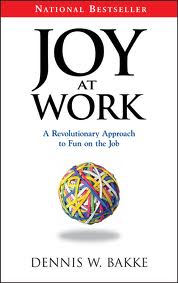
Joy at Work: A Revolutionary Approach To Fun on the Job [Paperback]

Dennis W. Bakke (Author)

images

Book Description

Publication Date: July 1, 2006

Imagine a company where people love coming to work and are highly productive on a daily basis. Imagine a company whose top executives, in a quest to create the most “fun” workplace ever, obliterate labor-management divisions and push decision-making responsibility down to the plant floor. Could such a company compete in today’s bottom-line corporate world? Could it even turn a profit? Well, imagine no more.

In Joy at Work, Dennis W. Bakke tells the true story of this extraordinary company–and how, as its co-founder and longtime CEO, he challenged the business establishment with revolutionary ideas that could remake America’s organizations. It is the story of AES, whose business model and operating ethos -“let’s have fun”-were conceived during a 90-minute car ride from Annapolis, Maryland, to Washington, D.C. In the next two decades, it became a worldwide energy giant with 40,000 employees in 31 countries and revenues of $8.6 billion. It’s a remarkable tale told by a remarkable man: Bakke, a farm boy who was shaped by his religious faith, his years at Harvard Business School, and his experience working for the Federal Energy Administration. He rejects workplace drudgery as a noxious remnant of the Industrial Revolution. He believes work should be fun, and at AES he set out to prove it could be. Bakke sought not the empty “fun” of the Friday beer blast but the joy of a workplace where every person, from custodian to CEO, has the power to use his or her God-given talents free of needless corporate bureaucracy.

In Joy at Work, Bakke tells how he helped create a company where every decision made at the top was lamented as a lost chance to delegate responsibility–and where all employees were encouraged to take the “game-winning shot,” even when it wasn’t a slam-dunk. Perhaps Bakke’s most radical stand was his struggle to break the stranglehold of “creating shareholder value” on the corporate mind-set and replace it with more timeless values: integrity, fairness, social responsibility, and a sense of fun. Read more of this post

The Decision Maker: Unlock the Potential of Everyone in Your Organization, One Decision at a Time; How Dennis Bakke build AES into a Fortune 200 global power company with 27,000 people in 27 countries.

The Decision Maker: Unlock the Potential of Everyone in Your Organization, One Decision at a Time [Hardcover]

Dennis Bakke (Author)

DecisionMaker Cover-Perseus.indd

Book Description

Publication Date: March 5, 2013

Who makes the important decisions in your organization? Strategy, product development, budgeting, compensation—such key decisions typically are made by company leaders. That’s what bosses are for, right? But maybe the boss isn’t the best person to make the call.

That’s the conclusion Dennis Bakke came to, and he used it to build AES into a Fortune 200 global power company with 27,000 people in 27 countries. He used it again to create Imagine Schools, the largest non-profit charter-school network in the U.S.

As a student at Harvard Business School, Bakke made hundreds of decisions using the case-study method. He realized two things: decision-making is the best way to develop people; and that shouldn’t stop at business school. So Bakke spread decision-making throughout his organizations, fully engaging people at all levels. Today, Bakke has given thousands of people the freedom and responsibility to make decisions that matter.

In The Decision Maker, a leadership fable loosely based on Bakke’s experience, the New York Times bestselling author shows us how giving decisions to the people closest to the action can transform any organization.

The idea is simple.

The results are powerful.

When leaders put real control into the hands of their people, they tap incalculable potential. The Decision Maker, destined to be a business classic, holds the key to unlocking the potential of every person in your organization. Read more of this post

The Truth Behind “Secret” Innovation At Nike, Apple, Google X

The Truth Behind “Secret” Innovation At Nike, Apple, Google X

BY AUSTIN CARR

MARCH 5, 2013

Our annual guide to the state of innovation in our economy, featuring the businesses whose innovations are having the greatest impacts across their industries and our culture as a whole.  Read more of this post

Apple Vs Exxon Mobil

CHART OF THE DAY: The Incredible Destruction Of Apple

Jay Yarow | Mar. 4, 2013, 5:39 PM | 5,647 | 8

sai-cotd-030413

Apple‘s stock fell to another new low point of its current crash, closing at $420.15. It’s an incredible decline for the stock which was at $700 in September. Read more of this post

Elder Buffett’s letter to Murray Rothbard: “I have a son who is a particularly avid reader of books about panics and similar phenomena.”

Letter from Howard Buffett to Murray Rothbard: “I have a son who is a particularly avid reader of books about panics and similar phenomena.”

March 4, 2013 by Tobias Carlisle

This letter from Howard Buffett, the highly libertarian “Old Right” United States Representative father of Warren, to anarcho-capitalist historian and economist Murray Rothbard, if real, is incredible. Buffett the Elder wrote to Rothbard that he “read that Rothbard had written a book on ‘The Panic of 1819‘” and wanted to know where he could buy a copy for his son “who is a particularly avid reader of books about panics and similar phenomena.”

Here is the letter:

howard-buffett-715x1024

The timing of the letter – July 31, 1962 – is interesting. The first “flash crash” occurred in May 1962, and was at the time the worst crash since 1929. Time LIFE described the 1962 “flash crash” thus:

The signs, like the rumblings of an Alpine ice pack at the time of thaw, had been heard. The glacial heights of the stock boom suddenly began to melt in a thaw of sell-off. More and more stocks went up for sale, with fewer and fewer takers at the asking price. Then suddenly, around lunchtime on Monday, May 28, the sell-off swelled to an avalanche. In one frenzied day in brokerage houses and stock exchanges across the U.S., stock values — glamor and blue-chip alike — took their sharpest drop since 1929.

Memory of the great crash, and the depression that followed, has haunted America’s subconscious. Now, after all these years, was that nightmare to happen again?

The article continues that, “although the Dow Jones Industrial Average fell almost 6 percent on that one vertiginous Monday and the market was anemic for a year afterwards, the markets as a whole, at home and abroad, did bounce back.” Good to know.

CJ rises as beacon of Korean food, shopping, pop culture

CJ rises as beacon of Korean food, shopping, pop culture

20130305.101204_khera_cj

CJ Group expands bio pharma, entertainment, home shopping, logistics businesses abroad. -Korea Herald/ANN

Kim So-hyun
Tue, Mar 05, 2013
The Korea Herald/Asia News Network

SOUTH KOREA – When CheilJedang spun off from Samsung Group in 1993, not many expected the food company would grow into a major conglomerate encompassing retail and entertainment businesses as well. With food and food service; biopharmaceuticals; entertainment and media; home shopping and logistics as its four core businesses, CJ Group has shown remarkable growth and change over the past 20 years. In addition to keeping the No. 1 spot in the food and bio businesses, CJ acquired Korea Express, the nation’s largest logistics firm, in 2011, and is leading the country’s entertainment and media industries.

The history of CheilJedang, now called CJ, dates back to when its founder Lee Byung-chull built a sugar mill in Busan amid the devastation of the Korean War. It succeeded in domestic sugar production in November 1953, lessening the country’s dependence on expensive sugar imports. Soon met with fierce competition in sugar refining, CheilJedang completed a flour mill using its own technologies and Korean-made machinery in 1958 and began production. The company entered the artificial seasoning product market in 1963, with its Mipoong vying against then-bestseller Miwon of Daesang. CJ developed mass-production techniques for a seasoning product it called “Dashida” in 1975 and nucleic acid for the first time in Korea two years later, which became a stepping stone for the seasoning industry. Dashida, which came in beef, fish and anchovy flavors, was a gustatory delight for ordinary Koreans who weren’t well off. In the 1980s, CJ expanded to processed food items such as beverages and frozen foods, and entered the pharmaceutical business based on new advanced technologies.

Read more of this post

Singapore Zoo to celebrate 40th anniversary with special programmes; Lee Kuan Yew: “The Singapore Zoo makes Singapore a better place for children and their parents.”

Singapore Zoo to celebrate 40th anniversary with special programmes

20130305.190154_zoo430

Among the activities include a search for people born on June 27, 1973 to join the Zoo’s birthday party, as well as 40 per cent discounts off admission prices for visitors who turn 40 in 2013. -AsiaOne

Tue, Mar 05, 2013
AsiaOne

SINGAPORE – The Singapore Zoo is rolling out celebratory activities from now until the end of the year to commemorate its 40th anniversary. Read more of this post

Spending on Traditional Drugs Drops as Specialty Medicines Rise

Spending on Traditional Drugs Drops as Specialty Medicines Rise

Americans are spending less on pills and other conventional medications for the first time in two decades, and more on complex injected drugs, a study has found.

Use of pills and other non-injected, non-specialty drugs fell 1.5 percent last year, according to the report by the pharmacy management company Express Scripts Holding Co. Traditional drugs are medicines like pills that don’t require special means of administration or frequent monitoring.

The drop is a reflection of trends in the pharmaceutical industry that include development of biotechnology drugs made from living organisms that require injection as well as expensive injectable or infused “specialty” medications that require special care. Wider use of cheaper generic equivalents of pills has helped reduce spending on conventional medicines, even as total pharmaceutical spending continues to rise. Read more of this post

Jim Rogers Bullish on Japan Equities on Abe’s Catalyst; “Japan is one of the few places in the world where I own shares,”

Jim Rogers Bullish on Japan Equities on Abe’s Catalyst

Jim Rogers, who co-founded the Quantum Fund with George Soros in the 1970s, said he increased his holdings of Japanese shares and plans to buy more because Prime Minister Shinzo Abe will boost the economy.

“Japan is one of the few places in the world where I own shares,” Rogers, chairman of Rogers Holdings, said at a Daiwa Securities Group Inc. (8601) equity conference in Tokyo today. “I have no plans to sell and plan to accumulate more when I can. Abe has been a catalyst and this will continue for several years.” Read more of this post

India Rewarded Ineligible Farmers With $9.5 Billion Debt Waiver

India Rewarded Ineligible Farmers With $9.5 Billion Debt Waiver

Almost a tenth of Indian farmers whose debts were written off by the government were not eligible for relief, according to an audit of a $9.5 billion plan that helped the ruling Congress party win a second term in power.

There were errors in nearly 25 percent of the cases where debt assistance was offered from 2008, the Comptroller and Auditor General of India said in a review submitted to parliament. About 13 percent of farmers the government considered qualified for help were denied funding by banks, the auditor said.

Lapses and errors “raised serious concerns about the implementation of the scheme,” it said in its report. Read more of this post

Why Blackberry Remains Powerful In Indonesia, and How It’s Still Going to Lose

Why Blackberry Remains Powerful In Indonesia, and How It’s Still Going to Lose

Mar 5, 2013 at 15:00 PM by Enricko Lukman, in MobileOpinion

A lot of my friends have had their fair share of complaints about the Blackberry Messenger (BBM) service in Indonesia, especially about the service’s lagginess. But still, a lot of them are wired into using BBM every single day, despite strong competition from apps like Line, Whatsapp, WeChat, and KakaoTalk. How deeply rooted is BBM in the Indonesian messaging ecosystem? The answer might lie in its importance in people’s professions. I asked a few of my friends from four different professions for a layman’s take on Blackberry and BBM. They’ve got some insights on how important BBM has become integral in their life and work, and yet how frustrated they are about it. Read more of this post