Gucci-Owner PPR Said to Consider Changing Its Name to Kering which is supposed to evoke the idea of caring and signal a new chapter in the company’s development

Gucci-Owner PPR Said to Consider Changing Its Name to Kering

PPR SA (PP), the French owner of Gucci and Puma, is considering changing its name to Kering to cap its transformation into a luxury and sporting-goods specialist, according to people with knowledge of the plan.

The re-branding of Paris-based PPR may be announced this month, said the people, who asked not to be identified because the information is confidential. The name, which would be the company’s fifth since listing on the Paris stock exchange in 1988, is supposed to evoke the idea of caring and signal a new chapter in the company’s development, one of the people said. Read more of this post

Nurses Spar With Doctors as 30 Million Insured Seek Care

Nurses Spar With Doctors as 30 Million Insured Seek Care

Christy Blanco’s health clinic in El Paso, Texas, is sitting empty. Blanco, a nurse practitioner, says she has a waiting list of patients, all the necessary equipment, and a Ph.D. in nursing that gives her the training to start treating patients.

About 50 miles (80 kilometers) away in Las Cruces, New Mexico, dozens of nurse practitioners at clinics like Blanco’s are busy caring for patients with a range of diseases from diabetes to asthma to depression.

The only difference between the El Paso and Las Cruces facilities is that in Texas, nurse practitioners are required to have a doctor under contract to sign off on 10 percent of medical charts and spend 1 of 10 days at the clinic. In New Mexico, no doctor is needed.

“I just want to get started,” said Blanco, who has spent about two years seeking a doctor for her clinic geared for low- income women. “I’m trying to work for the poor. I’ve spent thousands of dollars of my own money. I have a waiting list of patients, and I have to tell them I can’t practice yet.”

Blanco is caught in the middle of a tug-of-war between doctors and nurses over who will provide basic primary care for the 30 million U.S. citizens expected to get health insurance under the 2010 health-care law.

Nurse practitioners say they can do their jobs just fine without doctors and they’re lobbying lawmakers to end restrictions in more than a dozen of the 34 states that require physician oversight. Despite the need for increased care, doctors are pushing back, fighting for restrictions with their own lobbying efforts as well as with lawsuits across the country, arguing that patients’ basic care is at risk. Read more of this post

Apple’s Planned ‘IWatch’ Could Be More Profitable Than TV

Apple’s Planned ‘IWatch’ Could Be More Profitable Than TV

While Tim Cook has dropped hints that Apple Inc. (AAPL) is hard at work on a television to drive the next era of growth, the company’s wristwatch-style device, still in development, may prove more profitable.

The global watch industry will generate more than $60 billion in sales in 2013, said Citigroup Inc. analyst Oliver Chen. While that’s smaller than the pool of revenue that comes from TVs, gross margins on watches are about 60 percent, he said. That’s four times bigger than for televisions, according to Anand Srinivasan, a Bloomberg Industries analyst.

Apple, with its iconic brand and lucrative retail network, is poised to tap into the growing watch industry. Headway in the business would help compensate for slowing growth in other areas, such as iPhones and iPods. Apple’s stock has slumped by more than a third since peaking in September on signs of accelerating competition led by Samsung Electronics Co. (005930) and concern over how quickly Chief Executive Officer Cook is pushing into new products.

“This can be a $6 billion opportunity for Apple, with plenty of opportunity for upside if they create something totally new like they did with the iPod — something consumers didn’t even know they needed,” said Chen, who covers luxury- goods retailers.

The TV industry will generate $119 billion in sales this year, according to market-research firm IHS Electronics & Media. Using Chen’s margin estimates, a 10 percent share for Apple in each market would mean gross profit of $3.6 billion for watches, outstripping $1.79 billion for TVs. Read more of this post

Big-Bang Disruption; A new kind of innovator can wipe out incumbents in a flash

Big-Bang Disruption

by Larry Downes and Paul F. Nunes

By now any well-read executive knows the basic playbook for saving a business from disruptive innovation. Nearly two decades of management research, beginning with Joseph L. Bower and Clayton M. Christensen’s 1995 HBR article, “Disruptive Technologies: Catching the Wave,” have taught businesses to be on the lookout for upstarts that offer cheap substitutes to their products, capture new, low-end customers, and then gradually move upmarket to pick off higher-end customers, too. When these disrupters appear, we’ve learned, it’s time to act quickly—either acquiring them or incubating a competing business that embraces their new technology.

But the strategic model of disruptive innovation we’ve all become comfortable with has a blind spot. It assumes that disrupters start with a lower-priced, inferior alternative that chips away at the least profitable segments, giving an incumbent business time to start a skunkworks and develop its own next-generation products.

That advice hasn’t been much help to navigation-product makers like TomTom, Garmin, and Magellan. Free navigation apps, now preloaded on every smartphone, are not only cheaper but better than the stand-alone devices those companies sell. And thanks to the robust platform provided by the iOS and Android operating systems, navigation apps are constantly improving, with new versions distributed automatically through the cloud.

The disruption here hasn’t come from competitors in the same industry or even from companies with a remotely similar business model. Nor did the new technology enter at the bottom of a mature market and then follow a carefully planned march through larger customer segments. Users made the switch in a matter of weeks. And it wasn’t just the least profitable or “underserved” customers who were lured away. Consumers in every segment defected simultaneously—and in droves.

That kind of innovation changes the rules. We’re accustomed to seeing mature products wiped out by new technologies and to ever-shorter product life cycles. But now entire product lines—whole markets—are being created or destroyed overnight. Disrupters can come out of nowhere and instantly be everywhere. Once launched, such disruption is hard to fight.

We call these game changers “big-bang disrupters.” They don’t create dilemmas for innovators; they trigger disasters. Read more of this post

What does it take to turn around a Web company? A look inside the only two we’ve ever seen

What does it take to turn around a Web company? A look inside the only two we’ve ever seen

BY KEVIN KELLEHER 

ON MARCH 1, 2013

Every time a has-been startup like MySpace or Digg or a big public company like Yahoo or AOL attempts a Web turnaround, the tech media is quick to remind them that Web turnarounds never work.

Technically, we can’t say that anymore. Two companies– Priceline and eBay– have quietly proven that truism wrong, at least from a financial point of view.

Are they anomalies or has it just taken this long to see a turnaround work?

We forget that as industries go, the Web is a young one. The first Web site appeared only 21 years ago. That’s enough time for countless Web startups to appear, for far fewer to succeed and for a subset of those successes to fall on hard times. But it’s hardly enough time to produce any successful case studies in corporate turnarounds. Read more of this post

Hangzhou eatery chain Grandma’s thrives on making customers wait at its chain of 60 outlets across China; One customer claimed online he had queued for three days before finally securing a seat in his local Grandma’s

Hangzhou eatery chain Grandma’s thrives on making customers wait

  • Staff Reporter
  • 2013-03-04

Grandma’s, a chain of eateries founded in Hangzhou in 1998 as a single noodle house, now has 60 outlets across China often crammed with diners or those waiting in long queues for a table.

One customer claimed online he had queued for three days before finally securing a seat in his local Grandma’s, reported the Beijing magazine, China Entrepreneur.

However, for most the wait is well worth it as the restaurant chain’s fare is usually priced at about a third of what it costs for similar food at other restaurants, the magazine said.

Whether in Hangzhou, Shanghai or Beijing, the average bill per customer at a Grandma’s restaurant comes to about 60 yuan (US$9.50), compared with around 80 yuan (US$12.70) at similar restaurants.

Although eateries across the country have been hurt by increasing costs and sliding profits since 2010, Grandma’s has remained strong. It opened a dozen new outlets in 2012 alone, and is expected to open more in 2013.

Founder Wu Guoping told the China Entrepreneur the key to his success lay in his unending drive to look for ways to improve the management of his business. Read more of this post

We Are What We Quote

MARCH 2, 2013, 12:59 PM

We Are What We Quote

By GEOFFREY O’BRIEN

Quotes are the mental furniture of my life. From certain angles my inner landscape resembles a gallery hung with half-recalled citations, the rags and tag-ends of a lifetime of reading and listening. They can be anything at all, the exquisitely chiseled perceptions of poets and philosophers or the blurts of unscheduled truth-telling by public figures caught in the spotlight (the former Jersey City mayor Frank Hague’s “I am the law” or Richard Nixon’s “I’m not a crook”); the punch lines of 1930s comedians or the curtain lines of Jacobean dramatists; or words of wisdom or anguish or ridiculous humor, or simply, for instance, M.F.K. Fisher’s recollection of “the potato chips I ate slowly one November afternoon in 1936, in the bar of the Lausanne Palace.” They are the dangling threads that memory can latch onto when everything else goes blank.

What is the use of quotations? They have of, course, their practical applications for after-dinner speakers or for editorialists looking to buttress their arguments. They also make marvelous filler for otherwise uninspired conversations. But the gathering of such fragments responds to a much deeper compulsion. It resonates with the timeless desire to seize on the minimal remnant — the tiniest identifiable gesture — out of which the world could, in a pinch, be reconstructed. Libraries may go under, cultures may go under, but single memorizable bits of rhyme and discourse persist over centuries. Shattered wholes reach us in small disconnected pieces, like the lines of the poet Sappho preserved in ancient treatises. To collect those pieces, to extrapolate lost worlds from them, to create a larger map of the human universe by laying many such pieces side by side: this can become a fever, and one that has afflicted writers of all eras.

Anyone, of course, might develop a passion for quotes, but for a writer it’s a particularly intimate connection. A good quotation can serve as a model for one’s own work, a perpetual challenge with the neatness and self-sufficiency of its structure laid bare in the mind. How does it work? How might a quotation be done differently, with the materials and urgencies of a different moment? Perhaps writers should begin, in fact, by inwardly uttering again what has already been uttered, to get the feel of it and to savor its full power.

Quotes are the actual fabric with which the mind weaves: internalizing them, but also turning them inside out, quarreling with them, adding to them, wandering through their architecture as if a single sentence were an expansible labyrinthine space. Read more of this post

Spoiled brats spring from pampering parents

Spoiled brats spring from pampering parents

Created: 2013-3-4

Author:Ni Tao

20130304_525102_01

FOR renowned army singer Li Shuangjiang, the music is over, the curtain brought down by his ne’er-do-well son Li Tianyi. The junior Li has been placed under detention in Beijing for allegedly taking part in the gang-rape of an underage girl in a hotel room, together with four friends. It’s not the first time Li fils has dishonored his father, now 74 and arguably one of China’s best altos.  In 2011, the younger Li was given a one-year term in a juvenile rehabilitation facility for violently beating a man with whom he nearly had a car crash. He was released in September. After only six months, the bad boy struck again, this time bringing greater shame to his father and raising deeper questions about his parenting. The younger Li’s aggression can only be bred by his parents’ indulgence, many assert. This assertion appears plausible.  After the gang-rape case went public, Meng Ge, the boy’s mother and also a singer, appealed to the public to show some tolerance for his son, who is still a minor aged 17. Read more of this post

The $7 billion superannuation fund CareSuper has fired its last hedge fund manager, Fauchier Partners, as the industry prepares to move towards simpler, low-cost investments ahead of July 1 MySuper reforms

CareSuper axes last hedge fund manager

PUBLISHED: 1 HOUR 3 MINUTES AGO | UPDATE: 0 HOUR 41 MINUTES AGO

Exclusive | The $7 billion superannuation fund CareSuper has fired its last hedge fund manager, Fauchier Partners, as the industry prepares to move towards simpler, low-cost investments ahead of July 1 MySuper reforms.

Finding IPO Alley; Permission to list on a stock exchange is often granted to companies that play an opaque and graft-poisoned game

03.04.2013 11:53

Finding IPO Alley

Permission to list on a stock exchange is often granted to companies that play an opaque and graft-poisoned game

1362369019965518

By staff reporter Lu Yuan

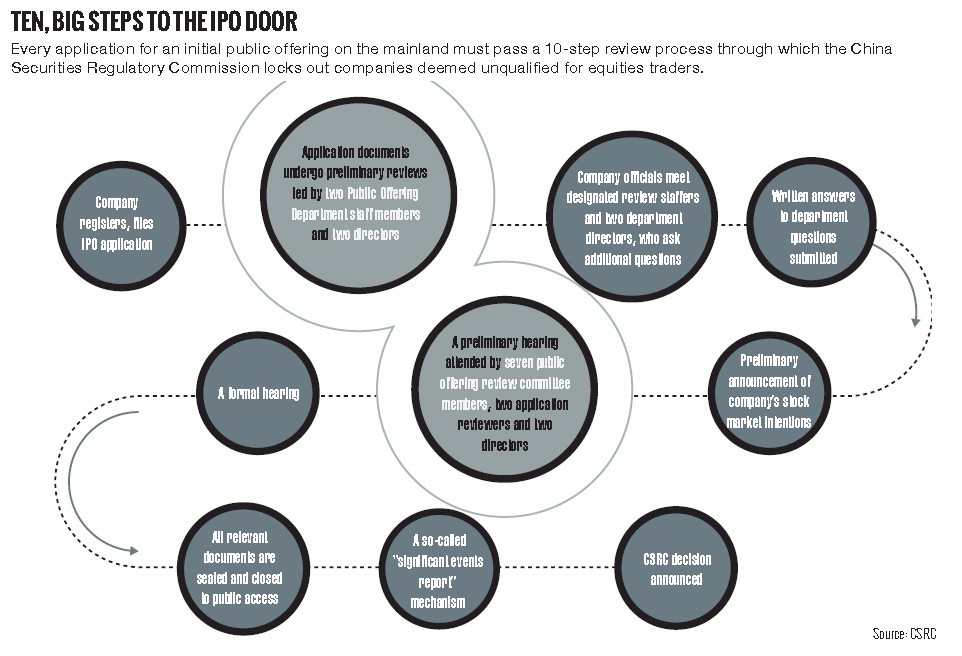
China’s IPO action has been locked in ice since October by China Securities Regulatory Commission (CSRC) officials intent on boosting investor confidence and improving scrutiny of stock market hopefuls.

Yet the heat is on for aspiring executives at more than 800 companies who, despite the freeze, have continued lobbying CSRC for permission to launch initial public offerings on the Shanghai and Shenzhen exchanges.

No one knows when CSRC might thaw the market for new listings. So executives have been busy door-knocking deep inside the commission at its dual “public offering departments” – one that reviews IPO applications for the Shenzhen Stock Exchange’s ChiNext growth board, the other for the Shanghai Stock Exchange A-share market.

They’ve also been busy wining, dining and warming up to members of CSRC’s elite Public Offering Review Committee (PORC), which ultimately decides the fate of every IPO application that’s survives the commission’s lengthy company review process.

In pursuit of warm relations, Caixin has learned, some IPO-hungry company executives have played along with rent-seeking CSRC officials. They’ve also paid intermediaries who charge enormous fees for access to key CSRC officials. Tens of millions of yuan may have traded hands in recent years. Read more of this post

All the words Warren Buffett had never used until this year

http://data.qz.com/2013/warren-buffetts-2012-letter-to-shareholders/

All the words Warren Buffett had never used until this year

By David Yanofsky — March 3, 2013

Warren Buffett’s annual letter to Berkshire Hathaway shareholders for 2012 is more than 13,000 words long, but some words stand out more than others. There are 188 words in this year’s missive— including ”fret,” “software,” and “recession-resistant”—that Buffett had never used in his previous 35 letters, which describe his thoughts about Berkshire’s performance and the global business climate.

buffettimage

Are High-Priced Managers Worth It? Some stock pickers get paid a lot more than others. Here’s how to decide if they are right for you

March 1, 2013, 10:47 a.m. ET

FUNDAMENTALS OF INVESTING

Are High-Priced Managers Worth It?

Some stock pickers get paid a lot more than others. Here’s how to decide if they are right for you.

By CORRIE DRIEBUSCH

IF-AB069_COSTch_G_20130228141804

Investors know they have to pay higher fees for actively managed mutual funds than for index funds.

But those portfolio-management fees vary greatly from fund to fund, and investors often wonder if they will get enough bang from a costlier fund to justify the bigger buck.

Consider, for instance, the 100 largest actively run U.S.-stock mutual funds. The average portfolio-management fee—which is typically the largest component of a fund’s overall expense ratio—is 0.58% of assets a year, according to Morningstar Inc. MORN +0.28% But five of the funds charge an even 1%: Yacktman FocusedFairholmeSequoiaBaron Growth andJPMorgan U.S. Large Cap Core Plus .

Is a higher-paid manager worth it? Financial advisers and fund analysts consider things such as a fund’s track record, management style and total costs when making the decision. Read more of this post

Apps Rocket Toward $25 Billion in Sales; Players in Quickly Growing Business Scramble to Figure Out Best Ways to Attract Users and Turn a Profit

Updated March 3, 2013, 8:37 p.m. ET

Apps Rocket Toward $25 Billion in Sales

Players in Quickly Growing Business Scramble to Figure Out Best Ways to Attract Users and Turn a Profit

By JESSICA E. LESSIN and SPENCER E. ANTE

How big of a money maker are apps? What country’s GDP is the size of the global app economy? How does app use compare to TV in terms of time spent per day? WSJ’s Jason Bellini has answers.

Nearly five years after Apple Inc. AAPL -2.48% kicked off the mobile-apps craze, the industry is booming.

App stores run by Apple and Google Inc. GOOG +0.62% now offer more than 700,000 apps each. With so many apps to choose from, consumers are estimated to spend on average about two hours a day with apps. Global revenue from app stores is expected to rise 62% this year to $25 billion, according to Gartner Inc. IT +0.14%

The apps industry has matured in some respects. Some of the Wild West tactics of five years ago—like scams to accrue more downloads—have given way to more order as Apple and others tighten their rules. App developers are more methodical about marketing their apps and focusing on the few apps that work best. Read more of this post

In teachers they trust: Every Finnish school is a good school, because every teacher is highly-trained and qualified. In a two-part special report, we look at the secrets of Finland’s education model.

In teachers they trust

Every Finnish school is a good school, because every teacher is highly-trained and qualified. In a two-part special report, we look at the secrets of Finland’s education model.

Asked how he assesses his teachers, Mr Matti Koivusalo shrugs matter-of-factly that he has “no means” to do so. “There is no evaluation whatsoever for teachers. Everything is based on trust,” says the Principal of Haaga Comprehensive School in Helsinki.

Asked how he assesses his teachers, Mr Matti Koivusalo shrugs matter-of-factly that he has “no means” to do so. “There is no evaluation whatsoever for teachers. Everything is based on trust,” says the Principal of Haaga Comprehensive School in Helsinki.

Indeed, the “open” school culture means any feedback quickly reaches his ears, says Mr Koivusalo, who looks after 50 teachers and 600 pupils in grades one through nine (the equivalent of Primary 1 to Secondary 3 in Singapore).

It is easy to see how: Along the school’s hallway, pupils look up from their mobile phones and greet him as he walks past; some engage him in friendly banter. At the school cafeteria where free lunches are served daily — an established practice at all Finnish schools — teachers join him for lunch and chat about how their day has gone.

Said Mr Koivusalo: “If something bad happens, I’ll hear about it in five minutes … The atmosphere is such that (students and teachers) can come and talk about it freely without being afraid.”

Even so, sackings are rare in Finnish schools, say educators. Mr Vesa Valkila, one of the principals at Turku University teacher training school, tried to explain: “Finnish teachers have a lot of freedom and are trusted … that really motivates a lot of them to do their best.” Read more of this post

Baby Cured of HIV for the First Time, Researchers Say; Success With Aggressive Drug Regimen Could Spur Wider Use of Such Treatment

Updated March 3, 2013, 4:33 p.m. ET

Baby Cured of HIV for the First Time, Researchers Say

Success With Aggressive Drug Regimen Could Spur Wider Use of Such Treatment

By RON WINSLOW

A Mississippi baby born with the AIDS virus appears to have been cured after being treated with an aggressive regimen of drugs just after her birth 2½ years ago, an unusual case that could trigger changes in care for hundreds of thousands of babies born globally each year with HIV.

The findings, reported Sunday by researchers, mark only the second documented case of a patient being cured of infection with the human immune-deficiency virus. The first, an adult man known as the Berlin patient, was cured as a result of a 2007 bone-marrow transplant.

The new case was discovered after the baby girl’s mother stopped treatment on her, and doctors realized that the virus was undetectable even without drugs, which HIV patients normally must take for the rest of their lives. Read more of this post

Frogs Leap from Indonesian Swamps to Tabletops in France; “God will protect us and be fair to us, and make sure there are always frogs”

Frogs Leap from Indonesian Swamps to Tabletops in France
March 03, 2013

Bogor, West Java. The Indonesian frog vendor closes her eyes, asks Allah for his blessing, and with one swift strike of a cleaver, beheads the trembling creature.

Though diners in white table-clothed French brasseries may not know it, their frogs legs most likely come from the murky swamps of tropical Indonesia, caught by hunters in the dead of the night to be slaughtered and sold at local markets.

As mechanically as a factory worker, Sri Mulyani rips off the frog’s skin, pulls out its innards with her bare hands and flings the amphibian onto a mountain of others that have suffered the same fate.

“If I feel disgusted and sick of frogs, I just think about the money,” the smiling 41-year-old told AFP at an early-morning market in Bogor, on the outskirts of the capital Jakarta.

Mulyani and her frog-hunter husband, Suwanto, 48, make up to Rp 500,000 ($52) a day – well above the local minimum wage of around $200 a month – chasing and selling frogs to restaurants or middlemen for export. Read more of this post

China’s next inner circle

Monday March 4, 2013

China’s next inner circle

HONG KONG: Even as Xi Jinping gets ready to assume the presidency of China this month, jockeying has begun for 2017 when rising stars of the ruling Communist Party move into top leadership posts.

China’s first and second generation Communist Party leaders, such as Mao Zedong and Deng Xiaoping, ruled as single paramount leaders. But over the past two decades, Chinese leaders have tried to institutionalise governance with an emphasis on collective leadership – except when it comes to choosing leaders.

The process is highly secretive and influenced by faction leaders who jockey to get their allies on the 25-member Politburo and its apex body, the seven-member Politburo Standing Committee.

“In certain areas the rules and the norms of institutionalisation continue, but in certain areas they are subject to manipulation, in particular with regard to the selection of the Politburo,” said Cheng Li, director of research at the John L. Thornton China Center in the Foreign Policy program at the Brookings Institution. Read more of this post

Malaysia Regime Ouster Hinges on Borneo as Radio Aids Opposition

Malaysia Regime Ouster Hinges on Borneo as Radio Aids Opposition

At 7 p.m. on the Malaysian side of Borneo island, Luang Entiyang turns the dial on a transistor radio in search of an anti-government talk show as about a dozen villagers sit cross-legged on the floor waiting to listen.

Similar meetings occur daily across the jungles of Sarawak, Malaysia’s biggest state and one that has underpinned the ruling Barisan Nasional alliance’s 55-year hold on national power. The two-hour broadcast by U.K.-based Radio Free Sarawak, in which villagers call in to tell stories of land-grabs by palm oil companies, aided by local officials, has helped to pry loose Entiyang and other lifelong BN backers since it began in 2010.

“It makes a great difference because we are listening and learning,” Entiyang, 61, said Feb. 15 at his home in Melikin, a hillside village about a two-hour drive from Kuching, Sarawak’s capital. “If BN wins the election, the natives will have nothing. They will take all the land. Once they betray us, we say goodbye.”

Opposition inroads in Borneo rain forests that hold a quarter of Malaysia’s parliamentary seats pose the biggest threat to Prime Minister Najib Razak’s tenure as he prepares to call an election in the coming weeks. The prospect of a loss has unsettled investors, who have made the FTSE Bursa Malaysia KLCI Index the worst-performing benchmark in Asia this year on concern the country will undergo its first transfer of power since gaining independence from Britain in 1957. Read more of this post

China’s graft-fighting Xi tells party future is on the line; the Chinese leader peppered his latest speech with references to aphorisms from virtuous officials and philosophers such as Mencius and Zhuge Liang

China’s graft-fighting Xi tells party future is on the line

Xi, who will take over the reins of state power from outgoing President Hu Jintao this month, has made fighting pervasive graft a central theme since assuming the top job. -Reuters

Sun, Mar 03, 2013
Reuters

BEIJING – China’s ruling Communist Party will only be able to mark its 100th birthday in eight years time if officials can learn from the selfless sages of the past, party chief Xi Jinping said in remarks published on Sunday, taking another swipe at corruption.

Xi, who will take over the reins of state power from outgoing President Hu Jintao at this month’s annual full session of parliament, has made fighting pervasive graft a central theme since assuming the top job in the party and military in November.

The Communist Party marks the 100th anniversary of its founding in 2021, one year before the second of Xi’s two five-year term ends and he steps down as party chief.

“Only if the capabilities of all party members unceasingly continue to strengthen, can the goal of ‘two 100 years’ and ‘the dream’ of the great rejuvenation of the Chinese people be realised,” Xi said in a speech marking the 80th anniversary of the Central Party School, which trains rising officials.

“Two 100 years” refers to both the party and the People’s Republic of China lasting at least a century each. Read more of this post

Think New York Property Is Costly? In New Delhi, Seedy Goes for 8 Figures

March 2, 2013

Think New York Is Costly? In New Delhi, Seedy Goes for 8 Figures

By JIM YARDLEY

NEW DELHI — The fading bungalow at 38 Amrita Shergil Marg does not immediately shout real estate bling. There is no tennis court, no infinity pool, no Sub-Zero refrigerator or walk-in closet. The paint is chipped, the bathrooms are musty and the ceilings have water stains. The house may ultimately be torn down. Yet when it went up for public auction, the winning bid was almost $29 million. And many neighbors consider that a bargain. One block away, a gracious if not quite Rockefeller-ready residence once leased by the Mexican ambassador is now reportedly on the market for more than $100 million. Other nearby houses are going for $40 million to $70 million. “The price of the Mexican residence is $110 million,” said Jorge Roza de Oliveira, Portugal’s ambassador to India. “You can buy a home in New York and Miami and Lisbon and London and keep a lot of change for that much.” Real estate prices in the heart of New Delhi, especially for the bungalows built nearly a century ago during the British Raj, are among the highest in the world.

Read more of this post

A Wonderful Lesson From Warren Buffett That Explains One Of The Biggest Mysteries About Amazon; Novy-Marx (2012) shows, however, that a simple quality metric, gross profits-to-assets, has roughly as much power predicting the relative performance of different stocks as tried-and-true value measures like book-to-price

A Wonderful Lesson From Warren Buffett That Explains One Of The Biggest Mysteries About Amazon

Joe Weisenthal | Mar. 2, 2013, 8:53 AM | 16,147 | 21

Warren Buffett is known as the world’s most famous “value investor,” but that term is not well understood.

In his latest letter to shareholders (.pdf), Buffett includes a great paragraph explaining that value is not synonymous for cheap.

More than 50 years ago, Charlie told me that it was far better to buy a wonderful business at a fair price than to buy a fair business at a wonderful price. Despite the compelling logic of his position, I have sometimes reverted to my old habit of bargain-hunting, with results ranging from tolerable to terrible. Fortunately, my mistakes have usually occurred when I made smaller purchases. Our large acquisitions have generally worked out well and, in a few cases, more than well.

As Charlie Munger evidently taught Buffett, it’s better to buy high-quality businesses for a fair amount than finding assets at bargain basement prices. Read more of this post

The Quality Dimension of Value Investing

The Quality Dimension of Value Investing

Robert Novy-Marx

Robert Novy-Marx is assistant professor of finance at the Simon Graduate School of Business at the University of Rochester, New York, and a faculty research fellow of the National Bureau of Economic Research.

Buying high quality assets without paying premium prices is just as much value investing as buying average quality assets at discount prices. Strategies that exploit the quality dimension of value are nearly as profitable as traditional value strategies based on price signals alone. Accounting for both dimensions by trading on combined quality and price signals yields dramatic performance improvements over traditional value strategies. Accounting for quality also yields significant performance improvements for investors trading momentum as well as value.

The No-Limits Job; for 20-somethings in creative fields, the work — often unpaid — never seems to end. Nor do the days

March 1, 2013

The No-Limits Job

By TEDDY WAYNE

Every generation has its own anthem of making the journey from youthful naïveté to adult reality, whether it’s Neil Young’s “Old Man,” Nirvana’s “Smells Like Teen Spirit” or most recently, perhaps, the Taylor Swift song “22.”

“Tonight’s the night when we forget about the deadlines,” it goes. “It feels like one of those nights, we won’t be sleeping.”

If only it were as easy for Ms. Swift’s less affluent contemporaries to blow off their deadlines as it is for the singer-songwriter (now a slightly more seasoned 23). Sleepless nights are more likely because they are on the clock, not at the club.

“If I’m not at the office, I’m always on my BlackBerry,” said Casey McIntyre, 28, a book publicist in New York. “I never feel like I’m totally checked out of work.”

Ms. McIntyre is just one 20-something — a population historically exploitable as cheap labor — learning that long hours and low pay go hand in hand in the creative class. The recession has been no friend to entry-level positions, where hundreds of applicants vie for unpaid internships at which they are expected to be on call with iPhone in hand, tweeting for and representing their company at all hours.

“We need to hire a 22-22-22,” one new-media manager was overheard saying recently, meaning a 22-year-old willing to work 22-hour days for $22,000 a year. Read more of this post

Cave Explorer Hunts Antibiotics 1,600 Feet Down: Health

Cave Explorer Hunts Antibiotics 1,600 Feet Down: Health

By Meg Tirrell  Feb 27, 2013

In a remote cave 1,600 feet below New Mexico’s Carlsbad Caverns National Park, Hazel Barton, a microbiologist working with Cubist Pharmaceuticals Inc. (CBST), has found a drug-resistant bacteria that may one day help extend the life of Cubist’s best-selling antibiotic, Cubicin.

“We know what the resistance is going to look like,” said Barton, an associate professor at the University of Akron in Ohio. “There’s no resistance now, but in something like 20 years when there is, we’re going to know how to inhibit it.”

Barton’s discovery in Lechuguilla Cave, where humans have rarely set foot since its opening in 1986, is part of a global hunt for never-before-used antibiotics to combat the spread of drug-resistant superbugs. Last month, the World Economic Forum declared drug-resistant bacteria one of the greatest risks to human health in its 2013 Global Risks report. With the pace of new antibiotic development slowing to a crawl, the report warned that the world may face “a scenario in which all antibiotics are rendered ineffective for treating even common infections.”

As bacteria develop resistance to available medicines, modern methods of antibiotic development in labs have failed to keep pace with an emerging crop of superbugs. Many drugmakers have dropped out of the market because of regulatory hurdles and poor return on investment.

That failure carries a steep price. Antibiotic-resistant infections are estimated to add $21 billion to $34 billion in costs to the U.S. health-care system each year, according to the World Economic Forum’s report. Antibiotic-resistant bacteria cause the majority of the 99,000 deaths annually in North America from infections acquired in hospitals, the report said. Read more of this post

Sticks and Stones: Defeating the Culture of Bullying and Rediscovering the Power of Character and Empathy

Sticks and Stones: Defeating the Culture of Bullying and Rediscovering the Power of Character and Empathy[Hardcover]

Emily Bazelon (Author)

13642996

Book Description

Release date: February 19, 2013

Being a teenager has never been easy, but in recent years, with the rise of the Internet and social media, it has become exponentially more challenging. Bullying, once thought of as the province of queen bees and goons, has taken on new, complex, and insidious forms, as parents and educators know all too well. No writer is better poised to explore this territory than Emily Bazelon, who has established herself as a leading voice on the social and legal aspects of teenage drama. In Sticks and Stones, she brings readers on a deeply researched, clear-eyed journey into the ever-shifting landscape of teenage meanness and its sometimes devastating consequences. The result is an indispensable book that takes us from school cafeterias to courtrooms to the offices of Facebook, the website where so much teenage life, good and bad, now unfolds. Along the way, Bazelon defines what bullying is and, just as important, what it is not. She explores when intervention is essential and when kids should be given the freedom to fend for themselves. She also dispels persistent myths: that girls bully more than boys, that online and in-person bullying are entirely distinct, that bullying is a common cause of suicide, and that harsh criminal penalties are an effective deterrent. Above all, she believes that to deal with the problem, we must first understand it. Blending keen journalistic and narrative skills, Bazelon explores different facets of bullying through the stories of three young people who found themselves caught in the thick of it. Thirteen-year-old Monique endured months of harassment and exclusion before her mother finally pulled her out of school. Jacob was threatened and physically attacked over his sexuality in eighth grade—and then sued to protect himself and change the culture of his school. Flannery was one of six teens who faced criminal charges after a fellow student’s suicide was blamed on bullying and made international headlines. With grace and authority, Bazelon chronicles how these kids’ predicaments escalated, to no one’s benefit, into community-wide wars. Cutting through the noise, misinformation, and sensationalism, she takes us into schools that have succeeded in reducing bullying and examines their successful strategies. The result is a groundbreaking book that will help parents, educators, and teens themselves better understand what kids are going through today and what can be done to help them through it. Read more of this post

Want To Build A $1B Consumer Tech Company? Look For Long-Haul Founders And Don’t Fear Incumbents

Want To Build A $1B Consumer Company? Look For Long-Haul Founders And Don’t Fear Incumbents

JACOB MULLINS ,posted 6 hours ago

Editor’s note: Jacob Mullins is a VC at Shasta Ventures who primarily focuses on consumer web and mobile companies. Follow him on Twitter @jacob

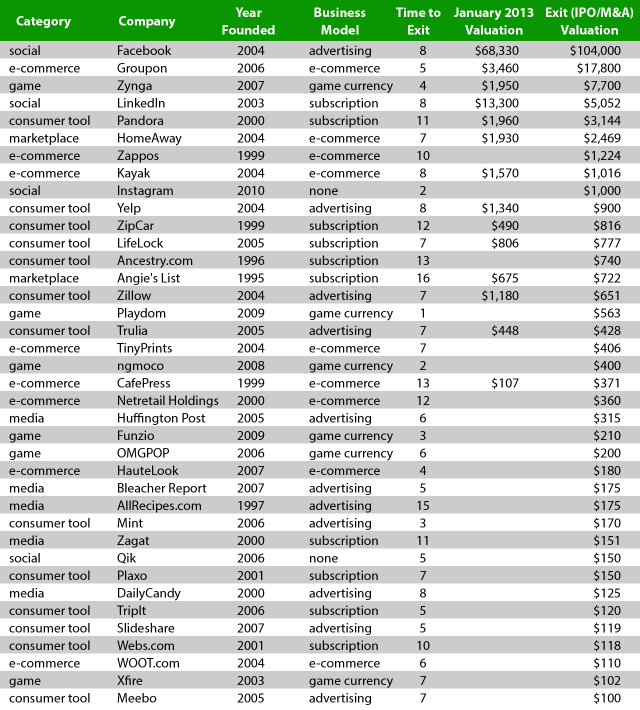
With the recent talk about the growing “billion-dollar club” in startups, I’ve been wondering, as a Series A investor, what characteristics a $1 billion consumer tech company has. I examined the pool of consumer companies that have had exits over $100 million within the current era of consumer tech, which I consider to be post-recession 2008. I wanted to see what I could learn and ideally reverse-engineer common characteristics that would help me identify the next big winners when I see them today or in the future. I created a dataset pulling from a number of venture capital data sources, including CrunchBase, and narrowed it down to my own specifics: U.S., venture-backed companies that have had realized outcomes, both IPO and M&A, over $100 million since 2008. Because private-equity funding and M&A details are less clearly reported, this may not be a comprehensive list of consumer companies. Also, I did not include software/enterprise companies, of which there are many more.

COMMON CHARACTERISTICS OF CONSUMER TECH COMPANIES

billion-chart
Here are a few highlights:

  • 38 companies over the past five years have exited over $100 million
  • Only nine companies over the past five years have exited over $1 billion; all but one of these nine (Zappos) exited in 2011/2012
  • 29 of the 38 outcomes happened in 2011 and 2012
  • 14 of these companies exited via IPO, all in 2011 and 2012
  • seven of the nine most valuable exits were all public offerings (Zappos and Instagram are the two M&A transactions worth $1 billion or more. I’m continuing to value the Instagram acquisition at the original offer of $1 billion, not taking the decreased market value of public Facebook stock into account.)

This simple survey affirmed my belief that achieving outsized results within the consumer company landscape is incredibly difficult. Now that we’re sure it’s difficult, what insight can we glean? Read more of this post

Boy, 6, writes book to save friend’s life

Boy, 6, writes book to save friend’s life

bookchocv

Saturday, Mar 02, 2013
The New Paper

They are the best of friends in primary school.

So when his chum needed help, Dylan Siegel jumped in.

At six, Dylan has produced a 16-page book called Chocolate Bar, a handwritten and illustrated story.

More than two months after putting his book on the market, he has managed to raise more than US$30,000 (S$37,150) from events, sales and donations made through Facebook and online.

The book uses the term chocolate bar as a synonym for awesome.

He came up with his book because his good friend Jonah Pournazarian, seven, suffers from a rare liver disorder with no known cure, the Daily Mail reported. Jonah often eats through a tube, sometimes corn starch or chicken soup with vegetables. Read more of this post

Buffett: Performance streak may end this year; “To date, we’ve never had a five-year period of underperformance, having managed 43 times to surpass the S&P over such a stretch”: Long-time Berkshire investors said they detected almost a sense of frustration in this year’s letter

Buffett: Performance streak may end this year

12:30am EST

By Ben Berkowitz

(Reuters) – Berkshire Hathaway may end a long streak of outperforming the S&P 500 this year, Chief Executive Warren Buffett warned shareholders on Friday, even as he said he was still eagerly hunting for acquisitions to grow the ice-cream-to-insurance conglomerate.

In his annual letter to investors, Buffett opened up with a caution that this year, for the first time, the growth in Berkshire’s book value per share may underperform the growth in the S&P 500 when measured over a five-year period.

“To date, we’ve never had a five-year period of underperformance, having managed 43 times to surpass the S&P over such a stretch,” he wrote. “But the S&P has now had gains in each of the last four years, outpacing us over that period. If the market continues to advance in 2013, our streak of five-year wins will end.”

Buffett said he expects the growth in Berkshire’s intrinsic business value will over time exceed the S&P’s returns by small margins. But at the same time, he said the firm would continue to underperform in a strong market like this year.

Long-time Berkshire investors said they detected almost a sense of frustration in this year’s letter. Read more of this post

Druckenmiller Sees Storm Worse Than ’08 as Seniors Steal

Druckenmiller Sees Storm Worse Than ’08 as Seniors Steal

Stan Druckenmiller, one of the best- performing hedge fund managers of the past three decades, has a warning for the youth of America: Don’t let your grandparents steal your money.

Druckenmiller, 59, said the mushrooming costs of Social Security, Medicare and Medicaid, with unfunded liabilities as high as $211 trillion, will bankrupt the nation’s youth and pose a much greater danger than the country’s $16 trillion of debt currently being debated in Congress.

“While everybody is focusing on the here and now, there’s a much, much bigger storm that’s about to hit,” Druckenmiller said in an hour-long interview with Stephanie Ruhle on Bloomberg Television’s Market Makers. “I am not against seniors. What I am against is current seniors stealing from future seniors.” Read more of this post

Smartphone sales in India may suffer from a higher tax on handsets costing more than $37

Chidambaram Eyes IPhone, Z10 to Plug Budget Gap: Corporate India

Smartphone sales in India may suffer from a higher tax on handsets costing more than $37 just as Apple Inc. (AAPL) steps up efforts to tap demand for data services in the world’s second-largest mobile-phone market.

Finance Minister Palaniappan Chidambaram yesterday said he would raise the excise tax on high-end phones to 6 percent from 1 percent to help finance welfare programs for the country’s poor and fund the widest budget deficit among the largest emerging economies. Samsung Electronics Co. (005930), which sells the Galaxy range of smartphones, said the move “won’t have a positive impact” on the mobile-phone industry and will force customers to pay more.

India’s government, after attempting to squeeze wireless operators including Vodafone Group Plc (VOD) and Bharti Airtel Ltd. (BHARTI) with higher license fees and airwave tariffs, is now targeting handsets for revenue from an industry that has boomed since Prime Minister Manmohan Singh opened the economy more than two decades ago. Chidambaram also increased tax on high earners, luxury cars and yachts. Read more of this post