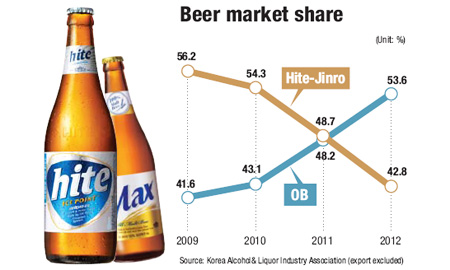
‘Winner’s curse’ entraps Hite-Jinro; Hite-Jinro has seen its market share fall in the beer industry with the firm failing to create synergy since Hite took over Jinro in 2005

2013-02-28 17:06

‘Winner’s curse’ entraps Hite-Jinro

OB rises to top on stellar sales

By Rachel Lee

130228_p18_winner

Hite-Jinro has seen its market share fall in the beer industry with the firm failing to create synergy since Hite took over Jinro in 2005. The setback is expected to deal a blow to the country’s leading beer and soju maker’s long-term plan to become a global alcohol beverage maker. Led by CEO Kim In-kyu, the firm has set a goal of achieving 100 percent growth in overseas sales by 2017 from 2011 and expanding exports to amount to 300 billion won by then.

The company, which had ruled the highly-competitive local beer market for 15 years, gave up the top position to archrival Oriental Brewery (OB) last year. Read more of this post

Investment Migrants Taking Billions out of China

Investment Migrants Taking Billions out of China – Economic Observer Online – In-depth and Independent

By Chao Xinrui and Wang Shulan (巢新蕊,王淑兰)

Issue 608, Feb 25, 2013

It’s been said that China’s rich are all either emigrating or planning to emigrate.

That may not be much of an exaggeration. In 2011, of those Chinese with personal assets of over 100 million yuan, 27 percent had already emigrated and 47 percent were considering emigration, according to The Annual Report on Chinese International Migration (2012), jointly issued by the Center for China & Globalization (CCG) and the Beijing Institute of Technology School of Law

The report showed that China is experiencing a third wave of large-scale emigration. Since the economic crisis of 2008, European and American countries have tightened policies on admitting skilled immigrants, but investment immigration policy has been relaxed.

Wang Huiyao (王辉耀), director of CCG and one of the editors of the International Migration report, said that in the past three years, Chinese who used overseas investment in order to obtain permanent residence in other countries took at least $15 billion out of China with them. Read more of this post

Shares of the fallen doughnut maker Kripsy Kreme have risen from a buck and change to about $13 in four years

Krispy Kreme’s Unlikely Comeback

By Roben Farzad on February 22, 2013

In the three years following Krispy Kreme Doughnuts’ (KKD) initial public offering in 2000, its shares soared 840 percent, despite a bear market. Back then, everyone wanted a bite of the Winston-Salem (N.C.) doughnut maker: Baseball great Hank Aaron scored a franchise in Atlanta, and American Bandstander Dick Clark lobbied unsuccessfully for a Times Square concession. In 2003 the cover of Fortune magazine anointed Krispy Kreme “America’s hottest brand.”

The hot-glazed hype peaked just as the Atkins diet and its carbophobia took hold. It didn’t help that Krispy Kreme alienated its franchisees by skimping on brand promotion. And when rival Dunkin’ Donuts (DNKN) reinvented itself as a top destination for coffee, its Southern rival failed to serve up a competitive brew.

Short-sellers swarmed Krispy, and were vindicated in 2004 when the company reported its first quarterly loss since going public. Later that year, the Securities and Exchange Commission opened an inquiry into accounting irregularities. As stores shut down and rumors of bankruptcy swirled, the market increasingly saw Krispy Kreme as another fast-food flameout. The stock hit bottom at $1.08 four years ago.

A lot has changed since. Krispy now trades for $13.25 a share, up more than 60 percent from a year earlier. New management has returned the company to profitability after 14 quarters of losses. International franchises kicked in $4.3 million in operating income in Krispy’s latest quarter; in the U.S., where the company owns many of its stores, franchises contributed just $1.2 million. An appreciation for fried dough, it seems, transcends cultural barriers, with appetite for Krispy Kreme’s flagship product particularly strong in Asia and the Middle East. Backed by a 12 percent equity investment from Kuwait’s Al Kharafi family, the company last year set a target to increase franchises abroad to 900 stores by 2017 from 506 now. At home, the chain hopes to expand to 400 U.S. stores from 240 over the same period. Read more of this post

Hard Landing Ahead for China’s Local Governments?

March 1, 2013, 5:05 PM

Hard Landing Ahead for China’s Local Governments?

China’s use of land sales to fund local governments is no longer on such solid ground, according to a top legislator.

Just a few days ahead of the annual session of China’s National People’s Congress, which gets under way on Tuesday, Li Shenming vented his frustration with the government’s investment-driven economic growth policies and its reliance on selling land-use rights to fund local government operations.

He called for urgent changes and suggested that time was growing short for a policy shift.

“It’s getting so bad that if (local governments) don’t sell land, they can’t even pay salaries,” said Mr. Li, a member of the legislature’s Standing Committee, a grouping of its senior members.

“How long can this ‘land fiscal policy’ last? Another five years?” he moaned in front of an audience at a financial forum.

Local governments generally rely on land sales — and taxes on property transactions — for a hefty chunk of their revenues. That often makes them a reliable friend of property developers and makes them more than a little eager to eager to sell off land.

But that formula has been sorely tested as the central government continues itsprolonged clampdown on property speculation, banning purchases of multiple homes and squeezing credit to property developers. Revenue from land sales fell 14% nationwide last year, official data show, due to the central-government campaign.

The constant push for more land sales ensures lots of development projects – some of them of questionable economic value. It supports an economic growth model that relies on investment for economic growth, and has been widely criticized as one that won’t be sustainable over the longer term. And it often leads to forced evictions of farmers or urban residents to make way for development projects, at timesendangering social stability.

Mr. Li, who is also an economist and the vice president and deputy party chief of the Chinese Academy of Social Sciences, a top state think-tank, estimated that proceeds from land sales account for over 40% of revenue for most local governments.

Economists have called for broad reforms of China’s fiscal policies by giving local governments more authority in setting taxes, and allowing them to expand trial projects setting annual taxes on property values, rather than just property sales. The tax reform is currently being tested in Shanghai and Chongqing.

China’s legislators gather for a two-week session that generally is confined to endorsing policies set by Communist Party heavyweights but also allowing legislators to blow off a bit of steam. If Mr. Li’s pre-session outburst is an indication, land policies could be a steamy topic.
China’s Government-Run Auction House Is Unstoppable

China’s Government-Run Auction House Is Unstoppable

Cain NunnsGlobalPost | 10 minutes ago | 17 | 

TAIPEI, Taiwan — In Huang Hung-jen’s plush office in old-money West Taipei, there hangs a 6-foot oil painting of US Marines manhandling an Iraqi family in their own home. The Iraqis look petrified, the Marines aggressive and overbearing. The piece, part of up-and-coming Chinese artist Yuan Liang-yu’s “War Series,” is a blunt metaphor for how China believes the human rights narrative is skewed in Washington’s favor. It’s also an example of how Beijing uses the arts to engender soft power at home and abroad. It goes without saying that Yuan wouldn’t be permitted the same artistic license were he protesting trouble spots closer to home, say in Tibet or riotous Xinjiang. But Huang, a Chinese art insider, doesn’t care about that. What he cares about is securing pieces for Beijing Poly International Auction Company, the fine arts arm of a powerful and opaque mainland Chinese business conglomerate. Read more of this post

Pine Nuts Rate Foie Gras Prices as Bugs to Drought Cut Harvests; “Pine nuts, being for the most part a product of wild ecosystems, follow the sad fate of their forests,”

Pine Nuts Rate Foie Gras Prices as Bugs to Drought Cut Harvests

French gourmets face a quandry: spend that last euro on foie gras or on a package of pine nuts.

The global harvest of the nuts — a key ingredient in classic Italian pesto sauce which graced prehistoric diets and was considered an aphrodisiac in ancient Rome — fell an estimated 47 percent last year, boosting prices to the highest in more than a decade. That’s prompting manufacturers and home preparers to substitute cheaper cashews or walnuts.

“Consumers will start treating them more like a luxury item, something of a tree-produced caviar,” said Leonid Sharashkin, pine-nut forestry adviser to Salem, Missouri-based Pinenut.com, which harvests and sells wild crops.

The crop in China, the biggest shipper, fell 90 percent last year, while yields dropped 63 percent in the Mediterranean region, the International Nut & Dried Fruit Council estimates. U.S. import prices for shelled pine nuts were the highest in at least two decades in 2012, while German buyers in November paid the most for Chinese nuts since at least 1998, trade data show.

French retailer Monoprix SA sells the nuts online starting at 78.40 euros ($103) a kilogram (2.2 pounds), more expensive than foie gras, 20-month-cured Parma ham or lumpfish eggs. Read more of this post

Palm Oil Inventory in China Is Seen at Record Amid Global Glut; Palm Oil Heads for Worst Losing Streak Since 2006 on Inventories

Palm Oil Inventory in China Is Seen at Record Amid Global Glut

Palm oil inventory held at ports in China, the second-biggest importer, expanded to a record last month driven by slow growth in demand and after the biggest-ever purchases in December, according to a Bloomberg survey.

Shipments stored at large ports rose to 1.4 million metric tons from 1.2 million tons in January, according to the median of a survey of three researchers and one trader yesterday. Buyers in China may slow purchases further to absorb the supply that’s accumulated, they said. A separate estimate today from researcher Grain.gov.cn put the reserves at 1.22 million tons.

The inventory in China adds to a glut in the world’s most- used cooking oil, which is caught in a bear market as supply expands to the biggest ever. Reserves in Malaysia, the largest producer after Indonesia, reached an all-time high in December. Futures in Kuala Lumpur fell for an eighth day today, poised for the worst run since 2006. Read more of this post

China’s Legions of ‘Housing Slaves’; In China’s affluent cities, it’s not uncommon for people to spend 40 times their annual income on an apartment.

China’s Legions of ‘Housing Slaves’

By Bonnie Cao and Zhang Dingmin on February 28, 2013

Sherry Sheng permitted herself one final splurge before joining China’s swelling ranks of homeowners: a 4,000 yuan ($642) black fur jacket. “I could never afford such a luxury after I start repaying my housing loans next month,” says the Shanghai policewoman. Servicing the two mortgages on the 1.1 million yuan one-bedroom Sheng bought on the city’s western outskirts will eat up about 70 percent of her salary.

Sheng is a fang nu, or housing slave, the popular name for a generation of middle-class Chinese who will need to work a lifetime to pay off their debts. A 1,076-square-foot apartment in one of China’s most affluent cities today costs about 40 years’ annual income, according to data supplied by the government and SouFun Holdings, a company that operates a popular real estate website. “The ‘housing slaves’ term is quite reasonable because it will put a lot of burden on home buyers if housing payments are more than half their incomes,” says Liu Li-Gang, an economist at Australia & New Zealand Banking Group.

Property prices on the mainland have almost tripled since China’s leadership began a push to encourage homeownership in 1998. That’s when Premier Zhu Rongji allowed residents in state-owned housing developments in urban centers to purchase their dwellings. The idea of buying a property with borrowed money didn’t become popular until several years later, when prices in major cities began to skyrocket. Read more of this post

In Japan, the Rising Cost of Elder Care—and Dying Alone

In Japan, the Rising Cost of Elder Care—and Dying Alone

By Kanoko Matsuyama on February 28, 2013

Itoko Uchida, 82, was counting on the nephew she raised to support her during old age. He refused, she says, forcing the Tokyo widow to pay 710,000 yen ($7,600) to a nonprofit, which will assist with her nursing home application and act in lieu of a close relative on health-care matters. Some 420,000 Japanese nationwide are waiting for a nursing home bed.

An erosion of traditional Confucian values, which stress the obligations children have to their parents, means fewer elderly are being cared for at home by relatives. By 2025, one in three citizens in Japan will be 65 or older, up from 12 percent of the population in 1990, the Organisation for Economic Co-operation and Development estimates. “The system is designed for the 1970s, when multiple generations lived together and family caregiving was thought to continue forever,” says Hiroshi Takahashi, a professor of health sciences at the International University of Health and Welfare in Otawara, north of Tokyo. “But that’s not the reality now.” Read more of this post

Expensive housing turning Australia into a nation of renters

Expensive housing turning Australia into a nation of renters

PUBLISHED: 01 MAR 2013 17:18:00 | UPDATED: 02 MAR 2013 02:42:28

ROBERT HARLEY

THE DREAM OF BUYING A HOME IS QUICKLY FADING FOR MANY AUSTRALIANS.THE RESIDENTIAL DEVELOPMENT COUNCIL’S CARYN KAKAS

Australians are headed to be a nation of renters, living increasingly in apartments, and, for the poor, crammed into more crowded homes.

On Friday the federal government’s independent adviser on housing, the National Housing Supply Council, released a major report warning of the long term consequences of constricted new supply and low affordability. Read more of this post

India’s Cycle of Recklessness and Reform; Unless Delhi holds itself accountable, it will periodically face crises

February 28, 2013, 12:21 p.m. ET

India’s Cycle of Recklessness and Reform

Unless Delhi holds itself accountable, it will periodically face crises.

By RUCHIR SHARMA

India’s cycle of crisis and reform is predictable as clockwork. Ever since it faced a balance of payments crisis in 1981, the country has found itself in some macroeconomic trouble at the start of every decade. This, in turn, has pushed its reactive policy makers into reform mode.

The same pattern has been at play over the past year, with the economy slowing sharply to 5%, inflation stubbornly high at 10% and the fiscal and current account deficits widening sharply. The threat last summer of India’s sovereign rating being downgraded to junk status finally galvanized policy makers into taking some corrective measures. They liberalized foreign investment in retail and airlines, and took aim at the subsidy system. Read more of this post

Institutional Holding Periods; Our results are consistent with the agency problem that arises when clients cannot distinguish when a manager is “actively doing nothing” versus “simply doing nothing” as well as managers having overconfidence in their own short-term trading ability

Institutional Holding Periods

Bidisha Chakrabarty 

Saint Louis University – John Cook School of Business

Pamela C. Moulton 

Cornell University

Charles Trzcinka 

Indiana University Bloomington – Department of Finance
February 20, 2013

Abstract: 
We find wide dispersion in trade holding periods for institutional money managers and pension funds, using a large database of fund-level transactions. All of the institutional funds execute round-trip trades lasting over a year; 96% of them also execute trades lasting less than one month, although short-duration trades have negative returns on average. We find only limited evidence that institutions choose trade holding periods based on portfolio optimization and no evidence that short-duration institutional trades are driven by the disposition effect. Our results are consistent with the agency problem that arises when clients cannot distinguish when a manager is “actively doing nothing” versus “simply doing nothing” as well as managers having overconfidence in their own short-term trading ability.

Can Any Mutual Fund Capture the Value Premium? Market-based value portfolios and passive value style indexes simply do not outperform growth portfolios and growth indexes over time. Therefore, we ask whether any managed fund can capture the elusive value premium that undoubtedly appears in the academic data

Can Any Mutual Fund Capture the Value Premium?

Kenneth E. Scislaw 

Drexel University Lebow College of Business

David G. McMillan 

University of Stirling
September 19, 2012

Abstract: 
If the value premium exists as a function of risk, then value investment portfolios should systematically outperform growth portfolios over time. A long lineage of research is very clear on the matter. Unfortunately, recent tests of managed portfolios and market indexes have failed to support the risk thesis. Market-based value portfolios and passive value style indexes simply do not outperform growth portfolios and growth indexes over time. Therefore, we ask whether any managed fund can capture the elusive value premium that undoubtedly appears in the academic data. Moreover, we do so by examining the returns of one particular fund that was specifically designed to capture it. In the end, we find the fund has indeed been successful. However, in decomposing the returns of this particular fund, in order to illuminate how others might replicate its success, we find substantial evidence that the value return premium is in fact partially a growth stock discount story. This finding goes a long way in explaining why managed growth fund returns have equalled managed value fund returns over time, despite predictions to the contrary from a long lineage of academic research.

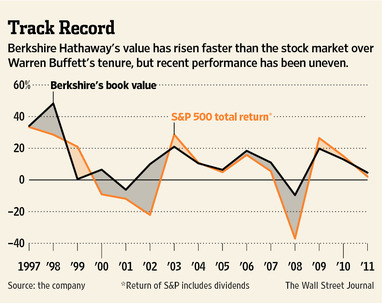
Buffett to Update His Acquisition Hunt; Investors Are Curious if Berkshire CEO Is Still Looking for Big Deals After Heinz

Updated February 28, 2013, 5:23 p.m. ET

Buffett to Update His Acquisition Hunt

Investors Are Curious if Berkshire CEO Is Still Looking for Big Deals After Heinz

By ANUPREETA DAS And SERENA NG

Two years ago, Warren Buffett told Berkshire Hathaway Inc. BRKB +0.94%shareholders he was on the lookout for major acquisitions, as part of his unending effort to profitably employ the buckets of cash his company collects every month.

Since then, however, the billionaire investor has fired what he called his “elephant gun” just twice. Berkshire in February said it would join with a Brazilian investment firm to buy ketchup maker H.J. Heinz Co. HNZ -0.11% for $23.4 billion. In 2011, Berkshire bought engine lubricant-maker Lubrizol Corp. for $9 billion.

MI-BU438_BERKSH_G_20130228161413MI-BU435_BERKSH_NS_20130228160603

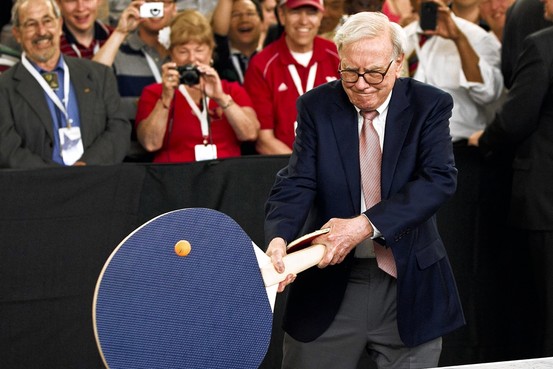
Shareholders watch as Warren Buffett, chairman and CEO of Berkshire Hathaway, deploys an oversize bat against table tennis prodigy Ariel Hsing in Omaha, Neb., in May.

The challenge of finding a big target at the right price will again be on investors’ minds when Berkshire files its annual report Friday afternoon. The report includes the shareholder letter penned by the 82-year-old Mr. Buffett, which over the years has been the source of many of the bon mots for which the Omaha, Neb., company’s chairman and chief executive is known. Read more of this post

From rags to riches to jail; Mexico’s top union leader; She was Mexico’s most powerful woman, feared by presidents and held the future of millions of school children in her hands; now facing charges of embezzling around $200 million from union coffers to fund a lavish, jet-set lifestyle

Published: Friday March 1, 2013 MYT 8:29:00 AM

From rags to riches to jail; Mexico’s top union leader

MEXICO CITY: She was Mexico’s most powerful woman, feared by presidents and held the future of millions of school children in her hands, but the head of one of Latin America’s biggest trade unions now languishes behind bars on corruption charges.

With a penchant for plastic surgery, designer purses and luxury villas, Elba Esther Gordillo, the 68-year-old leader of Mexico’s main teachers’ union, has come to embody the abuse of power by the country’s political class.

She now wears a prison uniform at Santa Martha Acatitla women’s prison on the edge of Mexico City, facing charges of embezzling around $200 million from union coffers to fund a lavish, jet-set lifestyle. Read more of this post

US companies in China: tougher times

US companies in China: tougher times

Feb 28, 2013 11:30am by Stefan Wagstyl

After a string of cautious statements on China from US companies ranging from Caterpillar to Yum!Foods, the American Chamber of Commerce in Shanghai has declared that the days of relentless sales and rising profits are over.

The “new normal” is one of slower economic growth, rising costs, skilled labour shortages and an increasingly competitive business environment. Tougher times “will be the rule rather than the exception in the years ahead,” AmCham says in a report. Read more of this post

Coca-Cola’s Chok! Chok! Chok! ad shakes up mobile marketing

Chok! Chok! Chok! ad shakes up mobile marketing

2:45pm EST

By Kate Holton and Leila Abboud

BARCELONA (Reuters) – A strange phenomenon hit Hong Kong in late 2011.

As the clock hit 10 pm each night a Coca Cola ad aired on television, prompting thousands of viewers to grab their phones and start shaking them frantically to virtually “catch” the falling bottle caps on the screen and win instant prizes.

Dubbed Chok! Chok! Chok! – meaning rapid motion in local slang – the interactive campaign by McCann Worldgroup became a hit, and sent viewers at home, in cinemas and in front of giant outdoor screens into a frenzy. (link.reuters.com/wux36t)

Nine million people saw the ad – 380,000 downloaded the Chok! Chok! Chok! app in the first month – and its success indicates that marketers may be finally figuring out how to direct ads at consumers via mobile phones. Read more of this post

Buffett’s Mentor Benjamin Graham’s Clever Idea for Averting Currency Wars

Benjamin Graham’s Clever Idea for Averting Currency Wars

Benjamin Graham is remembered primarily as the father of value investing, and as the former professor, employer, friend and investing mentor of Warren Buffett. Yet Graham did a lot more than dispense sound investment advice.

For one thing, he developed a subtle and clever idea for stabilizing currencies — and economies — that might bear closer examination today. He called it the commodity reserve currency.

Graham first formulated the idea in response to the recession of 1920-1921. During that crisis, Graham observed that the price of gold was remarkably stable while the prices of many other items, even basic commodities with far greater direct impact on the economy than precious metals, were dropping precipitously. From his perch on Wall Street, Graham saw these declining prices reflected in plummeting corporate earnings.

At the time, each U.S. dollar represented a fixed amount of gold. Graham noticed how that dynamic stabilized the price of gold (and, to a lesser extent, silver) while the price of other goods crashed. Gold producers were “exempt from the difficulties that bedeviled the rest of us,” he wrote.

So, with characteristic inventiveness, Graham wondered how much more stable the economy would be if, instead of precious metals alone, fixed quantities of more essential commodities would be pegged to the value of the dollar. He speculated that this would ensure that the prices of, say, petroleum or wheat would be as stable as that of gold. Read more of this post

Buffett Betrayed by Calls Shows Nobody Safe From Leaks

Buffett Betrayed by Calls Shows Nobody Safe From Leaks

The surge in H.J. Heinz Co. options before Berkshire Hathaway Inc. (BRK/A)’s $23 billion takeover bid shows that even the world’s most successful investor isn’t immune to leaks.

Federal authorities began a criminal probe after almost 2,600 Heinz June $65 call options changed hands on Feb. 13, compared with 14 the day before, according to data compiled by Bloomberg. It was the second instance in two years of well-timed trading before billionaire Warren Buffett’s company announced an acquisition. In March 2011, call volume in Lubrizol Corp. climbed to 12 times more than puts days before Berkshire offered to buy the world’s largest producer of lubricant additives.

While Buffett is under no suspicion, the government suit shows it’s getting harder to keep secrets in mergers and acquisitions, according to Robert Pavlik, chief market strategist at Banyan Partners LLC, which oversees $1.4 billion. Regulators have probed at least a dozen cases of options trading before events such as takeover announcements since 2007, including AstraZeneca Plc (AZN)’s purchase of MedImmune Inc. and BHP Billiton Ltd. (BHP)’s bid for Potash Corp. of Saskatchewan Inc., data compiled by Bloomberg show.

“People are looking for whatever edge they can get, which includes trying to game the system,” Pavlik said in a Feb. 22 phone interview from New York. “With these kinds of big deals there are a lot of participants, and anyone with access to information has friends and family who may engage in nefarious activity simply based on an off-the-cuff remark.” Read more of this post

Desigual’s Swiss Billionaire Meyer Forms Fortune With Kissing Party

Swiss Billionaire Meyer Forms Fortune With Kissing Party

Dressed in nothing but their lingerie and boxer shorts, more than 300 shoppers lined up outside the Desigual shop in the Soho neighborhood of New York City on Sept. 23, 2010, for a free outfit.

“I got out here at 1 a.m.,” said one customer in a video posted by the company on YouTube, her driver’s license stuffed into a pink bra as bypassers snapped pictures of the crowd, who were attending a marketing event Desigual called an Undie Party.

She emerged from the store hours later, posing in a black and green jacket. Other shoppers screamed with glee as they walked away in the color-splashed designs and prints the retailer is known for.

Such promotions — and others, like kissing festivals in London, Paris and Berlin — have helped make Thomas Meyer, the 50-year-old founder and owner of the Barcelona-based fashion chain, a billionaire.

Desigual, which is Spanish for “atypical,” has tripled its annual sales in the past five years to 700 million euros ($903 million), according to Orbis, a database of company information published by Bureau van Dijk. The company sold more than 22 million garments in 2012 through 330 of its own stores and 11,200 other points of sale in more than 100 countries.

Net Worth

Meyer has a net worth of at least $1.1 billion, according to the Bloomberg Billionaires Index. He has never appeared on an international wealth ranking.

“Desigual is a very unique, fast-growing brand that is doing well globally,” David Haigh, chief executive officer of Brand Finance Plc, a London-based consultancy, said by phone. Brand Finance releases an annual report on the most valuable publicly listed fashion companies in Spain. “They are very differentiated from other fashion brands. Their garments are edgy and complex.”

The company is valued at $1.6 billion, according to the Bloomberg ranking, based on the average enterprise value-to- earnings before interest and tax, and enterprise value-to-sales multiples of two publicly traded peers: Philadelphia-based Urban Outfitters Inc. (URBN) and Cheltenham, England-based Supergroup Plc. (SGP) Enterprise value is defined as market capitalization plus total debt minus cash. Read more of this post

Can’t sell the TV?…sell the office: Japan Inc fires up property market

Can’t sell the TV?…sell the office: Japan Inc fires up property market

4:44pm EST

By Junko Fujita

TOKYO (Reuters) – Japanese blue-chip firms, from electronics giants to brewers, are selling prime real estate to shore up battered balance sheets, stoking a resurgent property market. Some are moving into new offices to take advantage of relatively low rents.

Big downtown office buildings are coming up for sale as Tokyo’s property market regains growth momentum for the first time in almost five years, with plenty of interest among buyers, particularly Japan’s public real estate trusts, experts said. Read more of this post

China plans bond overhaul to fund $6 trillion urbanization

Exclusive: China plans bond overhaul to fund $6 trillion urbanization – sources

4:20pm EST

By Nick Edwards and Benjamin Kang Lim

BEIJING (Reuters) – China plans major bond market reform to raise the money the ruling Communist Party needs for a 40 trillion yuan ($6.4 trillion) urbanization program to buoy economic growth and close a chasm between the country’s urban rich and rural poor.

The Party aims to bring 400 million people to cities over the next decade as the new leadership of president-in-waiting Xi Jinping and premier-designate Li Keqiang seek to turn China into a wealthy world power with economic growth generated by an affluent consumer class.

The urban development would be funded by a major expansion of bond markets, sources with leadership ties, and a senior executive at one of China’s “Big Four” state banks, who was formerly at the central bank, told Reuters. Read more of this post

Yeltsin-Era Tycoons Sell Resources to Keep Distance From Kremlin

Yeltsin-Era Tycoons Sell Resources to Keep Distance From Kremlin

Russian billionaires who made their fortunes buying commodities assets in the 1990s are exiting natural resources to gain independence as Kremlin-backed oligarchs take their place.

Viktor Vekselberg, Russia’s third-richest man according to the Bloomberg Billionaire Index, said this year he will invest his share of the $28 billion sale of half of oil producer TNK-BP in technology, machinery and alternative energy, not resources.

Mikhail Prokhorov, Russia’s ninth-richest, sold his stake in Russia’s biggest gold producer, Polyus Gold International Ltd. (PGIL) for $3.6 billion last week, to diversify his investments. Sergey Popov, No. 27, sold his remaining stake in coal miner SUEK this year, the last of his resource assets.

“There is an evolution of interests among the wealthiest Russians and that evolution is in sync with the evolution of the Russian economy,” said James Beadle, an investment adviser at Societe Generale SA’s private banking unit in Monaco. “By saying that you are investing in areas other than commodities, you are both following the Kremlin’s nod and also following the economic logic of the situation.”

Russia’s government set targets to diversify the economy and cut its dependence on oil, gas and metals, which last year accounted for 81.3 percent of exports to countries excluding former Soviet republics, customs service data shows. Read more of this post