Missing Tycoon Mars Overseas Push of China’s Private Businesses; Liu’s rise to riches and sudden disappearance aren’t just the makings of a made-for-Hollywood potboiler. They’re a warning of the risks investors take when dealing with opaque private businesses in China, where fortunes depend on political ties and the favors of state entities, and even the wealthiest entrepreneurs can vanish if they lose the patronage of powerful government allies

Missing Tycoon Mars Overseas Push of China’s Private Businesses

Even by the standards of China’s rough and tumble breed of entrepreneurs, billionaire Liu Han’s brushes with death mark him out.

After dodging a hitman’s bullets in 1997, which led to the execution of a rival tycoon and two of his relatives almost a decade later, Liu, 47, finds himself ensnared in more killings. This time, his own brother is the suspect, and the Sichuan Hanlong Group founder is being held by police for helping him evade capture over a 2009 triple murder, state media reported.

The arrest throws into jeopardy Hanlong’s planned mining investments, casting doubt on the future of Sundance Resources Ltd. (SDL)’s $4.7 billion iron-ore project in West Africa and General Moly Inc. (GMO)’s Mt. Hope, Nevada, molybdenum mine. His detention still hasn’t been confirmed by authorities and there has been no official indication of who is now running Liu’s empire, which spans energy, real estate, chemicals and technology.

Liu’s rise to riches and sudden disappearance aren’t just the makings of a made-for-Hollywood potboiler. They’re a warning of the risks investors take when dealing with opaque private businesses in China, where fortunes depend on political ties and the favors of state entities, and even the wealthiest entrepreneurs can vanish if they lose the patronage of powerful government allies. Read more of this post

Emerging Stocks Head for Worst First Quarter Since 2008

Emerging Stocks Head for Worst First Quarter Since 2008

Emerging stocks fell, extending the biggest first-quarter slump since 2008, as China’s banking regulator tightened rules on wealth-management products and the cabinet called for new measures to deregulate interest rates. Read more of this post

Hunt Brothers Becomes Billionaire on Bakken Oil After Bankruptcy from Silver Manipulation 33 Years Ago

Hunt Becomes Billionaire on Bakken Oil After Bankruptcy

William Herbert Hunt was once one of the wealthiest men on Earth. With his brother, Nelson Bunker Hunt, the billionaire bought more than 195 million ounces of silver — 60 percent of the U.S. market — in the 1970s. By early 1980, their stake was valued at more than $9 billion.

The Hunts’ position imploded when silver prices plummeted 80 percent over the course of a few weeks in March 1980, culminating 33 years ago this week on what traders called Silver Thursday. The crash rattled Wall Street and sent the Texas brothers into bankruptcy.

Hunt is once again a billionaire, this time with oil. In October, he sold 43 percent of the North Dakota petroleum assets owned by his closely held Petro-Hunt LLC for $1.45 billion to Houston-based Halcon Resources Corp. (HK) The cash and stock deal made Hunt Halcon’s largest shareholder and boosted his net worth to $4.2 billion, according to the Bloomberg Billionaires Index. Read more of this post

Matthew 25 Fund Inspired by Scripture Returns 27%

Matthew 25 Fund Inspired by Scripture Returns 27%

When the Matthew 25 Fund fell 40 percent in 2008, it kept Mark Mulholland awake at night.

Mulholland, the founder and sole manager of the mutual fund — named after a Bible passage — says he would lie in bed thinking about the damage he had done to his investors, particularly the elderly whose nest eggs might not recover before they died. The assets he managed dwindled to $22 million from $115 million, Bloomberg Markets will report in its May issue.

What Mulholland didn’t worry about were the stocks in his portfolio.

“The companies we owned were so cheap that barring a total collapse of the economic system, I knew at some point we were going to make a lot of money,” he says.

That time has come. Mulholland, 53, bought smartphone maker Apple Inc. (AAPL) in 2008 for $80 to $128 a share. He also hung onto his investment in companies such as Sidney, Nebraska-based Cabela’s Inc., (CAB) a retailer of hunting and fishing products, and Medina, Minnesota-based Polaris Industries Inc. (PII), which makes all-terrain vehicles.

The rebound in those stocks helped propel the now-$452 million fund to gains that beat the Standard & Poor’s 500 Index by a wide margin. The fund returned 13.1 percent annualized during the five years ended on Feb. 15 compared with 4.7 percent for the S&P 500 (SPX). Matthew 25 (MXXVX) gained 26.8 percent over three years and 25.4 percent in one year. Read more of this post

Aberdeen, Manulife Seek More Independent Boards: Southeast Asia

Aberdeen, Manulife Seek More Independent Boards: Southeast Asia

Southeast Asia’s companies need to add more independent directors to their boards and boost diversity to attract foreign investors including Aberdeen Asset Management Plc (ADN) and Manulife Asset Management.

One of the biggest obstacles is strengthening the roles of independent directors because many publicly traded companies in the region are family-owned, Stephen Schuster, a financial sector specialist at the Asian Development Bank, said in an interview yesterday from Manila. Other challenges include disclosure and cross-border dispute resolution, he said. Read more of this post

Hong Kong Drops New Law Restricting Access to Directors’ Details

Hong Kong Drops New Law Restricting Access to Directors’ Details

Hong Kong’s government dropped legislation that would restrict public access to the personal details of company directors, following opposition from unions, small businesses and journalists.

The Financial Services and Treasury Bureau removed provisions obscuring company directors’ residential addresses and full identification numbers from an overhaul of the city’s companies ordinance, according to a legislative briefing document sent by e-mail from Shirley Wong, the department’s spokeswoman.

Opponents of the change said it would protect bosses from scrutiny and erode the city’s reputation by making it easier to launder money and cheat on taxes. Trade unions have used the database to track down runaway employers who owed wages, and small businesses use the information to conduct background checks on trading partners. Read more of this post

Zoomlion, China’s second-biggest construction equipment maker, Misses Estimates on Finance Costs, Demand Weakness; The stock has slumped 21 percent since Ming Pao reported on Jan. 8 that it had received an unsigned letter alleging that Zoomlion’s sales are exaggerated

Zoomlion Net Misses Estimates on Finance Costs, Demand Weakness

Zoomlion Heavy Industry Science and Technology Co., China’s second-biggest construction equipment maker, posted profit that missed analyst estimates as government measures to cool the property market damped demand while finance costs and provision for bad debts increased.

Net income in 2012 fell 9.1 percent to 7.33 billion yuan ($1.18 billion) from 8.07 billion yuan in the prior year, according to a filing to the Hong Kong stock exchange today. That compares with the 8.49 billion yuan average of 26 analysts’ estimates compiled by Bloomberg. Sales climbed 3.8 percent to 48 billion yuan.

Zoomlion, based in Changsha, Hunan province, and bigger rival Sany Heavy Industry Co. face a drop in orders as slowing economic growth and government curbs on the property market sap demand. Zoomlion is also seeking to boost investor confidence after its shares slumped following a January report in Hong Kong’s Ming Pao newspaper that the company’s sales may have been exaggerated.

“Economic growth in China remained slackened with low investment in infrastructure,” the company said in today’s statement, “The construction machinery industry was also under severe challenges brought by the sluggish growth of production and sales and the increase in credit risks.”

Shares (1157) of Zoomlion rose 0.9 percent to HK$9.37 at the close in Hong Kong trading, before the earnings were released. The stock has slumped 21 percent since Ming Pao reported on Jan. 8 that it had received an unsigned letter alleging that Zoomlion’s sales are exaggerated. Read more of this post

When Will Deposit Haircuts Take Place In Other European Countries?

When Will Deposit Haircuts Take Place In Other European Countries?

Tyler Durden on 03/28/2013 11:55 -0400

When all is said and done, what happened in Cyprus over the past two weeks, is nothing but the culmination of re-marking the “assets” in the country’s financial system (which as noted previously, were a preponderance of worthless Greek bonds and countless other non-performing loans), long priced at assorted “myth” levels, to a long overdue reality. As a result of delaying resolving the mismatch between non-performing assets and liabilities for years, the resolution was one which saw some €16 billion of the total asset base impaired, which in turn necessitated the impairment of billions of deposits: the primary liability funding the Cypriot financial system. Furthermore, as a result of the “Freudian Slip” by the Eurogroup’s new head earlier this week, we know that Cyprus will be the template for all future bank resolutions, which seek to avoid a democratic popular vote of depositor self-impairment (a vote which is now known will never actually pass) and proceed to restructuring the banking sector a la carte, by liquidating bad banks and impairing liabilities to the point where the balance sheet is once again viable (however briefly).

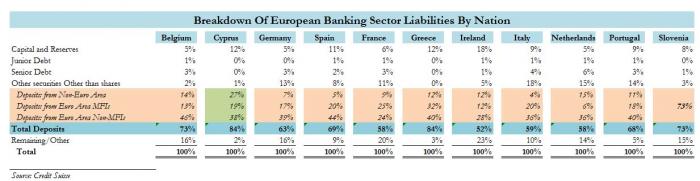
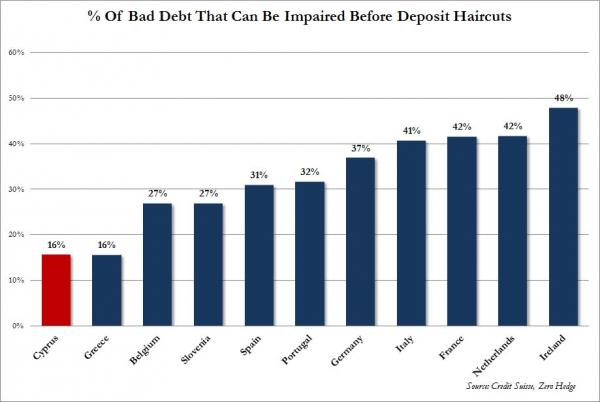
The bottom line is that at its core, it is all simply a bad-debt problem, and the more the bad debt, the greater the ultimate liability impairments become, including deposits. Which means that the real question in Europe is: how much impairment capacity is there in the various European nations before deposits have to be haircut? Thanks to Credit Suisse we now know the answer. The chart below shows the liability breakdown for various Eurozone nations, of which the key line item is the Total Deposits, and which in Europe comprises the bulk of bank funding. It becomes obvious why Cyprus had no choice but to crush depositors: they make up a whopping 84% of all liabilities (the highest in Europe and matched only by Greece), so assuming all other liabilities are liquidated, there still would be impairments if the total bad assets (assuming all bank assets are loans which in Europe, unlike the US, is more or less the case) pushed above 16% which in Cyprus they did. So applying some simple balance sheet equality math, one can quickly calculate how much of a “Bad-Debt Impairment” assorted European financial systems can withstand before they too have no choice but to follow in Cyprus’ footsteps and begin crushing depositors, who in bankruptcy court are known by a different, less friendly term: General Unsecured Claims.

Euro Financial Liabilities_2_0

Bad Debt Capacity_0 Read more of this post

Chart of the day: Euro area M3 growth vs Bank lending to euro area private sector

M3 Credit February Europe_0

James Altucher: Unschool Yourself!

Unschool Yourself!

Posted by James Altucher on March 28th, 2013 at 9:36 am

I want to put on Google Glasses, stare at the sun until I go blind, and have a Google Hangout with all my friends at the same time while the sun burns my vision away. Everyone will see what I will be seeing (or not seeing. Because of going blind) because of the Google Glasses. I feel like that would make me a master of the universe. My teachers from grade school would be proud. They might rename the school after me. I told my kids, “You’re always complaining about school. If you don’t like school just don’t go. I don’t care at all.” And guess what? They practically spit in my face in rebellion. They didn’t shoot up crack heroin. Or get tattoos. They went to school. HOW DARE THEY! I wasn’t even trying to do any reverse psychology on them. Reverse psychology is for people afraid to say the truth. It was like reverse reverse psychology. My kids can do what they want. What I give them is not freedom but choice. They choose to go to prison. That’s fine. School was like a mental institution for me where I was force fed the following drugs:

1) Lots of facts. At talks I ask people, “When was Charlemagne born?” I have yet to get a response that is correct within 200 years. Research shows that 90% of what we learn in a class we forget after 45 minutes. The reason is: our brain likes to have 2 or more things going for it before it is convinced it has a worthy fact for memory. So, “passion + awe” are two things. But boring facts disappear quickly.

2) Perfectionism. Schools celebrate the A+ and punish the C-. Whenever my daughter tells me she got an A+ I ask her why she wants to take a class that is too easy for her. The C- shows you so much more: What you need to learn. What you might not be interested in. How to deal with imperfection. How to deal with the pride of others. How to deal with insecurity. As some woman tweeted on twitter the other day, @jaltucher is a C-. I have room to improve!

3) Cliques. My best friend Jimmy Biondo punched me in the back at my locker and I fell to the ground and started crying. I think I was 15. In school you have a small group of people to choose from for friendship. This makes for political, spiteful, gossip-filled, often Lord-of-the-Flies-style friendships. Yeah, I’m the ugly kid that got killed in the book. And no, I did not read the book in school. I read the Cliff’s Notes.

) Science and Math. While these are beautiful subjects I often feel that my kids are encouraged to drop their creativity at the door if it involves art or storytelling. Everything is rote, then tested. Then rote again, then tested again. For twenty years. That’s only a tiny part of the brain. Humans are meant to use their entire brain. It’s our entire brain that let’s us DESTROY and RULE the animal kingdom.

5) Work. From 7am to often 10pm, my kids are “working”. They sit in classrooms all day, barely moving, and then they are often working on homework until they fall asleep. They learn to work hard. But…

But as an adult, if you want to succeed, be creative, learn to fail, learn to sell ideas, learn to build momentum around your life, you need to UNLEARN:

HOW TO UNSCHOOL YOURSELF:

A) Play. Playing (however you want to define that word) reduces stress, encourages creativity, increases happiness, is FUN. Nothing wrong with that. Maybe people think they HAVE to be working. Else they are unproductive. They get this reactive stress when they aren’t “at work”. Because we got addicted to working back in our school daze. What should you play at? I don’t know! Do whatever you want. Go to a museum. Or a movie in the middle of the day. Or pee in public places, take pictures of the pee, and make a photo exhibit. Who cares? Homework! – think of five things you can “play” at today.

B) Creativity.  Sometimes I’m sick of writing this blog. So I do other stuff. I draw. Or I take photographs of my urine in public places. Or I plan my upcoming run for Congress! (Don’t tell Claudia. She is against it). This makes my brain feel good. I can literally feel the neurons light up. It makes my brain feel loved by me. Every day I try and exercise different parts of my brain. Homework! – What are some ways you can be creative today outside your normal work schedule?

C) Friendship. It turns out we don’t have to be friends with the people immediately around us. That was only a school thing. We can choose to be friends, instead, just with the people who love us and who we love. Like how I’m friends with Oprah. Hi honey! I didn’t learn this for a long time. And this one aspect of my life made me desperately unhappy. Maybe I finally learned it in 2010. I was 42 years old. Some people, thank god, learn it much earlier. But I had to “unschool” myself from all that I learned about friendship in ninth grade.

D) Imperfectionism. A friend of mine once told me she wanted to go to Paris because she’d really be able to paint there. Good fucking luck. Situations are never perfect. We’re never perfect. It’s 20 years later and she hasn’t gone through one color on her watercolor set. Being comfortable with imperfection gives us a lot more opportunities. And helps us love ourselves more. And we don’t get easily ashamed, which translates to deeper honesty and relationships. Perfectionism is a cage that has captured our happiness and won’t let it out. I lost a lot of friends when I stopped pretending to be perfect. I was afraid people would not like and I was right. That’s ok. See “C” above. Finally, all of life is a sculpture chiseled with the knife of imperfection. Realizing that allows us to be kind to the chaos we see everywhere. We’re all going through a hard time just trying to live.

E) Make shit up. Facts are for boring people. I can look up any fact on Google. It doesn’t make me stupid. It makes room in my brain to have fun. I only read the things I’m passionate about. I look up the things I could care less about but maybe need to know for a split-second every now and then. (Charlemagne was born in 742 AD. Thank you Wikipedia!). So just read about stuff you’re interested  in. Today I’m reading “New Ideas in Backgammon” so I can crush Dubner the next time I play him. (MEGA-CHAMPION!)

F) Independence. Finally, they never teach this in school. So it’s hard to learn it as an adult. We lose the habit. But once you learn to be creative, to have positive friendships. to have ideas, to be imperfect, you also have to learn how to sell your ideas to people who believe in them. This is the beginnings of independence. This means you graduate life and get the keys to the kingdom. Start unschooling yourself today. Unschooling is not ust for kids. Read more of this post
How Multilatinas Are Taking Over the World

How Multilatinas Are Taking Over the World

25 MAR 2013 – JONATHAN KANDELL

HERE’S A TEST OF YOUR GLOBAL BUSINESS IQ. Where would you find each of the following: the world’s largest baker, the leading iron miner and the second most valuable airline by market capitalization?

Answer: Latin America. Mexico’s Grupo Bimbo has built the world’s largest bakery products company through a string of acquisitions, Brazil’s Vale is the biggest producer of iron ore, and Latam Airlines Group, a Chilean-controlled company that combines Chile’s LAN and Brazil’s TAM airlines, is the continent’s dominant carrier, with a stock market value of $11.4 billion, second only to Delta Air Lines.

These companies are far from alone. Latin America’s economic renaissance over the past two decades has fostered the emergence of a new generation of corporate champions with regional, and sometimes global, ambitions. Read more of this post

Layoffs trigger panic among Chinese multinational employees; Last year, many multinational employees became eager to change jobs due to worries of being laid off, which was very rare in the past

Layoffs trigger panic among Chinese multinational employees

SHANGHAI, March 28 (Xinhua) — Chinese employees of multinationals are finding their jobs no longer secure and enviable as a massive round of layoffs has hit such companies. Read more of this post

This Is The Most Innovative Startup From This Year’s Y-Combinator Class; Thalmic Labs positions its MYO armband as the next generation of gesture control, enabling you to control other devices using your movements, and without the need for a camera

This Is The Most Innovative Startup From This Year’s Y-Combinator Class

Megan Rose Dickey | Mar. 27, 2013, 10:41 AM | 3,498 | 2

Silicon Valley’s most prestigious accelerator Y Combinator just hosted its Demo Day for its Winter 2013 class. Even though this class was smaller than its previous batches, the talent was just as good. Out of the 47 startups that presented at YC’s Demo Day, Thalmic Labs really caught our attention. Thalmic Labs positions its MYO armband as the next generation of gesture control, enabling you to control other devices using your movements, and without the need for a camera. Many current gesture control technologies like Microsoft‘s Xbox Kinect, for example, require you to be in front of a camera. It also forces you to use pre-programmed gestures. But with MYO, it can track even the most subtle gestures. The armband works by sensing the electrical activity in your muscles to control your computer, video games, or even a drone. But Thalmic has opened up its API so developers can come up with more ways to use MYO. Already, Thalmic has sold 25,000 MYO devices and brought in $3.7 million in revenue. You can pre-order your own MYO for $149 here.

How Samsung Became the World’s No. 1 Smartphone Maker

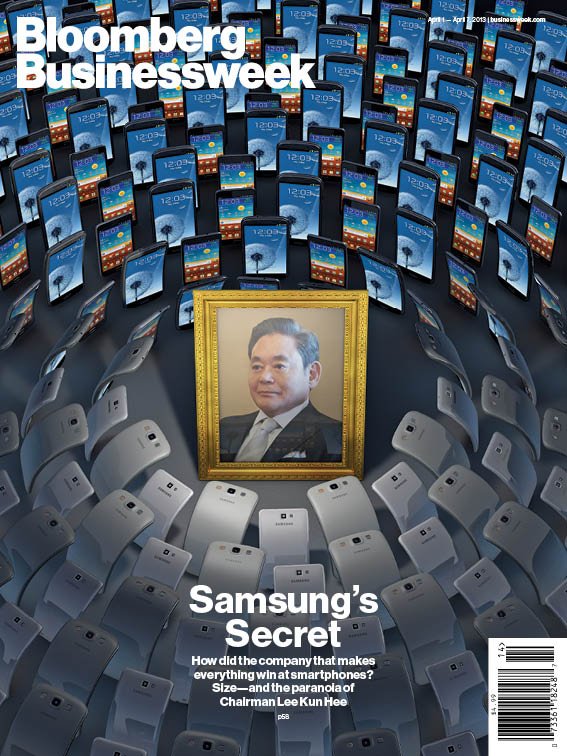
Here’s Bloomberg Businessweek’s Cover About How Samsung Became The King Of Smartphones

Steve Kovach | 59 minutes ago | 18 | 

Bloomberg Businessweek’s cover story this week is all about the rise of Samsung. Here’s a sneak peek at the cover art:

4-1-13 newsstand

How Samsung Became the World’s No. 1 Smartphone Maker

By Sam Grobart on March 28, 2013

I’m in a black Mercedes-Benz (DAI) van with three Samsung Electronics PR people heading toward Yongin, a city about 45 minutes south of Seoul. Yongin is South Korea’s Orlando: a nondescript, fast-growing city known for its tourist attractions, especially Everland Resort, the country’s largest theme park. But the van isn’t going to Everland. We’re headed to a far more profitable theme park: the Samsung Human Resources Development Center, where the theme just happens to be Samsung.

feature_samsung14__01__inline605feature_samsung14__04__inline605

Photograph by Tony Law for Bloomberg BusinessweekSamsung’s Human Resources Development Center

feature_samsung14__01__304

feat_samsung14_samsungscale-chart_605

feat_samsung14_mobile-chart_605 Read more of this post

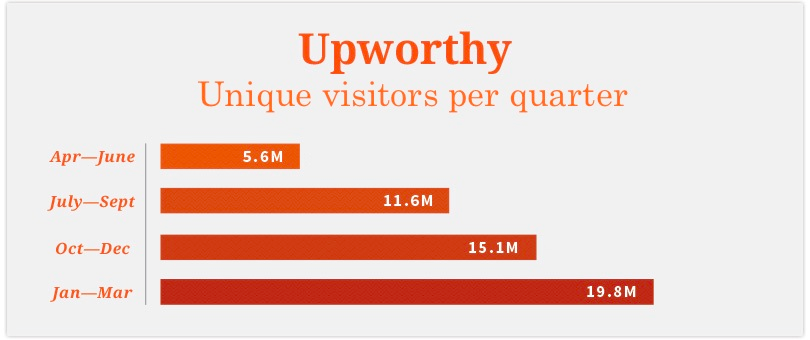
The Brilliant, Unusual Way Media Startup Upworthy Grew To 10.4 Million Monthly Readers In Its First Year

The Brilliant, Unusual Way Media Startup Upworthy Grew To 10.4 Million Monthly Readers In Its First Year

Alyson Shontell | Mar. 27, 2013, 1:44 PM | 2,680 | 4

screen shot 2012-11-05 at 1.52.25 pm51542599-0c46-4b24-8c68-215fcac01582

Eli Pariser, co-founder of Upworthy.

Most media companies focus on covering the latest news. Eli Pariser and his army of bloggers at Upworthy don’t, yet they have grown from no readers last year to 10.4 million last month.

If The New York Times is a designer store with new, original items that keep readers informed, Pariser is running an antique shop, recognizing the value in old gems, and selling them for much more.

Essentially, Upworthy goes dumpster diving in the Internet’s archives, hoping to find gold. They’re looking for any scrap of a moving, visual story they can tell that was, for some reason or another, initially overlooked by readers. They polish it off with a catchy headline, send it out into the Twitterverse and Facebook, and watch the readers flock to the page.

When you’re promoting old stories, there’s not much competition either. News sites compete to be the first to a story, so there’s a lot of overlapping coverage. It’d be hard for another site to stumble upon the same older content Upworthy finds at exactly the same time.

To find the hidden gems, Upworthy’s content curators spend a large portion of the day scouring YouTube and other visual sites. They don’t crank out dozens of stories each; Pariser estimates only 60 pieces of content are created per week. Interest, not timeliness, is what matters when it comes to social content.   Read more of this post

Bitcoin Prices Have Gone Utterly Nuclear In The Last Two Days; Back in February, one Bitcoin was trading at around $20. Today? $95

Bitcoin Prices Have Gone Utterly Nuclear In The Last Two Days

Joe Weisenthal | Mar. 28, 2013, 5:30 AM | 4,438 | 18

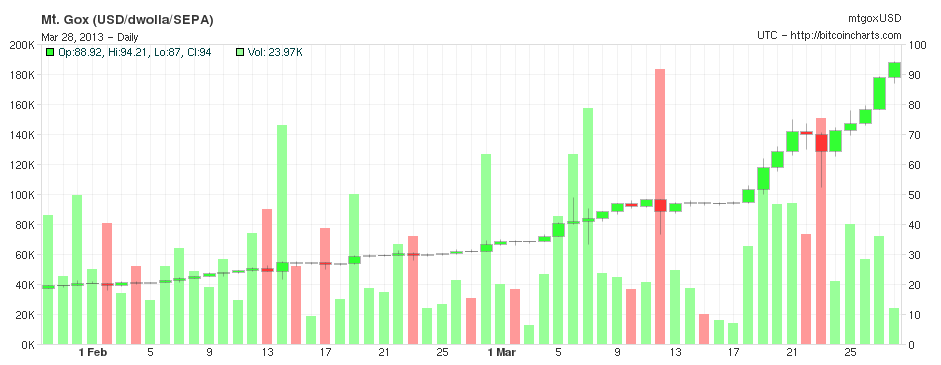
The price of a Bitcoin, the digital money that’s become the new obsession of gold and silver-types, continues its dizzying assent. Here’s a short term chart. Back in February, one Bitcoin was trading at around $20. Today? $95, having had two huge moves over the last two days.

screen shot 2013-03-28 at 5.24.53 am


26 Tips On How To Read People

26 Tips On How To Read People

Kim Bhasin and Max Nisen | Mar. 27, 2013, 2:18 PM | 192,193 | 1

Few people are so rigidly controlled that they don’t give clues as to what they’re thinking or feeling. Learning to read these can be a big advantage in business and life.

There’s no single, consistent recipe — and even the best mind readers on the planet are only right 80 percent of the time — but there’s a lot to be learned.

According to UCLA professor Albert Mehrabian55 percent of what you convey comes from body language, 38 percent from the tone of your voice, and only 7 percent from what you actually say. 

We’ve compiled tips from Psychology Today and elsewhere that will help you stay one step ahead of everyone else.

To start, always get a baseline reading so you can distinguish personal quirks from real tells.

Notice others trying to read your baseline with seemingly innocuous questions like, “How are you today?” Read more of this post

Cao Shiru, the woman behind Zhongnanhai’s Hongqi supermarket; “In business, it is not enough to be self-possessed, you also need innovation”; Cao gives her staff the freedom to carry out their plans and backs them strongly if she believes that their ideas are right.

Cao Shiru, the woman behind Zhongnanhai’s Hongqi supermarket

Staff Reporter 2013-03-28

CFP409141893-153133_copy1

Until its mysterious closure, Hongqi of Chengdu was the only supermarket chain to operate an outlet in Zhongnanhai, the government compound in the heart of Beijing that houses the State Council and the headquarters of the Communist Party.

Despite the setback, the chain’s founder Cao Shiru has proved herself a canny operator in the retail industry, reports the semi-monthly China Entrepreneur.

“The first two characters of my name are pronounced the same as supermarket in Mandarin,” Cao told the magazine, explaining why she has a strong affinity for the retail sector.

Cao’s chain employs over 13,000 workers, and while around 80% of them are female, most of her senior executives are men.

Yu Shi, the company’s deputy general manager, told the magazine that Cao gives her staff the freedom to carry out their plans and backs them strongly if she believes that their ideas are right. Read more of this post

Bubbles and bankruptcy: a British history

Bubbles and bankruptcy: a British history

We review the Bubbles and Bankruptcy exhibition at the British Museum, which charts four hundred years of British bank collapses and the frenzied asset bubbles that all too often beguiled investors.

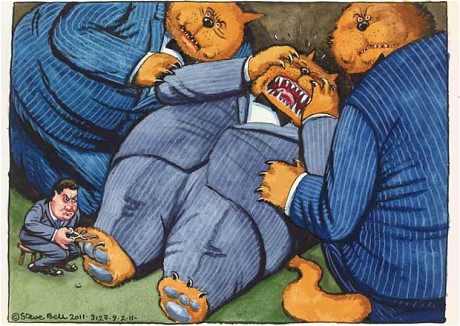
UK history – as the British Museum reveals in its “Bubbles and Bankruptcy” exhibition – is crammed with examples of wily banking scams, bailouts and asset bubbles.

financial-crisis-2_2521054c

Steve Bell’s ‘Bank Levy’ at the British Museum

By Helia Ebrahimi, Senior City Correspondent

2:47PM GMT 27 Mar 2013

No man is an island. But try telling General Gregor MacGregor that.

He invented one, the Principality of Poyais, which he claimed to rule before selling shares in the South American colony. It turned out to be totally uninhabitable.

He also pre-fixed his name with “Sir”. As you do. His honour, as it turned out, was also fictitious.

Still, in many ways, the general was a prototype investment banker. Not that far removed, perhaps, from those who packaged up sub-prime mortgages known to be worthless before selling them to hapless investors.

In fact, UK history – as the British Museum reveals in its “Bubbles and Bankruptcy” exhibition – is crammed with examples of wily banking scams, bailouts and asset bubbles.

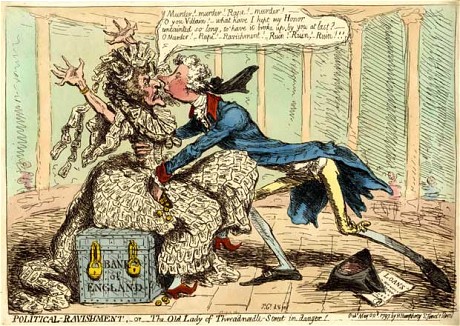
From the South Sea bubble, to tulip speculation, it turns out that naughty bankers have always had a knack of getting rich while others pick up the bill. Not least the Old Lady of Threadneedle Street – aka the Bank of England.

The exhibition takes an amusing look at Northern Rock’s collapse, which is placed alongside a collage of defunct credit cards from HBOS, RBS and Lloyds – now propped up only by taxpayer funds.

financial-crises-1_2521051c Read more of this post

The Ambow Massacre — Baring Private Equity Fails in Its Take Private Plan

The Ambow Massacre — Baring Private Equity Fails in Its Take Private Plan

March 27th, 2013

Peter Fuhrman is Chairman, Founder & CEO at China First Capital, (中国首创)a leading China-focused specialist international investment bank and advisory firm for private capital markets and M&A transactions.

ambowbaringchart

In the last two years, more than 40 US-listed Chinese companies have announced plans to delist in “take private” deals.  About half the deals have a PE firm at the center of things, providing some of the capital and most of the intellectual and strategic firepower. The PE firms argue that the US stock market has badly misunderstood, and so deeply undervalued these Chinese companies. The PE firms confidently boast they are buying into great businesses at fire sale prices.

The PE firm teams up with the company’s owner to buy out public shareholders, with the plan being at some future point to either sell the business or relist it outside the US. At the moment, PE firms are involved in take private deals worth about $5 billion. Some of the bigger names include Focus Media7 Days InnSimcere Pharmaceutical.

The ranks of “take private” deals fell by one yesterday. PE firm Baring Private Equityannounced it is dropping its plan to take private a Chinese company called Ambow Education Holding listed on the New York Stock Exchange. Baring, which is among the larger Asia-headquartered private equity firms, with over $5 billion under management,  first announced its intention to take Ambow private on March 15. Within eleven days, Baring was forced to scrap the whole plan. Read more of this post

Looming property taxes in China spark owner panic; South China’s Guangdong Province was first to detail its implementation of the measures on Tuesday

Looming property taxes spark owner panic

English.news.cn   2013-03-27

BEIJING, March 27 (Xinhua) — Pre-opening queues have snaked around Chinese property trading centers in the past few days, with those in line vexed by the uncertain roll-out date of stricter market regulations.

They have been joined by Chinese netizens in feverish discussion of the March 1 announcement by central government that homeowners who sell will face income tax as high as 20 percent of the profit they make on the transaction. With no firm timeline set for the imposition of the measure, which is designed to cool the red-hot property sector, many are racing to sell.

Consequently, property agencies throughout the country have been inundated by sellers and buyers in a dilemma over the future heavier taxes.

Prior to the new rules, income tax was 1 percent to 2 percent of sale price.

South China’s Guangdong Province was first to detail its implementation of the measures on Tuesday. Read more of this post

Cool pictures of a soy sauce factory in Pudong, Shanghai that has been recognized by State Council for its intangible cultural heritage for its use of traditional processes to ferment the sauce

官酱名天下

作者:金兮敏  | 2013年03月27日 08:44 | 栏目: 城市景深 原创

3月24日,上海博联部分博友,应邀赴地处浦东外高桥保税区的上海钱万隆调味品有限公司参观。 2008年6月,国务院公布了第二批国家级非物质文化遗产保护名录,”钱万隆酱油酿造技艺”成为中国酱油行业唯一的”国家级非物质文化遗产”的中华老字号品牌。钱万隆”官酱园”以其129年的历史传承,特有的酿造技艺,生产出纯正滋味的高品质酱油。得知天然特晒酱油的抗氧化剂保健作用高出红酒10倍,更感到传统酿造业的大有可为。

11734_1364342497l00U11734_1364342499JIs1

Liberate Your Employees and Recharge your Business Model

Liberate Your Employees and Recharge your Business Model

by Karan Girotra and Serguei Netessine  |   1:00 PM March 27, 2013

It finally seems that the uproar over Marissa Meyer’s diktat banning flexible work policies at Yahoo is dying down. While good arguments were made on both sides of the issue, what got lost in the charged debate was the potential for evolving traditional business models through changing the employee-employer relationship.

Our research on identifying replicable templates for business model innovation shows that innovating how a company engages with its workforce is an often overlooked way of increasing business model performance. The basic structure of the firm-employee relationship has not changed much over the last 50 years. Relying on a forecast of organizational needs, firms select the nature and number of employees, who are then assigned some working hours and tasks to do in those hours.

But a few pioneering companies are challenging each aspect of this traditional model and are offering unprecedented opportunities along the way.

Rethinking Who Your Employees Are

Traditional organizations identify a set of individuals as their “employees” before they are fully aware of the employee’s talents and their needs.  Read more of this post
A Data Scientist’s Real Job: Storytelling

A Data Scientist’s Real Job: Storytelling

by Jeff Bladt and Bob Filbin  |   2:00 PM March 27, 2013

Every morning at DoSomething.org, our computers greet us with a report containing over 350 million data points tracking our organization’s performance. Our challenge as data scientists is to translate this haystack of information into guidance for staff so they can make smart decisions — whether it’s choosing the right headline for today’s email blast (should we ask our members to “take action now” or “learn more”?) or determining the purpose of our summer volunteer campaign (food donation drive or recycling campaign?).

In short, we’re tasked with transforming data into directives. Good analysis parses numerical outputs into an understanding of the organization. We “humanize” the data by turning raw numbers into a story about our performance. Read more of this post

Dutch Co-Founder of Tudou.com: Why I’m leaving China

Why I’m leaving China – opinion

By Marc van der Chijs @CNNMoney March 27, 2013: 10:08 AM ET

130319015856-marc-van-der-chijs-620xa

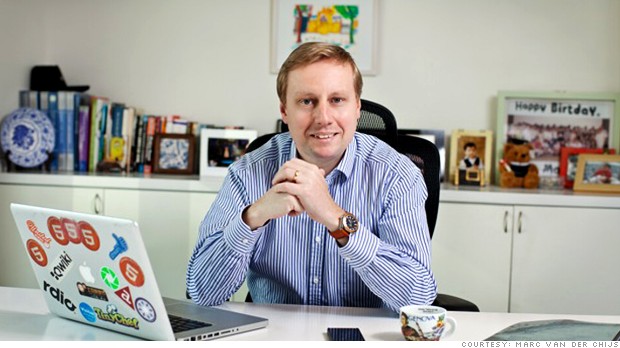
After doing business in China for more than a decade, Marc van der Chijs is moving to Vancouver.

When I first came to China as an expatriate in early 2000 to work for Daimler, I had no plans to stay.

But I fell in love with this country and ended up making China my home for more than 13 years. I stayed for the business opportunities, as well as the entrepreneurial vibe that runs through cities like Shanghai and Beijing.

While living in China I was able to co-found several companies, including online video site Tudou.com, the Asian operations of Dutch online game company Spil Games and online fashion site UnitedStyles.com. I also invested in many Chinese Internet and tech startups and helped them to grow.

However, about two years ago I realized that my love for China was slowly changing, and I first started thinking about moving to a different place.

Over the years, doing business had become more and more difficult for a non-Chinese. Although many areas have opened up for foreign investment, outsiders are not always able to do business on equal terms with Chinese entrepreneurs.

For example, foreigners need more capital to set up a business. Once you have a business up and running, it will be more closely scrutinized than Chinese firms. There are still tons of business opportunities available in China, but I generally felt less welcome in recent years as a foreign entrepreneur.

Much more important than this, however, was the fact that air pollution and food quality were getting worse in my adopted home. Read more of this post

Tiny Dolls Get Big Personalities in Hopes of Boosting Sales; Fisher-Price is revamping its Little People line of preschool dolls with an older appearance, personality traits and back stories. Will the move bring licensing riches?

March 27, 2013, 7:17 p.m. ET

Tiny Dolls Get Big Personalities in Hopes of Boosting Sales

By ANN ZIMMERMAN

PJ-BN405_DOLLS_F_20130327175214

The redesigned Little People dolls, on sale this summer, will have distinct personalities. From left to right: artistic Sofie, energetic Eddie, shy Mia, silly Kobe and twirly Tessa.

Little People dolls, a staple of the toddler playroom for more than half a century, have a problem: No one remembers their names.

Their maker, Fisher-Price Inc., is trying to change that. It hopes more memorable names lead to add-on riches like television shows and songs.

The visual changes in the figures—their first in 15 years—might seem subtle. They will be a tad taller (about 2½ inches high), thinner and less babyish looking. The dolls will wear updated clothing and hairstyles. No longer holding pets or playthings or snack food, their arms will be set in more expressive poses.

Most important, says the company, the painted plastic figures will have full-blown, identifiable personalities: Eddie is active and athletic. Mia is the shy, feminine one. Tessa loves to twirl like a ballerina. Read more of this post

A fast-growing crowd of mobile messaging apps with funny names like WhatsApp, WeChat and KakaoTalk is rankling technology giants from Silicon Valley to Seoul

March 27, 2013, 8:13 p.m. ET

The Messaging Apps Taking on Facebook, Phone Giants

By EVELYN M. RUSLI

On a recent Saturday, Johan Dijkland, a 23-year-old student in Emmen, Netherlands, opened a free messaging app called Line on his iPhone. Then he tapped on a virtual sticker of a sleepy panda with a “good night” speech bubble and pressed send to a friend.

With that action, Mr. Dijkland’s text joined the tens of billions of messages that are processed every day from a fast-growing crowd of mobile messaging apps.

These messaging apps—with funny names like WhatsApp, WeChat and KakaoTalk—have become an indispensable form of communication for hundreds of millions of people world-wide.

They are also rankling technology giants from Silicon Valley to Seoul. That is because when users like Mr. Dijkland send messages using Line, his mobile carrier Vodafone Group VOD.LN -0.05% PLC and iPhone maker Apple Inc. AAPL -2.00% don’t directly profit from the interaction. Read more of this post

When Apps Attack: Industries Under Pressure

Updated March 27, 2013, 7:59 p.m. ET

When Apps Attack: Industries Under Pressure

By GREG BENSINGER

The mobile-apps industry is still in its infancy, but it is already taking on giants.

Apps are cheap to make and easy to distribute, forcing many old-line industries to rethink the way they do business.

With a single click, millions of Americans are comparing prices, hailing taxis and downloading addictive videogames to their smartphones.

“You don’t have to be a huge company with billions of dollars to build a business anymore; you really can be two guys in a basement,” said Jeff Haynie, chief executive of Appcelerator, which licenses software for app developers. “Very traditional models are getting disrupted.”

That trend is set to continue as more consumers switch from simple mobile phones to smartphones that spur app consumption. Last year marked the first time more U.S. mobile phone users had smartphones than simpler feature phones, according to data from comScore Inc.SCOR -0.24%

Here are four industries under pressure because of the rise of apps: Read more of this post
Adapt or Perish: Evidence of CEO Adaptability to Strategic Industry Shocks

Adapt or Perish: Evidence of CEO Adaptability to Strategic Industry Shocks

Wayne R. Guay University of Pennsylvania – Accounting Department

Daniel J. Taylor University of Pennsylvania – The Wharton School

Jason J. Xiao University of Pennsylvania – The Wharton School

March 13, 2013

Abstract: 
Prior turnover literature documents various signals of poor performance that lead a board of directors to terminate the CEO, but does not explore the underlying causes of the CEO’s poor performance. Recognizing that terminated CEOs have often been successful earlier in their tenure, we conjecture that strategic shocks to a firm’s business environment can cause the board to decide that the existing CEO’s skills do not fit with the firm’s current leadership needs. Moreover, prior research on manager ability engenders the question of whether managers are specialists or are instead capable of adapting their “style” to the changing economic conditions. We examine industry-level changes in investing, financing, and operating policies, and their effects on CEO turnover. Our turnover results suggest that CEOs struggle to adapt to a change in industry globalization, investment and marketing efforts. We also find that boards consider the CEO’s performance in response to strategic industry shocks when inferring the CEO’s adaptability, and that the sensitivity of turnover to these shocks varies with activist investors, CEO tenure, and CEO entrenchment.

China Tightens Regulations on Wealth Management

Updated March 27, 2013, 11:08 a.m. ET

China Tightens Regulations on Wealth Management

By DINNY MCMAHON And AARON BACK

‘Shadow banking’ in China was worth $3.7 trillion in 2012 according to Standard & Poor’s estimates. Qiang Liao of the S&P tells the WSJ’s Jake Lee why these risky investments are being sold across the country.

BEIJING—China moved to rein in wildly popular but opaque investment products that form a key plank of the nation’s shadow-banking system, after the high-profile failure of one product offered a glimpse of the risk they pose to the financial system.

The rules issued Wednesday by China’s banking regulator came as China’s four biggest state-run banks said they had more than 3 trillion yuan ($467 billion) worth of such products outstanding at the end of last year, their fullest disclosure yet of their exposure to the products and a move signaling their own caution toward their proliferation.

They are called wealth-management products, which some Chinese regulators have said are sold with limited oversight or disclosure of what they contain. They are typically short-term investments that banks market as a high-yield alternative to bank deposit rates, which are kept low by the government. About half are invested in low-risk assets such as government and corporate bonds and money-market products, according to research firm Cnbenefit. But many others are backed by everything from loans to developers to accounts receivable to valuables such as gold and jewels. Read more of this post