Updated March 21, 2013, 8:32 p.m. ET
The Odd, Enduring Power of ‘Praying Hands’
How a 16th-century sketch became an international symbol for piety—and an inspiration for kitsch
By ANNA RUSSELL
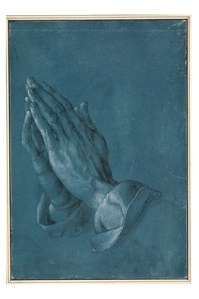

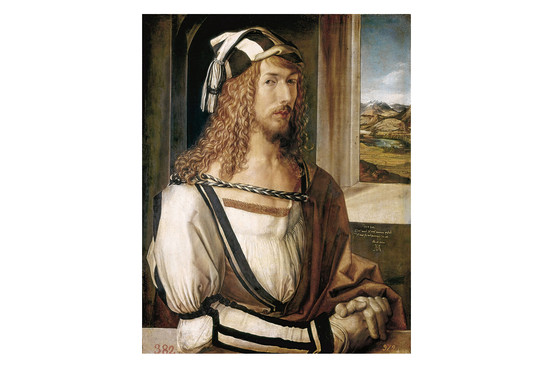
DRAWING POWER: Albrecht Dürer
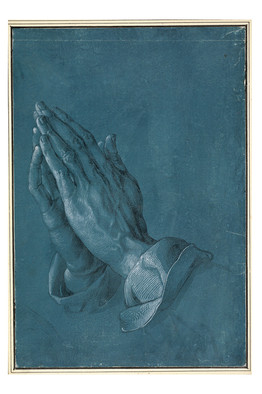
The image at the center of Albrecht Dürer’s drawing “Praying Hands” has traveled a long way from its roots in the German Renaissance. It is the most enduring work by one of the greatest draftsmen in the history of Western art, but it has also taken on a pop-culture life of its own, all over the world.
It is found on posters, dishes, washcloths, urns, aprons, coffee mugs, cellphone cases and pocketknives—and tattooed onto Justin Bieber‘s leg. Its likeness appears on Andy Warhol’s tombstone. Singer and songwriter Trey Bruce has a song called “Velvet Elvis and Prayin’ Hands.” Of the many tattoo takes on the image, one of the more exotic is that of pro basketball player Stephen Jackson, of the San Antonio Spurs, who has on his torso a rendering of “Praying Hands”—holding a handgun.
Now, the real thing will be on view at the National Gallery in Washington. The last time the drawing came to the U.S. was in 1984-85, when it was shown in Washington and New York. From Sunday through June 9, the museum will host “Albrecht Dürer: Master Drawings, Watercolors, and Prints From the Albertina,” comprising 118 works on loan from the Albertina Museum in Vienna.
“Without a doubt, it’s the most famous drawing in the world,” says Andrew Robison, a senior curator of prints and drawings at the museum. And one of the most appropriated. “In every gas station in the South, in every bank behind the teller, you have an image of the ‘Praying Hands,’ ” says Mr. Robison, who grew up in Memphis, Tenn. Read more of this post













 Bamboo Innovator