P&G, Big Companies Pinch Suppliers on Payments

April 16, 2013, 10:55 p.m. ET

P&G, Big Companies Pinch Suppliers on Payments

By SERENA NG

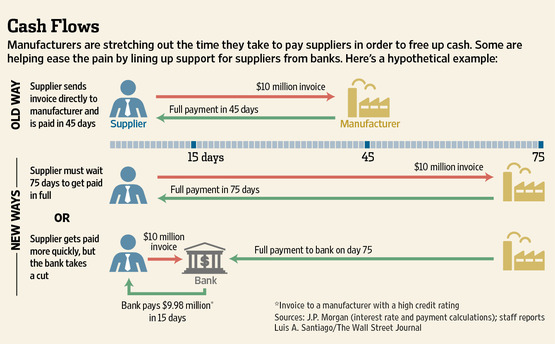
Procter & Gamble Co. PG -1.30% is planning to add weeks to the amount of time it takes to pay its suppliers, a shift that could free up as much as $2 billion in cash for the consumer products giant, people familiar with the matter said. P&G could use that cash to fund investments in new factories overseas or to help pay for stock buybacks. That added flexibility, however, will come at the expense of the companies that supply P&G with materials or services. The suppliers will have to tie up more of their own cash in receivables or eat the interest costs charged by banks to bridge the gap until P&G pays its bills.
P1-BL148_SQUEEZ_G_20130416191505

The move highlights how America’s biggest companies continue to build on the aggressive cash management practices they adopted in the wake of the credit crisis. What began as a way to preserve cash when markets dried up a few years ago has become a means of freeing up money to fund expansions, buy back stock and support dividend payouts at a time of lackluster sales growth and shrinking profit margins. Read more of this post

Apple Loses Throne as World’s Biggest Company

Apr 17, 2013

Apple Loses Throne as World’s Biggest Company

By Steven Russolillo

OB-XC753_AppleE_G_20130417173902

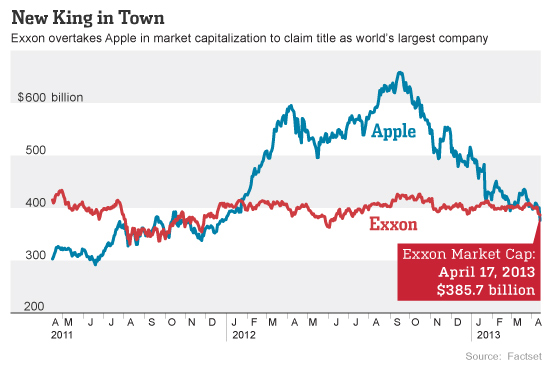
Apple’s market cap (in blue) compared to Exxon’s over the past two years

Apple Inc. AAPL -5.50% is no longer on top.

Wednesday’s steep slide in Apple’s shares has pushed the tech giant to second place on the list of the world’s most valuable companies. Oil giant Exxon Mobil Corp. XOM -0.61%has reclaimed the throne.

As the chart shows, both companies have been jockeying back and forth for the top spot for much of 2013. Prior to that, Apple had been the clear-cut king from January 2012 through this past January. And before that, Exxon had been the king dating back to 2006. Apple shares recently dropped more than 5% and briefly dipped below $400 for the first time since December 2011. Exxon shares are down less than 1%. One peculiar trend that has taken place this year: The S&P 500 has set new records without its two biggest components contributing to the rally. Apple shares are down 25% this year and Exxon Mobil shares are off 0.5% Meanwhile, the S&P 500 is up about 9%. Read more of this post

Google executive chairman Eric Schmidt predicts there will be more than 1 billion Android smartphones in use by the end of the year

Android to reach 1 billion mark this year: Schmidt

April 18, 2013 – 11:05AM

Alexei Oreskovic

Google executive chairman Eric Schmidt predicts there will be more than 1 billion Android smartphones in use by the end of the year.

The five-year-old Android software has been a huge hit for Google, giving the internet search company a strong footing with consumers who increasingly access the web from smartphones and tablets rather than PCs. Android is now the world’s No.1 mobile phone software, with more than 750 million mobile devices featuring Android in use across the world.

At the current rate, Schmidt said that Google should cross the 1 billion mark within six to nine months and will be “nearing 2 billion in a year or two”. Read more of this post

Heading off a China-style Subprime Mortgage Crisis; This debt is worrying not only because of its size. Worse, it is not transparent and we don’t know how it will be handled.

04.17.2013 18:27

Heading off a China-style Subprime Mortgage Crisis

The risk from ballooning local government debt is enormous, and to address this problem the government must learn to play its proper role

Warning of local governments’ high exposure to bad debts, the credit agency Fitch recently downgraded China’s long-term local-currency rating from AA– to A+. Officials should take note: the downgrade underlines how closely international markets are watching developments in the country.

Local government debt is nothing new, but the amount has been modest – until recently. The government’s pursuit in 2008 of a 4 trillion yuan stimulus package has pushed debt levels sky-high. The continuing growth of the shadow banking system is also a source of hidden risk.

Just how big is the debt? The National Audit Office says local governments had 10.7 trillion yuan of debt at the end of 2010. The National People’s Congress budget report, meanwhile, said principal repayment of local government bonds last year totaled 200 billion yuan. Some experts estimated a rise last year of 1 to 2 trillion yuan. Even based on conservative estimates, local government debt may now exceed 12 trillion yuan.

This debt is worrying not only because of its size. Worse, it is not transparent and we don’t know how it will be handled. Particularly of concern is the tendency of Chinese officials to let political expediency override economic sense. Read more of this post

China CITIC Bank Caught Up in Financial Fraud Case Over Wealth Management Product (WMP) Sold By Bank Employee

CITIC Caught Up in Financial Fraud Case – Economic Observer Online – In-depth and Independent

1366171113598

Photo: Protestors hold up a banner calling for the return of their money 
Source: China Internet Information Center
Apr 17, 2013
Translated by Liu Jingyue

Frustrated customers recently protested in front of a branch of China CITIC Bank in Zhengzhou. The protestors were calling for the return of a total of 40 million yuan that they had invested in a wealth management product (WMP) that they say was sold by an employee of the bank in 2011. Details of the case were reported by China Internet Information Center (中国网) yesterday. According to the report, employees at a branch of China CITIC Bank in Zhengzhou, the largest city in the central province of Henan, sold unauthorized financial products without the permission of the bank to 110 customers. Guo Wenya (郭文雅), the former vice director at the branch sold the WMP to several customers in 2011, promising returns that were 10 times what customers would earn if they parked their money in ordinary deposit accounts. Guo is reported to have used the money to make high-interest rate loans that were not paid back. Read more of this post

Diabetes in Mexico: Eating themselves to death; Mexico has the sixth most cases of diabetes in the world

Diabetes in Mexico: Eating themselves to death

Apr 10th 2013, 11:27 by H.T. | MEXICO CITY

MEXICO has long been a country that derives extraordinary pleasure from eating and drinking—and it hasn’t minded the consequences much either. Gordo or gorda, meaning “chubby”, is used by both wives and husbands as a term of endearment. Pudgy kids bear proudly the nickname gordito, as they tuck into snacks after school slathered with beans, cheese, cream and salsa.

Your correspondent, having just arrived to live in Mexico City after more than a decade away, finds the increase in waistlines even more staggering than the increase in traffic. Mexico has become one of the most overweight countries on earth, even more so than the United States; a quarter of its men and a third of its women are obese. Indecorously, the country has even come up with figures on figures: the Mexican Diabetes Federation says that among women between 20 and 49, the average waistline is 91.1cm (35.9 inches), more than 10cm above the “ideal” size. Stores are now full of large- and extra large-sized clothing.

Time was, a prominent girth may have been enviable proof of relative prosperity. Now, it is a serious health risk. At a conference here on April 9th it was estimated that more than 10m Mexicans, or almost a sixth of the adult population, suffer from diabetes, largely because of over-eating and increasingly sedentary lifestyles. Mexico has the sixth most cases of diabetes in the world.

Diabetes is one of the top two causes of death in the country, alongside (and occasionally overlapping with) heart disease. The diabetes federation says that the illness kills 70,000 people a year. However, it gets far less attention than much less deadly diseases such as HIV/AIDS, not to mention organised crime (which is responsible for roughly 60,000 deaths in the past six years). “It could get to the point where we are literally eating ourselves to death,” says Jesper Holland of Novo Nordisk, a Danish health-care company that is a big supplier of insulin to Mexico. Read more of this post

A Closer Look At Today’s German Stock Market Flash Crash; Egan-Jones Downgrades Germany From A+ To A, Outlook Negative

A Closer Look At Today’s German Stock Market Flash Crash

Tyler Durden on 04/17/2013 19:46 -0400

While most of the US was in deep REM sleep, the Germany stock index, the DAX, had a flashback to May 2010: starting at 3:44 am EDT, in the span of 6 minutes or much faster than the gradual drop that led to the US flash crash from three years ago, the DAX went from well and solidly-bid to having zero liquidity… and dumping nearly 200 points in the process. Whether it was rumors of a (subsequently validated) rating agency downgrade, or just an algo testing its quote stuffing ability, the moves showed vividly that when the current rosy paradigm shifts abruptly and violently, all those hoping to be the first out of the door and hit the sell button, simply won’t be able to do so. Because sadly there is no such thing as a free “4 year long zero volume levitation” – one must always pay the piper in the end.

Charts below from NanexJune 2013 DAX Futures Depth of Book. Shouldn’t demand increase as prices drop? Only if it is demand for physical gold it seems.

20130417.fDAX_.M13_0

Egan-Jones Downgrades Germany From A+ To A, Outlook Negative

Tyler Durden on 04/17/2013 15:41 -0400

4/17/2013: Federal Republic Of Germany: EJR lowered A+ to A (Neg.) (S&P: AAA) (3413Z GR)

Although Germany’s credit metrics are respectable, the country has exposure to its banks and the weaker EU members. Deutche Bank has adjusted shareholders’ equity to asset near 2% and might need EUR 100B of support. Via the ECB’s Target 2, Germany is owed EUR700B of which perhaps 50% is collectible and then there is the banks’ southern EMU exposures. Germany’s debt to GDP was 80.6% as of 2011. However, increasing Germany’s debt by EUR500B raises the adjusted debt to GDP to 100%. The deficit to GDP of .8% is reasonably strong. Unemployment is 6.9% but will probably rise as global economies continue to show weakness. The positive (EUR16.8B) balance of trade (per GFSO) and the positive EUR5.59B current account (per the OECD) help. Inflation has been moderate at 1.4% (per GFSO). Chancellor Merkel continues to resist calls for EU bonds (shared liabs.) and money printing and is pushing for fiscal controls and the seniority of bailout funding. Germany is likely to be outvoted by other ECB members and therefore will have greater prospective exposure. Watch for the EFSF and the ESM morphing into banks (thereby depressing eventual recoveries) and a rise in the number of euros. Watch progress on the EU banking union. We used the IMF’s data for Germany’s debt which is greater than Eurostat’s data.Downgrading.

China’s Animal Apocalypse Spreads To Dogs

China’s Animal Apocalypse Spreads To Dogs

Tyler Durden on 04/17/2013 15:24 -0400

First it was floating dead pigs, then ducks, then black swans, then mass chicken exterminations, then fish, and now more pigs and also a brand new entrant to the Chinese animal apocalypse: dogsAP reports that hundreds more pigs have been found dead in China – this time together with dozens of dogs. “A total of 410 pigs and 122 dogs were discovered in homes and at farms earlier this week in a village that comes under Yanshi city’s jurisdiction in central Henan province, authorities said Wednesday. The city’s propaganda office said that the deaths were being investigated but that they suspected they had to do with nearby chemical factories. The factories have been ordered to suspend production and help police with a criminal investigation into the incident, according to a report on a Henan provincial news website.” One would assume that something is responsible for these mass animal  deaths, and one of these years, not the propaganda office, but someone actually accountable (so not CNN) will report what it is. Although we are not holding our breath, which if one were to live in Beijing, would not be a bad idea.

No poisonous gases have been found in tests on the air around the village and its drinking water has met quality standards, said the report, which the propaganda office confirmed. Local authorities said the deaths have nothing to do with any epidemic or the H7N9 bird flu virus that has recently spread to humans. Last month, more than 16,000 dead pigs were found in rivers that supply water to Shanghai. The dumping has not been explained, though police had been cracking down on the illegal sale of pork products made from dead, diseased pigs.  Read more of this post

Harvard kids use 3D printing to help the blind ‘see’ paintings

Harvard kids use 3D printing to help the blind ‘see’ paintings

By VentureBeat.com, Published: April 17

For the visually impaired, the basic problem with art is that, well, they can’t see it. But with a project called “Midas Touch” a group of Harvard kids say they have a fix: Use 3D printing to help the blind ‘see’ what they cannot actually see.

“We want to bridge the gap between the visually impaired and the visual world of art,” Constantine Tarabanis, one of the brains behind the project, told me.

Basically, what Midas Touch does is take a flat image — say, of Starry Night — and use 3D printing to add layers of texture to it, creating an image that’s half painting, half relief sculpture. Essentially, Midas Touch takes the visual nature of art and translates it to a physical world that the visually impaired can understand.

In theory, anyway. The thing to keep in mind with Midas Touch is that the whole project is at this point a concept. While Tarabanis and his team have a great idea and a bunch of funding, they’re still working on creating working prototypes to prove their idea has legs. Read more of this post

A Story of Value Investing by Loews: The Adventures of Lotta Value, Investment Hunter

The Adventures of Lotta Value, Investment Hunter

At Loews, we seek to combine dynamic creativity and a willingness to embrace constant change with a deep and abiding commitment to long-established principles of prudent business and investment management.
Our presentation of the Loews value story in graphic form may surprise some of you. We chose this method of communication because it has become increasingly difficult, in today’s “pure-play” business environment, for conglomerates like Loews to be heard.
We know we have a good story to tell, and we want to find a new way to tell it — this time in a unique and engaging way.
Since we never do anything halfway at Loews, we asked Lotta Value to be our guide.
We hope you enjoy The Adventures of Lotta Value, Investment Hunter ! We certainly had a lot of fun creating her and sending her on her value quest.

value-hunter

Buffett Mocking Gold Sidesteps Slump As He Bets on Stocks

Buffett Mocking Gold Sidesteps Slump As He Bets on Stocks

Investors including hedge-fund manager John Paulson faced losses this week as gold suffered its biggest rout in three decades. Warren Buffett told them there were better places to put their money.

The billionaire chairman of Berkshire Hathaway Inc. (BRK/A) cautioned against investing in the metal in February 2012, when an ounce sold for more than $1,700, because it’s not productive like a farm or company. Gold fell 14 percent to $1,348.21 in the two trading days through April 15, the biggest decline since 1983, and wiped out almost $1 billion in Paulson’s wealth. Prices rebounded to $1,384.71 at 10:51 a.m. in New York today.

“What motivates most gold purchasers is their belief that the ranks of the fearful will grow,” Buffett wrote last year in a letter to shareholders. “During the past decade that belief has proved correct. Beyond that, the rising price has on its own generated additional buying enthusiasm, attracting purchasers who see the rise as validating an investment thesis. As ‘bandwagon’ investors join any party, they create their own truth — for a while.”

Buffett, 82, has said his preference is to build Omaha, Nebraska-based Berkshire by investing in companies, such as chemical maker Lubrizol Corp., which he bought in 2011. Since his comments about gold, his firm has struck a deal with Jorge Paulo Lemann’s 3G Capital to take HJ Heinz Co. private, acquired more than two dozen daily newspapers, bought retailer Oriental Trading and added to its $87.7 billion stock portfolio. Read more of this post

IMF Sees Some Corporate Debt Unsustainable in Parts of EU

IMF Sees Some Corporate Debt Unsustainable in Parts of EU

As much as 20 percent of non-bank corporate debt in the weakest euro-area economies is unsustainable and may force companies to cut dividends and sell assets, dealing further blows to investor confidence, the International Monetary Fund said.

Businesses (SXXP) in Italy, Spain and Portugal have the largest “debt overhang,” according to the IMF’s Global Financial Stability Report released today, which analyzed 1,500 publicly traded non-financial European firms. Strains in the corporate sector may in turn hurt banks’ asset quality, the report showed.

“Firms in the euro-area periphery have built a sizable debt overhang during the credit boom, on the back of high profit expectations and easy credit conditions,” the IMF said. Now they “face the challenge of reducing the debt overhang in an environment of lower growth and higher interest rates, in part related to financial fragmentation in the euro area.”

European policy makers are struggling for ways to give companies in the so-called periphery access to affordable credit even after the European Central Bank’s plan to purchase bonds of debt-burdened countries. The IMF report defined the periphery as Cyprus, Greece, Ireland, Italy, Portugal and Spain. Read more of this post

Mongolia Says Rio Mine Audit Seeks Answers on $2 Billion Cost Overrun

Mongolia Says Rio Mine Audit Seeks Answers on $2 Billion Overrun

Mongolia said it’s undertaking an audit of Rio Tinto Group (RIO)’s Oyu Tolgoi operation as it seeks to understand the reasons for an alleged $2 billion cost overrun at the mine where output is due to start in June.

“We are checking procurement documents and expenditures,” Finance Minister Chultem Ulaan told reporters yesterday in the capital Ulaanbaatar. “No one understands why the project has gone $2 billion over budget, so we are checking this.”

The $6.6 billion Oyu Tolgoi mine will be the largest contributor to Mongolia’s economy and is estimated to account for one-third of the nation’s gross domestic product by 2020. The government’s audit team is studying what equipment was bought for the mine and its cost, said Ulaan. The operators of Oyu Tolgoi have brought in a foreign auditor, he said. Read more of this post

Korean Supermarket Uses a Guiding Light to Point Out Discounts on Your Smartphone

Korean Supermarket Uses a Guiding Light to Point Out Discounts on Your Smartphone

April 17, 2013

by Steven Millward

“Mom, turn right for the candy – AND HURRY!” We’ve seen Korean supermarket chain Emart (KRX:139480) do some innovative stuff before, like its shadowy QR codes. But this time Emart is trying something more substantive – using smartphones and LED lights to guide shoppers around their stores and lead them to discounts. Dubbed ‘Emart Sale Navigation’, the idea is a combination of car-like GPS with a location-based discounts app. But rather than actually relying on GPS (which could be unreliable indoors), the Korean supermarket is using special LED lights on the ceiling to send information to lenses attached to shopping carts. Then, so long as you have the Emart app on your Android phone and it’s attached to the shopping cart on the special plastic arm shown in the pictures, you’ll be guided around the aisles by dedicated indoor maps. If you pass an area where there’s a discount coupon available, that’ll pop up on-screen. It’s all pretty clever and actually simpler than it sounds. For consumers it’s pretty straightforward, as all you need to do is have the app on your phone and then attach it to your cart. Emart itself sorts out the lenses and the lights, so shoppers don’t need to worry about compatibility issues. It avoids other technologies likeNFC and QR codes which tend to be either fragmented across devices or just too damn confusing for most people. So one single app in this project from Emart makes it all intelligible and fairly easy. If you’re in South Korea, grab the Emart sale navigation Android app and then head out to do some shopping; or check out the two-minute demo video (in English) here:

Goldman Traders Cede Tokyo Party Bar to Google-Apple Invasion

Goldman Traders Cede Tokyo Party Bar to Google-Apple Invasion

By Takahiko Hyuga and Terje Langeland  Apr 16, 2013

The champagne used to flow at Heartland, the bar in Tokyo’s Roppongi Hills complex that drew bankers from the Japan headquarters ofGoldman Sachs Group Inc. (GS) and Lehman Brothers Holdings Inc. upstairs.

“Every day, there was a party,” said Mai Shioya, the 39- year-old manager, who started in May 2008 before the global financial crisis that led to Lehman’s bankruptcy.

Bankers in well-cut suits would come in about 5 p.m., hand bartenders corporate credit cards and let their friends charge drinks to the tab until 2 a.m., said Michio Nakamura, 45, who’s been running events and entertainment at Heartland since its opening as part of the famed Roppongi Hills development in 2003. After the financial crisis, many disappeared, cutting revenue by 30 percent, Shioya said.

“Those customers and that age have gone,” she said.

The void is being filled by a new group of bar patrons: information-technology workers. While financial firms have cut staff in Japan, technology companies have boosted hiring, and as bankers vacated offices at Roppongi Hills, companies including Google Inc. (GOOG) andLenovo Group Ltd. (992) moved in. As early as this month, Apple Inc. (AAPL) will also make the complex its home in Japan, two people familiar with the plan said in January. Read more of this post

150 Years of Boom and Bust – What Drives Mineral Commodity Prices?

150 Years of Boom and Bust – What Drives Mineral Commodity Prices?

Martin Stürmer University of Bonn

February 1, 2013
German Development Institute Paper No. 5/2013

Abstract: 
This paper examines the dynamic effects of demand and supply shocks on mineral commodity prices. It provides empirical insights by using annual data for the copper, lead, tin, and zinc markets from 1840 to 2010. I identify structural shocks by using long-run restrictions and compare these shocks to narrative historical evidence about the respective markets. Long-term price fluctuations are mainly driven by persistent demand shocks. Supply shocks exhibit some importance in the tin and copper markets due to oligopolistic market structures. World output- driven demand shocks have persistent, positive effects on mineral production. Long-term linear trends are statistically insignificant or significantly negative for the examined commodity prices. My results suggest that the current price boom is temporary but not permanent. Commodity exporting countries should prepare for a downswing of prices, while commodity importing countries should not fear for the security of supply of these widely used mineral commodities.

Size is a Drag: How Hedge Fund Growth May Be Affecting Returns

Size is a Drag: How Hedge Fund Growth May Be Affecting Returns

Ian Hunt EDHEC Risk Institute

March 31, 2013

Abstract: 
The hedge fund industry has grown massively. Most of the growth appears to be from inward capital cash flows, rather than retained investment returns. But it is difficult to gauge hedge fund cash flows and returns exactly – no available data set straightforwardly represents the industry as a whole, and each data set is incomplete and possibly biased. Despite various data constraints, I reveal a salient negative relationship between the hedge fund industry’s size and its percentage returns. This relationship is economically and statistically significant. And it is not sensitive to the choice of data set.

Tech-savvy Vietnam coffee farmers brew global takeover; Most Vietnamese coffee farmers can tell you the price of the beans, the second most traded commodity in the world after oil, in their sleep

Tech-savvy Vietnam coffee farmers brew global takeover

Most Vietnamese coffee farmers can tell you the price of the beans in their sleep. -AFP

Wed, Apr 17, 2013
AFP

Buon Ma Thuot, Vietnam – Most Vietnamese coffee farmers have never heard of a double tall skinny latte, but they could tell you the price of the beans that go into one in their sleep.

From high-tech Israeli irrigation systems to text message updates of global prices for the commodity, coffee farming in Vietnam’s Central Highlands has come a long way since the French first introduced the bean over a century ago.

“I used to carry my coffee to market by bicycle,” said 44-year-old farmer Ama Diem. “Now I check the bean price on my mobile phones” before making the trip.

By texting “CA” to the number 8288 from any Vietnamese mobile phone, farmers almost instantly receive a message with the London prices of Robusta coffee beans and the New York price of Arabica beans from a data supply firm. Read more of this post

The Cypriot government plans to sell part of its gold reserves within the next months, Finance Minister Haris Georgiades said

Cyprus Central Bank Must Approve Gold Sale, Finance Chief Says

The Cypriot government plans to sell part of its gold reserves within the next months, a decision that needs to be approved by the country’s central bank, Finance Minister Haris Georgiadessaid.

“The exact details of it will be formulated in due course primarily by the board of the central bank,” Georgiades, 41, told Bloomberg TV’s Ryan Chilcote in an interview in Nicosia. “Obviously it’s a big decision.”

Cypriot President Nicos Anastasiades is trying to unlock 10 billion euros ($13.2 billion) of loans from the euro area and the International Monetary Fund. To do so, he must come up with a further 11 billion euros through measures including a tax on bank deposits of more than 100,000 euros at the country’s two biggest banks and the sale of assets and gold.

An April 9 debt assessment by the European Commission said Cyprus had committed to selling about 400 million euros of “excess” gold reserves, prompting gold futures to fall the most in five months. In response to the disclosure, the Central Bank of Cyprus said it wasn’t considering a sale. Read more of this post

Berkshire Gains as Buffett’s Coca-Cola Stake Rallies

Berkshire Gains as Buffett’s Coca-Cola Stake Rallies

Warren Buffett’s Berkshire Hathaway Inc., the largest investor in Coca-Cola Co. (KO), jumped the most since January in New York trading on gains in the value of its stake in the soft-drink maker. Berkshire Class A shares rallied $4,000, or 2.6 percent, to $161,000, a record closing price. Atlanta-based Coca-Cola surged 5.7 percent after posting first-quarter profit that beat analysts’ estimates and announcing a deal to sell some bottling distribution rights in North America. Buffett’s firm has 400 million Coca-Cola shares, making it one of the four largest holdings at Omaha, Nebraska-based Berkshire, along with investments in Wells Fargo & Co., American Express Co., and International Business Machines Corp. Berkshire’s stakes in the companies may increase in the future as the firms buy back shares, Buffett said in a letter to investors last month. “The four companies possess marvelous businesses and are run by managers who are both talented and shareholder- oriented,” Buffett said in the letter. “Too much of good thing can be wonderful.”

To contact the reporter on this story: Noah Buhayar in New York at nbuhayar@bloomberg.net

Updated April 16, 2013, 7:59 p.m. ET

New Coke: Bottlers Are Back

Beverage Company Expanding Delivery Territories for Five of Its Independent Bottling Companies

By MIKE ESTERL And PAUL ZIOBRO

Coca-Cola Co. KO +5.69% likes to have its cake and eat it too.

That is why it sold its bottlers and then bought them back again. That is why it is now going back to the franchise model for distribution. Read more of this post

The Fresh Start Effect: Breaking Points in Life Motivate Virtuous Behavior

The Fresh Start Effect: Breaking Points in Life Motivate Virtuous Behavior

Hengchen Dai University of Pennsylvania – The Wharton School

Katherine L. Milkman University of Pennsylvania – The Wharton School

Jason Riis Harvard Business School

January 20, 2013
The Wharton School Research Paper No. 51

Abstract: 
Many view the commencement of each New Year as an opportunity for a fresh start, which motivates them to pursue virtuous goals. We demonstrate that this well-known uptick in virtuous behavior following New Year’s is just one example of a broader phenomenon, which we refer to as the ‘fresh start effect.’ Specifically, special (and mundane) occasions in our lives and calendar events demarcate the passage of time (e.g., a promotion, a birthday, the beginning of a new week/month), creating many breaking points in each year. We show that these breaking points generate fresh start feelings, which are stronger at meaningful discontinuities and motivate subsequent virtuous behavior such as exercise and dieting. We propose and show that the fresh start feelings associated with breaking points originate from a psychological disassociation from our past self and belief that we are more like our ideal selves at the beginning of a new period.

The Art of Thinking Clearly

The Art of Thinking Clearly [Hardcover]

Rolf Dobelli (Author)

16248196

Release date: May 14, 2013

The Art of Thinking Clearly by world-class thinker and entrepreneur Rolf Dobelli is an eye-opening look at human psychology and reasoning — essential reading for anyone who wants to avoid “cognitive errors” and make better choices in all aspects of their lives.

Have you ever: Invested time in something that, with hindsight, just wasn’t worth it? Or continued doing something you knew was bad for you? These are examples of cognitive biases, simple errors we all make in our day-to-day thinking. But by knowing what they are and how to spot them, we can avoid them and make better decisions.

Simple, clear, and always surprising, this indispensable book will change the way you think and transform your decision-making—work, at home, every day. It reveals, in 99 short chapters, the most common errors of judgment, and how to avoid them. Read more of this post

Minxin Pei: China’s Dream World; Political slogans, however high-sounding, become stale when their purveyors fail to make good on their promises

China’s Dream World

Minxin Pei is Professor of Government at Claremont McKenna College and a non-resident senior fellow at the German Marshall Fund of the United States.

16 April 2013

CLAREMONT, CALIFORNIA – Ruling elites almost everywhere – whether in democracies or in authoritarian regimes – believe that clever sloganeering can inspire their people and legitimize their power. There are, of course, crucial differences. In functioning democracies, government leaders can be held accountable for their promises: the press can scrutinize their policies, opposition parties are motivated to show that the party in power lies and cheats. As a result, incumbents are frequently forced to carry out at least some of their promises.

Autocratic rulers, by contrast, face no such pressures. Press censorship, repression of dissent, and the absence of organized opposition allow rulers the luxury of promising whatever they want, with no political consequences for failing to deliver. The result is government of the sloganeers, by the sloganeers, and for the sloganeers. Read more of this post

China has over-invested in itself: IMF official; The government has extracted money from the population to help pay the huge cost of maintaining its rapid growth

China has over-invested in itself: IMF official

Staff Reporter, 2013-04-17

China has over-invested its resources domestically, according to a report by Li Yiheng, chief representative of the International Monetary Fund in the country.

Domestic investment has accounted for about 50% of China’s GDP, which is far higher than the 12%-20% average found around the globe, said the report. The situation is primarily due to large investments by the government to try to overcome the negative effect of the global financial crisis during the period 2007-2011.

Though the over-investment will not immediately cause a crisis, the government should keep an eye on the possible negative effects, said Li, adding that loans made for the purpose of investment projects will become a burden on the nation’s population.

The country’s outstanding economic growth was the result of long-term large-scale investment over the past 20 years, said Li. The government has extracted money from the population to help pay the huge cost of maintaining its rapid growth and has only recently tried to slow down investments and promote local consumption, said Li. Read more of this post

If news makes us sick, Twitter must be a cancer; News is bad for you – and giving up reading it will make you happier

If news makes us sick, Twitter must be a cancer

BY HAMISH MCKENZIE 

ON APRIL 15, 2013

On Friday, the Guardian ran a provocative op-ed by Rolf Dobelli arguing that news is bad for our health and hinders our thinking. The much-discussed article, which the author had first written two years ago, was excerpted from the soon-to-be-released “The Art of Thinking Clearly,” a compendium of essays penned by theself-described “serial entrepreneur, thinker and writer.”*

Dolbelli’s argument is that “news is to the mind what sugar is to the body.” Not only does it distract us from wider issues, but it tells us stuff we don’t need to know, has a toxic effect on our bodies, inhibits our thinking, wastes our time, and makes us passive. Heavy stuff! Read more of this post

WhatsApp “Bigger Than Twitter” With Over 200M Monthly Active Users, 8B Inbound And 12B Outbound Messages Daily

WhatsApp “Bigger Than Twitter” With Over 200M Monthly Active Users, 8B Inbound And 12B Outbound Messages Daily

DARRELL ETHERINGTON

posted yesterday

WhatsApp CEO Jan Koum was on stage today at the AllThingsD Dive Into Mobile conference in New York City, where he said that the app is now larger than Twitter by monthly active users. He wouldn’t say exactly how many the company had, just that it was north of 200 million users.

Koum also noted that the messaging app now sees an average of 8 billion inbound, and 12 million outbound messages per day, and with less than 50 engineers, the highest ratio of active users per long-term employee today of any active tech company.

Twitter noted that it hit its own 200 million monthly active user count back in December, while WhatsApp noted in January that it had reached the 7 billion inbound messages per day milestone. To some extent, comparing the two is a bit like comparing apples and oranges, but recent evidence suggests that social networking tools like Facebook and Twitter are losing the attention of younger users, who are turning to platforms like WhatsApp instead. Read more of this post

Find Your Sister: China’s hottest mobile game; The game is currently making 5 million yuan (US$810,000) a month through the Apple App Store

Find Your Sister: China’s hottest mobile game

Staff Reporter, 2013-04-17

funship-161821_copy1

A screenshot from Find Your Sister. (Internet photo)

Find Your Sister, a free mobile phone game in China, has become a hit with over 55 million subscribers and 8 million active players daily, topping the Apple App Store in the country for downloads.

The game got off to a slow start on its release last September but improvements to its gameplay have paid off since early this year. The game has managed to attract people who have not been playing online games before, from toddlers aged 2-3 to people over the age of 60, according to China Entrepreneur magazine.

A user who plays the game regularly said the game is popular because it can be played anytime and anywhere, such as the subway commute to work, when you can take out your phone and take on one challenge after another.

One major attraction of the game is its humorous content, as well as its multiplayer feature.

The game is currently making 5 million yuan (US$810,000) a month through the Apple App Store and income from the Android platform also started to grow sharply in March. Read more of this post

Samsung accused of paying people to criticize rival HTC

Samsung accused of paying people to criticize rival

2013-04-17 06:27:58 GMT2013-04-17 14:27:58(Beijing Time)  SINA.com

Fair-trade officials in Taiwan are looking into reports that Samsung paid people to criticise rival HTC online.

Samsung is alleged to have hired students to post negative comments about phones made by Taiwan’s HTC.

Samsung, based in South Korea, said the “unfortunate incident” had gone against the company’s “fundamental principles”. Read more of this post

China’s digital advertisers need to grow up instead of just growing fast

Cost-per-billion

Wednesday, April 17, 2013

China’s digital advertisers need to grow up instead of just growing fast

Browsing one of China’s leading internet portals has been easier on the eye in recent years. By Western standards, sites such as Sina or Tencent may seem cluttered – even overwhelming. But, compared to the omnipresent floating ads, pop-ups and uncloseable boxes of years past that pestered Chinese internet users, the general demeanor of online advertising in the country has become – at least for market leaders – increasingly pleasant.

While decluttering is a good start, China has a lot of ground to cover in monetizing digital ads. Boosting the value of ads and handling large amounts of user data will be a large part of raising revenues in the months and years to come. Although digital ad revenues are expected to surpass those of TV in 2013, according to Chinese internet analysis firm iResearch, investors are waiting to see if they can keep up with the pace of the country’s quickly expanding digital universe.

Along the way, harnessing the mobile market will help – in fact, it will be essential. But this market is in its early stages and companies will be wary of running adverts on smartphones or tablets until advertisers can prove that people are looking at them. Read more of this post

Asia slowly losing its luster – Nomura

Asia slowly losing its luster – Nomura

By Prinz P. Magtulis (The Philippine Star) | Updated April 15, 2013 – 12:00am

MANILA, Philippines – Strong economies in the Asian region are slowly losing their luster as the low interest environment here and abroad is beginning to cause some problems, an investment bank said.

“We are becoming more concerned that Asia’s once solid economic fundamentals are deteriorating,” Nomura economist Rob Subbaraman said in the bank’s Asia Economic Monthly report. Read more of this post