Cities as ideas; founding visions are vulnerable. The more their realisation depends on the will and power of a single leader (or a colonial power), the more likely they are to be subverted

Cities as ideas

When Peter the Great visited Amsterdam in 1697, he was dazzled. It was the richest city in the world, a maritime superpower and a global trade hub — confirmation of the West’s superiority in technology, education and the arts.

Amy Bernstein is the editor of Harvard Business Review.

20 HOURS 22 MIN AGO

When Peter the Great visited Amsterdam in 1697, he was dazzled. It was the richest city in the world, a maritime superpower and a global trade hub — confirmation of the West’s superiority in technology, education and the arts.

The contrast between the brilliance and worldliness of Amsterdam and the dreariness and xenophobia of his own capital, Moscow, was not to be borne. He wanted an Amsterdam of his own. So he built one.

As Daniel Brook describes in A History of Future Cities, St Petersburg was the czar’s bid to modernise (read: Westernise) his empire, and he supervised every detail of its construction. He brought in architects from Switzerland and Germany and engineers from England, Germany and Italy. He established the empire’s first secular, coeducational university and the world’s first public museum. He introduced his people to newspapers, salons and instrumental music concerts. In just a few years, St Petersburg grew into a model of European sophistication and a monument to its founder’s vision and audacity. Peter’s accomplishment, Brook argues persuasively, illustrates the notion that cities are “metaphors in steel and stone”. St Petersburg — along with Shanghai, Mumbai (formerly Bombay) and Dubai, the other three cities profiled in Brook’s engaging book — served as a gateway to the West. Through it, Peter imported non-native attitudes, approaches and behaviours in order to build the future.

But founding visions are vulnerable. The more their realisation depends on the will and power of a single leader (or a colonial power), the more likely they are to be subverted. And cities founded on ideas can suddenly, sometimes violently, come to represent entirely different ones. St Petersburg, Shanghai and Mumbai, for example, all turned against the West. Read more of this post


Beijing Brambling, Zhejiang Duck Spawn Deadly Flu, Study Finds

Beijing Brambling, Zhejiang Duck Spawn Deadly Flu, Study Finds

A brambling from Beijing, a wild bird from Korea and a duck from China’s Zhejiang province probably helped spawn the new flu variant that’s killed 10 people, a study in the New England Journal of Medicine found.

The birds were infected with avian flu strains that most resemble the H7N9 virus circulating in eastern China, according to yesterday’s study by researchers at the Chinese Center for Disease Control and Prevention in Beijing and Fudan University in Shanghai.

Thirty-eight people have been sickened with H7N9 flu, which the authors said causes brain damage, muscles to break down and vital organs to fail in its most extreme form. Different mutations in samples taken from patients suggest the virus entered human populations at least twice, the study found.

“We are concerned by the sudden emergence of these infections and the potential threat to the human population,” Rongbao Gao and colleagues wrote. “An understanding of the source and mode of transmission of these infections, further surveillance, and appropriate counter measures are urgently required.” The new strain, which hasn’t been detected in humans or animals before, raises “many urgent questions and global public health concerns,” Timothy Uyeki and Nancy Cox, flu scientists at the Centers for Disease Control and Prevention in Atlanta, said in an accompanying editorial in the journal. Read more of this post

Blind Spots and How to Work at Them

Blind Spots and How to Work at Them

by Karen Christensen | Apr 12, 2013

Douglas Stone, the Boston-based consultant and ‘difficult conversations’ expert talks about blind spots (the bad news: we all have them) and the best way to give and receive feedback

Positive self-regard helps us feel good about who we are, but it can get in the way of learning and improving.  Why is that?
Stanford Psychologist Carol Dweck has done some interesting research on this.  She had middle school students take a test and then gave them feedback on the results.  Some were told that they were “smart,” while others were praised for how hard they worked.  The ones who were praised for their intelligence were less likely to want to take on a next set of challenges; the ones who were praised for their effort were excited to exert more effort.  So, Dweck says, “praise the process,” rather than intelligence or natural ability.   Read more of this post

The Power of Talking to Your Baby

APRIL 10, 2013, 3:25 PM

The Power of Talking to Your Baby

By TINA ROSENBERG

By the time a poor child is 1 year old, she has most likely already fallen behind middle-class children in her ability to talk, understand and learn. The gap between poor children and wealthier ones widens each year, and by high school it has become a chasm. American attempts to close this gap in schools have largely failed, and a consensus is starting to build that these attempts must start long before school — before preschool, perhaps even before birth.

There is no consensus, however, about what form these attempts should take, because there is no consensus about the problem itself. What is it about poverty that limits a child’s ability to learn? Researchers have answered the question in different ways: Is it exposure to lead? Character issues like a lack of self-control or failure to think of future consequences? The effects of high levels of stress hormones? The lack of a culture of reading?

Another idea, however, is creeping into the policy debate: that the key to early learning is talking — specifically, a child’s exposure to language spoken by parents and caretakers from birth to age 3, the more the better. It turns out, evidence is showing, that the much-ridiculed stream of parent-to-child baby talk — Feel Teddy’s nose! It’s so soft! Cars make noise — look, there’s a yellow one! Baby feels hungry? Now Mommy is opening the refrigerator! — is very, very important. (So put those smartphones away!) Read more of this post

From bust to boom, how Kate Swann transformed one of Britain’s oldest companies WH Smith

From bust to boom, how Kate Swann transformed WH Smith

After an extraordinary decade at the helm of WH Smith, Kate Swann is preparing to say goodbye to a retailer that has been transformed.

whsmith_2366273b

By Graham Ruddick, Retail Correspondent

8:15PM BST 11 Apr 2013

WH Smith is one of Britain’s oldest companies and began life in 1792 as a small shop in Little Grosvenor Street, London.

Its unique mix of stationery, entertainment, books, and confectionary made it a high street institution, but by the time Swann arrived in 2003, the company was on its knees, outmanoeuvred by supermarkets and the internet. Read more of this post

Rosabeth Moss Kanter: The Happiest People Pursue the Most Difficult Problems

The Happiest People Pursue the Most Difficult Problems

by Rosabeth Moss Kanter  |   9:00 AM April 10, 2013

Lurking behind the question of jobs — whether there are enough of them, how hard we should work at them, and what kind the future will bring — is a major problem of job engagement. Too many people are tuned out, turned off, or ready to leave. But there’s one striking exception.

The happiest people I know are dedicated to dealing with the most difficult problems. Turning around inner city schools. Finding solutions to homelessness or unsafe drinking water. Supporting children with terminal illnesses. They face the seemingly worst of the world with a conviction that they can do something about it and serve others.

Ellen Goodman, a Pulitzer Prize-winning journalist (and long-time friend), has turned grief to social purpose. She was distraught over the treatment of her dying mother. After leaving her job as a syndicated columnist, she founded The Conversation Project, a campaign to get every family to face the difficult task of talking about death and end-of-life care. Read more of this post

Does Money Really Affect Motivation? A Review of the Research

Does Money Really Affect Motivation? A Review of the Research

by Tomas Chamorro-Premuzic  |   9:50 AM April 10, 2013

How much should people earn? Even if resources were unlimited, it would be difficult to stipulate your ideal salary. Intuitively, one would think that higher pay should produce better results, but scientific evidence indicates that the link between compensation, motivation and performance is much more complex. In fact, research suggests that even if we let people decide how much they should earn, they would probably not enjoy their job more.

Even those who highlight the motivational effects of money accept that pay alone is not sufficient. The basic questions are: Does money make our jobs more enjoyable? Or can higher salaries actually demotivate us? Read more of this post

If You’re Confident About Competence, Admit Your Flaws; IBM’s Lou Gerstner’s, “I don’t know IT but I know management” was pure genius. Here’s why

If You’re Confident About Competence, Admit Your Flaws

by Steven Berglas  |  11:00 AM April 10, 2013

Within moments of seeing white smoke billow from the Sistine Chapel, media outlets were inundated with a slew of reports about the former Cardinal Bergoglio. The Vatican PR machine noted that Pope Francis was an incredibly humble Cardinal who, as was befitting a Jesuit, had an abiding concern for the poor, rode the subway, and cooked his own meals. Oh… and that he was missing most of one lung.

This certainly runs contrary to conventional wisdom about how best to conduct impression management; i.e. “Put your best foot forward.” With Catholics already anxious about the new Bishop of Rome’s wellbeing, doesn’t pointing-out a condition that begs the question, “Was it cancer?” constitute impression mismanagement?

Actually, I think it’s something leaders should do more of. Let’s take an example from history to see why: Back in 1999, Louis V. Gerstner “let out” word that he had a deficiency immediately prior to taking the helm at IBM. Big Blue had been among the nation’s foremost enterprises, but when Gerstner was picked for the top spot it was bleeding red ink. Conventional wisdom would say that to redress the blue mood IBMers were suffering, Gerstner should have greeted them with bravado to boost morale. Instead, Gerstner exposed his soft underbelly by stating, “I don’t completely understand the technology [of IBM’s product line]. I’ll need to learn it, but don’t expect me to master it… unit leaders must translate it into business terms for me.”

Gerstner’s, “I don’t know IT but I know management” was pure genius. Here’s why: Read more of this post

Who Says Innovation Is Dead in Age of Crazy Cheesy Crust

Who Says Innovation Is Dead in Age of Crazy Cheesy Crust

Move over hamburgers and fries. Here come the sweet-chili chicken wraps and bacon-filled tater tots.

Looking to lure Americans with the coolest new menu item, Burger King Worldwide Inc (BKW)., McDonald’s Corp. (MCD) (MCD) and Red Robin Gourmet Burgers Inc (RRGB) (RRGB). and others are turning up the heat in their test kitchens. At the same time, classically trained chefs, looking for more regular work hours and higher pay, are no longer snubbing large chains. The result has been an arms race among eateries to create the most exciting new foods to attract consumers and boost sales.

“Over the last 12 to 18 months, you’ve seen a lot of innovation,” Eric Hirschhorn, Burger King’s vice president of global innovation, said in an interview. The Miami-based chain last year introduced 57 new items, the biggest menu overhaul in the company’s history and more than twice as many as in 2011, he said. In March, the Whopper seller rolled out bacon-filled tater tots for $1.99. Read more of this post

The Shibumi Seven Design Principles, Inspired By Zen Wisdom

7 Design Principles, Inspired By Zen Wisdom

WRITTEN BY: Matthew May

WANT TO BECOME THE NEXT STEVE JOBS–OR JUST UNDERSTAND HIS NEAR-SPIRITUAL DEVOTION TO SIMPLICITY? THIS PRIMER, OUTLINING THE MAIN TENETS OF “ZEN DESIGN,” WILL HELP.

One of the best-known photographs of the late Steve Jobs pictures him sitting in the middle of the living room of his Los Altos house, circa 1982. There isn’t much in the room, save an audio system and a Tiffany lamp. Jobs is sipping tea, sitting yoga-style on a mat, with but a few books around him. The picture speaks volumes about the less-is-more motive behind every Apple product designed under his command.

As Warren Berger wrote on Co.Design, Jobs’s love for elegantly simple, intuitive design is widely attributed to his appreciation of Zen philosophy (Jobs was a practicing Buddhist). But while many people might be familiar with Zen as a broad concept, far fewer are knowledgeable of the key aesthetic principles that collectively comprise the “Zen of design.”

To understand the Zen principles, a good starting point is shibumi. It is an overarching concept, an ideal. It has no precise definition in Japanese, but its meaning is reserved for objects and experiences that exhibit in paradox and all at once the very best of everything and nothing: Elegant simplicity. Effortless effectiveness. Understated excellence. Beautiful imperfection.

James Michener referred to shibumi in his 1968 novel Iberia, writing that it can’t be translated and has no explanation. In his 1972 book, The Unknown Craftsman, Soetsu Yanagi talked about shibumi in the context of art, writing that a true work of art is one whose intentionally imperfect beauty makes an artist of the viewer. In the 1979 best-selling spy novelShibumi, the author Trevanian (the nom de plume of Dr. Rodney William Whitaker) wrote, “Shibumi has to do with great refinement underlying commonplace appearances.”

Shibumi was first introduced to the West by House Beautiful in 1960. Nearly 40 years later, architect Sarah Susanka reintroduced shibumi in her 1998 book The Not So Big House: “The quality of shibumi evolves out of a process of complexity, though none of this complexity shows in the result. It often seems to arise when an architect is striving to meet a particular design challenge. When something has been designed really well, it has an understated, effortless beauty, and it really works. That’s shibumi.”

The process may be complex, but these seven Zen principles can help you approach shibumi in your own designs:

THE SHIBUMI SEVEN Read more of this post

Australia’s Woodside shelves $45 bln Browse LNG project, the strongest sign yet that the country’s energy construction boom may be peaking

Updated April 12, 2013, 2:57 a.m. ET

Woodside Shelves Browse LNG Project

By ROSS KELLY

SYDNEY—Woodside Petroleum Ltd. WPL.AU +3.17% said Friday it has shelved an onshore gas-export project in Australia estimated to cost over US$40 billion to build, the strongest sign yet that the country’s energy construction boom may be peaking.

Natural gas from the Browse development, which also counts Royal Dutch ShellRDSB.LN -0.21% PLC, BP BP.LN -0.82% PLC and Asian companies as shareholders, will no longer be piped to a processing facility at James Price Point on the Western Australia state coast, Woodside said in a statement Friday.

The decision means a development of one of Australia’s biggest natural gas resources will be pushed back by at least two years, increasing the risk it will have to compete for customers with anticipated gas export projects in North America and East Africa. Woodside and its partners can submit new development plans to regulators, but securing approvals is often slow and time-consuming. Read more of this post

American Dream Eludes With Student Debt Burden: Mortgages

American Dream Eludes With Student Debt Burden: Mortgages

Luke Nichter of Harker Heights, Texas, said he’s not a renter by choice. The Texas A&M University history professor’s $125,000 of student debt means he has no hope of getting a mortgage.

Nichter, 35, who’s paying $1,500 a month on loans for degrees from Bowling Green State University in Ohio, is part of the most debt-laden generation to emerge from college. Two- thirds of student loans are held by people under the age of 40, according to the Federal Reserve Bank of New York, blocking millions of them from taking advantage of the most affordable housing market on record. The number of people in that age group who own homes fell by 4.6 percent in the fourth quarter from the third, the biggest drop in records dating to 1982.

“Student debt has a dramatic impact on the ability to buy a house, and to buy the dishwashers and the lawnmowers and all the other purchases that stem from that,” said Diane Swonk, chief economist of Mesirow Financial. “It has a ripple effect throughout the economy.”

The issue is being exacerbated by an explosion in the $150 billion private market for student debt with interest rates for some existing loans surpassing 12 percent. Unlike mortgage holders, borrowers have little hope of refinancing at lower rates. Interest on some new federal loans is set to double to 6.8 percent in July if Congress doesn’t extend the current rate, as they did last year. Read more of this post

Cyprus bailout cost surges from €17.5bn to €23bn – larger than the size of the country’s economy; The Cypriot developments came as Portugal was disclosed to be facing a second bail-out

Cyprus bailout cost surges to €23bn

The financial crisis ravaging Cyprus deepened on Thursday after the cost of the country’s bail-out surged from €17.5bn to €23bn – larger than the size of the country’s economy.

cyprus_2534002b

A demonstrator burns a European Union flag outside the parliament in the Cypriot capital, Nicosia Photo: AFP

By Bruno Waterfield, in Brussels

7:29PM BST 11 Apr 2013

Cyprus will have to find an €6bn extra to contribute to its own bail-out, less than a month after the original EU-IMF deal was agreed, putting the already teetering economy in danger of collapse and further endangering large bank depositors. It also emerged that the government in Nicosia has agreed to sell gold reserves to raise around €400m to help finance its part of its own bail-out. The Cypriot developments came as Portugal was disclosed to be facing a second bail-out. Read more of this post

Consultants to Banks Are Sharply Questioned on Independence

APRIL 11, 2013, 10:21 AM

Consultants to Banks Are Sharply Questioned on Independence

By BEN PROTESS

A multibillion-dollar consulting industry came under the spotlight in Washington on Thursday, as lawmakers questioned the quality and independence of companies that guide banks through regulatory scrutiny.

At a Senate Banking Committee hearing, lawmakers contended that the consulting business was fraught with conflicts. While banking regulators rely on consultants to help clean up financial misdeeds like money laundering and foreclosure abuses, the companies remain on Wall Street’s payroll.

“Consultants have a financial incentive to do things to attract repeat business,” Senator Sherrod Brown, the Ohio Democrat leading the hearing, said to a panel of regulators who testified. Read more of this post

Analysis: Japan’s big “Abenomics” gamble: how to tell if it’s paying off; “The question is whether Abenomics will lead to increased competitiveness of the Japanese economy”

Analysis: Japan’s big “Abenomics” gamble: how to tell if it’s paying off

Thu, Apr 11 2013

By Tomasz Janowski

TOKYO (Reuters) – Debating the merits of “Abenomics” is much like talking about a new miracle diet or a life-saving drug: there are many skeptics, but very few who wouldn’t want to see it work.

A stronger Japanese economy would help global growth and make domestic problems such as ageing and runaway debt more manageable, so it is no wonder many people give Prime Minister Shinzo Abe and his economic plans the benefit of the doubt.

So far, Abe’s heady cocktail of massive money printing, public spending and promised pro-growth reforms has sent Tokyo stocks to five-year highs and kept his support at 70 percent – unheard of for a leader already more than three months in power.

But ultimately even well-wishing observers will want to be assured Abenomics is delivering the desired rise in economic activity: better jobs, wages and sustained growth Japan has not seen for two decades. Read more of this post

Chinese online retailers hope to challenge industry trend

Chinese online retailers hope to challenge industry trend

Online retailers have an advantage in not facing the geographical restrictions that their brick-and-mortar counterparts do. -China Daily/ANN
Fri, Apr 12, 2013
China Daily/Asia News Network

Chinese online luxury retailers have big ambitions, despite the market’s slower growth in recent years. Sun Yafei, CEO of Fifth Avenue Globe – one of the earliest online luxury retailers in China, said she plans to double her website’s turnover in 2013, as the company’s sales in 2012 already doubled from the previous year. As sales growth in China’s luxury market declined in the past year, some luxury brands said they would slow the expansion of their store networks and integrate their channels in the market in 2013. The Internet would be an effective distribution channel for the brands, Sun said. Read more of this post

Infosys, India’s second- largest software services exporter, fell the most in 10 years in Mumbai trading as it forecast annual sales will rise slower than analysts estimated. Infosys Plunge Gives Options Traders 200% Profit on Strangle Bet

Infosys Plunges as Sales Forecast Lags Behind Estimates

Infosys Ltd. (INFO), India’s second- largest software services exporter, fell the most in 10 years in Mumbai trading as it forecast annual sales will rise slower than analysts estimated.

Shares plunged as much as 20 percent, the biggest drop since April 2003, to 2,337.35 rupees as of 9:21 a.m.

The spending budgets of customers in financial services, which contributed 27 percent of Infosys’s revenue in the third quarter, will drop, the company said last month. Pricing has been under pressure since the financial crisis for most information technology services providers and remains a key concern, according to Anurag Rana, an analyst at Bloomberg Industries.

“It is a real disaster for Infosys, primarily because their low guidance along with their fourth-quarter revenue which continues to drop,” said Amar Mourya, Mumbai-based analyst with India Nivesh Ltd. ’’Their confidence seems to be shaken with such a broad forecast and visibility looks poor.’’ Read more of this post

A new device analyses brain waves to warn drivers before they nod off

Good Vibrations

A new device analyses brain waves to warn drivers before they nod off

Published: 12 Apr 2013 at 00.00

490869 Read more of this post

Journal of Accounting and Economics: Performance Shocks and Misreporting

Performance Shocks and Misreporting

Joseph Gerakos University of Chicago – Booth School of Business

Andrei Kovrijnykh University of Chicago – Booth School of Business

February 1, 2013
Journal of Accounting and Economics, Forthcoming 
Chicago Booth Research Paper No. 10-12 

Abstract:      
We propose a parsimonious stochastic model of reported earnings that links misreporting to performance shocks. Our main analytical prediction is that misreporting leads to a negative second-order autocorrelation in the residuals from a regression of current earnings on lagged earnings. We also propose a stylized dynamic model of earnings manipulation and demonstrate that both earnings smoothing and target-beating considerations result in the same predictions of negative second-order autocorrelations. Empirically, we find that the distribution of this measure is asymmetric around zero with 27 percent of the firms having significantly negative estimates. Using this measure, we specify a methodology to estimate the intensity of misreporting and to create estimates of unmanipulated earnings. Our estimates of unmanipulated earnings are more correlated with contemporaneous returns and have higher volatility than reported earnings. With respect to economic magnitude, we find that, in absolute terms, median misreporting is 0.7 percent of total assets. Moreover, firms in our sample subject to SEC AAERs have significantly higher estimates of manipulation intensity.

26 Time Management Hacks

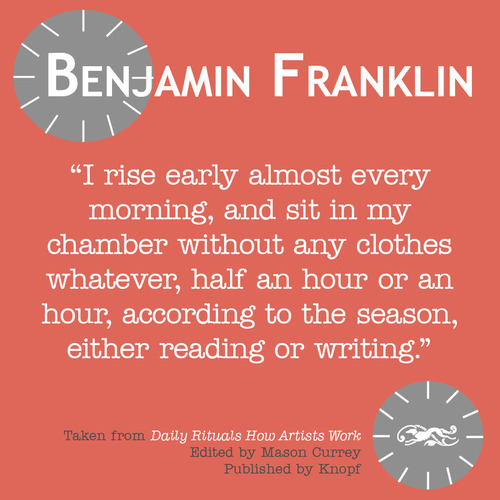
Daily Rituals: How Artists Work

Daily Rituals: How Artists Work [Hardcover]

Mason Currey (Editor)

15799151tumblr_ml3greMwIs1qbxxuao1_500

Release date: April 23, 2013

Franz Kafka, frustrated with his living quarters and day job, wrote in a letter to Felice Bauer in 1912, “time is short, my strength is limited, the office is a horror, the apartment is noisy, and if a pleasant, straightforward life is not possible then one must try to wriggle through by subtle maneuvers.”

Kafka is one of 161 inspired—and inspiring—minds, among them, novelists, poets, playwrights, painters, philosophers, scientists, and mathematicians, who describe how they subtly maneuver the many (self-inflicted) obstacles and (self-imposed) daily rituals to get done the work they love to do, whether by waking early or staying up late; whether by self-medicating with doughnuts or bathing, drinking vast quantities of coffee, or taking long daily walks. Thomas Wolfe wrote standing up in the kitchen, the top of the refrigerator as his desk, dreamily fondling his “male configurations”. . . Jean-Paul Sartre chewed on Corydrane tablets (a mix of amphetamine and aspirin), ingesting ten times the recommended dose each day . . . Descartes liked to linger in bed, his mind wandering in sleep through woods, gardens, and enchanted palaces where he experienced “every pleasure imaginable.”

Here are: Anthony Trollope, who demanded of himself that each morning he write three thousand words (250 words every fifteen minutes for three hours) before going off to his job at the postal service, which he kept for thirty-three years during the writing of more than two dozen books . . . Karl Marx . . . Woody Allen . . . Agatha Christie . . . George Balanchine, who did most of his work while ironing . . . Leo Tolstoy . . . Charles Dickens . . . Pablo Picasso . . . George Gershwin, who, said his brother Ira, worked for twelve hours a day from late morning to midnight, composing at the piano in pajamas, bathrobe, and slippers . . .

Here also are the daily rituals of Charles Darwin, Andy Warhol, John Updike, Twyla Tharp, Benjamin Franklin, William Faulkner, Jane Austen, Anne Rice, and Igor Stravinsky (he was never able to compose unless he was sure no one could hear him and, when blocked, stood on his head to “clear the brain”).

Brilliantly compiled and edited, and filled with detail and anecdote, Daily Rituals is irresistible, addictive, magically inspiring.

How to Live Like an Artist, by Author Mason Currey

How to Live Like an Artist, by Author Mason Currey

By Mason Currey on April 11, 2013

You’d do well to find a supportive spouse. While there are people who had day jobs—Anthony Trollope worked at the post office for 35 years—most were either independently wealthy or had a spouse (a wife, usually) who took care of day-to-day operations so they could go about writing or painting or composing. Sigmund Freud’s wife even put toothpaste on his toothbrush.

You do have to carve out a few hours a day to work. Most artists don’t work long hours, often just three or four a day, but they work every day. They have routines. Frank Lloyd Wright designed his buildings around 4 a.m. Ernest Hemingway stopped when he felt he could go on. He believed in leaving something in the tank, so to speak, that makes you want to pick up the next day where you left off.

You don’t have to cultivate an eccentric habit, but if you have one, you’re in good company. Friedrich Schiller kept rotting apples in his workroom. He said he needed their decaying smell to feel the urge to write, whatever that’s about.

Not many drink while they work, but a lot seem to pull off an amphetamine habit. W.H. Auden took Benzedrine every morning like a multivitamin. Jean-Paul Sartre used Corydrane, fashionable among Parisian intellectuals at the time. He’d take 20 a day, chewing them like candy. It made him really, really productive. It’s tempting to look into that.

• Currey is author of Daily Rituals: How Artists Work. As told to Claire Suddath

How to Follow Your Instincts, by Net-A-Porter’s Natalie Massenet

How to Follow Your Instincts, by Net-A-Porter’s Natalie Massenet

By Natalie Massenet on April 11, 2013

OB-JQ887_magazi_G_20100823114840

Before I launched Net-A-Porter I came up with a number of different ideas that business associates deemed ridiculous, and I ignored my instinct and lost opportunities. When it came to starting Net-A-Porter, I found strength in being a loner, initially, and then even more strength in finding and hiring people who shared my vision. At the beginning it’s better to have fewer people who are on your side than many people who want to change what you feel is right.

In our early days, instinct was everything. Slowly experience took over, and I’ve had to work hard to ensure that I value experience but allow it to coexist with gut reaction. My instinct has told me to hire people I trust—those who have strong belief in their own convictions and the experience to back it up, but not necessarily the relevant résumé. Sometimes I make mistakes, and with hindsight I can say those decisions were made when I didn’t listen to the voice inside. The priority is creating time for silence so we can process ideas, react instinctively to them, give them strong business foundations, and ensure they are in line with the idea that launched us in the first place.

• Massenet is the founder and executive chairman of the Net-A-Porter Group.

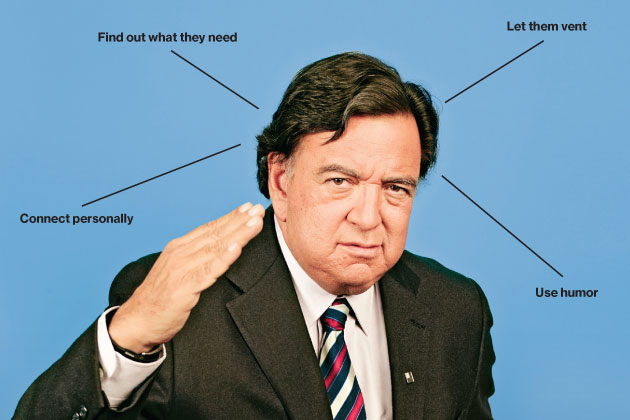
How to Sweet-Talk a Shark: Strategies and Stories from a Master Negotiator, by former governor of New Mexico and US Ambassador to the United Nations Bill Richardso

How to Sweet-Talk a Shark: Strategies and Stories from a Master Negotiator [Hardcover]

Bill Richardson (Author), Kevin Bleyer (Author)

Release date: October 15, 2013

1ht_talktoadictator16__01__630x420

Former governor of New Mexico and US Ambassador to the United Nations Bill Richardson has engaged in high-stakes, face-to-face negotiations with Castro, Saddam, the Taliban, North Korea leaders, Slobodan Milosevic, and many other of the world’s “crazy people”—and done it so well he’s been nominated for the Nobel Peace Prize three times. Now he tells these stories—from Washington, DC to the Middle East to Pyongyang—in all their intense and sometimes absurd glory.

Readers also get a fine lesson in the art of negotiation: How to prepare, how to size up your opponent, understanding the nature of power in a standoff, how to give up only what is necessary while getting what you want, and many other strategies Richardson has mastered through at-the-table experience.

Richardson’s co-writer, Kevin Bleyer, is an Emmy Award-winning writer on The Daily Show, so this book will be as entertaining as it is revelatory. It’s part memoir, part instructional guide, part humor book, and the perfect read for anyone who wants to understand how the world really works.

Editorial Reviews

About the Author

BILL RICHARDSON is a two-term governor of New Mexico, former US ambassador to the UN, and former secretary of the Department of Energy. He spent 15 years in Congress and has successfully won the release of hostages, American servicemen, and prisoners in North Korea, Iraq, Cuba, and Sudan.

KEVIN BLEYER is an Emmy Award-winning writer for The Daily Show with Jon Stewart and author of Me The People: One Man’s Quest to Rewrite the Constitution of the United States of America.

How to Get People to Listen, by Newark Mayor Cory Booker; “Statistics tell, and stories sell.” The real communicators are the ones who can motivate people to act—and ultimately to lead themselves.

How to Get People to Listen, by Newark Mayor Cory Booker

Cory Booker on April 11, 2013

1ht_getpeopletolisten16__01__630x420

My mom told me very early in life, “Who you are speaks so loudly, I can’t hear what you say.” What she meant was you’ve really got to embody what you’re trying to communicate. Ultimately, that’s more important than mere words. You also have to have passion and belief. My dad worked for IBM (IBM). He said, “Look, I can’t sell products I don’t believe in. People will see right through me. But if I’m passionate and have a deep conviction about what I’m doing, I’m the greatest salesman there is.” I’ve found it to be the same way for me.

If that doesn’t work, sometimes you have to do things that push people out of their comfort zone. I’ll ask for a handheld microphone because I don’t want to be behind that podium. Sometimes I’ll jump off the stage and walk in the audience. I’ll start with a joke and get people laughing, or I’ll tell a story. Again, I go back to my father. He used to say, “Statistics tell, and stories sell.”

When I was a Newark councilperson in my late 20s and felt impotent because I couldn’t get anything done, I had to use my creativity to get people’s attention. I engaged in a hunger strike at a housing project to get people to listen. I moved into a mobile home and parked it on the worst drug corner to get people to pay attention and address the issue. My goal is to motivate people to act.

In the end, it’s not about you; it’s not about getting people to listen to you. That’s just an ego indulgence. As a society, we’ve gotten into this state of what I call sedentary agitation—we’re often upset about what’s going on but not getting up and taking action. The real communicators are the ones who can motivate people to act—and ultimately to lead themselves.

• Booker is mayor of Newark, N.J. As told to Devin Leonard

How to Create a Workplace People Never Want to Leave, by Google’s Christopher Coleman

How to Create a Workplace People Never Want to Leave, by Google’s Christopher Coleman

By Christopher Coleman on April 11, 2013

The No. 1 thing is to listen to what employees need. We found that they need a lot of diversity. There are so many ways to work—as a team, solo—and so many kinds of workers, from introverts to extroverts and so on. We create many different places so people can be as productive as possible—from formal and informal conference rooms to open spaces to stretching and yoga areas and gyms. One trick is to design spaces with a diversity of scale, light, and mood. It’s really hard to do, and it looks like we’re just making up these crazy spaces, but it’s very scientific. We have information from Googlers on what works and what doesn’t, we do post-occupancy surveys, we ask questions, and we listen very closely. When we design a space, we usually offer a few solutions people can react to. We go back to the drawing board, go down to two or three options, and pick one. Next we define aspects like mood, lighting, and furniture. Then we build it, and people are happy—hopefully.

With all this input, they’re basically designing their own space. One of the earlier amenities we provided were micro-kitchens. It was an amazing, vibrant place where people connected before they started their workday. Now we have micro-kitchens that are libraries, micro-kitchens that are game rooms. Also, health is very important. A few years ago we introduced sit-stand desks, and they’re used extensively now. It changes the worker’s environment all through the day and gives them flexibility to work how they want to work.

We look at every single detail through the Living Lab, which is a space where the Real Estate and Workplace Services team can experiment with innovative ideas for the office. We’re trying out three ventilation systems, six lighting systems, and furniture from 10 manufacturers. In the end, though, we’re actually very frugal in our approach to design. It’s more about creating character than money spent.

• Coleman is global design director at Google (GOOG). As told to Venessa Wong

How to Overcome Fear, by Skydiver Felix Baumgartner

How to Overcome Fear, by Skydiver Felix Baumgartner

By Felix Baumgartner on April 11, 2013

Fear isn’t something to be eliminated. It’s something to be managed. In my line of work, skydiving, fear is what keeps you from getting careless. A healthy amount of apprehension has helped me to stay safe over a 20-year career. I am cautious enough to plan each one of my jumps carefully and to reject ideas when the risks were unacceptably high. Fear gets problematic when it becomes your focal point, dominating your thoughts and distracting you from the task at hand.

Training for my Red Bull Stratos jump, I went through a period where I hated wearing the spacesuit. It’s something a lot of high-altitude pilots deal with. The suit creates a sort of sensory deprivation, and in my case its rigidity made it impossible to use techniques I’d worked my whole life to develop. Subconsciously, I think maybe the suit came to represent everything that could defeat me. It became a trigger for what was fear. As soon as I put it on, I was itching to take it off.

Photograph by Redbull/CorbisThat fear itself wasn’t irrational: It pointed out some significant operational challenges we had to address. What I needed was to get out of the endless loop of negative thinking. Our psychologists taught me some simple techniques. Sometimes in training they’d ask me a question totally unrelated to the mission, maybe a question that didn’t even make sense, just to break the cycle of negative thoughts in my head. Then I could come back to see the situation more objectively. Another technique was to actively look for the positives. At 24 miles above earth, where my blood would boil without protection, the benefits of that suit were going to far outweigh its drawbacks. Eventually the suit came to represent not potential problems but the technological solution that would keep me alive and let me accomplish my goals. We moved forward, and the program was a success.

Let your fear inform you. Get outside help if you need it. And be patient with yourself. Dealing with it might be one of the smartest things you do.

• During his record-breaking, nine-minute fall from a balloon more than 24 miles above the earth, Baumgartner broke the speed of sound, reaching almost 834 miles per hour.

How to Ask Difficult Questions, by Senator Carl Levin; A lot of people can’t afford to lose their job by being too harsh or unsubtle with questioning

How to Ask Difficult Questions, by Senator Carl Levin

By Carl Levin on April 11, 2013

In the workplace, you’ve got to consider your relationships and impacts on your career. A lot of people can’t afford to lose their job by being too harsh or unsubtle with questioning. Regardless of the environment, it’s best to be direct and clear. Don’t be arrogant or domineering; be firm.

I put an awful lot of time into preparing questions. We’ll spend days before a major hearing, like for JPMorgan (JPM) or Enron or any of the other dozen hearings we’ve had in recent years. The point of the hearing is to gather information. I master the material, to know as much as the witness. Then I listen very carefully. You’ve got to focus on what someone is saying to determine whether they’re being responsive. That’s part of listening, but that’s also part of being determined to not allow a witness to avoid answering. I focus on words. I believe that words matter. It’s important that you have time. Being chairman on a subcommittee is a big advantage: I can keep a hearing going as long as necessary—we can go hours. Time becomes the essence.

• U.S. Senator Levin (D-Mich.) is chairman of the Permanent Subcommittee on Investigations. As told to Keenan Mayo

How to Read a Financial Statement, by Oracle’s Mark Hurd

How to Read a Financial Statement, by Oracle’s Mark Hurd

By Mark Hurd on April 11, 2013

We covered over the company name, Smith & Wesson (SWHC), on the statements and asked Hurd how he would review them.

There are two sets of financial statements, the income statement and the balance sheet, and they work in concert. If you want to get to the health of a company, you have to look at both. What we have here is an income statement. It’s going to take you through things like revenue and expenses and tell you about the profitability of the company. That profitability generally turns into cash flow and brings you to the balance sheet.

The more years of financial data you can get, the better, because you get to see a flow. You look at things like revenue, and you look at expenses, and you can start to ask, “What happened year to year?” and start looking at the deltas between the numbers. That’s one methodology for looking at a business.

Another is to simply take the expenses and say, “If you’ve got $1 of revenue and 80¢ of expenses and your profit is 20¢, just tell me what you spend the 80¢ on.” How much on sales? How much on overhead? How much of it do you spend on R&D?

Instead of taking a line-by-line view, take a look at the relationship between expenses to revenue and gross margin to revenue. It will tell you a lot about the choices the company is making about where to invest.

This all comes with a note of caution. Even when you start to analyze these lines for their incremental ups or downs, you may not get clarity. People see a sales expense go up and assume that means there are more salespeople or more selling effort like advertising. Well, frankly, that may not be true, because inside sales expenses there could be other costs that are categorized in sales expenses, but they’re not giving you sales effort in the marketplace. Like office overhead or IT upgrades for the sales team, for example. It’s the same thing with R&D. People think R&D being up or down is some surrogate for the amount of innovation in a company. Not necessarily so: There are things that go on in the R&D line that could be overhead or some other kind of spending that’s not valuable, such as duplicative real estate or human resources costs inherited as part of an acquisition.

There are a lot of people who don’t want to spend time on this type of stuff, but the great thing about numbers is they typically don’t mislead you. They don’t purposely lie to you. If you interrogate them, they’ll reveal things to you, so you have to be able to have enough different looks at them that you can get absolute clarity.

Clearly, what we have here is a manufacturer. They have a large cost of sales, so they’re building a product of some type. They’re not a services company. I would guess they sell their products through some sort of channel. So because they have big [general and administrative] costs, and G&A exceeds their sales and marketing, my inclination would be they must sell at retail or sell through some sort of aggregator process. They have a small relative R&D bill. When you look at this from an R&D perspective, they’re spending less than 1 percent, so this must be a conveyor-belt-oriented branded product. It’s some sort of hard good.

But again, even with those two statements you may never get a complete picture. As I’m here to tell you, many people even inside have a hard time getting all the detail you’d like to get a full view of the health of the company. Then the thing always when you’re running these companies is the quality of the people driving this income statement.

The nice thing about the income statement is that if you understand the strategy, the income statement is the X-ray that shows the health of the patient.

• Hurd is president of Oracle (ORCL) and former CEO of Hewlett-Packard (HPQ). As told to Ashlee Vance

How to Lie, by Novelist Jesse Ball

How to Lie, by Novelist Jesse Ball

By Jesse Ball on April 11, 2013

To lie effectively, it’s crucial that you remove all feelings of discomfort and moral quandary so you can control your demeanor. If you do not, they will hang from your tail like a tin can, and you’ll be found out.

Step 1. Profile your mark. Go over him with a fine-toothed comb and figure out as many things as you can. The more you know about him, the easier it will be to deceive him.

Step 2. Decide on what you want to achieve with the lie. Then find a way to tie that lie into a concept that supports the world the mark believes in. An easy way to understand this is to imagine the mark saying the phrase that contains the lie to someone else. Imagine overhearing the mark repeating what you’ve said because it supports the basic tenets of his life. Your lie should be embedded in such a phrase. The effect of this is that the mark will not consider the truth or falsity of your claim because he accepts the truth of the entire statement.

Step 3. Do not add to the lie in a weak-kneed way in order to repair it while in the midst of your deception. Simply let it stand. Never be the one to delineate the lie’s silhouette. Permit the silhouette to stand in obscurity. If the mark wants to figure out what’s true or not, let him do that work. People are often too lazy to think illogical propositions all the way through, and that’s why they don’t realize the propositions are incorrect.

Step 4. Don’t feel that in lying you’re trying to persuade. Lying isn’t about persuasion, it’s about manipulation. If you try to persuade someone, you’re trying to change a person’s belief. That’s hard work. You don’t want to do that. You want to trick the mark into believing that your lie fits with everything else he already believes. Nobody likes to be persuaded of things. Every person believes himself stubborn. Don’t fight that! Just make the mark believe you are agreeing with him when you lie to him.

Remember, to lie well is to take advantage of the mark’s faulty perception. A great liar is a great perceiver of truth. A mark has a romanticized idea of the world. To keep that idealistic view, the mark must lie to himself. He probably does that every day, just to stay sane. In fact, everyone does this. To be human is to lie!

• Ball is an assistant professor at the School of the Art Institute of Chicago. He teaches courses on lying and wandering, among other subjects.