Garters Help Tell H&M’s Other Stories in Inditex Chase

Garters Help Tell H&M’s Other Stories in Inditex Chase

Counting on the old adage that sales of affordable luxuries like lipstick and scarves climb in tough times, Hennes & Mauritz AB (HMB) is rolling out a new chain called & Other Stories that focuses on upscale accessories.

As it seeks to make up ground lost to rival Inditex SA (ITX) and win a bigger share of the $111 billion market for shoes and accessories in western Europe, H&M is opening seven outlets of the chain across the crisis-ravaged region this spring.

Better known for dresses and ballet flats cheap enough to be almost disposable, H&M promises curated style at & Other Stories. The stores feature a selection of more expensive clothing jockeying for space with wardrobe add-ons such as jewelry, lingerie, and shoes in four basic styles ranging from “Industrial” to “Glamorous.”

“H&M is getting a lot of pressure from low-price retailers on the one hand and from retailers like Inditex, which reacts faster to demand in the fashion world, on the other,” said Soeren Loentoft Hansen, an analyst at Sydbank A/S. (SYDB) With & Other Stories, H&M can “build some bridges to a higher price segment.” Read more of this post

Australia 10% Unemployment for 9.6% Punctures Gillard Prosperity

Australia 10% Unemployment for 9.6% Punctures Gillard Prosperity

Keith Darley, a 34-year-old electrician, hears from the government that Australia is the envy of the developed world. Yet the father of two, who employed 22 people a year ago, now works alone and says he’ll be voting against Prime Minister Julia Gillard in the Sept. 14 election.

The world’s 12th biggest economy boasts the lowest benchmark interest rate in 53 years, unemployment less than half of Europe’s, contained inflation and an economic growth rate double the average of advanced nations. Even with these conditions — the best since Gough Whitlam took office in 1972 — Gillard’s ruling Labor Party is 16 percentage points behind the Tony Abbott-led opposition.

“When we see a story that Gillard claims the government has created 900,000 jobs, we know that doesn’t stack up here; that’s not our experience,” said Darley, who lives in Sydney’s western suburbs, where eight of Labor’s 72 national seats are threatened and the unemployment rate is as high as 14 percent. “The voters here are not going to support Tony Abbott because they think he’s better, they’re going to be voting against the current government because they’re sick of hearing everything’s great when they know it’s not.”

Darley reflects a widening gap among Australia’s regions and industries. While national unemployment was 5.4 percent in December, the rate was 10 percent or higher in 9.6 percent of the nation’s 1,402 regions, according to government data that dates back to 2008. In some parts of Brisbane, where five Labor seats are in play, joblessness exceeds 27 percent — the highest on record for the areas. Read more of this post

Billionaire Mittal in India Legal Spat Adds to Investor Unease

Billionaire Mittal in India Legal Spat Adds to Investor Unease

Billionaire Sunil Mittal and his company Bharti Airtel Ltd. (BHARTI) are locked in legal battles in India’s top court that some fund managers say could drive wary investors away from the world’s second-largest wireless market. India’s Supreme Court today ordered a lower court to halt proceedings against Mittal until April 15 when it will next hear his challenge to charges relating to Bharti’s purchase of mobile-airwaves beyond the legal limit. A three-judge panel headed by Chief Justice Altamas Kabir asked federal investigators to file a reply to Mittal’s petition. Mittal, 55, faces legal battles even as the Supreme Court in February 2012 canceled 122 licenses tied to India’s largest graft case that led to the exit of Bahrain Telecommunications Co. (BATELCO) and Emirates Telecommunications Corp. Foreign direct investment into India’s telecom industry shrank to $93 million in the first 10 months of the year ended March 31, from $2 billion for the previous 12-month fiscal period, according to data from the Department of Industrial Policy and Promotion.

“When I heard about this case, I thought ’Oh, here we go again’,” Taina Erajuuri, a Helsinki-based fund manager at FIM Asset Management Ltd., said by telephone on April 5, referring to Mittal’s case. “I don’t own telecom stock in India, and that’s for a reason. It’s become too unpredictable, with other places being much safer, without legal or regulatory problems.” Mittal, heralded as one of India’s entrepreneurial leaders who started his business in the 1970s by selling bicycle parts, has been charged with acquiring airwaves in excess of a government limit. India’s Central Bureau of Investigation filed criminal charges in December against Bharti, along with government officials and two other carriers, for revising rules to allocate wireless spectrum, which led to a loss of about 8.5 billion rupees ($155 million) to the exchequer. Read more of this post

Managers Trek to Omaha In a Crush of Buffett Fans

Updated April 7, 2013, 7:18 p.m. ET

Managers Trek to Omaha In a Crush of Buffett Fans

By JONNELLE MARTE

IF-AB091_BUFFET_G_20130403183707

IF-AB099_BUFFET_NS_20130404144509

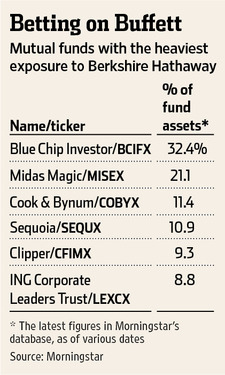
As attendance at the annual Berkshire Hathaway Inc. BRKB -0.94% shareholders’ meeting has ballooned over the years, mutual-fund managers say it’s become trickier to land some personal time with Warren Buffett—but easier to take a piece of him home.

Just ask Steven Check, manager of the $19 million Blue Chip Investor fund, who owns a coin with Mr. Buffett’s face on it, a never-been-used deck of cards that feature the Oracle of Omaha as the king, and bobbleheads of Mr. Buffett and his partner,Charlie Munger, among other Berkshire-themed possessions.

“Ten years ago you could run into him several times a night and shake his hand,” says Mr. Check, who also scored a few framed photos of himself and Mr. Buffett together during those earlier years. These days, you’re much more likely to walk away with just a Berkshire Hathaway golf club or money clip, or with some of the goods offered by the company’s subsidiaries, he says.

At the 194,300-square-foot hall that will be set up next to the meeting area next month and at other nearby vendors, you can get an insurance quote, upgrade your wardrobe or even buy a share of a private jet through one of Berkshire’s companies.

Buffett time or no Buffett time, Mr. Check and other fund managers say the real reason they make the trek to Omaha each year is to recharge with lessons from one of the best in the business. “It’s good to go there and get a reset, to clear your mind,” says Mr. Check. “I get a refresher course on the principles of investing.” Read more of this post

Shenzhen-based BGI holds 20 percent of the world’s genome-sequencing capacity, and is using it to unlock the genetic mysteries of autism

Chinese Genome-Sequencer Leads World Autism Research

April 8, 2013
By Nick Compton

Apr 2 marked the sixth World Autism Awareness Day.  While surging diagnostic rates and extensive media coverage of the disorder have raised public awareness to unprecedented heights, the autism research community has a new, unlikely star: China.

The Shenzhen-based BGI (formerly Beijing Genomics Institute) is a privately held, non-profit research institute staffed by thousands of young Chinese scientists and powered by 100 of the most sophisticated DNA sequencing machines on the planet.  Since its establishment in 1999, it’s become the world’s largest genomic-focused institute, and in 2011, it announced a $30 million, two-year partnership with the U.S. autism advocacy group Autism Speaks. Its goal: to sequence the whole-genomes of close to 10,000 individuals with autism.

Autism, like cancer, is a multifactorial disease with at least some genetic roots. This project aims to pinpoint, for the first time, biomarkers and genetic defects that may be linked to the disorder. Although other research institutes, most notably California’s UC Davis, are involved in similar projects, none have the depth or breadth of the project underway at BGI. Read more of this post

Why Alzheimer’s Will Be The Fiscal Nightmare Of The Century

Why Alzheimer’s Will Be The Fiscal Nightmare Of The Century

Michael HoldinThe Fiscal Times | Apr. 8, 2013, 9:51 AM | 564 | 1

A new study by the RAND Corporation projects that the cumulative costs of caring for people with dementia could be as high as $215 billion annually in the United States – which would exceed the combined costs of heart disease and cancer.

The RAND study, published in the New England Journal of Medicine, estimates that by 2040, these costs will nearly double.

RAND’s research is the latest addition to the growing body of evidence that shows Alzheimer’s is poised to become the fiscal nightmare of the 21st century. Perhaps most notably, their work confirms the World Health Organization’s bold claim a year ago that Alzheimer’s was a “public health priority.” The WHO, to be sure, doesn’t use this language lightly. Read more of this post

The global popularity of sushi, coupled with the yen’s 18 percent decline in the past six months, is proving to be a sweet spot for Suzumo, Japan’s biggest producer of automatic sushi-making machines

Sushi machine maker upbeat about yen’s fall, high overseas demand

BY NAOKO FUJIMURA AND TAKASHI AMANO, BLOOMBERG

iPk8Ig.W0dwc

Ikuya Oneda, president of Suzumo Machinery Co., poses for a photograph with the company’s automatic sushi chefs in Tokyo.

The global popularity of sushi, coupled with the yen’s 18 percent decline in the past six months, is proving to be a sweet spot for Suzumo Machinery Co., Japan’s biggest producer of automatic sushi-making machines.

The company plans to triple overseas sales to as many as 3,000 units from the last fiscal year and is boosting manufacturing capacity to meet demand in foreign markets, President Ikuya Oneda, 69, said Thursday.

“A weaker yen will make it easier for us to do business” abroad, Oneda said, adding that Suzumo may start taking payments in dollars, if customers request, as the Japanese currency weakens.

The firm’s new production line turning out the automatic chefs, which shape rice into blocks to serve with raw fish or other ingredients, will open around November at its plant in Saitama, according to Oneda. Orders for the machines are pouring in from South America, Europe and Asia, as global consumption of seafood is expected to jump by as much as 17 percent per person over the next two decades. Read more of this post

Luxury brands embrace DNA technology in fakes-ridden China; Chanel announced recently that it has a unique coding method to control the production process for its handbags and the codes are incorporated into a fluorescent card, which accompanies every handbag on the shelf

Luxury brands embrace DNA technology in fakes-ridden China

Staff Reporter, 2013-04-07

The world’s leading luxury brands have resorted to cutting-edge anti-counterfeiting technology to combat the rampant proliferation of fakes in the Chinese market. Counterfeit products have upped their tactics with similarly advanced technology, making it has become increasingly difficult to crack down the products.

Chanel announced recently that it has a unique coding method to control the production process for its handbags and the codes are incorporated into a fluorescent card, which accompanies every handbag on the shelf.

The anti-counterfeiting method is easy and clear for consumers but is still easy to be cracked. As a result, branded suppliers have strived to achieve breakthroughs in anti-counterfeiting technology, notably DNA-based technology, which includes DNA anti-counterfeiting ink, DNA anti-counterfeiting labels, and a DNA anti-counterfeiting chips.

“It is very difficult to crack DNA-based information, which will entail a big investment in time and costs on the part of counterfeiters,” remarks Mike Hayes, president of DNA Technologies. Read more of this post

China: Wenzhou’s financial reform fails to bear expected fruit; Wenzhou’s courts are currently in the processes of handling private debt collections exceeding 50 billion yuan (US$8 billion), while the total of private debt in the city has reached 100 billion yuan (US$16 billion)

Wenzhou’s financial reform fails to bear expected fruit

Staff Reporter, 2013-04-08

On the first anniversary of the State Council’s decision to set up the Wenzhou financial reform zone, an official has admitted that the program has not attracted robust investment as previously expected, the Beijing-based Economic Observer reports. Read more of this post

High inventory plagues China’s Fujian garment capital Jinjiang; Six leading sportswear producers, including Anta, 361 Degrees, Xtep, Peak, Li Ning and Dxsport have been forced to close more than 3,000 outlets across the country since last year, with heavy losses arising from their excess stock worth more than 3.72 billion yuan (US$594 million)

High inventory plagues Fujian garment capital Jinjiang

Staff Reporter, 2013-04-08

The city of Jinjiang in Fujian province is a major center of the Chinese garment and sportswear industry, but many of the businesses there are struggling to stay afloat owing to the heavy burden of excess inventory, reports the Beijing-based China Entrepreneur magazine.

Six leading sportswear producers, including Anta, 361 Degrees, Xtep, Peak, Li Ning and Dxsport have been forced to close more than 3,000 outlets across the country since last year, with heavy losses arising from their excess stock worth more than 3.72 billion yuan (US$594 million), said the magazine. Read more of this post

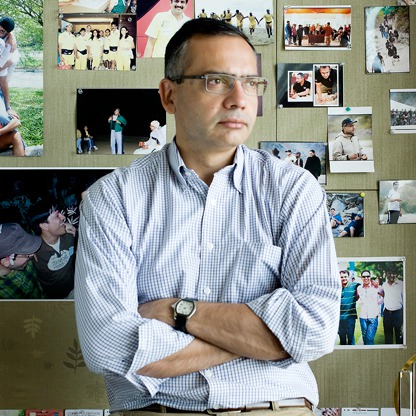
The Bumpy Ride for Deep Kalra’s MakeMyTrip Web Operation; Kalra’s paper wealth, over $50 million, has been halved in 18 months and cut by two-thirds since a post-IPO peak

4/03/2013 @ 7:00AM |2,775 views

The Bumpy Ride for Deep Kalra’s MakeMyTrip Web Operation

By Saritha Rai

DeepK0402_deep-kalra_416x416

In humongous India, where snaking lines and extended waits are emblematic, instant travel reservations herald a new mobility. Deep Kalra’s MakeMyTrip Web operation, of New Delhi, pioneered the online travel field and at times has felt investor and customer delight.

But this is India, remember, and for the 43-year-old Kalra, as for many a service sector startup, the flight has been a bumpy one.

Today MakeMyTrip is fighting to stay profitable in an erratic economy and nascent e-commerce ecosystem. Kalra’s paper wealth, over $50 million, has been halved in 18 months and cut by two-thirds since a post-IPO peak. In the quarter ended in December, MakeMyTrip’s net revenues declined 5.5% and losses mounted to $2.6 million.

Even as investors pummeled the stock back to its $14 listing price, Kalra in an interview stoically takes refuge in Bollywood-speak. “Life is QSQT … quarter se quarter tak [quarter to quarter],” he says, using the popular acronym for the iconic romance film Qayamat Se Qayamat Tak (From Resurrection to Resurrection). Read more of this post

Tech companies see real-life results from online translation programs; Google is now doing a record billion translations on any given day

Tech companies see real-life results from online translation programs

BY MARTHA MENDOZA

AP, APR 9, 2013

MOUNTAIN, VIEW CALIFORNIA – You might use Google Translate to read a hard-to-find manga or to decipher an obscure recipe for authentic Polish blintzes. Or, like Phillip and Niki Smith in rural Mississippi, you could use it to rescue a Chinese orphan and fall in love at the same time.

Google is now doing a record billion translations on any given day, as much text as you’d find in 1 million books for everything from understanding school lunch menus to gathering national security intelligence. It translates in 65 languages, from Afrikaans to Yiddish, and can be used on websites, with speech recognition and as an app on mobile phones even if there is no connection.

While the technology is exponentially evolving, Google’s translation guru Franz Och’s face lit up when he heard that the Smiths and their new daughter, 14-year-old Guan Ya, are settling into their lives together this month communicating almost exclusively through Google Translate.

“All day long I look at algorithms, algorithms and algorithms,” he says. “It is so rewarding to hear that it is touching lives.” Read more of this post

Watch Margaret Thatcher Slap Down A Socialist Politician For Wanting To Make The Poor Even Poorer

Watch Margaret Thatcher Slap Down A Socialist Politician For Wanting To Make The Poor Even Poorer

Joe Weisenthal | Apr. 8, 2013, 8:18 AM | 2,849 | 12

The sad news today is that former UK PM Margaret Thatcher has died.

She was incredibly influential among conservatives, and she was beloved for stuff like this.

Watch as she slams an opposition labor politician, for, in her words, advocating policies that would prefer to make the poor poorer so long as it resulted in more equality.

10 Memorable Quotes From Margaret Thatcher ; “Economics are the method; the object is to change the heart and soul.”

10 Memorable Quotes From Margaret Thatcher — One Of The Most Quoteworthy Politicians In History

Rob Wile | Apr. 8, 2013, 8:49 AM | 10,357 | 17

Former British PM Margaret Thatcher has died.

Thatcher was one of the more quotable politicians in recent memory.

Her wit and sharp lines about socialism have helped cement her reputation as “The Iron Lady.”

Via Wikiquote, here are some great ones.

“I don’t think there will be a woman Prime Minister in my lifetime.” — BBC, March 5, 1975

“If a Tory does not believe that private property is one of the main bulwarks of individual freedom, then he had better become a socialist and have done with it.” — Daily Telegraph, Jan. 30, 1975.

“The Russians are bent on world dominance, and they are rapidly acquiring the means to become the most powerful imperial nation the world has seen. The men in the Soviet politburo don’t have to worry about the ebb and flow of public opinion. They put guns before butter, while we put just about everything before guns. They know that they are a super power in only one sense—the military sense. They are a failure in human and economic terms.” Speech, Jan. 19, 1976 (The Russians would respond by calling her the “Iron Lady.”) —

“Socialist governments traditionally do make a financial mess. They always run out of other people’s money. It’s quite a characteristic of them.” Speech, Feb. 5, 1976

“Pennies don’t fall from heaven, they have to be earned here on earth.” Speech, Nov. 12, 1979

“No one would remember the Good Samaritan if he’d only had good intentions; he had money as well.” Weekend World, Jan. 6, 1980

“Economics are the method; the object is to change the heart and soul.” Sunday Times, May 1, 1981

“I came to office with one deliberate intent: to change Britain from a dependent to a self-reliant society — from a give-it-to-me, to a do-it-yourself nation. A get-up-and-go, instead of a sit-back-and-wait-for-it Britain.” Speech, Feb. 8, 1984

“It was a lovely morning. We have not had many lovely days. And the sun was just coming through the stained glass windows and falling on some flowers right across the church and it just occurred to me that this was the day I was meant not to see.” Channel 4, Oct 15, 1984, following an assassination attempt by the IRA.

“I like Mr. Gorbachev. We can do business together.” — BBC, Dec. 17, 1984

“No. No. No.” — House of Commons, Oct. 30, 1990

Margaret Thatcher, the former British prime minister who became one of the most influential global leaders of the postwar period, died at age 87

Updated April 8, 2013, 8:03 a.m. ET

Margaret Thatcher Dies

By ALISTAIR MACDONALD

OB-WZ086_0408Th_G_20130408075452

LONDON—Margaret Thatcher, the former British prime minister who became one of the most influential global leaders of the postwar period, died on Monday, three decades after her championing of free-market economics and individual choice transformed Britain’s economy and her vigorous foreign policy played a key role in the end of the Cold War. Mrs. Thatcher, who grew up in an apartment without hot water above her father’s grocery store in Grantham, eastern England, went on to become Britain’s first female prime minister and arguably the country’s dominant political figure since Winston Churchill. She was 87.

She was a key ally and close friend of former U.S. President Ronald Reagan, sharing with him a view on free-market, monetarist solutions to the economic problems of the day, as well as an uncompromising stance on how to handle the former Soviet Union, earning her the nickname “the Iron Lady.” Together the two led a rightward shift in Western politics that extolled the virtues of a free-market economic system with little government intervention that has largely endured, though aspects, such as the deregulation of financial services, have been questioned during the credit crisis. In moves that were widely copied, Mrs. Thatcher took on Britain’s all-powerful trade unions and privatized state-run industries, governing with a take-no-prisoners style that earned her both admiration and dislike.

In China, off-balance-sheet lending risks lurk in the shadows

In China, off-balance-sheet lending risks lurk in the shadows

3:33am EDT

By Gabriel Wildau and Shengnan Zhang

SHANGHAI (Reuters) – China’s banks are feeding unwanted assets into the country’s “shadow banking system” on an unprecedented scale, reinforcing suspicions that bank balance sheets reflect only a fraction of the actual credit risk lurking in the financial system.

Banks’ latest earnings reports only added to concerns. Despite the slowest economic growth in 13 years in 2012, the banking system’s official non-performing loan (NPL) ratio actually declined, renewing a debate about how reliable those figures are.

But the key question is no longer how much risk banks are carrying. Rather, it’s how many risky loans have been shifted to the lightly regulated shadow banking institutions – mainly trust companies, brokerages and insurance companies.

The risk to the overall financial system is not clear, because of insufficient data about the quality of credit in the shadow banking sector. Read more of this post

China’s President Xi Jinping said the days of “ultra-high speed” growth in the world’s second-largest economy – which many hope can spur a global recovery – are probably over.

China’s Xi says “ultra-high speed” growth probably over

POSTED: 08 Apr 2013 5:32 PM

China’s President Xi Jinping said Monday the days of “ultra-high speed” growth in the world’s second-largest economy – which many hope can spur a global recovery – are probably over.

BOAO, China:  China’s President Xi Jinping said Monday the days of “ultra-high speed” growth in the world’s second-largest economy — which many hope can spur a global recovery — are probably over.

“I don’t think we will be able to sustain an ultra-high speed of economic growth and it is not what we want either,” Xi told about two dozen foreign business figures on the southern island of Hainan. Read more of this post

Hey, Fund Companies: Share the Wealth; The oft-practiced but rarely disclosed tactic of securities lending has landed BlackRock and State Street in the courts. Here’s what this practice is, and why it matters to you

SATURDAY, APRIL 6, 2013

Hey, Fund Companies: Share the Wealth

By BRENDAN CONWAY | MORE ARTICLES BY AUTHOR

The oft-practiced but rarely disclosed tactic of securities lending has landed BlackRock and State Street in the courts. Here’s what this practice is, and why it matters to you.

When funds lend their holdings to short sellers, shareholders take on all of the risk—but they don’t always get to keep all of the profits.

A handful of pension funds and trusts are suing giant asset managers, includingBlackRock (ticker: BLK) and State Street (STT), over the arcane realm of securities lending. The claim: The firms kept too much profit from this corner of fund management for themselves, instead of disbursing more of those profits to exchange-traded-funds’ shareholders and other fund investors.

The lawsuits focus attention on an industrywide practice whereby asset managers lend (usually to institutional short sellers) stock held by its funds in exchange for various fees and cash collateral, on which they collect interest. Securities lending is common enough that it probably contributes to your funds’ returns—so long as the asset manager rewards you with most of the income it collects, instead of keeping gobs of it at the corporate level. The latter is at the heart of the continuing lawsuits, and while it might not be a bad thing for the firms’ stockholders, it behooves you to know who’s getting what. It’s the fund shareholders, after all, taking on the risk of lending the securities. Read more of this post

Shanghai McDonalds Slashes McNuggets Price By Nearly Half As Birdflu Fears Drive Away Buyers

Shanghai McDonalds Slashes McNuggets Price By Nearly Half As Birdflu Fears Drive Away Buyers

Tyler Durden on 04/07/2013 22:48 -0400

How do you know when the people “just say no” to chicken over rampant bird flu concerns? When even McDonalds (whose ad campaign for the past decade “I am loving it” continues to be an anagram for “ailing vomit“) is forced to slash chicken-related prices, in this case the 20 piece McNuggets, from CNY36 to CNY20. Pretty soon not even giving away the McMystery meat will clear out the shelves of all chicken-related fast food first in Shanghai and soon elsewhere in China. Finally, we dread to imagine the horrors that will befall Yum (read China KFC sales), now that after so much pain, the fast-food chain had finally reported a modest bounce in Chinese sales. So much for that.

McD Nuggets Shanghai

Thousands of Dead Fish in Shanghai River prompt safety fears (Bloomberg TV)

Dead fish in Shanghai river prompt safety fears

A total of 250 kilograms of dead fish, mainly crucian carp, have been retrieved in suburban Shanghai’s Sijing pond since last week. -China Daily/ANN

i7U4oobTwK50
Shi Yingying
Mon, Apr 08, 2013
China Daily/Asia News Network

SHANGHAI – Hundreds of dead fish have washed up along the shorelines of a man-made river in Shanghai’s Songjiang district since April 3, but the local water authority and environmental protection bureau insist the water is safe.

A total of 250 kilograms of dead fish, mainly crucian carp, have been retrieved in suburban Shanghai’s Sijing pond since last week. Gao Yunchu, director of Songjiang water authority, said small fish with relatively weaker body defence systems were found dead at the beginning of April and the bodies of bigger fish such as carp were discovered on Saturday. Read more of this post

Beware of Index Funds That Aren’t; The new generation of investments aren’t nearly as passive— or as cheap—as you might think

Updated April 7, 2013, 7:51 p.m. ET

Beware of Index Funds That Aren’t

The new generation of investments aren’t nearly as passive— or as cheap—as you might think

By MICHAEL A. POLLOCK

IF-AB108A_INDEX_G_20130404152104

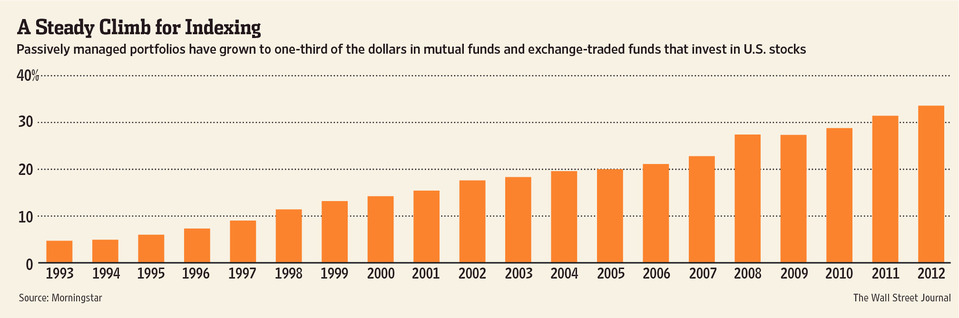
Index funds aren’t always what you think they are. And your innocence could cost you.

To most investors, of course, index funds are passive investments, providing returns that basically mirror the market they are designed to follow. They charge low fees and carry no hidden costs.

But the old definition is starting to change. Unlike simpler, earlier generations of index and exchange-traded funds, new variations are morphing into products that risk putting many investors afoul of the old rule about not investing in things you don’t understand.

As more money flows toward indexing, some fund firms are trying to capture a share of it by creating complex ETFs that blend active management and indexing. The fees charged by some of these funds can be several times those charged by traditional index funds. And, because they sometimes specialize in very narrowly defined, less-active markets, they can wrack up hidden trading costs. Read more of this post

First zoo in S’pore rated ‘wonderful’ by Albert Einstein

First zoo in S’pore rated ‘wonderful’ by Einstein

Nation’s status as a hub for animal collectors is featured in exhibition. -ST
Melody Zaccheus

Mon, Apr 08, 2013
The Straits Times

Singapore’s first zoo, which had its beginnings at a family bungalow in Serangoon Road, has at least one unique bragging right.

Albert Einstein, the father of modern physics, was among the first visitors to the private zoo, which was run by animal lover William Lawrence Soma Basapa from 1920 to 1922.

His zoo and the history of Singapore’s status as a hub for animal collectors in the late 18th and early 19th century, are part of a travelling exhibition by the National Heritage Board. Read more of this post

British class system alive and growing, survey finds

British class system alive and growing, survey finds

Wed, Apr 3 2013

LONDON (Reuters) – British people can now aspire to and despise four new levels of social classes, according to a new survey conducted by researchers in partnership with public broadcaster the BBC.

The Great British Class Survey found that the prevailing notions of a system comprised of the Upper Class, Middle Class and Working Class only related to a slice of the UK population, when analyzed according to income, assets, social connections and social activities.

An “Elite” class and a “Precariat” (precarious proletariat)were the two most extreme groups at either end of a new social scale of seven classes produced by researchers from the London School of Economics (LSE) and University of Manchester based on two surveys conducted by the BBC and research firm GfK.

“It is striking that we have been able to discern a distinctive elite, whose sheer economic advantage sets it apart from other classes,” LSE Professor Mike Savage said.

“At the opposite extreme, we have discerned the existence of a sizeable group (the Precariat) – 15 percent of the population – which is marked by the lack of any significant amount of economic, cultural, or social capital.” Read more of this post

To crack human brain’s code, a search for visionaries

To crack human brain’s code, a search for visionaries

Sun, Apr 7 2013

By Deborah Zabarenko

WASHINGTON (Reuters) – To crack the code of the human brain, Cori Bargmann figures it’s best to keep an open mind.

As one of two leaders of a scientific “dream team” in the initial phase of President Barack Obama’s ambitious $100 million project to map the brain, Bargmann said the first step is to find the right combination of people to set research priorities.

“You might start with people who are very senior and are household words in their fields, and then you may realize that what (you) actually need is the young Turk who’s a visionary wild man,” Bargmann said.

Bargmann, a neurobiologist at The Rockefeller University in New York, and William Newsome, a neurobiologist at Stanford Medical School in California, are the co-chairs of a committee announced by the White House on Tuesday for the Brain Research through Advancing Innovative Neurotechnologies Initiative. That long title has been dubbed BRAIN for short.

Both Newsome and Bargmann are at the top of the neurobiology pyramid, professors at premiere institutions, winners of dozens of scientific honors and awards, authors of research papers in prestigious journals. As Newsome noted wryly, “I don’t need this aggravation, to some extent, but I think this is really important.”

Bargmann, who recalls watching the first Apollo moon landing in 1969 as an 8-year-old, this year won a $3 million Breakthrough Prize in Life Sciences for her work on the genetics of neural circuits and behavior and synaptic guidepost molecules. Read more of this post

Disruptions: The Logic (or Lack of It) in Appraising Start-Ups; What a start-up is worth depends on why the prospective buyer wants it, but the prices still sometimes seem random or even nonsensical

APRIL 7, 2013, 11:00 AM

Disruptions: The Logic (or Lack of It) in Appraising Start-Ups

By NICK BILTON
08bits-disrupt-tmagArticle
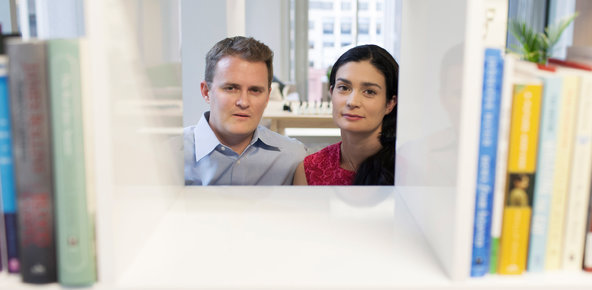
Otis Chandler and his wife, Elizabeth Khuri Chandler, the founders of Goodreads, a social media site that recently sold for a reported $150 million.

I have a vision of how suitors decide how much to offer for a start-up they want to buy. Several executives go into a conference room. Each scribbles a number on a piece of paper and places it in a hat. Then the chief executive pulls out a number, and there it is.

It might sound like a stretch, but given the seemingly random and sometimes nonsensical amounts for which start-ups with no revenue, or no users, or even no product are bought, I might not be far off.

But let’s say there is a logical way to value a company. During Bubble 1.0 there seemed to be — at least sometimes. Tech start-ups were valued by the number of eyeballs they attracted. When Broadcast.com was acquired by Yahoo for $5.9 billion in stock in April 1999, it was estimated that the company paid $10,000 per user.

Today, when eyeballs mean much less, how do start-ups with no revenue come up with a valuation? Well, it depends on a buyer’s reason for wanting the company. Read more of this post

Tech upstarts threaten TV broadcast model

Tech upstarts threaten TV broadcast model

Sun, Apr 7 2013

By Liana B. Baker and Ronald Grover

(Reuters) – Two fledgling technologies could dramatically reshape the $60 billion-a-year television broadcast industry as they challenge the business model that has helped keep broadcasters on the lucrative end of the media spectrum.

On April 1, a U.S. appeals court rejected a petition by the major broadcasters including Comcast’s NBC, News Corp’s FOX, Disney’s ABC and CBS, to stop a service called Aereo, which offers a cut-rate TV subscription for consumers by capturing broadcast signals over thousands of antennas at one time.

It was the second time in recent months that TV broadcasters failed to block a new technology that undercuts revenue they generate for their television shows. Read more of this post

Malaysia’s Prime Minister Najib Unveils Poll Manifesto Similar to Opposition leader Anwar’s; “My sincere apologies to all Malaysians if we have done anything wrong. At the end of the day, we are ordinary humans.”

Malaysia’s Najib Unveils Poll Manifesto Similar to Anwar’s

Malaysian Prime Minister Najib Razak pledged to fight corruption, bring down living costs and build a pan-Borneo expressway if his coalition retains power in elections due in a matter of weeks.

These were all policies mooted by opposition leader Anwar Ibrahim in his manifesto released six weeks earlier than the one Najib’s governing National Front unveiled at a weekend rally in Kuala Lumpur. The Election Commission meets this week to set a date for polls after the prime minister dissolved parliament on April 3.

“They had the benefit of time to study our manifesto over the past month and incorporate some elements,” Ong Kian Ming, a political analyst at Kuala Lumpur’s UCSI University and an opposition election strategist, said by phone. “Unlike us, there’s nothing in there about electoral reform. That’s something a lot of people are concerned about.”

In the lead-up to the polls, Najib has boosted government spending, distributed a second round of cash handouts to the poor, and raised salaries of civil servants, police and the military. He also delayed implementing a goods-and-services tax and froze plans to wind back state subsidies on essential items. The manifesto offers increased handouts for the poor, and lowered car costs and broadband fees.

“My sincere apologies to all Malaysians if we have done anything wrong,” the prime minister said in a speech at the rally, broadcast live on national television. “At the end of the day, we are ordinary humans. If we are given a strong mandate, I can assure you that we will do better in the next five years.” Read more of this post

Liquidity Carpet Bombs Fueling Asset Bubbles, Rohde Says

Liquidity Carpet Bombs Fueling Asset Bubbles, Rohde Says

Policy makers steering the global economy have pumped the financial system with so much liquidity that any exit risks popping potential asset bubbles or stunting a recovery, Danish central bank Governor Lars Rohde said.

“The risk is we stay in this climate too long and that the carpet bombing of liquidity spurs inflation,” Rohde, 59, said in an April 5 interview from his office in Copenhagen. Though there are no current signs of consumer price inflation “there is inflation, perhaps a bubble, in some asset classes,” he said. “Equities (MXWO) are trading close to all-time highs. Segments of property markets across the globe, for example London, also display symptoms of this. How do we exit this without killing whatever nascent recovery there might be at that time?”

The warning from the head of Denmark’s central bank, which has kept its deposit rate below zero since July, comes as policy makers in Japan, the euro area and the U.S. deliver unprecedented monetary stimulus to drag the global economy out of the worst crisis since the Great Depression. Easy money has fueled equity prices, helping send the Standard & Poor’s 500 Index to an all-time high on April 2. The yield on Japan’s benchmark 10-year bond hit its lowest on record last week.

“We’re in a landscape where we’ve never been before, with regard to extreme monetary accommodation over a very, very long period of time,” said Rohde, who took over as the head of Denmark’s central bank in February. “What does that end up doing to a society? It’s been a necessary policy, but I have my concerns about what the long-term risks are.” Read more of this post

Why Making Europe German Won’t Fix the Crisis

Why Making Europe German Won’t Fix the Crisis

Most people see Europe’s economic crisis as a cautionary tale of good and bad policy making, in which fiscally prudent countries, such as Germany, remain stable, while reckless ones, such as Greece, unravel.

So ingrained is this idea that it’s now common to hear analysts say Europe must become “German” to exit from the crisis, adopting Teutonic approaches to policy — from fiscal tightening to labor- and product-market reforms. If only societies on Europe’s periphery can learn to do what the Germans do, the argument goes, the European Union and its single currency will have a stable future.

This is wrong and we already have evidence to show it. The question isn’t whether Germany’s policies are correct. It is whether they will produce the same outcomes in different economic and political environments. To see that they don’t, you need to ignore Greece and look at its neighbor, Bulgaria.

Like Germany, Bulgaria went through several years of prudent budgets and economic reforms aimed at improving competitiveness before the financial crisis began in 2008. Both countries initially responded to the shock with sudden increases to their budget deficits, but also quickly reined these back in. Bulgaria’s deficit was 0.7 percent of gross domestic product in February, according to the Finance Ministry. Government debt was 16 percent of GDP. So pretty German already. Read more of this post

Vietnam Crony Communists Resist Constitution Backlash

Vietnam Crony Communists Resist Constitution Backlash

While filming a documentary about Ho Chi Minh as his compatriots battled U.S. forces in the 1960s, Tran Van Tan observed how the Communist leader’s embrace of a simple lifestyle endeared him to Vietnam’s poor.

Five decades later, Tan says the Communist Party’s leaders are more concerned with enriching themselves than adhering to Ho Chi Minh’s ideals. Abolishing the one-party system would lead to “healthy competition” and narrow the wealth gap, said Tan, 65, a retired civil servant who now sells tea in downtown Hanoi.

“There are people who don’t have enough food to eat, whose children don’t have enough clothes to cover their bodies in winter,” Tan said. “There are farmers who don’t have land. They are so poor, while many in the leadership are very wealthy. These leaders are so rich that even their children, grandchildren wouldn’t be able to use it all up.”

Tan is among more than 12,000 former bureaucrats, academics and rice farmers speaking out publicly against proposed constitutional changes that would strengthen the Communist Party’s grip on power. The unprecedented movement threatens to increase challenges to Prime Minister Nguyen Tan Dung as he seeks to turn around a slowing economy which posted Southeast Asia’s highest level of bad debt last year. Read more of this post