Alcoa No Better Than Coin Flip as Market Bellwether Status Fades

Alcoa No Better Than Coin Flip as Market Bellwether Status Fades

Alcoa Inc. (AA), the first Dow Jones Industrial Average member to report results each quarter, is losing its accuracy as a bellwether for the U.S. stock market.

The Standard & Poor’s 500 Index has usually followed Alcoa’s lead since 2002, rising 2.5 percent in quarters when the aluminum producer beat the market after earnings, less when it didn’t. That relationship has broken down since 2011, when the S&P 500 posted even bigger gains, about 3 percent, when Alcoa’s results hurt its stock, according to data compiled by Bloomberg.

Overtaken in size and market clout by diversified commodities companies such as BHP Billiton Ltd. (BHP) and Glencore International Plc, Alcoa has struggled to make a profit with aluminum prices sagging as production outpaces the metal’s use. Investors are looking beyond the New York-based producer, which announces results after the close of trading today, to companies such as International Business Machines Corp., which reports in ten days, according to Bespoke Investment Group.

“We don’t consider it much of a bellwether,” said Edward Dewees, who helps oversee about 3 million Alcoa shares among the $2.7 billion managed by New York-based Douglas C. Lane & Associates. “As far as did Alcoa beat or meet earnings, that’s a meaningless headline. Any investor who’s going to make a decision about other companies’ earnings based on Alcoa’s headline earnings, that’s silly.” Read more of this post

IPO Bankers Become Frogs in Hot Water Amid China Market Halt after China’s securities regulator mandated that two so-called baodai, or sponsor representatives, conduct due diligence and sign off on every IPO to curb fraud; “The baodai are like frogs in a pot of hot water that’s been on slow boil for nine years. The days of excess pay are gone. Rationality has returned.”

IPO Bankers Become Frogs in Hot Water Amid China Market Halt

Shen Wei, one of the first 600 investment bankers authorized to sign off on initial public offerings in China, said the license that made him one of the “golden collared” has lost its magic.

The teacher’s son studied 14-hours a day for a month in 2004 to qualify after China’s securities regulator mandated that two so-called baodai, or sponsor representatives, conduct due diligence and sign off on every IPO to curb fraud. Demand for such bankers is now being eroded by a freeze on IPOs, a surge in people getting licensed and an easing of underwriting rules.

“The baodai are like frogs in a pot of hot water that’s been on slow boil for nine years,” said Shen, 41, who is executive director of Citigroup Inc. (C)’s local joint venture in Shenzhen, overseeing a team of 20 bankers. “The days of excess pay are gone. Rationality has returned.” Read more of this post

Hong Kong nets only small fry for laundering illegal Chinese money

Hong Kong nets only small fry for laundering illegal Chinese money

Sun, Apr 7 2013

By Lawrence White

HONG KONG (Reuters) – Luo Juncheng, a delivery man and school dropout from China’s Guangdong province, was 19 years old when he opened an account at Bank of China subsidiary Chiyu Bank in Hong Kong in mid-2009.

Over the next eight months, he moved more than HK$13 billion ($1.7 billion) through the account, making nearly 5,000 deposits and more than 3,500 withdrawals in the largest money laundering case on record in the territory.

Luo is now serving a 10-and-a-half-year jail sentence for illegal money transfers. But his conviction raises wider concerns – how he got away with it for so many months despite the red flags that should have been raised by his transactions, and why no other arrests have been made despite evidence at trial that he did not act alone.

His conviction is one of the few in Hong Kong for money laundering, despite the city’s reputation as a hub in money transfers, both legal and illegal, carried out by wealthy Chinese. Experts estimate tens of billions of dollars are laundered in Hong Kong every year, much of it crime or drugs-related money funnelled from China or the gambling haven of Macau. Read more of this post

Seoul Residents Threatened With ‘Sea of Fire’ Carry On With Life; “Even if they were to launch a nuclear attack, we’d be dead within minutes anyway.”

Seoul Residents Threatened With ‘Sea of Fire’ Carry On With Life

Choi Yong Wook woke on his 29th birthday to the news that North Korea had repositioned a missile days after threatening to turn Seoul into a “sea of fire.” That didn’t stop him from a romantic dinner with his wife in one of the South Korean capital’s busiest areas.

“This is how we survive, we continue living our lives,” Choi, a Daewoo Electronics Corp. (0741) salesman, said in an interview. “North Korea has always threatened that war can break out any day. But who can believe them?”

As tensions escalate, life for 10 million South Koreans in their capital 40 kilometers (24 miles) from the world’s most fortified border goes on uninterrupted. Schools, businesses and public offices keep regular schedules and there are no reports of panic-buying in shops. While Choi and his wife blew out his birthday candles, Seoul’s LG Twins lost their baseball game against crosstown rivals the Nexen Heroes, 4-3. Read more of this post

Netherlands, the Next Chip to Fall? Consumer debt amounts to about 250 percent of available income. By comparison, in 2011 even the Spaniards only reached a debt ratio of 125 percent

Netherlands, the Next Chip to Fall?

Mike “Mish” Shedlock
http://globaleconomicanalysis.blogspot.com

Posted: 07 Apr 2013 07:36 AM PDT

Most attention lately has been on Cyprus, Spain, and Italy. Long-time troubles have been brewing in Portugal and I have an update coming up shortly.

First consider Underwater: The Netherlands Falls Prey to Economic Crisis.

The Netherlands, Berlin’s most important ally in pushing for greater budgetary discipline in Europe, has fallen into an economic crisis itself. The once exemplary economy is suffering from huge debts and a burst real estate bubble, which has stalled growth and endangered jobs.

“Underwater” is a good description of the crisis in a country where large parts of the territory are below sea level. Ironically, the Netherlands, widely viewed as a model economy, is facing the kind of real estate crisis that has only affected the United States and Spain until now. Banks in the Netherlands have also pumped billions upon billions in loans into the private and commercial real estate market since the 1990s, without ensuring that borrowers had sufficient collateral.

Private homebuyers, for example, could easily find banks to finance more than 100 percent of a property’s price. “You could readily obtain a loan for five times your annual salary,” says Scheepens, “and all that without a cent of equity.” This was only possible because property owners were able to fully deduct mortgage interest from their taxes. Read more of this post

Acupuncture For India’s Poor; Middle and upper-middle class patients pay between 800 and 1,000 rupees ($15 – $18) for a session of acupuncture. This subsidizes the cost of running the clinic for the underprivileged, who pay 20 rupees a session

April 7, 2013, 9:00 AM

Acupuncture For India’s Poor

By Shanoor Seervai

Sheetal Tupare sits in the waiting room of the Barefoot Acupuncturists clinic in Mumbai’s Vijay Nagar slum. She is accompanying her uncle, who was left partially paralyzed from a stroke eight months ago, for his second session of acupuncture.

Ms. Tupare has also been treated at the clinic. The 25-year-old went there last year because her menstrual cycle was irregular.

“The medicines other doctors gave me only made my stomach hurt more,” she says, adding that she felt better after three months of regular acupuncture treatment.

Barefoot Acupuncturists runs five clinics — three in Mumbai and two in rural Tamil Nadu — that provide low-cost acupuncture to poor communities. The organization was founded by Walter Fischer, a Belgian businessman-turned-acupuncturist, in 2008. Read more of this post

Concerns Grow About New Avian-Flu Strain; Disease May Move Easily to Humans; U.S. Is Preparing to Develop a Vaccine

Updated April 7, 2013, 12:14 p.m. ET

Concerns Grow About New Avian-Flu Strain

Disease May Move Easily to Humans; U.S. Is Preparing to Develop a Vaccine

By JOSH CHIN And BETSY MCKAY

AI-CA156_BIRDFL_G_20130405020009

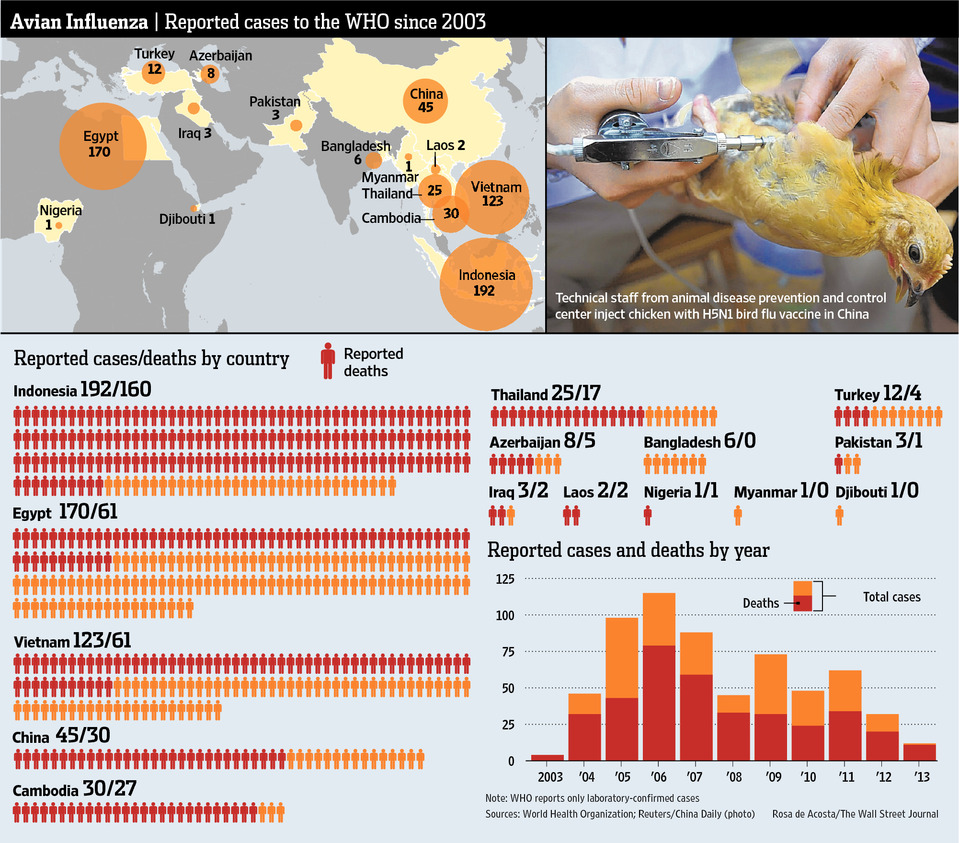
BEIJING—Concerns about a deadly new strain of bird flu intensified last week as the disease claimed a sixth life in eastern China and agricultural authorities in Shanghai ordered a wide-scale slaughter of poultry in an effort to stem its spread.

The U.S. Centers for Disease Control and Prevention warned U.S. public-health departments and physicians to be on the lookout for signs of the new virus, a variant of the H7N9 strain of avian flu. The CDC said it is developing a diagnostic kit to send to U.S. states and China, and is working on a seed virus for a vaccine that could be prepared should the disease start spreading human-to-human.

Flu experts said they are concerned about the new virus because it exhibits signs of being more readily able to infect humans from ailing birds than is another form of avian flu known as H5N1, which has been infecting people off and on for more than a decade.

The number of people infected nationwide as of Sunday evening had risen to 21, according to the official Xinhua news agency, up from Friday’s 16. The death toll was unchanged from Friday, Xinhua said. The latest was a 55-year-old male working in the live poultry trade in the Chinese province of Anhui who began exhibiting flu symptoms on March 28, Xinhua said. The number of cases, while small, is large for the early stages of an outbreak, and some flu experts said the fact that they are spread over a relatively wide geographic region is reason for concern. Read more of this post

Be like the bamboo, not the oak (Today, 8 April, 2013); “Singapore is too small and its talent pool is too small to produce a world-class manufacturing giant of the Fortune 500 class,” Singapore’s founding Prime Minister Lee Kuan Yew once said. A cryptic remark, indeed, because it does not imply that he thinks Singapore cannot produce knowledge-based giants, or resilient “bamboo innovators”

Be like the bamboo, not the oak
“Singapore is too small and its talent pool is too small to produce a world-class manufacturing giant of the Fortune 500 class,” Singapore’s founding Prime Minister Lee Kuan Yew once said. A cryptic remark, indeed, because it does not imply that he thinks Singapore cannot produce knowledge-based giants, or resilient “bamboo innovators”.
BY KEE KOON BOON –
6 HOURS 19 MIN AGO

“Singapore is too small and its talent pool is too small to produce a world-class manufacturing giant of the Fortune 500 class,” Singapore’s founding Prime Minister Lee Kuan Yew once said. A cryptic remark, indeed, because it does not imply that he thinks Singapore cannot produce knowledge-based giants, or resilient “bamboo innovators”.

Why bamboo innovators? Bamboos bend, not break, even in the most terrifying storm or devastating earthquake that would snap the mighty oak tree. It survives, therefore it conquers.

Disruptive industry trends and black-swan crises have become a permanent fixture in today’s marketplace. How wonderful it would be if countries, companies and individuals can stay resilient amid such upheavals and unorthodox challenges.

The study of bamboo innovators could inspire companies to be productive innovators in order to surpass stall-points in their business models during tumultuous periods, particularly for small and medium enterprises aspiring to scale up to become global champions.

But why is it that Asian companies are predominantly product manufacturers in the first place? This could ironically be a result of the Asian values of hard work and sacrifice.

It is far easier for the Asian entrepreneur to be the middleman taking orders from a few important anchor multinational corporation customers with access to the end-customers, take capital risk investing in tangible assets and work hard to produce the required products with quality and efficiency — than to attempt to build business models that have direct ownership of the hundreds and thousands of end-customers.

As a result, these entrepreneurs are unwilling to share the rewards with their “undeserving” staff who took neither risk nor sacrifice. They treat employees as expenses and not intangible assets, make most or all of the decisions and hoard most resources and information, running the firm as a “one-man show”. Eventually, they may face the challenge of business continuity arising from succession woes.

NEW IDEAS

Keyence is an example of the unconventional Asian firm. Founder Takemitsu Takizaki liberated the firm from manufacturing conventions and built a knowledge-based enterprise in laser sensors for factory automation, serving more than 100,000 customers in 70 countries.

Despite having less than 1 per cent global market share in a commodity-like product and only around 3,000 employees, Keyence commands a US$17-billion (S$21.1 billion) market value — approximately similar to Singapore’s Keppel Corp, a global leader in offshore oil rig design and building.

Mr Takizaki understood keenly that Keyence cannot improve on Japan’s legendary manufacturing efficiency. So, unlike its manufacturing-based competitors who leave sales to distributors, wholesalers and agents, it deliberately avoids making products, except for manufacturing steps that involve trade secrets kept in-house.

Most of its employees are either “sales” or “research” staff. In their direct contact with the customers, Keyence’s in-house “sales” team picks up new product ideas on frequent factory visits. For instance, its front-liners observed from the production lines at instant noodle factories that the noodle quality was compromised because the noodles were manufactured at variable thicknesses. Laser sensors that could measure noodles to 1/100th of a millimetre were developed to ensure consistency.

A quarter of sales at Keyence is generated from such new products every year, more than what 3M achieves. To excel in these areas, Keyence had to cultivate a meritocratic culture, and it is known for having some of the highest-paid employees in corporate Japan.

Bright young people from rival firms are attracted to Keyence by the performance-based pay. The average salary there is US$100,000. Engineers also get to do their own research, rather than labouring for years under grey-haired supervisors.

THE EMPTY CORE

Keeping the front line or the “periphery” resilient and innovative, and the centre or the “core” diffused, and enforcing meritocratic values at all levels have compounded immense value at Keyence. This “core-periphery” growth pattern is also that of the bamboo: The vitality of its growth revolves around its “empty” centre.

Instead of constructing itself inch by solid inch, like a tree, the nutrients and moisture that would have been exhausted making and maintaining its empty centre can be utilised for growth of its periphery in the stem. From a builder’s viewpoint, the architecture of the bamboo presents a powerful configuration: Fibres of greatest strength occur in increasing concentration towards the periphery.

Manufacturing and project-based companies often tout the size of their order book and their idea of “team” is about having high-profile dealmakers who can bring in the sales orders; the job of “everyone else” is to execute efficiently and “productively”.

The well-connected dealmakers may be able to pull in high-dollar projects, but because of the difficulties in coordinating and executing large-scale complex projects, these deals cannot be repeated and the hype associated with a big order book starts to fade, particularly when cost overruns and delivery delays rear their ugly heads. Bigger becomes riskier.

Even in manufacturing, the only way to perform and execute large-scale complex projects repeatedly is to create a culture of excellence where the interests of emotionally engaged front-liners matter in the innovation and value creation process.

Customers are attracted to this contagious performance culture rather than to the dealmakers on a relationship basis, resulting in a valuation breakthrough beyond the billion-dollar market value barrier that many Asian companies find difficult to break.

“Fortune 500”? With “emptiness” in business model design, Singapore can instead aim for its own resilient “Bamboo Innovator 500” powerhouse with a US$10-trillion value.

ABOUT THE AUTHOR:

Kee Koon Boon, a former lecturer of accounting at the Singapore Management University, has been an investment professional for the past decade. He is a presenter at the Emerging Value Summit 2013 on April 9-10.
Resilient Growth In Crisis? Bamboo Innovators CSL and Keppel Show How

Resilient Growth In Crisis? Bamboo Innovators CSL and Keppel Show How

By KEE Koon Boon

8 April 2013

“Sometimes to be reborn, you must first die,” Dr. Victor Fung, group chairman of the multi-billion Li & Fung group of companies, cites pensively this old Chinese proverb in order to ask an open-ended question, “In a world that’s speeding up, how will companies change enough without crisis?”

We cannot avoid, or even choose, a crisis in order to engender the change that is required to overcome stall points in growth and to stay relevant in today’s marketplace where disruptive industry trends and black-swan crises have become a permanent fixture. When the inevitable traumatic upheavals and unorthodox challenges do come, innovators craft their business models to stay resilient like the bamboo, which bend, not break, even in the most terrifying storm that would snap the might resisting oak tree.

Australia’s CSL and Singapore’s Keppel are two such companies who have experienced near-deaths in daring greatly to scale and globalize their once domestic SME operations right under the noses of powerful incumbent global giant rivals – and they were renewed and reborned to be resilient Bamboo Innovators.

In its remarkable transformation from a sleepy government outfit providing snakebite antivenin since its privatization and listing in 1994 with a market value of A$500 million to a A$29 billion global biotech champion, CSL had experienced a near-death crisis in 2002. Similarly, Keppel, the global leader in offshore oil rig design and building, had hit a crisis in 1973, 1983 and 1990. Both were able to bounce back higher to scale greater heights. Why? Both companies have dedicated leaders cultivating a culture rooted in trust, cooperation and empowerment to contend with and heal creative dissent to handle large-scale complex projects repeatedly with excellence.

Brian McNamee was plucked from relative obscurity at the age of 33 to head CSL at the recommendation of then Industry Minister John Button. Similarly, the late Hon Sui Sen, founding Chairman of Singapore’s Economic Development Board (EDB), picked Chua Chor Teck to be Keppel’s first managing director in May 1972 and to take over and “Singaporeanize” Keppel from the hands of British managers of the Swan Hunter Group, then one of the best known shipbuilding companies in the world that has now disappeared.

During the era when America was dubbed the OPEC (Organization of Plasma Exporting Companies) of the global plasma industry, CSL broke the dominance of America’s grip by buying Swiss plasma fractionation pioneer ZLB for A$1 billion in 2000 and Germany’s Aventis Behring for US$925 million in 2004. Today, domestic earnings account for 10 percent of the group earnings at CSL with the bulk provided by its global businesses. Similarly, Keppel got its design and technology in oil rig from acquiring rig builder Far East Livingstone Shipbuilding (FELS), which Keppel took majority control in 1973 during the oil crisis. Subsequently, the late Sim Kee Boon, Chairman of Keppel Corp from 1984 to 1999, continued to lead the globalization push of Keppel, subsequently continued by the capable leaders Mr. Lim Chee Oon, Mr. Choo Chiau Beng, Mr. Tong Chong Heong, Mr. Loh Wing Siew and so on. Mr. Sim outlined the basic strategy of avoiding “green-field” or start-from-scratch projects and to invest in yards that are already there. For instance, Keppel acquired Allison-McDermid in America, AHI in Middle East, PEM Setal in Brazil, and Verolme Botlek in Europe. Mr. Sim’s dream was to see Keppel become like a Nestle with a very significant global presence.

The big-picture “plan” to globalize is seen obvious but managing the unseen risks and creating adaptive advantages along the way are more important. For the first two years, ZLB lived up to its promise, resulting in solid earnings growth for CSL, and its market value more than doubled. But the wheels came off in 2002 when the industry went into oversupply and a combination of sharply falling product prices and disadvantageous currency mismatch nearly crippled CSL. Back in 1983, Keppel’s cash purchase of Straits Steamship saddled it with a debt of S$845 million. Furthermore, the shipbuilding industry during that period was pronounced a sunset industry by the pundits as the industry went into oversupply with more than 80 shipyards capable of building rigs. Keppel survived the crisis and was the only surviving rig-builder in the world in 1986 then. Subsequently, another crisis hit shortly after Keppel’s acquisition of Texas-based jackup yard Allison-McDermid in 1990 when an American firm brought a US$565 million litigation case against Keppel for alleged breach of contract and damages involving the building of jackup offshore drilling rigs. CSL turned risk into opportunity by acquiring Aventis Behring to consolidate its position as the industry recovers. Keppel eventually won the suit. Keppel saw the need for control and bought out its partner, renaming the entity AmFELS which became a wholly-owned subsidiary of Keppel. It grew to become one of the best-equipped offshore yards in the Gulf of Mexico.

Growth through acquisitions has proven to be the graveyard for many companies in general. Warren Buffett, the world’s greatest investor, likened growing via acquisitions to kissing unresponsive corporate toads who croaked and the tempting but value-destroying toy that executives must have because their peers have one too. Post-acquisition efforts in integrating the companies into the parent company to compete as a coherent whole prove crucial to successfully scale to greater heights and not blow up. Both CSL and Keppel are able to do so because of the foundation laid down in the culture carefully nurtured by Mr. McNamee and Mr. Chua.

“We respected them greatly for their skills and their capabilities, so we weren’t cultural imperialists. We greatly respect our Swiss and German colleagues and so there was no notion that they were being taken over and that they were going to work to our method,” McNamee articulated how their culture of trust and respect provided both parties a common ground to work together towards a global vision for the group. The culture of empowerment at CSL is embedded into its business model to foster open innovation and extensive collaboration with its acquired companies and a network of high-quality academics, scientists and physicians across the world. CSL minimises a silo formation by giving people personal responsibility and by running R&D using a matrix structure. This intangible culture has delivered powerful tangible results, including how CSL beat competitors to be the first to market with an effective vaccine against the global swine flu epidemic and in developing the anti-cervical cancer drug Gardasil. The dedication of McNamee is also touching. He was diagnosed to have cancer and kidney problems when he was planning to buy ZLB. Swiss giant Novartis also offered more money and fanned the patriotism flame that ZLB should remain in Swiss hands. Due to the persistence of McNamee who flew to Switzerland against medical advice to personally negotiate the deal, CSL acquired ZLB despite paying 20 percent less than its rival bidder.

In his touching eulogy for Mr. Chua, “the much-loved leader among his men” who passed away from cancer in 1986 when he was 47, Keppel’s influential long-time US representative Mr. John Bajor commented, “Yes there’s complete dedication expected but the return in caring for each employee is the spirit he so carefully nurtured and left behind. It has become the Keppel way.” Mr. Sim also paid tributes to Mr. Chua who “tried exceedingly hard to inculcate in the organisation the ‘Keppel culture’ of loyalty, thrift and hard work.” Mr. Chua’s dedication and his “genuine interest in helping junior officers overcome difficulties in order to advance their career” has laid the foundation to the “Can Do” spirit of excellence at all levels in Keppel for many years to come.

The story at Bamboo Innovators CSL and Keppel highlighted the intangible culture of kindness, caring and empowerment is akin to the invisible intricate underground root structure that makes the ground around a bamboo grove very stable – and make possible the adaptability of the bamboo to bend, not break, with storms and crisis, and to remain relevant and evergreen no matter how the world around us speeds up and changes.

Chinese President Xi Jinping said the global economy has entered a period of “profound readjustment” and recovery remains elusive

China President Xi Says Global Economic Recovery Remains Elusive

Chinese President Xi Jinping said the global economy has entered a period of “profound readjustment” and recovery remains elusive.

The international financial industry is fraught with risks and protectionism is on the rise, Xi said in a speech at the Boao Forum for Asia in the southern Chinese province of Hainan today. Countries are still facing difficulties in adjusting their economic structure and the global-governance mechanism needs improvement, he said. Read more of this post

Local Chinese governments may have more than 20 trillion yuan ($3.2 trillion) of debt, double the official estimates, former Finance Minister said

China Local Debt May Top Estimates, Former Minister Says

Local Chinese governments may have more than 20 trillion yuan ($3.2 trillion) of debt, exceeding the official estimates, former Finance Minister Xiang Huaicheng said at the Boao Forum for Asia.

Xiang’s estimate for provincial and city government borrowings is almost double the 10.7 trillion-yuan figure that the National Audit Office gave for such debt in a 2011 report. The combined debt of China’s central and local governments may currently be more than 30 trillion yuan, said Xiang, who served as finance minister from 1998 to 2003.

“It seems the central government’s debt level is quite transparent, while local government debt isn’t, and therefore it’s not easy to get a clear picture,” Xiang said yesterday. He added that since he retired, he’s no longer “within the system” and that his comments on government debt are based on his own personal estimates.

China has sought to curtail borrowing by local governments because of concerns that banks will be saddled with bad debts. The nation’s central bank estimated in 2011 that local governments, which are barred from directly taking bank loans or selling debt, had set up more than 10,000 financing arms to fund the construction of roads, bridges and sewage plants. Read more of this post

In History Departments, It’s Up With Capitalism; The new work marries hardheaded economic analysis with the insights of social and cultural history, integrating the bosses’-eye view with that of the office drones — and consumers — who power the system

April 6, 2013

In History Departments, It’s Up With Capitalism

By JENNIFER SCHUESSLER

A specter is haunting university history departments: the specter of capitalism. After decades of “history from below,” focusing on women, minorities and other marginalized people seizing their destiny, a new generation of scholars is increasingly turning to what, strangely, risked becoming the most marginalized group of all: the bosses, bankers and brokers who run the economy. Even before the financial crisis, courses in “the history of capitalism” — as the new discipline bills itself — began proliferating on campuses, along with dissertations on once deeply unsexy topics like insurance, banking and regulation. The events of 2008 and their long aftermath have given urgency to the scholarly realization that it really is the economy, stupid.

The financial meltdown also created a serious market opportunity. Columbia University Press recently introduced a new “Studies in the History of U.S. Capitalism” book series (“This is not your father’s business history,” the proposal promised), and other top university presses have been snapping up dissertations on 19th-century insurance and early-20th-century stock speculation, with trade publishers and op-ed editors following close behind. The dominant question in American politics today, scholars say, is the relationship between democracy and the capitalist economy. “And to understand capitalism,” said Jonathan Levy, an assistant professor of history at Princeton University and the author of “Freaks of Fortune: The Emerging World of Capitalism and Risk in America,” “you’ve got to understand capitalists.” That doesn’t mean just looking in the executive suite and ledger books, scholars are quick to emphasize. The new work marries hardheaded economic analysis with the insights of social and cultural history, integrating the bosses’-eye view with that of the office drones — and consumers — who power the system. “I like to call it ‘history from below, all the way to the top,’ ” said Louis Hyman, an assistant professor of labor relations, law and history at Cornell and the author of “Debtor Nation: The History of America in Red Ink.”

Read more of this post

Big, Hot, Cheap, and Right: What America Can Learn from the Strange Genius of Texas

April 6, 2013

How Texas Became Texas and Why It Matters

By BRYAN BURROUGH

41ZcuFIesgL

AS a Texas-raised journalist, I can tell you two things with confidence about my native state. One, its economy has been humming nicely for years. Two, this appears to greatly offend a certain breed of Northern writer, several of whom have descended on the state in an attempt to rebut stories of a “Texas miracle.” Their reports, Erica Grieder writes, have contributed to “a widespread impression that Texas is corrupt, callous, racist, theocratic, stupid, belligerent, and most of all, dangerous.”

This is nothing new, as most any Texan will tell you. But Ms. Grieder, a onetime correspondent for The Economist who now works at Texas Monthly, and a Texan herself, has written a smart little book that counters much of this silliness, and explains why the Texas economy is thriving. It’s called “Big, Hot, Cheap and Right: What America Can Learn from the Strange Genius of Texas” (PublicAffairs, $26.99). The sad truth, alas, is that it’s probably a lot easier to understand the successes of Texas than it would be to duplicate them.

What might be copied, Ms. Grieder indicates, is the so-called Texas model — that is, a weak state government with few taxes and fewer regulations and services. It would be far harder to replicate the state’s civic DNA, which features traits that can be traced to its decade, beginning in 1836, as a stand-alone nation (independent, suspicious of Washington), the late-1800s cowboy era (self-reliant, fraternal) and the 20th-century introduction of oil and entrepreneurialism (pro-business, skeptical of government). Those values, Ms. Grieder says, created a populace ideal for economic growth: “pragmatic, fiscally conservative, socially moderate and slightly disengaged.” Read more of this post

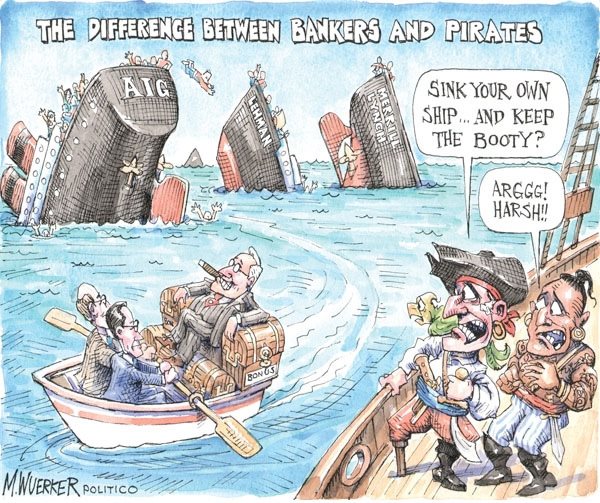
Cartoon of the Day: The Difference Between Bankers and Pirates

pirates-vs-bankers

It’s harder than ever to run a truly actively managed fund. Here’s how four firms execute unique – and successful – strategies. “We want to know that there’s intellectual thought, that there’s a process for buying companies, as well as for selling them”

SATURDAY, APRIL 6, 2013

Earning Their Keep

By SARAH MAX | MORE ARTICLES BY AUTHOR

It’s harder than ever to run a truly actively managed fund. Here’s how four firms execute unique — and successful — strategies.

It’s not easy being an active fund manager these days. Market information that was once available to a privileged few now flows freely and quickly. Index funds and exchange-traded funds, meanwhile, make it possible to implement simple or sophisticated strategies cheaply and effectively.

And then there’s performance.

Last year, 66% of domestic equity managers underperformed relative to the Standard & Poor’s 1500 index, according to the S&P Dow Jones Indices SPIVA Scorecard. That’s a considerable improvement over 2011, when 84% of active managers lagged the benchmark, but it’s hardly vindication for stock-picking. Even managers dealing in the supposedly inefficient international markets have struggled to get an edge. Last year, just 56% of international funds and 54% of emerging-market funds managed to deliver that elusive, market-beating “alpha” they’re paid for. There have been consequences: Over the past five years, nearly 27% of actively managed domestic equity funds and 23% of international equity funds have merged or liquidated.

So what’s an active manager to do? Some end up as “closet indexers,” who charge too much for hugging the index. In 2011, only 11% of assets invested in actively managed large-company funds were in portfolios that deviated from their benchmark by more than 80%, according to Martijn Cremers, a Notre Dame professor who helped pioneer “active share,” a measure of how truly active an active manager is. However, “skilled managers are out there,” says Charlie Ruffel, managing partner at Kudu Advisors, a strategic advisory firm for asset managers. “The challenge is in identifying them.”

The standout managers tend to have standout firms behind them, equipping them with the research teams, technology, financial backing, and supportive culture needed to go above and beyond. Some favor more concentrated approaches, investing in a small number of their very best ideas. Others take pains to investigate or even involve themselves with the management of the companies they invest in. Some take creative approaches to data-crunching, creating new perspectives on the market, while others simply thrive in a culture of constantly questioning and defending their stock-picking and portfolio moves. “Up until five years ago, managers didn’t need to try so hard to stand out,” adds Ruffel. “We’re in a different place.” Experts, such as financial advisors and consultants who help institutions choose funds, are constantly evaluating managers, looking for a process that brings consistent outperformance. They’re also looking for lights and mirrors — actions that appear to be in the name of research but don’t add value. Too much activity, they say, can be a warning sign. For instance, a manager who spends a disproportionate amount of time or travel on a position that represents less than 5% of the portfolio “might be cause for concern,” says Jonathan Bergman, a managing director at TAG Associates in New York. In general, however, Bergman and his peers are reassured when they hear that management has gone to great lengths to gain extra insight into a holding. “We want to know that there’s intellectual thought, that there’s a process for buying companies, as well as for selling them,” he says. Read more of this post

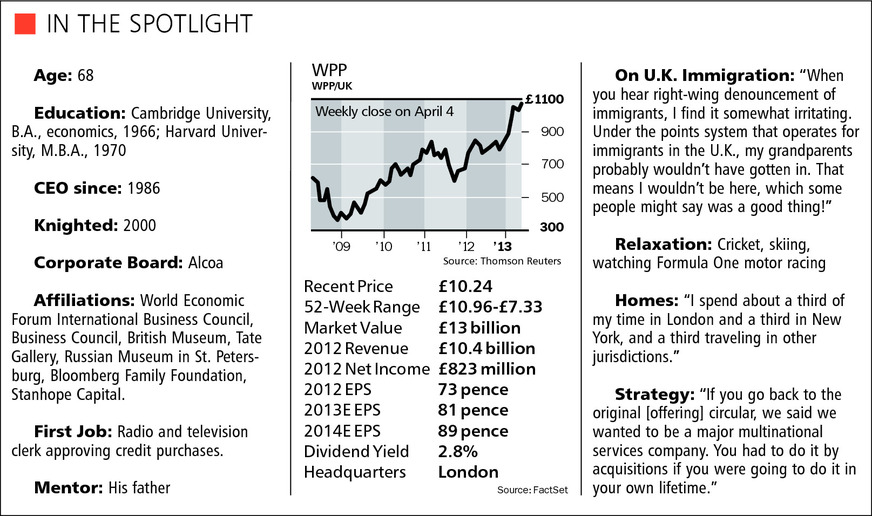
WPP CEO Martin Sorrell has built an advertising and marketing-services colossus by snapping up famous agencies on both sides of the Atlantic. A fighter to the end

SATURDAY, APRIL 6, 2013

No Ordinary Ad Man

By JONATHAN BUCK  | MORE ARTICLES BY AUTHOR

WPP CEO Martin Sorrell has built an advertising and marketing-services colossus by snapping up famous agencies on both sides of the Atlantic. A fighter to the end.

BA-BB574_ceo_p1_DV_20130406000449ON-BA554_SPOTLI_G_20130406010611

The advertising industry has long been known for colorful, larger-than-life characters. But few—past, present, or fictional (think Mad Men‘s Don Draper)—can compete with Martin Sorrell.

The head of London-based WPP, Sorrell is charming and feisty, puckish and ruthless, and seems to make money and enemies with equal dispatch. The legendary ad man David Ogilvy dismissed him as an “odious little jerk” when Sorrell sought to buy the U.S. advertising firm Ogilvy & Mather in 1989. But Sorrell, as usual, got the last laugh, winning both the company and an apology from Ogilvy, who went on to serve as WPP’s nonexecutive chairman for the next three years.

Sorrell, 68, has been called a bean counter, but then, his globe-spanning advertising and marketing-services conglomerate amounts to a huge hill of beans. Launched in 1985 with the friendly takeover of a British shopping-cart maker known as Wire & Plastic Products, WPP (ticker: WPP.U.K.) today employs 165,000 people in 110 countries, and operates under dozens of separate brands. It reported worldwide billings of more than $70 billion in 2012, and counts Google (GOOG) and News Corp. (NWSA), the owner of Barron’s, as its biggest customers. Read more of this post

These Charts Better Not Reflect The True State Of The US Economy; US GDP has the same total consumption of all petroleum products as it did back in 1997

These Charts Better Not Reflect The True State Of The US Economy

Tyler Durden on 04/06/2013 20:16 -0400

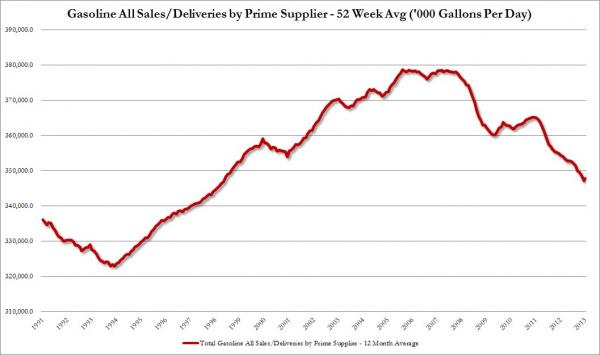
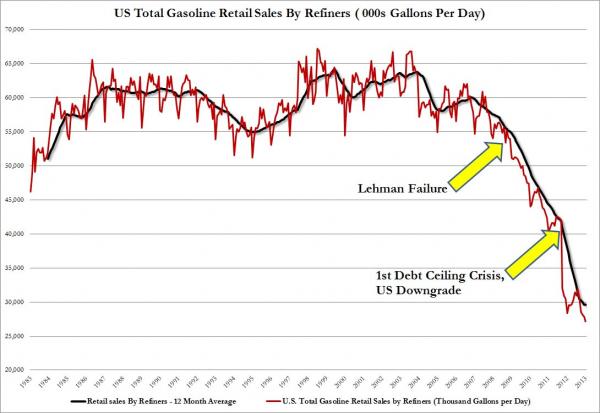
Lately, when it comes to obtaining an accurate sense of the true state of the US economy, it is as difficult if not more than analyzing the openly-manipulated Chinese data. On one hand, the Fed-juiced market, which has lost its discounting powers, no longer reflects the current or future economic (or corporate) fundamentals, on the other, massive seasonal aberrations, whether purposeful or accidental, have made a mockery of any data series, be it jobs, manufacturing, retail sales, or housing. On the other, the administration – still stuck in the worst economic “recovery” since the Great Depression – is desperate to telegraph an improving economy, most evident in the months leading up to the presidential election, which makes taking any data at face value problematic and naive at best. Yet even the openly-contradicting Chinese data manipulation has its Achilles heel in the form of monthly electricity consumption (and to a lesser extent, production) updates. So what is the US equivalent of Chinese electricity consumption data? We believe it may be the little-tracked, and thus not nearly as “adjusted” weekly updates from the Energy Information Administration, whose data on barrels of US product supplied of both total petroleum products and just gasoline are as indicative of the true state of the energy-hungry beating heart of the US economy as any other data set, and is likely a far more accurate representation of what is really going on between the lines.

Sadly, if that is indeed the case, then the disconnect between propaganda myth and reality is about as big as can be, since on a blended 52-week average basis, the total product supplied of motor gasoline is back to 2003 levels (black line on chart below). However, where it gets really scary is looking at the total product supplied category, which includes gasoline and all other product such as heating oil, propane, and kerosene.As the chart below shows, the US economy, whose GDP we are led to believe has never been higher, now has the same total consumption of all petroleum products (red line) as it did… back in 1997!

Product Supplied Gasoline and Petroleum Product_3_0 Gasoline All sales Prime Supplier_0 Weekly Total Gasoline Retail sales By Refiners_0 Read more of this post

Language Learning Startup Busuu Hits 30M Users And Launches New Kids iPad App

Language Learning Startup Busuu Hits 30M Users And Launches New Kids iPad App

MIKE BUTCHER

posted yesterday

busuu

Just this week Rosetta Stone acquired Seattle-based online language-learning communityLivemocha for $8.5 million in cash. At exit Livemocha had a 16 million member online language-learning community. It had also raised $19 million over six years. But today Busuu, a competing language-learning community based out of London, announces that it has reached 30 million users and its launched a dedicated iPad app for kids to learn Spanish.

It now reaches into 200 countries, and could lay justifiable claim to being the largest language learning community in the world. They also say they are growing at 40,000 new users a day with growth mainly coming from emerging markets like Brazil, Russia and Turkey, where clearly learning a language can help you get on. Read more of this post

China Is Finally Becoming A Lucrative Market For App Makers

China Is Finally Becoming A Lucrative Market For App Makers

KIM-MAI CUTLER

posted yesterday

screen-shot-2013-04-05-at-3-44-13-pm

screen-shot-2013-04-05-at-3-44-36-pm

screen-shot-2013-04-05-at-4-19-07-pm

screen-shot-2013-04-05-at-4-15-28-pm

screen-shot-2013-04-05-at-4-19-00-pm Read more of this post

Billabong perilously close to a wipeout; In 25 years, the company has lost most of its street cred and its value has shrunk from billions to whatever is on offer

Billabong perilously close to a wipeout

April 6, 2013, Elizabeth Knight

In 25 years, the company has lost most of its street cred and its value has shrunk from billions to whatever is on offer, writes Elizabeth Knight.

art_n_tide_0604-300x0

Twenty-five years ago, Billabong basked in street cred. Today, as one fashion industry insider quipped, the brand has become the barbecue short for the sausage sizzle. If the 45-year-old dads are wearing boardies with elasticised or Velcro adjustable waists to accommodate a middle-aged muffin top, their 15-year-old sons are not in the market.

On Friday, the future ownership of this Australian iconic brand hung in the balance. Two American corporate sharks have been circling the bleeding Billabong carcass for a couple of months and intense talks are continuing over the weekend.

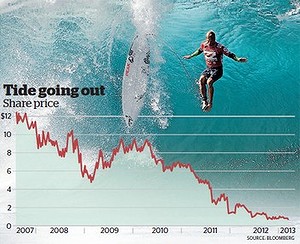
The decision by the Billabong board and its largest shareholder and founder, Gordon Merchant, to hang out the for sale sign, is the ultimate recognition the company has lost its way. Five years ago Billabong was a $5 billion company and its stock traded for $14. The prices being offered by these financial syndicates today are less than 70¢ a share – the financial equivalent of the bin out the front of the store housing the end-of-season/couldn’t-sell stock that customers rifle through. At this price the whole company is worth closer to $300 million. It is the final ignominy for the company whose financial performance has been in such steep decline that it has lost the support of many of its major investors and has been playing a dangerous game of dodgeball with its bankers. Read more of this post

India tackles entrenched culture of tax dodging; “In a country of holier than thou’s, no one thinks that it’s a blatant lie” to cheat on your taxes”

India tackles entrenched culture of tax dodging

BY TIM SULLIVAN

AP, APR 6, 2013

NEW DELHI – In a country long defined by its poverty, it’s now easy to find India’s rich.

They’re at New Delhi’s Emporio mall, where herds of chauffeur-driven Jaguars and Audis disgorge shoppers heading to the high-end designer stores. They’re shopping for Lambor- ghinis in Mumbai. They’re putting elevators in their homes and showing off collections of jewel-encrusted watches, and they’re buying real estate in comfortable but unpretentious neighborhoods thought of as simply upper-middle class just a couple years ago, where apartments now regularly sell for millions of dollars.

They’re just about everywhere — unless it’s income tax time. Then, suddenly, they barely exist.

The reality is simple: “There are very few people who are paying taxes,” said Sonu Iyer, a taxation expert at Ernst & Young in New Delhi. And tax dodging is everywhere, he said: “It’s rampant — rampant.” Read more of this post

The New Bird Flu Could Be Way More Widespread Than Tests Are Showing; Even patients on their death beds are only “weakly positive”; New Bird Flu Seen Having Some Markers of Airborne Killer; “This virus really doesn’t look like a bird virus anymore; it looks like a mammalian virus.”

The New Bird Flu Could Be Way More Widespread Than Tests Are Showing

Jennifer Welsh | Apr. 5, 2013, 6:36 PM | 2,527 | 5

A new bird flu is infecting patients across China, currently 16 patients have tested positive for the virus and six have died. But some flu watchers are convinced that the test that doctors are using to detect the H9N7 virus are faulty — that they aren’t sensitive enough. Even patients on their death beds are only “weakly positive” Laurie Garrett, senior editor for the Council on Foreign Relations and flu-outbreak-follower notes on twitter: This could mean that the test is missing vital cases before they get to the seriously ill stage, so we won’t know who is infected until it gets really bad. It could also mean the virus is more widespread than tests are showing us. This is especially important for the 520 people that the WHO is monitoring for infection. These people were in close contact with people who died or became seriously ill. Reports yesterday said that one of these people showed flu-like symptoms but tests later confirmed to show negative results. If that test was faulty…. that person could still have the virus. And it would be a sign that the virus can spread between humans — a very dangerous omen. There are also reports that animals are falling ill with the disease, even birds falling out of the sky. These animals test negative for the virus, but if the tests are faulty, that could be a big problem.

New Bird Flu Seen Having Some Markers of Airborne Killer

The new bird influenza that’s killed six people in eastern China has some of the genetic hallmarks of an easily transmissible virus, according to the scientist who showed how H5N1 avian flu could become airborne.

The H7N9 strain, which is a new virus formed as a result of two others merging their genetic material, has features of viruses that are known to jump easily from birds to mammals, and a mutation that may help it attach to cells in the respiratory tract, said Ron Fouchier, a professor of molecular virology at Erasmus Medical Center in the Netherlands, in a telephone interview yesterday.

“That’s certainly not good news,” said Fouchier, who reviewed a gene sequencing of H7N9 published by Chinese health authorities. “This virus really doesn’t look like a bird virus anymore; it looks like a mammalian virus.” Read more of this post

Chronic pain common after strokes caused by clots

Chronic pain common after strokes caused by clots

Fri, Apr 5 2013

By Andrew M. Seaman

NEW YORK (Reuters Health) – One in 10 people who have a stroke caused by a clot blocking blood to the brain go on to develop chronic pain, according to a new study.

Researchers found that just over 10 percent of about 16,000 study participants developed chronic pain after their strokes, and that was also linked to a greater risk of physical and mental decline.

While pain has been known to follow strokes, there has been confusion about how many people experience it and whether it causes other health problems. Read more of this post

Up close and personal with Subway’s co-founder Fred DeLuca

Saturday April 6, 2013

Up close and personal with Fred DeLuca

By Liz Lee
lizlee@thestar.com.my

Star Publication (M) Bhd

WHEN he started, he had only five sandwiches on the menu, all foot-long and served cold.

Today, he heads the world’s largest food chains, beating McDonald’s in 2011 and not showing signs of giving up that position.

Subway co-founder and president, Fred DeLuca’s story is the epitome of the proverb “slow and steady wins the race”.

Even though Subway is growing at a rapid-fire pace especially in Asia, DeLuca says the main focus is to look at building the business one store at a time.

“The foundation for success is to understand what customers want, and that is good food, service and cleanliness,” he adds.

At the Asian level, Subway’s business is also undergoing strong expansion with an ambitious target of 10,000 stores by 2020. These stores would generate US$3bil (RM9.26bil) sales.

Subway’s Asia business is now worth over US$500mil (RM1.54bil), with 1,600 stores operating in the region. It enjoys a 29% year-on-year revenue growth. Read more of this post

Great Scientist ≠ Good at Math; E.O. Wilson shares a secret: Discoveries emerge from ideas, not number-crunching

April 5, 2013, 10:07 p.m. ET

Great Scientist ≠ Good at Math

E.O. Wilson shares a secret: Discoveries emerge from ideas, not number-crunching

By E.O. WILSON

For many young people who aspire to be scientists, the great bugbear is mathematics. Without advanced math, how can you do serious work in the sciences? Well, I have a professional secret to share: Many of the most successful scientists in the world today are mathematically no more than semiliterate.

During my decades of teaching biology at Harvard, I watched sadly as bright undergraduates turned away from the possibility of a scientific career, fearing that, without strong math skills, they would fail. This mistaken assumption has deprived science of an immeasurable amount of sorely needed talent. It has created a hemorrhage of brain power we need to stanch. Read more of this post

How the South Sea Bubble Created U.K.’s Modern Monarchy; The crisis devastated thousands of investors, including Sir Isaac Newton, and permanently changed the structure of the constitutional monarchy, allowing a prime minister to become head of the government as the monarch gradually assumed the more ceremonial role of head of state

How the South Sea Bubble Created U.K.’s Modern Monarchy

The bubble of 1720 precipitated England’s first stock-market crash. In August of that year, shares in the South Sea Company reached a peak of 1,000 pounds and dropped to 150 pounds by the end of September.

The crisis devastated thousands of investors, including Sir Isaac Newton, who reputedly said after losing 20,000 pounds, “I can calculate the movement of heavenly bodies but not the madness of men.” The crash also permanently changed the structure of the constitutional monarchy, allowing a prime minister to become head of the government as the monarch gradually assumed the more ceremonial role of head of state. Read more of this post

Appily Ever After: A Smartphone Shrink; A few bucks and a lot of squinting into my phone: that certainly beats a $300-an-hour psychiatrist, right?

April 5, 2013

Appily Ever After: A Smartphone Shrink

By JUDITH NEWMAN

0407JP-APPI-NESS-articleLarge

When I was a kid, my favorite toy was the Magic 8 Ball. There was something immensely comforting about asking this little gizmo a question (“Will I find true love?”), shaking it and then seeing the answer that would bubble to the top of the screen: “Outlook good.”

As the world became more complicated and full of anxieties, many of us traded our Magic 8 Balls for therapists and self-help gurus. (“Will I find true love?” Answer: “First, you need to learn to love yourself.”)

But now a proliferation of psychology smartphone apps — with names like BreakkUpiStress and myinstantCOACH — purports to help us live happier, less anxious lives. As Mark McGonigle, a therapist in Kansas City, Mo., who invented the app Fix a Fight, puts it: “Electronic devices don’t have to drive us apart. They can bring us together.” Which sounds so good. A few bucks and a lot of squinting into my phone: that certainly beats a $300-an-hour psychiatrist, right? Read more of this post

9 Shocking Truths about Silicon Valley – Lessons from 100 Startup Founders

9 Shocking Truths about Silicon Valley – Lessons from 100 Startup Founders (Live Blog)

April 5, 2013 by Krish Raghav

Read more of this post

Fake Twitter Followers Becomes Multimillion-Dollar Business; The average price for 1,000 fake followers is $18

APRIL 5, 2013, 6:50 PM

Fake Twitter Followers Becomes Multimillion-Dollar Business

By NICOLE PERLROTH

Far from slowing, the market for fake Twitter followers seems to be taking off.

The fake Twitter follower phenomenon made headlines last summer after Mitt Romney’s Twitter following jumped by 100,000 in a matter of days. That news inspired a number of social media management companies like StatusPeople and SocialBakers to develop Web tools that try to determine what percent of a person’s Twitter followings are fake.

But those sites have hardly deterred people from dealing in the market for fake followers and fake retweets. The market is also becoming more sophisticated. In many cases, high-quality false  Twitter accounts are nearly impossible to discern from the real thing. Those that sell them claim that they can make up to a million dollars in one week.

Andrea Stroppa and Carlo De Micheli, two Italian security researchers, spent the last several months investigating the underground economy for Twitter followers and said they had found a thriving market.

There are now more than two dozen services that sell fake Twitter accounts, but Mr. Stroppa and Mr. De Micheli said they limited themselves to the most popular networks, forums and Web sites, which include Fiverr, SeoClerks, InterTwitter, FanMeNow, LikedSocial, SocialPresence and Viral Media Boost. Based on the number of accounts for sale through those services — and eliminating overlapping accounts — they estimate that there are now as many as 20 million fake follower accounts.

Fake followers are typically sold in batches of one thousand to one million accounts. The average price for 1,000 fake followers is $18, according to one study by Barracuda Labs. Mr. Stroppa and Mr. De Micheli said some sellers bragged that they made $2 and $30 per fake account. A conservative estimate, they said, was that fake Twitter followers offered potential for a $40 million to $360 million business. Read more of this post

Japan’s 13 Sigma Bond Swan

Japan’s 13 Sigma Bond Swan

Tyler Durden on 04/05/2013 14:27 -0400

For six months the Japanese jawboning has seen investors front-running the BoJ, selling JPY and buying whatever risk-asset is the most correlated that day – whether it is the Nikkei 225 or the S&P 500. However, now that words have been replaced by actions, it appears that someone (cough Japanese institutions cough) has decided the 13.4-sigma swing in JGBs last night is just too much and have rotated to US Treasuries. The selling of JPY and buying of EUR (to fund peripheral bond buying) and USD (to fund Treasury buying) is very clear. That means, implicitly, thatevery ramp higher in JPY (weaker JPY) is simply more bond-buying – which leaves the algos directionless. If you were a risk-manager, what would you do? And as far as all those VaR risk models – oops!! It seems the ‘sellers’ of those JGBs have found a new place to put that capital to work (and in a non-devaluing currency)…

20130405_JPY_020130405_JPY1_0