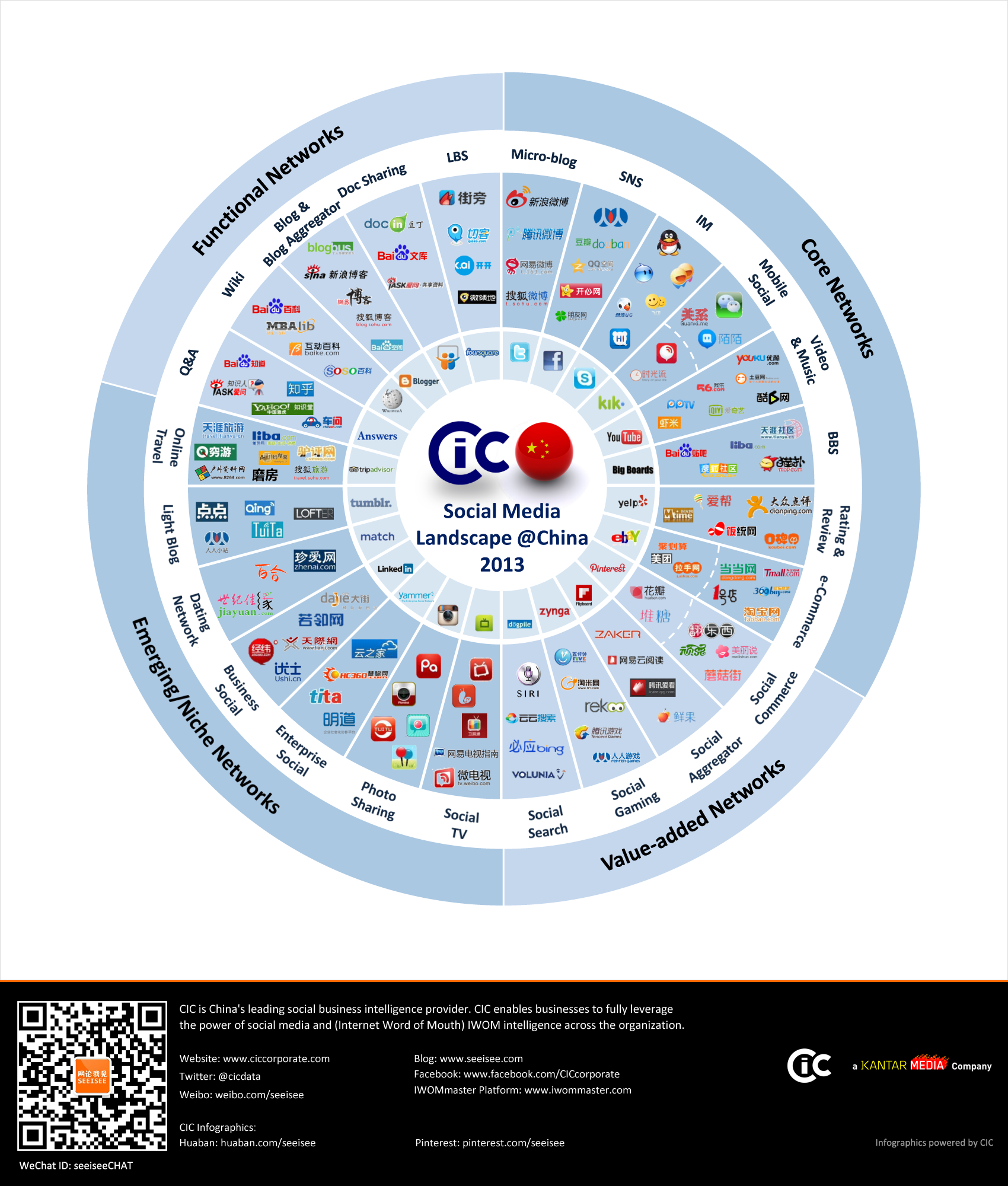
China Social Media Landscape (Infographics)
April 3, 2013 Leave a comment
R.E.S.-ilience in Value Creation 《竹经:经商经世离不得立根创新》
April 3, 2013 Leave a comment
PRESENTING: The Nightmare Scenario For Gold Investors That Could Cause The Market To Crash
Matthew Boesler | Apr. 2, 2013, 10:58 AM | 5,471 | 13
Société Générale analysts are quite bearish on gold. Their $1375-per-ounce price target for the end of 2013 puts them well below most of the Street. Today, the SocGen team, led by Patrick Legland and Michael Haigh, released a new report titled “The End of the Gold Era.”
April 3, 2013 Leave a comment
April 2, 2013 6:23 pm
Inside Business: Asia royalty rises provoke investor fury
Dramatic hikes viewed by many as worrying trend to remove funds from emerging markets
By Jeremy Grant
If you are a fund manager investing inAsia’s emerging markets, one way to gain exposure is by holding shares in a multinational company’s locally listed subsidiary.
Want some concrete action in India? Buy shares in Ambuja Cements, a Mumbai-listed company controlled by Holcim, the Swiss cement maker.
How about shampoo in Indonesia? Simple. Buy a chunk of Unilever Indonesia, which has been listed on the Jakarta stock exchange since 1981.
For years, this arrangement worked well for fund groups such as Aberdeen Asset Management and Arisaig Partners, a Singapore-based boutique investor with a focus on the consumer companies that are such a big part of the emerging market growth story. Unilever Indonesia made sales of $2.6bn last year from selling Dove soap, Surf detergent and Wall’s ice cream across the country’s vast archipelago. Its market capitalisation makes it one of Asia’s biggest companies. It is also highly profitable. Net profit has risen every year bar one since 1999, hitting $432m in 2011 – the last year for which figures are available. Dividends have rolled in nicely.
However, in the past few months, this neat way of investing in emerging markets has been upset. A chorus of funds is furious that Unilever and Holcim, as parent companies, have recently decided to take much bigger royalty payments from their Indonesian subsidiaries. Similar noises have been made in India where the two companies are also seeking higher royalty payments. Royalties are levied by multinationals on local units to recoup the cost of providing “shared services” – research and development, marketing, branding and so forth. But changes to royalties are not unusual and are perfectly legal. Read more of this post
April 3, 2013 Leave a comment
April 2, 2013 6:42 pm
Why China’s economy might topple
By Martin Wolf
As Japan has shown, shifting to a lower-growth model is risky
Over the next decade, China’s growth will slow, probably sharply. That is not the view of malevolent outsiders. It is the view of the Chinese government. The question is whether it will do so smoothly or abruptly. On the answer depends not only China’s own future, but also that of much of the world.
Official Chinese thinking was on display at last month’s China Development Forum, organised by the Development Research Center of the State Council (DRC), which brought influential foreigners together with high-level officials. Among the background papers was one prepared by economists at the DRC, entitled “Ten-year Outlook: Decline of Potential Growth Rate and Start of a New Phase of Growth”. Its proposition is that China’s growth will slow from more than 10 per cent a year from 2000 to 2010 to 6.5 per cent between 2018 and 2022. Such a decline, notes the paper, is consistent with the slowdown since the second quarter of 2010 (see chart).
The authors note two possible reasons for the decline: either China has fallen into the “middle income trap” of aborted industrialisation; or it is managing the “natural landing” that occurs when an economy begins to catch up with advanced economies. This latter scenario played out in Japan in the 1970s and South Korea in the 1990s. The DRC paper argues that, after 35 years of 10 per cent growth, it is at last happening to China.
Here are a few reasons why the authors say this view is plausible. Read more of this post
April 3, 2013 Leave a comment
April 2, 2013, 7:20 p.m. ET
Tactics to Spark Creativity
Even People Who Lack Ideas Can Set the Scene for Inspiration; Just Walk Away
By SUE SHELLENBARGER
Why is it that some people rack their brains for new ideas, only to come up empty—while others seem to shake them almost effortlessly out of their sleeves? Whether creativity is an innate gift or a cognitive process that anyone can jump-start is a question so intriguing that researchers keep studying it from different angles and discovering new and surprising techniques. Several recent studies suggest that the best route to an “aha moment” involves stepping away from the grindstone—whether it’s taking a daydream break, belting back a drink or two or simply gazing at something green. Of course, personality can make a difference. People who rate high in openness to new experiences in personality tests also may be more distractible and curious, according to a 2010 study in Creativity Research Journal. Among 158 college students, those who were less inhibited and more receptive to lots of stimuli also were able to generate more ideas than others, says the study by British researchers.
But personality isn’t the only path to inspiration, researchers say. Walking away from a problem to do simple, routine tasks, and letting the mind wander in the process, can spark creative new connections or approaches to solving dilemmas, says a 2012 study in Psychological Science. That helps explain why “a lot of great ideas occur at transition times,” when people are waking up or falling asleep, bathing, showering or jogging, says Jennifer Wiley, a psychology professor at University of Illinois at Chicago and lead author of a 2012 research summary in Current Directions in Psychological Science. Read more of this post
April 3, 2013 Leave a comment
Updated April 2, 2013, 9:51 p.m. ET
Key Bond Index Gets Bitten
Investors Are Pulling Funds Tied to ‘the Agg’ as Safe Bonds Look Anything But
By CAROLYN CUI And PATRICK MCGEE
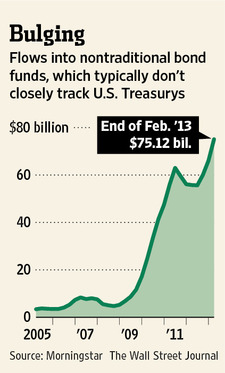
The guiding star for many bond investors is starting to flicker. The Barclays BARC.LN +2.18% U.S. Aggregate Bond Index, known as “the Agg”—which tracks the broader debt market the way the Standard & Poors-500 follows stocks—declined 0.12% in the first quarter, its first negative return in that period since 2006. And with many large investors yanking funds tied to the Agg, the index’s flagging popularity is having repercussions for how hundreds of billions of dollars are allocated in fixed-income portfolios. The move is perhaps the most stark indication yet that the safest bonds are scaring investors.
April 3, 2013 Leave a comment
Updated April 2, 2013, 8:10 p.m. ET
Silver Bears Pounce as Manufacturing Sputters

Silver prices plunged deeper into bear-market territory, as weak manufacturing data from the world’s major economies stoked investor fears that the metal’s gradual decline this year is turning into a rout.
Silver has shed over 20% of its value since October and its losses this year surpass most other commodities, including gold. Bets that silver will decline are on the verge of outnumbering bullish positions for the first time since September 2007, according to the U.S. Commodity Futures Trading Commission. On Tuesday, silver ended 2.5% lower at $27.217 a troy ounce on the New York Mercantile Exchange.
April 3, 2013 Leave a comment
SEC lacks ability to nab manipulators
Published: 3 Apr 2013 at 00.00
The securities regulator wants to put more effort into cracking down on share price manipulators during the bull market, but its work remains limp as it has no authority to file charges against perpetrators.
The Securities and Exchange Commission (SEC) is only the starting point for a stock manipulation crackdown, as these matters go to court, said secretary-general Vorapol Socatiyanurak.
The SEC just filed its first criminal complaint this year against Shine Bunnag and 12 others for manipulating the share prices of Mida Leasing Plc (ML) from March-May 2008 and in August 2010 and doing the same to Max Metal Corporation (MAX) shares in September 2010. There are growing worries over the irregular movements of several stocks now that the market is skyrocketing. Read more of this post
April 3, 2013 Leave a comment
Asia Soaring Wages Stoke Inflation as Factory Costs Rise
Koda Ltd (KODA). Executive Director Ernie Koh has a message for clients in 50 countries who complain about the Singapore-based furniture maker’s first price increase in two years: Take it or leave it.
Koda’s factories in China, Malaysia and Vietnam are battling rising costs as governments in Asia increase minimum wages to curb discontent over a widening wealth gap. While weak global growth and increased competition limited the ability of producers to raise prices during the past five years, Koh says they can’t go on absorbing the additional expenses.
“We aren’t even passing on the full costs,” said Koh, who counts U.S. retailer Williams-Sonoma Inc (WSM)., owner of Pottery Barn, and Cost Plus Inc. among customers. “Wage escalation in China these past few years has been crazy. We have collective bargaining with the union in Vietnam, and in Malaysia there is a big outcry among manufacturers over the minimum wage.”
Average pay in Asia almost doubled between 2000 and 2011, compared with a 5 percent increase in developed countries and about 23 percent worldwide, according to the International Labour Organization in Geneva. The gain was led by China, where average remuneration more than tripled during the period. Southeast Asia is catching up, with new minimum pay levels in at least five nations eroding companies’ ability to make cheap toys, clothes and furniture. Read more of this post
April 3, 2013 Leave a comment
Aspirin Seen Fueling $100 Billion Pensions Cost
Aspirin’s use fighting cancer has the potential to increase pension liabilities by as much as $100 billion by extending lifespans, a risk modeler said in a report.
The pension costs for men in the U.K. could rise by 0.7 percent within 20 years if more people begin taking aspirin daily, according to a statement by Risk Management Solutions Inc. today. An increase of that magnitude across the more than $13 trillion in pension liabilities in North America and Europe would be about the same as everyone giving up smoking within a generation, the modeling firm said.
Employers and governments are grappling with obligations to retirees as low bond yields make it harder to generate returns on funds set aside for the benefits. Actuaries’ assumptions about costs have been challenged as medical advances and changes in behavior help people live longer.
“Aspirin was not known to be a protection against cancer,” said Andrew Coburn, a senior vice president of RMS’s LifeRisks platform and one of the report’s authors. “It’s another one that people just didn’t expect” when they forecast liabilities.
Daily doses of aspirin reduce the chances of developing or dying from cancer earlier than previously thought and also prevent tumors from spreading, studies published in the Lancet medical journal last year showed.
The findings could increase the use of a drug that’s cheaper and more readily available than other cancer-fighting treatments, RMS said in its report. The modeling firm ran different scenarios about how widely aspirin would be used to predict additional pension costs. Read more of this post
April 3, 2013 Leave a comment
Related-party loans probed in LM fund
April 3, 2013, Ben Butler
The failed $740 million funds management empire overseen by flamboyant Gold Coast businessman Peter Drake lent $301 million to Mr Drake and his companies, administrators have revealed.
Administrators John Park and Ginette Muller, of FTI Consulting, said the loans were made from the LM Managed Performance Fund, which operated outside Australian company law.
The related-party loans, representing about three-quarters of the $397 million fund, included $17 million lent directly to Mr Drake, the administrators said.
They said they would apply to the Queensland Supreme Court on April 12 to take control of the fund as its receivers.
”MPF has to date been operating as an unregulated fund outside the Corporations Act,” the administrators said. ”The administrators are continuing to work with ASIC [the Australian Securities and Investments Commission] to address the regulatory concerns.” Read more of this post
April 3, 2013 Leave a comment
SEC Approves Using Facebook, Twitter for Company Statements
Companies can use social media outlets such as Facebook Inc. and Twitter Inc. to announce key information as long as investors have been alerted where to look, the U.S. Securities and Exchange Commission said today.
The SEC clarified the disclosure guidelines in a report of an investigation involving Netflix Inc. (NFLX) Chief Executive Officer Reed Hastings, who posted monthly viewership results on his Facebook page in July even though the company didn’t report the data in a public filing or press release.
The SEC confirmed that a regulation which prohibits companies from disclosing material information to select sets of investors applies to social media and other emerging means of communication the same way it applies to company websites. Company communications made through social media channels could constitute a violation of the fair disclosure rule known as Regulation FD if investors had not been told in advance where the information would be posted, the SEC said. Read more of this post
April 3, 2013 Leave a comment
New Bird Flu Virus Kills 2 in China, Sparking WHO Probe
A new strain of bird flu sickened four people and killed two in eastern China, prompting the World Health Organization to investigate whether the virus has the potential to spread easily among people. The H7N9 strain of avian influenza struck two people in Shanghai, one in Anhui province, and a fourth in the city of Nanjing, according to the Geneva-based WHO and China Central Television. Two of the people died and a third is in critical condition, the United Nations health agency said in a statement yesterday. No link between the cases has been identified, and no further infections have been found among 88 contacts of the first three patients, the WHO said, suggesting the virus isn’t easily transmissible between people. The fourth case is a 45- year-old woman who slaughters poultry at a local farmers’ market, CCTV reported on its website today. “This is of concern,” Gregory Hartl, a WHO spokesman, said by phone today. “These are the first cases we’ve seen in human beings. We’re watching this very closely.” The virus is genetically an avian flu virus, and hasn’t mixed with human or pig pathogens, Hartl said. The WHO is looking into whether the virus has evolved to become more of a threat to humans, he said.
To contact the reporter on this story: Simeon Bennett in Geneva at sbennett9@bloomberg.net
April 3, 2013 Leave a comment
Suntech Unit Bankruptcy Had Roots in Deadbeat Customers
Suntech Power Holdings Co. (STP), forced to put its Chinese solar unit into bankruptcy last month, began that slide into insolvency in 2009 when customers linked to the founder couldn’t pay their bills and the company booked the sales as revenue anyway, regulatory filings show.
Seven buyers backed by an investment firm funded by Suntech and its founder, Shi Zhengrong, accounted for 29 percent of Suntech’s uncollected bills as 2009 ended, according to correspondence between the solar company and the U.S. Securities and Exchange Commission. Those customers hadn’t yet received enough money to proceed with their projects and Suntech, once the world’s largest solar-panel maker gave them more time to pay, the letters show.
The SEC correspondence provides clues to Suntech’s prospects and a road map to business practices that left the company vulnerable to a 560 million-euro ($720 million) fraud and a $541 million bond default. Anyone with Internet access could have learned that Suntech was booking revenue from sales to related companies with unbuilt projects in the fledgling solar industry, while also guaranteeing loans to those related companies. It relied on a former sales agent to secure one guarantee with bonds it never saw.
“Digging through SEC correspondence is one of the most important things an investor should do before investing in any company — especially in companies that are higher risk or more opaque,” said short seller Carson Block of Muddy Waters LLC, whose analyst reports starting in November 2010 triggered $7 billion in losses for Chinese stocks in two years. Read more of this post
April 2, 2013 Leave a comment
Updated April 1, 2013, 9:06 p.m. ET
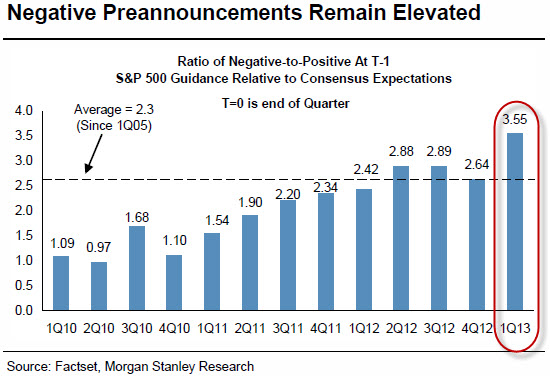
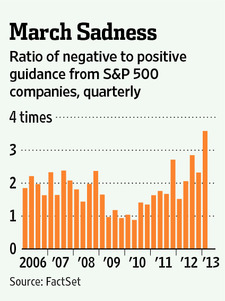
Recent months have offered yet more proof that markets love to climb a wall of worry. Hand-wringing, whether from retail investors or professional pundits, often precedes heady gains. But some people’s anxiety counts for more than others. While last week the S&P 500 finally erased all its bear-market losses and strategists are falling over one another to raise their year-end targets, the only people in the market with legal inside information are surprisingly cautious. As the first quarter drew to a close, 86 companies in the S&P 500 issued negative guidance for what they expect to report in earnings for that period. Just 24 issued positive guidance. At 3.58 negative updates for every positive one, that is by far the highest ratio since FactSet began tracking such data in 2006.
April 2, 2013 Leave a comment
Mar 30th 2013 | BARROW-IN-FURNESS, CORBY AND PENDLE |From the print edition
TO WALK into Devonshire Dock Hall, in Barrow-in-Furness, a town of 70,000 in England’s north-west, is to walk into the heart of a community. Some 260 metres long, this cathedral of industry houses three part-built grey and black nuclear submarines. Workers in blue overalls and hard hats are busy assembling the vast machines. Among them are “fourth- or even fifth-generation shipbuilders”, says Alan Dunn, the operations director at the plant. “When people here go to the pub, they talk about submarines. The yard dominates everything we do.”
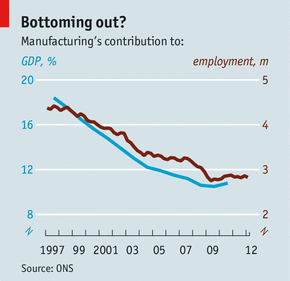
In most parts of Britain, manufacturing has all but disappeared in the past half-century. In 1997 about 4.4m people worked making things; now, just 2.8m do. North of Birmingham the urban landscape is characterised by redundant factories and the glitzy regeneration schemes intended to replace them. And yet in a few places, such as Barrow-in-Furness in Cumbria, or Pendle in Lancashire by the Yorkshire Dales, manufacturing and engineering continue to thrive. If there ever is a new “march of the makers”, as George Osborne, the chancellor of the exchequer, hopes, these places will be where they head for. Read more of this post
April 2, 2013 Leave a comment
Canada’s economy on thinning ice
Disappointing exports, stalled investment and fiscal austerity leave the overstretched consumer as Canada’s only hope for growth
Mar 30th 2013 | OTTAWA |From the print edition
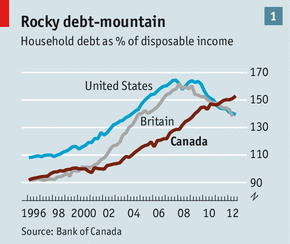
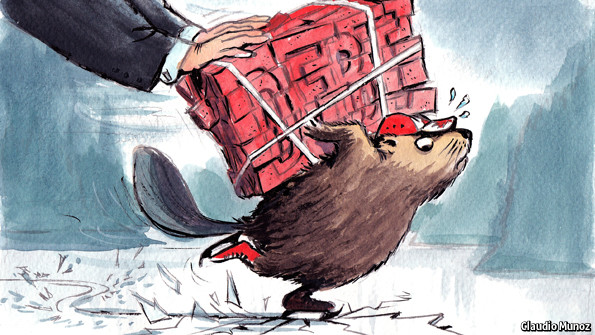
WHEN the world financial system collapsed in 2007, triggering a global recession, Canada recovered faster than any of the other members of the G7 group of large developed countries. Its banks remained solid, while low interest rates encouraged consumers to borrow and spend. But five years on, consumers are showing signs of flagging. The economy is set to expand by a paltry 1.6% this year. So the authorities are casting around for another source of growth. The trouble is they cannot seem to find one. Government, both federal and provincial, is trying to curb deficits swollen by stimulus spending. Companies are restrained by uncertainty prompted by Europe’s woes and the stand-off over fiscal policy in the United States, Canada’s main trading partner. Exports have still not returned to their pre-recession peak. As for consumers, after 11 consecutive years in which household spending has exceeded disposable income, they are deeply in hock. Just over a year ago, Craig Alexander, chief economist at Toronto-Dominion Bank, predicted the debt build-up “is going to end in tears”. The ratio of household debt to disposable income has continued to edge up (see chart 1). An increase in unemployment (from 7% at the moment) or a rise in interest rates could push some households into bankruptcy and puncture a housing bubble inflating in several Canadian cities.
April 2, 2013 Leave a comment
Mobile banking
Is it a phone, is it a bank? Safaricom widens its banking services from payments to savings and loans
Mar 30th 2013 | NAIROBI |From the print edition

Loans as well as phones
SWAHILI continues to creep into the language of global finance. M-PESA, a thriving money-transfer system run by Safaricom, a Kenyan mobile-phone operator, and named after the word for “cash”, has already entered the lexicon. Having persuaded millions of Kenyans to send cash through an SMS network, Safaricom is now trying to tempt them into a savings-and-loans service called M-Shwari, after the Swahili for “cool” or “calm”.
Safaricom has nearly as many subscribers as Kenya has adults—19m people from a population of 43m. Almost 15m of them use M-PESA for everything from paying electricity bills to school fees, thanks to a simple text-based menu that is accessible on even the most basic mobile phone. The firm, which is 40%-owned by Vodafone, makes its money through transaction fees when customers withdraw or transfer cash at a network of more than 40,000 M-PESA agents throughout the country. Read more of this post
April 2, 2013 Leave a comment
Three Rules for Making a Company Truly Great
by Michael E. Raynor and Mumtaz Ahmed
Much of the strategy and management advice that business leaders turn to is unreliable or impractical. That’s because those who would guide us underestimate the power of chance. Gurus draw pointed lessons from companies whose outstanding results may be nothing more than random fluctuations. Executives speak proudly of corporate achievements that may be only lucky coincidences. Unfortunately, almost no one provides scientifically credible answers to every business leader’s basic questions about superior performance: Which companies are worth studying? What sets them apart? How can we follow their examples?
Frustrated by the lack of rigorous research, we undertook a statistical study of thousands of companies, and eventually identified several hundred among them that have done well enough for a long enough period of time to qualify as truly exceptional. Then we discovered something startling: The many and diverse choices that made certain companies great were consistent with just three seemingly elementary rules:
1. Better before cheaper—in other words, compete on differentiators other than price.
2. Revenue before cost—that is, prioritize increasing revenue over reducing costs.
3. There are no other rules—so change anything you must to follow Rules 1 and 2.
April 2, 2013 Leave a comment
The Two Most Important Words
by Robert A. Eckert
When I arrived at Mattel, the company was losing almost a million dollars a day, the bonus pool was empty, and equity awards were underwater. I believed that those challenges were surmountable. On my first day, at a “town hall” gathering in the cafeteria, I said, “I know how this works. We will turn things around, and because I’m the new, outsider CEO, I’ll get a lot of the credit. But I know who’s really going to deserve the thanks—all of you. I appreciate what you’re about to accomplish.”
I had just arrived from Kraft Foods, where I spent the first 23 years of my career. By the time I was chosen to lead the world’s largest toy company, I had experienced every layer of organizational life, starting as an entry-level grunt. And although I worked hard, I also had a lot of help. My parents and teachers influenced me in powerful and positive ways. My 15 different bosses at Kraft all supported, guided, and taught me. (Well, all but one—who, by the way, lasted only a year at the company.) I found myself saying thank you a lot. Yet I’m also a learner by nature, as I expect most readers of this column are. So I learned to say thank you even more, because the effect was obvious.
Most people come to work every day aiming to do a good job (even if my one bad boss didn’t believe that). And most people—and, as a result, most organizations—actually do pretty well. What should they get in return? Cosmetics entrepreneur Mary Kay Ash put it this way: “There are two things people want more than sex and money: recognition and praise.”
Now, I’m not Pollyannaish. My colleagues can vouch for my toughness. But what’s wrong with recognizing a job well done? Why not say thank you more often—and mean it? Read more of this post
April 2, 2013 Leave a comment
Video: Haptic-feedback shoes guide blind walkers
Posted by: Kate Torgovnick
April 1, 2013 at 5:51 pm EDT
The footage in this video — which shows a man, a woman and a teenager walking down paths, around curves, up stairs and across streets — may not at first viewing seem remarkable. But the people in this video are blind — and walking without a cane or guide dog. Instead, they are being guided by their shoes. These shoes, which TED Senior Fellow Anthony Vipin Das introduced us to at TED2013, use haptic feedback and GPS technology to guide the blind. Each pair contains electronic circuitry, sensors and small actuators that give the wearer feedback on their movement as they walk, vibrating to tell them when to turn or lift their feet. (See Katherine Kuchenbecker’s great TED-Ed lesson to the field of haptic technology, which debuted on TED.com just last week.) They use a voice-programmed app that reads local GPS maps and plan routes. They have sensors that note obstacles and tell the wearer to stop. The shoes can also read gestures from the walker — for example, two taps means “take me home.” These shoes are called Le Chal, which means “take me there” in Hindi. And as Vipin Das shared in this Q&A with the TED Blog, they are being tested in their first clinical study at LV Prasad Eye Institute in Hyderabad, India. Expected to be available this year, the shoes can be pre-ordered at Ducere Technology’s website. “It’s very encouraging to see the kind of response we’ve had from wearers,” Vipin Das tells the TED Blog. “They were so moved because it was probably the very first time that they had the sense of independence to move confidently — that the shoe was talking to them, telling them where to go and what to do.”
April 2, 2013 Leave a comment
March 27, 2013, 11:52 AM
The Mattress Safe: Cushion Your Pain In Spain
By Matthew Walter
An industrious Spanish bed maker has come up with a novel take on money-hoarding: a mattress with a built-in safe.
April 2, 2013 Leave a comment
April 1, 2013, 7:38 p.m. EDT
10 things financial advisers won’t say
Pros will tell you where to put your money, but often at a steep price

1. “We’re your biggest advocate, except when we’re not.” Read more of this post
April 2, 2013 Leave a comment
The Role of the Media in Disseminating Insider Trading News
Jonathan L. Rogers University of Chicago – Booth School of Business
Douglas J. Skinner The University of Chicago – Booth School of Business
Sarah L. C. Zechman University of Chicago – Booth School of Business
March 1, 2013
Chicago Booth Research Paper No. 13-34
Fama-Miller Working Paper
Abstract:
We use the disclosure of insiders’ trades to investigate whether the way in which news is disseminated by the media affects the market response. To do this, we use recent changes in the disclosure rules governing insider trades and an exogenous change in media coverage to cleanly identify media effects. Using high-resolution intraday data and a plausibly exogenous change in media coverage, we find clear media effects in the price and volume response to news. These results help resolve open questions regarding the importance of investor inattention and help explain why apparently “second hand” news affects securities prices.
April 2, 2013 Leave a comment
Diseased pork eaten in Shanghai for years, says farmer
Staff Reporter 2013-04-02
The thousands of dead pigs fished out of Shanghai’s Huangpu river last month have lifted the lid on the formerly hush-hush practice of selling diseased pig carcasses for human consumption, reports Hong Kong’s Wen Wei Po.
More than 10,000 pigs have been retrieved from the river since early March, according to official figures, though internet users believe the real figure may be far higher.
Local media has reported that the dead pigs are likely to have originated from Jiaxing, a prefecture-level city in neighboring Zhejiang province about 100 kilometers southwest of Shanghai. Public pressure has reportedly now forced farmers to stash their dead pigs in more centralized locations rather than simply dumping them by the side of the road, where they were often collected by organized scavengers that resold the pigs — usually infected with disease — to butchers and meat processing companies that prepare the meat for human consumption.
“You Shanghai people have no idea how many diseased pigs you have eaten over the years,” a restaurant owner near Jiaxing told Wen Wei Po. The newspaper found that many local farmers regularly sell their dead pigs at a discount price of around 1 yuan (US$0.16) per kilogram to recover their losses. Read more of this post
April 2, 2013 Leave a comment
CHART OF THE DAY: The Insane Parabolic Rise Of Bitcoin
Matthew Boesler | Apr. 1, 2013, 4:55 PM | 3,475 | 5
The parabolic rise of Bitcoin has caught a lot of people off guard this year and is generating a ton of investor interest. Nick Colas at ConvergEx Group, the only Wall Street strategist we know of so far who has written about the Bitcoin market, says all of his clients think the virtual currency is in a bubble. When one looks at a chart, going all the way back to 2010, it’s easy to see why the word “bubble” is being tossed around among investors. Whether it continues to go up is anyone’s guess, but Colas thinks there are five broad themes converging to create a “perfect storm” behind the current rise of Bitcoin.

Bitcoin Is The Perfect Asset Bubble — Prices Could Go Vastly Higher From Here
Henry Blodget | Apr. 1, 2013, 11:29 AM | 6,594 | 36 Read more of this post
April 2, 2013 Leave a comment
April 1, 2013
Air Pollution Linked to 1.2 Million Premature Deaths in China
By EDWARD WONG
BEIJING — Outdoor air pollution contributed to 1.2 million premature deaths in China in 2010, nearly 40 percent of the global total, according to a new summary of data from a scientific study on leading causes of death worldwide.
Figured another way, the researchers said, China’s toll from pollution was the loss of 25 million healthy years of life from the population. Read more of this post
April 2, 2013 Leave a comment
The Continuing Evolution of “Starbucks with Chinese Characteristics”
By Robert O’Brien on March 27, 2013 at 10:00 AM 0 Comments
Last year was a big year for Starbucks in China. The company continued to open cafes at a rapid rate, began offering breakfast to Chinese consumers for the first time, was accused of “cultural invasion” for the second time in five years, and took a huge step toward establishing Yunnan Province as a major producer of coffee beans. All of these developments, and the rapid evolution of the company’s China strategy in general, led us to launch a special series –“Starbucks in China” – last December. In contrast, 2013 started off quietly on the Starbucks China front. That is, until last week, when the publication of a China Daily article and the company’s annual shareholder’s meeting shed fresh light on what new plans the popular coffee purveyor is brewing in China. Read more of this post
April 2, 2013 Leave a comment
茅台应收账款激增7倍 欠款前五均为经销商
http://www.nbd.com.cn 2013-04-02 01:09
核心提示: 记者翻阅贵州茅台2012年报发现,应收账款金额前五名单位均为经销商,占应收账款总额的87.98%。
每经记者 曹晟源 发自成都
尽管贵州茅台(600519,SH)日前公布的2012年年报成绩不错,净利润同比增速仍在50%以上,但其激增7倍的应收账款却引发关注。《每日经济新闻》记者注意到,应收账款前五名均为本应该早已打款的经销商。
在 “塑化剂事件”、“三公消费”瘦身、反垄断等冲击下,白酒行业已进入调整期。而此时经销商和酒企之间的关系变得异常敏感,出现应收账款的大幅增长,似乎预示着经销商和白酒企业之间此前的关系或将发生改变。 Read more of this post
April 2, 2013 Leave a comment
The Hidden Biases in Big Data
by Kate Crawford | 2:00 PM April 1, 2013
This looks to be the year that we reach peak big data hype. From wildly popular big data conferences to columns in major newspapers, the business and science worlds are focused on how large datasets can give insight on previously intractable challenges. The hype becomes problematic when it leads to what I call “data fundamentalism,” the notion that correlation always indicates causation, and that massive data sets and predictive analytics always reflect objective truth. FormerWired editor-in-chief Chris Anderson embraced this idea in his comment, “with enough data, the numbers speak for themselves.” But can big data really deliver on that promise? Can numbers actually speak for themselves?
Sadly, they can’t. Data and data sets are not objective; they are creations of human design. We give numbers their voice, draw inferences from them, and define their meaning through our interpretations. Hidden biases in both the collection and analysis stages present considerable risks, and are as important to the big-data equation as the numbers themselves. Read more of this post

咬定青山不放松,立根原在破岩中。 千磨万击还坚劲,任尔东西南北风。



 Bamboo Innovator