Oil Pipelines to Drive Canada Economy Like 1880s Railroad

Oil Pipelines to Drive Canada Economy Like 1880s Railroad

Oil pipelines, under attack from environmentalists, are essential to Canada’s economic growth just as railroads were in the 1880s, Enbridge Inc. (ENB) Chief Executive Officer Al Monaco said.

“Pipelines are very similar to railroads,” Monaco said yesterday at the Bloomberg Canada Economic Summit in Toronto. “When you really get down to it, Canada is an export-driven resource economy. This is our foundation.”

Pipelines already carry 15 percent of Canadian exports in the form of crude, mostly to U.S. markets. Plans by Enbridge and TransCanada Corp. (TRP) to spend more than a combined C$50 billion ($49 billion) to expand networks to the Pacific and Atlantic coasts, are opposed by environmental groups such as ForestEthics. The nation’s oil trade rose 7 percent to about C$73 billion last year, according to Statistics Canada, and is set to grow faster than the total economy. Read more of this post

HSH Nordbank, the world’s largest shipping lender, Says Shipping Crisis May Worsen Through 2014

HSH Nordbank Says Shipping Crisis May Worsen Through 2014

HSH Nordbank AG, the world’s largest shipping lender, said the crisis buffeting the industry may worsen through 2014 as clients contend with a drop in demand and the arrival of a new generation of container vessels.

HSH Nordbank, which holds 27 billion euros ($35 billion) of shipping loans in its portfolio, has taken provisions to prepare for the worst-case scenario, HSH Chief Executive Officer Constantin von Oesterreich told journalists in Hamburg, the bank’s home city, last night. Read more of this post

The New Buyers of ETFs: According to Morningstar, hundreds of mutual funds now own passive ETFs

The New Buyers of ETFs

Stan Luxenberg

Fri, 2013-05-17 09:21

Many actively managed mutual funds are now in the market for ETFs for their low costs of ownership and ease of trading. But should shareholders be annoyed? During the past decade, ETFs have spread relentlessly, appealing to pensions, retail investors, and financial advisors. But lately a new group has begun buying: actively managed mutual funds. According to Morningstar, hundreds of mutual funds now own passive ETFs. More than 100 mutual funds hold SDPR S&P 500 (SPY), while more than 70 portfolios use iShares iBoxx High Yield Corporate (HYG). Mutual Funds with ETF stakes include Columbia Dividend Income (LBSAX), Monetta (MONTX) and Vanguard Windsor II (VWNFX). ETF provider SPDR says that 21 of the 25 largest fund companies hold at least some ETFs.

new-buyers-etfs-table Read more of this post

To Spark Buyers for Electric Cars, Drop the Price to Nearly $0

Updated May 22, 2013, 3:34 a.m. ET

To Spark Buyers for Electric Cars, Drop the Price to Nearly $0

By JOSEPH B. WHITE

This car deal sounds too good to be true: Drive a car, almost free. To entice drivers to try electric-powered cars, auto makers are lowering the price of entry to the zero-emission lifestyle. A new round of discount leases on mainstream-brand plug-in cars such as theNissan 7201.TO -1.38% Leaf or Fiat F.MI +0.93% 500e, combined with federal, state and local electric-vehicle incentives, could make a battery-electric car an extraordinarily economical way to get around for drivers. There are two big caveats: Drivers need to live in states offering tax incentives and can’t drive very far in a single day.

PJ-BO412_EYESRO_G_20130521230902 Read more of this post

China’s Toxic Rice Bowl; 44% of rice samples collected locally contained dangerously high levels of cadmium, a heavy metal that causes cancer, kidney failure and other diseases

May 22, 2013, 12:47 p.m. ET

China’s Toxic Rice Bowl

Elections are the only antidote for cadmium rice and other horrors.

The Guangzhou Food and Drug Administration says that 44% of rice samples collected locally contained dangerously high levels of cadmium, a heavy metal that causes cancer, kidney failure and other diseases. Local residents are rightly worried—and furious. So are Chinese across the country: Rice is the staple food for most of the population, so widespread cadmium exposure is another wake-up call that unaccountable government causes public health disasters.

Cases of cadmium in rice and other crops are not new. In February, a Guangdong newspaper reported that the state-owned Shenzhen Cereals Group distributed a large shipment of cadmium-tainted rice from Hunan in 2009. The company denied the report. But researchers at Nanjing Agricultural University found that 10% of China’s rice crop is contaminated with the metal. The full extent of soil pollution is deemed a state secret, and activists who expose polluters are regularly imprisoned. Read more of this post

Richemont Departure Signals Fashion Is an Accessory

Richemont Departure Signals Fashion Is an Accessory

For luxury-goods maker Richemont (CFR), clothing and bags are going out of fashion.

While Richemont last week reported a 30 percent gain in annual profit as shoppers spent more on its Cartier jewelry and IWC watches, leather goods and fashion brands such as Lancel and Chloe have struggled. Earnings at Richemont’s so-called soft luxury unit fell by more than half in the last fiscal year.

Chairman Johann Rupert last week said Richemont (CFR) should have been quicker to get rid of brands that disappoint. Then yesterday, the Geneva-based company announced the departure of Marty Wikstrom, the head of the fashion and accessories business — which accounts for less than a fifth of the company’s 10 billion euros ($12.9 billion) in revenue. Read more of this post

Hong Kong Police Probe Mercantile Exchange at SFC Request, which said it found “serious” suspected financial irregularities at the shuttered commodities market.

Hong Kong Police Probe Mercantile Exchange at SFC Request

Police began probing the Hong Kong Mercantile Exchange Ltd. at the request of the Securities and Futures Commission, which said it found “serious” suspected financial irregularities at the shuttered commodities market.

The financial regulator started its own investigation on May 15 and then referred the matter to Hong Kong Police’s Commercial Crime Bureau, according to a statement published on the SFC’s website yesterday. Read more of this post

Death in Parched Farm Field Reveals Growing India Water Tragedy

Death in Parched Farm Field Reveals Growing India Water Tragedy

Sachin Ingale slipped out of his family’s two-room, white-painted mud hut about 4 p.m. and walked into their farm field where the 22-year-old took a deep swig of pesticide from a plastic bottle. He died later that evening.

Four months later, the mercury is pushing 50 degrees Celsius (122 degrees Fahrenheit) in his village in India’s Maharashtra state. Inside the family hut, a picture of a serene Buddha decorates a wall above a cracked concrete floor.

Elder brother Satish Ingale is sitting on a plastic chair in a white singlet as he explains the pesticide killed Sachin, but it’s the loss of water rights to heavy industry, the worst drought in four decades and the rise in debt that follows that’s causing farmers to take their own lives. Read more of this post

In complex world, investing should be simple

LARRY SWEDROE / 

MONEYWATCH/ May 21, 2013, 7:00 AM

In complex world, investing should be simple

(MoneyWatch) Many investors have ventured into the land of alternative investments, including such alternatives as REITs, commodities, private equity and hedge funds. However, a recent paper by the chief investment officer of a pension system says these investors may want to think twice.

Robert Maynard, chief investment officer of the Public Employee Retirement System of Idaho and author of the article “Conventional Investing in a Complex World” (Journal of Investing, Spring 2013), cautions investors who are thinking about abandoning traditional investment plans. He advocates “policies that are simple, transparent, and focused rather than the increasingly popular alternative tactics, such as illiquid instruments and vehicles, leverage, and complex, opaque investment strategies.”

As we have shown here on a regular basis, hedge funds have had a hard time keeping up with the risk-adjusted returns on safe bond investments (let alone with the returns of publicly available stocks). And private equity has underperformed publicly available small value stocks. This is in addition to the greater risks of such investments, plus their lack of transparency and liquidity. Read more of this post

Duke’s Campbell Harvey et al: Most claimed research findings are false; a newly discovered factor needs to clear a much higher hurdle, with a t-ratio greater than 3.0

…and the Cross-Section of Expected Returns

Campbell R. Harvey Duke University – Fuqua School of Business; National Bureau of Economic Research (NBER)

Yan Liu Duke University

Heqing Zhu Duke University – Fuqua School of Business

May 4, 2013

Abstract: 
Hundreds of papers and hundreds of factors attempt to explain the cross-section of expected returns. Given this extensive data mining, it does not make any economic or statistical sense to use the usual significance criteria for a newly discovered factor, e.g., a t-ratio greater than 2.0. However, what hurdle should be used for current research? Our paper introduces a multiple testing framework and provides a time series of historical significance cutoffs from the first empirical tests in 1967 to today. We also project forward 20 years assuming the rate of factor production remains similar to the experience of the last few years. We argue that today a newly discovered factor needs to clear a much higher hurdle, with a t-ratio greater than 3.0. Echoing a recent disturbing conclusion in the medical literature, we argue that most claimed research findings are false. Our key results are summarized:

Ab_id_2249314_Fig3

The Constant: Companies that Matter

The Constant: Companies that Matter

Paul Kedrosky University of California, San Diego (UCSD); Ewing Marion Kauffman Foundation

May 2013

Abstract: 
There are few constants in entrepreneurship — perhaps none. That is why when something appears to be even semi-stable across meaningful periods, it is usually worth further investigation.

This short paper investigates just such an apparent constant. Specifically, it is often claimed that there only are fifteen to twenty information technology companies created per year in the United States that turn out to “matter,” where matter is defined as the company (relatively) promptly going from founding to $100 million in revenues. Further, and of real consequence to cities and regional economies, is that most such companies founded in any given year are thought to be in California. This paper tries to find out if the preceding is true.

The Corporate Immune System: Governance from the Inside Out

The Corporate Immune System: Governance from the Inside Out

Omari Scott Simmons Wake Forest University School of Law

April 29, 2013
University of Illinois Law Review, Forthcoming
Wake Forest Univ. Legal Studies Paper

Abstract: 
The “Corporate Immune System” (CIS) is an outgrowth of an evolutionary trend reflecting firms’ adaptation to challenges including growing corporate complexity, threats to corporate value, and political compromise. Similar to biological immune systems, corporations have adopted a range of internal mechanisms to ward off threats. The CIS performs an internal regulatory function that lowers monitoring costs for government regulators through internal mechanisms such as a monitoring board, compliance and risk management systems, compensation, and an enhanced chief legal officer (CLO) role. It complements external corporate governance strategies: shareholder empowerment, markets, litigation, gatekeepers, and top-­down public regulation. Today’s corporate boards are much more informed, organized, skilled, and accountable than their historical antecedents. Although far from perfect, they continue to evolve and improve. The CIS, recognizing the potential of collaborative inside‐out reforms in the corporate arena is, on balance, a promising development. But this trend also raises concerns that merit further discussion.

Corporate Governance Reforms Around the World and Cross-Border Acquisitions

Corporate Governance Reforms Around the World and Cross-Border Acquisitions

E. Han Kim University of Michigan – Stephen M. Ross School of Business

Yao Lu Tsinghua University – School of Economics & Management

May 15, 2013

Abstract: 
This paper provides comprehensive, detailed documentation of major corporate governance reforms (CGRs) undertaken by 26 advanced and emerging economies. Have these reforms impacted corporate investment decisions by altering investor protection (IP)? To answer this question, we estimate the CGRs’ impacts on foreign acquirers’ tendency to pick better performing firms in emerging markets. We argue the cherry picking is partly due to emerging countries’ weaker IP than acquirer countries’, predicting a positive relation between the degree of cherry picking and the gap in the strength of IP. If the CGRs strengthen IP, the gap will decrease (increase) following a CGR in a target’s (acquirer’s) country, moderating (intensifying) the cherry picking tendency. This is what we find when we estimate difference-in-differences in cherry picking before and after a CGR. These results not only demonstrate the CGRs’ impacts, but also imply the IP gap between capital exporting and importing countries distorts firm-level allocation of foreign capital inflows and reduces the benefits of globalization.

Meeting or Missing Earnings Benchmarks: The Role of CEO Integrity

Meeting or Missing Earnings Benchmarks: The Role of CEO Integrity

Yuping Jia Frankfurt School of Finance and Management

April/May 2013
Journal of Business Finance & Accounting, Vol. 40, Issue 3-4, pp. 373-398, 2013

Abstract: 
This paper examines the role of CEO integrity in determining whether a company’s earnings benchmarks will be met, beaten or missed. Prior literature provides evidence that managers have incentives for meeting or beating earnings benchmarks and are rewarded by the market for doing so (Lopez and Rees, 2002; and Skinner and Sloan, 2002). Managers also have incentives to miss their earnings targets for the benefit of a lower strike price on subsequent option grants (McAnally et al., 2008). A CEO’s involvement in backdating is taken here as a measure of his or her integrity. This paper shows that CEO integrity significantly influences whether benchmarks are met or beaten. In other words, backdating CEOs are more likely to meet or narrowly beat all three earnings benchmarks examined in the paper: positive earnings, last year’s earnings and analysts’ forecasts. At the same time, they are also less likely to narrowly miss a zero‐earnings benchmark. The results presented in this paper further validate the use of benchmark meeting/beating as a measure of earnings manipulation.

Social Media and Firm Equity Value

Social Media and Firm Equity Value

Xueming Luo University of Texas at Arlington

Jie Zhang University of Texas at Arlington; University of Rochester – Simon School of Business

Wenjing Duan George Washington University – School of Business

May 3, 2013
Luo, Xueming, J. Zhang, and W. Duan (2013), “Social Media and Firm Equity Value,” Information Systems Research, Forthcoming

Abstract:
Companies have increasingly advocated social media technologies to transform businesses and improve organizational performance. This study scrutinizes the predictive relationships between social media and firm equity value, the relative effects of social media metrics compared with conventional online behavioral metrics, and the dynamics of these relationships. The results derived from vector autoregressive models suggest that social media-based metrics (web blogs and consumer ratings) are significant leading indicators of firm equity value. Interestingly, conventional online behavioral metrics (Google searches and web traffic) are found to have a significant yet substantially weaker predictive relationship with firm equity value than social media metrics. We also find that social media has a faster predictive value, i.e., shorter “wear-in” time, than conventional online media. These findings are robust to a consistent set of volume-based measures (total blog posts, rating volume, total page views, and search intensity). Collectively, this study proffers new insights for senior executives with respect to firm equity valuations and the transformative power of social media.

The husband and wife behind Zaggora used social media to build a hot activewear brand

May 21, 2013 7:08 pm

A start-up that is fit for purpose

By James Pickford

©Charlie Bibby

Image matters: when deciding who should be the public face of the company, Malcolm and Dessislava Bell calculated that a female entrepreneur would generate more publicity

It was while road-testing the 21st prototype of her brainchild in the gym that Dessislava Bell realised she had made a breakthrough. “I lost a couple of inches off my waist in two weeks,” she says. Mrs Bell had alighted on an idea that, at first glance, holds little consumer appeal: skin-tight women’s exercise shorts designed to retain so much body heat that the wearer breaks into profuse, free-flowing sweat. Prompted by the effect of heat on physical performance and the fashion for high-sweat Bikram yoga, she spent months researching heat-inducing fabrics and design on the internet. The buying public appears to have reacted with anything but distaste to the calorie-burning “HotPants” produced by Zaggora, the London-based company founded by Mrs Bell, a 28-year-old former investment banker at JPMorganChase, and her husband Malcolm, an ex-investment manager. Read more of this post

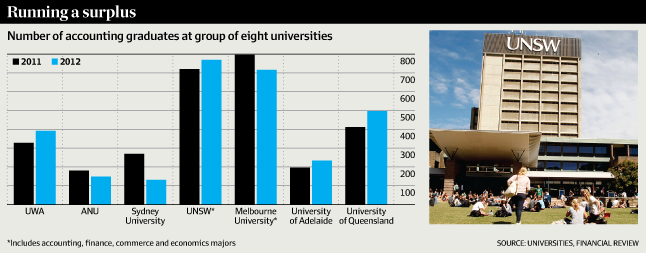
Accounting graduates face job market squeeze. And the notion of an accounting degree as a safe bet is under threat.

Accounting graduates face job market squeeze

PUBLISHED: 12 HOURS 11 MINUTES AGO | UPDATE: 4 HOURS 20 MINUTES AGO

e73cce96-c1ee-11e2-9cbc-90803cd1267c_22p33gradRESIZED

‘The supply of accounting education providers has increased – the market will become saturated and it will become difficult to get jobs,’ says Professor Raymond da Silva Rosa Photo: Bohdan Warchomij

AGNES KING

The trend towards offshoring low-level finance jobs and the fragmentation of financial services are affecting the job outcomes of accounting graduates. Confidential data being circulated among academics shows 25 per cent to 40 per cent of accounting graduates from the nation’s top universities haven’t secured work in the sector within a year of graduating. The market for accounting roles is becoming saturated. And the notion of an accounting degree as a safe bet is under threat. Read more of this post

Federal Reserve Bank of New York President Bill Dudley Says He Can’t Be Sure If Next QE Move Is ‘Up or Down’

Dudley Says He Can’t Be Sure If Next QE Move Is ‘Up or Down’

Federal Reserve Bank of New York President William C. Dudley said he has not decided whether the Fed’s next move should be to enlarge or shrink its bond buying program as he called for a fresh look at its eventual retreat from record asset purchases.

“Because the outlook is uncertain, I cannot be sure which way — up or down — the next change will be,” Dudley said in a speech today in New York.

Dudley adds his voice to a debate on the Federal Open Market Committee about what to do with its program of bond purchases, designed to lower the 7.5 percent unemployment rate. While many Fed officials have voiced support for shrinking purchases as the next step, Dudley, who is also vice chairman of the FOMC, signaled willingness to increase purchases. Read more of this post

Gold ETF Sellers Facing Tax Surprises at 28% Gains Rate

Gold ETF Sellers Facing Tax Surprises at 28% Gains Rate

Investors who dumped shares in gold exchange-traded funds amid the biggest selloff in the metal in four years may be in for a shock: capital-gains taxes are higher than for stocks and bonds.

Profits from investments in ETFs that back their shares with physical holdings of precious metals face taxes as high as 28 percent for investments held at least a year. That’s the rate the U.S. Internal Revenue Service applies to items it considers “collectibles,” such as coins, art, silver and gold. Long-term gains from stocks and bonds, including equity and fixed-income ETFs, are taxed at a maximum 20 percent.

“There are some tax surprises out there lurking for them when they go to sell,” Tim Steffen, director of financial planning at wealth-management firm Robert W. Baird & Co. in Milwaukee, said of gold exchange-traded product investors. Read more of this post

Gold’s Fall Stings University Endowment, saddling the second-largest U.S. college endowment with more than $300 million in paper losse

May 21, 2013, 5:22 p.m. ET

Gold U. Takes It on the Chin

Hit Is $300 Million at Endowment for Texas Schools, Which Invests in the Metal

By GREGORY ZUCKERMAN

MI-BW112_TEXAS_G_20130521183008

Gold’s slump has saddled the second-largest U.S. college endowment with more than $300 million in paper losses. But the swoon hasn’t shaken the faith of Bruce Zimmerman, who since 2007 has been chief executive of University of Texas Investment Management Co.

“We always prefer that our assets go up, rather than down, but we’re not day traders,” said Mr. Zimmerman, whose company invests $29.5 billion for the benefit of the University of Texas and Texas A&M systems. “Gold is a hedge, and it still fills that role.” Lately, investors have been dumping gold anew, citing limp inflation, a raging stock market and a reduced need for a safe-harbor investment. Gold prices fell Tuesday, their eighth decline in the past nine sessions. Few investors have suffered from the recent tumble like Utimco, which ranks behind only Harvard Management Co. in terms of assets in the university-endowment world. The organization holds about $1.1 billion of gold-related investments, down from about $1.4 billion before gold began heading south last October. Read more of this post

Hai Di Lao, a successful Chinese hot pot restaurant chain featuring waiters who swing 10-foot-long noodles around tables, tries to make the jump to the U.S.

May 21, 2013, 6:49 p.m. ET

Chinese Hot Pot Chain Hai Di Lao Makes Move to U.S.

By LAURIE BURKITT

PJ-BO413_HOTPOT_G_20130521172845

A Hai Di Lao employee, near right, performs a ‘noodle dance’ at a table of diners at a Beijing branch of the restaurant.

If P.T. Barnum had ever opened a restaurant, it might look a lot like Hai Di Lao, the popular chain of 75 Chinese eateries planning its first foray into the U.S. market this fall. Talk about a three-ring circus: Diners pass the time in the waiting area with Internet terminals, board games and kids’ toys. They can nibble on unlimited free snacks. Or kick back for a shoeshine, manicure or hand massage. In the dining room, patrons wearing full-size aprons provided by the restaurant lean together over the boiling caldrons embedded in each table, dropping morsels of uncooked meat, fish, vegetables or tofu in a spicy steaming broth, then dipping them in flavorful sauces. On special holidays, magicians in colorful, traditional masks perform tricks. Patrons order using iPads. Periodically, a server breaks into the restaurant’s signature Olympic-style “noodle dance.”

Such showmanship, along with service, has set Hai Di Lao apart in China’s burgeoning restaurant landscape and has distinguished it from competitors that also sell hot pot, the traditional communal cuisine that originated in Mongolia centuries ago. Spicy versions emerged from the southwestern city of Chongqing and expanded in neighboring Sichuan province and then across China. Hot pot is particularly popular with groups of young people and families. The act of pulling food from the caldron lends to the chain’s name, which in Mandarin means “fishing in the bottom of the sea.” Read more of this post

Hidden Bad Loans in Chinese Banks Raising Ponzi Risk

Hidden Bad Loans Raising Ponzi Risk

05-21 17:19 Caijing

Interest arbitrage practices, which constitute a self-loop within the financial sector, are likely to weaken the links between finance and the real economy and negatively impact the real economy.

By staff reporters Wang Peicheng, Dong Yuxiao, and You Xi

Official statistics show that the banking industry in China had 526.5 billion yuan worth of non-performing loans and a bad loan ratio of 0.96 percent by the end of the first quarter of 2013, which represents a 0.01 percent increase in the bad loan ratio since the end of 2012. However, the ratio is still below general expectations, given the slow and zigzagging growth in the real economy.

The real condition is far more serious than that reflected on financial reports, as are the potential risks in certain areas. “There is no point trying to gauge the actual risks facing the domestic banking industry with the bad loan ratio,” said an official at the China Banking Regulatory Commission (CBRC). Read more of this post

China’s banks face no-win situation; Given the continued downgrading of Chinese prospects, there may well be worse to come

May 21, 2013 5:29 pm

Inside Business: China’s banks face no-win situation

By Henny Sender

Given the continued downgrading of Chinese prospects, there may well be worse to come

When hundreds of private equity executives met in Washington last week to discuss emerging markets, China dominated the debate. This outcome at the International Finance Corporation and Emerging Markets Private Equity Association conference is hardly surprising, given how important China is for the health of the world economy and for the price of everything from coal to copper to credit.

Analysts have downgraded China’s growth prospects once more, making it clear that its slowdown is more than a cyclical phenomenon. Growth of 8 per cent used to be the floor and has instead become the ceiling, as Ruchir Sharma, managing director of Morgan Stanley Investment Management, puts it. Slowing growth is not necessarily a bad thing, if the quality of the growth improves. Maybe in time, it will. But not today. The rebalancing is still more aspiration than reality. Read more of this post

Buffett, With His Magic Touch, May Be Irreplaceable

MAY 21, 2013, 6:50 PM

Buffett, With His Magic Touch, May Be Irreplaceable

By STEVEN M. DAVIDOFF

Acquisitions usually come with a nice premium for the seller. But when Warren E. Buffett is the buyer, there is typically something of a discount.

The ability to make acquisitions on favorable terms is a testament to Mr. Buffett’s personality and skills as a deal maker. It also highlights an almost unsolvable problem for his company, Berkshire Hathaway, and its shareholders. When its 82-year-old chief executive is gone, who will negotiate such sweet deals?

A case in point is the $28 billion buyout of the H.J. Heinz Company by Berkshire Hathaway and a partner, the investment firm 3G Capital. The deal, announced in February, is expected to be completed by the end of the summer. Read more of this post

Korean chaebol CJ Group is under a prosecution investigation over an alleged slush fund

CJ hit by slush fund probe

2013-05-21

By Kim Jae-won prosecutors target chairman, raid offices

Prosecutors on Tuesday raided CJ Group’s Main Office and Affiliate firms, along with The Homes of a Number of executives in What appears to be an Investigation targeting Chairman Lee Jay-Hyun who is Suspected of Running a Slush Fund.  Read more of this post

World Not Ready for Mass Flu Outbreak: WHO

World Not Ready for Mass Flu Outbreak: WHO

By Agence France-Presse on 9:53 am May 22, 2013.
Geneva. The world is unprepared for a massive virus outbreak, the deputy chief of the World Health Organization warned on Tuesday, amid fears that H7N9 bird flu striking China could morph into a form that spreads easily among people. Keiji Fukuda told delegates at a WHO meeting that despite efforts since an outbreak of another form of avian influenza, H1N1, in 2009-10, far more contingency planning was essential. “Even though work has been done since that time, the world is not ready for a large, severe outbreak,” Fukuda said. Rapid-reaction systems were crucial, given that health authorities’ efforts are already hampered by lack of knowledge about such diseases, he insisted. “When people get hit with an emerging disease, you can’t just go to a book and know what to do,” he said.

Read more of this post

Pesticides Make a Comeback; Many Corn Farmers Go Back to Using Chemicals as Mother Nature Outwits Genetically Modified Seeds

May 21, 2013, 8:28 p.m. ET

Pesticides Make a Comeback

Many Corn Farmers Go Back to Using Chemicals as Mother Nature Outwits Genetically Modified Seeds

By IAN BERRY

MK-CD405_PESTIC_NS_20130521181204

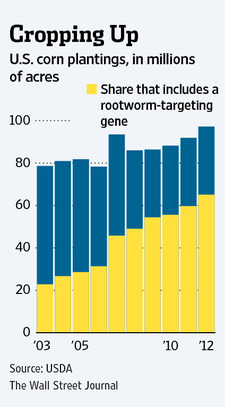
Insecticide sales are surging after years of decline, as American farmers plant more corn and a genetic modification designed to protect the crop from pests has started to lose its effectiveness. The sales are a boon for big pesticide makers, such as American Vanguard Corp.AVD +0.94% and Syngenta SYNN.VX -2.64% AG. But it has sparked fresh concerns among environmental groups and some scientists that one of the most widely touted benefits of genetically modified crops—that they reduce the need for chemical pest control—is unraveling. At the same time, the resurgence of insecticides could expose both farmers and beneficial insects to potential harm. Read more of this post

The Debt Problem Hasn’t Vanished; While deficit projections have recently moderated, the cost of servicing the national debt will explode once interest rates begin to rise

May 21, 2013, 6:59 p.m. ET

Gramm and McMillin: The Debt Problem Hasn’t Vanished

While deficit projections have recently moderated, the cost of servicing the national debt will explode once interest rates begin to rise.

By PHIL GRAMM AND STEVE MCMILLIN

President Obama has raised the national debt by nearly $6.2 trillion, the equivalent of $78,385 per family of four. It is true that projected deficits recently have been reduced. April tax filings increased 28% from 2012, but much of this was thanks to a one-time rush at the end of 2012 to report income before rates rose in January. The second largest reduction in the deficit came from Fannie Mae FNMA +11.04% taking a one-time accounting adjustment.

But unless the economy soars, or a significant budget agreement is reached, the most lasting legacy of the Obama presidency will be a $10 trillion increase in the national debt—a burden that bodes ill for the nation’s future.

Once the Federal Reserve’s easy-money policy comes to an end and interest rates return to their post-World War II norms, the cost of servicing this debt will explode. The cost will increase further as the Fed sells down its $1.85 trillion holding of government bonds, and the Social Security system runs deeper and deeper into the red. The Treasury will then have to pay interest on an ever-growing percentage of the debt. Read more of this post

Canada Real Estate Slump Only Just Beginning, Madani Says

Canada Real Estate Slump Only Just Beginning, Madani Says

Canada’s housing slump has only just begun and it is premature to say the market will have a so-called soft landing, said David Madani, an economist at Toronto-based Capital Economics Ltd.

“We don’t expect prices to rebound this year,” Madani said today at the Bloomberg Economic Summit in Toronto.

Finance Minister Jim Flaherty has acted four times in the past five years to make mortgage-lending rules more restrictive amid concern that the Vancouver and Toronto markets were overheating. Flaherty has said he welcomes a slowdown of condominium construction in the two cities and has warned consumers, who have a record debt-to-disposable-income ratio of 165 percent, not to become overextended. Read more of this post

Mobile Commerce Worth $4.29 Billion in Q1 in China, But One Company Dominates

Mobile Commerce Worth $4.29 Billion in Q1 in China, But One Company Dominates

May 21, 2013

by Steven Millward

We know that mobile commerce in China was worth $7.8 billion in 2012 – and is expected to rise to $41.4 billion in 2015 – but who are the biggest e-commerce brands among the nation’s mobile shoppers? New statistics from iResearch give us that answer and show that one company seriously dominates. The clear market leader for mobile-based shopping in China is Taobao, the iconic consumer-to-consumer shopping mall from Alibaba that’s been rocking China for a decade. In terms of the value of mobile purchases among Chinese consumers, Taobao leads with 75.1 percent market share. Some of that is from the parent company’s B2C marketplace Tmall. In second place in this sector is Jingdong (formally called 360Buy), which is also China’s second largest B2C e-tailer. Its share of the mobile sector is a lot lower than its share of the overall China B2C shopping market, suggesting that Jingdong – and, indeed, all other such Amazon-like brands – needs to seriously sharpen up its mobile strategy. I notice that, if we again compare mobile spending share with overall market share, it’s only two fashion e-commerce companies that are punching above their weight when it comes to mobile shoppers – own-brand clothing e-store Vancl and specialist handbag site Maibaobao. Here’s the market share pie chart: A fairly slow shift to m-commerce

iResearch estimates that Q1 2013 will see Chinese mobile netizens spending a total of RMB 26.6 billion ($4.29 billion) in all of these e-commerce companies. That indicates that 2013 will indeed be the biggest ever year for mobile commerce in China – possibly exceeding the research firm’s earlier estimates of $15.7 billion for the entire year: In Q1 2013, we see that PC-based shopping still dominates the country’s e-commerce sector , but mobile is rising fast, anticipated to reach 7.6 percent of purchases in the first quarter: If you can handle any more massive numbers you might like to know that China’s entire e-commerce industry looks set to be worth $177 billion in 2013. Keep an eye on our ‘e-commerce in China’ tag to get more news on this massive market.

Mobile-commerce-in-China-Q1-2013-stats-01Mobile-commerce-in-China-Q1-2013-stats-02Mobile-commerce-in-China-Q1-2013-stats-03