Sweden is leading the world in allowing private companies to run public institutions

Sweden is leading the world in allowing private companies to run public institutions

May 18th 2013 |From the print edition

SAINT GORAN’S hospital is one of the glories of the Swedish welfare state. It is also a laboratory for applying business principles to the public sector. The hospital is run by a private company, Capio, which in turn is run by a consortium of private-equity funds, including Nordic Capital and Apax Partners. The doctors and nurses are Capio employees, answerable to a boss and a board. Doctors talk enthusiastically about “the Toyota model of production” and “harnessing innovation” to cut costs.

Welcome to health care in post-ideological Sweden. From the patient’s point of view, St Goran’s is no different from any other public hospital. Treatment is free, after a nominal charge which is universal in Sweden. St Goran’s gets nearly all its money from the state. But behind the scenes it has led a revolution in the relationship between government and business. In the mid-1990s St Goran’s was slated for closure. Then, in 1999, the Stockholm County Council struck a deal with Capio to take over the day-to-day operation of the hospital. In 2006 Capio was taken over by a group of private-equity firms led by Nordic Capital. Stockholm County Council recently extended Capio’s contract until 2021.

St Goran’s is now a temple to “lean management”—an idea that was pioneered by Toyota in the 1950s and has since spread from carmaking to services and from Japan to the rest of the world. Britta Wallgren, the hospital’s chief executive, says she never heard the term “lean” when she was at medical school (she is an anaesthetist by training). Now she hears it all the time. Read more of this post

Obamacare Sees Swiss Show Mandatory-Private System Works

Obamacare Sees Swiss Show Mandatory-Private System Works

Money manager Tim McCarthy has worked in the U.S., Russia and Switzerland, and has seen doctors in all three countries for Hashimoto disease, a condition in which his immune system attacks his thyroid. He has no doubt which health system is best.

“On a price-quality ratio, Switzerland is better,” McCarthy said in a phone interview. “It’s not cheap, but you get what you pay for.”

McCarthy, 46, has lived in Switzerland for about five years, where he oversees more than $1 billion at Valartis Asset Management SA in Geneva. He said he pays about 16,500 Swiss francs ($17,220) a year in insurance premiums for his family of four. Buying private health coverage has been obligatory in Switzerland for all residents since 1996.

As the U.S. moves towards mandatory health insurance, the small alpine nation offers clues about what does and doesn’t work, said Valerie Paris, a senior health policy analyst at the Organization for Economic Co-operation and Development, who co-authored a 2011 report on the Swiss health system.

“Everybody has access to a wide benefit package, which is uniform and very popular,” Paris said in a telephone interview. “It is a unique system that makes sense.” Read more of this post

US energy revolution gathers pace as the Obama administration approved wider exports of liquefied natural gas and international companies committed billions of dollars for new infrastructure.

Last updated: May 17, 2013 9:21 pm

US energy revolution gathers pace

By Ed Crooks in New York, Jonathan Soble in Tokyo and Guy Chazan in London

The growing role of the US in world energy markets was underlined on Friday as the Obama administration approved wider exports of liquefied natural gas and international companies committed billions of dollars for new infrastructure.

The developments were both consequences of the shale revolution in the US, in which improvements in the techniques of horizontal drilling and hydraulic fracturing, or “fracking”, have unlocked new supplies of oil and gas, and raised the prospect that the US will be an increasingly important supplier of energy to the rest of the world.

The Department of Energy on Friday authorised the Freeport LNG project in Texas to export to countries that do not have a trade agreement with the US, including Japan and the members of the EU. It was the first such approval to be granted for two years and only the second ever. Read more of this post

China deal ends distraction, but not questions, for Caterpillar

China deal ends distraction, but not questions, for Caterpillar

Fri, May 17 2013

By James B. Kelleher

CHICAGO (Reuters) – Caterpillar Inc’s (CAT.N: Quote,ProfileResearchStock Buzz) deal to cut the purchase price of a Chinese mining-equipment maker it bought last year ends an embarrassing episode that overshadowed the company’s effort to expand in China and distracted its executives for months. Now, analysts say, comes the hard part: Proving to investors that ERA Mining Machinery, the Chinese maker of hydraulic roof supports that Caterpillar purchased, really can help penetrate China’s huge underground mining market. In January, Caterpillar took a $580 million impairment related to the ERA deal after discovering what it characterized as a “deliberate, multi-year, coordinated accounting misconduct” at Siwei, a subsidiary that handled ERA’s principal business. Late on Thursday, Caterpillar said it reached a deal with the former controlling shareholders of ERA to cut $135 million from the $886 million purchase price – a move welcomed by analysts even if the money involved was, in the words of one, “a blip” in the U.S. company’s overall finances. “Outside of the reduction in purchase price, the chief benefit of the settlement is to eliminate the management distraction caused by the issue and get on with realizing the potential that led Caterpillar to buy this company in the first place,” said Alex Blanton, a senior analyst at Clear Harbor Asset Management in New York. “Whether or not it realizes the potential is another question,” he said. Read more of this post

Less guff, more puff: Thanks to new digital tools, marketing is no longer voodoo

Less guff, more puff: Thanks to new digital tools, marketing is no longer voodoo

May 18th 2013 |From the print edition

20130518_wbc573

WHEN a power cut interrupted this year’s Super Bowl, advertisers lit up. “Sending some LEDs to the @MBUSA Superdome right now,” tweeted Audi, swiftly plugging its own LED-accented car while taking a dig at its rival Mercedes, sponsor of the New Orleans Superdome. Tide, a detergent, came up with: “We can’t get your #blackout, but we can get your stains out.” But by general consent Oreo won the tweet-off with “Power out? No problem. You can still dunk in the dark.” The biscuit baker’s reward: 16,000 retweets and 20,000 Facebook likes.

Super Bowl TV commercials are the Broadway spectaculars of the marketing world, broadcast to millions. The blackout banter is more like improv, created on the fly for a select audience. Marketers these days must master both. It is not easy. Lightning reflexes have never been part of a marketer’s toolkit. Chief marketing officers (CMOs) “used to deliver big iconic brand ideas on a seasonal basis,” says Luke Taylor of DigitasLBi, a digital advertising agency. Some “are outside of their comfort zones”.

Nearly 40% of CMOs do not think they have the right people and resources to meet their goals, says an Accenture report entitled “Turbulence for the CMO”. Martin Sorrell, the boss of WPP, the world’s biggest marketing and advertising group, says that since the 2008 financial crisis marketers have been elbowed aside by finance and procurement chiefs. Dominique Turpin, the head of IMD, a Swiss business school, writes that “the CMO is dead”. Read more of this post

Korea still behind in software power; “The biggest issue is the lack of appreciation for intangible assets imbedded in Korean culture”

2013-05-17 17:23

Korea still behind in software power

State-run program needed to nurture software talent

By Cho Mu-hyun

Korea’s competiveness in the global IT industry has to date been from making durable, high quality hardware. Though many use Samsung Electronics’ Galaxy S3, few would say they’ve ever used a program made here and if they did, with satisfaction. The local industry has been well aware of the problem, even before big-named brands such as Samsung and LG kicked off abroad. But now that the new administration is pushing for a “creative economy,” there have been more visible initiatives for more software.
However, many say there is a fundamental issue that needs resolving. Hiring a bunch of software developers or pouring in money, which many conglomerates have been doing, doesn’t touch the heart of the matter, they say. “The biggest issue is the lack of appreciation for intangible assets imbedded in Korean culture,” said an executive of an enterprise software developer, requesting anonymity. “Piracy is embarrassingly high compared to other mature markets in the Asia Pacific region.” Read more of this post

Intel’s Outgoing CEO Says He Passed On A Chance To Get Intel Chips Inside The First iPhone

Intel’s Outgoing CEO Says He Passed On A Chance To Get Intel Chips Inside The First iPhone

Kevin McLaughlin | May 17, 2013, 7:48 AM | 2,765 | 2

When Steve Jobs unveiled Apple‘s first Intel-powered Macs at a January 2006 event in San Francisco, Intel CEO Paul Otellini made a dramatic entrance, emerging onstage from a cloud of smoke wearing a “bunny suit,” the protective outfit workers wear in Intel’s semiconductor fabrication plants. Otellini didn’t often engage in such bizarre pageantry during his 8-year tenure as Intel CEO, which officially ended Thursday. But the Apple Mac deal was a major coup for Intel, and the bunny suit helped Otellini drive that message home.  Now, as Otellini heads into retirement, he’s talking about an even bigger deal with Apple that he wasn’t able to close. When Apple was working on a prototype for the first iPhone, it approached Intel about making the processor for the device. But Intel passed on the opportunity because it didn’t make sense financially, Otellini told Alexis Madrigal of The Atlantic in an interview published Thursday.  “At the end of the day, there was a chip that they were interested in that they wanted to pay a certain price for and not a nickel more and that price was below our forecasted cost. I couldn’t see it,” Otellini told Madrigal. “It wasn’t one of these things you can make up on volume. And in hindsight, the forecasted cost was wrong and the volume was 100x what anyone thought.” While Otellini kept Intel on a profitable path, he wasn’t able to figure out how to make Intel relevant in smartphones, the majority of which are running ARM chips. Intel is still trying to figure out its mobile strategy, and incoming CEO Brian Krzanich said Thursday that he plans to fix this. Of course, Otellini isn’t the only tech executive who didn’t anticipate the impact the iPhone would have. Shortly before Apple launched the iPhone, Microsoft Steve Ballmer said it had “no chance” of gaining meaningful market share. Otellini told Madrigal his gut reaction was to pull the trigger on the Apple mobile deal. But he didn’t, and so it’s likely every time Otellini sees someone using an iPhone, he’ll cringe a little bit inside.

Target goes hunting in Silicon Valley, following Wal-Mart

Target goes hunting in Silicon Valley, following Wal-Mart

Fri, May 17 2013

By Alistair Barr

SAN FRANCISCO (Reuters) – Target Corp (TGT.N: Quote,ProfileResearchStock Buzz) said on Friday it opened a new San Francisco office to track down technology companies that can help the second-largest U.S. retailer grow its online commerce business. Target’s Technology Innovation Center is run by David Newman, an executive who spent six years at the online business of Wal-Mart Stores Inc (WMT.N: QuoteProfile,ResearchStock Buzz), which has had a major presence in Silicon Valley for several years. “Partnership is in our DNA and early-stage companies can sense that and are proving to be very willing to partner and co-develop,” said Newman. Many retailers are pouring money into new technology to help them catch up with Amazon.com Inc (AMZN.O:QuoteProfileResearchStock Buzz), which has become the world’s largest retailer by grabbing market share from traditional bricks-and-mortar stores. Mobile commerce, powered by smartphone-wielding shoppers, is a particular focus of retailers because this technology has the potential to revitalize in-store sales. Read more of this post

Coming to terms with China’s growth prospects

Coming to terms with China’s growth prospects

Yukon Huang

May 16, 2013

Markets have not been enthused by the numbers coming out of China in recent months. Typical headlines are “China’s production indicators disappoint” or “analysts are worried that rapid expansion is faltering”. Estimates of China’s economic growth this year are slipping from more than 8 per cent to something closer to 7.5 per cent. Those concerned about the country’s longer-term growth challenges, however, tend to be more relaxed about near-term outcomes but preoccupied with the new leadership’s commitment to reforms. Is there a trade-off between reviving the economy and establishing a sustainable basis for longer-term growth? Unfortunately there is. Beijing has run out of good options to further stimulate the economy as a strategy to buy time until western economies rebound. There are lessons from what happened in the aftermath of China’s post Asian financial crisis stimulus more than a decade ago. At that time China responded with a massive programme comparable to its more recent effort in the aftermath of the global financial/fiscal crisis spurred by the economic collapse in the US and Europe. China’s confidence in stimulus programmes was unrealistically buoyed by its success in dealing with the Asian crisis which resulted in a soft landing followed by years of sustained and rapid growth. But the lingering consequences of the 2009 stimulus package have not been as benign, with no signs that the resulting high debt levels are moderating and that continued expansionary credit policies are spurring production and real demand. Read more of this post

As cost of living rises, Singaporeans turn to pawnshops; Economist Intelligence Unit has ranked Singapore the world’s sixth most expensive city to live in.

As cost of living rises, Singaporeans turn to pawnshops

Agence France-Presse

Posted at 05/18/2013 12:31 PM | Updated as of 05/18/2013 12:32 PM

SINGAPORE – Singaporean housewife Siti Khadijah Abdul Rahman accumulated a few thousand dollars’ worth of gold accessories over the past two decades, but now a rising cost of living is forcing her to pawn them.

With a stretched household budget that must also cater to school expenses for her two teenaged children, the 49 year-old is pawning her gold to relieve pressure on her security guard husband, who earns Sg$1,500 ($1,211) a month.

“Pawning is better than going to friends or family when you have budget problems,” said Abdul Rahman. “When I have money, I will claim it back.”

She is one of a rapidly increasing number of people opting to take short-term pawnshop loans to try to keep up with rising prices, in what the Economist Intelligence Unit has ranked the world’s sixth most expensive city to live in. Read more of this post

American Capital Fights Fed Exit Worry as Investors Flee

American Capital Fights Fed Exit Worry as Investors Flee

Gary Kain built American Capital Agency Corp. (AGNC) into the fastest growing real estate investment trust as the Federal Reserve pushed borrowing costs to record lows. Now he’s trying to persuade investors to stay with him as he navigates the central bank’s retreat.

American Capital slumped 11 percent since May 2 through yesterday, the worst performance in a Bloomberg index of 34 companies that invest in mortgage bonds, after reporting an 8.6 percent drop in book value from the prior quarter. Annaly Capital Management Inc. (NLY), the only mortgage REIT bigger than American Capital, said its book value, a measure of its assets minus its liabilities, fell 4 percent.

“The issue isn’t if the Fed exits, it’s a question of whether they exit way earlier than expected,” Kain said in a telephone interview. “We feel like positions are in much better shape now than they were in the January-February time frame.”

Firms that buy government-backed home-loan bonds are under pressure as investors speculate the Fed will withdraw from buying $40 billion of mortgage securities each month as the economy shows signs of strengthening. American Capital, which increased assets over three years more than 20-fold to $100.5 billion at the end of 2012, plunged the most of mortgage REITs after targeting higher-priced bonds that would benefit from continued Fed intervention. Read more of this post

Europe’s EUR 500 Billion Ticking NPLTime Bomb

Europe’s EUR 500 Billion Ticking NPLTime Bomb

Tyler Durden on 05/17/2013 20:14 -0400

Europe’s non-performing loan problem is such an issue that there is increasing bluster that the ECB may take this garbage on to its balance sheet since policymakers realize that bad debts and non-performing loans (NPLs) reduce the capacity of banks to lend, hindering the monetary policy transmission mechanism. Bad debts consume capital and make banks more risk averse, especially with respect to lending to higher risk borrowers such as SMEs. With Italy (NPLs 13.4%) now following the same dismal trajectory of Spain’s bad debts, the situation is rapidly escalating (at an average of around 2.5% increase per year). As we discussed in detail here, the bottom line is that at its core, it is all simply a bad-debt problem, and the more the bad debt, the greater the ultimate liability impairments become, including deposits. As we answered at the time – the real question in Europe is: how much impairment capacity is there in the various European nations before deposits have to be haircut? With Periphery non-performing loans totaling EUR 720bn across the whole of the Euro area in 2012 and EUR 500bn of which were with Peripheral banks, it seems the Cyprus deposit haircut non-template may indeed become the key template. Simply put, the greater the unemployment the more the strain on banks to generate “profits” by any means possible (GGBS?) to cover the capitalization shortfall from NPLs until at some point liability haircuts have to begin… 

Non-performing loans as % of total loans across the Euro area; Unemployment rates across Euro area countries

20130517_NPL1_020130517_NPL2_0

Via JPMorgan: It is not surprising that the periphery is exhibiting a rising pattern in terms of NPL ratios. What is worrying is the speed of increase, at 2.5% per year. Within the periphery, Greece is the outlier with a NPL ratio of 25%, and no signs of abating yet. Ireland follows with a NPL ratio of 19%. Italy (at 13.4%) is above Spain and Portugal (at close to 10%)… The German divergence is making the task of the ECB very difficult both in terms of setting monetary policy for the whole region, but also in terms of dealing with an impaired transmission outside Germany. Draghi clarified in its latest press conference that it is not the ECB’s role to clean up banks’ balance sheets, meaning that the ECB is unlikely to deal itself with the €500bn large non-performing loan problem in periphery.

Stranded Dad Decries Frankfurt Ban on Night Flights Aiding Dubai; “You can hub through Dubai rather than Heathrow or Frankfurt. There is no curfew in Dubai.”

Stranded Dad Decries Frankfurt Ban on Night Flights Aiding Dubai

Shortly after 10 p.m. in Frankfurt, Peter Meany settled into his seat on Qantas Airways Ltd. (QAN) flight QF6, looking forward to reuniting with his family in Sydney for his son’s birthday after a two-week business trip across Europe.

Meany, a 38 year-old fund manager with Qantas frequent-flier status, would miss the party. As the plane crawled to the runway, passengers were surprised to learn that they were five minutes over the last permitted takeoff time and would need to turn back. Frustrated and tired, Meany and his fellow travelers spilled back into the deserted airport building.

“People knew they weren’t going to see their families as planned, or wouldn’t make their meetings,” Meany said. “Bad weather is unavoidable, but I haven’t been in a situation like this in 20 years of flying.”

Meany is among more than 28,000 passengers who have been left stuck on the outskirts of Germany’s financial capital since Frankfurt introduced the night-flight ban in October 2011. While creating a steady stream of involuntary guests for local hotels, the directive has eaten into Deutsche Lufthansa AG (LHA)’s earnings and encourages long-distance passengers to travel via Dubai, where operations run around the clock. Read more of this post

EU Ban Leaves Buyers Holding 144 Million Homeless Carbon Credits

EU Ban Leaves Buyers Holding 144 Million Homeless Carbon Credits

Companies holding United Nations carbon offsets equivalent to 7 percent of the European Union’s annual emissions cap risk losing their investment unless they find a buyer for the credits the bloc banned earlier this year. Power stations and factories in the EU’s emissions-trading system still hold 144 million of the UN offsets after surrendering 552 million in the five years through 2012, EU data compiled by Bloomberg show. The bloc banned the use of credits awarded to projects that destroy nitrous oxide and hydrofluorocarbon-23, two powerful greenhouse gases. The UN’s Clean Development Mechanism awards Certified Emission Reductions, or CERs, to projects in developing countries that reduce climate pollution. The projects can sell the offsets to buyers in cap-and-trade markets such as Europe’s, who use the credits to cover emissions, or to governments seeking to meet Kyoto Protocol emissions targets. The banned credits, known as grey CERs, will “either end up in the hands of the sovereigns, or they become worthless,” Trevor Sikorski, an analyst in London at Energy Aspects Ltd., said by e-mail May 16. “With market prices where they are, one should be able to pick up an issued grey CER spot for 10 euro cents or so.”

Read more of this post

Purloined Picassos Chased by FBI Art Sleuths for Wealthy; “Stolen art, stolen antiquities move into a legitimate market very easily.”

Purloined Picassos Chased by FBI Art Sleuths for Wealthy

Stored inside a laptop at FBI headquarters are photos of thousands of paintings, sculptures and artifacts, works by Vincent Van Gogh and Henri Matisse, Pablo Picasso and Paul Cezanne — international treasures worth millions of dollars each. All are missing.

The computer belongs to Bonnie Magness-Gardiner, a PhD in Near Eastern archeology who leads the agency’s art-theft program and considers herself one of the least-likely employees walking through the doors of the J. Edgar Hoover Building headquarters in Washington each morning.

As wealthy investors seek to diversify their assets and Wall Street art enthusiasts like SAC Capital Advisors LP founder Steven Cohen beef up their collections, art crime is a growth industry and an increasingly important target for the Federal Bureau of Investigation. Read more of this post

Multiproduct Multinationals and the Quality of Innovation

Multiproduct Multinationals and the Quality of Innovation

Sasan Bakhtiari University of New South Wales

Antonio Minniti Catholic University of Louvain (UCL) – Center for Operations Research and Econometrics (CORE)

Alireza Naghavi University of Bologna – Department of Economics

May 10, 2013
Quaderni DSE Working Paper N° 879

Abstract: 
This research sheds light on the role of product scope on the innovation activity of multinational multi-product firms. We use patent citation data to break down innovation into two types by measuring the degree to which innovation performed by firms is fundamental and the extent to which the output of the R&D can be spread across different product lines. We focus on two features in multinational production: (i) fundamental innovation is geographically more difficult to transfer abroad to foreign production sites, (ii) learning spillovers can occur from international operations. The results reveal that the second effect is more likely to dominate when a firm is active in more product lines. We argue that a more diversified portfolio of products increases a firm’s scope of learning from international operations, thereby enhancing its ability to engage in more fundamental research. In contrast, firms with less product lines that geographically separate production from innovation shift the innovation activities towards more specialized types of innovation.

Education 2.0 In Indonesia: Inspiring Bamboo Innovators (Jakarta Post)

Dear Friends and All,

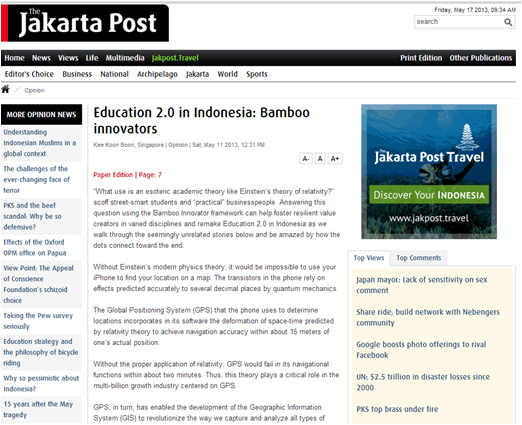
“What use is an esoteric academic theory like Einstein’s theory of relativity?” Answering this question with the Bamboo Innovator framework can surprisingly lead to the uncovering of resilient compounders: the Indonesian-listed bread company Indosari, the largest mass-market producer of bread in Indonesia under the “Sari Roti” brand, and Mexican-listed Grupo Bimbo, the largest bread manufacturer in the world. Interestingly, Indosari’s market value of US$750 million (now over US$900 million) is almost 20-times smaller as compared to Mexico’s Grupo Bimbo’s US$15 billion, even though both Indonesia and Mexico have gross domestic product (GDP) of US$1 trillion. What is so unique about the business models at Indosari and Grupo Bimbo? Why are they Bamboo Innovators? I like to share the article that was published in Jakarta Post, the oldest and largest-circulated English newspaper (one of the few dailies who survived the 1997/98 Asian Financial Crisis): “Education 2.0 in Indonesia: Inspiring Bamboo Innovators”.

Education 2.0 In Indonesia: Inspiring Bamboo Innovators, May 11, 2013 (Weblink: Jakarta Post)
Jakarta Post_Bamboo Innovators

Below is the unedited version:

Education 2.0 in Indonesia: Inspiring Bamboo Innovators

April 2013

“What use is an esoteric academic theory like Einstein’s Theory of Relativity?” scoffed the “street-smart” students and “practical” businesspeople. Answering this question using the Bamboo Innovator framework can help foster resilient value creators in varied disciplines and remake Education 2.0 in Indonesia as we walk through the seemingly unrelated stories below and be amazed by how the dots connect towards the end.

Without Einstein’s modern physics theory, it would be impossible to use your iPhone to find your location on a map. The transistors in the phone rely on effects predicted accurately to several decimal places by quantum mechanics. The Global Positioning Satellites (GPS) that the phone uses to locate us incorporate in their software the deformation of space-time predicted by relativity theory to achieve navigation accuracy within about 15 meters of our actual position. Without the proper application of relativity, GPS would fail in its navigational functions within about 2 minutes. Thus, this theory plays a critical role in the multi-billion growth industry centered around the GPS.

GPS, in turn, has enabled the development of the GIS (Geographic Information System) to revolutionize the way we capture and analyze all types of geographical data for multiple applications from urban planning, disaster response, epidemic planning, mining and oil exploration to location-based services. ESRI is the GIS software pioneer, founded by Jack Dangermond in 1969. ESRI has an installed base of more than one million users in more than 350,000 organizations with over a billion in annual revenue achieved by 3,000 employees. ESRI grew by focusing on its users and employees, eschewing incentives such as sales commissions. “People want to do the right thing; they want to be purposeful in their life,” Jack said. “Throwing financial thresholds and goals — my experience in running at least my kind of organization is that it robs people of the culture of doing great things.”

ESRI, in turn, is linked to Singapore entrepreneur Wong Fong Fui who runs the conglomerate Boustead, which has exclusive country license to ESRI GIS software in South East Asia and Australia. Mr Wong is known as a turnaround specialist, having helped the loss-making unfocused QAF with a market cap of $15 million then in 1988 to build the Gardenia bakery brand in Singapore into a $500 million food business when it was sold, and now Boustead, which he bought for $14 million in 1996 and has a current market value of $580 million.

Interestingly, this $500 million market value has been exceeded by Wendy Yap who helped focus her family business Nippon Indosari to become a Gardenia 2.0 and the largest mass-market producer of bread in Indonesia under the “Sari Roti” brand with a market value of $750 million. Around the same time FF Wong got into Boustead, Wendy started Indosari in 1995 with her father Piet Yap, one of the Salim Group executive who co-founded Bogasari Flour Mills. The typical businessman might shrug and point out that for Indosari to be bigger than Gardenia is an obvious observation, since Indonesia is a far larger market than Singapore. However, many companies and MNC giants such as SaraLee had tried to expand in Indonesia earlier but all retreated with heavy losses. So why was Wendy Yap able to scale up while others with abundant tangible resources failed?

Indosari has adopted an open innovation business model in collaborating with Japan’s Shikishima Baking who helped Indosari in its technological processes in introducing Japanese-style soft breads that won over the Indonesian palate. Importantly, Indosari has built trust with retailers and customers to overcome the logistics nightmare that doomed its better-capitalized rivals through its strong distribution network for its highly-perishable products of more than 2 million pieces of bread daily, resulting in a dominant 90% market share. It sells its products through modern distribution channels and an innovative system of around 3,000 mobile tricycle carts to penetrate over 17,000 small traditional shops in the rural parts of Indonesia.

Yet, Indosari’s market value at $750 million pales in comparison to Mexico’s Grupo Bimbo’s $15 billion even though both Indonesia and Mexico have a GDP of $1 trillion. Bimbo is also the world’s largest bread manufacturing with over $13 billion in sales. So why is this “small white teddy bear”, Bimbo’s corporate image, which “began with great limitations” in 1945 from Mexico, a country where half the population lived below the poverty line, able to become the largest in the world and compound 24-fold in market value since 1994?

Given that over 80% of bread is sold in mom-and-pop stores in Mexico scattered miles from one another over poor roads, cultivating trust and support amongst its community of customers, suppliers and employees is critical to overcome the geographical limitations in scaling up. Small store owners tend to ask for credit which was provided informally by Bimbo. Its partnership with community bank FinComún leveraged upon the bank’s pioneering expertise in providing micro-loans to extend credit yet reduce bad debt and improve working capital position to free up more cash to carry out expansion. In a country known for the exploitation of workers, Bimbo has built an unusually people-oriented culture with its well-known policy of avoiding layoffs even in times of crisis and sponsoring its employees’ education which helped foster loyalty and committment. As a result, Bimbo was able to resist the 1991 threat from the arrival on the Mexican market of giant PepsiCo. While Bimbo innovated in integrating production-delivery-finance, none of it would amount to much if Bimbo had not offered the country affordable, edible aspiration, spreading this dream to nearly every remote corner of Mexico.

There is a common thread running through these stories: the resilient Bamboo Innovator. The vitality of the bamboo revolves around its empty hollow center in the same way as the “emptiness” of the Bamboo Innovator with its “indestructible intangibles” that derive its strength from “know-how” and “trust and support in the community”. The “emptiness” is why bamboo bend but not break in the wildest storms that snapped the mighty resisting oak tree. The intangible know-how in relativity theory has led to the multi-billion GPS industry which enabled the development of the GIS pioneered by Jack Dangermond’s ESRI whose leadership nurtured a culture of empowerment and innovations. FF Wong is attracted by this intangible know-how of ESRI, having built the “intangible” Gardenia brand. At the same time when FF Wong is building Boustead, Wendy Yap has scaled up a bigger, more focused Gardenia 2.0 at Indosari by cultivating trust and support in the company’s community of customers, suppliers, partners and employees, in the same way this “emptiness” worked wonders at Grupo Bimbo.

In the landscape of Education 2.0 in Indonesia, students can search for facts on Google, but Google and Facebook cannot tell them how to connect the dots in alignment with their talent and personality to pursue what they can excel in. With the Bamboo Innovator in their hearts, they will experience the uncanny: the raw sensual data reaching their eyes before and after are the same, but with this pertinent framework of meaning, the chaotic features and anomalies in the marketplace are visible. Instead of producing “grades”, “checklist-based holistic CV” and “high graduation salary”, the education system inspires students to be the Jack Dangermond inventor, the FF Wong and Wendy Yap entrepreneur, the quantum mechanics engineer and physics expert, the geography-based business and trade specialist, the teacher and the value investor, and so on. Their fate all intertwined as Bamboo Innovators to forge their own larger-than-self path to create value for Indonesia and the world.

2,557th birthday of Buddha celebrated in S. Korea

2,557th birthday of Buddha celebrated in S. Korea

Xinhua)  15:15, May 17, 2013

F201305171518414713119182

Ben Franklin’s Face-Lift: The New $100 Bill

Ben Franklin’s Face-Lift: The New $100 Bill

By Keenan Mayo on May 16, 2013

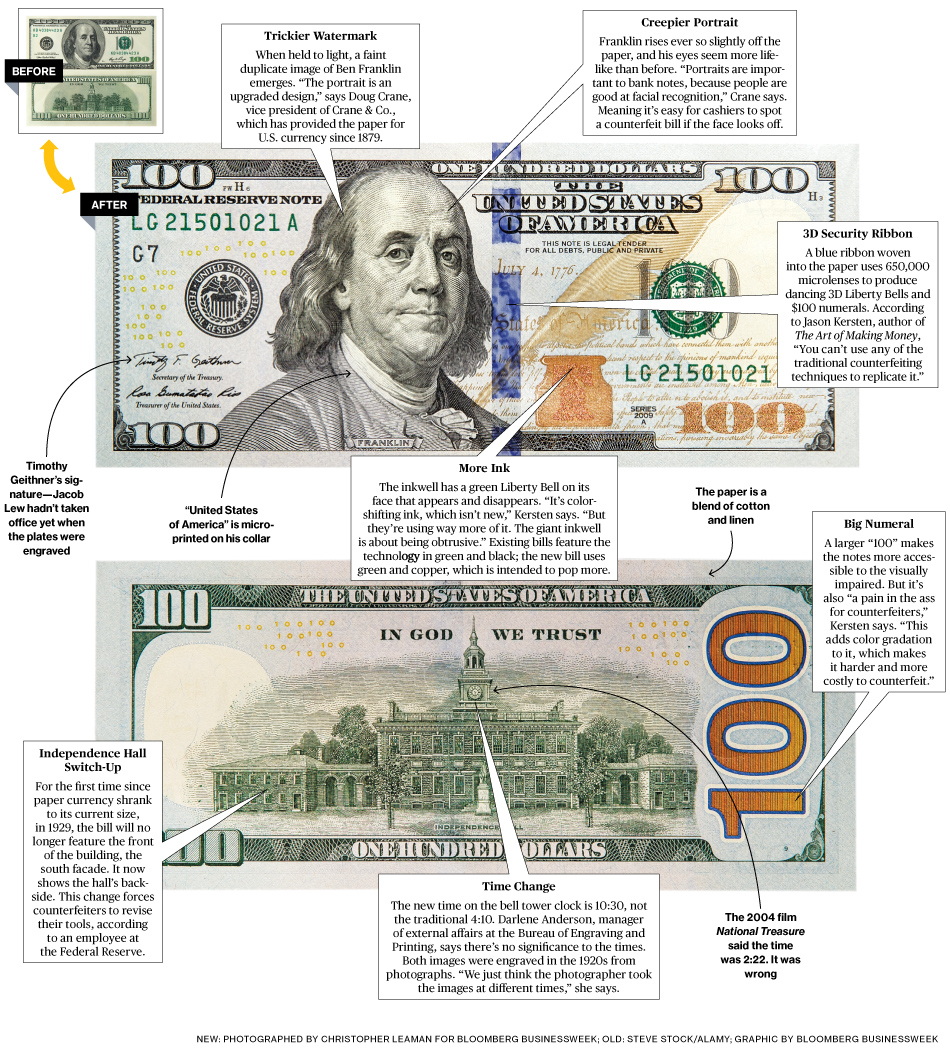
After a three-year delay, the new high-tech $100 bill enters circulation this fall. Here’s how it’s designed to beat the counterfeiters.

etc_money21_950

Education strategy and the philosophy of bicycle riding

Education strategy and the philosophy of bicycle riding

Budiono Kusumohamidjojo, Jakarta | Opinion | Tue, May 14 2013, 11:04 AM

Paper Edition | Page: 7

Indonesia is a vast country that should not tolerate dilettantish national policy formulations, let alone in the field of education, which should always be perceived as the most important undertaking of human investment.
With its population of 240 million people and abundant natural resources, it is a land that is badly in need of a state of the art education strategy.
Indonesia’s education strategy should be capable to withstand geopolitical shifts, yet, flexible enough for policy adjustments that may be called for by changes in the course of national development.  Read more of this post

Hedge Funder’s Advice On How To Go Through A Company’s Annual Report

Hedge Funder’s Advice On How To Go Through A Company’s Annual Report

BlackHatWall Street Oasis | May 16, 2013, 1:15 PM | 9,420 | 5

Still jet-lagged by 8 hours from a day and a half in London, I haven’t slept for a good 48 hours and remembered I owe WSO my process for dissecting a 10-k in the usual form. Before I get right into it, keep in mind every business is different and that will dictate the way you should read their specific annual report. What might be important to look at for an oil & gas company might be completely ignored for a hardline retail company, so don’t take this as gospel when your PM tells you to get up to speed on a company and you remember the stupid shit old BlackHat told you was right and you end up missing something crucial to making an investment decision. So with that, here is a full breakdown of how I like to look through a 10-K for the first time, what’s important to focus on, and what can be glazed over (if anything) to save time and/or not confuse yourself. As always, I’ll field questions afterwards if and when I feel like it to clear anything up. Read more of this post

16 Wildly Successful People Who Majored In English: Steven Spielberg, Hank Paulson, Mitt Romney, Michael Eisner

16 Wildly Successful People Who Majored In English

Vivian GiangLynne Guey and Max Nisen | May 16, 2013, 5:13 PM | 57,027 | 9

Guess what, contrary to popular belief, you’re not entirely screwed out of having a successful career if you get an English degree.  English majors get a bad rap in today’s college debate, and it seems they always have.  It’s argued that their education doesn’t provide the necessary skills required in today’s economy. However, there are always exceptions to the rule, and many English majors go on to become highly successful people in business, government and technology. We’ve included 17 people who prove that success is determined by your drive, not background.

Singer Sting was an English major at Northern Counties College of Education.

He might be known for his musical career, but at one time, Sting was a school teacher until he decided to pursue his musical passions full-time. He has since received additional honorary music degrees from Northumbria University and Berklee College of Music.

Mitt Romney, CEO of Bain Capital, was an English major at Brigham Young University.

Mitt Romney acquired a multimillion-dollar fortune running private equity firm Bain Capital. His success in business was a popular selling point during his 2012 presidential campaign. But he didn’t get that background from an undergraduate degree. He actually graduated from Brigham Young University with a B.A. in English before going on to Harvard to get his MBA and J.D. Read more of this post

The Greatest Blunders Of Genius Scientists

The Greatest Blunders Of Genius Scientists

Clara MoskowitzLiveScience | May 16, 2013, 2:47 PM | 3,699 | 8

Even geniuses make mistakes, and sometimes those mistakes turn out to be genius in their own right, helping to illuminate some underlying mystery or impacting the way an entire field thinks. In celebration of happy accidents and enlightening errors, astrophysicist Mario Livio of the Space Telescope Science Institute in Baltimore, Md., tells the stories of five great scientific mistakes in his new book “Brilliant Blunders” (Simon & Schuster, May 14, 2013). These stories serve to show how even the smartest among us can err, and that in fact to achieve a big breakthrough, big risks are necessary, which sometimes also involve big failures. Below are Livio’s choices for the most brilliant scientific blunders. [Oops! 5 Retracted Science Studies]

Darwin’s notion of heredity

Charles Darwin achieved an amazing feat when he came up with his theory of natural selection in 1859. “Darwin was an incredible genius,” Livio told LiveScience. “His idea of evolution by natural selection is just mind-boggling — how he came up with something so all-encompassing as that. Plus Darwin really didn’t know any mathematics so his theory is entirely non mathematical.” This feat is even more incredible given the notion of heredity how traits are passed from parents to offspring) that Darwin and scientists of the time subscribed to would have made natural selection impossible. At the time, people thought the characteristics of the mother and the father simply get blended in the offspring just as a can of black paint and a can of white paint blend to create gray when combined. Darwin’s error was in not recognizing the conflict between this idea and his new theory. “If you introduce one black cat into a million white cats, the theory of blending heredity would just dilute the black color away completely. There’s no way you would ever end up with black cats,” Livio said. “Darwin didn’t understand this, he really didn’t catch this point.” It wasn’t until the concept of Mendelian inheritance was widely accepted and understood in the early 1900s that the puzzle pieces of natural selection fell into place. Gregor Mendel proposed correctly that when traits from two parents come together, rather than blending, one or the other is expressed. “As it turned out, Mendelian genetics worked precisely to solve this problem. In Mendelian genetics you mix more like you’re mixing two decks of cards, where each card retains its identity — not like paint,” Livio said. Read more of this post

Bill Gates Retakes World’s Richest Title From Carlos Slim

Bill Gates Retakes World’s Richest Title From Carlos Slim

Bill Gates is once again the world’s richest person.

The 57-year-old co-founder of Redmond, Washington-based Microsoft Corp. (MSFT) recaptured the title from Mexican investor Carlos Slim yesterday, according to the Bloomberg Billionaires Index, as the software maker hit a five-year high. It is the first time Gates has held the mantle since 2007. His fortune is valued at $72.7 billion, up 16 percent year-to-date.

Slim’s America Movil (AMXL) SAB, the largest mobile-phone operator in the Americas, has dropped 14 percent this year after Mexico’s Congress passed a bill that could quash the billionaire’s market dominance. That’s helped erase more than $3 billion from the 73-year-old tycoon’s net worth.

“When they’re talking about reform in a country that’s generally poor, and the guy shows up No. 1 on the list — not a good thing,” said Greg Lesko, managing director at New York-based Deltec Asset Management LLC, which oversees $750 million and has an “underweight” position in Slim’s flagship company. “He’s had a pretty good monopoly situation in Mexico, and the Mexican cellphone user has been paying more than he should. We applaud it for the country.” Read more of this post

Dan Brown’s Secret to Keeping Secrets; The best-selling author visits locations he never plans to write about, just to keep fans and readers guessing

May 16, 2013, 6:17 p.m. ET

Dan Brown’s Secret to Keeping Secrets

The best-selling author visits locations he never plans to write about, just to keep fans and readers guessing

By ALEXANDRA ALTER

When Dan Brown was researching his new novel, “Inferno,” a Dante-themed thriller set in Florence, he visited Michelangelo’s statue of David multiple times, and spent hours studying floor plans of Florence’s Uffizi Gallery, home to masterpieces by Leonardo da Vinci, Raphael and Botticelli. But the Uffizi and the David are mentioned only in passing in “Inferno,” and Mr. Brown never intended to use them to much effect. He visited the sites as a sort of cover, to throw people off and prevent plot points from leaking out. For Mr. Brown, who has made a name for himself writing novels about explosive revelations and codes, secrecy is paramount. So he uses a technique that he has mastered as a thriller writer: misdirection. “If I’m trying to keep things secret, it’s impossible to talk to these specialists without them saying, ‘Oh, my God, you wouldn’t believe who was here today and what he was asking,’ ” Mr. Brown says. “These trips usually take longer than they should, because out of 10 things I see, five of them have nothing to do with the book. I’m constantly trying to keep people guessing as to what I’m doing.” Read more of this post

Out of sync with the world: Depressed people suffer with ‘broken body clocks’

Out of sync with the world: Depressed people suffer with ‘broken body clocks’

  • There is a link between depression and changes in the body’s circadian rhythm, or body clock
  • There is a daily rhythm to the activity of many genes across many different areas of the brain
  • The pattern of gene activity is so distinctive that it can be used to estimate the hour of someone’s death
  • In people with depression clock is so disrupted that day pattern of gene activity can look like night pattern

By EMMA INNES

PUBLISHED: 11:39 GMT, 14 May 2013 | UPDATED: 11:48 GMT, 14 May 2013

Depressed people are out of sync with the rest of the world because their body clocks are broken, according to a new study.

The discovery of disrupted body clocks in the brains of people with depression is the first link to be found between the condition and changes in the circadian rhythm.

It is hoped that the finding will allow for the development of better treatments. Read more of this post

Richemont Chairman Rupert to Take Sabbatical After 25 Years; “I just want to be the master of my own time for a while,” he said, adding he will return. “It’s ironic that someone in the watch business isn’t in control of his time.”

Richemont Chairman Rupert to Take Sabbatical After 25 Years

Cie. Financiere Richemont SA (CFR) Chairman and controlling shareholder Johann Rupert will take a year off, leaving management of the world’s second-biggest luxury-goods company to a team of executives including Cartier’s former CEO. The stock rose as much as 7.6 percent to a record after the Geneva-based maker of Montblanc pens and Chloe fashion said it’s increasing its dividend 82 percent to 1 Swiss franc a share to mark its 25th anniversary. Rupert’s leave will put the company in the hands of Co-Chief Executive Officers Richard Lepeu and Bernard Fornas, who previously ran Cartier. The 62-year-old South African billionaire ended his third stint as CEO in March after having taken on the job in 2010 to replace his predecessor who resigned for health reasons. His sabbatical will start after the annual shareholders meeting in September.

“There are things I want to see and want to do,” Rupert said in a call with reporters, adding he may go to Antarctica and has 50 books he’d like to read. “I have the right to take a break after 25 years.” Read more of this post

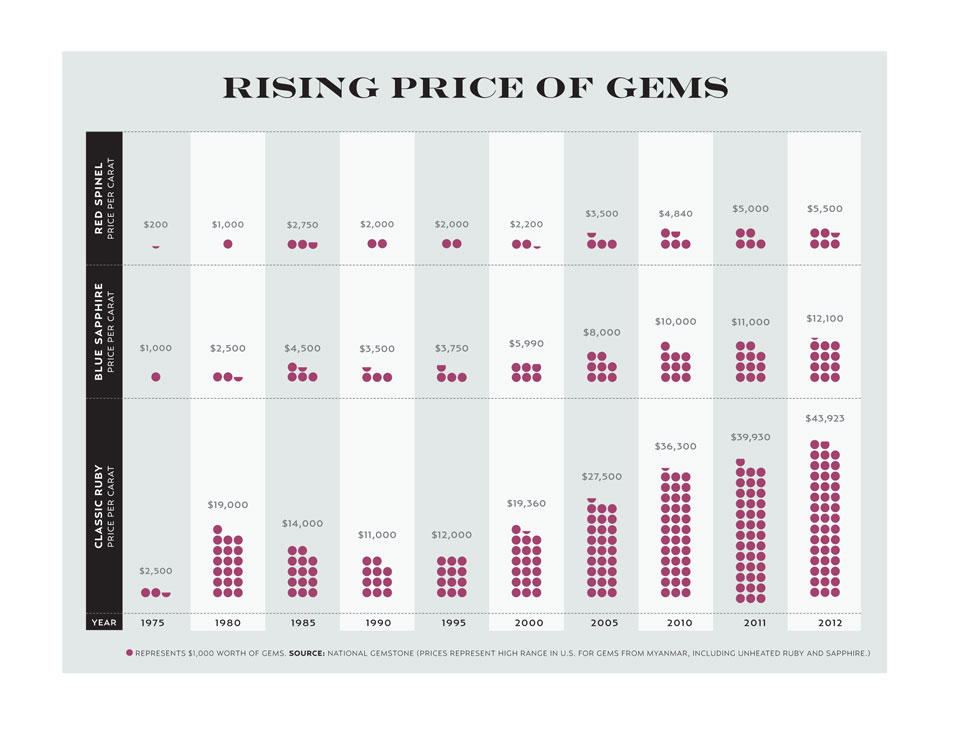
Secret Rocks: The $10 billion jewels industry is shrouded in beauty—and mystery. Is change about to come?

Updated May 17, 2013, 12:47 a.m. ET

Secret Rocks

The $10 billion jewels industry is shrouded in beauty—and mystery. Is change about to come?

By SHIBANI MAHTANI AND PATRICK BARTA

OB-XJ670_OBXJ66_G_20130507145913

TO HEAR RICHARD HUGHES tell it, the journey was like something straight out of “Indiana Jones and the Temple of Doom.” One of the world’s leading modern-day gem hunters, he was hell-bent on reaching the fabled jade mines of upper Myanmar—a jungle redoubt so remote and closely guarded that few living Westerners have ever laid eyes on it. Before he could get close, he had to spend months ahead of his trip convincing Myanmar’s secretive military, which controlled access to the country’s mines, to let him in. Then he had to navigate some of the most punishing, malaria-ridden terrain east of the Congo, capped by a grueling climb along a dirt road his handlers said would only take seven hours to ascend. The trail quickly turned into a river of sludge under Myanmar’s brutal monsoons, trapping vehicles in mud to their doors until teams of elephants showed up to haul them out. Days passed by as Hughes and his companions fought their way through the muck. In ramshackle villages along the way, residents smoked opium and told wild tales of the mining world beyond the ridges above. Read more of this post

China’s Next Crisis Lurks in Shadow Banking; “The longer the government takes to address this, the bigger the problem becomes.”

China’s Next Crisis Lurks in Shadow Banking

By Dexter Roberts on May 16, 2013

http://www.businessweek.com/articles/2013-05-16/chinas-next-crisis-lurks-in-shadow-banking

China’s growing reliance on shadow banking is contributing to its debt problem. Since 2010 the value of the unregulated loans, investments, and other financial products of this sector has almost doubled, to as much as 36 trillion yuan ($5.86 trillion). That’s equal to 69 percent of gross domestic product, says Haibin Zhu, chief China economist at JPMorgan Chase (JPM) in Hong Kong. “Shadow banking poses systemic risks,” warned Moody’s (MCO) in a May 13 report.

The question is how much of this capital carries an implicit guarantee that the national government must cover. “It is our belief that at some point the central government will have to take responsibility for local debt,” says Derek Ovington, head of regional banks in Asia at CLSA Asia-Pacific Markets. The official debt burden of central and local government, which does not take the localities’ shadow banking activities into account, is just below 30 percent of GDP, Moody’s says. In contrast, Ovington estimates that shadow banking liabilities and consumer, corporate, and government debt are now more than 200 percent of GDP. “The longer the government takes to address this, the bigger the problem becomes.” Read more of this post

Phoney QE peace masks rising risk of instability

May 16, 2013 3:48 pm

Markets Insight: Phoney QE peace masks rising risk of instability

By Gillian Tett

Profound tensions lurk beneath surface calm

Are the markets going mad? That is a question many investors might have asked in recent weeks, as stocks in the UK, eurozone and US have soared – even as bond spreads decline.

But, if you want another sign of how peculiar market patterns now seem, take a look at a report recently compiled by Matt King, an analyst at Citigroup. For what is most striking about the current market trends, Mr King argues, is not simply those dazzling equity and bond prices; instead the really notable issue is how many long-standing data patterns have broken down*.

Take a look at the link between unemployment and equity markets. Between 1997 and 2011 the level of unemployment in the eurozone was always inversely correlated to the Stoxx index. However, since 2011 the eurozone jobless rate has jumped from 10 to 12 per cent – even as the Stoxx has risen 10 per cent. Read more of this post