Berkshire Skips Apple Bonds as Buffett Says Not at Those Yields

Berkshire Skips Apple Bonds as Buffett Says Not at Those Yields

Warren Buffett, the billionaire chairman and chief executive officer of Berkshire Hathaway Inc. (BRK/A), said he isn’t investing in corporate debt, including Apple Inc. (AAPL)’s record offering, because yields are too low. “We’re not buying corporate bonds of any kind now,” Buffett, 82, said May 4 during an interview with Bloomberg Television’s Betty Liu in Omaha, Nebraska, where Berkshire held its annual meeting. “Not at those yields.” Berkshire held $12.2 billion of corporate bonds as of March 31, according to a quarterly filing issued on May 3. That’s down 14 percent from two years earlier. The value of Berkshire’s equity portfolio climbed 54 percent to $97.2 billion in the two years ended March 31 as markets rallied and Buffett added shares of International Business Machines Corp. Yields on debt from corporate securities to Treasuries have tumbled as the Federal Reserve slashed interest rates and bought bonds to help the economy recover from recession. The payout rate on dollar-denominated company debt fell to a record 3.35 percent on May 2, according to the Bank of America Merrill Lynch U.S. Corporate & High Yield Index. Yields have averaged 5.87 percent during the past decade.

Read more of this post

Asian Leaders’ Tough Talk Hides Failure of Leadership

Asian Leaders’ Tough Talk Hides Failure of Leadership

Visiting China in 1928, when a rising Japan had begun to prey on its neighbor, the Japanese poet Akiko Yosano took a surprisingly broad-minded view of anti-Japanese passion among the Chinese: “It’s surely frightful from the imperialists’ point of view,” she wrote in her travelogue, “but for the Chinese people it must be celebrated in the name of humanity.”

Writing last year in the Asahi Shimbun, as anti-Japanese rioting erupted in China, the writer Haruki Murakami had a wholly unsympathetic take on the same phenomenon. He assailed the “cheap alcohol” of nationalism that “makes you speak loudly and act rudely” and leaves you “with nothing but an awful headache the next morning.”

I was recently reminded of these contrasting responses, as Chinese and Korean leaders protested high-profile Japanese visits to Tokyo’s Yasukuni Shrine, which commemorates, among others, Japanese indicted for war crimes during Japan’s early 20th-century invasions and occupations of China and Korea.

The South Korean foreign minister canceled his visit to Japan. Japan’s conservative Prime Minister Shinzo Abe then caused further outrage by appearing to question whether Japan had actually invaded its neighboring countries. Read more of this post

Banks in Singapore agonize over rich clients in tax evasion clampdown

Banks in Singapore agonize over rich clients in tax evasion clampdown

5:29pm EDT

By Rachel ArmstrongSaeed Azhar and John O‘Callaghan

SINGAPORE (Reuters) – Banks in Singapore are urgently scrutinizing their account holders as an imminent deadline on stricter tax evasion measures forces them to decide whether to send some of their wealthiest clients packing.

The Southeast Asian city-state has grown into the world’s fourth-biggest offshore financial center but, with U.S. and European regulators on the hunt for tax cheats, the government is clamping down to forestall the kind of onslaught from foreign authorities that is now hitting Switzerland’s banks.

Before July 1, all financial institutions in Singapore must identify accounts they strongly suspect hold proceeds of fraudulent or wilful tax evasion and, where necessary, close them. After that, handling the proceeds of tax crimes will be a criminal offence under changes to the city-state’s anti-money laundering law.

“Because of banking secrecy, Singapore used to be an attractive place to put money if you didn’t want the authorities back home to know about it,” said Erik Wilgenhof Plante, head of compliance at Germany’s DZ Privatbank in Singapore.

“That has left legacy problems for some banks.” Read more of this post

Chinese Growth – Real Or Imagined?

Chinese Growth – Real Or Imagined?

Tyler Durden on 05/05/2013 16:15 -0400

We toyed with titling this post “Lies, Damned Lies, And Chinese Statistics” but perhaps that is a little harsh, though one glance at the chart below and one instantly comprehends the efforts that are being undertaken to ‘show’ the world that China’s transition is on target (and crumbling into collapse). As we recently noted, it is actually unlikely that China can complete this transition to organic (as opposed to investment-led) growth (with moderate growth the exception not the rule), and China’s recent trade data does not pass the smell test. As GREED & Fear’s Chris Wood notes, with the Hong Kong trade data being released last week, it is worth noting a growing discrepancy between the data on China’s exports to Hong Kong reported by mainland’s customs department and the corresponding data on Hong Kong’s imports from China reported by Hong Kong’s Census and Statistics Department in March. Such inconsistency in China’s export numbers relative to the imports data from its trading partners has generated growing speculation about the credibility of China’s trade figures. Various explanations have been put forward (below) but the divergence would seem far too large to be simply explained by “different statistical methods” as the Chinese government’s official line notes.

Via GREED & Fear,

Hong Kong’s reported imports from China rose by “only” 13.8%YoY to US$20.6bn in March and were up 10%YoY to US$56bn in 1Q13. By contrast, China reported that exports to Hong Kong surged by 93%YoY to US$48.4bn in March and were up 74%YoY to US$106bn in 1Q13. As a result, the ratio between China’s reported exports to Hong Kong and Hong Kong’s reported imports from China has surged to 2.35 times in March, up from 1.36x in 2012 and an average of 1.11x during the previous five years between 2007 and 2011. Such inconsistency in China’s export numbers relative to the imports data from its trading partners has generated growing speculation about the credibility of China’s trade figures.

20130505_china_0 Read more of this post

‘Speed money’ puts the brakes on India’s retail growth; “You get excited about the Indian middle class but then you wonder – is it really worth it?”

Insight: ‘Speed money’ puts the brakes on India’s retail growth

6:02am EDT

By Nandita Bose

MUMBAI (Reuters) – Hong-Kong entrepreneur Ramesh Tainwala spent 18 months operating branded clothing retail stores in India before deciding it was impossible to succeed without paying bribes.

Tainwala, a 55-year-old expatriate Indian, owns Planet Retail, which held the India franchise rights for U.S. fashion labels Guess and Nautica as well as UK retailers Next and Debenhams. He sold the brands last September to various Indian businesses.

“Right now it’s not possible to do business in India without greasing palms, without paying bribes,” said Tainwala, who is also luggage maker Samsonite’s president for Asia Pacific and West Asia. Tainwala said he himself refused to pay bribes to licensing officials, though that could not be independently confirmed. Read more of this post

Big drugmakers think small with nanomedicine deals

Big drugmakers think small with nanomedicine deals

Fri, May 3 2013

By Ben Hirschler

LONDON (Reuters) – Is nanomedicine the next big thing? A growing number of top drug companies seem to think so. The ability to encapsulate potent drugs in tiny particles measuring billionths of a meter in diameter is opening up new options for super-accurate drug delivery, increasing precision hits at the site of disease with, hopefully, fewer side effects. Three deals struck this year by privately held Bind Therapeutics, together worth nearly $1 billion if experiments are successful, highlight a new interest in using such tiny carriers to deliver drug payloads to specific locations in the body. U.S.-based Bind is one of several biotechnology firms that are luring large pharmaceutical makers with a range of smart drug nanotechnologies, notably against cancer.

Read more of this post

Compliance, Detection, and Mergers and Acquisitions

Compliance, Detection, and Mergers and Acquisitions

Vivek Ghosal Georgia Institute of Technology; Center for Economic Studies and Ifo Institute for Economic Research (CESifo)

D. Daniel Sokol University of Florida – Levin College of Law; University of Minnesota School of Law; George Washington University Law School Competition Law Center

May 1, 2013
University of Minnesota Law School, Legal Studies Research Paper Series, Paper No. 13-21

Abstract: 
Firms operate under a wide range of rules and regulations. These include, for example, environmental regulations (in which some industries have increased regulatory exposure) and finance and accounting (where all industries have reporting requirements). In other areas, such as antitrust cartels, enforcement is unregulated and antitrust leaves the market as the default tool to police against anti-competitive behavior. In all of these areas, detection of non-compliance by a firm can result in significant penalties. This issue of non-compliance has implications in the merger and acquisitions (M&A) context. In a transaction between an acquiring firm (buyer) and a target firm (seller), there is asymmetric information about the target’s quality. In our framework, we link a target’s quality directly to the strength of its regulatory compliance. In an M&A transaction, an acquirer seeks information about the target’s compliance, as a compliance failure may result in substantial penalties and sanctions, post-acquisition. In the presence of quality (compliance) uncertainty about target firms, low quality targets can masquerade as high quality. This would tend to give rise to a M&A market with Lemons-like characteristics, resulting in low transactions prices and dampening of M&A activity. We examine how M&A transactions in such regulatory areas – environmental, finance and accounting, and antitrust compliance problems – might function to alleviate quality uncertainty.

Classification Shifting Using the ‘Corporate/Other’ Segment

Classification Shifting Using the ‘Corporate/Other’ Segment

Bradley E. Lail Baylor University

Wayne B. Thomas University of Oklahoma – Michael F. Price College of Business

Glyn J. Winterbotham Winthrop University

April 26, 2013
Accounting Horizons, Forthcoming

Abstract: 
In this paper, we examine management’s use of the “corporate/other” segment to mask the true performance of operating (or core) segments. The corporate/other segment represents firm-wide expenses not allocated to core segments. We find that managers take advantage of vague cost allocation requirements to shift expenses between the corporate/other segment and core segments. Specifically, in the presence of agency problems (i.e., transfer of resources to underperforming segments), our evidence is consistent with expenses being shifted from core segments to the corporate/other segment. This shifting increases the reported performance of underperforming core segments. In addition, when proprietary concerns are high (i.e., operations in less competitive industries), we find evidence consistent with corporate/other expenses being shifted to core segments. By shifting expenses to core segments, core profits are concealed when proprietary motives are present. Our research contributes to a growing literature on earnings manipulation through expense shifting (rather than accrual manipulation or real activities management).

An Analysis of Accounting Frauds and the Timing of Analyst Coverage Decisions and Recommendation Revisions: Evidence from the US

An Analysis of Accounting Frauds and the Timing of Analyst Coverage Decisions and Recommendation Revisions: Evidence from the US

Susan M. Young Fordham University

Emma Y. Peng Fordham University – Accounting Area

April/May 2013
Journal of Business Finance & Accounting, Vol. 40, Issue 3-4, pp. 399-437, 2013

Abstract: 
This paper provides a comprehensive exploration of the types of accounting fraud committed by firms over the period 1995–2009. Using detailed data from US SEC Accounting and Auditing Enforcement Releases (AAER), we examine the likelihood and timing of analyst coverage decisions and recommendation revisions related to fraud firms versus firms without accounting fraud. We find that analysts have a higher probability of taking the more severe action of dropping coverage rather than only revising down recommendations for firms with any type of accounting fraud and also for specific egregious types of accounting fraud. Through the use of competing hazards models, we also find that accounting frauds and their egregiousness are positively (negatively) associated with the timeliness of the analysts’ action to drop coverage (revise only). Overall, we find that analysts’ actions may be useful in determining the occurrence of accounting fraud prior to the public announcement of the fraud.


Is the Decline in the Information Content of Earnings Following Restatements Short-Lived?

Is the Decline in the Information Content of Earnings Following Restatements Short-Lived?

Xia Chen Singapore Management University

Qiang Cheng Singapore Management University

Alvis K. Lo Boston College

May 1, 2013
Singapore Management University School of Accountancy Research Paper No. 1

Abstract: 
Prior research finds that the decline in the information content of earnings after restatement announcements is short-lived and that the earnings response coefficient (ERC), the proxy for the information content of earnings, bounces back after three quarters. We re-examine the persistence of the drop in the ERC after restatement announcements using a more comprehensive and recent sample of restatements. We find that material restatement firms experience a significant decrease in the ERC over a prolonged period – close to three years after restatement announcements. In contrast, other restatement firms experience a decline in the ERC only for one quarter after restatement announcements. In cross-sectional analyses, we find that among material restatement firms, those that are subject to more credibility concerns and those that do not take prompt actions to improve reporting credibility are associated with a longer drop in the ERC than others. Lastly, we reconcile our findings with prior studies. Our analyses indicate that using a potentially more powerful proxy for material restatements and imposing less restrictive sampling requirement help increase the power of the tests to detect the long-run drop in the ERC.

Using MD&A to Improve Earnings Forecasts

Using MD&A to Improve Earnings Forecasts

Khrystyna Bochkay Rutgers, The State University of New Jersey – Rutgers Business School at Newark & New Brunswick

Carolyn B. Levine Rutgers, The State University of New Jersey – Rutgers Business School at Newark & New Brunswick

April 17, 2013

Abstract: 
We estimate and compare quantitative and text-enhanced earnings forecasting models to evaluate the extent to which MD&A disclosures improve earnings forecasts. Incorporating MD&A disclosures into forecasting models significantly improves forecasting accuracy. The gains in accuracy are much greater following regulatory reforms, providing some of the first large-sample empirical evidence on the success of recent MD&A regulatory actions. The MD&A section is less informative between 2007-2009, particularly for those firms hardest hit by the financial crisis (i.e., firms with low cash and large changes in performance). Further, we find that text improves forecast accuracy most for firms in the consumer staples sector, firms with low profit margins, large changes in performance, high political and/or legal costs and high complexity. Last, we find that models enhanced by MD&A disclosures are generally less accurate than analysts’ consensus forecasts for large and medium sized firms, but equally accurate for small firms.

Warren Buffett and Charlie Munger’s Advice for a Good Life: “You gotta work where you’re turned on.”

Warren Buffett and Charlie Munger’s Advice for a Good Life

By Matt Koppenheffer | More Articles | Save For Later 
May 4, 2013 | Comments (0)

“Find what turns you on.” – Warren Buffett

Get your head out of the gutter. When Buffett spoke those words at Berkshire Hathaway‘s (NYSE: BRK-A  ) (NYSE: BRK-B  ) annual meeting, he was responding to a question about what advice he’d give to himself if he could go back 50 years and give himself some advice. And with that quip, Buffett was referring to finding something that “turns you on” to do for a living. Buffett’s right-hand man Charlie Munger didn’t disagree. He piled on: “You gotta work where you’re turned on.” Not that that comment did anything to squelch the innuendo.

It’s hard to argue the importance of that if you’re trying to live a satisfied life. But this isn’t just solid life guidance, it’s also a reminder of an critical aspect of Berkshire: Just how much Buffett and Munger love what they do. There’s a reason that Fortune‘s Carol Loomis titled her most recent book about Buffett “Tap Dancing to Work.” Is it warm and fuzzy? Sure it is, but it’s also a big reason why shareholder have, over the years, seen such incredible returns from Berkshire Hathaway. Buffett and Munger love what they do and that allows them to think in terms of the long term and what will drive long-term success. During the meeting, both executives opined on how big of an advantage it is that they don’t have outside forces — read quarterly earnings pressures — weighing on them. Since it’s not about a bigger bonus or more stock options, they’re free to make tough decisions — like not writing unprofitable insurance business — rather than always putting the pedal to the metal. As shareholders look ahead to whomever will succeed Buffett and Munger, this shouldn’t be overlooked. It’ll be great to get someone in there who’s tack-smart, cool-headed, and value-oriented at heart. But over the long term, the transition will work best if the current duo is able to find somebody that simply loves the job as much as they do (or, at least, close).

Buffett and Munger dances to “Gangnam Style” + Buffett jokes in the cold and rainy Omaha weather: “If we had a company that sold coats we would have left you out there.”

Here’s What Buffett’s Saying at the Berkshire Annual Meeting

By Matt Koppenheffer | More Articles | Save For Later
May 4, 2013 | Comments (0)

Before Warren Buffett and Charlie Munger even sat down at Berkshire Hathaway‘s (NYSE:BRK-A  ) (NYSE: BRK-B  annual meeting, the annual “Berkshire video” showed a cartoon version of Buffett and Munger dancing to “Gangnam Style.” With that under your belt, it’s hard to feel that your day didn’t start off right. But that was just the warm-up for the much-awaited Q&A session with Buffett and Munger. Here is a look at some of what Buffett and Munger have been saying so far.

On first quarter earnings. Buffett noted that closures and persistentcy in GEICO policies. He called this trend “solid gold.”

On challenging Ariel Hsing in ping-pong at Borsheims. Buffett: “If you’re courageous you’ll show up with your paddle and you’ll look like an idiot.”

On trailing the market. Buffett conceded that if the market continues on the trajectory it’s on so far in 2013, Berkshire could trail the S&P 500  (SNPINDEX: ^GSPC  ) for a five-year period for the first time. Buffett said that it “won’t be a happy day, but won’t totally discourage us.” Munger chimed in with: “We’re slowing down, but it’ll still be very pleasant.”

On selling things to Berkshire shareholders. A shareholder asking a question thanked Buffett for letting everyone in early (it was cold and raining in Omaha this morning). Buffett quipped: “If we had a company that sold coats we would have left you out there.”

On selling Berkshire shares. To head off any rash moves by family members, Munger warned: “I want to say to the many Mungers in the audience, don’t be so stupid as to sell these shares.” Buffett quickly followed up with: “That goes to the Buffetts too.”

On negative implications of the H.J. Heinz  (NYSE: HNZ  )  deal. A questioner wondered whether Berkshire’s preferred position in the Heinz deal and the high price paid suggested that Buffett isn’t optimistic about the returns available in the market. Buffett responded simply that that was “totally inaccurate.” Munger later added on: “As you said, the report was totally wrong.”

On hiring executives from AIG  (NYSE: AIG  ) . Buffett pointed out that “these are people that reached out to Berkshire, in the case at least one of them had reached out numerous times in the past” and added that “we’ve had a number of people reach out since the announcement was made.” That’s a big positive for Berkshire since it’s looking to aggressively build out its commercial insurance capabilities.

The Plateau Effect: Getting from Stuck to Success

Where Were You in 1979? The final year of the 1970s witnessed epochal shifts in power that ushered in the modern world.

May 3, 2013, 2:57 p.m. ET

Where Were You in 1979?

The final year of the 1970s witnessed epochal shifts in power that ushered in the modern world.

By Jonathan Karl

The 1970s seem destined to be a justly forgotten decade—a time of disco, stagflation and little of the social upheaval that defined the previous decade or the epic global changes of the one that followed. But Christian Caryl sees more than malaise when he looks at the 1970s; he sees one of history’s great turning points. “With the passage of time,” Mr. Caryl writes in “Strange Rebels: 1979 and the Birth of the 21st Century,” “the 1970s begin to appear less like a sideshow than the main event.”

Strange Rebels

By Christian Caryl
Basic, 407 pages, $28.99

As the title of Mr. Caryl’s book suggests, his focus is 1979—a year that brought Iran’s Islamic revolution, the siege of the U.S. embassy in Tehran, the Soviet invasion of Afghanistan, and the emergence of four leaders who, he argues, changed the course of history: Margaret Thatcher, the Ayatollah Khomeini, Deng Xiaoping and Pope John Paul II.

It is hard to imagine figures as different as these or a year quite as grim as 1979, but suspend your disbelief for a moment. Mr. Caryl makes a fairly compelling case that this was a year when history made a sharp turn and that each leader set in motion the seismic changes that came to shape our world today: the fall of the Soviet Union, the rise of China and the emergence of radical Islam. In 1979, Mr. Caryl says, “the twin forces of markets and religion, discounted for so long, came back with a vengeance.”

In January of that year, China’s new paramount leader, Deng Xiaoping, made a nine-day visit to the United States. He was not technically China’s head of state (he never held that title), but President Jimmy Carter welcomed him to the White House with a state dinner. At the dinner, Deng found himself seated at a table with actress Shirley MacLaine, who had spent time in China working on a documentary extolling the virtues of Maoism during the bloody Cultural Revolution. She told Deng how wonderful it had been for her to meet a professor plowing a field on a collective farm. “Deng looked at her scornfully . . . ,” Mr. Caryl writes. “Professors, he told her, should be teaching university classes, not planting vegetables.” Read more of this post

Munger Decries Wall Street Approach at Deposit-Taking Banks; Munger said that he was “a little less optimistic about the U.S. banking system” than Buffett is

Munger Decries Wall Street Approach at Deposit-Taking Banks

Berkshire Hathaway Inc. (BRK/A) Vice Chairman Charles Munger, whose firm owns stakes in some of the biggest U.S. lenders, said Wall Street trading risks should be curbed at deposit-taking institutions. “I do not see why massive derivative books should be mixed up with” government-insured deposits, Munger, 89, said yesterday during Omaha, Nebraska-based Berkshire’s annual meeting. “The more bankers want to be like investment bankers, instead of like bankers, the worse I like it.” Munger’s comments echo those of former financial executives and lawmakers who say the largest lenders still pose risks to the economy years after reforms and U.S. bailouts. Derivatives, which are used to hedge risks or for speculation, magnify the interconnectedness of firms including JPMorgan Chase & Co. (JPM) and Bank of America Corp. (BAC) Critics say that these so-called too-big- to-fail companies would get taxpayer help in a future crisis.

The Berkshire vice-chairman said his views about the industry differ with those of his longtime business partner, billionaire Chairman Warren Buffett. Responding to a question at the meeting about how too-big-to-fail affected Berkshire holdings, Buffett reiterated his support of U.S. lenders. In January, he said he guaranteed that banks no longer posed a threat to the economy because capital levels were higher. “I don’t worry about the banking system being the cause of the next bubble,” Buffett, 82, said yesterday. While lenders “won’t earn as high a return as they would’ve” previously, because of regulation, they still are “decent” investments, he said.

‘Less Optimistic’

Munger said that he was “a little less optimistic about the U.S. banking system” than Buffett is. Read more of this post

IT engineer becomes Weibo sensation after giving up career to become a fruit seller

IT engineer becomes Weibo sensation after giving up career to become a fruit seller

Xu Jia was a PHP engineer for Sina Weibo in 2011 and often worked late into the night. -China Daily
7427ea210acc12ed5abd14
Sat, May 04, 2013
China Daily/Asia News Network

A former IT engineer has become a sensation on China’s Twitter-like Sina Weibo after he gave up a promising career to successfully turn into a fruit vendor. Xu Jia was a PHP engineer for Sina Weibo in 2011 and often worked late into the night. In 2013, he was promoted to a title equivalent to an architect in one of China’s most popular social networking sites. “I was in tears to see my promotion. It was a dream for many years finally coming true. But I changed my mind and wanted to discover the other me,” Xu wrote on Weibo. Xu quit his job to sell fruit in 2013. What surprised Weibo users most is the combination photo showing sharp differences in his looks between the two working environments. In his high-end IT job, he looked exhausted, wore glasses and had scanty hair on his head. But in the fruit store, he appears vigorous, well-dressed, and in good shape. Read more of this post

Buffett maps out hopes for Berkshire without him

Buffett maps out hopes for Berkshire without him

8:19pm EDT

By Jonathan Stempel and Jennifer Ablan

OMAHA, Nebraska (Reuters) – Warren Buffett on Saturday gave the most extensive comments to date about the future of Berkshire Hathaway Inc after he is gone, saying he still expects the conglomerate to be a partner of choice for distressed companies.

Buffett, 82, also defended his plan to install his son, Howard, who has little investing experience, as nonexecutive chairman, saying the younger man’s role would be to ensure that Berkshire had the right CEO in place.

During the financial crisis and its immediate aftermath, Berkshire helped prop up a number of companies, among them blue-chips such as General Electric and Goldman Sachs. Buffett’s investments were viewed by many shareholders as a seal of approval from one of the world’s most respected businessmen.

Short-seller Doug Kass, invited by Buffett to Berkshire’s annual meeting on Saturday to offer contrarian points of view, asked whether a successor would have the same heft. Buffett said it would not matter.

“Berkshire is the 800 number when there is really some panic in the markets, and people really need significant capital,” Buffett said. Read more of this post

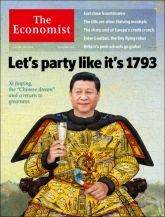
The Economist: Party Like It’s 1793? China’s New President Should Scare The Crap Out Of The Rest Of The World

China’s New President Should Scare The Crap Out Of The Rest Of The World

The Economist | May 4, 2013, 9:12 AM | 14,577 | 66

20130504_cna400

IN 1793 a British envoy, Lord Macartney, arrived at the court of the Chinese emperor, hoping to open an embassy. He brought with him a selection of gifts from his newly industrialising nation. The Qianlong emperor, whose country then accounted for about a third of global GDP, swatted him away: “Your sincere humility and obedience can clearly be seen,” he wrote to King George III, but we do not have “the slightest need for your country’s manufactures”. The British returned in the 1830s with gunboats to force trade open, and China’s attempts at reform ended in collapse, humiliation and, eventually, Maoism. China has made an extraordinary journey along the road back to greatness. Hundreds of millions have lifted themselves out of poverty, hundreds of millions more have joined the new middle class. It is on the verge of reclaiming what it sees as its rightful position in the world.

China’s global influence is expanding and within a decade its economy is expected to overtake America’s. In his first weeks in power, the new head of the ruling Communist Party, Xi Jinping, has evoked that rise with a new slogan which he is using, as belief in Marxism dies, to unite an increasingly diverse nation. He calls his new doctrine the “Chinese dream” evoking its American equivalent. Such slogans matter enormously in China (see “Xi Jinping’s vision: Chasing the Chinese dream”). News bulletins are full of his dream. Schools organise speaking competitions about it. A talent show on television is looking for “The Voice of the Chinese Dream”. Countries, like people, should dream. But what exactly is Mr Xi’s vision? It seems to include some American-style aspiration, which is welcome, but also a troubling whiff of nationalism and of repackaged authoritarianism. Read more of this post

As Best Buy’s ‘Five Star’ exits China, more foreign retailers jump in

As Best Buy’s ‘Five Star’ exits China, more foreign retailers jump in

Staff Reporter

2013-05-04

Foreign electronics retail giants such as Best Buy and Wonder City have repeatedly faced setbacks in China, but this hasn’t extinguished their enthusiasm as RadioShack approaches the mainland market, IT Times Weekly reports.

On March 18, consumer electronics retail giant Best Buy announced that Wang Jian, president of Five Star Appliance, its wholly owned subsidiary in China, will leave his post, though he will continue as a senior adviser for a smooth transition to help the new leadership until the end of June.

Wang’s departure means Best Buy’s “Five-Star era” has come to an end, as the subsidiary it bought in 2009 didn’t satisfy the parent company, insiders said. Best Buy will have to rethink its development strategy in China. Read more of this post

Steve Case: When Attackers Become Defenders, Innovation Is Lost

May 4, 2013

When Attackers Become Defenders, Innovation Is Lost

By ADAM BRYANT

This interview with Steve Case, chief executive of Revolution, an investment firm, was conducted and condensed by Adam Bryant. Mr. Case was also a founder of America Online.

Q. What were some early leadership lessons for you?

A. The earliest ones probably related to just understanding that everybody is wired a little bit differently. Just because you think a certain way or are inclined to react a certain way doesn’t mean everybody thinks and reacts the same way. I think people just naturally presume that they look at a problem in a certain way and frame the issue in a certain way and that everybody else would look at it the same way.

I learned in my 20s that there are a lot of different ways to look at things, a lot of different filters that people put on, partly based on how they analyze the circumstance but also based on their own history and perspectives and biases and instincts and so forth. You have to be open-minded about that and listen to what’s being said — but also to what’s not said sometimes. Those discussions can lead you to different places. Read more of this post

Emil Frei III, Who Put Cancer Cures in Reach, Dies at 89

May 4, 2013

Emil Frei III, Who Put Cancer Cures in Reach, Dies at 89

By MARGALIT FOX

Emil_FREI_26

Dr. Emil Frei III, an oncologist whose trailblazing use of combination chemotherapy — in which anticancer drugs are administered simultaneously rather than singly — helped make certain cancers curable for the first time, died on Tuesday at his home in Oak Park, Ill. He was 89.

His daughter Judy Frei confirmed the death.

Combination chemotherapy is now a standard treatment for a wide range of cancers, including breast, bone and testicular cancers, and has been credited with saving millions of lives worldwide. Read more of this post

To Fight Pandemics, Reward Research; An outbreak of avian flu in Asia raises questions about national preparedness for pandemics. A reward system for medical innovators would be a step in the right direction

May 4, 2013

To Fight Pandemics, Reward Research

By TYLER COWEN

THAT frightening word “pandemic” is back in the news. A strain of avian influenza has infected people in China, with a death toll of more than 25 as of late last week. The outbreak raises renewed questions about how to prepare for possible risks, should the strain become more easily communicable or should other deadly variations arise.

Our current health care policies are not optimal for dealing with pandemics. The central problem is that these policies neglect what economists call “public goods”: items and services that benefit many people and can’t easily be withheld from those who don’t pay for them directly.

Protection against communicable diseases is a core example of a public good, as is basic scientific research, which can yield new ideas that may be spread at very low additional cost. (In contrast, Medicare, which is publicly financed, has some elements of a public good, but any particular expenditure tends to benefit an individual receiving treatment, rather than being spread over a number of beneficiaries.)

One obvious step forward would be to exempt biomedical research from cuts of the current federal budget sequestration. Research and development grants are a way to pay potential innovators up front — an important move, as an innovator can’t always charge high-enough prices for the value of its remedies when they’re actually needed. Read more of this post

NYT: Malay majority are tired of the corruption and theft of public assets practiced in their name, greeted with enthusiasm the pledge to replace the corrupt ethnicity-based affirmative action program that has benefited cronies of PM Najib with a program that bases assistance on need

May 4, 2013

In Malaysia, a Historic Chance for Reform

By JOHN PANG

KUALA LUMPUR, Malaysia

MALAYSIANS are going to the polls Sunday for the most important election in our history. The opposition stands a real chance of winning, for the first time since independence from Britain in 1957. Recent polls show the People’s Alliance, the opposition coalition led by Anwar Ibrahim, running neck and neck with the governing National Front, led by Prime Minister Najib Razak. The National Front, the direct successor to the Alliance Party of the 1950s, has been one of the world’s longest-governing parties, outside of authoritarian regimes like China, North Korea and Cuba. For half a century, until 2008, it had a two-thirds parliamentary majority, which allowed it to amend Malaysia’s Constitution at will. Since the 1980s, the governing party has resorted to stoking fears among the country’s many ethnic communities — Malays, Chinese, Indians and many non-Malay indigenous peoples — to keep them beholden to its rule. It has abused affirmative action policies, intended to help impoverished ethnic Malays, in order to enrich its members and their cronies. Malaysia’s outdated model of governance — a system of racially exclusive parties that deliver patronage to captive racial voter blocs — is no longer sustainable. Read more of this post

The Smartest Thing Warren Buffett Ever Said

The Smartest Thing Warren Buffett Ever Said

By Matt Koppenheffer | More Articles | Save For Later
April 30, 2013 | Comments (1)

Berkshire Hathaway  (NYSE: BRK-A  ) (NYSE: BRK-B  ) CEO Warren Buffett is never shy about sharing wisdom. The brilliant investor is known for witty quips (“Rule No. 1: Never lose money. Rule No. 2: Never forget Rule No. 1.”) as well as longer parables (such as “The Superinvestors of Graham-and-Doddsville“). But could any one of Buffett’s gems of wisdom be the best? Could there be one Buffett-ism to rule them all? To find out, I grabbed five game Fools to weigh in.

Scott Phillips: In trying to distill Warren Buffett’s brilliance, many Buffett-watchers lean heavily on the Oracle of Omaha’s formative years at the metaphorical knee of his mentor, the famed value investor Ben Graham. Graham was notoriously mechanical in his investing; seeking to find companies with specific financial characteristics, then buy them in bulk. However, Buffett — particularly after he met his business partner and Berkshire Vice-Chairman Charlie Munger — is far from the myopically mechanical investor some would paint him to be. Indeed, in his 1982 Chairman’s letter to Berkshire Hathaway shareholders, Warren Buffett wrote: Managers and investors alike must understand that accounting numbers are the beginning, not the end, of business valuation. Yes, the reported numbers matter — a lot — but they are a guide to starting to understand the business, not neatly packaged answers. Buffett’s brilliance was in taking the fundamental lessons he’d learned from Graham and improving on them by understanding the factors that build and sustain great companies. Buffett has said he has one message for the managers of Berkshire’s subsidiaries — “widen the moat.” He wants them to focus on doing those things that make the business stronger and less vulnerable to the competition. Talking about Coca-Cola (NYSE: KO  ) , he said “Give me $10 billion and how much can I hurt Coca-Cola? I can’t do it.” That fact won’t show up in black and white on the financial statements, but is far more important than the numbers themselves.

Jason Moser: I had the great fortune of attending the Berkshire meeting last year, and while I’ve followed Buffett for a while now, something he said during the Q&A session last year resonated with me. Someone asked him his opinion on gold, to which he replied (and I’m paraphrasing): Let’s say you own an ounce of gold today. You hold it, love it and caress it. In 50 years you’ll still own an ounce of gold. Now say you own 100 acres of farmland today. In 50 years you’ll still own that same 100 acres of farmland. The difference is you’ll also have had the time to produce crops to grow more stuff to buy more farmland and whatever else you want. In other words, there’s a tremendous cycle of production there. Gold on the other hand is more or less an unproductive asset. This, to me, is key to why Buffett has been such a successful investor all these years. Not only is he able to focus on longer periods of time, but also the ever-so-valuable cycles of production that can occur during that time. It should therefore come as no surprise that if you gave me a bar of gold today, I would sell it and go buy stocks.

Tim Beyers: While Buffett is often thought of as the patron saint of value investing, I find him in many ways to be the quintessential Rule Breaker. Just listen to what he said at last year’s confab: I would never spend a lot of time valuing declining businesses. The same amount of energy and intelligence brought to other businesses is just going to work out better. I’d never have believed it had I not heard it myself. After all, what is value investing if not for figuring the worth of an oversold business that may, in fact, be in decline? Buffett’s lesson here, I think, is to be open to a broad range of stock ideas. Don’t merely look for a low price-to-earnings ratio. Look instead for businesses that are surprisingly strong defenders of the majority share of a profitable niche, such as Walt Disney  (NYSE: DIS  ) . The House of Mouse isn’t cheap at 20 times earnings, but can you name an enterprise with more big-name brands under its belt? Marvel, Star Wars, Pixar, and all those princesses that seven-year-old girls worship? Don’t be surprised if Berkshire takes a close-up tour of the Magic Kingdom.

Jacob Roche:

It takes 20 years to build a reputation and five minutes to ruin it. If you think about that, you’ll do things differently. This quote always stuck with me because it’s so applicable to both life and business. It takes a long history of coming through for people to build a reputation with your friends, family, and coworkers, but one big mistake can shatter that reputation and leave a lasting bitter taste in the mouths of people who know you. Whether you’re the normally responsible friend who had too a few too many drinks at a party, or the go-to guy at work who told off the wrong client, a person’s worst impression of you is usually their most lasting. This is even more true for the highest levels of management in a large company. It can take decades for a company to earn the trust of its customers, shareholders, and employees. And while a big accounting scandal may take years to fully percolate, it starts with one bad decision. Whether it was the massive accounting scandals at Enron, Worldcom, or evenWaste Management, an unethical decision that could have been avoided can, at best, result in massive fines, like WM’s half-billion dollar shareholder suit, or even jail time in the case of Enron and Worldcom executives. These unfortunate fates could have been avoided by managers at the top simply deciding to do things differently in that crucial moment.

Dan Dzombak:

Buffett: I tell college students, when you get to be my age, you will be successful if the people who you hope to have love you, do love you. Charlie and I know people who have buildings named after them, receive great honors, etc., and nobody loves them — not even the people who give them honors. Charlie and I talk about wouldn’t it be great if we could buy love for $1 million. But the only way to be loved is to be lovable. You always get back more than you give away. If you don’t give any, you won’t get any. Everybody loves Don. There’s nobody I know who commands the love of others who doesn’t feel like a success. And I can’t imagine people who aren’t loved feel very successful.

Munger: You don’t want to be like the motion picture exec who had so many people at his funeral, but they were there just make sure he was dead. Or how about the guy who, at his funeral, the priest said, “Won’t anyone stand up and say anything nice for the deceased?” and finally someone said, “Well, his brother was worse.”

Buffett: Most people in this room and most college students I talk to will have plenty of money, but some will have few friends.

— 2003 Berkshire Hathaway Annual Meeting

Coming from one of the richest people in the world, the quote is a good reminder that there’s a lot more to a successful life than just money. My definition of success is long-term sustainable happiness, and having friends who love you is a key part of that. A close network of friends has been shown to help fight illness and depression, speed recovery, slow aging, and prolong life. While it takes effort to be lovable, Buffett has shown that the benefits are massive and certainly worth the effort.


Van Gogh: “Today again from seven o’clock in the morning till six in the evening I worked without stirring except to take some food a step or two away”

What does nearly every genius have in common when it comes to work habits?

by eric barker

A very interesting new book, Daily Rituals: How Artists Work, examines the work habits of over 150 of the greatest writers, artists and scientists. What does nearly every genius have in common? Those interested in the 10,000 hour theory of deliberate practice won’t be surprised — the vast majority of them were complete and unapologetic workaholics.

Via Daily Rituals: How Artists Work:

William Faulkner:

During his most fertile years, from the late 1920s through the early ’40s, Faulkner worked at an astonishing pace, often completing three thousand words a day and occasionally twice that amount. (He once wrote to his mother that he had managed ten thousand words in one day, working between 10: 00 A.M. and midnight— a personal record.) “I write when the spirit moves me,” Faulkner said, “and the spirit moves me every day.”

Maya Angelou:

Sometimes the intensity of the work brings on strange physical reactions— her back goes out, her knees swell, and her eyelids once swelled completely shut. Still, she enjoys pushing herself to the limits of her ability. “I have always got to be the best,” she has said. “I’m absolutely compulsive, I admit it. I don’t see that’s a negative.”

H.L. Mencken:

His compulsiveness meant that he was astonishingly productive throughout his life— and yet, at age sixty-four, he could nevertheless write, “Looking back over a life of hard work  …   my only regret is that I didn’t work even harder.”

Musician Glenn Gould:

From the time he retired from public performances in 1961, when he was thirty-one years old, Gould devoted himself completely to his work, spending the vast majority of his time thinking about music at home or recording music in the studio. He had no hobbies and only a few close friends and collaborators, with whom he communicated mostly by telephone. “I don’t think that my life style is like most other people’s and I’m rather glad for that,” Gould told an interviewer in 1980. “[ T] he two things, life style and work, have become one. Now if that’s eccentricity, then I’m eccentric.”

Alexander Graham Bell:

As a young man, Bell tended to work around the clock, allowing himself only three or four hours of sleep a night… When in the throes of a new idea, he pleaded with his wife to let him be free of family obligations; sometimes, in these states, he would work for up to twenty-two hours straight without sleep.

Van Gogh:

“Today again from seven o’clock in the morning till six in the evening I worked without stirring except to take some food a step or two away,” van Gogh wrote in an 1888 letter to his brother, Theo, adding, “I have no thought of fatigue, I shall do another picture this very night, and I shall bring it off.”

Artist Chuck Close:

“Inspiration is for amateurs,” Close says. “The rest of us just show up and get to work.” Read more of this post

Charlie Munger: No tweets for me, Buffett’s second-in-command says

No tweets for me, Buffett’s second-in-command says

2:20pm EDT

By Jennifer Ablan and Jonathan Stempel

OMAHA, Nebraska (Reuters) – So they are not completely in sync after all. A day after Berkshire Hathaway Inc Chairman Warren Buffett set up his own account on Twitter, his second-in-command, Charlie Munger, said he has no plans to follow the legendary investor’s lead. Buffett, 82, launched his “@WarrenBuffett” account with the tweet “Warren is in the house,” and immediately started adding followers at the rate of 1,000 per minute. But the 89-year-old Munger – renowned for his forthright style of speaking – suggested fans should not look forward to seeing his trademark remarks in 140-character form any time soon.

“No, certainly not,” Munger said in an interview, after being asked whether he planned to join the social media network. “That’s not my milieu. I don’t like too many things going on at once.” It marks a rare point of departure between Buffett and Munger, who have worked together at Berkshire for decades. “We have practically no disagreements. That’s just the way the chemistry has worked,” Munger said, commenting on his working relationship with Buffett. “People who think we’re quite a diverse pair, and that one is helping the other – it’s more like two twins, and one of them is a little more able than the other.” Berkshire Hathaway will hold its annual shareholder meeting on Saturday in Omaha. Buffett calls the meeting and the weekend’s related events “Woodstock for Capitalists.”

Find the Customers Your Competitors Are Offending

Find the Customers Your Competitors Are Offending

by Sehreen NoorAli  |  10:00 AM May 3, 2013

In a targeted effort to appeal to Gen Y, Pizza Hut offered free pizzas for life to any attendee of last October’s presidential debate who dared ask President Obama or Governor Romney, “Sausage or Pepperoni?” Outraged by the mockery to the democratic process, millennials shamed the popular company across national outlets. The backlash against the campaign shocked Pizza Hut and forced it to backpedal.

Pizza Hut’s campaign unwittingly shut the door on thousands of customers who were either: 1) people within the target market that the ad alienated (ex: millennials who care about politics more than pizza); or 2) people excluded from the target market altogether (ex: non-Gen Yers).

This is a basic problem with target advertising: it frequently ignores the fact that people who share a common demographic do not necessarily share the same preferences or opinions. By extrapolating consumer behavior from fixed demographic information like gender, age, and ethnicity, companies indiscriminately make conclusions like “African-Americans love fried chicken,” “senior citizens only care about incontinence” and “single men aspire to be James Bond.” Using unrefined market segmentation to understand the preferences of potential target customers often backfires. Take Diet Pepsi’s “Skinny Can” controversy, or Groupon’s callous Tibet commercial. Read more of this post

Little Data Makes Big Data More Powerful

Little Data Makes Big Data More Powerful

by Mark Bonchek  |  11:00 AM May 3, 2013

You may not know this, but Big Data has a little brother. And together, Big and Little Data are far more powerful than Big Data alone.

Big Data is what organizations know about people — be they customers, citizens, employees, or voters. Data is aggregated from a large number of sources, assembled into a massive data store, and analyzed for patterns. The results are more accurate predictions, more targeted communications, and more personalized services. Big Data is what enables banks to predict credit card fraud by analyzing billions of transactions, marketers to understand customer sentiment by analyzing millions of interactions on social media, and retailers to target promotions and offers by analyzing millions of purchases.

In contrast, Little Data is what we know about ourselves. What we buy. Who we know. Where we go. How we spend our time. We’ve always had a sense for these things — after all, it’s our lives. But thanks to the combination of mobile, social, and cloud technologies, it’s easier than ever to gain insight into our own behavior. Read more of this post

Leadership Is More than Interpersonal Skills

Leadership Is More than Interpersonal Skills

by Terri Griffith  |  12:00 PM May 3, 2013

Most of the 89,000 leadership books offered on Amazon.com focus on traditional interpersonal leadership: the relationships between leaders and followers. Interpersonal leadership sets up an expectation that leaders must be in dialog or at least in view of their followers. Yet this style of interaction is less likely as work stretches across locations and company boundaries as we telecommute, crowdsource, and take on joint ventures. Modern leadership may be as much about facilitating strategy through hiring, training, technology, and focused tasks and goals, as it is about face-to-face interaction.

Clear and meaningful tasks, goals, and technology tools that support the organization’s direction can supplement interpersonal leadership. This is a classic topic in the management field. In the 70s, Steve Kerr and John Jermier offered that leaders do many things beyond their interpersonal relationships with their followers. Talking about the history of substitutes for leadership research, Jermier said in 1997, “[Substitutes for leadership] pointed to unobtrusive and impersonal forces such as technology and task characteristics, professional standards, and formal regulations (policies, rules and procedures).” One of their conclusions was that some people don’t even need leadership in the traditional sense, or find leadership substitutes through interactions with other workers. Hiring for employees who can model the vision of the organization through their work can substitute for interactions with formal leaders. Read more of this post