Future of Cable Might Not Include TV

August 4, 2013, 7:38 p.m. ET

Future of Cable Might Not Include TV

At Cablevision, Broadband Could Become Primary Offering Eventually

SHALINI RAMACHANDRAN And MARTIN PEERS

Predicting that transmission of TV will move to the Internet eventually, Cablevision Systems Corp. CVC +5.20% Chief Executive James Dolan says “there could come a day” when his company stops offering television service, making broadband its primary offering. His comments may be the first public acknowledgment by a cable CEO of the possibility of such a shift, long speculated about by analysts. It comes amid growing tensions between cable operators and channel owners over rising programming costs, highlighted Friday night when Time Warner Cable Inc. TWC -0.49% dropped CBS from its channel lineup in major markets such as New York and Los Angeles.
Read more of this post

China Mobile launches own-brand smartphones

China Mobile launches own-brand smartphones

English.news.cn   2013-08-03

By Shen Jingting

BEIJING, Aug. 3 (Xinhuanet) — China Mobile Ltd officially entered the booming mobile terminal market on Friday as it unveiled its own-brand smartphone models. The China Mobile M701, a 5-inch screen Android-based smartphone equipped with MediaTek Inc’s 1.2-gigahertz quad-core processor, is priced at 1,299 yuan ($212). The China Mobile M601 is a 4-inch screen, dual-core Android smartphone that targets lower-end users with a price of 499 yuan. The two smartphones are produced by original equipment manufacturers, Hisense Group and Shenzhen-based BYD Co Ltd, respectively. They will hit the Chinese market through China Mobile’s online and offline outlets this month. Read more of this post

Baby Formula Brands Admit Possible Price Violation; Mead Johnson is the largest baby formula company in China with a 14% market share; Beingmate ranked second with a 10% share, followed by Danone’s 9.2%

Baby Formula Brands Admit Possible Price Violation, Xinhua Says

By Bloomberg News  Aug 4, 2013

Infant-formula companies being probed in China have broadly admitted that their resale prices may have violated rules, the official Xinhua News Agency reported, citing an official in the National Development Reform Commission. The official, Xu Kunlin, head of the regulatory body’s pricing supervision department, didn’t name the dairy companies who admitted to price violations, according to the news report. Mead Johnson Nutrition Co. (MJN), Danone, Nestle SA (NESN)Abbott Laboratories (ABT), Royal FrieslandCampina NV and domestic manufacturer Biostime International Holdings Ltd (1112) were being probed on pricing, the official People’s Daily reported on July 2. The investigation offered a window into how government scrutiny in China can create obstacles for overseas companies expanding there. Read more of this post

Toyota’s $37 Billion Cash Pile Means Turning Point for Abenomics; Auto Maker pulled off the unlikely feat of nearly doubling profit while selling fewer cars

Toyota’s $37 Billion Cash Pile Means Turning Point for Abenomics

AM-AZ707_JAPANH_NS_20130804053005

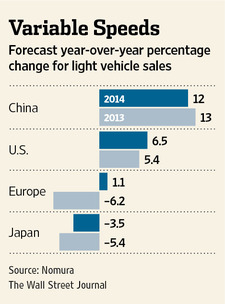
Prime Minister Shinzo Abe has been urging Japan’s companies to spend their growing piles of money to bolster the country’s economy. Toyota Motor Corp. (7203), with cash swelling to about $37 billion, is beginning to comply. The carmaker said on Aug. 2 that net income almost doubled to 562.2 billion yen ($5.7 billion) last quarter — more than General Motors Co. (GM) and Volkswagen AG (VOW) combined — as U.S. sales rose and the weaker yen boosted overseas profit. Cash and marketable securities rose 11 percent and totaled the most of any non-bank in Japan, according to data compiled by Bloomberg. Read more of this post

Is Japan’s Beer Market Set to Fizz on Abenomics?

August 5, 2013, 9:22 AM

Is Japan’s Beer Market Set to Fizz on Abenomics?

Top of Form

By Hiroyuki Kachi

Japan’s long-stagnant beer market may have finally started picking up in the wake of Prime Minister Shinzo Abe’s pro-growth economic policies, known as “Abenomics.” But it’s hard to be sure just yet, given that shipments actually fell in the first half of 2013. The first true test of whether Abenomics is putting a head of foam on the beer industry will be when figures for the peak beer-drinking month of July come out Aug. 12. From January to June, overall beer shipments for Japan’s five top brewers declined 0.9% from a year earlier. Shipments have languished more than 20% off their 1994 peak as the population ages and consumer demand has diversified. Still, the country’s two biggest brewers, Asahi Group Holdings 2502.TO -0.90% andKirin Holdings Co. 2503.TO -0.26%, last week reported solid operating profit gains for the first six months of the year. But most of the gains were attributable to the weaker yen, which lifted the value of their overseas operations. Weak beer sales at home failed to put any extra fizz in their bottom lines. Read more of this post