America’s Farm-Labor Pool Is Graying; Growers Say Reliance on Aging Workers Shows Urgent Need for Immigration Overhaul
August 13, 2013 Leave a comment
Updated August 12, 2013, 2:50 p.m. ET
America’s Farm-Labor Pool Is Graying
Growers Say Reliance on Aging Workers Shows Urgent Need for Immigration Overhaul
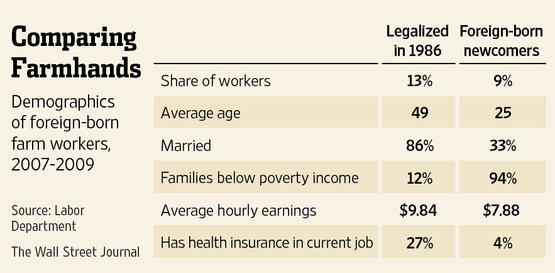
David Cox, left, tends his almond trees with 20-year employee Domingo Cortez, 58. Mr. Cox says young American workers aren’t as productive. When Bruce Frasier surveys his sprawling south Texas farm during the harvest, he sees “a bunch of grandparents bunching onions,” he says. In California’s Central Valley, nurseryman David Cox says he sees young Americans stacking his trees who are less productive than the older, predominantly Mexican workers he lost to an immigration audit. From Vermont and Michigan to Texas and California, the nation’s long-standing pool of farm labor is graying. “You have to remember that the last amnesty happened 27 years ago,” says Mr. Frasier, referring to a U.S. immigration overhaul in 1986 that legalized 2.7 million immigrants. “The average age I have is pushing 50,” he adds. Government data confirm that the workers who got legal status nearly three decades ago are now 49 years old, on average. The average age of farm workers overall is around 37, according to the data, up from 31 in 2000.This aging workforce, farmers say, is just one of the problems that highlight American agriculture’s urgent need for an overhaul of the nation’s immigration system. Beefed-up patrols and drug violence along the Mexican border are discouraging potential migrants from journeying to the U.S. And, as the oil patch booms in Texas and construction recovers in California, other industries are competing for the same supply of low-skilled labor.
A crackdown on illegal immigration, meanwhile, has pushed many farmers, including Mr. Cox, to use the government’s E-Verify system to ensure new employees are legal, only to discover the quality of their workforce has declined.
“If we have border security and E-Verify without giving [illegal] workers already here a way to pass muster, agriculture is screwed,” says Mr. Cox, whose nursery raises fruit and ornamental trees that he sells to farmers, landscapers and garden-center retailers.
That’s because net migration from Mexico, which has long supplied the bulk of U.S. field workers, has come to a standstill, according to the Pew Hispanic Center. Not only has crossing the border become riskier for these mostly undocumented immigrants, but the U.S. economy has remained relatively weak while the Mexican job market has improved.
Farm workers who benefited from the amnesty in 1986 represent only about 10% of today’s field workers. Since then, many of those workers have taken jobs in other parts of the economy, returned to their native country or died. Still, about three-fourths of all crop workers were born abroad, and more than half of them work in the U.S. illegally, according to official estimates
A bipartisan bill passed by the Senate offers an expedited path to legal residency for undocumented field workers who remain in agriculture for a minimum number of days over three or five years. To guarantee a steady future flow of legal labor, the bill also includes two kinds of agricultural guest-worker visas. If such legislation were passed by both houses of Congress it would “provide labor certainty” that has been absent for years, says Philip Martin, an agricultural-labor expert at the University of California, Davis.
Leaders of the Republican-controlled House, however, have pledged to ignore the comprehensive Senate bill in favor a piecemeal approach that would start by addressing border security. That approach is raising concerns among farmers who fear that no agreement on new legislation will be possible until after next year’s midterm elections.
“The frustration level is rising,” says Julia Rothwell, chairwoman of the Michigan Apple Association, which represents growers and shippers.
Apple farmers in the state expect a bumper crop this fall following a freeze that decimated production last year. But a labor shortage looms.
“There’s continuous talk about securing the border,” says Mrs. Rothwell. “We would contend our borders are secure because we aren’t able to find workers.”
The labor supply is even more restricted for farmers who use the government’s electronic system to verify whether new hires are eligible to work in the U.S.
Mr. Cox began to use E-Verify after his tree business, L.E. Cooke Co., in Visalia, Calif., lost a quarter of its workers to an immigration inspection in November 2010. Since then, he says, he has had to employ 10% more workers to complete the harvest, even though his current labor force is generally younger than the workers he was forced to let go. He says absenteeism is common, and some workers clock just enough hours to enable them to resume collecting unemployment.
After a fist fight erupted at the end of a work shift, Mr. Cox added to the manual for his workers that “no guns or knives are allowed” on the premises, even if left in cars.
“Only immigration reform can broaden my labor pool,” says Mr. Cox. “We need this thing done, and we need it quick.”
In Carrizo Springs, Texas, Mr. Frasier says he can’t rely on the shriveling population of workers who benefited from the 1986 legalization to keep his cantaloupe and onion farm productive. Mr. Frasier, whose family started planting onions 100 years ago, is among growers who have made trips to Washington to persuade House Republicans to act on a bill.
To counter the labor shortage and better compete for workers with oil companies in the nearby Eagle Ford area, he runs vans that ferry workers to his farm during the onion and cantaloupe harvests, which together stretch from November to July.
“Those cantaloupes don’t know if it’s Sunday or the Fourth of July when they’re ready to go,” he said a few weeks ago as he watched boxes of the fruit being loaded on trucks.
 About bambooinnovator
 Bamboo Innovator